

- Industry Size (2025)
- USD 299.2 Mn
- Forecast (2035)
- USD 491.4 Mn
- CAGR (2025 to 2035)
- 5.1%
Polysorbate 20 Market Forecast and Outlook 2025 to 2035
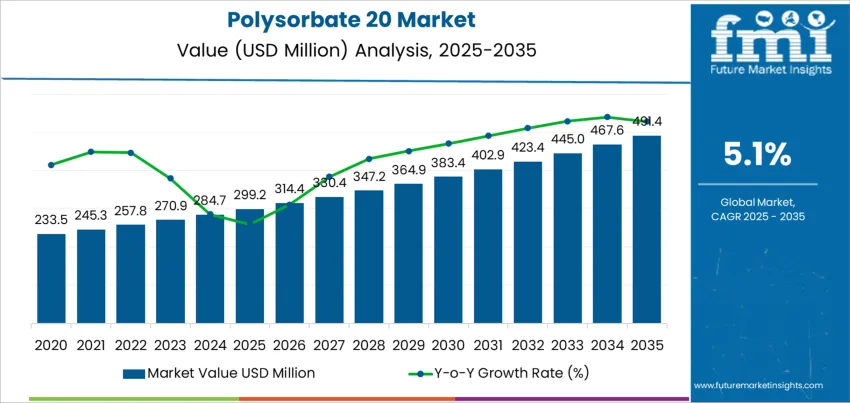
In 2025, the polysorbate 20 market is valued at USD 299.2 million and is projected to reach USD 491.4 million by 2035 at a CAGR of 5.1%. The first demand steps up runs through roughly 2025 to 2030, taking value from about USD 299.2 million to near USD 383.4 million as formulators rely on polysorbate 20 as a primary solubilizer and emulsifier. Personal care, home care, and food applications dominate this block, where fragrance solubilization, flavor dispersion, and mild cleansing drive recurring use. Procurement is contract based, anchored by predictable usage in shampoos, body washes, serums, syrups, and beverage concentrates across large manufacturing networks.
A second, higher demand steps up occurs between 2030 and 2035 as value moves from around USD 383.4 million to USD 491.4 million, representing the stronger contribution to cumulative growth. This phase reflects deeper integration into pharmaceutical and dermocosmetic systems where consistency and regulatory alignment drive grade selection. Low-foaming behavior and compatibility with actives support wider use in topical formulations, oral liquids, and medical-adjacent products. Blended surfactant systems in concentrated home care cleaners also lift dosage intensity. Suppliers focus on batch homogeneity, peroxide control, and documentation quality as buyers link long term contracts to traceability and specification stability rather than spot purchasing.
Quick Stats of the Polysorbate 20 Market
- Polysorbate 20 Market Value (2025): USD 299.2 million
- Polysorbate 20 Market Forecast Value (2035): USD 491.4 million
- Polysorbate 20 Market Forecast CAGR (2025–2035): 5.1%
- Leading Product Form in Polysorbate 20 Market: Powder (16.3%)
- Key Growth Regions in Polysorbate 20 Market: Asia Pacific, Europe
- Top Players in Polysorbate 20 Market: BASF SE, Croda International, Evonik Industries, Symrise (incl. IFF/Givaudan actives), Dow / Dow Inc., Ashland, Clariant, Seppic / Others
What is the Growth Forecast for the Polysorbate 20 Market through 2035?
The global polysorbate 20 market expands from USD 299.2 million in 2025 to USD 364.9 million by 2030, delivering an absolute increase of USD 65.7 million in the first half of the forecast period. During this phase, Growth Compression Risk remains moderate, as the market is still supported by stable demand from personal care emulsions, fragrance solubilization, pharmaceutical syrups, and beverage flavor systems. Annual value additions average a controlled USD 13 million to USD 15 million range, reflecting reliable but increasingly standardized usage. Compression risk begins to emerge from two sources: increasing price sensitivity among mass personal care manufacturers and partial substitution by alternative solubilizers in cost-optimized formulations. Despite this, demand persistence across regulated pharma and food-grade applications continues to support baseline expansion.
From 2030 to 2035, the market advances from USD 364.9 million to USD 491.4 million, adding USD 126.5 million in the second half of the decade. Growth Compression Risk rises structurally in this phase as competition intensifies among non-ionic surfactants, bio-derived emulsifiers, and multifunctional solubilizer blends that reduce dependency on single-input excipients. Annual value additions widen toward USD 18 million to USD 23 million, yet margin expansion remains constrained by commoditization pressure in cosmetic and beverage segments. Compression risk is partially offset by sustained pharmaceutical demand, injectable formulations, and high-purity food-grade applications that preserve pricing floors. Overall growth remains intact, but upside velocity becomes increasingly capped by formulation substitution and pricing discipline through 2035.
Polysorbate 20 Industry Key Takeaways
| Metric | Value |
|---|---|
| Industry Value (2025) | USD 299.2 million |
| Forecast Value (2035) | USD 491.4 million |
| Forecast CAGR (2025–2035) | 5.1% |
How Is the Polysorbate 20 Market Developing Across Food, Personal Care, and Pharmaceutical Formulations?
The polysorbate 20 market developed from the need for a mild, non ionic solubilizer that can disperse essential oils, fragrances, and lipophilic actives into water based systems. Early demand was concentrated in food emulsions, beverage flavor stabilization, and pharmaceutical syrups where uniform dispersion directly affected product consistency and shelf stability. Personal care adoption expanded as toners, facial mists, micellar waters, and light cleansing liquids required clear, stable formulations without heavy surfactant residue. Polysorbate 20 became a preferred choice for low oil load systems because it delivers transparency and gentle performance without altering skin feel. Its compatibility with sensitive skin products also strengthened long term use in baby care, facial skincare, and fragrance delivery systems.
Future growth of the polysorbate 20 market will be shaped by continued demand for clear formulations, fragrance solubilization, and gentle delivery of oil soluble actives. Expansion is expected in aromatherapy products, micellar technologies, beverage emulsions, and oral liquid pharmaceuticals where low irritation and stability matter. Barriers include rising scrutiny around ethoxylated ingredients, cost pressure from alternative natural solubilizers, and formulation shifts toward fully plant derived emulsifier systems. It also faces substitution risk in premium clean label products where ingredient sourcing perception plays a stronger role. Long term growth will depend on how well polysorbate 20 maintains regulatory acceptance, supply consistency, and performance reliability across tightly controlled food, beauty, and drug formulation environments.
How Are End Use Application and Product Form Structuring the Demand for Polysorbate 20?
The demand for polysorbate 20 is structured by end use application and product form. Skin care accounts for 11.3% of total demand, followed by body care, hair care, sun care, color cosmetics, men grooming, baby and kids care, and dermocosmetic and professional care. By product form, powder represents 16.3% of total consumption, followed by granules and agglomerates, flakes, pellets and prills, liquid solutions, high active concentrates, dispersions and suspensions, emulsions, pastes, gels, wax or solid block formats, and oils. Demand is shaped by solubilization requirements, fragrance dispersion needs, emulsification stability, and compatibility with sensitive skin product systems.
Why Does Skin Care Lead the Polysorbate 20 End Use Demand?
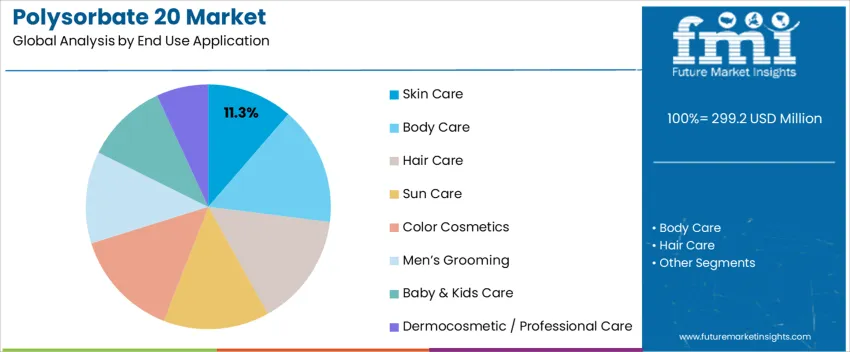
Skin care represents 11.3% of total polysorbate 20 demand due to its role as a primary solubilizer and emulsifier in low-viscosity aqueous formulations. It is widely used in facial toners, micellar waters, cleansing waters, serums, and essence-type products that require uniform dispersion of fragrance oils, essential oils, and lipophilic actives. Polysorbate 20 enables clear and stable formulations without phase separation, which is critical for transparent skin care products with high aesthetic expectations.
Skin care formulators rely on polysorbate 20 for its mildness and low irritation profile compared with stronger nonionic surfactants. It maintains stability across a wide pH range and supports the uniform distribution of preservatives, botanical extracts, and solubilized fragrances. Its favorable eye tolerance supports use in makeup removers and periocular care products. These solubilization efficiency, formulation clarity, and dermal compatibility characteristics sustain skin care as the leading end use segment.
Why Does Powder Lead the Polysorbate 20 Product Form Demand?
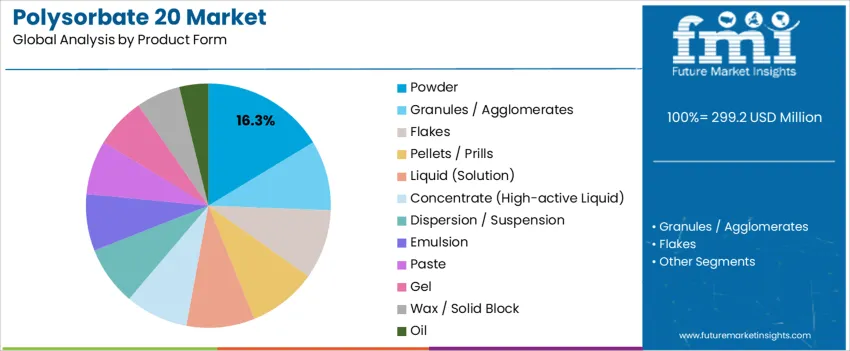
Powder accounts for 16.3% of total polysorbate 20 demand due to its superior handling control, extended shelf stability, and suitability for controlled hydration during formulation. Powdered polysorbate 20 allows manufacturers to prepare precise solubilizer concentrations for use in clear cleansers, toners, and fragrance delivery systems. Low moisture content minimizes hydrolytic degradation and limits microbial exposure during long-term storage under standard warehouse conditions.
Powder form also supports efficient bulk transport and centralized compounding operations where hydration occurs at the final processing stage. It dissolves predictably in water under controlled shear without creating turbidity or residue. Free-flowing characteristics support automated feeding systems in large-scale production. These storage stability, dosing accuracy, and logistical efficiency advantages position powder as the dominant product form within polysorbate 20 demand.
Why Has Polysorbate 20 Become A Quiet Enabler of Clear, Fragranced Water Systems?
Polysorbate 20 is selected when formulators need to pull fragrance oils and lightweight essential oils into clear water systems without creating haze or separation. Its short lauric acid tail favors solubilization over emulsification, which makes it ideal for toners, mists, micellar waters, and room sprays. Unlike heavier polysorbates, it keeps viscosity low and clarity high. This positions it as a transparency enabler rather than a texture builder. Demand grows wherever scent delivery must appear invisible in water. The ingredient rarely defines product feel, yet it determines whether a formula stays optically clean on shelf during distribution, temperature cycling, and extended storage in high-turn consumer channels.
How Does Its High-HLB Solubilizing Behavior Shape Fragrance and Flavor Stability?
Polysorbate 20 behaves as a high-HLB solubilizer, meaning its hydrophilic portion dominates how it aligns in solution. This allows it to wrap around small oil droplets and suspend them in water without building a true emulsion. The result is rapid self-dispersion during manufacturing with minimal shear input. Fragrance load tolerance, however, is narrow. Once saturation is exceeded, clouding appears suddenly rather than gradually. This sharp break point forces careful fragrance dosing and bench validation. Demand is shaped by how precisely it manages micro-oil domains rather than by any contribution to foam, slip, or skin feel in personal care, air care, and pharmaceutical syrup flavor systems.
What Structural Limits and Perception Issues Restrict Its Functional Range?
Polysorbate 20 shows weakness when heavier botanical oils, resins, or lipophilic actives enter the formula. Its lauric backbone cannot anchor large hydrophobic molecules with stability, which leads to slow phase creep or ring formation over time. It also introduces tack at higher use levels, especially in leave-on skin products. Heat stability is moderate, and prolonged exposure to elevated storage temperatures can accelerate oxidative odor shift. From a regulatory angle, some natural-leaning brands avoid it due to ethoxylation origin. These functional and perception limits keep it confined to lightweight fragrance-centric applications rather than broad emulsification roles in food flavor micro-delivery, surface coatings, or structured oil dispersions.
Where Is Demand Shifting as Product Formats Become Lighter and More Transparent?
Demand for polysorbate 20 is shifting toward fine-mist sprays, facial waters, and low-residue deodorizing systems where fragrance visibility in water remains the primary technical challenge. Room sprays, fabric refreshers, and skin mists depend on it for uniform scent delivery without nozzle clogging. Pharmaceutical syrups and oral care rinses also use it to keep volatile flavor oils evenly dispersed. As product formats move toward lighter textures, lower oil loads, and transparent packaging, reliance on precise solubilization increases. Growth is therefore tied to optical clarity, spray reliability, and dose uniformity rather than to cleansing, conditioning, or traditional emulsification demand in fragrance-forward, fast-turn consumer and clinical liquid systems.
What Is the Global Growth Outlook for the Polysorbate 20 Industry by Country?
| Country | CAGR (%) |
|---|---|
| India | 6.9 |
| China | 6.4 |
| Japan | 5.9 |
| UK | 5.3 |
| Germany | 4.8 |
| USA | 4.3 |
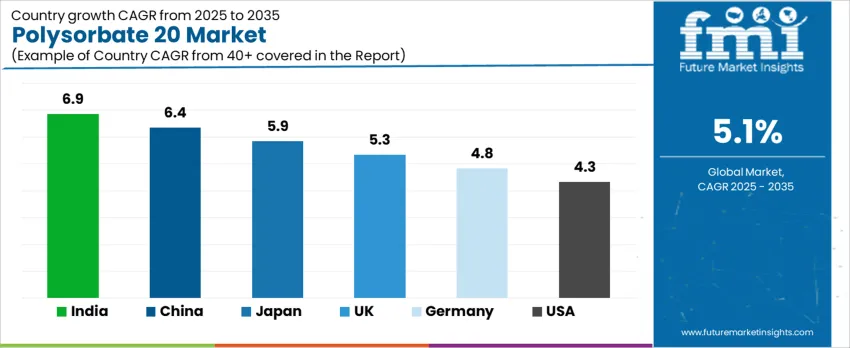
The polysorbate 20 industry is showing steady global expansion across pharmaceutical, personal care, and food formulation markets, with India at a 6.9% CAGR. Growth in India is supported by rising production of liquid skincare, oral care, and pharmaceutical syrups that rely on non-ionic solubilizers and emulsifiers. China follows at 6.4%, driven by large-scale cosmetics manufacturing, expanding pharmaceutical excipient demand, and export-oriented formulation activity. Japan at 5.9% reflects stable usage in topical medicines, premium cosmetics, and functional food formulations. The UK and Germany record 5.3% and 4.8% growth, supported by consistent demand from healthcare, beauty, and specialty food producers. The USA at 4.3% reflects a mature but steadily advancing market driven by pharmaceutical standards compliance and replacement demand in personal care formulations.
What Is Supporting Polysorbate 20 Demand Growth in India Food and Personal Care Formulations?
Expansion in India is progressing at a CAGR of 6.9% through 2035 for polysorbate 20 demand, driven by rising production of flavored beverages, pharmaceutical syrups, and cosmetic emulsions. Food processors use this ingredient as a solubilizer in flavor systems and beverage concentrates. Cosmetic brands apply it in toners, sprays, and fragrance based skincare products. Domestic manufacturing supplies part of industrial volumes, while higher purity cosmetic and pharmaceutical grades rely on imports. Demand remains formulation driven and compliance aligned, shaped by steady packaged food growth, expanding liquid drug production, and rising use of fragrance solubilizers across mass personal care products.
- Beverage flavor emulsions support food grade consumption
- Cosmetic sprays and toners drive personal care demand
- Pharmaceutical syrups sustain regulated usage
- Imports dominate high purity cosmetic and pharma grades
How Is China Scaling Industrial Polysorbate 20 Utilization Across Multiple Sectors?
Growth in China reflects a CAGR of 6.4% through 2035 for polysorbate 20 utilization, supported by large scale food additive manufacturing, pharmaceutical liquid formulation, and export oriented cosmetics production. The ingredient appears in beverage concentrates, injectable drug solubilizers, perfumed body sprays, and oral care liquids. Domestic chemical plants operate at high capacity for stable bulk supply. Export focused manufacturers ship finished products across Asian and global markets. Demand remains production driven and volume oriented, aligned with mass beverage processing output, steady pharmaceutical liquid growth, and continuous scale up of personal care manufacturing.
- Beverage concentrates anchor bulk food additive demand
- Injectable drug formulations support pharma grade usage
- Domestic production stabilizes high volume availability
- Export finished goods strengthen continuous offtake
Why Does Japan Maintain Stable Demand for High Purity Polysorbate 20?
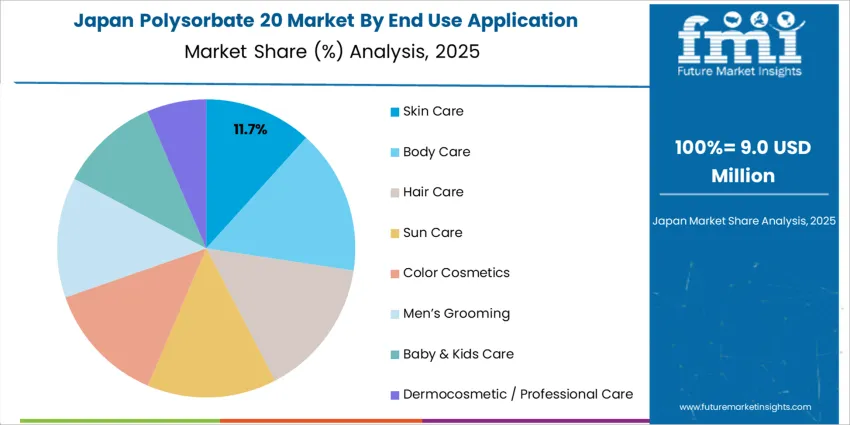
Demand in Japan is increasing at a CAGR of 5.9% through 2035 for polysorbate 20 usage, supported by regulated pharmaceutical formulations, premium skincare products, and controlled flavor solubilization systems. Polysorbate 20 is used in ophthalmic solutions, nasal sprays, fragrance free lotions, and beverage essence concentrates. Domestic users prioritize tight impurity control and batch consistency. Pharmacy distributed formulations account for steady regulated consumption. Demand stays quality driven and safety focused, supported by aging population healthcare needs and strict pharmaceutical and cosmetic formulation standards.
- Ophthalmic and nasal sprays anchor medical usage
- Fragrance free lotions support cosmetic consumption
- Domestic quality control stabilizes batch consistency
- Pharmacy distribution ensures steady regulated turnover
What Is Supporting Polysorbate 20 Market Expansion in the United Kingdom?
Growth in the UK is advancing at a CAGR of 5.3% through 2035 for polysorbate 20 demand, supported by flavored beverage production, dermatology aligned cosmetics, and pharmaceutical liquid dosage growth. The ingredient appears in soft drink concentrates, facial toners, therapeutic sprays, and oral solutions. Independent beverage processors and contract formulators sustain steady ingredient offtake. Imports dominate pharmaceutical and cosmetic grade sourcing due to limited domestic refinement capacity. Demand remains retail driven and formulation focused, shaped by steady beverage innovation and controlled expansion of regulated liquid drug products.
- Beverage concentrates support stable food grade demand
- Facial toners drive cosmetic solubilizer usage
- Contract drug formulation sustains pharma volumes
- Imported sourcing dominates high purity supply
How Is Germany Applying Polysorbate 20 in Regulated Medical and Cosmetic Products?
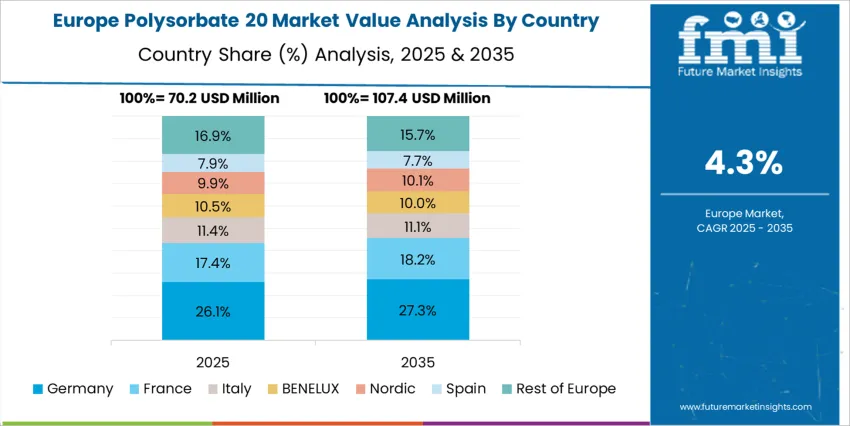
Growth in Germany reflects a CAGR of 4.8% through 2035 for polysorbate 20 consumption, driven by pharmacy grade medicines, certified cosmetic products, and functional food formulations. Polysorbate 20 is used in injectable drug solubilizers, fragrance free skincare, and specialty beverage emulsions. Strict ingredient testing, documentation, and excipient compliance govern formulation and supplier approval. Imports remain the primary supply route for pharmaceutical grade material. Demand stays quality focused and regulation aligned, supported by preventive healthcare practices and controlled cosmetic usage across pharmacy and medical retail networks.
- Injectable excipients anchor regulated pharmaceutical demand
- Certified cosmetics support sensitive skin applications
- Compliance standards shape ingredient qualification
- Pharmacy retail stabilizes long term consumption
What Is Driving Measured Polysorbate 20 Growth in the United States?
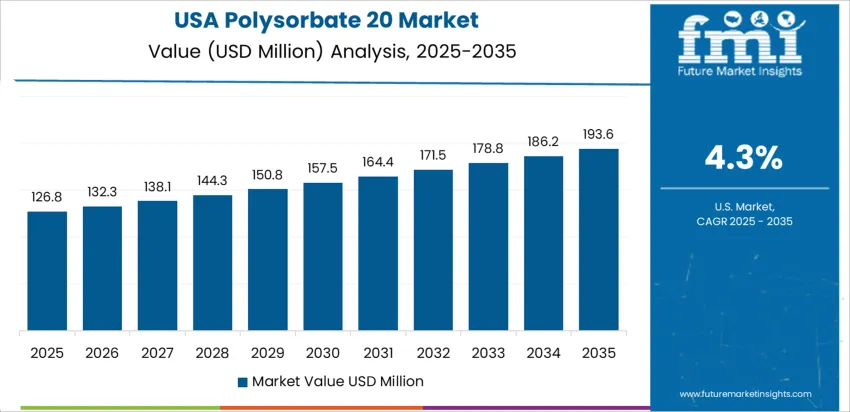
Expansion in the United States is moving at a CAGR of 4.3% through 2035 for polysorbate 20 demand, supported by flavored beverage manufacturing, injectable pharmaceutical formulations, and mass cosmetics production. The ingredient appears in drink concentrates, vaccine stabilizers, body sprays, and fragrance based skincare products. Large beverage companies and pharmaceutical producers both contribute to volume demand. Imports supply most pharmaceutical grade material. Demand remains application driven and formulation diverse, shaped by steady beverage sales, consistent injectable drug production, and stable use of fragrance solubilizers across mass personal care products.
- Beverage flavor systems sustain food grade usage
- Injectable formulations support pharmaceutical consumption
- Body sprays and fragrances drive cosmetic demand
- Import dependence dominates pharma grade sourcing
What Is Driving Global Demand for Polysorbate 20 and Who Are the Key Suppliers Meeting That Demand?
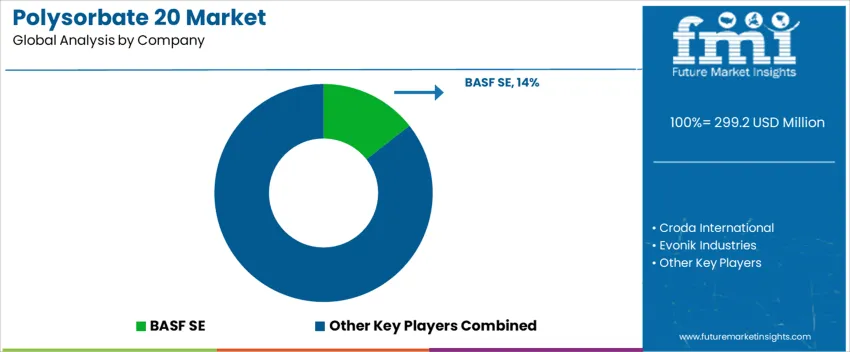
Global demand for Polysorbate 20 is rising as personal care, food, pharmaceutical, and industrial formulators seek a versatile, efficient emulsifier that enables stable oil in water mixtures. Its capacity to disperse oils, fragrances, and lipophilic actives in creams, lotions, beverages, syrups and cleaning products supports broad adoption. The push for lighter textures, better ingredient mixing, and gentle formulations in skincare and haircare boosts its use. Growth of ready to drink beverages, nutritional syrups and liquid detergents further drives demand. Regulatory shifts toward milder surfactants and growing consumer preference for predictable, stable formulations reinforce Polysorbate 20’s role in both established and emerging markets.
Major suppliers shaping the Polysorbate 20 market include BASF SE, Croda International, Evonik Industries, Symrise (including its IFF/Givaudan actives division), Dow Inc., Ashland, Clariant, Seppic and various regional or specialized chemical producers. Large integrated firms supply bulk volumes with quality control and global logistics that satisfy major personal care, food and pharmaceutical customers. Smaller or niche producers offer specialized grades and customization for natural, sensitive skin or specialty product lines. This multi tier supplier structure provides both high volume capacity and flexibility, enabling formulators worldwide to access Polysorbate 20 for a wide range of applications.
Key Players in the Polysorbate 20 Market
- BASF SE
- Croda International
- Evonik Industries
- Symrise (incl. IFF/Givaudan actives)
- Dow / Dow Inc.
- Ashland
- Clariant
- Seppic
- Others
Scope of the report
| Items | Values |
|---|---|
| Quantitative Units (2025) | USD million |
| End-Use Applications | Skin Care, Body Care, Hair Care, Sun Care, Color Cosmetics, Men’s Grooming, Baby & Kids Care, Dermocosmetic / Professional Care |
| Product Forms | Powder, Granules/Agglomerates, Flakes, Pellets/Prills, Liquid (Solution), Concentrate (High-active Liquid), Dispersion/Suspension, Emulsion, Paste, Gel, Wax / Solid Block, Oil |
| Regions Covered | Asia Pacific, Europe, North America, Latin America, Middle East & Africa |
| Countries Covered | China, Japan, South Korea, India, Australia & New Zealand, ASEAN, Germany, United Kingdom, France, Italy, Spain, Nordic, BENELUX, USA, Canada, Mexico, Brazil, Chile, Saudi Arabia, Turkey, South Africa, plus 40+ additional countries globally |
| Key Companies Profiled | BASF SE, Croda International, Evonik Industries, Symrise (incl. IFF/Givaudan actives), Dow Inc., Ashland, Clariant, Seppic, Lubrizol, Lonza, Inolex |
| Additional Attributes | Dollar by sales breakdown by region, country, end-use, and product form; global growth projections; multi-sector adoption (cosmetic, nutraceutical, functional food); extract bioactivity profiling; iodine and polyphenol standardization; contract harvesting; vertical integration; supply chain stability; regulatory compliance; sensory and bioavailability performance |
Polysorbate 20 Market Segmentation
End Use Application:
- Skin Care
- Body Care
- Hair Care
- Sun Care
- Color Cosmetics
- Men’s Grooming
- Baby & Kids Care
- Dermocosmetic / Professional Care
Product Form:
- Powder
- Granules / Agglomerates
- Flakes
- Pellets / Prills
- Liquid (Solution)
- Concentrate (High-active Liquid)
- Dispersion / Suspension
- Emulsion
- Paste
- Gel
- Wax / Solid Block
- Oil
Region
- Asia Pacific
- China
- Japan
- South Korea
- India
- Australia & New Zealand
- ASEAN
- Rest of Asia Pacific
- Europe
- Germany
- United Kingdom
- France
- Italy
- Spain
- Nordic
- BENELUX
- Rest of Europe
- North America
- United States
- Canada
- Mexico
- Latin America
- Brazil
- Chile
- Rest of Latin America
- Middle East & Africa
- Kingdom of Saudi Arabia
- Other GCC Countries
- Turkey
- South Africa
- Other African Union
- Rest of Middle East & Africa
Frequently Asked Questions
How big is the polysorbate 20 market in 2025?
The global polysorbate 20 market is estimated to be valued at USD 299.2 million in 2025.
What will be the size of polysorbate 20 market in 2035?
The market size for the polysorbate 20 market is projected to reach USD 491.4 million by 2035.
How much will be the polysorbate 20 market growth between 2025 and 2035?
The polysorbate 20 market is expected to grow at a 5.1% CAGR between 2025 and 2035.
What are the key product types in the polysorbate 20 market?
The key product types in polysorbate 20 market are skin care, body care, hair care, sun care, color cosmetics, men’s grooming, baby & kids care and dermocosmetic / professional care.
Which product form segment to contribute significant share in the polysorbate 20 market in 2025?
In terms of product form , powder segment to command 16.3% share in the polysorbate 20 market in 2025.
Preview the report firsthand - request a free sample
Get SampleGet the brochure for pricing and purchase details.
Get PDFTable of Content
- Executive Summary
- Global Market Outlook
- Demand-side Trends
- Supply-side Trends
- Technology Roadmap Analysis
- Analysis and Recommendations
- Market Overview
- Market Coverage / Taxonomy
- Market Definition / Scope / Limitations
- Market Background
- Market Dynamics
- Drivers
- Restraints
- Opportunity
- Trends
- Scenario Forecast
- Demand in Optimistic Scenario
- Demand in Likely Scenario
- Demand in Conservative Scenario
- Opportunity Map Analysis
- Product Life Cycle Analysis
- Supply Chain Analysis
- Investment Feasibility Matrix
- Value Chain Analysis
- PESTLE and Porter’s Analysis
- Regulatory Landscape
- Regional Parent Market Outlook
- Production and Consumption Statistics
- Import and Export Statistics
- Market Dynamics
- Global Market Analysis 2020 to 2024 and Forecast, 2025 to 2035
- Historical Market Size Value (USD Million) Analysis, 2020 to 2024
- Current and Future Market Size Value (USD Million) Projections, 2025 to 2035
- Y-o-Y Growth Trend Analysis
- Absolute $ Opportunity Analysis
- Global Market Pricing Analysis 2020 to 2024 and Forecast 2025 to 2035
- Global Market Analysis 2020 to 2024 and Forecast 2025 to 2035, By End Use Application
- Introduction / Key Findings
- Historical Market Size Value (USD Million) Analysis By End Use Application , 2020 to 2024
- Current and Future Market Size Value (USD Million) Analysis and Forecast By End Use Application , 2025 to 2035
- Skin Care
- Body Care
- Hair Care
- Sun Care
- Color Cosmetics
- Men’s Grooming
- Baby & Kids Care
- Dermocosmetic / Professional Care
- Y-o-Y Growth Trend Analysis By End Use Application , 2020 to 2024
- Absolute $ Opportunity Analysis By End Use Application , 2025 to 2035
- Global Market Analysis 2020 to 2024 and Forecast 2025 to 2035, By Product Form
- Introduction / Key Findings
- Historical Market Size Value (USD Million) Analysis By Product Form, 2020 to 2024
- Current and Future Market Size Value (USD Million) Analysis and Forecast By Product Form, 2025 to 2035
- Powder
- Granules / Agglomerates
- Flakes
- Pellets / Prills
- Liquid (Solution)
- Concentrate (High-active Liquid)
- Dispersion / Suspension
- Emulsion
- Paste
- Gel
- Wax / Solid Block
- Y-o-Y Growth Trend Analysis By Product Form, 2020 to 2024
- Absolute $ Opportunity Analysis By Product Form, 2025 to 2035
- Global Market Analysis 2020 to 2024 and Forecast 2025 to 2035, By Region
- Introduction
- Historical Market Size Value (USD Million) Analysis By Region, 2020 to 2024
- Current Market Size Value (USD Million) Analysis and Forecast By Region, 2025 to 2035
- North America
- Latin America
- Western Europe
- Eastern Europe
- East Asia
- South Asia and Pacific
- Middle East & Africa
- Market Attractiveness Analysis By Region
- North America Market Analysis 2020 to 2024 and Forecast 2025 to 2035, By Country
- Historical Market Size Value (USD Million) Trend Analysis By Market Taxonomy, 2020 to 2024
- Market Size Value (USD Million) Forecast By Market Taxonomy, 2025 to 2035
- By Country
- USA
- Canada
- Mexico
- By End Use Application
- By Product Form
- By Country
- Market Attractiveness Analysis
- By Country
- By End Use Application
- By Product Form
- Key Takeaways
- Latin America Market Analysis 2020 to 2024 and Forecast 2025 to 2035, By Country
- Historical Market Size Value (USD Million) Trend Analysis By Market Taxonomy, 2020 to 2024
- Market Size Value (USD Million) Forecast By Market Taxonomy, 2025 to 2035
- By Country
- Brazil
- Chile
- Rest of Latin America
- By End Use Application
- By Product Form
- By Country
- Market Attractiveness Analysis
- By Country
- By End Use Application
- By Product Form
- Key Takeaways
- Western Europe Market Analysis 2020 to 2024 and Forecast 2025 to 2035, By Country
- Historical Market Size Value (USD Million) Trend Analysis By Market Taxonomy, 2020 to 2024
- Market Size Value (USD Million) Forecast By Market Taxonomy, 2025 to 2035
- By Country
- Germany
- UK
- Italy
- Spain
- France
- Nordic
- BENELUX
- Rest of Western Europe
- By End Use Application
- By Product Form
- By Country
- Market Attractiveness Analysis
- By Country
- By End Use Application
- By Product Form
- Key Takeaways
- Eastern Europe Market Analysis 2020 to 2024 and Forecast 2025 to 2035, By Country
- Historical Market Size Value (USD Million) Trend Analysis By Market Taxonomy, 2020 to 2024
- Market Size Value (USD Million) Forecast By Market Taxonomy, 2025 to 2035
- By Country
- Russia
- Poland
- Hungary
- Balkan & Baltic
- Rest of Eastern Europe
- By End Use Application
- By Product Form
- By Country
- Market Attractiveness Analysis
- By Country
- By End Use Application
- By Product Form
- Key Takeaways
- East Asia Market Analysis 2020 to 2024 and Forecast 2025 to 2035, By Country
- Historical Market Size Value (USD Million) Trend Analysis By Market Taxonomy, 2020 to 2024
- Market Size Value (USD Million) Forecast By Market Taxonomy, 2025 to 2035
- By Country
- China
- Japan
- South Korea
- By End Use Application
- By Product Form
- By Country
- Market Attractiveness Analysis
- By Country
- By End Use Application
- By Product Form
- Key Takeaways
- South Asia and Pacific Market Analysis 2020 to 2024 and Forecast 2025 to 2035, By Country
- Historical Market Size Value (USD Million) Trend Analysis By Market Taxonomy, 2020 to 2024
- Market Size Value (USD Million) Forecast By Market Taxonomy, 2025 to 2035
- By Country
- India
- ASEAN
- Australia & New Zealand
- Rest of South Asia and Pacific
- By End Use Application
- By Product Form
- By Country
- Market Attractiveness Analysis
- By Country
- By End Use Application
- By Product Form
- Key Takeaways
- Middle East & Africa Market Analysis 2020 to 2024 and Forecast 2025 to 2035, By Country
- Historical Market Size Value (USD Million) Trend Analysis By Market Taxonomy, 2020 to 2024
- Market Size Value (USD Million) Forecast By Market Taxonomy, 2025 to 2035
- By Country
- Kingdom of Saudi Arabia
- Other GCC Countries
- Turkiye
- South Africa
- Other African Union
- Rest of Middle East & Africa
- By End Use Application
- By Product Form
- By Country
- Market Attractiveness Analysis
- By Country
- By End Use Application
- By Product Form
- Key Takeaways
- Key Countries Market Analysis
- USA
- Pricing Analysis
- Market Share Analysis, 2024
- By End Use Application
- By Product Form
- Canada
- Pricing Analysis
- Market Share Analysis, 2024
- By End Use Application
- By Product Form
- Mexico
- Pricing Analysis
- Market Share Analysis, 2024
- By End Use Application
- By Product Form
- Brazil
- Pricing Analysis
- Market Share Analysis, 2024
- By End Use Application
- By Product Form
- Chile
- Pricing Analysis
- Market Share Analysis, 2024
- By End Use Application
- By Product Form
- Germany
- Pricing Analysis
- Market Share Analysis, 2024
- By End Use Application
- By Product Form
- UK
- Pricing Analysis
- Market Share Analysis, 2024
- By End Use Application
- By Product Form
- Italy
- Pricing Analysis
- Market Share Analysis, 2024
- By End Use Application
- By Product Form
- Spain
- Pricing Analysis
- Market Share Analysis, 2024
- By End Use Application
- By Product Form
- France
- Pricing Analysis
- Market Share Analysis, 2024
- By End Use Application
- By Product Form
- India
- Pricing Analysis
- Market Share Analysis, 2024
- By End Use Application
- By Product Form
- ASEAN
- Pricing Analysis
- Market Share Analysis, 2024
- By End Use Application
- By Product Form
- Australia & New Zealand
- Pricing Analysis
- Market Share Analysis, 2024
- By End Use Application
- By Product Form
- China
- Pricing Analysis
- Market Share Analysis, 2024
- By End Use Application
- By Product Form
- Japan
- Pricing Analysis
- Market Share Analysis, 2024
- By End Use Application
- By Product Form
- South Korea
- Pricing Analysis
- Market Share Analysis, 2024
- By End Use Application
- By Product Form
- Russia
- Pricing Analysis
- Market Share Analysis, 2024
- By End Use Application
- By Product Form
- Poland
- Pricing Analysis
- Market Share Analysis, 2024
- By End Use Application
- By Product Form
- Hungary
- Pricing Analysis
- Market Share Analysis, 2024
- By End Use Application
- By Product Form
- Kingdom of Saudi Arabia
- Pricing Analysis
- Market Share Analysis, 2024
- By End Use Application
- By Product Form
- Turkiye
- Pricing Analysis
- Market Share Analysis, 2024
- By End Use Application
- By Product Form
- South Africa
- Pricing Analysis
- Market Share Analysis, 2024
- By End Use Application
- By Product Form
- USA
- Market Structure Analysis
- Competition Dashboard
- Competition Benchmarking
- Market Share Analysis of Top Players
- By Regional
- By End Use Application
- By Product Form
- Competition Analysis
- Competition Deep Dive
- BASF SE
- Overview
- Product Portfolio
- Profitability by Market Segments (Product/Age /Sales Channel/Region)
- Sales Footprint
- Strategy Overview
- Marketing Strategy
- Product Strategy
- Channel Strategy
- Croda International
- Evonik Industries
- Symrise (incl. IFF/Givaudan actives)
- Dow / Dow Inc.
- Ashland
- Clariant
- Seppic
- Others
- BASF SE
- Competition Deep Dive
- Assumptions & Acronyms Used
- Research Methodology


