

- Industry Size (2025)
- USD 21.7 Mn
- Forecast (2035)
- USD 35.2 Mn
- CAGR (2025 to 2035)
- 5.0%
Demand for Polysorbate-80 in Japan Forecast and Outlook 2025 to 2035
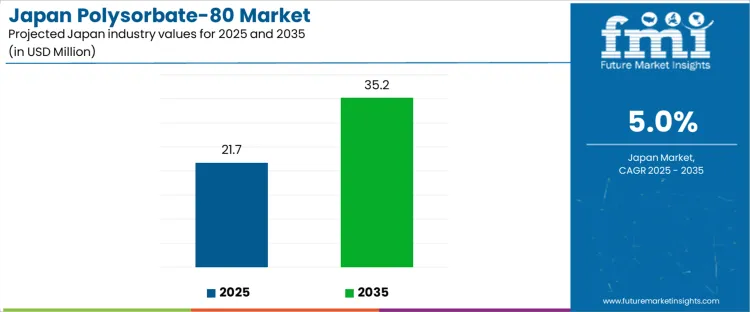
The demand for Polysorbate-80 in Japan is projected to grow from USD 21.7 million in 2025 to USD 35.2 million by 2035, reflecting a compound annual growth rate (CAGR) of 5%. Polysorbate-80, an emulsifier used in pharmaceuticals, cosmetics, and food products, is increasingly in demand due to its ability to stabilize formulations and improve product texture. As the food and beverage, pharmaceutical, and cosmetic industries in Japan continue to grow and innovate, the demand for such ingredients is expected to rise steadily. As consumer preference shifts towards more complex and functional formulations, Polysorbate-80’s role in enhancing product performance will contribute to continued growth.
Growth is also supported by the growing focus on clean-label products in the food and cosmetics sectors, where Polysorbate-80 is a crucial ingredient for maintaining stability and consistency. As Japan’s regulations surrounding product safety and quality remain stringent, the continued demand for reliable emulsifiers such as Polysorbate-80 is expected to rise. With the ongoing development of new applications and formulations, the demand for Polysorbate-80 in Japan will continue to expand over the next decade.
Quick Stats of the Demand for Polysorbate-80 in Japan
- Demand for Polysorbate-80 in Japan Value (2025): USD 21.7 million
- Demand for Polysorbate-80 in Japan Forecast Value (2035): USD 35.2 million
- Demand for Polysorbate-80 in Japan Forecast CAGR (2025-2035): 5.0%
- Demand for Polysorbate-80 in Japan Leading Source: Plant Based (70%)
- Demand for Polysorbate-80 in Japan Key Growth Regions: Kyushu & Okinawa, Kanto, Kansai, Chubu, Tohoku, Rest of Japan
- Demand for Polysorbate-80 in Japan Key Players: Lonza Group Limited, Avril Group, BASF Corporation, Solenis, Reachin Chemical Co., Ltd.
What is the Growth Forecast for the Polysorbate-80 Market through 2035?
The peak-to-trough analysis of the Polysorbate-80 market in Japan shows a steady and consistent increase in demand, with some periods of acceleration as the market progresses. Starting at USD 21.7 million in 2025, the market grows gradually to USD 22.8 million in 2026 and USD 23.9 million in 2027. These early years represent a period of gradual growth as Polysorbate-80 continues to be adopted across multiple industries, including food, pharmaceuticals, and cosmetics.
From 2027 to 2030, the polysorbate-80 market continues to grow steadily, reaching USD 25.1 million in 2028, USD 26.3 million in 2029, and USD 27.6 million in 2030. This reflects an upward trajectory as demand for functional ingredients in product formulations increases. By 2035, the polysorbate-80 market is projected to reach USD 35.2 million, with peak-to-trough analysis indicating that demand for Polysorbate-80 will grow steadily, with some acceleration in the latter years, driven by ongoing product innovation and expanding use cases across various industries.
Key Takeaways of Polysorbate-80 Industry in Japan
| Metric | Value |
|---|---|
| Industry Sales Value (2025) | USD 21.7 million |
| Industry Forecast Value (2035) | USD 35.2 million |
| Industry Forecast CAGR (2025-2035) | 5% |
What Is Driving the Demand for Polysorbate-80 in Japan?
Demand for Polysorbate 80 in Japan is driven by its widespread use as an emulsifier, stabilizer, and surfactant in food, beverage, pharmaceutical, and personal care products. In the food and beverage industry, Polysorbate 80 is commonly used to mix oil and water, stabilize emulsions, and maintain texture and consistency in products such as ice cream, sauces, dressings, baked goods, and beverages. As processed and convenience food consumption continues to be a major part of Japanese diets, the demand for reliable emulsifiers like Polysorbate 80 remains strong. In pharmaceuticals and cosmetics, Polysorbate 80 is used as an excipient in drug formulations and as an emulsifier or stabilizer in personal care products such as creams and lotions. Regulatory approvals for food-grade Polysorbate 80 in Japan further support its widespread use in food and beverage processing.
Future demand for Polysorbate 80 in Japan is expected to increase as the consumption of processed foods, ready-to-eat meals, and beverages continues to rise. With the growth of the food emulsifier market, the use of Polysorbate 80 is likely to expand across various food categories, including bakery products, dairy, confectionery, sauces, and frozen foods. The continued development of new product formats, including functional and fortified foods, may further increase demand for emulsifiers that can provide texture, stability, and consistent quality. As the pharmaceutical and personal care markets evolve, the need for reliable emulsifiers in drug formulations and cosmetic products will support further growth. However, factors such as consumer preference for natural ingredients, regulatory scrutiny, and competition from alternative emulsifiers could influence the market dynamics and shape the future demand for Polysorbate 80.
What Are the Key Segments in Polysorbate-80 Market in Japan?
The polysorbate-80 market in Japan is segmented by source and functionality. Plant-based polysorbate-80 leads the source segment, holding 70% of the market share. In terms of functionality, emulsifiers dominate, representing 30% of the market. The growing demand for natural and versatile ingredients in food, pharmaceuticals, and cosmetics is driving the adoption of plant-based polysorbate-80 in Japan.
Which Source Drives Polysorbate-80 Demand in Japan?
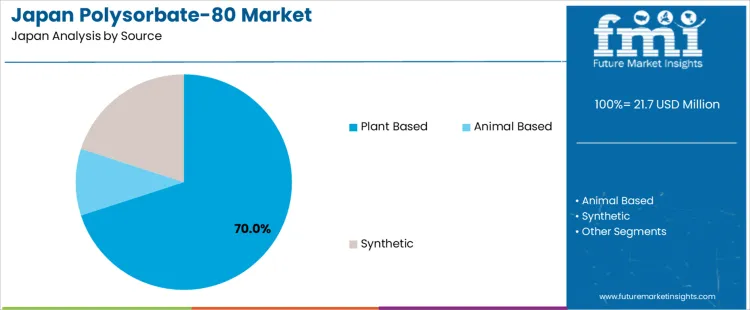
Plant-based polysorbate-80 is the leading source in the Japanese market, accounting for 70% of the market share. Plant-based polysorbate-80 is preferred due to its natural origin, which aligns with the increasing demand for clean-label and sustainably sourced ingredients. It is commonly used in a wide range of applications, particularly in the food and beverage industry, cosmetics, and pharmaceuticals, where consumers and manufacturers are increasingly prioritizing natural ingredients. The versatility of plant-based polysorbate-80 as an emulsifier, stabilizer, and solubilizer further boosts its demand. Although animal-based and synthetic sources are also available, plant-based polysorbate-80 is the most popular due to its alignment with current consumer preferences for eco-friendly and health-conscious products.
Which Functionality Drives Polysorbate-80 Demand in Japan?
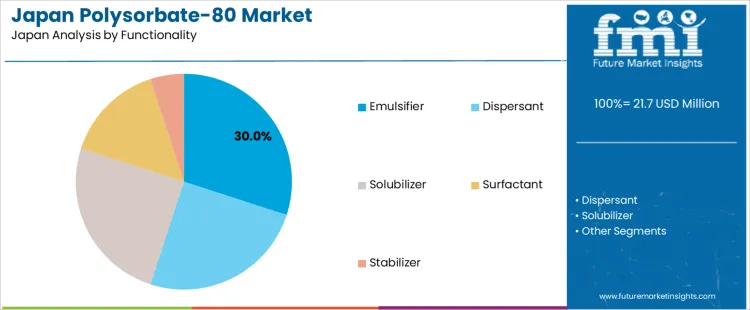
Emulsifier is the most important functionality for polysorbate-80 in Japan, representing 30% of the market share. As an emulsifier, polysorbate-80 is essential for creating stable mixtures of oil and water, which is crucial in the production of a wide range of products, including beverages, dairy, baked goods, and cosmetics. Its ability to improve texture and consistency makes it a valuable ingredient in both food and non-food products. The demand for polysorbate-80 as an emulsifier is driven by its effectiveness in improving the stability and shelf-life of emulsions, as well as its ability to enhance the sensory qualities of products. Other functionalities, such as dispersant, solubilizer, surfactant, and stabilizer, also contribute to the market, but emulsification remains the dominant application for polysorbate-80 in Japan.
What is the Key Dynamics for Polysorbate 80 Demand in Japan?
Demand for Polysorbate 80 in Japan is shaped by its widespread use as emulsifier, stabilizer, and solubilizer across food, beverage, pharmaceutical, and personal care sectors. As processed foods, ready to eat items, nutritional products, and cosmetic and pharmaceutical formulations expand, Polysorbate 80 is increasingly required to ensure product stability, texture, and shelf life. Its dual use nature across multiple industries gives it a strong base demand, making it a core ingredient in many supply chains in Japan.
What are the Key Drivers for Polysorbate 80 Demand in Japan?
Growing consumption of processed foods, beverages, nutritional supplements and functional foods supports rising demand for emulsifiers like Polysorbate 80. The pharmaceutical sector’s expansion-including demand for oral, injectable, and topical formulations-also boosts its use because Polysorbate 80 helps solubilize and stabilize active ingredients. The personal care and cosmetics industry further contributes as emulsifiers and surfactants remain essential for creams, lotions and hygiene products. Rising interest in convenience, consistent quality, longer shelf life and stable formulations encourages manufacturers to rely on Polysorbate 80.
What are the Restraints for Polysorbate 80 Demand in Japan?
Concerns about additive use and growing consumer awareness about ingredient safety can restrain demand, especially among segments favoring minimal ingredient or “clean label” products. Price fluctuations of raw materials or global supply chain disruptions may raise costs for manufacturers, affecting margins and potentially reducing usage volume. Competition from alternative emulsifiers, natural gums or other stabilizing agents may limit the growth of Polysorbate 80 in certain applications. Regulatory scrutiny or changing standards-especially in food or pharmaceutical sectors-could also impose constraints on its adoption.
What are the Key Trends in Polysorbate 80 Demand in Japan?
A trend toward multifunctional ingredients is visible, with Polysorbate 80 being used across food, beverages, pharma and personal care, reflecting cross industry convergence. Use in high value sectors such as biologics and advanced drug formulations is rising, given its role in stabilizing proteins and improving solubility. In food and beverage applications-especially baked goods, sauces, dairy, beverages-demand is driven by desire for smooth texture, product consistency and longer shelf life. Growing demand for processed, convenience, and ready to eat foods-along with expansion in supplements and nutraceuticals-is widening the application scope of Polysorbate 80.
What is the Regional Demand Outlook for Polysorbate-80 in Japan?
The demand for polysorbate-80 in Japan is projected to grow steadily, with Kyushu & Okinawa leading the way at a projected CAGR of 6.2%. Kanto follows with a growth rate of 5.7%, while Kansai is expected to grow at 5.0%. Chubu is projected to grow at a rate of 4.4%, while Tohoku and Rest of Japan show more moderate growth, with CAGRs of 3.9% and 3.7%, respectively. The increasing use of polysorbate-80 in the food, pharmaceutical, and cosmetic industries, as well as the growing demand for emulsifiers and surfactants, is driving the adoption of this ingredient across Japan.
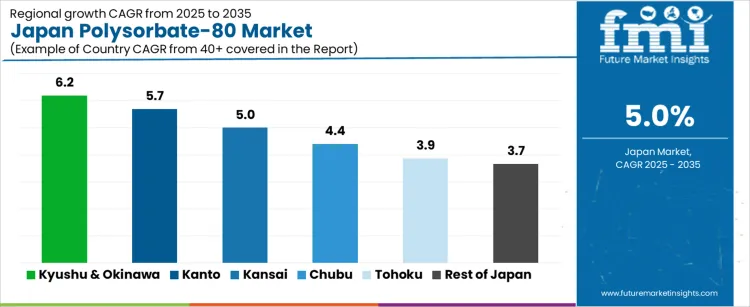
| Region | CAGR (2025-2035) |
|---|---|
| Kyushu & Okinawa | 6.2% |
| Kanto | 5.7% |
| Kansai | 5.0% |
| Chubu | 4.4% |
| Tohoku | 3.9% |
| Rest of Japan | 3.7% |
What is Driving the Growth of Polysorbate-80 in Kyushu & Okinawa?
Kyushu & Okinawa is projected to experience the highest growth in the polysorbate-80 market, with a projected CAGR of 6.2%. The region’s strong demand for food-grade emulsifiers, particularly in processed foods and beverages, is a key driver of this growth. Polysorbate-80 is used to enhance the texture and stability of many products, and as the region's food and pharmaceutical sectors grow, the demand for this ingredient increases. Kyushu & Okinawa’s growing focus on the cosmetic industry, particularly in skincare and personal care products, is further fueling the demand for polysorbate-80. As consumers in the region seek higher-quality and more stable formulations in food and personal care products, the market for polysorbate-80 is expected to continue expanding.
Why is the Polysorbate-80 Market Expanding in Kanto?
In Kanto, the demand for polysorbate-80 is projected to grow at a CAGR of 5.7%. Kanto, including Tokyo, is Japan's most populous and economically developed region, and its large manufacturing and consumer base are contributing to the growing demand for this emulsifier. Polysorbate-80 is widely used in food products, pharmaceuticals, and cosmetics for its ability to improve solubility, texture, and stability. In Kanto, the increasing demand for functional and processed foods, as well as high-performance cosmetic products, is driving the growth of polysorbate-80. The region’s strong focus on innovation and quality in the food, pharmaceutical, and personal care sectors is further supporting the adoption of polysorbate-80. As consumer preferences continue to shift toward more sophisticated and versatile products, the market for polysorbate-80 in Kanto is expected to expand steadily.
How is the Polysorbate-80 Market Growing in Kansai?
In Kansai, the polysorbate-80 market is projected to grow at a CAGR of 5.0%. Kansai, including Osaka and Kyoto, has a well-established food and beverage industry, and the demand for polysorbate-80 in this region is driven by the need for high-quality emulsifiers that can improve the texture and stability of food products. The cosmetic industry in Kansai, known for its emphasis on skincare and beauty products, is also a significant driver of the market. As the region’s population becomes more health-conscious and aware of the benefits of high-quality ingredients in food and cosmetics, the demand for polysorbate-80 is expected to rise. Furthermore, Kansai’s focus on food safety and quality, combined with the growing preference for processed and functional foods, will continue to drive the demand for polysorbate-80 in the region.
What is Contributing to the Growth of Polysorbate-80 in Chubu?
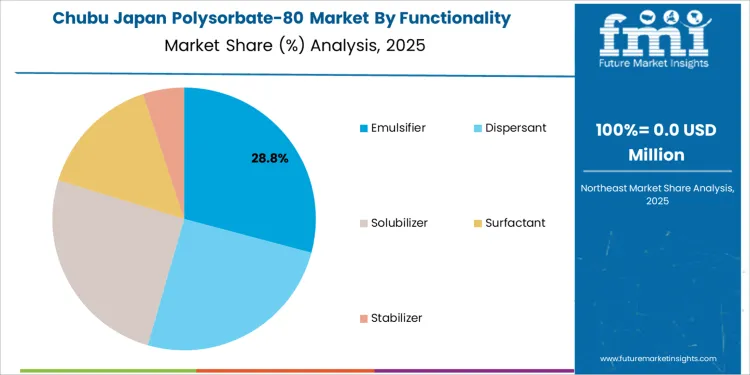
In Chubu, the polysorbate-80 market is expected to grow at a CAGR of 4.4%. Chubu, home to Nagoya, is a major industrial region with a growing demand for food-grade emulsifiers and stabilizers in various sectors, including food processing and pharmaceuticals. The use of polysorbate-80 to enhance the consistency and performance of products in these industries is driving polysorbate-80 market growth. Chubu's expanding personal care and cosmetic industry, which is increasingly adopting high-quality, versatile ingredients for skincare formulations, is driving the demand for polysorbate-80. As Chubu’s food and cosmetic manufacturers continue to prioritize product quality and innovation, the market for polysorbate-80 is expected to experience steady growth.
What is Influencing the Growth of Polysorbate-80 in Tohoku?
In Tohoku, the demand for polysorbate-80 is projected to grow at a CAGR of 3.9%. Although the growth rate is slower compared to other regions, the increasing adoption of emulsifiers in food products and cosmetics is contributing to steady growth in Tohoku. As the region’s food manufacturing sector continues to grow, there is an increasing need for emulsifiers that improve texture and stability. Rising consumer awareness of product quality and safety is also driving the use of polysorbate-80 in food and cosmetic products. Tohoku’s expanding retail sector, combined with the increasing availability of polysorbate-80 in local supermarkets and beauty stores, is helping drive market growth in the region.
What is Contributing to the Growth of Polysorbate-80 in Rest of Japan?
In Rest of Japan, the polysorbate-80 market is expected to grow at a more moderate rate of 3.7%. While demand in this region is lower than in more urbanized areas, the ongoing adoption of emulsifiers in food production, cosmetics, and pharmaceuticals is contributing to gradual growth. As access to high-quality ingredients and natural additives expands nationwide, the adoption of polysorbate-80 is increasing. Rest of Japan’s growing interest in healthier food products and cleaner cosmetic formulations is also driving the demand for polysorbate-80. Increasing availability of polysorbate-80 in local markets, combined with rising consumer demand for functional, high-quality products, is expected to contribute to steady market growth in the region.
What is the Competitive Landscape for Demand for Polysorbate 80 in Japan?
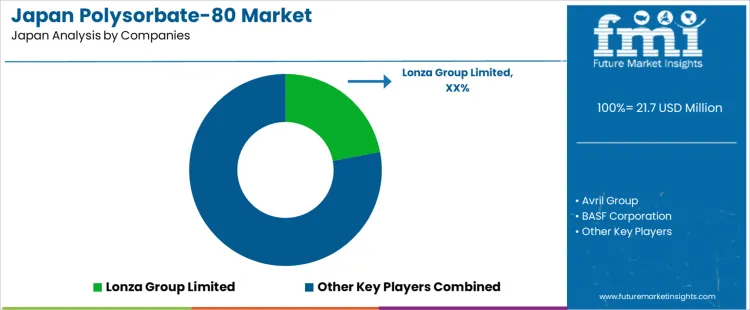
Demand for Polysorbate 80 in Japan is rising steadily thanks to expanding use across multiple industries-including food and beverages, pharmaceuticals, and cosmetics. As processed foods, convenience foods, fortified beverages, and ready to eat meals grow in popularity, manufacturers increasingly rely on Polysorbate 80 as an emulsifier and stabilizer to ensure consistent texture, prevent separation of oil and water phases, and extend shelf life. The demand is also boosted by growth in the pharmaceutical sector-Polysorbate 80 is widely used in drug formulations, vaccines, and nutritional supplements to solubilize compounds and stabilize emulsions. Cosmetic and personal care product demand for smooth creams, lotions, and emulsions further supports uptake. In sum, as Japan’s consumers continue to favour convenience foods, health-oriented products, and advanced pharmaceuticals, Polysorbate 80 remains a key ingredient fueling formulation flexibility and product stability.
Lonza Group Limited appears as a leading supplier. Other important suppliers include Avril Group, BASF Corporation, Solenis, and Reachin Chemical Co., Ltd.. These firms provide Polysorbate 80 in food-grade, pharmaceutical-grade, and cosmetic-grade variants, serving a range of industries, from packaged foods and dairy to injectable drugs and skincare products. Competition among suppliers focuses on the compound's purity and consistency, compliance with Japanese and international safety and food additive regulations, flexibility to meet different grade requirements, supply chain reliability, and volume capacity to serve large manufacturers. Suppliers that can deliver high-quality Polysorbate 80 with traceability, regulatory compliance, and stable supply are best positioned to benefit from the growing demand in Japan.
Key Players of the Polysorbate-80 Industry in Japan
- Lonza Group Limited
- Avril Group
- BASF Corporation
- Solenis
- Reachin Chemical Co., Ltd.
Scope of the Report
| Items | Values |
|---|---|
| Quantitative Units (2025) | USD Million |
| Source | Plant Based, Animal Based, Synthetic |
| Functionality | Emulsifier, Dispersant, Solubilizer, Surfactant, Stabilizer |
| Application | Food & Beverage, Pharmaceutical, Nutraceutical, Cosmetics & Personal Care, Agrochemical |
| Companies | Lonza Group Limited, Avril Group, BASF Corporation, Solenis, Reachin Chemical Co., Ltd. |
| Regions Covered | Kyushu & Okinawa, Kanto, Kansai, Chubu, Tohoku, Rest of Japan |
| Additional Attributes | Dollar by sales by source, functionality, application, and region. Includes product quality and stability, impact on formulations in various industries, performance as an emulsifier and stabilizer, cost-effectiveness in production, market trends, consumer demand for plant-based alternatives, compliance with industry standards and regulations, sustainability practices in sourcing and production, market share of key companies, and usage in various sectors including food, pharmaceuticals, and cosmetics. |
Key Segments in the Demand for Polysorbate-80 in Japan
Source
- Plant Based
- Animal Based
- Synthetic
Functionality
- Emulsifier
- Dispersant
- Solubilizer
- Surfactant
- Stabilizer
Application
- Food & Beverage
- Pharmaceutical
- Nutraceutical
- Cosmetics & Personal Care
- Agrochemical
Region
- Kyushu & Okinawa
- Kanto
- Kansai
- Chubu
- Tohoku
- Rest of Japan
Frequently Asked Questions
How big is the demand for polysorbate-80 in Japan in 2025?
The demand for polysorbate-80 in Japan is estimated to be valued at USD 21.7 million in 2025.
What will be the size of polysorbate-80 in Japan in 2035?
The market size for the polysorbate-80 in Japan is projected to reach USD 35.2 million by 2035.
How much will be the demand for polysorbate-80 in Japan growth between 2025 and 2035?
The demand for polysorbate-80 in Japan is expected to grow at a 5.0% CAGR between 2025 and 2035.
What are the key product types in the polysorbate-80 in Japan?
The key product types in polysorbate-80 in Japan are plant based, animal based and synthetic.
Which functionality segment is expected to contribute significant share in the polysorbate-80 in Japan in 2025?
In terms of functionality, emulsifier segment is expected to command 30.0% share in the polysorbate-80 in Japan in 2025.
Preview the report firsthand - request a free sample
Get SampleGet the brochure for pricing and purchase details.
Get PDFTable of Content
- Executive Summary
- Japan Market Outlook
- Demand-side Trends
- Supply-side Trends
- Technology Roadmap Analysis
- Analysis and Recommendations
- Market Overview
- Market Coverage / Taxonomy
- Market Definition / Scope / Limitations
- Market Background
- Market Dynamics
- Drivers
- Restraints
- Opportunity
- Trends
- Scenario Forecast
- Demand in Optimistic Scenario
- Demand in Likely Scenario
- Demand in Conservative Scenario
- Opportunity Map Analysis
- Product Life Cycle Analysis
- Supply Chain Analysis
- Investment Feasibility Matrix
- Value Chain Analysis
- PESTLE and Porter’s Analysis
- Regulatory Landscape
- Regional Parent Market Outlook
- Production and Consumption Statistics
- Import and Export Statistics
- Market Dynamics
- Japan Market Analysis 2020 to 2024 and Forecast, 2025 to 2035
- Historical Market Size Value (USD Million) Analysis, 2020 to 2024
- Current and Future Market Size Value (USD Million) Projections, 2025 to 2035
- Y-o-Y Growth Trend Analysis
- Absolute $ Opportunity Analysis
- Japan Market Pricing Analysis 2020 to 2024 and Forecast 2025 to 2035
- Japan Market Analysis 2020 to 2024 and Forecast 2025 to 2035, By Source
- Introduction / Key Findings
- Historical Market Size Value (USD Million) Analysis By Source , 2020 to 2024
- Current and Future Market Size Value (USD Million) Analysis and Forecast By Source , 2025 to 2035
- Plant Based
- Animal Based
- Synthetic
- Y-o-Y Growth Trend Analysis By Source , 2020 to 2024
- Absolute $ Opportunity Analysis By Source , 2025 to 2035
- Japan Market Analysis 2020 to 2024 and Forecast 2025 to 2035, By Functionality
- Introduction / Key Findings
- Historical Market Size Value (USD Million) Analysis By Functionality, 2020 to 2024
- Current and Future Market Size Value (USD Million) Analysis and Forecast By Functionality, 2025 to 2035
- Emulsifier
- Dispersant
- Solubilizer
- Surfactant
- Stabilizer
- Y-o-Y Growth Trend Analysis By Functionality, 2020 to 2024
- Absolute $ Opportunity Analysis By Functionality, 2025 to 2035
- Japan Market Analysis 2020 to 2024 and Forecast 2025 to 2035, By Application
- Introduction / Key Findings
- Historical Market Size Value (USD Million) Analysis By Application, 2020 to 2024
- Current and Future Market Size Value (USD Million) Analysis and Forecast By Application, 2025 to 2035
- Food & Beverage
- Pharmaceutical
- Nutraceutical
- Cosmetics & Personal Care
- Agrochemical
- Y-o-Y Growth Trend Analysis By Application, 2020 to 2024
- Absolute $ Opportunity Analysis By Application, 2025 to 2035
- Market Structure Analysis
- Competition Dashboard
- Competition Benchmarking
- Market Share Analysis of Top Players
- By Regional
- By Source
- By Functionality
- By Application
- Competition Analysis
- Competition Deep Dive
- Lonza Group Limited
- Overview
- Product Portfolio
- Profitability by Market Segments (Product/Age /Sales Channel/Region)
- Sales Footprint
- Strategy Overview
- Marketing Strategy
- Product Strategy
- Channel Strategy
- Avril Group
- BASF Corporation
- Solenis
- Reachin Chemical Co., Ltd.
- Lonza Group Limited
- Competition Deep Dive
- Assumptions & Acronyms Used
- Research Methodology


