
- Market Size (2026)
- USD 424.0 Mn
- Forecast (2036)
- USD 759.3 Mn
- CAGR (2026 to 2036)
- 6.0%
How big is the Preformed Crowns Market in 2026?
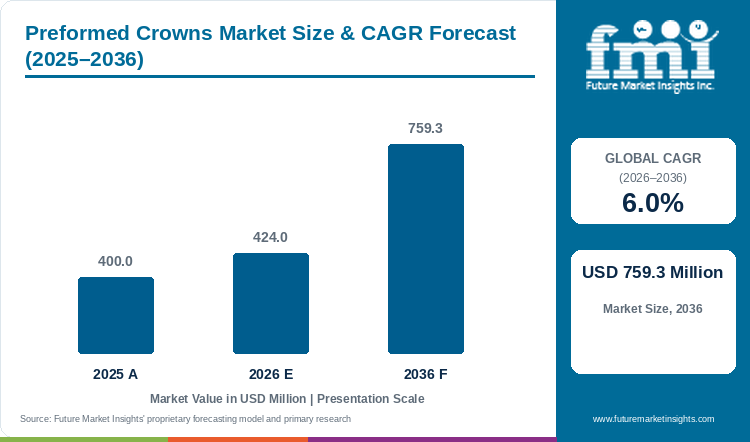
The global preformed crowns market should reach USD 759.3 million by 2036 at a CAGR of 6.0% across 2026 to 2036. The market was valued at USD 400.0 million in 2025, and FMI estimates USD 424.0 million for 2026.
Preformed Crowns Market Size and Forecast
Table 1: Preformed Crowns Market Size and Forecast
| Market size and forecast | Value |
|---|---|
| Market size in 2025 | USD 400.0 million |
| Estimated market size in 2026 | USD 424.0 million |
| Projected market size by 2036 | USD 759.3 million |
| CAGR from 2026 to 2036 | 6.0% |
Source: Future Market Insights analysis of the preformed crowns market, 2026.
Preparation requirements separate demand for aesthetic crowns from actual purchasing. Sprig surveyed 161 pediatric dentists, residents and dental team members at the AAPD 2026 Annual Session. Its report says 94.0% expected to place more zirconia crowns, while 69.0% identified preparation as the leading adoption barrier. FMI therefore sees training and predictable case selection as commercial requirements for zirconia growth.
The available material choices are also widening. NuSmile's 2026 product communications introduced ReVIVE resin-ceramic crowns, and its product page distinguishes these from both zirconia and BioFlx polymer crowns. Suppliers are competing over handling and inventory requirements as well as appearance. The AAPD's restorative guidance stresses that not every caries lesion needs restoration. Crown demand consequently depends on the number of teeth judged suitable for full coverage, access to trained clinicians and the funding available for the chosen material. The wider pediatric dental market provides the service context for that conversion from diagnosed disease to treatment.
Key Market Trends & Insights
- The forecast material mix favours zirconia, whose revenue rises from USD 144.2 million in 2026 to USD 363.9 million in 2036. Its 9.7% segment CAGR exceeds the 2.7% growth forecast for stainless steel. This creates a stronger revenue opportunity for aesthetic product ranges.
- Replenishment packaging matters commercially because practices consume sizes unevenly. Shinhung offers posterior steel kits containing 48 or 96 crowns and refills of five crowns in the same size.
- Adopting a second material adds handling requirements. Cheng Crowns differentiates a resin-faced steel product from a monolithic zirconia product, and its comparison also distinguishes their ability to be crimped and their stated sterilization methods.
Regional Highlights
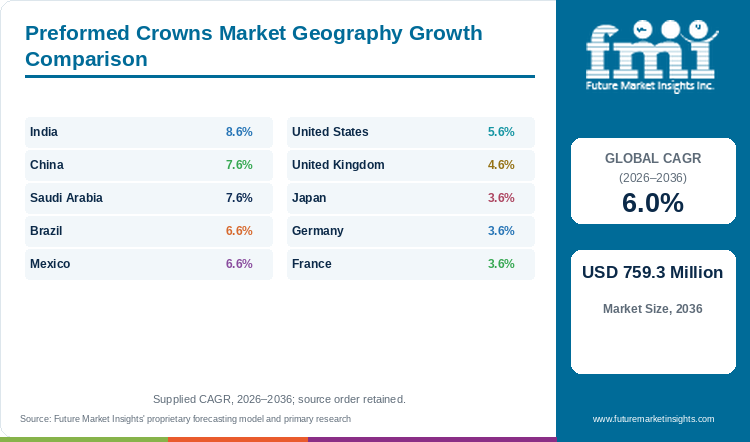
- India, China and Saudi Arabia grow fastest in the country outlook. FMI projects CAGRs of India at 8.6%, China at 7.6% and Saudi Arabia at 7.6% over 2026 to 2036 against 6.0% for the global market.
- Japan, Germany and France post the slowest growth among the named countries. FMI projects CAGRs of Japan at 3.6%, Germany at 3.6% and France at 3.6% over the same period, which is beneath the global rate.
Analyst Perspective
“FMI expects material conversion to account for a substantial part of revenue growth. Steel retains a place in affordable full-coverage care, while zirconia offers suppliers a larger value opportunity. The decisive commercial test is whether practices replenish a crown range after the starter kit. Training, size availability and clearly documented handling requirements influence that decision more directly than a broad promise of aesthetic improvement.”
- Anurag Sharma, Principal Consultant, FMI
How is the Preformed Crowns Market segmented?
- By material: Stainless Steel, Zirconia, and Pre-Veneered and Other.
- By end user: Dental Clinics, Hospitals, and Academic and Teaching Institutes.
- By tooth type: Primary Molars, Permanent Teeth, and Anterior Teeth.
- By region: North America, Latin America, Western Europe, East Asia, South Asia, Middle East and the Rest of world aggregate.
Why does the Stainless Steel segment lead by Material in the Preformed Crowns Market in 2026?
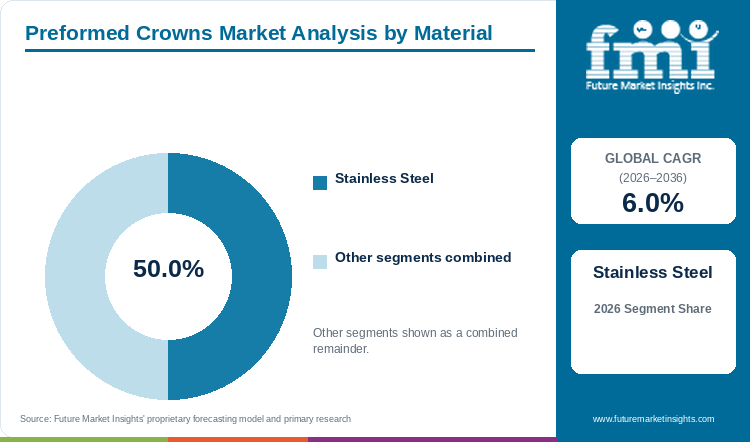
The Stainless Steel segment holds 50.0% of the Preformed Crowns Market by material in 2026.
Steel's current revenue lead rests on an established full-coverage treatment category with broad size availability. Solventum's crown reference chart distinguishes primary-molar steel crowns from permanent-tooth products and from strip forms used for anterior restorations. This product separation matters to purchasing. A distributor's total crown assortment can include items outside the pediatric preformed-crown scope.
FMI forecasts steel revenue of USD 277.2 million in 2036, representing 36.5% of material revenue. Its share falls because zirconia grows more quickly. A supplier serving both materials must consequently manage different growth rates within the same practice account. Expanding the aesthetic range while allowing common steel sizes to run out would weaken a useful replenishment relationship.
The market also includes resin-faced steel and other prefabricated alternatives. Handling characteristics and product-specific clinical indications affect where each crown belongs. For manufacturers, the commercial opportunity is a coherent assortment with clear material distinctions. A broad catalogue loses value if buyers cannot identify the correct dentition, size and handling instructions for a particular line.
Zirconia and Pre-Veneered and Other together make up the remaining 50.0% by material.
Table 2: Material, 2026 Share
| Leading Share | 2026 market share |
|---|---|
| Stainless Steel | 50.0% |
| All Other Segments Combined Share | 50.0% |
Source: Future Market Insights analysis of the preformed crowns market, 2026.
Why does the Dental Clinics segment lead by End User in the Preformed Crowns Market in 2026?
The Dental Clinics segment holds 78.0% of the Preformed Crowns Market by end user in 2026.
Purchasing responsibility remains close to the treating practice. Crown size selection, replenishment and the decision to introduce another material all affect the clinic's working inventory. Sprig's current EZCrowns offering combines crown refills with training resources and describes insurance coverage as dependent on location and payer. The commercial relationship therefore extends beyond selling an initial assortment.
Hospitals hold 12.0% of end-user revenue in 2026, while academic and teaching institutes hold 10.0%. These channels have distinct roles. A hospital's pediatric dental service may receive referred cases that need a different care setting. Teaching institutions purchase for clinical care and education.
Dental-clinic revenue reaches USD 598.8 million in 2036, maintaining a 78.9% share. That outlook gives suppliers a reason to prioritize repeat purchasing at practice level. The relevant measures include how quickly a clinic consumes its active sizes and whether its clinicians continue using a material after training. Adjacent dental crown removal activity concerns a separate service and instrument requirement.
Hospitals and Academic and Teaching Institutes together hold the remaining 22.0% by end user.
Table 3: End User, 2026 Share
| Leading Share | 2026 market share |
|---|---|
| Dental Clinics | 78.0% |
| All Other Segments Combined Share | 22.0% |
Source: Future Market Insights analysis of the preformed crowns market, 2026.
Why does the Primary Molars segment lead by Tooth Type in the Preformed Crowns Market in 2026?
The Primary Molars segment holds 76.0% of the Preformed Crowns Market by tooth type in 2026.
Primary molars lead because preformed crowns are principally a restorative option for decayed primary teeth in children, where a full-coverage crown is placed in a single visit. The CDC's 2024 surveillance findings show that nearly 18.0% of American children aged six to eight had untreated decay in primary teeth. That condition creates the treatment need, although the clinician still selects the restoration for the individual child.
Other tooth types are served by separate products. A manufacturer's crown reference chart distinguishes primary-molar steel crowns from permanent-tooth products and from strip forms used for anterior restorations. Distributors therefore stock three different assortments, and a practice that treats few older patients may not justify permanent-tooth sizes.
FMI's 2026 assessment values Primary Molars at USD 322.2 million. Permanent-tooth crowns and anterior forms cover narrower cases, so growth in those segments adds assortment complexity before it adds volume. Suppliers should link new product ranges to practices that already treat primary molars.
Permanent Teeth and Anterior Teeth together hold the remaining 24.0% by tooth type.
Table 4: Tooth Type, 2026 Share
| Leading Share | 2026 market share |
|---|---|
| Primary Molars | 76.0% |
| All Other Segments Combined Share | 24.0% |
Source: Future Market Insights analysis of the preformed crowns market, 2026.
What are the key drivers restraints and opportunities?
Demand grows when children with suitable damaged teeth reach restorative care. Clinical capacity and material-specific handling constrain conversion, while aesthetic alternatives create a larger revenue opportunity within existing practice accounts.
Driver
Dental services continue to encounter children with extensive decay, creating a treatment population in which clinicians assess full-coverage restoration.
Restraint
Preparation demands and limited practical experience slow the introduction of aesthetic crowns, even when clinicians express interest in them.
Opportunity
Suppliers can develop repeat accounts by combining differentiated material ranges with appropriate training and dependable refill availability.
How do purchasing rules and qualification affect preformed crowns market demand?
Untreated decay establishes a need for care but does not specify the restoration that will be purchased. The CDC's 2024 surveillance findings show that nearly 18.0% of American children aged six to eight had untreated decay in primary teeth. Treatment decisions still depend on the tooth's condition and the individual child. FMI's growth argument is therefore based on access to suitable restorative treatment, followed by purchasing of the selected crown.
Screening programmes affect the first stage of that process. A diagnosed child must reach a clinician and complete the planned care before a crown is consumed. Manufacturers assessing an expansion in public dental services should look for evidence of treatment delivery and replenishment orders. Counting everyone screened as a future crown recipient would overstate the addressable market. A supplier also needs to distinguish repeat care within an existing practice from first-time adoption of a new crown system.
What limits reliable preformed crowns market supply and quality?
Zirconia growth brings an adoption risk that does not appear in a material price list. A clinician may prefer the appearance of a crown yet use it selectively because its preparation demands differ from steel. The 2026 Sprig survey identifies that practical tension within its own conference sample.
Assortment risk sits alongside clinical risk. Buying more sizes than a practice regularly uses ties up cash. Buying too narrow a range can leave the required crown out of stock. Suppliers that add products without a clear refill policy increase the buyer's working-capital commitment. This is particularly relevant where a practice serves a small pediatric caseload. Product comparisons with dental inlays and onlays also need a firm scope boundary because those restorations often follow different manufacturing and care pathways. Crowns are one line within a practice's wider supply purchasing, covered in FMI's dental consumables market.
Where can suppliers win additional business in the preformed crowns market?
The strongest revenue opening is within practices already purchasing steel crowns. They provide a route to introduce aesthetic products without first building an entirely new distribution account. The supplier still needs to demonstrate which cases and purchasing requirements its added material addresses.
NuSmile's ReVIVE line illustrates the expanding competitive choices. The manufacturer identifies a resin-ceramic composition and distinguishes it from zirconia. FMI sees this as evidence that aesthetic competition extends beyond a simple steel-versus-zirconia choice. Manufacturers can compete through assortment simplicity and support, but claimed handling advantages require product-specific evidence. The revenue opportunity is most durable when the practice understands those distinctions and continues ordering the sizes it actually uses.
Preformed Crowns Market by Country (2026 to 2036)
Table 5: Preformed Crowns Market Country Growth Forecast
| Country | CAGR, 2026 to 2036 |
|---|---|
| India | 8.6% |
| China | 7.6% |
| Saudi Arabia | 7.6% |
| Brazil | 6.6% |
| Mexico | 6.6% |
| United States | 5.6% |
| United Kingdom | 4.6% |
| Japan | 3.6% |
| Germany | 3.6% |
| France | 3.6% |
Source: Future Market Insights analysis of the preformed crowns market, 2026.
India
India has the fastest national growth forecast in this assessment at 8.6% from 2026 to 2036. Revenue begins at USD 33.9 million in 2026. Expansion in dental access is commercially relevant, but the structure of that access matters as much as its scale. The Directorate General of Health Services says the National Oral Health Programme supports dental personnel, equipment, consumables and training at district hospitals and lower levels of care. Its programme page reports 9,587 units supported partially or fully since 2014 to 2015.
The supplier's first task is to identify where clinicians actually perform full-coverage pediatric restorations. A general dental unit and a specialist pediatric practice can have different treatment patterns and stock requirements. For a low-volume purchaser, an expensive assortment with many infrequently used sizes may slow adoption. A predictable refill route can reduce the amount of cash committed before the product has a regular caseload.
Academic and teaching institutions also matter to the clinical introduction of materials. Their purchasing is separately represented in the global end-user taxonomy. FMI sees a practical connection between education and later practice demand, while avoiding an assumed conversion rate from training to crown sales. Steel can support cost-sensitive care, and zirconia offers a separate aesthetic opportunity where the service and family budget permit it. A single nationwide premium-material proposition would overlook these different purchasing conditions.
China
Screening and referral services provide a useful lens on China's outlook. Shenzhen's health commission reported in September 2026 that its children's oral-health network involved 122 designated medical institutions. It also described a new family-facing screening and appointment pathway. The city's reported primary-tooth caries prevalence among three- to five-year-olds fell from 56.4% in 2018 to 50.2% in 2024.
For a crown supplier, the local example exposes two forces operating together. Better prevention can reduce future severe decay. At the same time, organized assessment and referral can bring existing untreated disease into care. The net effect on a particular clinic depends on its patients and treatment choices. Counting a decline in caries as an automatic decline in current restorative purchasing would miss that distinction.
FMI forecasts China's preformed crowns revenue at USD 50.9 million in 2026, followed by a 7.6% CAGR during 2026 to 2036. The commercial opportunity rests on converting suitable diagnosed cases into completed treatment. Suppliers need a dependable local replenishment route and product information that differentiates steel, zirconia and other prefabricated materials. The sales plan should consequently follow the institutions and practices capable of delivering pediatric restoration, with expansion linked to actual orders instead of the number of children assessed. China's 2026 revenue ranks second of ten. China reaches 12.0% of the global market in 2026. China grows at 7.6% a year, 1.6 points faster than the global rate.
Saudi Arabia
Saudi Arabia's National Initiative on Prevent Tooth Caries combines awareness, preventive applications and therapeutic procedures for primary-school pupils. The Ministry of Health identifies cooperation with the Ministry of Education and the geographic reach of health centres as parts of the programme. Its June 2026 update provides an access and prevention framework.
School contact can bring children into assessment, but a suitable clinical service must then determine the treatment. A supplier has to understand which health centres provide restoration and which rely on referral.
FMI estimates Saudi Arabian preformed crowns revenue at USD 12.7 million in 2026, with a 7.6% CAGR across 2026 to 2036. The opportunity includes serving treatment settings with repeat pediatric cases and introducing aesthetic alternatives where clinicians use them appropriately. Material-specific product information and dependable local availability become more useful commercial tools than an undifferentiated claim of superior aesthetics. The public prevention objective also creates a long-term qualification: successful prevention can change the severity and mix of cases reaching care. Suppliers should follow delivered treatment and replenishment patterns as those services develop. Growth assumptions based only on present disease burden would overlook that interaction between prevention and restoration. In the preformed crowns market, Saudi Arabia grows 7.6% a year, 1.6 points above the global rate. Saudi Arabia holds joint eighth place by 2026 revenue. In 2026, Saudi Arabia accounts for 3.0% of global revenue.
Brazil
Public oral-health capacity is a significant part of Brazil's demand context. The Ministry of Health's 2025 Brasil Sorridente summary reports delivery of 491 mobile dental units during that year. It also identifies approximately 1,200 dental specialty centres. These investments broaden routes into care, but the stated activities span oral health generally.
FMI projects the Brazilian preformed crowns market at USD 21.2 million in 2026, growing at 6.6% annually through 2036. Suppliers need to distinguish direct treatment points from services that examine patients and refer them elsewhere. If the destination clinic lacks a suitable range of crown sizes or a clinician comfortable with the material, greater screening activity may not produce a corresponding increase in placements. Brazil compounds at 6.6%, which is 0.6 points above the global 6.0%. Measured by 2026 revenue, Brazil sits joint fifth of ten.
The public-service route also differs from a private practice offering aesthetic options to families. Steel and zirconia compete under different purchasing conditions across those settings. A manufacturer assessing local expansion should establish which institution owns the buying decision and how refills reach the treating service. A headline kit order can indicate initial adoption while providing little information about continued use. FMI expects recurring supply relationships to depend on those operational details. Public access improvements support the overall opportunity, but verified treatment activity remains the better guide to where crown inventories should be placed.
Mexico
Mexico's school-health programme provides a concrete example of disease detection at scale. In June 2025, the presidency reported that 2.7 million primary-school pupils had received assessments under Vive Saludable, Vive Feliz. Around six in ten assessed children had caries. The number describes the children examined within that programme.
The immediate commercial question is whether children referred after screening reach restorative services. A crown supplier can benefit from a stronger treatment route, but screening alone consumes no crown stock. Institutions responsible for referral and clinicians providing care have different roles in that chain. Manufacturers need to locate the point where a material is selected and the purchase is authorized.
FMI expects Mexico's preformed crowns revenue to increase from USD 12.7 million in 2026 at a 6.6% CAGR through 2036. The outlook supports investment in reliable distributor and clinic relationships. Starter assortments must be appropriate to the practice's pediatric workload, with refill quantities that do not force unnecessary inventory. Aesthetic demand offers additional value where the family and clinical setting support it. However, a mixed material range is commercially more credible than an assumption that all diagnosed decay will move into zirconia treatment. Actual repeat orders remain the evidence that a screening and referral pathway is generating sustained product consumption. In 2026, Mexico accounts for 3.0% of global revenue. Mexico's 2026 revenue ranks joint eighth of ten.
United States
The United States represents the largest national revenue opportunity in this assessment. FMI projects USD 135.7 million in 2026 and a 5.6% CAGR between 2026 and 2036. The commercial task is to serve practices treating a persistent burden of damaged primary teeth while introducing aesthetic options at a pace their clinicians can support. The CDC's 2024 report places untreated primary-tooth decay at nearly 18.0% among children aged six to eight. Its findings also show higher untreated decay in lower-income groups. By 2026 revenue the country ranks first among the ten named countries.
Payer conditions influence the material mix within that treatment opportunity. Sprig states that coverage of its zirconia crowns varies by location and insurer. A national supplier therefore cannot assume that a product accepted by one practice has the same financial conditions in every state. A practice may maintain steel stock while using zirconia for selected cases. FMI regards that coexistence as a more useful sales assumption than wholesale substitution.
Manufacturers compete for the replenishment account after an initial kit is placed. Crown availability, practical education and straightforward ordering help turn product interest into recurring purchases. An aesthetic range offers higher revenue potential, but a narrow focus on premium materials would miss clinics balancing family affordability with treatment requirements. Supplier planning should follow actual practice purchasing patterns and the locally available payment route.
United Kingdom
Hospital extraction statistics expose a serious limit on interpreting unmet need as crown demand. England recorded 33,976 hospital tooth-extraction episodes attributed primarily to decay among people aged zero to nineteen in the financial year ending 2025. The February 2026 release reports an 11.0% increase on the previous year. An extraction episode is not a crown placement, and the statistics apply to England instead of the entire United Kingdom.
FMI forecasts United Kingdom preformed crowns revenue of USD 17.0 million in 2026 and a 4.6% CAGR during 2026 to 2036. The commercial case depends on restorative care reaching children while a tooth remains suitable for retention. A large extraction burden demonstrates the cost of advanced disease and access difficulties. The United Kingdom compounds at 4.6%, which is 1.4 points below the global 6.0%.
Suppliers should therefore look closely at the services completing pediatric restorative treatment and the materials those clinicians routinely use. A referral centre can influence product choice, but repeat purchasing may sit with practices outside the hospital. An aesthetic crown range also needs a feasible payment route and clinician familiarity. Manufacturers that focus solely on premium appearance risk missing the more immediate requirements of consistent sizes and practical support. For FMI, the strongest account is one with a repeat restorative caseload and a clear replenishment process, instead of a location selected only because its hospital extraction figures are high.
Japan
Japan's outlook calls for a selective product strategy. FMI forecasts revenue of USD 25.4 million in 2026 and a 3.6% CAGR over 2026 to 2036. Growth is slower than in India or China, so the quality of the practice account and the material mix become especially important. A supplier needs a clear reason for a clinic to add another crown range instead of simply increasing the number of products held in stock. The CAGR for Japan is 3.6%, which runs 2.4 points below the 6.0% worldwide rate. Japan ranks fourth of ten on 2026 revenue.
The Ministry of Health, Labour and Welfare published results from its 2024 Survey of Dental Diseases in June 2025. The survey combined questionnaires and dental examinations, with fieldwork in October and November 2024. Its all-age dental attendance findings describe the broader care environment. FMI keeps those distinctions central to the local assessment.
The commercial decision is whether a material or size range addresses a recurring need within the practice. Introducing aesthetic products without sustained clinical use creates inventory instead of recurring demand. Conversely, a reliable established steel range may retain purchasing even where the overall market grows slowly. Suppliers should therefore assess active sizes, product instructions and local servicing as part of account development. The scope also excludes adult custom crowns, so broader spending on aesthetic dentistry cannot be assigned to this market.
Germany
Germany demonstrates why a crown forecast should not assume continually rising caries across every market. The Sixth German Oral Health Study, presented in March 2025, found that 78.0% of the examined twelve-year-olds were caries-free. Its sponsors also highlighted continuing inequality in oral-health outcomes and a significant burden of molar-incisor hypomineralization. The United States starts from USD 135.7 million in 2026, 6.4 times the German base. Japan, Germany and France share the lowest CAGR among the named countries at 3.6%.
FMI's German revenue outlook starts at USD 21.2 million in 2026 and grows at a 3.6% CAGR to 2036. The commercial argument is focused care for children who still need substantial restoration, alongside material selection in suitable cases. Prevention success can limit broad disease-driven volume expansion. Germany reaches 5.0% of the global market in 2026. Germany holds joint fifth place by 2026 revenue. In the preformed crowns market, Germany grows 3.6% a year, 2.4 points below the global rate.
For suppliers, this favours a precise clinical and product proposition. A wider assortment has little value if it does not match recurring cases. Product replenishment should follow the treating practice's case pattern, with steel retained where it fits the chosen treatment plan. FMI consequently places emphasis on documented local use, reliable service and clear pediatric scope when assessing supplier opportunity.
France
France expanded the frequency of youth dental prevention through M'T dents tous les ans. Assurance Maladie's October 2025 information states that eligible children and young adults can receive an annual appointment from age three through twenty-four, subject to the stated insurance requirements. The programme increases opportunities for regular assessment.
FMI forecasts USD 12.7 million of French preformed crowns revenue in 2026 and a 3.6% CAGR to 2036. More frequent review can identify decay earlier, when a less extensive intervention may be sufficient. It can also connect a child with existing untreated disease to care. Those effects operate in different directions for full-coverage restorations. FMI therefore reads the prevention programme as a change in the route to treatment, not proof of a predetermined rise in crown placements. Measured by 2026 revenue, France sits joint eighth of ten.
For manufacturers, practice-level use is the key commercial test. A crown range must earn regular use within the local care pattern and remain available in the sizes the practice needs. Aesthetic products can alter revenue per crown, but the product's material and handling requirements need to be clear. Supplier support is particularly valuable when a practice introduces an additional range without an established replenishment history. Adult prosthetic spending and custom dental laboratory activity remain outside this forecast, preventing broader restorative statistics from overstating the pediatric opportunity.
Who are the notable companies in the Preformed Crowns Market?
Notable companies in the Preformed Crowns Market include Solventum, NuSmile, Kinder Krowns, Shinhung and EZ Pedo, operating under the Sprig identity.
Solventum and Shinhung illustrate the established steel-crown supply model. Their published ranges identify crown forms and assortments designed around specific dentition and size needs. NuSmile combines several material families, including zirconia and newer resin-ceramic products. That breadth allows a supplier to address different practice requirements while keeping the material distinctions explicit.
Kinder Krowns and Cheng Crowns focus on pediatric aesthetic restoration. Kinder Krowns' manufacturer brochure describes its prefabricated zirconia range, while Cheng offers both resin-faced steel and monolithic zirconia products. Sprig supplies EZCrowns and supporting education. Its company history states that EZPEDO rebranded as Sprig Oral Health Technologies in 2017. These names represent one business history instead of two independent competitors.
Dentsply Sirona's restorative portfolio provides a useful adjacent comparison for materials and workflows. Its presence in broader dentistry does not establish a share of this specific crown market. FMI differentiates such adjacent roles from directly documented product supply. No company revenue or market-share ranking is inferred from the list.
Key Developments in the Preformed Crowns Market
- In 2026, NuSmile introduced ReVIVE, a 3D-printed resin-ceramic crown, after announcing it in AAPD communications. The manufacturer's product page lists kits, states that the crown is FDA registered and available for anterior teeth only, and distinguishes the material from zirconia. The evidence supports an additional aesthetic product option, without establishing a comparative clinical success rate.
Key Players in the Preformed Crowns Market
- Solventum
- NuSmile
- Kinder Krowns
- Shinhung
- EZ Pedo, operating under the Sprig identity
- Cheng Crowns
- Dentsply Sirona, adjacent restorative participant
Preformed Crowns Market Report Scope
Table 6: Preformed Crowns Market Report Scope
| Coverage field | Report scope |
|---|---|
| Market definition | Prefabricated crowns for restoring decayed primary and young permanent teeth in children. |
| Included product scope | Stainless steel, zirconia, nickel-chromium, strip crowns, and related pre-veneered and other prefabricated forms within the stated pediatric scope. |
| Exclusions | Adult custom laboratory crowns, treatment fees, dental equipment, implants and unrelated restorative materials. |
| Quantitative Units | USD million |
| Segmentation | Material and End User. |
| Geographic coverage | United States, China, India, Japan, Brazil, Germany, United Kingdom, Mexico, Saudi Arabia, France and Rest of world aggregate. |
| Tooth Type coverage | Primary Molars, Permanent Teeth, Anterior Teeth. |
| Companies examined | Solventum, NuSmile, Kinder Krowns, Shinhung, Dentsply Sirona, EZ Pedo / Sprig and Cheng Crowns, with direct and adjacent roles distinguished. |
Source: Future Market Insights analysis of the preformed crowns market, 2026.
Preformed Crowns Market Research Methodology
The assessment combines FMI's defined numerical outlook with secondary review of national health publications, pediatric dental guidance and original manufacturer documentation. Value and volume units, forecast periods, leading-share comparisons and company identities were checked for consistency. Disease indicators describe treatment context without being converted into crown-placement counts. Competitive comparisons retain the distinction between documented products, manufacturer claims and adjacent restorative activity.
Preformed Crowns Market by Segments
Preformed Crowns Market segmented by Material:
- Stainless Steel
- Zirconia
- Pre-Veneered and Other
Preformed Crowns Market segmented by End User:
- Dental Clinics
- Hospitals
- Academic and Teaching Institutes
Preformed Crowns Market segmented by Tooth Type:
- Primary Molars
- Permanent Teeth
- Anterior Teeth
Preformed Crowns Market by Region
- North America
- United States
- Latin America
- Brazil
- Mexico
- Western Europe
- Germany
- United Kingdom
- France
- East Asia
- China
- Japan
- South Asia
- India
- Middle East
- Saudi Arabia
- Rest of world
Research Sources and Bibliography
- 3M. (2017). Prefabricated Crowns: Crown Reference Chart, currently hosted by Solventum; Solventum. (n.d.). All Dental Products. Accessed 9 November 2026.
- American Academy of Pediatric Dentistry. (2025). Pediatric Restorative Dentistry. The Reference Manual of Pediatric Dentistry, pp. 473-486. Latest guideline revision 2022.
- Assurance Maladie, France. (2025, October 23). M'T dents tous les ans: Annual Dental Appointments for Children and Young Adults.
- Centers for Disease Control and Prevention. (2024, October 9). 2024 Oral Health Surveillance Report: Selected Findings.
- Cheng Crowns. (n.d.). Our Pediatric Crowns: Classic and Zirconia Product Comparison. Accessed 9 November 2026. https://chengcrowns.com/products/
- Dentsply Sirona. (n.d.). Dental Restorative Products. Accessed 9 November 2026. https://www.dentsplysirona.com/en-us/explore/restorative.html
- Directorate General of Health Services, India. (n.d.). National Oral Health Division: Programme Components and Supported Dental Units. Accessed 9 November 2026. https://www.dghs.mohfw.gov.in/national-oral-health-division.php
- Kassenzahnärztliche Bundesvereinigung. (2025, March 17). Zahnärztliche Prävention wirkt! Results of the Sixth German Oral Health Study. https://www.kzbv.de/pressemitteilungen/zahnaerztliche-praevention-wirkt/
- Kinder Krowns. (n.d.). Zirconia Kinder Krowns: Coronas Pediátricas de Zirconia. Manufacturer brochure, Spanish edition. Accessed 9 November 2026. https://www.proclinic.es/media/proclinic-es/annexes/45690_45691_45692_IF_Kinder_Krowns_Brochure-Spanish.pdf
- Ministério da Saúde, Brazil. (2025). Brasil Sorridente: Maior oferta de Saúde Bucal da história do SUS. Annual summary. Accessed 9 November 2026. https://www.gov.br/saude/pt-br/assuntos/balancos/2025/brasil-sorridente
- Ministry of Health, Labour and Welfare, Japan. (2025, June 26). Results of the 2024 Survey of Dental Diseases. https://www.mhlw.go.jp/stf/newpage_59190.html
- Ministry of Health, Saudi Arabia. (2026, June 14 update). National Initiative on Prevent Tooth Caries. https://www.moh.gov.sa/en/ministry/projects/tooth-decay/pages/default.aspx
- NuSmile. (n.d.). ReVIVE: Resin-Ceramic Reinforced Pediatric Crowns. Product description and material distinctions. Accessed 9 November 2026. https://www.nusmile.com/nusmile-revive
- NuSmile. (2026). ReVIVE Resin Ceramic Crowns: Coming Soon. Manufacturer communication distributed through the American Academy of Pediatric Dentistry. Accessed 9 November 2026. https://www.aapd.org/link/c46e48df6e50437498c2f2c44b91af40.aspx
- Office for Health Improvement and Disparities, England. (2026, February 17). Short Statistical Commentary for Hospital Tooth Extractions in 0 to 19 Year Olds 2025. https://www.gov.uk/government/statistics/hospital-tooth-extractions-in-0-to-19-year-olds-2025/short-statistical-commentary-for-hospital-tooth-extractions-in-0-to-19-year-olds-2025
- Presidencia de la República, Mexico. (2025, June 17). Con Vive Saludable, Vive Feliz, Gobierno de México ha valorado la salud de 2.7 millones de estudiantes de primaria. https://www.gob.mx/presidencia/prensa/con-vive-saludable-vive-feliz-gobierno-de-mexico-ha-valorado-la-salud-de-2-7-millones-de-estudiantes-de-primaria
- Shenzhen Municipal Health Commission. (2026, September 23). Shenzhen's student oral-health module and children's oral-health services. Original Chinese title: 深圳首创把“牙医”装进小程序,数智赋能提升儿童口腔健康服务水平. https://wjw.sz.gov.cn/gzdt/content/post_12995457.html
- Shinhung. (n.d.). Kids Crown: Steel Crown Features, Kits and Refills. Accessed 9 November 2026. https://kidscrown.com/bbs/board.php?bo_table=kids_crown&wr_id=1
- Sprig Oral Health Technologies. (n.d.). About Sprig: Company Timeline; EZCrowns Product Information. Accessed 9 November 2026. https://sprigusa.com/about/ ; https://sprigusa.com/products/ezcrowns/
- Sprig Oral Health Technologies. (2026). The State of Pediatric Restorative Dentistry: 2026 Benchmark Report. Conference survey of 161 respondents. Accessed 9 November 2026. https://sprigusa.com/white-papers/the-state-of-pediatric-restorative-dentistry/
Table of Content
- Key Takeaways
- Market Size and CAGR
- Top Growth Driver
- Fastest Growing Segment
- Leading Region
- Key Companies
- Emerging Opportunities
- Executive Summary
- Global Market Outlook
- Demand-side Trends
- Supply-side Trends
- Technology Roadmap Analysis
- Analysis and Recommendations
- Analyst Perspective (What is happening? Why now? What should investors know?)
- Key Questions Answered
- How large is the market?
- What is the CAGR?
- What are key trends?
- Which region dominates?
- Who are the leaders?
Read More...
- Market Overview
- Market Coverage / Taxonomy
- Market Definition / Scope / Limitations
- Research Methodology
- Chapter Orientation
- Analytical Lens and Working Hypotheses
- Market Structure, Signals, and Trend Drivers
- Benchmarking and Cross-market Comparability
- Market Sizing, Forecasting, and Opportunity Mapping
- Research Design and Evidence Framework
- Desk Research Programme (Secondary Evidence)
- Expert Input and Fieldwork (Primary Evidence)
- Tooling, Models, and Reference Databases
- Data Engineering and Model Build
- Quality Assurance and Audit Trail
- Market Background
- Market Dynamics (Drivers, Restraints, Opportunity, Trends)
- Scenario Forecast (Optimistic, Likely, Conservative)
- Impact Analysis
- AI Impact
- Sustainability Impact
- Regulatory Impact
- Technology Impact
- Consumer / Buyer Analysis
- Purchase Drivers
- Adoption Barriers
- Buyer Journey
- Opportunity Map Analysis
- Product Life Cycle Analysis
- Supply Chain Analysis
- Investment Feasibility Matrix
- Value Chain Analysis
- PESTLE and Porter's Analysis
- Regulatory Landscape
- Regional Parent Market Outlook
- Production and Consumption Statistics
- Import and Export Statistics
- Global Market Analysis and Forecast, 2021 to 2036
- Historical Market Size Value (USD Million) Analysis, 2021 to 2025
- Current and Future Market Size Value (USD Million) Projections, 2026 to 2036
- Y-o-Y Growth Trend Analysis
- Absolute $ Opportunity Analysis
- Global Market Pricing Analysis, 2021 to 2036
- Global Market Analysis and Forecast, By Material, 2021 to 2036
- Introduction / Key Findings
- Historical Market Size Value (USD Million) Analysis By Material, 2021 to 2025
- Current and Future Market Size Value (USD Million) Analysis and Forecast By Material, 2026 to 2036
- Stainless Steel
- Zirconia
- Pre-Veneered and Other
- Y-o-Y Growth Trend Analysis By Material, 2021 to 2025
- Absolute $ Opportunity Analysis By Material, 2026 to 2036
- Global Market Analysis and Forecast, By End User, 2021 to 2036
- Introduction / Key Findings
- Historical Market Size Value (USD Million) Analysis By End User, 2021 to 2025
- Current and Future Market Size Value (USD Million) Analysis and Forecast By End User, 2026 to 2036
- Dental Clinics
- Hospitals
- Academic and Teaching Institutes
- Y-o-Y Growth Trend Analysis By End User, 2021 to 2025
- Absolute $ Opportunity Analysis By End User, 2026 to 2036
- Global Market Analysis and Forecast, By Tooth Type, 2021 to 2036
- Introduction / Key Findings
- Historical Market Size Value (USD Million) Analysis By Tooth Type, 2021 to 2025
- Current and Future Market Size Value (USD Million) Analysis and Forecast By Tooth Type, 2026 to 2036
- Primary Molars
- Permanent Teeth
- Anterior Teeth
- Y-o-Y Growth Trend Analysis By Tooth Type, 2021 to 2025
- Absolute $ Opportunity Analysis By Tooth Type, 2026 to 2036
- Global Market Analysis and Forecast, By Region, 2021 to 2036
- Introduction
- Historical Market Size Value (USD Million) Analysis By Region, 2021 to 2025
- Current Market Size Value (USD Million) Analysis and Forecast By Region, 2026 to 2036
- North America
- Latin America
- Western Europe
- East Asia
- South Asia
- Middle East
- Market Attractiveness Analysis By Region
- North America Market Analysis and Forecast, By Country, 2021 to 2036
- Historical Market Size Value (USD Million) Trend Analysis By Market Taxonomy, 2021 to 2025
- Market Size Value (USD Million) Forecast By Market Taxonomy, 2026 to 2036
- By Country
- United States
- By Material
- By End User
- By Tooth Type
- By Country
- Market Attractiveness Analysis
- By Country
- By Material
- By End User
- By Tooth Type
- Key Takeaways
- Latin America Market Analysis and Forecast, By Country
- Historical Market Size Value (USD Million) Trend Analysis By Market Taxonomy, 2021 to 2025
- Market Size Value (USD Million) Forecast By Market Taxonomy, 2026 to 2036
- By Country
- Brazil
- Mexico
- By Material
- By End User
- By Tooth Type
- By Country
- Market Attractiveness Analysis
- By Country
- By Material
- By End User
- By Tooth Type
- Key Takeaways
- Western Europe Market Analysis and Forecast, By Country
- Historical Market Size Value (USD Million) Trend Analysis By Market Taxonomy, 2021 to 2025
- Market Size Value (USD Million) Forecast By Market Taxonomy, 2026 to 2036
- By Country
- Germany
- United Kingdom
- France
- By Material
- By End User
- By Tooth Type
- By Country
- Market Attractiveness Analysis
- By Country
- By Material
- By End User
- By Tooth Type
- Key Takeaways
- East Asia Market Analysis and Forecast, By Country
- Historical Market Size Value (USD Million) Trend Analysis By Market Taxonomy, 2021 to 2025
- Market Size Value (USD Million) Forecast By Market Taxonomy, 2026 to 2036
- By Country
- China
- Japan
- By Material
- By End User
- By Tooth Type
- By Country
- Market Attractiveness Analysis
- By Country
- By Material
- By End User
- By Tooth Type
- Key Takeaways
- South Asia Market Analysis and Forecast, By Country
- Historical Market Size Value (USD Million) Trend Analysis By Market Taxonomy, 2021 to 2025
- Market Size Value (USD Million) Forecast By Market Taxonomy, 2026 to 2036
- By Country
- India
- By Material
- By End User
- By Tooth Type
- By Country
- Market Attractiveness Analysis
- By Country
- By Material
- By End User
- By Tooth Type
- Key Takeaways
- Middle East Market Analysis and Forecast, By Country
- Historical Market Size Value (USD Million) Trend Analysis By Market Taxonomy, 2021 to 2025
- Market Size Value (USD Million) Forecast By Market Taxonomy, 2026 to 2036
- By Country
- Saudi Arabia
- Rest of world
- By Material
- By End User
- By Tooth Type
- By Country
- Market Attractiveness Analysis
- By Country
- By Material
- By End User
- By Tooth Type
- Key Takeaways
- Key Countries Market Analysis
- United States
- Pricing Analysis
- Market Share Analysis, 2025
- By Material
- By End User
- By Tooth Type
- Mexico
- Pricing Analysis
- Market Share Analysis, 2025
- By Material
- By End User
- By Tooth Type
- Brazil
- Pricing Analysis
- Market Share Analysis, 2025
- By Material
- By End User
- By Tooth Type
- Germany
- Pricing Analysis
- Market Share Analysis, 2025
- By Material
- By End User
- By Tooth Type
- United Kingdom
- Pricing Analysis
- Market Share Analysis, 2025
- By Material
- By End User
- By Tooth Type
- France
- Pricing Analysis
- Market Share Analysis, 2025
- By Material
- By End User
- By Tooth Type
- India
- Pricing Analysis
- Market Share Analysis, 2025
- By Material
- By End User
- By Tooth Type
- China
- Pricing Analysis
- Market Share Analysis, 2025
- By Material
- By End User
- By Tooth Type
- Japan
- Pricing Analysis
- Market Share Analysis, 2025
- By Material
- By End User
- By Tooth Type
- Saudi Arabia
- Pricing Analysis
- Market Share Analysis, 2025
- By Material
- By End User
- By Tooth Type
- United States
- Market Structure Analysis
- Competition Dashboard
- Competition Benchmarking
- Market Share Analysis of Top Players
- By Regional
- By Material
- By End User
- By Tooth Type
- Emerging Startups
- Innovation Benchmarking
- Competition Analysis
- Competition Deep Dive
- Solventum
- Overview
- Product Portfolio
- Profitability by Market Segments
- Sales Footprint
- Strategy Overview
- Marketing Strategy
- Product Strategy
- Channel Strategy
- NuSmile
- Kinder Krowns
- Shinhung
- Dentsply Sirona
- EZ Pedo / Sprig
- Cheng Crowns
- EZ Pedo, operating under the Sprig identity
- Dentsply Sirona, adjacent restorative participant
- Solventum
- Case Studies
- Success Stories
- Recent Developments
- Competition Deep Dive
- Assumptions & Acronyms Used
List of Tables
- Table 1: Global Market Value (USD Million) Forecast by Region, 2021 to 2036
- Table 2: Global Market Value (USD Million) Forecast by Material, 2021 to 2036
- Table 3: Global Market Value (USD Million) Forecast by End User, 2021 to 2036
- Table 4: Global Market Value (USD Million) Forecast by Tooth Type, 2021 to 2036
- Table 5: North America Market Value (USD Million) Forecast by Country, 2021 to 2036
- Table 6: North America Market Value (USD Million) Forecast by Material, 2021 to 2036
- Table 7: North America Market Value (USD Million) Forecast by End User, 2021 to 2036
- Table 8: North America Market Value (USD Million) Forecast by Tooth Type, 2021 to 2036
- Table 9: Latin America Market Value (USD Million) Forecast by Country, 2021 to 2036
- Table 10: Latin America Market Value (USD Million) Forecast by Material, 2021 to 2036
- Table 11: Latin America Market Value (USD Million) Forecast by End User, 2021 to 2036
- Table 12: Latin America Market Value (USD Million) Forecast by Tooth Type, 2021 to 2036
- Table 13: Western Europe Market Value (USD Million) Forecast by Country, 2021 to 2036
- Table 14: Western Europe Market Value (USD Million) Forecast by Material, 2021 to 2036
- Table 15: Western Europe Market Value (USD Million) Forecast by End User, 2021 to 2036
- Table 16: Western Europe Market Value (USD Million) Forecast by Tooth Type, 2021 to 2036
- Table 17: East Asia Market Value (USD Million) Forecast by Country, 2021 to 2036
- Table 18: East Asia Market Value (USD Million) Forecast by Material, 2021 to 2036
- Table 19: East Asia Market Value (USD Million) Forecast by End User, 2021 to 2036
- Table 20: East Asia Market Value (USD Million) Forecast by Tooth Type, 2021 to 2036
- Table 21: South Asia Market Value (USD Million) Forecast by Country, 2021 to 2036
- Table 22: South Asia Market Value (USD Million) Forecast by Material, 2021 to 2036
- Table 23: South Asia Market Value (USD Million) Forecast by End User, 2021 to 2036
- Table 24: South Asia Market Value (USD Million) Forecast by Tooth Type, 2021 to 2036
- Table 25: Middle East Market Value (USD Million) Forecast by Country, 2021 to 2036
- Table 26: Middle East Market Value (USD Million) Forecast by Material, 2021 to 2036
- Table 27: Middle East Market Value (USD Million) Forecast by End User, 2021 to 2036
- Table 28: Middle East Market Value (USD Million) Forecast by Tooth Type, 2021 to 2036
List of Figures
- Figure 1: Global Market Pricing Analysis
- Figure 2: Global Market Value (USD Million) Forecast 2021-2036
- Figure 3: Global Market Value Share and BPS Analysis by Material, 2026 and 2036
- Figure 4: Global Market Y-o-Y Growth Comparison by Material, 2026-2036
- Figure 5: Global Market Attractiveness Analysis by Material
- Figure 6: Global Market Value Share and BPS Analysis by End User, 2026 and 2036
- Figure 7: Global Market Y-o-Y Growth Comparison by End User, 2026-2036
- Figure 8: Global Market Attractiveness Analysis by End User
- Figure 9: Global Market Value Share and BPS Analysis by Tooth Type, 2026 and 2036
- Figure 10: Global Market Y-o-Y Growth Comparison by Tooth Type, 2026-2036
- Figure 11: Global Market Attractiveness Analysis by Tooth Type
- Figure 12: Global Market Value (USD Million) Share and BPS Analysis by Region, 2026 and 2036
- Figure 13: Global Market Y-o-Y Growth Comparison by Region, 2026-2036
- Figure 14: Global Market Attractiveness Analysis by Region
- Figure 15: North America Market Incremental Dollar Opportunity, 2026-2036
- Figure 16: Latin America Market Incremental Dollar Opportunity, 2026-2036
- Figure 17: Western Europe Market Incremental Dollar Opportunity, 2026-2036
- Figure 18: East Asia Market Incremental Dollar Opportunity, 2026-2036
- Figure 19: South Asia Market Incremental Dollar Opportunity, 2026-2036
- Figure 20: Middle East Market Incremental Dollar Opportunity, 2026-2036
- Figure 21: North America Market Value Share and BPS Analysis by Country, 2026 and 2036
- Figure 22: North America Market Value Share and BPS Analysis by Material, 2026 and 2036
- Figure 23: North America Market Y-o-Y Growth Comparison by Material, 2026-2036
- Figure 24: North America Market Attractiveness Analysis by Material
- Figure 25: North America Market Value Share and BPS Analysis by End User, 2026 and 2036
- Figure 26: North America Market Y-o-Y Growth Comparison by End User, 2026-2036
- Figure 27: North America Market Attractiveness Analysis by End User
- Figure 28: North America Market Value Share and BPS Analysis by Tooth Type, 2026 and 2036
- Figure 29: North America Market Y-o-Y Growth Comparison by Tooth Type, 2026-2036
- Figure 30: North America Market Attractiveness Analysis by Tooth Type
- Figure 31: Latin America Market Value Share and BPS Analysis by Country, 2026 and 2036
- Figure 32: Latin America Market Value Share and BPS Analysis by Material, 2026 and 2036
- Figure 33: Latin America Market Y-o-Y Growth Comparison by Material, 2026-2036
- Figure 34: Latin America Market Attractiveness Analysis by Material
- Figure 35: Latin America Market Value Share and BPS Analysis by End User, 2026 and 2036
- Figure 36: Latin America Market Y-o-Y Growth Comparison by End User, 2026-2036
- Figure 37: Latin America Market Attractiveness Analysis by End User
- Figure 38: Latin America Market Value Share and BPS Analysis by Tooth Type, 2026 and 2036
- Figure 39: Latin America Market Y-o-Y Growth Comparison by Tooth Type, 2026-2036
- Figure 40: Latin America Market Attractiveness Analysis by Tooth Type
- Figure 41: Western Europe Market Value Share and BPS Analysis by Country, 2026 and 2036
- Figure 42: Western Europe Market Value Share and BPS Analysis by Material, 2026 and 2036
- Figure 43: Western Europe Market Y-o-Y Growth Comparison by Material, 2026-2036
- Figure 44: Western Europe Market Attractiveness Analysis by Material
- Figure 45: Western Europe Market Value Share and BPS Analysis by End User, 2026 and 2036
- Figure 46: Western Europe Market Y-o-Y Growth Comparison by End User, 2026-2036
- Figure 47: Western Europe Market Attractiveness Analysis by End User
- Figure 48: Western Europe Market Value Share and BPS Analysis by Tooth Type, 2026 and 2036
- Figure 49: Western Europe Market Y-o-Y Growth Comparison by Tooth Type, 2026-2036
- Figure 50: Western Europe Market Attractiveness Analysis by Tooth Type
- Figure 51: East Asia Market Value Share and BPS Analysis by Country, 2026 and 2036
- Figure 52: East Asia Market Value Share and BPS Analysis by Material, 2026 and 2036
- Figure 53: East Asia Market Y-o-Y Growth Comparison by Material, 2026-2036
- Figure 54: East Asia Market Attractiveness Analysis by Material
- Figure 55: East Asia Market Value Share and BPS Analysis by End User, 2026 and 2036
- Figure 56: East Asia Market Y-o-Y Growth Comparison by End User, 2026-2036
- Figure 57: East Asia Market Attractiveness Analysis by End User
- Figure 58: East Asia Market Value Share and BPS Analysis by Tooth Type, 2026 and 2036
- Figure 59: East Asia Market Y-o-Y Growth Comparison by Tooth Type, 2026-2036
- Figure 60: East Asia Market Attractiveness Analysis by Tooth Type
- Figure 61: South Asia Market Value Share and BPS Analysis by Country, 2026 and 2036
- Figure 62: South Asia Market Value Share and BPS Analysis by Material, 2026 and 2036
- Figure 63: South Asia Market Y-o-Y Growth Comparison by Material, 2026-2036
- Figure 64: South Asia Market Attractiveness Analysis by Material
- Figure 65: South Asia Market Value Share and BPS Analysis by End User, 2026 and 2036
- Figure 66: South Asia Market Y-o-Y Growth Comparison by End User, 2026-2036
- Figure 67: South Asia Market Attractiveness Analysis by End User
- Figure 68: South Asia Market Value Share and BPS Analysis by Tooth Type, 2026 and 2036
- Figure 69: South Asia Market Y-o-Y Growth Comparison by Tooth Type, 2026-2036
- Figure 70: South Asia Market Attractiveness Analysis by Tooth Type
- Figure 71: Middle East Market Value Share and BPS Analysis by Country, 2026 and 2036
- Figure 72: Middle East Market Value Share and BPS Analysis by Material, 2026 and 2036
- Figure 73: Middle East Market Y-o-Y Growth Comparison by Material, 2026-2036
- Figure 74: Middle East Market Attractiveness Analysis by Material
- Figure 75: Middle East Market Value Share and BPS Analysis by End User, 2026 and 2036
- Figure 76: Middle East Market Y-o-Y Growth Comparison by End User, 2026-2036
- Figure 77: Middle East Market Attractiveness Analysis by End User
- Figure 78: Middle East Market Value Share and BPS Analysis by Tooth Type, 2026 and 2036
- Figure 79: Middle East Market Y-o-Y Growth Comparison by Tooth Type, 2026-2036
- Figure 80: Middle East Market Attractiveness Analysis by Tooth Type
- Figure 81: Global Market - Tier Structure Analysis
- Figure 82: Global Market - Company Share Analysis
Frequently Asked Questions
How big is the preformed crowns market in 2026?
FMI estimates the market at USD 424.0 million in 2026, up from USD 400.0 million in 2025. It is forecast to reach USD 759.3 million by 2036 at a 6.0% CAGR.
Which material leads the preformed crowns market in 2026?
Stainless Steel leads by material with 50.0% in 2026. All other segments together hold 50.0%.
Which end user and tooth type lead in 2026?
Dental Clinics holds 78.0% by end user and Primary Molars holds 76.0% by tooth type in FMI's 2026 assessment.
Which market is forecast to grow fastest through 2036?
India has the highest forecast CAGR at 8.6% during 2026 to 2036, followed by China and Saudi Arabia at 7.6%.
Does a higher childhood caries rate directly imply more crown sales?
No. Caries severity, access to care and clinical selection determine whether a crown is appropriate. The AAPD notes that not every caries lesion needs restorative treatment.[1]
Preview the report firsthand - request a free sample
Get SampleGet the brochure for pricing and purchase details.
Get PDF
