

- Market Size (2026)
- USD 4.2 Bn
- Forecast (2036)
- USD 7.4 Bn
- CAGR (2026 to 2036)
- 5.8%
How big is Dental Inlays and Onlays Market in 2026?
USD 4.2 billion in 2026 and USD 7.4 billion by 2036 at a 5.8% CAGR.
Demand for dental inlays and onlays is projected to expand at 5.8% CAGR from 2026 to 2036, raising valuation from USD 4.2 billion to USD 7.4 billion. Posterior defects generate demand as clinicians seek more support than a direct filling without removing sound walls for a complete crown. Material selection then depends on remaining enamel and functional load plus appearance across the prepared tooth. The clinical boundary gives indirect partial coverage a distinct role rather than making it a broad substitute for every restoration. The American Dental Association updated its indirect restoration guidance in November 2025 and listed ceramic plus resin-composite inlays and onlays among accepted uses. The guidance reinforces competition across dental ceramic materials with different strength and bonding requirements for suitable posterior cases.
Commercial routes differ across payment systems and practices that mill restorations internally or use dental laboratories. Japan provides a named CAD/CAM inlay fee route for eligible posterior teeth, whereas Germany requires patients to fund premium inlays beyond covered filling allowances. United States practices can combine private plan benefits with chairside equipment, although coverage and case volume continue to control conversion. The digital file must preserve preparation margins from scanning through milling throughout the connected workflow. The FDA recognized ANSI/ADA Standard 187-2024 in May 2025 for machinable ceramic blanks used in fixed dental restorations. The standard establishes a shared technical boundary for ceramic processing without proving patient adoption or practice-level purchasing. Comparable discipline applies to intraoral scanning systems that establish the restoration margin during design for dependable digital production.
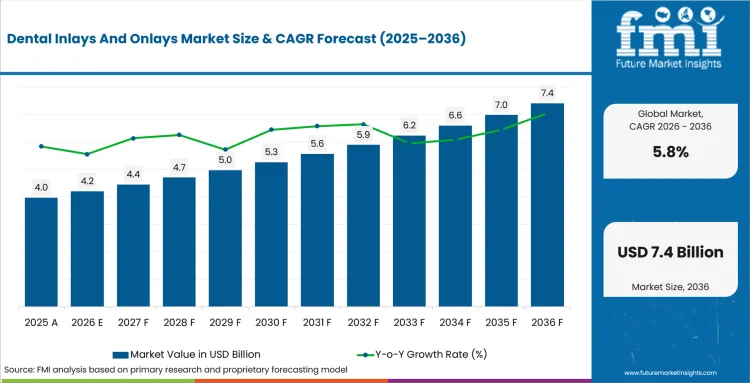
Key Takeaways of Dental Inlays And Onlays Market
- Demand is expected to grow due to posterior defects that need greater support than direct fillings without requiring complete crown preparation across suitable teeth.
- Ceramic inlays and onlays are projected to account for 36.0% share in 2026, supported by tooth-colored appearance and established milling routes.
- Posterior tooth restoration is estimated to hold 38.0% share in 2026 within application because large defects often need broader coverage than fillings provide.
- In the end user category, dental clinics are forecast to represent 47.0% share in 2026 through direct control of preparation and bonding.
- Patient payment and technique-sensitive cementation can redirect suitable cases toward fillings or complete crowns despite the benefits of partial coverage.
- Dentsply Sirona and Ivoclar lead connected digital workflows, while Solventum and specialist material companies compete through blocks plus bonding systems.
Analyst Perspective
"Dental inlays and onlays earn their place between large direct fillings and complete crowns across carefully selected posterior defects. Practices should confirm enough suitable cases to justify scanning or milling investment across routine schedules. Laboratory fabrication remains practical for irregular demand and restorations that require specialized finishing or complex shade control. Chairside production becomes more attractive for trained teams that deliver repeatable margins and bonding outcomes without costly remakes."
- Anurag Sharma, Principal Analyst, Future Market Insights
How is the Dental Inlays And Onlays Market segmented?
The dental inlays and onlays industry is segmented by Product Type, Application, End User, Distribution Channel, Material, and Region.
The market is segmented by product type, application, end user, distribution channel, material, and region. Product type includes ceramic and composite resin restorations alongside lithium disilicate plus gold and zirconia options. Application covers posterior restoration, caries treatment, cosmetic dentistry, fractured teeth, and replacement of large fillings. End-user analysis separates clinics and hospitals from dental laboratories plus academic institutes and specialty centers. Distribution channels include direct sales, dental distributors, laboratory networks, online supply platforms, and retail dental suppliers. Material analysis compares ceramics and composite resin with lithium disilicate plus gold alloys and zirconia. Regional analysis tracks payment routes and service conditions across the listed countries, while machinable dental composites provide a related view of digital material demand.
How do ceramic inlays & onlays shape demand in the product type category?
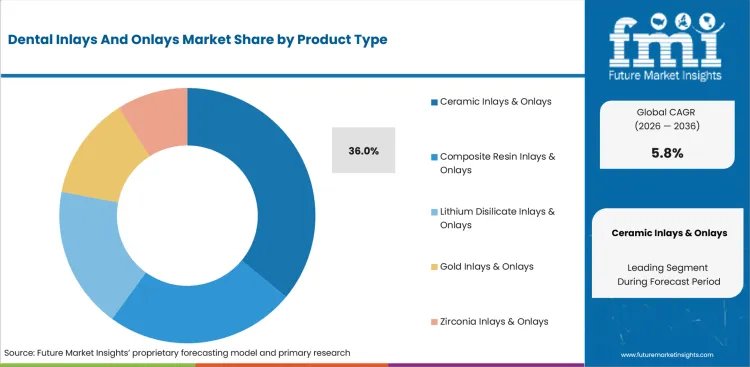
Tooth-colored partial coverage helps dentists restore weakened posterior teeth without removing the remaining walls needed for complete crowns. Ceramic selection depends on defect size and occlusal load as well as available enamel for bonding. Clinical familiarity also matters across practices that standardize preparation and finishing steps for recurring cases. Ivoclar reported in March 2025 that IPS e.max materials had been used for more than 230 million restorations worldwide. The installed history gives practices and laboratories a broad processing reference, although each case still requires suitable thickness and isolation.
- Based on product type, ceramic inlays and onlays are projected to account for 36.0% in 2026 due to their tooth-colored appearance and established digital fabrication routes. The segment covers glass-ceramic and other ceramic choices that balance appearance with strength across selected posterior defects. Its position remains strongest in practices that preserve enamel and control occlusal adjustment across repeat placement workflows.
- Ceramic inlays and onlays are drawing attention from practices that want partial cuspal support with a natural appearance. Adoption improves through consistent isolation and clear primer plus cement protocols across materials with different surface treatments. Access to dental adhesive systems can simplify inventory decisions, yet the clinical team must protect enamel and control contamination during placement.
What keeps posterior tooth restoration ahead within application?
Posterior teeth receive concentrated chewing forces and often contain large existing restorations that weaken remaining cusps. Dentsply Sirona stated in July 2025 that CEREC supports inlays and onlays through more than sixty validated materials. The validated range broadens material choice across practices that already operate suitable digital restorative workflows. Partial coverage can reinforce weakened structures without removing sound walls needed for a full crown. Same-day production also removes one laboratory transfer, although practices must control proximal contact and occlusion across the completed restoration.
- By application, posterior tooth restoration is estimated to hold 38.0% in 2026 owing to frequent molar and premolar defects that exceed reliable filling limits. The segment addresses large intracoronal defects and weakened cusps across teeth that continue to carry heavy functional loads. Dentists can preserve sound walls and provide broader support without removing the complete circumference required for a crown.
- Dental practices are expected to favour posterior inlays and onlays across defects with stable margins and manageable adjustment needs. Earlier dental caries management can identify suitable teeth with enough remaining cusp structure for partial coverage. Use remains limited across teams that cannot maintain isolation or reproduce proximal contact and occlusion across routine cases.
Which buying mechanism supports dental clinics in the end user category?
Dental clinics control diagnosis and preparation plus digital capture and final cementation within one treatment relationship. Direct workflow control supports same-day care across teams with stable case volume and reliable isolation procedures. Solventum announced a strategic partnership with SprintRay in March 2025 to develop permanent chairside printed crowns and inlays plus onlays. The agreement connects material science with in-office printing and broadens future production choices for dental clinics. Commercial adoption still depends on final product availability plus clinical validation across routine restorative cases.
- Dental clinics are set to lead the end user category with 47.0% share in 2026 due to their control of case selection and final bonding. Direct access to the preparation supports immediate try-in and adjustment across one appointment sequence during final placement. Clinics also coordinate isolation and postoperative review without transferring clinical responsibility to another production site.
- Group practices are increasingly purchasing chairside equipment as they can spread scanners and mills across several dentists. Independent clinics adopt more cautiously as irregular case volume can leave fixed equipment underused throughout the ownership period. Laboratory outsourcing remains practical for lower-volume practices that need broad material choice and specialized finishing without internal maintenance responsibilities.
What supports the position of direct sales within the distribution channel category?
Large dental groups and digital laboratories may negotiate directly for equipment and material portfolios across several operating sites. Direct relationships can combine installation and training with service responsibility under one account plan for complex digital systems. Smaller practices often rely on distributors for local stock and faster replacement support across routine consumables. Dentsply Sirona reported in February 2026 that approximately two-thirds of its consumable and technology products were sold through third-party distributors. The filing shows that direct sales remain selective across larger systems and strategic accounts requiring dedicated technical support.
- Direct sales are likely to capture 37.0% share in 2026 attributable to larger accounts seeking coordinated equipment and material support. The channel fits multi-site groups that need one installation plan and clearly assigned technical service across connected locations. Direct relationships also give manufacturers clearer demand visibility across capital equipment and recurring restorative materials.
- Purchase activity for direct sales is anticipated to rise across dental groups and laboratories that manage complex digital systems. Regional distributors remain necessary for smaller practices that need nearby inventory and service across several material brands. The wider dental consumables route therefore continues through intermediaries, while direct accounts expand around systems that justify dedicated technical ownership.
Why does ceramics lead the material category?
Ceramics provide color stability and natural optical integration across tooth-colored partial restorations for visible posterior cases. GC India documented in February 2025 that Initial LiSi Block arrives fully crystallized and can be milled without separate crystallization firing. The route removes one processing stage from suitable chairside cases and shortens production without a crystallization firing. Glass ceramics support efficient production across many chairside cases and zirconia serves selected defects that require greater strength. Final material choice still depends on preparation design and bonding conditions across the prepared tooth.
- By material, ceramics are forecast to represent 39.0% in 2026 driven by broad optical and strength options across chairside and laboratory workflows. Glass-ceramic and zirconia families address different load and appearance needs across posterior indications within clinical practice. Laboratories can also align ceramic selection with their existing milling units and firing equipment across repeat cases.
- Ceramic adoption is gaining momentum in practices that match minimum thickness and bonding procedures to each material family. Access to zirconia ceramic materials widens strength choices across selected defects with high functional demands. Glass-ceramic use remains strongest across workflows that prioritize efficient milling and dependable adhesive placement for natural optical integration.
What are the drivers, restraints, and opportunities in the Dental Inlays And Onlays Market?
Conservative partial coverage supports demand across posterior defects that exceed filling limits, yet patient cost and technique-sensitive bonding restrict conversion as connected scanning and milling create a shorter treatment route.
- Driver: Conservative partial coverage preserves sound tooth structure across posterior defects that require more support than direct fillings provide.
- Restraint: Patient cost and technique-sensitive bonding can redirect suitable cases toward lower-cost fillings or complete crown treatment.
- Opportunity: Integrated scanning and milling can shorten selected treatment routes while preserving design control across clinics and laboratories.
Conservative partial coverage is driving demand across posterior defects that need more support than direct fillings can provide. The treatment preserves more sound tooth structure than complete crown preparation across suitable posterior teeth. Material choice also affects conversion through strength requirements and the bonding route needed for dependable placement. The FDA recognized ANSI/ADA Standard 186-2024 in May 2025 for polymer-based machinable blanks used in fixed restorations. The shared testing boundary widens material competition but does not establish demand across every restorative case.
Patient payment creates one of the considerable restraint across care settings with substantial personal costs for indirect restorations. Coverage gaps redirect suitable cases toward lower-cost fillings or delayed treatment across price-sensitive patient groups. The Centers for Medicare & Medicaid Services confirmed in March 2026 that Original Medicare generally excludes routine dental services. Private dental plans apply different terms, so practices need clear fees and plain clinical explanations for every recommended restoration. Technique-sensitive cementation adds further risk through adjustments and remakes that can erase scheduling gains from digital production.
Digital integration creates the clearest operating opportunity for clinics and laboratories handling repeat indirect restorations. A reliable scan can preserve design responsibility and reduce manual handoffs between preparation and milling. The FDA product classification database listed optical impression CAD/CAM systems as Class II devices in July 2026. The classification covers systems that capture tooth topography for computer-aided design and manufacturing of restorations. Validated scanning and controlled milling can shorten selected treatment routes and allow digital dental laboratories to standardize production for several practices.
Which country CAGRs are profiled in the Dental Inlays And Onlays Market?
| Country | CAGR |
|---|---|
| Japan | 7.2% |
| Germany | 6.7% |
| USA | 6.1% |
| Australia | 5.8% |
| Brazil | 5.5% |
| Canada | 4.6% |
| UK | 4.1% |
How do country-level CAGRs compare in the Dental Inlays And Onlays Market?
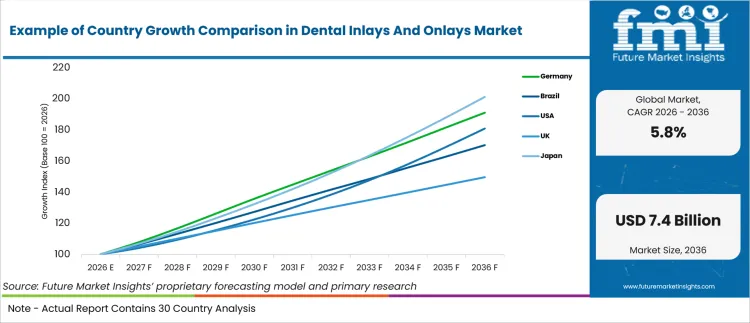
The country forecasts show a gradual progression across the dental inlays and onlays market, with growth distributed across all seven countries rather than concentrated in a small number of markets. Japan and Germany form a closely aligned upper group, reflecting strong demand for restorative dental procedures and continued adoption of advanced indirect restoration techniques. The USA, Australia and Brazil create a middle band where differences are relatively limited, indicating comparable momentum despite distinct healthcare and dental care delivery models. A more noticeable gap emerges between Brazil and Canada, after which the UK forms the lower end of the comparison.
- Japan benefits from a mature dental care system and strong emphasis on restorative treatments that preserve natural tooth structure, supporting demand for inlays and onlays across multiple patient groups.
- Germany's outlook is supported by advanced dental practice standards and broad adoption of high-quality restorative materials, including ceramic and composite-based indirect restorations.
- The USA continues to generate demand through cosmetic and restorative dentistry procedures, with digital impression systems and chairside manufacturing technologies supporting treatment adoption.
- Australia reflects steady growth as dental clinics increasingly utilize minimally invasive restorative approaches that balance durability, aesthetics and long-term oral health outcomes.
- Brazil benefits from a large dental services sector and growing patient interest in aesthetic and functional restorative treatments that offer alternatives to full-crown procedures.
- Canada's market development is influenced by increasing use of conservative restorative techniques and continued investment in modern dental technologies across private practices.
- The UK maintains demand through established restorative dentistry services, although adoption patterns are influenced by treatment funding mechanisms and patient access considerations.
Similar CAGRs do not necessarily translate into identical market opportunities. Differences in reimbursement structures, dental insurance coverage, patient spending patterns and adoption of digital dentistry technologies can significantly influence treatment volumes and material preferences. As a result, manufacturers and dental laboratories may encounter distinct competitive and commercialization conditions despite broadly comparable growth trends. The full report provides country-level CAGR analysis across North America, Latin America, Europe, East Asia, South Asia, Oceania and the Middle East and Africa.
Country-wise Analysis
- Japan’s national fee schedule names CAD/CAM inlays for premolars and molars under defined material categories. Adoption of dental inlays and onlays in Japan is estimated to expand at 7.2% CAGR through 2036, supported by a national CAD/CAM inlay fee route. The payment route gives participating clinics a clear claim path for eligible digital partial restorations. The Ministry of Health, Labour and Welfare revised the relevant dental material fees in February 2026 and retained separate CAD/CAM inlay categories. The schedule supports recognized materials and clearly defined claims across participating dental practices using eligible digital restorations. Metropolitan clinics can access established equipment distributors and structured training networks across Japan’s major dental service hubs. Smaller regional practices face lower milling utilization and longer service travel across limited local case volume. Manufacturers need local maintenance coverage and structured training before chairside systems expand beyond dense urban networks.
- Germany combines skilled dental laboratories with statutory coverage rules that distinguish basic fillings from premium indirect restorations. Patient payment remains central as insured adults fund the added cost of inlays beyond the covered filling allowance. Dental inlay and onlay demand in Germany is forecast to rise at 6.7% CAGR over the forecast period, influenced by laboratory capacity and private payment. KZBV stated in January 2025 that patients choosing inlays must sign an added-cost agreement prior to treatment. German practices can commission laboratory inlays or use chairside CAD/CAM across suitable case volumes in daily restorative care. Laboratory access lowers the need for every practice to own milling equipment across irregular demand. Price sensitivity remains the main friction due to the continued availability of covered filling alternatives through statutory care.
- United States dental practices combine private purchasing freedom with broad distributor networks and several chairside system options. Private benefits can support inlays and onlays, although coverage depends on the selected plan and clinical necessity. In January 2025, the Office of Personnel Management Delta Dental brochure listed ceramic and metallic inlay plus onlay procedure codes under federal employee coverage. Dental inlay and onlay sales in the USA are forecast to expand at 6.1% CAGR by 2036, supported by private plan coverage and chairside systems. The plan also limits payment across teeth that can be restored adequately with lower-cost filling materials. Practice economics improve across groups with enough suitable cases to use scanners and mills consistently. Smaller offices face training costs and equipment underuse across irregular partial-restoration demand during normal schedules.
- Australia concentrates advanced restorative services in metropolitan areas and regional practices manage longer travel for equipment support. Veteran funding provides a defined payment route for eligible indirect posterior restorations under national claims rules. Australia’s dental inlays and onlays market is estimated to post 5.8% CAGR over the forecast period, shaped by metropolitan service access and veteran benefits. The Department of Veterans’ Affairs updated its dental fee schedules in July 2026 and identified current restrictions plus approval requirements for covered services. DVA provider guidance also separates routine Schedule C claims from services that need prior financial authorization. Urban practices can use national distributors and outsourced laboratory production across several ceramic and composite material families. Lower case density outside major cities weakens chairside milling economics and increases service risk during equipment downtime.
- Brazil combines large private dental centers with a new federal procedure route for digitally manufactured partial restorations. By 2036, Brazil’s dental inlays and onlays market is projected to grow at 5.5% CAGR through a defined digital procedure route in SUS. The Ministry of Health added a fixed single-unit digital prosthesis procedure in May 2026 that explicitly includes indirect onlays and inlays. The measure creates a defined SUS production and payment route across eligible public laboratories and clinics. Private practices in major cities also support premium materials and chairside systems through concentrated patient demand. Implementation depends on local scanning and milling capacity plus trained technical staff across public facilities. Imported equipment costs and uneven service coverage remain material barriers outside established urban dental networks and technical hubs.
- Canada combines national benefit programs with provincial delivery differences and private practice purchasing across dispersed population centers. Federal employee coverage provides a direct payment enabler for eligible inlays and onlays after the annual deductible. Patient contributions and regional service distance remain material frictions across other plans and smaller communities. Canada’s dental inlays and onlays outlook is anticipated to advance at 4.6% CAGR over the assessment period, supported by defined federal employee coverage. The Public Service Dental Care Plan confirmed in January 2025 that major restorative coverage increased to 65% for eligible expenses. The plan gives covered members a clear reimbursement route without representing universal access across Canadian patients. Laboratory outsourcing can protect material choice across practices that cannot justify dedicated chairside production equipment.
- The UK combines NHS dentistry with private restorative routes across practices facing uneven appointment capacity. Band 3 treatment gives eligible inlays and onlays a defined public payment route in England. The UK dental inlays and onlays sector is projected to record 4.1% CAGR during the assessment period, influenced by NHS and private treatment routes. The NHS confirmed in March 2025 that Band 3 treatment can include restoration with inlays and onlays. Adult patient charges and local appointment availability still affect completed treatment across the public route. Private practices and laboratories provide wider material choice for complex cases outside standard public pathways. Digital workflow providers need laboratory partnerships and regional service coverage as chairside economics vary sharply by practice volume.
Who are the notable companies in the Dental Inlays And Onlays Market?
Dentsply Sirona, Ivoclar, Solventum, GC Corporation, Kuraray Noritake Dental, VITA Zahnfabrik, COLTENE Group, and VOCO GmbH are the notable companies shaping this market.
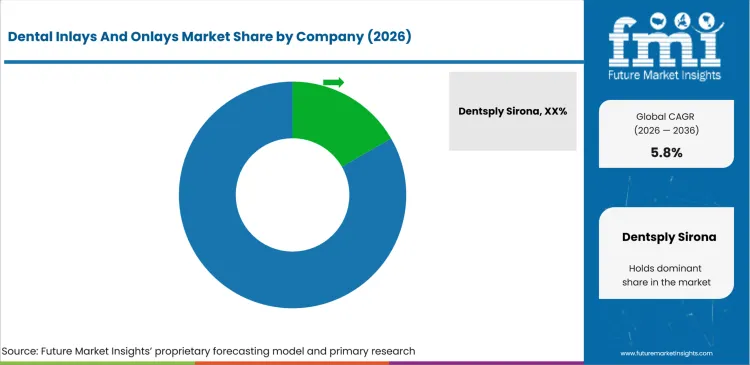
Competition is moderately concentrated around companies that control connected digital workflows or broad restorative material systems across several treatment routes. Dentsply Sirona offers a proprietary chairside path from scanning through design and milling, giving practices one accountable system for same-day production. Ivoclar and GC Corporation combine machinable material families with coordinated bonding choices, whereas Solventum and Kuraray Noritake Dental influence final placement. VITA Zahnfabrik competes through ceramics validated across different milling environments and specialist companies focus on composite blocks with named equipment compatibility. Practices often combine open scanners with third-party materials and laboratory support, so focused entrants need dependable training plus technical service to expand beyond individual accounts.
- Dentsply Sirona and Ivoclar compete for practices that want coordinated design and production across established digital workflows. Dentsply Sirona controls a proprietary chairside system, while Ivoclar extends material compatibility across its own and partner milling units. Selection depends on existing equipment plus service response and the restoration material preferred across each practice or laboratory workflow.
- GC Corporation and VITA Zahnfabrik compete through ceramic families that support chairside and laboratory production. COLTENE Group and VOCO GmbH offer machinable composite blocks across named milling systems used by clinics and laboratories. Material specialists gain entry through compatibility and simpler finishing rather than scanner ownership, with printed dental restorations providing an adjacent production route.
- Solventum and Kuraray Noritake Dental shape placement through coordinated adhesives and resin cements used across indirect restorations. Their products can enter an established practice without requiring replacement of its current scanner or milling equipment. Repeat purchasing depends on simple surface treatment and dependable bonding across ceramic and composite materials, supported by permanent cement systems for defined placement routes.
Competitive Benchmarking: Dental Inlays And Onlays Market
| Company | CAD/CAM Material Breadth | Bonding Workflow | Chairside System Integration | Geographic Reach |
|---|---|---|---|---|
| Dentsply Sirona | High | High | High | Global |
| Ivoclar | High | High | Medium | Global |
| Solventum | Medium | High | Low | Global |
| GC Corporation | High | High | Medium | Global |
| Kuraray Noritake Dental | Medium | High | Medium | Global |
| VITA Zahnfabrik | High | High | Medium | Global |
| COLTENE Group | Medium | Medium | Medium | Multi-country |
| VOCO GmbH | Medium | High | Medium | Multi-country |
Key Developments in the Dental Inlays And Onlays Market
- In September 2025, Dentsply Sirona announced an expanded AI-powered CEREC workflow with margin and design proposals for crowns plus inlays and onlays inside DS Core. The company also introduced new milling units and Cercon 4D zirconia blocks for single-visit production. The release reduces manual design steps and gives practices additional equipment choices across different capital budgets. Its commercial effect depends on regular case volume and dependable staff training across the complete chairside workflow.
- In October 2025, Ivoclar and vhf expanded their partnership by validating IPS e.max CAD processing across the vhf N4+ plus Z4 and E4 milling machines. The companies aligned material holders and software with approved milling strategies for reproducible lithium disilicate processing across validated equipment. The validation widens equipment choice for practices and laboratories that want lithium disilicate production without changing the established material or cementation workflow.
- In October 2025, Ivoclar launched IPS e.max Ceram Art with ready-to-use stains and glazes plus structure pastes for ceramic restorations. The materials support press and CAD/CAM techniques across monolithic and layered ceramic work handled by dental laboratories. The launch gives laboratories a coordinated finishing route for repeatable surface texture and shade characterization across lithium disilicate and zirconia restorations. Its value is strongest across ceramic laboratories that standardize finishing procedures across several restoration types.
- In June 2025, VITA Zahnfabrik and UP3D announced a validated workflow covering the complete VITA CAD/CAM material portfolio across three UP3D milling machines. The collaboration includes feldspar ceramic and hybrid ceramic plus zirconia materials through coordinated milling parameters. The route gives laboratories and clinics broader material flexibility without relying on untested processing combinations across open digital production. It also reduces qualification work for teams adopting additional VITA material families within validated digital workflows.
Dental Inlays And Onlays Market - Report Scope
| Coverage field | Report scope |
|---|---|
| Market breakdown | Product Type, Application, End User, Distribution Channel, Material, and Region. |
| Market Definition | Indirect intracoronal and partial-cuspal restorations fabricated from ceramic, composite, metal, or hybrid materials through laboratories or chairside digital workflows. |
| Regions Covered | North America, Latin America, Western Europe, Eastern Europe, East Asia, South Asia and Pacific, and the Middle East and Africa. |
| Countries Covered | Japan, Germany, USA, Australia, Brazil, Canada, and UK. |
| Key Companies Profiled | Dentsply Sirona, Ivoclar, Solventum, GC Corporation, Kuraray Noritake Dental, VITA Zahnfabrik, COLTENE Group, and VOCO GmbH. |
| Forecast Period | 2026 to 2036. |
| Approach | Hybrid bottom-up and top-down market sizing supported by primary interviews and official desk research. |
Dental Inlays And Onlays Market - Research Methodology
| Method | Approach |
|---|---|
| Primary Research | FMI analysts gathered input from manufacturers, service providers, technology developers, distributors, end users, procurement teams, and subject-matter experts. Interviews examined purchasing decisions, product or service evaluation, adoption barriers, approval requirements, pricing considerations, and expectations for technical or commercial support. Respondents were also asked what evidence is required before a trial, pilot, or initial order develops into regular purchasing. |
| Desk Research | Desk research covered government statistics, regulatory publications, trade data, industry associations, technical literature, standards, company filings, product information, and official corporate announcements. Sources were reviewed for relevance, publication date, geographic coverage, and consistency with the defined market scope. Claims relating to performance, applications, approvals, capacity, investment, and commercial activity were retained only when supported by credible public evidence. |
| Market Sizing and Forecasting | The market model combined the baseline value with historical performance, segment structure, pricing and volume indicators, adoption levels, company participation, and country-level demand conditions. Forecast assumptions considered economic activity, investment trends, regulatory developments, technology adoption, purchasing cycles, supply availability, and barriers to wider market use. Segment and regional estimates were reconciled before the final market total was calculated. |
| Data Validation | Estimates were checked against multiple independent indicators, including public data, company activity, trade patterns, industry developments, and findings from primary interviews. Validation also tested whether products, services, applications, and company revenues fell within the defined market boundaries. Adjacent categories, unsupported claims, overlapping revenues, and activities without direct market relevance were excluded to reduce double counting and maintain consistency across segments and countries. |
Dental Inlays And Onlays Market by Segments
Dental Inlays And Onlays Market segmented by Product Type:
- Ceramic Inlays & Onlays
- Feldspathic Ceramic
- Leucite-Reinforced Ceramic
- Composite Resin Inlays & Onlays
- Nanohybrid Composite
- Microhybrid Composite
- Lithium Disilicate Inlays & Onlays
- Pressed Lithium Disilicate
- CAD/CAM Lithium Disilicate
- Gold Inlays & Onlays
- High Noble Gold Alloys
- Noble Gold Alloys
- Zirconia Inlays & Onlays
- Monolithic Zirconia
- Multilayer Zirconia
Dental Inlays And Onlays Market segmented by Application:
- Posterior Tooth Restoration
- Molar Restoration
- Premolar Restoration
- Caries Treatment
- Moderate Dental Caries
- Extensive Dental Caries
- Cosmetic Dentistry
- Esthetic Smile Restoration
- Discolored Tooth Restoration
- Fractured Tooth Restoration
- Cusp Replacement
- Crack Repair
- Replacement of Large Fillings
- Amalgam Filling Replacement
- Composite Filling Replacement
Dental Inlays And Onlays Market segmented by End User:
- Dental Clinics
- Private Dental Clinics
- Group Dental Practices
- Hospitals
- General Hospitals
- Dental Departments
- Dental Laboratories
- Full-Service Dental Labs
- Digital Dental Labs
- Academic & Research Institutes
- Dental Schools
- Research Centers
- Specialty Dental Centers
- Cosmetic Dentistry Centers
- Prosthodontic Clinics
Dental Inlays And Onlays Market segmented by Distribution Channel:
- Direct Sales
- Direct Manufacturer Sales
- Key Account Contracts
- Dental Distributors
- National Distributors
- Regional Distributors
- Dental Laboratories
- CAD/CAM Laboratory Networks
- Custom Fabrication Centers
- Online Dental Supply Platforms
- B2B E-Commerce
- Digital Purchasing Platforms
- Retail Dental Suppliers
- Dental Equipment Stores
- Specialty Dental Retailers
Dental Inlays And Onlays Market segmented by Material:
- Ceramics
- Feldspathic Ceramic
- Glass Ceramic
- Composite Resin
- Nanocomposite Resin
- Hybrid Composite Resin
- Lithium Disilicate
- Pressed Lithium Disilicate
- Milled Lithium Disilicate
- Gold Alloys
- High Noble Alloy
- Noble Alloy
- Zirconia
- Translucent Zirconia
- High-Strength Zirconia
Dental Inlays And Onlays Market by Region:
- North America
- United States
- Canada
- Latin America
- Brazil
- Mexico
- Argentina
- Chile
- Western Europe
- Germany
- France
- United Kingdom
- Italy
- Spain
- Benelux
- Nordics
- Eastern Europe
- Poland
- Czech Republic
- Romania
- Hungary
- East Asia
- China
- Japan
- South Korea
- South Asia and Pacific
- India
- ASEAN
- Australia and New Zealand
- Middle East and Africa
- GCC Countries
- South Africa
- Türkiye
- Israel
Research Sources and Bibliography
- American Dental Association. (2025, November 11).
- USA Food and Drug Administration. (2025, May 26)
- Ivoclar. (2025, March 24).
- Dentsply Sirona. (2025, July 7).
- Solventum. (2025, March 25).
- Dentsply Sirona Inc. (2026, February 26)
- GC India. (2025, February 12).
- USA. Food and Drug Administration. (2025, May 26).
- Centers for Medicare & Medicaid Services. (2026, March 10).
- USA Food and Drug Administration. (2026, July 20).
- Ministry of Health, Labour and Welfare. (2026, February 27).
- Kassenzahnärztliche Bundesvereinigung. (2025, January).
- USA Office of Personnel Management. (2025, January 1).
- Ministério da Saúde. (2026, May 26)
- Treasury Board of Canada Secretariat. (2025, January 16).
- National Health Service. (2025, March 13).
- Dentsply Sirona. (2025, September 8)
- Ivoclar. (2025, October 21).
- Ivoclar. (2025, October 13).
- VITA Zahnfabrik. (2025, June 26).
- Solventum Corporation. (2026, February 27)
- Kuraray Co., Ltd. (2025, May 30).
- COLTENE Group. (2025, May).
- VITA Zahnfabrik. (2023, July).
This bibliography is provided for reader reference and is not exhaustive. The full report contains the complete reference list and detailed citations.
This Report Answers
- How large is the dental inlays and onlays market in 2026 and 2036?
- Which posterior defects create a clinical role for partial-coverage restorations?
- Why do ceramic inlays and onlays hold the largest product type share during 2026?
- How does posterior tooth restoration influence material and workflow selection?
- Why do dental clinics account for the largest end user share during 2026?
- How do payment and service conditions differ across seven profiled countries?
- Which companies provide digital workflows plus materials and bonding systems?
- What limits adoption across patient payment and preparation plus cementation requirements?
- How should clinics compare chairside production with laboratory fabrication for suitable cases?
Frequently Asked Questions
How big is the Dental Inlays and Onlays Market in 2026?
The dental inlays and onlays market is valued at USD 4.2 billion in 2026 and is forecast to reach USD 7.4 billion by 2036. Growth is supported by posterior tooth defects that exceed reliable filling limits and sustain recurring demand for partial-coverage restorations across dental clinics and laboratories using chairside digital workflows and outsourced ceramic fabrication routes.
What is the CAGR of the Dental Inlays and Onlays Market from 2026 to 2036?
The dental inlays and onlays market grows at a CAGR of 5.8% between 2026 and 2036, supported by dental practices adopting integrated scanning and milling systems once repeatable margin capture and bonding outcomes are validated within routine restorative schedules across clinics handling sufficient posterior indirect restoration volume to justify chairside capital investment.
Which material leads the Dental Inlays and Onlays Market?
Ceramics account for 39.0% of the dental inlays and onlays market by material in 2026, driven by broad optical and strength options that address different posterior load and appearance requirements across chairside and laboratory workflows, where glass-ceramic families support efficient milling and zirconia extends coverage to selected defects carrying higher functional demands.
How much will the Dental Inlays and Onlays Market add between 2026 and 2036?
The dental inlays and onlays market is set to add USD 3.2 billion between 2026 and 2036, growing from USD 4.2 billion to USD 7.4 billion as ceramic and composite indirect restorations enter broader clinical use through integrated scanning, milling, and bonding systems across a widening base of dental clinics, group practices, and digital laboratory networks globally.
Who are the leading companies in the Dental Inlays and Onlays Market?
Notable companies competing in the dental inlays and onlays market include Dentsply Sirona, Ivoclar, Solventum, GC Corporation, Kuraray Noritake Dental, VITA Zahnfabrik, COLTENE Group, and VOCO GmbH, differentiating through CAD/CAM material breadth, coordinated bonding workflow depth, chairside system integration capability, and the geographic reach of their distributor and clinical training networks.
Preview the report firsthand - request a free sample
Get SampleGet the brochure for pricing and purchase details.
Get PDFTable of Content
- Key Takeaways
- Market Size and CAGR
- Top Growth Driver
- Fastest Growing Segment
- Leading Region
- Key Companies
- Emerging Opportunities
- Executive Summary
- Global Market Outlook
- Demand-side Trends
- Supply-side Trends
- Technology Roadmap Analysis
- Analysis and Recommendations
- Analyst Perspective (What is happening? Why now? What should investors know?)
- Key Questions Answered
- How large is the market?
- What is the CAGR?
- What are key trends?
- Which region dominates?
- Who are the leaders?
- Market Overview
- Market Coverage / Taxonomy
- Market Definition / Scope / Limitations
- Research Methodology
- Chapter Orientation
- Analytical Lens and Working Hypotheses
- Market Structure, Signals, and Trend Drivers
- Benchmarking and Cross-market Comparability
- Market Sizing, Forecasting, and Opportunity Mapping
- Research Design and Evidence Framework
- Desk Research Programme (Secondary Evidence)
- Expert Input and Fieldwork (Primary Evidence)
- Tooling, Models, and Reference Databases
- Data Engineering and Model Build
- Quality Assurance and Audit Trail
- Market Background
- Market Dynamics (Drivers, Restraints, Opportunity, Trends)
- Scenario Forecast (Optimistic, Likely, Conservative)
- Impact Analysis
- AI Impact
- Sustainability Impact
- Regulatory Impact
- Technology Impact
- Consumer / Buyer Analysis
- Purchase Drivers
- Adoption Barriers
- Buyer Journey
- Opportunity Map Analysis
- Product Life Cycle Analysis
- Supply Chain Analysis
- Investment Feasibility Matrix
- Value Chain Analysis
- PESTLE and Porter's Analysis
- Regulatory Landscape
- Regional Parent Market Outlook
- Production and Consumption Statistics
- Import and Export Statistics
- Global Market Analysis and Forecast, 2021 to 2036
- Historical Market Size Value (USD Billion) Analysis, 2021 to 2025
- Current and Future Market Size Value (USD Billion) Projections, 2026 to 2036
- Y-o-Y Growth Trend Analysis
- Absolute $ Opportunity Analysis
- Global Market Pricing Analysis, 2021 to 2036
- Global Market Analysis and Forecast, By Product Type, 2021 to 2036
- Introduction / Key Findings
- Historical Market Size Value (USD Billion) Analysis By Product Type, 2021 to 2025
- Current and Future Market Size Value (USD Billion) Analysis and Forecast By Product Type, 2026 to 2036
- Ceramic Inlays & Onlays
- Feldspathic Ceramic
- Leucite-Reinforced Ceramic
- Composite Resin Inlays & Onlays
- Nanohybrid Composite
- Microhybrid Composite
- Lithium Disilicate Inlays & Onlays
- Pressed Lithium Disilicate
- CAD/CAM Lithium Disilicate
- Gold Inlays & Onlays
- High Noble Gold Alloys
- Noble Gold Alloys
- Zirconia Inlays & Onlays
- Monolithic Zirconia
- Multilayer Zirconia
- Ceramic Inlays & Onlays
- Y-o-Y Growth Trend Analysis By Product Type, 2021 to 2025
- Absolute $ Opportunity Analysis By Product Type, 2026 to 2036
- Global Market Analysis and Forecast, By Application, 2021 to 2036
- Introduction / Key Findings
- Historical Market Size Value (USD Billion) Analysis By Application, 2021 to 2025
- Current and Future Market Size Value (USD Billion) Analysis and Forecast By Application, 2026 to 2036
- Posterior Tooth Restoration
- Molar Restoration
- Premolar Restoration
- Caries Treatment
- Moderate Dental Caries
- Extensive Dental Caries
- Cosmetic Dentistry
- Esthetic Smile Restoration
- Discolored Tooth Restoration
- Fractured Tooth Restoration
- Cusp Replacement
- Crack Repair
- Replacement of Large Fillings
- Amalgam Filling Replacement
- Composite Filling Replacement
- Posterior Tooth Restoration
- Y-o-Y Growth Trend Analysis By Application, 2021 to 2025
- Absolute $ Opportunity Analysis By Application, 2026 to 2036
- Global Market Analysis and Forecast, By End User, 2021 to 2036
- Introduction / Key Findings
- Historical Market Size Value (USD Billion) Analysis By End User, 2021 to 2025
- Current and Future Market Size Value (USD Billion) Analysis and Forecast By End User, 2026 to 2036
- Dental Clinics
- Private Dental Clinics
- Group Dental Practices
- Hospitals
- General Hospitals
- Dental Departments
- Dental Laboratories
- Full-Service Dental Labs
- Digital Dental Labs
- Academic & Research Institutes
- Dental Schools
- Research Centers
- Specialty Dental Centers
- Cosmetic Dentistry Centers
- Prosthodontic Clinics
- Dental Clinics
- Y-o-Y Growth Trend Analysis By End User, 2021 to 2025
- Absolute $ Opportunity Analysis By End User, 2026 to 2036
- Global Market Analysis and Forecast, By Distribution Channel, 2021 to 2036
- Introduction / Key Findings
- Historical Market Size Value (USD Billion) Analysis By Distribution Channel, 2021 to 2025
- Current and Future Market Size Value (USD Billion) Analysis and Forecast By Distribution Channel, 2026 to 2036
- Direct Sales
- Direct Manufacturer Sales
- Key Account Contracts
- Dental Distributors
- National Distributors
- Regional Distributors
- Dental Laboratories
- CAD/CAM Laboratory Networks
- Custom Fabrication Centers
- Online Dental Supply Platforms
- B2B E-Commerce
- Digital Procurement Platforms
- Retail Dental Suppliers
- Dental Equipment Stores
- Specialty Dental Retailers
- Direct Sales
- Y-o-Y Growth Trend Analysis By Distribution Channel, 2021 to 2025
- Absolute $ Opportunity Analysis By Distribution Channel, 2026 to 2036
- Global Market Analysis and Forecast, By Material, 2021 to 2036
- Introduction / Key Findings
- Historical Market Size Value (USD Billion) Analysis By Material, 2021 to 2025
- Current and Future Market Size Value (USD Billion) Analysis and Forecast By Material, 2026 to 2036
- Ceramics
- Feldspathic Ceramic
- Glass Ceramic
- Composite Resin
- Nanocomposite Resin
- Hybrid Composite Resin
- Lithium Disilicate
- Pressed Lithium Disilicate
- Milled Lithium Disilicate
- Gold Alloys
- High Noble Alloy
- Noble Alloy
- Zirconia
- Translucent Zirconia
- High-Strength Zirconia
- Ceramics
- Y-o-Y Growth Trend Analysis By Material, 2021 to 2025
- Absolute $ Opportunity Analysis By Material, 2026 to 2036
- Global Market Analysis and Forecast, By Region, 2021 to 2036
- Introduction
- Historical Market Size Value (USD Billion) Analysis By Region, 2021 to 2025
- Current Market Size Value (USD Billion) Analysis and Forecast By Region, 2026 to 2036
- North America
- Latin America
- Western Europe
- Eastern Europe
- East Asia
- South Asia and Pacific
- Middle East & Africa
- Market Attractiveness Analysis By Region
- North America Market Analysis and Forecast, By Country, 2021 to 2036
- Historical Market Size Value (USD Billion) Trend Analysis By Market Taxonomy, 2021 to 2025
- Market Size Value (USD Billion) Forecast By Market Taxonomy, 2026 to 2036
- By Country
- USA
- Canada
- By Product Type
- By Application
- By End User
- By Distribution Channel
- By Material
- By Country
- Market Attractiveness Analysis
- By Country
- By Product Type
- By Application
- By End User
- By Distribution Channel
- By Material
- Key Takeaways
- Latin America Market Analysis and Forecast, By Country
- Historical Market Size Value (USD Billion) Trend Analysis By Market Taxonomy, 2021 to 2025
- Market Size Value (USD Billion) Forecast By Market Taxonomy, 2026 to 2036
- By Country
- Brazil
- Mexico
- Chile
- Rest of Latin America
- By Product Type
- By Application
- By End User
- By Distribution Channel
- By Material
- By Country
- Market Attractiveness Analysis
- By Country
- By Product Type
- By Application
- By End User
- By Distribution Channel
- By Material
- Key Takeaways
- Western Europe Market Analysis and Forecast, By Country
- Historical Market Size Value (USD Billion) Trend Analysis By Market Taxonomy, 2021 to 2025
- Market Size Value (USD Billion) Forecast By Market Taxonomy, 2026 to 2036
- By Country
- Germany
- UK
- Italy
- Spain
- France
- Nordic
- BENELUX
- Rest of Western Europe
- By Product Type
- By Application
- By End User
- By Distribution Channel
- By Material
- By Country
- Market Attractiveness Analysis
- By Country
- By Product Type
- By Application
- By End User
- By Distribution Channel
- By Material
- Key Takeaways
- Eastern Europe Market Analysis and Forecast, By Country
- Historical Market Size Value (USD Billion) Trend Analysis By Market Taxonomy, 2021 to 2025
- Market Size Value (USD Billion) Forecast By Market Taxonomy, 2026 to 2036
- By Country
- Russia
- Poland
- Hungary
- Balkan & Baltic
- Rest of Eastern Europe
- By Product Type
- By Application
- By End User
- By Distribution Channel
- By Material
- By Country
- Market Attractiveness Analysis
- By Country
- By Product Type
- By Application
- By End User
- By Distribution Channel
- By Material
- Key Takeaways
- East Asia Market Analysis and Forecast, By Country
- Historical Market Size Value (USD Billion) Trend Analysis By Market Taxonomy, 2021 to 2025
- Market Size Value (USD Billion) Forecast By Market Taxonomy, 2026 to 2036
- By Country
- China
- Japan
- South Korea
- By Product Type
- By Application
- By End User
- By Distribution Channel
- By Material
- By Country
- Market Attractiveness Analysis
- By Country
- By Product Type
- By Application
- By End User
- By Distribution Channel
- By Material
- Key Takeaways
- South Asia and Pacific Market Analysis and Forecast, By Country
- Historical Market Size Value (USD Billion) Trend Analysis By Market Taxonomy, 2021 to 2025
- Market Size Value (USD Billion) Forecast By Market Taxonomy, 2026 to 2036
- By Country
- India
- ASEAN
- Australia & New Zealand
- Rest of South Asia and Pacific
- By Product Type
- By Application
- By End User
- By Distribution Channel
- By Material
- By Country
- Market Attractiveness Analysis
- By Country
- By Product Type
- By Application
- By End User
- By Distribution Channel
- By Material
- Key Takeaways
- Middle East & Africa Market Analysis and Forecast, By Country
- Historical Market Size Value (USD Billion) Trend Analysis By Market Taxonomy, 2021 to 2025
- Market Size Value (USD Billion) Forecast By Market Taxonomy, 2026 to 2036
- By Country
- Kingdom of Saudi Arabia
- Other GCC Countries
- Türkiye
- South Africa
- Other African Union
- Rest of Middle East & Africa
- By Product Type
- By Application
- By End User
- By Distribution Channel
- By Material
- By Country
- Market Attractiveness Analysis
- By Country
- By Product Type
- By Application
- By End User
- By Distribution Channel
- By Material
- Key Takeaways
- Key Countries Market Analysis
- USA
- Pricing Analysis
- Market Share Analysis, 2025
- By Product Type
- By Application
- By End User
- By Distribution Channel
- By Material
- Canada
- Pricing Analysis
- Market Share Analysis, 2025
- By Product Type
- By Application
- By End User
- By Distribution Channel
- By Material
- Mexico
- Pricing Analysis
- Market Share Analysis, 2025
- By Product Type
- By Application
- By End User
- By Distribution Channel
- By Material
- Brazil
- Pricing Analysis
- Market Share Analysis, 2025
- By Product Type
- By Application
- By End User
- By Distribution Channel
- By Material
- Chile
- Pricing Analysis
- Market Share Analysis, 2025
- By Product Type
- By Application
- By End User
- By Distribution Channel
- By Material
- Germany
- Pricing Analysis
- Market Share Analysis, 2025
- By Product Type
- By Application
- By End User
- By Distribution Channel
- By Material
- UK
- Pricing Analysis
- Market Share Analysis, 2025
- By Product Type
- By Application
- By End User
- By Distribution Channel
- By Material
- Italy
- Pricing Analysis
- Market Share Analysis, 2025
- By Product Type
- By Application
- By End User
- By Distribution Channel
- By Material
- Spain
- Pricing Analysis
- Market Share Analysis, 2025
- By Product Type
- By Application
- By End User
- By Distribution Channel
- By Material
- France
- Pricing Analysis
- Market Share Analysis, 2025
- By Product Type
- By Application
- By End User
- By Distribution Channel
- By Material
- India
- Pricing Analysis
- Market Share Analysis, 2025
- By Product Type
- By Application
- By End User
- By Distribution Channel
- By Material
- ASEAN
- Pricing Analysis
- Market Share Analysis, 2025
- By Product Type
- By Application
- By End User
- By Distribution Channel
- By Material
- Australia & New Zealand
- Pricing Analysis
- Market Share Analysis, 2025
- By Product Type
- By Application
- By End User
- By Distribution Channel
- By Material
- China
- Pricing Analysis
- Market Share Analysis, 2025
- By Product Type
- By Application
- By End User
- By Distribution Channel
- By Material
- Japan
- Pricing Analysis
- Market Share Analysis, 2025
- By Product Type
- By Application
- By End User
- By Distribution Channel
- By Material
- South Korea
- Pricing Analysis
- Market Share Analysis, 2025
- By Product Type
- By Application
- By End User
- By Distribution Channel
- By Material
- Russia
- Pricing Analysis
- Market Share Analysis, 2025
- By Product Type
- By Application
- By End User
- By Distribution Channel
- By Material
- Poland
- Pricing Analysis
- Market Share Analysis, 2025
- By Product Type
- By Application
- By End User
- By Distribution Channel
- By Material
- Hungary
- Pricing Analysis
- Market Share Analysis, 2025
- By Product Type
- By Application
- By End User
- By Distribution Channel
- By Material
- Kingdom of Saudi Arabia
- Pricing Analysis
- Market Share Analysis, 2025
- By Product Type
- By Application
- By End User
- By Distribution Channel
- By Material
- Türkiye
- Pricing Analysis
- Market Share Analysis, 2025
- By Product Type
- By Application
- By End User
- By Distribution Channel
- By Material
- South Africa
- Pricing Analysis
- Market Share Analysis, 2025
- By Product Type
- By Application
- By End User
- By Distribution Channel
- By Material
- USA
- Market Structure Analysis
- Competition Dashboard
- Competition Benchmarking
- Market Share Analysis of Top Players
- By Regional
- By Product Type
- By Application
- By End User
- By Distribution Channel
- By Material
- Emerging Startups
- Innovation Benchmarking
- Competition Analysis
- Competition Deep Dive
- Dentsply Sirona
- Overview
- Product Portfolio
- Profitability by Market Segments
- Sales Footprint
- Strategy Overview
- Marketing Strategy
- Product Strategy
- Channel Strategy
- Ivoclar Vivadent
- 3M
- GC Corporation
- Kuraray Noritake Dental
- VITA Zahnfabrik
- COLTENE Group
- VOCO GmbH
- Envista Holdings
- Shofu Inc.
- Dentsply Sirona
- Case Studies
- Success Stories
- Recent Developments
- Competition Deep Dive
- Assumptions & Acronyms Used


