

- Market Size (2026)
- USD 188.0 Mn
- Forecast (2036)
- USD 1751.0 Mn
- CAGR (2026 to 2036)
- 25.0%
How big is the Dental Implant Robotics Market in 2026?
USD 188.0 million in 2026 and USD 1,751.0 million by 2036 at a 25.0% CAGR.
Demand for dental implant robotics is projected to expand at 25.0% CAGR between 2026 and 2036. Market value rises from USD 188.0 million in 2026 to USD 1,751.0 million by 2036. Implant surgery leaves little room for error near nerves and thin bone; a misplaced drill path can limit the final crown position or add corrective work. Neocis reported in January 2026 that clinicians had completed more than 100,000 Yomi-guided osteotomies. That record shows that robotic guidance has entered repeat clinical use and increases demand for dental implantology software that links scan review with the planned drill path.
Commercial rollout is expected to remain steady in the United States than in the European Union through 2036. The United States offers one federal FDA clearance route for devices sold across the country. European adoption depends on separate national decisions for training and capital investment across each member state. WITS data in 2024 reported that United States dental-fitting import reached USD 337.6 million. Dental fittings do not measure robot sales but they show the scale of the implant supply base that robotic systems can serve. Clinics therefore judge each platform by scan compatibility and drill control across the cases they perform most often. The investment case for dental imaging equipment improves as the system removes planning steps and fits the surgeon's normal procedure.
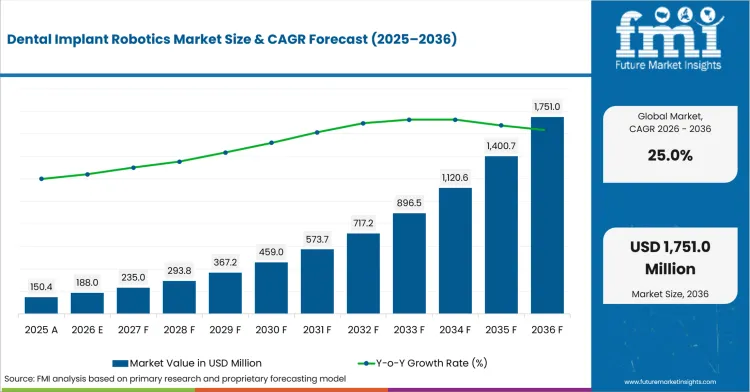
Key Takeaways of Dental Implant Robotics Market
- Demand for dental implant robotics is driven by the need to keep drill paths closer to the digital plan during routine and complex implant cases, turning placement consistency into a measurable operating goal.
- By technology, haptic-guided robotic arms are expected to lead with 56.0% share in 2026, valued for physical restraint that remains under surgeon control.
- Single implant placement is the dominant application segment, projected to hold 44.0% share in 2026, offering new users a familiar starting point for training.
- Systems are estimated to lead the component category with 54.0% share in 2026, reflecting the cost of the robot and planning software.
- Faster planning and direct scan transfer remain key value drivers, reducing setup work and helping clinicians use the same process across multiple treatment rooms, with investment cases depending on monthly implant volume.
- The United States and European Union are expected to grow at 26.0% and 23.0% CAGR respectively through 2036, with the gap reflecting slower commercial rollout across Europe's fragmented national purchasing rather than weaker clinical demand.
- Competition centers on Neocis, Yakebot Technology, Beijing Baihui Weikang, Dcarer, X-Nav Technologies, ClaroNav, Planmeca, Dentsply Sirona, and Carestream Dental, with vendors differentiating through physical guidance versus live navigation approaches and imaging/planning software integration.
Analyst Perspective
"The robotic dental implant systems market is gaining acceptance as dental practices focus on improving procedural consistency, clinical efficiency, and long-term workflow optimization rather than isolated technology demonstrations. Investment decisions are increasingly shaped by how well robotic guidance integrates with routine implant planning, imaging systems, and day-to-day clinical operations. Companies that simplify adoption through intuitive workflows, dependable service, and seamless digital connectivity are expected to build stronger relationships with multi-clinic dental networks and specialist implant centers."
- Anurag Sharma, Principal Analyst at Future Market Insights
Source: FMI's proprietary forecasting model and primary research
How is the Dental Implant Robotics Market segmented?
technology, application, component, end user, business model, and region
The market uses six lenses covering technology, application, component, end user, business model and region complete the scope. Technology separates haptic robotic arms from live navigation systems and automated drilling support used during implant procedures. Application covers single implants and full-arch restoration together with complex edentulous cases that need wider planning. Component analysis divides complete systems from instruments and consumables, with service forming the remaining group. End users include dental clinics and oral surgery centers, and academic teaching settings form a smaller group. Capital purchase remains separate from leasing and per-procedure pricing, and pilot programs support early trials. Regional analysis considers device clearance and local technical service, and the scope separates live robotic guidance from guided surgery kits that direct a drill through a fixed template.
How does haptic guidance shape demand within the technology category?
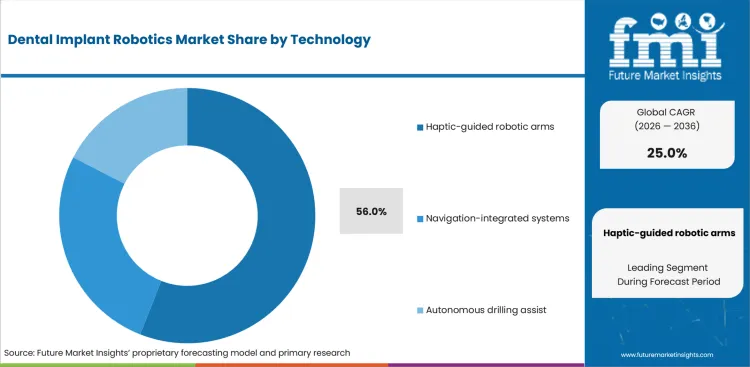
Implant surgeons need physical guidance near nerves and thin bone, yet they must retain full control of each drilling movement. The FDA cleared Yomi S on October 28, 2025 for planning and guided implant surgery in adults who qualify for implants. Its arm holds a standard drill and resists movement outside the approved path as the surgeon provides the force. This design explains why haptic guidance leads technology demand without removing the surgeon's direct control of the procedure.
- Haptic-guided robotic arms are projected to hold 56.0% share in 2026 due to their controlled path and familiar hand position. The arm adds physical resistance without replacing the surgeon's judgment, and it works with standard electric dental handpieces during site preparation. This design protects the approved angle and depth and leaves every movement under the clinician's direct control.
- Implant surgeons are choosing haptic guidance for cases with little bone available for correction near the mandibular nerve or adjacent roots. Visual navigation can show the target but cannot stop an unintended change in angle, so physical restraint adds value in cases that demand precise depth control during difficult implant procedures.
What supports demand for single implant placement within the application category?
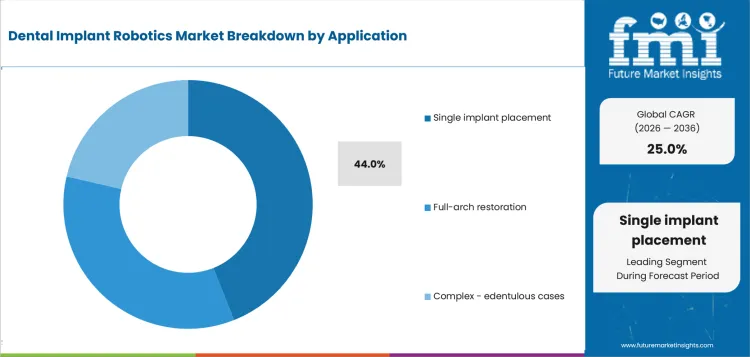
Single-tooth cases give clinicians a practical starting point for live guidance through a familiar surgical sequence. The procedure produces a clear comparison between the approved plan and final implant position, which supports training for later cases. In April 2025 Dcarer reported a European clinical debut in Bologna involving an upper-jaw case with 1.5 millimeters between implant and root. The case shows how guidance can support a tight target without adding the restorative work required for full-arch treatment.
- In 2026, single implant placement is expected to lead the application category with 44.0% share. Frequent case volume and a simpler setup make this segment a practical training route for new users. Cone-beam scans show bone width and nearby anatomy at one site, so dental X-ray systems support the same guided procedure. This link makes imaging part of the robotic process rather than a separate investment decision.
- Single implant placement is drawing demand from practices that need a manageable first use for robotic guidance. One site lets the surgeon learn scan registration and guided drilling without coordinating several implant positions during the same procedure. The final scan creates a training record that supports later work on more complex cases and reduces the risk of inconsistent use.
What makes systems central to the component category?
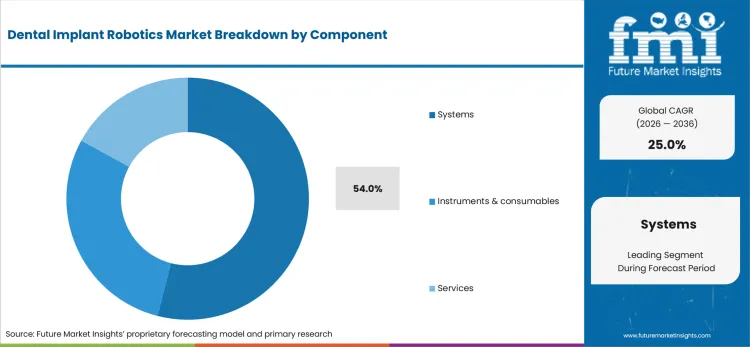
Complete systems carry most component value by combining the robotic arm with planning software and patient tracking. The FDA cleared Yomi software version 2.7 on October 10, 2025 with automatic tracing of the jawbone and nearby anatomy. The added tracing cuts manual setup and gives the surgeon more time to review the proposed drill path. Instruments and service remain necessary throughout use, but the first capital decision still centers on the complete platform.
- Systems are forecast to represent 54.0% of component value in 2026 due to the cost of the robot and planning software. Clinics compare that expense with 3D printing dental devices and other tools used across many procedures. Annual implant volume determines whether the platform saves enough time to justify the larger commitment.
- Multi-location dental groups are expected to favor complete systems that give each surgeon the same planning method. Shared software can reduce variation between practices and create one training record that covers the wider network. The purchase remains practical with clinical support that reaches every location and prevents long service delays from removing cases from the schedule.
What are the drivers, restraints, and opportunities in the Dental Implant Robotics Market?
Physical drill guidance improves placement consistency, while high costs and training limit routine use, and faster planning with open scan links enables wider deployment across treatment rooms.
- Driver: Robotic guidance keeps the drill closer to the approved angle and depth during implant-site preparation.
- Restraint: High equipment cost and staff training can restrict routine use in practices with limited monthly implant volume.
- Opportunity: Faster planning and open imaging links can extend guided surgery across more clinicians and treatment rooms.
Placement accuracy affects both surgery and the final crown that must fit the implant angle. A drill path outside the approved axis can limit crown design and create corrective work during the restorative stage. Neocis reported in October 2025 that a multisite study reduced procedure time by about 45% for partial-implant patients. Full-arch cases saved an average of 80 minutes from start to finish, linking drill control with treatment-room capacity. These results make procedure time a measurable part of the investment case for clinics considering robotic guidance.
Capital cost is difficult to recover in practices that complete few implant cases each month. The American Dental Association published its second-quarter dental economy report in June 2025, and most dentists reported equipment and supply price increases above 5% during the first five months of 2025. A robotic system therefore competes with imaging upgrades and replacement equipment inside the same budget. Training raises the risk further if the platform changes the surgeon's normal sequence or remains unused between complex cases.
Faster planning can extend live guidance to more treatment rooms without adding a separate workstation. Carestream Dental launched CS 3D Imaging Premium on October 15, 2025 to automate implant planning and share cases from the clinic's imaging system. This launch shows why planning speed and data exchange affect the value of robotic guidance. Platforms with open links can shorten setup and preserve familiar clinical steps across ordinary treatment rooms. The wider dental diagnostic and surgical equipment category favors products that fit normal clinical spaces during adoption.
Which country CAGRs are profiled in the Dental Implant Robotics Market?
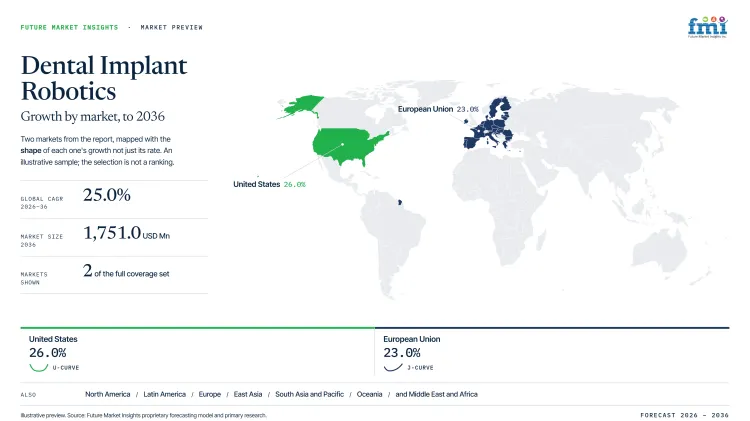
| Country | CAGR |
|---|---|
| United States | 26.0% |
| European Union | 23.0% |
Source: FMI's proprietary forecasting model and primary research
How do country-level CAGRs compare in the Dental Implant Robotics Market?
The comparison covers a 3.0 percentage point range, showing a relatively concentrated growth outlook across the dental implant robotics market. The United States leads with a CAGR of 26.0%, while the European Union follows at 23.0%. Although both markets are moving toward greater use of robotic guidance in implant procedures, adoption is shaped by different clinical practice patterns, capital investment decisions and digital dentistry maturity.
- The United States records the higher CAGR at 26.0%. Dental practices and specialty clinics are increasingly evaluating robotic implant systems to improve surgical planning, placement accuracy and workflow consistency. Growing integration of digital imaging, guided implantology and chairside digital workflows continues to strengthen interest in robotic-assisted implant procedures.
- The European Union follows at 23.0%, remaining 3.0 percentage points below the United States. Demand reflects continued adoption of advanced dental technologies across implant centers and specialist practices where robotic guidance is assessed for complex procedures and precision-driven treatment planning. Commercial uptake differs across member states because reimbursement structures, clinic investment priorities and technology adoption rates are not uniform throughout the region.
Comparable CAGRs do not necessarily create identical commercial opportunities. Differences in digital dentistry infrastructure, clinician training, capital equipment spending and regulatory pathways influence purchasing decisions and long-term market development. The full report provides country-level CAGR analysis across North America, Latin America, Europe, East Asia, South Asia, Oceania and the Middle East and Africa.
Country-wise Analysis
The United States and European Union have similar treatment needs but follow different routes to adoption. United States companies use one federal clearance system and can organize training across a national market. European clinics make purchasing and training decisions through separate national systems, which can slow rollout across member states. Public health and trade data show a large base for image-guided implant care in both regions. The forecast gap reflects commercial rollout and service coverage rather than weaker clinical need across Europe.
-
Robotic implant surgery has a clearer regulatory path in the United States through one federal device clearance system. Demand is forecast to expand at 26.0% CAGR from 2026 to 2036 as companies organize sales and training across market. The CDC updated its oral health page in January 2026 and reported complete tooth loss among 13.2% of adults aged 65 or older. The figure uses data collected from 2017 through March 2020 and shows a substantial need for complex tooth replacement. It does not measure robot demand, so procedure volume and service access remain necessary for adoption. Miami-based Neocis adds domestic training and service for clinics that compare robotic guidance with the wider dental implant and prosthetic process. Procedure time and staff use remain more important than the novelty of a robot during capital review.
- European clinics serve a large implant base through separate purchasing and training systems across the region. European Union demand is projected to record 23.0% CAGR by 2036 as national decisions shape the rollout pace. WITS records accessed in July 2026 placed 2024 European Union dental-fitting imports at USD 838.0 million. Dental fittings do not measure robotic equipment, but the trade value shows the scale of implant components moving across the region. National certification and service arrangements can slow the transition from purchase to routine use at clinics. Platforms that connect surgical planning with dental laboratory workflows can reduce handoffs between implant placement and final restoration. This link matters for dental groups that operate across several national health and training systems.
Who are the notable companies in the Dental Implant Robotics Market?
Neocis, Yakebot Technology, Beijing Baihui Weikang, Dcarer, X-Nav Technologies, ClaroNav, Planmeca, Dentsply Sirona, and Carestream Dental are notable companies across robot-assisted drilling, live navigation, imaging, and implant planning.
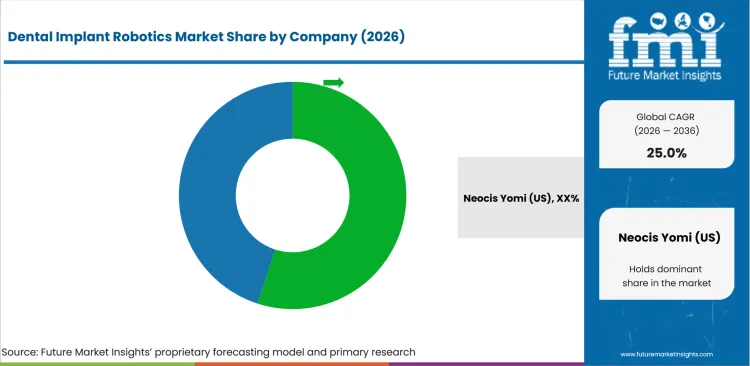
Competition spans robot-assisted platforms and live navigation systems that support different parts of implant placement. Neocis and Yakebot Technology add physical guidance during drilling, and Beijing Baihui Weikang offers another robot-assisted platform from China. Dcarer, X-Nav Technologies and ClaroNav track instruments against three-dimensional scans without a restraining arm during surgery. Planmeca and Dentsply Sirona support imaging and treatment planning, and Carestream Dental adds automated planning and case sharing. The APAC dental market gives Asian companies a larger base for product development and clinical training. Commercial success still depends on local service and fit with the clinic's existing scans and procedure.
- Neocis and Yakebot Technology combine digital planning with physical guidance that keeps the drill inside the approved path. The commercial test is whether that control saves enough time and corrective work to justify a higher capital cost than live navigation.
- Beijing Baihui Weikang competes through another robot-assisted platform from China; Dcarer tracks the drill through markerless navigation during guided implant procedures. Both companies need dependable training and technical support outside their home market to convert certification into routine clinical use.
- X-Nav Technologies and ClaroNav provide live navigation without physical drill restraint, which suits clinicians who prefer the familiar handpiece process during surgery. These systems compete on tracking accuracy and setup time, and they depend on clean links with cone-beam scans.
- Planmeca and Dentsply Sirona support imaging and implant planning across the treatment sequence; Carestream Dental adds automated planning and case sharing. These companies can become integration partners for robot makers as clinics avoid closed systems that require separate files or workstations.
Competitive Benchmarking: Dental Implant Robotics Market
| Company | Robot-assisted Guidance Depth | Dynamic Navigation Depth | Implant-planning Integration | Service Reach |
|---|---|---|---|---|
| Neocis | High | Low | High | United States |
| Yakebot Technology | High | Low | Medium | China and European Union |
| Beijing Baihui Weikang | High | Low | Medium | China |
| Suzhou Digital-health Care (Dcarer) | Low | High | Medium | China and Europe |
| X-Nav Technologies | Low | High | High | Global |
| ClaroNav | Low | High | Medium | Global |
| Planmeca | Low | Low | High | Global |
| Dentsply Sirona | Low | Low | High | Global |
| Carestream Dental | Low | Low | High | Global |
Scoring basis: High indicates a direct product with current evidence in that capability column, and Medium marks a relevant but narrower position. Low indicates limited direct activity in dental implant robotics during the period assessed for this comparison.
Source: Future Market Insights competitive analysis, 2026. Ratings compare documented product depth, planning integration and stated service reach across every company included in the benchmark.
Key Developments in the Dental Implant Robotics Market
- In November 2025, Neocisn launched Yomi S and the updated YomiPlan platform following FDA clearance for the redesigned system and planning software. The smaller arm adds an integrated drill console with speed and irrigation controls inside one unit. Foot-pedal and touchscreen controls support a single-surgeon procedure, which addresses a practical barrier in dental robotics.
- In July 2025, Yakebot Technology announced CE certification for its dental surgical robot for use across the European market. The certification created a formal route to commercial use and showed that China-based robot makers are seeking approval outside their domestic market.
- In September 2025, Dcarer launched a markerless oral surgical navigation system that tracks the drill without a fixed reference array. The company reported positional accuracy of no more than 0.2 millimeters and drill recognition within 3 seconds.
- In June 2025, Planmeca released Romexis 7 with an automated implant-planning process that can propose a complete plan in as little as 9 seconds. The software strengthens the planning layer used by robotic and navigation systems and raises the cost of poor integration.
Key Players in the Dental Implant Robotics Market
Robot-assisted implant platforms
- Neocis
- Yakebot Technology
- Beijing Baihui Weikang
Dynamic navigation specialists
- Suzhou Digital-health Care (Dcarer)
- X-Nav Technologies
- ClaroNav
Digital planning and implant workflow providers
- Planmeca
- Dentsply Sirona
- Carestream Dental
Dental Implant Robotics Market - Report Scope
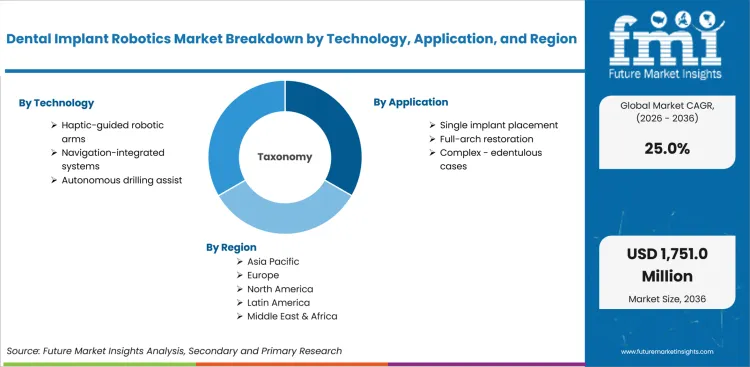
| Report Attribute | Coverage |
|---|---|
| Market Breakdown | Technology, Application, Component, End User, Business Model, and Region |
| Quantitative Units | USD million |
| Market Definition | Robotic and live navigation systems used to plan or guide implant-site preparation and implant placement across single and multi-implant procedures. |
| Regions Covered | North America, Latin America, Europe, East Asia, South Asia and Pacific, Oceania, and Middle East and Africa |
| Countries Covered | United States, European Union, and other countries within the regional model |
| Key Companies Profiled | Neocis, Yakebot Technology, Beijing Baihui Weikang, Dcarer, X-Nav Technologies, ClaroNav, Planmeca, Dentsply Sirona, and Carestream Dental |
| Approach | Demand-side review of guided implant procedures combined with device-clearance analysis, company capability mapping and country forecast reconciliation |
Source: Future Market Insights - analysis driven by proprietary forecasting models and primary research
Dental Implant Robotics Market - Research Methodology
| Method | Application |
|---|---|
| Primary Research | FMI analysts gathered input from manufacturers, service providers, technology developers, distributors, end users, procurement teams, and subject-matter experts. Interviews examined purchasing decisions, product or service evaluation, adoption barriers, approval requirements, pricing considerations, and expectations for technical or commercial support. Respondents were also asked what evidence is required before a trial, pilot, or initial order develops into regular purchasing. |
| Desk Research | Desk research covered government statistics, regulatory publications, trade data, industry associations, technical literature, standards, company filings, product information, and official corporate announcements. Sources were reviewed for relevance, publication date, geographic coverage, and consistency with the defined market scope. Claims relating to performance, applications, approvals, capacity, investment, and commercial activity were retained only when supported by credible public evidence. |
| Market Sizing and Forecasting | The market model combined the baseline value with historical performance, segment structure, pricing and volume indicators, adoption levels, company participation, and country-level demand conditions. Forecast assumptions considered economic activity, investment trends, regulatory developments, technology adoption, purchasing cycles, supply availability, and barriers to wider market use. Segment and regional estimates were reconciled before the final market total was calculated. |
| Data Validation | Estimates were checked against multiple independent indicators, including public data, company activity, trade patterns, industry developments, and findings from primary interviews. Validation also tested whether products, services, applications, and company revenues fell within the defined market boundaries. Adjacent categories, unsupported claims, overlapping revenues, and activities without direct market relevance were excluded to reduce double counting and maintain consistency across segments and countries. |
Source: Future Market Insights (FMI) analysis, based on proprietary forecasting model and primary research
Dental Implant Robotics Market by Segments
Dental Implant Robotics Market segmented by Technology:
- Haptic-guided robotic arms
- Navigation-integrated systems
- Autonomous drilling assist
Dental Implant Robotics Market segmented by Application:
- Single implant placement
- Full-arch restoration
- Complex edentulous cases
Dental Implant Robotics Market segmented by Component:
- Systems
- Instruments and consumables
- Services
Dental Implant Robotics Market segmented by End User:
- Dental clinics and dental service organizations
- Oral surgery centers
- Academic teaching settings
Dental Implant Robotics Market segmented by Business Model:
- Capital purchase
- Per-procedure pricing
- Lease
- Pilot programs
Dental Implant Robotics Market by Region:
- North America
- United States
- Canada
- Latin America
- Brazil
- Mexico
- Argentina
- Rest of Latin America
- Europe
- Germany
- France
- United Kingdom
- Italy
- Spain
- Nordics
- Benelux
- Rest of Europe
- East Asia
- China
- Japan
- South Korea
- South Asia and Pacific
- India
- ASEAN countries
- Rest of South Asia and Pacific
- Oceania
- Australia
- New Zealand
- Middle East and Africa
- Gulf Cooperation Council countries
- South Africa
- Israel
- Rest of Middle East and Africa
Research Sources and Bibliography
- American Dental Association Health Policy Institute. (2025, June).
- Centers for Disease Control and Prevention. (2026, January 16).
- Carestream Dental. (2025, October 15).
- Suzhou Digital-health Care (Dcarer). (2025, April 9).
- Suzhou Digital-health Care (Dcarer). (2025, September 15).
- Dentsply Sirona. (n.d.).
- Food and Drug Administration. (2025, October 28).
- Food and Drug Administration. (2025, October 10).
- Neocis. (2025, October 23).
- Neocis. (2025, November 17).
- Neocis. (2026, January 7).
- Planmeca. (2025, June 27).
- World Bank World Integrated Trade Solution. (2024).
- World Bank World Integrated Trade Solution. (2024).
- Yakebot Technology. (2025, July 8).
This bibliography is provided for reader reference and uses primary government, standards-body, official trade body, and company sources.
This Report Answers
- How large is the dental implant robotics market in 2026 and how quickly is it forecast to grow?
- Why do haptic-guided robotic arms lead the technology category?
- Which implant procedures offer the clearest starting point for robotic guidance?
- How do capital cost and training affect adoption at dental practices?
- Why does the United States grow faster than the European Union?
- Which companies provide robot-assisted guidance or dynamic navigation?
- How should clinics compare a robotic platform with navigation alternatives?
- Which business models can lower the initial commitment for a practice?
- How do imaging and planning software shape the value of a robotic system?
- What recent company actions show commercial progress in the category?
Frequently Asked Questions
What is driving growth in the Dental Implant Robotics Market?
Growth is driven by the need to control implant depth and angle near sensitive anatomy during surgery. Clinical evidence now links robotic guidance with shorter procedures and steadier results across different implant case types.
Who are the key players in the Dental Implant Robotics Market?
Neocis and Yakebot Technology provide robot-assisted platforms that guide drilling against a digital plan during implant surgery. X-Nav Technologies and ClaroNav provide live navigation, and Planmeca and Carestream Dental support imaging and implant planning.
What is a significant restraint in the Dental Implant Robotics Market?
Capital cost is difficult to recover for a practice that completes few implant cases each month. Training and room changes can delay routine use during the first months following installation at the practice.
Why should executives track the Dental Implant Robotics Market?
The category connects placement control with treatment-room efficiency across a high-value implant service for dental groups. Multi-site practices can use the systems to standardize procedures and compare results across several locations.
What business problem does the Dental Implant Robotics Market address?
Robotic guidance narrows the gap between the approved plan and the drill path used during surgery. Better alignment can protect restorative choices and reduce corrective work during the final crown stage.
What should procurement leaders evaluate before selecting suppliers?
Clinic owners should compare scan compatibility and training demands across each platform on the shortlist. The final choice should reflect planning time and procedure volume together with dependable local service support.
What limits return on investment for purchasers?
Low case volume can leave the platform underused during its first years in a dental practice. Software fees and instrument costs weaken returns if each guided procedure carries a high added expense.
How do suppliers build long-term account confidence?
Long-term trust comes from documented clinical use and dependable technical support during routine implant procedures. Open scan links reduce workflow disruption across several treatment rooms in the same dental practice.
Preview the report firsthand - request a free sample
Get SampleGet the brochure for pricing and purchase details.
Get PDFTable of Content
- Key Takeaways
- Market Size and CAGR
- Top Growth Driver
- Fastest Growing Segment
- Leading Region
- Key Companies
- Emerging Opportunities
- Executive Summary
- Global Market Outlook
- Demand-side Trends
- Supply-side Trends
- Technology Roadmap Analysis
- Analysis and Recommendations
- Analyst Perspective (What is happening? Why now? What should investors know?)
- Key Questions Answered
- How large is the market?
- What is the CAGR?
- What are key trends?
- Which region dominates?
- Who are the leaders?
- Market Overview
- Market Coverage / Taxonomy
- Market Definition / Scope / Limitations
- Research Methodology
- Chapter Orientation
- Analytical Lens and Working Hypotheses
- Market Structure, Signals, and Trend Drivers
- Benchmarking and Cross-market Comparability
- Market Sizing, Forecasting, and Opportunity Mapping
- Research Design and Evidence Framework
- Desk Research Programme (Secondary Evidence)
- Expert Input and Fieldwork (Primary Evidence)
- Tooling, Models, and Reference Databases
- Data Engineering and Model Build
- Quality Assurance and Audit Trail
- Market Background
- Market Dynamics (Drivers, Restraints, Opportunity, Trends)
- Scenario Forecast (Optimistic, Likely, Conservative)
- Impact Analysis
- AI Impact
- Sustainability Impact
- Regulatory Impact
- Technology Impact
- Consumer / Buyer Analysis
- Purchase Drivers
- Adoption Barriers
- Buyer Journey
- Opportunity Map Analysis
- Product Life Cycle Analysis
- Supply Chain Analysis
- Investment Feasibility Matrix
- Value Chain Analysis
- PESTLE and Porter's Analysis
- Regulatory Landscape
- Regional Parent Market Outlook
- Production and Consumption Statistics
- Import and Export Statistics
- Global Market Analysis and Forecast, 2021 to 2036
- Historical Market Size Value (USD Mn) Analysis, 2021 to 2025
- Current and Future Market Size Value (USD Mn) Projections, 2026 to 2036
- Y-o-Y Growth Trend Analysis
- Absolute $ Opportunity Analysis
- Global Market Pricing Analysis, 2021 to 2036
- Global Market Analysis and Forecast, By Technology, 2021 to 2036
- Introduction / Key Findings
- Historical Market Size Value (USD Mn) Analysis By Technology, 2021 to 2025
- Current and Future Market Size Value (USD Mn) Analysis and Forecast By Technology, 2026 to 2036
- Haptic-guided robotic arms
- Navigation-integrated systems
- Autonomous drilling assist
- Haptic-guided robotic arms
- Y-o-Y Growth Trend Analysis By Technology, 2021 to 2025
- Absolute $ Opportunity Analysis By Technology, 2026 to 2036
- Global Market Analysis and Forecast, By Application, 2021 to 2036
- Introduction / Key Findings
- Historical Market Size Value (USD Mn) Analysis By Application, 2021 to 2025
- Current and Future Market Size Value (USD Mn) Analysis and Forecast By Application, 2026 to 2036
- Single implant placement
- Full-arch restoration
- Complex - edentulous cases
- Single implant placement
- Y-o-Y Growth Trend Analysis By Application, 2021 to 2025
- Absolute $ Opportunity Analysis By Application, 2026 to 2036
- Global Market Analysis and Forecast, By Component, 2021 to 2036
- Introduction / Key Findings
- Historical Market Size Value (USD Mn) Analysis By Component, 2021 to 2025
- Current and Future Market Size Value (USD Mn) Analysis and Forecast By Component, 2026 to 2036
- Systems
- Instruments & consumables
- Services
- Systems
- Y-o-Y Growth Trend Analysis By Component, 2021 to 2025
- Absolute $ Opportunity Analysis By Component, 2026 to 2036
- Global Market Analysis and Forecast, By End User, 2021 to 2036
- Introduction / Key Findings
- Historical Market Size Value (USD Mn) Analysis By End User, 2021 to 2025
- Current and Future Market Size Value (USD Mn) Analysis and Forecast By End User, 2026 to 2036
- Dental clinics & DSOs
- Oral surgery centers
- Academic - teaching
- Dental clinics & DSOs
- Y-o-Y Growth Trend Analysis By End User, 2021 to 2025
- Absolute $ Opportunity Analysis By End User, 2026 to 2036
- Global Market Analysis and Forecast, By Business Model, 2021 to 2036
- Introduction / Key Findings
- Historical Market Size Value (USD Mn) Analysis By Business Model, 2021 to 2025
- Current and Future Market Size Value (USD Mn) Analysis and Forecast By Business Model, 2026 to 2036
- Capital purchase
- Per-procedure pricing
- Lease
- Pilot programs
- Capital purchase
- Y-o-Y Growth Trend Analysis By Business Model, 2021 to 2025
- Absolute $ Opportunity Analysis By Business Model, 2026 to 2036
- Global Market Analysis and Forecast, By Region, 2021 to 2036
- Introduction
- Historical Market Size Value (USD Mn) Analysis By Region, 2021 to 2025
- Current Market Size Value (USD Mn) Analysis and Forecast By Region, 2026 to 2036
- North America
- Latin America
- Western Europe
- Eastern Europe
- East Asia
- South Asia and Pacific
- Middle East & Africa
- Market Attractiveness Analysis By Region
- North America Market Analysis and Forecast, By Country, 2021 to 2036
- Historical Market Size Value (USD Mn) Trend Analysis By Market Taxonomy, 2021 to 2025
- Market Size Value (USD Mn) Forecast By Market Taxonomy, 2026 to 2036
- By Country
- USA
- Canada
- By Technology
- By Application
- By Component
- By End User
- By Business Model
- By Country
- Market Attractiveness Analysis
- By Country
- By Technology
- By Application
- By Component
- By End User
- By Business Model
- Key Takeaways
- Latin America Market Analysis and Forecast, By Country
- Historical Market Size Value (USD Mn) Trend Analysis By Market Taxonomy, 2021 to 2025
- Market Size Value (USD Mn) Forecast By Market Taxonomy, 2026 to 2036
- By Country
- Brazil
- Mexico
- Chile
- Rest of Latin America
- By Technology
- By Application
- By Component
- By End User
- By Business Model
- By Country
- Market Attractiveness Analysis
- By Country
- By Technology
- By Application
- By Component
- By End User
- By Business Model
- Key Takeaways
- Western Europe Market Analysis and Forecast, By Country
- Historical Market Size Value (USD Mn) Trend Analysis By Market Taxonomy, 2021 to 2025
- Market Size Value (USD Mn) Forecast By Market Taxonomy, 2026 to 2036
- By Country
- Germany
- UK
- Italy
- Spain
- France
- Nordic
- BENELUX
- Rest of Western Europe
- By Technology
- By Application
- By Component
- By End User
- By Business Model
- By Country
- Market Attractiveness Analysis
- By Country
- By Technology
- By Application
- By Component
- By End User
- By Business Model
- Key Takeaways
- Eastern Europe Market Analysis and Forecast, By Country
- Historical Market Size Value (USD Mn) Trend Analysis By Market Taxonomy, 2021 to 2025
- Market Size Value (USD Mn) Forecast By Market Taxonomy, 2026 to 2036
- By Country
- Russia
- Poland
- Hungary
- Balkan & Baltic
- Rest of Eastern Europe
- By Technology
- By Application
- By Component
- By End User
- By Business Model
- By Country
- Market Attractiveness Analysis
- By Country
- By Technology
- By Application
- By Component
- By End User
- By Business Model
- Key Takeaways
- East Asia Market Analysis and Forecast, By Country
- Historical Market Size Value (USD Mn) Trend Analysis By Market Taxonomy, 2021 to 2025
- Market Size Value (USD Mn) Forecast By Market Taxonomy, 2026 to 2036
- By Country
- China
- Japan
- South Korea
- By Technology
- By Application
- By Component
- By End User
- By Business Model
- By Country
- Market Attractiveness Analysis
- By Country
- By Technology
- By Application
- By Component
- By End User
- By Business Model
- Key Takeaways
- South Asia and Pacific Market Analysis and Forecast, By Country
- Historical Market Size Value (USD Mn) Trend Analysis By Market Taxonomy, 2021 to 2025
- Market Size Value (USD Mn) Forecast By Market Taxonomy, 2026 to 2036
- By Country
- India
- ASEAN
- Australia & New Zealand
- Rest of South Asia and Pacific
- By Technology
- By Application
- By Component
- By End User
- By Business Model
- By Country
- Market Attractiveness Analysis
- By Country
- By Technology
- By Application
- By Component
- By End User
- By Business Model
- Key Takeaways
- Middle East & Africa Market Analysis and Forecast, By Country
- Historical Market Size Value (USD Mn) Trend Analysis By Market Taxonomy, 2021 to 2025
- Market Size Value (USD Mn) Forecast By Market Taxonomy, 2026 to 2036
- By Country
- Kingdom of Saudi Arabia
- Other GCC Countries
- Türkiye
- South Africa
- Other African Union
- Rest of Middle East & Africa
- By Technology
- By Application
- By Component
- By End User
- By Business Model
- By Country
- Market Attractiveness Analysis
- By Country
- By Technology
- By Application
- By Component
- By End User
- By Business Model
- Key Takeaways
- Key Countries Market Analysis
- USA
- Pricing Analysis
- Market Share Analysis, 2025
- By Technology
- By Application
- By Component
- By End User
- By Business Model
- Canada
- Pricing Analysis
- Market Share Analysis, 2025
- By Technology
- By Application
- By Component
- By End User
- By Business Model
- Mexico
- Pricing Analysis
- Market Share Analysis, 2025
- By Technology
- By Application
- By Component
- By End User
- By Business Model
- Brazil
- Pricing Analysis
- Market Share Analysis, 2025
- By Technology
- By Application
- By Component
- By End User
- By Business Model
- Chile
- Pricing Analysis
- Market Share Analysis, 2025
- By Technology
- By Application
- By Component
- By End User
- By Business Model
- Germany
- Pricing Analysis
- Market Share Analysis, 2025
- By Technology
- By Application
- By Component
- By End User
- By Business Model
- UK
- Pricing Analysis
- Market Share Analysis, 2025
- By Technology
- By Application
- By Component
- By End User
- By Business Model
- Italy
- Pricing Analysis
- Market Share Analysis, 2025
- By Technology
- By Application
- By Component
- By End User
- By Business Model
- Spain
- Pricing Analysis
- Market Share Analysis, 2025
- By Technology
- By Application
- By Component
- By End User
- By Business Model
- France
- Pricing Analysis
- Market Share Analysis, 2025
- By Technology
- By Application
- By Component
- By End User
- By Business Model
- India
- Pricing Analysis
- Market Share Analysis, 2025
- By Technology
- By Application
- By Component
- By End User
- By Business Model
- ASEAN
- Pricing Analysis
- Market Share Analysis, 2025
- By Technology
- By Application
- By Component
- By End User
- By Business Model
- Australia & New Zealand
- Pricing Analysis
- Market Share Analysis, 2025
- By Technology
- By Application
- By Component
- By End User
- By Business Model
- China
- Pricing Analysis
- Market Share Analysis, 2025
- By Technology
- By Application
- By Component
- By End User
- By Business Model
- Japan
- Pricing Analysis
- Market Share Analysis, 2025
- By Technology
- By Application
- By Component
- By End User
- By Business Model
- South Korea
- Pricing Analysis
- Market Share Analysis, 2025
- By Technology
- By Application
- By Component
- By End User
- By Business Model
- Russia
- Pricing Analysis
- Market Share Analysis, 2025
- By Technology
- By Application
- By Component
- By End User
- By Business Model
- Poland
- Pricing Analysis
- Market Share Analysis, 2025
- By Technology
- By Application
- By Component
- By End User
- By Business Model
- Hungary
- Pricing Analysis
- Market Share Analysis, 2025
- By Technology
- By Application
- By Component
- By End User
- By Business Model
- Kingdom of Saudi Arabia
- Pricing Analysis
- Market Share Analysis, 2025
- By Technology
- By Application
- By Component
- By End User
- By Business Model
- Türkiye
- Pricing Analysis
- Market Share Analysis, 2025
- By Technology
- By Application
- By Component
- By End User
- By Business Model
- South Africa
- Pricing Analysis
- Market Share Analysis, 2025
- By Technology
- By Application
- By Component
- By End User
- By Business Model
- USA
- Market Structure Analysis
- Competition Dashboard
- Competition Benchmarking
- Market Share Analysis of Top Players
- By Regional
- By Technology
- By Application
- By Component
- By End User
- By Business Model
- Emerging Startups
- Innovation Benchmarking
- Competition Analysis
- Competition Deep Dive
- Neocis Yomi (US)
- Overview
- Product Portfolio
- Profitability by Market Segments
- Sales Footprint
- Strategy Overview
- Marketing Strategy
- Product Strategy
- Channel Strategy
- Dentsply Sirona robotics (US-DE)
- Perceptive (US)
- Neocis Yomi (US)
- Case Studies
- Success Stories
- Recent Developments
- Competition Deep Dive
- Assumptions & Acronyms Used


