

- Industry Size (2026)
- USD 438.9 Mn
- Forecast (2036)
- USD 793.5 Mn
- CAGR (2026 to 2036)
- 6.1%
Electric Dental Handpiece Market Forecast and Outlook 2026 to 2036
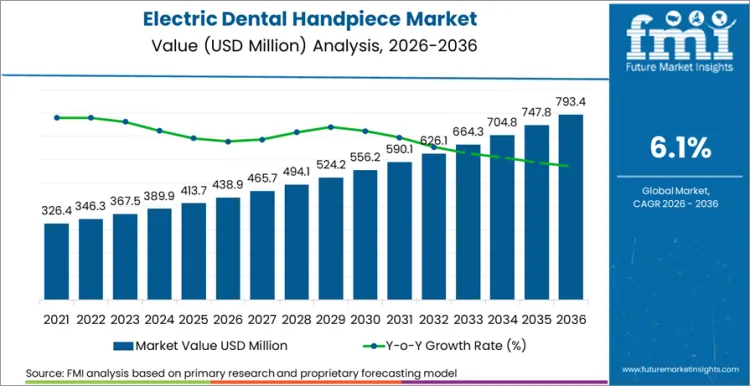
The global electric dental handpiece sector is on track to achieve a valuation of USD 793.5 million by 2036, accelerating from USD 438.9 million in 2026 at a CAGR of 6.1%. As per Future Market Insights, expansion is structurally underpinned by the clinical superiority of electric handpieces over air-driven turbines in torque consistency, cutting efficiency, and noise reduction, which is driving adoption across restorative, endodontic, and prosthodontic procedures.
The American Dental Association (ADA) reported in its 2024 Health Policy Institute Survey that dental practice revenue grew by 6.2% year-on-year, validating the financial capacity of dental practices to invest in premium electric instrumentation. This revenue growth compels manufacturers to invest in cordless platforms, sensor-driven feedback systems, and sustainable lifecycle engineering. Simultaneously the competitive landscape is shifting as traditional air-driven handpiece manufacturers launch electric alternatives which forces incumbent electric handpiece specialists to differentiate through clinical intelligence features and total cost of ownership optimisation.
In January 2026, W&H Group announced the release of the Synea Power Edition, a series of electric handpieces specifically engineered for the removal of zirconia restorations, featuring a proprietary ScratchBlocker coating and 29 watts of power. FMI opines that the growing installed base of zirconia restorations globally will drive a dedicated sub-segment for high-torque removal handpieces, adding 8 to 12% incremental value to the electric handpiece category within five years.
The competitive landscape in 2025 and 2026 is defined by cordless innovation and sustainability-driven product engineering. Dentsply Sirona expanded its Midwest Energo portfolio in September 2025, launching the premium T1 and comfort T2 electric handpieces featuring Safe Head Technology with a patented 4x2 nozzle spray that achieves the coolest head temperatures on the market and a 25% reduction in carbon emissions through digital-only instructions and sustainable packaging.
NSK debuted three major innovations at IDS 2025 in March 2025, including the Varios Combi Pro2 which integrates ultrasonic scaling and powder therapy into a single electric platform with Clinical Excellence sensor feedback providing real-time speed and torque adjustments based on tissue resistance. Henry Schein launched the Acclean cordless handpiece in August 2025 to expand its proprietary dental equipment portfolio. As per FMI, this convergence of cordless platforms, sensor-driven clinical intelligence, and lifecycle sustainability confirms that the electric dental handpiece is transitioning from a premium alternative to the default clinical standard for restorative practice.
Summary of Electric Dental Handpiece Market
What Is Growth Outlook for Electric Dental Handpiece Market as per Future Market Insights Projection?
Future Market Insights projects the electric dental handpiece industry to expand at a CAGR of 6.1% from 2026 to 2036, increasing from USD 438.9 Million in 2026 to USD 793.5 Million by 2036.
FMI Research Approach: FMI proprietary forecasting model based on dental practice equipment replacement cycles, ADA practitioner survey data, and IDS product launch tracking.
How Do FMI Analysts Perceive Electric Dental Handpiece Market to Evolve?
FMI analysts perceive the market evolving toward sensor-equipped, cordless electric platforms where real-time torque and temperature feedback enables precision restorative procedures, replacing the variable performance of pneumatic air-driven turbines as the clinical standard.
FMI Research Approach: ADA Health Policy Institute dental practice revenue data and IDS 2025 product launch analysis.
Which Country Holds Largest Share in Global Electric Dental Handpiece Market?
The United States holds a significant share of the global electric dental handpiece market by value which is supported by the scale of its dental practice infrastructure and the purchasing power of its private dental care sector.
FMI Research Approach: FMI country-level revenue modeling by dental practice counts and handpiece procurement data.
How Large Will Electric Dental Handpiece Market Be by 2036?
The global electric dental handpiece market is projected to reach USD 793.5 Million by 2036.
FMI Research Approach: FMI long-term revenue forecast derived from dental equipment CAPEX projections and electric-to-air-driven conversion rate analysis.
What Is Definition of Electric Dental Handpiece Market?
The electric dental handpiece market includes brushless electric motor-driven dental instruments used in restorative, endodontic, prosthodontic, and surgical procedures, covering corded and cordless models with integrated speed, torque, and temperature control systems.
FMI Research Approach: FMI market taxonomy aligned with FDA dental device classification and ISO 14457 dental handpiece standards.
What Are Globally Unique Trends Shaping Electric Dental Handpiece Market?
Globally unique trends include the launch of zirconia-specific high-torque handpieces (W&H Synea Power Edition), sensor-driven Clinical Excellence feedback systems (NSK Varios Combi Pro2), and sustainability-mandated lifecycle engineering reducing carbon emissions by 25% (Dentsply Sirona Midwest Energo).
FMI Research Approach: IDS 2025 exhibition product launch tracking and W&H Group 2026 product announcements.
Electric Dental Handpiece Market Key Takeaways
| Metric | Details |
|---|---|
| Industry Size (2026) | USD 438.9 Million |
| Industry Value (2036) | USD 793.5 Million |
| CAGR (2026 to 2036) | 6.1% |
Source: Future Market Insights (FMI) analysis, based on proprietary forecasting model and primary research
Semi Annual Market Update
A comparative analysis of fluctuations in compound annual growth rate (CAGR) for the electric dental handpiece industry outlook between 2024 and 2025 on a six-month basis is shown below. By this examination, major variations in the performance of these markets are brought to light, and trends of revenue generation are captured hence offering stakeholders useful ideas on how to carry on with the market’s growth path in any other given year.
January through June covers the first part of the year called half1 (H1), while half2 (H2) represents July to December.
The table below compares the compound annual growth rate (CAGR) for the global electric dental handpiece industry analysis from 2024 to 2025 during the first half of the year. This overview highlights key changes and trends in revenue growth, offering valuable insights into market dynamics. H1 covers January to June, while H2 spans July to December. In the first half (H1) of the decade from 2024 to 2034, the business is predicted to surge at a CAGR of 6.8%, followed by a slightly lower growth rate of 6.5% in the second half (H2) of the same decade.
| Particular | Value CAGR |
|---|---|
| H1 | 6.8% (2024 to 2034) |
| H2 | 6.5% (2024 to 2034) |
| H1 | 6.1% (2025 to 2035) |
| H2 | 5.6% (2025 to 2035) |
Moving into the subsequent period, from H1 2025 to H2 2035, the CAGR is projected to decrease slightly to 6.1% in the first half and projected to lower at 5.6% in the second half. In the first half (H1) the market witnessed a decrease of 70 BPS while in the second half (H2), the market witnessed a decrease of 90 BPS.
Key Industry Highlights
Rising Prevalence of Oral Health Disorders Globally Boosting the Market for Electric Dental Handpieces
Oral health disorders, including cavities, periodontal diseases, and tooth loss, are becoming increasingly prevalent worldwide. According to the World Health Organization (WHO), nearly 3.5 billion people suffer from oral diseases, with untreated dental caries being the most widespread condition. This alarming statistic highlights the growing need for effective and precise dental tools to address complex dental health issues.
Electric dental handpieces have emerged as indispensable in modern dentistry due to their consistent torque, precision, and ability to handle intricate procedures efficiently. For instance, in cases of severe decay, these tools provide the reliability required for accurate tissue removal and preparation for restorative treatments.
Furthermore, the rise in geriatric populations globally has intensified the demand for advanced dental care. Older adults often require specialized treatments, such as prosthodontics or periodontics, where electric dental handpieces excel due to their durability and control. Institutions like the World Dental Federation have advocated for incorporating these tools to combat the increasing burden of oral diseases.
By reducing procedural time and enhancing patient outcomes, electric dental handpieces are becoming a cornerstone in addressing the oral health crisis, driving their adoption among dental professionals worldwide.
Emergence of Wireless and Battery-Operated Dental Handpieces Revolutionizing Dental Practices
Wireless and battery-powered electric dental handpieces are revolutionizing the dental world by offering increased mobility and convenience. The new devices are free from the constraints of the traditional corded models, thus allowing practitioners to carry out procedures with greater ease.
Advanced wireless handpieces from top manufacturers like Dentsply Sirona and NSK are now equipped with long-lasting lithium-ion batteries and rapid charging capabilities. These innovations ensure uninterrupted operation, even during lengthy procedures, making them highly desirable in both private clinics and mobile dental units.
Portability allows the wireless handpieces to be used in underserved or remote areas, hence enhancing access to dental care. Mobile dental clinics are an example, and these are used to give treatment in rural areas where dental disparities exist. Additionally, their ergonomic design reduces practitioner fatigue and increases the efficiency of procedures, keeping in line with the increasing trend of practitioner wellness.
With the modernization of clinics, the adoption of cordless and battery-operated technologies is expected to increase in the future. These will find a permanent place in the future dental care practice. The advancements are not only making the workflow easier but also more patient-centric by providing a smooth experience during procedures.
Partnerships with Dental Schools for Training and Awareness Enhancing Market Penetration
Partnering with dental schools and training institutes is an effective way to foster the adoption of electric dental handpieces. Students would, therefore, acquire hands-on knowledge of the sophisticated tools and handle them well as they begin practice.It eliminates several misconceptions existing in the realm of electric handpieces, especially in terms of being difficult to use or more expensive, for instance, proving the long-run advantages in everyday life.
Dental schools act as channels through which recent advances in the dental technology could be spread in the most potent manner, resulting in early adopters among them. Training programmes aimed at targeting can give the much-needed confidence to use electric handpieces as integral parts of practice. These developments showcase electric handpieces not just as state-of-the-art tools in dentistry but also as the most improved and modern tool, leading to long-term growth of the market.
Complexity in Maintenance and Repairs Hindering Adoption of Electric Dental Handpieces
Though these electric dental handpieces have a lot of benefits, their maintenance and repair complexities make them a challenge to be adopted. As compared to the air-driven model, which is relatively simple in servicing, the electric handpieces require specialized service for motor calibration, electronic failures, and software updates. In most cases, this results in increased downtime and higher maintenance costs for dental practices.
For instance, electric handpieces tend to degrade the internal bearings or motors to the point that they need complete replacement. Repeated costs on tight budgets become unaffordable for some clinics, and it deters them from adopting electric models. Procuring replacement parts can also cause long delays that further disrupt operations in the clinics.
Another challenge that arises is the lack of standard repair protocols among manufacturers, making practitioners unwilling to switch. To overcome these barriers, manufacturers must focus on improving the durability of their products and providing accessible, cost-effective repair services to foster broader adoption of electric handpieces.
2021 to 2025 Global Electric Dental Handpiece Industry Outlook Compared to Demand Forecast from 2026 to 2036
Electric dental handpiece over the past two to three years has experienced massive change in character, largely being driven by innovation and the growing preference of dentists for electricity. A noticeable trend in electric handpieces replacing air-driven types is because electric handpieces give better torque and precision than the air-driven varieties.
The adoption was highly marked in developed areas, which are characterized by higher investments in superior dental care facilities. To respond to the ever-increasing rate of musculoskeletal disorders among dentists, manufacturers focused on ergonomic design, and this resulted in light and easy-to-handle models.
Another trend from history is the growing interest in digital dentistry, which led to the demand for integration-friendly tools with high-tech diagnostic and treatment systems. Electric handpieces made their entrance with IoT features like real-time feedback and automatic adjustments. Additionally, in the wake of the pandemic, infection control awareness led to handpieces with enhanced sterilization capabilities and disposable components.
Looking ahead, the electric dental handpiece market is poised to witness transformative trends driven by advancements in digital healthcare and the increasing focus on patient-centered care. One key futuristic trend is the integration of artificial intelligence (AI) for optimizing procedural performance. AI-enabled handpieces are expected to assist dentists by learning user preferences, automating torque adjustments, and providing real-time procedural insights, improving precision and patient outcomes.
Portability and versatility are also becoming the key factors, with manufacturers designing compact, multifunctional handpieces to cater to mobile clinics and resource-limited settings. Wireless and cordless technologies will dominate in the market, due to its innovations in battery life and fast-charging capabilities. These features are likely to appeal to modern dental practices seeking operational flexibility.
Additionally, the emphasis on patient comfort will drive the development of noise-reduction and vibration-dampening technologies, enhancing the overall dental experience. Customizable handpieces tailored to specific procedures or user ergonomics will further align with personalized healthcare trends.
Market Concentration
Tier 1 companies are the major companies as they hold a 41.1% share worldwide. Tier 1 companies are the largest and most influential players in the electric dental handpiece market. They have a significant global presence, often operating across multiple continents and serving a wide array of customers in both developed and emerging markets. These companies offer a broad range of dental handpieces with advanced features, catering to various specialties within dentistry.
Their products are typically known for their reliability, precision, and cutting-edge technology. Prominent tier 1 players include KaVo Dental GmbH, Dentsply Sirona Inc., Bien-Air Medical Technologies and W&H Dentalwerk Bürmoos GmbH
The tier 2 companies hold a share of 29.6% worldwide. Tier 2 companies tend to have a strong presence in specific regions or countries rather than a global footprint. They may not have the same level of worldwide distribution as Tier 1 companies but are still highly regarded within their market segments.
Companies in this tier often focus on providing cost-effective solutions without sacrificing quality. They may be known for offering good value products with solid performance, which appeals to dental professionals looking for reliable and affordable options. Key Companies under this category include Nakanishi Inc., A-dec Inc., SciCan Ltd., DentalEZ Group, and Brasseler USA
Country-wise Insights
The section below covers the industry analysis for electric dental handpiece sales for different countries. Market demand analysis on key countries in several regions of the globe, including North America, Latin America, East Asia, South Asia & Pacific, Western Europe, Eastern Europe, and Middle East & Africa is provided. The United States is anticipated to remain at the forefront in North America, with a CAGR of 3.5% through 2036. In South Asia & Pacific, India is projected to witness the highest CAGR in the market of 11.1% by 2036.
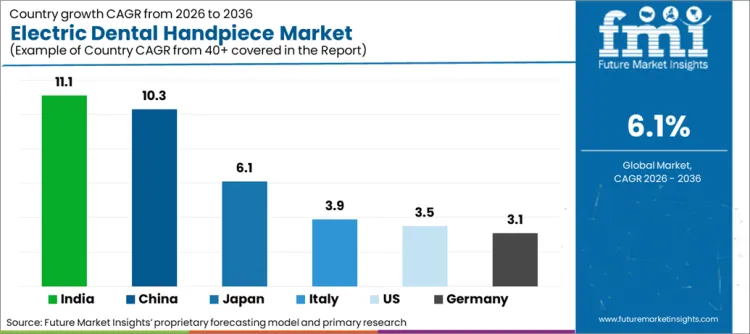
| Countries | Value CAGR (2026 to 2036) |
|---|---|
| United States | 3.5% |
| Germany | 3.1% |
| Italy | 3.9% |
| China | 10.3% |
| India | 11.1% |
| Japan | 6.1% |
Cutting-Edge Dental Education and Training Programs Solidify the United States' Leadership in the Electric Dental Handpiece Market
The United States dominates the global market with a high share in 2025. The United States is expected to exhibit a CAGR of 3.5% throughout the forecast period (2026 to 2036).
The United States is the global leader in electric dental handpieces, mainly due to its vast network of educational and training institutions. The country houses some of the world's finest dental schools that are affiliated with Harvard University and the University of Michigan, both of which put a lot of emphasis on embracing advanced technologies in dental practice. These institutes not only produce very qualified dental professionals but also implement innovative tools, such as electric dental handpieces, into their curriculum.
This early exposure ensures that practitioners entering the workforce are already adept at using electric handpieces, creating sustained demand within the market. Additionally, continuous professional development programs and certifications in the USA prioritize precision and efficiency in dental care, further driving the preference for electric handpieces. By cultivating a workforce trained in advanced tools and techniques, the USA establishes a strong foundation for technological adoption, maintaining its market dominance.
Engineering Excellence and Manufacturing Prowess Propel Germany’s Leadership in the Electric Dental Handpiece Market
In 2025, Germany held a dominant revenue in the Western Europe market and is expected to grow with a CAGR of 3.1%.
Germany is leading the electric dental handpiece market, coupled with strength in precision engineering and manufacturing excellence. The country is known worldwide for its state-of-the-art engineering capabilities, hosting many of the world's most innovative companies in dental equipment manufacturing, including industry leaders KaVo and Dentsply Sirona, who continuously advance the quality and performance standards within the industry.
The country's engineering capabilities ensure that electric dental handpieces manufactured in Germany are unmatched in terms of precision, durability, and efficiency, making them highly sought after both domestically and globally. Moreover, the stringent regulatory framework of medical devices in Germany, combined with high manufacturing standards, instills confidence in the reliability of its dental products.
This reputation for precision and quality is what encourages wider adoption among German dentists who prefer technologically advanced tools that meet the expectation of patients towards high-quality care. Germany achieves its leadership in the market through the combination of engineering innovation and stringent quality standards.
Robust Dental Tourism Industry Drives Adoption of Electric Dental Handpieces in India
India occupies a leading value share in South Asia & Pacific market in 2025 and is expected to grow with a CAGR of 11.1% during the forecasted period.
India is becoming an emerging player in the electric dental handpiece market as its dental tourism sector grows. India offers good quality at an affordable cost to patients who want to avail themselves of dental treatment, thus annually attracting thousands of international patients to the country from the Middle East, Africa, and Europe. With this increasing flow of patients, Indian dental clinics have begun using advanced tools like electric dental handpieces to keep up with global standards and make procedures more precise and efficient.
The competitive nature of dental tourism forces clinics to innovate and invest more in the technological advancement of a dental handpiece to ensure better and improved patient results and satisfaction leading to repeat visits with positive referrals to others.
Demand for premium, high-quality instruments has grown remarkably in cities as Mumbai, Delhi, and Chennai, which can be termed 'dental tourist destinations'. Consequently, India also emerges as the fastest-growing electrical dental hand-piece market.
Category-wise Insights
The section contains information about the leading segments in the industry. Based on motor type, brush motors are expected to account 67.7% of the global share in 2026.
Cost-Effectiveness and Simplicity of Brush Motors Drive Their Market Dominance
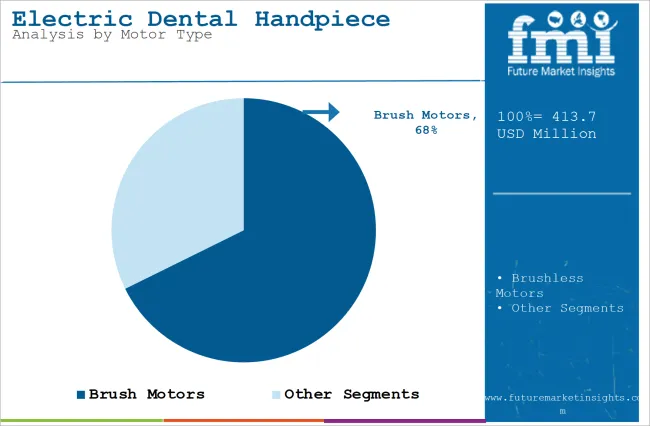
| Motor Type | Value Share (2026) |
|---|---|
| Brush Motors | 67.7% |
Brush motors dominate the electric dental handpiece market. This is due to their low cost and ease of design. They are significantly less expensive to produce than brushless motors, and thus, are widely used by dental practitioners, especially in regions that are sensitive to cost. This allows the dental clinic to embrace high-performance electric handpieces without any financial strain.
Moreover, the simpler design of brush motors facilitates easier maintenance and repairs. With a straightforward mechanism involving brushes and a commutator, repairs are less complex and do not require specialized expertise. This simplicity is especially appealing for smaller dental practices that may not have immediate access to advanced repair services.
Another contributing factor is the compatibility of brush motors with a wide range of existing dental systems. Their adaptability to different power sources and handpiece configurations ensures that they remain a practical choice for practitioners globally, reinforcing their market leadership.
High Patient Volume and Specialized Care Drive Dental Clinics' Dominance in the Market
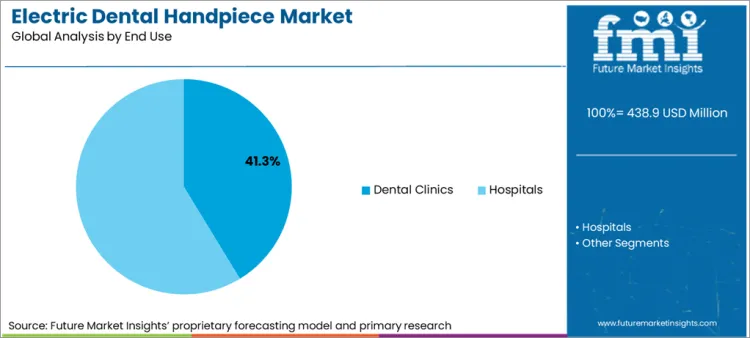
| By End User | Value Share (2026) |
|---|---|
| Dental Clinics | 41.3% |
Dental clinics will account for 41.3% of the end user segment in 2026, and exhibit the highest CAGR in the forecast period.
With dental clinics, more patient volume can be treated under a specialty care scope. They can have more electrical dental handpiece purchases since patients of such clinics demand highly specialized treatments that require excellent equipment.
There are no cases in hospitals where electric dental handpieces would only be used and nothing else would be treated except by electric tools. This will vary based on the variety of procedures; it may involve cleanings up to complex restorative treatments for which precision and efficiency are always key.
The trend of private dental practices is on the rise, which further strengthens this dominance. In addition, the increase in cosmetic dentistry, an area that has been largely provided by dental clinics, has increased demand for high technology equipment. This focus on patient-centered, specialized services ensures that dental clinics remain leaders in the market.
Competitive Landscape
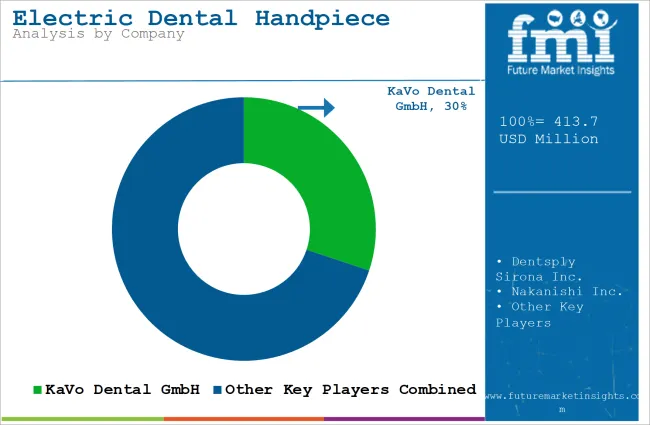
Key players in the electric dental handpiece market are focusing on continuous product innovations to maintain competitiveness. Companies are introducing new models with improved durability, ergonomic designs, and diverse options to meet the varying needs of dental professionals. Additionally, frequent product launches are aimed at enhancing performance, user comfort, and overall efficiency to appeal to a broader market and adapt to changing dental practice requirements.
Recent Developments:
- In September 2025, Dentsply Sirona expanded its Midwest Energo portfolio, launching the premium T1 and comfort T2 electric handpieces with Safe Head Technology and a 25% reduction in lifecycle carbon emissions through sustainable packaging and digital-only instructions.
- In March 2025, NSK debuted the Varios Combi Pro2 at IDS 2025, integrating ultrasonic scaling and powder therapy into a single electric platform with Clinical Excellence sensor feedback for real-time speed and torque adjustment based on tissue resistance.
- In January 2026, W&H Group announced the Synea Power Edition, engineered for zirconia restoration removal with ScratchBlocker coating and 29 watts of power, addressing demand for durable tools in high-volume clinics.
Key Players of Electric Dental Handpiece Industry
- KaVo Dental GmbH
- Dentsply Sirona Inc.
- Nakanishi Inc.
- A-dec Inc.
- Bien-Air Medical Technologies
- SciCan Ltd.
- DentalEZ Group
- Brasseler USA
- W&H Dentalwerk Bürmoos GmbH
- NSK Ltd.
- Keystone Dental, Inc.
- DENTFLEX
Market Definition
The electric dental handpiece market represents revenue generated from the manufacture and sale of brushless electric motor-driven dental instruments used across clinical dentistry. The market measures the value of high-speed and low-speed electric handpieces, contra-angle attachments, electric motors, and associated consumables sold to dental practices, clinics, hospitals, and dental service organisations.
Inclusions cover high-speed electric handpieces for restorative cutting, low-speed electric handpieces for polishing and endodontics, cordless battery-powered models, electric micromotor systems, contra-angle and straight attachments, and integrated ultrasonic scaling platforms. Sensor-equipped models with real-time torque, speed, and temperature feedback are also included.
Exclusions include air-driven pneumatic turbine handpieces, standalone dental air compressors, dental laser systems, and manual hand instruments (scalers, curettes). Dental laboratory handpieces used outside the clinical operatory are outside the scope.
Scope of Report
| Items | Values |
|---|---|
| Quantitative Units (2026) | USD 438.9 Million |
| Product Type | High-Speed Electric, Low-Speed Electric, Cordless, Electric Micromotor Systems, Contra-Angle Attachments |
| Application | Restorative, Endodontic, Prosthodontic, Surgical, Prophylaxis |
| End User | Dental Practices, Dental Clinics, Hospitals, Dental Service Organisations (DSOs) |
| Regions Covered | North America, Europe, Asia Pacific, Latin America, Middle East and Africa |
| Countries Covered | USA, Germany, Japan, UK, China, India, and 40+ countries |
| Key Companies Profiled | Dentsply Sirona, NSK (Nakanishi), KaVo (Envista), W&H Group, Bien-Air, Henry Schein, DENTALEZ |
Key Segments of Electric Dental Handpiece Industry
By Motor Type:
In terms of motor type, the industry is divided into non-complaint brush motors and brushless motors.
By End User:
In terms of end user, the industry is segregated into hospitals, dental clinics and others.
By Region:
Key countries of North America, Latin America, East Asia, South Asia & Pacific, Western Europe, Eastern Europe, and Middle East and Africa (MEA) have been covered in the report.
Bibliography
- American Dental Association, Health Policy Institute. (2024). Dental Practice Revenue and Economic Outlook Survey. ADA HPI.
- Dentsply Sirona. (2025, September). Midwest Energo T1 and T2 electric handpiece portfolio expansion. Dentsply Sirona Newsroom.
- NSK (Nakanishi Inc.). (2025, March). NSK debuts innovations at IDS 2025 under n_xt theme. NSK Dental.
- W&H Group. (2026, January). Synea Power Edition 2026 launch announcement. W&H Group.
Frequently Asked Questions
What is the current global market size for Electric Dental Handpieces?
The global market is valued at USD 438.9 Million in 2026, driven by the clinical superiority of electric platforms in torque consistency and the transition from air-driven turbines to sensor-equipped electric instruments.
What is the projected Compound Annual Growth Rate (CAGR) for the market over the next 10 years?
The market is projected to grow at a CAGR of 6.1% from 2026 to 2036.
Which regions are experiencing the fastest expansion?
Europe leads adoption driven by the German and Scandinavian dental markets, while Asia Pacific is the fastest-growing region by volume driven by rising dental tourism and DSO expansion in India and China.
What are the primary market drivers?
Clinical superiority in torque and speed consistency, cordless battery platform innovation, and sustainability-mandated lifecycle engineering are the primary growth catalysts.
Who are the leading suppliers in the industry?
Dentsply Sirona, NSK, KaVo (Envista), and W&H Group are key players, differentiating through sensor-driven clinical intelligence, cordless platforms, and zirconia-specific high-torque handpiece design.
Preview the report firsthand - request a free sample
Get SampleGet the brochure for pricing and purchase details.
Get PDFTable of Content
- Executive Summary
- Global Market Outlook
- Demand-side Trends
- Supply-side Trends
- Technology Roadmap Analysis
- Analysis and Recommendations
- Market Overview
- Market Coverage / Taxonomy
- Market Definition / Scope / Limitations
- Research Methodology
- Chapter Orientation
- Analytical Lens and Working Hypotheses
- Market Structure, Signals, and Trend Drivers
- Benchmarking and Cross-market Comparability
- Market Sizing, Forecasting, and Opportunity Mapping
- Research Design and Evidence Framework
- Desk Research Programme (Secondary Evidence)
- Company Annual and Sustainability Reports
- Peer-reviewed Journals and Academic Literature
- Corporate Websites, Product Literature, and Technical Notes
- Earnings Decks and Investor Briefings
- Statutory Filings and Regulatory Disclosures
- Technical White Papers and Standards Notes
- Trade Journals, Industry Magazines, and Analyst Briefs
- Conference Proceedings, Webinars, and Seminar Materials
- Government Statistics Portals and Public Data Releases
- Press Releases and Reputable Media Coverage
- Specialist Newsletters and Curated Briefings
- Sector Databases and Reference Repositories
- FMI Internal Proprietary Databases and Historical Market Datasets
- Subscription Datasets and Paid Sources
- Social Channels, Communities, and Digital Listening Inputs
- Additional Desk Sources
- Expert Input and Fieldwork (Primary Evidence)
- Primary Modes
- Qualitative Interviews and Expert Elicitation
- Quantitative Surveys and Structured Data Capture
- Blended Approach
- Why Primary Evidence is Used
- Field Techniques
- Interviews
- Surveys
- Focus Groups
- Observational and In-context Research
- Social and Community Interactions
- Stakeholder Universe Engaged
- C-suite Leaders
- Board Members
- Presidents and Vice Presidents
- R&D and Innovation Heads
- Technical Specialists
- Domain Subject-matter Experts
- Scientists
- Physicians and Other Healthcare Professionals
- Governance, Ethics, and Data Stewardship
- Research Ethics
- Data Integrity and Handling
- Primary Modes
- Tooling, Models, and Reference Databases
- Desk Research Programme (Secondary Evidence)
- Data Engineering and Model Build
- Data Acquisition and Ingestion
- Cleaning, Normalisation, and Verification
- Synthesis, Triangulation, and Analysis
- Quality Assurance and Audit Trail
- Market Background
- Market Dynamics
- Drivers
- Restraints
- Opportunity
- Trends
- Scenario Forecast
- Demand in Optimistic Scenario
- Demand in Likely Scenario
- Demand in Conservative Scenario
- Opportunity Map Analysis
- Product Life Cycle Analysis
- Supply Chain Analysis
- Investment Feasibility Matrix
- Value Chain Analysis
- PESTLE and Porter’s Analysis
- Regulatory Landscape
- Regional Parent Market Outlook
- Production and Consumption Statistics
- Import and Export Statistics
- Market Dynamics
- Global Market Analysis 2021 to 2025 and Forecast, 2026 to 2036
- Historical Market Size Value (USD Million) Analysis, 2021 to 2025
- Current and Future Market Size Value (USD Million) Projections, 2026 to 2036
- Y-o-Y Growth Trend Analysis
- Absolute $ Opportunity Analysis
- Global Market Pricing Analysis 2021 to 2025 and Forecast 2026 to 2036
- Global Market Analysis 2021 to 2025 and Forecast 2026 to 2036, By Motor Type
- Introduction / Key Findings
- Historical Market Size Value (USD Million) Analysis By Motor Type , 2021 to 2025
- Current and Future Market Size Value (USD Million) Analysis and Forecast By Motor Type , 2026 to 2036
- Brush Motors
- Brushless Motors
- Brush Motors
- Y-o-Y Growth Trend Analysis By Motor Type , 2021 to 2025
- Absolute $ Opportunity Analysis By Motor Type , 2026 to 2036
- Global Market Analysis 2021 to 2025 and Forecast 2026 to 2036, By End Use
- Introduction / Key Findings
- Historical Market Size Value (USD Million) Analysis By End Use, 2021 to 2025
- Current and Future Market Size Value (USD Million) Analysis and Forecast By End Use, 2026 to 2036
- Dental Clinics
- Hospitals
- Dental Clinics
- Y-o-Y Growth Trend Analysis By End Use, 2021 to 2025
- Absolute $ Opportunity Analysis By End Use, 2026 to 2036
- Global Market Analysis 2021 to 2025 and Forecast 2026 to 2036, By Region
- Introduction
- Historical Market Size Value (USD Million) Analysis By Region, 2021 to 2025
- Current Market Size Value (USD Million) Analysis and Forecast By Region, 2026 to 2036
- North America
- Latin America
- Western Europe
- Eastern Europe
- East Asia
- South Asia and Pacific
- Middle East & Africa
- Market Attractiveness Analysis By Region
- North America Market Analysis 2021 to 2025 and Forecast 2026 to 2036, By Country
- Historical Market Size Value (USD Million) Trend Analysis By Market Taxonomy, 2021 to 2025
- Market Size Value (USD Million) Forecast By Market Taxonomy, 2026 to 2036
- By Country
- USA
- Canada
- Mexico
- By Motor Type
- By End Use
- By Country
- Market Attractiveness Analysis
- By Country
- By Motor Type
- By End Use
- Key Takeaways
- Latin America Market Analysis 2021 to 2025 and Forecast 2026 to 2036, By Country
- Historical Market Size Value (USD Million) Trend Analysis By Market Taxonomy, 2021 to 2025
- Market Size Value (USD Million) Forecast By Market Taxonomy, 2026 to 2036
- By Country
- Brazil
- Chile
- Rest of Latin America
- By Motor Type
- By End Use
- By Country
- Market Attractiveness Analysis
- By Country
- By Motor Type
- By End Use
- Key Takeaways
- Western Europe Market Analysis 2021 to 2025 and Forecast 2026 to 2036, By Country
- Historical Market Size Value (USD Million) Trend Analysis By Market Taxonomy, 2021 to 2025
- Market Size Value (USD Million) Forecast By Market Taxonomy, 2026 to 2036
- By Country
- Germany
- UK
- Italy
- Spain
- France
- Nordic
- BENELUX
- Rest of Western Europe
- By Motor Type
- By End Use
- By Country
- Market Attractiveness Analysis
- By Country
- By Motor Type
- By End Use
- Key Takeaways
- Eastern Europe Market Analysis 2021 to 2025 and Forecast 2026 to 2036, By Country
- Historical Market Size Value (USD Million) Trend Analysis By Market Taxonomy, 2021 to 2025
- Market Size Value (USD Million) Forecast By Market Taxonomy, 2026 to 2036
- By Country
- Russia
- Poland
- Hungary
- Balkan & Baltic
- Rest of Eastern Europe
- By Motor Type
- By End Use
- By Country
- Market Attractiveness Analysis
- By Country
- By Motor Type
- By End Use
- Key Takeaways
- East Asia Market Analysis 2021 to 2025 and Forecast 2026 to 2036, By Country
- Historical Market Size Value (USD Million) Trend Analysis By Market Taxonomy, 2021 to 2025
- Market Size Value (USD Million) Forecast By Market Taxonomy, 2026 to 2036
- By Country
- China
- Japan
- South Korea
- By Motor Type
- By End Use
- By Country
- Market Attractiveness Analysis
- By Country
- By Motor Type
- By End Use
- Key Takeaways
- South Asia and Pacific Market Analysis 2021 to 2025 and Forecast 2026 to 2036, By Country
- Historical Market Size Value (USD Million) Trend Analysis By Market Taxonomy, 2021 to 2025
- Market Size Value (USD Million) Forecast By Market Taxonomy, 2026 to 2036
- By Country
- India
- ASEAN
- Australia & New Zealand
- Rest of South Asia and Pacific
- By Motor Type
- By End Use
- By Country
- Market Attractiveness Analysis
- By Country
- By Motor Type
- By End Use
- Key Takeaways
- Middle East & Africa Market Analysis 2021 to 2025 and Forecast 2026 to 2036, By Country
- Historical Market Size Value (USD Million) Trend Analysis By Market Taxonomy, 2021 to 2025
- Market Size Value (USD Million) Forecast By Market Taxonomy, 2026 to 2036
- By Country
- Kingdom of Saudi Arabia
- Other GCC Countries
- Turkiye
- South Africa
- Other African Union
- Rest of Middle East & Africa
- By Motor Type
- By End Use
- By Country
- Market Attractiveness Analysis
- By Country
- By Motor Type
- By End Use
- Key Takeaways
- Key Countries Market Analysis
- USA
- Pricing Analysis
- Market Share Analysis, 2025
- By Motor Type
- By End Use
- Canada
- Pricing Analysis
- Market Share Analysis, 2025
- By Motor Type
- By End Use
- Mexico
- Pricing Analysis
- Market Share Analysis, 2025
- By Motor Type
- By End Use
- Brazil
- Pricing Analysis
- Market Share Analysis, 2025
- By Motor Type
- By End Use
- Chile
- Pricing Analysis
- Market Share Analysis, 2025
- By Motor Type
- By End Use
- Germany
- Pricing Analysis
- Market Share Analysis, 2025
- By Motor Type
- By End Use
- UK
- Pricing Analysis
- Market Share Analysis, 2025
- By Motor Type
- By End Use
- Italy
- Pricing Analysis
- Market Share Analysis, 2025
- By Motor Type
- By End Use
- Spain
- Pricing Analysis
- Market Share Analysis, 2025
- By Motor Type
- By End Use
- France
- Pricing Analysis
- Market Share Analysis, 2025
- By Motor Type
- By End Use
- India
- Pricing Analysis
- Market Share Analysis, 2025
- By Motor Type
- By End Use
- ASEAN
- Pricing Analysis
- Market Share Analysis, 2025
- By Motor Type
- By End Use
- Australia & New Zealand
- Pricing Analysis
- Market Share Analysis, 2025
- By Motor Type
- By End Use
- China
- Pricing Analysis
- Market Share Analysis, 2025
- By Motor Type
- By End Use
- Japan
- Pricing Analysis
- Market Share Analysis, 2025
- By Motor Type
- By End Use
- South Korea
- Pricing Analysis
- Market Share Analysis, 2025
- By Motor Type
- By End Use
- Russia
- Pricing Analysis
- Market Share Analysis, 2025
- By Motor Type
- By End Use
- Poland
- Pricing Analysis
- Market Share Analysis, 2025
- By Motor Type
- By End Use
- Hungary
- Pricing Analysis
- Market Share Analysis, 2025
- By Motor Type
- By End Use
- Kingdom of Saudi Arabia
- Pricing Analysis
- Market Share Analysis, 2025
- By Motor Type
- By End Use
- Turkiye
- Pricing Analysis
- Market Share Analysis, 2025
- By Motor Type
- By End Use
- South Africa
- Pricing Analysis
- Market Share Analysis, 2025
- By Motor Type
- By End Use
- USA
- Market Structure Analysis
- Competition Dashboard
- Competition Benchmarking
- Market Share Analysis of Top Players
- By Regional
- By Motor Type
- By End Use
- Competition Analysis
- Competition Deep Dive
- KaVo Dental GmbH
- Overview
- Product Portfolio
- Profitability by Market Segments (Product/Age /Sales Channel/Region)
- Sales Footprint
- Strategy Overview
- Marketing Strategy
- Product Strategy
- Channel Strategy
- Dentsply Sirona Inc.
- Nakanishi Inc.
- A-dec Inc.
- Bien-Air Medical Technologies
- KaVo Dental GmbH
- Competition Deep Dive
- Assumptions & Acronyms Used


