

- Industry Size (2026)
- USD 3.88 Bn
- Forecast (2036)
- USD 6.20 Bn
- CAGR (2026 to 2036)
- 4.8%
Pretzel Salt Market Size, Market Forecast and Outlook By FMI
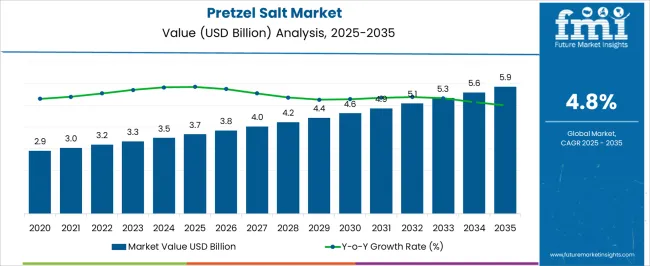
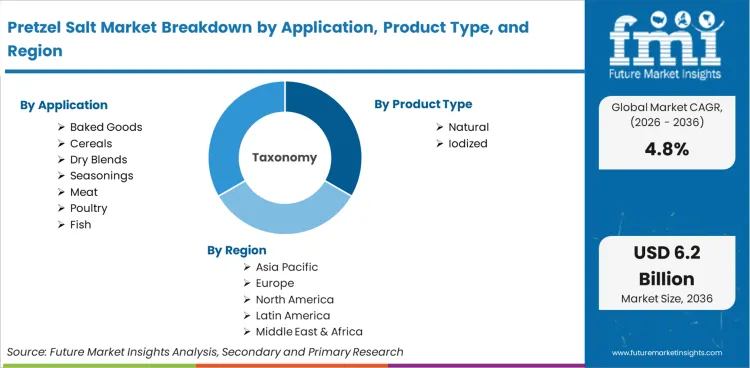
In 2025, the pretzel salt market was valued at USD 3.70 billion. Based on Future Market Insights' analysis, demand for pretzel salt is estimated to grow to USD 3.88 billion in 2026 and USD 6.20 billion by 2036. FMI projects a CAGR of 4.8% during the forecast period.
Absolute dollar growth of USD 2.32 billion over the decade signals expansion driven by intersecting forces of snack category premiumization, regulatory sodium reduction pressure, and geographic market development in Asia-Pacific and South Asia. The sodium labeling regulation implemented in Canada effective January 1, 2026, mandating front-of-package high sodium warning symbols on pretzels and snack products exceeding 15% of the Daily Value for sodium, has triggered a measurable industry-wide shift toward gourmet salt flake formats including fleur de sel variants that dissolve faster on the palate and deliver a more intense salty burst at lower total sodium application rates. [1] Responding to sustained long-term volume demand, Morton Salt announced a significant production expansion targeting its evaporated and solar salt facilities that produce the high-purity coarse crystal grades essential for the pretzel salt specification, with completion expected within 12 to 18 months of the June 2025 announcement. [2]
Summary of Pretzel Salt Market
- Pretzel Salt Market Definition
- The market covers specialized high-purity coarse crystal salt grades for topical application on pretzel, baked snack, and bakery products, differentiated by crystal morphology, adhesion characteristics, and visual whiteness specifications that distinguish pretzel-grade from commodity food-grade salt across B2B manufacturing and B2C specialty food channels.
- Demand Drivers in the Market
- Front-of-package sodium warning label regulations in Canada effective January 2026 and ongoing EU sodium reduction frameworks are compelling pretzel and snack manufacturers to shift from high-volume standard coarse salt toward fast-dissolve gourmet crystal formats that deliver equivalent perceived saltiness at materially lower sodium application rates.
- Snack food category premiumization across North America, Europe, and Asia-Pacific is driving demand for specialty pretzel salt grades including artisanal sea salt flakes, mineral-distinctive crystal varieties, and origin-labeled gourmet salts that provide differentiation credentials in premium snack product positioning.
- Low-sodium micronized crystal technology, as demonstrated by MicroSalt PLC's January 2026 four-year development agreement with a leading global snack manufacturer targeting a Q2 2026 product launch, is creating a new technical specification tier within pretzel salt procurement where patented particle engineering delivers full-flavor performance at clinically reduced sodium dosage.
- Key Segments Analyzed in the FMI Report
- Application: Baked Goods holds approximately 42.6% of application demand, anchored by the industrial pretzel manufacturing base where consistent crystal morphology, predictable adhesion behavior, and flavor burst performance across high-volume production lines are contractual specification requirements for B2B pretzel-grade salt supply agreements.
- Product Type: Natural salt represents approximately 57.8% of market share, reflecting consumer and manufacturer preference for minimal processing designation in snack ingredient labeling where clean-label positioning supports premium pricing and is increasingly required by retail chain ingredient policy commitments.
- Distribution: Indirect Sales B2C accounts for approximately 44.9% of channel volume, reflecting the specialty food retail and online market for consumer-facing gourmet pretzel salt formats, while Direct Sales B2B serves industrial pretzel and snack manufacturers through specification-based bulk supply contracts.
- Analyst Opinion at FMI
- Nandini Roy Choudhury, Principal Consultant for Food & Beverage at Future Market Insights, opines, 'In the updated version of the Pretzel Salt Market Report for 2026 to 2036, CXOs will find that the sodium warning label cascade beginning in Canada in 2026 represents a procurement restructuring event rather than a gradual market shift. My findings indicate that the pretzel and snack manufacturers most exposed to front-of-package labeling requirements are actively reformulating crystal salt specifications in parallel product development cycles, and that suppliers with validated low-sodium crystal technology and gourmet fast-dissolve salt formats are positioned to capture disproportionate contract volume as this regulatory wave extends from North America into European and Asian markets over the forecast decade.'
- Strategic Implications / Executive Takeaways
- Invest in validated low-sodium crystal salt technology partnerships with patent holders such as MicroSalt to capture the reformulation contract volume triggered by front-of-package sodium warning label requirements, positioning ahead of the regulatory cascade from North America into European and Asian snack markets.
- Expand production capacity for high-purity evaporated and solar salt facilities that produce the coarse crystal grades meeting pretzel-grade morphology specifications, as Morton Salt's June 2025 capacity expansion announcement signals supply tightening in premium pretzel-grade crystal grades across the forecast period.
- Develop origin-labeled and gourmet salt flake product lines for the specialty food retail and direct-to-consumer channels where snack premiumization is generating sustainable volume growth at price points that commodity pretzel salt cannot access.
- Methodology
- Validated through primary interviews with pretzel salt producers, snack food manufacturers, and bakery ingredient buyers across North America and Europe.
- Zero reliance on speculative third-party market research reports; benchmarks sourced from national salt industry association production data and verified company investor disclosures.
- Based on snack food production volume data, pretzel-grade salt specification penetration rates, and verified regulatory sodium labeling implementation timelines from food agency official publications.
China (6.5% CAGR) leads country growth through expanding snack food manufacturing and premiumization of bakery and cereal product categories. India (6.0% CAGR) follows through rapid growth in packaged snack consumption. Germany (5.5% CAGR) and France (5.0% CAGR) reflect European snack and bakery industry demand within a regulatory sodium reduction framework. UK (4.6% CAGR) generates growth from clean-label snack product development. USA (4.1% CAGR) contributes steady demand from established pretzel manufacturing and snack seasoning applications. Brazil (3.6% CAGR) represents developing market snack industry growth. Natural Product Type holds approximately 57.8% of market share; Baked Goods represents approximately 42.6% of application demand; Indirect Sales B2C accounts for approximately 44.9% of distribution channel volume.
Pretzel Salt Market Definition
The pretzel salt market comprises the global production, trade, and food industry application of specialized high-purity coarse crystal salt grades specifically formulated for topical application on pretzel, baked snack, bakery, and food seasoning products. These salt products are distinguished from commodity food-grade salt by their specific crystal morphology requirements including defined crystal size ranges, surface adhesion characteristics, visual whiteness standards, and clean burst-of-flavor performance attributes required by pretzel and snack food manufacturers. The market includes natural and iodized pretzel salt grades supplied in bulk and retail packaging formats across the B2B food manufacturing and B2C specialty food retail channels.
Pretzel Salt Market Inclusions
The report includes Global and Regional Market Sizes (Volume and Value) and a 10-year Forecast (2026 to 2036). Coverage spans segmental breakdowns by application (Baked Goods, Cereals, Dry Blends, Seasonings, Meat, Poultry, and Fish), product type (Natural and Iodized), distribution channel (Indirect Sales B2C, Direct Sales B2B, Hypermarkets and Supermarkets, Online Stores, Specialty Stores, and Other Retailers), and geography across 40-plus countries.
Pretzel Salt Market Exclusions
The scope excludes commodity food-grade salt that does not meet pretzel-grade crystal morphology specifications for topical snack application. Industrial and non-food grade salt products are outside the reportable market boundary. Flavored or compound seasoning blends where salt is a component within a multi-ingredient formulation rather than a standalone topical crystal application are excluded. Anti-caking agent formulations and salt substitutes based on potassium chloride or other mineral salts marketed as sodium reduction solutions rather than pretzel-grade crystal salt products are not included within this market scope.
Pretzel Salt Market Research Methodology
- Primary Research: Interviews were conducted with pretzel salt producers, snack food manufacturers, bakery ingredient buyers, food-grade salt distributors, and food technology specialists across North America, Europe, and Asia-Pacific.
- Desk Research: Production data from national salt industry associations, company investor disclosures and press releases, food regulatory agency sodium labeling requirements, and specialty food retail industry reports supported volume and value benchmarking.
- Market-Sizing and Forecasting: A hybrid top-down and bottom-up model was applied. Demand was reconstructed from snack food production volumes, pretzel-grade salt specification penetration rates by application type, and regional regulatory sodium reduction timeline data, then validated against salt manufacturer capacity announcements.
- Data Validation and Update Cycle: Outputs undergo cross-validation against food ingredient trade statistics, regulatory agency front-of-package labeling implementation records, and structured expert review by food industry specialists prior to release.
Why is the Pretzel Salt Market Growing?
The Pretzel Salt market is experiencing steady growth due to increasing consumer demand for flavored snacks and baked goods, driven by evolving taste preferences and rising consumption of convenience foods. In 2026, the market is witnessing robust adoption in both retail and food service sectors, with consumers showing preference for quality ingredients that enhance taste and texture.
The market expansion is supported by the growing popularity of baked snacks, particularly in urban and semi-urban areas where snack culture is rapidly evolving. Increasing investments in food processing technology and rising awareness regarding ingredient quality have contributed to the preference for premium salt variants.
Furthermore, the shift toward organized retail channels and e-commerce platforms has facilitated wider distribution, while innovations in packaging and portion sizes are improving product accessibility The market outlook remains positive as demand continues to grow for specialty salts that can enhance the sensory experience of baked products and meet evolving consumer expectations in both domestic and international markets.
Segmental Analysis
The pretzel salt market is segmented by application, product type, distribution channel, and geographic regions. By application, pretzel salt market is divided into Baked Goods, Cereals, Dry Blends, Seasonings, Meat, Poultry, and Fish. In terms of product type, pretzel salt market is classified into Natural and Iodized. Based on distribution channel, pretzel salt market is segmented into Indirect Sales (B2C), Direct Sales (B2B), Hypermarkets/Supermarkets, Online Stores, Specialty Stores, and Other Retailers. Regionally, the pretzel salt industry is classified into North America, Latin America, Western Europe, Eastern Europe, Balkan & Baltic Countries, Russia & Belarus, Central Asia, East Asia, South Asia & Pacific, and the Middle East & Africa.
Insights into the Baked Goods Application Segment
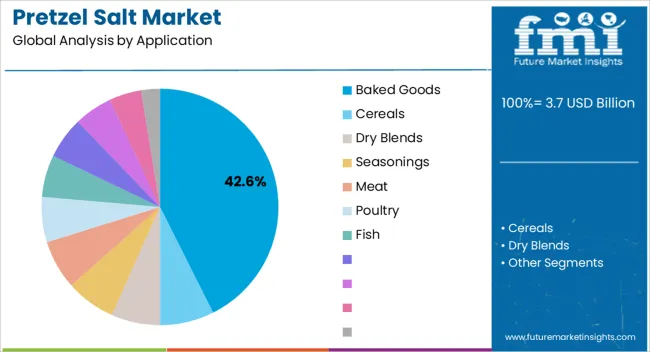
The Baked Goods application is projected to hold 42.60% of the Pretzel Salt market revenue share in 2026, making it the leading segment in terms of application. This dominance is being driven by the high consumption of pretzels and related baked snacks in retail and food service sectors, where taste consistency and texture enhancement are critical.
Adoption has been accelerated by rising consumer preference for ready-to-eat and packaged baked goods that require uniform seasoning for quality assurance. The growth of this segment has been supported by manufacturers increasingly focusing on improving product appeal through premium ingredients, including specialty salts, to differentiate their offerings in competitive markets.
In addition, retail expansion and increasing product availability across urban and semi-urban areas have reinforced the segment’s leading position The combination of enhanced flavor profile, convenience, and the ability to maintain consistent product quality across large production volumes is driving continued adoption in baked goods applications.
Insights into the Natural Product Type Segment
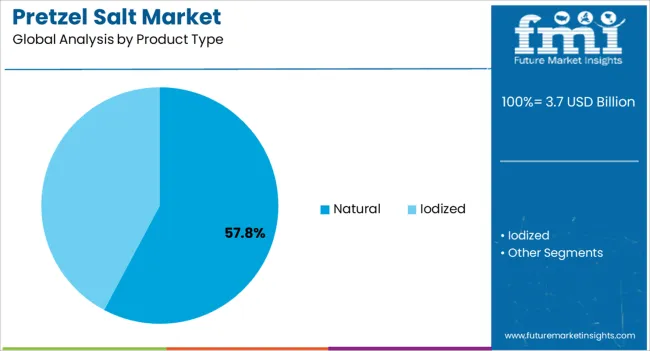
The Natural product type is expected to capture 57.80% of the Pretzel Salt market revenue share in 2026, establishing it as the leading product type. This growth is being attributed to rising consumer awareness regarding health and ingredient transparency, where natural salts are perceived as higher quality and safer alternatives to refined options.
Manufacturers are increasingly responding to demand for clean label products, which has further accelerated adoption of natural salts in pretzel production and other baked applications. The preference for natural salt is also being reinforced by its ability to enhance flavor while minimizing additives, making it suitable for a broad range of products.
As consumers continue to prioritize natural and minimally processed ingredients, the Natural product type is being preferred across retail, food service, and e-commerce channels In addition, its compatibility with premium and artisanal baked goods supports sustained growth, as producers aim to meet both functional and sensory expectations.
Insights into the Indirect Sales (B2C) Distribution Channel Segment
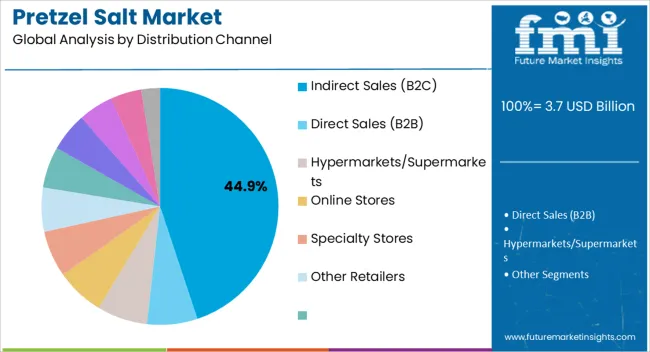
The Indirect Sales (B2C) distribution channel is projected to account for 44.90% of the Pretzel Salt market revenue share in 2026, emerging as the largest distribution channel. This leadership is being driven by the widespread penetration of modern retail chains, supermarkets, and online grocery platforms that facilitate convenient access for consumers.
Adoption has been accelerated by growing consumer preference for purchasing packaged snacks and ingredients through accessible retail formats that offer variety, standardized quality, and attractive packaging. The segment benefits from the ability to reach a wide demographic, from households to food service operators, without requiring direct relationships with manufacturers.
Increased digitalization and the rise of e-commerce have further strengthened indirect distribution channels, enabling easy product discovery and delivery As urbanization continues and retail infrastructure expands, the Indirect Sales channel is expected to maintain its market dominance due to convenience, broad availability, and the scalability it offers to manufacturers seeking to meet growing consumer demand.
Market Overview
Market Outlook
Pretzel salt is a food grade, crushed, white crystalline, NaCl (sodium chloride) produced under strict process control procedures. It is made from finely grounded salt that doesn't absorb moisture as much as regular salts. The grains of pretzel salt are flat and rectangular shaped.
The shape of the pretzel salt adheres to pretzels and other baked goods such as bread, hard rolls, and bagels. Additional applications of pretzel salt include fortification of meat, salt-coated fish, zucchini fritters and pickling. Increasing demand for ready-to-eat food products and the needs of healthy snacks are assisting the growth of the pretzel salt market.
Analysis of Pretzel Salt Market By Key Countries
.webp "Top Country Growth Comparison Pretzel Salt Market Cagr (2026 2036)")
| Country | CAGR |
|---|---|
| China | 6.5% |
| India | 6.0% |
| Germany | 5.5% |
| France | 5.0% |
| UK | 4.6% |
| USA | 4.1% |
| Brazil | 3.6% |
Source: FMI analysis based on primary research and proprietary forecasting model
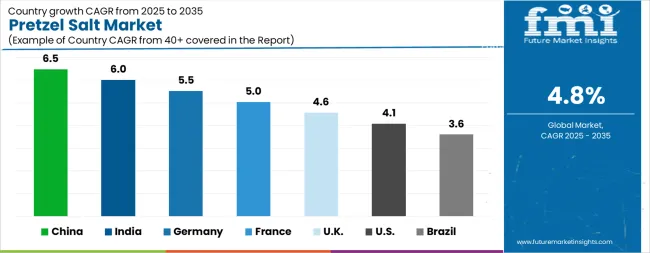
The Pretzel Salt Market is expected to register a CAGR of 4.8% during the forecast period, exhibiting varied country level momentum. China leads with the highest CAGR of 6.5%, followed by India at 6.0%. Developed markets such as Germany, France, and the UK continue to expand steadily, while the USA is likely to grow at consistent rates. Brazil posts the lowest CAGR at 3.6%, yet still underscores a broadly positive trajectory for the global Pretzel Salt Market. In 2026, Germany held a dominant revenue in the Western Europe market and is expected to grow with a CAGR of 5.5%. The USA Pretzel Salt Market is estimated to be valued at USD 1.4 billion in 2026 and is anticipated to reach a valuation of USD 2.1 billion by 2036. Sales are projected to rise at a CAGR of 4.1% over the forecast period between 2026 and 2036. While Japan and South Korea markets are estimated to be valued at USD 182.2 million and USD 105.6 million respectively in 2026.
Key Players in the Pretzel Salt Market
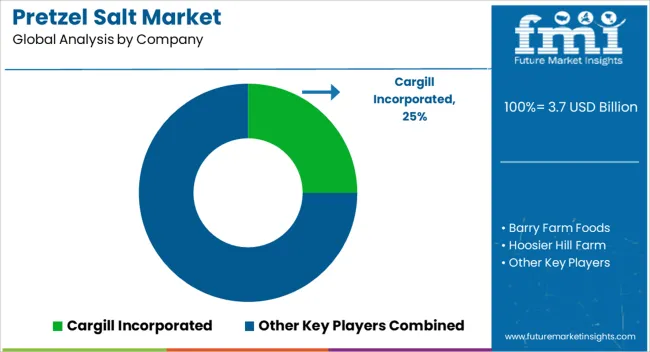
- Cargill Incorporated
- Barry Farm Foods
- Hoosier Hill Farm
- Jacobsen Salt
- Morton Salt
- SaltWorks
- San Francisco Salt Company
- Southwest Salt Company
- QualiTech
- Santa Cruz Biotechnology
Recent Developments
The report includes full coverage of key trends from competitive benchmarking. Some of the recent developments covered in the reports:
- In January 2026, MicroSalt PLC signed a new four-year development agreement with a leading global food and snack manufacturer, focusing on integrating MicroSalt's patented micron-sized salt particles into large-scale snack production lines and targeting a new product launch in Q2 2026 that delivers a full-flavor pretzel experience using low-sodium salt technology. [3]
- In June 2025, Morton Salt announced a significant production expansion targeting its evaporated and solar salt facilities that produce the high-purity coarse crystal grades essential for pretzel-grade salt specifications, with completion expected within 12 to 18 months of the announcement date. [2]
- Effective January 1, 2026, Canada implemented new front-of-package nutrition symbols mandating high sodium warning labels on pretzels and snack products exceeding 15% of the Daily Value for sodium, triggering a measurable industry-wide shift toward gourmet salt flake formats that dissolve faster and provide a more intense salty burst at lower total sodium application rates per product serving. [1]
Scope of the Report
| Metric | Value |
|---|---|
| Quantitative Units | USD 3.88 billion (2026) to USD 6.20 billion (2036), at a CAGR of 4.8% |
| Market Definition | The pretzel salt market covers specialized high-purity coarse crystal salt grades for topical application on pretzel, baked snack, and bakery products, distinguished by crystal morphology, adhesion characteristics, and visual whiteness specifications from commodity food-grade salt. |
| Application Segmentation | Baked Goods, Cereals, Dry Blends, Seasonings, Meat, Poultry, Fish |
| Product Type Segmentation | Natural, Iodized |
| Distribution Channel | Indirect Sales B2C, Direct Sales B2B, Hypermarkets and Supermarkets, Online Stores, Specialty Stores, Other Retailers |
| Regions Covered | North America, Latin America, Europe, East Asia, South Asia, Oceania, Middle East and Africa |
| Countries Covered | China, India, Germany, France, United Kingdom, United States, Brazil and 40 plus countries |
| Key Companies Profiled | Cargill Incorporated, Barry Farm Foods, Hoosier Hill Farm, Jacobsen Salt, Morton Salt, SaltWorks, San Francisco Salt Company, Southwest Salt Company, QualiTech, Santa Cruz Biotechnology |
| Forecast Period | 2026 to 2036 |
| Approach | Hybrid top-down and bottom-up market modeling validated through primary interviews with pretzel salt producers and snack food manufacturers, supported by salt industry production statistics and food regulatory agency sodium labeling records |
Pretzel Salt Market by Segments
Application:
- Baked Goods
- Cereals
- Dry Blends
- Seasonings
- Meat
- Poultry
- Fish
Product Type:
- Natural
- Iodized
Distribution Channel:
- Indirect Sales (B2C)
- Direct Sales (B2B)
- Hypermarkets/Supermarkets
- Online Stores
- Specialty Stores
- Other Retailers
Region:
- North America
- USA
- Canada
- Mexico
- Latin America
- Brazil
- Chile
- Rest of Latin America
- Western Europe
- Germany
- UK
- Italy
- Spain
- France
- Nordic
- BENELUX
- Rest of Western Europe
- Eastern Europe
- Russia
- Poland
- Hungary
- Balkan & Baltic
- Rest of Eastern Europe
- East Asia
- China
- Japan
- South Korea
- South Asia and Pacific
- India
- ASEAN
- Australia & New Zealand
- Rest of South Asia and Pacific
- Middle East & Africa
- Kingdom of Saudi Arabia
- Other GCC Countries
- Turkiye
- South Africa
- Other African Union
- Rest of Middle East & Africa
Bibliography
- [1] Health Canada. (2026). Front-of-package labeling regulations: implementation of high sodium warning symbols on food products effective January 1, 2026. Government of Canada Regulatory Gazette. https://www.canada.ca/en/health-canada/services/food-nutrition/front-package-labelling.html
- [2] Morton Salt. (2025). Morton Salt announces significant production expansion at evaporated and solar salt facilities to meet demand for high-purity coarse crystal pretzel-grade salt. Corporate Announcement, June 2025. https://www.mortonsalt.com/
- [3] MicroSalt PLC. (2026). MicroSalt signs four-year development agreement with leading global snack manufacturer targeting Q2 2026 low-sodium pretzel product launch using patented micron-sized salt particle technology. Corporate Press Release, January 2026. https://www.microsalt.com/
- [4] Cargill Incorporated. (2025). Cargill food-grade salt: pretzel and snack topical crystal application specifications and sustainability sourcing standards. Corporate Technical Data, 2025. https://www.cargill.com/
- [5] Salt Institute. (2025). North American food-grade salt production and quality standards: annual industry statistics 2024-2025. Industry Report. Alexandria: Salt Institute. https://www.saltinstitute.org/
- [6] European Commission. (2025). EU salt reduction framework: targets and implementation timelines for processed food sodium content reduction under the Farm to Fork strategy. EC Policy Document. https://food.ec.europa.eu/
This bibliography is provided for reader reference and is not exhaustive. The full report contains the complete reference list and detailed citations.
This Report Addresses
- Market intelligence to enable structured procurement, formulation strategy, and regulatory compliance planning for pretzel salt producers, snack food manufacturers, bakery ingredient buyers, and specialty food retailers
- Market size estimation and 10-year revenue forecasts from 2026 to 2036, supported by snack food production volume data, pretzel-grade crystal specification penetration rates, and regulatory sodium labeling implementation analysis
- Growth opportunity mapping across application and product type segments with emphasis on low-sodium crystal technology adoption in baked goods and the gourmet salt flake transition driven by front-of-package labeling requirements
- Segment and regional revenue forecasts covering baked goods, cereals, seasonings, and meat application channels across key pretzel manufacturing and snack consuming geographies in North America, Europe, and Asia-Pacific
- Competition strategy assessment including crystal morphology technology differentiation, production capacity and purity grade positioning, and gourmet versus commodity salt product line benchmarking
- Regulatory compliance tracking including Canada and EU front-of-package sodium warning label requirements, daily value sodium threshold enforcement timelines, and their procurement implications for pretzel-grade salt specification transitions
- Regulatory impact analysis covering North American and European sodium reduction frameworks, their enforcement timelines, and the resultant crystal morphology and low-sodium technology procurement requirements for snack manufacturers
- Market report delivery in PDF, Excel, PPT, and interactive dashboard formats for executive and operational use
Frequently Asked Questions
How large is the demand for pretzel salt in the global market in 2026?
Demand for pretzel salt in the global market is estimated to be valued at USD 3.88 billion in 2026.
What will be the market size of pretzel salt by 2036?
Market size for pretzel salt is projected to reach USD 6.20 billion by 2036.
What is the expected CAGR for the pretzel salt market between 2026 and 2036?
Demand for pretzel salt is expected to grow at a CAGR of 4.8% between 2026 and 2036.
Which application segment holds the largest share in the pretzel salt market?
Baked Goods accounts for approximately 42.6% of application demand, anchored by the industrial pretzel manufacturing base where consistent crystal morphology and predictable adhesion performance across high-volume production lines are contractual pretzel-grade supply specifications.
Which product type dominates the pretzel salt market?
Natural salt represents approximately 57.8% of market share, reflecting clean-label positioning requirements in snack ingredient labeling where minimal processing designation supports premium pricing and retail chain ingredient policy compliance.
What was the significance of Canada's January 2026 sodium labeling regulation for pretzel salt?
Canada's front-of-package high sodium warning symbol mandate for products exceeding 15% of the Daily Value for sodium triggered a measurable shift toward fast-dissolve gourmet salt flake formats that deliver the same perceived saltiness intensity at lower total sodium application rates, directly restructuring crystal morphology specifications across pretzel and snack procurement.
Which countries show the fastest growth in pretzel salt demand?
China leads at 6.5% CAGR through 2036, followed by India at 6.0% and Germany at 5.5%, driven by snack food manufacturing expansion, packaged snack consumption growth, and European bakery and snack industry demand within a sodium reduction framework respectively.
What does MicroSalt's January 2026 development agreement mean for the pretzel salt market?
The four-year agreement with a leading global snack manufacturer to develop Q2 2026 low-sodium pretzel products signals commercial-scale validation of micronized salt particle technology as a viable pretzel-grade reformulation solution, establishing a technological precedent that larger salt producers will face competitive pressure to match.
Is the USA covered in this report's regional analysis?
Yes, the USA is covered within the North America regional scope at a projected 4.1% CAGR through 2036, driven by established pretzel manufacturing operations and ongoing snack seasoning category growth where pretzel-grade coarse crystal salts are a consistent procurement requirement.
How does FMI validate the pretzel salt market forecast?
The forecast uses a hybrid model validated through primary interviews with pretzel salt producers and snack food manufacturers, cross-referenced against salt industry association production statistics, food regulatory agency sodium labeling records, and verified company capacity announcements from major salt producers.
Preview the report firsthand - request a free sample
Get SampleGet the brochure for pricing and purchase details.
Get PDFTable of Content
- Executive Summary
- Global Market Outlook
- Demand-side Trends
- Supply-side Trends
- Technology Roadmap Analysis
- Analysis and Recommendations
- Market Overview
- Market Coverage / Taxonomy
- Market Definition / Scope / Limitations
- Research Methodology
- Chapter Orientation
- Analytical Lens and Working Hypotheses
- Market Structure, Signals, and Trend Drivers
- Benchmarking and Cross-market Comparability
- Market Sizing, Forecasting, and Opportunity Mapping
- Research Design and Evidence Framework
- Desk Research Programme (Secondary Evidence)
- Company Annual and Sustainability Reports
- Peer-reviewed Journals and Academic Literature
- Corporate Websites, Product Literature, and Technical Notes
- Earnings Decks and Investor Briefings
- Statutory Filings and Regulatory Disclosures
- Technical White Papers and Standards Notes
- Trade Journals, Industry Magazines, and Analyst Briefs
- Conference Proceedings, Webinars, and Seminar Materials
- Government Statistics Portals and Public Data Releases
- Press Releases and Reputable Media Coverage
- Specialist Newsletters and Curated Briefings
- Sector Databases and Reference Repositories
- FMI Internal Proprietary Databases and Historical Market Datasets
- Subscription Datasets and Paid Sources
- Social Channels, Communities, and Digital Listening Inputs
- Additional Desk Sources
- Expert Input and Fieldwork (Primary Evidence)
- Primary Modes
- Qualitative Interviews and Expert Elicitation
- Quantitative Surveys and Structured Data Capture
- Blended Approach
- Why Primary Evidence is Used
- Field Techniques
- Interviews
- Surveys
- Focus Groups
- Observational and In-context Research
- Social and Community Interactions
- Stakeholder Universe Engaged
- C-suite Leaders
- Board Members
- Presidents and Vice Presidents
- R&D and Innovation Heads
- Technical Specialists
- Domain Subject-matter Experts
- Scientists
- Physicians and Other Healthcare Professionals
- Governance, Ethics, and Data Stewardship
- Research Ethics
- Data Integrity and Handling
- Primary Modes
- Tooling, Models, and Reference Databases
- Desk Research Programme (Secondary Evidence)
- Data Engineering and Model Build
- Data Acquisition and Ingestion
- Cleaning, Normalisation, and Verification
- Synthesis, Triangulation, and Analysis
- Quality Assurance and Audit Trail
- Market Background
- Market Dynamics
- Drivers
- Restraints
- Opportunity
- Trends
- Scenario Forecast
- Demand in Optimistic Scenario
- Demand in Likely Scenario
- Demand in Conservative Scenario
- Opportunity Map Analysis
- Product Life Cycle Analysis
- Supply Chain Analysis
- Investment Feasibility Matrix
- Value Chain Analysis
- PESTLE and Porter’s Analysis
- Regulatory Landscape
- Regional Parent Market Outlook
- Production and Consumption Statistics
- Import and Export Statistics
- Market Dynamics
- Global Market Analysis 2021 to 2025 and Forecast, 2026 to 2036
- Historical Market Size Value (USD Million) Analysis, 2021 to 2025
- Current and Future Market Size Value (USD Million) Projections, 2026 to 2036
- Y-o-Y Growth Trend Analysis
- Absolute $ Opportunity Analysis
- Global Market Pricing Analysis 2021 to 2025 and Forecast 2026 to 2036
- Global Market Analysis 2021 to 2025 and Forecast 2026 to 2036, By Application
- Introduction / Key Findings
- Historical Market Size Value (USD Million) Analysis By Application , 2021 to 2025
- Current and Future Market Size Value (USD Million) Analysis and Forecast By Application , 2026 to 2036
- Baked Goods
- Cereals
- Dry Blends
- Seasonings
- Meat
- Poultry
- Fish
- Baked Goods
- Y-o-Y Growth Trend Analysis By Application , 2021 to 2025
- Absolute $ Opportunity Analysis By Application , 2026 to 2036
- Global Market Analysis 2021 to 2025 and Forecast 2026 to 2036, By Product Type:
- Introduction / Key Findings
- Historical Market Size Value (USD Million) Analysis By Product Type:, 2021 to 2025
- Current and Future Market Size Value (USD Million) Analysis and Forecast By Product Type:, 2026 to 2036
- Natural
- Iodized
- Natural
- Y-o-Y Growth Trend Analysis By Product Type:, 2021 to 2025
- Absolute $ Opportunity Analysis By Product Type:, 2026 to 2036
- Global Market Analysis 2021 to 2025 and Forecast 2026 to 2036, By Distribution Channel
- Introduction / Key Findings
- Historical Market Size Value (USD Million) Analysis By Distribution Channel, 2021 to 2025
- Current and Future Market Size Value (USD Million) Analysis and Forecast By Distribution Channel, 2026 to 2036
- Indirect Sales (B2C)
- Direct Sales (B2B)
- Hypermarkets/Supermarkets
- Online Stores
- Specialty Stores
- Other Retailers
- Indirect Sales (B2C)
- Y-o-Y Growth Trend Analysis By Distribution Channel, 2021 to 2025
- Absolute $ Opportunity Analysis By Distribution Channel, 2026 to 2036
- Global Market Analysis 2021 to 2025 and Forecast 2026 to 2036, By Region
- Introduction
- Historical Market Size Value (USD Million) Analysis By Region, 2021 to 2025
- Current Market Size Value (USD Million) Analysis and Forecast By Region, 2026 to 2036
- North America
- Latin America
- Western Europe
- Eastern Europe
- East Asia
- South Asia and Pacific
- Middle East & Africa
- Market Attractiveness Analysis By Region
- North America Market Analysis 2021 to 2025 and Forecast 2026 to 2036, By Country
- Historical Market Size Value (USD Million) Trend Analysis By Market Taxonomy, 2021 to 2025
- Market Size Value (USD Million) Forecast By Market Taxonomy, 2026 to 2036
- By Country
- USA
- Canada
- Mexico
- By Application
- By Product Type:
- By Distribution Channel
- By Country
- Market Attractiveness Analysis
- By Country
- By Application
- By Product Type:
- By Distribution Channel
- Key Takeaways
- Latin America Market Analysis 2021 to 2025 and Forecast 2026 to 2036, By Country
- Historical Market Size Value (USD Million) Trend Analysis By Market Taxonomy, 2021 to 2025
- Market Size Value (USD Million) Forecast By Market Taxonomy, 2026 to 2036
- By Country
- Brazil
- Chile
- Rest of Latin America
- By Application
- By Product Type:
- By Distribution Channel
- By Country
- Market Attractiveness Analysis
- By Country
- By Application
- By Product Type:
- By Distribution Channel
- Key Takeaways
- Western Europe Market Analysis 2021 to 2025 and Forecast 2026 to 2036, By Country
- Historical Market Size Value (USD Million) Trend Analysis By Market Taxonomy, 2021 to 2025
- Market Size Value (USD Million) Forecast By Market Taxonomy, 2026 to 2036
- By Country
- Germany
- UK
- Italy
- Spain
- France
- Nordic
- BENELUX
- Rest of Western Europe
- By Application
- By Product Type:
- By Distribution Channel
- By Country
- Market Attractiveness Analysis
- By Country
- By Application
- By Product Type:
- By Distribution Channel
- Key Takeaways
- Eastern Europe Market Analysis 2021 to 2025 and Forecast 2026 to 2036, By Country
- Historical Market Size Value (USD Million) Trend Analysis By Market Taxonomy, 2021 to 2025
- Market Size Value (USD Million) Forecast By Market Taxonomy, 2026 to 2036
- By Country
- Russia
- Poland
- Hungary
- Balkan & Baltic
- Rest of Eastern Europe
- By Application
- By Product Type:
- By Distribution Channel
- By Country
- Market Attractiveness Analysis
- By Country
- By Application
- By Product Type:
- By Distribution Channel
- Key Takeaways
- East Asia Market Analysis 2021 to 2025 and Forecast 2026 to 2036, By Country
- Historical Market Size Value (USD Million) Trend Analysis By Market Taxonomy, 2021 to 2025
- Market Size Value (USD Million) Forecast By Market Taxonomy, 2026 to 2036
- By Country
- China
- Japan
- South Korea
- By Application
- By Product Type:
- By Distribution Channel
- By Country
- Market Attractiveness Analysis
- By Country
- By Application
- By Product Type:
- By Distribution Channel
- Key Takeaways
- South Asia and Pacific Market Analysis 2021 to 2025 and Forecast 2026 to 2036, By Country
- Historical Market Size Value (USD Million) Trend Analysis By Market Taxonomy, 2021 to 2025
- Market Size Value (USD Million) Forecast By Market Taxonomy, 2026 to 2036
- By Country
- India
- ASEAN
- Australia & New Zealand
- Rest of South Asia and Pacific
- By Application
- By Product Type:
- By Distribution Channel
- By Country
- Market Attractiveness Analysis
- By Country
- By Application
- By Product Type:
- By Distribution Channel
- Key Takeaways
- Middle East & Africa Market Analysis 2021 to 2025 and Forecast 2026 to 2036, By Country
- Historical Market Size Value (USD Million) Trend Analysis By Market Taxonomy, 2021 to 2025
- Market Size Value (USD Million) Forecast By Market Taxonomy, 2026 to 2036
- By Country
- Kingdom of Saudi Arabia
- Other GCC Countries
- Turkiye
- South Africa
- Other African Union
- Rest of Middle East & Africa
- By Application
- By Product Type:
- By Distribution Channel
- By Country
- Market Attractiveness Analysis
- By Country
- By Application
- By Product Type:
- By Distribution Channel
- Key Takeaways
- Key Countries Market Analysis
- USA
- Pricing Analysis
- Market Share Analysis, 2025
- By Application
- By Product Type:
- By Distribution Channel
- Canada
- Pricing Analysis
- Market Share Analysis, 2025
- By Application
- By Product Type:
- By Distribution Channel
- Mexico
- Pricing Analysis
- Market Share Analysis, 2025
- By Application
- By Product Type:
- By Distribution Channel
- Brazil
- Pricing Analysis
- Market Share Analysis, 2025
- By Application
- By Product Type:
- By Distribution Channel
- Chile
- Pricing Analysis
- Market Share Analysis, 2025
- By Application
- By Product Type:
- By Distribution Channel
- Germany
- Pricing Analysis
- Market Share Analysis, 2025
- By Application
- By Product Type:
- By Distribution Channel
- UK
- Pricing Analysis
- Market Share Analysis, 2025
- By Application
- By Product Type:
- By Distribution Channel
- Italy
- Pricing Analysis
- Market Share Analysis, 2025
- By Application
- By Product Type:
- By Distribution Channel
- Spain
- Pricing Analysis
- Market Share Analysis, 2025
- By Application
- By Product Type:
- By Distribution Channel
- France
- Pricing Analysis
- Market Share Analysis, 2025
- By Application
- By Product Type:
- By Distribution Channel
- India
- Pricing Analysis
- Market Share Analysis, 2025
- By Application
- By Product Type:
- By Distribution Channel
- ASEAN
- Pricing Analysis
- Market Share Analysis, 2025
- By Application
- By Product Type:
- By Distribution Channel
- Australia & New Zealand
- Pricing Analysis
- Market Share Analysis, 2025
- By Application
- By Product Type:
- By Distribution Channel
- China
- Pricing Analysis
- Market Share Analysis, 2025
- By Application
- By Product Type:
- By Distribution Channel
- Japan
- Pricing Analysis
- Market Share Analysis, 2025
- By Application
- By Product Type:
- By Distribution Channel
- South Korea
- Pricing Analysis
- Market Share Analysis, 2025
- By Application
- By Product Type:
- By Distribution Channel
- Russia
- Pricing Analysis
- Market Share Analysis, 2025
- By Application
- By Product Type:
- By Distribution Channel
- Poland
- Pricing Analysis
- Market Share Analysis, 2025
- By Application
- By Product Type:
- By Distribution Channel
- Hungary
- Pricing Analysis
- Market Share Analysis, 2025
- By Application
- By Product Type:
- By Distribution Channel
- Kingdom of Saudi Arabia
- Pricing Analysis
- Market Share Analysis, 2025
- By Application
- By Product Type:
- By Distribution Channel
- Turkiye
- Pricing Analysis
- Market Share Analysis, 2025
- By Application
- By Product Type:
- By Distribution Channel
- South Africa
- Pricing Analysis
- Market Share Analysis, 2025
- By Application
- By Product Type:
- By Distribution Channel
- USA
- Market Structure Analysis
- Competition Dashboard
- Competition Benchmarking
- Market Share Analysis of Top Players
- By Regional
- By Application
- By Product Type:
- By Distribution Channel
- Competition Analysis
- Competition Deep Dive
- Cargill Incorporated
- Overview
- Product Portfolio
- Profitability by Market Segments (Product/Age /Sales Channel/Region)
- Sales Footprint
- Strategy Overview
- Marketing Strategy
- Product Strategy
- Channel Strategy
- Barry Farm Foods
- Hoosier Hill Farm
- Jacobsen Salt
- Morton Salt
- SaltWorks
- San Francisco Salt Company
- Southwest Salt Company
- QualiTech
- Santa Cruz Biotechnology
- Cargill Incorporated
- Competition Deep Dive
- Assumptions & Acronyms Used


