

- Market Size (2026)
- USD 199.3 Mn
- Forecast (2036)
- USD 334.0 Mn
- CAGR (2026 to 2036)
- 5.3%
How big is Professional Wax Heaters Market in 2026?
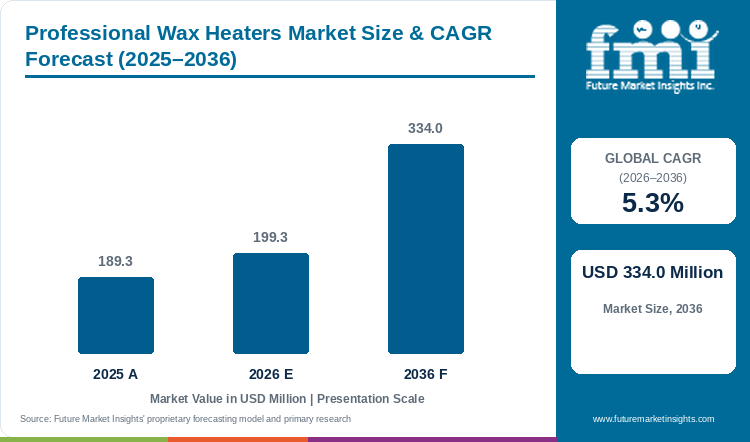
USD 199.3 Million in 2026 and USD 334.0 Million by 2036, expanding at a 5.3% CAGR
The Professional Wax Heaters Market was valued at USD 189.3 Million in 2025 and is likely to reach USD 199.3 Million in 2026. Demand is forecast to reach USD 334.0 Million by 2036 at a 5.3% CAGR. The U.S. Bureau of Labor Statistics reported 104,200 skincare specialist jobs in 2025 and projects 9% employment growth through 2035 [1]. Hair removal is a routine service for many skincare specialists. That gives salons and spas a steady reason to keep wax heaters in working condition. A heater does not need to be complicated. It needs to warm wax evenly, hold the temperature during a busy day and be easy to clean after use. Replacement purchases are therefore driven as much by daily wear and service volume as by business expansion.
The buying environment is different in each country. In the UAE and Saudi Arabia, salon hygiene and safety requirements make equipment condition and cleaning more important. In South Korea, non-medical hair removal is formally covered within the skin-beauty business, which gives waxing a clear place in professional beauty services. Japan already has a large number of beauty establishments, so the opportunity is more closely linked to replacement of existing equipment. At the same time, low prices and pressure on customer numbers can make salon owners cautious about spending on higher-priced models. In practice, most buyers need a heater that works reliably, is easy to maintain and does not add unnecessary cost to the service.
Key Takeaways
- Core professional range is likely to account for 44.0% of Product Type demand in 2026. These heaters cover the temperature control and capacity needed for routine salon waxing without adding features that many operators do not need.
- Hair salons are likely to hold 41.0% of End User demand in 2026. Many already serve regular beauty clients and buy through professional supply channels, making waxing easier to add to the existing service menu.
- Core equipment will account for 43.0% of Offering demand in 2026. The heater is the main piece of equipment used for waxing, while wax, liners and other supplies are purchased around it.
- L'Oreal, Takara Belmont, Conair, REM UK, Henkel, Gharieni Group, Kao Corporation, Wella Company, Andis and Wahl are among the notable companies profiled in the market.
Analyst Perspective
Wax heaters are simple equipment, but salons still depend on them throughout the working day. Buyers need steady heat, easy cleaning and equipment that can be replaced quickly when needed. Models that do these basics well are more useful to most salons than products built around extra features that add cost without improving the service.
- Rahul Pandita, Principal Analyst at Future Market Insights
How is the professional wax heaters market segmented?
The market is segmented by Product Type, End User, Offering, Price Tier, Sales Channel and Region
The market is segmented by Product Type, End User, Offering, Price Tier and Sales Channel. Product Type covers Core professional range, Premium & specialist range and Entry & value range. End User includes Hair salons, Spas & wellness centers, Nail salons, Medspas & clinics and Barbershops. Offering comprises Core equipment, Consumables & refills and Accessories. Price Tier is divided into Mid-range, Economy and Premium. Sales Channel covers Professional distributors, Direct sales and B2B e-commerce.
Why does Core professional range lead demand within the Product Type category?
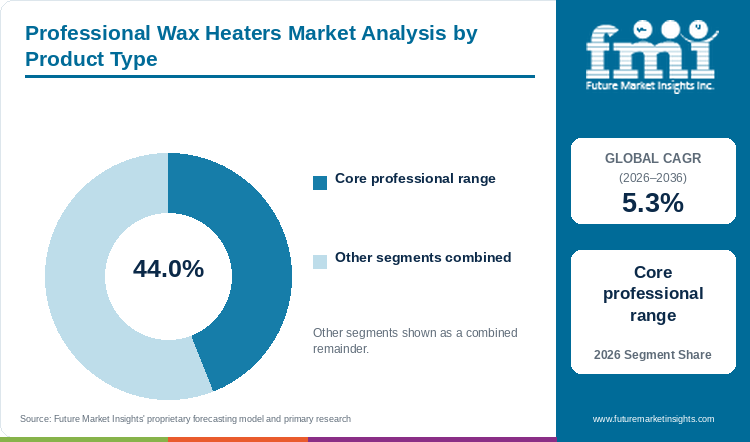
Core professional range holds 44.0% in 2026
Core professional models lead because they cover what most salons need for routine waxing. They provide steady heat, work with commonly used wax containers and are easy to clean between appointments. More specialized functions matter mainly where salons offer a wider or more premium treatment range. This category also aligns with a compliance environment in which skin-care electrical appliances include wax-melting products under IEC safety requirements.[2]
- Core professional range holds 44.0% in 2026. Its advantage comes from balancing salon-grade temperature control and durability with a purchase price that can fit frequent replacement cycles.
- The 2026 pre-release second edition of IEC 60335-2-115 lists wax-melting appliances within scope, keeping electrical safety relevant to professional purchase decisions [2].
Why do Hair salons lead demand within the End User category?
Hair salons hold 41.0% in 2026.
Hair salons lead because they already have regular client traffic and established beauty-service routines. Waxing can be added alongside brow, facial or body treatments without requiring a major equipment investment. For salons that already buy professional consumables and manage back-to-back appointments, a wax heater fits easily into the existing setup. Growth is slower where licensing rules or limited treatment space make it harder to add the service.
- Hair salons hold 41.0% in 2026. Their position reflects existing professional infrastructure, recurring client contact and access to beauty-supply channels that can support both equipment and refills.
- In its August 2026 occupational update, the U.S. Bureau of Labor Statistics said skincare specialists commonly work in salons and beauty or health spas and specifically perform hair-removal services [1]. That operating overlap supports cross-service equipment purchasing.
Why does Core equipment lead demand within the Offering category?
Core equipment holds 43.0% in 2026
Core equipment leads because the heater is the starting point for any waxing service. Wax, liners, inserts and other accessories may be bought more often, but they are only useful when a compatible heater is already in place. Once the equipment is installed, suppliers can build repeat sales around the consumables and accessories used with it.
- Core equipment holds 43.0% in 2026. The heater is the enabling asset for the treatment station and determines compatibility with many related consumables and accessories.
- In August 2026, the IEC released a pre-release second edition of IEC 60335-2-115 that again lists wax-melting appliances within scope [2]. The revision reinforces that the core device carries a distinct safety and qualification burden.
Why does Mid-range lead demand within the Price Tier category?
Mid-range holds 46.0% in 2026
Mid-range models lead because they give salons the features needed for regular waxing without pushing the equipment cost too high. Small salons and self-employed practitioners usually need reliable temperature control and enough capacity for daily appointments, but many have little reason to pay extra for features they may rarely use. Economy models compete mainly on price, while premium products make more sense for salons that need larger capacity, multiple pots or a higher-end treatment setup.
- Mid-range holds 46.0% in 2026. It captures the strongest compromise between equipment reliability, professional features and the capital discipline of independent operators.
- In June 2026, Insee reported average monthly activity income of EUR 1,690 for classic self-employed workers in French hairdressing and beauty care in 2024 [3]. That income context helps explain why many independent buyers scrutinize equipment payback and replacement cost.
Why do Professional distributors lead demand within the Sales Channel category?
Professional distributors reduce search and qualification effort for salons that need equipment, wax and accessories from the same purchasing relationship. They can also restrict access to licensed professionals, support education and simplify replenishment. Direct sales remain relevant for specialist equipment brands. B2B e-commerce is widening choice, but buyers still value a trusted professional account when product compatibility or service support matters.
- Professional distributors hold 42.0% in 2026. Their advantage comes from assortment breadth, professional account controls and the ability to combine equipment with recurring supplies.
- On 29 July 2026, L'Oreal reported acceleration at SalonCentric within its North American professional channel [4]. SalonCentric also lists multiple professional single and double wax warmers, illustrating how distributor breadth can place heaters within a broader salon purchasing basket.
What are the drivers, restraints and opportunities in the Professional Wax Heaters Market?
Professional hair-removal service demand supports equipment replacement, while safety and hygiene requirements can slow qualification and B2B e-commerce creates room for broader professional assortment and faster replenishment.
- Driver: A growing professional skincare workforce and recurring hair-removal services support replacement and capacity purchases.
- Restraint: Electrical safety, sanitation and local licensing requirements raise the qualification burden for small operators.
- Opportunity: Professional marketplaces can widen access to compliant heaters and bundle equipment with consumables, accessories and education.
The primary driver is service activity that keeps waxing stations in regular use. The U.S. Bureau of Labor Statistics counted 104,200 skincare specialist jobs in 2025 and expects employment to reach 113,300 by 2035 [1]. It also projects about 14,200 openings per year. Because hair removal is a defined part of the occupation, more practitioners and replacement hiring expand the pool of businesses that may need warmers. The commercial effect is not automatic unit growth, but a larger installed-base opportunity when salons add capacity, replace aging devices or standardize equipment across workstations.
The main restraint appears at qualification and operation rather than at the basic heating function. IEC 60335-2-115 covers commercial wax-melting appliances and addresses foreseeable electrical hazards [2]. Local rules can add sanitation and facility obligations. Saudi Arabia tightened beauty-salon requirements in May 2025 with licensing, tool sterilization and single-use provisions. South Korean law also requires beauty equipment to be managed hygienically and safely. These requirements can lengthen vendor selection, make undocumented low-cost products less attractive and raise the total effort required for compliant use.
The clearest opportunity is a professional digital channel that combines licensed-buyer access with a wider equipment assortment. SalonCentric states that its Online Exclusives are available only to verified licensed professionals and can be fulfilled by curated third-party sellers. Its hair-removal tools category lists multiple warmer formats, including single, double and larger-capacity units. That model lowers the assortment constraint of physical stores. Suppliers can capture the opening by pairing clear safety documentation with compatible refills, replaceable pots and training content rather than competing only on heater price.[5]
Which country CAGRs are profiled in the Professional Wax Heaters Market?
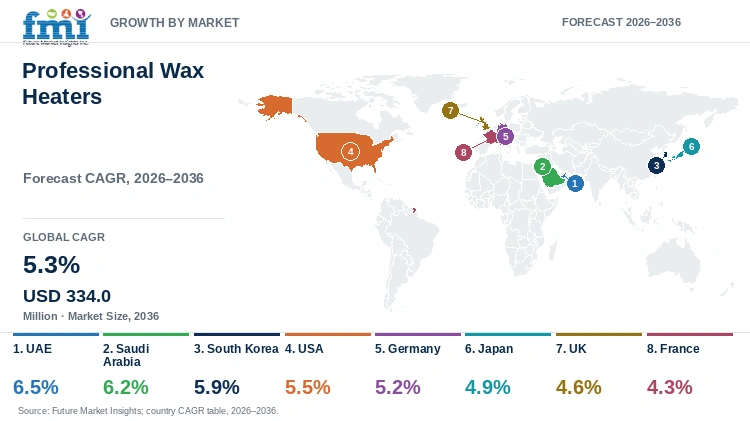
| Country | CAGR |
|---|---|
| UAE | 6.5% |
| Saudi Arabia | 6.2% |
| South Korea | 5.9% |
| USA | 5.5% |
| Germany | 5.2% |
| Japan | 4.9% |
| UK | 4.6% |
| France | 4.3% |
How do country-level CAGRs compare in the Professional Wax Heaters Market?
The profiled growth rates form three useful bands. UAE and Saudi Arabia are above 6%, South Korea and USA sit in the upper-5% band, and Germany through France range from 5.2% to 4.3%. The spread between UAE and France is 2.2 percentage points. These rates describe expected growth speed, not absolute country market size. Faster rates can reflect channel development or formalization even where the installed base is smaller.
- UAE: Regular salon inspections keep hygiene, equipment condition and day-to-day operating standards important for professional buyers.
- Saudi Arabia: Updated salon rules place more attention on licensing, sterilization and how equipment is maintained during daily use.
- South Korea: Non-medical hair removal is recognized within the skin-beauty business, giving wax heaters a clear role in professional beauty services.
- USA: A large skincare-specialist workforce supports a broad user base for professional waxing equipment and supplies.
- Germany: The market includes many small hairdressing and beauty businesses, making distributor reach and easy equipment replacement important.
- Japan: A large beauty-service network supports replacement demand, but pressure on prices makes salons more cautious about paying for premium equipment.
- UK: A broad hairdressing and beauty-treatment sector supports demand across independent salons and other professional beauty businesses.
- France: Hair removal is an established beauty service, but tighter budgets among independent operators keep equipment cost and payback important.
Country-wise Analysis
- UAE: UAE is expected to record the fastest profiled growth at a 6.5% CAGR from 2026 to 2036. Dubai Municipality’s inspection activity is likely to keep hygiene, temperature control and equipment maintenance important for salon operators. This will support demand for wax heaters that are easy to clean and dependable during repeated appointments.
- Saudi Arabia: Saudi Arabia is likely to grow at a 6.2% CAGR from 2026 to 2036. Updated beauty-salon requirements covering licensing, sterilization and operating conditions are expected to influence equipment selection. Salons will place greater value on heaters that are simple to use, clean and maintain.
- South Korea: South Korea is expected to post a 5.9% CAGR from 2026 to 2036. Non-medical hair removal will remain part of the skin-beauty business, giving waxing a clear place within professional beauty services. Demand is likely to favor heaters that provide steady temperature control and can be cleaned quickly between clients.
- USA: USA is likely to grow at a 5.5% CAGR from 2026 to 2036. Growth in the skincare-specialist workforce is expected to widen the user base for professional waxing equipment. Independent practitioners and salons will continue to buy through a mix of professional distributors and B2B e-commerce, with mid-range heaters likely to remain attractive to cost-conscious buyers.
- Germany: Germany is expected to record a 5.2% CAGR from 2026 to 2036. Its large number of hairdressing and beauty businesses will keep demand spread across many smaller professional buyers. Distributor coverage is therefore likely to remain important, particularly when salons need to replace equipment quickly.
- Japan: Japan is likely to grow at a 4.9% CAGR from 2026 to 2036. Its large beauty-establishment base is expected to support regular replacement demand. At the same time, low pricing and pressure on customer numbers will make salons more selective about premium equipment, especially where the additional features do not improve everyday service.
- UK: UK is expected to expand at a 4.6% CAGR from 2026 to 2036. A broad hairdressing and beauty-treatment sector will support demand from independent salons and other professional operators. Wholesale and online channels are likely to remain important, while smaller businesses may keep existing heaters in use for longer before replacing them.
- France: France is likely to record a 4.3% CAGR from 2026 to 2036. Hair removal will remain an established beauty-care service, but the economics of self-employed operators are expected to keep equipment spending disciplined. Buyers are likely to favor practical heaters that offer a reasonable purchase cost and a long working life.
Who are the notable companies in the Professional Wax Heaters Market?
L'Oreal; Takara Belmont; Conair; REM UK; Henkel; Gharieni Group; Kao Corporation; Wella Company; Andis; Wahl
The profiled companies occupy different points around the beauty equipment market ecosystem. L'Oreal has a direct public link to professional wax-heater distribution through SalonCentric, which currently lists multiple warmer brands and formats. Takara Belmont, REM UK and Gharieni Group participate through salon and spa equipment design, installation and service. Henkel, Kao Corporation and Wella Company compete through professional salon products, education and business support. Conair participates through consumer beauty and personal care electrical products, while Andis and Wahl are professional grooming-tool specialists.
- Professional distribution and salon ecosystems: L'Oreal, Henkel, Kao Corporation and Wella Company. These businesses have professional salon channels, education systems or distributor relationships.
- Salon and spa equipment platforms: Takara Belmont, REM UK and Gharieni Group. Their portfolios emphasize professional furnishings, treatment equipment or spa infrastructure.
- Professional grooming and electrical appliance adjacencies: Conair, Andis and Wahl. Their current portfolios cover consumer hair-removal or professional grooming devices.
Competitive Benchmarking: Professional Wax Heaters Market
| Company | Direct Wax-Heater Exposure | Professional Channel Access | Salon/Spa Equipment Adjacency | Geographic Reach |
|---|---|---|---|---|
| L'Oreal | Medium | High | Medium | United States through SalonCentric; wider global professional-beauty ecosystem |
| Takara Belmont | Unscored | High | High | 120+ countries/regions in professional equipment and cosmetics |
| Conair | Unscored | Medium | Medium | International consumer beauty and personal-care distribution |
| REM UK | Unscored | Medium | High | United Kingdom salon and spa equipment base with export-oriented current collections |
| Henkel | Unscored | High | Low | Professional hair network anchored in Germany with innovation sites in the USA, Japan, China and Mexico |
| Gharieni Group | Unscored | High | High | 140+ countries through direct and distributor relationships |
| Kao Corporation | Unscored | High | Low | Professional hair business in more than 40 countries with EMEA salon support network |
| Wella Company | Unscored | High | Low | International professional network; Destination 2025 drew participants from 52 countries |
| Andis | Unscored | High | Medium | Professional barber products with global-version tools |
| Wahl | Unscored | High | Medium | Professional beauty and barber trade; corporate history reports products in 165 countries |
Scoring basis: Direct Wax-Heater Exposure measures documented current sale, manufacture or controlled professional distribution of wax-heating equipment. Professional Channel Access measures reach into licensed salon, spa, barber or beauty-professional purchasing. Salon/Spa Equipment Adjacency measures capability in electrical grooming tools, treatment equipment, furniture or salon infrastructure that can influence equipment procurement. High indicates broad capability, Medium indicates credible but narrower exposure, and Low indicates a limitation relative to the criterion. Unscored indicates that no rating is assigned for that criterion.
Key Developments in the Professional Wax Heaters Market
- July 2026: L'Oreal reported that its North American professional channel accelerated at SalonCentric during the first half of the year [4]. SalonCentric's current professional assortment includes multiple wax warmer formats from third-party brands. The development strengthens a distributor route that places hair-removal equipment beside broader salon purchasing.
- July 2026: Gharieni Group launched ZenFusion Flow and said the treatment platform would be distributed in Europe through Takara Belmont. The collaboration combines equipment design with an established salon-equipment route to market and service network.
- March 2026: Henkel reported that its Hamburg House of Hair had consolidated major hair-business functions at one site since March 2025. The site brings together research and development with test salons, marketing and the Academy of Hair. More than 300 experts work there. This professional-salon investment shows how large beauty suppliers are pairing product development with testing and education.
Key Players in the Professional Wax Heaters Market
Professional Distribution and Salon Ecosystems
- L'Oreal
- Henkel
- Kao Corporation
- Wella Company
Salon and Spa Equipment Platforms
- Takara Belmont
- REM UK
- Gharieni Group
Professional Grooming and Electrical Appliance Adjacencies
- Conair
- Andis
- Wahl
Professional Wax Heaters Market - Report Scope
| Coverage field | Report scope |
|---|---|
| Market breakdown | Product Type; End User; Offering; Price Tier; Sales Channel |
| Quantitative Units | USD Million |
| Market Definition | Includes revenue from professional wax-heating devices and the consumables, refills and accessories represented within the defined Offering axis when sold within the professional heater system. Excludes downstream salon-service revenue, laser or light-based hair removal devices, depilatory substitutes, unrelated salon furniture and other adjacent equipment revenue. |
| Regions Covered | North America; Latin America; Western Europe; Eastern Europe; East Asia; South Asia and Pacific; Middle East and Africa |
| Countries Covered | USA; Germany; France; UK; Saudi Arabia; UAE; Japan; South Korea |
| Key Companies Profiled | L'Oreal; Takara Belmont; Conair; REM UK; Henkel; Gharieni Group; Kao Corporation; Wella Company; Andis; Wahl |
| Forecast Period | 2026 to 2036 |
| Approach | Primary and secondary research with market triangulation. |
Professional Wax Heaters Market - Research Methodology
| Method | Approach |
|---|---|
| Primary Research | FMI analysts gathered input from manufacturers, service providers, technology developers, distributors, end users, procurement teams and subject-matter experts. Interviews examined purchasing decisions, product or service evaluation, adoption barriers, approval requirements, pricing considerations and expectations for technical or commercial support. Respondents were also asked what evidence is required before a trial, pilot, or initial order develops into regular purchasing. |
| Desk Research | Desk research covered government statistics, regulatory publications, trade data, industry associations, technical literature, standards, company filings, product information and official corporate announcements. Sources were reviewed for relevance, publication date, geographic coverage and consistency with the defined market scope. Claims relating to performance, applications, approvals, capacity, investment and commercial activity were retained only when supported by credible public evidence. |
| Market Sizing and Forecasting | The market model combined the baseline value with historical performance, segment structure, pricing and volume indicators, adoption levels, company participation and country-level demand conditions. Forecast assumptions considered economic activity, investment trends, regulatory developments, technology adoption, purchasing cycles, supply availability and barriers to wider market use. Segment and regional estimates were reconciled before the final market total was calculated. |
| Data Validation | Estimates were checked against multiple independent indicators, including public data, company activity, trade patterns, industry developments and findings from primary interviews. Validation also tested whether products, services, applications and company revenues fell within the defined market boundaries. Adjacent categories, unsupported claims, overlapping revenues and activities without direct market relevance were excluded to reduce double counting and maintain consistency across segments and countries. |
Professional Wax Heaters Market by Segments
Professional Wax Heaters Market segmented by Product Type:
- Core professional range
- Premium & specialist range
- Entry & value range
Professional Wax Heaters Market segmented by End User:
- Hair salons
- Spas & wellness centers
- Nail salons
- Medspas & clinics
- Barbershops
Professional Wax Heaters Market segmented by Offering:
- Core equipment
- Consumables & refills
- Accessories
Professional Wax Heaters Market segmented by Price Tier:
- Mid-range
- Economy
- Premium
Professional Wax Heaters Market segmented by Sales Channel:
- Professional distributors
- Direct sales
- B2B e-commerce
Professional Wax Heaters Market by Region:
- North America
- United States
- Canada
- Latin America
- Brazil
- Mexico
- Argentina
- Chile
- Western Europe
- Germany
- France
- United Kingdom
- Italy
- Spain
- Benelux
- Nordics
- Eastern Europe
- Poland
- Czech Republic
- Romania
- Hungary
- East Asia
- China
- Japan
- South Korea
- South Asia and Pacific
- India
- ASEAN
- Australia and New Zealand
- Middle East and Africa
- GCC Countries
- South Africa
- Türkiye
- Israel
Research Sources and Bibliography
- U.S. Bureau of Labor Statistics (2026, August 27). Skincare Specialists.
- International Electrotechnical Commission (2026, August 14). IEC 60335-2-115:2026 PRV - Household and similar electrical appliances - Safety - Part 2-115: Particular requirements for skin care appliances.
- Insee (2026, June). Les revenus d’activité des non-salariés en 2024.
- L'Oreal Finance (2026, July 29). 2026 Half-Year Results.
- SalonCentric (n.d.). Online Exclusive.
- SalonCentric (n.d.). Professional Hair Removal Appliances & Accessories.
- SalonCentric (n.d.). About Us.
- Dubai Municipality (2025, June 2). Food safety inspections intensified ahead of Eid Al-Adha.
- Ministry of Municipalities and Housing, Saudi Arabia (2025, May 14). MOMAH Announces Updated Requirements for Women’s Beauty Salons and Relaxation and Body Care Centers.
- National Law Information Center, Korea (effective 2025, July 31). Public Health Control Act - Article 2 Definitions.
- National Law Information Center, Korea (effective 2025, July 31). Public Health Control Act - Article 4 Obligations of Public Health Business Operators.
- Ministry of Health, Labour and Welfare, Japan (n.d.). Overview of the Beauty Industry.
- Federal Statistical Office of Germany (Destatis) (n.d.). GENESIS-Online Table 48112-0002: Enterprises, persons engaged, turnover and business indicators by economic activity.
- Office for National Statistics (2026, March 3). The Beauty industry 2025.
- Insee (2026, September 4). NAF 2025 - Sub-class 96.22Y: Beauty care and other beauty treatment activities.
- Takara Belmont (n.d.). Company Overview.
- Takara Belmont (n.d.). Global Business.
- Conair (n.d.). About Conair.
- REM UK (n.d.). REM Spa Furniture & Beauty Equipment.
- Henkel (2026, March 11). Henkel delivers organic growth in 2025 and increases profitability through innovation and more efficiency.
- Henkel (2025, August 6). How Schwarzkopf Professional’s initiative Shaping Futures creates new perspectives for refugees.
- Gharieni Group (2026, July 14). Gharieni Unveils ZenFusion Flow.
- Gharieni Group (2025, March 27). Gharieni Group Expands Strategic Presence in France with New Partner Network.
- Gharieni Group (2025, February 19). reLounge and Gharieni Group Join Forces to Revolutionize Back and Neck Pain Relief in the Medical & Wellness Industries Worldwide.
- Kao Corporation (n.d.). Kao Professional Hair.
- Kao Corporation (n.d.). Germany.
- Wella Company (2025, June 11). 10 Show-Stopping Looks from Wella Destination 2025.
- Wella Company (2025, August 22). Wella Professionals is officially the No.1 Salon Hair Brand in the UK.
- Andis (n.d.). Our Story.
- Wahl (n.d.). About Us - Wahl Clipper Corporation History.
This bibliography is provided for reader reference and is not exhaustive. The full report contains the complete reference list and detailed citations.
This Report Answers
- How large is the Professional Wax Heaters Market in 2026 and what value is forecast for 2036?
- Which industry and service pressures support demand for professional wax heaters?
- Why does Core professional range lead the Product Type category?
- Why do Hair salons lead the End User category?
- How do growth rates differ across UAE, Saudi Arabia, South Korea, USA, Germany, Japan, UK and France?
- Which profiled companies have direct wax-heater channel exposure and which participate through adjacent salon, spa or professional-beauty capabilities?
- What safety, sanitation, licensing and switching factors can limit adoption or delay equipment replacement?
- What should professional buyers evaluate before purchasing a wax heater for professional beauty workflows?
Frequently Asked Questions
How big is the Professional Wax Heaters Market in 2026, and what is forecast for 2036?
The market is valued at USD 199.3 Million in 2026 and is forecast to reach USD 334.0 Million by 2036. The increase reflects a larger professional service base and continuing replacement demand, subject to compliance and operator economics.
What is the CAGR of the Professional Wax Heaters Market from 2026 to 2036?
The market is forecast to expand at a 5.3% CAGR from 2026 to 2036. The rate represents the overall market trajectory and should not be interpreted as a country-level growth rate or a company share.
Which Product Type segment leads the Professional Wax Heaters Market?
Core professional range leads Product Type with 44.0% in 2026. Its position reflects the value of dependable temperature control and professional durability without the cost burden of specialist features that many operators may not need.
Which End User segment leads the Professional Wax Heaters Market?
Hair salons lead End User with 41.0% in 2026. Existing professional supply relationships and frequent client traffic make waxing equipment easier to add where local licensing and service demand justify the workflow.
Which country has the fastest profiled growth in the Professional Wax Heaters Market?
UAE has the fastest profiled CAGR at 6.5% from 2026 to 2036, followed by Saudi Arabia at 6.2% and South Korea at 5.9%.
Which companies are profiled in the Professional Wax Heaters Market?
The profiled companies are L'Oreal, Takara Belmont, Conair, REM UK, Henkel, Gharieni Group, Kao Corporation, Wella Company, Andis and Wahl.
Preview the report firsthand - request a free sample
Get SampleGet the brochure for pricing and purchase details.
Get PDFTable of Content
- Key Takeaways
- Market Size and CAGR
- Top Growth Driver
- Fastest Growing Segment
- Leading Region
- Key Companies
- Emerging Opportunities
- Executive Summary
- Global Market Outlook
- Demand-side Trends
- Supply-side Trends
- Technology Roadmap Analysis
- Analysis and Recommendations
- Analyst Perspective (What is happening? Why now? What should investors know?)
- Key Questions Answered
- How large is the market?
- What is the CAGR?
- What are key trends?
- Which region dominates?
- Who are the leaders?
- Market Overview
- Market Coverage / Taxonomy
- Market Definition / Scope / Limitations
- Research Methodology
- Chapter Orientation
- Analytical Lens and Working Hypotheses
- Market Structure, Signals, and Trend Drivers
- Benchmarking and Cross-market Comparability
- Market Sizing, Forecasting, and Opportunity Mapping
- Research Design and Evidence Framework
- Desk Research Programme (Secondary Evidence)
- Expert Input and Fieldwork (Primary Evidence)
- Tooling, Models, and Reference Databases
- Data Engineering and Model Build
- Quality Assurance and Audit Trail
- Market Background
- Market Dynamics (Drivers, Restraints, Opportunity, Trends)
- Scenario Forecast (Optimistic, Likely, Conservative)
- Impact Analysis
- AI Impact
- Sustainability Impact
- Regulatory Impact
- Technology Impact
- Consumer / Buyer Analysis
- Purchase Drivers
- Adoption Barriers
- Buyer Journey
- Opportunity Map Analysis
- Product Life Cycle Analysis
- Supply Chain Analysis
- Investment Feasibility Matrix
- Value Chain Analysis
- PESTLE and Porter's Analysis
- Regulatory Landscape
- Regional Parent Market Outlook
- Production and Consumption Statistics
- Import and Export Statistics
- Global Market Analysis and Forecast, 2021 to 2036
- Historical Market Size Value (USD Million) Analysis, 2021 to 2025
- Current and Future Market Size Value (USD Million) Projections, 2026 to 2036
- Y-o-Y Growth Trend Analysis
- Absolute $ Opportunity Analysis
- Global Market Pricing Analysis, 2021 to 2036
- Global Market Analysis and Forecast, By Product Type, 2021 to 2036
- Introduction / Key Findings
- Historical Market Size Value (USD Million) Analysis By Product Type, 2021 to 2025
- Current and Future Market Size Value (USD Million) Analysis and Forecast By Product Type, 2026 to 2036
- Core professional range
- Premium & specialist range
- Entry & value range
- Y-o-Y Growth Trend Analysis By Product Type, 2021 to 2025
- Absolute $ Opportunity Analysis By Product Type, 2026 to 2036
- Global Market Analysis and Forecast, By End User, 2021 to 2036
- Introduction / Key Findings
- Historical Market Size Value (USD Million) Analysis By End User, 2021 to 2025
- Current and Future Market Size Value (USD Million) Analysis and Forecast By End User, 2026 to 2036
- Hair salons
- Spas & wellness centers
- Nail salons
- Medspas & clinics
- Barbershops
- Y-o-Y Growth Trend Analysis By End User, 2021 to 2025
- Absolute $ Opportunity Analysis By End User, 2026 to 2036
- Global Market Analysis and Forecast, By Offering, 2021 to 2036
- Introduction / Key Findings
- Historical Market Size Value (USD Million) Analysis By Offering, 2021 to 2025
- Current and Future Market Size Value (USD Million) Analysis and Forecast By Offering, 2026 to 2036
- Core equipment
- Consumables & refills
- Accessories
- Y-o-Y Growth Trend Analysis By Offering, 2021 to 2025
- Absolute $ Opportunity Analysis By Offering, 2026 to 2036
- Global Market Analysis and Forecast, By Price Tier, 2021 to 2036
- Introduction / Key Findings
- Historical Market Size Value (USD Million) Analysis By Price Tier, 2021 to 2025
- Current and Future Market Size Value (USD Million) Analysis and Forecast By Price Tier, 2026 to 2036
- Mid-range
- Economy
- Premium
- Y-o-Y Growth Trend Analysis By Price Tier, 2021 to 2025
- Absolute $ Opportunity Analysis By Price Tier, 2026 to 2036
- Global Market Analysis and Forecast, By Sales Channel, 2021 to 2036
- Introduction / Key Findings
- Historical Market Size Value (USD Million) Analysis By Sales Channel, 2021 to 2025
- Current and Future Market Size Value (USD Million) Analysis and Forecast By Sales Channel, 2026 to 2036
- Professional distributors
- Direct sales
- B2B e-commerce
- Y-o-Y Growth Trend Analysis By Sales Channel, 2021 to 2025
- Absolute $ Opportunity Analysis By Sales Channel, 2026 to 2036
- Global Market Analysis and Forecast, By Region, 2021 to 2036
- Introduction
- Historical Market Size Value (USD Million) Analysis By Region, 2021 to 2025
- Current Market Size Value (USD Million) Analysis and Forecast By Region, 2026 to 2036
- North America
- Latin America
- Western Europe
- Eastern Europe
- East Asia
- South Asia and Pacific
- Middle East and Africa
- Market Attractiveness Analysis By Region
- North America Market Analysis and Forecast, By Country, 2021 to 2036
- Historical Market Size Value (USD Million) Trend Analysis By Market Taxonomy, 2021 to 2025
- Market Size Value (USD Million) Forecast By Market Taxonomy, 2026 to 2036
- By Country
- United States
- Canada
- By Product Type
- By End User
- By Offering
- By Price Tier
- By Sales Channel
- By Country
- Market Attractiveness Analysis
- By Country
- By Product Type
- By End User
- By Offering
- By Price Tier
- By Sales Channel
- Key Takeaways
- Latin America Market Analysis and Forecast, By Country
- Historical Market Size Value (USD Million) Trend Analysis By Market Taxonomy, 2021 to 2025
- Market Size Value (USD Million) Forecast By Market Taxonomy, 2026 to 2036
- By Country
- Brazil
- Mexico
- Argentina
- Chile
- By Product Type
- By End User
- By Offering
- By Price Tier
- By Sales Channel
- By Country
- Market Attractiveness Analysis
- By Country
- By Product Type
- By End User
- By Offering
- By Price Tier
- By Sales Channel
- Key Takeaways
- Western Europe Market Analysis and Forecast, By Country
- Historical Market Size Value (USD Million) Trend Analysis By Market Taxonomy, 2021 to 2025
- Market Size Value (USD Million) Forecast By Market Taxonomy, 2026 to 2036
- By Country
- Germany
- France
- United Kingdom
- Italy
- Spain
- Benelux
- Nordics
- By Product Type
- By End User
- By Offering
- By Price Tier
- By Sales Channel
- By Country
- Market Attractiveness Analysis
- By Country
- By Product Type
- By End User
- By Offering
- By Price Tier
- By Sales Channel
- Key Takeaways
- Eastern Europe Market Analysis and Forecast, By Country
- Historical Market Size Value (USD Million) Trend Analysis By Market Taxonomy, 2021 to 2025
- Market Size Value (USD Million) Forecast By Market Taxonomy, 2026 to 2036
- By Country
- Poland
- Czech Republic
- Romania
- Hungary
- By Product Type
- By End User
- By Offering
- By Price Tier
- By Sales Channel
- By Country
- Market Attractiveness Analysis
- By Country
- By Product Type
- By End User
- By Offering
- By Price Tier
- By Sales Channel
- Key Takeaways
- East Asia Market Analysis and Forecast, By Country
- Historical Market Size Value (USD Million) Trend Analysis By Market Taxonomy, 2021 to 2025
- Market Size Value (USD Million) Forecast By Market Taxonomy, 2026 to 2036
- By Country
- China
- Japan
- South Korea
- By Product Type
- By End User
- By Offering
- By Price Tier
- By Sales Channel
- By Country
- Market Attractiveness Analysis
- By Country
- By Product Type
- By End User
- By Offering
- By Price Tier
- By Sales Channel
- Key Takeaways
- South Asia and Pacific Market Analysis and Forecast, By Country
- Historical Market Size Value (USD Million) Trend Analysis By Market Taxonomy, 2021 to 2025
- Market Size Value (USD Million) Forecast By Market Taxonomy, 2026 to 2036
- By Country
- India
- ASEAN
- Australia and New Zealand
- By Product Type
- By End User
- By Offering
- By Price Tier
- By Sales Channel
- By Country
- Market Attractiveness Analysis
- By Country
- By Product Type
- By End User
- By Offering
- By Price Tier
- By Sales Channel
- Key Takeaways
- Middle East and Africa Market Analysis and Forecast, By Country
- Historical Market Size Value (USD Million) Trend Analysis By Market Taxonomy, 2021 to 2025
- Market Size Value (USD Million) Forecast By Market Taxonomy, 2026 to 2036
- By Country
- GCC Countries
- South Africa
- Türkiye
- Israel
- By Product Type
- By End User
- By Offering
- By Price Tier
- By Sales Channel
- By Country
- Market Attractiveness Analysis
- By Country
- By Product Type
- By End User
- By Offering
- By Price Tier
- By Sales Channel
- Key Takeaways
- Key Countries Market Analysis
- United States
- Pricing Analysis
- Market Share Analysis, 2025
- By Product Type
- By End User
- By Offering
- By Price Tier
- By Sales Channel
- Canada
- Pricing Analysis
- Market Share Analysis, 2025
- By Product Type
- By End User
- By Offering
- By Price Tier
- By Sales Channel
- Mexico
- Pricing Analysis
- Market Share Analysis, 2025
- By Product Type
- By End User
- By Offering
- By Price Tier
- By Sales Channel
- Brazil
- Pricing Analysis
- Market Share Analysis, 2025
- By Product Type
- By End User
- By Offering
- By Price Tier
- By Sales Channel
- Chile
- Pricing Analysis
- Market Share Analysis, 2025
- By Product Type
- By End User
- By Offering
- By Price Tier
- By Sales Channel
- Germany
- Pricing Analysis
- Market Share Analysis, 2025
- By Product Type
- By End User
- By Offering
- By Price Tier
- By Sales Channel
- United Kingdom
- Pricing Analysis
- Market Share Analysis, 2025
- By Product Type
- By End User
- By Offering
- By Price Tier
- By Sales Channel
- Italy
- Pricing Analysis
- Market Share Analysis, 2025
- By Product Type
- By End User
- By Offering
- By Price Tier
- By Sales Channel
- Spain
- Pricing Analysis
- Market Share Analysis, 2025
- By Product Type
- By End User
- By Offering
- By Price Tier
- By Sales Channel
- France
- Pricing Analysis
- Market Share Analysis, 2025
- By Product Type
- By End User
- By Offering
- By Price Tier
- By Sales Channel
- India
- Pricing Analysis
- Market Share Analysis, 2025
- By Product Type
- By End User
- By Offering
- By Price Tier
- By Sales Channel
- ASEAN
- Pricing Analysis
- Market Share Analysis, 2025
- By Product Type
- By End User
- By Offering
- By Price Tier
- By Sales Channel
- Australia and New Zealand
- Pricing Analysis
- Market Share Analysis, 2025
- By Product Type
- By End User
- By Offering
- By Price Tier
- By Sales Channel
- China
- Pricing Analysis
- Market Share Analysis, 2025
- By Product Type
- By End User
- By Offering
- By Price Tier
- By Sales Channel
- Japan
- Pricing Analysis
- Market Share Analysis, 2025
- By Product Type
- By End User
- By Offering
- By Price Tier
- By Sales Channel
- South Korea
- Pricing Analysis
- Market Share Analysis, 2025
- By Product Type
- By End User
- By Offering
- By Price Tier
- By Sales Channel
- Poland
- Pricing Analysis
- Market Share Analysis, 2025
- By Product Type
- By End User
- By Offering
- By Price Tier
- By Sales Channel
- Hungary
- Pricing Analysis
- Market Share Analysis, 2025
- By Product Type
- By End User
- By Offering
- By Price Tier
- By Sales Channel
- Türkiye
- Pricing Analysis
- Market Share Analysis, 2025
- By Product Type
- By End User
- By Offering
- By Price Tier
- By Sales Channel
- South Africa
- Pricing Analysis
- Market Share Analysis, 2025
- By Product Type
- By End User
- By Offering
- By Price Tier
- By Sales Channel
- UAE
- Pricing Analysis
- Market Share Analysis, 2025
- By Product Type
- By End User
- By Offering
- By Price Tier
- By Sales Channel
- Saudi Arabia
- Pricing Analysis
- Market Share Analysis, 2025
- By Product Type
- By End User
- By Offering
- By Price Tier
- By Sales Channel
- United States
- Market Structure Analysis
- Competition Dashboard
- Competition Benchmarking
- Market Share Analysis of Top Players
- By Regional
- By Product Type
- By End User
- By Offering
- By Price Tier
- By Sales Channel
- Emerging Startups
- Innovation Benchmarking
- Competition Analysis
- Competition Deep Dive
- L'Oreal
- Overview
- Product Portfolio
- Profitability by Market Segments
- Sales Footprint
- Strategy Overview
- Marketing Strategy
- Product Strategy
- Channel Strategy
- Takara Belmont
- Conair
- REM UK
- Henkel
- Gharieni Group
- Kao Corporation
- Wella Company
- Andis
- Wahl
- L'Oreal
- Case Studies
- Success Stories
- Recent Developments
- Competition Deep Dive
- Assumptions & Acronyms Used


