

- Market Size (2026)
- USD 3.3 Bn
- Forecast (2036)
- USD 5.1 Bn
- CAGR (2026 to 2036)
- 4.6%
How big is Refuse Tailgates Market in 2026?
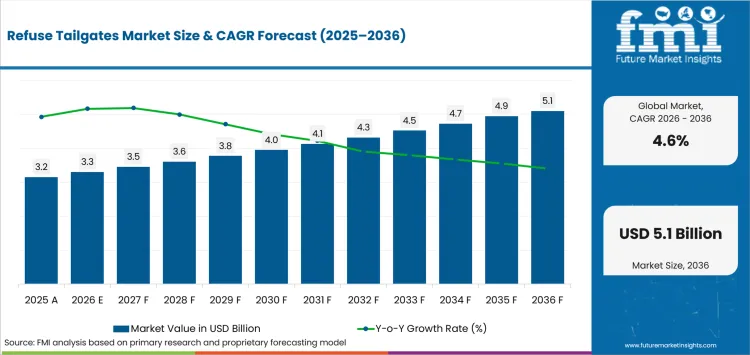
USD 3.3 Billion in 2026 and USD 5.1 Billion by 2036 at a 4.6% CAGR.
Demand for refuse tailgates is projected to expand at 4.6% CAGR between 2026 and 2036, lifting valuation from USD 3.3 billion in 2026 to USD 5.1 billion by 2036. Demand expands when refuse-body production, fleet renewal, and high-cycle tailgate replacement converge. The tailgate carries the loading hopper or discharge closure on many refuse-body architectures. It also contains wear surfaces and seals. Locks, cylinders, and safety controls must remain synchronized with the body. Natural Resources Canada reported in April 2026 that Toronto is converting 60 waste collection trucks to hybrid natural gas-electric operation. The city runs larger waste trucks on 10-hour shifts and keeps vehicles in service for as long as 15 years. Those duty cycles favor component strategies that preserve uptime while accommodating new auxiliary-power systems. A fleet can therefore create tailgate demand through a new-body purchase or through refurbishment of a long-lived vehicle. Purchasing teams increasingly compare integration effort and parts access with the initial tailgate price. (Natural Resources Canada, April 2026)
Country conditions change the conversion path. Canadian fleets can favor retrofit-compatible systems because long shifts make full battery conversion difficult on some routes. US municipalities are testing zero-emission refuse trucks against route completion and charging requirements before wider replacement. German public fleets are adding charging capacity alongside electric collection vehicles. Japanese municipalities are introducing fuel-cell refuse trucks in compact urban service. These approaches all change auxiliary-power and weight requirements around the rear body. They do not create identical procurement cycles. Suppliers that can document control compatibility and locking safety have a stronger route from technical interest to purchase approval. Sealing performance and service response also influence approval. The practical threshold is whether the tailgate can fit the vehicle architecture without adding route downtime or compromising payload. (City of Long Beach, May 2026; City of Hilden, June 2025; Koto City, November 2025)
Key Takeaways
- Tailgate demand is governed by route uptime: fleets replace or refurbish high-cycle closure assemblies when wear, sealing or hydraulic problems threaten collection schedules.
- Rear-loader tailgates hold 34.0% share in 2026 because the tailgate is integral to the hopper, loading, and discharge cycle on rear-loading bodies.
- Abrasion-resistant steel holds 42.0% share in 2026 because wear-critical tailgate and hopper surfaces require durability while fleets remain sensitive to rear-body weight.
- Rear-loader refuse trucks hold 38.0% share in 2026 because their collection and discharge cycle depends directly on a high-duty rear tailgate assembly.
- Body OEMs hold 43.0% share in 2026 because tailgate structures, locks, sensors, and hydraulics are easiest to validate as part of the original refuse-body build.
- Municipal fleets hold 39.0% share in 2026 because service continuity and maintenance standardization make tailgate reliability a direct procurement concern.
- Fitment complexity and downtime can delay replacement, while lighter tailgate architectures designed around electric and alternative-power chassis create a new specification window.
- Refuse-body manufacturers include Heil Environmental, McNeilus, Labrie Enviroquip (part of Hiab), New Way Trucks, Dennis Eagle, FAUN, ZOELLER-KIPPER, Pak-Mor, Haul-All Equipment, and Bridgeport Manufacturing.
Analyst Perspective
“A refuse tailgate is bought as part of a working body system, so the winning design has to survive repeated cycles, seal reliably and be serviceable without keeping a route off the road. Electrification adds another test because weight and auxiliary power now matter more.”
- Nikhil Kaitwade, Principal Consultant, Future Market Insights
How is the Refuse Tailgates Market segmented?
The market is segmented by Tailgate Type, Material, Vehicle Type, Sales Channel, and End Use.
Tailgate Type distinguishes loading and discharge architectures at the rear body. Material separates wear resistance and corrosion behavior from fabrication cost. Vehicle Type links tailgate design to the body layout and available payload. Sales Channel identifies whether the assembly enters service through an OEM build or replacement. It also captures refurbishment and municipal service arrangements. End Use separates public fleets from private and industrial collection operators. Buyers assess each axis differently. Tailgate duty depends on waste stream and route intensity as well as chassis packaging and service practice.
Why do Rear-loader tailgates lead the Tailgate Type category?
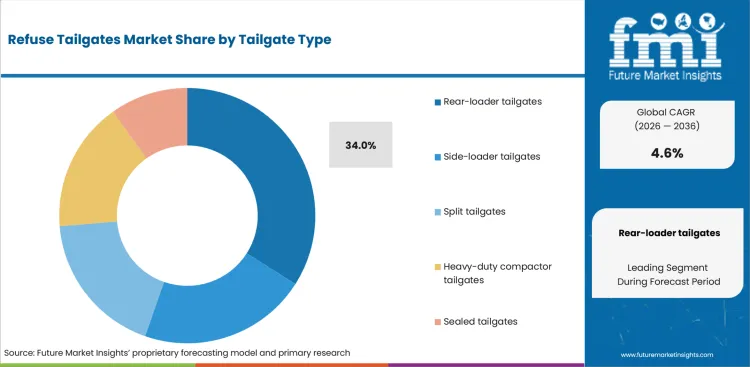
Rear-loader tailgates combine the hopper-facing structure with closure, locking, and discharge functions. They must tolerate repeated refuse impact while keeping the body sealed during transport. Split-body versions add independent tailgate operation for separate waste streams. Dennis Eagle stated in January 2026 that the Olympus Midi launched in April 2025 with the widest tailgate hopper in its class. McNeilus also documents independent tailgate operation on its split-body rear loader. These designs show why the rear assembly is engineered around loading geometry and compaction workflow rather than treated as a generic door. (Dennis Eagle, January 2026; McNeilus, accessed August 2026) Tailgate architecture must work with the broader refuse compactor system that sets compaction loads and closure geometry.
- Rear-loader tailgates hold 34.0% share in 2026 because the tailgate is integral to the hopper, loading, and discharge cycle on rear-loading bodies.
- Dennis Eagle reported in January 2026 that its Olympus Midi, launched in April 2025, uses a wide tailgate hopper and a short rear overhang to fit compact urban duty.
Why does Abrasion-resistant steel lead the Material category?
Hopper-facing tailgate zones see sliding refuse, sharp debris, and repeated contact with compacted material. Abrasion-resistant steel extends wear life without relying only on thicker mild-steel sections. That matters because extra rear mass consumes payload and can affect axle loading. Heil specifies AR400 steel on the hopper floor and sides of the DuraPack 4060 split-body rear loader. The same product combines those wear plates with high-tensile body steel and hydraulic tailgate locks. The material choice therefore reflects a targeted wear strategy: put harder steel where abrasion is concentrated while preserving a manageable overall structure. (Heil Environmental, accessed August 2026) Fleet planners often compare refurbishment with full garbage truck replacement before approving a tailgate job.
- Abrasion-resistant steel holds 42.0% share in 2026 because wear-critical tailgate and hopper surfaces require durability while fleets remain sensitive to rear-body weight.
- Heil Environmental documented AR400 hopper floor and side material on the DuraPack 4060 page reviewed in August 2026, alongside an optimized-weight body structure.
Why do Rear-loader refuse trucks lead the Vehicle Type category?
Rear-loader trucks place the tailgate directly in the collection path. The assembly must coordinate with the packing mechanism and remain secure in transport. It must also open for unloading without interfering with chassis or lifter geometry. Safety requirements make those interfaces consequential. BSI’s current EN 1501-5 material covers lifting-device interfaces with refuse collection vehicles while the related EN 1501-1 work addresses rear-loaded vehicles regardless of power drive. That standards context keeps rear-body controls and safety states central during OEM design and replacement qualification. The result is a tailgate market that follows body architecture more closely than truck chassis brand. (British Standards Institution, January 2025) Electrification shifts mass and auxiliary-power budgets across the electric garbage vehicle platform.
- Rear-loader refuse trucks hold 38.0% share in 2026 because their collection and discharge cycle depends directly on a high-duty rear tailgate assembly.
- British Standards Institution published the current BS EN 1501-5:2021 edition on January 31, 2025, covering safety requirements for lifting-device interfaces on refuse collection vehicles.
Why do Body OEMs lead the Sales Channel category?
Tailgate fit is established most efficiently during body manufacture. OEMs can match hinge geometry and lift cylinders before the body enters fleet service. They can also validate hydraulic flow and locks at the factory. Sensors and control logic are checked within the same body architecture. They can also standardize common parts across related platforms. Heil’s May 2026 Canadian Waste Collection Summit presented a common body architecture with shared components across front- and side-load applications. The company also highlighted relocated tailgate locks for maintenance access. That type of factory-level integration illustrates why OEM channels retain an advantage for new tailgate assemblies even as replacement suppliers remain important during the vehicle life cycle. (Heil Environmental, May 2026) Route uptime makes tailgate service a direct operating issue for waste management organizations.
- Body OEMs hold 43.0% share in 2026 because tailgate structures, locks, sensors, and hydraulics are easiest to validate as part of the original refuse-body build.
- Heil Environmental presented its Common Body platform in Montreal on May 20, 2026, with shared components and revised tailgate-lock access intended to simplify fleet maintenance.
Why do Municipal fleets lead the End Use category?
Municipal fleets buy around route completion and public-service continuity. A tailgate failure can remove an otherwise serviceable refuse truck from daily collection. Public fleets also tend to validate new powertrains before broader replacement. The City of Long Beach deployed two electric collection trucks in April 2026 and published the pilot in May. Staff are measuring tonnage and operating time per charge before considering larger fleet replacement. Route completion and technical issues are also part of the test. That operating discipline also applies to tailgate procurement. Municipal buyers need assemblies that fit established maintenance practice and do not create new downtime around locks, seals, or controls. (City of Long Beach, May 2026) Public buyers increasingly assess lifecycle cost within wider municipal waste procurement programs.
- Municipal fleets hold 39.0% share in 2026 because service continuity and maintenance standardization make tailgate reliability a direct procurement concern.
- The City of Long Beach reported in May 2026 that its electric refuse-truck pilot evaluates real-route tonnage, charge duration, route completion, and technical issues before broader fleet replacement.
What are the drivers, restraints and opportunities in the Refuse Tailgates Market?
Fleet renewal and new powertrains support demand, while integration and downtime constrain replacement, and lighter electrification-ready tailgate systems create an addressable opportunity.
- Driver: Fleet renewal and alternative-power adoption increase demand for tailgates that remain compatible with changing body and auxiliary-power architectures.
- Restraint: Tailgate replacement can require geometry, hydraulic, control, safety, and sealing qualification that extends downtime and narrows interchangeable options.
- Opportunity: Modular tailgates with lower weight, demand-controlled hydraulics, standardized locks, and serviceable wear parts can reduce lifetime fleet cost.
Fleet decarbonization is changing the technical envelope around refuse bodies. Natural Resources Canada reported in April 2026 that Toronto is converting 60 CNG waste collection trucks to hybrid natural gas-electric operation. The hybrid system powers auxiliary equipment electrically during parts of the duty cycle. This matters for tailgates because hydraulic and control loads are tied to collection-body operation. A new tailgate or a refurbished one must therefore work with the chosen auxiliary-power architecture. The demand effect is broader than electric trucks alone. Fleets renewing conventional bodies also seek lower downtime and longer wear life because collection schedules leave little tolerance for a disabled rear assembly. (Natural Resources Canada, April 2026)
The main restraint is qualification risk rather than lack of need. BSI’s EN 1501 framework treats refuse-body interfaces and lifting systems as safety-relevant. Replacement work must preserve locking states, controls, and safe interaction with adjacent equipment. Electric fleet transitions add another constraint. Long Beach reported in May 2026 that moving an 89-plus truck collection fleet to zero-emission vehicles would involve major charging logistics and financial considerations. Those issues can slow complete vehicle replacement and keep mixed fleets in service. Tailgate suppliers must therefore support several body generations at once. A technically suitable component can still lose an order if installation time or control integration threatens route availability. (British Standards Institution, January 2025; City of Long Beach, May 2026)
The opportunity is to make the tailgate easier to integrate across powertrains and easier to maintain through the vehicle life cycle. ZOELLER-KIPPER described its 2025 Electric Power Move system as a lighter auxiliary drive that operates hydraulic power only when required. The company also emphasizes chassis-independent integration for multiple electric platforms. Tailgate suppliers can apply the same design logic through lower rear mass and modular locks. Accessible cylinders, replaceable wear liners, and diagnostics-ready controls can further reduce service burden. Body OEMs are best placed to validate these features on new platforms. Aftermarket specialists can capture a separate opening by packaging compatible replacement modules for long-lived municipal and private fleets. (ZOELLER-KIPPER, 2025)
Which country CAGRs are profiled in the Refuse Tailgates Market?
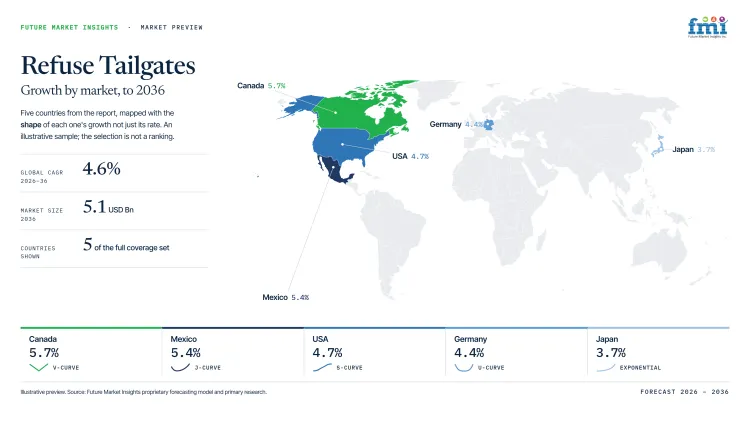
| Country | CAGR (2026-2036) |
|---|---|
| Canada | 5.7% |
| USA | 4.7% |
| Japan | 3.7% |
| Germany | 4.4% |
| Mexico | 5.4% |
| Brazil | 5.1% |
| France | 4.1% |
How do country-level CAGRs compare in the Refuse Tailgates Market?
The seven profiled countries span a 2.0 percentage-point range between Canada at 5.7% and Japan at 3.7% from 2026 to 2036. Canada, Mexico, and Brazil form the faster-growth band above 5.0%. The USA and Germany sit in a middle band at 4.7% and 4.4%. France and Japan form the lower-growth band at 4.1% and 3.7%. These bands indicate different replacement and platform-adoption speeds. They do not establish which country has the leading absolute revenue base.
- Canada's 5.7% outlook is shaped by execution conditions. Municipal fleets in Canada often run heavy collection vehicles for long duty cycles and keep them in service for many years.
- For USA, the forecast reaches 4.7% CAGR. US municipal and private fleets tend to validate collection equipment against route completion and service capacity before broad replacement.
- Japanese municipal collection favors compact route-specific vehicles where rear overhang and mass can quickly affect maneuverability. That gives Japan a distinct Refuse Tailgates path within its 3.7% CAGR forecast.
- Germany carries a 4.4% CAGR through 2036, with conversion tied to this market reality: German municipal fleets are adding electric refuse vehicles alongside dedicated charging and load-management infrastructure.
- At 5.4% CAGR, Mexico remains commercially distinct. Mexican municipal demand is being shaped by basic fleet expansion as well as modernization of collection operations.
- Brazil is forecast at 5.1% CAGR. Brazilian collection fleets face high-volume urban duty and abrasive mixed-waste conditions that reward durable rear-body hardware.
- French municipalities are adding electric refuse vehicles where stop-start duty can suit battery propulsion and quieter operation. In France, that operating setting accompanies a 4.1% CAGR through 2036.
CAGR should be used to plan timing rather than to infer absolute market size. Procurement structure and installed fleet age can change the revenue available to a tailgate supplier. Body mix and route density also affect the addressable opportunity. Labor practice and replacement intensity add another layer of variation. The broader report therefore evaluates growth rates together with vehicle architecture and sales channel before drawing commercial conclusions.
Country-wise Analysis
- Municipal fleets in Canada often run heavy collection vehicles for long duty cycles and keep them in service for many years. A 5.7% CAGR is projected for Refuse Tailgates in Canada between 2026 and 2036. Natural Resources Canada reported in April 2026 that Toronto is converting 60 CNG waste collection trucks to hybrid natural gas-electric operation after pilot work. The same source notes 10-hour shifts and vehicle lives of up to 15 years. Those conditions make full-platform replacement difficult on some routes. Suppliers can win by offering tailgates that support retrofit programs, preserve payload, and arrive with fast parts and field-service support.
- US municipal and private fleets tend to validate collection equipment against route completion and service capacity before broad replacement. Through 2036, the market for Refuse Tailgates in USA is set to register a 4.7% CAGR. The City of Long Beach reported on May 1, 2026 that two electric collection trucks were operating in a pilot measuring tonnage, charge duration, route completion, and technical issues. The city also identified major charging and financial considerations for an 89-plus truck fleet. Tailgate suppliers need efficient auxiliary loads, dependable locks, and dealer parts coverage that can support mixed CNG, diesel, and electric fleets.
- Japanese municipal collection favors compact route-specific vehicles where rear overhang and mass can quickly affect maneuverability. Growth in Refuse Tailgates across Japan is projected at 3.7% CAGR from 2026 to 2036. Koto City reported on November 19, 2025 that it began full-scale use of a fuel-cell refuse collection truck and planned additional units. The local transition remains sensitive to vehicle availability and the packaging of alternative-power hardware. Tailgate suppliers therefore need compact structures, efficient electric-hydraulic interfaces, and sealing systems that do not consume scarce payload on dense urban routes.
- German municipal fleets are adding electric refuse vehicles alongside dedicated charging and load-management infrastructure. The ten-year forecast for Refuse Tailgates in Germany reaches 4.4% CAGR. The City of Hilden reported on June 26, 2025 that its first fully electric refuse collection vehicle had been in service since April and a second was expected during summer. Charging capacity and standards-based safety integration remain practical constraints. Suppliers can respond with weight-efficient rear assemblies, demand-controlled hydraulics, and clearly documented interfaces for electric chassis and body controls.
- Mexican municipal demand is being shaped by basic fleet expansion as well as modernization of collection operations. Between 2026 and 2036, sales of Refuse Tailgates in Mexico are expected to rise at 5.4% CAGR. Toluca reported in June 2025 that its solid-waste collection fleet grew from 70 to 148 units within five months and added hybrid trucks on selected routes. Rapid expansion raises the maintenance burden and increases the value of interchangeable parts. Suppliers should emphasize rugged standardized tailgate structures, simple hydraulic service, and distributor coverage that can keep a growing fleet operational.
- Brazilian collection fleets face high-volume urban duty and abrasive mixed-waste conditions that reward durable rear-body hardware. The Refuse Tailgates outlook for Brazil points to a 5.1% CAGR from 2026 to 2036. São Paulo reported on March 17, 2025 that 22 clean-energy refuse collection trucks entered service using biomethane or CNG. The city also expected further alternative-fuel additions through a concession operator. Regional service reach and component wear remain key frictions. Suppliers can compete through abrasion-resistant structures, reliable sealing and locking, and parts support suited to heavy-duty compactor fleets.
- French municipalities are adding electric refuse vehicles where stop-start duty can suit battery propulsion and quieter operation. For France, the Refuse Tailgates market is projected to advance at 4.1% CAGR through 2036. Grand Albigeois reported on April 14, 2025 that a fully electric household-refuse truck had entered service at the start of the month. Payload and charging economics still constrain the pace of fleet-wide conversion. Suppliers can improve fit by reducing tailgate mass, minimizing auxiliary hydraulic demand, and using serviceable seals and wear parts that protect lifetime operating cost.
Who are the notable companies in the Refuse Tailgates Market?
Heil Environmental, McNeilus, Labrie Enviroquip (part of Hiab), New Way Trucks, Dennis Eagle, FAUN, ZOELLER-KIPPER, Pak-Mor, Haul-All Equipment, and Bridgeport Manufacturing.
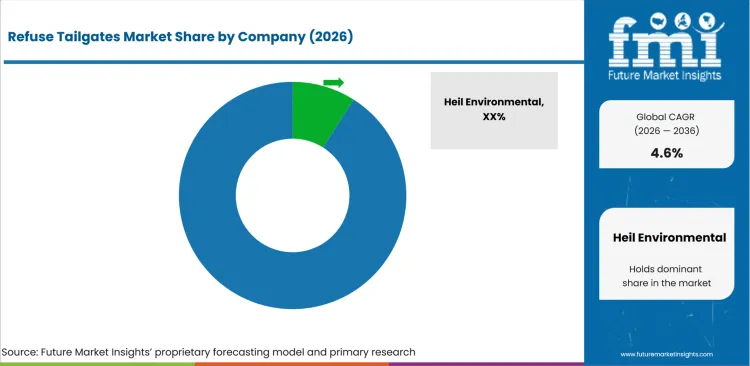
Competition is anchored in refuse-body integration and field support rather than tailgate hardware alone. Heil Environmental, McNeilus, Labrie and New Way Trucks have deep North American fleet exposure; Dennis Eagle, FAUN and ZOELLER-KIPPER add European engineering and electrification experience. Pak-Mor, Haul-All Equipment and Bridgeport Manufacturing serve regional and application-focused fleets where localized body design and parts support remain important. Hiab completed its acquisition of Labrie on July 1, 2026; the Labrie operating brand continues within Hiab's waste and recycling platform.
- North American body platforms: Heil Environmental, McNeilus, Labrie and New Way Trucks combine refuse-body engineering with fleet service and parts support.
- European collection-system specialists: Dennis Eagle, FAUN and ZOELLER-KIPPER compete through rear-loader engineering, integrated collection systems and alternative-power readiness.
- Regional fleet suppliers: Pak-Mor, Haul-All Equipment and Bridgeport Manufacturing broaden buyer choice in fleet-specific body configurations and replacement support.
Competitive Benchmarking: Refuse Tailgates Market
| Company | Refuse-Body Position | Tailgate Relevance | Geographic Focus | Commercial Emphasis |
|---|---|---|---|---|
| Heil Environmental | Refuse-body OEM | Rear-loader and body-tailgate integration | North America | Installed base, parts and fleet support |
| McNeilus | Refuse-body OEM | Multi-body configurations and tailgate integration | North America | Fleet service and system integration |
| Labrie Enviroquip (part of Hiab) | Refuse equipment OEM | Rear- and side-loader body/tailgate integration | USA and Canada | Municipal and private fleet applications |
| New Way Trucks | Refuse equipment OEM | Rear- and side-loader tailgate systems | USA and Canada | Municipal and private fleets |
| Dennis Eagle | Refuse vehicle and body OEM | Rear-loader body/tailgate integration | UK, Europe and selected exports | Electrified and conventional collection platforms |
| FAUN | Refuse collection vehicle OEM | Body and tailgate integration | Europe and selected exports | Municipal collection systems |
| ZOELLER-KIPPER | Refuse collection systems OEM | Body, lifter and tailgate integration | Europe | Integrated collection equipment |
| Pak-Mor | Refuse equipment manufacturer | Refuse-body and tailgate systems | North America | Regional fleet replacement and service |
| Haul-All Equipment | Refuse equipment manufacturer | Compaction and body systems | Canada and North America | Municipal and niche collection fleets |
| Bridgeport Manufacturing | Refuse-body manufacturer | Rear- and side-loader body systems | North America | Regional fleet applications |
The comparison focuses on the body architecture surrounding the tailgate, serviceability, powertrain integration and the fleet footprint through which replacement parts and refurbishment work are supported.
Key Developments in the Refuse Tailgates Market
- In April 2025, Dennis Eagle launched the Olympus Midi refuse collection body. The company later described the 12-tonne to 16-tonne platform as using a short rear overhang, a 17-second compactor speed, and the widest tailgate hopper in its class. The launch broadens the design space for compact rear-loader tailgates where maneuverability and payload are both procurement constraints. (Dennis Eagle, January 2026)
- In July 2025, FAUN and ZOELLER-KIPPER jointly acquired 100% of VISY GmbH in equal shares. The companies said VISY would be combined with existing digital capabilities to create a competence center for AI, recognition, assistance, and fleet solutions. Better integration of digital safety and operating data can extend tailgate value beyond structure into sensors, controls, and service diagnostics. (ZOELLER-KIPPER, July 2025)
- In May 2026, Heil Environmental debuted the Sentien automated side-loader arm and Common Body platform at its Canadian Waste Collection Summit in Montreal. Heil stated that the common body uses 44% or more shared components across front- and side-load platforms and highlighted relocated tailgate locks for maintenance access. Standardized architecture can reduce parts complexity and improve serviceability around tailgate-integrated systems. (Heil Environmental, May 2026)
- In July 2026, Hiab completed the acquisition of Labrie Environmental Group after required regulatory approval. Labrie’s refuse collection operations became a new Environmental Vehicle Solutions business area within Hiab while the established product brands continued. The ownership change adds a larger industrial platform behind Labrie Enviroquip and can influence future investment in body systems, service infrastructure, and replacement-component availability. (Labrie Environmental Group, July 2026)
Key Players in the Refuse Tailgates Market
North American Refuse-Body Platforms
- Heil Environmental
- McNeilus
- Labrie Enviroquip (part of Hiab)
- New Way Trucks
European Collection-System Specialists
- Dennis Eagle
- FAUN
- ZOELLER-KIPPER
Regional Fleet Suppliers
- Pak-Mor
- Haul-All Equipment
- Bridgeport Manufacturing
Refuse Tailgates Market - Report Scope
| Coverage field | Report scope |
|---|---|
| Market breakdown | Tailgate Type; Material; Vehicle Type; Sales Channel; End Use |
| Quantitative Units | USD Billion |
| Market Definition | Revenue includes refuse-tailgate assemblies sold for rear-loader, side-loader, split, heavy-duty compactor, and sealed refuse-body applications. It includes OEM-fit tailgate modules plus tailgate-specific replacement and refurbishment assemblies. Complete refuse trucks, non-tailgate refuse-body revenue, standalone lifting arms, generic hydraulic components, and downstream waste-collection services are excluded. |
| Regions Covered | North America; Latin America; Western Europe; Eastern Europe; East Asia; South Asia and Pacific; Middle East and Africa |
| Countries Covered | Canada, USA, Japan, Germany, Mexico, Brazil, France, and more than twenty-five additional countries in the full report |
| Key Companies Profiled | Heil Environmental; McNeilus; Labrie Enviroquip (part of Hiab); New Way Trucks; Dennis Eagle; FAUN; ZOELLER-KIPPER; Pak-Mor; Haul-All Equipment; Bridgeport Manufacturing |
| Forecast Period | 2026 to 2036 |
| Approach | FMI applies a hybrid bottom-up and top-down sizing approach that reconciles refuse-body production, replacement and refurbishment activity, vehicle mix, tailgate configuration, and channel evidence within the defined revenue boundary. |
Refuse Tailgates Market - Research Methodology
| Method | Approach |
|---|---|
| Primary Research | FMI primary research engages refuse-body manufacturers, distributors, service organizations, municipal procurement stakeholders, fleet managers, technicians, and industry specialists. Discussions focus on tailgate specification, replacement triggers, material choice, route uptime, service requirements, channel behavior, and powertrain integration. |
| Desk Research | Desk research reviews government fleet announcements, municipal procurement and operational material, standards bodies, company filings, first-party product documentation, service-network information, and dated company news. Desk research focuses on material that clarifies the defined tailgate revenue boundary and directly relevant operating mechanisms. |
| Market Sizing and Forecasting | Market sizing maps attributable tailgate revenue across body-OEM fitment, replacement, refurbishment, and municipal service channels. Forecast assumptions consider refuse-body production, fleet age, replacement intensity, vehicle architecture, material mix, alternative-power adoption, service life, and country-specific procurement conditions. |
| Data Validation | Findings are cross-checked across demand-side and supply-side indicators. Validation removes complete-truck and non-tailgate body revenue, prevents double counting between OEM and replacement channels, and excludes standalone lifters, generic hydraulic components, downstream collection services, and adjacent truck-body products. |
Refuse Tailgates Market by Segments
Refuse Tailgates Market segmented by Tailgate Type:
- Rear-loader tailgates
- Side-loader tailgates
- Split tailgates
- Heavy-duty compactor tailgates
- Sealed tailgates
Refuse Tailgates Market segmented by Material:
- Abrasion-resistant steel
- Mild steel
- Stainless steel
- High-strength low-alloy steel
Refuse Tailgates Market segmented by Vehicle Type:
- Rear-loader refuse trucks
- Side-loader refuse trucks
- Front-loader refuse trucks
- Mini compactors
- Electric refuse trucks
Refuse Tailgates Market segmented by Sales Channel:
- Body OEMs
- Aftermarket replacement
- Fleet refurbishment
- Municipal service contracts
Refuse Tailgates Market segmented by End Use:
- Municipal fleets
- Private waste haulers
- Commercial waste contractors
- Industrial waste services
Refuse Tailgates Market by Region:
- North America
- United States
- Canada
- Latin America
- Brazil
- Mexico
- Argentina
- Chile
- Western Europe
- Germany
- France
- United Kingdom
- Italy
- Spain
- Benelux
- Nordics
- Eastern Europe
- Poland
- Czech Republic
- Romania
- Hungary
- East Asia
- China
- Japan
- South Korea
- South Asia and Pacific
- India
- ASEAN
- Australia and New Zealand
- Middle East and Africa
- GCC Countries
- South Africa
- Türkiye
- Israel
Research Sources and Bibliography
- Natural Resources Canada (2026, April 1). Toronto’s hybrid waste trucks take noise to the curb.
- City of Long Beach (2026, May 1). City of Long Beach Deploys First-Ever Zero-Emissions Collections Trucks in New Pilot Program.
- Koto City (2025, November 19). FC Refuse Collection Truck Departure Ceremony and Collection Operations.
- City of Hilden (2025, June 26). Stadt Hilden nimmt Ladeinfrastruktur auf dem Zentralen Bauhof in Betrieb.
- Ayuntamiento de Toluca (2025, June 10). Duplica y moderniza Toluca su flotilla de servicio de recolección de residuos sólidos.
- Prefeitura de São Paulo (2025, March 17). Prefeitura apresenta mais 22 caminhões da coleta de lixo movidos a energia limpa para reduzir emissão de poluentes.
- Grand Albigeois (2025, April 14). Une benne à ordures 100% électrique.
- Dennis Eagle (2026, January 22). Olympus Midi: Unlocking the Goldilocks Principle.
- Heil Environmental (2026, May 20). 2026 Canadian Waste Collection Summit.
- ZOELLER-KIPPER (2025, July). FAUN and ZOELLER acquire 100% of the shares in VISY GmbH.
- Labrie Environmental Group (2026, July 1). Hiab completes the acquisition of Labrie Environmental Group, Michael Eastabrook joins Hiab Leadership Team.
- Heil Environmental (Accessed 2026, August 27). DuraPack 4060 Split Body Rear Loader.
- McNeilus (Accessed 2026, August 27). Split Body Rear Loader.
- New Way Trucks (Accessed 2026, August 27). New Way Garbage Trucks and Parts & Service.
- British Standards Institution (2025, January 31). BS EN 1501-5:2021 Refuse collection vehicles - General requirements and safety requirements - Lifting devices for refuse collection vehicles.
This Report Answers
- How is demand for the Refuse Tailgates Market expected to evolve through 2036?
- What refuse-fleet renewal and powertrain pressures support demand for tailgate assemblies?
- Why do Rear-loader tailgates hold the leading position within Tailgate Type?
- How does Abrasion-resistant steel influence tailgate wear life and vehicle payload?
- Why do Rear-loader refuse trucks hold the leading position within Vehicle Type?
- How do growth rates differ across Canada, USA, Japan, Germany, Mexico, Brazil, and France?
- How do the companies differ in body integration, alternative-power readiness, and aftermarket support?
- What integration and downtime constraints limit replacement of refuse tailgates?
- What should fleet procurement teams evaluate before selecting a refuse tailgate or replacement assembly?
Frequently Asked Questions
What is driving growth in the Refuse Tailgates Market?
Growth is supported by refuse-body renewal, long vehicle service lives, and replacement of high-cycle tailgate components. Alternative-power vehicles also create demand for tailgates that protect payload and integrate with changing hydraulic or electric auxiliary systems.
Who are the key players in the Refuse Tailgates Market?
Key players include Heil Environmental, McNeilus, Labrie Enviroquip (part of Hiab), New Way Trucks, Dennis Eagle, FAUN, ZOELLER-KIPPER, Pak-Mor, Haul-All Equipment and Bridgeport Manufacturing. Fleet service coverage and body integration are as important as tailgate design itself.
What notable restraint affects the Refuse Tailgates Market?
Replacement is constrained when an assembly must be requalified for body geometry and locks. Hydraulics, controls, and safety interfaces can add further validation work. Installation downtime and limited interchangeability can make a technically suitable tailgate unattractive for a fleet with tight collection schedules.
Why should executives track the Refuse Tailgates Market?
Tailgates sit at the intersection of refuse-body durability and payload. Safety and route uptime are equally important to fleet economics. Changes in electric or hybrid vehicle architecture can shift which materials, auxiliary-power systems, and service models are commercially attractive across both OEM and replacement channels.
What business problem does the Refuse Tailgates Market address?
The market supplies the high-duty rear closure and related structural functions needed for refuse collection. Those functions support loading and containment. They also support compaction and safe discharge. Replacement products also extend the useful life of collection bodies when wear zones deteriorate. Seals, locks, and cylinders can be additional replacement triggers.
What should refuse fleet procurement teams evaluate in the Refuse Tailgates Market?
Procurement teams should compare structural fit and sealing first. Lock safety and wear material then shape operating fit. Hydraulic demand, control compatibility, and parts availability complete the assessment. They should also test how installation time and rear-body mass affect route uptime and payload. Technician workload and future powertrain choices matter over the full service life.
What limits return on investment in the Refuse Tailgates Market?
ROI weakens when purchase price is evaluated without installation and downtime. Maintenance, payload, and service costs can materially change the lifetime economics. A lower-cost assembly can become expensive if poor compatibility creates repeat repairs or if excessive rear weight reduces productive payload throughout the vehicle life.
What supports long-term commercial confidence in the Refuse Tailgates Market?
Refuse collection remains a recurring public and commercial service that depends on durable vehicle bodies and replacement parts. Long fleet lives and recurring wear sustain a need for engineered tailgate assemblies. Safety requirements and continuing powertrain transitions reinforce demand for serviceable components.
Preview the report firsthand - request a free sample
Get SampleGet the brochure for pricing and purchase details.
Get PDFTable of Content
- Key Takeaways
- Market Size and CAGR
- Top Growth Driver
- Fastest Growing Segment
- Leading Region
- Key Companies
- Emerging Opportunities
- Executive Summary
- Global Market Outlook
- Demand-side Trends
- Supply-side Trends
- Technology Roadmap Analysis
- Analysis and Recommendations
- Analyst Perspective (What is happening? Why now? What should investors know?)
- Key Questions Answered
- How large is the market?
- What is the CAGR?
- What are key trends?
- Which region dominates?
- Who are the leaders?
- Market Overview
- Market Coverage / Taxonomy
- Market Definition / Scope / Limitations
- Research Methodology
- Chapter Orientation
- Analytical Lens and Working Hypotheses
- Market Structure, Signals, and Trend Drivers
- Benchmarking and Cross-market Comparability
- Market Sizing, Forecasting, and Opportunity Mapping
- Research Design and Evidence Framework
- Desk Research Programme (Secondary Evidence)
- Expert Input and Fieldwork (Primary Evidence)
- Tooling, Models, and Reference Databases
- Data Engineering and Model Build
- Quality Assurance and Audit Trail
- Market Background
- Market Dynamics (Drivers, Restraints, Opportunity, Trends)
- Scenario Forecast (Optimistic, Likely, Conservative)
- Impact Analysis
- AI Impact
- Sustainability Impact
- Regulatory Impact
- Technology Impact
- Consumer / Buyer Analysis
- Purchase Drivers
- Adoption Barriers
- Buyer Journey
- Opportunity Map Analysis
- Product Life Cycle Analysis
- Supply Chain Analysis
- Investment Feasibility Matrix
- Value Chain Analysis
- PESTLE and Porter's Analysis
- Regulatory Landscape
- Regional Parent Market Outlook
- Production and Consumption Statistics
- Import and Export Statistics
- Global Market Analysis and Forecast, 2021 to 2036
- Historical Market Size Value (USD Billion) Analysis, 2021 to 2025
- Current and Future Market Size Value (USD Billion) Projections, 2026 to 2036
- Y-o-Y Growth Trend Analysis
- Absolute $ Opportunity Analysis
- Global Market Pricing Analysis, 2021 to 2036
- Global Market Analysis and Forecast, By Tailgate Type, 2021 to 2036
- Introduction / Key Findings
- Historical Market Size Value (USD Billion) Analysis By Tailgate Type, 2021 to 2025
- Current and Future Market Size Value (USD Billion) Analysis and Forecast By Tailgate Type, 2026 to 2036
- Rear-loader tailgates
- Side-loader tailgates
- Split tailgates
- Heavy-duty compactor tailgates
- Sealed tailgates
- Rear-loader tailgates
- Y-o-Y Growth Trend Analysis By Tailgate Type, 2021 to 2025
- Absolute $ Opportunity Analysis By Tailgate Type, 2026 to 2036
- Global Market Analysis and Forecast, By Material, 2021 to 2036
- Introduction / Key Findings
- Historical Market Size Value (USD Billion) Analysis By Material, 2021 to 2025
- Current and Future Market Size Value (USD Billion) Analysis and Forecast By Material, 2026 to 2036
- Abrasion-resistant steel
- Mild steel
- Stainless steel
- High-strength low-alloy steel
- Abrasion-resistant steel
- Y-o-Y Growth Trend Analysis By Material, 2021 to 2025
- Absolute $ Opportunity Analysis By Material, 2026 to 2036
- Global Market Analysis and Forecast, By Vehicle Type, 2021 to 2036
- Introduction / Key Findings
- Historical Market Size Value (USD Billion) Analysis By Vehicle Type, 2021 to 2025
- Current and Future Market Size Value (USD Billion) Analysis and Forecast By Vehicle Type, 2026 to 2036
- Rear-loader refuse trucks
- Side-loader refuse trucks
- Front-loader refuse trucks
- Mini compactors
- Electric refuse trucks
- Rear-loader refuse trucks
- Y-o-Y Growth Trend Analysis By Vehicle Type, 2021 to 2025
- Absolute $ Opportunity Analysis By Vehicle Type, 2026 to 2036
- Global Market Analysis and Forecast, By Sales Channel, 2021 to 2036
- Introduction / Key Findings
- Historical Market Size Value (USD Billion) Analysis By Sales Channel, 2021 to 2025
- Current and Future Market Size Value (USD Billion) Analysis and Forecast By Sales Channel, 2026 to 2036
- Body OEMs
- Aftermarket replacement
- Fleet refurbishment
- Municipal service contracts
- Body OEMs
- Y-o-Y Growth Trend Analysis By Sales Channel, 2021 to 2025
- Absolute $ Opportunity Analysis By Sales Channel, 2026 to 2036
- Global Market Analysis and Forecast, By End Use, 2021 to 2036
- Introduction / Key Findings
- Historical Market Size Value (USD Billion) Analysis By End Use, 2021 to 2025
- Current and Future Market Size Value (USD Billion) Analysis and Forecast By End Use, 2026 to 2036
- Municipal fleets
- Private waste haulers
- Commercial waste contractors
- Industrial waste services
- Municipal fleets
- Y-o-Y Growth Trend Analysis By End Use, 2021 to 2025
- Absolute $ Opportunity Analysis By End Use, 2026 to 2036
- Global Market Analysis and Forecast, By Region, 2021 to 2036
- Introduction
- Historical Market Size Value (USD Billion) Analysis By Region, 2021 to 2025
- Current Market Size Value (USD Billion) Analysis and Forecast By Region, 2026 to 2036
- North America
- Latin America
- Western Europe
- Eastern Europe
- East Asia
- South Asia and Pacific
- Middle East & Africa
- Market Attractiveness Analysis By Region
- North America Market Analysis and Forecast, By Country, 2021 to 2036
- Historical Market Size Value (USD Billion) Trend Analysis By Market Taxonomy, 2021 to 2025
- Market Size Value (USD Billion) Forecast By Market Taxonomy, 2026 to 2036
- By Country
- USA
- Canada
- By Tailgate Type
- By Material
- By Vehicle Type
- By Sales Channel
- By End Use
- By Country
- Market Attractiveness Analysis
- By Country
- By Tailgate Type
- By Material
- By Vehicle Type
- By Sales Channel
- By End Use
- Key Takeaways
- Latin America Market Analysis and Forecast, By Country
- Historical Market Size Value (USD Billion) Trend Analysis By Market Taxonomy, 2021 to 2025
- Market Size Value (USD Billion) Forecast By Market Taxonomy, 2026 to 2036
- By Country
- Brazil
- Mexico
- Chile
- Rest of Latin America
- By Tailgate Type
- By Material
- By Vehicle Type
- By Sales Channel
- By End Use
- By Country
- Market Attractiveness Analysis
- By Country
- By Tailgate Type
- By Material
- By Vehicle Type
- By Sales Channel
- By End Use
- Key Takeaways
- Western Europe Market Analysis and Forecast, By Country
- Historical Market Size Value (USD Billion) Trend Analysis By Market Taxonomy, 2021 to 2025
- Market Size Value (USD Billion) Forecast By Market Taxonomy, 2026 to 2036
- By Country
- Germany
- UK
- Italy
- Spain
- France
- Nordic
- BENELUX
- Rest of Western Europe
- By Tailgate Type
- By Material
- By Vehicle Type
- By Sales Channel
- By End Use
- By Country
- Market Attractiveness Analysis
- By Country
- By Tailgate Type
- By Material
- By Vehicle Type
- By Sales Channel
- By End Use
- Key Takeaways
- Eastern Europe Market Analysis and Forecast, By Country
- Historical Market Size Value (USD Billion) Trend Analysis By Market Taxonomy, 2021 to 2025
- Market Size Value (USD Billion) Forecast By Market Taxonomy, 2026 to 2036
- By Country
- Russia
- Poland
- Hungary
- Balkan & Baltic
- Rest of Eastern Europe
- By Tailgate Type
- By Material
- By Vehicle Type
- By Sales Channel
- By End Use
- By Country
- Market Attractiveness Analysis
- By Country
- By Tailgate Type
- By Material
- By Vehicle Type
- By Sales Channel
- By End Use
- Key Takeaways
- East Asia Market Analysis and Forecast, By Country
- Historical Market Size Value (USD Billion) Trend Analysis By Market Taxonomy, 2021 to 2025
- Market Size Value (USD Billion) Forecast By Market Taxonomy, 2026 to 2036
- By Country
- China
- Japan
- South Korea
- By Tailgate Type
- By Material
- By Vehicle Type
- By Sales Channel
- By End Use
- By Country
- Market Attractiveness Analysis
- By Country
- By Tailgate Type
- By Material
- By Vehicle Type
- By Sales Channel
- By End Use
- Key Takeaways
- South Asia and Pacific Market Analysis and Forecast, By Country
- Historical Market Size Value (USD Billion) Trend Analysis By Market Taxonomy, 2021 to 2025
- Market Size Value (USD Billion) Forecast By Market Taxonomy, 2026 to 2036
- By Country
- India
- ASEAN
- Australia & New Zealand
- Rest of South Asia and Pacific
- By Tailgate Type
- By Material
- By Vehicle Type
- By Sales Channel
- By End Use
- By Country
- Market Attractiveness Analysis
- By Country
- By Tailgate Type
- By Material
- By Vehicle Type
- By Sales Channel
- By End Use
- Key Takeaways
- Middle East & Africa Market Analysis and Forecast, By Country
- Historical Market Size Value (USD Billion) Trend Analysis By Market Taxonomy, 2021 to 2025
- Market Size Value (USD Billion) Forecast By Market Taxonomy, 2026 to 2036
- By Country
- Kingdom of Saudi Arabia
- Other GCC Countries
- Türkiye
- South Africa
- Other African Union
- Rest of Middle East & Africa
- By Tailgate Type
- By Material
- By Vehicle Type
- By Sales Channel
- By End Use
- By Country
- Market Attractiveness Analysis
- By Country
- By Tailgate Type
- By Material
- By Vehicle Type
- By Sales Channel
- By End Use
- Key Takeaways
- Key Countries Market Analysis
- USA
- Pricing Analysis
- Market Share Analysis, 2025
- By Tailgate Type
- By Material
- By Vehicle Type
- By Sales Channel
- By End Use
- Canada
- Pricing Analysis
- Market Share Analysis, 2025
- By Tailgate Type
- By Material
- By Vehicle Type
- By Sales Channel
- By End Use
- Mexico
- Pricing Analysis
- Market Share Analysis, 2025
- By Tailgate Type
- By Material
- By Vehicle Type
- By Sales Channel
- By End Use
- Brazil
- Pricing Analysis
- Market Share Analysis, 2025
- By Tailgate Type
- By Material
- By Vehicle Type
- By Sales Channel
- By End Use
- Chile
- Pricing Analysis
- Market Share Analysis, 2025
- By Tailgate Type
- By Material
- By Vehicle Type
- By Sales Channel
- By End Use
- Germany
- Pricing Analysis
- Market Share Analysis, 2025
- By Tailgate Type
- By Material
- By Vehicle Type
- By Sales Channel
- By End Use
- UK
- Pricing Analysis
- Market Share Analysis, 2025
- By Tailgate Type
- By Material
- By Vehicle Type
- By Sales Channel
- By End Use
- Italy
- Pricing Analysis
- Market Share Analysis, 2025
- By Tailgate Type
- By Material
- By Vehicle Type
- By Sales Channel
- By End Use
- Spain
- Pricing Analysis
- Market Share Analysis, 2025
- By Tailgate Type
- By Material
- By Vehicle Type
- By Sales Channel
- By End Use
- France
- Pricing Analysis
- Market Share Analysis, 2025
- By Tailgate Type
- By Material
- By Vehicle Type
- By Sales Channel
- By End Use
- India
- Pricing Analysis
- Market Share Analysis, 2025
- By Tailgate Type
- By Material
- By Vehicle Type
- By Sales Channel
- By End Use
- ASEAN
- Pricing Analysis
- Market Share Analysis, 2025
- By Tailgate Type
- By Material
- By Vehicle Type
- By Sales Channel
- By End Use
- Australia & New Zealand
- Pricing Analysis
- Market Share Analysis, 2025
- By Tailgate Type
- By Material
- By Vehicle Type
- By Sales Channel
- By End Use
- China
- Pricing Analysis
- Market Share Analysis, 2025
- By Tailgate Type
- By Material
- By Vehicle Type
- By Sales Channel
- By End Use
- Japan
- Pricing Analysis
- Market Share Analysis, 2025
- By Tailgate Type
- By Material
- By Vehicle Type
- By Sales Channel
- By End Use
- South Korea
- Pricing Analysis
- Market Share Analysis, 2025
- By Tailgate Type
- By Material
- By Vehicle Type
- By Sales Channel
- By End Use
- Russia
- Pricing Analysis
- Market Share Analysis, 2025
- By Tailgate Type
- By Material
- By Vehicle Type
- By Sales Channel
- By End Use
- Poland
- Pricing Analysis
- Market Share Analysis, 2025
- By Tailgate Type
- By Material
- By Vehicle Type
- By Sales Channel
- By End Use
- Hungary
- Pricing Analysis
- Market Share Analysis, 2025
- By Tailgate Type
- By Material
- By Vehicle Type
- By Sales Channel
- By End Use
- Kingdom of Saudi Arabia
- Pricing Analysis
- Market Share Analysis, 2025
- By Tailgate Type
- By Material
- By Vehicle Type
- By Sales Channel
- By End Use
- Türkiye
- Pricing Analysis
- Market Share Analysis, 2025
- By Tailgate Type
- By Material
- By Vehicle Type
- By Sales Channel
- By End Use
- South Africa
- Pricing Analysis
- Market Share Analysis, 2025
- By Tailgate Type
- By Material
- By Vehicle Type
- By Sales Channel
- By End Use
- USA
- Market Structure Analysis
- Competition Dashboard
- Competition Benchmarking
- Market Share Analysis of Top Players
- By Regional
- By Tailgate Type
- By Material
- By Vehicle Type
- By Sales Channel
- By End Use
- Emerging Startups
- Innovation Benchmarking
- Competition Analysis
- Competition Deep Dive
- Heil Environmental
- Overview
- Product Portfolio
- Profitability by Market Segments
- Sales Footprint
- Strategy Overview
- Marketing Strategy
- Product Strategy
- Channel Strategy
- McNeilus
- Labrie Enviroquip
- New Way Trucks
- Dennis Eagle
- FAUN
- ZOELLER-KIPPER
- Pak-Mor
- Haul-All Equipment
- Bridgeport Manufacturing
- Heil Environmental
- Case Studies
- Success Stories
- Recent Developments
- Competition Deep Dive
- Assumptions & Acronyms Used


