

- Industry Size (2025)
- USD 129.1 Bn
- Forecast (2035)
- USD 178.7 Bn
- CAGR (2025 to 2035)
- 3.3%
Municipal Solid Waste Management Market Size and Share Forecast Outlook 2025 to 2035
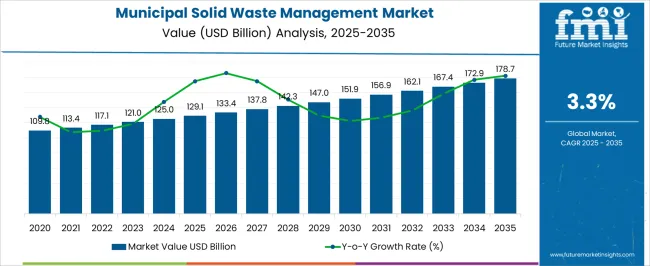
The municipal solid waste management sector is projected to rise from USD 129.1 billion in 2025 to USD 178.7 billion in 2035, advancing at a CAGR of 3.3%. The growth rate volatility index indicates a moderate and steady curve, with values moving from 125.0 billion in 2024 to 133.4 billion by 2026 and 142.3 billion in 2029. This gradual climb highlights reliance on established collection and disposal practices with incremental upgrades in treatment facilities.
Subdued pace reflects the mature nature of municipal waste services, where expansion is tied to efficiency measures and regulatory enforcement rather than sudden demand shifts. By 2030, the industry value is forecasted at 147.0 billion, reaching 156.9 billion in 2032 and 167.4 billion in 2034, before closing at 178.7 billion in 2035. The index underscores a low-volatility environment, where growth is shaped by stable urban consumption patterns and long-term contracts with service providers. Market experts consider this trajectory dependable, though less dynamic compared with sectors fueled by rapid innovation. The consistent upward slope suggests municipalities and private operators will continue focusing on capacity planning, treatment upgrades, and recycling integration. The long-term outlook is seen as reliable, with resilience outweighing short-term volatility.
Quick Stats for Municipal Solid Waste Management Market
- Municipal Solid Waste Management Market Value (2025): USD 129.1 billion
- Municipal Solid Waste Management Market Forecast Value (2035): USD 178.7 billion
- Municipal Solid Waste Management Market Forecast CAGR: 3.3%
- Leading Segment in Municipal Solid Waste Management Market in 2025: Residential (41.8%)
- Key Growth Regions in Municipal Solid Waste Management Market: North America, Asia-Pacific, Europe
- Top Key Players in Municipal Solid Waste Management Market: Waste Management, Biffa, China Everbright Environment Group, Clean Harbors, Cleanaway, E.L. Harvey, GFL Environmental, Hitachi Zosen, Keppel Seghers, OMNI Conversion Technologies, Recology, Reworld, SUEZ, Veolia, Waste Connections, WIN Waste Innovations
Municipal Solid Waste Management Market Key Takeaways
| Metric | Value |
|---|---|
| Municipal Solid Waste Management Market Estimated Value in (2025 E) | USD 129.1 billion |
| Municipal Solid Waste Management Market Forecast Value in (2035 F) | USD 178.7 billion |
| Forecast CAGR (2025 to 2035) | 3.3% |
The municipal solid waste management segment is estimated to contribute nearly 32% of the waste management market, about 24% of the environmental services market, close to 27% of the recycling and resource recovery market, around 18% of the hazardous and non-hazardous waste treatment market, and nearly 20% of the circular economy and material management market.
This accounts for an aggregated share of approximately 121% across its parent sectors. This weight highlights the scale at which municipal solid waste management defines operational frameworks and investment flows within broader waste handling industries. It has been positioned as a pivotal area because the collection, segregation, disposal, and recycling of daily refuse form the backbone of how service models are designed and how compliance targets are achieved. Industry analysts often view municipal solid waste management not only as a regulatory obligation but also as an arena where efficiency, cost reduction, and material recovery can be optimized to influence national and local economies.
The demand for structured systems has been shaped by rising urban populations, expanding service coverage, and the need for resource recovery infrastructure. Municipal solid waste management is therefore seen as an indispensable foundation in its parent markets, driving capital expenditure, technology adoption, and contractual models that define the competitive landscape in waste services across regions.
Why is the Municipal Solid Waste Management Market Growing?
The municipal solid waste management market is expanding steadily, driven by urbanization, population growth, and increasing environmental regulations aimed at sustainable waste handling. Policy frameworks from national and local governments have intensified efforts to improve collection, segregation, and processing systems, while public awareness campaigns have encouraged community participation in waste minimization.
Technological advancements in waste sorting, energy recovery, and recycling processes have enhanced operational efficiency, reducing the environmental footprint of municipal waste. Investments in integrated waste management facilities and public-private partnerships have further strengthened infrastructure capacity, particularly in emerging economies facing rapid urban development.
Rising recovery of recyclable materials and the push for circular economy principles are reshaping operational priorities in the sector. Growth will be supported by strong residential waste generation, reliance on landfill disposal in certain regions, and the steady recovery of paper and paperboard materials for recycling and reuse.
Segmental Analysis
The municipal solid waste management market is segmented by source, treatment, material, and geographic regions. By source, municipal solid waste management market is divided into Residential and Commercial. In terms of treatment, municipal solid waste management market is classified into Landfill, Open Dumping, Disposal, Recycling, Incineration/Combustion, and Composting & AD.
Based on material, municipal solid waste management market is segmented into Paper & Paperboard, Metals, Plastics, Food, Glass, and Others. Regionally, the municipal solid waste management industry is classified into North America, Latin America, Western Europe, Eastern Europe, Balkan & Baltic Countries, Russia & Belarus, Central Asia, East Asia, South Asia & Pacific, and the Middle East & Africa.
Insights into the Source Segment: Residential
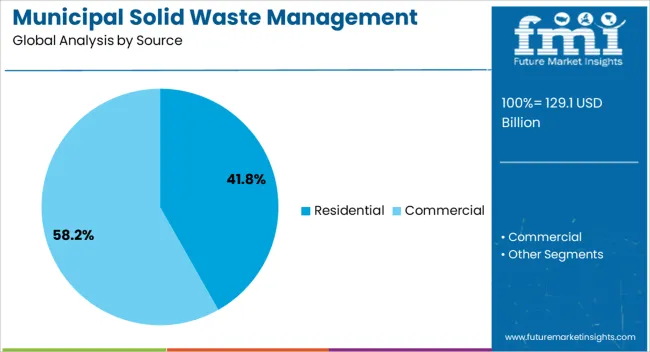
The residential segment is projected to account for 41.80% of the municipal solid waste management market revenue in 2025, maintaining its leadership due to consistent waste generation from households in urban and suburban areas. Increased consumption of packaged goods, single-use plastics, and e-commerce deliveries has significantly contributed to household waste volumes.
Municipal authorities have prioritized residential waste collection through curbside programs, source segregation initiatives, and awareness campaigns promoting recycling and composting. Urban housing density and population growth have reinforced the need for efficient collection systems, while seasonal patterns and lifestyle changes continue to influence waste composition.
The segment’s stability is also supported by mandatory waste disposal regulations and expanding access to organized collection services in developing regions. As municipalities invest in modernizing waste collection fleets and digital tracking systems, residential waste generation will remain the primary contributor to overall market volumes.
Insights into the Treatment Segment: Landfill
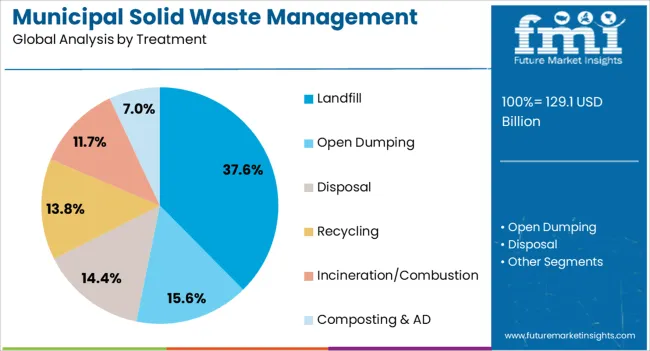
The landfill segment is projected to contribute 37.60% of the municipal solid waste management market revenue in 2025, retaining a significant share due to its widespread use as a cost-effective disposal method. Many regions, particularly in developing economies, continue to rely on landfills due to limited infrastructure for advanced waste treatment options.
Landfills remain a critical component of waste management systems, handling non-recyclable and residual waste streams that cannot be processed through recycling or composting. Regulatory requirements have increasingly emphasized engineered landfill designs, leachate control systems, and methane capture technologies to reduce environmental risks.
While landfill diversion policies and recycling targets are gradually reducing volumes sent to disposal, the segment’s importance persists where alternative processing capacity is insufficient. Ongoing modernization of landfill sites to meet environmental compliance standards is expected to sustain their role in municipal waste management over the coming years.
Insights into the Material Segment: Paper & Paperboard
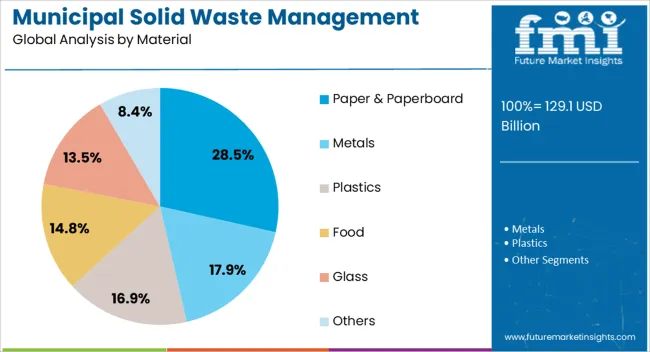
The paper and paperboard segment is projected to hold 28.50% of the municipal solid waste management market revenue in 2025, making it the leading material category recovered from waste streams. High recovery rates have been achieved due to the established recycling infrastructure and strong demand for recycled fiber in packaging and printing industries.
Increased use of paper-based packaging as a sustainable alternative to plastics has contributed to higher collection volumes from residential and commercial sources. Municipal recycling programs have prioritized paper and paperboard recovery due to their economic viability and ease of processing compared to other materials.
Seasonal peaks in packaging waste, driven by retail activity and e-commerce, have further boosted volumes. With corporate commitments toward recycled content in packaging and ongoing investment in paper recycling facilities, this segment is expected to maintain its prominence in material recovery within municipal solid waste management systems.
What are the Drivers, Restraints, and Key Trends of the Municipal Solid Waste Management Market?
The municipal solid waste management market is projected to grow steadily as cities and municipalities focus on efficient collection, disposal, and recycling systems. Demand is influenced by rising waste volumes, stricter regulations, and the need for organized disposal practices. Opportunities lie in waste-to-energy projects, recycling initiatives, and public-private partnerships. Trends highlight the use of digital monitoring tools, segregation at source, and investment in material recovery facilities. Yet, challenges such as infrastructure deficits, funding constraints, and inadequate compliance frameworks continue to limit smooth operations across many regions.
Demand Rising from Expanding Waste Volumes Globally
Demand for municipal solid waste management services has been reinforced by the growing waste volumes generated by households, commercial establishments, and industries. Organized collection and disposal systems are being prioritized by municipal authorities to prevent environmental hazards and public health risks. Regulatory pressure has driven municipalities to expand coverage and efficiency in collection and treatment. Demand is most pronounced in regions where population density is high, creating challenges for unregulated landfills. Recycling and composting initiatives have been supported as communities prefer visible improvements in waste handling. With rising expectations for cleaner urban environments and efficient public services, demand for structured municipal solid waste management has become a necessity rather than a choice, thereby strengthening the role of service providers across developed and emerging markets.
Opportunities Emerging from Recycling and Energy Recovery
The municipal solid waste management market has observed opportunities through expansion of recycling programs, energy recovery facilities, and circular material use. Waste-to-energy plants have been prioritized by municipalities as they reduce landfill dependency and generate power from non-recyclable waste streams. Recycling of plastics, paper, and metals has created opportunities for new revenue streams while meeting regulatory compliance. Opportunities lie in public-private partnerships where infrastructure development is shared between government and private contractors. Growth in waste segregation practices has opened further opportunities to improve efficiency in processing. Municipalities investing in composting and anaerobic digestion facilities are also positioned to benefit from by-products such as bio-gas and fertilizers.
Trends Transforming Collection, Segregation, and Monitoring
Trends in municipal solid waste management have centered on segregation at source, advanced collection systems, and adoption of monitoring technologies. Municipalities have been moving toward smart collection bins and route optimization software to reduce operational costs. Segregation initiatives have gained traction as mixed waste streams create inefficiencies in recycling and energy recovery processes. The adoption of material recovery facilities has grown significantly, reshaping recycling operations by improving efficiency in sorting and processing. Regional programs promoting community participation in segregation have also strengthened these trends. Growing interest in integrating digital platforms for monitoring waste generation and collection efficiency has been observed, especially in high-density cities. Collectively, these trends point toward a more structured and technology-aided framework that improves efficiency and accountability in municipal waste operations.
Challenges Constraining Infrastructure and Compliance Implementation
Challenges in the municipal solid waste management market are linked to infrastructure limitations, financial constraints, and regulatory compliance issues.
Many municipalities lack adequate treatment facilities, forcing continued reliance on open dumping and poorly managed landfills. Budget constraints have restricted investment in modern infrastructure, leaving collection and processing systems fragmented. Enforcement of regulations remains inconsistent, with waste segregation laws often poorly implemented. Shortages of skilled labor and weak coordination between public agencies and private operators add to inefficiencies. High capital costs for setting up waste-to-energy plants or large-scale recycling units further challenge adoption in developing regions.
Analysis of Municipal Solid Waste Management Market By Key Countries
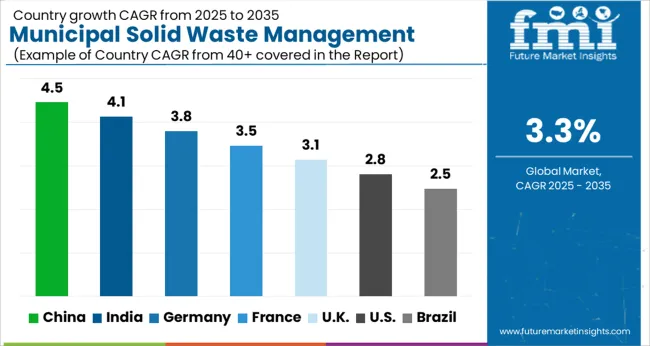
| Countries | CAGR |
|---|---|
| China | 4.5% |
| India | 4.1% |
| Germany | 3.8% |
| France | 3.5% |
| UK | 3.1% |
| USA | 2.8% |
| Brazil | 2.5% |
The global municipal solid waste management market is projected to grow at a CAGR of 3.3% between 2025 and 2035. China is expected to lead expansion at 4.5%, followed by India at 4.1% and Germany at 3.8%. The United Kingdom records a moderate growth of 3.1%, while the United States posts the slowest pace at 2.8%. Rising volumes of urban and industrial waste, adoption of waste to energy facilities, and stricter compliance frameworks are the primary growth factors. Asian markets record faster growth due to large-scale infrastructure projects and capacity building, while European nations rely on policy enforcement and recycling mandates. The USA shows more restrained growth due to mature infrastructure and slower adoption of advanced diversion practices. This report includes insights on 40+ countries; the top markets are shown here for reference.
Sales Outlook for Municipal Solid Waste Management Market in China
The municipal solid waste management market in China is projected to grow at a CAGR of 4.5%. Expansion is driven by large urban populations, rapid consumption cycles, and government backed investment in incineration and waste to energy plants. Recycling capacity is being scaled through partnerships between public agencies and private operators. Technology adoption for collection, sorting, and landfill diversion is prioritized to manage increasing waste volumes. China’s policy direction continues to emphasize capacity addition and circular material recovery.
- Waste to energy projects increase power generation from municipal solid waste streams.
- Public private partnerships improve collection efficiency and recycling throughput.
- Smart collection systems enhance monitoring and reduce operational inefficiencies.
Demand Analysis for Municipal Solid Waste Management Market in India
The municipal solid waste management market in India is forecast to grow at a CAGR of 4.1%. Rising household consumption, expanding urban regions, and limited legacy infrastructure create demand for integrated collection and processing systems. Government backed programs emphasize source segregation, door to door collection, and landfill remediation. Private contractors are increasingly involved in waste collection and treatment, boosting efficiency. Stronger emphasis on recycling and composting reinforces long term waste diversion goals.
- Source segregation campaigns promote higher recovery rates in Indian municipalities.
- Landfill remediation projects create opportunities for technology and service providers.
- Increased private participation expands coverage and efficiency in waste management services.
Growth Outlook for Municipal Solid Waste Management Market in Germany
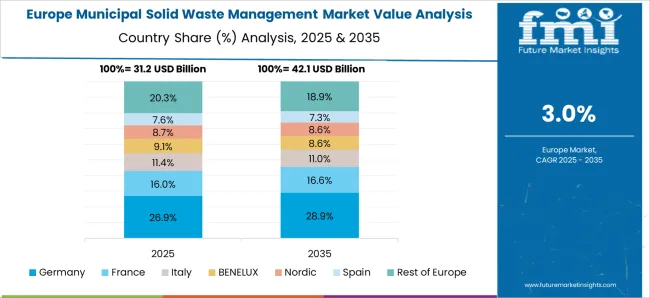
The municipal solid waste management market in Germany is projected to expand at a CAGR of 3.8%. The system benefits from strong policy frameworks, with high recycling targets and waste diversion mandates. Advanced sorting facilities and waste to energy plants ensure reduced landfill dependency. Germany’s circular economy initiatives support material recovery, while public sector investments ensure continuous innovation in treatment and recycling. The market remains mature yet dynamic, with efficiency and compliance driving growth.
- High recycling targets increase demand for advanced sorting and recovery technologies.
- Waste to energy projects strengthen material diversion and energy recovery potential.
- Government funding supports adoption of innovative recycling and treatment systems.
Future Analysis for Municipal Solid Waste Management Market in the United Kingdom
The municipal solid waste management market in the UK is expected to grow at a CAGR of 3.1%. Growth is supported by stricter recycling targets, landfill diversion policies, and investments in sorting facilities. Local councils emphasize efficiency in collection and processing, while private operators expand their role in treatment plants and recycling centers. Market expansion is tempered by mature infrastructure, yet momentum is maintained through compliance with EU-derived standards and rising pressure for waste diversion.
- Local councils enforce stricter recycling and diversion mandates across municipalities.
- Private sector partnerships expand treatment capacity and service coverage.
- Sorting facility upgrades increase efficiency in material recovery processes.
Opportunity Analysis for Municipal Solid Waste Management Market in the United States
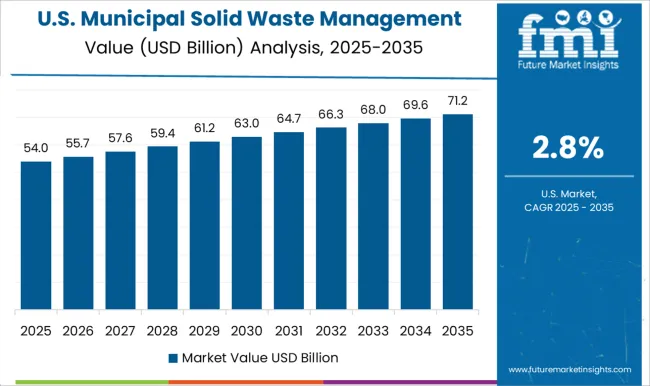
The municipal solid waste management market in the US is forecast to grow at a CAGR of 2.8%. Growth remains moderate due to mature infrastructure and reliance on established collection and landfill systems. Adoption of advanced waste diversion technologies is slower compared to Europe and Asia, though metropolitan regions push for higher recycling and composting rates. Private waste management companies dominate the sector, with investments directed toward automation, smart collection, and regional recycling hubs.
- Metropolitan regions push higher adoption of recycling and composting systems.
- Automation and smart collection solutions improve efficiency for waste haulers.
- Private operators invest in regional recycling hubs to meet compliance demands.
Competitive Landscape of Municipal Solid Waste Management Market
Competition in municipal solid waste management has revolved around scale, technology depth, and the clarity of service brochures. Waste Management, Veolia, and SUEZ highlight comprehensive networks of collection, recycling, and disposal, using brochures to underline landfill diversion rates, recycling facilities, and energy recovery plants. Waste Connections and GFL Environmental stress integrated offerings across North America, distributing catalogues that show coverage maps, specialty recycling programs, and subscription tiers for municipalities.
Biffa and Recology issue brochures that emphasize closed loop recycling, community engagement, and curbside convenience. Cleanaway and E.L. Harvey leverage region specific brochures that outline tailored waste streams, hazardous handling, and compliance with local regulations.
The messaging is consistent: large scale networks, reliability, and environmental performance, condensed into service documents that municipalities can benchmark. Technology suppliers compete by turning complex conversion processes into accessible brochure language. Hitachi Zosen and Keppel Seghers showcase waste-to-energy brochures that stress thermal efficiency, low emissions, and turnkey engineering packages.
OMNI Conversion Technologies differentiates itself with advanced chemical recycling and syngas production, presenting brochures that highlight modular designs and reduced landfill dependency. Clean Harbors and Reworld sharpen the competitive angle with hazardous waste brochures that detail safety certifications, on-site treatment options, and cradle-to-grave liability coverage. WIN Waste Innovations highlights integrated collection and energy recovery brochures, showing contracts where power is sold back to grids. Strategy is straightforward: publish service brochures that prove regulatory compliance, cost efficiency, and environmental metrics.
Key Players in the Municipal Solid Waste Management Market
- Waste Management
- Biffa
- China Everbright Environment Group
- Clean Harbors
- Cleanaway
- E.L. Harvey
- GFL Environmental
- Hitachi Zosen
- Keppel Seghers
- OMNI Conversion Technologies
- Recology
- Reworld
- SUEZ
- Veolia
- Waste Connections
- WIN Waste Innovations
Scope of the Report
| Item | Value |
|---|---|
| Quantitative Units | USD 129.1 Billion |
| Source | Residential and Commercial |
| Treatment | Landfill, Open Dumping, Disposal, Recycling, Incineration/Combustion, and Composting & AD |
| Material | Paper & Paperboard, Metals, Plastics, Food, Glass, and Others |
| Regions Covered | North America, Europe, Asia-Pacific, Latin America, Middle East & Africa |
| Country Covered | United States, Canada, Germany, France, United Kingdom, China, Japan, India, Brazil, South Africa |
| Key Companies Profiled | Waste Management, Biffa, China Everbright Environment Group, Clean Harbors, Cleanaway, E.L. Harvey, GFL Environmental, Hitachi Zosen, Keppel Seghers, OMNI Conversion Technologies, Recology, Reworld, SUEZ, Veolia, Waste Connections, and WIN Waste Innovations |
| Additional Attributes | Dollar sales by waste type (organic, plastic, paper, metal, glass, others), Dollar sales by service type (collection, transportation, disposal, recycling, energy recovery), Trends in circular economy practices and recycling mandates, Role of public–private partnerships in waste infrastructure, Growth of waste-to-energy and material recovery facilities, Regional variations in municipal waste generation and regulatory enforcement. |
Municipal Solid Waste Management Market by Segments
Source:
- Residential
- Commercial
Treatment:
- Landfill
- Open Dumping
- Disposal
- Recycling
- Incineration/Combustion
- Composting & AD
Material:
- Paper & Paperboard
- Metals
- Plastics
- Food
- Glass
- Others
Region:
- North America
- USA
- Canada
- Mexico
- Latin America
- Brazil
- Chile
- Rest of Latin America
- Western Europe
- Germany
- UK
- Italy
- Spain
- France
- Nordic
- BENELUX
- Rest of Western Europe
- Eastern Europe
- Russia
- Poland
- Hungary
- Balkan & Baltic
- Rest of Eastern Europe
- East Asia
- China
- Japan
- South Korea
- South Asia and Pacific
- India
- ASEAN
- Australia & New Zealand
- Rest of South Asia and Pacific
- Middle East & Africa
- Kingdom of Saudi Arabia
- Other GCC Countries
- Turkiye
- South Africa
- Other African Union
- Rest of Middle East & Africa
Frequently Asked Questions
How big is the municipal solid waste management market in 2025?
The global municipal solid waste management market is estimated to be valued at USD 129.1 billion in 2025.
What will be the size of municipal solid waste management market in 2035?
The market size for the municipal solid waste management market is projected to reach USD 178.7 billion by 2035.
How much will be the municipal solid waste management market growth between 2025 and 2035?
The municipal solid waste management market is expected to grow at a 3.3% CAGR between 2025 and 2035.
What are the key product types in the municipal solid waste management market?
The key product types in municipal solid waste management market are residential, commercial, _hospitals, _offices & institutions, _hotels and _others.
Which treatment segment to contribute significant share in the municipal solid waste management market in 2025?
In terms of treatment, landfill segment to command 37.6% share in the municipal solid waste management market in 2025.
Preview the report firsthand - request a free sample
Get SampleGet the brochure for pricing and purchase details.
Get PDFTable of Content
- Executive Summary
- Global Market Outlook
- Demand-side Trends
- Supply-side Trends
- Technology Roadmap Analysis
- Analysis and Recommendations
- Market Overview
- Market Coverage / Taxonomy
- Market Definition / Scope / Limitations
- Market Background
- Market Dynamics
- Drivers
- Restraints
- Opportunity
- Trends
- Scenario Forecast
- Demand in Optimistic Scenario
- Demand in Likely Scenario
- Demand in Conservative Scenario
- Opportunity Map Analysis
- Product Life Cycle Analysis
- Supply Chain Analysis
- Investment Feasibility Matrix
- Value Chain Analysis
- PESTLE and Porter’s Analysis
- Regulatory Landscape
- Regional Parent Market Outlook
- Production and Consumption Statistics
- Import and Export Statistics
- Market Dynamics
- Global Municipal Solid Waste Management Market Analysis 2020-2024 and Forecast, 2025-2035
- Historical Market Size Value (USD Mn) Analysis, 2020-2024
- Current and Future Market Size Value (USD Mn) Projections, 2025-2035
- Y-o-Y Growth Trend Analysis
- Absolute $ Opportunity Analysis
- Global Municipal Solid Waste Management Market Pricing Analysis 2020-2024 and Forecast 2025-2035
- Global Municipal Solid Waste Management Market Analysis 2020-2024 and Forecast 2025-2035, By Source
- Introduction / Key Findings
- Historical Market Size Value (USD Mn) Analysis By Source , 2020-2024
- Current and Future Market Size Value (USD Mn) Analysis and Forecast By Source , 2025-2035
- Residential
- Commercial
- Hospitals
- Offices & Institutions
- Hotels
- Others
- Y-o-Y Growth Trend Analysis By Source , 2020-2024
- Absolute $ Opportunity Analysis By Source , 2025-2035
- Global Municipal Solid Waste Management Market Analysis 2020-2024 and Forecast 2025-2035, By Treatment
- Introduction / Key Findings
- Historical Market Size Value (USD Mn) Analysis By Treatment, 2020-2024
- Current and Future Market Size Value (USD Mn) Analysis and Forecast By Treatment, 2025-2035
- Landfill
- Open Dumping
- Disposal
- Recycling
- Incineration/Combustion
- Composting & AD
- Y-o-Y Growth Trend Analysis By Treatment, 2020-2024
- Absolute $ Opportunity Analysis By Treatment, 2025-2035
- Global Municipal Solid Waste Management Market Analysis 2020-2024 and Forecast 2025-2035, By Material
- Introduction / Key Findings
- Historical Market Size Value (USD Mn) Analysis By Material, 2020-2024
- Current and Future Market Size Value (USD Mn) Analysis and Forecast By Material, 2025-2035
- Paper & Paperboard
- Metals
- Plastics
- Food
- Glass
- Others
- Y-o-Y Growth Trend Analysis By Material, 2020-2024
- Absolute $ Opportunity Analysis By Material, 2025-2035
- Global Municipal Solid Waste Management Market Analysis 2020-2024 and Forecast 2025-2035, By Region
- Introduction
- Historical Market Size Value (USD Mn) Analysis By Region, 2020-2024
- Current Market Size Value (USD Mn) Analysis and Forecast By Region, 2025-2035
- North America
- Latin America
- Western Europe
- Eastern Europe
- East Asia
- South Asia and Pacific
- Middle East & Africa
- Market Attractiveness Analysis By Region
- North America Municipal Solid Waste Management Market Analysis 2020-2024 and Forecast 2025-2035, By Country
- Historical Market Size Value (USD Mn) Trend Analysis By Market Taxonomy, 2020-2024
- Market Size Value (USD Mn) Forecast By Market Taxonomy, 2025-2035
- By Country
- USA
- Canada
- Mexico
- By Source
- By Treatment
- By Material
- By Country
- Market Attractiveness Analysis
- By Country
- By Source
- By Treatment
- By Material
- Key Takeaways
- Latin America Municipal Solid Waste Management Market Analysis 2020-2024 and Forecast 2025-2035, By Country
- Historical Market Size Value (USD Mn) Trend Analysis By Market Taxonomy, 2020-2024
- Market Size Value (USD Mn) Forecast By Market Taxonomy, 2025-2035
- By Country
- Brazil
- Chile
- Rest of Latin America
- By Source
- By Treatment
- By Material
- By Country
- Market Attractiveness Analysis
- By Country
- By Source
- By Treatment
- By Material
- Key Takeaways
- Western Europe Municipal Solid Waste Management Market Analysis 2020-2024 and Forecast 2025-2035, By Country
- Historical Market Size Value (USD Mn) Trend Analysis By Market Taxonomy, 2020-2024
- Market Size Value (USD Mn) Forecast By Market Taxonomy, 2025-2035
- By Country
- Germany
- UK
- Italy
- Spain
- France
- Nordic
- BENELUX
- Rest of Western Europe
- By Source
- By Treatment
- By Material
- By Country
- Market Attractiveness Analysis
- By Country
- By Source
- By Treatment
- By Material
- Key Takeaways
- Eastern Europe Municipal Solid Waste Management Market Analysis 2020-2024 and Forecast 2025-2035, By Country
- Historical Market Size Value (USD Mn) Trend Analysis By Market Taxonomy, 2020-2024
- Market Size Value (USD Mn) Forecast By Market Taxonomy, 2025-2035
- By Country
- Russia
- Poland
- Hungary
- Balkan & Baltic
- Rest of Eastern Europe
- By Source
- By Treatment
- By Material
- By Country
- Market Attractiveness Analysis
- By Country
- By Source
- By Treatment
- By Material
- Key Takeaways
- East Asia Municipal Solid Waste Management Market Analysis 2020-2024 and Forecast 2025-2035, By Country
- Historical Market Size Value (USD Mn) Trend Analysis By Market Taxonomy, 2020-2024
- Market Size Value (USD Mn) Forecast By Market Taxonomy, 2025-2035
- By Country
- China
- Japan
- South Korea
- By Source
- By Treatment
- By Material
- By Country
- Market Attractiveness Analysis
- By Country
- By Source
- By Treatment
- By Material
- Key Takeaways
- South Asia and Pacific Municipal Solid Waste Management Market Analysis 2020-2024 and Forecast 2025-2035, By Country
- Historical Market Size Value (USD Mn) Trend Analysis By Market Taxonomy, 2020-2024
- Market Size Value (USD Mn) Forecast By Market Taxonomy, 2025-2035
- By Country
- India
- ASEAN
- Australia & New Zealand
- Rest of South Asia and Pacific
- By Source
- By Treatment
- By Material
- By Country
- Market Attractiveness Analysis
- By Country
- By Source
- By Treatment
- By Material
- Key Takeaways
- Middle East & Africa Municipal Solid Waste Management Market Analysis 2020-2024 and Forecast 2025-2035, By Country
- Historical Market Size Value (USD Mn) Trend Analysis By Market Taxonomy, 2020-2024
- Market Size Value (USD Mn) Forecast By Market Taxonomy, 2025-2035
- By Country
- Kingdom of Saudi Arabia
- Other GCC Countries
- Turkiye
- South Africa
- Other African Union
- Rest of Middle East & Africa
- By Source
- By Treatment
- By Material
- By Country
- Market Attractiveness Analysis
- By Country
- By Source
- By Treatment
- By Material
- Key Takeaways
- Key Countries Municipal Solid Waste Management Market Analysis
- USA
- Pricing Analysis
- Market Share Analysis, 2024
- By Source
- By Treatment
- By Material
- Canada
- Pricing Analysis
- Market Share Analysis, 2024
- By Source
- By Treatment
- By Material
- Mexico
- Pricing Analysis
- Market Share Analysis, 2024
- By Source
- By Treatment
- By Material
- Brazil
- Pricing Analysis
- Market Share Analysis, 2024
- By Source
- By Treatment
- By Material
- Chile
- Pricing Analysis
- Market Share Analysis, 2024
- By Source
- By Treatment
- By Material
- Germany
- Pricing Analysis
- Market Share Analysis, 2024
- By Source
- By Treatment
- By Material
- UK
- Pricing Analysis
- Market Share Analysis, 2024
- By Source
- By Treatment
- By Material
- Italy
- Pricing Analysis
- Market Share Analysis, 2024
- By Source
- By Treatment
- By Material
- Spain
- Pricing Analysis
- Market Share Analysis, 2024
- By Source
- By Treatment
- By Material
- France
- Pricing Analysis
- Market Share Analysis, 2024
- By Source
- By Treatment
- By Material
- India
- Pricing Analysis
- Market Share Analysis, 2024
- By Source
- By Treatment
- By Material
- ASEAN
- Pricing Analysis
- Market Share Analysis, 2024
- By Source
- By Treatment
- By Material
- Australia & New Zealand
- Pricing Analysis
- Market Share Analysis, 2024
- By Source
- By Treatment
- By Material
- China
- Pricing Analysis
- Market Share Analysis, 2024
- By Source
- By Treatment
- By Material
- Japan
- Pricing Analysis
- Market Share Analysis, 2024
- By Source
- By Treatment
- By Material
- South Korea
- Pricing Analysis
- Market Share Analysis, 2024
- By Source
- By Treatment
- By Material
- Russia
- Pricing Analysis
- Market Share Analysis, 2024
- By Source
- By Treatment
- By Material
- Poland
- Pricing Analysis
- Market Share Analysis, 2024
- By Source
- By Treatment
- By Material
- Hungary
- Pricing Analysis
- Market Share Analysis, 2024
- By Source
- By Treatment
- By Material
- Kingdom of Saudi Arabia
- Pricing Analysis
- Market Share Analysis, 2024
- By Source
- By Treatment
- By Material
- Turkiye
- Pricing Analysis
- Market Share Analysis, 2024
- By Source
- By Treatment
- By Material
- South Africa
- Pricing Analysis
- Market Share Analysis, 2024
- By Source
- By Treatment
- By Material
- USA
- Market Structure Analysis
- Competition Dashboard
- Competition Benchmarking
- Market Share Analysis of Top Players
- By Regional
- By Source
- By Treatment
- By Material
- Competition Analysis
- Competition Deep Dive
- Waste Management
- Overview
- Product Portfolio
- Profitability by Market Segments (Product/Age /Sales Channel/Region)
- Sales Footprint
- Strategy Overview
- Marketing Strategy
- Product Strategy
- Channel Strategy
- Biffa
- China Everbright Environment Group
- Clean Harbors
- Cleanaway
- E.L. Harvey
- GFL Environmental
- Hitachi Zosen
- Keppel Seghers
- OMNI Conversion Technologies
- Recology
- Reworld
- SUEZ
- Veolia
- Waste Connections
- WIN Waste Innovations
- Waste Management
- Competition Deep Dive
- Assumptions & Acronyms Used
- Research Methodology


