

- Market Size (2026)
- USD 301.7 Mn
- Forecast (2036)
- USD 727.4 Mn
- CAGR (2026 to 2036)
- 9.2%
How big is the rotary moulders market in 2026?
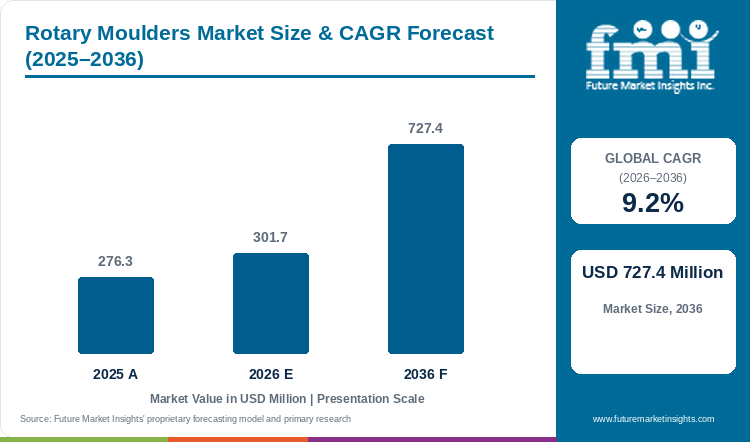
The market was valued at USD 276.3 million in 2025 and is expected to reach USD 301.7 million in 2026. It is projected to reach USD 727.4 million by 2036 at a CAGR of 9.2% from 2026 to 2036.
The rotary moulders market was valued at USD 276.3 million in 2025 and is estimated at USD 301.7 million in 2026. It is projected to reach USD 727.4 million by 2036 at a CAGR of 9.2%, while mid-capacity lines represent 43.0% of equipment type demand in 2026. German fine-bakery production fell 4.2% to approximately 701,000 tonnes in 2025, according to BDSI.[5] Against that operating backdrop, a new moulder must earn its place through more consistent piece weight, fewer damaged products or faster changeovers, as well as any increase in output. Product renewal can also bring forward replacement when a new engraved design requires forming and release performance the installed machine cannot provide without excess scrap. During a trial, buyers can compare scrap, product definition and cleaning time on their own doughs, since those measures determine usable output over a shift and routine mould changes.
Key Market Trends & Insights
- By equipment type: Mid-Capacity Lines represented 43.0% of 2026 equipment type demand. These lines lead because one forming station can serve several dies and changing runs. The test is a fine engraving, where release problems that a simple outline hides show up at once.
- By capacity: 500-2,000 kg/hr accounted for 39.0% of 2026 capacity demand. Biscuit weight and piece spacing turn belt speed into hourly mass, so the rating alone doesn't define usable output. Oven width and cooling set the real limit.
- By automation level: Fully Automatic / Robotic held 41.0% of 2026 automation level demand. Independent feed, roller and extraction settings let a bakery return to a known condition after a die change. It's tested by how soon the first biscuits meet weight and definition.
Regional Highlights
- The UAE leads the rotary moulder country outlook at 10.5% CAGR through 2036, where product definition, scrap and changeover performance will shape investment decisions.
- Saudi Arabia is projected at 10.2%, South Korea at 9.8% and the UK at 9.5%; Japan's 8.2% forecast points to a slower, though continuing, replacement cycle.
Market Size & Forecast
Table 1: Rotary Moulders Market Size and Forecast (USD million), 2025 to 2036
| Market size and forecast | Value |
|---|---|
| 2025 Value (actual) | USD 276.3 million |
| Estimated market size in 2026 | USD 301.7 million |
| Projected market size by 2036 | USD 727.4 million |
| CAGR (2026-2036) | 9.2% |
The practical opportunity depends on how cleanly a machine fills and releases its cavities at the rate the oven requires. Bühler introduced RotaMold Max Smart in May 2026 with a stated speed of up to 40 metres per minute and a 390 mm die roller.[2] Baker Perkins’ TruClean Series3 offers independent process adjustments and access for changing the die roll and extraction web.[4] Reading Bakery Systems added a third pilot line in September 2026, and its cookie capabilities include rotary moulding.[3] These offers shorten the route from a new design to production, although a published specification cannot show how the dough in a particular factory will behave. FDA manufacturing requirements add cleaning and upkeep obligations to every installation.[1] Consequently, actual demand will depend on whether a moulder holds piece weight and engraving definition across changing doughs without adding cleaning or changeover time that offsets the gain.
Rotary Moulders Market is segmented by Equipment Type, Capacity, Automation Level, End User, Sales Channel and Region. The forecast period runs from 2026 to 2036.
An engraved roll gives rotary moulding a direct relationship with biscuit design. The machine must fill its cavities consistently and release the dough without losing detail. Baker Perkins’ TruClean Series3 uses independent process adjustments and provides access for changing the die roll and extraction web.[4] That arrangement matters when a bakery returns repeatedly to several designs. A new roll can extend the assortment while retaining the machine; a new moulder becomes more attractive when the existing drive, extraction or access arrangement restricts acceptable production. Tooling revenue and machinery investment consequently respond differently to the same product-development programme.
Dough condition can change the outcome even when the forming settings remain constant. Fat condition, mixing and the properties of bakery ingredients affect how the dough fills and leaves the roll. Reading Bakery Systems’ innovation centre provides a connected setting for investigating those interactions. Its September 2026 expansion added a third pilot line for pretzels and bread snacks; the centre’s existing cookie capabilities include rotary moulding and wire cutting.[3] Testing the formed piece through baking helps distinguish a tooling problem from a formulation problem. This can narrow the capital project to the stage that actually limits the intended biscuit.
Access to the roll and extraction web affects the cost of keeping several biscuit designs in production. Bühler’s RotaMold Max Smart presentation emphasises removable hopper, die-roller and knife components.[2] Removing residue and restoring the forming setup occupy time between runs, particularly when intricate engravings or recipe changes require more attention. FDA manufacturing requirements also cover equipment condition and sanitary operations.[1] A replacement with more accessible components can reduce the work around a tooling change even if its maximum speed is no higher. This creates a separate investment case for factories whose assortment uses several dies. The benefit grows when tooling and cleaning repeatedly interrupt the hours available for biscuit production.
Table 2: Supporting Industry Indicators for the Rotary Moulders Market, 2025 to 2026 and current product specifications
| Indicator | Data point | Why it matters | Source |
|---|---|---|---|
| Downstream fine-bakery output | BDSI estimates German production at 701,000 tonnes in 2025, down 4.2%. | Replacement and product-mix projects can matter more than new volume capacity. | [5] |
| Forming speed specification | Bühler states up to 40 metres/minute for RotaMold Max Smart. | The oven and biscuit layout determine how much forming speed can be used. | [2] |
| Die-roller specification | RotaMold Max Smart uses a 390 mm die roller. | Tool geometry is part of the machine and product configuration. | [2] |
| Accessible process components | Baker Perkins describes independent adjustments and roll/web replacement access. | Returning to an established product depends on setup and component condition. | [4] |
| Application-centre expansion | RBS announced a third pilot line in September 2026. | Its wider centre supports trials across forming and baking stages. | [3] |
| Cleaning and condition | FDA CGMP requirements cover sanitary operations and equipment. | Access to the roll and extraction components affects cleaning and maintenance time. | [1] |
Demand Intensity Analysis
The rotary moulders market is forecast to generate an additional USD 425.7 million in annual revenue between 2026 and 2036, growing at a 9.2% value CAGR. BDSI’s estimated 4.2% decline in German fine-bakery production in 2025 shows the pressure on downstream volumes in that country.[5] Under such conditions, a moulder replacement needs an economic purpose beyond additional tonnage. Lower dough giveaway, fewer damaged pieces or less time between designs can provide that purpose. A new biscuit format may also require another forming capability while leaving factory output broadly unchanged. Product renewal and replacement provide sources of equipment demand alongside capacity for more biscuits.
Mid-capacity lines represent USD 129.7 million in 2026. Their appeal lies in accommodating several dies without the cost and engineering scope of a completely new high-output line. One moulder can serve different biscuit patterns when roll changes and process adjustments remain manageable. This creates an investment ladder: another engraved roll can extend the assortment, while a replacement machine becomes necessary when the drive, extraction arrangement or access limits the new design. Tooling expenditure and equipment orders therefore respond differently to product development. The machine market benefits when a factory’s range has outgrown the capabilities of its forming station.
Industrial bakeries account for USD 126.7 million in 2026. Repeated piece-weight variation has a direct material cost, while poor release can send damaged dough towards the oven. Engraving and extraction consequently affect the economics of a long run at every cycle. Faster forming has little value if it increases either loss. Adjustable roller and belt conditions, such as those described by Baker Perkins, help accommodate the relationship between dough and tooling.[4] RBS’s connected pilot capabilities provide a way to examine that relationship through baking.[3] The equipment opportunity centres on more dependable conversion of each dough batch into the intended biscuit.
Direct OEM sales represent USD 178.0 million in 2026, reflecting the coordination of rolls, feeds, extraction surfaces and controls. Manufacturer involvement can also help distinguish a need for new tooling from a need for a new machine. Factories also install capacity and renew forming stages that no longer suit their products. Continued access to rolls and wear components protects that investment. A moulder’s commercial life depends partly on whether it can keep serving future designs, making tooling compatibility and application knowledge enduring sources of supplier differentiation. Long-term sales are ultimately determined by whether the installed moulder keeps filling and releasing each new engraving before a replacement becomes necessary.
Table 3: Demand Intensity Metrics for the Rotary Moulders Market, 2026 to 2036 with relevant industry comparisons
| Demand intensity metric | Value | Basis |
|---|---|---|
| Rotary moulders value CAGR | 9.2% | Global market value growth, 2026 to 2036. |
| German fine-bakery production change | −4.2% | BDSI estimate for 2025; wider downstream bakery category.[5] |
| Documented forming speed | Up to 40 metres/minute | Bühler RotaMold Max Smart manufacturer specification, May 2026.[2] |
| Mid-capacity-line revenue, 2026 | USD 129.7 million | Equipment Type category. |
| Industrial-bakery revenue, 2026 | USD 126.7 million | End User category. |
| Direct OEM sales revenue, 2026 | USD 178.0 million | Sales Channel category. |
| Added revenue through 2036 | USD 425.7 million | Increase in market revenue from 2026 to 2036. |
Analyst Perspective
A rotary moulder earns a lasting place when it fills and releases each engraved design cleanly without disrupting the production schedule. Suppliers that keep tooling and extraction consistent across designs retain the line, while a machine that cannot release the next engraving loses it.
- Nandini Roy Choudhury, Principal Analyst at Future Market Insights
How is the rotary moulders market segmented?
The rotary moulders market is segmented by Equipment Type (Mid-capacity lines, Compact / entry systems, High-capacity industrial lines), Capacity (500-2,000 kg/hr, Below 500 kg/hr, Above 2,000 kg/hr), Automation Level (Fully automatic / robotic, Semi-automatic, Manual), End User (Industrial bakeries, In-store & retail bakeries, Artisan bakeries, Foodservice / QSR central kitchens), and Sales Channel (Direct OEM sales, Dealers & distributors, Aftermarket & refurbished). Regionally, the market is segmented into North America, Latin America, Western Europe, Eastern Europe, East Asia, South Asia and Pacific, and Middle East and Africa.
Why are Mid-capacity lines the anchor of Equipment Type demand?
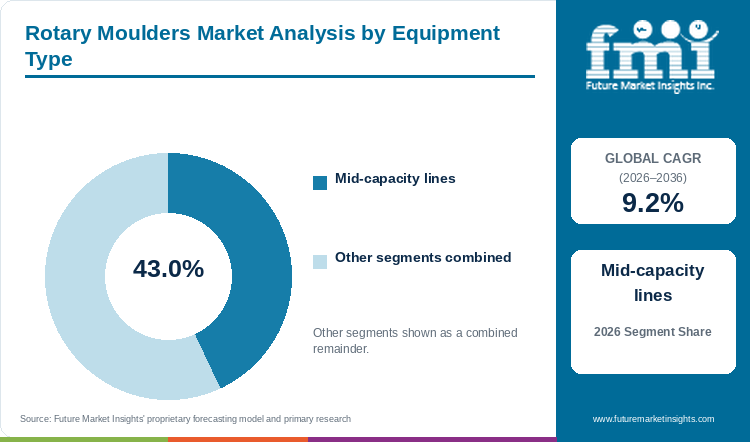
Mid-capacity lines lead with 43.0% of Equipment Type revenue in 2026.
A mid-capacity moulder serves several biscuit designs on one forming station without a commitment to a high-capacity line. The flexibility is physical: exchangeable rolls, an adjustable extraction arrangement and room to handle the tooling. Fine engraving is harder to release than a simple outline, so a new design can expose limits that the existing range hid.
- Mid-capacity lines hold 43.0% of Equipment Type; roll changes and adjustment range support their use across several biscuit designs.
- The trial needs to include the finest engraving, because release problems can stay hidden with a simple biscuit shape.
What gives 500-2,000 kg/hr its lead in the Capacity category?
500-2,000 kg/hr leads with 39.0% of Capacity revenue in 2026.
Biscuit weight and spacing translate belt movement into an hourly mass rate, and oven width and baking time then limit how much formed dough the line can receive. Within a dough processing system, the 500-2,000 kg/hr band therefore covers several combinations of product and layout. Increasing forming speed alone does little where cooling or packaging already sets output.
- The 500-2,000 kg/hr band leads Capacity at 39.0%, with piece weight and the oven layout governing the output available for each biscuit.
- The line needs to be sized around oven width, piece spacing and the cooling route, not the moulder’s rated speed.
How does Fully automatic / robotic equipment reshape Automation Level demand?
Fully automatic / robotic leads with 41.0% of Automation Level revenue in 2026.
Independent controls for feed, roller and extraction speeds let a bakery return to an established combination when it changes dies. That reduces the adjustment needed to recover piece weight and definition. Dough condition can still move outside the working range, so controls complement formulation discipline rather than remove it. The category does not require a robotic arm at the forming roll.
- Fully automatic / robotic represents 41.0% of Automation Level in 2026, with independent settings helping reproduce feed and extraction conditions.
- The settings need to recover the same piece weight and definition after a die is replaced.
Why do Industrial bakeries predominate in End User demand?
Industrial bakeries hold 42.0% of End User revenue in 2026.
Industrial biscuit production spreads small forming losses across a large number of pieces. Excess dough in each cavity raises ingredient use, and inconsistent dimensions complicate stacking and packaging. Long operating hours also expose wear in the extraction web and roll components, which creates demand for replacement parts and technical support.
- Industrial bakeries account for 42.0% of End User in 2026, where continuous runs make piece-weight variation and interrupted release visible in yield.
- Fresh dough batches need to feed consistently if piece weight is to remain stable.
Why does Direct OEM sales lead the Sales Channel category?
Direct OEM sales hold 59.0% of Sales Channel revenue in 2026.
A rotary moulder connects a specific die-roll dimension to a feeder, an oven width and a control system. These interfaces encourage direct engineering discussion with the manufacturer, and acceptance can then use the intended die and extraction arrangement. Dealers provide a local route for installation and parts support, while refurbished units raise questions about control compatibility, hygiene work and roll availability.
- Direct OEM sales represents 59.0% of Sales Channel in 2026, covering detailed coordination of tooling, controls and the installed line.
- The acceptance run needs to use the intended die and extraction arrangement on the installed line.
What are the drivers, restraints and opportunities in the rotary moulders market?
Distinctive biscuit designs support repeat tooling and machine investment
An engraved roll connects product identity with machinery investment. A distinctive surface has to fill correctly, leave the cavity and keep its definition through baking. Baker Perkins’ Series3 provides independent process adjustments and access for changing the roll and extraction web,[4] so one machine can serve more than one design over its life. A supplier gains the order where a new engraving needs more release control than the installed moulder can give.
Recipe sensitivity can prevent higher speed from improving output
Short dough has to hold an engraving without remaining attached to it. Fat condition, flour properties and mixing decide that balance, so a speed increase can raise rejects instead of useful output. FDA manufacturing requirements place equipment condition and sanitation within routine factory responsibilities.[1] A supplier gains where serviceable components and open access keep the machine inside its recipe window for years.
More accessible trials can shorten qualification of new biscuit formats
Application facilities reduce uncertainty around a biscuit that is new to the factory. Reading Bakery Systems added a third pilot line in September 2026, and its existing cookie capabilities include rotary moulding and wire cutting.[3] Examining forming and baking together shows whether a difficulty comes from dough, engraving or release. A supplier gains where a trial narrows the purchase to the roll, the feed or the whole machine before capital is committed.
Which country CAGRs are profiled in the rotary moulders market?
Table 4: Country growth outlook for the rotary moulders market
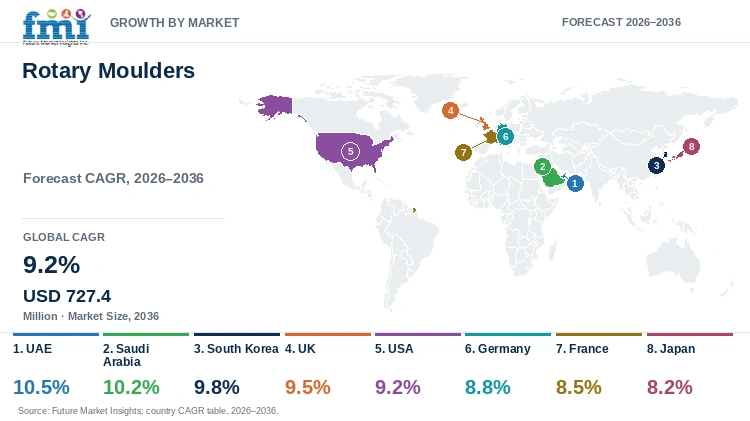
| Country | CAGR, 2026 to 2036 |
|---|---|
| UAE | 10.5% |
| Saudi Arabia | 10.2% |
| South Korea | 9.8% |
| UK | 9.5% |
| USA | 9.2% |
| Germany | 8.8% |
| France | 8.5% |
| Japan | 8.2% |
UAE
The UAE has the highest profiled CAGR at 10.5% for 2026 to 2036, above the global rate of 9.2%. The Ministry of Industry and Advanced Technology reported that industrial exports reached AED 197 billion in 2024, 68.0% above 2021. The figure covers all manufacturing, so it shows industrial momentum rather than demand for biscuit forming equipment. New biscuit installations create an initial requirement for a moulder and a set of commercial designs, followed by opportunities to add tooling as the assortment develops. However, the first die pattern also affects oven-band loading and later product handling, so adjustment range and tooling access decide how long the original machine stays useful. Demand will depend on how many new factories plan for several formats from the start.
Saudi Arabia
Saudi Arabia is forecast at 10.2% CAGR over 2026 to 2036, above the global rate of 9.2%. The Ministry of Industry and Mineral Resources reported 1,660 new industrial licences in 2025, with 1,201 factories entering production. The count covers all manufacturing, not biscuit forming, so it indicates the pace of new plant rather than demand for moulders. Rolls and extraction webs create a continuing supply requirement after a moulder reaches a Saudi factory, and their availability decides whether an established biscuit stays in production when wear occurs. New-line orders bring an initial engineering opportunity, while replacement projects have to fit a shutdown of the connected oven. Demand will depend on how many new plants secure local access to rolls and webs.
South Korea
South Korea’s outlook is 9.8% CAGR from 2026 to 2036, above the global rate of 9.2%. Korea Customs Service data showed snack and confectionery exports above USD 700 million for the first time in January to November 2024, up 16.5%. Export growth supports product development but does not show how many producers will buy forming equipment. A new embossed design can change release conditions without changing the rest of a Korean biscuit line, and fine detail places particular demands on the move from die to belt. Another roll can extend the range if the existing machine has enough adjustment, while unstable extraction may call for a larger investment. Demand will depend on how many producers can add designs through tooling alone.
UK
The UK market is projected at 9.5% CAGR through 2036, slightly above the global rate of 9.2%. The Office for National Statistics’ output price index for rusks, biscuits, preserved pastry goods and cakes stood at 124.2 in September 2026, 2.1% above a year earlier. Modest price growth leaves producers little room to recover equipment cost through selling prices, though the index does not measure capital spending and covers cakes as well as biscuits. In an upgrade, compatibility with the current roll inventory can preserve value beyond the machine being replaced. Changing roll dimensions or extraction arrangements may add tooling expenditure and alter the installation scope. Demand will depend on how many factories can keep their roll inventory in service.
USA
The USA is forecast at 9.2% CAGR between 2026 and 2036, in line with the global rate. The Bureau of Labor Statistics’ producer price index for cookie and cracker manufacturing rose 0.7% in the twelve months to August 2026. Nearly flat output prices leave a project to earn its return from yield and uptime, although the index says nothing about capital budgets. Reading Bakery Systems’ US pilot facilities connect rotary-moulded cookie development with baking, giving prospective projects access to application work before the production layout is fixed.[3] The installed machine then has to support routine cleaning and upkeep under the FDA’s manufacturing framework.[1] Demand will depend on whether trials turn into projects that hold their return over the equipment’s working life.
Germany
Germany is projected at 8.8% CAGR through 2036, below the global rate of 9.2%. BDSI estimates that German fine-bakery production fell 4.2% in 2025.[5] The figure describes output, not equipment spending, but a weak volume background places greater weight on the replacement case than on added forming capacity. Lower piece-weight variation, fewer release losses and easier die changes can support investment at a stable factory output. Product renewal remains another source of demand when a new engraving requires more control than the installed moulder can provide. However, a replacement has to repay itself through yield, since extra tonnage cannot carry it. Demand will depend on how many producers can show a saving at flat output.
France
France is forecast at 8.5% CAGR over 2026 to 2036, below the global rate of 9.2%. INSEE reported that food prices rose 1.2% on average in 2025. Slow price growth leaves little room to pass ingredient cost into the shelf price, which keeps attention on dough yield, although the index says nothing about equipment budgets. For a producer using butter-rich dough, the condition of the fat and the holding interval affect how the mixture fills and leaves an engraved roll. A familiar design can therefore behave differently as the dough changes, and equipment with accessible adjustments has value where several such recipes share a forming station. Demand will depend on how many producers run enough recipes through one station to use that flexibility.
Japan
Japan is projected at 8.2% CAGR for 2026 to 2036, the lowest profiled rate and below the global rate of 9.2%. The Statistics Bureau’s consumer price index put biscuit prices 5.8% above a year earlier in February 2026. Rising prices suggest firmer input costs, which raise the value of each gram of dough saved, although the index does not show how many producers will replace forming equipment. An established die inventory can influence the choice of a replacement moulder, because compatible roll dimensions preserve several designs while a different extraction arrangement may change release settings. The new machine also has to transfer those shapes to existing bakery processing equipment. Demand will depend on how many producers can protect their engraved rolls through a replacement.
Who are the notable companies in the rotary moulders market?
Bühler; Baker Perkins; Reading Bakery Systems; AMF Bakery Systems; Polin
Bühler, Baker Perkins, Reading Bakery Systems, AMF and Polin offer rotary-moulding technologies with different arrangements for adjustment, tooling access and extraction. Competition begins with the interaction of dough and engraved roll. The supplier’s wider line experience also matters when a forming issue emerges only during baking or transfer, because the remedy may lie outside the moulder itself.
A moulder establishes a long-lived tooling relationship. New designs, replacement rolls and extraction components continue to connect the bakery with its supplier after commissioning. Application knowledge can extend the range served by an installed machine or identify when its limits justify replacement. That recurring relationship gives service and tooling compatibility a commercial role beyond the initial equipment order.
Competitive Benchmarking: Rotary Moulders Market
Table 5: Company capabilities in the rotary moulders market
| Company | Relevant offer | Commercial capability |
|---|---|---|
| Bühler | RotaMold rotary moulders | Biscuit forming with removable service components |
| Baker Perkins | TruClean Series3 rotary moulder | Independent process adjustment and accessible tooling |
| Reading Bakery Systems | Thomas L. Green rotary moulders | Forming equipment and product-development trials |
| AMF Bakery Systems | Biscuit rotary moulder | Forming equipment for industrial bakery lines |
| Polin | Rotary moulders for soft biscuits | Independent roller drives and adjustable forming controls |
Key Developments in the Rotary Moulders Market
- Bühler introduced RotaMold Max Smart in May 2026. Its removable hopper, die roller and knife components provide access for cleaning and maintenance in biscuit production.[2]
- Reading Bakery Systems announced a third pilot production line in September 2026. The expanded centre retains rotary-moulded and wirecut cookie capabilities and reduces competition for trial time among its snack processes.[3]
Key Players in the Rotary Moulders Market
- Bühler
- Baker Perkins
- Reading Bakery Systems
- AMF Bakery Systems
- Polin
Rotary Moulders Market - Report Scope
Table 6: Report scope for the rotary moulders market
| Coverage field | Report scope |
|---|---|
| Market breakdown | Equipment Type; Capacity; Automation Level; End User; Sales Channel |
| Quantitative Units | USD Million |
| Market Definition | Revenue from rotary moulders sold for dough forming within the defined equipment, capacity, automation, user and channel categories. Where sold in a bundled line, only the attributable rotary moulder value is included. Finished biscuits, ovens, mixers, spare parts sold separately, standalone service contracts and unrelated bread-shaping or pastry machines are excluded; refurbished equipment is considered only when a rotary moulder is sold. |
| Regions Covered | North America; Latin America; Western Europe; Eastern Europe; East Asia; South Asia and Pacific; Middle East and Africa |
| Countries Covered | UAE; Saudi Arabia; South Korea; UK; USA; Germany; France; Japan |
| Key Companies Profiled | Bühler; Baker Perkins; Reading Bakery Systems; AMF Bakery Systems; Polin |
| Forecast Period | 2026 to 2036 |
| Approach | Market assessment supported by official technical and regulatory publications, company product information and country operating conditions. |
Rotary Moulders Market - Research Methodology
Table 7: Research approach for the rotary moulders market
| Method | Approach |
|---|---|
| Market coverage | The assessment follows the equipment sold, its bakery application and the revenue boundaries stated in the market definition. |
| Secondary evidence | Government and technical publications are considered alongside first-party product information and dated corporate announcements. |
| Commercial analysis | Purchasing requirements, operating constraints, service needs and country-specific routes to market inform the interpretation of demand. |
| Forecast presentation | Global values, leading segment shares and country growth rates are stated for the 2026 to 2036 forecast period. |
Rotary Moulders Market by Segments
Equipment Type
- Mid-capacity lines
- Compact / entry systems
- High-capacity industrial lines
Capacity
- 500-2,000 kg/hr
- Below 500 kg/hr
- Above 2,000 kg/hr
Automation Level
- Fully automatic / robotic
- Semi-automatic
- Manual
End User
- Industrial bakeries
- In-store & retail bakeries
- Artisan bakeries
- Foodservice / QSR central kitchens
Sales Channel
- Direct OEM sales
- Dealers & distributors
- Aftermarket & refurbished
Rotary Moulders Market by Region
- North America
- United States
- Canada
- Latin America
- Brazil
- Mexico
- Argentina
- Chile
- Western Europe
- Germany
- France
- United Kingdom
- Italy
- Spain
- Benelux
- Nordics
- Eastern Europe
- Poland
- Czech Republic
- Romania
- Hungary
- East Asia
- China
- Japan
- South Korea
- South Asia and Pacific
- India
- ASEAN
- Australia and New Zealand
- Middle East and Africa
- GCC Countries
- South Africa
- Türkiye
- Israel
Research Sources and Bibliography
- [1] U.S. Food and Drug Administration. (n.d.). Current Good Manufacturing Practices (CGMPs) for Food and Dietary Supplements.
- [2] Bühler Group. (2026, May 7). Bühler launches innovations and releases major upgrades to its Grains & Food portfolio.
- [3] Reading Bakery Systems. (2026, September 17). Reading Bakery Systems adds third pilot production line to meet growing customer demand.
- [4] Baker Perkins. (n.d.). TruClean Series3 Rotary Moulder.
- [5] Bundesverband der Deutschen Süßwarenindustrie. (2026, January 28). Arbeitsplätze in der Süßwarenindustrie in Gefahr.
This Report Answers
- How large is the rotary moulders market in 2026 and what value is forecast for 2036?
- Which industrial production pressures sustain demand for rotary biscuit forming equipment?
- Why do Mid-capacity lines lead rotary moulder Equipment Type?
- Why is 500-2,000 kg/hr the largest Capacity category?
- How do rotary moulder CAGRs compare across the eight profiled countries?
- Which profiled companies document biscuit rotary moulders and which offer adjacent systems?
Frequently Asked Questions
How big is the rotary moulders market in 2026, and what is forecast for 2036?
The rotary moulders market is valued at USD 301.7 Million in 2026 and is forecast at USD 727.4 Million by 2036.
What is the rotary moulders market CAGR from 2026 to 2036?
The market is forecast to expand at a 9.2% CAGR from 2026 to 2036.
Which Equipment Type leads the rotary moulders market?
Mid-capacity lines lead with 43.0% of Equipment Type in 2026. They can accommodate several biscuit designs through roll changes and adjustable forming conditions.
Which Capacity segment holds the largest position in rotary moulders?
The 500-2,000 kg/hr segment leads with 39.0% of Capacity in 2026. It can meet continuous production requirements without demanding the infrastructure of the highest-output lines.
Which profiled countries have the fastest rotary moulders market growth?
The UAE at 10.5% and Saudi Arabia at 10.2% have the highest projected CAGRs from 2026 to 2036.
Which companies participate in the rotary moulders market?
Relevant participants include Bühler, Baker Perkins, Reading Bakery Systems, AMF Bakery Systems and Polin.
Preview the report firsthand - request a free sample
Get SampleGet the brochure for pricing and purchase details.
Get PDFTable of Content
- Key Takeaways
- Market Size and CAGR
- Top Growth Driver
- Fastest Growing Segment
- Leading Region
- Key Companies
- Emerging Opportunities
- Executive Summary
- Global Market Outlook
- Demand-side Trends
- Supply-side Trends
- Technology Roadmap Analysis
- Analysis and Recommendations
- Analyst Perspective (What is happening? Why now? What should investors know?)
- Key Questions Answered
- How large is the market?
- What is the CAGR?
- What are key trends?
- Which region dominates?
- Who are the leaders?
- Market Overview
- Market Coverage / Taxonomy
- Market Definition / Scope / Limitations
- Research Methodology
- Chapter Orientation
- Analytical Lens and Working Hypotheses
- Market Structure, Signals, and Trend Drivers
- Benchmarking and Cross-market Comparability
- Market Sizing, Forecasting, and Opportunity Mapping
- Research Design and Evidence Framework
- Desk Research Programme (Secondary Evidence)
- Expert Input and Fieldwork (Primary Evidence)
- Tooling, Models, and Reference Databases
- Data Engineering and Model Build
- Quality Assurance and Audit Trail
- Market Background
- Market Dynamics (Drivers, Restraints, Opportunity, Trends)
- Scenario Forecast (Optimistic, Likely, Conservative)
- Impact Analysis
- AI Impact
- Sustainability Impact
- Regulatory Impact
- Technology Impact
- Consumer / Buyer Analysis
- Purchase Drivers
- Adoption Barriers
- Buyer Journey
- Opportunity Map Analysis
- Product Life Cycle Analysis
- Supply Chain Analysis
- Investment Feasibility Matrix
- Value Chain Analysis
- PESTLE and Porter's Analysis
- Regulatory Landscape
- Regional Parent Market Outlook
- Production and Consumption Statistics
- Import and Export Statistics
- Global Market Analysis and Forecast, 2021 to 2036
- Historical Market Size Value (USD Million) Analysis, 2021 to 2025
- Current and Future Market Size Value (USD Million) Projections, 2026 to 2036
- Y-o-Y Growth Trend Analysis
- Absolute $ Opportunity Analysis
- Global Market Pricing Analysis, 2021 to 2036
- Global Market Analysis and Forecast, By Equipment Type, 2021 to 2036
- Introduction / Key Findings
- Historical Market Size Value (USD Million) Analysis By Equipment Type, 2021 to 2025
- Current and Future Market Size Value (USD Million) Analysis and Forecast By Equipment Type, 2026 to 2036
- Mid-capacity lines
- Compact / entry systems
- High-capacity industrial lines
- Y-o-Y Growth Trend Analysis By Equipment Type, 2021 to 2025
- Absolute $ Opportunity Analysis By Equipment Type, 2026 to 2036
- Global Market Analysis and Forecast, By Capacity, 2021 to 2036
- Introduction / Key Findings
- Historical Market Size Value (USD Million) Analysis By Capacity, 2021 to 2025
- Current and Future Market Size Value (USD Million) Analysis and Forecast By Capacity, 2026 to 2036
- 500-2,000 kg/hr
- Below 500 kg/hr
- Above 2,000 kg/hr
- Y-o-Y Growth Trend Analysis By Capacity, 2021 to 2025
- Absolute $ Opportunity Analysis By Capacity, 2026 to 2036
- Global Market Analysis and Forecast, By Automation Level, 2021 to 2036
- Introduction / Key Findings
- Historical Market Size Value (USD Million) Analysis By Automation Level, 2021 to 2025
- Current and Future Market Size Value (USD Million) Analysis and Forecast By Automation Level, 2026 to 2036
- Fully automatic / robotic
- Semi-automatic
- Manual
- Y-o-Y Growth Trend Analysis By Automation Level, 2021 to 2025
- Absolute $ Opportunity Analysis By Automation Level, 2026 to 2036
- Global Market Analysis and Forecast, By End User, 2021 to 2036
- Introduction / Key Findings
- Historical Market Size Value (USD Million) Analysis By End User, 2021 to 2025
- Current and Future Market Size Value (USD Million) Analysis and Forecast By End User, 2026 to 2036
- Industrial bakeries
- In-store & retail bakeries
- Artisan bakeries
- Foodservice / QSR central kitchens
- Y-o-Y Growth Trend Analysis By End User, 2021 to 2025
- Absolute $ Opportunity Analysis By End User, 2026 to 2036
- Global Market Analysis and Forecast, By Sales Channel, 2021 to 2036
- Introduction / Key Findings
- Historical Market Size Value (USD Million) Analysis By Sales Channel, 2021 to 2025
- Current and Future Market Size Value (USD Million) Analysis and Forecast By Sales Channel, 2026 to 2036
- Direct OEM sales
- Dealers & distributors
- Aftermarket & refurbished
- Y-o-Y Growth Trend Analysis By Sales Channel, 2021 to 2025
- Absolute $ Opportunity Analysis By Sales Channel, 2026 to 2036
- Global Market Analysis and Forecast, By Region, 2021 to 2036
- Introduction
- Historical Market Size Value (USD Million) Analysis By Region, 2021 to 2025
- Current Market Size Value (USD Million) Analysis and Forecast By Region, 2026 to 2036
- North America
- Latin America
- Western Europe
- Eastern Europe
- East Asia
- South Asia and Pacific
- Middle East and Africa
- Market Attractiveness Analysis By Region
- North America Market Analysis and Forecast, By Country, 2021 to 2036
- Historical Market Size Value (USD Million) Trend Analysis By Market Taxonomy, 2021 to 2025
- Market Size Value (USD Million) Forecast By Market Taxonomy, 2026 to 2036
- By Country
- United States
- Canada
- By Equipment Type
- By Capacity
- By Automation Level
- By End User
- By Sales Channel
- By Country
- Market Attractiveness Analysis
- By Country
- By Equipment Type
- By Capacity
- By Automation Level
- By End User
- By Sales Channel
- Key Takeaways
- Latin America Market Analysis and Forecast, By Country
- Historical Market Size Value (USD Million) Trend Analysis By Market Taxonomy, 2021 to 2025
- Market Size Value (USD Million) Forecast By Market Taxonomy, 2026 to 2036
- By Country
- Brazil
- Mexico
- Argentina
- Chile
- By Equipment Type
- By Capacity
- By Automation Level
- By End User
- By Sales Channel
- By Country
- Market Attractiveness Analysis
- By Country
- By Equipment Type
- By Capacity
- By Automation Level
- By End User
- By Sales Channel
- Key Takeaways
- Western Europe Market Analysis and Forecast, By Country
- Historical Market Size Value (USD Million) Trend Analysis By Market Taxonomy, 2021 to 2025
- Market Size Value (USD Million) Forecast By Market Taxonomy, 2026 to 2036
- By Country
- Germany
- France
- United Kingdom
- Italy
- Spain
- Benelux
- Nordics
- By Equipment Type
- By Capacity
- By Automation Level
- By End User
- By Sales Channel
- By Country
- Market Attractiveness Analysis
- By Country
- By Equipment Type
- By Capacity
- By Automation Level
- By End User
- By Sales Channel
- Key Takeaways
- Eastern Europe Market Analysis and Forecast, By Country
- Historical Market Size Value (USD Million) Trend Analysis By Market Taxonomy, 2021 to 2025
- Market Size Value (USD Million) Forecast By Market Taxonomy, 2026 to 2036
- By Country
- Poland
- Czech Republic
- Romania
- Hungary
- By Equipment Type
- By Capacity
- By Automation Level
- By End User
- By Sales Channel
- By Country
- Market Attractiveness Analysis
- By Country
- By Equipment Type
- By Capacity
- By Automation Level
- By End User
- By Sales Channel
- Key Takeaways
- East Asia Market Analysis and Forecast, By Country
- Historical Market Size Value (USD Million) Trend Analysis By Market Taxonomy, 2021 to 2025
- Market Size Value (USD Million) Forecast By Market Taxonomy, 2026 to 2036
- By Country
- China
- Japan
- South Korea
- By Equipment Type
- By Capacity
- By Automation Level
- By End User
- By Sales Channel
- By Country
- Market Attractiveness Analysis
- By Country
- By Equipment Type
- By Capacity
- By Automation Level
- By End User
- By Sales Channel
- Key Takeaways
- South Asia and Pacific Market Analysis and Forecast, By Country
- Historical Market Size Value (USD Million) Trend Analysis By Market Taxonomy, 2021 to 2025
- Market Size Value (USD Million) Forecast By Market Taxonomy, 2026 to 2036
- By Country
- India
- ASEAN
- Australia and New Zealand
- By Equipment Type
- By Capacity
- By Automation Level
- By End User
- By Sales Channel
- By Country
- Market Attractiveness Analysis
- By Country
- By Equipment Type
- By Capacity
- By Automation Level
- By End User
- By Sales Channel
- Key Takeaways
- Middle East and Africa Market Analysis and Forecast, By Country
- Historical Market Size Value (USD Million) Trend Analysis By Market Taxonomy, 2021 to 2025
- Market Size Value (USD Million) Forecast By Market Taxonomy, 2026 to 2036
- By Country
- GCC Countries
- South Africa
- Türkiye
- Israel
- By Equipment Type
- By Capacity
- By Automation Level
- By End User
- By Sales Channel
- By Country
- Market Attractiveness Analysis
- By Country
- By Equipment Type
- By Capacity
- By Automation Level
- By End User
- By Sales Channel
- Key Takeaways
- Key Countries Market Analysis
- United States
- Pricing Analysis
- Market Share Analysis, 2025
- By Equipment Type
- By Capacity
- By Automation Level
- By End User
- By Sales Channel
- Canada
- Pricing Analysis
- Market Share Analysis, 2025
- By Equipment Type
- By Capacity
- By Automation Level
- By End User
- By Sales Channel
- Mexico
- Pricing Analysis
- Market Share Analysis, 2025
- By Equipment Type
- By Capacity
- By Automation Level
- By End User
- By Sales Channel
- Brazil
- Pricing Analysis
- Market Share Analysis, 2025
- By Equipment Type
- By Capacity
- By Automation Level
- By End User
- By Sales Channel
- Chile
- Pricing Analysis
- Market Share Analysis, 2025
- By Equipment Type
- By Capacity
- By Automation Level
- By End User
- By Sales Channel
- Germany
- Pricing Analysis
- Market Share Analysis, 2025
- By Equipment Type
- By Capacity
- By Automation Level
- By End User
- By Sales Channel
- United Kingdom
- Pricing Analysis
- Market Share Analysis, 2025
- By Equipment Type
- By Capacity
- By Automation Level
- By End User
- By Sales Channel
- Italy
- Pricing Analysis
- Market Share Analysis, 2025
- By Equipment Type
- By Capacity
- By Automation Level
- By End User
- By Sales Channel
- Spain
- Pricing Analysis
- Market Share Analysis, 2025
- By Equipment Type
- By Capacity
- By Automation Level
- By End User
- By Sales Channel
- France
- Pricing Analysis
- Market Share Analysis, 2025
- By Equipment Type
- By Capacity
- By Automation Level
- By End User
- By Sales Channel
- India
- Pricing Analysis
- Market Share Analysis, 2025
- By Equipment Type
- By Capacity
- By Automation Level
- By End User
- By Sales Channel
- ASEAN
- Pricing Analysis
- Market Share Analysis, 2025
- By Equipment Type
- By Capacity
- By Automation Level
- By End User
- By Sales Channel
- Australia and New Zealand
- Pricing Analysis
- Market Share Analysis, 2025
- By Equipment Type
- By Capacity
- By Automation Level
- By End User
- By Sales Channel
- China
- Pricing Analysis
- Market Share Analysis, 2025
- By Equipment Type
- By Capacity
- By Automation Level
- By End User
- By Sales Channel
- Japan
- Pricing Analysis
- Market Share Analysis, 2025
- By Equipment Type
- By Capacity
- By Automation Level
- By End User
- By Sales Channel
- South Korea
- Pricing Analysis
- Market Share Analysis, 2025
- By Equipment Type
- By Capacity
- By Automation Level
- By End User
- By Sales Channel
- Poland
- Pricing Analysis
- Market Share Analysis, 2025
- By Equipment Type
- By Capacity
- By Automation Level
- By End User
- By Sales Channel
- Hungary
- Pricing Analysis
- Market Share Analysis, 2025
- By Equipment Type
- By Capacity
- By Automation Level
- By End User
- By Sales Channel
- Türkiye
- Pricing Analysis
- Market Share Analysis, 2025
- By Equipment Type
- By Capacity
- By Automation Level
- By End User
- By Sales Channel
- South Africa
- Pricing Analysis
- Market Share Analysis, 2025
- By Equipment Type
- By Capacity
- By Automation Level
- By End User
- By Sales Channel
- UAE
- Pricing Analysis
- Market Share Analysis, 2025
- By Equipment Type
- By Capacity
- By Automation Level
- By End User
- By Sales Channel
- Saudi Arabia
- Pricing Analysis
- Market Share Analysis, 2025
- By Equipment Type
- By Capacity
- By Automation Level
- By End User
- By Sales Channel
- United States
- Market Structure Analysis
- Competition Dashboard
- Competition Benchmarking
- Market Share Analysis of Top Players
- By Regional
- By Equipment Type
- By Capacity
- By Automation Level
- By End User
- By Sales Channel
- Emerging Startups
- Innovation Benchmarking
- Competition Analysis
- Competition Deep Dive
- Bühler
- Overview
- Product Portfolio
- Profitability by Market Segments
- Sales Footprint
- Strategy Overview
- Marketing Strategy
- Product Strategy
- Channel Strategy
- Baker Perkins
- Reading Bakery Systems
- AMF Bakery Systems
- Polin
- Bühler
- Case Studies
- Success Stories
- Recent Developments
- Competition Deep Dive
- Assumptions & Acronyms Used


