

- Industry Size (2026)
- USD 120.0 Mn
- Forecast (2036)
- USD 186.0 Mn
- CAGR (2026 to 2036)
- 4.5%
Run-Flat Support Ring Retrofits Market Forecast and Outlook 2026 to 2036
The run-flat support ring retrofits market is likely to be valued at USD 120.0 million in 2026, and reach USD 186.0 million by 2036, at 4.5% CAGR. Value behavior reflects mobility assurance economics rather than comfort or convenience enhancement. Demand concentrates in operating environments where roadside immobilization creates safety, security, or mission risk. Adoption aligns with vehicles exposed to puncture threats, debris-prone routes, or limited service infrastructure. Support rings capture value by enabling controlled zero-pressure operation without reliance on sealants or immediate tire replacement. Procurement emphasis centers on load-bearing reliability, thermal tolerance, and dimensional compatibility, as improper fit directly compromises handling stability and tire integrity during deflated operation.
Expansion remains structurally bounded by installation complexity and use-case specificity. Retrofit deployment requires specialized equipment, trained technicians, and longer service times, limiting scalability through general service networks. Added unsprung mass and altered ride characteristics constrain adoption in comfort-sensitive passenger vehicles. Heat buildup during extended run-flat operation accelerates material fatigue, reinforcing replacement-led demand rather than long service life cycles. Regulatory acceptance and insurance treatment vary across regions for modified wheel assemblies, reducing uniform adoption potential. Cost thresholds restrict uptake to security-focused fleets and high-risk operations. Volume growth tracks exposure to puncture risk, fleet safety protocols, and downtime avoidance priorities rather than penetration of factory-fitted run-flat tire systems.
Quick Stats for Run-Flat Support Ring Retrofits Market
- Run-Flat Support Ring Retrofits Market Value (2026): USD 120.0 million
- Run-Flat Support Ring Retrofits Market Forecast Value (2036): USD 186.0 million
- Run-Flat Support Ring Retrofits Market Forecast CAGR 2026 to 2036: 4.5%
- Leading Product Type by Demand Share: Support Ring Inserts
- Fastest-Growing Countries: India, UAE, Saudi Arabia, South Africa, Brazil
- Top Players in Global Demand: Hutchinson, Tyron Runflat, Run Flat International, Michelin, Bridgestone
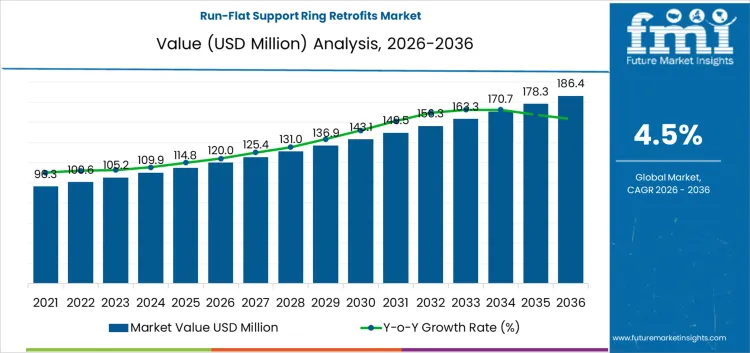
Run-Flat Support Ring Retrofits Market Key Takeaways
| Metric | Value |
|---|---|
| Market Value (2026) | USD 120.0 million |
| Market Forecast Value (2036) | USD 186.0 million |
| Forecast CAGR (2026-2036) | 4.5% |
Why is the Demand for Run-Flat Support Ring Retrofits Growing?
Demand for run-flat support ring retrofits is increasing as drivers and fleet operators seek enhanced mobility and safety on vehicles equipped with run-flat capable tires but lacking original equipment reinforcement features. Support rings provide internal structural backing for tires when air pressure is lost, allowing continued travel at controlled speeds to reach a safe stop without immediate roadside intervention. This capability reduces risk of immobilization in high-traffic, remote, or hazardous conditions where rapid tire service is impractical.
Fleet maintenance planners specify retrofit support rings that match the internal diameter and load rating of existing wheels and tire assemblies because precise fit is essential for balanced performance and prevention of sidewall collapse during zero-pressure operation. Procurement decisions emphasize ring material strength, corrosion resistance, and compatibility with wheel specifications to maintain long-term reliability under repeated load cycles.
Growth in urban delivery fleets, rideshare services, and commercial vehicle use on mixed surfaces reinforces uptake of run-flat support ring retrofits that enhance operational continuity and reduce downtime associated with puncture events. Aftermarket demand is supported by availability of retrofit kits tailored to popular wheel sizes and load ratings, enabling service centers to expand run-flat capability without full wheel replacement. Operators value retrofit solutions that maintain handling characteristics, support emergency mileage objectives, and integrate with tire pressure monitoring systems for real-time status feedback. These vehicle safety and operational continuity requirements are contributing to sustained demand growth in the run-flat support ring retrofits market.
How Are the Segments Classified in the Run-Flat Support Ring Retrofits Market?
Demand for run-flat support ring retrofits is shaped by mobility assurance requirements, vehicle safety mandates, and operational continuity expectations under tire failure conditions. Vehicle operators require solutions that maintain control and limited driving capability after air loss events. Adoption aligns with security-focused transportation, premium vehicle usage, and fleet operations requiring uninterrupted movement. Product selection prioritizes load-bearing capacity, compatibility with wheel assemblies, and installation feasibility. Segment classification reflects differentiation by retrofit configuration, operational end use, and material composition influencing performance reliability, retrofit complexity, and service lifecycle expectations.
Which Product Type Represents the Largest Share of Demand?
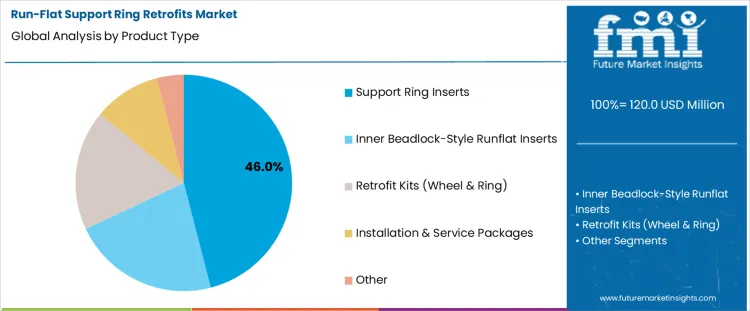
Support ring inserts hold 46.0%, representing the largest share among product types due to straightforward retrofit compatibility. These inserts mount within existing wheel assemblies, providing immediate load support during tire deflation. Design simplicity supports integration without full wheel replacement. Structural geometry enables controlled vehicle movement under reduced speed conditions. Inner beadlock-style runflat inserts provide enhanced retention with increased installation complexity. Retrofit kits combining wheels and rings address complete system replacement with higher cost. Installation and service packages support deployment with limited standalone volume. Product type segmentation reflects preference for modular solutions balancing effectiveness and retrofit practicality.
Key Points
- Support ring inserts integrate with existing wheel assemblies.
- Modular design simplifies retrofit implementation.
- Other product types address enhanced retention or full system replacement.
Which End Use Accounts for the Highest Share of Demand?
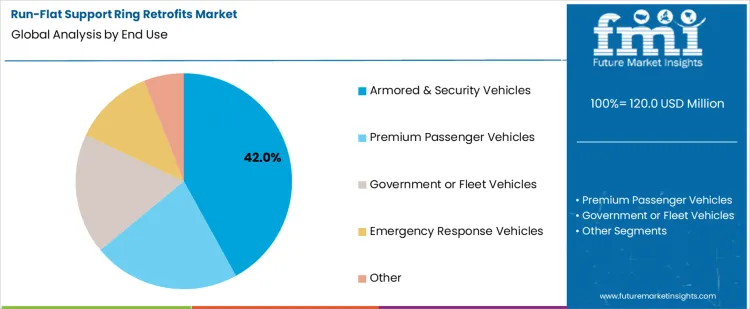
Armored and security vehicles hold 42.0%, representing the largest share among end-use categories due to mission-critical mobility needs. These vehicles operate in high-risk environments where tire damage likelihood remains elevated. Run-flat capability supports continued movement during hostile or emergency conditions. Operational protocols prioritize occupant safety and route completion reliability. Premium passenger vehicles adopt retrofits for safety enhancement with lower penetration. Government and fleet vehicles apply systems selectively based on duty requirements. Emergency response vehicles rely on run-flat support for service continuity. End-use segmentation reflects concentration where risk exposure and operational criticality drive adoption.
Key Points
- Armored vehicles require uninterrupted mobility under threat conditions.
- Run-flat systems support mission completion and occupant safety.
- Other end uses apply retrofits based on operational risk profiles.
Which Material Accounts for the Highest Share of Demand?
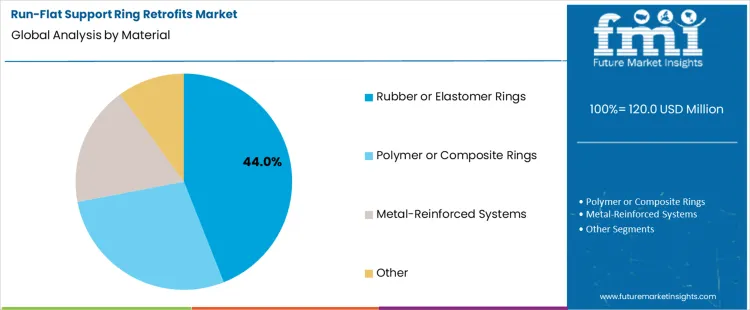
Rubber or elastomer rings hold 44.0%, representing the largest share among materials due to energy absorption characteristics. These materials deform under load, supporting controlled ride behavior during deflated operation. Elastic properties reduce vibration transfer and wheel damage. Compatibility with varied wheel sizes supports broad application. Polymer or composite rings offer weight reduction with different load profiles. Metal-reinforced systems provide higher load capacity with added mass. Material segmentation reflects preference for resilient compounds balancing load support, ride stability, and retrofit adaptability across diverse vehicle platforms.
Key Points
- Elastomer rings absorb load and reduce vibration.
- Deformable structure supports controlled deflated driving.
- Other materials trade weight for load capacity or rigidity.
What are the Key Dynamics in the Run-Flat Support Ring Retrofits Market?
Demand for run-flat support ring retrofits reflects mobility continuity requirements after tire pressure loss without reliance on sealants or roadside assistance. Adoption concentrates in armored vehicles, security fleets, emergency response vehicles, and high-risk commercial transport. Global scope aligns with safety-driven vehicle operation and downtime avoidance priorities. Usage centers on internal support rings installed inside standard tires to carry vehicle load during zero-pressure operation.
How do mobility assurance requirements and risk exposure shape adoption?
Vehicles operating in hostile or remote environments require guaranteed mobility following puncture or ballistic damage. Demand increases where loss of tire pressure creates safety, mission, or service continuity risk. Support rings maintain vehicle control and limited driving range after deflation, enabling controlled retreat or route completion. Armored and security vehicles adopt retrofits to avoid dependency on external assistance. Emergency and utility fleets value predictable limp-home capability under debris-heavy routes. Compatibility with standard wheels allows retrofit without full wheel system replacement. Installation supports mixed fleets where only select vehicles require enhanced survivability. Adoption reflects operational necessity for assured mobility rather than comfort or convenience features.
How do installation constraints, ride impact, and cost sensitivity influence market scalability?
Support ring retrofits add weight inside wheel assemblies, affecting ride comfort, noise, and suspension wear. Demand sensitivity rises where civilian vehicle users prioritize comfort over redundancy. Installation requires specialized equipment and trained technicians, limiting service network availability. Heat buildup during extended zero-pressure operation affects ring material durability and tire life. Fitment remains tire-size and wheel-specific, constraining standardization. High unit cost restricts adoption to mission-critical applications. Tire replacement complexity increases service time and labor expense. Regulatory acceptance varies by region for modified wheel assemblies, limiting scalable deployment beyond specialized vehicle segments.
How Is Demand for Run-Flat Support Ring Retrofits Evolving Globally?
Demand for run-flat support ring retrofits is expanding globally due to mobility continuity requirements, security considerations, and operating risk reduction across passenger and utility vehicles. Adoption aligns with regions facing road safety risks, long-distance travel, and limited roadside assistance coverage. Retrofit solutions allow conventional tires to deliver limited run-flat capability without full tire replacement. Fleet operators and security-focused users prioritize continued vehicle control after pressure loss. Growth rates in India at 5.9%, UAE at 5.4%, Saudi Arabia at 5.1%, South Africa at 4.8%, and Brazil at 4.6% indicate steady expansion driven by risk mitigation, retrofit flexibility, and operating environment constraints rather than premium vehicle penetration.
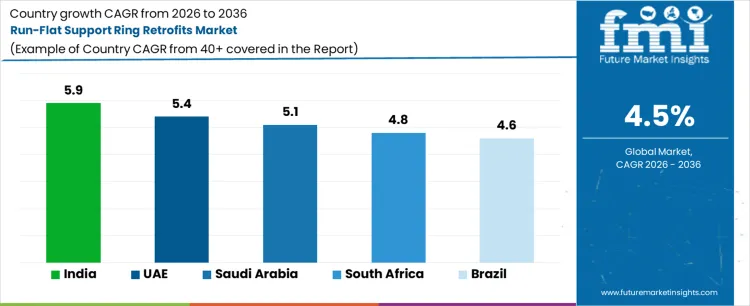
| Country | CAGR (%) |
|---|---|
| India | 5.9% |
| UAE | 5.4% |
| Saudi Arabia | 5.1% |
| South Africa | 4.8% |
| Brazil | 4.6% |
What Is Driving Growth of Run-Flat Support Ring Retrofit Demand in India?
Demand for run-flat support ring retrofits in India is growing at a CAGR of 5.9%, supported by road safety risks and varied driving environments. Highway puncture incidents increase need for continued mobility without immediate roadside intervention. Security vehicles and private fleets adopt retrofit solutions to reduce immobilization risk. Long-distance intercity travel with uneven service coverage reinforces adoption. Retrofit compatibility with existing wheel and tire setups improves cost feasibility. Growth reflects practical mobility assurance and safety planning rather than widespread adoption of factory-fitted run-flat tires.
- High puncture incidence on mixed road networks
- Security and private fleet mobility requirements
- Long-distance travel with limited roadside assistance
- Cost-effective retrofit compatibility
Why Is the UAE Supporting Expansion of Run-Flat Support Ring Retrofits?
Run-flat support ring retrofit demand in the United Arab Emirates is expanding at a CAGR of 5.4%, driven by security considerations and high-speed travel conditions. Premium SUVs and armored vehicles require continued control after tire pressure loss. Desert highways and high ambient temperatures increase risk exposure. Retrofit systems allow performance retention without switching tire formats. Fleet operators emphasize preventive risk management. Growth reflects operational safety priorities and retrofit adaptability rather than mass-market consumer adoption.
- Security-focused vehicle usage
- High-speed highway driving conditions
- Extreme temperature operating environments
- Fleet-level preventive risk management
How Is Saudi Arabia Influencing Demand for Run-Flat Support Ring Retrofits?
Demand for run-flat support ring retrofits in Saudi Arabia is growing at a CAGR of 5.1%, shaped by long-distance travel and desert terrain exposure. Remote routes reduce immediate access to tire service support. Government and security fleets prioritize uninterrupted vehicle operation. Retrofit solutions offer flexibility across varied vehicle platforms. Harsh road and climate conditions accelerate interest in mobility assurance technologies. Growth reflects operational continuity requirements and geographic challenges rather than consumer preference for premium tire systems.
- Remote route travel with limited service access
- Government and security fleet requirements
- Compatibility across multiple vehicle platforms
- Harsh desert road conditions
What Factors Are Supporting Run-Flat Retrofit Adoption in South Africa?
Run-flat support ring retrofit demand in South Africa is expanding at a CAGR of 4.8%, supported by security risks and extended rural travel. Long stretches between service centers increase value of puncture-tolerant solutions. Private security fleets and commercial operators adopt retrofits to reduce immobilization exposure. Mixed road quality raises tire damage probability. Retrofit installation during tire replacement supports incremental adoption. Growth reflects security-driven mobility planning and geographic travel patterns rather than penetration of factory run-flat vehicles.
- Extended rural travel distances
- Security risk mitigation needs
- Variable road surface quality
- Retrofit installation during maintenance cycles
Why Is Brazil Experiencing Measured Growth in Run-Flat Support Ring Retrofits?
Run-flat support ring retrofit demand in Brazil is growing at a CAGR of 4.6%, influenced by urban security concerns and intercity travel patterns. Puncture incidents in metropolitan areas encourage adoption among private fleets. Long-distance highways increase need for continued mobility. Retrofit systems offer cost-effective alternatives to dedicated run-flat tires. Fleet operators value standardized solutions across mixed vehicle fleets. Growth remains measured, reflecting selective adoption driven by risk exposure and operational planning rather than broad consumer uptake.
- Urban puncture and security exposure
- Long-distance highway travel requirements
- Cost-effective alternative to run-flat tires
- Fleet standardization across vehicle types
What is the competitive landscape of demand for the run-flat support ring retrofits market globally?
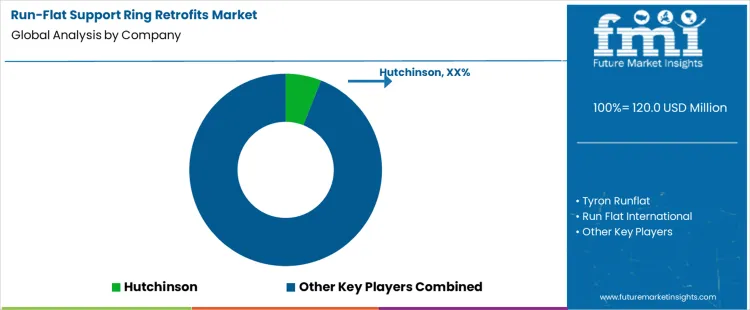
Demand for run-flat support ring retrofits is driven by the increasing need for tire safety, convenience, and performance, particularly in emergency situations where traditional tires may fail. Buyers evaluate the performance of run-flat support rings in maintaining vehicle mobility, ease of installation, and compatibility with a wide range of tire types and sizes. Procurement behavior emphasizes suppliers offering reliable, cost-effective solutions that enhance vehicle safety without requiring tire replacement. Purchasing decisions prioritize companies with strong reputations for durability, ease of integration into existing tire systems, and compatibility with various automotive applications. Trend in the market reflects growing demand for enhanced mobility solutions in both passenger and commercial vehicles, as well as the integration of tire pressure monitoring systems (TPMS).
Hutchinson leads competitive positioning with its advanced run-flat support ring technology, offering proven solutions for a wide range of vehicles, focusing on safety, durability, and ease of use. Tyron Runflat competes by providing robust retrofitting options designed for use in various vehicle types, ensuring continued mobility even after tire deflation. Run Flat International supports demand with innovative support ring designs that maintain tire integrity and performance during emergencies. Michelin participates by offering retrofit solutions that enhance vehicle safety, aiming to provide superior support in critical situations. Bridgestone and Continental both provide reliable retrofitting systems for passenger and commercial vehicles, emphasizing their commitment to vehicle safety and tire durability.
Key Players in the Run-Flat Support Ring Retrofits Market
- Hutchinson
- Tyron Runflat
- Run Flat International
- Michelin
- Bridgestone
- Continental
- Pirelli
- Trelleborg
- Sumitomo Rubber Industries
Scope of the Report
| Items | Values |
|---|---|
| Quantitative Units | USD million |
| Product Type | Support Ring Inserts; Inner Beadlock-Style Runflat Inserts; Retrofit Kits (Wheel & Ring); Installation & Service Packages; Other |
| End Use | Armored & Security Vehicles; Premium Passenger Vehicles; Government or Fleet Vehicles; Emergency Response Vehicles; Other |
| Material | Rubber or Elastomer Rings; Polymer or Composite Rings; Metal-Reinforced Systems; Other |
| Sales Channel | Specialty Installers; Direct Contracts; Distributors; OEM Programs; Other |
| Regions Covered | Asia Pacific, Europe, North America, Latin America, Middle East & Africa |
| Countries Covered | India, UAE, Saudi Arabia, South Africa, Brazil, and 40+ countries |
| Key Companies Profiled | Hutchinson; Tyron Runflat; Run Flat International; Michelin; Bridgestone; Continental; Pirelli; Trelleborg; Sumitomo Rubber Industries |
| Additional Attributes | Dollar sales by product type, end use, material, and sales channel; performance in tire integrity, vehicle safety, and run-flat capabilities across rubber, polymer, and metal-reinforced systems; adoption trends in armored, premium passenger, and government fleet vehicles; procurement patterns influenced by specialty installers, direct contracts, OEM programs, and distributor channels. |
Run-Flat Support Ring Retrofits Market by Segment
Product Type:
- Support Ring Inserts
- Inner Beadlock-Style Runflat Inserts
- Retrofit Kits (Wheel & Ring)
- Installation & Service Packages
- Other
End Use:
- Armored & Security Vehicles
- Premium Passenger Vehicles
- Government or Fleet Vehicles
- Emergency Response Vehicles
- Other
Material:
- Rubber or Elastomer Rings
- Polymer or Composite Rings
- Metal-Reinforced Systems
- Other
Sales Channel:
- Specialty Installers
- Direct Contracts
- Distributors
- OEM Programs
- Other
Region:
- Asia Pacific
- China
- Japan
- South Korea
- India
- Australia & New Zealand
- ASEAN
- Rest of Asia Pacific
- Europe
- Germany
- United Kingdom
- France
- Italy
- Spain
- Nordic
- BENELUX
- Rest of Europe
- North America
- United States
- Canada
- Mexico
- Latin America
- Brazil
- Chile
- Rest of Latin America
- Middle East & Africa
- Kingdom of Saudi Arabia
- Other GCC Countries
- Turkey
- South Africa
- Other African Union
- Rest of Middle East & Africa
Bibliography
- International Organization for Standardization. (2023). Road vehicles-Tyres (run-flat)-Performance requirements and test methods (ISO 16992:2023). ISO.
- International Organization for Standardization. (2024). Road vehicles-Wheels and rims-Load capacity, endurance, and safety test procedures (ISO 7141:2024). ISO.
- United Nations Economic Commission for Europe. (2024). UNECE Regulation No. 30-Pneumatic tyres for motor vehicles and their trailers (latest consolidated amendments including run-flat provisions). United Nations.
- United Nations Economic Commission for Europe. (2023). UNECE Regulation No. 64-Temporary use spare units, run-flat tyres, and run-flat support systems (consolidated text in force). United Nations.
- European Commission Joint Research Centre. (2023). Vehicle mobility and safety under tyre deflation: Run-flat technologies and retrofit implications. Publications Office of the European Union.
Frequently Asked Questions
How big is the run-flat support ring retrofits market in 2026?
The global run-flat support ring retrofits market is estimated to be valued at USD 120.0 million in 2026.
What will be the size of run-flat support ring retrofits market in 2036?
The market size for the run-flat support ring retrofits market is projected to reach USD 186.4 million by 2036.
How much will be the run-flat support ring retrofits market growth between 2026 and 2036?
The run-flat support ring retrofits market is expected to grow at a 4.5% CAGR between 2026 and 2036.
What are the key product types in the run-flat support ring retrofits market?
The key product types in run-flat support ring retrofits market are support ring inserts, inner beadlock-style runflat inserts, retrofit kits (wheel & ring), installation & service packages and other.
Which end use segment to contribute significant share in the run-flat support ring retrofits market in 2026?
In terms of end use, armored & security vehicles segment to command 42.0% share in the run-flat support ring retrofits market in 2026.
Preview the report firsthand - request a free sample
Get SampleGet the brochure for pricing and purchase details.
Get PDFTable of Content
- Executive Summary
- Global Market Outlook
- Demand-side Trends
- Supply-side Trends
- Technology Roadmap Analysis
- Analysis and Recommendations
- Market Overview
- Market Coverage / Taxonomy
- Market Definition / Scope / Limitations
- Market Background
- Market Dynamics
- Drivers
- Restraints
- Opportunity
- Trends
- Scenario Forecast
- Demand in Optimistic Scenario
- Demand in Likely Scenario
- Demand in Conservative Scenario
- Opportunity Map Analysis
- Product Life Cycle Analysis
- Supply Chain Analysis
- Investment Feasibility Matrix
- Value Chain Analysis
- PESTLE and Porter’s Analysis
- Regulatory Landscape
- Regional Parent Market Outlook
- Production and Consumption Statistics
- Import and Export Statistics
- Market Dynamics
- Global Market Analysis 2021 to 2025 and Forecast, 2026 to 2036
- Historical Market Size Value (USD Million) Analysis, 2021 to 2025
- Current and Future Market Size Value (USD Million) Projections, 2026 to 2036
- Y-o-Y Growth Trend Analysis
- Absolute $ Opportunity Analysis
- Global Market Pricing Analysis 2021 to 2025 and Forecast 2026 to 2036
- Global Market Analysis 2021 to 2025 and Forecast 2026 to 2036, By Product Type
- Introduction / Key Findings
- Historical Market Size Value (USD Million) Analysis By Product Type , 2021 to 2025
- Current and Future Market Size Value (USD Million) Analysis and Forecast By Product Type , 2026 to 2036
- Support Ring Inserts
- Inner Beadlock-Style Runflat Inserts
- Retrofit Kits (Wheel & Ring)
- Installation & Service Packages
- Other
- Support Ring Inserts
- Y-o-Y Growth Trend Analysis By Product Type , 2021 to 2025
- Absolute $ Opportunity Analysis By Product Type , 2026 to 2036
- Global Market Analysis 2021 to 2025 and Forecast 2026 to 2036, By End Use
- Introduction / Key Findings
- Historical Market Size Value (USD Million) Analysis By End Use, 2021 to 2025
- Current and Future Market Size Value (USD Million) Analysis and Forecast By End Use, 2026 to 2036
- Armored & Security Vehicles
- Premium Passenger Vehicles
- Government or Fleet Vehicles
- Emergency Response Vehicles
- Other
- Armored & Security Vehicles
- Y-o-Y Growth Trend Analysis By End Use, 2021 to 2025
- Absolute $ Opportunity Analysis By End Use, 2026 to 2036
- Global Market Analysis 2021 to 2025 and Forecast 2026 to 2036, By Material
- Introduction / Key Findings
- Historical Market Size Value (USD Million) Analysis By Material, 2021 to 2025
- Current and Future Market Size Value (USD Million) Analysis and Forecast By Material, 2026 to 2036
- Rubber or Elastomer Rings
- Polymer or Composite Rings
- Metal-Reinforced Systems
- Other
- Rubber or Elastomer Rings
- Y-o-Y Growth Trend Analysis By Material, 2021 to 2025
- Absolute $ Opportunity Analysis By Material, 2026 to 2036
- Global Market Analysis 2021 to 2025 and Forecast 2026 to 2036, By Sales Channel
- Introduction / Key Findings
- Historical Market Size Value (USD Million) Analysis By Sales Channel, 2021 to 2025
- Current and Future Market Size Value (USD Million) Analysis and Forecast By Sales Channel, 2026 to 2036
- Specialty Installers
- Direct Contracts
- Distributors
- OEM Programs
- Other
- Specialty Installers
- Y-o-Y Growth Trend Analysis By Sales Channel, 2021 to 2025
- Absolute $ Opportunity Analysis By Sales Channel, 2026 to 2036
- Global Market Analysis 2021 to 2025 and Forecast 2026 to 2036, By Region
- Introduction
- Historical Market Size Value (USD Million) Analysis By Region, 2021 to 2025
- Current Market Size Value (USD Million) Analysis and Forecast By Region, 2026 to 2036
- North America
- Latin America
- Western Europe
- Eastern Europe
- East Asia
- South Asia and Pacific
- Middle East & Africa
- Market Attractiveness Analysis By Region
- North America Market Analysis 2021 to 2025 and Forecast 2026 to 2036, By Country
- Historical Market Size Value (USD Million) Trend Analysis By Market Taxonomy, 2021 to 2025
- Market Size Value (USD Million) Forecast By Market Taxonomy, 2026 to 2036
- By Country
- USA
- Canada
- Mexico
- By Product Type
- By End Use
- By Material
- By Sales Channel
- By Country
- Market Attractiveness Analysis
- By Country
- By Product Type
- By End Use
- By Material
- By Sales Channel
- Key Takeaways
- Latin America Market Analysis 2021 to 2025 and Forecast 2026 to 2036, By Country
- Historical Market Size Value (USD Million) Trend Analysis By Market Taxonomy, 2021 to 2025
- Market Size Value (USD Million) Forecast By Market Taxonomy, 2026 to 2036
- By Country
- Brazil
- Chile
- Rest of Latin America
- By Product Type
- By End Use
- By Material
- By Sales Channel
- By Country
- Market Attractiveness Analysis
- By Country
- By Product Type
- By End Use
- By Material
- By Sales Channel
- Key Takeaways
- Western Europe Market Analysis 2021 to 2025 and Forecast 2026 to 2036, By Country
- Historical Market Size Value (USD Million) Trend Analysis By Market Taxonomy, 2021 to 2025
- Market Size Value (USD Million) Forecast By Market Taxonomy, 2026 to 2036
- By Country
- Germany
- UK
- Italy
- Spain
- France
- Nordic
- BENELUX
- Rest of Western Europe
- By Product Type
- By End Use
- By Material
- By Sales Channel
- By Country
- Market Attractiveness Analysis
- By Country
- By Product Type
- By End Use
- By Material
- By Sales Channel
- Key Takeaways
- Eastern Europe Market Analysis 2021 to 2025 and Forecast 2026 to 2036, By Country
- Historical Market Size Value (USD Million) Trend Analysis By Market Taxonomy, 2021 to 2025
- Market Size Value (USD Million) Forecast By Market Taxonomy, 2026 to 2036
- By Country
- Russia
- Poland
- Hungary
- Balkan & Baltic
- Rest of Eastern Europe
- By Product Type
- By End Use
- By Material
- By Sales Channel
- By Country
- Market Attractiveness Analysis
- By Country
- By Product Type
- By End Use
- By Material
- By Sales Channel
- Key Takeaways
- East Asia Market Analysis 2021 to 2025 and Forecast 2026 to 2036, By Country
- Historical Market Size Value (USD Million) Trend Analysis By Market Taxonomy, 2021 to 2025
- Market Size Value (USD Million) Forecast By Market Taxonomy, 2026 to 2036
- By Country
- China
- Japan
- South Korea
- By Product Type
- By End Use
- By Material
- By Sales Channel
- By Country
- Market Attractiveness Analysis
- By Country
- By Product Type
- By End Use
- By Material
- By Sales Channel
- Key Takeaways
- South Asia and Pacific Market Analysis 2021 to 2025 and Forecast 2026 to 2036, By Country
- Historical Market Size Value (USD Million) Trend Analysis By Market Taxonomy, 2021 to 2025
- Market Size Value (USD Million) Forecast By Market Taxonomy, 2026 to 2036
- By Country
- India
- ASEAN
- Australia & New Zealand
- Rest of South Asia and Pacific
- By Product Type
- By End Use
- By Material
- By Sales Channel
- By Country
- Market Attractiveness Analysis
- By Country
- By Product Type
- By End Use
- By Material
- By Sales Channel
- Key Takeaways
- Middle East & Africa Market Analysis 2021 to 2025 and Forecast 2026 to 2036, By Country
- Historical Market Size Value (USD Million) Trend Analysis By Market Taxonomy, 2021 to 2025
- Market Size Value (USD Million) Forecast By Market Taxonomy, 2026 to 2036
- By Country
- Kingdom of Saudi Arabia
- Other GCC Countries
- Turkiye
- South Africa
- Other African Union
- Rest of Middle East & Africa
- By Product Type
- By End Use
- By Material
- By Sales Channel
- By Country
- Market Attractiveness Analysis
- By Country
- By Product Type
- By End Use
- By Material
- By Sales Channel
- Key Takeaways
- Key Countries Market Analysis
- USA
- Pricing Analysis
- Market Share Analysis, 2025
- By Product Type
- By End Use
- By Material
- By Sales Channel
- Canada
- Pricing Analysis
- Market Share Analysis, 2025
- By Product Type
- By End Use
- By Material
- By Sales Channel
- Mexico
- Pricing Analysis
- Market Share Analysis, 2025
- By Product Type
- By End Use
- By Material
- By Sales Channel
- Brazil
- Pricing Analysis
- Market Share Analysis, 2025
- By Product Type
- By End Use
- By Material
- By Sales Channel
- Chile
- Pricing Analysis
- Market Share Analysis, 2025
- By Product Type
- By End Use
- By Material
- By Sales Channel
- Germany
- Pricing Analysis
- Market Share Analysis, 2025
- By Product Type
- By End Use
- By Material
- By Sales Channel
- UK
- Pricing Analysis
- Market Share Analysis, 2025
- By Product Type
- By End Use
- By Material
- By Sales Channel
- Italy
- Pricing Analysis
- Market Share Analysis, 2025
- By Product Type
- By End Use
- By Material
- By Sales Channel
- Spain
- Pricing Analysis
- Market Share Analysis, 2025
- By Product Type
- By End Use
- By Material
- By Sales Channel
- France
- Pricing Analysis
- Market Share Analysis, 2025
- By Product Type
- By End Use
- By Material
- By Sales Channel
- India
- Pricing Analysis
- Market Share Analysis, 2025
- By Product Type
- By End Use
- By Material
- By Sales Channel
- ASEAN
- Pricing Analysis
- Market Share Analysis, 2025
- By Product Type
- By End Use
- By Material
- By Sales Channel
- Australia & New Zealand
- Pricing Analysis
- Market Share Analysis, 2025
- By Product Type
- By End Use
- By Material
- By Sales Channel
- China
- Pricing Analysis
- Market Share Analysis, 2025
- By Product Type
- By End Use
- By Material
- By Sales Channel
- Japan
- Pricing Analysis
- Market Share Analysis, 2025
- By Product Type
- By End Use
- By Material
- By Sales Channel
- South Korea
- Pricing Analysis
- Market Share Analysis, 2025
- By Product Type
- By End Use
- By Material
- By Sales Channel
- Russia
- Pricing Analysis
- Market Share Analysis, 2025
- By Product Type
- By End Use
- By Material
- By Sales Channel
- Poland
- Pricing Analysis
- Market Share Analysis, 2025
- By Product Type
- By End Use
- By Material
- By Sales Channel
- Hungary
- Pricing Analysis
- Market Share Analysis, 2025
- By Product Type
- By End Use
- By Material
- By Sales Channel
- Kingdom of Saudi Arabia
- Pricing Analysis
- Market Share Analysis, 2025
- By Product Type
- By End Use
- By Material
- By Sales Channel
- Turkiye
- Pricing Analysis
- Market Share Analysis, 2025
- By Product Type
- By End Use
- By Material
- By Sales Channel
- South Africa
- Pricing Analysis
- Market Share Analysis, 2025
- By Product Type
- By End Use
- By Material
- By Sales Channel
- USA
- Market Structure Analysis
- Competition Dashboard
- Competition Benchmarking
- Market Share Analysis of Top Players
- By Regional
- By Product Type
- By End Use
- By Material
- By Sales Channel
- Competition Analysis
- Competition Deep Dive
- Hutchinson
- Overview
- Product Portfolio
- Profitability by Market Segments (Product/Age /Sales Channel/Region)
- Sales Footprint
- Strategy Overview
- Marketing Strategy
- Product Strategy
- Channel Strategy
- Tyron Runflat
- Run Flat International
- Michelin
- Bridgestone
- Continental
- Pirelli
- Trelleborg
- Sumitomo Rubber Industries
- Hutchinson
- Competition Deep Dive
- Assumptions & Acronyms Used
- Research Methodology


