

- Market Size (2026)
- USD 454.8 Mn
- Forecast (2036)
- USD 1066.8 Mn
- CAGR (2026 to 2036)
- 8.9%
How big is Saffron Extract & Mood-Support Botanicals Market in 2026?
USD 454.8 million in 2026 and USD 1,066.8 million by 2036 at an 8.9% CAGR.
Demand in saffron extract & mood-support botanicals market is expected to propel valuation from USD 454.8 million in 2026 to USD 1,066.8 million by 2036 at an 8.9% CAGR over the forecast period. Rising consumer interest in natural wellness solutions and growing incorporation of botanicals into functional health products are supporting market expansion. Givaudan reported in May 2025 that it launched Zensera as a lemon balm extract designed for a 300 mg dose and selected beverage applications. The launch shows how a defined extract enters commercial formats with stated dose and formulation properties.
Country demand differs under national ingredient and claims rules across the expanding mood-enhancing supplements market. Spain brings established saffron processing expertise that supports standardized extract production for European formulation customers. India combines ashwagandha extraction capacity with broad supplement manufacturing across domestic and export-oriented development programs. In South Korea, Pharmactive reported in February 2026 that South Korea's Ministry of Food and Drug Safety approved Affron as an individual functional ingredient for stress relief. The approval gives one standardized saffron extract a defined commercialization route without granting equivalent status to other preparations. Iran requires stronger authenticity documentation for export-oriented saffron lots entering regulated international ingredient supply chains. Companies in the botanical supplements market must align identity methods with local claims rules and technical support across several countries.
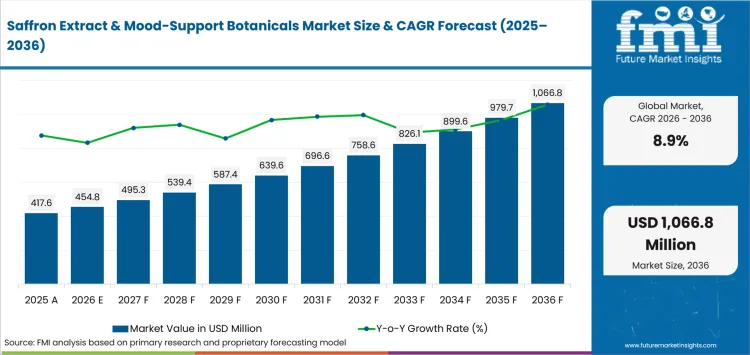
Key Takeaways of Saffron Extract And Mood-Support Botanicals Market
- Demand increases for mood-support botanicals that combine verified identity with practical doses and evidence suited to finished-product claims.
- Saffron is expected to account for 38.4% of ingredient demand in 2026 owing to compact doses and differentiated premium positioning.
- Mood is projected to represent 41.7% of applications in 2026 driven by daily stress-support positioning across several convenient formats.
- Powder is anticipated to capture 48.1% of form revenue in 2026 supported by dose control and established manufacturing compatibility.
- Adulteration risk and extract-specific evidence requirements combine with claims restrictions and stability limits to slow wider commercial adoption.
- Pharmactive Biotech Products and Givaudan develop standardized saffron or lemon balm extracts across distinct mood-support applications. Indena and Kerry compete with Arjuna Natural and OmniActive across ashwagandha or lemon balm technologies. PLT Health Solutions and Nektium support broader mood-botanical platforms through branded ingredients and delivery technologies.
Analyst Perspective
“Executives should compare saffron with ashwagandha or lemon balm through the exact extract used in each finished formula. Saffron programs require authenticated Crocus sativus material and stable crocin or safranal profiles across commercial batches. Manufacturers must also reproduce the clinical dose that supports the intended mood or sleep positioning. The strongest ingredient partners connect these controls with practical guidance for capsules and gummies as well as powders and beverages.”
- Nandini Roy Choudhury, Principal Analyst, Future Market Insights
How is the Saffron Extract And Mood-Support Botanicals Market segmented?
The saffron extract & mood-support botanicals industry is segmented by ingredient, application, form, and region.
The market is segmented by ingredient, application, form, and region to reflect distinct sourcing and formulation decisions. Ingredient comprises saffron, ashwagandha, lemon balm, and lavender, with comparison based on identity controls and active-marker specifications. Application includes mood, sleep, and menopause support, with evidence requirements changing across each intended benefit and studied population. Form covers powder, liquid, granules, and paste, which differ in dose uniformity and compatibility across capsules, gummies, and beverages. Regional analysis covers major countries, with commercialization shaped by ingredient status, claims rules, authenticity controls, and technical support.
What drives saffron’s position in the ingredient category?
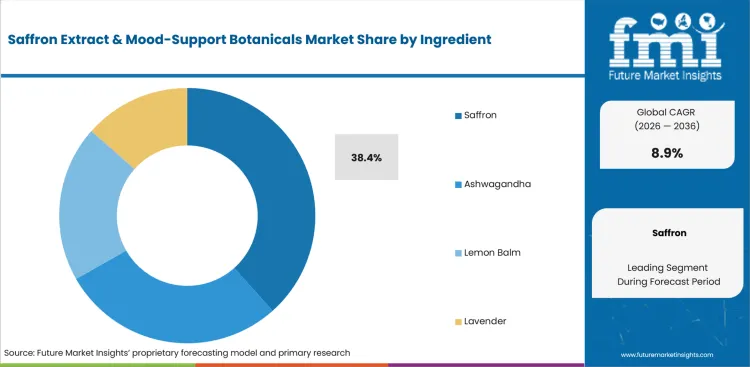
Saffron extracts use low serving levels, but commercial qualification depends on identity controls for crocin and safranal profiles. Pharmactive reported in June 2025 that a twelve-week Affron study included more than 200 adults at a daily dose of 28 mg. The announcement strengthens extract-specific evidence within food botanicals without extending the findings to every saffron preparation. Formulation scientists must connect the studied material with production batches through validated testing and controlled raw-material sourcing.
- Based on ingredient, saffron is projected to account for 38.4% in 2026 due to compact dosing and documented marker control in premium formulas. Verified origin records protect premium value by reducing substitution risk across commercial batches and supporting consistent finished-product specifications. The segment loses its advantage if extraction or storage changes the composition evaluated in human research.
- A low daily saffron dose fits compact capsule and gummy formats without displacing other active ingredients. Combination formulas also support distinct mood or sleep positioning across several consumer routines and convenient daily-use formats. Adoption slows in value-sensitive programs that cannot absorb identity testing and variable raw-material costs across repeated commercial batches.
What makes mood central to the application category?
Mood applications combine saffron and adaptogenic botanicals under wellness claims that must remain separate from disease-treatment language. Product developers need evidence that matches the exact extract and daily dose used in the finished formula. PLT Health Solutions reported in January 2025 that Blue Toad Botanicals launched a capsule containing standardized Vanizem extract. The launch gives the stress relief supplements a direct example of a mood ingredient entering a commercial multi-ingredient product with stated serving conditions.
- By application segment, mood is likely to capture 41.7% share in 2026 attributable to daily stress-support positioning across capsules and gummies as well as beverage formats. The application accommodates several botanical mechanisms within familiar wellness routines and supports clear differentiation across finished-product formats.
- Daily-use positioning supports mood formulas across capsules and gummies that fit familiar consumer routines and repeat purchasing patterns. Powders and beverages extend the same benefit platform through flexible serving occasions and combination concepts. Repeat purchasing weakens if a complex blend lacks evidence that reflects the complete formula and intended dose.
Why does powder lead the form category?
Powdered extracts support controlled blending in capsules and sachets and also enter gummies or dry beverage systems. Dry materials reduce transport and storage complexity across international manufacturing networks that serve several finished-product categories. Nektium reported in November 2025 that it introduced Smartek delivery technologies for botanical ingredients used in supplements and beverages. The development shows why the functional beverages requires stability and sensory control for consistent performance in a finished drink.
- Powder is projected to hold 48.1% share in 2026 owing to dose control and compatibility with established manufacturing systems. Dry extracts allow contract manufacturers to combine several botanicals within one controlled blend and maintain consistent serving levels. Commercial performance declines if moisture absorption or uneven dispersion changes the intended serving level across finished units.
- Established capsule and sachet lines give powdered extracts a practical route into commercial production across contract manufacturing facilities. The same ingredient requires additional dispersibility and sensory work for gummies or beverages with different processing and storage conditions. Adoption expands through materials that preserve active markers during storage and distribute evenly at the intended serving level.
What are the drivers, restraints, and opportunities in the Saffron Extract And Mood-Support Botanicals Market?
Extract-specific evidence supports differentiated mood and sleep formulations. Botanical variability and claims restrictions limit evidence transfer. Finished-formula validation creates a commercial opening for multi-ingredient products.
- Driver: Extract-specific evidence supports differentiated mood and sleep formulations through defined doses and controlled botanical composition.
- Restraint: Botanical variability and claims restrictions prevent clinical findings from transferring automatically across different extracts or finished formulas.
- Opportunity: Formula-specific validation creates a commercial opening for multi-ingredient products that require evidence beyond separate ingredient studies.
Demand strengthens through finished products that use a defined extract at a practical dose and retain its studied composition. Herbalife India reported in April 2025 that it launched Sleep Enhance with Affron saffron extract in a caffeine-free nighttime supplement. The launch shows that commercial demand develops around a specific ingredient and serving route rather than general sleep interest. Extract producers gain repeat orders by supplying stable batches and formulation guidance that protects the stated dose.
Plant-part and extraction differences create a notable evidence-transfer restraint across saffron and adaptogenic botanicals used in commercial formulas. Finished-product language adds a separate legal risk even if the ingredient remains lawful for supplement use. FDA issued an online advisory in August 2025 against an ashwagandha seller using disease-treatment claims. Manufacturers need coordinated specification and claims review across regulated retail and digital channels that expose unsupported language quickly.
Formula-specific validation offers an opportunity for botanical combinations that cannot rely on studies for separate branded ingredients. PLT Health Solutions reported in June 2026 that it partnered with Alethios to support clinical validation of finished consumer formulations. Study designs must preserve the final dose and intended claims across the complete product and its intended commercial format. The partnership gives developers in the nutraceutical ingredients market a defined route to test complete formulas ahead of broader distribution.
Which country CAGRs are profiled in the saffron extract & mood-support botanicals market?
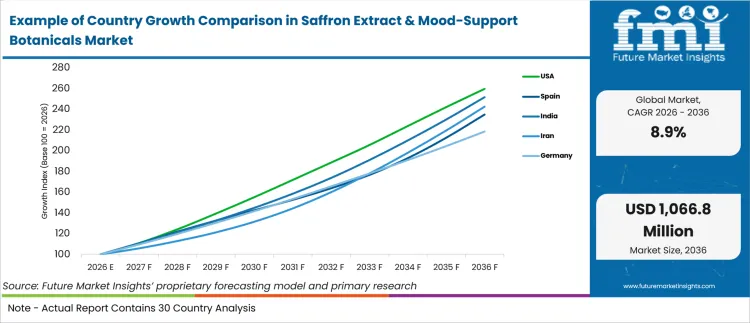
| Country | CAGR |
|---|---|
| USA | 8.5% |
| Spain | 8.9% |
| India | 9.7% |
| Iran | 9.3% |
| Germany | 8.1% |
How do country-level CAGRs compare in the Saffron Extract And Mood-Support Botanicals Market?
The profiled rates span 1.6 percentage points between Germany at 8.1% and India at 9.7%. India and Iran occupy the 9.3% to 9.7% band through strong botanical supply knowledge and extract development. Spain records 8.9% and forms the middle comparison through saffron processing expertise and European distribution access. The USA and Germany form the 8.1% to 8.5% band with stricter finished-product review and conservative claims practices. The spacing reflects different commercialization routes rather than a simple contrast between mature and developing consumer markets.
- India combines domestic wellness channels with established ashwagandha extraction capacity across supplements and functional foods. Commercial entry requires qualified sourcing that preserves root identity through extraction and finished-product manufacturing across domestic and export programs.
- Iran remains close to India through raw saffron availability and export-oriented processing knowledge across specialized production regions. Authentication requirements and indirect payment routes create separate frictions for companies serving international formulation customers.
- Spain links protected saffron origin controls with processing experience and access to European supplement channels. European health-claim rules create a separate barrier for mood or sleep formulas without permitted benefit wording.
- The USA provides broad wellness retail and established branded-ingredient distribution across national supplement channels and specialized e-commerce platforms. Finished-product manufacturers must control disease claims and maintain batch documentation throughout commercial expansion across national retail channels.
- Germany favors clearly classified formulas with conservative benefit language across established supplement retailers and pharmacy-oriented distribution channels. Borderline product reviews often delay imported formulas that resemble medicinal products through claims or presentation.
Comparable CAGRs create different entry conditions through ingredient status and source controls or channel economics. Commercial plans must distinguish raw-material access from the documentation and claims route required for repeat finished-product sales. The full report provides country-level CAGR analysis across North America and Latin America along with Europe and East Asia. Coverage also extends across South Asia and Oceania as well as the Middle East and Africa.
Country-wise Analysis
- United States supplement commercialization begins with finished-product specifications and lawful structure-function claims for each botanical formula. Saffron extract and mood-support botanical demand in the USA is forecast to rise at 8.5% CAGR over the forecast period, supported by broad wellness retail and established branded-ingredient distribution. FDA reported in September 2025 that one manufacturer lacked adequate identity and composition specifications for ashwagandha gummies. The enforcement record favors extract developers that provide validated analytical methods and complete batch documentation across commercial production runs. Disease-treatment language changes a product’s regulatory status and creates material sales friction across retail and digital channels. Commercial programs also need technical support that answers retailer questions without changing the tested ingredient specification.
- Spanish extract production benefits from regional saffron expertise and protected-origin controls that reinforce source traceability. In Spain, saffron extract and mood-support botanical demand is predicted to advance at 8.9% CAGR through 2036 owing to regional processing expertise and European formulation demand. The European Union published an approved Azafrán de la Mancha specification amendment in June 2025 for protected Spanish saffron. The amendment strengthens source documentation for premium extract programs that require verified plant origin across European distribution channels. European health-claim rules remain a material friction for mood or sleep formulas without authorized wording. Processors need records that connect protected raw material with standardized extraction and finished-product documentation across each commercial batch.
- Indian supplement commercialization requires clear plant-part identity across ashwagandha extracts used in regulated health products and related manufacturing records. India is estimated to post 9.7% CAGR in the saffron extract and mood-support botanicals market over the assessment period, aided by domestic wellness channels and established extraction capacity. FSSAI clarified in April 2026 that listed food categories permit ashwagandha roots and root extracts but not leaves. The advisory supports root-verified ingredients and creates friction for formulas with incomplete plant-part records across regulated health products. Export programs need traceable sourcing that remains intact through extraction and finished-product manufacturing across several destination markets. Domestic manufacturing scale provides a direct route into supplements and functional foods that meet the required documentation.
- Iranian saffron processors operate near a major production base but require stronger authenticity and post-harvest controls. Iran’s saffron extract and mood-support botanicals outlook is anticipated to advance at 9.3% CAGR over the assessment period, reinforced by raw-material availability and export-oriented extraction. FAO reported in September 2025 that it partnered with Mashhad University to advance saffron authenticity testing methods. The program combines chemical fingerprinting with field guidance that protects export quality across commercial lots. Incomplete lot records create material friction if authenticity data do not follow saffron through extraction and overseas distribution. Export-oriented extraction remains an enabler for standardized lots that satisfy destination-market documentation and verified authenticity requirements.
- German supplement commercialization begins with classification review across food and medicine rules for borderline botanical products. Saffron extract and mood-support botanical sales in Germany are forecast to expand at 8.1% CAGR by 2036, influenced by demand for documented formulas and established retail distribution. BfR reported in November 2025 that botanical supplements remain subject to manufacturer safety responsibility without routine premarket approval. The national framework favors manufacturers that maintain conservative claims and complete ingredient records across retail and regulatory review. Ambiguous treatment language creates material friction during retailer and regulator review across imported and domestically formulated products. Established distribution supports documented formulas that fit German food-supplement requirements across pharmacies and specialized wellness retailers.
Who are the notable companies in the Saffron Extract And Mood-Support Botanicals Market?
Pharmactive Biotech Products, Givaudan, Indena, Kerry, Arjuna Natural, PLT Health Solutions, OmniActive Health Technologies, and Nektium are the notable companies shaping this market.
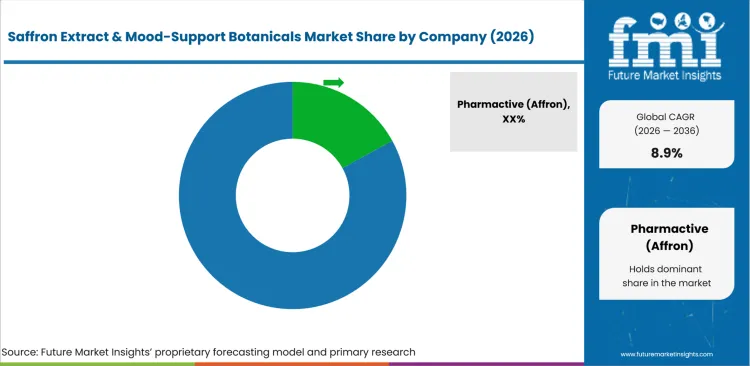
The competitive landscape combines saffron specialists with developers of ashwagandha and lemon balm extracts across several wellness applications. Pharmactive competes through standardized saffron extracts supported by low-dose human evidence across mood and sleep products. Givaudan and Indena provide distinct lemon balm technologies for stress and sleep formulations across multiple delivery formats. Kerry and Arjuna Natural provide ashwagandha platforms with clinical programs and controlled active-marker profiles across targeted wellness applications. OmniActive reported in September 2025 that two peer-reviewed Zenroot studies evaluated its root-only ashwagandha extract for mood and sleep outcomes at a 125 mg daily dose. PLT Health Solutions and Nektium extend in sleep supplements sector through branded mood ingredients and delivery support. Selection depends on reproducible composition and practical doses alongside formulation support and country-ready documentation across intended launch markets.
- Pharmactive and Givaudan focus on low-dose saffron or lemon balm extracts with defined human evidence. Their commercial advantage depends on consistent composition across capsules and beverage-oriented formats with different stability and sensory demands. Technical support becomes decisive if sensory changes or dose loss weaken the finished product’s intended positioning.
- Indena and Kerry join Arjuna Natural through lemon balm or ashwagandha platforms with distinct delivery technologies. Companies compare evidence depth and marker control across capsules and gummies or powders and beverages. Regional documentation also determines how quickly one specification enters several finished-product channels across national regulatory systems.
- OmniActive and PLT Health Solutions join Nektium across stress and mood ingredients with complementary formulation technologies. Selection depends on low-dose performance and stability or sensory control across modern delivery formats and intended serving conditions. Finished-product developers also compare ingredient research with evidence generated for the complete commercial formula and its intended daily dose.
Competitive Benchmarking: Saffron Extract & Mood-Support Botanicals Market
| Company | Extract Standardization | Human Evidence Depth | Formulation Support | Geographic Reach |
|---|---|---|---|---|
| Pharmactive Biotech Products | High | High | Medium | Europe and North America |
| Givaudan | Medium | Medium | High | Global |
| Indena | High | Medium | High | Global |
| Kerry | High | High | Medium | Global |
| Arjuna Natural | High | Medium | Medium | More than 70 countries |
| PLT Health Solutions | Medium | Medium | High | Global partner network |
| OmniActive Health Technologies | High | Medium | High | North America, Europe and Asia |
| Nektium | High | Medium | High | Europe and North America |
Key Developments in the Saffron Extract & Mood-Support Botanicals Market
- In July 2026, dsm-firmenich partnered with Nous to commercialize Koncentra for energy and mood-support applications. The partnership combines a low-dose botanical ingredient with clinical-trial design and regulatory support across food and beverage formats. The development expands access to a standardized mood ingredient and gives finished-product developers a clearer launch route.
- In April 2025, Kerry published Sensoril research that evaluated a 250 mg daily dose across post-menopausal quality-of-life outcomes. The program extended evidence for a standardized ashwagandha extract across mood and sleep concerns within menopause formulations. The advancement gives manufacturers a defined dose and studied population for targeted product development across menopause-support formulations. Complete formulas require separate validation if other ingredients or delivery systems change the studied dose or intended commercial claim.
- In October 2025, PLT Health Solutions and Nektium announced a Zynamite S study using a water-soluble mango leaf extract. The companies reported improved mood and reduced fatigue from a 100 mg dose alongside faster information processing. The water-soluble format extends the ingredient into beverages that require neutral taste and consistent dispersion. The advancement connects mood evidence with a delivery form designed for commercial drink applications and low-dose formulation work.
- In September 2025, Arjuna Natural reported new human bioavailability findings for its standardized Shoden ashwagandha extract. The company identified a 35% withanolide-glycoside profile and a 60 mg low dose for the standardized ingredient. The findings distinguish verified extract composition from a generic ashwagandha label used without comparable pharmacokinetic evidence. Formulators must preserve the studied profile through processing and storage across repeated commercial production batches.
Key Players in the Saffron Extract & Mood-Support Botanicals Market
Standardized saffron and lemon balm specialists
- Pharmactive Biotech Products
- Givaudan
- Indena
Ashwagandha platforms
- Kerry
- Arjuna Natural
- OmniActive Health Technologies
Broader mood-botanical developers
- PLT Health Solutions
- Nektium
Saffron Extract & Mood-Support Botanicals Market - Report Scope
| Coverage field | Report scope |
|---|---|
| Market breakdown | Ingredient, application, form, and region. |
| Quantitative Units | Revenue in USD Million and CAGR in %. |
| Market Definition | Standardized saffron and other botanical extracts sold for mood, stress, sleep, or menopause-support formulations across supplements, functional foods, and beverages. |
| Regions Covered | North America, Latin America, Europe, East Asia, South Asia, Oceania, and Middle East and Africa. |
| Countries Covered | USA, Spain, India, Iran, and Germany, with additional analysis across 30+ countries. |
| Key Companies Profiled | Pharmactive Biotech Products, Givaudan, Indena, Kerry, Arjuna Natural, PLT Health Solutions, OmniActive Health Technologies, Nektium |
| Forecast Period | 2026 to 2036. |
| Approach | Hybrid bottom-up and top-down market sizing supported by primary interviews and official desk research. |
Saffron Extract & Mood-Support Botanicals Market - Research Methodology
| Method | Approach |
|---|---|
| Primary Research | FMI analysts gathered input from manufacturers, service providers, technology developers, distributors, end users, procurement teams, and subject-matter experts. Interviews examined purchasing decisions, product or service evaluation, adoption barriers, approval requirements, pricing considerations, and expectations for technical or commercial support. Respondents were also asked what evidence is required before a trial, pilot, or initial order develops into regular purchasing. |
| Desk Research | Desk research covered government statistics, regulatory publications, trade data, industry associations, technical literature, standards, company filings, product information, and official corporate announcements. Sources were reviewed for relevance, publication date, geographic coverage, and consistency with the defined market scope. Claims relating to performance, applications, approvals, capacity, investment, and commercial activity were retained only when supported by credible public evidence. |
| Market Sizing and Forecasting | The market model combined the baseline value with historical performance, segment structure, pricing and volume indicators, adoption levels, company participation, and country-level demand conditions. Forecast assumptions considered economic activity, investment trends, regulatory developments, technology adoption, purchasing cycles, supply availability, and barriers to wider market use. Segment and regional estimates were reconciled before the final market total was calculated. |
| Data Validation | Estimates were checked against multiple independent indicators, including public data, company activity, trade patterns, industry developments, and findings from primary interviews. Validation also tested whether products, services, applications, and company revenues fell within the defined market boundaries. Adjacent categories, unsupported claims, overlapping revenues, and activities without direct market relevance were excluded to reduce double counting and maintain consistency across segments and countries. |
Saffron Extract & Mood-Support Botanicals Market by Segments
Saffron Extract & Mood-Support Botanicals Market segmented by Ingredient:
- Saffron
- Ashwagandha
- Lemon Balm
- Lavender
Saffron Extract & Mood-Support Botanicals Market segmented by Application:
- Mood
- Sleep
- Menopause
Saffron Extract & Mood-Support Botanicals Market segmented by Form:
- Powder
- Liquid
- Granules
- Paste
Saffron Extract & Mood-Support Botanicals Market by Region:
- North America
- United States
- Canada
- Latin America
- Brazil
- Mexico
- Argentina
- Chile
- Western Europe
- Germany
- France
- United Kingdom
- Italy
- Spain
- Benelux
- Nordics
- Eastern Europe
- Poland
- Czech Republic
- Romania
- Hungary
- East Asia
- China
- Japan
- South Korea
- South Asia and Pacific
- India
- ASEAN
- Australia and New Zealand
- Middle East and Africa
- GCC Countries
- South Africa
- Türkiye
- Israel
Research Sources and Bibliography
- Givaudan. (2025, May 14). Givaudan launches next-generation innovation for stress management with Zensera™.
- Pharmactive Biotech Products. (2026, February 10). Affron® becomes first saffron extract to obtain MFDS Individual Approval for Stress Relief in South Korea.
- Pharmactive Biotech Products. (2025, June 24). Affron®, a new clinical study confirms its positive impact on emotional balance.
- PLT Health Solutions. (2025, January 27). Blue Toad Botanicals Launches You’ve Got Some NERVE™ Stack Featuring Vanizem™ Aframomum melegueta Extract.
- Nektium. (2025, November 20). Nektium introduces new delivery technologies for smarter botanical formulations in supplements and beyond.
- Herbalife India. (2025, April 23). Herbalife India Launches Sleep Enhance™.
- USA Food and Drug Administration. (2025, August 1). Four Hearts Creations LLC - Online Advisory Letter.
- PLT Health Solutions. (2026, June 1). PLT Health Solutions Partners with Alethios to Help Consumer Brands Generate Clinical Validation of Finished Formulations.
- USA Food and Drug Administration. (2025, September 10). Eniva USA, Inc. - 706565 - 09/10/2025.
- European Commission. (2025, June 11). Publication of the communication of an approved standard amendment to a product specification of a geographical indication in accordance with Article 5(4) of Commission Delegated Regulation (EU) 2025/27.
- Food Safety and Standards Authority of India. (2026, April 16). Advisory regarding non-use of Ashwagandha (Withania somnifera) leaves in crude or extract or any other form in food products - reg.
- Food and Agriculture Organization of the United Nations. (2025, September 16). FAO signs agreement with Mashhad University to advance saffron authenticity testing methodologies.
- Bundesinstitut für Risikobewertung. (2025, November 3). Über Sinn und Unsinn von Nahrungsergänzungsmitteln.
- OmniActive Health Technologies. (2025, September 3). Two New Peer-Reviewed Studies on Zenroot.
- dsm-firmenich. (2026, July 15). dsm-firmenich and Nous partner to bring novel functional ingredient, Koncentra to market for energy, focus, and mood support.
- Kerry. (2025, April 7). Redefining menopause symptom management with Sensoril®.
- PLT Health Solutions. (2025, October 20). PLT And Nektium Announce New Clinical Study on Zynamite® S Ingredient that Redefines Non-Stim Mental Energy.
- Arjuna Natural. (2025, September 19). Enhanced bioavailability in Shoden® Ashwagandha.
- Indena. (2025, April 18). Indena at Health Food Expo, Ingredients and Contract Manufacture 2025.
This bibliography is provided for reader reference and is not exhaustive. The full report contains the complete reference list and detailed citations.
This Report Answers
- How large is the saffron extract & mood-support botanicals market in 2026 and 2036?
- Which commercial conditions support demand for standardized mood botanicals?
- Why does saffron hold the main ingredient position in 2026?
- How does mood shape formulation priorities within the application category?
- Why does powder account for the main form share in 2026?
- How do country growth rates differ across the USA and Spain compared with India and Iran or Germany?
- Which companies provide standardized saffron or ashwagandha alongside lemon balm and related mood botanicals?
- What limits evidence transfer across different botanical extracts and finished formulations?
- How does delivery technology expand botanicals across gummies and powders with beverage applications?
Frequently Asked Questions
How big is the Saffron Extract & Mood-Support Botanicals Market in 2026?
The saffron extract & mood-support botanicals market is valued at USD 454.8 million in 2026 and is forecast to reach USD 1066.8 million by 2036. Growth is supported by rising consumer interest in natural wellness solutions and growing incorporation of standardized botanical extracts into mood, sleep, and stress-support supplement formats across established commercial channels.
What is the CAGR of the Saffron Extract & Mood-Support Botanicals Market from 2026 to 2036?
The saffron extract & mood-support botanicals market grows at a CAGR of 8.9% between 2026 and 2036, supported by manufacturers adopting extract-specific evidence and defined daily doses once those systems preserve verified botanical composition and active-marker profiles across commercial capsule, powder, and beverage supplement programs.
Which ingredient leads the Saffron Extract & Mood-Support Botanicals Market?
Saffron accounts for 38.4% of the saffron extract & mood-support botanicals market by ingredient in 2026, driven by compact dosing and documented marker control that support premium positioning across capsule and gummy formats without displacing other active ingredients in multi-ingredient mood and sleep formulas.
How much will the Saffron Extract & Mood-Support Botanicals Market add between 2026 and 2036?
The saffron extract & mood-support botanicals market is set to add USD 612.0 million between 2026 and 2036, growing from USD 454.8 million to USD 1066.8 million as standardized botanical extracts with extract-specific human evidence enter funded commercial pathways across a widening base of mood, sleep, and stress supplement programs.
Who are the leading companies in the Saffron Extract & Mood-Support Botanicals Market?
Five companies lead the saffron extract & mood-support botanicals market, including Pharmactive Biotech Products, Givaudan, Indena, Kerry, and Arjuna Natural, competing through standardized saffron and lemon balm extracts, ashwagandha platforms, defined human evidence, and formulation support across mood, sleep, and menopause supplement programs worldwide.
Preview the report firsthand - request a free sample
Get SampleGet the brochure for pricing and purchase details.
Get PDFTable of Content
- Key Takeaways
- Market Size and CAGR
- Top Growth Driver
- Fastest Growing Segment
- Leading Region
- Key Companies
- Emerging Opportunities
- Executive Summary
- Global Market Outlook
- Demand-side Trends
- Supply-side Trends
- Technology Roadmap Analysis
- Analysis and Recommendations
- Analyst Perspective (What is happening? Why now? What should investors know?)
- Key Questions Answered
- How large is the market?
- What is the CAGR?
- What are key trends?
- Which region dominates?
- Who are the leaders?
- Market Overview
- Market Coverage / Taxonomy
- Market Definition / Scope / Limitations
- Research Methodology
- Chapter Orientation
- Analytical Lens and Working Hypotheses
- Market Structure, Signals, and Trend Drivers
- Benchmarking and Cross-market Comparability
- Market Sizing, Forecasting, and Opportunity Mapping
- Research Design and Evidence Framework
- Desk Research Programme (Secondary Evidence)
- Expert Input and Fieldwork (Primary Evidence)
- Tooling, Models, and Reference Databases
- Data Engineering and Model Build
- Quality Assurance and Audit Trail
- Market Background
- Market Dynamics (Drivers, Restraints, Opportunity, Trends)
- Scenario Forecast (Optimistic, Likely, Conservative)
- Impact Analysis
- AI Impact
- Sustainability Impact
- Regulatory Impact
- Technology Impact
- Consumer / Buyer Analysis
- Purchase Drivers
- Adoption Barriers
- Buyer Journey
- Opportunity Map Analysis
- Product Life Cycle Analysis
- Supply Chain Analysis
- Investment Feasibility Matrix
- Value Chain Analysis
- PESTLE and Porter's Analysis
- Regulatory Landscape
- Regional Parent Market Outlook
- Production and Consumption Statistics
- Import and Export Statistics
- Global Market Analysis and Forecast, 2021 to 2036
- Historical Market Size Value (USD Million) Analysis, 2021 to 2025
- Current and Future Market Size Value (USD Million) Projections, 2026 to 2036
- Y-o-Y Growth Trend Analysis
- Absolute $ Opportunity Analysis
- Global Market Pricing Analysis, 2021 to 2036
- Global Market Analysis and Forecast, By Ingredient, 2021 to 2036
- Introduction / Key Findings
- Historical Market Size Value (USD Million) Analysis By Ingredient, 2021 to 2025
- Current and Future Market Size Value (USD Million) Analysis and Forecast By Ingredient, 2026 to 2036
- Saffron
- Ashwagandha
- Lemon Balm
- Lavender
- Saffron
- Y-o-Y Growth Trend Analysis By Ingredient, 2021 to 2025
- Absolute $ Opportunity Analysis By Ingredient, 2026 to 2036
- Global Market Analysis and Forecast, By Application, 2021 to 2036
- Introduction / Key Findings
- Historical Market Size Value (USD Million) Analysis By Application, 2021 to 2025
- Current and Future Market Size Value (USD Million) Analysis and Forecast By Application, 2026 to 2036
- Mood
- Sleep
- Menopause
- Mood
- Y-o-Y Growth Trend Analysis By Application, 2021 to 2025
- Absolute $ Opportunity Analysis By Application, 2026 to 2036
- Global Market Analysis and Forecast, By Form, 2021 to 2036
- Introduction / Key Findings
- Historical Market Size Value (USD Million) Analysis By Form, 2021 to 2025
- Current and Future Market Size Value (USD Million) Analysis and Forecast By Form, 2026 to 2036
- Powder
- Liquid
- Granules
- Paste
- Powder
- Y-o-Y Growth Trend Analysis By Form, 2021 to 2025
- Absolute $ Opportunity Analysis By Form, 2026 to 2036
- Global Market Analysis and Forecast, By Region, 2021 to 2036
- Introduction
- Historical Market Size Value (USD Million) Analysis By Region, 2021 to 2025
- Current Market Size Value (USD Million) Analysis and Forecast By Region, 2026 to 2036
- North America
- Latin America
- Western Europe
- Eastern Europe
- East Asia
- South Asia and Pacific
- Middle East & Africa
- Market Attractiveness Analysis By Region
- North America Market Analysis and Forecast, By Country, 2021 to 2036
- Historical Market Size Value (USD Million) Trend Analysis By Market Taxonomy, 2021 to 2025
- Market Size Value (USD Million) Forecast By Market Taxonomy, 2026 to 2036
- By Country
- USA
- Canada
- By Ingredient
- By Application
- By Form
- By Country
- Market Attractiveness Analysis
- By Country
- By Ingredient
- By Application
- By Form
- Key Takeaways
- Latin America Market Analysis and Forecast, By Country
- Historical Market Size Value (USD Million) Trend Analysis By Market Taxonomy, 2021 to 2025
- Market Size Value (USD Million) Forecast By Market Taxonomy, 2026 to 2036
- By Country
- Brazil
- Mexico
- Chile
- Rest of Latin America
- By Ingredient
- By Application
- By Form
- By Country
- Market Attractiveness Analysis
- By Country
- By Ingredient
- By Application
- By Form
- Key Takeaways
- Western Europe Market Analysis and Forecast, By Country
- Historical Market Size Value (USD Million) Trend Analysis By Market Taxonomy, 2021 to 2025
- Market Size Value (USD Million) Forecast By Market Taxonomy, 2026 to 2036
- By Country
- Germany
- UK
- Italy
- Spain
- France
- Nordic
- BENELUX
- Rest of Western Europe
- By Ingredient
- By Application
- By Form
- By Country
- Market Attractiveness Analysis
- By Country
- By Ingredient
- By Application
- By Form
- Key Takeaways
- Eastern Europe Market Analysis and Forecast, By Country
- Historical Market Size Value (USD Million) Trend Analysis By Market Taxonomy, 2021 to 2025
- Market Size Value (USD Million) Forecast By Market Taxonomy, 2026 to 2036
- By Country
- Russia
- Poland
- Hungary
- Balkan & Baltic
- Rest of Eastern Europe
- By Ingredient
- By Application
- By Form
- By Country
- Market Attractiveness Analysis
- By Country
- By Ingredient
- By Application
- By Form
- Key Takeaways
- East Asia Market Analysis and Forecast, By Country
- Historical Market Size Value (USD Million) Trend Analysis By Market Taxonomy, 2021 to 2025
- Market Size Value (USD Million) Forecast By Market Taxonomy, 2026 to 2036
- By Country
- China
- Japan
- South Korea
- By Ingredient
- By Application
- By Form
- By Country
- Market Attractiveness Analysis
- By Country
- By Ingredient
- By Application
- By Form
- Key Takeaways
- South Asia and Pacific Market Analysis and Forecast, By Country
- Historical Market Size Value (USD Million) Trend Analysis By Market Taxonomy, 2021 to 2025
- Market Size Value (USD Million) Forecast By Market Taxonomy, 2026 to 2036
- By Country
- India
- ASEAN
- Australia & New Zealand
- Rest of South Asia and Pacific
- By Ingredient
- By Application
- By Form
- By Country
- Market Attractiveness Analysis
- By Country
- By Ingredient
- By Application
- By Form
- Key Takeaways
- Middle East & Africa Market Analysis and Forecast, By Country
- Historical Market Size Value (USD Million) Trend Analysis By Market Taxonomy, 2021 to 2025
- Market Size Value (USD Million) Forecast By Market Taxonomy, 2026 to 2036
- By Country
- Kingdom of Saudi Arabia
- Other GCC Countries
- Türkiye
- South Africa
- Other African Union
- Rest of Middle East & Africa
- By Ingredient
- By Application
- By Form
- By Country
- Market Attractiveness Analysis
- By Country
- By Ingredient
- By Application
- By Form
- Key Takeaways
- Key Countries Market Analysis
- USA
- Pricing Analysis
- Market Share Analysis, 2025
- By Ingredient
- By Application
- By Form
- Canada
- Pricing Analysis
- Market Share Analysis, 2025
- By Ingredient
- By Application
- By Form
- Mexico
- Pricing Analysis
- Market Share Analysis, 2025
- By Ingredient
- By Application
- By Form
- Brazil
- Pricing Analysis
- Market Share Analysis, 2025
- By Ingredient
- By Application
- By Form
- Chile
- Pricing Analysis
- Market Share Analysis, 2025
- By Ingredient
- By Application
- By Form
- Germany
- Pricing Analysis
- Market Share Analysis, 2025
- By Ingredient
- By Application
- By Form
- UK
- Pricing Analysis
- Market Share Analysis, 2025
- By Ingredient
- By Application
- By Form
- Italy
- Pricing Analysis
- Market Share Analysis, 2025
- By Ingredient
- By Application
- By Form
- Spain
- Pricing Analysis
- Market Share Analysis, 2025
- By Ingredient
- By Application
- By Form
- France
- Pricing Analysis
- Market Share Analysis, 2025
- By Ingredient
- By Application
- By Form
- India
- Pricing Analysis
- Market Share Analysis, 2025
- By Ingredient
- By Application
- By Form
- ASEAN
- Pricing Analysis
- Market Share Analysis, 2025
- By Ingredient
- By Application
- By Form
- Australia & New Zealand
- Pricing Analysis
- Market Share Analysis, 2025
- By Ingredient
- By Application
- By Form
- China
- Pricing Analysis
- Market Share Analysis, 2025
- By Ingredient
- By Application
- By Form
- Japan
- Pricing Analysis
- Market Share Analysis, 2025
- By Ingredient
- By Application
- By Form
- South Korea
- Pricing Analysis
- Market Share Analysis, 2025
- By Ingredient
- By Application
- By Form
- Russia
- Pricing Analysis
- Market Share Analysis, 2025
- By Ingredient
- By Application
- By Form
- Poland
- Pricing Analysis
- Market Share Analysis, 2025
- By Ingredient
- By Application
- By Form
- Hungary
- Pricing Analysis
- Market Share Analysis, 2025
- By Ingredient
- By Application
- By Form
- Kingdom of Saudi Arabia
- Pricing Analysis
- Market Share Analysis, 2025
- By Ingredient
- By Application
- By Form
- Türkiye
- Pricing Analysis
- Market Share Analysis, 2025
- By Ingredient
- By Application
- By Form
- South Africa
- Pricing Analysis
- Market Share Analysis, 2025
- By Ingredient
- By Application
- By Form
- USA
- Market Structure Analysis
- Competition Dashboard
- Competition Benchmarking
- Market Share Analysis of Top Players
- By Regional
- By Ingredient
- By Application
- By Form
- Emerging Startups
- Innovation Benchmarking
- Competition Analysis
- Competition Deep Dive
- Pharmactive (Affron)
- Overview
- Product Portfolio
- Profitability by Market Segments
- Sales Footprint
- Strategy Overview
- Marketing Strategy
- Product Strategy
- Channel Strategy
- Nutrafur
- Gencor
- Sabinsa
- Naturex (Givaudan)
- Verdure
- Pharmactive (Affron)
- Case Studies
- Success Stories
- Recent Developments
- Competition Deep Dive
- Assumptions & Acronyms Used


