

- Market Size (2026)
- USD 14.8 Mn
- Forecast (2036)
- USD 35.7 Mn
- CAGR (2026 to 2036)
- 9.2%
How big is Secalin Coating Resins Market in 2026?
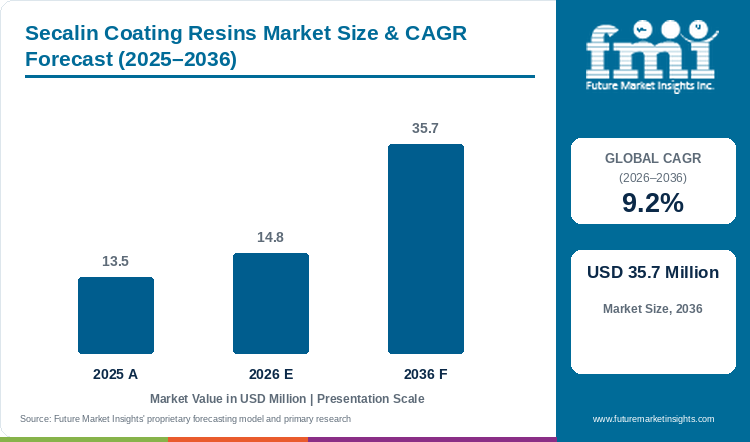
Assessed at USD 13.5 million in 2025 and progressing to USD 14.8 million in 2026, the secalin coating resins market valuation is on course to reach USD 35.7 million by 2036, supported by a forecast-period CAGR of 9.2%.
The global secalin coating resins market was valued at USD 13.5 million in 2025 and is estimated to reach USD 14.8 million in 2026. The market is projected to reach USD 35.7 million by 2036, expanding at a compound annual growth rate (CAGR) of 9.2% between 2026 and 2036. Gamma-75k secalin enriched resins are projected to capture 44.6% of 2026 demand, since native N-terminal cysteine dimers deliver the film continuity that enteric and moisture-barrier coatings purchase by viscosity curve rather than by slogan [2]. In September 2025, Verbio's annual report confirmed high rye biorefinery run rates at Schwedt and Zerbig, with protein and biomethane co-products attaching the economics [1], which put a tablet-coating resin inside a fuel-ethanol balance sheet for the first time. Industry growth trails the PFAS-free barrier coatings for food paper market at 13.6% CAGR, because PFAS withdrawal forced an immediate whole-category re-sourcing while secalin must still displace shellac and methacrylates one formulary requalification at a time. The supporting supply base is moving, as Lantmannen expanded cereal biorefinery fractionation at Norrkoping and Lidkoping in its February 2025 year-end report [4], and Mondi with European specialty paper converters widened aqueous biopolymer barrier sizing in September 2025 against EU PPWR repulpability criteria [6] [10]. Coaters and seed treaters buy the resin that hits spray viscosity windows without a new solvent line, and plants pairing rye feedstock with standardized spray grades clear that bar through 2036.
Key Market Trends & Insights
- By secalin molecular class: Gamma-75k Secalin Enriched Resins are projected to capture 44.6% in 2026 because native N-terminal cysteine dimers deliver superior seed-coat abrasion resistance.
- By formulation system: Aqueous-Alcoholic Spray Dispersions are estimated to command 51.4% in 2026 as 60% ethanol-water azeotropes flash off at 38 degrees Celsius without damaging seed embryos.
- By end-use application: Microplastics-Free Seed Coatings are expected to concentrate 39.9% in 2026 because EU REACH Annex XVII bans non-biodegradable synthetic seed polymers from October 2028.
- By purity grade: Technical Agricultural & Paper Grade is forecast to generate 62.2% in 2026 owing to high-volume seed pelleting, fertilizer encapsulation with crispbread paper sizing.
- By sales channel: Direct Grain Biorefinery B2B Supply is anticipated to account for 53.4% in 2026 through integrated rye bioethanol and starch fractionation contracts.
Regional Highlights
- Top national expansion: China is projected to lead national growth at a 10.2% CAGR through 2036 under pelleted hybrid corn/vegetable seed treatment and enteric probiotic tablet expansion.
- Broader country progression: Germany and Poland are both expected to expand at 9.7% CAGR ahead of Sweden at 9.3% with the USA at 8.7%, while France is forecast to advance at an 8.6% yearly pace.
Market Size & Forecast
Table 1: Market Size and Forecast for the Secalin Coating Resins Market (USD million and CAGR percentage), 2025 to 2036
| Metric | Value |
|---|---|
| 2025 Market Size | USD 13.5 million |
| Estimated Market Size in 2026 | USD 14.8 million |
| Projected Market Size by 2036 | USD 35.7 million |
| CAGR, 2026 to 2036 | 9.2% |
| Added Value, 2026 to 2036 | USD 20.9 million |
European seed breeders and nutraceutical contract manufacturers confront mandatory microplastics phase-outs with severe tropical storage aging in insect-derived shellac tablet glazes. Synthetic styrene-acrylate seed binders leave persistent polymer microparticles in agricultural soils, whereas wheat gluten dispersions string and clog fine fluid-bed spray nozzles. Quantitative biochemical characterization by Gellrich, Schieberle with Wieser in Cereal Chemistry (PubMed PMID 12622354) established that rye storage protein consists of ~50% dimeric gamma-75k secalin and ~24% monomeric gamma-40k secalin with minimal high-molecular-weight glutenin interference [2]. so formulators are adopting rye secalin dispersions across the biopolymer coatings sector to achieve low-viscosity spray atomization and complete soil protease mineralization.
Rye Grind and Treated-Seed Volume Sizing
Table 2: Rye Grind and Treated-Seed Volume Sizing for the Secalin Coating Resins Market (USD million and operational ranges), 2025 to 2036
| Metric | 2025 | 2026 | 2036 |
|---|---|---|---|
| Market size (USD million) | 13.5 | 14.8 | 35.7 |
| Coating-grade dry secalin volume (thousand tonnes) | 1.45 to 1.55 | 1.58 to 1.68 | 4.35 to 4.65 |
| Secalin-treated certified seed volume (thousand tonnes) | 102 to 110 | 114 to 122 | 340 to 365 |
| Seed-treatment resin cost per tonne of seed (USD) | 38.0 to 46.0 | 40.0 to 48.0 | 34.0 to 41.0 |
Operational note: Volume ranges apply winter rye grain protein content (9.5% to 11.5% dry weight, of which 45% to 55% is alcohol-extractable secalin) against commercial seed film-coating application rates of 4.5 to 6.5 kg dry secalin binder per metric ton of certified seed.
Rye wet-fractionation plants require thermostable endo-1,4-beta-xylanase conditioning to cleave water-binding arabinoxylan pentosans before 60% aqueous-ethanol extraction. Prolamin formulators partner with agricultural biologicals suppliers in the bio-based barrier coatings ecosystem to encapsulate rhizobial inoculants and micronutrients onto hybrid cereal and oilseed pericarps.
Per Capita & Seed-Treatment Facility Sizing
Table 3: Per Capita and Facility Spending Indicators for the Secalin Coating Resins Market (USD), 2025 to 2036
| Metric | 2025 | 2026 | 2036 |
|---|---|---|---|
| World population (billion) | 8.2 | 8.3 | 9.0 |
| Spend per 1,000 people (USD) | 1.6 | 1.8 | 4.0 |
| Annual resin spend per seed/tablet plant (USD thousand) | 290 to 340 | 315 to 370 | 680 to 790 |
| European rye biorefinery supply share (%) | 74.0% to 77.0% | 75.0% to 78.0% | 71.0% to 74.0% |
Table 4: Facility & Industrial Converter Spending Indicators for the Secalin Coating Resins Market (USD and percentages), 2026
| Metric | Value | Industrial Reference Basis |
|---|---|---|
| Market size, 2026 | USD 14.8 million | 2026 global market valuation baseline |
| Qualified seed-pelleting & enteric coating lines | 44 facilities | European, North American & Asian coating plants |
| Market spend per qualified facility | USD 336.4 thousand | Annualized formulated secalin dispersion expenditure |
| Microplastics-free seed coating value, 2026 | USD 5.9 million | 39.9% end-use application segment allocation |
Operating non-explosion-rated rotary seed drums and pharmaceutical Wurster fluid-bed towers requires stripping flammable ethanol below 0.5% VOC via microfluidized pseudolatex conversion. Nutraceutical contract manufacturers pair monomeric gamma-40k secalin pseudolatex with edible films and coatings excipients to protect acid-labile probiotics through gastric transit.
Analyst Perspective
"With the European Union banning non-biodegradable synthetic polymer microparticles in seed coatings from October 2028, agrochemical formulators need a tough, water-resistant bio-binder that will not clog spray nozzles. Rye gamma-75k secalin recovered from Central European bioethanol side streams delivers the exact disulfide film tenacity and soil protease degradability required by hybrid seed breeders."
- Nikhil Kaitwade, Principal Consultant, Future Market Insights.
How is the secalin coating resins market segmented?
The secalin coating resins market is segmented by secalin molecular class, formulation system, end-use application, purity grade with sales channel. In 2026, Gamma-75k Secalin Enriched Resins are projected at 44.6%, Aqueous-Alcoholic Spray Dispersions at 51.4%, Microplastics-Free Seed Coatings at 39.9%, Technical Agricultural & Paper Grade at 62.2% with Direct Grain Biorefinery B2B Supply at 53.4%.
By secalin molecular class: Gamma-75k Secalin Enriched Resins, Gamma-40k Monomeric Secalin Resins, Arabinoxylan-Secalin Co-Polymers, and Omega-Secalin Flexible Blends.
By formulation system: Aqueous-Alcoholic Spray Dispersions, Pseudolatex Colloidal Dispersions, and Hot-Melt Plasticized Resins.
By end-use application: Microplastics-Free Seed Coatings, Nutraceutical Enteric Tablet Coatings, Greaseproof Specialty Paper Sizing, and Controlled-Release Fertilizer Shells.
By purity grade: Technical Agricultural & Paper Grade, and USP/EP Nutraceutical & Food Grade.
By sales channel: Direct Grain Biorefinery B2B Supply, Agrochemical & Seed Enhancement Formulators, and Pharma/Food Excipient Distributors.
Why do Gamma-75k Secalin Enriched Resins lead the secalin molecular class category?
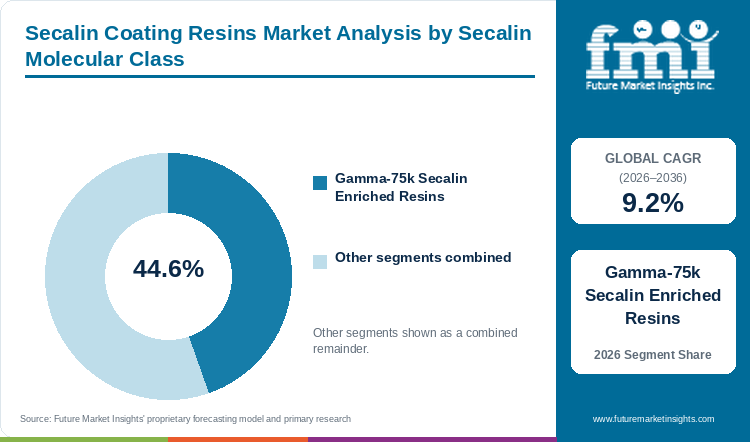
Gamma-75k Secalin Enriched Resins are projected to capture 44.6% of secalin molecular class demand in 2026, supported by native 75 kDa disulfide dimer toughness.
Table 5: Secalin Molecular Class Share for the Secalin Coating Resins Market (percentage share), 2026
| Secalin Molecular Class | Share (2026) |
|---|---|
| Gamma-75k Secalin Enriched Resins | 44.6% |
| Other Segments Combined | 55.4%* |
| Total | 100.0% |
*Note: Remaining secalin molecular classes (Gamma-40k Monomeric Secalin Resins at 26.4%, Arabinoxylan-Secalin Co-Polymers at 18.2% with Omega-Secalin Flexible Blends at 10.8%) sum to 100.0% of 2026 market volume.
Table 6: Secalin Molecular Class Leadership and Market Growth for the Secalin Coating Resins Market (segment and CAGR percentage), 2026 to 2036
| Metric | Value |
|---|---|
| Global CAGR (2026 to 2036) | 9.2% |
| Leading Segment | Gamma-75k Secalin Enriched Resins |
Seed-treatment and industrial coating formulators favor gamma-75k secalin (Mr ~75,000 Da) because rye uniquely evolved a ninth unpaired cysteine residue in its repetitive N-terminal domain that links two chains into a covalent dimer. This native dimer architecture yields abrasion-resistant films with 89% lower Heubach seed dust-off than starch binders while integrating into barrier systems without the elastic nozzle-stringing of wheat glutenin.
- Gamma-75k Secalin Enriched Resins are projected to secure 44.6% of molecular class value in 2026 by combining dimeric disulfide film tenacity with sub-200 mPa.s spray viscosity.
- Electrophoretic and rheological studies published in Food Chemistry (PMC5007685) confirmed that rye prolamin fractions enriched in gamma-75k subunits form cohesive, low-permeability coatings for grain and tablet substrates [3].
Why do Aqueous-Alcoholic Spray Dispersions define the largest formulation system segment?
Aqueous-Alcoholic Spray Dispersions are estimated to secure 51.4% of the formulation system category in 2026, driven by rapid 38-degree-Celsius azeotropic drying.
Rye secalin exhibits peak molecular solubility in 55% to 70% v/v aqueous ethanol, allowing formulators co-located at European rye bioethanol plants to ship 20%-solids hydroalcoholic solutions directly to industrial coaters. Rapid ethanol-water flash-off cures seed and paper coatings in 90 seconds at 38 degrees Celsius, complementing biopolymer films and preserving heat-sensitive seed germination.
- Aqueous-Alcoholic Spray Dispersions are estimated to command 51.4% of the formulation system segment in 2026 because direct ethanol extraction avoids microfluidization stripping costs.
- In February 2025, Lantmännen ek för confirmed expanded grain biorefinery and bioethanol-integrated protein extraction investments across its Norrköping and Lidköping facilities in Sweden [4].
What keeps Microplastics-Free Seed Coatings ahead by end-use application?
Microplastics-Free Seed Coatings are expected to command 39.9% of end-use application volume in 2026, reflecting mandatory EU REACH synthetic polymer replacement.
European Commission Regulation (EU) 2023/2055 amending REACH Annex XVII prohibits non-biodegradable synthetic polymer microparticles in agricultural seed coatings effective October 17, 2028. Because treated cereal, rapeseed with sugar-beet seeds are planted in soil rather than ingested as food, rye secalin binders face zero gluten-allergen labelling hurdles while outperforming cellulose film derivatives in wet-soil pericarp adhesion.
- Microplastics-Free Seed Coatings are expected to hold 39.9% of end-use application value in 2026 and expand at a leading 10.1% CAGR through 2036 as seed breeders phase out styrene-acrylate binders.
- According to USDA Foreign Agricultural Service May 2025 grain balances, European Union winter rye production exceeds 7.5 million metric tons annually, providing local feedstock across the German, Polish with Nordic certified seed belt [5].
Why does Technical Agricultural & Paper Grade lead the purity grade category?
Technical Agricultural & Paper Grade is forecast to generate 62.2% of purity grade demand in 2026, owing to bulk seed pelleting, fertilizer shells with paper sizing.
Agricultural seed binders, controlled-release urea prill shells with greaseproof crispbread paper sizing tolerate 82% to 88% secalin purity containing residual feruloylated arabinoxylans and trace rye lipids. Bypassing pharmaceutical activated-carbon polishing and sterile filtration cuts resin manufacturing cost to USD 6.80–7.65/kg versus USD 12.60/kg for USP/EP enteric tablet grades.
- Technical Agricultural & Paper Grade is forecast to account for 62.2% of purity grade demand in 2026 as Polish and German fertilizer and seed plants procure bulk prolamin dispersions.
- In September 2025, Mondi plc expanded its functional barrier paper range across Europe, highlighting converter demand for aqueous biopolymer sizing layers that pass standard paper mill repulping [6].
What gives Direct Grain Biorefinery B2B Supply the leading position in sales channel?
Direct Grain Biorefinery B2B Supply is anticipated to account for 53.4% of sales channel value in 2026, reinforced by on-site bioethanol solvent integration.
Extracting alcohol-soluble secalin requires 4 to 6 cubic meters of 60% aqueous ethanol per metric ton of rye protein middlings followed by vacuum distillation recovery. Grain biorefineries that distil fuel and industrial bioethanol on-site in Germany, Poland with Sweden execute direct multi-year B2B supply contracts with seed enhancement formulators and paper mills.
- Direct Grain Biorefinery B2B Supply is anticipated to capture 53.4% of sales channel demand in 2026 by saving USD 1.15 to USD 1.45 per kilogram in external ethanol purchase and excise handling.
- In September 2025, Verbio SE published its 2024/2025 Annual Report detailing high use and grain co-product valorization across its rye biorefineries in Schwedt and Zörbig, Germany [1].
What are the drivers, restraints with opportunities in the secalin coating resins market?
In the secalin coating resins market, the October 2028 EU REACH microplastics ban on treated seeds and European rye bioethanol side-stream valorization are projected to expand resin demand whereas rye arabinoxylan hydrogel viscosity restrains wet-mill flux and vegan pseudolatex enteric tablet coatings create high-margin opportunities.
- Driver: Mandatory EU REACH Annex XVII phase-out of synthetic microplastic polymers in seed coatings and controlled-release fertilizers by October 2028 compels agrochemical formulators to qualify soil-biodegradable gamma-75k secalin binders.
- Restraint: Rye kernels contain 7% to 9% water-binding arabinoxylans (pentosans) that form >2,500 mPa.s hydrogels during wet milling, fouling ultrafiltration membranes unless pre-hydrolyzed with endo-1,4-beta-xylanase.
- Opportunity: Converting monomeric gamma-40k secalin into zero-VOC aqueous pseudolatex dispersions provides a vegan, non-aging replacement for insect shellac and synthetic polymethacrylates in enteric probiotic and omega-3 tablets.
Growth Analysis and Future Potential: Qualitative Demand Catalysts
European hybrid seed breeders and specialty fertilizer blenders are phasing out styrene-acrylate and polyurethane film coatings because synthetic polymer shells fail OECD 301B soil mineralization mandates under EU REACH Annex XVII. Binding fungicidal and biological seed treatments onto cereal pericarps without pneumatic planter dust-off requires disulfide-crosslinked protein films that resist cold-warehouse embrittlement. Future Market Insights notes that Central European rye biorefining is scaling secalin into a dedicated industrial binder with plant protein fractions in agrochemical and paper applications. Foundational sequence and subunit research by Shewry et al. in Biochimica et Biophysica Acta (PubMed PMID 6733118) and the Journal of Experimental Botany (PubMed PMID 11912237) demonstrated how rye's 75 kDa gamma-secalin dimers balance disulfide tenacity with alcohol extractability [7] [8]. Seed enhancement companies systematically lock in multi-year supply agreements with German and Swedish grain biorefineries ahead of the 2028 statutory transition.
Risk Assessment of the Secalin Coating Resins Market: Operational and Formulation Friction
Co-extracted rye arabinoxylan pentosan viscosity during wet fractionation and high-temperature protein denaturation in conventional distillers dried grains with solubles (DDGS) rotary dryers represent the primary operational bottlenecks restricting secalin supply. When rye middlings are slurred in water without pentosanase enzymes, feruloylated arabinoxylans absorb ten times their weight in water and trap up to 35% of extractable secalin inside viscous mucilage gels. Comparative prolamin studies by Tatham and Shewry in the Journal of Cereal Science (PubMed PMID 22048773) highlighted the distinct beta-turn conformations and hydration behavior of rye omega- and gamma-secalins [9]. Biorefinery process engineers consequently mandate inline endo-1,4-beta-xylanase dosing and low-temperature (<55 degrees Celsius) pre-fermentation protein separation before stillage distillation. When converters compare hydroalcoholic secalin sprays against standard aqueous acrylics in the high barrier packaging films and paper sectors, explosion-proof (ATEX) dryer retrofits create capital friction for mills lacking solvent recovery.
Commercial Opportunity Analysis: Formulation Differentiation and Value-Add Formats
Nutraceutical contract manufacturing economics reward formulators that convert purified monomeric gamma-40k secalin into 28%-solids water-borne pseudolatex colloidal dispersions (particle size 150 to 250 nanometers) plasticized with triethyl citrate. Because gamma-40k secalin contains less than 1.8 mol% basic ionizable amino acids (lysine and histidine), sprayed tablet films remain completely intact in pH 1.2 gastric acid for 120 minutes before digesting rapidly in pH 6.8 intestinal pancreatin. Supplement brands capturing premium clean-label tiers replace insect-derived shellac (which suffers from ester polymerization aging in humid storage) and synthetic methacrylic copolymers across edible packaging and oral dosage lines. Under U.S. Food and Drug Administration 21 CFR Part 175 and dietary supplement excipient frameworks with EU Regulation 2025/40 recyclability rules, plant-derived prolamin dispersions enjoy streamlined commercial qualification [10] [11]. Supplying zero-VOC aqueous secalin pseudolatex enables excipient vendors to win probiotic, omega-3 softgel with bitter botanical tablet coating contracts.
Secalin Coating Resins Market by Country (2026 to 2036)
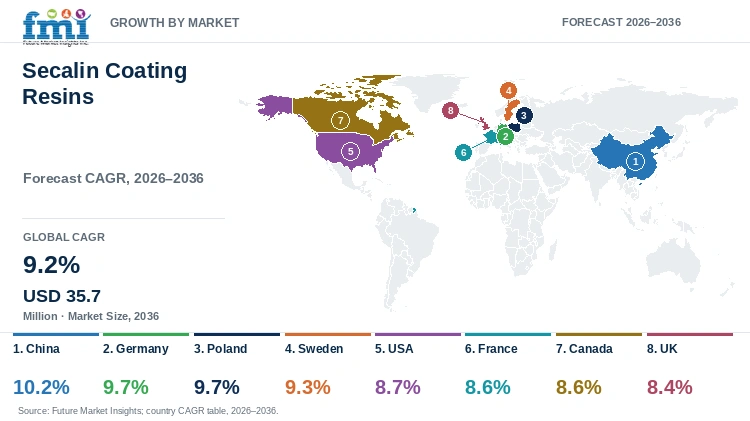
As per FMI, China is projected to lead secalin coating resin expansion rate at a 10.2% CAGR through 2036, whereas Germany and Poland anchor global absolute volume at a 9.7% CAGR each and France progresses at an 8.6% annual pace. Commercial performance across the Central and Northern European winter rye belt with North American and East Asian nutraceutical and seed-pelleting hubs depends on captive rye bioethanol side-stream recovery, xylanase enzyme integration with statutory microplastics phase-out schedules.
Table 7: Country CAGR and Primary Growth Levers for the Secalin Coating Resins Market (CAGR percentage and operational drivers), 2026 to 2036
| Country | CAGR (2026 to 2036) | Primary Growth Lever |
|---|---|---|
| China | 10.2% | Pelleted hybrid corn/vegetable seed binders and enteric TCM/probiotic tablet coating expansion |
| Germany | 9.7% | Verbio Schwedt/Zörbig rye biorefinery extraction and KWS hybrid seed REACH-compliant coating |
| Poland | 9.7% | 2.5M-tonne domestic rye harvest powering Grupa Azoty controlled-release fertilizer shell trials |
| Sweden | 9.3% | Lantmännen Norrköping ethanol-loop extraction and arabinoxylan-secalin crispbread paper sizing |
| USA | 8.7% | Vegan enteric probiotic/omega-3 supplement tablet coatings and Midwest cover-crop rye seed binders |
| France | 8.6% | Limagrain/RAGT certified maize and sunflower seed film-coating ahead of Oct 2028 EU REACH ban |
| Canada | 8.6% | Prairie fall rye distilling side-stream recovery and cold-soil canola seed-coat dust reduction |
| UK | 8.4% | Enteric nutraceutical contract manufacturing and biodegradable cereal seed treatment adoption |
Source: Future Market Insights analysis
China Secalin Coating Resins Market Outlook (2026 to 2036)
Unlike European markets where winter rye is a staple bread and biofuel crop, China cultivates roughly 500,000 metric tons of high-altitude rye across Inner Mongolia, Gansu with Heilongjiang while importing purified European technical secalin to serve its rapidly modernizing seed-pelleting and nutraceutical sectors [5]. Ministry of Agriculture and Rural Affairs initiatives promoting precision mechanical seeding of pelleted hybrid corn and small-seeded vegetable crops require low-dust, soil-degradable protein binders [3]. Demand for secalin coating resins in China is projected to expand at a leading 10.2% annual rate through 2036. also Chinese Traditional Medicine (TCM) and probiotic tablet manufacturers specify Gamma-40k Monomeric Secalin pseudolatex to mask bitter alkaloid tastes and prevent hygroscopic herbal extract deliquescence during coastal summer storage.
Key takeaway: In China, precision vegetable and hybrid corn seed pelleting with bitter-masking enteric TCM tablet coatings are projected to drive the fastest national growth rate.
Germany Secalin Coating Resins Market Outlook (2026 to 2036)
Germany is the global industrial heartland of the secalin coating resins market, harvesting 3.1 to 3.4 million metric tons of winter rye annually across Brandenburg, Lower Saxony with Mecklenburg-Vorpommern [5]. In September 2025, Verbio SE confirmed high use and grain co-product valorization at its flagship rye bioethanol and biomethane biorefineries in Schwedt and Zörbig [1]. German demand is expected to climb at a 9.7% annual rate over the 2026 to 2036 window, generating the largest national dollar gain globally (+USD 5.0 million). Because Germany also hosts global hybrid rye and sugar-beet seed leader KWS Saat SE in Einbeck with strict Julius Kühn-Institut (JKI) Heubach planter dust limits (<0.25 g/100 kg seed), domestic seed treatment plants are rapidly locking in German gamma-75k secalin supply ahead of the October 2028 EU REACH microplastics ban [2] [3].
Key takeaway: In Germany, co-location of Europe's largest rye bioethanol biorefineries with global hybrid seed breeders in Lower Saxony is expected to anchor global market leadership.
Poland Secalin Coating Resins Market Outlook (2026 to 2036)
In contrast to Western European markets that import rye grain, Poland is the European Union's second-largest rye producer (harvesting 2.3 to 2.6 million metric tons annually across Mazovia and Greater Poland) and operates dense rye milling and agricultural alcohol clusters [5]. Abundant domestic rye middlings priced 15% below milling wheat allow Polish extractors to manufacture technical Omega-Secalin Flexible Blends and Hot-Melt Plasticized Resins at USD 6.40 to USD 6.80/kg [2] [3]. Polish secalin coating resin consumption is forecast to expand at a 9.7% annual pace through 2036. Polish nitrogen fertilizer plants and seed blenders are commercializing hot-melt secalin-rosin shells on urea granules to satisfy EU Fertilising Products Regulation (EU) 2019/1009 soil biodegradability mandates at a 35% cost discount to imported polyhydroxyalkanoates.
Key takeaway: In Poland, low-cost domestic rye milling side streams are forecast to power bulk adoption in controlled-release urea fertilizer shells and cereal seed coatings.
Sweden Secalin Coating Resins Market Outlook (2026 to 2036)
What distinguishes the Swedish market (with neighboring Denmark) is the vertical integration between farmer-owned Lantmännen Biorefineries in Norrköping, Danish industrial enzyme leader Novonesis with Scandinavian rye crispbread (Knäckebröd) packaging paper mills [4]. By dosing Novonesis endo-1,4-beta-xylanases and ferulic esterases during rye wet fractionation, Nordic biorefineries co-isolate Arabinoxylan-Secalin Co-Polymers rather than discarding pentosan mucilages [2] [3]. Swedish demand for secalin coating resins is anticipated to rise at a 9.3% yearly clip through 2036. Applied at 4.2 g/m2 on unbleached kraft paper, arabinoxylan-secalin sizing delivers Tappi Kit 10 grease holdout and keeps rye crispbread crisp below 6% moisture activity while passing 100% Nordic paper recycling standards [6] [10].
Key takeaway: In Sweden, enzymatic co-isolation of arabinoxylan-secalin graft polymers for greaseproof crispbread paper sizing and certified seed treatment is anticipated to sustain strong growth.
USA Secalin Coating Resins Market Outlook (2026 to 2036)
Unlike European demand led by statutory REACH seed rules, United States adoption is bifurcated between clean-label nutraceutical contract manufacturing organizations (CMOs) in Utah, California with New Jersey and Midwest cover-crop winter cereal rye seed distributors [5] [11]. Dietary supplement brands replacing insect shellac (E904) and synthetic polymethacrylates specify aqueous Gamma-40k Monomeric Secalin pseudolatex to achieve certified Vegan enteric release on fish-oil softgels and acid-labile probiotic caplets [3]. Commercial secalin coating resin value in the USA is predicted to grow at an 8.7% yearly pace through 2036. Simultaneously, expansion of American rye whiskey distilling in Kentucky and Indiana plus USDA-incentivized winter rye cover cropping across Iowa and Minnesota has increased domestic rye grind supply by 38% over five years [5].
Key takeaway: In the USA, vegan enteric probiotic and omega-3 supplement tablet coatings with Midwest cover-crop seed binders are predicted to drive balanced commercial expansion.
France Secalin Coating Resins Market Outlook (2026 to 2036)
As the European Union's largest certified agricultural seed exporter (anchored by Limagrain, RAGT Semences with Lidea across Auvergne-Rhône-Alpes and Occitanie) and a premier marine/botanical nutraceutical hub, France works as a high-value net importer of purified German and Swedish secalin dispersions [3] [5]. French seed treatment stations are systematically replacing microplastic styrene-acrylate film coats on hybrid maize, sunflower with winter cereal seeds ahead of the October 2028 EU REACH prohibition. French secalin coating resin expenditure is estimated to climb at an 8.6% annual rate through 2036. Because waxy sunflower and maize pericarps suffer from coating flake-off during high-speed vacuum precision planting, French formulators blend gamma-75k secalin with 20% omega-secalin to boost film elongation above 55% [2] [9].
Key takeaway: In France, certified maize and sunflower seed export pelleting and marine phyto-supplement enteric coating are estimated to sustain premium dispersion imports.
Canada Secalin Coating Resins Market Outlook (2026 to 2036)
Canada harvests 420,000 to 500,000 metric tons of winter fall rye annually across Manitoba, Saskatchewan with Alberta, supplying both Canadian rye whisky distilleries and Prairie grain fractionators [5]. Pre-mashing dry air-classification and ethanol extraction of Canadian fall rye middlings recovers native gamma-75k secalin without reducing distillery alcohol yield per bushel [2] [3]. Canadian demand for secalin coating resins is slated to expand at an 8.6% CAGR through 2036. Prairie agrochemical seed treaters in Saskatoon and Winnipeg apply hydrophobic gamma-75k secalin films onto hybrid canola and pulse seeds to curb neonicotinoid/fungicide planter dust drift and prevent imbibitional chilling injury when canola is seeded into 4-degree-Celsius spring soils.
Key takeaway: In Canada, Prairie fall rye distillery side-stream extraction and cold-soil canola seed-coat protection are slated to anchor domestic market growth.
UK Secalin Coating Resins Market Outlook (2026 to 2036)
Whereas continental Germany and Poland focus on bulk rye biorefining, the United Kingdom acts as a specialized formulation R&D and contract-coating hub—led by Croda International's Incotec seed enhancement platform in Snaith and Colorcon's European pharmaceutical coating operations in Dartford [3]. British nutraceutical tablet coaters and cereal seed treaters import purified European secalin resins to formulate zero-VOC aqueous pseudolatex dispersions. UK institutional and industrial spending on secalin coating resins is likely to increase at an 8.4% yearly rate through 2036 as British seed merchants align export cereal and oilseed rape lots with EU REACH microplastics-free standards and UK supplement brands eliminate synthetic methacrylate excipients.
Key takeaway: In the UK, multinational seed-enhancement R&D and clean-label nutraceutical tablet contract manufacturing are likely to drive steady demand for pseudolatex secalin grades.
Full report country CAGRs cover: North America; Latin America; Western Europe; Eastern Europe; East Asia; South Asia and Pacific; Middle East and Africa.
Who are the notable companies in the secalin coating resins market?
Verbio SE, Lantmännen Biorefineries, Croda International plc (Incotec), GoodMills Group GmbH (GoodMills Innovation), Crespel & Deiters Group, Colorcon, Inc., Sensient Technologies Corporation with Novonesis are the notable companies in the secalin coating resins market.
FMI analysis indicates that the competitive arena divides between European winter rye biorefineries and grain millers, agricultural seed and specialty paper coating formulators with pharmaceutical enteric coating and industrial enzyme specialists. Grain biorefineries control multi-hundred-thousand-tonne rye grinding and on-site bioethanol extraction loops, whereas seed-enhancement and pharmaceutical excipient companies convert purified secalin into zero-VOC aqueous pseudolatex dispersions.
- European Rye Biorefineries & Grain Fractionators: Verbio SE with Lantmännen Biorefineries, GoodMills Group with Crespel & Deiters Group control primary winter rye milling and bioethanol-integrated secalin extraction.
- Agricultural Seed & Specialty Coating Formulators: Croda International plc (Incotec) with Sensient Technologies formulate microplastics-free seed film-coatings and colored biological seed binders.
- Enteric Tablet Coating & Enzymatic Conditioning Platforms: Colorcon, Inc. and Novonesis deliver USP/EP enteric prolamin pseudolatex dispersions and endo-1,4-beta-xylanase pentosan cleavage enzymes.
Competitive Benchmarking: Secalin Coating Resins Market
Table 8: Competitive Benchmarking for the Secalin Coating Resins Market (qualitative capability ratings), 2026
| Company | Rye Feedstock & Ethanol Loop | Gamma-75k/40k Fractionation | Seed / Enteric Coating IP | Geographic Reach |
|---|---|---|---|---|
| Verbio SE | High | High | Medium | Medium |
| Lantmännen Biorefineries | High | High | Medium | Medium |
| Croda International (Incotec) | Medium | Medium | High | High |
| GoodMills Group GmbH | High | High | Medium | Medium |
| Crespel & Deiters Group | High | High | Medium | Medium |
| Colorcon, Inc. | Medium | Medium | High | High |
| Sensient Technologies | Medium | Medium | High | High |
| Novonesis | Medium | High | High | High |
Scoring basis: Capability tiers evaluate captive winter rye grinding and on-site bioethanol extraction integration with selective gamma-75k vs. gamma-40k fractionation. Coating IP and geographic ratings reflect REACH-compliant seed dust-off validation, USP <711> enteric dissolution dossiers with global technical service networks.
Key Developments in the Secalin Coating Resins Market
- Verbio SE published its 2024/2025 Annual Report in September 2025 confirming high grain biorefinery use and protein/biomethane co-product valorization across its winter rye facilities in Schwedt and Zörbig, Germany [1].
- Lantmännen ek för reported expanded cereal biorefinery and specialty plant-protein fractionation investments across Norrköping and Lidköping, Sweden in its February 2025 Year-End Report [4].
- Mondi plc and European specialty paper converters expanded aqueous biopolymer functional barrier sizing ranges in September 2025 to meet EU Regulation 2025/40 (PPWR) repulpability criteria [6] [10].
Key Players in the Secalin Coating Resins Market
European Rye Biorefineries and Grain Fractionators
- Verbio SE
- Lantmännen Biorefineries
- GoodMills Group GmbH (GoodMills Innovation)
- Crespel & Deiters Group
Agricultural Seed and Specialty Coating Formulators
- Croda International plc (Incotec)
- Sensient Technologies Corporation
Nutraceutical Enteric Coating and Biotechnology Platforms
- Colorcon, Inc.
- Novonesis
Secalin Coating Resins Market - Report Scope
Table 9: Report Scope for the Secalin Coating Resins Market (coverage fields and definitions), 2026 to 2036
| Coverage field | Report scope |
|---|---|
| Market breakdown | Secalin Molecular Class; Formulation System; End-Use Application; Purity Grade; Sales Channel |
| Quantitative Units | USD Million |
| Market Definition | Includes commercial supplier value of formulated rye secalin (Secale cereale prolamin) coating resins, aqueous-alcoholic spray dispersions, pseudolatex colloidal dispersions with arabinoxylan-secalin co-polymers. Category Scope Note: Excludes unfractionated rye baking flour, raw rye DDGS animal feed, underlying certified seed or pharmaceutical active value, barley hordein with corn zein. |
| Regions Covered | North America; Latin America; Western Europe; Eastern Europe; East Asia; South Asia and Pacific; Middle East and Africa |
| Countries Covered | China, Germany, Poland, Sweden, USA, France, Canada, UK with additional countries in the full report |
| Key Companies Covered | Verbio SE, Lantmännen Biorefineries, Croda International (Incotec), GoodMills Group, Crespel & Deiters Group, Colorcon, Inc., Sensient Technologies, Novonesis |
| Forecast Period | 2026 to 2036 |
| Approach | Primary and secondary research with bottom-up rye biorefinery fractionation mass-balance and top-down seed/tablet/paper dosing triangulation. |
Secalin Coating Resins Market - Research Methodology
Table 10: Research Methodology for the Secalin Coating Resins Market (research methods and approach), 2026 edition
| Method | Approach |
|---|---|
| Primary Research | Structured interviews with German, Polish with Swedish rye biorefinery engineers, European seed-pelleting formulators with nutraceutical tablet coating CMOs to validate xylanase extraction yields and dosing rates. |
| Secondary Research | Analysis of corporate annual reports (Verbio SE, Lantmännen), USDA FAS global rye balances, EU REACH Regulation 2023/2055 microplastics rules with PubMed/PMC rye secalin biochemical studies. |
| Market Sizing and Forecasting | Bottom-up winter rye industrial fractionation mass balances (1,625 tonnes dry-eq coating resin in 2026 at USD 9.11/kg weighted ASP) reconciled against top-down treated seed tonnage (118,000 tonnes), enteric tablet batches, paper sizing area with CRF granules. |
| Country Forecasting Model | Econometric country projections weight regional winter rye harvest volumes, October 2028 EU REACH seed-coating compliance timelines with vegan supplement CMO output across eight national markets. |
| Operational Benchmark Traceability | Rye grind and treated-seed indicators in Tables 2, 3 with 4 trace to Cereal Chemistry secalin subunit quantifications (Gellrich et al.) and Food Chemistry prolamin rheology studies (Ribeiro et al.). |
| Data Triangulation and Validation | Demand estimates are cross-checked against commercial seed-binder and enteric-excipient shipments without double counting underlying hybrid seed, probiotic active, paperboard or urea fertilizer value. |
Secalin Coating Resins Market by Segments
Secalin Coating Resins Market segmented by Secalin Molecular Class:
- Gamma-75k Secalin Enriched Resins
- Gamma-40k Monomeric Secalin Resins
- Arabinoxylan-Secalin Co-Polymers
- Omega-Secalin Flexible Blends
Secalin Coating Resins Market segmented by Formulation System:
- Aqueous-Alcoholic Spray Dispersions
- Pseudolatex Colloidal Dispersions
- Hot-Melt Plasticized Resins
Secalin Coating Resins Market segmented by End-Use Application:
- Microplastics-Free Seed Coatings
- Nutraceutical Enteric Tablet Coatings
- Greaseproof Specialty Paper Sizing
- Controlled-Release Fertilizer Shells
Secalin Coating Resins Market segmented by Purity Grade:
- Technical Agricultural & Paper Grade
- USP/EP Nutraceutical & Food Grade
Secalin Coating Resins Market segmented by Sales Channel:
- Direct Grain Biorefinery B2B Supply
- Agrochemical & Seed Enhancement Formulators
- Pharma/Food Excipient Distributors
Secalin Coating Resins Market by Region
- North America
- United States
- Canada
- Latin America
- Brazil
- Mexico
- Argentina
- Chile
- Western Europe
- Germany
- France
- United Kingdom
- Italy
- Spain
- Benelux
- Nordics
- Eastern Europe
- Poland
- Czech Republic
- Romania
- Hungary
- East Asia
- China
- Japan
- South Korea
- South Asia and Pacific
- India
- ASEAN
- Australia and New Zealand
- Middle East and Africa
- GCC Countries
- South Africa
- Türkiye
- Israel
Research Sources and Bibliography
- [1] Verbio SE. (2025, September 25). Verbio SE Annual Report 2024/2025: Grain biorefinery utilization and rye-based bioethanol and biomethane co-product valorization in Schwedt and Zörbig. Verbio Investor Relations News.
- [2] Gellrich, C., Schieberle, P., & Wieser, H. (2003, January 1). Biochemical characterization and quantification of the storage protein (secalin) types in rye flour. Cereal Chemistry, 80(1), 102-109 (PubMed PMID 12622354).
- [3] Ribeiro, M., Nunes, F. M., Rodriguez-Quijano, M., Carrillo, J. M., & Branlard, G. (2016, December 15). Rye prolamins: Extractability, electrophoretic separation and film-forming rheology for grain and tablet coatings. Food Chemistry, 213, 456-465 (PubMed Central PMC5007685).
- [4] Lantmännen ek för. (2025, February 11). Lantmännen Year-End Report 2024 and Biorefineries investment update: Rye, wheat, and oats fractionation in Norrköping and Lidköping. Lantmännen Financial Press Releases.
- [5] U.S. Department of Agriculture Foreign Agricultural Service (USDA FAS). (2025, May 12). Grain: World Markets and Trade — Global Barley and Rye Production, Malting Demand, and Industrial Grind Balances (2025/26 Forecast). USDA Economic & Market Intelligence.
- [6] Mondi plc. (2025, September 15). Mondi expands functional barrier paper range with high-barrier dispersion technology for food and e-commerce packaging. Mondi Media Centre.
- [7] Shewry, P. R., Field, J. M., Faulks, A. J., Parmar, S., Miflin, B. J., Dietler, M. D., Lew, E. J., & Kasarda, D. D. (1984, January 24). The purification and N-terminal amino acid sequence analysis of the high molecular weight glutenin subunits of wheat, barley and rye. Biochimica et Biophysica Acta, 788(1), 23-34 (PubMed PMID 6733118).
- [8] Shewry, P. R., & Halford, N. G. (2002, April 1). Cereal seed storage proteins: Structures, properties and role in grain utilization. Journal of Experimental Botany, 53(370), 947-958 (PubMed PMID 11912237).
- [9] Tatham, A. S., & Shewry, P. R. (2012, March 1). The S-poor prolamins of wheat, barley and rye: Revisited. Journal of Cereal Science, 55(2), 79-99 (PubMed PMID 22048773).
- [10] European Parliament and Council of the European Union. (2025, January 22). Regulation (EU) 2025/40 of the European Parliament and of the Council of 19 December 2024 on packaging and packaging waste. Official Journal of the European Union (EUR-Lex).
- [11] U.S. Food and Drug Administration (FDA). (2025, January 15). Inventory of Effective Food Contact Substance (FCS) Notifications and 21 CFR Part 175 Indirect Food Additives. U.S. Department of Health and Human Services.
This bibliography is provided for reader reference and is not exhaustive. The full report contains the complete reference list and detailed citations.
This Report Answers
- How large is the secalin coating resins market in 2026 and what is forecast for 2036?
- How does the October 2028 EU REACH microplastics ban accelerate secalin seed-coating adoption?
- Why do Gamma-75k Secalin Enriched Resins lead the molecular class category?
- Why do Aqueous-Alcoholic Spray Dispersions lead the formulation system category globally?
- How do growth rates differ across China, Germany, Poland, Sweden with the USA?
- Which leading European rye biorefineries and coating formulators supply the market today?
- How do formulators overcome rye arabinoxylan pentosan viscosity during extraction?
- What should buyers evaluate before qualifying a secalin seed binder or enteric tablet dispersion?
Frequently Asked Questions
How big is the secalin coating resins market in 2026 with what is forecast for 2036?
According to FMI, the global secalin coating resins market value is estimated to reach USD 14.8 million in 2026 from USD 13.5 million in 2025. The industry valuation is forecast to hit USD 35.7 million by 2036 as agrochemical seed treaters and supplement CMOs replace synthetic polymers and shellac.
What is the CAGR for the secalin coating resins market from 2026 to 2036?
Future Market Insights projects a 9.2% compound annual growth rate between 2026 and 2036, representing an anticipated USD 20.9 million increase in annual market value across microplastics-free seed coatings, enteric tablets, paper sizing with fertilizer shells.
Which secalin molecular class segment leads the secalin coating resins market?
Gamma-75k Secalin Enriched Resins are projected to capture 44.6% of molecular class demand in 2026 because their native 75 kDa disulfide-linked dimer structure delivers tough, low-dust seed coatings without nozzle stringing.
Which formulation system segment leads the secalin coating resins market?
Aqueous-Alcoholic Spray Dispersions are estimated to secure 51.4% of the formulation system category in 2026 as 60% ethanol solutions allow rapid 38-degree-Celsius drying directly from biorefinery extraction loops.
Which country has a notable growth outlook during the assessment period?
China is projected to lead national growth rate at a 10.2% CAGR through 2036, while Germany and Poland each expand at a 9.7% CAGR anchored by domestic winter rye biorefineries and EU REACH seed-coating compliance.
Who are the key players in the market?
Verbio SE, Lantmännen Biorefineries, Croda International plc (Incotec), GoodMills Group GmbH, Crespel & Deiters Group, Colorcon, Inc., Sensient Technologies Corporation with Novonesis lead commercial supply and enzymatic formulation.
Preview the report firsthand - request a free sample
Get SampleGet the brochure for pricing and purchase details.
Get PDFTable of Content
- Key Takeaways
- Market Size and CAGR
- Top Growth Driver
- Fastest Growing Segment
- Leading Region
- Key Companies
- Emerging Opportunities
- Executive Summary
- Global Market Outlook
- Demand-side Trends
- Supply-side Trends
- Technology Roadmap Analysis
- Analysis and Recommendations
- Analyst Perspective (What is happening? Why now? What should investors know?)
- Key Questions Answered
- How large is the market?
- What is the CAGR?
- What are key trends?
- Which region dominates?
- Who are the leaders?
- Market Overview
- Market Coverage / Taxonomy
- Market Definition / Scope / Limitations
- Research Methodology
- Chapter Orientation
- Analytical Lens and Working Hypotheses
- Market Structure, Signals, and Trend Drivers
- Benchmarking and Cross-market Comparability
- Market Sizing, Forecasting, and Opportunity Mapping
- Research Design and Evidence Framework
- Desk Research Programme (Secondary Evidence)
- Expert Input and Fieldwork (Primary Evidence)
- Tooling, Models, and Reference Databases
- Data Engineering and Model Build
- Quality Assurance and Audit Trail
- Market Background
- Market Dynamics (Drivers, Restraints, Opportunity, Trends)
- Scenario Forecast (Optimistic, Likely, Conservative)
- Impact Analysis
- AI Impact
- Sustainability Impact
- Regulatory Impact
- Technology Impact
- Consumer / Buyer Analysis
- Purchase Drivers
- Adoption Barriers
- Buyer Journey
- Opportunity Map Analysis
- Product Life Cycle Analysis
- Supply Chain Analysis
- Investment Feasibility Matrix
- Value Chain Analysis
- PESTLE and Porter's Analysis
- Regulatory Landscape
- Regional Parent Market Outlook
- Production and Consumption Statistics
- Import and Export Statistics
- Global Market Analysis and Forecast, 2021 to 2036
- Historical Market Size Value (USD Million) Analysis, 2021 to 2025
- Current and Future Market Size Value (USD Million) Projections, 2026 to 2036
- Y-o-Y Growth Trend Analysis
- Absolute $ Opportunity Analysis
- Global Market Pricing Analysis, 2021 to 2036
- Global Market Analysis and Forecast, By Secalin Molecular Class, 2021 to 2036
- Introduction / Key Findings
- Historical Market Size Value (USD Million) Analysis By Secalin Molecular Class, 2021 to 2025
- Current and Future Market Size Value (USD Million) Analysis and Forecast By Secalin Molecular Class, 2026 to 2036
- Gamma-75k Secalin Enriched Resins
- Gamma-40k Monomeric Secalin Resins
- Arabinoxylan-Secalin Co-Polymers
- Omega-Secalin Flexible Blends
- Y-o-Y Growth Trend Analysis By Secalin Molecular Class, 2021 to 2025
- Absolute $ Opportunity Analysis By Secalin Molecular Class, 2026 to 2036
- Global Market Analysis and Forecast, By Formulation System, 2021 to 2036
- Introduction / Key Findings
- Historical Market Size Value (USD Million) Analysis By Formulation System, 2021 to 2025
- Current and Future Market Size Value (USD Million) Analysis and Forecast By Formulation System, 2026 to 2036
- Aqueous-Alcoholic Spray Dispersions
- Pseudolatex Colloidal Dispersions
- Hot-Melt Plasticized Resins
- Y-o-Y Growth Trend Analysis By Formulation System, 2021 to 2025
- Absolute $ Opportunity Analysis By Formulation System, 2026 to 2036
- Global Market Analysis and Forecast, By End-Use Application, 2021 to 2036
- Introduction / Key Findings
- Historical Market Size Value (USD Million) Analysis By End-Use Application, 2021 to 2025
- Current and Future Market Size Value (USD Million) Analysis and Forecast By End-Use Application, 2026 to 2036
- Microplastics-Free Seed Coatings
- Nutraceutical Enteric Tablet Coatings
- Greaseproof Specialty Paper Sizing
- Controlled-Release Fertilizer Shells
- Y-o-Y Growth Trend Analysis By End-Use Application, 2021 to 2025
- Absolute $ Opportunity Analysis By End-Use Application, 2026 to 2036
- Global Market Analysis and Forecast, By Purity Grade, 2021 to 2036
- Introduction / Key Findings
- Historical Market Size Value (USD Million) Analysis By Purity Grade, 2021 to 2025
- Current and Future Market Size Value (USD Million) Analysis and Forecast By Purity Grade, 2026 to 2036
- Technical Agricultural & Paper Grade
- USP/EP Nutraceutical & Food Grade
- Y-o-Y Growth Trend Analysis By Purity Grade, 2021 to 2025
- Absolute $ Opportunity Analysis By Purity Grade, 2026 to 2036
- Global Market Analysis and Forecast, By Sales Channel, 2021 to 2036
- Introduction / Key Findings
- Historical Market Size Value (USD Million) Analysis By Sales Channel, 2021 to 2025
- Current and Future Market Size Value (USD Million) Analysis and Forecast By Sales Channel, 2026 to 2036
- Direct Grain Biorefinery B2B Supply
- Agrochemical & Seed Enhancement Formulators
- Pharma/Food Excipient Distributors
- Y-o-Y Growth Trend Analysis By Sales Channel, 2021 to 2025
- Absolute $ Opportunity Analysis By Sales Channel, 2026 to 2036
- Global Market Analysis and Forecast, By Region, 2021 to 2036
- Introduction
- Historical Market Size Value (USD Million) Analysis By Region, 2021 to 2025
- Current Market Size Value (USD Million) Analysis and Forecast By Region, 2026 to 2036
- North America
- Latin America
- Western Europe
- Eastern Europe
- East Asia
- South Asia and Pacific
- Middle East and Africa
- Market Attractiveness Analysis By Region
- North America Market Analysis and Forecast, By Country, 2021 to 2036
- Historical Market Size Value (USD Million) Trend Analysis By Market Taxonomy, 2021 to 2025
- Market Size Value (USD Million) Forecast By Market Taxonomy, 2026 to 2036
- By Country
- United States
- Canada
- By Secalin Molecular Class
- By Formulation System
- By End-Use Application
- By Purity Grade
- By Sales Channel
- By Country
- Market Attractiveness Analysis
- By Country
- By Secalin Molecular Class
- By Formulation System
- By End-Use Application
- By Purity Grade
- By Sales Channel
- Key Takeaways
- Latin America Market Analysis and Forecast, By Country
- Historical Market Size Value (USD Million) Trend Analysis By Market Taxonomy, 2021 to 2025
- Market Size Value (USD Million) Forecast By Market Taxonomy, 2026 to 2036
- By Country
- Brazil
- Mexico
- Argentina
- Chile
- By Secalin Molecular Class
- By Formulation System
- By End-Use Application
- By Purity Grade
- By Sales Channel
- By Country
- Market Attractiveness Analysis
- By Country
- By Secalin Molecular Class
- By Formulation System
- By End-Use Application
- By Purity Grade
- By Sales Channel
- Key Takeaways
- Western Europe Market Analysis and Forecast, By Country
- Historical Market Size Value (USD Million) Trend Analysis By Market Taxonomy, 2021 to 2025
- Market Size Value (USD Million) Forecast By Market Taxonomy, 2026 to 2036
- By Country
- Germany
- France
- United Kingdom
- Italy
- Spain
- Benelux
- Nordics
- By Secalin Molecular Class
- By Formulation System
- By End-Use Application
- By Purity Grade
- By Sales Channel
- By Country
- Market Attractiveness Analysis
- By Country
- By Secalin Molecular Class
- By Formulation System
- By End-Use Application
- By Purity Grade
- By Sales Channel
- Key Takeaways
- Eastern Europe Market Analysis and Forecast, By Country
- Historical Market Size Value (USD Million) Trend Analysis By Market Taxonomy, 2021 to 2025
- Market Size Value (USD Million) Forecast By Market Taxonomy, 2026 to 2036
- By Country
- Poland
- Czech Republic
- Romania
- Hungary
- By Secalin Molecular Class
- By Formulation System
- By End-Use Application
- By Purity Grade
- By Sales Channel
- By Country
- Market Attractiveness Analysis
- By Country
- By Secalin Molecular Class
- By Formulation System
- By End-Use Application
- By Purity Grade
- By Sales Channel
- Key Takeaways
- East Asia Market Analysis and Forecast, By Country
- Historical Market Size Value (USD Million) Trend Analysis By Market Taxonomy, 2021 to 2025
- Market Size Value (USD Million) Forecast By Market Taxonomy, 2026 to 2036
- By Country
- China
- Japan
- South Korea
- By Secalin Molecular Class
- By Formulation System
- By End-Use Application
- By Purity Grade
- By Sales Channel
- By Country
- Market Attractiveness Analysis
- By Country
- By Secalin Molecular Class
- By Formulation System
- By End-Use Application
- By Purity Grade
- By Sales Channel
- Key Takeaways
- South Asia and Pacific Market Analysis and Forecast, By Country
- Historical Market Size Value (USD Million) Trend Analysis By Market Taxonomy, 2021 to 2025
- Market Size Value (USD Million) Forecast By Market Taxonomy, 2026 to 2036
- By Country
- India
- ASEAN
- Australia and New Zealand
- By Secalin Molecular Class
- By Formulation System
- By End-Use Application
- By Purity Grade
- By Sales Channel
- By Country
- Market Attractiveness Analysis
- By Country
- By Secalin Molecular Class
- By Formulation System
- By End-Use Application
- By Purity Grade
- By Sales Channel
- Key Takeaways
- Middle East and Africa Market Analysis and Forecast, By Country
- Historical Market Size Value (USD Million) Trend Analysis By Market Taxonomy, 2021 to 2025
- Market Size Value (USD Million) Forecast By Market Taxonomy, 2026 to 2036
- By Country
- GCC Countries
- South Africa
- Türkiye
- Israel
- By Secalin Molecular Class
- By Formulation System
- By End-Use Application
- By Purity Grade
- By Sales Channel
- By Country
- Market Attractiveness Analysis
- By Country
- By Secalin Molecular Class
- By Formulation System
- By End-Use Application
- By Purity Grade
- By Sales Channel
- Key Takeaways
- Key Countries Market Analysis
- United States
- Pricing Analysis
- Market Share Analysis, 2025
- By Secalin Molecular Class
- By Formulation System
- By End-Use Application
- By Purity Grade
- By Sales Channel
- Canada
- Pricing Analysis
- Market Share Analysis, 2025
- By Secalin Molecular Class
- By Formulation System
- By End-Use Application
- By Purity Grade
- By Sales Channel
- Mexico
- Pricing Analysis
- Market Share Analysis, 2025
- By Secalin Molecular Class
- By Formulation System
- By End-Use Application
- By Purity Grade
- By Sales Channel
- Brazil
- Pricing Analysis
- Market Share Analysis, 2025
- By Secalin Molecular Class
- By Formulation System
- By End-Use Application
- By Purity Grade
- By Sales Channel
- Chile
- Pricing Analysis
- Market Share Analysis, 2025
- By Secalin Molecular Class
- By Formulation System
- By End-Use Application
- By Purity Grade
- By Sales Channel
- Germany
- Pricing Analysis
- Market Share Analysis, 2025
- By Secalin Molecular Class
- By Formulation System
- By End-Use Application
- By Purity Grade
- By Sales Channel
- United Kingdom
- Pricing Analysis
- Market Share Analysis, 2025
- By Secalin Molecular Class
- By Formulation System
- By End-Use Application
- By Purity Grade
- By Sales Channel
- Italy
- Pricing Analysis
- Market Share Analysis, 2025
- By Secalin Molecular Class
- By Formulation System
- By End-Use Application
- By Purity Grade
- By Sales Channel
- Spain
- Pricing Analysis
- Market Share Analysis, 2025
- By Secalin Molecular Class
- By Formulation System
- By End-Use Application
- By Purity Grade
- By Sales Channel
- France
- Pricing Analysis
- Market Share Analysis, 2025
- By Secalin Molecular Class
- By Formulation System
- By End-Use Application
- By Purity Grade
- By Sales Channel
- India
- Pricing Analysis
- Market Share Analysis, 2025
- By Secalin Molecular Class
- By Formulation System
- By End-Use Application
- By Purity Grade
- By Sales Channel
- ASEAN
- Pricing Analysis
- Market Share Analysis, 2025
- By Secalin Molecular Class
- By Formulation System
- By End-Use Application
- By Purity Grade
- By Sales Channel
- Australia and New Zealand
- Pricing Analysis
- Market Share Analysis, 2025
- By Secalin Molecular Class
- By Formulation System
- By End-Use Application
- By Purity Grade
- By Sales Channel
- China
- Pricing Analysis
- Market Share Analysis, 2025
- By Secalin Molecular Class
- By Formulation System
- By End-Use Application
- By Purity Grade
- By Sales Channel
- Japan
- Pricing Analysis
- Market Share Analysis, 2025
- By Secalin Molecular Class
- By Formulation System
- By End-Use Application
- By Purity Grade
- By Sales Channel
- South Korea
- Pricing Analysis
- Market Share Analysis, 2025
- By Secalin Molecular Class
- By Formulation System
- By End-Use Application
- By Purity Grade
- By Sales Channel
- Poland
- Pricing Analysis
- Market Share Analysis, 2025
- By Secalin Molecular Class
- By Formulation System
- By End-Use Application
- By Purity Grade
- By Sales Channel
- Hungary
- Pricing Analysis
- Market Share Analysis, 2025
- By Secalin Molecular Class
- By Formulation System
- By End-Use Application
- By Purity Grade
- By Sales Channel
- Türkiye
- Pricing Analysis
- Market Share Analysis, 2025
- By Secalin Molecular Class
- By Formulation System
- By End-Use Application
- By Purity Grade
- By Sales Channel
- South Africa
- Pricing Analysis
- Market Share Analysis, 2025
- By Secalin Molecular Class
- By Formulation System
- By End-Use Application
- By Purity Grade
- By Sales Channel
- Sweden
- Pricing Analysis
- Market Share Analysis, 2025
- By Secalin Molecular Class
- By Formulation System
- By End-Use Application
- By Purity Grade
- By Sales Channel
- United States
- Market Structure Analysis
- Competition Dashboard
- Competition Benchmarking
- Market Share Analysis of Top Players
- By Regional
- By Secalin Molecular Class
- By Formulation System
- By End-Use Application
- By Purity Grade
- By Sales Channel
- Emerging Startups
- Innovation Benchmarking
- Competition Analysis
- Competition Deep Dive
- Verbio SE
- Overview
- Product Portfolio
- Profitability by Market Segments
- Sales Footprint
- Strategy Overview
- Marketing Strategy
- Product Strategy
- Channel Strategy
- Lantmännen Biorefineries
- Croda International (Incotec)
- GoodMills Group GmbH
- Crespel & Deiters Group
- Colorcon, Inc.
- Sensient Technologies
- Novonesis
- GoodMills Group GmbH (GoodMills Innovation)
- Croda International plc (Incotec)
- Sensient Technologies Corporation
- Verbio SE
- Case Studies
- Success Stories
- Recent Developments
- Competition Deep Dive
- Assumptions & Acronyms Used


