

- Market Size (2026)
- USD 620.7 Mn
- Forecast (2036)
- USD 1011.1 Mn
- CAGR (2026 to 2036)
- 5.0%
How big is Secondary Clutch Assembly Market in 2026?
USD 620.7 Million in 2026 and USD 1,011.1 Million by 2036 at a 5.0% CAGR.
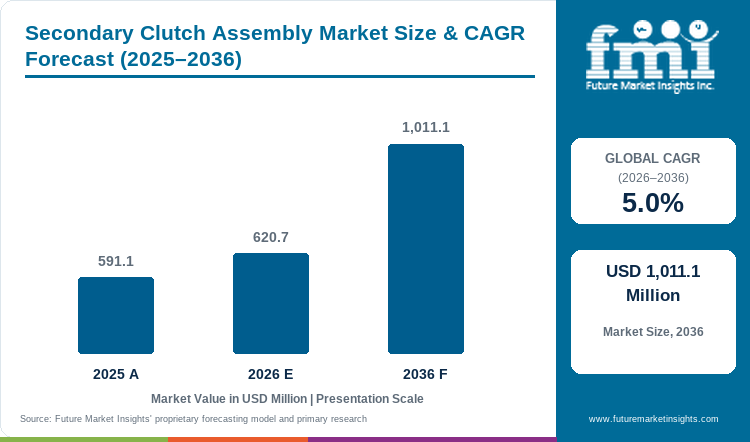
Sales of secondary clutch assemblies are estimated to grow at 5.0% CAGR through 2036. The market is valued at USD 591.1 Million in 2025, rising to USD 620.7 Million in 2026 and USD 1,011.1 Million by 2036. Demand mainly comes from vehicles that are already in use and need replacement or adjustment. Changes in tire diameter and towing load can affect how the clutch handles torque. Mud use and normal wear can also change clutch performance. A replacement clutch therefore needs to restore the expected balance between belt grip and backshift while handling the vehicle load properly. The U.S. Consumer Product Safety Commission's 2026 off-highway vehicle report shows the large number of ATVs, ROVs and UTVs that remain in active use.
These vehicles continue to build service hours, supporting ongoing demand for replacement clutch assemblies. Revenue conversion depends on exact fitment more than on generic pulley availability. CVTech-IBC's February 2025 guidance requires manufacturer-specified tightening torque and pulley-alignment checks, showing why installation data sits beside the hardware in the purchase decision. This service requirement connects secondary clutches with the wider power sports market, while their torque-sensitive operating role links them with the broader continuously variable transmission market. A complete assembly earns its value when the dealer can install it for the correct model year, belt geometry and load without creating another calibration problem.
Key Takeaways
- The market is valued at USD 591.1 Million in 2025. It is expected to grow from USD 620.7 Million in 2026 to USD 1,011.1 Million by 2036 at a 5.0% CAGR.
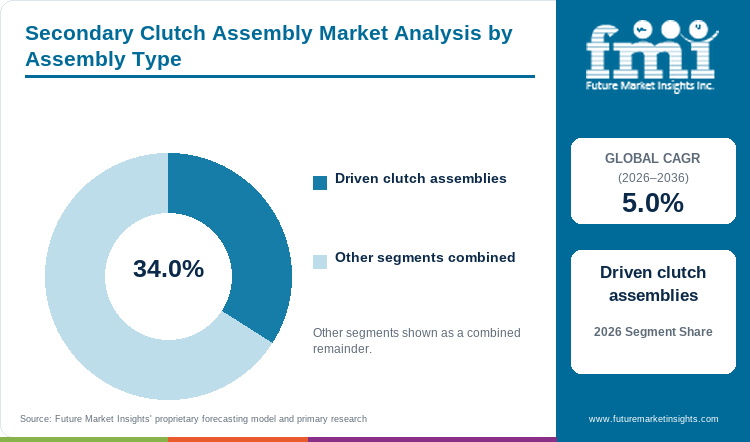
- Driven clutch assemblies lead Assembly Type with 34.0% share in 2026 because replacing the full unit can solve several wear-related problems on the secondary side at the same time.
- ATVs account for 33.0% of Vehicle Type demand. Trail riding and utility work create changing torque needs. Towing and tire changes can also affect clutch performance.
- Aftermarket replacement represents 43.0% of Sales Channel demand because many secondary-clutch problems appear after the vehicle has been used for some time or modified.
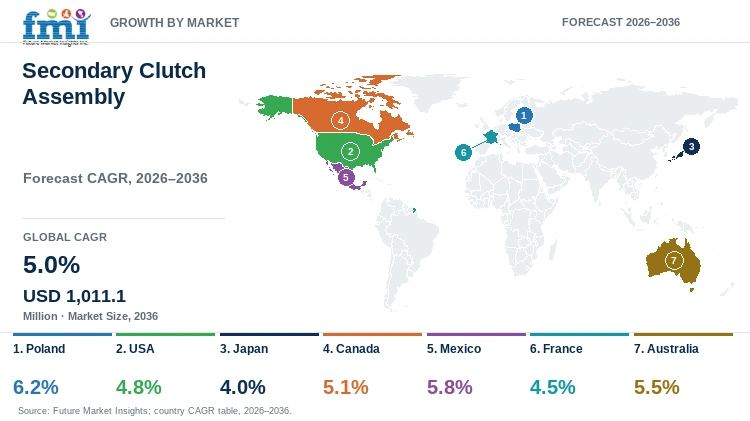
- Country growth ranges from 6.2% in Poland to 4.0% in Japan. Mexico is forecast at 5.8%, while Australia is at 5.5%.
- TEAM Industries, CVTech-IBC, EPI Performance, STM Powersports, Dalton Industries, Comet Industries, Hunterworks, SLP, Hilliard Corporation and GBoost Technology compete through assembly coverage and calibration options. Model-specific fitment is also important.
Analyst Perspective
“Secondary clutch margin is created before the assembly reaches the vehicle. A complete unit still creates repeat labor if belt offset, spring choice or helix geometry is wrong for the model and load. Suppliers that convert vehicle configuration into a clear installation path can compete on avoided diagnosis and workshop time, not only on hardware price.”
- Nikhil Kaitwade, Principal Consultant, Future Market Insights
How is the secondary clutch assembly market segmented?
The Secondary Clutch Assembly Market is segmented by Assembly Type, Vehicle Type, Sales Channel, Material, Application, and Region.
Assembly Type includes Driven clutch assemblies, Torque-sensing clutches, Roller secondary clutches, Helix-tuned clutches, and Performance secondary clutches. Vehicle Type includes ATVs, UTVs, Snowmobiles, Golf/utility carts, and Small off-road vehicles. Sales Channel includes Aftermarket replacement, OEM direct, Powersports dealers, and Performance tuners. Material includes Cast aluminum, Steel components, Forged aluminum, and Composite sheaves. Application includes Torque transfer, Belt tension control, Performance tuning, and Heavy-duty utility use.
Why do Driven clutch assemblies lead demand within the Assembly Type category?
A driven clutch assembly replaces the torque-reactive secondary mechanism as one operating unit instead of asking the technician to isolate wear across sheaves, rollers, helix surfaces and supporting parts. That distinction matters when several interfaces have already accumulated the same service hours. Hilliard Corporation's EP 4 563 849 A1, published in June 2025, describes a driven-clutch architecture with separate acceleration and engine-braking helix ramps. The design illustrates how multiple secondary-side components work together to control belt pinching and torque response.
- Driven clutch assemblies account for 34.0% of Assembly Type demand in 2026, giving them the leading position within the category.
- Complete-unit replacement is most valuable when restoring several worn interfaces separately would require more diagnosis, parts matching and setup time.
Why do ATVs lead demand within the Vehicle Type category?
ATVs move between operating conditions that impose different loads on the same CVT. A machine can be used for trail riding on one day and towing, forestry or estate work on another. Larger tires and soft terrain further change the torque presented to the driven clutch. Yamaha Motor Europe's February 2026 Kodiak Kiwami launch shows the breadth of this duty cycle, with models positioned for forestry, agriculture and estate management alongside off-road use. Similar load changes also affect other components tracked in the ATV differential market.
- ATVs represent 33.0% of Vehicle Type demand in 2026 because one platform can experience recreational use, utility loading and vehicle modification during its service life.
- Secondary-clutch demand rises when tire or load changes alter belt grip and backshift enough to require replacement or recalibration rather than routine belt service.
Why does Aftermarket replacement lead demand within the Sales Channel category?
The secondary clutch becomes commercially visible after the vehicle has accumulated wear or moved away from its original setup. EPI Performance lists direct-replacement Polaris secondary clutches while also identifying applications that require a new spring or helix. That distinction shows why aftermarket sales combine replacement with configuration. The buyer is not simply ordering another pulley. The workshop must determine whether the original calibration should be restored or changed for the vehicle's current use. This service-led buying pattern also appears across the wider power sports accessories market.
- Aftermarket replacement accounts for 43.0% of Sales Channel demand in 2026, making it the leading route to market.
- Fitment information has direct commercial value because some replacements retain the existing spring and helix while others require a different secondary-side setup.
Why does Cast aluminum lead demand within the Material category?
Secondary assemblies need large belt-contact surfaces without adding unnecessary rotating mass. Cast aluminum gives volume manufacturers a practical route to consistent sheave geometry while keeping component weight below an equivalent all-steel construction. Steel remains useful for shafts, hubs and highly stressed interfaces, while forged or billet aluminum becomes more attractive where higher loads or tunability justify additional manufacturing cost.
- Cast aluminum accounts for 36.0% of Material demand in 2026 because it combines scalable manufacturing with the mass requirements of rotating sheave components.
- Material selection is not uniform across the assembly. Steel remains relevant at concentrated load points, while billet or forged designs serve selected performance applications.
Why does Torque transfer lead demand within the Application category?
Torque transfer is the basic operating job of the secondary clutch. As belt radius changes between the primary and driven sides of the CVT, the secondary clutch must maintain belt engagement while transmitting torque to the driveline. Hilliard Corporation's June 2025 patent publication demonstrates how acceleration and engine-braking loads can require different ramp behavior within the same driven-clutch architecture. Performance tuning and belt-tension control add value only after that core transfer function remains stable.
- Torque transfer represents 37.0% of Application demand in 2026, the leading share within the category.
- Separate acceleration and engine-braking helix paths illustrate why secondary-clutch geometry must react differently to drive torque and deceleration torque.
What are the drivers, restraints and opportunities in the Secondary Clutch Assembly Market?
Recurring wear and recalibration support demand across belt-driven off-highway vehicles, while model-specific fitment and setup errors remain a restraint, creating opportunities for tunable complete assemblies with clear fitment guidance and serviceable calibration parts.
- Driver: Installed ATV and UTV fleets create recurring wear demand, while tire, load and duty changes can move shift behavior away from the original setup.
- Restraint: Pulley alignment, tightening torque, belt compatibility and secondary-side calibration are model-sensitive, so an incorrect installation can create heat, poor shifting and repeat workshop labor.
- Opportunity: Complete assemblies that combine exact fitment with selectable helix or spring configurations can shorten the path from diagnosis to a usable vehicle setup.
The demand mechanism starts with vehicle use rather than new-vehicle production alone. An ATV or UTV accumulates hours under changing traction and payload conditions. Owners may later install larger tires, add accessories or shift the vehicle toward heavier work. Dalton Industries' 2026 DB HD11-2 kit addresses this sequence directly by recalibrating CVT operation for 2026 Can-Am Defender HD11 models using larger tires. Secondary-clutch replacement therefore participates in the wider off-road vehicles market through an installed-base service cycle that continues long after the original vehicle purchase.
Installation is where many problems can occur. CVTech-IBC's February 2025 pulley specification tells technicians to check alignment with the correct tool, use the required tightening torque and adjust gearbox-shaft shims when measurements fall outside tolerance. Even a good secondary clutch can create belt heat or unstable shifting if the alignment is wrong. This makes correct model-year fitment and installation accuracy an important part of the product.
The opportunity is to make installation and tuning easier for workshops. STM Powersports offers a billet secondary assembly with selectable helix angles and spring choices for specific Can-Am applications. Suppliers can add more value by combining this tunability with a clear starting setup. This can reduce repeat adjustments, shorten installation time and give more predictable shifting after the vehicle returns to use.
Which country CAGRs are profiled in the Secondary Clutch Assembly Market?
| Country | CAGR |
|---|---|
| Poland | 6.2% |
| USA | 4.8% |
| Japan | 4.0% |
| Canada | 5.1% |
| Mexico | 5.8% |
| France | 4.5% |
| Australia | 5.5% |
How do country-level CAGRs compare in the Secondary Clutch Assembly Market?
Growth across the profiled countries ranges from 6.2% in Poland to 4.0% in Japan from 2026 to 2036. Poland and Mexico are growing faster than the global market, but for different reasons. Poland benefits from off-road vehicle manufacturing and utility ATV use. Mexico benefits from large-scale off-road vehicle production. Australia follows at 5.5%, supported by strong work and farm use of quad bikes. Canada grows at 5.1%, close to the global market rate. USA at 4.8%, France at 4.5% and Japan at 4.0% have more mature or selective replacement demand.
- Poland leads at 6.2%, which is 0.4 percentage points above Mexico. Local manufacturing and utility vehicle use support both original equipment and replacement demand.
- Mexico grows at 5.8%, supported by off-road vehicle manufacturing and replacement demand for locally produced vehicles.
- Australia grows at 5.5%, supported by heavy utility and farm use. This makes durability and correct clutch setup important.
- Canada grows at 5.1%, supported by local CVT engineering and aftermarket tuning through suppliers such as CVTech-IBC and Dalton Industries.
- USA grows at 4.8%, France at 4.5% and Japan at 4.0%. Each market requires a different approach to fitment and distribution based on local vehicle use.
Country-wise Analysis
- Poland: Demand for Secondary Clutch Assemblies in Poland is forecast to increase at 6.2% CAGR from 2026 to 2036. The country has utility vehicle demand as well as an established off-road manufacturing base. Yamaha Motor Europe introduced its Kodiak 700 and 450 Kiwami utility ATVs in February 2026 for forestry, agriculture and estate-management work. Polaris also reported a 365,000-square-foot wholegoods facility in Opole at year-end 2025. This supports demand from vehicle production as well as replacement once utility machines build up operating hours.
- USA: Demand for Secondary Clutch Assemblies in USA is projected to rise at 4.8% CAGR from 2026 to 2036. The U.S. Consumer Product Safety Commission's May 2026 report covers a large active base of ATVs, ROVs and UTVs. The aftermarket also gives owners access to springs, helixes and complete secondary units, along with tuning kits. The main challenge is choosing the right part for each model and year. Suppliers can reduce ordering mistakes by clearly separating direct replacement products from recalibrated applications.
- Japan: Demand for Secondary Clutch Assemblies in Japan is forecast to advance at 4.0% CAGR from 2026 to 2036. Yamaha Motor announced the domestic GRIZZLY EPS XT-R in July 2026 with an Ultramatic CVT and engine braking. It is sold through nationwide dealers on a build-to-order basis. This gives dealers a stronger role in replacement and service. Suppliers therefore compete more on correct fitment and clear service support than on offering many performance combinations.
- Canada: Demand for Secondary Clutch Assemblies in Canada is forecast to grow at 5.1% CAGR from 2026 to 2036. Canada has local capability in both replacement hardware and clutch calibration. CVTech-IBC's 2025 guidance covers pulley alignment and shimming, as well as torque requirements. Dalton Industries' 2026 product activity focuses on model-specific CVT recalibration for larger tires. This gives dealers access to both replacement parts and application-specific setup support.
- Mexico: Sales of Secondary Clutch Assemblies in Mexico are estimated to expand at 5.8% CAGR from 2026 to 2036. Polaris reported approximately 3.2 million square feet of mainly leased off-road wholegoods manufacturing space in Monterrey at the end of 2025. This creates demand from vehicle production as well as replacement for vehicles already in use. For suppliers, consistent fitment and assembly quality become more important when parts are used across large vehicle-production programs.
- France: Demand for Secondary Clutch Assemblies in France is forecast to rise at 4.5% CAGR from 2026 to 2036. France treats pure off-road vehicles differently from road-qualified heavy quadricycles. The Service-Public portal confirmed in May 2025 that the B1 licence covers L7e heavy motor quadricycles from age 16. Suppliers therefore need to match clutch assemblies to the correct vehicle application rather than treating all similar-sized vehicles the same.
- Australia: Demand for Secondary Clutch Assemblies in Australia is projected to grow at 5.5% CAGR from 2026 to 2036. The Australian Competition and Consumer Commission reported in November 2025 that 234 Australians had died in quad-bike incidents since 2011 and that most deaths occur on farms. This is a safety indicator rather than a measure of clutch demand, but it shows the work environment in which many vehicles operate. Farm and utility vehicles place greater importance on predictable low-speed response and correct setup than on complex tuning changes.
Who are the notable companies in the Secondary Clutch Assembly Market?
TEAM Industries; CVTech-IBC; EPI Performance; STM Powersports; Dalton Industries; Comet Industries; Hunterworks; SLP; Hilliard Corporation; GBoost Technology
The competitive field divides according to how the supplier reaches the secondary-clutch problem. TEAM Industries, CVTech-IBC, Hilliard Corporation and Comet Industries participate closer to CVT or drivetrain engineering. EPI Performance, STM Powersports and SLP expose spring, helix and complete-clutch choices directly to powersports buyers. Dalton Industries, Hunterworks and GBoost Technology concentrate more heavily on model-specific calibration or replacement needs in the aftermarket.
- System-level CVT suppliers compete on clutch architecture, integration with the rest of the transmission and manufacturing compatibility with vehicle programs.
- Performance secondary specialists make helix angle, spring rate and secondary calibration visible parts of the purchase decision.
- Replacement and calibration specialists win when they can translate a defined model, tire size or duty change into a narrower set of parts and settings.
Competitive Benchmarking: Secondary Clutch Assembly Market
| Company | Complete Secondary Assembly Coverage | Helix and Spring Calibration Depth | Vehicle Fitment and Integration | Geographic Reach |
|---|---|---|---|---|
| TEAM Industries | High | Medium | High | North America with OEM and off-highway drivetrain programs |
| CVTech-IBC | High | Medium | High | Canada with CVT applications serving international OEM markets |
| EPI Performance | High | High | High | United States with broad North American powersports aftermarket reach |
| STM Powersports | High | High | High | United States with ATV, UTV and snowmobile performance aftermarket reach |
| Dalton Industries | Medium | High | High | Canada with dealer and distributor access in multiple markets |
| Comet Industries | High | Medium | High | United States with OEM and aftermarket CVT applications |
| Hunterworks | High | Medium | High | United States direct aftermarket with international order support |
| SLP | High | High | High | United States with UTV and snowmobile performance aftermarket reach |
| Hilliard Corporation | Unscored | High | Unscored | United States engineering base with European patent activity |
| GBoost Technology | High | High | Medium | United States specialist powersports aftermarket |
Complete Secondary Assembly Coverage reflects availability of complete driven or secondary units across relevant vehicle applications. Helix and Spring Calibration Depth reflects the ability to alter secondary-side torque response through setup choices. Vehicle Fitment and Integration considers model specificity and compatibility with the broader CVT. High denotes broad capability within the criterion. Medium denotes a narrower position. Low denotes a defined limitation. Unscored is retained as a neutral benchmark state.
Key Developments in the Secondary Clutch Assembly Market
- In June 2026, Dalton Industries introduced the DB HD11-2 clutch kit for 2026 Can-Am Defender HD11 models using 33 to 34 inch tires. The kit recalibrates CVT components to manage upshift, belt grip and backshift under the additional tire load.
- In September 2025, TEAM Industries received U.S. Patent US 12,422,024 B2 for a continuously variable transmission clutch with a movable-sheave actuator. The architecture provides a control path for moving a sheave independently of the normal reactive clutch mechanism.
- In June 2025, Hilliard Corporation had European patent application EP 4 563 849 A1 published for a driven clutch with a dual-helix assembly using separate acceleration and engine-braking ramps.
Key Players in the Secondary Clutch Assembly Market
OEM-Grade CVT and Driven-System Engineering
- TEAM Industries
- CVTech-IBC
- Hilliard Corporation
- Comet Industries
Performance Secondary Assembly Specialists
- STM Powersports
- EPI Performance
- SLP
Replacement and Calibration Specialists
- Dalton Industries
- Hunterworks
- GBoost Technology
Secondary Clutch Assembly Market - Report Scope
| Coverage field | Report scope |
|---|---|
| Market breakdown | Assembly Type; Vehicle Type; Sales Channel; Material; Application |
| Quantitative Units | USD Million |
| Market Definition | Revenue includes complete secondary or driven CVT clutch assemblies sold for ATVs, UTVs, snowmobiles, golf/utility carts and small off-road vehicles. The scope excludes primary clutches, belts sold independently, complete transmissions, finished vehicles and adjacent substitute components. |
| Regions Covered | North America; Latin America; Western Europe; Eastern Europe; East Asia; South Asia & Pacific; Middle East & Africa |
| Countries Covered | Poland; USA; Japan; Canada; Mexico; France; Australia; plus more than twenty-five additional countries in the full report |
| Key Companies Profiled | TEAM Industries; CVTech-IBC; EPI Performance; STM Powersports; Dalton Industries; Comet Industries; Hunterworks; SLP; Hilliard Corporation; GBoost Technology |
| Forecast Period | 2026 to 2036 |
| Approach | Hybrid bottom-up and top-down sizing that connects vehicle application demand with replacement patterns, channel structure and supplier activity within the defined revenue boundary. |
Secondary Clutch Assembly Market - Research Methodology
| Method | Approach |
|---|---|
| Primary Research | Structured discussions with manufacturers, distributors, powersports dealers, performance tuners, repair specialists, OEM procurement contacts and vehicle service professionals. Interviews examine purchase triggers, replacement behavior, fitment requirements, calibration priorities and channel economics. |
| Desk Research | Review of government statistics, safety and regulatory material, patent records, company filings, current product documentation and trade information relevant to market scope, operating mechanisms, country conditions and supplier activity. |
| Market Sizing and Forecasting | Bottom-up application and replacement logic is compared with vehicle use, supplier activity, channel structure and manufacturing context. Forecast assumptions consider installed-base service requirements, OEM and aftermarket mix, fitment complexity and vehicle duty cycles. |
| Data Validation | Findings are compared across independent evidence types within the defined revenue boundary. Primary clutches, standalone belts, complete transmissions and finished vehicles are outside the market value. |
Secondary Clutch Assembly Market by Segments
Secondary Clutch Assembly Market segmented by Assembly Type:
- Driven clutch assemblies
- Torque-sensing clutches
- Roller secondary clutches
- Helix-tuned clutches
- Performance secondary clutches
Secondary Clutch Assembly Market segmented by Vehicle Type:
- ATVs
- UTVs
- Snowmobiles
- Golf/utility carts
- Small off-road vehicles
Secondary Clutch Assembly Market segmented by Sales Channel:
- Aftermarket replacement
- OEM direct
- Powersports dealers
- Performance tuners
Secondary Clutch Assembly Market segmented by Material:
- Cast aluminum
- Steel components
- Forged aluminum
- Composite sheaves
Secondary Clutch Assembly Market segmented by Application:
- Torque transfer
- Belt tension control
- Performance tuning
- Heavy-duty utility use
Secondary Clutch Assembly Market by Region
- North America
- United States
- Canada
- Latin America
- Brazil
- Mexico
- Argentina
- Chile
- Western Europe
- Germany
- France
- United Kingdom
- Italy
- Spain
- Benelux
- Nordics
- Eastern Europe
- Poland
- Czech Republic
- Romania
- Hungary
- East Asia
- China
- Japan
- South Korea
- South Asia & Pacific
- India
- ASEAN
- Australia and New Zealand
- Middle East & Africa
- GCC Countries
- South Africa
- Türkiye
- Israel
Research Sources and Bibliography
- U.S. Consumer Product Safety Commission. (2026, May 27). 2025 Report of Deaths and Injuries Involving Off-Highway Vehicles with More than Two Wheels.
- Polaris Inc. (2026, February 13). 2025 Annual Report.
- Yamaha Motor Co., Ltd. (2026, July 24). Domestic ATV GRIZZLY EPS XT-R New Model Announcement.
- Yamaha Motor Europe. (2026, February 16). Yamaha Expands Utility Line with Kodiak 700 and 450 Kiwami Editions.
- Australian Competition and Consumer Commission. (2025, November 14). Farmers and families urged to stay safe on quad bikes.
- Direction de l'information légale et administrative. (2025, May 26). Permis B1: quadricycle lourd à moteur.
- CVTech-IBC. (2025, February). Pulleys Geometrical Specifications.
- European Patent Office. (2025, June 4). EP 4 563 849 A1: Driven Clutch with Dual Helix Assembly for Continuously Variable Transmission.
- United States Patent and Trademark Office. (2025, September 23). US 12,422,024 B2: Continuously Variable Transmission Clutch with Movable Sheave Actuator.
- Dalton Industries. (2026, June). DB HD11-2.
- EPI Performance. (2026, accessed August 20). ATV / UTV Clutches - Secondary.
- STM Powersports. (2026, accessed August 20). VELOCITY Tuner Secondary Assembly Can-Am for Outlander Models with the stock P-Drive system.
This bibliography is provided for reader reference and is not exhaustive. The full report contains the complete reference list and detailed citations.
This Report Answers
- What is the Secondary Clutch Assembly Market size in 2025, 2026 and 2036?
- Which vehicle-use and service conditions support secondary-clutch replacement demand?
- Why do Driven clutch assemblies lead Assembly Type demand in 2026?
- Why do ATVs represent the leading Vehicle Type category?
- Why does Aftermarket replacement account for 43.0% of Sales Channel demand?
- How do growth rates differ across Poland, USA, Japan, Canada, Mexico, France and Australia?
- How do suppliers differ in complete-assembly coverage and secondary-side calibration capability?
- What should dealers and service buyers evaluate before ordering a secondary clutch assembly?
Frequently Asked Questions
What is driving growth in the Secondary Clutch Assembly Market?
Growth is supported by recurring wear and configuration changes across belt-driven ATVs, UTVs and other off-highway vehicles. Larger tires, towing loads and changes in vehicle duty can alter the torque conditions seen by the secondary clutch, creating replacement or recalibration demand after the original vehicle sale.
Who are the key players in the Secondary Clutch Assembly Market?
The profiled companies include TEAM Industries, CVTech-IBC, EPI Performance, STM Powersports, Dalton Industries, Comet Industries, Hunterworks, SLP, Hilliard Corporation and GBoost Technology. Their roles range from drivetrain engineering and complete-clutch supply to model-specific performance calibration.
What is a notable restraint in the Secondary Clutch Assembly Market?
A key restraint is installation precision. Pulley alignment, belt compatibility, tightening torque and spring or helix selection can vary by application. An unsuitable setup can create poor shift behavior or additional workshop work even when the replacement assembly itself is mechanically sound.
Why should executives track the Secondary Clutch Assembly Market?
The market converts an installed base of belt-driven vehicles into recurring component revenue. It is also technically demanding enough that suppliers can differentiate through fitment coverage and calibration support rather than competing on assembly price alone.
What business problem does the Secondary Clutch Assembly Market address?
Secondary clutch assemblies restore or alter the way a belt-driven CVT transfers torque from the primary clutch into the driveline. Complete assemblies allow service providers to address multiple secondary-side wear points without rebuilding every component individually.
What limits return on investment in the Secondary Clutch Assembly Market?
Return on investment weakens when a replacement requires repeated setup corrections after installation. Belt-offset errors, inappropriate spring or helix choices and poor model-year fitment can create labor and downtime that exceed the initial difference in component price.
Preview the report firsthand - request a free sample
Get SampleGet the brochure for pricing and purchase details.
Get PDFTable of Content
- Key Takeaways
- Market Size and CAGR
- Top Growth Driver
- Fastest Growing Segment
- Leading Region
- Key Companies
- Emerging Opportunities
- Executive Summary
- Global Market Outlook
- Demand-side Trends
- Supply-side Trends
- Technology Roadmap Analysis
- Analysis and Recommendations
- Analyst Perspective (What is happening? Why now? What should investors know?)
- Key Questions Answered
- How large is the market?
- What is the CAGR?
- What are key trends?
- Which region dominates?
- Who are the leaders?
- Market Overview
- Market Coverage / Taxonomy
- Market Definition / Scope / Limitations
- Research Methodology
- Chapter Orientation
- Analytical Lens and Working Hypotheses
- Market Structure, Signals, and Trend Drivers
- Benchmarking and Cross-market Comparability
- Market Sizing, Forecasting, and Opportunity Mapping
- Research Design and Evidence Framework
- Desk Research Programme (Secondary Evidence)
- Expert Input and Fieldwork (Primary Evidence)
- Tooling, Models, and Reference Databases
- Data Engineering and Model Build
- Quality Assurance and Audit Trail
- Market Background
- Market Dynamics (Drivers, Restraints, Opportunity, Trends)
- Scenario Forecast (Optimistic, Likely, Conservative)
- Impact Analysis
- AI Impact
- Sustainability Impact
- Regulatory Impact
- Technology Impact
- Consumer / Buyer Analysis
- Purchase Drivers
- Adoption Barriers
- Buyer Journey
- Opportunity Map Analysis
- Product Life Cycle Analysis
- Supply Chain Analysis
- Investment Feasibility Matrix
- Value Chain Analysis
- PESTLE and Porter's Analysis
- Regulatory Landscape
- Regional Parent Market Outlook
- Production and Consumption Statistics
- Import and Export Statistics
- Global Market Analysis and Forecast, 2021 to 2036
- Historical Market Size Value (USD Million) Analysis, 2021 to 2025
- Current and Future Market Size Value (USD Million) Projections, 2026 to 2036
- Y-o-Y Growth Trend Analysis
- Absolute $ Opportunity Analysis
- Global Market Pricing Analysis, 2021 to 2036
- Global Market Analysis and Forecast, By Assembly Type, 2021 to 2036
- Introduction / Key Findings
- Historical Market Size Value (USD Million) Analysis By Assembly Type, 2021 to 2025
- Current and Future Market Size Value (USD Million) Analysis and Forecast By Assembly Type, 2026 to 2036
- Driven clutch assemblies
- Torque-sensing clutches
- Roller secondary clutches
- Helix-tuned clutches
- Performance secondary clutches
- Y-o-Y Growth Trend Analysis By Assembly Type, 2021 to 2025
- Absolute $ Opportunity Analysis By Assembly Type, 2026 to 2036
- Global Market Analysis and Forecast, By Vehicle Type, 2021 to 2036
- Introduction / Key Findings
- Historical Market Size Value (USD Million) Analysis By Vehicle Type, 2021 to 2025
- Current and Future Market Size Value (USD Million) Analysis and Forecast By Vehicle Type, 2026 to 2036
- ATVs
- UTVs
- Snowmobiles
- Golf/utility carts
- Small off-road vehicles
- Y-o-Y Growth Trend Analysis By Vehicle Type, 2021 to 2025
- Absolute $ Opportunity Analysis By Vehicle Type, 2026 to 2036
- Global Market Analysis and Forecast, By Sales Channel, 2021 to 2036
- Introduction / Key Findings
- Historical Market Size Value (USD Million) Analysis By Sales Channel, 2021 to 2025
- Current and Future Market Size Value (USD Million) Analysis and Forecast By Sales Channel, 2026 to 2036
- Aftermarket replacement
- OEM direct
- Powersports dealers
- Performance tuners
- Y-o-Y Growth Trend Analysis By Sales Channel, 2021 to 2025
- Absolute $ Opportunity Analysis By Sales Channel, 2026 to 2036
- Global Market Analysis and Forecast, By Material, 2021 to 2036
- Introduction / Key Findings
- Historical Market Size Value (USD Million) Analysis By Material, 2021 to 2025
- Current and Future Market Size Value (USD Million) Analysis and Forecast By Material, 2026 to 2036
- Cast aluminum
- Steel components
- Forged aluminum
- Composite sheaves
- Y-o-Y Growth Trend Analysis By Material, 2021 to 2025
- Absolute $ Opportunity Analysis By Material, 2026 to 2036
- Global Market Analysis and Forecast, By Application, 2021 to 2036
- Introduction / Key Findings
- Historical Market Size Value (USD Million) Analysis By Application, 2021 to 2025
- Current and Future Market Size Value (USD Million) Analysis and Forecast By Application, 2026 to 2036
- Torque transfer
- Belt tension control
- Performance tuning
- Heavy-duty utility use
- Y-o-Y Growth Trend Analysis By Application, 2021 to 2025
- Absolute $ Opportunity Analysis By Application, 2026 to 2036
- Global Market Analysis and Forecast, By Region, 2021 to 2036
- Introduction
- Historical Market Size Value (USD Million) Analysis By Region, 2021 to 2025
- Current Market Size Value (USD Million) Analysis and Forecast By Region, 2026 to 2036
- North America
- Latin America
- Western Europe
- Eastern Europe
- East Asia
- South Asia & Pacific
- Middle East & Africa
- Market Attractiveness Analysis By Region
- North America Market Analysis and Forecast, By Country, 2021 to 2036
- Historical Market Size Value (USD Million) Trend Analysis By Market Taxonomy, 2021 to 2025
- Market Size Value (USD Million) Forecast By Market Taxonomy, 2026 to 2036
- By Country
- United States
- Canada
- By Assembly Type
- By Vehicle Type
- By Sales Channel
- By Material
- By Application
- By Country
- Market Attractiveness Analysis
- By Country
- By Assembly Type
- By Vehicle Type
- By Sales Channel
- By Material
- By Application
- Key Takeaways
- Latin America Market Analysis and Forecast, By Country
- Historical Market Size Value (USD Million) Trend Analysis By Market Taxonomy, 2021 to 2025
- Market Size Value (USD Million) Forecast By Market Taxonomy, 2026 to 2036
- By Country
- Brazil
- Mexico
- Argentina
- Chile
- By Assembly Type
- By Vehicle Type
- By Sales Channel
- By Material
- By Application
- By Country
- Market Attractiveness Analysis
- By Country
- By Assembly Type
- By Vehicle Type
- By Sales Channel
- By Material
- By Application
- Key Takeaways
- Western Europe Market Analysis and Forecast, By Country
- Historical Market Size Value (USD Million) Trend Analysis By Market Taxonomy, 2021 to 2025
- Market Size Value (USD Million) Forecast By Market Taxonomy, 2026 to 2036
- By Country
- Germany
- France
- United Kingdom
- Italy
- Spain
- Benelux
- Nordics
- By Assembly Type
- By Vehicle Type
- By Sales Channel
- By Material
- By Application
- By Country
- Market Attractiveness Analysis
- By Country
- By Assembly Type
- By Vehicle Type
- By Sales Channel
- By Material
- By Application
- Key Takeaways
- Eastern Europe Market Analysis and Forecast, By Country
- Historical Market Size Value (USD Million) Trend Analysis By Market Taxonomy, 2021 to 2025
- Market Size Value (USD Million) Forecast By Market Taxonomy, 2026 to 2036
- By Country
- Poland
- Czech Republic
- Romania
- Hungary
- By Assembly Type
- By Vehicle Type
- By Sales Channel
- By Material
- By Application
- By Country
- Market Attractiveness Analysis
- By Country
- By Assembly Type
- By Vehicle Type
- By Sales Channel
- By Material
- By Application
- Key Takeaways
- East Asia Market Analysis and Forecast, By Country
- Historical Market Size Value (USD Million) Trend Analysis By Market Taxonomy, 2021 to 2025
- Market Size Value (USD Million) Forecast By Market Taxonomy, 2026 to 2036
- By Country
- China
- Japan
- South Korea
- By Assembly Type
- By Vehicle Type
- By Sales Channel
- By Material
- By Application
- By Country
- Market Attractiveness Analysis
- By Country
- By Assembly Type
- By Vehicle Type
- By Sales Channel
- By Material
- By Application
- Key Takeaways
- South Asia & Pacific Market Analysis and Forecast, By Country
- Historical Market Size Value (USD Million) Trend Analysis By Market Taxonomy, 2021 to 2025
- Market Size Value (USD Million) Forecast By Market Taxonomy, 2026 to 2036
- By Country
- India
- ASEAN
- Australia and New Zealand
- By Assembly Type
- By Vehicle Type
- By Sales Channel
- By Material
- By Application
- By Country
- Market Attractiveness Analysis
- By Country
- By Assembly Type
- By Vehicle Type
- By Sales Channel
- By Material
- By Application
- Key Takeaways
- Middle East & Africa Market Analysis and Forecast, By Country
- Historical Market Size Value (USD Million) Trend Analysis By Market Taxonomy, 2021 to 2025
- Market Size Value (USD Million) Forecast By Market Taxonomy, 2026 to 2036
- By Country
- GCC Countries
- South Africa
- Türkiye
- Israel
- By Assembly Type
- By Vehicle Type
- By Sales Channel
- By Material
- By Application
- By Country
- Market Attractiveness Analysis
- By Country
- By Assembly Type
- By Vehicle Type
- By Sales Channel
- By Material
- By Application
- Key Takeaways
- Key Countries Market Analysis
- United States
- Pricing Analysis
- Market Share Analysis, 2025
- By Assembly Type
- By Vehicle Type
- By Sales Channel
- By Material
- By Application
- Canada
- Pricing Analysis
- Market Share Analysis, 2025
- By Assembly Type
- By Vehicle Type
- By Sales Channel
- By Material
- By Application
- Mexico
- Pricing Analysis
- Market Share Analysis, 2025
- By Assembly Type
- By Vehicle Type
- By Sales Channel
- By Material
- By Application
- Brazil
- Pricing Analysis
- Market Share Analysis, 2025
- By Assembly Type
- By Vehicle Type
- By Sales Channel
- By Material
- By Application
- Chile
- Pricing Analysis
- Market Share Analysis, 2025
- By Assembly Type
- By Vehicle Type
- By Sales Channel
- By Material
- By Application
- Germany
- Pricing Analysis
- Market Share Analysis, 2025
- By Assembly Type
- By Vehicle Type
- By Sales Channel
- By Material
- By Application
- United Kingdom
- Pricing Analysis
- Market Share Analysis, 2025
- By Assembly Type
- By Vehicle Type
- By Sales Channel
- By Material
- By Application
- Italy
- Pricing Analysis
- Market Share Analysis, 2025
- By Assembly Type
- By Vehicle Type
- By Sales Channel
- By Material
- By Application
- Spain
- Pricing Analysis
- Market Share Analysis, 2025
- By Assembly Type
- By Vehicle Type
- By Sales Channel
- By Material
- By Application
- France
- Pricing Analysis
- Market Share Analysis, 2025
- By Assembly Type
- By Vehicle Type
- By Sales Channel
- By Material
- By Application
- India
- Pricing Analysis
- Market Share Analysis, 2025
- By Assembly Type
- By Vehicle Type
- By Sales Channel
- By Material
- By Application
- ASEAN
- Pricing Analysis
- Market Share Analysis, 2025
- By Assembly Type
- By Vehicle Type
- By Sales Channel
- By Material
- By Application
- Australia and New Zealand
- Pricing Analysis
- Market Share Analysis, 2025
- By Assembly Type
- By Vehicle Type
- By Sales Channel
- By Material
- By Application
- China
- Pricing Analysis
- Market Share Analysis, 2025
- By Assembly Type
- By Vehicle Type
- By Sales Channel
- By Material
- By Application
- Japan
- Pricing Analysis
- Market Share Analysis, 2025
- By Assembly Type
- By Vehicle Type
- By Sales Channel
- By Material
- By Application
- South Korea
- Pricing Analysis
- Market Share Analysis, 2025
- By Assembly Type
- By Vehicle Type
- By Sales Channel
- By Material
- By Application
- Poland
- Pricing Analysis
- Market Share Analysis, 2025
- By Assembly Type
- By Vehicle Type
- By Sales Channel
- By Material
- By Application
- Hungary
- Pricing Analysis
- Market Share Analysis, 2025
- By Assembly Type
- By Vehicle Type
- By Sales Channel
- By Material
- By Application
- Türkiye
- Pricing Analysis
- Market Share Analysis, 2025
- By Assembly Type
- By Vehicle Type
- By Sales Channel
- By Material
- By Application
- South Africa
- Pricing Analysis
- Market Share Analysis, 2025
- By Assembly Type
- By Vehicle Type
- By Sales Channel
- By Material
- By Application
- Australia
- Pricing Analysis
- Market Share Analysis, 2025
- By Assembly Type
- By Vehicle Type
- By Sales Channel
- By Material
- By Application
- United States
- Market Structure Analysis
- Competition Dashboard
- Competition Benchmarking
- Market Share Analysis of Top Players
- By Regional
- By Assembly Type
- By Vehicle Type
- By Sales Channel
- By Material
- By Application
- Emerging Startups
- Innovation Benchmarking
- Competition Analysis
- Competition Deep Dive
- TEAM Industries
- Overview
- Product Portfolio
- Profitability by Market Segments
- Sales Footprint
- Strategy Overview
- Marketing Strategy
- Product Strategy
- Channel Strategy
- CVTech-IBC
- EPI Performance
- STM Powersports
- Dalton Industries
- Comet Industries
- Hunterworks
- SLP
- Hilliard Corporation
- GBoost Technology
- TEAM Industries
- Case Studies
- Success Stories
- Recent Developments
- Competition Deep Dive
- Assumptions & Acronyms Used


