

- Market Size (2026)
- USD 1.3 Bn
- Forecast (2036)
- USD 2.0 Bn
- CAGR (2026 to 2036)
- 5.1%
How big is ATV Differential Market in 2026?
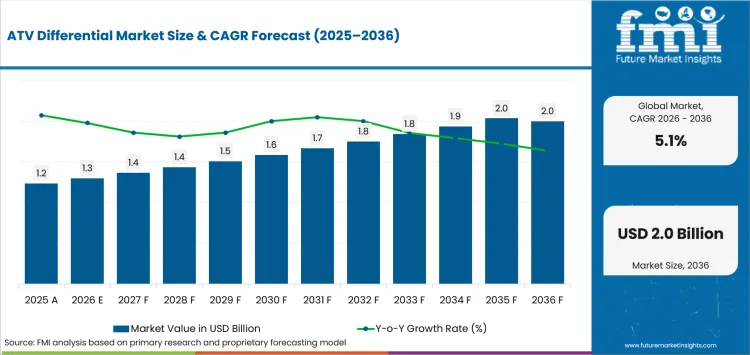
USD 1.3 billion in 2026 and USD 2.0 billion by 2036 at a 5.1% CAGR.
Demand for ATV differentials is projected to expand at 5.1% CAGR between 2026 and 2036, increasing valuation from USD 1.3 billion to USD 2.0 billion. Repeated use on designated off-road routes keeps locking and differential hardware exposed to changing wheel grip. National Park Service guidance updated in May 2026 lists 388 miles of designated roads at Glen Canyon including 304 unpaved miles. That road mix sustains first-fit traction requirements and later replacement demand after extended off-road use.
Country conversion differs even among close growth rates because utility registration rules determine which off-road platforms can enter regular work. The model places Norway at 6.2% CAGR and Australia at 5.9% during 2026-2036. Statistics Norway recorded 329,345 registered tractors in 2025 with national registrations rising 2.1% from 2024. The tractor fleet does not measure ATV demand directly, but it explains why Norwegian fitment records and tractor-class service routes carry commercial weight.
Key Takeaways of ATV Differential Market
- Variable trail surfaces and utility work keep traction transfer central to ATV and UTV driveline specification and replacement decisions.
- By differential type, locking differentials are estimated to hold 25.0% in 2026 owing to positive axle coupling on loose surfaces.
- Based on vehicle type, UTVs are projected to account for 36.0% in 2026 due to higher work-cycle drivetrain loading.
- In 2026, OEM direct is expected to lead sales channel with 42.0% share because vehicle-level validation fixes platform fitment before production.
- Platform-specific ratios, housings and engagement hardware limit interchangeability and increase the cost of carrying broad aftermarket coverage.
- Some of the key players in this market include TEAM Industries, The Hilliard Corporation, Yamaha Motor Corporation, U.S.A., BRP Inc., Polaris Inc., Kawasaki Motors Corp., U.S.A., Suzuki Motor USA, LLC, and GKN Automotive.
Analyst Perspective
"ATV differential programs are won at the fitment level because housing geometry and engagement behavior must match a named vehicle platform. Aftermarket margin improves once complete assemblies reduce rebuild uncertainty without forcing dealers to stock several near-identical internal parts."
- Nikhil Kaitwade, Principal Consultant, Future Market Insights
How is the ATV Differential Market segmented?
The market is analyzed by differential type, vehicle type, sales channel, component, application and region.
Differential type covers locking, limited-slip, open and electronic limited-slip designs. Vehicle type includes UTVs, ATVs, side-by-sides, utility vehicles and youth ATVs. Sales channels separate OEM direct, aftermarket and distributor routes. Components include complete assemblies, carriers, gearsets, bearings and seals plus actuation hardware. Applications cover trail riding, towing, mud or sand, racing and heavy-duty commercial use.
What drives Trail riding leadership in the Application category?
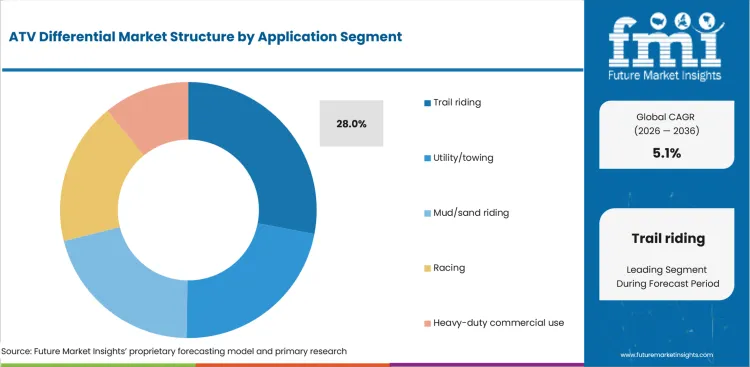
Off-road trail use repeatedly changes wheel grip as vehicles cross hardpack and loose soil during one outing. Differential behavior therefore affects steering feel and forward progress during the same operating cycle instead of one isolated obstacle.
- By application, trail riding is forecast to represent 28.0% in 2026 driven by frequent surface changes requiring predictable differentiation and selectable traction.
- Polaris announced its 2026 off-road lineup in July 2025 with Sportsman models using on-demand all-wheel drive that reacts to tire slip. The launch reinforces traction control as a visible feature for recreational and utility riders.
What makes Locking differentials central to the Differential type category?
Loose soil exposes the weakness of an open torque split once one tire loses usable grip. Locking designs restore positive axle coupling and release it as normal steering returns under stable grip.
- By differential type, the locking differential segment is estimated to hold 25.0% in 2026 owing to positive axle coupling during low-grip operation.
- Kawasaki Motors Corp., U.S.A. specified selectable 2WD/4WD with variable front differential lock in its January 2025 Brute Force 750 release. The documented control keeps locking behavior visible during purchase and service decisions.
Why do UTVs lead the Vehicle type category?
UTVs carry payload and tow equipment for longer daily periods than lighter recreational machines. These UTV duty cycles place repeated load on final-drive hardware and raise the value of service access for bearings and complete assemblies.
- In 2026, UTVs are expected to lead vehicle type with 36.0% share because work-oriented loading increases drivetrain exposure during daily use.
- A February 2025 Royal Canadian Mounted Police tender states that its emergency response team uses multiple off-road vehicles including a UTV and an ATV. Federal operational use illustrates why fleet buyers require transportable vehicles with dependable field support.
How does OEM direct retain the lead in the Sales channel category?
Differential selection follows housing geometry and axle interfaces plus the all-wheel-drive control logic used by each platform. OEM sourcing captures this specification during pre-production validation with the surrounding driveline under expected operating loads.
- Based on sales channel, OEM direct is projected to account for 42.0% in 2026 due to vehicle-level validation fixing first-fit engagement requirements.
- GKN Automotive presented limited-slip differentials and torque-management devices at CTI Symposium USA in May 2025. The event put those systems before vehicle engineering teams during series-production planning and calibration review.
What are the drivers, restraints and opportunities in the ATV Differential Market?
Selectable traction hardware supports demand, platform-specific validation limits interchangeability and compact controlled differentials widen the addressable upgrade route.
- Driver: Mixed trail and utility duty repeatedly shifts available wheel grip, keeping differential engagement and gear durability tied to vehicle performance.
- Restraint: Model-specific housings and ratios increase validation work while actuation layouts reduce the number of replacement units fitting multiple platforms.
- Opportunity: Compact electronically controlled torque systems shorten traction response and preserve serviceable mechanical interfaces for off-road vehicle platforms.
Trail and utility riding repeatedly shifts wheel grip, so differential engagement must change without making ordinary steering heavy. The USA Forest Service updated its Hawkwright Trailhead page in February 2025 and documents 52 miles of ATV loops in South Dakota. That route exposure keeps gear durability and predictable lock release relevant to first-fit selection and later service.
Replacement coverage narrows as ratios and splines must match the original differential housing fitment for service installation. In April 2025 the USA Consumer Product Safety Commission recalled about 1,300 youth ATVs for failures against the federal mandatory ATV standard. The recall concerns vehicle safety instead of differential quality, but it demonstrates why replacement programs require platform-level documentation prior to service-channel release.
Controlled torque hardware gives engineers a route to shorten traction response without locking both wheels during normal steering. BorgWarner announced an electric cross-differential program in July 2025 that reallocates wheel torque under changing friction. The passenger-vehicle program does not prove ATV adoption because electric UTV platforms require separate sealing and shock-load validation before similar control hardware reaches off-road duty.
Which country CAGRs are profiled in the ATV Differential Market?
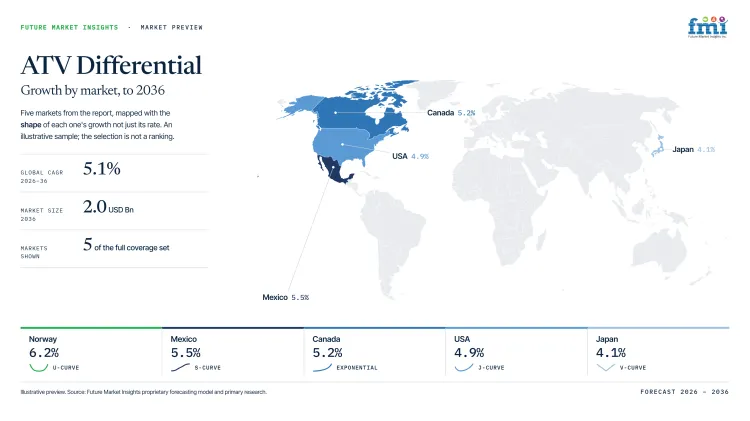
| Country | CAGR |
|---|---|
| Norway | 6.2% |
| Mexico | 5.5% |
| Canada | 5.2% |
| USA | 4.9% |
| Japan | 4.1% |
How do country-level CAGRs compare in the ATV Differential Market?
The forecasts form a narrow 1.3-point band, with Norway and Australia above the group and the USA at its lower edge. Mexico holds the midpoint as Canada bridges Mexico and the USA. The spacing reflects different operating mixes instead of current market size because utility work and recreation produce different replacement cycles.
- Norway's winter utility use raises demand for cold-weather driveline durability and sealing.
- Mexico's northern manufacturing base shortens regional replenishment routes for drivetrain assemblies.
- Canada's mixed work and recreation channels divide replacement demand by vehicle use.
- USA aftermarket scale supports deeper inventory coverage for widely used ATV platforms.
- Japan’s specialized ATV applications support targeted inventory coverage for commonly used ATV platforms.
Comparable CAGRs produce different order timing as installed fleets reach service channels differently. The full report provides country-level CAGR analysis across North America, Latin America, Europe, East Asia, South Asia, Oceania and the Middle East and Africa.
Country-wise Analysis
- Norwegian ATV and UTV use overlaps farm and utility work registered under tractor rules, making licence eligibility part of purchase decisions for local operators. The Norway ATV differential sector is projected to record 6.2% CAGR during the assessment period, tied to utility demand for selectable traction on steep or slippery ground. Statens vegvesen opened a June 2026 consultation for a new LT licence class covering lighter ATVs and UTVs with targeted training for registered tractor models. Clearer training gives compliant dealers a defined operating route, but imported platforms still require fitment records matching each registration class and approved drivetrain configuration for sale.
- Mexico supports regular recreational ATV and UTV use through organized routes that put traction hardware under repeated load far from major service centers. Chihuahua's tourism ministry announced in February 2025 that its FITA calendar included 90 events in 42 municipalities and listed ATV and UTV routes among scheduled disciplines. Local event density gives dealers a steady service base, but long distances between riding areas and specialist workshops can extend repair cycles for exact-fit assemblies. ATV differential sales in Mexico are forecast to expand at 5.5% CAGR by 2036, helped by tourism programs that keep off-road vehicle activity commercially visible throughout the year.
- Canadian UTV and ATV operators often work far from specialist workshops, making transport time and exact replacement fitment part of rural repair economics. Canada is estimated to post 5.2% CAGR over the forecast period, given fleet and recreational demand for serviceable hardware with reliable dealer support in remote regions. Transport Canada published a March 2025 recall covering the 2025 ARGO Magnum XF 1000 UTV after an accelerator issue required dealer repair to restore regular use. Dealer networks provide corrective work, but remote operating areas make small fitment errors expensive once disabled vehicles need specialist transport for drivetrain service and calibration.
- USA ATV ownership spans trail recreation and property work, giving replacement brands a large installed base with substantial model-specific variation between vehicle families. Dealers compete on vehicle identification and parts availability because drivetrain service depends on matching the original platform during installation. ATV differential demand in the USA is forecast to rise at 4.9% CAGR over the forecast period, propelled by four-wheel-drive use and differential remanufacturing programs after heavy duty cycles. In May 2026 the USA Consumer Product Safety Commission recalled about 2,820 Can-Am Outlander ATVs, reinforcing the commercial value of exact model records during dealer service and warranty handling.
- Japan’s ATV ownership is concentrated across recreational trail riding, agricultural, and utility applications, creating a specialized installed base with substantial model-specific variation between vehicle families. Dealers compete on vehicle identification and parts availability because drivetrain servicing depends on matching the original platform during installation. ATV differential demand in Japan is forecast to rise at 4.1% CAGR over the forecast period, supported by four-wheel-drive applications and replacement demand following intensive operating cycles. This model diversity increases the importance of accurate vehicle records and compatible differential components during dealer service and parts replacement.
Who are the notable companies in the ATV Differential Market?
TEAM Industries, The Hilliard Corporation, Yamaha Motor Corporation, U.S.A., BRP Inc., Polaris Inc., Kawasaki Motors Corp., U.S.A., Suzuki Motor USA, LLC, GKN Automotive
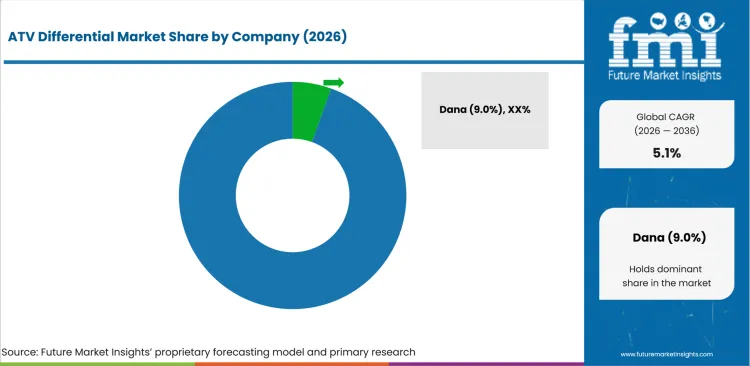
Competition separates specialist drivetrain manufacturers from vehicle OEMs that define first-fit traction behavior. TEAM Industries and The Hilliard Corporation work directly in powersports driveline programs. GKN Automotive contributes broader differential engineering and axle carrier assemblies for adjacent vehicle platforms. Yamaha and BRP join Polaris plus Kawasaki and Suzuki as vehicle OEMs setting reference specifications for service and replacement.
- TEAM Industries, The Hilliard Corporation and GKN Automotive address driveline design plus differential integration for powersports vehicle programs.
- Yamaha Motor Corporation, U.S.A., BRP Inc. and Polaris Inc. specify traction systems on broad ATV and UTV families with established dealer service.
- Kawasaki Motors Corp., U.S.A. and Suzuki Motor USA, LLC retain utility ATV positions with selectable 4WD and visible differential-control features.
Competitive Benchmarking: ATV Differential Market
| Company | ATV/UTV driveline fit | Traction-control depth | Platform validation depth | Geographic Reach |
|---|---|---|---|---|
| TEAM Industries | High | High | High | North America and Mexico |
| The Hilliard Corporation | High | High | Medium | North America and export markets |
| Yamaha Motor Corporation, U.S.A. | High | High | High | Global |
| BRP Inc. | High | High | High | Global |
| Polaris Inc. | High | Medium | High | Global |
| Kawasaki Motors Corp., U.S.A. | High | High | High | Global |
| Suzuki Motor USA, LLC | High | High | High | Global |
| GKN Automotive | Medium | High | High | Global |
Scoring basis: High driveline fit requires direct ATV or UTV evidence, Medium requires adjacent off-road evidence and Low reflects automotive-only evidence. High traction depth requires multiple control modes, Medium requires one documented route and Low identifies conventional differential supply. High platform validation requires OEM engineering plus testing or production, Medium shows one validation route and Low indicates component-only evidence.
Key Developments in the ATV Differential Market
- In September 2025, Yamaha Motor Corporation, U.S.A. announced its 2026 ATV lineup with Grizzly and Kodiak utility models retaining selectable On-Command four-wheel drive.
- In August 2025, BRP Inc. launched the 2026 Can-Am Outlander Electric ATV with its in-house Rotax E-Power system, highlighting the shift toward electrified ATV drivetrains and evolving requirements for differential and power-transfer components.
- In January 2025, Polaris Inc. released six additional 2025 ATV models spanning mud, sport and touring use within its Sportsman and Scrambler families.
Key Players in the ATV Differential Market
Driveline Specialists
- TEAM Industries
- The Hilliard Corporation
ATV and UTV Platform Manufacturers
- Yamaha Motor Corporation, U.S.A.
- BRP Inc.
- Polaris Inc.
- Kawasaki Motors Corp., U.S.A.
- Suzuki Motor USA, LLC
Broader Torque-Management Engineering
- GKN Automotive
ATV Differential Market - Report Scope
| Coverage field | Report scope |
|---|---|
| Market breakdown | By differential type, vehicle type, sales channel, component, application and region. |
| Quantitative Units | USD Million. |
| Market Definition | Differential assemblies and related internal or actuation components used in ATVs, UTVs and side-by-side off-road vehicle platforms. |
| Regions Covered | North America, Latin America, Europe, East Asia, South Asia and Pacific, and Middle East and Africa. |
| Countries Covered | Norway, Australia, Mexico, Canada, USA, and 20+ countries included in the full report. |
| Key Companies Profiled | TEAM Industries, The Hilliard Corporation, Yamaha Motor Corporation, U.S.A., BRP Inc., Polaris Inc., Kawasaki Motors Corp., U.S.A., Suzuki Motor USA, LLC, GKN Automotive |
| Forecast Period | 2026 to 2036. |
| Approach | Primary and secondary research with market triangulation. |
ATV Differential Market - Research Methodology
| Method | Approach |
|---|---|
| Primary Research | FMI analysts gathered input from manufacturers, service providers, technology developers, distributors, end users, procurement teams, and subject-matter experts. Interviews examined purchasing decisions, product or service evaluation, adoption barriers, approval requirements, pricing considerations, and expectations for technical or commercial support. Respondents were also asked what evidence is required before a trial, pilot, or initial order develops into regular purchasing. |
| Desk Research | Desk research covered government statistics, regulatory publications, trade data, industry associations, technical literature, standards, company filings, product information, and official corporate announcements. Sources were reviewed for relevance, publication date, geographic coverage, and consistency with the defined market scope. Claims relating to performance, applications, approvals, capacity, investment, and commercial activity were retained only when supported by credible public evidence. |
| Market Sizing and Forecasting | The market model combined the baseline value with historical performance, segment structure, pricing and volume indicators, adoption levels, company participation, and country-level demand conditions. Forecast assumptions considered economic activity, investment trends, regulatory developments, technology adoption, purchasing cycles, supply availability, and barriers to wider market use. Segment and regional estimates were reconciled before the final market total was calculated. |
| Data Validation | Estimates were checked against multiple independent indicators, including public data, company activity, trade patterns, industry developments, and findings from primary interviews. Validation also tested whether products, services, applications, and company revenues fell within the defined market boundaries. Adjacent categories, unsupported claims, overlapping revenues, and activities without direct market relevance were excluded to reduce double counting and maintain consistency across segments and countries. |
ATV Differential Market by Segments
ATV Differential Market segmented by Differential Type:
- Locking differentials
- Limited-slip differentials
- Open differentials
- Electronic limited-slip differentials
ATV Differential Market segmented by Vehicle Type:
- UTVs
- ATVs
- Side-by-sides
- Utility vehicles
- Youth ATVs
ATV Differential Market segmented by Sales Channel:
- OEM direct
- Aftermarket
- Distributors
ATV Differential Market segmented by Component:
- Complete assemblies
- Carriers
- Gearsets
- Bearings and seals
- Actuation hardware
ATV Differential Market segmented by Application:
- Trail riding
- Towing
- Mud or sand
- Racing
- Heavy-duty commercial use
ATV Differential Market by Region:
- North America
- United States
- Canada
- Latin America
- Brazil
- Mexico
- Chile
- Rest of Latin America
- Western Europe
- Germany
- United Kingdom
- Italy
- Spain
- France
- Nordics
- Benelux
- Rest of Western Europe
- Eastern Europe
- Russia
- Poland
- Hungary
- Balkan and Baltic States
- Rest of Eastern Europe
- East Asia
- China
- Japan
- South Korea
- South Asia and Pacific
- India
- ASEAN
- Australia and New Zealand
- Rest of South Asia and Pacific
- Middle East and Africa
- Kingdom of Saudi Arabia
- Other GCC Countries
- Türkiye
- South Africa
- Other African Union Countries
- Rest of Middle East and Africa
Research Sources and Bibliography
- National Park Service. (2026, May 19). Off-Road Vehicles - Glen Canyon National Recreation Area.
- Statistics Norway. (2026, March 6). Registered vehicles.
- Kawasaki Motors Corp., U.S.A. (2025, January 21). 2025 Kawasaki Brute Force 750, Brute Force 750 EPS, and Brute Force 750 EPS LE All-Terrain Vehicles.
- Royal Canadian Mounted Police. (2025, February 25). Equipment Trailer: Solicitation No. 202502057.
- GKN Automotive. (2025, May 16). GKN Automotive at CTI Symposium USA.
- Polaris Inc. (2025, July 29). Polaris Off Road Expands 2026 Family Lineup, While Celebrating the 40th Anniversary of Polaris ATVs.
- U.S. Forest Service. (2025, February 19). Hawkwright Trailhead.
- USA Consumer Product Safety Commission. (2025, April 10). Lil Pick Up Recalls Youth All-Terrain Vehicles (ATVs) Due to Injury Hazards; Risk of Serious Injury or Death; Violation of Federal Regulations for ATVs.
- BorgWarner Inc. (2025, July 31). BorgWarner Secures New Electric Cross Differential Project for Electric Vehicles in China.
- Statens vegvesen. (2026, June 12). Innføring av førerkortklasse og målrettet opplæring for ATV og UTV (26-148795).
- Australian Competition and Consumer Commission. (2025, November 19). Farmers and families urged to stay safe on quad bikes.
- Secretaría de Turismo del Estado de Chihuahua. (2025, February 26). Presentan en Cuauhtémoc el calendario del Festival Internacional de Turismo de Aventura 2025.
- Transport Canada. (2025, March 28). Transport Canada Recall - 2025161 - ARGO.
- USA Consumer Product Safety Commission. (2026, May 14). BRP Recalls Can-Am All-Terrain Vehicles (ATVs) Due to Risk of Serious Injury and Death from Crash Hazard.
- Yamaha Motor Corporation, U.S.A. (2025, September 10). Yamaha Announces 2026 ATV Lineup.
- BRP Inc. (2025, August 17). BRP Expands its Global Electric Powersports Offering with Launch of All-New 2026 Can-Am Outlander Electric.
- Polaris Inc. (2025, January 14). Polaris Releases New Purpose-Built Additions to the 2025 ATV Lineup.
- TEAM Industries. (2025, July 21). Minnesota Manufacturing Awards: From small-town roots to global reach, Team Industries marks 50-year journey in manufacturing.
- DNV Business Assurance USA Inc. (2025, April 7). Management System Certificate No. 134781-2013-AQ-USA-ANAB.
- Yamaha Motor Co., Ltd. (2026, August 4). Yamaha Motor to Make Sweeping Structural Reforms to Outdoor Land Vehicle Business.
- Polaris Inc. (2026, August 3). Polaris Introduces Breakthrough Power, Innovation and Value Across 2027 Off-Road Lineup.
- BorgWarner Inc. (2026, February 11). BorgWarner Secures Its First 48V Electric Cross Differential Program.
- Dana Incorporated. (2026, January 2). Dana Incorporated Completes Sale of Off-Highway Business.
- Suzuki Motor USA, LLC. (2025, November 4). Suzuki Launches Fast Friends Rewards Program to Celebrate Loyal Riders and Welcome New Ones.
- GKN Automotive. (2025, September 8). GKN Automotive Achieves ISO 21434 Certification.
- Dauch Corporation. (2026, February 3). Dauch Corporation (formerly AAM) and Dowlais Group (GKN) Combination Complete.
- BorgWarner Inc. (2025, October 30). BorgWarner Expands Collaboration with Chery to Supply Advanced AWD Products for Global Growth.
- Dana Incorporated. (2025, November 19). Dana and Allison Announce All Required Regulatory Approvals Received for Off-Highway Business Transaction.
- Suzuki Motor USA, LLC. (2025, August 1). Suzuki Doubles KingQuad ATV Warranty Coverage to Four Years for a Limited Time.
- Polaris Inc. (2025, November 24). POLARIS RZR FACTORY RACING AND LOEB FRAYMÉDIA MOTORSPORT ANNOUNCE FIVE-DRIVER LINEUP FOR 2026 DAKAR RALLY.
- Kawasaki Motors Corp., U.S.A. (2026, June 2). 2027 Kawasaki Brute Force All-Terrain Vehicle Model Lineup.
- BRP Inc. (2026, March 25). Annual Information Form.
This bibliography is provided for reader reference and is not exhaustive. The full report contains the complete reference list and detailed citations
This Report Answers
- What is the ATV differential market size through 2036?
- What conditions sustain ATV differential demand?
- Why do UTVs lead vehicle-type demand?
- Why does OEM direct lead sales channels?
- How does fitment complexity constrain aftermarket interchangeability?
- Which countries record fastest profiled growth?
- How do driveline specialists differ from ATV OEMs?
- Which recent launches could alter traction specifications?
Frequently Asked Questions
How big is the ATV differential market in 2026?
The ATV differential market is valued at USD 1.3 billion in 2026 and projected to reach USD 2.0 billion by 2036. Four-wheel-drive use and replacement demand sustain expansion.
What is the CAGR of the ATV differential market from 2026 to 2036?
The ATV differential market is projected to grow at 5.1% CAGR between 2026 and 2036. First-fit traction specification and replacement of heavily used assemblies support expansion.
Which differential type leads the ATV differential market?
The locking differential segment is expected to hold 25.0% of the ATV differential market in 2026, attributable to positive axle coupling on loose surfaces. Selectable designs restore differentiation as grip returns.
Which vehicle type holds the largest current share in the ATV differential market?
The UTV segment is expected to hold 36.0% of the ATV differential market in 2026, driven by work-oriented loading and longer cycles. Payload and towing exposure increase final-drive service demand.
How much value will the ATV differential market add between 2026 and 2036?
The ATV differential market is expected to add USD 812.4 million between 2026 and 2036. First-fit four-wheel-drive platforms and replacement assemblies account for this incremental opportunity.
Which countries are projected to record the highest growth in the ATV differential market?
Norway is projected at 6.2% CAGR, followed by Australia at 5.9% and Mexico at 5.5% through 2036. Utility work and recreational access shape their different growth paths.
Which companies are active in the ATV differential market?
Key companies in the ATV differential market include TEAM Industries, The Hilliard Corporation, Yamaha Motor Corporation, U.S.A., BRP Inc., Polaris Inc., Kawasaki Motors Corp., U.S.A., Suzuki Motor USA, LLC, and GKN Automotive. Their roles cover engineering and vehicle specification.
Preview the report firsthand - request a free sample
Get SampleGet the brochure for pricing and purchase details.
Get PDFTable of Content
- Key Takeaways
- Market Size and CAGR
- Top Growth Driver
- Fastest Growing Segment
- Leading Region
- Key Companies
- Emerging Opportunities
- Executive Summary
- Global Market Outlook
- Demand-side Trends
- Supply-side Trends
- Technology Roadmap Analysis
- Analysis and Recommendations
- Analyst Perspective (What is happening? Why now? What should investors know?)
- Key Questions Answered
- How large is the market?
- What is the CAGR?
- What are key trends?
- Which region dominates?
- Who are the leaders?
- Market Overview
- Market Coverage / Taxonomy
- Market Definition / Scope / Limitations
- Research Methodology
- Chapter Orientation
- Analytical Lens and Working Hypotheses
- Market Structure, Signals, and Trend Drivers
- Benchmarking and Cross-market Comparability
- Market Sizing, Forecasting, and Opportunity Mapping
- Research Design and Evidence Framework
- Desk Research Programme (Secondary Evidence)
- Expert Input and Fieldwork (Primary Evidence)
- Tooling, Models, and Reference Databases
- Data Engineering and Model Build
- Quality Assurance and Audit Trail
- Market Background
- Market Dynamics (Drivers, Restraints, Opportunity, Trends)
- Scenario Forecast (Optimistic, Likely, Conservative)
- Impact Analysis
- AI Impact
- Sustainability Impact
- Regulatory Impact
- Technology Impact
- Consumer / Buyer Analysis
- Purchase Drivers
- Adoption Barriers
- Buyer Journey
- Opportunity Map Analysis
- Product Life Cycle Analysis
- Supply Chain Analysis
- Investment Feasibility Matrix
- Value Chain Analysis
- PESTLE and Porter's Analysis
- Regulatory Landscape
- Regional Parent Market Outlook
- Production and Consumption Statistics
- Import and Export Statistics
- Global Market Analysis and Forecast, 2021 to 2036
- Historical Market Size Value (USD Billion) Analysis, 2021 to 2025
- Current and Future Market Size Value (USD Billion) Projections, 2026 to 2036
- Y-o-Y Growth Trend Analysis
- Absolute $ Opportunity Analysis
- Global Market Pricing Analysis, 2021 to 2036
- Global Market Analysis and Forecast, By Differential Type, 2021 to 2036
- Introduction / Key Findings
- Historical Market Size Value (USD Billion) Analysis By Differential Type, 2021 to 2025
- Current and Future Market Size Value (USD Billion) Analysis and Forecast By Differential Type, 2026 to 2036
- Locking differentials
- Open differentials
- Limited-slip differentials
- Electronic locking differentials
- Front differential assemblies
- Locking differentials
- Y-o-Y Growth Trend Analysis By Differential Type, 2021 to 2025
- Absolute $ Opportunity Analysis By Differential Type, 2026 to 2036
- Global Market Analysis and Forecast, By Vehicle Type, 2021 to 2036
- Introduction / Key Findings
- Historical Market Size Value (USD Billion) Analysis By Vehicle Type, 2021 to 2025
- Current and Future Market Size Value (USD Billion) Analysis and Forecast By Vehicle Type, 2026 to 2036
- UTVs
- ATVs
- Side-by-sides
- Utility vehicles
- Youth ATVs
- UTVs
- Y-o-Y Growth Trend Analysis By Vehicle Type, 2021 to 2025
- Absolute $ Opportunity Analysis By Vehicle Type, 2026 to 2036
- Global Market Analysis and Forecast, By Sales Channel, 2021 to 2036
- Introduction / Key Findings
- Historical Market Size Value (USD Billion) Analysis By Sales Channel, 2021 to 2025
- Current and Future Market Size Value (USD Billion) Analysis and Forecast By Sales Channel, 2026 to 2036
- OEM direct
- Aftermarket replacement
- Powersports dealers
- Rebuild/service parts
- OEM direct
- Y-o-Y Growth Trend Analysis By Sales Channel, 2021 to 2025
- Absolute $ Opportunity Analysis By Sales Channel, 2026 to 2036
- Global Market Analysis and Forecast, By Component, 2021 to 2036
- Introduction / Key Findings
- Historical Market Size Value (USD Billion) Analysis By Component, 2021 to 2025
- Current and Future Market Size Value (USD Billion) Analysis and Forecast By Component, 2026 to 2036
- Complete assembly
- Differential carrier
- Ring and pinion
- Bearings/seals
- Actuator/locker
- Complete assembly
- Y-o-Y Growth Trend Analysis By Component, 2021 to 2025
- Absolute $ Opportunity Analysis By Component, 2026 to 2036
- Global Market Analysis and Forecast, By Application, 2021 to 2036
- Introduction / Key Findings
- Historical Market Size Value (USD Billion) Analysis By Application, 2021 to 2025
- Current and Future Market Size Value (USD Billion) Analysis and Forecast By Application, 2026 to 2036
- Trail riding
- Utility/towing
- Mud/sand riding
- Racing
- Heavy-duty commercial use
- Trail riding
- Y-o-Y Growth Trend Analysis By Application, 2021 to 2025
- Absolute $ Opportunity Analysis By Application, 2026 to 2036
- Global Market Analysis and Forecast, By Region, 2021 to 2036
- Introduction
- Historical Market Size Value (USD Billion) Analysis By Region, 2021 to 2025
- Current Market Size Value (USD Billion) Analysis and Forecast By Region, 2026 to 2036
- North America
- Latin America
- Western Europe
- Eastern Europe
- East Asia
- South Asia and Pacific
- Middle East & Africa
- Market Attractiveness Analysis By Region
- North America Market Analysis and Forecast, By Country, 2021 to 2036
- Historical Market Size Value (USD Billion) Trend Analysis By Market Taxonomy, 2021 to 2025
- Market Size Value (USD Billion) Forecast By Market Taxonomy, 2026 to 2036
- By Country
- USA
- Canada
- By Differential Type
- By Vehicle Type
- By Sales Channel
- By Component
- By Application
- By Country
- Market Attractiveness Analysis
- By Country
- By Differential Type
- By Vehicle Type
- By Sales Channel
- By Component
- By Application
- Key Takeaways
- Latin America Market Analysis and Forecast, By Country
- Historical Market Size Value (USD Billion) Trend Analysis By Market Taxonomy, 2021 to 2025
- Market Size Value (USD Billion) Forecast By Market Taxonomy, 2026 to 2036
- By Country
- Brazil
- Mexico
- Chile
- Rest of Latin America
- By Differential Type
- By Vehicle Type
- By Sales Channel
- By Component
- By Application
- By Country
- Market Attractiveness Analysis
- By Country
- By Differential Type
- By Vehicle Type
- By Sales Channel
- By Component
- By Application
- Key Takeaways
- Western Europe Market Analysis and Forecast, By Country
- Historical Market Size Value (USD Billion) Trend Analysis By Market Taxonomy, 2021 to 2025
- Market Size Value (USD Billion) Forecast By Market Taxonomy, 2026 to 2036
- By Country
- Germany
- UK
- Italy
- Spain
- France
- Nordic
- BENELUX
- Rest of Western Europe
- By Differential Type
- By Vehicle Type
- By Sales Channel
- By Component
- By Application
- By Country
- Market Attractiveness Analysis
- By Country
- By Differential Type
- By Vehicle Type
- By Sales Channel
- By Component
- By Application
- Key Takeaways
- Eastern Europe Market Analysis and Forecast, By Country
- Historical Market Size Value (USD Billion) Trend Analysis By Market Taxonomy, 2021 to 2025
- Market Size Value (USD Billion) Forecast By Market Taxonomy, 2026 to 2036
- By Country
- Russia
- Poland
- Hungary
- Balkan & Baltic
- Rest of Eastern Europe
- By Differential Type
- By Vehicle Type
- By Sales Channel
- By Component
- By Application
- By Country
- Market Attractiveness Analysis
- By Country
- By Differential Type
- By Vehicle Type
- By Sales Channel
- By Component
- By Application
- Key Takeaways
- East Asia Market Analysis and Forecast, By Country
- Historical Market Size Value (USD Billion) Trend Analysis By Market Taxonomy, 2021 to 2025
- Market Size Value (USD Billion) Forecast By Market Taxonomy, 2026 to 2036
- By Country
- China
- Japan
- South Korea
- By Differential Type
- By Vehicle Type
- By Sales Channel
- By Component
- By Application
- By Country
- Market Attractiveness Analysis
- By Country
- By Differential Type
- By Vehicle Type
- By Sales Channel
- By Component
- By Application
- Key Takeaways
- South Asia and Pacific Market Analysis and Forecast, By Country
- Historical Market Size Value (USD Billion) Trend Analysis By Market Taxonomy, 2021 to 2025
- Market Size Value (USD Billion) Forecast By Market Taxonomy, 2026 to 2036
- By Country
- India
- ASEAN
- Australia & New Zealand
- Rest of South Asia and Pacific
- By Differential Type
- By Vehicle Type
- By Sales Channel
- By Component
- By Application
- By Country
- Market Attractiveness Analysis
- By Country
- By Differential Type
- By Vehicle Type
- By Sales Channel
- By Component
- By Application
- Key Takeaways
- Middle East & Africa Market Analysis and Forecast, By Country
- Historical Market Size Value (USD Billion) Trend Analysis By Market Taxonomy, 2021 to 2025
- Market Size Value (USD Billion) Forecast By Market Taxonomy, 2026 to 2036
- By Country
- Kingdom of Saudi Arabia
- Other GCC Countries
- Türkiye
- South Africa
- Other African Union
- Rest of Middle East & Africa
- By Differential Type
- By Vehicle Type
- By Sales Channel
- By Component
- By Application
- By Country
- Market Attractiveness Analysis
- By Country
- By Differential Type
- By Vehicle Type
- By Sales Channel
- By Component
- By Application
- Key Takeaways
- Key Countries Market Analysis
- USA
- Pricing Analysis
- Market Share Analysis, 2025
- By Differential Type
- By Vehicle Type
- By Sales Channel
- By Component
- By Application
- Canada
- Pricing Analysis
- Market Share Analysis, 2025
- By Differential Type
- By Vehicle Type
- By Sales Channel
- By Component
- By Application
- Mexico
- Pricing Analysis
- Market Share Analysis, 2025
- By Differential Type
- By Vehicle Type
- By Sales Channel
- By Component
- By Application
- Brazil
- Pricing Analysis
- Market Share Analysis, 2025
- By Differential Type
- By Vehicle Type
- By Sales Channel
- By Component
- By Application
- Chile
- Pricing Analysis
- Market Share Analysis, 2025
- By Differential Type
- By Vehicle Type
- By Sales Channel
- By Component
- By Application
- Germany
- Pricing Analysis
- Market Share Analysis, 2025
- By Differential Type
- By Vehicle Type
- By Sales Channel
- By Component
- By Application
- UK
- Pricing Analysis
- Market Share Analysis, 2025
- By Differential Type
- By Vehicle Type
- By Sales Channel
- By Component
- By Application
- Italy
- Pricing Analysis
- Market Share Analysis, 2025
- By Differential Type
- By Vehicle Type
- By Sales Channel
- By Component
- By Application
- Spain
- Pricing Analysis
- Market Share Analysis, 2025
- By Differential Type
- By Vehicle Type
- By Sales Channel
- By Component
- By Application
- France
- Pricing Analysis
- Market Share Analysis, 2025
- By Differential Type
- By Vehicle Type
- By Sales Channel
- By Component
- By Application
- India
- Pricing Analysis
- Market Share Analysis, 2025
- By Differential Type
- By Vehicle Type
- By Sales Channel
- By Component
- By Application
- ASEAN
- Pricing Analysis
- Market Share Analysis, 2025
- By Differential Type
- By Vehicle Type
- By Sales Channel
- By Component
- By Application
- Australia & New Zealand
- Pricing Analysis
- Market Share Analysis, 2025
- By Differential Type
- By Vehicle Type
- By Sales Channel
- By Component
- By Application
- China
- Pricing Analysis
- Market Share Analysis, 2025
- By Differential Type
- By Vehicle Type
- By Sales Channel
- By Component
- By Application
- Japan
- Pricing Analysis
- Market Share Analysis, 2025
- By Differential Type
- By Vehicle Type
- By Sales Channel
- By Component
- By Application
- South Korea
- Pricing Analysis
- Market Share Analysis, 2025
- By Differential Type
- By Vehicle Type
- By Sales Channel
- By Component
- By Application
- Russia
- Pricing Analysis
- Market Share Analysis, 2025
- By Differential Type
- By Vehicle Type
- By Sales Channel
- By Component
- By Application
- Poland
- Pricing Analysis
- Market Share Analysis, 2025
- By Differential Type
- By Vehicle Type
- By Sales Channel
- By Component
- By Application
- Hungary
- Pricing Analysis
- Market Share Analysis, 2025
- By Differential Type
- By Vehicle Type
- By Sales Channel
- By Component
- By Application
- Kingdom of Saudi Arabia
- Pricing Analysis
- Market Share Analysis, 2025
- By Differential Type
- By Vehicle Type
- By Sales Channel
- By Component
- By Application
- Türkiye
- Pricing Analysis
- Market Share Analysis, 2025
- By Differential Type
- By Vehicle Type
- By Sales Channel
- By Component
- By Application
- South Africa
- Pricing Analysis
- Market Share Analysis, 2025
- By Differential Type
- By Vehicle Type
- By Sales Channel
- By Component
- By Application
- USA
- Market Structure Analysis
- Competition Dashboard
- Competition Benchmarking
- Market Share Analysis of Top Players
- By Regional
- By Differential Type
- By Vehicle Type
- By Sales Channel
- By Component
- By Application
- Emerging Startups
- Innovation Benchmarking
- Competition Analysis
- Competition Deep Dive
- Dana (9.0%)
- Overview
- Product Portfolio
- Profitability by Market Segments
- Sales Footprint
- Strategy Overview
- Marketing Strategy
- Product Strategy
- Channel Strategy
- GKN Automotive
- TEAM Industries
- Hilliard Corporation
- BorgWarner
- American Axle & Manufacturing
- Kawasaki Heavy Industries
- Honda Motor
- Yamaha Motor
- SuperATV
- Dana (9.0%)
- Case Studies
- Success Stories
- Recent Developments
- Competition Deep Dive
- Assumptions & Acronyms Used


