
- Market Size (2026)
- USD 1000.0 Mn
- Forecast (2036)
- USD 2000.0 Mn
- CAGR (2026 to 2036)
- 6.6%
How big is the Secondary Refrigerants Market in 2026?
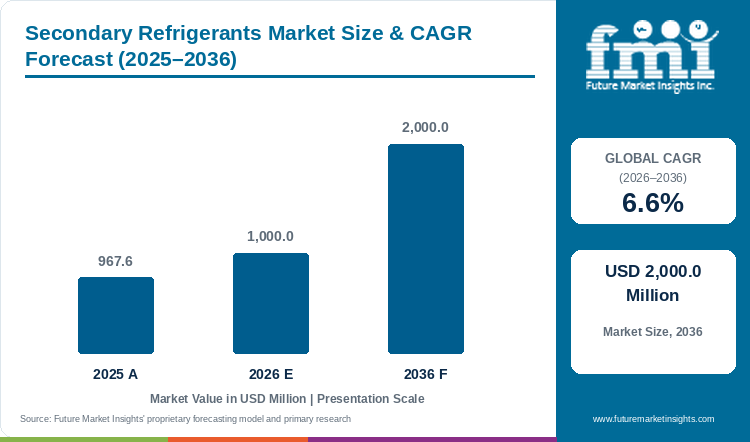
The Secondary Refrigerants Market is projected to reach USD 2.0 billion by 2036, growing at a 6.6% CAGR from 2026 to 2036. The market reaches USD 1.0 billion in 2026. The market was valued at USD 967.6 million in 2025. On 26 May 2026, the US Environmental Protection Agency published a final rule. It moves the 150 and 300 GWP limits for supermarket systems and remote condensing units to 1 January 2032, with an interim limit of 1,400 until then [16]. In Great Britain, Defra said in May 2026 it will not legislate in 2026 on the HFC phasedown steps due from 1 January 2027 [17]. Both decisions give plant owners more time without removing the pressure to cut the primary refrigerant charge.
A secondary refrigerant carries cold from a central chiller to the point of use, so the primary refrigerant stays in a small, sealed machine room. Clariant says its monoethylene glycol fluid, Antifrogen N, is not suitable for food or pharmaceutical use [6]. Dow, which sells the DOWFROST glycol range, reported on 22 October 2026 that third-quarter net sales rose 13% to USD 11.3 billion [1][3].
Key Market Trends & Insights
- Data centre cooling has become a new outlet for glycol fluids. BASF announced on 8 October 2026 that its propylene glycol-based GLYTHERMIN DC PG25 is qualified as an NVIDIA DSX Ready Coolant. The qualification covers secondary-loop, single-phase cold-plate cooling [9]. Dow lists DOWFROST LC 25, at 25% propylene glycol, for direct-to-chip loops [5].
- Regulators are lengthening the runway for high-GWP systems instead of closing it. The US rule published on 26 May 2026 moved supermarket and cold storage deadlines to 1 January 2032 and left the ultimate GWP limits unchanged [16].
- Heat pumps are pulling more heat transfer fluid into buildings. The German heat pump association reported 299,000 heating heat pumps sold in 2025, up 55% on 2024. Heat pumps make up nearly half of all heat generators sold in Germany [18].
Regional Highlights
- North America: the US final rule of 26 May 2026 sets 1 January 2032 as the deadline for the 150 and 300 GWP limits. It covers supermarket and cold storage systems, with interim limits of 1,400 and 700 [16].
- Europe: Regulation (EU) 2024/573 has applied since 11 March 2024 and phases HFCs out of the EU market by 2050. Producer allowances fall to 15% of their 2011 to 2013 average by 2036 [15].
- Asia Pacific: China's State Council issued a cold chain logistics plan for 2021 to 2025 on 12 December 2021 [22]. Under the Kigali schedule, China freezes HFC consumption in 2024 and India caps it in 2028 [20].
Secondary Refrigerants Market Size and Forecast
Table 1: Secondary Refrigerants Market Size and Forecast
| Market size and forecast | Value |
|---|---|
| Market size in 2025 | USD 967.6 million |
| Market size in 2026 | USD 1.0 billion |
| Projected market size by 2036 | USD 2.0 billion |
| CAGR from 2026 to 2036 | 6.6% |
Source: Future Market Insights analysis of the secondary refrigerants market, 2026.
Analyst Perspective
“Glycol fluids win the volume because they are cheap, familiar and easy to inhibit, but the buying decision is now about documentation. Plant owners ask whether a fluid is food-contact registered, how long the inhibitor package lasts and who will supply it in ten years. Suppliers that publish clear approval statements and keep a second fluid chemistry on the shelf, such as a potassium formate blend for low temperatures, will hold their accounts as refrigerant rules tighten.”
- Nikhil Kaitwade, Principal Consultant, FMI
How is the Secondary Refrigerants Market segmented?
- By product: Glycols, Salt Brines, Carbon Dioxide and Other Products
- By end-use: Commercial Refrigeration, Industrial Refrigeration, Heat Pumps, Air Conditioning and Other End Use
- By region: North America, Europe and Asia Pacific
Why do Glycols lead by Product in the Secondary Refrigerants Market in 2026?
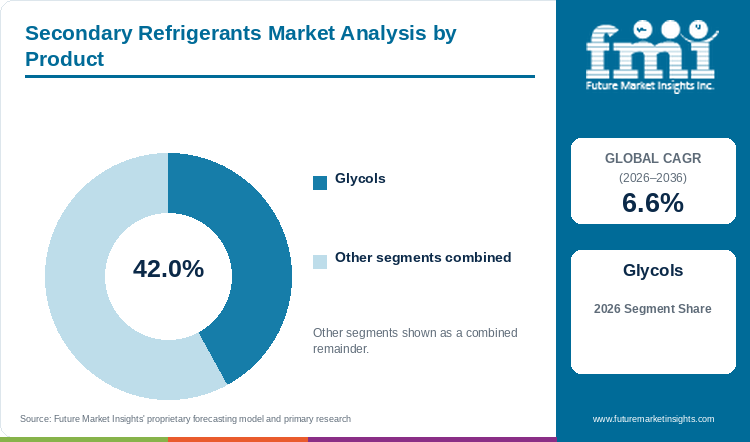
Glycols account for 42.0% of the Secondary Refrigerants Market by product in 2026, mainly because they come ready to use. Dow sells DOWFROST as 96.0% food grade propylene glycol plus food grade corrosion inhibitors. Its use range runs from 0 to 250 degrees Fahrenheit (minus 18 to 121 degrees Celsius), and Dow lists it for HVAC, food, pharmaceutical and geothermal use [2]. Clariant separates its range by risk. Antifrogen N, based on monoethylene glycol, serves industrial refrigeration brines. Antifrogen L, based on 1,2-propylene glycol, serves breweries, dairies, ice-cream factories, cold stores and fish processing plants [6][7]. Both Clariant fluids are inhibited without nitrites, amines, borates, silicates or phosphates. Antifrogen L also carries a VdS approval for sprinkler use [6][7]. A-Gas describes its secondary heat transfer fluids as designed for resistance to degradation, scale, bacterial growth and corrosion, supplied as concentrate or diluted [11]. Buyers who already run ethylene glycol in cooling or antifreeze duties can reuse handling and testing routines, which keeps switching costs low. The main weakness of glycols is leak sensitivity in food plants. That is why propylene glycol dominates where product contact is possible, and why Climalife adds a bittering agent to its monoethylene glycol fluids [25].
Table 2: Product, 2026 Share
| Leading Share | 2026 market share |
|---|---|
| Glycols | 42.0% |
| All Other Segments Combined Share | 58.0% |
Source: Future Market Insights analysis of the secondary refrigerants market, 2026.
Why does Commercial Refrigeration lead by End-use in the Secondary Refrigerants Market in 2026?
Commercial Refrigeration accounts for 38.0% of the Secondary Refrigerants Market by end-use in 2026. Supermarkets, cold stores and food processors run many circuits where a primary refrigerant would otherwise reach the sales floor or the process hall. Dow lists DOWFROST and DOWCAL for cooling, refrigerating, dehumidifying and fermentation in food and beverage plants. It describes them as food-grade, FDA- and NSF-compliant glycol fluids [3]. A-Gas lists its Temper fluid for commercial and domestic refrigeration, with a low-temperature range down to minus 55 degrees Celsius [10]. Rules shape the buying calendar. The US rule published on 26 May 2026 gives supermarket refrigeration systems and remote condensing units until 1 January 2032 to meet the 150 and 300 GWP limits. Cold storage warehouses have the same deadline, with interim limits of 1,400 and 700 [16]. In Canada, centralised commercial refrigeration systems have faced a 2,200 GWP limit on imported products since 1 January 2020 [23]. Retail groups that follow the commercial refrigeration equipment cycle usually specify the secondary fluid with the cabinet and compressor rack. That ties fluid demand to store refits.
Table 3: End-use, 2026 Share
| Leading Share | 2026 market share |
|---|---|
| Commercial Refrigeration | 38.0% |
| All Other Segments Combined Share | 62.0% |
Source: Future Market Insights analysis of the secondary refrigerants market, 2026.
What are the key drivers, restraints and opportunities?
Driver
Refrigerant rules. Regulation (EU) 2024/573 has applied since 11 March 2024 and phases HFCs out of the EU market by 2050. Producer allowances start at 60% of the 2011 to 2013 average in 2025 and fall to 15% by 2036 [15]. The Kigali schedule freezes HFC consumption for the group that includes China in 2024, with a 10% cut from 2029. It freezes consumption for India and a few other countries in 2028, with cuts from 2032 [20]. The Kigali Amendment sets that group schedule in its Article 5 provisions [19]. Indirect systems let owners keep a small primary charge, so each step down raises interest in secondary circuits.
Heat pumps and data halls. German heat pump sales reached 299,000 units in 2025, with state funding commitments of over 288,000 from KfW, up 91% [18]. Heat pump circuits use the same glycol and brine fluids as refrigeration. Clariant lists Antifrogen N and Antifrogen L for heat pumps [6][7]. Data centres add a second pull. Dow notes a planning assumption of a flush-and-fill about 5 to 7 years after installation for direct-to-chip systems. It also notes up to 10 years of life in secondary systems [4].
Restraint
Toxicity and food-contact limits. Monoethylene glycol is cheaper but cannot be used where food or drinking water could be reached. Food plants therefore pay more for propylene glycol or salt-based fluids [6][25]. Clariant states that Antifrogen N is not suitable for food or pharmaceutical applications [6]. This splits the market into two price tiers, which limits how far the lowest-cost fluid can spread.
Longer deadlines for high-GWP systems. The US rule of 26 May 2026 pushed the main supermarket and cold storage deadlines from earlier dates to 1 January 2032 [16]. Defra decided in May 2026 not to change the 2027 phasedown steps in Great Britain [17]. The revised 2032 dates govern new installations and defined major replacements. EPA allows existing systems to keep operating and be repaired, so working direct-expansion systems do not automatically have to convert in 2032.
Opportunity
Food-contact registered fluids. Climalife says its Crane Temper is registered as HT1 on the NSF list. The fluid is based on potassium acetate and formate, is non-flammable, and has protection levels from minus 10 to minus 60 degrees Celsius [24]. Eastman states that Therminol D-12 is NSF registered with HT1 status and can act as a secondary coolant in refrigeration loops [13]. Suppliers with a documented approval can sell into plants that would otherwise stay with water-based systems.
Cooling for data centres. Clariant lists Antifrogen PG 25 at 25% v/v propylene glycol. Its freezing point is minus 11 degrees Celsius, and its thermal conductivity is 0.471 watts per metre kelvin [8]. Dow lists DOWFROST LC 25 for use between minus 10 and 90 degrees Celsius [5]. These grades fall under Other End Use, a smaller segment than refrigeration but one with quick qualification cycles. Readers who also follow the calcium chloride market can compare how salt-based fluids compete on cost with these glycol blends.
Secondary Refrigerants Market by Country (2026 to 2036)
Table 4: Secondary Refrigerants Market Country Growth Forecast
| Country | CAGR, 2026 to 2036 |
|---|---|
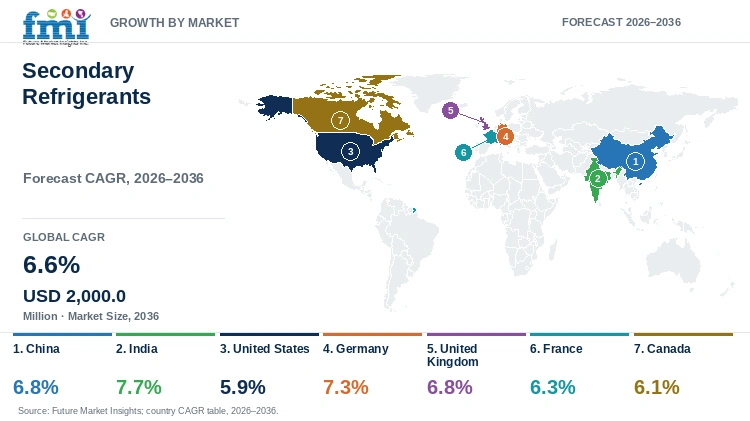
| China | 6.8% |
| India | 7.7% |
| United States | 5.9% |
| Germany | 7.3% |
| United Kingdom | 6.8% |
| France | 6.3% |
| Canada | 6.1% |
Source: Future Market Insights analysis of the secondary refrigerants market, 2026.
China
China's State Council General Office issued a development plan for cold chain logistics on 12 December 2021, covering 2021 to 2025. It calls for a network linking production and sales areas, cities and rural areas, and domestic and international markets [22]. Cold stores and refrigerated transport built under that plan need chillers and distribution loops, and many will use a secondary fluid.
Refrigerant policy points the same way. China's Ministry of Ecology and Environment froze new production capacity for five widely used HFCs from 1 January 2022 [21]. Under the Kigali schedule, the country freezes HFC consumption in 2024 and begins cuts in 2029 [20]. A fixed ceiling on HFC supply gives plant owners a reason to design low-charge systems before the cuts begin.
BASF said on 8 October 2026 that it takes part in the GB Standard Committee in China. It also points to a worldwide production footprint behind its Glythermin coolants [9]. Suppliers selling glycol and formate fluids into China should qualify products against local standards and secure local inhibitor supply first.
India
India sits in a later Kigali group. The schedule caps its HFC consumption in 2028 and begins cuts in 2032, three years after China's first cut [20]. That delay gives Indian cold storage and dairy operators more time. Equipment ordered now will still be in service when the cuts arrive.
Fluid buyers in India can draw on the same product families as elsewhere. Clariant positions Antifrogen L for dairies, ice-cream factories, cold stores and fish processing plants [7]. A-Gas lists Temper for commercial refrigeration, heat pump systems and indirect food and beverage cooling [10]. Dow's DOWFROST range is sold for food, pharmaceutical and HVAC duties [2].
India has the fastest forecast rate of the seven profiled countries, at 7.7%. Sellers with ready-diluted packs and written food-contact statements gain ground on concentrate-only offers.
United States
The EPA published its Technology Transitions reconsideration rule on 26 May 2026 at 91 Fed. Reg. 31284. Supermarket systems and remote condensing units now have until 1 January 2032 to meet the 150 or 300 GWP limits, with an interim limit of 1,400. Cold storage warehouse systems also move to 1 January 2032, with an interim limit of 700. The ultimate limits are unchanged, and EPA left the HFC allocation rule as it was [16].
For fluid suppliers the rule delays a wave of conversions instead of removing it. Retailers and cold store owners now plan against 2032. A project that adds a secondary loop to an existing site does not fall under the 15% capacity allowance. EPA says that allowance is not treated as new installation [16]. Dow and Clariant both publish food-grade propylene glycol fluids for such circuits [2][7].
Fluid choice in US plants follows food-contact status. Dow describes DOWFROST as made from food grade raw materials conforming to FDA CFR 21 and NSF guidelines [2]. Eastman says Therminol D-12 is NSF registered with HT1 status for incidental food contact [13]. The United States has the lowest rate of the seven countries, which fits a mature installed base with a long runway for existing systems.
Germany
Heat pumps are the clearest source of German demand. The Bundesverband Wärmepumpe reported on 27 January 2026 that 299,000 heating heat pumps were sold in 2025, up 55%. It also said KfW made over 288,000 funding commitments for heat pumps, and that the 2023 record has not yet been matched [18]. Ground-source units, which use brine circuits, were 16,000, or 5% of sales [18].
A steady heat pump base supports glycol and inhibitor sales for fluid suppliers. Clariant lists both Antifrogen N and Antifrogen L for heat pump systems [6][7]. BASF, which sells Glythermin propylene glycol fluids, positions them around backward integration in its production network [9]. The German association also warns that a reform of the Building Energy Act could brake investment if it sends fossil fuel signals again [18].
Regulation (EU) 2024/573 sets the wider frame for refrigeration, with HFC allowances falling to 15% of their 2011 to 2013 average by 2036 [15]. German plant owners face the same quota path as the rest of the EU. Germany's 7.3% is the second highest rate of the seven, and it rests on the heat pump base, not on supermarket refits.
United Kingdom
Great Britain runs its own HFC phasedown. Defra consulted from 5 November to 17 December 2025 on reducing the amount of HFCs placed on the market beyond current limits. It assessed 137 responses and said in May 2026 that further work is needed [17]. It will not legislate in 2026 to change the phasedown steps from 1 January 2027. It plans to publish a report on responses and next steps later in the year [17].
For buyers the practical result is a known 2027 step and an unknown path after it. The existing step in Annex 5 of the F-gas Regulation continues to apply for 2027 [17]. Operators of cold stores and food plants are likely to keep specifying secondary circuits in new builds while the longer schedule is decided.
Supply to UK buyers comes from international ranges. A-Gas lists refrigerant-grade R744 with moisture under 5 ppm on its UK site. It notes that industrial-grade carbon dioxide can carry up to ten times more water, which can form carbonic acid and corrode pipework [12]. Its UK secondary fluid range is sold as concentrate or diluted [11]. Buyers should therefore check the moisture grade before specifying carbon dioxide for a UK circuit.
France
Independent distributors shape fluid choice in France. Climalife sells Crane Temper in 25 litre cans, 208 litre barrels and 1,000 litre containers. Protection levels run from minus 10 to minus 60 degrees Celsius, and the product is registered as HT1 on the NSF list [24]. The fluid is based on potassium acetate and formate and is described as non-flammable and low in toxicity [24].
Climalife's 2021 guidance shows what buyers weigh. It said antifreeze protection is the first criterion. It added that lower viscosity can cut pumping energy, and that its fluids are free of nitrates, amines, phosphates and borates [25]. Climalife describes the viscosity of Crane Temper at low temperatures as suited to low-temperature industrial processes [24].
France applies the same EU HFC quota path as Germany [15], and the 6.3% rate sits below Germany's 7.3%. Suppliers selling potassium formate and acetate blends compete with glycol on pump power and safety, not on price per litre.
Canada
Canada controls HFCs through import prohibitions under the Ozone-depleting Substances and Halocarbon Alternatives Regulations, SOR/2016-137. Schedule 1.1 sets a 2,200 GWP limit for commercial and industrial centralised refrigeration systems and condensing units from 1 January 2020. It sets 1,400 for stand-alone medium-temperature units and 1,500 for stand-alone low-temperature units from the same date [23].
From 1 January 2025 chillers are limited to a GWP of 750, mobile refrigeration systems to 2,200, and residential stand-alone units to 150 [23]. A 750 limit on chillers pushes chilled-water plants towards lower-GWP refrigerants and the glycol loops that serve them, which supports demand for inhibited glycol fluids.
Cold winters add a seasonal need for freeze protection in outdoor loops. Dow's DOWFROST gives freeze protection below minus 50 degrees Celsius, depending on dilution [2]. Linde lists R744 carbon dioxide among its natural refrigerants supplied in cylinders, drums and bulk [14]. Outdoor loops in colder regions therefore need inhibited fluids rated well below the lowest local temperature.
Who are the notable companies in the Secondary Refrigerants Market?
Notable companies in the Secondary Refrigerants Market include Dow, Clariant, BASF, Eastman Chemical Company, The Linde Group and A-Gas International.
Chemistry and food-contact status decide how suppliers position their products. Clariant splits its range between monoethylene glycol for industrial brines and propylene glycol for food plants [6][7]. Dow concentrates on propylene glycol with food-grade claims for DOWFROST and also lists DOWCAL [2][3]. A-Gas and Climalife sell potassium acetate and formate fluids under the Temper name for low-temperature and food-adjacent circuits [10][24]. Eastman offers a synthetic fluid, Therminol D-12, that it says works as a secondary coolant [13]. Linde and A-Gas supply carbon dioxide as a refrigerant, not as a carrier fluid [12][14].
Approvals and documents separate similar fluids. Eastman cites NSF HT1 registration for Therminol D-12 [13], and Climalife cites HT1 for Crane Temper [24]. Dow cites FDA CFR 21 and NSF guidelines for DOWFROST [2]. Clariant cites a VdS approval and FDA listing for the propylene glycol in Antifrogen L [7]. A-Gas notes that its cylinder carbon dioxide is not for food applications. It sells refrigerant-grade carbon dioxide with moisture under 5 ppm [12]. Buyers read these statements before price.
Routes to market differ. A-Gas sells its Temper range through wholesale partners and offers larger packs directly [10]. Climalife lists pack sizes and a quote function [24], and Linde supplies refrigerants as cylinders, drums and bulk deliveries [14]. Data centre demand is pulling large producers into glycol coolants. BASF announced a qualified coolant on 8 October 2026 [9], Dow offers DOWFROST LC 25 [5], and Clariant lists Antifrogen PG 25 [8].
Key Developments in the Secondary Refrigerants Market
- On 26 May 2026, the US Environmental Protection Agency published its Technology Transitions reconsideration rule at 91 Fed. Reg. 31284. It moves the 150 and 300 GWP deadlines for supermarket systems and remote condensing units to 1 January 2032. It also moves the cold storage deadline from 1 January 2026 to 1 January 2032 [16].
- On 15 May 2026, Defra said it had assessed 137 responses to its consultation on the Great Britain HFC phasedown. It would not legislate in 2026 to change the steps due from 1 January 2027 [17].
- On 8 October 2026, BASF announced that GLYTHERMIN DC PG25, a propylene glycol-based heat transfer fluid, is qualified as an NVIDIA DSX Ready Coolant. The qualification covers secondary-loop, single-phase cold-plate cooling in data centres [9].
- On 22 October 2026, Dow reported third-quarter net sales of USD 11.3 billion, up 13%. It said it had captured sequential gains from the first of its three European asset shutdowns [1].
Key Players in the Secondary Refrigerants Market
- Dow
- Tazzetti S.p.A.
- Eastman Chemical Company
- Clariant
- The Linde Group
- BASF SE
- A-Gas International
Secondary Refrigerants Market Report Scope
Table 5: Secondary Refrigerants Market Report Scope
| Coverage field | Report scope |
|---|---|
| Market definition | Secondary refrigerants (heat transfer fluids that carry cold from a primary refrigerant circuit to the point of use), measured by value of sales |
| Product | Glycols, Salt Brines, Carbon Dioxide, Other Products |
| End-use | Commercial Refrigeration, Industrial Refrigeration, Heat Pumps, Air Conditioning, Other End Use |
| Regions and profiled countries | North America, Europe, Asia Pacific, China, India, United States, Germany, United Kingdom, France, Canada |
| Companies covered | Dow, Tazzetti S.p.A., Eastman Chemical Company, Clariant, The Linde Group, BASF SE, A-Gas International |
| Forecast period | 2026 to 2036, with 2025 as the historical base year |
| Quantitative Units | USD million |
Source: Future Market Insights analysis of the secondary refrigerants market, 2026.
Secondary Refrigerants Market by Segments
Secondary Refrigerants Market segmented by Product:
- Glycols
- Salt Brines
- Carbon Dioxide
- Other Products
Secondary Refrigerants Market segmented by End-use:
- Commercial Refrigeration
- Industrial Refrigeration
- Heat Pumps
- Air Conditioning
- Other End Use
Secondary Refrigerants Market by Region
- North America
- Europe
- Asia Pacific
- China
- India
- United States
- Germany
- United Kingdom
- France
- Canada
Research Sources and Bibliography
- [1] Dow Inc. (2026, October 22). Dow Reports Third Quarter 2026 Results (Form 8-K, Exhibit 99.1). https://www.sec.gov/Archives/edgar/data/0001751788/000175178826000155/exhibit991enrschedules3q26.htm
- [2] Dow. (n.d.). DOWFROST Heat Transfer Fluid. https://www.dow.com/en-us/pdp.dowfrost-heat-transfer-fluid.23545z.html
- [3] Dow. (n.d.). Heat Transfer Fluids for your next Food & Beverage Project. https://www.dow.com/en-us/product-technology/pt-lubricants/heat-transfer-fluids-for-your-next-food-beverage-project.html
- [4] Dow. (n.d.). Data Center Liquid Cooling Solutions & Technologies. https://www.dow.com/en-us/market/mkt-electronics/sub-elec-data-center-cooling.html
- [5] Dow. (n.d.). DOWFROST LC 25 Heat Transfer Fluid. https://www.dow.com/en-us/pdp.dowfrost-lc-25-heat-transfer-fluid.497419z.html
- [6] Clariant. (n.d.). Antifrogen N. https://www.clariant.com/en/products/antifrogen-n-1
- [7] Clariant. (n.d.). Antifrogen L. https://www.clariant.com/en/products/antifrogen-l-1
- [8] Clariant. (2026, October 2). ANTIFROGEN PG 25. https://www.clariant.com/de/products/antifrogen-pg-25
- [9] BASF SE. (2026, October 8). Trade News: GLYTHERMIN DC PG25 heat transfer fluid for data center direct liquid cooling. https://www.basf.com/global/en/media/news-releases/2026/10/p-26-162
- [10] A-Gas. (n.d.). Temper. https://www.agas.com/au/products-and-services/performance-chemicals/temper/
- [11] A-Gas. (n.d.). Secondary Heat Transfer Fluids. https://www.agas.com/uk/products-and-services/secondary-heat-transfer-fluids/
- [12] A-Gas. (n.d.). R744 CO2. https://www.agas.com/uk/products-and-services/refrigerants/r744-co2/
- [13] Eastman. (n.d.). Therminol D-12 heat transfer fluid. https://eastman.com/en/products/product-detail/71093448/therminol-d-12-heat-transfer-fluid
- [14] Linde. (n.d.). Refrigerant gases from Linde. https://www.linde-gas.com/en/products_and_supply/refrigerants/index.html
- [15] European Commission. (n.d.). EU-Rules: Fluorinated Greenhouse Gases (Regulation (EU) 2024/573). https://climate.ec.europa.eu/areas-action/fluorinated-greenhouse-gases/f-gas-legislation_en
- [16] Holland & Knight LLP. (2026, May 26). EPA Finalizes Changes to Technology Transitions Provisions of the AIM Act. https://www.hklaw.com/en/insights/publications/2026/05/epa-finalizes-changes-to-technology-transitions-provisions
- [17] Department for Environment, Food and Rural Affairs. (2026, May 15). Amending the hydrofluorocarbon phasedown schedule. https://www.gov.uk/government/consultations/amending-the-hydrofluorocarbon-phasedown-schedule
- [18] Solarserver. (2026, January 27). BWP: Waermepumpen-Absatz um 55 Prozent in 2025 gestiegen. https://www.solarserver.de/2026/01/27/bwp-waermepumpen-absatz-um-55-prozent-in-2025-gestiegen/
- [19] UNEP Ozone Secretariat. (n.d.). Kigali Amendment to the Montreal Protocol (2016). https://ozone.unep.org/treaties/montreal-protocol/amendments/kigali-amendment-2016-amendment-montreal-protocol-agreed
- [20] Cooling Post. (n.d.). Nations agree global phase-down of HFCs. https://www.coolingpost.com/world-news/nations-agree-global-phase-down-of-hfcs
- [21] Inside Climate News. (2022, January 21). China Moves to Freeze Production of Climate Super-Pollutants But Lacks a System to Monitor Emissions. https://insideclimatenews.org/news/21012022/china-super-pollutant-emissions/
- [22] State Council of the People's Republic of China. (2021, December 12). Development plan for cold chain logistics in the 14th Five-Year Plan period. https://english.www.gov.cn/policies/latestreleases/202112/12/content_WS61b5ddeac6d09c94e48a220d.html
- [23] Government of Canada. (n.d.). Ozone-depleting Substances and Halocarbon Alternatives Regulations, SOR/2016-137, Schedule 1.1. https://laws-lois.justice.gc.ca/eng/Regulations/SOR-2016-137/page-7.html
- [24] Climalife. (n.d.). CRANE Temper. https://climalife.com/?p=162788
- [25] ACR Journal. (2021, March 11). Climalife highlight safety and environment as essential when choosing a heat transfer fluid. https://www.acrjournal.uk/features/hvac/climalife-highlight-safety-and-environment-as-essential-when-choosing-/
Table of Content
Table of Content
- Key Takeaways
- Market Size and CAGR
- Top Growth Driver
- Fastest Growing Segment
- Leading Region
- Key Companies
- Emerging Opportunities
- Executive Summary
- Global Market Outlook
- Demand-side Trends
- Supply-side Trends
- Technology Roadmap Analysis
- Analysis and Recommendations
- Analyst Perspective (What is happening? Why now? What should investors know?)
- Key Questions Answered
- How large is the market?
- What is the CAGR?
- What are key trends?
- Which region dominates?
- Who are the leaders?
Read More...
- Market Overview
- Market Coverage / Taxonomy
- Market Definition / Scope / Limitations
- Research Methodology
- Chapter Orientation
- Analytical Lens and Working Hypotheses
- Market Structure, Signals, and Trend Drivers
- Benchmarking and Cross-market Comparability
- Market Sizing, Forecasting, and Opportunity Mapping
- Research Design and Evidence Framework
- Desk Research Programme (Secondary Evidence)
- Expert Input and Fieldwork (Primary Evidence)
- Tooling, Models, and Reference Databases
- Data Engineering and Model Build
- Quality Assurance and Audit Trail
- Market Background
- Market Dynamics (Drivers, Restraints, Opportunity, Trends)
- Scenario Forecast (Optimistic, Likely, Conservative)
- Impact Analysis
- AI Impact
- Sustainability Impact
- Regulatory Impact
- Technology Impact
- Consumer / Buyer Analysis
- Purchase Drivers
- Adoption Barriers
- Buyer Journey
- Opportunity Map Analysis
- Product Life Cycle Analysis
- Supply Chain Analysis
- Investment Feasibility Matrix
- Value Chain Analysis
- PESTLE and Porter's Analysis
- Regulatory Landscape
- Regional Parent Market Outlook
- Production and Consumption Statistics
- Import and Export Statistics
- Global Market Analysis and Forecast, 2021 to 2036
- Historical Market Size Value (USD Million) Analysis, 2021 to 2025
- Current and Future Market Size Value (USD Million) Projections, 2026 to 2036
- Y-o-Y Growth Trend Analysis
- Absolute $ Opportunity Analysis
- Global Market Pricing Analysis, 2021 to 2036
- Global Market Analysis and Forecast, By Product, 2021 to 2036
- Introduction / Key Findings
- Historical Market Size Value (USD Million) Analysis By Product, 2021 to 2025
- Current and Future Market Size Value (USD Million) Analysis and Forecast By Product, 2026 to 2036
- Glycols
- Salt Brines
- Carbon Dioxide
- Other Products
- Y-o-Y Growth Trend Analysis By Product, 2021 to 2025
- Absolute $ Opportunity Analysis By Product, 2026 to 2036
- Global Market Analysis and Forecast, By End-use, 2021 to 2036
- Introduction / Key Findings
- Historical Market Size Value (USD Million) Analysis By End-use, 2021 to 2025
- Current and Future Market Size Value (USD Million) Analysis and Forecast By End-use, 2026 to 2036
- Commercial Refrigeration
- Industrial Refrigeration
- Heat Pumps
- Air Conditioning
- Other End Use
- Y-o-Y Growth Trend Analysis By End-use, 2021 to 2025
- Absolute $ Opportunity Analysis By End-use, 2026 to 2036
- Global Market Analysis and Forecast, By Region, 2021 to 2036
- Introduction
- Historical Market Size Value (USD Million) Analysis By Region, 2021 to 2025
- Current Market Size Value (USD Million) Analysis and Forecast By Region, 2026 to 2036
- North America
- Europe
- Asia Pacific
- Market Attractiveness Analysis By Region
- North America Market Analysis and Forecast, By Country, 2021 to 2036
- Historical Market Size Value (USD Million) Trend Analysis By Market Taxonomy, 2021 to 2025
- Market Size Value (USD Million) Forecast By Market Taxonomy, 2026 to 2036
- By Country
- By Product
- By End-use
- Market Attractiveness Analysis
- By Country
- By Product
- By End-use
- Key Takeaways
- Europe Market Analysis and Forecast, By Country
- Historical Market Size Value (USD Million) Trend Analysis By Market Taxonomy, 2021 to 2025
- Market Size Value (USD Million) Forecast By Market Taxonomy, 2026 to 2036
- By Country
- By Product
- By End-use
- Market Attractiveness Analysis
- By Country
- By Product
- By End-use
- Key Takeaways
- Asia Pacific Market Analysis and Forecast, By Country
- Historical Market Size Value (USD Million) Trend Analysis By Market Taxonomy, 2021 to 2025
- Market Size Value (USD Million) Forecast By Market Taxonomy, 2026 to 2036
- By Country
- China
- India
- United States
- Germany
- United Kingdom
- France
- Canada
- By Product
- By End-use
- By Country
- Market Attractiveness Analysis
- By Country
- By Product
- By End-use
- Key Takeaways
- Key Countries Market Analysis
- United States
- Pricing Analysis
- Market Share Analysis, 2025
- By Product
- By End-use
- Canada
- Pricing Analysis
- Market Share Analysis, 2025
- By Product
- By End-use
- Germany
- Pricing Analysis
- Market Share Analysis, 2025
- By Product
- By End-use
- United Kingdom
- Pricing Analysis
- Market Share Analysis, 2025
- By Product
- By End-use
- France
- Pricing Analysis
- Market Share Analysis, 2025
- By Product
- By End-use
- India
- Pricing Analysis
- Market Share Analysis, 2025
- By Product
- By End-use
- China
- Pricing Analysis
- Market Share Analysis, 2025
- By Product
- By End-use
- United States
- Market Structure Analysis
- Competition Dashboard
- Competition Benchmarking
- Market Share Analysis of Top Players
- By Regional
- By Product
- By End-use
- Emerging Startups
- Innovation Benchmarking
- Competition Analysis
- Competition Deep Dive
- Dow
- Overview
- Product Portfolio
- Profitability by Market Segments
- Sales Footprint
- Strategy Overview
- Marketing Strategy
- Product Strategy
- Channel Strategy
- Clariant
- BASF SE
- Eastman Chemical Company
- The Linde Group
- A-Gas International
- Climalife
- Tazzetti S.p.A.
- Dow
- Case Studies
- Success Stories
- Recent Developments
- Competition Deep Dive
- Assumptions & Acronyms Used
List of Tables
- Table 1: Global Market Value (USD Million) Forecast by Region, 2021 to 2036
- Table 2: Global Market Value (USD Million) Forecast by Product, 2021 to 2036
- Table 3: Global Market Value (USD Million) Forecast by End-use, 2021 to 2036
- Table 4: North America Market Value (USD Million) Forecast by Country, 2021 to 2036
- Table 5: North America Market Value (USD Million) Forecast by Product, 2021 to 2036
- Table 6: North America Market Value (USD Million) Forecast by End-use, 2021 to 2036
- Table 7: Europe Market Value (USD Million) Forecast by Country, 2021 to 2036
- Table 8: Europe Market Value (USD Million) Forecast by Product, 2021 to 2036
- Table 9: Europe Market Value (USD Million) Forecast by End-use, 2021 to 2036
- Table 10: Asia Pacific Market Value (USD Million) Forecast by Country, 2021 to 2036
- Table 11: Asia Pacific Market Value (USD Million) Forecast by Product, 2021 to 2036
- Table 12: Asia Pacific Market Value (USD Million) Forecast by End-use, 2021 to 2036
List of Figures
- Figure 1: Global Market Pricing Analysis
- Figure 2: Global Market Value (USD Million) Forecast 2021-2036
- Figure 3: Global Market Value Share and BPS Analysis by Product, 2026 and 2036
- Figure 4: Global Market Y-o-Y Growth Comparison by Product, 2026-2036
- Figure 5: Global Market Attractiveness Analysis by Product
- Figure 6: Global Market Value Share and BPS Analysis by End-use, 2026 and 2036
- Figure 7: Global Market Y-o-Y Growth Comparison by End-use, 2026-2036
- Figure 8: Global Market Attractiveness Analysis by End-use
- Figure 9: Global Market Value (USD Million) Share and BPS Analysis by Region, 2026 and 2036
- Figure 10: Global Market Y-o-Y Growth Comparison by Region, 2026-2036
- Figure 11: Global Market Attractiveness Analysis by Region
- Figure 12: North America Market Incremental Dollar Opportunity, 2026-2036
- Figure 13: Europe Market Incremental Dollar Opportunity, 2026-2036
- Figure 14: Asia Pacific Market Incremental Dollar Opportunity, 2026-2036
- Figure 15: North America Market Value Share and BPS Analysis by Country, 2026 and 2036
- Figure 16: North America Market Value Share and BPS Analysis by Product, 2026 and 2036
- Figure 17: North America Market Y-o-Y Growth Comparison by Product, 2026-2036
- Figure 18: North America Market Attractiveness Analysis by Product
- Figure 19: North America Market Value Share and BPS Analysis by End-use, 2026 and 2036
- Figure 20: North America Market Y-o-Y Growth Comparison by End-use, 2026-2036
- Figure 21: North America Market Attractiveness Analysis by End-use
- Figure 22: Europe Market Value Share and BPS Analysis by Country, 2026 and 2036
- Figure 23: Europe Market Value Share and BPS Analysis by Product, 2026 and 2036
- Figure 24: Europe Market Y-o-Y Growth Comparison by Product, 2026-2036
- Figure 25: Europe Market Attractiveness Analysis by Product
- Figure 26: Europe Market Value Share and BPS Analysis by End-use, 2026 and 2036
- Figure 27: Europe Market Y-o-Y Growth Comparison by End-use, 2026-2036
- Figure 28: Europe Market Attractiveness Analysis by End-use
- Figure 29: Asia Pacific Market Value Share and BPS Analysis by Country, 2026 and 2036
- Figure 30: Asia Pacific Market Value Share and BPS Analysis by Product, 2026 and 2036
- Figure 31: Asia Pacific Market Y-o-Y Growth Comparison by Product, 2026-2036
- Figure 32: Asia Pacific Market Attractiveness Analysis by Product
- Figure 33: Asia Pacific Market Value Share and BPS Analysis by End-use, 2026 and 2036
- Figure 34: Asia Pacific Market Y-o-Y Growth Comparison by End-use, 2026-2036
- Figure 35: Asia Pacific Market Attractiveness Analysis by End-use
- Figure 36: Global Market - Tier Structure Analysis
- Figure 37: Global Market - Company Share Analysis
Frequently Asked Questions
How big is the secondary refrigerants market in 2026?
The Secondary Refrigerants Market reaches USD 1.0 billion in 2026, up from USD 967.6 million in 2025. It is projected to reach USD 2.0 billion by 2036, a 6.6% CAGR from 2026 to 2036.
Which product leads the secondary refrigerants market?
Glycols lead with 42.0% of the market in 2026. Dow sells DOWFROST as 96.0% food grade propylene glycol plus inhibitors, and Clariant offers monoethylene glycol-based Antifrogen N for industrial brines and propylene glycol-based Antifrogen L for food plants [2][6][7].
Which other products and end-uses matter?
By product, Salt Brines hold 25.0%, Carbon Dioxide 18.0% and Other Products 15.0%. By end-use, Commercial Refrigeration leads with 38.0%. Industrial Refrigeration follows at 22.0%, Heat Pumps at 16.0%, Air Conditioning at 13.0% and Other End Use at 11.0%. Climalife's Crane Temper is a potassium acetate and formate fluid, and A-Gas sells R744 carbon dioxide with moisture under 5 ppm. Both show how non-glycol products are sold [12][24].
Which profiled country is forecast to grow fastest?
India has the highest forecast CAGR of the seven profiled countries, at 7.7% from 2026 to 2036. Germany follows at 7.3%, with China and the United Kingdom at 6.8% each. Under the Kigali schedule, India caps HFC consumption in 2028 and begins cuts in 2032 [20]. In Germany, 299,000 heating heat pumps were sold in 2025 [18].
What rules are affecting demand for secondary refrigerants?
In the United States, a final rule published on 26 May 2026 moved the 150 and 300 GWP deadlines for supermarket systems and remote condensing units. The new deadline is 1 January 2032 [16]. In the EU, Regulation (EU) 2024/573 has applied since 11 March 2024 and phases HFCs out of the market by 2050 [15]. In Great Britain, Defra will not change the 2027 phasedown step through 2026 legislation [17].
What should a buyer check when choosing a fluid?
Check food-contact status first. Clariant says Antifrogen N is not suitable for food or pharmaceutical use [6]. Dow cites FDA CFR 21 and NSF guidelines for DOWFROST [2], and Eastman cites NSF HT1 registration for Therminol D-12 [13]. Then check the freezing point needed, the inhibitor package, and the supplier's pack sizes and local supply.
Preview the report firsthand - request a free sample
Get SampleGet the brochure for pricing and purchase details.
Get PDF
