

- Market Size (2026)
- USD 1.5 Bn
- Forecast (2036)
- USD 2.3 Bn
- CAGR (2026 to 2036)
- 4.7%
How big is the Wood Insecticides Market in 2026?
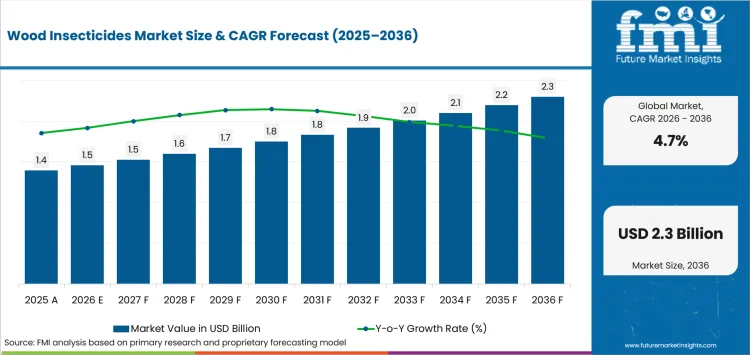
USD 1.5 billion in 2026 and USD 2.3 billion by 2036 at a 4.7% CAGR.
Demand for wood insecticides is projected to expand at a 4.7% CAGR between 2026 and 2036, increasing valuation from USD 1.5 billion to USD 2.3 billion. The economic case is strongest when termite and wood-boring insect protection is specified before installation or during industrial treatment, because a relatively small treatment input can protect a much larger downstream timber asset. The USA EPA reported in October 2025 that termites cause billions of dollars in structural damage each year, reinforcing the value of validated preventive protection.
Commercial conversion differs by treatment route and regulation. Australia links termite-risk management with building requirements, the USA combines federal pesticide registration with professional application channels, Brazil regulates wood-preservative products and preservation plants, and mature markets such as Japan and Germany place greater weight on product qualification and application consistency. The purchase threshold therefore depends on efficacy, formulation fit, treatment method and local compliance rather than insect pressure alone.
Key Takeaways
- Preventive treatment converts termite and wood-boring insect risk into repeat demand when protection is specified before fabrication, construction or long-term asset use.
- Permethrin is projected to lead Active Ingredient with a 24.0% share in 2026, supported by established use in structural insect control and professional treatment workflows.
- Liquid concentrate is forecast to account for 33.0% of Form demand in 2026 because dilution and dosing can be adapted to professional and industrial treatment workflows.
- Termites are expected to represent 39.0% of Target Pest demand in 2026, while sawn timber and wood treatment plants are projected at 26.0% and 38.0% in their categories because early and centralized treatment improves coverage, dosing and documentation.
- Registration, label compliance and application controls can slow qualification, while formulations designed for lower exposure and efficient industrial treatment create room for product differentiation.
- Some of the key players in this market include BASF, Bayer Environmental Science / Envu, Syngenta, Koppers, Lonza Wood Protection, Nisus Corporation, Kop-Coat, Troy Corporation, Lanxess, and Borax / Rio Tinto.
Analyst Perspective
“Wood insecticide suppliers gain repeat business when protection is easy to specify at the correct treatment stage and the formulation fits the applicator or plant process. Buyers will increasingly compare efficacy with documentation, dosing control and service-life economics rather than selecting chemistry on active ingredient alone.”
- Nikhil Kaitwade, Principal Consultant, Future Market Insights
How is the Wood Insecticides Market segmented?
The wood insecticides market is segmented by Active Ingredient, Form, Target Pest, End Use and Sales Channel.
Active Ingredient separates products by the chemistry used against wood-destroying insects, while Form distinguishes concentrates and finished application formats according to mixing and treatment equipment. Target Pest captures the biological risk that triggers purchase, End Use shows where treated wood enters service and Sales Channel identifies who converts formulation into a treated-wood or pest-management outcome. These axes connect the market to adjacent wood preservatives while keeping the revenue boundary focused on insecticidal protection products rather than downstream finished wood.
Why does Permethrin lead the Active Ingredient category?
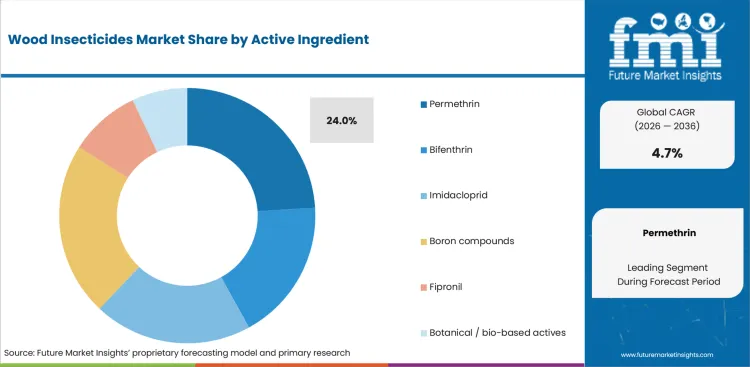
Permethrin combines a familiar pyrethroid mode of action with established use against structural insects. USA EPA termite-control guidance lists permethrin among common conventional termiticide actives, which supports familiarity among professional applicators working within label and exposure requirements. It competes with bifenthrin, imidacloprid, boron compounds, fipronil and botanical or bio-based actives, so its position depends on efficacy, application fit and local registration.
- Based on Active Ingredient, Permethrin is projected to account for 24.0% in 2026 due to its established role in structural insect control.
- Professional channels value chemistry that can be integrated into preventive wood protection without creating a separate operating process for each wood-destroying insect.
Why does Liquid concentrate lead the Form category?
Liquid concentrate gives treatment plants and professional applicators control over dilution and delivered dose. That flexibility supports spray, dip, injection and other wet-application workflows while reducing the amount of finished liquid moved through distribution. The broader biocide market also shows why industrial buyers place weight on formulation handling, dosing control and application compatibility alongside the active ingredient itself.
- Liquid concentrate is forecast to account for 33.0% of Form demand in 2026 because controlled dilution can be adapted to multiple professional treatment workflows.
- USDA Forest Service guidance links preservative performance to the chemical, treatment method and adequate penetration and retention in wood, reinforcing the need for disciplined mixing and application.
Why do Termites lead the Target Pest category?
Termites create a strong purchase trigger because damage can compromise structural wood before occupants notice an active infestation. USA EPA guidance links termites to billions of dollars in annual structural damage and distinguishes products that merely kill contacting insects from termiticides that demonstrate structural protection. This direct asset-risk mechanism also connects the category with broader pest control products used through professional channels.
- Termites are forecast to represent 39.0% of Target Pest demand in 2026 because structural damage makes preventive protection and validated control commercially urgent.
- Powderpost beetles, carpenter ants, wood borers and mixed-insect programs remain relevant, but termite risk is closely tied to buildings and long-lived timber assets.
Why does Sawn timber lead the End Use category?
Sawn timber is an efficient treatment point because insect protection can be applied while surfaces remain accessible and before pieces are incorporated into higher-value structures or fabricated products. Treating earlier makes coverage and retention easier to manage than corrective treatment after installation. Interest in low-leaching preservatives further increases the value of matching chemistry and treatment method to the final service environment.
- Sawn timber is projected to account for 26.0% of End Use demand in 2026 because protection can be specified before fabrication and installation.
- Arxada wood-protection guidance identifies general building timbers and joinery among uses for insect-protection products applied through dip and spray routes.
Why do Wood treatment plants lead the Sales Channel category?
Wood treatment plants convert insecticide chemistry into a controlled industrial process by metering solution concentration and applying treatment before timber enters distribution. This route suits buyers that need repeatable treatment across production lots, while pest control services remain essential for buildings and timber already in service. Brazil illustrates the process burden because preservation plants must register and report preservative use and treated-wood activity.
- Wood treatment plants are forecast to account for 38.0% of Sales Channel demand in 2026 because industrial treatment centralizes dosing, application and process documentation.
- Plant-based treatment supports volume throughput and repeatability, while pest-control channels, industrial distributors and retail or professional supply serve different points in the wood lifecycle.
What are the drivers, restraints and opportunities in the Wood Insecticides Market?
Preventive asset protection supports demand, registration and application controls slow qualification, and treatment-stage innovation creates room for more efficient wood-protection formulations.
- Driver: Avoided structural damage and longer wood service life support preventive insecticide spending.
- Restraint: Registration, label compliance, applicator qualification and treatment-process control add cost and time.
- Opportunity: Wood-focused formulations that improve treatment efficiency and exposure management can win earlier in the timber value chain.
The principal demand driver is the economic value of avoiding insect damage before timber loses serviceability. The USA EPA reported in October 2025 that termites cause billions of dollars in structural damage each year, while USDA Forest Service guidance links preservative treatment with longer service life when penetration and retention are adequate. Builders, timber treaters and property owners therefore pay for prevention when the expected cost of failure is materially higher than treatment.
Compliance remains a binding restraint because insecticides used around structures and wood must operate inside defined labels and treatment conditions. USA EPA guidance states that termiticides must demonstrate structural protection before registration, and professional application or licensing may be required. Even an effective active can underperform when mixing, penetration or retention is poor, so qualification extends beyond product chemistry.
The clearest opportunity is to move insect protection closer to the timber-treatment stage while improving formulation handling and environmental performance. USA EPA information on residential wood preservatives includes borates and water-based systems used against insect attack under registered conditions. Commercial capture depends on field efficacy, wood-species compatibility, treatment equipment and labels that match the intended end use.
Which country CAGRs are profiled in the Wood Insecticides Market?
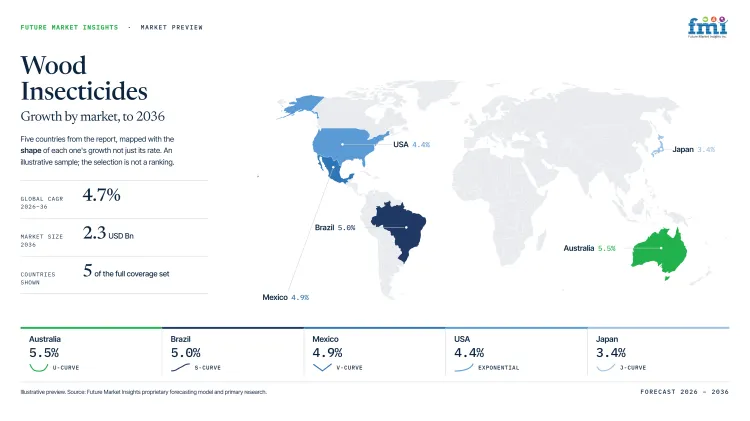
| Country | CAGR |
|---|---|
| Australia | 5.5% |
| South Africa | 5.2% |
| Brazil | 5.0% |
| Mexico | 4.9% |
| USA | 4.4% |
| Germany | 4.1% |
| Japan | 3.4% |
How do country-level CAGRs compare in the Wood Insecticides Market?
Australia leads the profiled group with South Africa and Brazil close behind. Mexico follows, while the USA and Germany form the middle band. Japan records the slowest CAGR as mature building and material-quality practices constrain acceleration.
- Australia: Combines building-level termite-risk management with an active housing approval pipeline.
- South Africa: Pairs preventive treatment with recurring remedial pest-management requirements.
- Brazil: Favors traceable formulations and disciplined treatment processes under formal registration.
- Mexico: Includes infrastructure and construction uses where treated wood can be tied to specified impregnation and inspection procedures.
- USA: Demand is supported by professional termite services, industrial wood treatment and a large construction channel.
- Germany: Pairs residential construction activity with formal biocide controls.
- Japan: Operates through mature building practices, so local application evidence and formulation consistency matter more than rapid construction-volume expansion.
Similar CAGRs therefore require different registration, channel and treatment-support decisions. The full report provides country-level CAGR analysis across North America, Latin America, Western Europe, Eastern Europe, East Asia, South Asia and Pacific, and Middle East and Africa.
Country-wise Analysis
- Demand for wood insecticides in Australia is forecast to expand at 5.5% CAGR from 2026 to 2036 because preventive protection enters the construction and treatment workflow before structural timber is exposed to long-term pest risk. Suppliers need registered products, treatment evidence and documentation that builders and treatment providers can use at the specification stage.
- Demand for wood insecticides in South Africa is forecast to expand at 5.2% CAGR through 2036 because public-sector maintenance programs convert chemical efficacy into repeat service demand. Buyers therefore assess service capability together with product performance, especially where treatment must be documented across multiple sites and recurring inspection cycles.
- Brazil places formal registration and reporting requirements on wood-preservative products and preservation plants, favoring traceable formulations and disciplined treatment processes. Demand for wood insecticides in Brazil is forecast to expand at 5.0% CAGR from 2026 to 2036 because regulated treatment infrastructure rewards suppliers that support concentration control, technical documentation and reliable supply. That operating environment favors suppliers that can help treatment plants maintain compliance while preserving treatment quality across production lots.
- Mexico includes infrastructure and construction uses where treated wood can be tied to specified impregnation and inspection procedures, increasing the value of process support. NOM-007-ARTF-2023 for wooden railway sleepers covers supply, impregnation and inspection, illustrating how industrial wood demand can be tied to prescribed treatment and conformity checks. Demand for wood insecticides in Mexico is forecast to rise at 4.9% CAGR over the forecast period because specified treatment routes create a qualified demand base for suppliers that can support documentation and process consistency. Suppliers that support treatment plants with process guidance are better placed to qualify for these uses.
- USA demand is supported by professional termite services, industrial wood treatment and a large construction channel, but federal registration and state licensing raise the qualification threshold. The USA Census Bureau and HUD reported June 2026 housing starts at a seasonally adjusted annual rate of about 1.4 million. Demand for wood insecticides in the USA is forecast to rise at 4.4% CAGR from 2026 to 2036 because new-construction and remedial demand both depend on registered products, trained applicators and treatment consistency. Federal pesticide registration and state licensing make labels, applicator training and treatment evidence central to commercial adoption.
- Demand for wood insecticides in Germany is forecast to rise at 4.1% CAGR through 2036 because construction activity creates treatment opportunities, but buyers place high weight on compliance and documented performance. Biocide authorization and exposure-management requirements keep technical documentation and treatment quality central to supplier selection.
- Demand for wood insecticides in Japan is forecast to expand at 3.4% CAGR from 2026 to 2036 because slower new-build momentum increases the importance of specialist treatment demand, renovation-related protection and professional distribution support. Suppliers that can demonstrate local application fit and stable product performance are better positioned than those relying on construction volume alone.
Who are the notable companies in the Wood Insecticides Market?
BASF, Bayer Environmental Science / Envu, Syngenta, Koppers, Lonza Wood Protection, Nisus Corporation, Kop-Coat, Troy Corporation, Lanxess, and Borax / Rio Tinto are the notable companies profiled in this market.
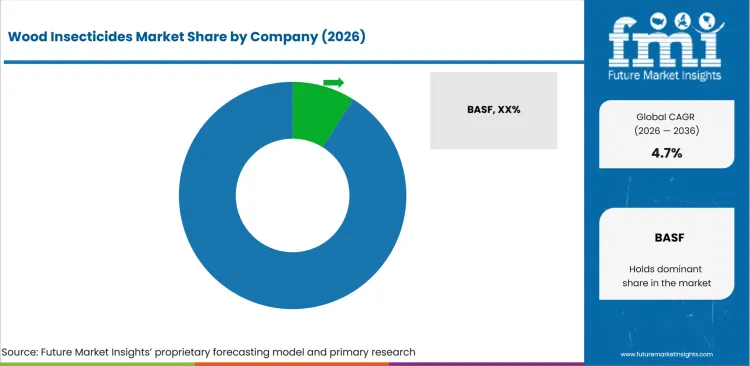
Competition separates into structural pest-management chemistry, industrial wood-preservation platforms and specialty preservation actives or formulation inputs. Buyers compare suppliers on fit with the target insect, treatment process, wood end use and professional or industrial channel. Well-positioned suppliers combine dependable formulation access with technical support that helps applicators and treatment plants achieve repeatable outcomes.
- BASF, Bayer Environmental Science / Envu, Syngenta and Nisus Corporation compete through professional pest and structural-protection routes.
- Koppers, Lonza Wood Protection and Kop-Coat are closely tied to treatment-plant and treated-timber workflows.
- Troy Corporation, Lanxess and Borax / Rio Tinto contribute chemistry used across preservation and treatment systems.
Competitive Benchmarking: Wood Insecticides Market
| Company | Wood-Insect Product Scope | Treatment / Process Fit | Channel / Technical Support | Geographic Reach |
|---|---|---|---|---|
| BASF | High | High | High | North America, Europe and Asia-Pacific |
| Bayer Environmental Science / Envu | High | High | High | North America, Europe and Asia-Pacific |
| Syngenta | High | Medium | High | Global professional pest markets |
| Koppers | High | High | High | North America, Australasia and Europe |
| Lonza Wood Protection | High | High | Medium | Europe and international markets |
| Nisus Corporation | Medium | High | Medium | North America and selected international markets |
| Kop-Coat | Medium | High | Medium | North America and international industrial markets |
| Troy Corporation | Medium | Medium | Medium | North America, Europe and Asia |
| Lanxess | Medium | Medium | Medium | Europe, North America and Asia-Pacific |
| Borax / Rio Tinto | High | Medium | High | Global borate supply markets |
Scoring basis: High wood-insect product scope requires a direct structural pest-management or wood-preservation platform with relevance to insect protection. Medium reflects specialty chemistry, formulation inputs or narrower product scope.
High treatment/process fit indicates alignment with professional application, treatment-plant workflows or industrial wood-treatment processes. Medium reflects a more focused route.
High channel/technical support combines product documentation, applicator or plant support and commercial channel access. Medium reflects a more focused support structure.
Key Developments in the Wood Insecticides Market
- May 2026: USA Borax / Rio Tinto issued an updated technical bulletin on borates in wood protection, outlining Borogard ZB and Tim-bor Industrial use for engineered and solid wood through pressure and diffusion treatment routes. The update strengthens technical support for boron-based termite and decay protection.
- May 2025: Envu completed the transfer of FMC Global Specialty Solutions assets into its Australia, New Zealand and Japan operations. Envu stated that the transferred portfolio includes pest-control products, broadening its professional pest-management offering and channel continuity in the region.
- April 2025: Envu India announced a certified 10-year termite warranty for Premise through its Pest Expert Alliance network. The program links long-duration pre-construction termite protection with trained applicators and a formal service proposition.
Key Players in the Wood Insecticides Market
Structural Termite and Pest-Management Solutions
- BASF
- Bayer Environmental Science / Envu
- Syngenta
- Nisus Corporation
Industrial Wood-Preservation Platforms
- Koppers
- Lonza Wood Protection
- Kop-Coat
Specialty Preservation Actives and Formulation Inputs
- Troy Corporation
- Lanxess
- Borax / Rio Tinto
Wood Insecticides Market - Report Scope
| Coverage Field | Report Scope |
|---|---|
| Market Breakdown | By Active Ingredient, Form, Target Pest, End Use, Sales Channel and region |
| Quantitative Units | USD billion |
| Market Definition | Revenue from wood insecticide and insecticidal wood-preservative products sold within the stated segment universe. Downstream finished-product revenue and adjacent substitute products are excluded |
| Regions Covered | North America, Latin America, Western Europe, Eastern Europe, East Asia, South Asia and Pacific, and Middle East and Africa |
| Countries Covered | Australia, USA, Japan, Brazil, Mexico, South Africa and Germany, and 20+ countries included in the full report |
| Key Companies Profiled | BASF, Bayer Environmental Science / Envu, Syngenta, Koppers, Lonza Wood Protection, Nisus Corporation, Kop-Coat, Troy Corporation, Lanxess, and Borax / Rio Tinto |
| Forecast Period | 2026 to 2036 |
| Approach | Primary and secondary research with market triangulation |
Wood Insecticides Market - Research Methodology
| Method | Approach |
|---|---|
| Primary Research | FMI analysts gathered input from manufacturers, formulation suppliers, wood treatment plants, pest-control professionals, distributors, industrial buyers and subject-matter experts. Interviews examined active selection, application form, treatment stage, regulatory qualification, pricing considerations, channel economics and repeat-treatment behavior. Respondents were also asked what evidence is required before a trial, specification or initial order develops into regular purchasing. |
| Desk Research | Desk research covered government statistics, pesticide and biocide regulation, wood-treatment standards, public procurement, company filings, first-party technical documents, product information and published forest-products research relevant to the defined market. Sources were assessed for relevance to the defined market scope. |
| Market Sizing and Forecasting | The market model combined the baseline value with historical performance, segment structure, pricing and volume indicators, treatment applications, construction and treated-wood demand, pest-management requirements, regulatory developments, treatment-process adoption and the timing of replacement or repeat protection. Forecast assumptions considered economic activity, investment trends, regulatory developments, formulation adoption, purchasing cycles, supply availability and barriers to wider market use. Segment and regional estimates were reconciled before the final market total was calculated. |
| Data Validation | Estimates were checked against independent indicators including public data, company activity, trade patterns, regulatory developments, technical documents and findings from primary interviews. Validation also considered whether products, applications and company revenues fell within the defined market boundaries. Adjacent categories, overlapping revenues and downstream finished wood were excluded to reduce double counting and maintain consistency across segments and countries. |
Wood Insecticides Market by Segments
Wood Insecticides Market segmented by Active Ingredient:
- Permethrin
- Bifenthrin
- Imidacloprid
- Boron compounds
- Fipronil
- Botanical / bio-based actives
Wood Insecticides Market segmented by Form:
- Liquid concentrate
- Ready-to-use spray
- Powder / dust
- Gel / paste
- Pressure-treatment solution
Wood Insecticides Market segmented by Target Pest:
- Termites
- Powderpost beetles
- Carpenter ants
- Wood borers
- Mixed insects
Wood Insecticides Market segmented by End Use:
- Sawn timber
- Structural wood
- Furniture
- Utility poles
- Construction lumber
Wood Insecticides Market segmented by Sales Channel:
- Wood treatment plants
- Pest control channel
- Industrial distributors
- Retail/professional supply
Wood Insecticides Market by Region
- North America
- United States
- Canada
- Latin America
- Brazil
- Mexico
- Argentina
- Chile
- Western Europe
- Germany
- France
- United Kingdom
- Italy
- Spain
- Benelux
- Nordics
- Eastern Europe
- Poland
- Czech Republic
- Romania
- Hungary
- East Asia
- China
- Japan
- South Korea
- South Asia and Pacific
- India
- ASEAN
- Australia and New Zealand
- Middle East and Africa
- GCC Countries
- South Africa
- Türkiye
- Israel
Research Sources and Bibliography
- USA Environmental Protection Agency. (2026, June 2). Overview of Wood Preservative Chemicals.
- USA Environmental Protection Agency. (2025, October 21). Termites: How to Identify and Control Them.
- Kirker, G. T., and Lebow, S. T., USDA Forest Service. (2021). Chapter 15: Wood Preservatives.
- Australian Building Codes Board. (2025, July 29). National Construction Code 2022, Amendment 2 and termite risk-management provisions.
- Australian Bureau of Statistics. (2026, July 30). Building Approvals, Australia, June 2026.
- USA Census Bureau and USA Department of Housing and Urban Development. (2026, July 17). New Residential Construction, June 2026.
- Ministry of Land, Infrastructure, Transport and Tourism, Japan. (2026, April 30). Building Starts Statistics Survey Report, Fiscal Year 2025.
- Instituto Brasileiro do Meio Ambiente e dos Recursos Naturais Renováveis. (2022, November 29). Produtos preservativos de madeiras.
- Agencia Reguladora del Transporte Ferroviario, Mexico. (2024, January 19). NOM-007-ARTF-2023: Wooden railway sleepers, supply, impregnation and inspection.
- Lesedi Local Municipality. (2026, June 11). Tender No. 16/2026: Termite Eradication and Quarterly Integrated Pest Management / Fumigation Programme.
- Statistisches Bundesamt (Destatis). (2026, July 17). Building permits for dwellings in May 2026.
- Envu. (2025, May 6). Envu Completes Transfer of Global Specialty Solutions Assets in Australia, New Zealand, and Japan.
- Envu India. (2025, April 15). Envu Introduces India’s First Certified 10-Year Termite Warranty with Premise.
- Koppers Holdings Inc. (2026, March 31). Koppers Holdings Publishes 2025 Annual Report.
- Arxada. (2024, May). Wood Protection Europe.
- USA Borax / Rio Tinto. (2026, May). Borates in Wood Protection.
This bibliography is provided for reader reference and is not exhaustive. The full report contains the complete reference list and detailed citations.
This Report Answers
- What is the wood insecticides market size in 2026 and what value is forecast for 2036?
- Why does preventive treatment support recurring wood insecticide demand?
- Why does Permethrin hold the leading position within Active Ingredient?
- Why does liquid concentrate lead the Form category?
- Why do termites hold the leading position within Target Pest?
- Why does sawn timber lead the End Use category?
- Why do wood treatment plants lead the Sales Channel category?
- How do country growth rates differ among Australia, USA, Japan, Brazil, Mexico, South Africa and Germany?
- How are BASF, Bayer Environmental Science / Envu, Syngenta, Koppers, Lonza Wood Protection, Nisus Corporation, Kop-Coat, Troy Corporation, Lanxess and Borax / Rio Tinto positioned?
- How do registration, applicator qualification and treatment-process controls influence commercial adoption?
Frequently Asked Questions
How big is the Wood Insecticides Market in 2026?
The wood insecticides market is valued at USD 1.5 billion in 2026 and is projected to reach USD 2.3 billion by 2036. Growth is tied to preventive structural protection, termite-risk management and industrial wood-treatment demand.
What is the CAGR of the Wood Insecticides Market from 2026 to 2036?
The wood insecticides market is projected to grow at a CAGR of 4.7% between 2026 and 2036. Expansion depends on treatment demand across structural wood, sawn timber and professional pest-management applications.
Which active ingredient leads the Wood Insecticides Market?
The Permethrin segment is expected to hold 24.0% of the wood insecticides market in 2026, attributable to established use in structural insect control and professional treatment workflows.
Which target pest leads the Wood Insecticides Market?
The termites segment is expected to represent 39.0% of target pest demand in 2026, supported by the structural damage risk and the economic urgency of preventive protection.
Which countries are projected to record the highest growth in the Wood Insecticides Market?
Australia is projected to grow at 5.5% CAGR, followed by South Africa at 5.2% and Brazil at 5.0% through 2036. Their growth routes differ because building requirements, treatment infrastructure and regulatory controls affect demand differently.
Which companies are active in the Wood Insecticides Market?
Key companies operating in the market include BASF, Bayer Environmental Science / Envu, Syngenta, Koppers, Lonza Wood Protection, Nisus Corporation, Kop-Coat, Troy Corporation, Lanxess, and Borax / Rio Tinto. They compete through structural pest-management chemistry, industrial wood preservation and specialty formulation routes.
Preview the report firsthand - request a free sample
Get SampleGet the brochure for pricing and purchase details.
Get PDFTable of Content
- Key Takeaways
- Market Size and CAGR
- Top Growth Driver
- Fastest Growing Segment
- Leading Region
- Key Companies
- Emerging Opportunities
- Executive Summary
- Global Market Outlook
- Demand-side Trends
- Supply-side Trends
- Technology Roadmap Analysis
- Analysis and Recommendations
- Analyst Perspective (What is happening? Why now? What should investors know?)
- Key Questions Answered
- How large is the market?
- What is the CAGR?
- What are key trends?
- Which region dominates?
- Who are the leaders?
- Market Overview
- Market Coverage / Taxonomy
- Market Definition / Scope / Limitations
- Research Methodology
- Chapter Orientation
- Analytical Lens and Working Hypotheses
- Market Structure, Signals, and Trend Drivers
- Benchmarking and Cross-market Comparability
- Market Sizing, Forecasting, and Opportunity Mapping
- Research Design and Evidence Framework
- Desk Research Programme (Secondary Evidence)
- Expert Input and Fieldwork (Primary Evidence)
- Tooling, Models, and Reference Databases
- Data Engineering and Model Build
- Quality Assurance and Audit Trail
- Market Background
- Market Dynamics (Drivers, Restraints, Opportunity, Trends)
- Scenario Forecast (Optimistic, Likely, Conservative)
- Impact Analysis
- AI Impact
- Sustainability Impact
- Regulatory Impact
- Technology Impact
- Consumer / Buyer Analysis
- Purchase Drivers
- Adoption Barriers
- Buyer Journey
- Opportunity Map Analysis
- Product Life Cycle Analysis
- Supply Chain Analysis
- Investment Feasibility Matrix
- Value Chain Analysis
- PESTLE and Porter's Analysis
- Regulatory Landscape
- Regional Parent Market Outlook
- Production and Consumption Statistics
- Import and Export Statistics
- Global Market Analysis and Forecast, 2021 to 2036
- Historical Market Size Value (USD Billion) Analysis, 2021 to 2025
- Current and Future Market Size Value (USD Billion) Projections, 2026 to 2036
- Y-o-Y Growth Trend Analysis
- Absolute $ Opportunity Analysis
- Global Market Pricing Analysis, 2021 to 2036
- Global Market Analysis and Forecast, By Active Ingredient, 2021 to 2036
- Introduction / Key Findings
- Historical Market Size Value (USD Billion) Analysis By Active Ingredient, 2021 to 2025
- Current and Future Market Size Value (USD Billion) Analysis and Forecast By Active Ingredient, 2026 to 2036
- Permethrin
- Bifenthrin
- Imidacloprid
- Boron compounds
- Fipronil
- Botanical / bio-based actives
- Permethrin
- Y-o-Y Growth Trend Analysis By Active Ingredient, 2021 to 2025
- Absolute $ Opportunity Analysis By Active Ingredient, 2026 to 2036
- Global Market Analysis and Forecast, By Form, 2021 to 2036
- Introduction / Key Findings
- Historical Market Size Value (USD Billion) Analysis By Form, 2021 to 2025
- Current and Future Market Size Value (USD Billion) Analysis and Forecast By Form, 2026 to 2036
- Liquid concentrate
- Ready-to-use spray
- Powder / dust
- Gel / paste
- Pressure-treatment solution
- Liquid concentrate
- Y-o-Y Growth Trend Analysis By Form, 2021 to 2025
- Absolute $ Opportunity Analysis By Form, 2026 to 2036
- Global Market Analysis and Forecast, By Target Pest, 2021 to 2036
- Introduction / Key Findings
- Historical Market Size Value (USD Billion) Analysis By Target Pest, 2021 to 2025
- Current and Future Market Size Value (USD Billion) Analysis and Forecast By Target Pest, 2026 to 2036
- Termites
- Powderpost beetles
- Carpenter ants
- Wood borers
- Mixed insects
- Termites
- Y-o-Y Growth Trend Analysis By Target Pest, 2021 to 2025
- Absolute $ Opportunity Analysis By Target Pest, 2026 to 2036
- Global Market Analysis and Forecast, By End Use, 2021 to 2036
- Introduction / Key Findings
- Historical Market Size Value (USD Billion) Analysis By End Use, 2021 to 2025
- Current and Future Market Size Value (USD Billion) Analysis and Forecast By End Use, 2026 to 2036
- Sawn timber
- Structural wood
- Furniture
- Utility poles
- Construction lumber
- Sawn timber
- Y-o-Y Growth Trend Analysis By End Use, 2021 to 2025
- Absolute $ Opportunity Analysis By End Use, 2026 to 2036
- Global Market Analysis and Forecast, By Sales Channel, 2021 to 2036
- Introduction / Key Findings
- Historical Market Size Value (USD Billion) Analysis By Sales Channel, 2021 to 2025
- Current and Future Market Size Value (USD Billion) Analysis and Forecast By Sales Channel, 2026 to 2036
- Wood treatment plants
- Pest control channel
- Industrial distributors
- Retail/professional supply
- Wood treatment plants
- Y-o-Y Growth Trend Analysis By Sales Channel, 2021 to 2025
- Absolute $ Opportunity Analysis By Sales Channel, 2026 to 2036
- Global Market Analysis and Forecast, By Region, 2021 to 2036
- Introduction
- Historical Market Size Value (USD Billion) Analysis By Region, 2021 to 2025
- Current Market Size Value (USD Billion) Analysis and Forecast By Region, 2026 to 2036
- North America
- Latin America
- Western Europe
- Eastern Europe
- East Asia
- South Asia and Pacific
- Middle East & Africa
- Market Attractiveness Analysis By Region
- North America Market Analysis and Forecast, By Country, 2021 to 2036
- Historical Market Size Value (USD Billion) Trend Analysis By Market Taxonomy, 2021 to 2025
- Market Size Value (USD Billion) Forecast By Market Taxonomy, 2026 to 2036
- By Country
- USA
- Canada
- By Active Ingredient
- By Form
- By Target Pest
- By End Use
- By Sales Channel
- By Country
- Market Attractiveness Analysis
- By Country
- By Active Ingredient
- By Form
- By Target Pest
- By End Use
- By Sales Channel
- Key Takeaways
- Latin America Market Analysis and Forecast, By Country
- Historical Market Size Value (USD Billion) Trend Analysis By Market Taxonomy, 2021 to 2025
- Market Size Value (USD Billion) Forecast By Market Taxonomy, 2026 to 2036
- By Country
- Brazil
- Mexico
- Chile
- Rest of Latin America
- By Active Ingredient
- By Form
- By Target Pest
- By End Use
- By Sales Channel
- By Country
- Market Attractiveness Analysis
- By Country
- By Active Ingredient
- By Form
- By Target Pest
- By End Use
- By Sales Channel
- Key Takeaways
- Western Europe Market Analysis and Forecast, By Country
- Historical Market Size Value (USD Billion) Trend Analysis By Market Taxonomy, 2021 to 2025
- Market Size Value (USD Billion) Forecast By Market Taxonomy, 2026 to 2036
- By Country
- Germany
- UK
- Italy
- Spain
- France
- Nordic
- BENELUX
- Rest of Western Europe
- By Active Ingredient
- By Form
- By Target Pest
- By End Use
- By Sales Channel
- By Country
- Market Attractiveness Analysis
- By Country
- By Active Ingredient
- By Form
- By Target Pest
- By End Use
- By Sales Channel
- Key Takeaways
- Eastern Europe Market Analysis and Forecast, By Country
- Historical Market Size Value (USD Billion) Trend Analysis By Market Taxonomy, 2021 to 2025
- Market Size Value (USD Billion) Forecast By Market Taxonomy, 2026 to 2036
- By Country
- Russia
- Poland
- Hungary
- Balkan & Baltic
- Rest of Eastern Europe
- By Active Ingredient
- By Form
- By Target Pest
- By End Use
- By Sales Channel
- By Country
- Market Attractiveness Analysis
- By Country
- By Active Ingredient
- By Form
- By Target Pest
- By End Use
- By Sales Channel
- Key Takeaways
- East Asia Market Analysis and Forecast, By Country
- Historical Market Size Value (USD Billion) Trend Analysis By Market Taxonomy, 2021 to 2025
- Market Size Value (USD Billion) Forecast By Market Taxonomy, 2026 to 2036
- By Country
- China
- Japan
- South Korea
- By Active Ingredient
- By Form
- By Target Pest
- By End Use
- By Sales Channel
- By Country
- Market Attractiveness Analysis
- By Country
- By Active Ingredient
- By Form
- By Target Pest
- By End Use
- By Sales Channel
- Key Takeaways
- South Asia and Pacific Market Analysis and Forecast, By Country
- Historical Market Size Value (USD Billion) Trend Analysis By Market Taxonomy, 2021 to 2025
- Market Size Value (USD Billion) Forecast By Market Taxonomy, 2026 to 2036
- By Country
- India
- ASEAN
- Australia & New Zealand
- Rest of South Asia and Pacific
- By Active Ingredient
- By Form
- By Target Pest
- By End Use
- By Sales Channel
- By Country
- Market Attractiveness Analysis
- By Country
- By Active Ingredient
- By Form
- By Target Pest
- By End Use
- By Sales Channel
- Key Takeaways
- Middle East & Africa Market Analysis and Forecast, By Country
- Historical Market Size Value (USD Billion) Trend Analysis By Market Taxonomy, 2021 to 2025
- Market Size Value (USD Billion) Forecast By Market Taxonomy, 2026 to 2036
- By Country
- Kingdom of Saudi Arabia
- Other GCC Countries
- Türkiye
- South Africa
- Other African Union
- Rest of Middle East & Africa
- By Active Ingredient
- By Form
- By Target Pest
- By End Use
- By Sales Channel
- By Country
- Market Attractiveness Analysis
- By Country
- By Active Ingredient
- By Form
- By Target Pest
- By End Use
- By Sales Channel
- Key Takeaways
- Key Countries Market Analysis
- USA
- Pricing Analysis
- Market Share Analysis, 2025
- By Active Ingredient
- By Form
- By Target Pest
- By End Use
- By Sales Channel
- Canada
- Pricing Analysis
- Market Share Analysis, 2025
- By Active Ingredient
- By Form
- By Target Pest
- By End Use
- By Sales Channel
- Mexico
- Pricing Analysis
- Market Share Analysis, 2025
- By Active Ingredient
- By Form
- By Target Pest
- By End Use
- By Sales Channel
- Brazil
- Pricing Analysis
- Market Share Analysis, 2025
- By Active Ingredient
- By Form
- By Target Pest
- By End Use
- By Sales Channel
- Chile
- Pricing Analysis
- Market Share Analysis, 2025
- By Active Ingredient
- By Form
- By Target Pest
- By End Use
- By Sales Channel
- Germany
- Pricing Analysis
- Market Share Analysis, 2025
- By Active Ingredient
- By Form
- By Target Pest
- By End Use
- By Sales Channel
- UK
- Pricing Analysis
- Market Share Analysis, 2025
- By Active Ingredient
- By Form
- By Target Pest
- By End Use
- By Sales Channel
- Italy
- Pricing Analysis
- Market Share Analysis, 2025
- By Active Ingredient
- By Form
- By Target Pest
- By End Use
- By Sales Channel
- Spain
- Pricing Analysis
- Market Share Analysis, 2025
- By Active Ingredient
- By Form
- By Target Pest
- By End Use
- By Sales Channel
- France
- Pricing Analysis
- Market Share Analysis, 2025
- By Active Ingredient
- By Form
- By Target Pest
- By End Use
- By Sales Channel
- India
- Pricing Analysis
- Market Share Analysis, 2025
- By Active Ingredient
- By Form
- By Target Pest
- By End Use
- By Sales Channel
- ASEAN
- Pricing Analysis
- Market Share Analysis, 2025
- By Active Ingredient
- By Form
- By Target Pest
- By End Use
- By Sales Channel
- Australia & New Zealand
- Pricing Analysis
- Market Share Analysis, 2025
- By Active Ingredient
- By Form
- By Target Pest
- By End Use
- By Sales Channel
- China
- Pricing Analysis
- Market Share Analysis, 2025
- By Active Ingredient
- By Form
- By Target Pest
- By End Use
- By Sales Channel
- Japan
- Pricing Analysis
- Market Share Analysis, 2025
- By Active Ingredient
- By Form
- By Target Pest
- By End Use
- By Sales Channel
- South Korea
- Pricing Analysis
- Market Share Analysis, 2025
- By Active Ingredient
- By Form
- By Target Pest
- By End Use
- By Sales Channel
- Russia
- Pricing Analysis
- Market Share Analysis, 2025
- By Active Ingredient
- By Form
- By Target Pest
- By End Use
- By Sales Channel
- Poland
- Pricing Analysis
- Market Share Analysis, 2025
- By Active Ingredient
- By Form
- By Target Pest
- By End Use
- By Sales Channel
- Hungary
- Pricing Analysis
- Market Share Analysis, 2025
- By Active Ingredient
- By Form
- By Target Pest
- By End Use
- By Sales Channel
- Kingdom of Saudi Arabia
- Pricing Analysis
- Market Share Analysis, 2025
- By Active Ingredient
- By Form
- By Target Pest
- By End Use
- By Sales Channel
- Türkiye
- Pricing Analysis
- Market Share Analysis, 2025
- By Active Ingredient
- By Form
- By Target Pest
- By End Use
- By Sales Channel
- South Africa
- Pricing Analysis
- Market Share Analysis, 2025
- By Active Ingredient
- By Form
- By Target Pest
- By End Use
- By Sales Channel
- USA
- Market Structure Analysis
- Competition Dashboard
- Competition Benchmarking
- Market Share Analysis of Top Players
- By Regional
- By Active Ingredient
- By Form
- By Target Pest
- By End Use
- By Sales Channel
- Emerging Startups
- Innovation Benchmarking
- Competition Analysis
- Competition Deep Dive
- BASF
- Overview
- Product Portfolio
- Profitability by Market Segments
- Sales Footprint
- Strategy Overview
- Marketing Strategy
- Product Strategy
- Channel Strategy
- Bayer Environmental Science / Envu
- Syngenta
- Koppers
- Lonza Wood Protection
- Nisus Corporation
- Kop-Coat
- Troy Corporation
- Lanxess
- Borax / Rio Tinto
- BASF
- Case Studies
- Success Stories
- Recent Developments
- Competition Deep Dive
- Assumptions & Acronyms Used


