

- Market Size (2026)
- USD 166.3 Mn
- Forecast (2036)
- USD 443.3 Mn
- CAGR (2026 to 2036)
- 10.3%
How big is Plant-Based Chelators Market in 2026?
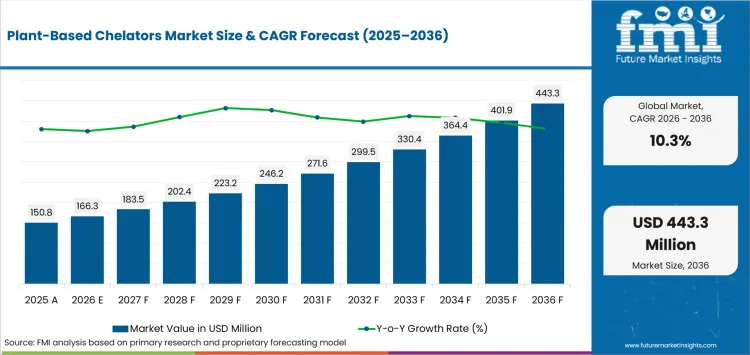
USD 166.3 million in 2026 and USD 443.3 million by 2036 at a 10.3% CAGR.
Demand for plant-based chelators is projected to expand at 10.3% CAGR between 2026 and 2036, increasing valuation from USD 166.3 million to USD 443.3 million. Fertilizer formulators compare bio-derived complexing with established crop micronutrients because metal solubility must survive practical mixing and application conditions. Borregaard’s March 2026 annual report recorded improved BioSolutions results and identified strong agriculture sales among the contributors to its 2025 performance.
Country adoption follows different farm structures and qualification expectations instead of progressing along one uniform commercial path. Germany has a visible base for bio-derived positioning with organic farming covering 11.1% of agricultural land during 2024 according to Destatis's February 2026 data. The documented organic base gives qualified agricultural chelates and related plant-origin complexes a clearer testing route, while USA formulators place greater weight on field-scale economics and channel coverage.
Key Takeaways of Plant-Based Chelators Market
- Fertilizer formulators are widening evaluation of plant-derived complexing where micronutrient solubility and formulation compatibility remain measurable under commercial use conditions.
- By product type, raw - crude extract grades are estimated to hold 43.0% in 2026 owing to downstream formulation flexibility.
- Cereals & grains are projected to account for 40.6% of crop-type demand in 2026, supported by broad treated acreage and repeat nutrient programs.
- In 2026, soil application is expected to represent 45.5% of application-method demand as the route fits current fertilizer placement routines.
- Batch variability and incomplete characterization can delay approval by forcing formulators to confirm metal binding, storage stability and compatibility before recurring purchases begin.
- Some of the key players in this market include Borregaard, Olmix Group, Ingevity, Seipasa, Acadian Plant Health, Algaia, Rovensa Next, and Syngenta.
Analyst Perspective
“Fertilizer formulators should judge plant-based chelators by metal-loading consistency and solubility inside the nutrient matrix they intend to sell. A renewable origin earns commercial value only if the grade shortens qualification and gives agronomists reproducible guidance for the target pH range.”
- Nikhil Kaitwade, Principal Consultant, Future Market Insights
How is the Plant-Based Chelators Market segmented?
Plant-based chelators use product type, crop type, application method, farm type and sales channel segmentation.
Product type includes raw - crude extract grades, refined & standardized fractions, formulated end-use blends and others. Crop type covers cereals & grains, fruits & vegetables, oilseeds & pulses, turf & ornamentals and others. Application method includes soil, foliar, fertigation / drip, seed and others. Farm type covers large commercial farms, mid-size farms, smallholders, greenhouses & nurseries and others. Sales channels include agri-input distributors, cooperatives, agri-retail chains, online / direct-to-farm and others.
What drives Agri-input Distributors within the Sales Channel category?
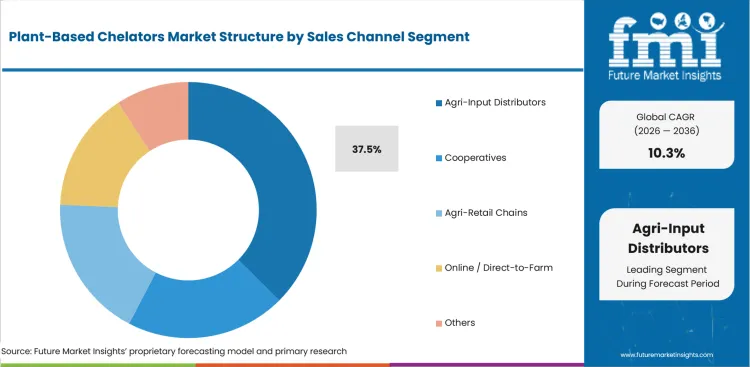
Agri-input distributors translate ingredient specifications into crop recommendations and keep technical support close to farms during first use. MAFRA brought 113 agricultural-input exporters together with 75 buyers from 27 countries in July 2025, showing how biostimulants and technical crop inputs use organized channels as growers evaluate new programs.
- Agri-input distributors are expected to hold 37.5% of sales-channel demand in 2026 given the channel's role in reducing uncertainty during initial qualification.
- Direct sales remain practical for large formulators, while distributors widen access by carrying inventory and supporting crop-specific troubleshooting after the first order.
What makes Raw - Crude extract grades central to the Product type category?
Raw and crude grades suit fertilizer formulators with in-house blending because concentration and metal loading remain adjustable during final formulation. Olmix received PFC 6 certification for Cormin SW in July 2025 and gave bulk-blending manufacturers a documented route for pairing a seaweed-derived input with specialty fertilizers under European rules.
- By product type, raw - crude extract grades are estimated to hold 43.0% in 2026 owing to large formulators standardizing incoming material internally.
- Commercial acceptance depends on characterization of solids, active composition and solubility before a lower-processing grade enters a repeatable micronutrient recipe.
Why do Cereals & Grains lead the Crop type category?
Cereal programs place unusual weight on cost per hectare given nutrient decisions repeat over broad acreage and regular application schedules. USDA reported in August 2025 that 55% of mid-size family farms specialized in grains and oilseeds, reinforcing the scale available to biofertilizers and compatible micronutrient systems that fit field operations.
- Cereals & grains are projected to hold 40.6% of crop-type demand in 2026 owing to repeat nutrient programs and distributor scale.
- Formulators serving row crops must preserve tank or soil compatibility without raising handling complexity enough to erase the economic benefit of wider acreage.
How does Soil application shape demand within the Application method category?
Root-zone delivery places complexing beside soil chemistry that reduces micronutrient availability in commercial fertilizer programs. USDA ERS reported in August 2025 that 70% of nitrogen on conventionally tilled cover-cropped corn and cotton fields was applied at or after planting, confirming timing windows for water-soluble fertilizers.
- Soil application is forecast to represent 45.5% of application-method demand in 2026 as root-zone delivery fits current nutrient programs without another field pass.
- Adoption requires stable behavior in the intended soil and fertilizer matrix since natural origin does not compensate for weak metal availability under variable pH conditions.
What are the drivers, restraints and opportunities in the Plant-Based Chelators Market?
Nutrient-efficiency requirements increase demand, qualification work limits substitution and standardized plant-derived formulations provide the clearest route to wider commercial use.
- Driver: Fertilizer programs increasingly reward inputs that improve nutrient availability without forcing a separate application system or major process change.
- Restraint: Natural-feedstock variability raises testing requirements as formulators must reproduce binding performance and shelf stability before changing a proven chelator system.
- Opportunity: Standardized extracts and formulated blends can convert renewable feedstocks into specification-led products that are easier to approve and reorder.
Fertilizer formulators increasingly compare biological inputs on nutrient performance inside existing crop programs instead of origin claims alone. Syngenta inaugurated a South Carolina biologicals facility in February 2025 to serve North and Latin American markets, expanding capacity available to crop-input channels selling biological nutrient products. Larger biological portfolios give plant-based chelators more formulation opportunities provided metal binding remains measurable beside humic and fulvic acids.
Qualification slows substitution unless plant-derived ingredients carry defensible composition and function claims in every sales jurisdiction. In March 2025, Seipasa obtained PFC 6(B) registration for SeiZen under Regulation (EU) 2019/1009 after efficacy testing established its biostimulant function. Comparable plant-based chelators need similarly clear technical files before seed biostimulants and fertilizer formulations move from evaluation into repeat purchasing.
Commercial opportunity is strongest where processors reduce the gap between laboratory screening and repeatable production of variable biological feedstocks. Rovensa Next’s February 2026 announcement confirmed that its Brazil pilot fermentation plant became fully operational after July 2025 completion and bridges laboratory work with industrial output. Plant-derived complexing routes can use similar scale-up controls to narrow lot variation before high-purity lignin reaches fertilizer formulators.
Which country CAGRs are profiled in the Plant-Based Chelators Market?
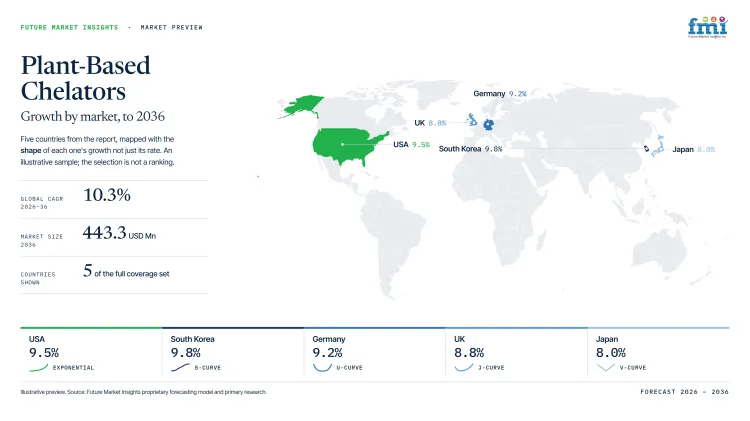
| Country | CAGR |
|---|---|
| South Korea | 9.8% |
| USA | 9.5% |
| Germany | 9.2% |
| UK | 8.8% |
| Japan | 8.0% |
How do country-level CAGRs compare in the Plant-Based Chelators Market?
The displayed 1.8-point range forms a compact upper growth group led by South Korea at 9.8% and the USA at 9.5%. Germany follows at 9.2% while the UK and Japan form the lower group. The spacing reflects commercialization speed and qualification burden more than differences in current market size today.
- Korean controlled-horticulture programs now use a designated smart-farming support centre for technology development and wider adoption.
- USA distributors require pH and soil-compatibility evidence before wider regional listings.
- German blenders value documentation that travels cleanly through EU-wide fertilizer distribution.
- UK specialty-fertilizer programs favor formulations that fit existing spray and fertigation schedules.
- MIDORI policy keeps nutrient-efficiency claims central to Japanese agricultural-input positioning.
Comparable growth rates therefore produce different trial costs and channel requirements for companies entering each country. The full report provides country-level CAGR analysis across North America, Latin America, Europe, East Asia, South Asia, Oceania and the Middle East and Africa.
Country-wise Analysis
- Large USA fertilizer accounts can spread one qualification program over broad grain acreage in major producing regions through national distributors serving repeated cereal and row-crop nutrient programs. Plant-based chelator demand in the USA is forecast to rise at 9.5% CAGR through 2036 owing to concentrated farms that can justify field validation before wider commercial listings. USDA NASS reported in February 2026 that farms with at least USD 1 million in annual sales controlled 36.0% of USA farmland. Farm concentration lowers trial cost per acre, yet manufacturers need reliable bulk supply and regional agronomy support before national trials become seasonal orders.
- UK crop-input companies rely on specialist distributors that separate verified product-function claims from broad natural-origin positioning during commercial review and initial technical screening. Defra's July 2026 data show 540 thousand hectares were farmed organically in 2025, with total organic area rising 7.3% from 2024. The UK plant-based chelators outlook is anticipated to advance at 8.8% CAGR over the assessment period aided by wider organic programs. Changing fertilizer categories still require clear technical files before distributors can translate new product functions into crop-specific recommendations. Companies with concise evidence and trained channel partners are better placed to convert seasonal trials into repeat purchasing without relying on natural-origin claims alone.
- German fertilizer companies evaluate plant-origin complexes within mature laboratory routines and a large cereal base that supports repeated micronutrient programs for commercial arable farms nationwide. Germany is estimated to post 9.2% CAGR over the forecast period reflecting specialty-input channels that screen characterized formulations against familiar synthetic options before wider distribution. Destatis estimated in May 2026 that German farms would plant 6.03 million hectares of cereals for the 2026 harvest, after cultivated area rose 4.4% during 2025. Allowed-use rules and solubility records therefore limit which formulations progress beyond controlled regional trials, even where cereal acreage gives manufacturers a large testing base.
- Japanese market entry depends on local agronomy partners because smaller operating units require concise application guidance and dealer support for region-specific crop systems. MAFF’s September 2025 review documented organic-village initiatives in 150 municipalities within 46 prefectures by fiscal 2025. Adoption of plant-based chelators in Japan is estimated to expand at 8.0% CAGR through 2036 tied to the expansion of these local programs. Regional dealers still need Japanese field evidence before they can recommend a new complexing input during first-use demonstrations. Companies that translate formulation data into short crop-specific guidance should convert local programs into repeat orders more efficiently than firms relying on global claims.
- South Korean agricultural-input companies use government-backed export programs to test technical positioning with overseas buyers before committing more resources to domestic demonstrations and partner selection. South Korea is projected to grow at 9.8% CAGR by 2036 propelled by faster buyer feedback from export programs that expose new formulations to commercial partners early. MAFRA documented in June 2025 that a 15-company delegation covering fertilizers and other agricultural inputs met prospective buyers in Thailand. Export feedback shortens commercial learning, but domestic registration rules and local crop economics still determine whether interest converts into repeat orders within established local South Korean distribution channels.
Who are the notable companies in the Plant-Based Chelators Market?
Borregaard, Olmix Group, Ingevity, Seipasa, Acadian Plant Health, Algaia, Rovensa Next, and Syngenta are the notable companies profiled in this market.
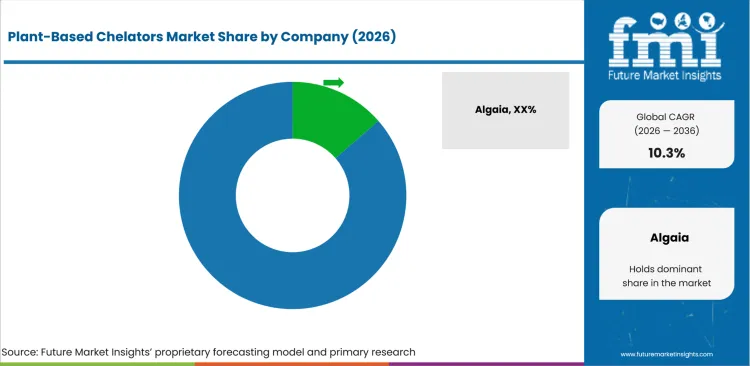
Competition separates direct complexing chemistry from broader biological crop-input platforms that compete for the same fertilizer-program budget. Borregaard and Olmix Group document plant-origin complexing roles, while Ingevity supplies lignin chemistry used in agricultural formulations. Seipasa, Acadian Plant Health, Algaia, Rovensa Next and Syngenta serve biological formulation and field-support channels inside the fertilizer market.
- Complexing and lignin chemistry: Borregaard, Olmix Group and Ingevity provide plant-derived complexing or related lignin chemistry for agricultural nutrition.
- Plant-derived crop-input platforms: Seipasa, Acadian Plant Health, Algaia, Rovensa Next and Syngenta sell biological formulations backed by crop evidence and commercial channels.
Competitive Benchmarking: Plant-Based Chelators Market
| Company | Bio-Derived Nutrient Function | Crop-Nutrition Formulation Breadth | Commercial Qualification Access | Geographic Reach |
|---|---|---|---|---|
| Borregaard | High | High | High | Global |
| Olmix Group | High | High | High | Europe, Americas and Asia |
| Ingevity | Medium | Medium | Medium | North America with international specialty-material sales |
| Seipasa | High | High | High | Europe and international distributor markets |
| Acadian Plant Health | High | High | High | North America, Europe and international markets |
| Algaia | Medium | Medium | Medium | Europe with global partner sales |
| Rovensa Next | High | High | High | Europe, Americas and international markets |
| Syngenta | High | High | High | Global |
Scoring basis: High bio-derived nutrient function requires three or more documented agricultural nutrient or complexing functions under the assessed company evidence. Medium requires two documented nutrient functions while Low requires one verified agricultural nutrient function within the assessed evidence set. High formulation breadth requires at least three agricultural product formats while Medium requires two verified formats and Low requires one. High qualification access requires documented registrations or technical channels in at least three regions while Medium requires two regions and Low requires one.
Key Developments in the Plant-Based Chelators Market
- In April 2026, Seipasa obtained European PFC 6(B) registration for Kynetic4 and expanded its portfolio of plant-based biostimulants with authorization for EU-wide commercialization.
- In August 2025, Acadian Plant Health expanded its CE-marked European biostimulant portfolio with a fifth product under the EU Fertilising Products Regulation.
- In February 2025, Syngenta and Ceres Biotics signed a global biologicals agreement covering a nutrient-use-efficiency product intended to complement conventional nitrogen fertilizer programs.
Key Players in the Plant-Based Chelators Market
Complexing and Lignin Chemistry
- Borregaard
- Olmix Group
- Ingevity
Plant-Derived Crop-Input Platforms
- Seipasa
- Acadian Plant Health
- Algaia
- Rovensa Next
- Syngenta
Plant-Based Chelators Market - Report Scope
| Coverage field | Report scope |
|---|---|
| Market breakdown | By product type, crop type, application method, farm type, sales channel and region. |
| Quantitative Units | USD million. |
| Market Definition | Commercial plant-origin and algal-origin chelating or complexing materials sold for agricultural nutrient delivery within the defined segmentation universe. |
| Regions Covered | North America, Latin America, Europe, East Asia, South Asia and Pacific, and Middle East and Africa. |
| Countries Covered | South Korea, USA, Germany, UK, Japan, and 20+ countries included in the full report. |
| Key Companies Profiled | Borregaard, Olmix Group, Ingevity, Seipasa, Acadian Plant Health, Algaia, Rovensa Next, Syngenta. |
| Forecast Period | 2026 to 2036. |
| Approach | Primary and secondary research with market triangulation. |
Plant-Based Chelators Market - Research Methodology
| Method | Approach |
|---|---|
| Primary Research | FMI analysts gathered input from manufacturers, service providers, technology developers, distributors, end users, procurement teams, and subject-matter experts. Interviews examined purchasing decisions, product or service evaluation, adoption barriers, approval requirements, pricing considerations, and expectations for technical or commercial support. Respondents were also asked what evidence is required before a trial, pilot, or initial order develops into regular purchasing. |
| Desk Research | Desk research covered government statistics, regulatory publications, trade data, industry associations, technical literature, standards, company filings, product information, and official corporate announcements. Sources were reviewed for relevance, publication date, geographic coverage, and consistency with the defined market scope. Claims relating to performance, applications, approvals, capacity, investment, and commercial activity were retained only when supported by credible public evidence. |
| Market Sizing and Forecasting | The market model combined the baseline value with historical performance, segment structure, pricing and volume indicators, adoption levels, company participation, and country-level demand conditions. Forecast assumptions considered economic activity, investment trends, regulatory developments, technology adoption, purchasing cycles, supply availability, and barriers to wider market use. Segment and regional estimates were reconciled before the final market total was calculated. |
| Data Validation | Estimates were checked against multiple independent indicators, including public data, company activity, trade patterns, industry developments, and findings from primary interviews. Validation also tested whether products, services, applications, and company revenues fell within the defined market boundaries. Adjacent categories, unsupported claims, overlapping revenues, and activities without direct market relevance were excluded to reduce double counting and maintain consistency across segments and countries. |
Plant-Based Chelators Market by Segments
Plant-Based Chelators Market segmented by Product Type:
- Raw / Crude Extract Grades
- Refined & Standardized Fractions
- Formulated End-Use Blends
- Others
Plant-Based Chelators Market segmented by Crop Type:
- Cereals & Grains
- Fruits & Vegetables
- Oilseeds & Pulses
- Turf & Ornamentals
- Others
Plant-Based Chelators Market segmented by Application Method:
- Soil Application
- Foliar Application
- Fertigation / Drip
- Seed Application
- Others
Plant-Based Chelators Market segmented by Farm Type:
- Large Commercial Farms
- Mid-Size Farms
- Smallholders
- Greenhouses & Nurseries
- Others
Plant-Based Chelators Market segmented by Sales Channel:
- Agri-Input Distributors
- Cooperatives
- Agri-Retail Chains
- Online / Direct-to-Farm
- Others
Plant-Based Chelators Market by Region:
- North America
- United States
- Canada
- Latin America
- Brazil
- Mexico
- Chile
- Rest of Latin America
- Western Europe
- Germany
- United Kingdom
- Italy
- Spain
- France
- Nordics
- Benelux
- Rest of Western Europe
- Eastern Europe
- Russia
- Poland
- Hungary
- Balkan and Baltic States
- Rest of Eastern Europe
- East Asia
- China
- Japan
- South Korea
- South Asia and Pacific
- India
- ASEAN
- Australia and New Zealand
- Rest of South Asia and Pacific
- Middle East and Africa
- Kingdom of Saudi Arabia
- Other GCC Countries
- Türkiye
- South Africa
- Other African Union Countries
- Rest of Middle East and Africa
Research Sources and Bibliography
- Borregaard ASA. (2026, March 26). Annual Report 2025.
- German Federal Statistical Office. (2026, February 17). Organic farming in the EU 2024.
- Olmix Group. (2025, July 17). European certification for Cormin® SW, the Olmix biostimulant that boosts fertilizer efficiency.
- USA Department of Agriculture, National Agricultural Statistics Service. (2025, August 19). Family-owned farms account for 95% of USA farms, according to the Census of Agriculture Typology Report.
- USA Department of Agriculture, Economic Research Service. (2025, August 12). Farmers adopting cover crops are more likely to adopt other conservation practices.
- Ministry of Agriculture, Food and Rural Affairs, Republic of Korea. (2025, July 23). Buyers from 27 Countries, including Vietnam, Kazakhstan, and India, Gather at the ROK’s Buyers-Exporters Meeting for Agricultural Inputs.
- Syngenta. (2025, February 26). Syngenta strengthens global leadership in agricultural biologicals.
- Seipasa. (2025, March 28). Seipasa introduces SeiZen as a new biostimulant registered in Europe.
- Rovensa Next. (2026, February 2). Rovensa Next strengthens global innovation capabilities with new pilot fermentation plant in Brazil.
- Ministry of Agriculture, Food and Rural Affairs, Republic of Korea. (2025, June 17).S. Korea Accelerates Turning Agricultural Production into Smart Farming through Smart Farming Support Centres.
- USA Department of Agriculture, National Agricultural Statistics Service. (2026, February 13). Farms and Land in Farms 2025 Summary.
- UK Department for Environment, Food & Rural Affairs. (2026, July 29). Chapter 12: Organics.
- Statistisches Bundesamt (Destatis). (2026, May 19). Getreideanbaufläche 2026 hat sich nach Tiefststand von 2024 weiter stabilisiert.
- Ministry of Agriculture, Forestry and Fisheries of Japan. (2025, September). The situation surrounding organic agriculture in Japan.
- Ministry of Agriculture, Food and Rural Affairs, Republic of Korea. (2025, June 24). S. Korea Expands an Entry of Its Agricultural Inputs into the Market of Thailand through an Export Delegation.
- Seipasa. (2026, April 28). Seipasa secures new European biostimulant registration for Kynetic4 and strengthens its portfolio of biotechnological solutions.
- Acadian Plant Health. (2025, August 13). Acadian expands CE-marked biostimulant portfolio across Europe.
- Syngenta. (2025, February 20). Sustainability in agriculture gets a boost with global biologicals partnership.
- Olmix Group. (2026, April 24). European PFC7 certification for Seamel PREVENT, our biostimulant that increases yield and quality of production in vineyards and orchards.
- Algaia. (Retrieved August 23, 2026). Research projects.
- Ingevity Corporation. (2026, February 26). Form 10-K.
- Rovensa Next. (2025, December 9). Rovensa Next launches Myndra, a new synergistic biostimulant to elevate fruit quality in woody perennials in Europe.
- Syngenta. (2026, July 14). Syngenta and Groundwork BioAg enter partnership to bring innovation in biologicals and soil carbon solutions to farmers.
- Seipasa. (2026, June 1). Seipasa presents its new Citrus Line: a comprehensive biotechnological strategy for chemical residue-free crops.
- Acadian Plant Health. (2026, May 26). Advancing Seed Treatment Biostimulant in EMEA.
- Algaia. (2026, June 24). Visit to LOCALITY agronomic trials in Poland.
- Yara International ASA. (2025, May 12). PepsiCo-Yara partnership expands to Latin America.
- Ingevity. (2026, February 25). Ingevity reports full year and fourth quarter 2025 financial results.
This bibliography is provided for reader reference and is not exhaustive. The full report contains the complete reference list and detailed citations
This Report Answers
- How large is the plant-based chelators market in 2026 and what value is projected for 2036?
- Which operating requirements are increasing commercial interest in plant-derived complexing agents?
- Why do raw - crude extract grades hold the largest product-type share in 2026?
- Why do cereals & grains represent the leading crop-type category for plant-based chelators?
- How does soil application affect formulation and qualification requirements?
- Why do agri-input distributors hold the leading sales-channel position?
- How do country growth rates differ among South Korea, the USA, Germany, the UK and Japan?
- Which companies provide direct complexing chemistry or adjacent plant-derived crop-input platforms?
- What qualification risks can delay repeat purchasing of plant-based chelators?
Frequently Asked Questions
How big is the Plant-Based Chelators Market in 2026?
The plant-based chelators market is valued at USD 166.3 million in 2026 and is projected to reach USD 443.3 million by 2036. Growth is supported by fertilizer formulators seeking bio-derived complexing systems with repeatable nutrient availability in commercial crop programs.
What is the CAGR of the Plant-Based Chelators Market from 2026 to 2036?
The plant-based chelators market is projected to grow at a CAGR of 10.3% between 2026 and 2036. Expansion depends on specification-grade plant inputs that pass formulation, storage-stability and crop-performance checks in commercial nutrient programs.
Which product type leads the Plant-Based Chelators Market?
The raw - crude extract grades segment is expected to hold 43.0% of the plant-based chelators market in 2026, attributable to downstream formulation flexibility. Large formulators can adjust concentration and metal loading after qualifying incoming material for their own micronutrient production systems.
Which crop type leads the Plant-Based Chelators Market?
The cereals & grains segment is expected to hold 40.6% of the plant-based chelators market in 2026, supported by broad treated acreage. Repeat nutrient programs and existing distribution improve the economics of qualified formulations during regular commercial use.
Which countries are projected to record the highest growth in the Plant-Based Chelators Market?
South Korea is projected to grow at 9.8% CAGR, followed by the USA at 9.5% and Germany at 9.2% through 2036. Commercial conditions differ because each country uses distinct distribution channels and qualification routes for plant-derived crop inputs.
Which companies are active in the Plant-Based Chelators Market?
Key companies operating in the market include Borregaard, Olmix Group, Ingevity, Seipasa, Acadian Plant Health, Algaia, Rovensa Next, and Syngenta. These companies compete through complexing chemistry and plant-derived formulation expertise with agricultural qualification and field-level distribution support.
Preview the report firsthand - request a free sample
Get SampleGet the brochure for pricing and purchase details.
Get PDFTable of Content
- Key Takeaways
- Market Size and CAGR
- Top Growth Driver
- Fastest Growing Segment
- Leading Region
- Key Companies
- Emerging Opportunities
- Executive Summary
- Global Market Outlook
- Demand-side Trends
- Supply-side Trends
- Technology Roadmap Analysis
- Analysis and Recommendations
- Analyst Perspective (What is happening? Why now? What should investors know?)
- Key Questions Answered
- How large is the market?
- What is the CAGR?
- What are key trends?
- Which region dominates?
- Who are the leaders?
- Market Overview
- Market Coverage / Taxonomy
- Market Definition / Scope / Limitations
- Research Methodology
- Chapter Orientation
- Analytical Lens and Working Hypotheses
- Market Structure, Signals, and Trend Drivers
- Benchmarking and Cross-market Comparability
- Market Sizing, Forecasting, and Opportunity Mapping
- Research Design and Evidence Framework
- Desk Research Programme (Secondary Evidence)
- Expert Input and Fieldwork (Primary Evidence)
- Tooling, Models, and Reference Databases
- Data Engineering and Model Build
- Quality Assurance and Audit Trail
- Market Background
- Market Dynamics (Drivers, Restraints, Opportunity, Trends)
- Scenario Forecast (Optimistic, Likely, Conservative)
- Impact Analysis
- AI Impact
- Sustainability Impact
- Regulatory Impact
- Technology Impact
- Consumer / Buyer Analysis
- Purchase Drivers
- Adoption Barriers
- Buyer Journey
- Opportunity Map Analysis
- Product Life Cycle Analysis
- Supply Chain Analysis
- Investment Feasibility Matrix
- Value Chain Analysis
- PESTLE and Porter's Analysis
- Regulatory Landscape
- Regional Parent Market Outlook
- Production and Consumption Statistics
- Import and Export Statistics
- Global Market Analysis and Forecast, 2021 to 2036
- Historical Market Size Value (USD Million) Analysis, 2021 to 2025
- Current and Future Market Size Value (USD Million) Projections, 2026 to 2036
- Y-o-Y Growth Trend Analysis
- Absolute $ Opportunity Analysis
- Global Market Pricing Analysis, 2021 to 2036
- Global Market Analysis and Forecast, By Product Type, 2021 to 2036
- Introduction / Key Findings
- Historical Market Size Value (USD Million) Analysis By Product Type, 2021 to 2025
- Current and Future Market Size Value (USD Million) Analysis and Forecast By Product Type, 2026 to 2036
- Raw / Crude Extract Grades
- Refined & Standardized Fractions
- Formulated End-Use Blends
- Others
- Raw / Crude Extract Grades
- Y-o-Y Growth Trend Analysis By Product Type, 2021 to 2025
- Absolute $ Opportunity Analysis By Product Type, 2026 to 2036
- Global Market Analysis and Forecast, By Crop Type, 2021 to 2036
- Introduction / Key Findings
- Historical Market Size Value (USD Million) Analysis By Crop Type, 2021 to 2025
- Current and Future Market Size Value (USD Million) Analysis and Forecast By Crop Type, 2026 to 2036
- Cereals & Grains
- Fruits & Vegetables
- Oilseeds & Pulses
- Turf & Ornamentals
- Others
- Cereals & Grains
- Y-o-Y Growth Trend Analysis By Crop Type, 2021 to 2025
- Absolute $ Opportunity Analysis By Crop Type, 2026 to 2036
- Global Market Analysis and Forecast, By Application Method, 2021 to 2036
- Introduction / Key Findings
- Historical Market Size Value (USD Million) Analysis By Application Method, 2021 to 2025
- Current and Future Market Size Value (USD Million) Analysis and Forecast By Application Method, 2026 to 2036
- Soil Application
- Foliar Application
- Fertigation / Drip
- Seed Application
- Others
- Soil Application
- Y-o-Y Growth Trend Analysis By Application Method, 2021 to 2025
- Absolute $ Opportunity Analysis By Application Method, 2026 to 2036
- Global Market Analysis and Forecast, By Farm Type, 2021 to 2036
- Introduction / Key Findings
- Historical Market Size Value (USD Million) Analysis By Farm Type, 2021 to 2025
- Current and Future Market Size Value (USD Million) Analysis and Forecast By Farm Type, 2026 to 2036
- Large Commercial Farms
- Mid-Size Farms
- Smallholders
- Greenhouses & Nurseries
- Others
- Large Commercial Farms
- Y-o-Y Growth Trend Analysis By Farm Type, 2021 to 2025
- Absolute $ Opportunity Analysis By Farm Type, 2026 to 2036
- Global Market Analysis and Forecast, By Sales Channel, 2021 to 2036
- Introduction / Key Findings
- Historical Market Size Value (USD Million) Analysis By Sales Channel, 2021 to 2025
- Current and Future Market Size Value (USD Million) Analysis and Forecast By Sales Channel, 2026 to 2036
- Agri-Input Distributors
- Cooperatives
- Agri-Retail Chains
- Online / Direct-to-Farm
- Others
- Agri-Input Distributors
- Y-o-Y Growth Trend Analysis By Sales Channel, 2021 to 2025
- Absolute $ Opportunity Analysis By Sales Channel, 2026 to 2036
- Global Market Analysis and Forecast, By Region, 2021 to 2036
- Introduction
- Historical Market Size Value (USD Million) Analysis By Region, 2021 to 2025
- Current Market Size Value (USD Million) Analysis and Forecast By Region, 2026 to 2036
- North America
- Latin America
- Western Europe
- Eastern Europe
- East Asia
- South Asia and Pacific
- Middle East & Africa
- Market Attractiveness Analysis By Region
- North America Market Analysis and Forecast, By Country, 2021 to 2036
- Historical Market Size Value (USD Million) Trend Analysis By Market Taxonomy, 2021 to 2025
- Market Size Value (USD Million) Forecast By Market Taxonomy, 2026 to 2036
- By Country
- USA
- Canada
- By Product Type
- By Crop Type
- By Application Method
- By Farm Type
- By Sales Channel
- By Country
- Market Attractiveness Analysis
- By Country
- By Product Type
- By Crop Type
- By Application Method
- By Farm Type
- By Sales Channel
- Key Takeaways
- Latin America Market Analysis and Forecast, By Country
- Historical Market Size Value (USD Million) Trend Analysis By Market Taxonomy, 2021 to 2025
- Market Size Value (USD Million) Forecast By Market Taxonomy, 2026 to 2036
- By Country
- Brazil
- Mexico
- Chile
- Rest of Latin America
- By Product Type
- By Crop Type
- By Application Method
- By Farm Type
- By Sales Channel
- By Country
- Market Attractiveness Analysis
- By Country
- By Product Type
- By Crop Type
- By Application Method
- By Farm Type
- By Sales Channel
- Key Takeaways
- Western Europe Market Analysis and Forecast, By Country
- Historical Market Size Value (USD Million) Trend Analysis By Market Taxonomy, 2021 to 2025
- Market Size Value (USD Million) Forecast By Market Taxonomy, 2026 to 2036
- By Country
- Germany
- UK
- Italy
- Spain
- France
- Nordic
- BENELUX
- Rest of Western Europe
- By Product Type
- By Crop Type
- By Application Method
- By Farm Type
- By Sales Channel
- By Country
- Market Attractiveness Analysis
- By Country
- By Product Type
- By Crop Type
- By Application Method
- By Farm Type
- By Sales Channel
- Key Takeaways
- Eastern Europe Market Analysis and Forecast, By Country
- Historical Market Size Value (USD Million) Trend Analysis By Market Taxonomy, 2021 to 2025
- Market Size Value (USD Million) Forecast By Market Taxonomy, 2026 to 2036
- By Country
- Russia
- Poland
- Hungary
- Balkan & Baltic
- Rest of Eastern Europe
- By Product Type
- By Crop Type
- By Application Method
- By Farm Type
- By Sales Channel
- By Country
- Market Attractiveness Analysis
- By Country
- By Product Type
- By Crop Type
- By Application Method
- By Farm Type
- By Sales Channel
- Key Takeaways
- East Asia Market Analysis and Forecast, By Country
- Historical Market Size Value (USD Million) Trend Analysis By Market Taxonomy, 2021 to 2025
- Market Size Value (USD Million) Forecast By Market Taxonomy, 2026 to 2036
- By Country
- China
- Japan
- South Korea
- By Product Type
- By Crop Type
- By Application Method
- By Farm Type
- By Sales Channel
- By Country
- Market Attractiveness Analysis
- By Country
- By Product Type
- By Crop Type
- By Application Method
- By Farm Type
- By Sales Channel
- Key Takeaways
- South Asia and Pacific Market Analysis and Forecast, By Country
- Historical Market Size Value (USD Million) Trend Analysis By Market Taxonomy, 2021 to 2025
- Market Size Value (USD Million) Forecast By Market Taxonomy, 2026 to 2036
- By Country
- India
- ASEAN
- Australia & New Zealand
- Rest of South Asia and Pacific
- By Product Type
- By Crop Type
- By Application Method
- By Farm Type
- By Sales Channel
- By Country
- Market Attractiveness Analysis
- By Country
- By Product Type
- By Crop Type
- By Application Method
- By Farm Type
- By Sales Channel
- Key Takeaways
- Middle East & Africa Market Analysis and Forecast, By Country
- Historical Market Size Value (USD Million) Trend Analysis By Market Taxonomy, 2021 to 2025
- Market Size Value (USD Million) Forecast By Market Taxonomy, 2026 to 2036
- By Country
- Kingdom of Saudi Arabia
- Other GCC Countries
- Türkiye
- South Africa
- Other African Union
- Rest of Middle East & Africa
- By Product Type
- By Crop Type
- By Application Method
- By Farm Type
- By Sales Channel
- By Country
- Market Attractiveness Analysis
- By Country
- By Product Type
- By Crop Type
- By Application Method
- By Farm Type
- By Sales Channel
- Key Takeaways
- Key Countries Market Analysis
- USA
- Pricing Analysis
- Market Share Analysis, 2025
- By Product Type
- By Crop Type
- By Application Method
- By Farm Type
- By Sales Channel
- Canada
- Pricing Analysis
- Market Share Analysis, 2025
- By Product Type
- By Crop Type
- By Application Method
- By Farm Type
- By Sales Channel
- Mexico
- Pricing Analysis
- Market Share Analysis, 2025
- By Product Type
- By Crop Type
- By Application Method
- By Farm Type
- By Sales Channel
- Brazil
- Pricing Analysis
- Market Share Analysis, 2025
- By Product Type
- By Crop Type
- By Application Method
- By Farm Type
- By Sales Channel
- Chile
- Pricing Analysis
- Market Share Analysis, 2025
- By Product Type
- By Crop Type
- By Application Method
- By Farm Type
- By Sales Channel
- Germany
- Pricing Analysis
- Market Share Analysis, 2025
- By Product Type
- By Crop Type
- By Application Method
- By Farm Type
- By Sales Channel
- UK
- Pricing Analysis
- Market Share Analysis, 2025
- By Product Type
- By Crop Type
- By Application Method
- By Farm Type
- By Sales Channel
- Italy
- Pricing Analysis
- Market Share Analysis, 2025
- By Product Type
- By Crop Type
- By Application Method
- By Farm Type
- By Sales Channel
- Spain
- Pricing Analysis
- Market Share Analysis, 2025
- By Product Type
- By Crop Type
- By Application Method
- By Farm Type
- By Sales Channel
- France
- Pricing Analysis
- Market Share Analysis, 2025
- By Product Type
- By Crop Type
- By Application Method
- By Farm Type
- By Sales Channel
- India
- Pricing Analysis
- Market Share Analysis, 2025
- By Product Type
- By Crop Type
- By Application Method
- By Farm Type
- By Sales Channel
- ASEAN
- Pricing Analysis
- Market Share Analysis, 2025
- By Product Type
- By Crop Type
- By Application Method
- By Farm Type
- By Sales Channel
- Australia & New Zealand
- Pricing Analysis
- Market Share Analysis, 2025
- By Product Type
- By Crop Type
- By Application Method
- By Farm Type
- By Sales Channel
- China
- Pricing Analysis
- Market Share Analysis, 2025
- By Product Type
- By Crop Type
- By Application Method
- By Farm Type
- By Sales Channel
- Japan
- Pricing Analysis
- Market Share Analysis, 2025
- By Product Type
- By Crop Type
- By Application Method
- By Farm Type
- By Sales Channel
- South Korea
- Pricing Analysis
- Market Share Analysis, 2025
- By Product Type
- By Crop Type
- By Application Method
- By Farm Type
- By Sales Channel
- Russia
- Pricing Analysis
- Market Share Analysis, 2025
- By Product Type
- By Crop Type
- By Application Method
- By Farm Type
- By Sales Channel
- Poland
- Pricing Analysis
- Market Share Analysis, 2025
- By Product Type
- By Crop Type
- By Application Method
- By Farm Type
- By Sales Channel
- Hungary
- Pricing Analysis
- Market Share Analysis, 2025
- By Product Type
- By Crop Type
- By Application Method
- By Farm Type
- By Sales Channel
- Kingdom of Saudi Arabia
- Pricing Analysis
- Market Share Analysis, 2025
- By Product Type
- By Crop Type
- By Application Method
- By Farm Type
- By Sales Channel
- Türkiye
- Pricing Analysis
- Market Share Analysis, 2025
- By Product Type
- By Crop Type
- By Application Method
- By Farm Type
- By Sales Channel
- South Africa
- Pricing Analysis
- Market Share Analysis, 2025
- By Product Type
- By Crop Type
- By Application Method
- By Farm Type
- By Sales Channel
- USA
- Market Structure Analysis
- Competition Dashboard
- Competition Benchmarking
- Market Share Analysis of Top Players
- By Regional
- By Product Type
- By Crop Type
- By Application Method
- By Farm Type
- By Sales Channel
- Emerging Startups
- Innovation Benchmarking
- Competition Analysis
- Competition Deep Dive
- Algaia
- Overview
- Product Portfolio
- Profitability by Market Segments
- Sales Footprint
- Strategy Overview
- Marketing Strategy
- Product Strategy
- Channel Strategy
- Gelymar
- Kimitec
- Seipasa
- Borregaard
- Ingevity
- Acadian Plant Health
- Olmix Group
- Algaia
- Case Studies
- Success Stories
- Recent Developments
- Competition Deep Dive
- Assumptions & Acronyms Used


