

- Market Size (2026)
- USD 351.6 Bn
- Forecast (2036)
- USD 704.7 Bn
- CAGR (2026 to 2036)
- 7.2%
How big is Wood Bio-Products Market in 2026?
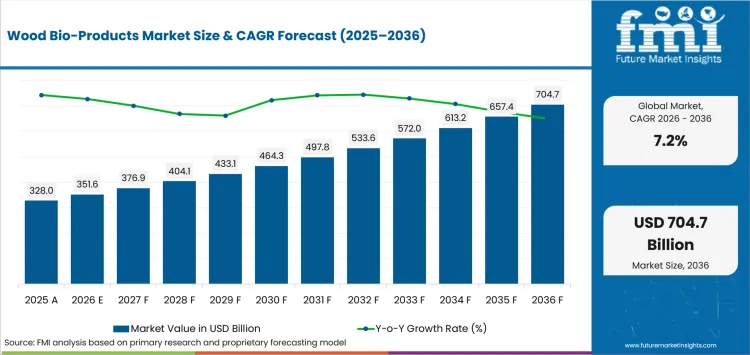
USD 351.6 billion in 2026 and USD 704.7 billion by 2036 at a 7.2% CAGR.
Demand for wood bio-products is projected to expand at a 7.2% CAGR between 2026 and 2036, increasing valuation from USD 351.6 billion in 2026 to USD 704.7 billion by 2036. Growth depends on mills assigning suitable wood fractions to products that meet repeatable material, chemical or fuel specifications.
The European Commission reported in February 2026 that annual EU wood harvest averaged about 570 million cubic metres during 2019-2023. That resource base supports recurring lignocellulosic biomass supply across several conversion routes that require reliable regional collection. Commercial contracts for green chemicals and energy continue to depend on documented residue quality plus economical delivery distance.
Key Takeaways ofWood Bio-Products Market
- Forest processors increase demand by directing documented wood fractions into material, chemical and fuel products with defined specifications.
- Bio-based materials are projected to account for 35.0% of product type demand in 2026 through composites and bioplastics.
- Energy is estimated to capture 31.0% of application demand in 2026 as standardized pellets fit established combustion systems.
- Industrial end users are anticipated to represent 38.0% of 2026 demand through repeatable inputs and contracted deliveries.
- Feedstock variability and transport distance can weaken project economics during application qualification and recurring volume planning.
- UPM-Kymmene Corporation, Stora Enso Oyj, West Fraser Timber Co. Ltd., Metsä Group, Sappi Limited, Weyerhaeuser Company, Borregaard ASA and Drax Group plc serve the market.
Analyst Perspective
"Wood bio-products should be evaluated through each mill’s ability to separate clean cellulose and lignin without weakening its primary output. Durable contracts define composition and delivery tolerances for one end use instead of relying on a broad renewable-material claim."
- Nikhil Kaitwade, Principal Consultant, Future Market Insights
How is the Wood Bio-Products Market segmented?
The wood bio-products market is segmented by product type, application, end user, distribution channel and region.
The market uses five axes as each category changes commercial product qualification and delivery decisions. Product type covers bio-based materials, pulp and fiber products, biofuels and biochemicals, while applications include energy, construction, packaging and chemicals or industrial uses. End users comprise industrial, commercial, residential and infrastructure groups, while distribution channels cover direct sales, distributors and wholesalers, online channels and retail outlets. Regional analysis spans North America, Latin America, Europe, East Asia, South Asia and Pacific, and the Middle East and Africa.
Why do bio-based materials lead demand within the product type category?
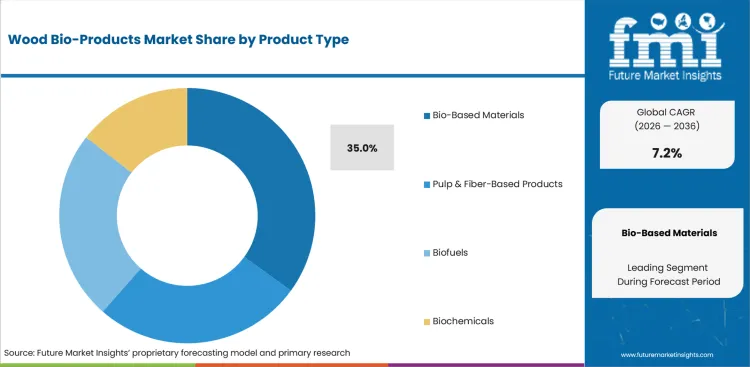
Packaging and industrial formulators need wood-derived composites and polymers that retain strength during established processing conditions. The European Commission identified bio-based materials and biochemicals as priority markets in its November 2025 bioeconomy strategy. The policy focus directs qualification toward defined commercial applications instead of broad claims about renewable feedstock.
- By product type, bio-based materials are estimated to hold 35.0% in 2026 owing to established conversion routes for reinforced formulations.
- Commercial programs for bio-based plastics require repeated strength and processing trials on the intended manufacturing equipment. Orders for lignin-based resins depend on stable performance across diverse commercial structural and packaging applications.
Why does energy lead demand within the application category?
Energy applications convert dry wood fractions into standardized fuels for boilers with dedicated storage and feed systems. Plant engineers compare wood pellet systems and biomass pellets against combustion settings, seasonal inventory capacity and operating limits.
- Energy is set to lead the application category with 31.0% share in 2026 due to pellet formats fitting established combustion systems.
- Large pellet plants depend on steady output across production cycles, storage periods and contracted delivery seasons. Drax reported in March 2026 that it produced 4.2 million tonnes of wood pellets during 2025. The disclosed production scale makes moisture control and freight reliability central to commercial supply contracts.
Why do industrial end users lead demand within the end user category?
Industrial facilities qualify wood-derived inputs for chemical, battery and process-energy systems that require documented performance during routine production. Stora Enso reported in June 2025 that prototype sodium-ion cells using wood-based lignin anodes were produced on industrial equipment. Industrial-scale testing reduces uncertainty about material consistency before manufacturers approve recurring commercial material supply contracts.
- By end user, industrial applications are forecast to represent 38.0% in 2026 driven by repeatable inputs that fit documented process controls.
- Cellulose fibers enter regular use through verified strength and conversion behavior across each manufacturing site. Wood pulp contracts depend on consistent grades and technical support throughout routine industrial manufacturing programs.
Why does direct sales lead demand within the distribution channel category?
Direct agreements connect one grade specification with committed volumes and scheduled deliveries across long-term commercial programs. Mill production teams can reserve suitable feedstock and resolve quality deviations through the same relationship without restarting qualification.
- In 2026, direct sales are expected to lead the distribution channel category with 46.0% share because technical contracts coordinate grades and scheduled volumes.
- New biorefinery output usually passes through application trials before manufacturing teams approve regular commercial orders. UPM reported in February 2025 that its Leuna qualification pipeline was several times the facility’s annual capacity. The project backlog makes direct technical coordination important during production scale-up and recurring contract scheduling.
What are the drivers, restraints and opportunities in the Wood Bio-Products Market?
Driver: higher-value material and chemical routes improve revenue from suitable wood fractions. Restraint: moisture variation and long collection routes raise conditioning costs. Opportunity: integrated conversion assigns cellulose, lignin and residual energy to separate commercial outlets.
- Driver: material and chemical outlets recover more value from clean wood fractions than conventional fuel routes.
- Restraint: moisture variation and long collection routes increase conditioning costs during recurring commercial supply commitments.
- Opportunity: integrated conversion platforms allocate cellulose and lignin to qualified products and use residual streams for energy.
Forest processors can direct clean fractions into material and chemical specifications instead of treating every residue as fuel. Fiber-based packaging rewards mills that separate suitable feedstock consistently, which supports recurring orders without changing the primary pulp or lumber program.
Moisture and species differences alter conditioning requirements across incoming loads and extended storage periods at forest-product mills. Long collection routes add conditioning and freight costs, which can make a technically suitable product uneconomic at the customer’s delivered price.
Integrated mills can assign cellulose and lignin to qualified products while residual streams supply process energy. The European Commission launched the Bio-based Europe Alliance in June 2026 to address deployment gaps for bio-based materials and products. Producers can use shared technical priorities to reduce qualification delays across wood-plastic composites and other industrial applications.
Which country CAGRs are profiled in the Wood Bio-Products Market?
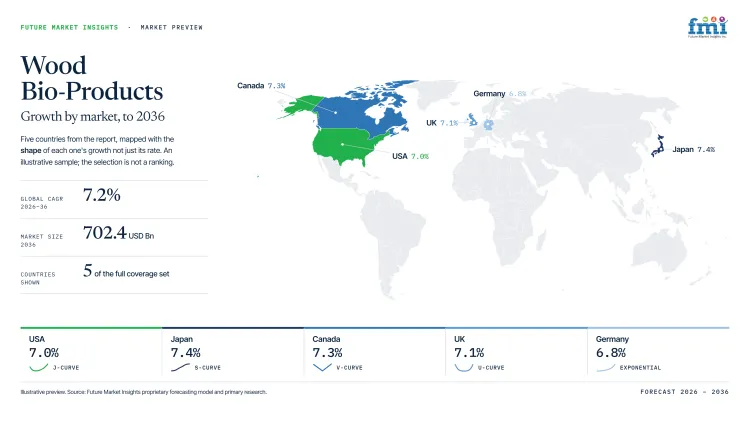
| Country | CAGR |
|---|---|
| Australia | 7.5% |
| Japan | 7.4% |
| United Kingdom | 7.1% |
| United States | 7.0% |
| Germany | 6.8% |
How do country-level CAGRs compare in the Wood Bio-Products Market?
The country comparison spans 0.7 percentage point and reveals three distinct growth groups across the Wood Bio-Products Market. Australia and Japan form the upper tier with a 0.1-point difference, while the United Kingdom and the United States create a closely aligned middle group separated by 0.1 percentage point. Germany remains at the lower end with a 0.2-point gap from the United States.
- Australia leads the comparison at a 7.5% CAGR through 2036, supported by applied forest-product research and the development of wood bio-product supply chains across long transport corridors between fiber sources and processing centers.
- Japan follows at a 7.4% CAGR, remaining 0.1 percentage point below Australia. Coordinated forest renewal and wider wood utilization support market development despite higher collection costs across mountainous prefectures.
- The United Kingdom records a 7.1% CAGR, creating a 0.3-percentage-point gap from Japan. Established pellet logistics and separate compliance routes for supported energy and non-energy applications influence market conditions.
- The United States grows at a 7.0% CAGR, only 0.1 percentage point below the United Kingdom. Federal biobased labeling and purchasing routes support demand across a large but regionally varied forest-products base.
- Germany records a 6.8% CAGR, remaining 0.2 percentage points below the United States. Chemical and wood-processing clusters, together with cascading-use rules, influence feedstock allocation toward higher-value applications.
Comparable CAGRs can still produce different market conditions. Differences in forest resources, feedstock collection costs, transport distances, regulatory frameworks, biobased purchasing policies and processing infrastructure influence market development across countries. The full report provides country-level CAGR analysis across North America, Latin America, Europe, East Asia, South Asia and Pacific, and the Middle East and Africa.
Country-wise Analysis
- Australian forest-product companies manage long supply corridors between fiber sources and processing centers, so commercial trials often remain close to mills with technical staff and established residue handling during routine commercial qualification. The Department of Agriculture reported in June 2025 that Australian Forest and Wood Innovations operates three regional research centers, giving producers local partners for applied testing across construction and industrial uses and residue-valorization programs. Australia's wood bio-products outlook is anticipated to advance at 7.5% CAGR over the assessment period, supported by applied research despite freight costs and limited service coverage across distant markets during extended qualification programs.
- Japanese wood processors work across mountainous prefectures that complicate collection and maintenance access, so new material or fuel programs depend on regional coordination between forest owners and mills during commercial qualification cycles. The Forestry Agency reported in June 2026 that national policy connects wider wood use with replanting and smart forestry, giving regional operators a clearer framework for harvesting and product planning for recurring commercial programs. Adoption of wood bio-products in Japan is estimated to expand at 7.4% CAGR through 2036, reinforced by domestic engineering capacity despite costly collection and uneven service coverage across remote production areas at scale.
- United Kingdom biomass operators combine imported pellet logistics with domestic material programs, but each project must document feedstock origin and greenhouse-gas performance under separate support and purchasing routes during recurring commercial approvals. The Department for Energy Security and Net Zero proposed stronger monitoring and verification requirements in December 2025, making standardized records more important for supported biomass operations and contract reviews for every supported operating scheme. Wood bio-product sales in the United Kingdom are forecast to expand at 7.1% CAGR by 2036, aided by established handling infrastructure despite compliance work that can delay qualification across energy and non-energy applications.
- United States manufacturers use federal biobased labeling and purchasing programs to document forestry-derived content, although regional feedstock quality and delivery distances vary across a large forest-products base during product qualification and contract renewal. USDA reported in March 2024 that biobased products contributed USD 489 billion during 2021 through economic activity linked with federal purchasing routes for forestry products and other qualified biobased applications across the national economy. The United States wood bio-products sector is projected to record 7.0% CAGR during the assessment period, supported by established processing capacity despite application testing and regional logistics that can delay recurring commercial orders.
- German chemical and wood-processing clusters can test new material specifications through established laboratories, while cascading-use rules direct suitable industrial wood toward higher-value applications before supported power generation across several established regional manufacturing networks. The Federal Ministry for Economic Affairs and Energy reported in July 2026 that the cabinet approved revised biomass rules excluding several higher-quality wood assortments from electricity support for projects under the Renewable Energy Act. Germany is estimated to post 6.8% CAGR over the forecast period, shaped by industrial qualification capacity although pending legislative completion leaves planning uncertainty for energy projects and feedstock allocation during commercial review.
Who are the notable companies in the Wood Bio-Products Market?
UPM-Kymmene Corporation, Stora Enso Oyj, West Fraser Timber Co. Ltd., Metsä Group, Sappi Limited, Weyerhaeuser Company, Borregaard ASA and Drax Group plc are the notable companies serving this market.
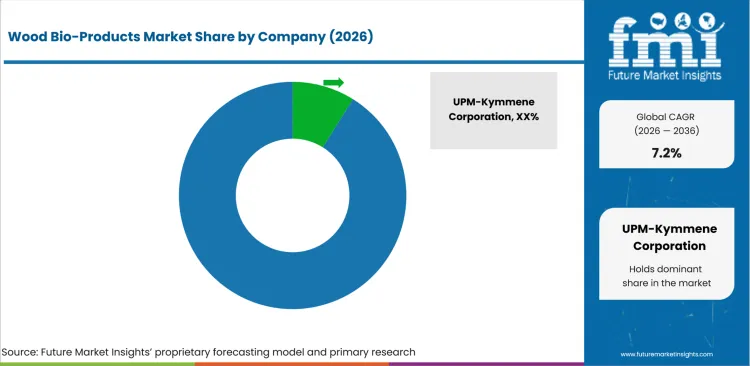
The competitive field is fragmented across engineered wood, specialty chemicals and pellet energy, with each route requiring different assets and qualification records. Entry barriers rise through feedstock control, mill integration and application records rather than company size alone.
- UPM-Kymmene Corporation, Stora Enso Oyj and Metsä Group combine forest platforms with materials, pulp and new bioproduct programs.
- West Fraser Timber Co. Ltd., Sappi Limited and Weyerhaeuser Company compete through engineered wood, pulp and specialty fiber applications.
- Borregaard ASA concentrates on wood chemistry, while Drax Group plc connects pellet production with biomass generation and third-party fuel sales.
Competitive Benchmarking: Wood Bio-Products Market
| Company | Product Route Breadth | Feedstock Conversion Control | Application Qualification Depth | Geographic Reach |
|---|---|---|---|---|
| UPM-Kymmene Corporation | High | High | High | Global |
| Stora Enso Oyj | High | High | High | Global |
| West Fraser Timber Co. Ltd. | Medium | High | High | North America and Europe |
| Metsä Group | High | High | High | Europe and international sales |
| Sappi Limited | Medium | High | High | Global |
| Weyerhaeuser Company | Medium | High | Low | North America |
| Borregaard ASA | High | Medium | High | Europe, Asia and Americas |
| Drax Group plc | Low | Medium | Low | North America and United Kingdom |
Key Developments in the Wood Bio-Products Market
- In March 2026, Metsä Group began pre-engineering for a commercial wood-based carbon-capture plant at its Rauma pulp mill with planned annual capacity of about 100,000 tonnes.
- In December 2025, UPM-Kymmene Corporation started commercial industrial-sugar production at its Leuna biorefinery as the facility advanced toward renewable glycols and lignin-based fillers.
- In September 2025, Borregaard ASA received NOK 15 million from the Research Council of Norway for the four-year Biomer program covering bio-based polymer alternatives.
Key Players in the Wood Bio-Products Market
Integrated Forest-Product and Bioproduct Platforms
- UPM-Kymmene Corporation
- Stora Enso Oyj
- Metsä Group
Wood Materials and Fiber Producers
- West Fraser Timber Co. Ltd.
- Sappi Limited
- Weyerhaeuser Company
Wood Chemistry and Biomass Energy Specialists
- Borregaard ASA
- Drax Group plc
Wood Bio-Products Market - Report Scope
| Coverage field | Report scope |
|---|---|
| Market breakdown | By product type, application, end user, distribution channel and region. |
| Quantitative Units | Revenue in USD billion and CAGR in %. |
| Market Definition | Commercial wood-derived materials, pulp and fiber products, biofuels and biochemicals supplied across qualified industrial, construction, packaging and energy routes. |
| Regions Covered | North America, Latin America, Europe, East Asia, South Asia and Pacific, and Middle East and Africa. |
| Countries Covered | Australia, Japan, United Kingdom, United States, Germany and 20+ countries included in the full report. |
| Key Companies Profiled | UPM-Kymmene Corporation, Stora Enso Oyj, West Fraser Timber Co. Ltd., Metsä Group, Sappi Limited, Weyerhaeuser Company, Borregaard ASA, Drax Group plc. |
| Forecast Period | 2026 to 2036. |
| Approach | Primary and secondary research with market triangulation. |
Wood Bio-Products Market - Research Methodology
| Method | Approach |
|---|---|
| Primary Research | FMI analysts gathered input from manufacturers, service providers, technology developers, distributors, end users, procurement teams, and subject-matter experts. Interviews examined purchasing decisions, product or service evaluation, adoption barriers, approval requirements, pricing considerations, and expectations for technical or commercial support. Respondents were also asked what evidence is required before a trial, pilot, or initial order develops into regular purchasing. |
| Desk Research | Desk research covered government statistics, regulatory publications, trade data, industry associations, technical literature, standards, company filings, product information, and official corporate announcements. Sources were reviewed for relevance, publication date, geographic coverage, and consistency with the defined market scope. Claims relating to performance, applications, approvals, capacity, investment, and commercial activity were retained only when supported by credible public evidence. |
| Market Sizing and Forecasting | The market model combined the baseline value with historical performance, segment structure, pricing and volume indicators, adoption levels, company participation, and country-level demand conditions. Forecast assumptions considered economic activity, investment trends, regulatory developments, technology adoption, purchasing cycles, supply availability, and barriers to wider market use. Segment and regional estimates were reconciled before the final market total was calculated. |
| Data Validation | Estimates were checked against multiple independent indicators, including public data, company activity, trade patterns, industry developments, and findings from primary interviews. Validation also tested whether products, services, applications, and company revenues fell within the defined market boundaries. Adjacent categories, unsupported claims, overlapping revenues, and activities without direct market relevance were excluded to reduce double counting and maintain consistency across segments and countries. |
Wood Bio-Products Market by Segments
Wood Bio-Products Market segmented by Product Type:
- Bio-Based Materials
- Bio-Composites
- Wood-Based Bioplastics
- Pulp & Fiber-Based Products
- Cellulose Fibers
- Wood-Based Pulp Products
- Biofuels
- Wood Pellets
- Liquid Biofuels
- Biochemicals
- Lignin-Based Chemicals
- Cellulose-Derived Chemicals
Wood Bio-Products Market segmented by Application:
- Energy
- Biomass Power Generation
- Wood Pellet Fuel
- Construction
- Engineered Wood Products
- Wood-Based Composites
- Packaging
- Fiber-Based Packaging
- Bio-Based Packaging Materials
- Chemicals & Industrial Uses
- Lignin-Based Chemicals
- Cellulose-Based Chemicals
Wood Bio-Products Market segmented by End User:
- Industrial
- Chemical & Material Manufacturers
- Energy Producers
- Commercial
- Construction Companies
- Packaging Manufacturers
- Residential
- Residential Construction
- Home & Interior Applications
- Infrastructure
- Public Infrastructure
- Utility Infrastructure
Wood Bio-Products Market segmented by Distribution Channel:
- Direct Sales
- Long-Term Supply Contracts
- Direct Industrial Sales
- Distributors & Wholesalers
- Industrial Distributors
- Building Material Distributors
- Online Channels
- B2B E-Commerce Platforms
- Direct Online Sales
- Retail Channels
- Home Improvement Retailers
- Specialty Retail Stores
Wood Bio-Products Market by Region:
- North America
- United States
- Canada
- Latin America
- Brazil
- Chile
- Mexico
- Rest of Latin America
- Western Europe
- Germany
- United Kingdom
- Italy
- Spain
- France
- Nordics
- Benelux
- Rest of Western Europe
- Eastern Europe
- Russia
- Poland
- Hungary
- Balkan and Baltic States
- Rest of Eastern Europe
- East Asia
- China
- Japan
- South Korea
- South Asia and Pacific
- India
- ASEAN
- Australia and New Zealand
- Rest of South Asia and Pacific
- Middle East and Africa
- Kingdom of Saudi Arabia
- Other GCC Countries
- Türkiye
- South Africa
- Other African Union Countries
- Rest of Middle East and Africa
Research Sources and Bibliography
- European Commission, Joint Research Centre. (2026, February 25). Forestry biomass.
- European Commission. (2025, November 27). Bioeconomy Strategy.
- Drax Group plc. (2026, March 25). Annual report and accounts 2025.
- Stora Enso Oyj. (2025, June 2). European Sodium-Ion Battery Cells Now a Reality - Made from Salt, Iron and Wood.
- UPM-Kymmene Corporation. (2025, February 5). UPM financial statements release 2024: Decisive actions to improve performance, accelerate growth and deliver value.
- European Commission. (2026, June 10). Commission steps up action on Europe’s bioeconomy.
- Australian Government Department of Agriculture, Fisheries and Forestry. (2025, June 18). Australian Forest and Wood Innovations.
- Forestry Agency, Ministry of Agriculture, Forestry and Fisheries. (2026, June 2).
- Department for Energy Security and Net Zero. (2025, December 2). Common biomass sustainability framework: consultation document (accessible webpage).
- USA Department of Agriculture. (2024, March 8). USDA Celebrates Second National Biobased Products Day.
- Federal Ministry for Economic Affairs and Energy. (2026, July 1). Neue Regelung zur Förderung der Stromerzeugung aus Holzbiomasse - Bundeskabinett beschließt Reform der Biomasseverordnung und setzt so EU-Vorgaben um.
- Metsä Group. (2026, March 31). Metsä Group is planning a commercial plant for wood-based carbon capture in Rauma.
- UPM-Kymmene Corporation. (2025, December 19). UPM unlocks new bio-based markets as Leuna biorefinery produces its first commercial product.
- Borregaard ASA. (2025, September 25). NOK 15 million grant for Borregaard’s Biomer project.
- UPM-Kymmene Corporation. (2026, March 4). UPM Annual Report 2025, Corporate Governance Statement and Remuneration Report published.
- Stora Enso Oyj. (2026, February 12). Stora Enso publishes its Annual Report and Remuneration Report 2025.
- West Fraser Timber Co. Ltd. (2026, February 11). West Fraser Announces Completion Of Form 40-F Filing.
- Metsä Group. (2026, February 19). Annual Review 2025: Metsä Group Publishes Review of the Financial Year and Updated Climate Transition Plan.
- Sappi Limited. (2025, December 12). 2025 Sappi Annual Integrated Report.
- Weyerhaeuser Company. (2026, February 13). 2025 Annual Report and Form 10-K.
- Borregaard ASA. (2026, March 26). Annual Report 2025.
This bibliography is provided for reader reference and is not exhaustive. The full report contains the complete reference list and detailed citations.
This Report Answers
- How large is the wood bio-products market in 2026 and 2036?
- Why should forest processors separate material, chemical and energy fractions during commercial planning?
- Which product type accounts for 35.0% of wood bio-product demand in 2026?
- How does the application mix shape conversion and storage priorities?
- Which end user group represents 38.0% of demand in 2026?
- How do operating conditions differ across the five profiled countries?
- Which companies combine materials, chemicals, engineered wood and biomass energy capabilities?
- What limits recurring orders across feedstock supply and application qualification?
- How should commercial teams compare wood bio-product suppliers during technical evaluation?
Frequently Asked Questions
How big is the wood bio-products market in 2026?
USD 351.6 billion is the estimated 2026 value of the wood bio-products market across materials, fiber products, fuels and biochemicals. Qualified conversion routes and dependable feedstock are projected to support a valuation of USD 704.7 billion by 2036 through recurring industrial, construction, packaging and energy applications.
What is the CAGR of the wood bio-products market from 2026 to 2036?
A 7.2% CAGR is projected for the wood bio-products market between 2026 and 2036 across its defined commercial scope. Expansion depends on processors matching documented wood fractions with performance requirements across material and chemical applications alongside construction, packaging and energy uses.
Which product type leads the wood bio-products market?
Bio-based materials account for 35.0% of the wood bio-products market by product type in 2026. Bio-composites and wood-based bioplastics support this position as manufacturers can qualify controlled formulations for construction, packaging and industrial applications using established processing equipment.
How much value will the wood bio-products market add between 2026 and 2036?
USD 350.8 billion is the projected absolute increase in the wood bio-products market between 2026 and 2036. That expansion depends on mills matching suitable wood fractions with qualified material, chemical, packaging and energy applications without weakening the economics of primary pulp or lumber production.
Who are the leading companies in the wood bio-products market?
Companies in the wood bio-products market across materials, fiber products, chemicals and pellet energy include UPM-Kymmene Corporation, Stora Enso Oyj, West Fraser Timber Co. Ltd., Metsä Group, Sappi Limited, Weyerhaeuser Company, Borregaard ASA and Drax Group plc.
Preview the report firsthand - request a free sample
Get SampleGet the brochure for pricing and purchase details.
Get PDFTable of Content
- Key Takeaways
- Market Size and CAGR
- Top Growth Driver
- Fastest Growing Segment
- Leading Region
- Key Companies
- Emerging Opportunities
- Executive Summary
- Global Market Outlook
- Demand-side Trends
- Supply-side Trends
- Technology Roadmap Analysis
- Analysis and Recommendations
- Analyst Perspective (What is happening? Why now? What should investors know?)
- Key Questions Answered
- How large is the market?
- What is the CAGR?
- What are key trends?
- Which region dominates?
- Who are the leaders?
- Market Overview
- Market Coverage / Taxonomy
- Market Definition / Scope / Limitations
- Research Methodology
- Chapter Orientation
- Analytical Lens and Working Hypotheses
- Market Structure, Signals, and Trend Drivers
- Benchmarking and Cross-market Comparability
- Market Sizing, Forecasting, and Opportunity Mapping
- Research Design and Evidence Framework
- Desk Research Programme (Secondary Evidence)
- Expert Input and Fieldwork (Primary Evidence)
- Tooling, Models, and Reference Databases
- Data Engineering and Model Build
- Quality Assurance and Audit Trail
- Market Background
- Market Dynamics (Drivers, Restraints, Opportunity, Trends)
- Scenario Forecast (Optimistic, Likely, Conservative)
- Impact Analysis
- AI Impact
- Sustainability Impact
- Regulatory Impact
- Technology Impact
- Consumer / Buyer Analysis
- Purchase Drivers
- Adoption Barriers
- Buyer Journey
- Opportunity Map Analysis
- Product Life Cycle Analysis
- Supply Chain Analysis
- Investment Feasibility Matrix
- Value Chain Analysis
- PESTLE and Porter's Analysis
- Regulatory Landscape
- Regional Parent Market Outlook
- Production and Consumption Statistics
- Import and Export Statistics
- Global Market Analysis and Forecast, 2021 to 2036
- Historical Market Size Value (USD Billion) Analysis, 2021 to 2025
- Current and Future Market Size Value (USD Billion) Projections, 2026 to 2036
- Y-o-Y Growth Trend Analysis
- Absolute $ Opportunity Analysis
- Global Market Pricing Analysis, 2021 to 2036
- Global Market Analysis and Forecast, By Product Type, 2021 to 2036
- Introduction / Key Findings
- Historical Market Size Value (USD Billion) Analysis By Product Type, 2021 to 2025
- Current and Future Market Size Value (USD Billion) Analysis and Forecast By Product Type, 2026 to 2036
- Bio-Based Materials
- Bio-Composites
- Wood-Based Bioplastics
- Pulp & Fiber-Based Products
- Cellulose Fibers
- Wood-Based Pulp Products
- Biofuels
- Wood Pellets
- Liquid Biofuels
- Biochemicals
- Lignin-Based Chemicals
- Cellulose-Derived Chemicals
- Bio-Based Materials
- Y-o-Y Growth Trend Analysis By Product Type, 2021 to 2025
- Absolute $ Opportunity Analysis By Product Type, 2026 to 2036
- Global Market Analysis and Forecast, By Application, 2021 to 2036
- Introduction / Key Findings
- Historical Market Size Value (USD Billion) Analysis By Application, 2021 to 2025
- Current and Future Market Size Value (USD Billion) Analysis and Forecast By Application, 2026 to 2036
- Energy
- Biomass Power Generation
- Wood Pellet Fuel
- Construction
- Engineered Wood Products
- Wood-Based Composites
- Packaging
- Fiber-Based Packaging
- Bio-Based Packaging Materials
- Chemicals & Industrial Uses
- Lignin-Based Chemicals
- Cellulose-Based Chemicals
- Energy
- Y-o-Y Growth Trend Analysis By Application, 2021 to 2025
- Absolute $ Opportunity Analysis By Application, 2026 to 2036
- Global Market Analysis and Forecast, By End User, 2021 to 2036
- Introduction / Key Findings
- Historical Market Size Value (USD Billion) Analysis By End User, 2021 to 2025
- Current and Future Market Size Value (USD Billion) Analysis and Forecast By End User, 2026 to 2036
- Industrial
- Chemical & Material Manufacturers
- Energy Producers
- Commercial
- Construction Companies
- Packaging Manufacturers
- Residential
- Residential Construction
- Home & Interior Applications
- Infrastructure
- Public Infrastructure
- Utility Infrastructure
- Industrial
- Y-o-Y Growth Trend Analysis By End User, 2021 to 2025
- Absolute $ Opportunity Analysis By End User, 2026 to 2036
- Global Market Analysis and Forecast, By Distribution Channel, 2021 to 2036
- Introduction / Key Findings
- Historical Market Size Value (USD Billion) Analysis By Distribution Channel, 2021 to 2025
- Current and Future Market Size Value (USD Billion) Analysis and Forecast By Distribution Channel, 2026 to 2036
- Direct Sales
- Long-Term Supply Contracts
- Direct Industrial Sales
- Distributors & Wholesalers
- Industrial Distributors
- Building Material Distributors
- Online Channels
- B2B E-Commerce Platforms
- Direct Online Sales
- Retail Channels
- Home Improvement Retailers
- Specialty Retail Stores
- Direct Sales
- Y-o-Y Growth Trend Analysis By Distribution Channel, 2021 to 2025
- Absolute $ Opportunity Analysis By Distribution Channel, 2026 to 2036
- Global Market Analysis and Forecast, By Region, 2021 to 2036
- Introduction
- Historical Market Size Value (USD Billion) Analysis By Region, 2021 to 2025
- Current Market Size Value (USD Billion) Analysis and Forecast By Region, 2026 to 2036
- North America
- Latin America
- Western Europe
- Eastern Europe
- East Asia
- South Asia and Pacific
- Middle East & Africa
- Market Attractiveness Analysis By Region
- North America Market Analysis and Forecast, By Country, 2021 to 2036
- Historical Market Size Value (USD Billion) Trend Analysis By Market Taxonomy, 2021 to 2025
- Market Size Value (USD Billion) Forecast By Market Taxonomy, 2026 to 2036
- By Country
- USA
- Canada
- By Product Type
- By Application
- By End User
- By Distribution Channel
- By Country
- Market Attractiveness Analysis
- By Country
- By Product Type
- By Application
- By End User
- By Distribution Channel
- Key Takeaways
- Latin America Market Analysis and Forecast, By Country
- Historical Market Size Value (USD Billion) Trend Analysis By Market Taxonomy, 2021 to 2025
- Market Size Value (USD Billion) Forecast By Market Taxonomy, 2026 to 2036
- By Country
- Brazil
- Mexico
- Chile
- Rest of Latin America
- By Product Type
- By Application
- By End User
- By Distribution Channel
- By Country
- Market Attractiveness Analysis
- By Country
- By Product Type
- By Application
- By End User
- By Distribution Channel
- Key Takeaways
- Western Europe Market Analysis and Forecast, By Country
- Historical Market Size Value (USD Billion) Trend Analysis By Market Taxonomy, 2021 to 2025
- Market Size Value (USD Billion) Forecast By Market Taxonomy, 2026 to 2036
- By Country
- Germany
- UK
- Italy
- Spain
- France
- Nordic
- BENELUX
- Rest of Western Europe
- By Product Type
- By Application
- By End User
- By Distribution Channel
- By Country
- Market Attractiveness Analysis
- By Country
- By Product Type
- By Application
- By End User
- By Distribution Channel
- Key Takeaways
- Eastern Europe Market Analysis and Forecast, By Country
- Historical Market Size Value (USD Billion) Trend Analysis By Market Taxonomy, 2021 to 2025
- Market Size Value (USD Billion) Forecast By Market Taxonomy, 2026 to 2036
- By Country
- Russia
- Poland
- Hungary
- Balkan & Baltic
- Rest of Eastern Europe
- By Product Type
- By Application
- By End User
- By Distribution Channel
- By Country
- Market Attractiveness Analysis
- By Country
- By Product Type
- By Application
- By End User
- By Distribution Channel
- Key Takeaways
- East Asia Market Analysis and Forecast, By Country
- Historical Market Size Value (USD Billion) Trend Analysis By Market Taxonomy, 2021 to 2025
- Market Size Value (USD Billion) Forecast By Market Taxonomy, 2026 to 2036
- By Country
- China
- Japan
- South Korea
- By Product Type
- By Application
- By End User
- By Distribution Channel
- By Country
- Market Attractiveness Analysis
- By Country
- By Product Type
- By Application
- By End User
- By Distribution Channel
- Key Takeaways
- South Asia and Pacific Market Analysis and Forecast, By Country
- Historical Market Size Value (USD Billion) Trend Analysis By Market Taxonomy, 2021 to 2025
- Market Size Value (USD Billion) Forecast By Market Taxonomy, 2026 to 2036
- By Country
- India
- ASEAN
- Australia & New Zealand
- Rest of South Asia and Pacific
- By Product Type
- By Application
- By End User
- By Distribution Channel
- By Country
- Market Attractiveness Analysis
- By Country
- By Product Type
- By Application
- By End User
- By Distribution Channel
- Key Takeaways
- Middle East & Africa Market Analysis and Forecast, By Country
- Historical Market Size Value (USD Billion) Trend Analysis By Market Taxonomy, 2021 to 2025
- Market Size Value (USD Billion) Forecast By Market Taxonomy, 2026 to 2036
- By Country
- Kingdom of Saudi Arabia
- Other GCC Countries
- Türkiye
- South Africa
- Other African Union
- Rest of Middle East & Africa
- By Product Type
- By Application
- By End User
- By Distribution Channel
- By Country
- Market Attractiveness Analysis
- By Country
- By Product Type
- By Application
- By End User
- By Distribution Channel
- Key Takeaways
- Key Countries Market Analysis
- USA
- Pricing Analysis
- Market Share Analysis, 2025
- By Product Type
- By Application
- By End User
- By Distribution Channel
- Canada
- Pricing Analysis
- Market Share Analysis, 2025
- By Product Type
- By Application
- By End User
- By Distribution Channel
- Mexico
- Pricing Analysis
- Market Share Analysis, 2025
- By Product Type
- By Application
- By End User
- By Distribution Channel
- Brazil
- Pricing Analysis
- Market Share Analysis, 2025
- By Product Type
- By Application
- By End User
- By Distribution Channel
- Chile
- Pricing Analysis
- Market Share Analysis, 2025
- By Product Type
- By Application
- By End User
- By Distribution Channel
- Germany
- Pricing Analysis
- Market Share Analysis, 2025
- By Product Type
- By Application
- By End User
- By Distribution Channel
- UK
- Pricing Analysis
- Market Share Analysis, 2025
- By Product Type
- By Application
- By End User
- By Distribution Channel
- Italy
- Pricing Analysis
- Market Share Analysis, 2025
- By Product Type
- By Application
- By End User
- By Distribution Channel
- Spain
- Pricing Analysis
- Market Share Analysis, 2025
- By Product Type
- By Application
- By End User
- By Distribution Channel
- France
- Pricing Analysis
- Market Share Analysis, 2025
- By Product Type
- By Application
- By End User
- By Distribution Channel
- India
- Pricing Analysis
- Market Share Analysis, 2025
- By Product Type
- By Application
- By End User
- By Distribution Channel
- ASEAN
- Pricing Analysis
- Market Share Analysis, 2025
- By Product Type
- By Application
- By End User
- By Distribution Channel
- Australia & New Zealand
- Pricing Analysis
- Market Share Analysis, 2025
- By Product Type
- By Application
- By End User
- By Distribution Channel
- China
- Pricing Analysis
- Market Share Analysis, 2025
- By Product Type
- By Application
- By End User
- By Distribution Channel
- Japan
- Pricing Analysis
- Market Share Analysis, 2025
- By Product Type
- By Application
- By End User
- By Distribution Channel
- South Korea
- Pricing Analysis
- Market Share Analysis, 2025
- By Product Type
- By Application
- By End User
- By Distribution Channel
- Russia
- Pricing Analysis
- Market Share Analysis, 2025
- By Product Type
- By Application
- By End User
- By Distribution Channel
- Poland
- Pricing Analysis
- Market Share Analysis, 2025
- By Product Type
- By Application
- By End User
- By Distribution Channel
- Hungary
- Pricing Analysis
- Market Share Analysis, 2025
- By Product Type
- By Application
- By End User
- By Distribution Channel
- Kingdom of Saudi Arabia
- Pricing Analysis
- Market Share Analysis, 2025
- By Product Type
- By Application
- By End User
- By Distribution Channel
- Türkiye
- Pricing Analysis
- Market Share Analysis, 2025
- By Product Type
- By Application
- By End User
- By Distribution Channel
- South Africa
- Pricing Analysis
- Market Share Analysis, 2025
- By Product Type
- By Application
- By End User
- By Distribution Channel
- USA
- Market Structure Analysis
- Competition Dashboard
- Competition Benchmarking
- Market Share Analysis of Top Players
- By Regional
- By Product Type
- By Application
- By End User
- By Distribution Channel
- Emerging Startups
- Innovation Benchmarking
- Competition Analysis
- Competition Deep Dive
- UPM-Kymmene Corporation
- Overview
- Product Portfolio
- Profitability by Market Segments
- Sales Footprint
- Strategy Overview
- Marketing Strategy
- Product Strategy
- Channel Strategy
- Stora Enso Oyj
- West Fraser Timber Co. Ltd.
- Metsä Group
- Sappi Limited
- Georgia-Pacific LLC
- Weyerhaeuser Company
- Canfor Corporation
- Borregaard ASA
- Drax Group plc
- Others
- UPM-Kymmene Corporation
- Case Studies
- Success Stories
- Recent Developments
- Competition Deep Dive
- Assumptions & Acronyms Used


