

- Market Size (2026)
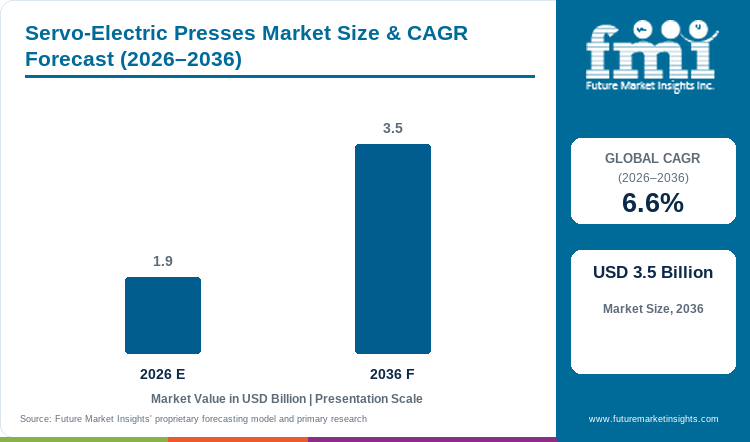
- USD 1.9 Bn
- Forecast (2036)
- USD 3.5 Bn
- CAGR (2026 to 2036)
- 6.6%
How big is Servo-Electric Presses Market in 2026?
USD 1.9 Billion in 2026 and USD 3.5 Billion by 2036 at a 6.6% CAGR.
Demand for servo-electric presses is estimated at USD 1.9 billion in 2026 and is forecast to reach USD 3.5 billion by 2036, growing at a CAGR of 6.6%. The International Federation of Robotics reported in September 2025 that 542,000 industrial robots were installed worldwide in 2024. That was the fourth straight year above 500,000 installations. Robot installations do not measure servo-electric press revenue, but they show the scale of capital deployment into automated production cells that can also require instrumented pressing. In those cells, a servo press can replace a fixed-force operation with a recipe-driven process that records force and displacement. The purchase case is strongest when manufacturers can use that control to reduce rework or shorten changeovers. It is also stronger when process data becomes part of quality release rather than an optional diagnostic.
Country conditions change how quickly that technical case becomes an order. France combines industrial modernization support with a smaller installed automation base than Germany. Germany starts from a much larger robot installation level, which pushes suppliers toward brownfield compatibility and productivity gains. Mexico has a concentrated automotive production system where new vehicle programs can pull servo-electric pressing into assembly and joining cells. Japan has a mature automation base and a strong domestic equipment ecosystem, so buyers often focus on precision and long equipment life rather than basic electrification. Across these markets, interest converts to purchase only after the supplier resolves force sizing and tooling. Safety logic, controls integration and service coverage must also be validated for the actual line.
Key Takeaways
- Programmable pressing is gaining value where assembly quality must be controlled during the stroke.
- C-frame servo presses lead Press Type with a 26.0% share in 2026 because open access supports operator loading and automated cell integration.
- Below 50 kN leads Force Range with a 24.0% share in 2026 as compact assembly tasks require controlled loads and small footprints.
- Assembly pressing leads Application with a 28.0% share in 2026 because press-fit and insertion work benefits directly from closed-loop control.
- Automotive leads End Use with a 34.0% share in 2026, while Direct OEM leads Sales Channel with a 43.0% share in 2026.
- France records the fastest profiled CAGR at 7.3% from 2026 to 2036, followed by Mexico at 6.5%.
Analyst Perspective
"Revenue capture will depend less on nominal press force than on how quickly a supplier can prove the complete production process. Buyers will favor systems that connect force control with quality records and usable machine interfaces. Application engineering and local service remain important because press selection is inseparable from tooling and process validation. Suppliers that reduce brownfield integration effort can convert a larger share of retrofit demand."
- Nikhil Kaitwade, Principal Consultant, Future Market Insights
How is the Servo-Electric Presses Market segmented?
The market is segmented by Press Type, Force Range, Application, End Use, Sales Channel, and Region.
Press Type separates frame architectures that change working access and structural stiffness. It also changes footprint and integration method. Force Range distinguishes the load envelope that engineering teams must match to the part and duty cycle. Application separates the process job, including assembly pressing, forming/stamping, riveting/clinching, bearing insertion, and precision joining. End Use captures industries with different validation rules and automation intensity. Sales Channel reflects who owns application engineering and commissioning responsibility between the press manufacturer and the final plant. Region captures local manufacturing investment and automation density. It also reflects service coverage and channel depth. These axes matter together because a compact assembly press and a large servo metalforming system can share electric actuation while serving very different buying decisions.
What makes C-frame servo presses central to the Press Type category?
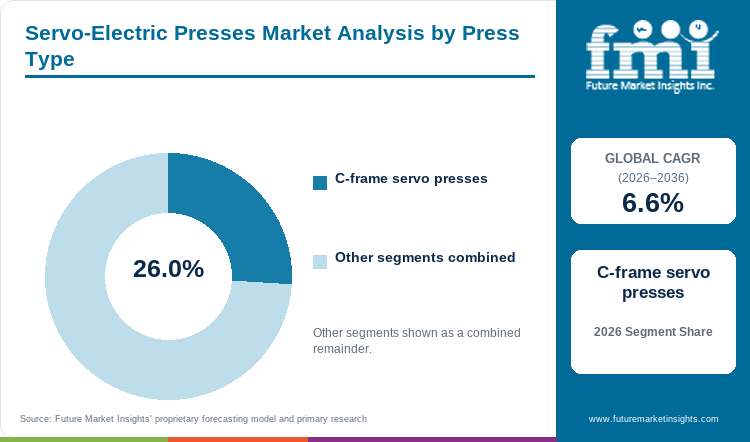
C-frame architecture gives operators and robots open access to the working area while keeping the press package relatively compact. That matters in assembly cells where components are loaded from the front or side and where tooling changes must be completed without dismantling a four-column structure. The format also supports bench and floor-mounted workstations, which broadens its use across prototype work and production cells. Its main tradeoff is lower structural symmetry than a straight-side or four-column frame at higher loads. This makes the architecture most attractive where access and footprint matter as much as maximum stiffness. Suppliers can then scale the actuator and safety package around a familiar cell layout.
- C-frame servo presses hold a 26.0% share in 2026 because open working-area access supports both operator-loaded stations and automated assembly cells.
- TOX Pressotechnik stated in March 2026 that its FlexPress Station combines C-frames with two- and four-column variants and ElectricDrive servo drives across 0.05 to 200 kN.
Why does Below 50 kN lead the Force Range category?
Below 50 kN covers a wide set of press-fit and staking tasks. It also serves clipping work plus electronics, medical device and small automotive assembly. These applications often need force accuracy and process documentation without the footprint or structural cost of a high-capacity press. Compact electric actuators are also easier to mount within indexing machines and dense automated cells. This force band therefore attracts both dedicated press builders and broader automation suppliers. Festo configures its YJKP servo press kit for electric press-fitting up to 17 kN, while IAI serves push-force requirements into the tens of kilonewtons. The segment benefits when buyers value repeatability and data capture more than sheer tonnage.
- Below 50 kN holds a 24.0% share in 2026 because many instrumented assembly operations need precise low-force control in compact cells.
- Festo documented in June 2024 that the YJKP servo press kit supports pressing forces up to 17 kN with application software and force-displacement measurement.
How does Assembly pressing anchor the Application category?
Assembly pressing aligns closely with the capabilities that differentiate servo-electric technology from simpler fixed-force methods. A programmable press can search for a contact point, move to a force or position target, and judge the cycle against a force-displacement window. That supports bearing insertion and bushing assembly. It also covers pins, connectors and staking where component tolerance affects the final result. The same press can store different recipes for product variants. This reduces the need for mechanical adjustment during changeovers and gives quality teams a cycle record. Forming and stamping remain important, but assembly pressing captures a broader set of lower-force operations where closed-loop control can replace separate inspection steps.
- Assembly pressing holds a 28.0% share in 2026 because force-position feedback can control the joining action and verify the result in the same cycle.
- Kistler announced in March 2026 that its Integrated Joining System records force-displacement values for each joining cycle and connects to maXYmos NC for monitoring and documentation.
What supports Automotive leadership within the End Use category?
Automotive plants combine high automation intensity with many pressing and joining operations. These operations span powertrain, chassis and seating as well as electronics and electrified vehicle assemblies. Those operations place a premium on repeatability because one unstable process can generate scrap at line speed. Servo-electric presses also allow engineers to run multiple force and motion recipes on one platform as vehicle programs change. The International Federation of Robotics reported in September 2025 that automotive remained the key robot customer in Mexico and accounted for 63% of robot installations there in 2024. That statistic is not servo press revenue, but it illustrates the automation-intensive environment where instrumented pressing is commercially relevant.
- Automotive holds a 34.0% share in 2026 because high-volume assembly programs reward programmable force control, traceability, and fast recipe changeover.
- Janome reported in its FYE March 2026 results materials that presses benefited from rising automotive demand in India and Korea, reinforcing the sector link for servo press suppliers.
Why does Direct OEM lead the Sales Channel category?
Servo-electric press selection is application engineering rather than a simple catalog transaction. Buyers must match continuous force and peak force to the application. Stroke, speed and tooling must also fit before guarding and controls are validated. Direct OEM engagement shortens the feedback loop between the plant engineer and the press supplier when those choices are still changing. It also gives the OEM more control over service expectations and future recipe support. Automation integrators remain critical for complete cells and industrial distributors can serve standardized requirements. Custom machine builders are important where the press is one module inside a larger machine. Direct OEM therefore leads where the press supplier must own more of the application risk.
- Direct OEM holds a 43.0% share in 2026 because force sizing and tooling interfaces require application support. Safety validation and commissioning deepen that need.
- Janome announced in April 2025 that it had started operations at JANOME Industrial Equipment India Pvt. Ltd., adding a dedicated industrial equipment sales company in India.
What are the drivers, restraints and opportunities in the Servo-Electric Presses Market?
Automation investment and in-process quality control support demand, while brownfield integration and validation can slow conversion, and compact low-force replacements create an opening in dense assembly cells.
- Driver: Manufacturing teams are moving more assembly steps toward programmable force and position control when traceability is tied to production release.
- Restraint: Brownfield integration and process validation can delay conversion when existing pneumatic, hydraulic, or mechanical stations already meet output targets.
- Opportunity: Compact all-electric press modules can displace pneumatic press-fitting where floor space and quality records matter. Energy use and recipe flexibility can strengthen the change case.
The main demand mechanism is the combination of factory automation and tighter process control at the point of assembly. The International Federation of Robotics reported in September 2025 that global industrial robot installations reached 542,000 units in 2024. That figure is a broader automation indicator rather than a servo-electric press measure. It still shows the scale of investment flowing into programmable production equipment. Servo presses benefit when a plant wants the pressing stroke to generate usable process evidence through force and position feedback. This turns a joining station into both a production and verification step. The result is a stronger purchase case in lines where scrap cost or traceability requirements make open-loop pressing harder to justify.
The binding restraint is often not the electric actuator itself. It is the work required to prove that the new station will run the existing process without disrupting throughput. Engineers must confirm tooling stiffness and force margins. They also need to validate stroke, cycle time and controls communication before approving the force-displacement window. A retrofit can also expose variation that older equipment never measured, which adds validation work before production release. Kistler described integration effort and external components when introducing its compact IJSys in March 2026. It also cited limited installation space and documentation needs. Those frictions can lengthen approval cycles even when the technical advantages are clear. Suppliers that underestimate commissioning effort risk turning a straightforward press purchase into a delayed automation project.
The clearest opportunity is at the low-force end where many plants still use pneumatic or simple mechanical pressing for routine assembly. Compact servo modules can combine motion control with load sensing in one package. Safety functions and data collection can be integrated without the same peripheral footprint as older designs. Kistler positioned its March 2026 IJSys as an electromechanical alternative to pneumatic joining. IAI followed in April 2026 with a cost-focused RCP6 servo press that can push and pull. The opening is not automatic replacement of every pneumatic station. Suppliers must show credible payback through quality gains or easier changeovers. Lower peripheral complexity and reduced energy or maintenance burden can strengthen that case. Machine builders and integrators are well placed to package that value into standardized cells.
Which country CAGRs are profiled in the Servo-Electric Presses Market?
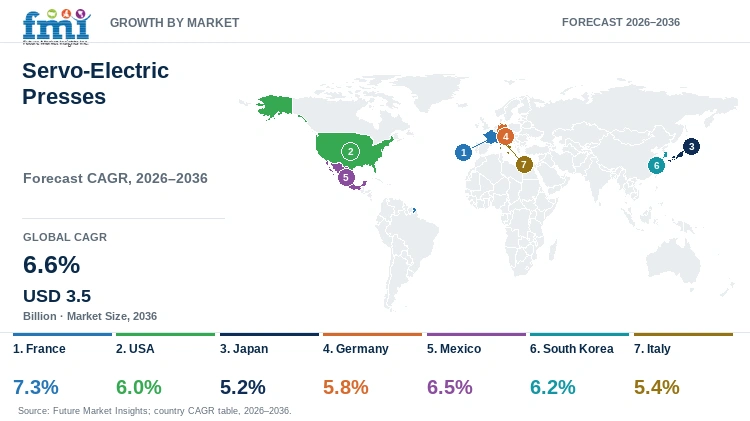
| Country | CAGR |
|---|---|
| France | 7.3% |
| USA | 6.0% |
| Japan | 5.2% |
| Germany | 5.8% |
| Mexico | 6.5% |
| South Korea | 6.2% |
| Italy | 5.4% |
How do country-level CAGRs compare in the Servo-Electric Presses Market?
The countries span a 2.1 percentage-point range between France at 7.3% and Japan at 5.2% from 2026 to 2036. France and Mexico form the upper group, with South Korea also above 6.0%. USA and Germany occupy a middle band where established manufacturing bases support replacement and line upgrades. Italy and Japan sit at the lower end of the profiled growth rates, but both have substantial automation capability and sophisticated buyers. The pattern therefore reflects different rates of incremental spending rather than a simple ranking of industrial scale. A higher CAGR can indicate faster modernization from a smaller base, while a lower rate can still sit on a deep installed manufacturing system.
- France at 7.3% is 0.8 percentage points above Mexico at 6.5%. The gap favors earlier channel investment in France when public industrial programs help accelerate new automation projects.
- Mexico at 6.5% and South Korea at 6.2% are close in growth rate but different in buying context. Mexico offers greenfield and expansion exposure, while South Korea demands performance inside an already dense automation base.
- USA at 6.0% and Germany at 5.8% form a narrow middle band. Suppliers in both markets need strong application engineering because retrofit compatibility can matter more than basic servo availability.
- Italy at 5.4% and Japan at 5.2% show the slowest profiled rates. Commercial success there depends on quantifiable productivity gains and fit with mature production practices rather than an assumption that automation is new.
Revenue potential also depends on the installed press base and end-use mix. Capital intensity, service expectations and local integrator capacity can change how many projects require closed-loop pressing rather than a substitute technology. The broader report coverage should therefore be used to evaluate country growth together with the scale and type of manufacturing demand.
Country-wise Analysis
- France: French buyers are increasingly exposed to industrial programs that support robotics, intelligent machines, and automated inspection. Demand for Servo-Electric Presses in France is forecast to expand at 7.3% CAGR from 2026 to 2036. In June 2026, the French government announced 31 new France 2030 projects under its robotics and intelligent-machines program, including projects tied to industrial automation and automated quality inspection. The local friction is converting public support and engineering interest into repeatable factory deployment among smaller manufacturers. Suppliers can respond with modular cells, clear application proof, and local integration support that lowers implementation risk.
- USA: US plants combine a large automation base with a deep network of system integrators that can embed presses into complete production cells. Demand for Servo-Electric Presses in USA is forecast to expand at 6.0% CAGR from 2026 to 2036. The International Federation of Robotics reported in September 2025 that 34,200 industrial robots were installed in the United States during 2024. The principal friction is brownfield economics because many plants already operate productive pneumatic, hydraulic, and mechanical stations. Suppliers need turnkey workstations, strong service coverage, and controls interfaces that allow a servo press to enter existing lines without creating a long commissioning cycle.
- Japan: Japanese manufacturers buy automation into an already mature production system where precision, reliability, and compact integration carry high weight. Demand for Servo-Electric Presses in Japan is forecast to expand at 5.2% CAGR from 2026 to 2036. In May 2025, Japan's Ministry of Economy, Trade and Industry released the White Paper on Manufacturing Industries 2025 with digital transformation positioned as a key issue for manufacturing competitiveness. The friction is that established plants have high performance baselines and long-lived equipment. Suppliers must prove incremental gains in process capability and traceability. Footprint and lifecycle support also matter more than electrification as a standalone benefit.
- Germany: German manufacturing has a dense automation base and a large installed press population across automotive, machinery, and metalforming operations. Demand for Servo-Electric Presses in Germany is forecast to expand at 5.8% CAGR from 2026 to 2036. The International Federation of Robotics reported in September 2025 that Germany installed 26,982 industrial robots in 2024, equal to nearly one-third of the European total. The friction is capital discipline in brownfield modernization, especially when a legacy press still meets production targets. Suppliers need measurable improvements in energy use or cycle performance. Quality and flexibility gains must also be backed by service capability for retrofit and high-utilization plants.
- Mexico: Mexican buyers are concentrated around export-oriented manufacturing where automotive line investments can create demand for new pressing and joining stations. Demand for Servo-Electric Presses in Mexico is forecast to expand at 6.5% CAGR from 2026 to 2036. INEGI reported on May 11 2026 that Mexico produced 329,878 light vehicles in April 2026. It also reported 286,317 exports for the month. The International Federation of Robotics also reported that automotive accounted for 63% of Mexican robot installations in 2024. The friction is maintaining uptime and technical support across fast-moving production programs. Suppliers need regional service, robust commissioning, and close relationships with automation integrators and OEM engineering teams.
- South Korea: South Korean plants operate at high automation intensity in electronics and automotive production, which raises the performance threshold for new equipment. Demand for Servo-Electric Presses in South Korea is forecast to expand at 6.2% CAGR from 2026 to 2036. The International Federation of Robotics reported in September 2025 that 30,600 industrial robots were installed in the Republic of Korea during 2024. The friction is not basic automation availability but cycle-time, footprint, and quality expectations inside highly optimized lines. Suppliers need compact high-speed systems and reliable force-displacement monitoring. Application support must also fit electronics, battery and automotive assembly.
- Italy: Italian buyers span large industrial groups and a broad base of smaller manufacturers that often evaluate automation through investment incentives and energy savings. Demand for Servo-Electric Presses in Italy is forecast to expand at 5.4% CAGR from 2026 to 2036. In February 2024, the Ministry of Enterprises and Made in Italy announced EUR 6.3 billion for Transition 5.0 on top of EUR 6.4 billion already planned for the digital and green transition. The friction is proving project eligibility and payback within smaller capital budgets. Suppliers can respond with modular retrofit packages and clear data on energy use, production quality, and changeover performance.
Who are the notable companies in the Servo-Electric Presses Market?
SCHMIDT Technology, Festo, Promess, Janome Industrial, Kistler, AIDA Engineering, Komatsu Industries, IAI America, and TOX Pressotechnik are the notable companies profiled in this market.
The competitive landscape is split by the production problem each supplier is built to solve. SCHMIDT Technology, Promess, Janome Industrial and Kistler focus heavily on instrumented assembly and joining. Force-displacement control and compact workstations shape the purchase in this group. Festo, IAI America, TOX Pressotechnik compete around automation integration and servo actuation. Process monitoring and press-room controls further differentiate their roles. Their roles are not identical, but each can influence how the press connects to the broader cell. AIDA Engineering and Komatsu Industries operate further toward large-format metalforming. Frame stiffness and motion profiles matter alongside high tonnage, line engineering and lifecycle service. Buyers therefore compare suppliers within the architecture that matches the application rather than across one undifferentiated product list.
- Integrated assembly press specialists: SCHMIDT Technology, Promess, Janome Industrial, and Kistler compete on closed-loop joining, application engineering, workstation integration, and process evidence.
- Automation-platform and press-control suppliers: Festo, IAI America, TOX Pressotechnik compete on modular integration, motion control, connectivity, monitoring, and retrofit support.
- High-tonnage servo metalforming builders: AIDA Engineering and Komatsu Industries compete on large press architectures, programmable slide motion, forming productivity, and global lifecycle support.
Competitive Benchmarking: Servo-Electric Presses Market
| Company | Closed-Loop Force/Displacement Control | Native Process Data & Connectivity | Servo Press Architecture / Force Coverage | Geographic Reach |
|---|---|---|---|---|
| SCHMIDT Technology | High | High | Medium | International sales and service network |
| Festo | High | High | Medium | Global industrial automation network |
| Promess | High | High | High | United States base with international customer support |
| Janome Industrial | High | Medium | Medium | Japan with industrial-equipment sales bases across major overseas markets |
| Kistler | High | High | Medium | Global measurement and assembly technology network |
| AIDA Engineering | Medium | Medium | High | Global metalforming sales, service, and manufacturing footprint |
| Komatsu Industries | Medium | Medium | High | Japan with industrial machinery sales and service across major global regions |
| IAI America | High | Medium | Medium | North America with IAI international sales and partner network |
| TOX Pressotechnik | High | High | High | Global sales and service organization |
Key Developments in the Servo-Electric Presses Market
- In April 2025, Janome Industrial announced that JANOME Industrial Equipment India Pvt. Ltd. had begun operations as its industrial-equipment sales company in India. The move added a dedicated local route for Janome's industrial equipment business, which includes servo presses. The commercial implication is stronger direct customer access for application discussions and after-sales coordination in a manufacturing market that Janome later identified as a source of rising automotive-related press demand.
- In October 2025, SCHMIDT Technology introduced the ServoPress 602 for high-precision low-force pressing. The model provides a maximum force of 300 N and force repeatability of 0.4 N. Position repeatability is +/-1 micrometer, with a 75 mm stroke and maximum speed of 150 mm/s. The launch deepens supplier coverage at the fine-assembly end of the market where small components and tight process windows favor compact instrumented presses.
- In March 2026, Kistler presented the Integrated Joining System developed with Cyltronic AG. The system is marketed as IJSys. The compact electromechanical unit integrates the servo drive and sensor in one housing. Data digitization and safety technology are also integrated, while maXYmos NC provides process monitoring. This design targets a common integration barrier by reducing peripheral components and gives machine builders a more direct path to replace pneumatic joining in space-constrained assembly equipment.
- In April 2026, IAI America added the RCP6 servo press with push and pull capability. IAI stated that the model costs more than 50% less than comparable servo-motor models that provide the same press force. The product broadens the supplier's entry point for cost-sensitive electric pressing applications and increases competitive pressure at the lower-force end where buyers often compare servo solutions with pneumatic or simpler electric actuators.
Key Players in the Servo-Electric Presses Market
Integrated Assembly Press Specialists
- SCHMIDT Technology
- Promess
- Janome Industrial
- Kistler
Automation-Platform and Press-Control Suppliers
- Festo
- IAI America
- TOX Pressotechnik
High-Tonnage Servo Metalforming Builders
- AIDA Engineering
- Komatsu Industries
Servo-Electric Presses Market - Report Scope
| Coverage field | Report scope |
|---|---|
| Market breakdown | Press Type; Force Range; Application; End Use; Sales Channel; Region |
| Quantitative Units | USD Billion |
| Market Definition | Revenue includes electromechanical servo-driven press systems and press modules sold for controlled pressing, joining, forming, stamping, clinching, riveting, bearing insertion, and precision joining within the stated segmentation. Revenue excludes downstream finished products, conventional non-servo presses, standalone sensors or press controls sold outside a servo-electric press system, tooling, dies, and adjacent automation equipment. |
| Regions Covered | North America; Latin America; Western Europe; Eastern Europe; East Asia; South Asia and Pacific; Middle East and Africa |
| Countries Covered | France; USA; Japan; Germany; Mexico; South Korea; Italy; and more than twenty-five additional countries in the full report |
| Key Companies Profiled | SCHMIDT Technology; Festo; Promess; Janome Industrial; Kistler; AIDA Engineering; Komatsu Industries; IAI America; TOX Pressotechnik |
| Forecast Period | 2026 to 2036 |
| Approach | FMI uses a hybrid bottom-up and top-down sizing approach that reconciles supplier product coverage, application demand indicators, country manufacturing activity, channel structure, and market-boundary checks. |
Servo-Electric Presses Market - Research Methodology
| Method | Approach |
|---|---|
| Primary Research | FMI primary research is structured around manufacturers, automation integrators, industrial distributors, custom machine builders, manufacturing engineers, procurement stakeholders, and subject-matter experts. Discussions test market definition, force-range adoption, purchase criteria, application fit, service expectations, channel behavior, and observed project conditions. |
| Desk Research | Desk research reviews government manufacturing statistics, industrial automation data, company filings, technical literature, product documentation, standards-related material, and dated first-party company announcements. Sources are retained when they support the defined revenue boundary, a country mechanism, a product capability, or a traceable company action. |
| Market Sizing and Forecasting | Market sizing reconciles supplier-side product coverage with application demand and manufacturing investment indicators. Forecast assumptions consider automation intensity, end-use capital spending, replacement and retrofit cycles, integration economics, force-range mix, channel development, and country-specific industrial conditions without using adjacent product revenue as direct market revenue. |
| Data Validation | Validation cross-checks market definitions, company roles, segmentation labels, dated developments, and country narratives across independent source types where available. The process excludes double-counting, downstream finished-product revenue, conventional non-servo press revenue, standalone adjacent controls, and unsupported claims that cannot be reconciled with the stated scope. |
Servo-Electric Presses Market by Segments
Servo-Electric Presses Market segmented by Press Type:
- C-frame servo presses
- Straight-side servo presses
- Four-column servo presses
- Bench-top servo presses
- High-speed servo presses
Servo-Electric Presses Market segmented by Force Range:
- Below 50 kN
- 50-250 kN
- 250-1,000 kN
- Above 1,000 kN
Servo-Electric Presses Market segmented by Application:
- Assembly pressing
- Forming/stamping
- Riveting/clinching
- Bearing insertion
- Precision joining
Servo-Electric Presses Market segmented by End Use:
- Automotive
- Electronics
- Medical devices
- Aerospace
- Industrial machinery
Servo-Electric Presses Market segmented by Sales Channel:
- Direct OEM
- Automation integrators
- Industrial distributors
- Custom machine builders
Servo-Electric Presses Market by Region:
- North America
- United States
- Canada
- Latin America
- Brazil
- Mexico
- Argentina
- Chile
- Western Europe
- Germany
- France
- United Kingdom
- Italy
- Spain
- Benelux
- Nordics
- Eastern Europe
- Poland
- Czech Republic
- Romania
- Hungary
- East Asia
- China
- Japan
- South Korea
- South Asia and Pacific
- India
- ASEAN
- Australia and New Zealand
- Middle East and Africa
- GCC Countries
- South Africa
- Türkiye
- Israel
Research Sources and Bibliography
- International Federation of Robotics (2025, September 25). World Robotics 2025 report - Industrial Robots: Global Robot Demand in Factories Doubles Over 10 Years.
- Ministry of the Economy, Finance and Industrial and Digital Sovereignty, France (2026, June 18). France 2030: 31 nouveaux projets pour accélérer l’émergence d’une filière française d’excellence en robotique et en drones souverains.
- Ministry of Economy, Trade and Industry, Japan (2025, May 30). FY2024 Measures to Promote Manufacturing Technology (White Paper on Manufacturing Industries 2025).
- Ministry of Enterprises and Made in Italy (2024, February 26). Mimit, DL Pnrr: al via Transizione 5.0, 6,3 miliardi per la sfida green e digitale delle imprese.
- Instituto Nacional de Estadística y Geografía (2026, May 11). Administrative record of the light vehicle automotive industry: April 2026.
- SCHMIDT Technology (2025, October 9). SCHMIDT ServoPress 602 - Precision in perfection.
- Festo (2024, June). Servo press kits YJKP.
- Promess Incorporated (2024, March). EMAP: A fully electric assembly press system.
- Janome Corporation (2025, April 4). JANOME establishes industrial equipment sales company JIE-India and starts operations.
- Kistler (2026, March 19). Compact servo press instead of pneumatic: with force-displacement monitoring for joining.
- AIDA Engineering (2025). Annual Integrated Report 2025.
- Komatsu (2025, July 10). Komatsu Industries exhibits latest forging and sheet-metal machinery at MF-TOKYO 2025.
- IAI Automation (2026, April 27). Cost-effective RCP6 servo press.
- TOX Pressotechnik (2025, October 13). TOX at SPS 2025 in Nuremberg: Intelligent drive technology and precise process monitoring for networked production.
This bibliography is provided for reader reference and is not exhaustive. The full report contains the complete reference list and detailed citations.
This Report Answers
- What is the Servo-Electric Presses Market size in 2026 and what value is forecast for 2036?
- Which manufacturing and quality-control pressures support demand for servo-electric presses?
- Why do C-frame servo presses hold the leading position within Press Type?
- How does the Below 50 kN force range influence demand for compact assembly presses?
- Why does Assembly pressing hold the leading position within Application?
- How do the 2026 to 2036 growth rates differ across France, USA, Japan, Germany, Mexico, South Korea, and Italy?
- Which suppliers focus on instrumented assembly presses, automation platforms, press controls, or high-tonnage servo metalforming?
- What integration and validation frictions can limit adoption in brownfield manufacturing lines?
- What should manufacturing engineers and procurement teams evaluate before purchasing a servo-electric press system?
Frequently Asked Questions
What is driving growth in the Servo-Electric Presses Market?
Growth is supported by manufacturers moving more pressing and joining steps toward programmable force-position control with in-process quality records. The commercial case is strongest where flexible recipes, lower rework, and traceable assembly results justify conversion from simpler press technologies.
Who are the key players in the Servo-Electric Presses Market?
Profiled companies are SCHMIDT Technology, Festo, Promess, Toledo Integrated Systems, Janome Industrial, Kistler, AIDA Engineering, Komatsu Industries, IAI America, and TOX Pressotechnik. Their roles range from compact assembly presses and automation platforms to press controls and high-tonnage metalforming systems.
What notable restraint affects the Servo-Electric Presses Market?
Brownfield integration and validation can delay purchases even when the electric press itself meets the force requirement. Buyers must prove tooling stiffness and cycle time before production release while confirming that safety logic, controls communication and serviceability support an acceptable process window.
Why should executives track the Servo-Electric Presses Market?
The market sits at the intersection of automation spending and quality assurance, with energy use and flexible manufacturing adding to the executive case. Tracking adoption helps executives judge when replacement improves production control and when existing pneumatic, hydraulic or mechanical equipment still offers sufficient economics.
What business problem does the Servo-Electric Presses Market address?
Servo-electric presses address the need to apply controlled force and motion while generating evidence that the operation stayed inside an approved process window. They can combine production and verification in one station for press-fit, insertion and controlled joining such as clinching or precision joining.
What should manufacturing engineers evaluate in the Servo-Electric Presses Market?
Engineers should evaluate continuous and peak force with stroke and speed, then check frame stiffness and tooling access against sensing accuracy. The best technical fit balances duty cycle and safety with connectivity and service while holding the required process window without unnecessary integration complexity.
What limits return on investment in the Servo-Electric Presses Market?
Return can be weakened by oversized equipment or long commissioning cycles when tooling changes and controls engineering add cost. Buyers should compare acquisition cost with scrap and changeover time, then weigh maintenance and energy use against inspection effort and downtime over the actual production life.
What supports long-term commercial confidence in the Servo-Electric Presses Market?
Long-term confidence comes from continued factory automation and the need for repeatable quality evidence at critical joining steps. The forecast also rests on a broad supplier base serving low-force assembly through high-tonnage metalforming, which supports multiple replacement and expansion pathways through 2036.
Preview the report firsthand - request a free sample
Get SampleGet the brochure for pricing and purchase details.
Get PDFTable of Content
- Key Takeaways
- Market Size and CAGR
- Top Growth Driver
- Fastest Growing Segment
- Leading Region
- Key Companies
- Emerging Opportunities
- Executive Summary
- Global Market Outlook
- Demand-side Trends
- Supply-side Trends
- Technology Roadmap Analysis
- Analysis and Recommendations
- Analyst Perspective (What is happening? Why now? What should investors know?)
- Key Questions Answered
- How large is the market?
- What is the CAGR?
- What are key trends?
- Which region dominates?
- Who are the leaders?
- Market Overview
- Market Coverage / Taxonomy
- Market Definition / Scope / Limitations
- Research Methodology
- Chapter Orientation
- Analytical Lens and Working Hypotheses
- Market Structure, Signals, and Trend Drivers
- Benchmarking and Cross-market Comparability
- Market Sizing, Forecasting, and Opportunity Mapping
- Research Design and Evidence Framework
- Desk Research Programme (Secondary Evidence)
- Expert Input and Fieldwork (Primary Evidence)
- Tooling, Models, and Reference Databases
- Data Engineering and Model Build
- Quality Assurance and Audit Trail
- Market Background
- Market Dynamics (Drivers, Restraints, Opportunity, Trends)
- Scenario Forecast (Optimistic, Likely, Conservative)
- Impact Analysis
- AI Impact
- Sustainability Impact
- Regulatory Impact
- Technology Impact
- Consumer / Buyer Analysis
- Purchase Drivers
- Adoption Barriers
- Buyer Journey
- Opportunity Map Analysis
- Product Life Cycle Analysis
- Supply Chain Analysis
- Investment Feasibility Matrix
- Value Chain Analysis
- PESTLE and Porter's Analysis
- Regulatory Landscape
- Regional Parent Market Outlook
- Production and Consumption Statistics
- Import and Export Statistics
- Global Market Analysis and Forecast, 2021 to 2036
- Historical Market Size Value (USD Billion) Analysis, 2021 to 2025
- Current and Future Market Size Value (USD Billion) Projections, 2026 to 2036
- Y-o-Y Growth Trend Analysis
- Absolute $ Opportunity Analysis
- Global Market Pricing Analysis, 2021 to 2036
- Global Market Analysis and Forecast, By Press Type, 2021 to 2036
- Introduction / Key Findings
- Historical Market Size Value (USD Billion) Analysis By Press Type, 2021 to 2025
- Current and Future Market Size Value (USD Billion) Analysis and Forecast By Press Type, 2026 to 2036
- C-frame servo presses
- Straight-side servo presses
- Four-column servo presses
- Bench-top servo presses
- High-speed servo presses
- Y-o-Y Growth Trend Analysis By Press Type, 2021 to 2025
- Absolute $ Opportunity Analysis By Press Type, 2026 to 2036
- Global Market Analysis and Forecast, By Force Range, 2021 to 2036
- Introduction / Key Findings
- Historical Market Size Value (USD Billion) Analysis By Force Range, 2021 to 2025
- Current and Future Market Size Value (USD Billion) Analysis and Forecast By Force Range, 2026 to 2036
- Below 50 kN
- 50-250 kN
- 250-1,000 kN
- Above 1,000 kN
- Y-o-Y Growth Trend Analysis By Force Range, 2021 to 2025
- Absolute $ Opportunity Analysis By Force Range, 2026 to 2036
- Global Market Analysis and Forecast, By Application, 2021 to 2036
- Introduction / Key Findings
- Historical Market Size Value (USD Billion) Analysis By Application, 2021 to 2025
- Current and Future Market Size Value (USD Billion) Analysis and Forecast By Application, 2026 to 2036
- Assembly pressing
- Forming/stamping
- Riveting/clinching
- Bearing insertion
- Precision joining
- Y-o-Y Growth Trend Analysis By Application, 2021 to 2025
- Absolute $ Opportunity Analysis By Application, 2026 to 2036
- Global Market Analysis and Forecast, By End Use, 2021 to 2036
- Introduction / Key Findings
- Historical Market Size Value (USD Billion) Analysis By End Use, 2021 to 2025
- Current and Future Market Size Value (USD Billion) Analysis and Forecast By End Use, 2026 to 2036
- Automotive
- Electronics
- Medical devices
- Aerospace
- Industrial machinery
- Y-o-Y Growth Trend Analysis By End Use, 2021 to 2025
- Absolute $ Opportunity Analysis By End Use, 2026 to 2036
- Global Market Analysis and Forecast, By Sales Channel, 2021 to 2036
- Introduction / Key Findings
- Historical Market Size Value (USD Billion) Analysis By Sales Channel, 2021 to 2025
- Current and Future Market Size Value (USD Billion) Analysis and Forecast By Sales Channel, 2026 to 2036
- Direct OEM
- Automation integrators
- Industrial distributors
- Custom machine builders
- Y-o-Y Growth Trend Analysis By Sales Channel, 2021 to 2025
- Absolute $ Opportunity Analysis By Sales Channel, 2026 to 2036
- Global Market Analysis and Forecast, By Region, 2021 to 2036
- Introduction
- Historical Market Size Value (USD Billion) Analysis By Region, 2021 to 2025
- Current Market Size Value (USD Billion) Analysis and Forecast By Region, 2026 to 2036
- North America
- Latin America
- Western Europe
- Eastern Europe
- East Asia
- South Asia and Pacific
- Middle East and Africa
- Market Attractiveness Analysis By Region
- North America Market Analysis and Forecast, By Country, 2021 to 2036
- Historical Market Size Value (USD Billion) Trend Analysis By Market Taxonomy, 2021 to 2025
- Market Size Value (USD Billion) Forecast By Market Taxonomy, 2026 to 2036
- By Country
- United States
- Canada
- By Press Type
- By Force Range
- By Application
- By End Use
- By Sales Channel
- By Country
- Market Attractiveness Analysis
- By Country
- By Press Type
- By Force Range
- By Application
- By End Use
- By Sales Channel
- Key Takeaways
- Latin America Market Analysis and Forecast, By Country
- Historical Market Size Value (USD Billion) Trend Analysis By Market Taxonomy, 2021 to 2025
- Market Size Value (USD Billion) Forecast By Market Taxonomy, 2026 to 2036
- By Country
- Brazil
- Mexico
- Argentina
- Chile
- By Press Type
- By Force Range
- By Application
- By End Use
- By Sales Channel
- By Country
- Market Attractiveness Analysis
- By Country
- By Press Type
- By Force Range
- By Application
- By End Use
- By Sales Channel
- Key Takeaways
- Western Europe Market Analysis and Forecast, By Country
- Historical Market Size Value (USD Billion) Trend Analysis By Market Taxonomy, 2021 to 2025
- Market Size Value (USD Billion) Forecast By Market Taxonomy, 2026 to 2036
- By Country
- Germany
- France
- United Kingdom
- Italy
- Spain
- Benelux
- Nordics
- By Press Type
- By Force Range
- By Application
- By End Use
- By Sales Channel
- By Country
- Market Attractiveness Analysis
- By Country
- By Press Type
- By Force Range
- By Application
- By End Use
- By Sales Channel
- Key Takeaways
- Eastern Europe Market Analysis and Forecast, By Country
- Historical Market Size Value (USD Billion) Trend Analysis By Market Taxonomy, 2021 to 2025
- Market Size Value (USD Billion) Forecast By Market Taxonomy, 2026 to 2036
- By Country
- Poland
- Czech Republic
- Romania
- Hungary
- By Press Type
- By Force Range
- By Application
- By End Use
- By Sales Channel
- By Country
- Market Attractiveness Analysis
- By Country
- By Press Type
- By Force Range
- By Application
- By End Use
- By Sales Channel
- Key Takeaways
- East Asia Market Analysis and Forecast, By Country
- Historical Market Size Value (USD Billion) Trend Analysis By Market Taxonomy, 2021 to 2025
- Market Size Value (USD Billion) Forecast By Market Taxonomy, 2026 to 2036
- By Country
- China
- Japan
- South Korea
- By Press Type
- By Force Range
- By Application
- By End Use
- By Sales Channel
- By Country
- Market Attractiveness Analysis
- By Country
- By Press Type
- By Force Range
- By Application
- By End Use
- By Sales Channel
- Key Takeaways
- South Asia and Pacific Market Analysis and Forecast, By Country
- Historical Market Size Value (USD Billion) Trend Analysis By Market Taxonomy, 2021 to 2025
- Market Size Value (USD Billion) Forecast By Market Taxonomy, 2026 to 2036
- By Country
- India
- ASEAN
- Australia and New Zealand
- By Press Type
- By Force Range
- By Application
- By End Use
- By Sales Channel
- By Country
- Market Attractiveness Analysis
- By Country
- By Press Type
- By Force Range
- By Application
- By End Use
- By Sales Channel
- Key Takeaways
- Middle East and Africa Market Analysis and Forecast, By Country
- Historical Market Size Value (USD Billion) Trend Analysis By Market Taxonomy, 2021 to 2025
- Market Size Value (USD Billion) Forecast By Market Taxonomy, 2026 to 2036
- By Country
- GCC Countries
- South Africa
- Türkiye
- Israel
- By Press Type
- By Force Range
- By Application
- By End Use
- By Sales Channel
- By Country
- Market Attractiveness Analysis
- By Country
- By Press Type
- By Force Range
- By Application
- By End Use
- By Sales Channel
- Key Takeaways
- Key Countries Market Analysis
- United States
- Pricing Analysis
- Market Share Analysis, 2025
- By Press Type
- By Force Range
- By Application
- By End Use
- By Sales Channel
- Canada
- Pricing Analysis
- Market Share Analysis, 2025
- By Press Type
- By Force Range
- By Application
- By End Use
- By Sales Channel
- Mexico
- Pricing Analysis
- Market Share Analysis, 2025
- By Press Type
- By Force Range
- By Application
- By End Use
- By Sales Channel
- Brazil
- Pricing Analysis
- Market Share Analysis, 2025
- By Press Type
- By Force Range
- By Application
- By End Use
- By Sales Channel
- Chile
- Pricing Analysis
- Market Share Analysis, 2025
- By Press Type
- By Force Range
- By Application
- By End Use
- By Sales Channel
- Germany
- Pricing Analysis
- Market Share Analysis, 2025
- By Press Type
- By Force Range
- By Application
- By End Use
- By Sales Channel
- United Kingdom
- Pricing Analysis
- Market Share Analysis, 2025
- By Press Type
- By Force Range
- By Application
- By End Use
- By Sales Channel
- Italy
- Pricing Analysis
- Market Share Analysis, 2025
- By Press Type
- By Force Range
- By Application
- By End Use
- By Sales Channel
- Spain
- Pricing Analysis
- Market Share Analysis, 2025
- By Press Type
- By Force Range
- By Application
- By End Use
- By Sales Channel
- France
- Pricing Analysis
- Market Share Analysis, 2025
- By Press Type
- By Force Range
- By Application
- By End Use
- By Sales Channel
- India
- Pricing Analysis
- Market Share Analysis, 2025
- By Press Type
- By Force Range
- By Application
- By End Use
- By Sales Channel
- ASEAN
- Pricing Analysis
- Market Share Analysis, 2025
- By Press Type
- By Force Range
- By Application
- By End Use
- By Sales Channel
- Australia and New Zealand
- Pricing Analysis
- Market Share Analysis, 2025
- By Press Type
- By Force Range
- By Application
- By End Use
- By Sales Channel
- China
- Pricing Analysis
- Market Share Analysis, 2025
- By Press Type
- By Force Range
- By Application
- By End Use
- By Sales Channel
- Japan
- Pricing Analysis
- Market Share Analysis, 2025
- By Press Type
- By Force Range
- By Application
- By End Use
- By Sales Channel
- South Korea
- Pricing Analysis
- Market Share Analysis, 2025
- By Press Type
- By Force Range
- By Application
- By End Use
- By Sales Channel
- Poland
- Pricing Analysis
- Market Share Analysis, 2025
- By Press Type
- By Force Range
- By Application
- By End Use
- By Sales Channel
- Hungary
- Pricing Analysis
- Market Share Analysis, 2025
- By Press Type
- By Force Range
- By Application
- By End Use
- By Sales Channel
- Türkiye
- Pricing Analysis
- Market Share Analysis, 2025
- By Press Type
- By Force Range
- By Application
- By End Use
- By Sales Channel
- South Africa
- Pricing Analysis
- Market Share Analysis, 2025
- By Press Type
- By Force Range
- By Application
- By End Use
- By Sales Channel
- United States
- Market Structure Analysis
- Competition Dashboard
- Competition Benchmarking
- Market Share Analysis of Top Players
- By Regional
- By Press Type
- By Force Range
- By Application
- By End Use
- By Sales Channel
- Emerging Startups
- Innovation Benchmarking
- Competition Analysis
- Competition Deep Dive
- SCHMIDT Technology
- Overview
- Product Portfolio
- Profitability by Market Segments
- Sales Footprint
- Strategy Overview
- Marketing Strategy
- Product Strategy
- Channel Strategy
- Festo
- Promess
- Janome Industrial
- Kistler
- AIDA Engineering
- Komatsu Industries
- IAI America
- TOX Pressotechnik
- SCHMIDT Technology
- Case Studies
- Success Stories
- Recent Developments
- Competition Deep Dive
- Assumptions & Acronyms Used


