

- Market Size (2026)
- USD 720.6 Mn
- Forecast (2036)
- USD 1365.4 Mn
- CAGR (2026 to 2036)
- 6.6%
How big is Electric Nose Wheel Steering System Market in 2026?
USD 720.6 Million in 2026 and USD 1,365.4 Million by 2036 at a 6.6% CAGR.
The electric nose wheel steering system market is forecast to grow from USD 720.6 Million in 2026 to USD 1365.4 Million in 2036 at a 6.6% CAGR, following a 2025 value of USD 676.0 Million. Aircraft production determines much of the initial demand. Airbus delivered 793 commercial aircraft in 2025 and ended the year with a record backlog of 8,754 aircraft. Higher build rates require a dependable supply of qualified steering actuators and electronic controls within the landing-gear package. Electronic commands add software and sensor requirements while the steering mechanism still has to deliver high force. OEMs consequently assess production readiness, certification history and the ability to support an unchanged configuration through fleet service.
France and Germany combine Airbus production with landing-system engineering, including Liebherr steering electronics in Germany. The USA supports commercial and defense fleets through a broad actuation supply chain. Embraer anchors Brazilian demand across regional, executive and defense aircraft; Japan retains selected fighter final assembly, while Canada combines business-aircraft manufacturing with landing-gear and controls capability. Each setting brings different production schedules and approval routes. A steering award depends on qualified integration and support for the platform over its operating life.

Key Takeaways of Electric Nose Wheel Steering System Market
- Aircraft build rates and fleet maintenance determine orders for qualified steering equipment.
- Electro-hydraulic steering holds 31.0% of system demand in 2026. It provides the required steering force while using hydraulic systems already installed on many aircraft.
- Narrow-body aircraft account for 33.0% of aircraft demand in 2026. Sustained production and a large operating fleet support both new equipment and service work.
- Actuators represent 32.0% of component demand in 2026. Their force and response determine whether the wheel follows the commanded angle under ground loads.
- Aircraft OEMs account for 49.0% of sales in 2026. Selection during aircraft development establishes the approved steering configuration for serial production.
- Taxi steering leads applications at 47.0% in 2026. Directional control on the ground remains the basic task of the powered nose-wheel system.
- Companies include Safran Landing Systems, Collins Aerospace, Liebherr-Aerospace, Heroux-Devtek, Moog, Parker Aerospace, Eaton Aerospace, Triumph Group, Crane Aerospace & Electronics, Woodward.
Analyst Perspective
"The steering design must be ready before the aircraft production ramp. A supplier needs to show how the system responds to commands and failures, then reproduce that approved configuration reliably in service."
- Nikhil Kaitwade, Principal Consultant, Future Market Insights
How is the Electric Nose Wheel Steering System Market segmented?
The market is assessed by System Type, Aircraft Type, Component, Sales Channel, and Application.
By System Type: Electro-hydraulic steering, Electromechanical steering, Steer-by-wire nose wheel systems, Integrated steering/braking systems; By Aircraft Type: Narrow-body aircraft, Wide-body aircraft, Regional aircraft, Business jets, Military aircraft; By Component: Actuators, Control units, Power electronics, Sensors, Mechanical linkages; By Sales Channel: Aircraft OEMs, Tier-1 landing gear suppliers, MRO replacement, Defense programs; By Application: Taxi steering, Ground handling efficiency, Autonomous taxi support, Brake/steering integration.
Why do narrow-body aircraft lead demand within the aircraft type category?
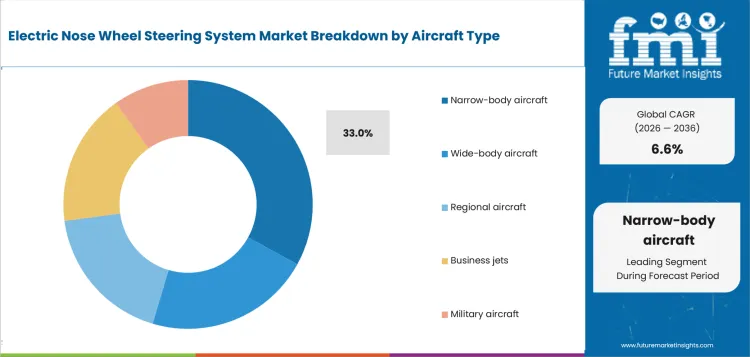
Narrow-body aircraft lead because production volume creates a dense stream of line-fit demand for steering hardware. These aircraft also accumulate frequent taxi cycles across high-utilization airline networks. Airbus reported 607 A320 Family deliveries in 2025 and opened a second modernized Toulouse final assembly line in June 2026. The new line supports the planned ramp-up toward between 70 and 75 A320 Family aircraft per month by the end of 2027. That scale matters to steering suppliers because a qualified design must be produced repeatedly with stable configuration, predictable lead times, and a support plan that follows the global fleet. Production planning also coordinates retraction actuators and other landing-system equipment fitted to the aircraft.
- Narrow-body aircraft account for 33.0% of the market in 2026, reflecting their high production cadence and broad commercial installed base.
- Airbus announced in June 2026 that its new Toulouse A320 Family final assembly line supports the production ramp-up trajectory toward between 70 and 75 A320 Family aircraft per month by the end of 2027.
Why does electro-hydraulic steering lead demand within the system type category?
Electro-hydraulic steering remains attractive where aircraft already carry hydraulic power and require high steering force at the nose gear. Electronic commands can close the loop around wheel angle while valves meter hydraulic flow to the steering actuators. Liebherr described this architecture for the Boeing 787 in 2019, where its remote electronic unit drives solenoid and servo valves that control hydraulic supply to the steering actuators. This architecture fits established ATA Chapter 32 practice while still allowing digital command logic. It also keeps the steering function aligned with the broader landing gear market where hydraulic power remains common. Steering interfaces must remain compatible with the complete aircraft landing gear assembly.
- Electro-hydraulic steering accounts for 31.0% of the market in 2026, supported by high-force capability and compatibility with installed aircraft hydraulic systems.
- Liebherr-Aerospace stated in January 2019 that its Boeing 787 nose wheel steering remote electronic unit provides closed-loop angle control and commands hydraulic valves feeding the steering actuators.
Why do actuators lead demand within the component category?
Actuators convert the steering command into nose-wheel motion under taxi loads. Force, response, sealing and fail-safe behavior must be assessed alongside shock, backlash and shimmy-related loads. Moog documents nose wheel steering servovalves on the Airbus A320, and Triumph lists steering actuators and linear nose wheel steering systems in its landing-gear portfolio. These are specific ground-control duties within the wider aircraft actuators field; unrelated flight-control hardware falls outside this market.
- Actuators account for 32.0% of the market in 2026, because force generation and controlled wheel-angle response are core to every powered steering architecture.
- Moog documented in June 2017 that its Airbus A320 shipset content includes a dedicated nose wheel steering servovalve for the steering and trailing-edge actuation package.
Why do aircraft OEMs lead demand within the sales channel category?
Aircraft OEMs control the line-fit specification and the certification interface that determine whether a steering system enters serial production. The steering supplier must coordinate with the nose landing gear and cockpit command devices. Braking logic, power sources, and airworthiness evidence also have to align. That integration burden favors selection early in the aircraft program rather than after production begins. Collins Aerospace's landing gear systems - covering main, nose and wing assemblies - are integrated with steering, braking and control systems, as described on its product pages and reaffirmed through its June 2026 expanded Tajęcina, Poland, facility announcement. The OEM route therefore captures more value where one supplier owns architecture responsibility and program-level qualification. Long-term steering repair services support the configuration selected during the OEM program.
- Aircraft OEMs account for 49.0% of the market in 2026, because line-fit selection determines the certified steering configuration on new aircraft.
- Liebherr-Aerospace announced in January 2019 that Boeing selected it to supply the 787 nose wheel steering remote electronic unit, illustrating direct OEM nomination for a safety-critical steering control.
Why does taxi steering lead demand within the application category?
Taxi steering is the primary application because directional control on the ground is the steering system’s essential operational job. EASA CS 25.745 requires nose-wheel steering behavior that does not demand exceptional pilot skill when the system is used beyond low-speed maneuvering. The rule addresses power continuity and failure cases. It also covers towing damage and crew alerting. Ground handling efficiency and autonomous taxi support build on that certified steering foundation rather than replacing it. The commercial priority is reliable command-to-wheel response during pushback and taxi. The same control must remain predictable during takeoff roll and landing rollout where steering authority is permitted. For hydraulic steering functions, aircraft seals contribute to pressure retention and predictable operation.
- Taxi steering accounts for 47.0% of the market in 2026, because direct ground directional control is the baseline function for powered nose-wheel steering systems.
- EASA consolidated its current CS 25.745 nose-wheel steering requirements in the Easy Access Rules for Large Aeroplanes, reinforcing the safety and failure-management burden attached to the taxi-steering function.
What are the drivers, restraints and opportunities in the Electric Nose Wheel Steering System Market?
Aircraft production and electronic control adoption support demand, while certification and platform integration slow qualification, and steer-by-wire creates a path to higher-value ground automation.
- Driver: Higher aircraft build rates and more-electric control architectures increase demand for qualified steering actuation and electronics.
- Restraint: Safety-critical qualification across landing gear and brakes extends program cycles. Power and cockpit-control integration add further burden.
- Opportunity: Steer-by-wire and digitally controlled steering can support lower hydraulic dependence, better diagnostics, and future autonomous taxi functions.
Airbus opened a second modernized A320 Family final assembly line in Toulouse in June 2026 to support its planned ramp toward 75 aircraft per month. Each aircraft needs the certified steering actuators, controls, sensors and mechanical interfaces specified for that platform. Electronic command increases the work required of control suppliers as well as actuator manufacturers. Production capacity must expand without introducing unapproved configuration changes or component shortages.
Nose-wheel steering certification addresses ground controllability, making it a substantial engineering commitment. EASA CS 25.745 covers handling, failures, towing damage and alerting. Eaton describes a controller certification framework that includes RTCA DO-178, DO-254, DO-160 and ARP4754. Software assurance, environmental tests and the system safety case must be complete at the aircraft integration stage. A late approval can exclude a capable component from the program, and switching suppliers after qualification can require expensive rework.
Electrical command and sensing offer room for better diagnostics and, where the aircraft permits, electromechanical actuation. Eaton’s 2025 annual report lists electronic controls, electromechanical actuators, sensors and nose wheel steering systems; its motion-control materials also describe steer-by-wire capability. Such designs may support closer brake and steering integration. Their adoption depends on demonstrating predictable response and safe failure behavior while simplifying the OEM’s integration work.
Which country CAGRs are profiled in the Electric Nose Wheel Steering System Market?

| Country | CAGR (2026 to 2036) |
|---|---|
| France | 7.3% |
| USA | 7.0% |
| Japan | 5.0% |
| Germany | 6.3% |
| Canada | 6.7% |
| Brazil | 5.6% |
| Italy | 5.9% |
How do country-level CAGRs compare in the electric nose wheel steering system market?
Forecast CAGRs range from 7.3% in France to 5.0% in Japan over 2026 to 2036, a difference of 2.3 percentage points. The USA follows France at 7.0%, ahead of Canada at 6.7% and Germany at 6.3%. Italy and Brazil are forecast at 5.9% and 5.6%. Aircraft program mix and production schedules help explain this spread; the rates measure growth rather than current market size.
- France: Airbus opened a second modernized A320 Family assembly line in Toulouse in June 2026. Higher output requires landing-system suppliers to increase deliveries while keeping the approved design and manufacturing controls consistent.
- USA: Woodward acquired Safran’s North American electromechanical actuation business in July 2025. The associated antitrust remedy identified nose-wheel steering gearboxes, illustrating the importance of qualified component supply in aircraft programs.
- Japan: Ministry of Defense FY2026 budget materials include F-35A and F-35B purchases, alongside domestic F-35A final assembly work. Access to these programs depends on defense qualification and long-term sustainment arrangements.
- Germany: Liebherr’s July 2026 disclosures identify steering electronics for the Boeing 787 and 777. German electronics and test capabilities support integration with several aircraft manufacturers and their certification procedures.
- Canada: Woodward’s July 2025 transaction included Safran Electronics & Defense Canada. Electronic controls complement the country’s landing-gear manufacturing base, with repair and continuing engineering work extending beyond initial aircraft deliveries.
- Brazil: Embraer reported 244 aircraft deliveries for 2025 across commercial, executive and defense programs. The different aircraft sizes create distinct load requirements, so steering suppliers need platform-specific approvals.
- Italy: Safran included an Italian facility in its July 2025 acquisition of Collins Aerospace actuation activities. Participation in these European supply chains depends on production milestones and the ability to support equipment throughout fleet service.
Regional coverage includes North America; Latin America; Western Europe; Eastern Europe; East Asia; South Asia and Pacific; Middle East and Africa.
Country-wise Analysis
- France: France's market is projected to expand at 7.3% CAGR over 2026 to 2036, underpinned by Airbus's June 2026 inauguration of a second modernized A320 Family final assembly line in Toulouse, supporting a ramp-up toward between 70 and 75 A320 Family aircraft per month by the end of 2027. As upstream suppliers raise output, steering manufacturers must maintain qualification standards and support OEM integration without disrupting deliveries.
- USA: A 7.0% CAGR is forecast for the USA between 2026 and 2036. In July 2025, Woodward completed its acquisition of Safran’s North American electromechanical actuation business after a USA antitrust remedy that identified nose-wheel steering gearboxes within the divestiture package. The range of civil and defense programs requires separate qualifications, traceable configurations and repair support over long service lives.
- Japan: The outlook for Japan implies 5.0% annual growth through 2036. Japan’s Ministry of Defense FY2026 budget materials provide for eight F-35A and three F-35B aircraft, while domestic companies continue F-35A final assembly and checkout for aircraft acquired from FY2023 through FY2027. Program security and defense qualification raise entry barriers. Platform-specific approval and local sustainment arrangements govern access to this defense work.
- Germany: Sales in Germany are expected to grow at 6.3% CAGR during the forecast period. Liebherr-Aerospace stated in July 2026 that it supplies the Boeing 787 nose wheel steering unit and the Boeing 777 main gear steering control unit, with electronics work centered in Germany. Serving several OEMs requires software and hardware traceability across their certification procedures. Nearby engineering and test facilities can help resolve integration issues.
- Canada: Canada is expected to post 6.7% CAGR from 2026 to 2036. Woodward’s July 2025 acquisition included Safran Electronics & Defense Canada and added electronic-control capability within a broader electromechanical actuation portfolio. Canada also remains an important landing-gear manufacturing base. Business and defense programs retain qualified equipment for long periods, so repair revenue and continuing engineering support matter well beyond initial production.
- Brazil: Brazil's market is projected to expand at 5.6% CAGR over 2026 to 2036. Embraer reported in January 2026 that it delivered 244 aircraft during 2025, including 78 commercial jets, 155 executive jets, and 11 defense aircraft. That mix broadens steering-system demand across different load and duty-cycle requirements. Each platform brings its own qualification and cost requirements. Early work with Embraer engineering teams and regional service capacity can support the resulting program commitments.
- Italy: A 5.9% CAGR is forecast for Italy between 2026 and 2036. In July 2025, Safran completed its acquisition of Collins Aerospace flight-control and actuation activities, and Safran identified Italy among the eight main facilities in the acquired business. Orders depend on multi-year aircraft schedules and defense procurement timing. Qualification work has to meet those milestones, with support retained after serial production begins.
Who are the notable companies in the Electric Nose Wheel Steering System Market?
Safran Landing Systems, Collins Aerospace, Liebherr-Aerospace, Heroux-Devtek, Moog, Parker Aerospace, Eaton Aerospace, Triumph Group, Crane Aerospace & Electronics, Woodward.

Competition separates into integrated landing-system providers, precision motion-control specialists, and control-electronics suppliers. Integrated providers can own the interface between nose landing gear structure and steering control.
- Integrated landing-system positions: Safran Landing Systems, Collins Aerospace, Liebherr-Aerospace, and Heroux-Devtek combine landing-gear knowledge with system or actuation integration responsibilities.
- Motion-control positions: Moog, Parker Aerospace, Eaton Aerospace, and Triumph Group compete through steering actuation, valves, command interfaces, or electromechanical control capability.
- Control and architecture positions: Crane Aerospace & Electronics and Woodward add electronic-control, hydraulic-control, or acquired electromechanical actuation capabilities that can sit inside wider ATA Chapter 32 architectures.
Competitive Benchmarking: Electric Nose Wheel Steering System Market
| Company | Landing-system integration | Actuation and controls | Aircraft support depth | Geographic reach |
|---|---|---|---|---|
| Safran Landing Systems | High | High | High | Europe and international aircraft programs |
| Collins Aerospace | High | High | High | North America and international programs |
| Liebherr-Aerospace | High | High | High | Europe with international OEM support |
| Heroux-Devtek | High | Medium | High | Canada, Europe and North America |
| Moog | Medium | High | High | North America, Europe and Asia |
| Parker Aerospace | Medium | High | High | North America and international programs |
| Eaton Aerospace | Medium | High | High | International aerospace supply |
| Triumph Group | Medium | High | Medium | North America and international programs |
| Crane Aerospace & Electronics | Medium | High | Medium | North America and international programs |
| Woodward | Medium | High | High | North America and international programs |
Liebherr supplies a nose-wheel steering unit for the Boeing 787. Safran’s July 2025 acquisition of Collins actuation activities and Woodward’s acquisition of the North American electromechanical business changed ownership of some capabilities. Comparing the relevant product and contract level avoids counting transferred activities twice.
Key Developments in the Electric Nose Wheel Steering System Market
- In July 2026, Liebherr-Aerospace announced a Boeing contract for the 777-8 Freighter brake remote electronic unit and reiterated its existing supply of the 787 nose wheel steering unit. The announcement places braking and steering electronics within the company’s continuing Boeing landing-system work.
- In July 2025, Woodward completed the acquisition of Safran’s North American electromechanical actuation business. USA antitrust documents defined the related divestiture business to include nose-wheel steering gearboxes and a Canada-based electronic-control-unit operation. The transaction transferred steering-related actuation and control assets to Woodward, changing the ownership of capabilities available for future platform bids.
- In June 2026, Collins Aerospace expanded its landing-gear manufacturing facility in Tajęcina, Poland, increasing production capacity by nearly 25% for commercial and defense aircraft programs. The $69 million expansion added 22,000 square meters and was expected to create about 190 jobs in 2026. Added landing-gear capacity strengthens the supply base for integrated steering, braking, and control content as aircraft production ramps while keeping qualification responsibility within an established landing-systems organization.
- Triumph Group completed its acquisition by Warburg Pincus and Berkshire Partners in July 2025, becoming a privately held independent aerospace supplier. TRIUMPH continued to serve OEM and aftermarket customers with engineered systems and proprietary components. Its steering and landing-system work remains tied to long aircraft development and service programs.
Key Players in the Electric Nose Wheel Steering System Market
Integrated Landing-System and Actuation Providers
- Safran Landing Systems
- Collins Aerospace
- Liebherr-Aerospace
- Heroux-Devtek
Precision Actuation and Motion-Control Specialists
- Moog
- Parker Aerospace
- Eaton Aerospace
- Triumph Group
Control Electronics and Architecture Specialists
- Crane Aerospace & Electronics
- Woodward
Electric Nose Wheel Steering System Market - Report Scope
| Coverage field | Report scope |
|---|---|
| Market breakdown | System Type, Aircraft Type, Component, Sales Channel, and Application |
| Quantitative Units | Revenue in USD Million and CAGR in %. |
| Market Definition | Revenue includes electric and electronically controlled nose wheel steering systems and named components sold within the market segments. It excludes complete aircraft, full landing-gear revenue outside steering content, ground tugs, and adjacent braking revenue except where steering/braking content is integrated and inseparable. |
| Regions Covered | North America; Latin America; Western Europe; Eastern Europe; East Asia; South Asia and Pacific; Middle East and Africa |
| Countries Covered | France, USA, Japan, Germany, Canada, Brazil, Italy |
| Key Companies Profiled | Safran Landing Systems, Collins Aerospace, Liebherr-Aerospace, Moog, Parker Aerospace, Eaton Aerospace, Crane Aerospace & Electronics, Triumph Group, Heroux-Devtek, Woodward |
| Forecast Period | 2026 to 2036 |
| Approach | A hybrid bottom-up and top-down sizing approach links aircraft production, platform content, replacement demand, and supplier revenue checks while excluding adjacent categories and duplicate value. |
Electric Nose Wheel Steering System Market - Research Methodology
| Method | Approach |
|---|---|
| Primary Research | The research framework uses structured discussions with aircraft OEM procurement teams, landing-gear suppliers, actuation specialists, MRO organizations, and aerospace engineering subject-matter experts. The discussion topics test purchase triggers, qualification barriers, channel roles, replacement cycles, and technology migration. |
| Desk Research | Desk research reviews airworthiness rules, aircraft production announcements, defense budget documents, company filings, technical product literature, program awards, and supplier capability disclosures. Sources are retained when they directly support the steering-system scope or a clearly identified operating proxy. |
| Market Sizing and Forecasting | Market sizing combines aircraft build rates, steering-system content by platform, component and channel boundaries, installed-base replacement patterns, and program timing. Forecast assumptions consider new-platform introductions, production-rate changes, more-electric architectures, certification timing, and aftermarket service life. |
| Data Validation | Validation cross-checks platform evidence and supplier roles across independent source types where available. The process excludes double counting between complete landing gear and steering components, removes downstream aircraft revenue, and rejects unsupported claims or adjacent braking content that cannot be isolated to the steering function. |
Electric Nose Wheel Steering System Market by Segments
Electric Nose Wheel Steering System Market segmented by System Type:
- Electro-hydraulic steering
- Electromechanical steering
- Steer-by-wire nose wheel systems
- Integrated steering/braking systems
Electric Nose Wheel Steering System Market segmented by Aircraft Type:
- Narrow-body aircraft
- Wide-body aircraft
- Regional aircraft
- Business jets
- Military aircraft
Electric Nose Wheel Steering System Market segmented by Component:
- Actuators
- Control units
- Power electronics
- Sensors
- Mechanical linkages
Electric Nose Wheel Steering System Market segmented by Sales Channel:
- Aircraft OEMs
- Tier-1 landing gear suppliers
- MRO replacement
- Defense programs
Electric Nose Wheel Steering System Market segmented by Application:
- Taxi steering
- Ground handling efficiency
- Autonomous taxi support
- Brake/steering integration
Electric Nose Wheel Steering System Market by Region:
- North America
- USA
- Canada
- Latin America
- Brazil
- Mexico
- Argentina
- Chile
- Western Europe
- Germany
- France
- United Kingdom
- Italy
- Spain
- Benelux
- Nordics
- Eastern Europe
- Poland
- Czech Republic
- Romania
- Hungary
- East Asia
- China
- Japan
- South Korea
- South Asia and Pacific
- India
- ASEAN
- Australia and New Zealand
- Middle East and Africa
- GCC Countries
- South Africa
- Türkiye
- Israel
Research Sources and Bibliography
- European Union Aviation Safety Agency (2023, January). Easy Access Rules for Large Aeroplanes (CS-25), CS 25.745 Nose-wheel steering.
- Airbus (2026, June 15). Airbus inaugurates new A320 Family final assembly line in Toulouse.
- Japan Ministry of Defense (2025, December 10). Progress and Budget in FY2026.
- Embraer (2026, January 6). Embraer reports 91 aircraft delivered in the fourth quarter and surpasses 4Q24 mark to meet 2025 guidance.
- Liebherr-Aerospace (2026, July 31). Liebherr electronic products on board Boeing airplanes.
- Airbus (2026, January 12). Airbus reports 793 commercial aircraft deliveries in 2025.
- Woodward (2025, July 21). Woodward completes acquisition of Safran’s North American electromechanical actuation business.
- USA Department of Justice (2025, June 17). Justice Department requires Safran to divest assets to proceed with acquisition of Collins Aerospace actuation and flight control activities from RTX.
- Safran (2025, July 21). Safran announces the acquisition of flight control and actuation activities from Collins Aerospace.
- Safran (2026, January 16). Rafale & A400M: extraordinary landing gear designed by Safran!
- RTX / Collins Aerospace (2026, June 2). RTX’s Collins Aerospace opens expanded manufacturing facility in Tajęcina, Poland.
- Moog (2017, June). Component Provider for the Airbus A320: Nose Wheel Steering Servovalve.
- USA Securities and Exchange Commission (2026, February 26). Eaton Corporation plc 2025 Annual Report on Form 10-K.
- Crane Aerospace & Electronics (2022, June 14). Landing Systems.
- Berkshire Partners (2025, July 24). Warburg Pincus and Berkshire Partners Complete Acquisition of TRIUMPH.
- Liebherr-Aerospace (2019, January 25). Liebherr to Supply Boeing 787 Nose Wheel Steering Remote Electronic Unit.
- Liebherr-Aerospace (n.d.; accessed September 9, 2026). Landing gear and ground control systems.
- Safran Landing Systems (n.d.; accessed September 9, 2026). Operational Assistance.
This bibliography is provided for reader reference and is not exhaustive. The full report contains the complete reference list and detailed citations.
This Report Answers
- Which aircraft-production and system-architecture pressures support demand for the electric nose wheel steering system market?
- Why does Electro-hydraulic steering hold the leading System Type position?
- How does Narrow-body aircraft production influence downstream steering-system demand?
- Why do Actuators hold the leading Component position?
- How do growth rates differ across France, USA, Japan, Germany, Canada, Brazil, and Italy?
- Which companies provide integrated landing-system, actuation, or electronic-control capabilities?
- How do certification and aircraft-integration requirements limit supplier entry and program switching?
Frequently Asked Questions
How big is the Electric Nose Wheel Steering System Market in 2026?
The market is estimated at USD 720.6 Million in 2026 and is projected to reach USD 1365.4 Million by 2036.
What is the CAGR of the Electric Nose Wheel Steering System Market from 2026 to 2036?
The market is forecast to expand at a 6.6% CAGR from 2026 to 2036.
Which segment leads the system type category?
Electro-hydraulic steering is expected to lead with a 31.0% share in 2026.
How much value is the Electric Nose Wheel Steering System Market expected to add by 2036?
The projected increase between 2026 and 2036 is USD 644.8 Million.
Which companies participate in the Electric Nose Wheel Steering System Market?
Safran Landing Systems, Collins Aerospace, Liebherr-Aerospace, Heroux-Devtek, Moog, Parker Aerospace, Eaton Aerospace, Triumph Group, Crane Aerospace & Electronics, Woodward.
What notable restraint affects the Electric Nose Wheel Steering System Market?
Safety-critical qualification is the principal restraint because steering hardware, software, power and landing-gear interfaces must pass as one system. Long certification cycles make late design changes expensive and can exclude a technically capable supplier whose qualification package is incomplete at the aircraft integration gate.
Preview the report firsthand - request a free sample
Get SampleGet the brochure for pricing and purchase details.
Get PDFTable of Content
- Key Takeaways
- Market Size and CAGR
- Top Growth Driver
- Fastest Growing Segment
- Leading Region
- Key Companies
- Emerging Opportunities
- Executive Summary
- Global Market Outlook
- Demand-side Trends
- Supply-side Trends
- Technology Roadmap Analysis
- Analysis and Recommendations
- Analyst Perspective (What is happening? Why now? What should investors know?)
- Key Questions Answered
- How large is the market?
- What is the CAGR?
- What are key trends?
- Which region dominates?
- Who are the leaders?
- Market Overview
- Market Coverage / Taxonomy
- Market Definition / Scope / Limitations
- Research Methodology
- Chapter Orientation
- Analytical Lens and Working Hypotheses
- Market Structure, Signals, and Trend Drivers
- Benchmarking and Cross-market Comparability
- Market Sizing, Forecasting, and Opportunity Mapping
- Research Design and Evidence Framework
- Desk Research Programme (Secondary Evidence)
- Expert Input and Fieldwork (Primary Evidence)
- Tooling, Models, and Reference Databases
- Data Engineering and Model Build
- Quality Assurance and Audit Trail
- Market Background
- Market Dynamics (Drivers, Restraints, Opportunity, Trends)
- Scenario Forecast (Optimistic, Likely, Conservative)
- Impact Analysis
- AI Impact
- Sustainability Impact
- Regulatory Impact
- Technology Impact
- Consumer / Buyer Analysis
- Purchase Drivers
- Adoption Barriers
- Buyer Journey
- Opportunity Map Analysis
- Product Life Cycle Analysis
- Supply Chain Analysis
- Investment Feasibility Matrix
- Value Chain Analysis
- PESTLE and Porter's Analysis
- Regulatory Landscape
- Regional Parent Market Outlook
- Production and Consumption Statistics
- Import and Export Statistics
- Global Market Analysis and Forecast, 2021 to 2036
- Historical Market Size Value (USD Million) Analysis, 2021 to 2025
- Current and Future Market Size Value (USD Million) Projections, 2026 to 2036
- Y-o-Y Growth Trend Analysis
- Absolute $ Opportunity Analysis
- Global Market Pricing Analysis, 2021 to 2036
- Global Market Analysis and Forecast, By System Type, 2021 to 2036
- Introduction / Key Findings
- Historical Market Size Value (USD Million) Analysis By System Type, 2021 to 2025
- Current and Future Market Size Value (USD Million) Analysis and Forecast By System Type, 2026 to 2036
- Electro-hydraulic steering
- Electromechanical steering
- Steer-by-wire nose wheel systems
- Integrated steering/braking systems
- Electro-hydraulic steering
- Y-o-Y Growth Trend Analysis By System Type, 2021 to 2025
- Absolute $ Opportunity Analysis By System Type, 2026 to 2036
- Global Market Analysis and Forecast, By Aircraft Type, 2021 to 2036
- Introduction / Key Findings
- Historical Market Size Value (USD Million) Analysis By Aircraft Type, 2021 to 2025
- Current and Future Market Size Value (USD Million) Analysis and Forecast By Aircraft Type, 2026 to 2036
- Narrow-body aircraft
- Wide-body aircraft
- Regional aircraft
- Business jets
- Military aircraft
- Narrow-body aircraft
- Y-o-Y Growth Trend Analysis By Aircraft Type, 2021 to 2025
- Absolute $ Opportunity Analysis By Aircraft Type, 2026 to 2036
- Global Market Analysis and Forecast, By Component, 2021 to 2036
- Introduction / Key Findings
- Historical Market Size Value (USD Million) Analysis By Component, 2021 to 2025
- Current and Future Market Size Value (USD Million) Analysis and Forecast By Component, 2026 to 2036
- Actuators
- Control units
- Power electronics
- Sensors
- Mechanical linkages
- Actuators
- Y-o-Y Growth Trend Analysis By Component, 2021 to 2025
- Absolute $ Opportunity Analysis By Component, 2026 to 2036
- Global Market Analysis and Forecast, By Sales Channel, 2021 to 2036
- Introduction / Key Findings
- Historical Market Size Value (USD Million) Analysis By Sales Channel, 2021 to 2025
- Current and Future Market Size Value (USD Million) Analysis and Forecast By Sales Channel, 2026 to 2036
- Aircraft OEMs
- Tier-1 landing gear suppliers
- MRO replacement
- Defense programs
- Aircraft OEMs
- Y-o-Y Growth Trend Analysis By Sales Channel, 2021 to 2025
- Absolute $ Opportunity Analysis By Sales Channel, 2026 to 2036
- Global Market Analysis and Forecast, By Application, 2021 to 2036
- Introduction / Key Findings
- Historical Market Size Value (USD Million) Analysis By Application, 2021 to 2025
- Current and Future Market Size Value (USD Million) Analysis and Forecast By Application, 2026 to 2036
- Taxi steering
- Ground handling efficiency
- Autonomous taxi support
- Brake/steering integration
- Taxi steering
- Y-o-Y Growth Trend Analysis By Application, 2021 to 2025
- Absolute $ Opportunity Analysis By Application, 2026 to 2036
- Global Market Analysis and Forecast, By Region, 2021 to 2036
- Introduction
- Historical Market Size Value (USD Million) Analysis By Region, 2021 to 2025
- Current Market Size Value (USD Million) Analysis and Forecast By Region, 2026 to 2036
- North America
- Latin America
- Western Europe
- Eastern Europe
- East Asia
- South Asia and Pacific
- Middle East & Africa
- Market Attractiveness Analysis By Region
- North America Market Analysis and Forecast, By Country, 2021 to 2036
- Historical Market Size Value (USD Million) Trend Analysis By Market Taxonomy, 2021 to 2025
- Market Size Value (USD Million) Forecast By Market Taxonomy, 2026 to 2036
- By Country
- USA
- Canada
- By System Type
- By Aircraft Type
- By Component
- By Sales Channel
- By Application
- By Country
- Market Attractiveness Analysis
- By Country
- By System Type
- By Aircraft Type
- By Component
- By Sales Channel
- By Application
- Key Takeaways
- Latin America Market Analysis and Forecast, By Country
- Historical Market Size Value (USD Million) Trend Analysis By Market Taxonomy, 2021 to 2025
- Market Size Value (USD Million) Forecast By Market Taxonomy, 2026 to 2036
- By Country
- Brazil
- Mexico
- Chile
- Rest of Latin America
- By System Type
- By Aircraft Type
- By Component
- By Sales Channel
- By Application
- By Country
- Market Attractiveness Analysis
- By Country
- By System Type
- By Aircraft Type
- By Component
- By Sales Channel
- By Application
- Key Takeaways
- Western Europe Market Analysis and Forecast, By Country
- Historical Market Size Value (USD Million) Trend Analysis By Market Taxonomy, 2021 to 2025
- Market Size Value (USD Million) Forecast By Market Taxonomy, 2026 to 2036
- By Country
- Germany
- UK
- Italy
- Spain
- France
- Nordic
- BENELUX
- Rest of Western Europe
- By System Type
- By Aircraft Type
- By Component
- By Sales Channel
- By Application
- By Country
- Market Attractiveness Analysis
- By Country
- By System Type
- By Aircraft Type
- By Component
- By Sales Channel
- By Application
- Key Takeaways
- Eastern Europe Market Analysis and Forecast, By Country
- Historical Market Size Value (USD Million) Trend Analysis By Market Taxonomy, 2021 to 2025
- Market Size Value (USD Million) Forecast By Market Taxonomy, 2026 to 2036
- By Country
- Russia
- Poland
- Hungary
- Balkan & Baltic
- Rest of Eastern Europe
- By System Type
- By Aircraft Type
- By Component
- By Sales Channel
- By Application
- By Country
- Market Attractiveness Analysis
- By Country
- By System Type
- By Aircraft Type
- By Component
- By Sales Channel
- By Application
- Key Takeaways
- East Asia Market Analysis and Forecast, By Country
- Historical Market Size Value (USD Million) Trend Analysis By Market Taxonomy, 2021 to 2025
- Market Size Value (USD Million) Forecast By Market Taxonomy, 2026 to 2036
- By Country
- China
- Japan
- South Korea
- By System Type
- By Aircraft Type
- By Component
- By Sales Channel
- By Application
- By Country
- Market Attractiveness Analysis
- By Country
- By System Type
- By Aircraft Type
- By Component
- By Sales Channel
- By Application
- Key Takeaways
- South Asia and Pacific Market Analysis and Forecast, By Country
- Historical Market Size Value (USD Million) Trend Analysis By Market Taxonomy, 2021 to 2025
- Market Size Value (USD Million) Forecast By Market Taxonomy, 2026 to 2036
- By Country
- India
- ASEAN
- Australia & New Zealand
- Rest of South Asia and Pacific
- By System Type
- By Aircraft Type
- By Component
- By Sales Channel
- By Application
- By Country
- Market Attractiveness Analysis
- By Country
- By System Type
- By Aircraft Type
- By Component
- By Sales Channel
- By Application
- Key Takeaways
- Middle East & Africa Market Analysis and Forecast, By Country
- Historical Market Size Value (USD Million) Trend Analysis By Market Taxonomy, 2021 to 2025
- Market Size Value (USD Million) Forecast By Market Taxonomy, 2026 to 2036
- By Country
- Kingdom of Saudi Arabia
- Other GCC Countries
- Türkiye
- South Africa
- Other African Union
- Rest of Middle East & Africa
- By System Type
- By Aircraft Type
- By Component
- By Sales Channel
- By Application
- By Country
- Market Attractiveness Analysis
- By Country
- By System Type
- By Aircraft Type
- By Component
- By Sales Channel
- By Application
- Key Takeaways
- Key Countries Market Analysis
- USA
- Pricing Analysis
- Market Share Analysis, 2025
- By System Type
- By Aircraft Type
- By Component
- By Sales Channel
- By Application
- Canada
- Pricing Analysis
- Market Share Analysis, 2025
- By System Type
- By Aircraft Type
- By Component
- By Sales Channel
- By Application
- Mexico
- Pricing Analysis
- Market Share Analysis, 2025
- By System Type
- By Aircraft Type
- By Component
- By Sales Channel
- By Application
- Brazil
- Pricing Analysis
- Market Share Analysis, 2025
- By System Type
- By Aircraft Type
- By Component
- By Sales Channel
- By Application
- Chile
- Pricing Analysis
- Market Share Analysis, 2025
- By System Type
- By Aircraft Type
- By Component
- By Sales Channel
- By Application
- Germany
- Pricing Analysis
- Market Share Analysis, 2025
- By System Type
- By Aircraft Type
- By Component
- By Sales Channel
- By Application
- UK
- Pricing Analysis
- Market Share Analysis, 2025
- By System Type
- By Aircraft Type
- By Component
- By Sales Channel
- By Application
- Italy
- Pricing Analysis
- Market Share Analysis, 2025
- By System Type
- By Aircraft Type
- By Component
- By Sales Channel
- By Application
- Spain
- Pricing Analysis
- Market Share Analysis, 2025
- By System Type
- By Aircraft Type
- By Component
- By Sales Channel
- By Application
- France
- Pricing Analysis
- Market Share Analysis, 2025
- By System Type
- By Aircraft Type
- By Component
- By Sales Channel
- By Application
- India
- Pricing Analysis
- Market Share Analysis, 2025
- By System Type
- By Aircraft Type
- By Component
- By Sales Channel
- By Application
- ASEAN
- Pricing Analysis
- Market Share Analysis, 2025
- By System Type
- By Aircraft Type
- By Component
- By Sales Channel
- By Application
- Australia & New Zealand
- Pricing Analysis
- Market Share Analysis, 2025
- By System Type
- By Aircraft Type
- By Component
- By Sales Channel
- By Application
- China
- Pricing Analysis
- Market Share Analysis, 2025
- By System Type
- By Aircraft Type
- By Component
- By Sales Channel
- By Application
- Japan
- Pricing Analysis
- Market Share Analysis, 2025
- By System Type
- By Aircraft Type
- By Component
- By Sales Channel
- By Application
- South Korea
- Pricing Analysis
- Market Share Analysis, 2025
- By System Type
- By Aircraft Type
- By Component
- By Sales Channel
- By Application
- Russia
- Pricing Analysis
- Market Share Analysis, 2025
- By System Type
- By Aircraft Type
- By Component
- By Sales Channel
- By Application
- Poland
- Pricing Analysis
- Market Share Analysis, 2025
- By System Type
- By Aircraft Type
- By Component
- By Sales Channel
- By Application
- Hungary
- Pricing Analysis
- Market Share Analysis, 2025
- By System Type
- By Aircraft Type
- By Component
- By Sales Channel
- By Application
- Kingdom of Saudi Arabia
- Pricing Analysis
- Market Share Analysis, 2025
- By System Type
- By Aircraft Type
- By Component
- By Sales Channel
- By Application
- Türkiye
- Pricing Analysis
- Market Share Analysis, 2025
- By System Type
- By Aircraft Type
- By Component
- By Sales Channel
- By Application
- South Africa
- Pricing Analysis
- Market Share Analysis, 2025
- By System Type
- By Aircraft Type
- By Component
- By Sales Channel
- By Application
- USA
- Market Structure Analysis
- Competition Dashboard
- Competition Benchmarking
- Market Share Analysis of Top Players
- By Regional
- By System Type
- By Aircraft Type
- By Component
- By Sales Channel
- By Application
- Emerging Startups
- Innovation Benchmarking
- Competition Analysis
- Competition Deep Dive
- Safran Landing Systems
- Overview
- Product Portfolio
- Profitability by Market Segments
- Sales Footprint
- Strategy Overview
- Marketing Strategy
- Product Strategy
- Channel Strategy
- Collins Aerospace
- Liebherr-Aerospace
- Moog
- Parker Aerospace
- Eaton Aerospace
- Crane Aerospace & Electronics
- Triumph Group
- Heroux-Devtek
- Woodward
- Safran Landing Systems
- Case Studies
- Success Stories
- Recent Developments
- Competition Deep Dive
- Assumptions & Acronyms Used


