

- Market Size (2026)
- USD 103.0 Mn
- Forecast (2036)
- USD 306.0 Mn
- CAGR (2026 to 2036)
- 11.5%
Corona Discharge Ignition System Platforms Market Size, Market Forecast and Outlook By FMI
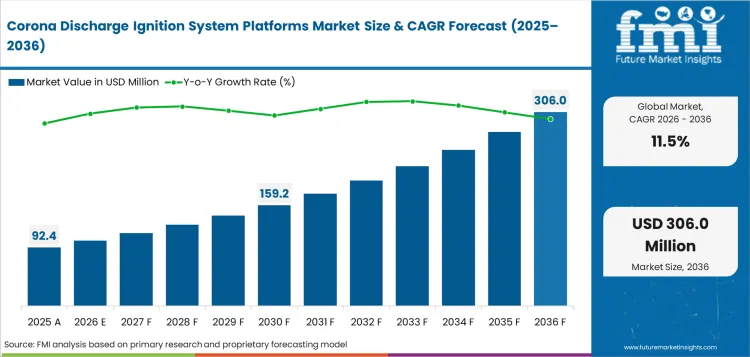
Corona discharge ignition system platforms market was valued at USD 92.4 million in 2025 and is projected to reach USD 103.0 million in 2026. The sector is forecast to reach USD 306.0 million by 2036 at 11.5% CAGR. RF corona modules are projected to lead platform type with 46.0% share in 2026. Power electronics segment is expected to hold 39.0% share of component type in 2026.
Summary of the Corona Discharge Ignition System Platforms Market
- Demand and Growth Drivers
- Lean burn gasoline work creates a direct need for wider ignition kernels and stable combustion control.
- Natural gas engine testing supports platform trials where dilute mixtures need more ignition energy.
- Range extender hybrids create a selective channel for range extended hybrid powertrains that run at optimized engine points.
- Hydrogen engine work raises interest in hydrogen ICE ignition platforms where ignition timing stays sensitive.
- Product and Segment View
- RF corona modules are projected to lead the platform type segment with 46.0% share as resonant control remains the proven route.
- Power electronics are expected to dominate the component type segment with 39.0% share since stable discharge depends on the driver stage.
- Gasoline is projected to account for 57.0% share of fuel type demand in 2026 as turbocharged engines retain development volume.
- Passenger cars are anticipated to hold 49.0% share of vehicle class demand with OEM engine programs using the widest test base.
- Geography and Competitive Outlook
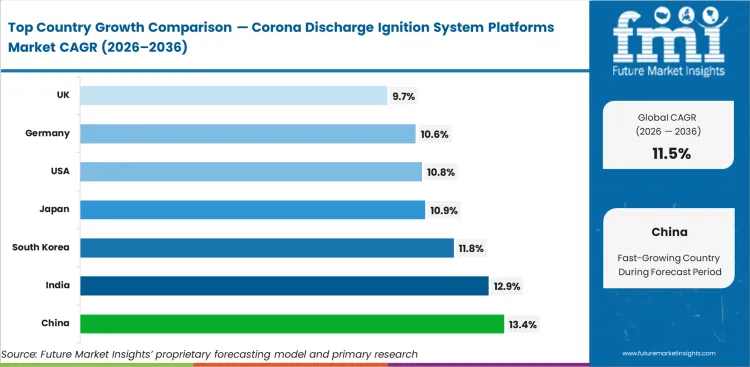
- China is expected to record 13.4% CAGR through 2036 as large vehicle output keeps advanced combustion programs active.
- India is forecast at 12.9% CAGR by 2036 as high two wheeler and passenger vehicle output supports local testing.
- BorgWarner, Tenneco and Transient Plasma Systems carry early platform know-how in corona and plasma ignition.
- Companies such as DENSO, Niterra and Hitachi Astemo influence adjacent automotive ignition systems through coil and spark plug depth.
- Analyst Opinion
- Nikhil Kaitwade, Principal Analyst at FMI says, "Corona discharge ignition is a selective platform opportunity inside the wider engine efficiency map. The technology is not trying to replace every spark plug. It is being evaluated where dilute combustion, high exhaust gas recirculation and fuel flexibility create misfire risk. The commercial test for suppliers is not laboratory spark energy alone. OEMs will ask whether the power electronics and engine control link can survive production timing."
- Corona Discharge Ignition System Platforms Market Value Analysis
- Commercial activity is moving from research programs into selective development kits for engine benches and prototype fleets.
- Cost remains a significant barrier as the platform needs power electronics beyond a standard ignition coil.
- RF control and pulse timing create value where electronic control units are being redesigned for hybrid powertrains.
- Commercial value is concentrated in OEM testing, natural gas engines and future fuel demonstrators.
Key Takeaways
- The corona discharge ignition system platforms market was valued at USD 92.4 million in 2025.
- By 2036, the corona discharge ignition system platforms market is forecast to reach USD 306.0 million as lean burn engine testing expands.
- From 2026 to 2036, the market is projected to expand at 11.5% CAGR.
- FMI estimates an incremental opportunity of USD 203.0 million between 2026 and 2036.
- RF corona modules are projected to account for 46.0% share of platform type in 2026 as high frequency control suits lean burn testing.
- Power electronics are expected to account for 39.0% share in 2026 with inverter control central to discharge stability.
- China at 13.4% CAGR and India at 12.9% CAGR are countries with significant expansion rates through 2036.
Engine programs keep advanced ignition under evaluation as gasoline and gas engines face stricter emission limits. The United States Environmental Protection Agency finalized model year 2027 and later light duty vehicle standards in April 2024. The European Council adopted Euro 7 rules in April 2024 for cars/vans including buses and trucks. The rules keep engineering attention on combustion stability and fuel use. Suppliers with tested high-frequency power electronics and engine calibration support are likely to gain repeat orders first.
Corona Discharge Ignition System Platforms Market Definition
The corona discharge ignition system platforms market covers high-frequency ignition hardware and control platforms that create a non-arc plasma discharge around an igniter tip. Scope includes RF corona modules, nanosecond plasma modules, control electronics, corona igniters, harnesses and software used for spark ignition engines. The market includes development kits and production-intent modules sold to OEMs, engine labs and selected retrofit pilots.
Corona Discharge Ignition System Platforms Market Inclusions
Market scope includes complete discharge platforms used in gasoline, natural gas, hydrogen and flex fuel spark ignition engines. Component coverage includes integrated power modules, resonant drivers, igniter assemblies and timing control software. Vehicle coverage includes passenger cars, light trucks, commercial vehicles, off-highway engines and stationary gas engines where a corona or plasma ignition event is the main ignition method.
Corona Discharge Ignition System Platforms Market Exclusions
Scope excludes standard coils, conventional spark plugs and glow plugs sold without corona or plasma discharge control. The market excludes diesel compression ignition parts, battery-electric vehicle power electronics and laboratory plasma tools sold for non-engine uses. Aftermarket ignition parts are excluded unless they are part of a corona discharge platform pilot.
Corona Discharge Ignition System Platforms Market Research Methodology
- Primary Research: FMI analysts reviewed ignition platform suppliers, engine test needs and feedback from powertrain engineering contacts in major automotive countries.
- Desk Research: The study used public data from transport agencies, automotive trade bodies, government rulemaking records and company technical pages.
- Market Sizing and Forecasting: Market size was estimated through bottom-up volumes for platform kits and top-down checks against advanced ignition spend.
- Data Validation: Forecast checks compared vehicle production, gasoline engine persistence, natural gas engine work and supplier evidence in advanced combustion.
Why is the Corona Discharge Ignition System Platforms Market Growing?
- Lean burn work raises the need for ignition systems that create a larger early flame region than a normal spark.
- Natural gas and hydrogen engine pilots need stable combustion under dilute fuel mixtures and variable load.
- Powertrain software work connects ignition timing with engine management sensors and pressure feedback.
Advanced ignition demand is connected to the gap between engine efficiency targets and real combustion limits. The International Energy Agency reported electric car sales exceeded 17 million globally in 2024 and are expected to exceed 20 million in 2025. Electrification narrows the field toward engines that justify extra hardware through fuel economy or emission gains. Corona discharge platforms are witnessing demand as OEMs need combustion margin in engines that remain part of hybrid or fleet programs.
Vehicle regulation is giving advanced ignition a clearer test route in the United States and Europe. The United States Environmental Protection Agency finalized model year 2027 and later multipollutant standards in April 2024. Regulatory action pushes engine teams to improve cold start control and low load efficiency. Corona discharge platforms are gaining attention as a stable early flame shortens the route from lab proof to calibration work.
Market Segmentation Analysis
- RF corona modules are projected to reach 46.0% share in 2026 as resonant drivers suit early OEM test benches.
- Power electronics are expected to represent 39.0% share in 2026 since discharge stability depends on high frequency control.
- Gasoline is forecast to account for 57.0% share in 2026 due to turbocharged engine development volume.
- Passenger cars are projected to capture 49.0% share in 2026 as light vehicle programs set most calibration rules.
- OEM development kits are estimated to account for 44.0% share in 2026 as platform work starts before production sourcing.
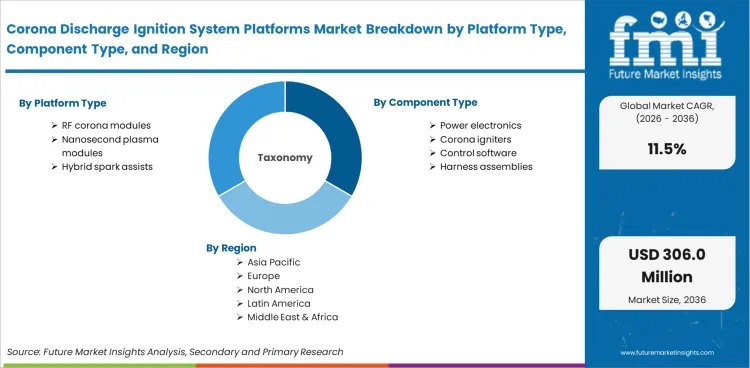
The market is divided into five segment groups based on platform type, component type, fuel type, vehicle class and sales model. Platform type separates RF corona modules from nanosecond plasma modules and hybrid spark assists. Component type shows where value sits inside the system. Fuel type and vehicle class explain the engine programs most likely to test the platform. Sales model shows whether revenue comes from early kits, Tier 1 modules or retrofit pilots.
Insights into the RF Corona Modules Platform Type Segment
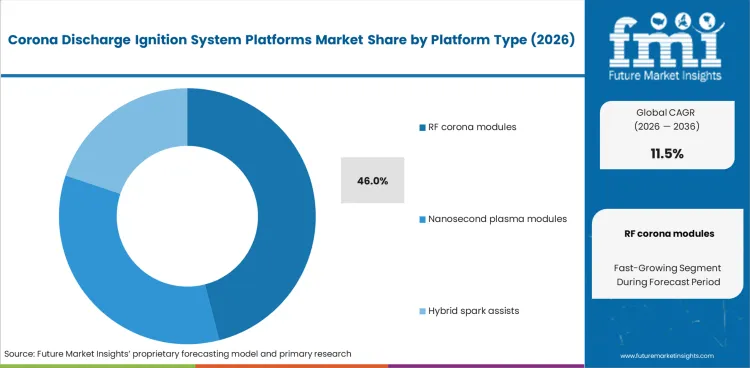
- RF corona modules are projected to account for 46.0% share of platform type demand in 2026 as resonant discharge control remains the main benchmark.
- BorgWarner EcoFlash evidence from California Energy Commission work published in June 2023 keeps RF corona modules visible in gasoline and gas engine testing.
Insights into the Power Electronics Component Type Segment
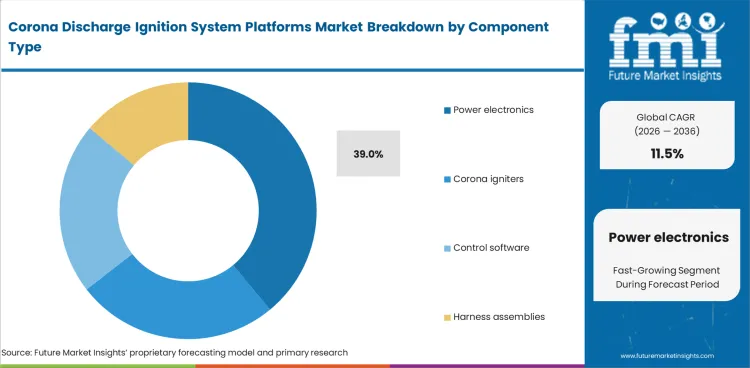
- Power electronics are expected to represent 39.0% share of component type in 2026 with the driver stage setting discharge repeatability.
- Suppliers with high voltage boards and thermal control experience gain an advantage near powertrain domain control units.
Insights into the Gasoline Fuel Type Segment
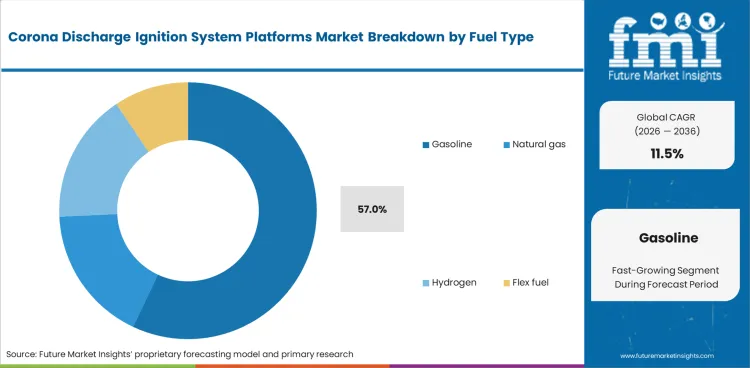
- Gasoline is forecast to account for 57.0% share of fuel type demand in 2026 as turbocharged engines remain the broadest test group.
- Corona ignition trials align with gasoline direct injection where dilution and knock control affect engine maps.
Insights into the Passenger Cars Vehicle Class Segment
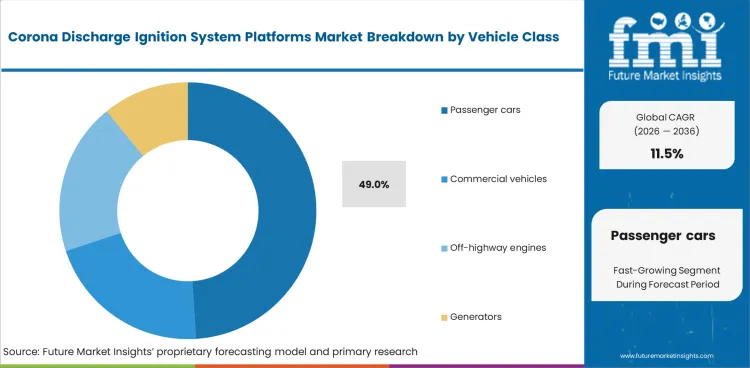
- Passenger cars are anticipated to hold 49.0% share of vehicle class demand in 2026 as light vehicle rules drive design work.
- Hybrid passenger platforms use engine control depth and automotive sensors to measure combustion stability during calibration.
Insights into the OEM Development Kits Sales Model Segment
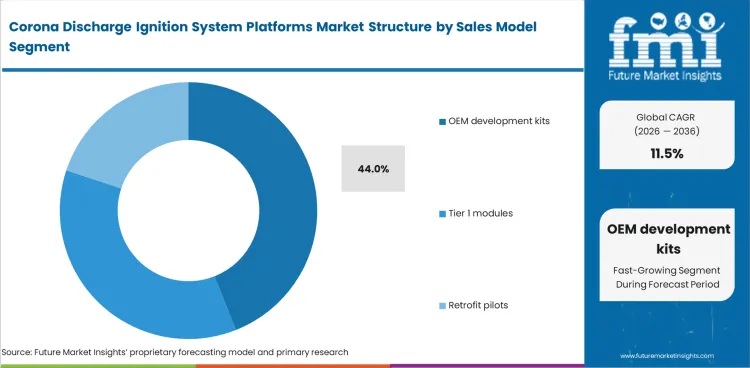
- OEM development kits are projected to account for 44.0% share of sales model demand in 2026 as buyers test before sourcing.
- Kits that include igniters, drivers and software reduce test burden for engine labs comparing plasma ignition with automotive spark plugs.
Corona Discharge Ignition System Platforms Market Drivers, Restraints, and Opportunities
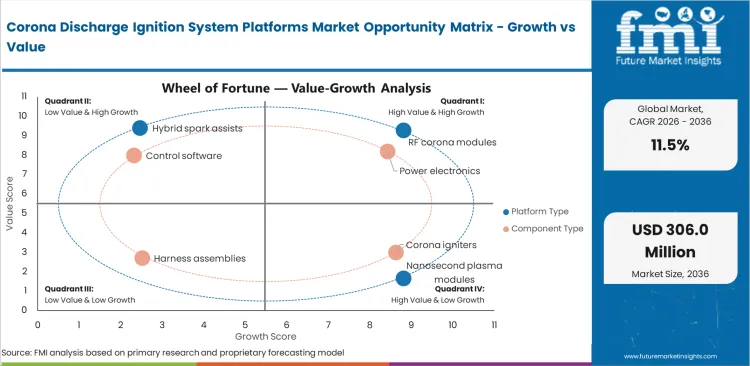
- Dilute combustion testing is raising interest in corona platforms for engines with high exhaust gas recirculation.
- Platform cost slows scale as power electronics and control software add cost above automotive ignition coils.
- Natural gas and hydrogen programs create opportunity where standard spark events face ignition stability limits.
A significant market driver is the need to widen the stable combustion window in engines that stay in hybrid and fleet roles. OICA reported in April 2026 that global vehicle production rose from 92.7 million units in 2024 to 96.4 million units in 2025. The production base shows engine platforms remain a large industrial base even as electric vehicles expand. Corona discharge platforms gain a role when each extra point of engine efficiency is worth more than the added ignition cost.
Platform Cost Limits Scale
The primary restraint is cost and packaging pressure around the power stage. A normal ignition path uses established coilsand service routines. Corona discharge adds high frequency control and tighter insulation needs. Vehicle makers will not add the platform unless it reduces calibration risk or fuel cost in a defined engine family. The cost profile keeps adoption focused on high value trials and selected production routes.
Fuel Flexibility Creates Opportunity
The clearest opportunity lies in engines that need fuel flexibility without losing combustion control. Natural gas engines, hydrogen ICE programs and range extended hybrids have different mixture risks. All three need accurate timing and stable early flame formation. Corona discharge platforms give suppliers a way to sell hardware with calibration services. Value moves toward tested platforms rather than isolated igniter parts.
Analysis of Corona Discharge Ignition System Platforms Market By Key Countries
.webp "Top Country Growth Comparison Corona Discharge Ignition System Platforms Market Cagr (2026 2036)")
| Country | CAGR |
|---|---|
| United States | 10.8% |
| China | 13.4% |
| India | 12.9% |
| Germany | 10.6% |
| Japan | 10.9% |
| South Korea | 11.8% |
| United Kingdom | 9.7% |
Source: Future Market Insights, 2026.
Corona Discharge Ignition System Platforms Market CAGR Analysis by Country
- China is projected to record 13.4% CAGR through 2036 as vehicle scale and hybrid engine work support testing.
- India is expected to advance at 12.9% CAGR during the foecast, as local vehicle production creates wider calibration opportunities.
- South Korea is forecast at 11.8% CAGR through 2036 due to Hyundai and Kia powertrain development depth.
- Japan is forecast at 10.9% CAGR through 2036 as gas engine and hybrid expertise supports advanced ignition checks.
- The United States and Germany are forecast near the global pace with 10.8% CAGR and 10.6% CAGR respectively.
Demand for corona discharge ignition system platforms is forecast to rise at 11.5% CAGR from 2026 to 2036. Country-level analysis covers large vehicle production centers and technology hubs because combustion programs remain commercially relevant.
Demand Outlook for Corona Discharge Ignition System Platforms in the United States
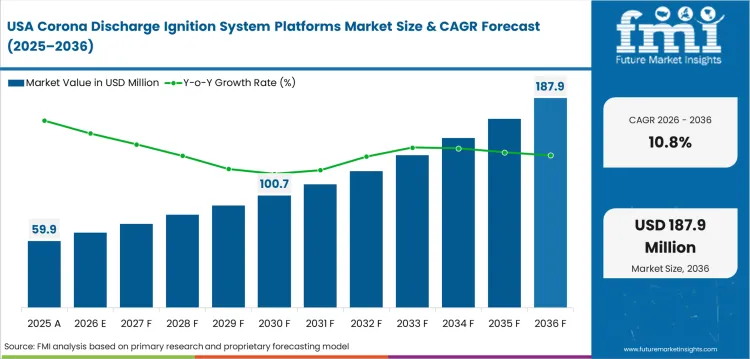
The United States remains a testing center for advanced combustion work in light vehicles and gas engines. The International Organization of Motor Vehicle Manufacturers reported 10.56 million United States vehicles produced in 2024. The production pool supports test demand for ignition platforms that improve efficiency without forcing a full engine redesign. Federal emission rules for model year 2027 and later vehicles add pressure around cold start and low load performance. Suppliers that can connect driver hardware with calibration support will find the clearest route into prototype fleets.
- Michigan engine teams can test corona ignition in hybrid passenger programs tied to Detroit and Ann Arbor engineering centers.
- California Energy Commission projects give Torrance and Sacramento a verified history of plasma ignition work.
- Ohio and Indiana supplier plants can support module packaging for engine programs that need short test cycles.
Sales Analysis of Corona Discharge Ignition System Platforms in China
China combines vehicle scale with fast hybrid and range extender activity. OICA data show China produced 31.28 million vehicles in 2024. China’s volume creates a broad pool for engine control trials as domestic brands refine fuel use in plug-in hybrid and extended range platforms. Local sourcing matters because corona discharge drivers need close coordination with ECU and engine teams. Chinese suppliers that can combine power electronics with vehicle calibration will shape price pressure across the segment.
- Shanghai engineering centers can connect corona testing with hybrid passenger car platforms from domestic OEMs.
- Chongqing range extender programs create a practical route for high energy ignition evaluation.
- Guangdong electronics clusters can shorten lead times for driver boards and harness assemblies.
Demand Outlook for Corona Discharge Ignition System Platforms in India
India offers a wide production base for two wheelers and passenger vehicles that still use spark ignition engines. The Society of Indian Automobile Manufacturers reported total vehicle production of 31.03 million units in April 2024 to March 2025. The production base supports a large engineering population for ignition upgrades in compact engines. The first commercial opportunities will be selective because cost pressure is high. Local value will improve when platform kits can be tested with gasoline and CNG engines in the same validation cycle.
- Pune and Chennai engineering centers can test corona drivers near gasoline and CNG engine programs.
- Gujarat vehicle plants create a route for supplier trials tied to export focused small car platforms.
- India Stage VI norms keep attention on combustion control in Delhi National Capital Region test programs.
Opportunity Analysis of Corona Discharge Ignition System Platforms in Germany
Germany has a smaller domestic output profile than China but holds deep powertrain engineering influence. VDA reported German passenger car production at 4.15 million units in 2025. The production base keeps suppliers close to premium gasoline and hybrid engine validation work. German buyers will require strong proof on durability, electromagnetic behavior and control integration before any production route. That means suppliers must sell a verified platform instead of a separate igniter.
- Stuttgart engine teams can test corona discharge on premium hybrid gasoline programs.
- Bavaria gives access to Munich based OEM validation teams and supplier engineering offices.
- Lower Saxony offers engine and component links near Wolfsburg for module packaging discussions.
Future Outlook for Corona Discharge Ignition System Platforms in Japan
Japan’s market is defined by hybrid system discipline and long engine validation cycles. Japan Automobile Manufacturers Association material for 2025 notes that Japan remains a major auto production and export center. Japan’s production role creates demand for ignition proof that fits lean combustion and fuel economy work. Japanese OEMs will avoid rapid platform change unless reliability is documented across long duty cycles. Corona suppliers will need test evidence that matches existing spark plug service expectations.
- Aichi vehicle clusters can support hybrid engine trials near Toyota and major supplier networks.
- Shizuoka and Hamamatsu support small engine and motorcycle engineering routes for compact ignition checks.
- Kanagawa research centers can compare corona discharge with pre-chamber combustion and engine valves development.
Sales Analysis of Corona Discharge Ignition System Platforms in South Korea
South Korea links power electronics depth with global passenger vehicle engineering. OICA data show South Korea produced about 4.13 million vehicles in 2024. South Korea’s scale supports advanced ignition trials where Hyundai and Kia assess hybrid and future fuel platforms. The country is smaller by volume than China. Its supplier concentration makes it useful for validation. Corona platform vendors will need local engineering support for control software and engine bench work.
- Gyeonggi supplier clusters can support power electronics and controller work for corona ignition modules.
- Ulsan vehicle production gives suppliers access to large scale gasoline and hybrid platform feedback.
- Daejeon research institutes can support engine bench tests for plasma ignition under fuel flexibility work.
Future Outlook for Corona Discharge Ignition System Platforms in the United Kingdom
The United Kingdom is a smaller production market and retains specialist powertrain engineering depth. SMMT Motor Industry Facts 2025 reported total UK vehicle manufacturing volume of 905,233 units in 2024. The figure points to a focused market with limited production scale. UK demand will center on motorsport, low volume powertrain engineering and fuel research. Suppliers can use the country as a validation site for premium engines and future fuel demonstrators.
- The Midlands supply chain gives access to prototype engine builders and powertrain test houses.
- Coventry and Warwick research groups can evaluate corona ignition against hybrid control work.
- Brixworth and Silverstone motorsport clusters support high value combustion testing for niche platforms.
Competitive Landscape and Strategic Positioning
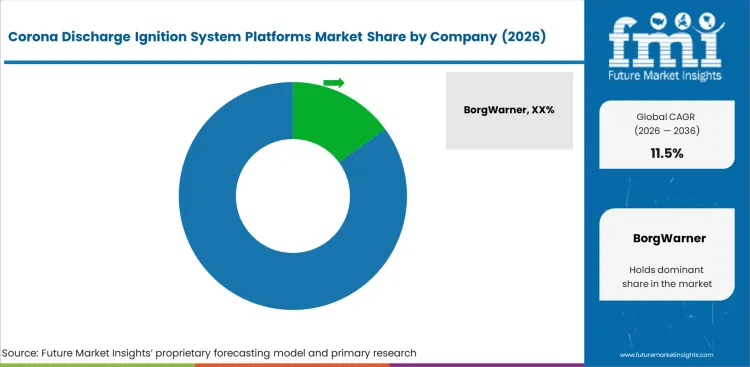
- The market is concentrated around platform know-how instead of standard ignition part volume.
- BorgWarner and Tenneco hold early corona knowledge through prior platform development and engine testing.
- Transient Plasma Systems competes through pulsed power expertise and natural gas engine project evidence.
- Entry barriers include high voltage insulation, electromagnetic control and engine calibration proof.
Competition in the industry is centered on proof that the ignition event works under real engine load. Transient Plasma Systems positions its technology around nanosecond pulsed power for ignition and emissions treatment. TPS’s offer differs from standard spark plug replacements. Engine teams will require bench data and software links before approving production work. Market access favors integrated platform evidence over component catalog breadth.
Large ignition suppliers have a channel advantage because engine buyers already know their validation routines. BorgWarner offers high energy ignition coils and BERU aftermarket ignition products. Tenneco’s ignition business has experience in plugs and lean burn pre-chamber designs. These suppliers understand warranty exposure and vehicle program timing. Their challenge is to prove that corona discharge adds enough value above premium fuel delivery systems and coil upgrades.
Entry remains difficult because the product must be approved as part of an engine system. A working lab discharge is not enough for an OEM sourcing decision. Suppliers must prove thermal durability, electromagnetic compatibility and repeatable timing across fuels. Suppliers with stronger evidence will link the igniter with fuel injection systems and pressure sensing data. Advantage moves toward companies that can support calibration work through the full engine program.
Key Companies in the Corona Discharge Ignition System Platforms Market
Competition is clearer by role because corona platform suppliers and standard ignition suppliers bring different strengths.
- Corona and Plasma Platform Specialists: BorgWarner, Tenneco and Transient Plasma Systems carry the clearest link with corona or plasma ignition work. BorgWarner has prior EcoFlash corona ignition evidence. Tenneco retains Federal-Mogul ignition heritage. Transient Plasma Systems focuses on nanosecond pulsed power. These firms are best placed where engine labs need a complete discharge concept and technical support.
- Ignition Hardware Leaders: DENSO, Niterra and Hitachi Astemo influence the market through coils, plugs and engine management components. Their product depth gives them access to OEM and service channels. Not all are positioned as corona platform suppliers today. Their knowledge of insulation, durability and ignition packaging gives them a route into adjacent platform work.
- Powertrain and Electronics Participants: Bosch and Mitsubishi Electric sit close to the control layer through engine management, power electronics and vehicle systems. Their role is strongest where corona discharge platforms must connect with sensors, ECUs and high voltage driver boards. Bosch and Mitsubishi Electric can support platform integration even when the igniter is sourced from a specialist.
Competitive Benchmarking: Corona Discharge Ignition System Platforms Market
| Company | Corona Platform Depth | High Voltage Driver Depth | Engine Calibration Support | Geographic Footprint |
|---|---|---|---|---|
| BorgWarner | High | Strong | Strong | Global with United States and Europe engineering depth |
| Tenneco | High | Medium | Strong | Global with ignition and powertrain heritage |
| Transient Plasma Systems | High | Strong | Medium | United States centered with specialist plasma focus |
| DENSO | Medium | Strong | Strong | Japan centered with global OEM channels |
| Niterra | Medium | Medium | Strong | Japan centered with global NGK ignition reach |
| Hitachi Astemo | Medium | Medium | Strong | Japan centered with Europe and Americas aftermarket access |
| Bosch | Low | Strong | Strong | Global with engine management and aftermarket depth |
| Mitsubishi Electric | Low | Medium | Medium | Japan centered with power electronics strength |
Source: Future Market Insights competitive analysis, 2026. Ratings reflect relative positioning based on corona platform depth, high voltage driver depth and engine calibration support.
Key Developments in Corona Discharge Ignition System Platforms Market
- In August 2024, Hitachi Astemo showcased ignition coils designed to convert low battery voltage to high voltage for efficient combustion. The showcase confirms adjacent ignition platform depth.
- In November 2024, Niterra launched seven double precious metal spark plugs and six ignition coils for four wheel vehicles. The launch reflects premium ignition durability demand.
- In May 2025, Bosch added 82 automotive aftermarket part numbers including ignition coils and spark plugs. The expansion reflects continued investment in combustion service channels.
Key Players in the Corona Discharge Ignition System Platforms Market
Corona and Plasma Platform Specialists:
- BorgWarner
- Tenneco
- Transient Plasma Systems
Ignition Hardware Leaders:
- DENSO
- Niterra
- Hitachi Astemo
Powertrain and Electronics Participants:
- Bosch
- Mitsubishi Electric
Report Scope and Coverage
| Parameter | Details |
|---|---|
| Quantitative Units | USD 103.0 million to USD 306.0 million, at a CAGR of 11.5% |
| Market Definition | High frequency ignition platforms that create non arc corona or plasma discharge for spark ignition engines |
| Platform Type | RF corona modules, Nanosecond plasma modules, Hybrid spark assists |
| Component Type | Power electronics, Corona igniters, Control software, Harness assemblies |
| Fuel Type | Gasoline, Natural gas, Hydrogen, Flex fuel |
| Vehicle Class | Passenger cars, Commercial vehicles, Off-highway engines, Generators |
| Sales Model | OEM development kits, Tier 1 modules, Retrofit pilots |
| Regions Covered | North America, Latin America, Western Europe, Eastern Europe, East Asia, South Asia and Pacific, Middle East and Africa |
| Countries Covered | United States, China, India, Germany, Japan, South Korea, United Kingdom, and 30+ countries |
| Key Companies Profiled | BorgWarner, Tenneco, Transient Plasma Systems, DENSO, Niterra, Hitachi Astemo, Bosch, Mitsubishi Electric |
| Forecast Period | 2026 to 2036 |
| Approach | Hybrid bottom-up and top-down methodology using vehicle production, engine program signals, supplier evidence and adoption checks |
Source: Future Market Insights, 2026.
Corona Discharge Ignition System Platforms Market Breakdown By Platform Type, Component Type, Fuel Type, Vehicle Class, Sales Model, and Region
Corona Discharge Ignition System Platforms Market Segmented by Platform Type:
- RF corona modules
- Nanosecond plasma modules
- Hybrid spark assists
Corona Discharge Ignition System Platforms Market Segmented by Component Type:
- Power electronics
- Corona igniters
- Control software
- Harness assemblies
Corona Discharge Ignition System Platforms Market Segmented by Fuel Type:
- Gasoline
- Natural gas
- Hydrogen
- Flex fuel
Corona Discharge Ignition System Platforms Market Segmented by Vehicle Class:
- Passenger cars
- Commercial vehicles
- Off-highway engines
- Generators
Corona Discharge Ignition System Platforms Market Segmented by Sales Model:
- OEM development kits
- Tier 1 modules
- Retrofit pilots
Corona Discharge Ignition System Platforms Market by Region:
- North America
- United States
- Canada
- Mexico
- Latin America
- Brazil
- Chile
- Rest of Latin America
- Western Europe
- Germany
- United Kingdom
- Italy
- Spain
- France
- Nordic
- BENELUX
- Rest of Western Europe
- Eastern Europe
- Russia
- Poland
- Hungary
- Balkan and Baltic
- Rest of Eastern Europe
- East Asia
- China
- Japan
- South Korea
- South Asia and Pacific
- India
- ASEAN
- Australia and New Zealand
- Rest of South Asia and Pacific
- Middle East and Africa
- Kingdom of Saudi Arabia
- Other GCC Countries
- Turkiye
- South Africa
- Other African Union
- Rest of Middle East and Africa
Research Sources and Bibliography
- 1. International Organization of Motor Vehicle Manufacturers. (2026, April 23). Auto industry growth shifted east in 2025 amid global repositioning. OICA.
- 2. International Organization of Motor Vehicle Manufacturers. (2025, October). World motor vehicle production by country and region 2024. OICA.
- 3. International Energy Agency. (2025, May 14). Global EV Outlook 2025. IEA.
- 4. United States Environmental Protection Agency. (2024, April 18). Final rule: Multi-pollutant emissions standards for model years 2027 and later light-duty and medium-duty vehicles. EPA.
- 5. Council of the European Union. (2024, April 12). Euro 7: Council adopts new rules on emission limits for cars, vans and trucks. Council of the EU.
- 6. Society of Indian Automobile Manufacturers. (2025, April 15). Quarterly performance: January to March 2025 and April 2024 to March 2025. SIAM.
- 7. Verband der Automobilindustrie. (2026, February 16). Automobile production. VDA.
- 8. Japan Automobile Manufacturers Association. (2025, September 26). The motor industry of Japan 2025. JAMA.
- 9. Society of Motor Manufacturers and Traders. (2025, May). SMMT motor industry facts 2025. SMMT.
- 10. California Energy Commission. (2023, June 22). A multi-cylinder transient plasma ignition system for increased efficiency and reduced emissions in gas engines. CEC.
- 11. Hitachi Astemo. (2024, August 13). Hitachi Astemo to showcase automotive solutions at Automechanika Frankfurt 2024. Hitachi Astemo.
- 12. Niterra. (2024, November). Niterra launches seven new double precious metal spark plugs and six ignition coils for 4-wheel vehicles. Niterra.
- 13. Bosch. (2025, May 14). Bosch adds 82 new automotive aftermarket part numbers in Q1. Bosch Auto Parts.
- 14. Transient Plasma Systems. (2026). Ignition solution. TPS Ignition.
- The bibliography is provided for reader reference and uses government, trade body, company and official technical sources relevant to ignition platforms and automotive demand signals.
This Report Answers
- What is the current and future size of the corona discharge ignition system platforms market?
- How fast is the corona discharge ignition system platforms market expected to expand between 2026 and 2036?
- Which platform type is expected to lead corona discharge ignition system platform demand by 2026?
- Which component type is projected to account for the leading corona discharge ignition system platform share in 2026?
- Why are RF corona modules and power electronics important for this market?
- How do emission rules and hybrid engine programs affect corona discharge ignition platform adoption?
- Which countries are projected to record faster expansion during the forecast period?
- Who are the main companies active in corona discharge ignition and adjacent ignition platform supply?
- How does FMI define the corona discharge ignition system platforms market scope?
- How does FMI estimate and validate the corona discharge ignition system platforms forecast?
Frequently Asked Questions
What is the global market demand for Corona Discharge Ignition System Platforms in 2026?
In 2026, the global corona discharge ignition system platforms market is expected to be worth USD 103.0 million as platform testing widens.
How big will the Corona Discharge Ignition System Platforms Market be in 2036?
By 2036, the corona discharge ignition system platforms market is expected to be worth USD 306.0 million as selective engine programs expand.
How much is demand for Corona Discharge Ignition System Platforms expected to expand between 2026 and 2036?
Between 2026 and 2036, corona discharge ignition system platform demand is expected to expand at 11.5% CAGR as engine testing deepens.
Which platform type is expected to lead the Corona Discharge Ignition System Platforms Market by 2026?
RF corona modules are projected to lead platform type demand with 46.0% share in 2026 due to resonant discharge control.
Which component type is expected to lead Corona Discharge Ignition System Platform demand in 2026?
Power electronics are expected to lead component type demand with 39.0% share in 2026 as discharge repeatability depends on driver design.
Which country is forecast to grow fastest in the Corona Discharge Ignition System Platforms Market?
China is expected to record 13.4% CAGR through 2036 as large vehicle output supports hybrid and range extender engine testing.
What does the Corona Discharge Ignition System Platforms Market include?
The market includes RF corona modules, plasma drivers, corona igniters and control software used to ignite spark ignition engines.
How does FMI estimate the Corona Discharge Ignition System Platforms Market forecast?
FMI estimates the forecast using vehicle production, supplier evidence, engine program signals and adoption checks across fuel and vehicle segments.
How does a corona discharge ignition system work in an engine?
A corona discharge system uses high frequency electrical energy to form a plasma region near the igniter tip. The discharge creates a larger early flame area than a normal spark.
Why would an automaker test corona ignition instead of a normal spark plug?
An automaker tests corona ignition when lean mixtures or high exhaust gas recirculation raise misfire risk. The system can improve combustion stability in selected engines.
Is corona discharge ignition ready for mass production?
Corona discharge ignition is closer to selective production than broad mass use. Cost, packaging, and durability proof remain the main barriers for most high volume engines.
Which engines are more suitable for corona discharge ignition systems?
Gasoline direct injection engines, natural gas engines and hydrogen ICE platforms are more suitable when stable ignition is difficult under dilute mixture conditions.
How does corona discharge ignition compare with pre-chamber ignition?
Corona discharge changes the electrical ignition event near the igniter. Pre-chamber ignition changes the combustion layout by using a small chamber to send flame jets.
Preview the report firsthand - request a free sample
Get SampleGet the brochure for pricing and purchase details.
Get PDFTable of Content
- Executive Summary
- Global Market Outlook
- Demand-side Trends
- Supply-side Trends
- Technology Roadmap Analysis
- Analysis and Recommendations
- Market Overview
- Market Coverage / Taxonomy
- Market Definition / Scope / Limitations
- Research Methodology
- Chapter Orientation
- Analytical Lens and Working Hypotheses
- Market Structure, Signals, and Trend Drivers
- Benchmarking and Cross-market Comparability
- Market Sizing, Forecasting, and Opportunity Mapping
- Research Design and Evidence Framework
- Desk Research Programme (Secondary Evidence)
- Company Annual and Sustainability Reports
- Peer-reviewed Journals and Academic Literature
- Corporate Websites, Product Literature, and Technical Notes
- Earnings Decks and Investor Briefings
- Statutory Filings and Regulatory Disclosures
- Technical White Papers and Standards Notes
- Trade Journals, Industry Magazines, and Analyst Briefs
- Conference Proceedings, Webinars, and Seminar Materials
- Government Statistics Portals and Public Data Releases
- Press Releases and Reputable Media Coverage
- Specialist Newsletters and Curated Briefings
- Sector Databases and Reference Repositories
- FMI Internal Proprietary Databases and Historical Market Datasets
- Subscription Datasets and Paid Sources
- Social Channels, Communities, and Digital Listening Inputs
- Additional Desk Sources
- Expert Input and Fieldwork (Primary Evidence)
- Primary Modes
- Qualitative Interviews and Expert Elicitation
- Quantitative Surveys and Structured Data Capture
- Blended Approach
- Why Primary Evidence is Used
- Field Techniques
- Interviews
- Surveys
- Focus Groups
- Observational and In-context Research
- Social and Community Interactions
- Stakeholder Universe Engaged
- C-suite Leaders
- Board Members
- Presidents and Vice Presidents
- R&D and Innovation Heads
- Technical Specialists
- Domain Subject-matter Experts
- Scientists
- Physicians and Other Healthcare Professionals
- Governance, Ethics, and Data Stewardship
- Research Ethics
- Data Integrity and Handling
- Primary Modes
- Tooling, Models, and Reference Databases
- Desk Research Programme (Secondary Evidence)
- Data Engineering and Model Build
- Data Acquisition and Ingestion
- Cleaning, Normalisation, and Verification
- Synthesis, Triangulation, and Analysis
- Quality Assurance and Audit Trail
- Market Background
- Market Dynamics
- Drivers
- Restraints
- Opportunity
- Trends
- Scenario Forecast
- Demand in Optimistic Scenario
- Demand in Likely Scenario
- Demand in Conservative Scenario
- Opportunity Map Analysis
- Product Life Cycle Analysis
- Supply Chain Analysis
- Investment Feasibility Matrix
- Value Chain Analysis
- PESTLE and Porter’s Analysis
- Regulatory Landscape
- Regional Parent Market Outlook
- Production and Consumption Statistics
- Import and Export Statistics
- Market Dynamics
- Global Market Analysis 2021 to 2025 and Forecast, 2026 to 2036
- Historical Market Size Value (USD Million) Analysis, 2021 to 2025
- Current and Future Market Size Value (USD Million) Projections, 2026 to 2036
- Y-o-Y Growth Trend Analysis
- Absolute $ Opportunity Analysis
- Global Market Pricing Analysis 2021 to 2025 and Forecast 2026 to 2036
- Global Market Analysis 2021 to 2025 and Forecast 2026 to 2036, By Platform Type
- Introduction / Key Findings
- Historical Market Size Value (USD Million) Analysis By Platform Type , 2021 to 2025
- Current and Future Market Size Value (USD Million) Analysis and Forecast By Platform Type , 2026 to 2036
- RF corona modules
- Nanosecond plasma modules
- Hybrid spark assists
- RF corona modules
- Y-o-Y Growth Trend Analysis By Platform Type , 2021 to 2025
- Absolute $ Opportunity Analysis By Platform Type , 2026 to 2036
- Global Market Analysis 2021 to 2025 and Forecast 2026 to 2036, By Component Type
- Introduction / Key Findings
- Historical Market Size Value (USD Million) Analysis By Component Type, 2021 to 2025
- Current and Future Market Size Value (USD Million) Analysis and Forecast By Component Type, 2026 to 2036
- Power electronics
- Corona igniters
- Control software
- Harness assemblies
- Power electronics
- Y-o-Y Growth Trend Analysis By Component Type, 2021 to 2025
- Absolute $ Opportunity Analysis By Component Type, 2026 to 2036
- Global Market Analysis 2021 to 2025 and Forecast 2026 to 2036, By Fuel Type
- Introduction / Key Findings
- Historical Market Size Value (USD Million) Analysis By Fuel Type, 2021 to 2025
- Current and Future Market Size Value (USD Million) Analysis and Forecast By Fuel Type, 2026 to 2036
- Gasoline
- Natural gas
- Hydrogen
- Flex fuel
- Gasoline
- Y-o-Y Growth Trend Analysis By Fuel Type, 2021 to 2025
- Absolute $ Opportunity Analysis By Fuel Type, 2026 to 2036
- Global Market Analysis 2021 to 2025 and Forecast 2026 to 2036, By Vehicle Class
- Introduction / Key Findings
- Historical Market Size Value (USD Million) Analysis By Vehicle Class, 2021 to 2025
- Current and Future Market Size Value (USD Million) Analysis and Forecast By Vehicle Class, 2026 to 2036
- Passenger cars
- Commercial vehicles
- Off-highway engines
- Generators
- Passenger cars
- Y-o-Y Growth Trend Analysis By Vehicle Class, 2021 to 2025
- Absolute $ Opportunity Analysis By Vehicle Class, 2026 to 2036
- Global Market Analysis 2021 to 2025 and Forecast 2026 to 2036, By Sales Model
- Introduction / Key Findings
- Historical Market Size Value (USD Million) Analysis By Sales Model, 2021 to 2025
- Current and Future Market Size Value (USD Million) Analysis and Forecast By Sales Model, 2026 to 2036
- OEM development kits
- Tier 1 modules
- Retrofit pilots
- OEM development kits
- Y-o-Y Growth Trend Analysis By Sales Model, 2021 to 2025
- Absolute $ Opportunity Analysis By Sales Model, 2026 to 2036
- Global Market Analysis 2021 to 2025 and Forecast 2026 to 2036, By Region
- Introduction
- Historical Market Size Value (USD Million) Analysis By Region, 2021 to 2025
- Current Market Size Value (USD Million) Analysis and Forecast By Region, 2026 to 2036
- North America
- Latin America
- Western Europe
- Eastern Europe
- East Asia
- South Asia and Pacific
- Middle East & Africa
- Market Attractiveness Analysis By Region
- North America Market Analysis 2021 to 2025 and Forecast 2026 to 2036, By Country
- Historical Market Size Value (USD Million) Trend Analysis By Market Taxonomy, 2021 to 2025
- Market Size Value (USD Million) Forecast By Market Taxonomy, 2026 to 2036
- By Country
- USA
- Canada
- Mexico
- By Platform Type
- By Component Type
- By Fuel Type
- By Vehicle Class
- By Sales Model
- By Country
- Market Attractiveness Analysis
- By Country
- By Platform Type
- By Component Type
- By Fuel Type
- By Vehicle Class
- By Sales Model
- Key Takeaways
- Latin America Market Analysis 2021 to 2025 and Forecast 2026 to 2036, By Country
- Historical Market Size Value (USD Million) Trend Analysis By Market Taxonomy, 2021 to 2025
- Market Size Value (USD Million) Forecast By Market Taxonomy, 2026 to 2036
- By Country
- Brazil
- Chile
- Rest of Latin America
- By Platform Type
- By Component Type
- By Fuel Type
- By Vehicle Class
- By Sales Model
- By Country
- Market Attractiveness Analysis
- By Country
- By Platform Type
- By Component Type
- By Fuel Type
- By Vehicle Class
- By Sales Model
- Key Takeaways
- Western Europe Market Analysis 2021 to 2025 and Forecast 2026 to 2036, By Country
- Historical Market Size Value (USD Million) Trend Analysis By Market Taxonomy, 2021 to 2025
- Market Size Value (USD Million) Forecast By Market Taxonomy, 2026 to 2036
- By Country
- Germany
- UK
- Italy
- Spain
- France
- Nordic
- BENELUX
- Rest of Western Europe
- By Platform Type
- By Component Type
- By Fuel Type
- By Vehicle Class
- By Sales Model
- By Country
- Market Attractiveness Analysis
- By Country
- By Platform Type
- By Component Type
- By Fuel Type
- By Vehicle Class
- By Sales Model
- Key Takeaways
- Eastern Europe Market Analysis 2021 to 2025 and Forecast 2026 to 2036, By Country
- Historical Market Size Value (USD Million) Trend Analysis By Market Taxonomy, 2021 to 2025
- Market Size Value (USD Million) Forecast By Market Taxonomy, 2026 to 2036
- By Country
- Russia
- Poland
- Hungary
- Balkan & Baltic
- Rest of Eastern Europe
- By Platform Type
- By Component Type
- By Fuel Type
- By Vehicle Class
- By Sales Model
- By Country
- Market Attractiveness Analysis
- By Country
- By Platform Type
- By Component Type
- By Fuel Type
- By Vehicle Class
- By Sales Model
- Key Takeaways
- East Asia Market Analysis 2021 to 2025 and Forecast 2026 to 2036, By Country
- Historical Market Size Value (USD Million) Trend Analysis By Market Taxonomy, 2021 to 2025
- Market Size Value (USD Million) Forecast By Market Taxonomy, 2026 to 2036
- By Country
- China
- Japan
- South Korea
- By Platform Type
- By Component Type
- By Fuel Type
- By Vehicle Class
- By Sales Model
- By Country
- Market Attractiveness Analysis
- By Country
- By Platform Type
- By Component Type
- By Fuel Type
- By Vehicle Class
- By Sales Model
- Key Takeaways
- South Asia and Pacific Market Analysis 2021 to 2025 and Forecast 2026 to 2036, By Country
- Historical Market Size Value (USD Million) Trend Analysis By Market Taxonomy, 2021 to 2025
- Market Size Value (USD Million) Forecast By Market Taxonomy, 2026 to 2036
- By Country
- India
- ASEAN
- Australia & New Zealand
- Rest of South Asia and Pacific
- By Platform Type
- By Component Type
- By Fuel Type
- By Vehicle Class
- By Sales Model
- By Country
- Market Attractiveness Analysis
- By Country
- By Platform Type
- By Component Type
- By Fuel Type
- By Vehicle Class
- By Sales Model
- Key Takeaways
- Middle East & Africa Market Analysis 2021 to 2025 and Forecast 2026 to 2036, By Country
- Historical Market Size Value (USD Million) Trend Analysis By Market Taxonomy, 2021 to 2025
- Market Size Value (USD Million) Forecast By Market Taxonomy, 2026 to 2036
- By Country
- Kingdom of Saudi Arabia
- Other GCC Countries
- Turkiye
- South Africa
- Other African Union
- Rest of Middle East & Africa
- By Platform Type
- By Component Type
- By Fuel Type
- By Vehicle Class
- By Sales Model
- By Country
- Market Attractiveness Analysis
- By Country
- By Platform Type
- By Component Type
- By Fuel Type
- By Vehicle Class
- By Sales Model
- Key Takeaways
- Key Countries Market Analysis
- USA
- Pricing Analysis
- Market Share Analysis, 2025
- By Platform Type
- By Component Type
- By Fuel Type
- By Vehicle Class
- By Sales Model
- Canada
- Pricing Analysis
- Market Share Analysis, 2025
- By Platform Type
- By Component Type
- By Fuel Type
- By Vehicle Class
- By Sales Model
- Mexico
- Pricing Analysis
- Market Share Analysis, 2025
- By Platform Type
- By Component Type
- By Fuel Type
- By Vehicle Class
- By Sales Model
- Brazil
- Pricing Analysis
- Market Share Analysis, 2025
- By Platform Type
- By Component Type
- By Fuel Type
- By Vehicle Class
- By Sales Model
- Chile
- Pricing Analysis
- Market Share Analysis, 2025
- By Platform Type
- By Component Type
- By Fuel Type
- By Vehicle Class
- By Sales Model
- Germany
- Pricing Analysis
- Market Share Analysis, 2025
- By Platform Type
- By Component Type
- By Fuel Type
- By Vehicle Class
- By Sales Model
- UK
- Pricing Analysis
- Market Share Analysis, 2025
- By Platform Type
- By Component Type
- By Fuel Type
- By Vehicle Class
- By Sales Model
- Italy
- Pricing Analysis
- Market Share Analysis, 2025
- By Platform Type
- By Component Type
- By Fuel Type
- By Vehicle Class
- By Sales Model
- Spain
- Pricing Analysis
- Market Share Analysis, 2025
- By Platform Type
- By Component Type
- By Fuel Type
- By Vehicle Class
- By Sales Model
- France
- Pricing Analysis
- Market Share Analysis, 2025
- By Platform Type
- By Component Type
- By Fuel Type
- By Vehicle Class
- By Sales Model
- India
- Pricing Analysis
- Market Share Analysis, 2025
- By Platform Type
- By Component Type
- By Fuel Type
- By Vehicle Class
- By Sales Model
- ASEAN
- Pricing Analysis
- Market Share Analysis, 2025
- By Platform Type
- By Component Type
- By Fuel Type
- By Vehicle Class
- By Sales Model
- Australia & New Zealand
- Pricing Analysis
- Market Share Analysis, 2025
- By Platform Type
- By Component Type
- By Fuel Type
- By Vehicle Class
- By Sales Model
- China
- Pricing Analysis
- Market Share Analysis, 2025
- By Platform Type
- By Component Type
- By Fuel Type
- By Vehicle Class
- By Sales Model
- Japan
- Pricing Analysis
- Market Share Analysis, 2025
- By Platform Type
- By Component Type
- By Fuel Type
- By Vehicle Class
- By Sales Model
- South Korea
- Pricing Analysis
- Market Share Analysis, 2025
- By Platform Type
- By Component Type
- By Fuel Type
- By Vehicle Class
- By Sales Model
- Russia
- Pricing Analysis
- Market Share Analysis, 2025
- By Platform Type
- By Component Type
- By Fuel Type
- By Vehicle Class
- By Sales Model
- Poland
- Pricing Analysis
- Market Share Analysis, 2025
- By Platform Type
- By Component Type
- By Fuel Type
- By Vehicle Class
- By Sales Model
- Hungary
- Pricing Analysis
- Market Share Analysis, 2025
- By Platform Type
- By Component Type
- By Fuel Type
- By Vehicle Class
- By Sales Model
- Kingdom of Saudi Arabia
- Pricing Analysis
- Market Share Analysis, 2025
- By Platform Type
- By Component Type
- By Fuel Type
- By Vehicle Class
- By Sales Model
- Turkiye
- Pricing Analysis
- Market Share Analysis, 2025
- By Platform Type
- By Component Type
- By Fuel Type
- By Vehicle Class
- By Sales Model
- South Africa
- Pricing Analysis
- Market Share Analysis, 2025
- By Platform Type
- By Component Type
- By Fuel Type
- By Vehicle Class
- By Sales Model
- USA
- Market Structure Analysis
- Competition Dashboard
- Competition Benchmarking
- Market Share Analysis of Top Players
- By Regional
- By Platform Type
- By Component Type
- By Fuel Type
- By Vehicle Class
- By Sales Model
- Competition Analysis
- Competition Deep Dive
- BorgWarner
- Overview
- Product Portfolio
- Profitability by Market Segments (Product/Age /Sales Channel/Region)
- Sales Footprint
- Strategy Overview
- Marketing Strategy
- Product Strategy
- Channel Strategy
- Tenneco
- Transient Plasma Systems
- DENSO
- Niterra
- Hitachi Astemo
- Bosch
- BorgWarner
- Competition Deep Dive
- Assumptions & Acronyms Used


