

- Market Size (2026)
- USD 1.0 Bn
- Forecast (2036)
- USD 1.7 Bn
- CAGR (2026 to 2036)
- 6.1%
Cylinder-Individual Ignition Timing Control Unit Platforms Market Size, Market Forecast and Outlook By FMI
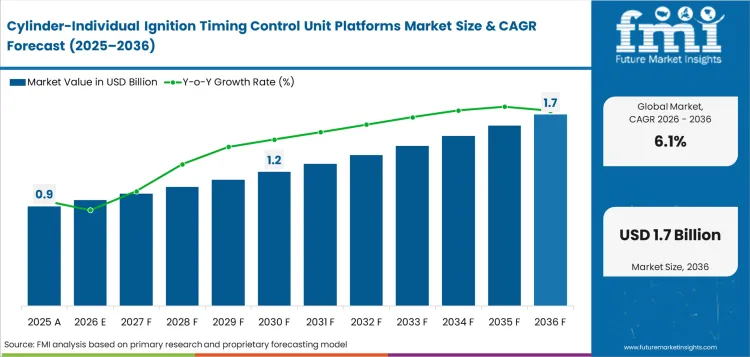
Cylinder-individual ignition timing control unit platforms market was valued at USD 0.9 billion in 2025 and is projected to reach USD 1.0 billion in 2026. It is forecast to reach USD 1.7 billion by 2036 at 6.1% CAGR. Integrated ECM platforms are projected to lead with 46.0% share, while OEM integration is expected to hold 72.0% share of sales channel in 2026.
Summary of the Cylinder-Individual Ignition Timing Control Unit Platforms Market
- Demand and Growth Drivers
- OEMs are using finer spark timing to meet emissions rules without redesigning every engine family.
- Hybrid gasoline engines need clean restart and load-change behavior during frequent engine cycling.
- Knock sensing and cylinder balancing raise the value of control units that adjust spark per cylinder.
- Aftermarket demand stays limited because the platform is usually designed into the vehicle at the factory.
- Product and Segment View
- Integrated ECM platforms are projected to account for 46.0% share in 2026 as engine functions combine in one control unit.
- Cylinder spark timing is likely to hold 48.0% share in 2026 as direct per-cylinder control becomes the main specification.
- Gasoline applications are forecast to account for 63.0% share in 2026 as spark ignition remains the main use area.
- Geography and Competitive Outlook
- China is likely to post 6.8% CAGR through 2036 as high vehicle output supports local engine control sourcing.
- India is projected at 6.6% CAGR through 2036 as two-wheeler and passenger car platforms keep spark ignition demand active.
- Key players such as Bosch and Denso shape the competitive outlook through engine ECU depth and powertrain calibration work.
- Analyst Opinion
- Nikhil Kaitwade, Principal Consultant at FMI, says, “The opportunity in cylinder-individual ignition timing control is in calibration control that can protect fuel economy under real driving conditions. Suppliers can sustain if they prove stable spark timing and knock response across engine families that will keep running beside electric platforms.”
- Cylinder-Individual Ignition Timing Control Unit Platforms Market Value Analysis
- Market value is increasing as fuel control modules become secure powertrain control nodes.
- Fuel pump controllers add value because protected pressure commands are critical for connected vehicle platforms.
- Encrypted communication raises content value as fuel delivery data moves across vehicle networks.
- Secure update support improves pricing because calibration changes must be authenticated after sale.
Key Takeaways, Market Size, and Forecast
- The cylinder-individual ignition timing control unit platforms market was valued at USD 0.9 billion in 2025.
- By 2036, the cylinder-individual ignition timing control unit platforms market is expected to be worth USD 1.7 billion.
- From 2026 to 2036, the market is projected to expand at 6.1% CAGR.
- The market is projected to create an incremental opportunity of USD 0.7 billion between 2026 and 2036.
- Integrated ECM platforms are projected to account for 46.0% share of control architecture demand in 2026.
- OEM integration is expected to account for 72.0% share of sales channel demand in 2026.
- China at 6.8% CAGR and India at 6.6% CAGR are the steadily expanding country markets.
Cylinder‑individual ignition timing control unit platforms are gaining importance as gasoline and hybrid engines require more precise, per‑cylinder combustion control to meet tightening emission standards. In March 2024, the USA EPA introduced multi‑pollutant regulations for model years 2027 to 2032, increasing pressure on automakers to reduce harmful emissions through more accurate engine calibration.
Industry research and technology development are focusing on real‑time combustion monitoring and control. For example, an April 2024 SAE paper by General Motors highlighted how cylinder pressure transducers enable real‑time adjustment of spark timing to optimize combustion. Supporting this trend, in February 2025, Kistler launched the 6054CU20 cylinder pressure sensor, designed to withstand extreme conditions such as pre‑ignition and heavy knocking.
Cylinder-Individual Ignition Timing Control Unit Platforms Market Definition
The cylinder-individual ignition timing control unit platforms market covers control hardware and embedded software used to manage spark timing at the cylinder level. Scope includes ECM-based timing platforms, standalone ignition controllers and hybrid control units that manage spark timing from sensor inputs. Scope connects directly with automotive ignition coils and automotive spark plugs when the platform controls ignition energy and spark timing together.
Cylinder-Individual Ignition Timing Control Unit Platforms Market Inclusions
Market scope includes control units and timing software plus driver electronics. Calibration interfaces and sensor input processing are included when used for per-cylinder spark control. Wiring interfaces are included where they are sold with the control platform. The scope connects with automotive wires in engine bay layouts. OEM line-fit programs, Tier-1 modules and validated engineering prototypes are included when spark timing control is separately identifiable.
Cylinder-Individual Ignition Timing Control Unit Platforms Market Exclusions
Scope excludes spark plugs and ignition coils sold alone without timing control software. It excludes conventional distributor parts, simple relay modules and automotive sparking cable replacement items when no cylinder-level control function is included. Scope excludes automotive key interlock cable products because those systems serve safety interlock functions outside engine combustion control.
Cylinder-Individual Ignition Timing Control Unit Platforms Market Research Methodology
- Primary Research: FMI analysts reviewed Tier-1 supplier portfolios and engine control platform needs. Calibration engineer inputs were checked against OEM program timing in major vehicle countries.
- Desk Research: The study used public data from government agencies and vehicle trade bodies. Standards bodies and company technical releases were used as support sources.
- Market sizing and forecasting: Market size was estimated through a hybrid top-down and bottom-up approach. Vehicle production and gasoline engine penetration were used to build the forecast. Ignition control content and attach rates were then checked.
- Data validation: Forecast checks compared emissions rules and vehicle production signals. Supplier product releases and ignition hardware coverage were reviewed across key regions.
Why is the Cylinder-Individual Ignition Timing Control Unit Platforms Market Growing?
- Engine makers are using cylinder-level spark timing to manage knock events under higher compression and turbocharged operation.
- Hybrid gasoline platforms need fast restart control as the engine turns on and off during mixed driving cycles.
- Emission rules raise the need for cleaner combustion control before exhaust aftertreatment starts working at full efficiency.
Cylinder-level control carries more value as engine management becomes a software-defined process. The United States Environmental Protection Agency reported in February 2026 that model year 2024 vehicles reached a record 27.2 miles per gallon. The 27.2 mpg level shows why calibration teams keep refining combustion control. Demand for automotive engine management sensors supports cylinder-level control as spark decisions depend on fast and accurate cylinder data.
Regulatory pressure reinforces the forecast. The European Council adopted Euro 7 in April 2024 and confirmed new rules on vehicle emission limits and battery durability. Spark timing control cannot solve every emissions issue on its own. Timing control can reduce combustion variation before exhaust gases reach downstream treatment systems.
Market Segmentation Analysis
- Integrated ECM platforms are projected to reach 46.0% share in 2026 as OEMs combine timing with fuel and air control.
- Cylinder spark timing is set to represent 48.0% share in 2026 as per-cylinder adjustment becomes the main control need.
- Passenger cars are forecast to account for 58.0% share in 2026 due to broad gasoline and hybrid production.
- Gasoline platforms are projected to capture 63.0% share in 2026 as spark ignition remains the primary fuel system fit.
- OEM integration is likely to account for 72.0% share in 2026 as timing platforms are validated before vehicle launch.
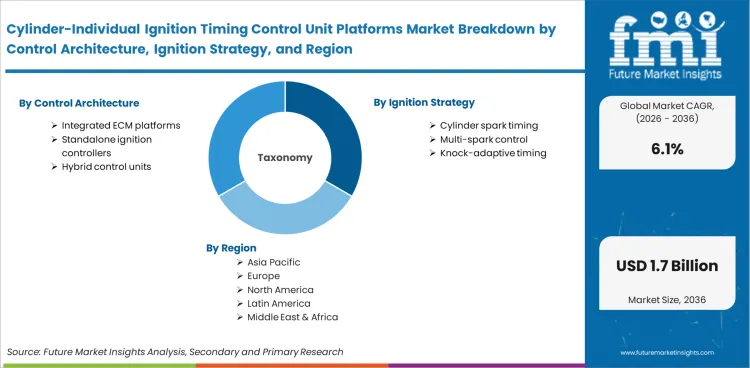
The market is divided into five primary segment groups based on control architecture and ignition strategy. Vehicle type plus fuel type and sales channel complete the layout. Control architecture explains whether timing logic is built into the main ECM or supplied as a distinct controller. Sensor input quality connects the segment with automotive sensors because knock and pressure signals shape the timing map.
Insights into the Integrated ECM Platforms Control Architecture Segment
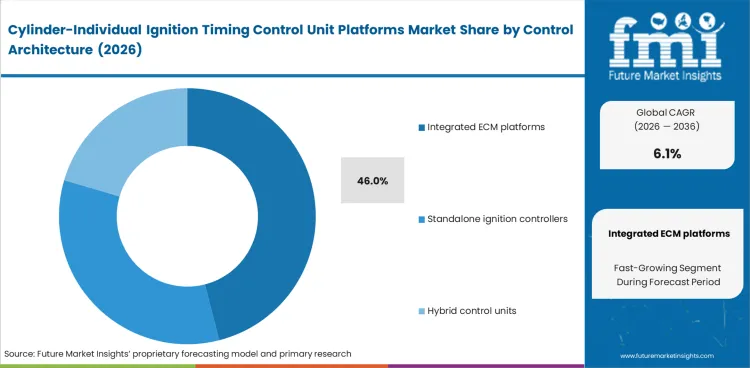
- Integrated ECM platforms are projected to account for 46.0% share of control architecture in 2026. OEMs prefer one control unit when timing, fuel and air decisions must run from a single calibrated map.
- Standalone controllers stay relevant in test programs and specialty engines. Mainstream vehicle programs favor integrated ECM designs because validation costs fall when fewer separate modules need approval.
Insights into the Cylinder Spark Timing Ignition Strategy Segment
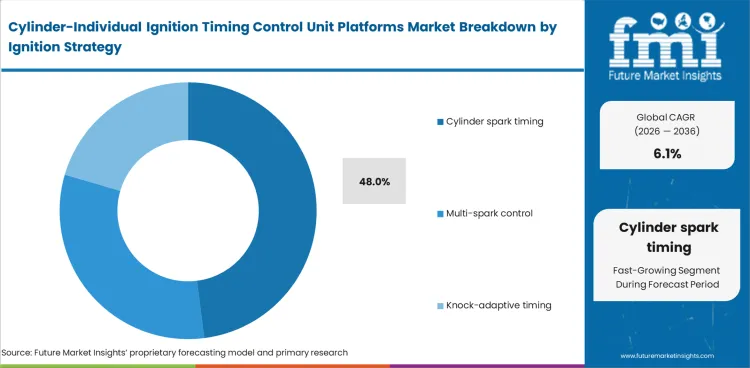
- Cylinder spark timing is expected to represent 48.0% share of ignition strategy in 2026. The approach lets engine software change timing by cylinder when knock or load variation appears.
- Multi-spark control supports cold start and lean burn trials. Knock-adaptive timing needs accurate sensor inputs, so the segment draws value from automotive MEMS sensors when vibration and pressure data guide the timing decision.
Insights into the Passenger Cars Vehicle Type Segment
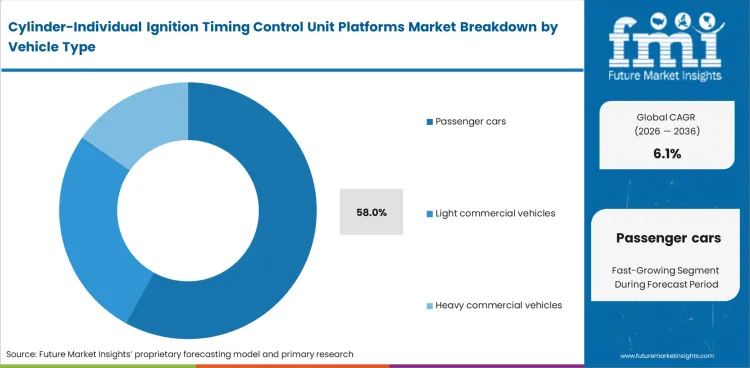
- Passenger cars are forecast to account for 58.0% share in 2026. The segment has the widest gasoline and hybrid engine pool across major production countries.
- Light commercial vehicles use similar control needs in gasoline vans and pickups. Heavy commercial demand is more selective because diesel platforms do not use spark ignition in the same way.
Insights into the Gasoline Fuel Type Segment
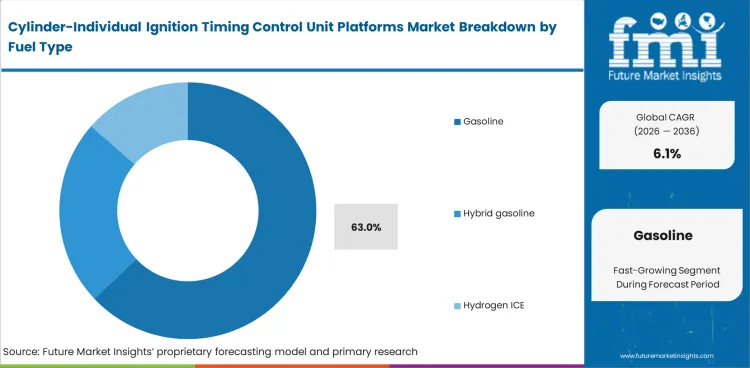
- Gasoline platforms are projected to account for 63.0% share of fuel type demand in 2026. Spark ignition remains the natural home for cylinder-individual timing control in passenger cars and light trucks.
- Hybrid gasoline platforms are growing inside the same control structure as start-stop and engine restart needs increase. Hydrogen ICE platforms are not widespread today, but hydrogen ICE ignition system platforms hold potential to lift demand for higher energy timing control later in the decade.
Insights into the OEM Integration Sales Channel Segment
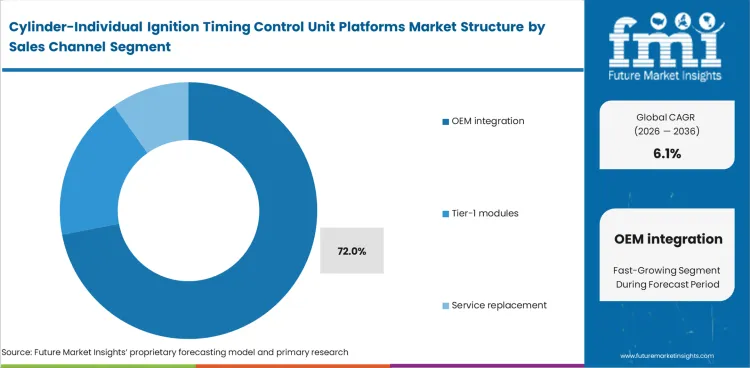
- OEM integration is expected to account for 72.0% share of sales channel demand in 2026. Timing control platforms need full validation with engine maps before a vehicle reaches production.
- Tier-1 modules serve programs where automakers buy a more complete engine control package. Service replacement witnesses’ moderate growth as timing logic is not usually replaced as a separate retail part.
Cylinder-Individual Ignition Timing Control Unit Platforms Market Drivers and Restraints Outlook
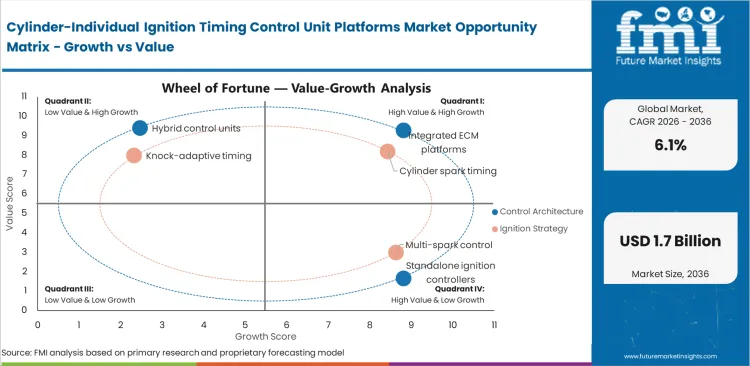
- Cylinder knock control is raising interest in spark timing platforms that can protect engines during high-load operation.
- Validation cost slows smaller suppliers because every timing map must pass durability and emissions checks.
- Hybrid restart control creates opportunity as automakers need smoother ignition during repeated engine cycling.
Engine calibration work is becoming a considerable part of combustion platform value, driving market growth. The United States Census Bureau reported USD 155.4 billion in 2025 exports of automotive vehicles, their parts or engines. That trade flow shows why suppliers must support different engine programs across regions. Related automotive performance tuning and engine remapping services show how software changes are becoming a defined value layer in engine performance.
Validation Cost Is Slowing Smaller Suppliers
Calibration proof is one of the significant restraints beyond hardware cost. Timing platforms require calibration proof across temperature and fuel quality plus engine load bands. Smaller suppliers often lack emissions bench access and long program records. Limited access keeps the market tilted toward companies with OEM control history.
Range-Extender Engines Create Control Opportunity
The strongest opportunity centers on engines that run as generators inside hybrid platforms. These engines need stable timing under repeated restarts and fixed operating bands. The adjacent ignition systems for range-extended hybrid powertrains field shows how spark control becomes more valuable when combustion supports electric driving. Through 2036, over-the-air engine control modules can extend the service life of timing maps after vehicles enter use.
Analysis of Cylinder-Individual Ignition Timing Control Unit Platforms Market by Key Countries
.webp "Top Country Growth Comparison Cylinder Individual Ignition Timing Control Unit Platforms Market Cagr (2026 2036)")
| Country | CAGR |
|---|---|
| United States | 5.7% CAGR |
| China | 6.8% CAGR |
| India | 6.6% CAGR |
| Germany | 5.9% CAGR |
| Japan | 5.7% CAGR |
| South Korea | 6.3% CAGR |
| United Kingdom | 5.2% CAGR |
Source: Future Market Insights, 2026.
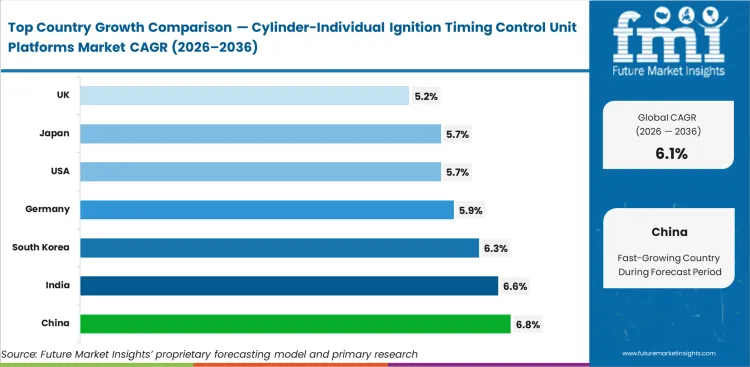
Cylinder-Individual Ignition Timing Control Unit Platforms Market CAGR Analysis by Country
- China is expected to expand at 6.8% CAGR through 2036 as vehicle output and hybrid launches support deeper timing control.
- India is forecast to grow at 6.6% CAGR through 2036 as gasoline two-wheelers and passenger vehicles keep engine control demand active.
- South Korea is projected to rise at 6.3% CAGR through 2036 due to export programs and supplier control electronics depth.
- Germany is expected to advance at 5.9% CAGR through 2036 as premium powertrain engineering keeps calibration content high.
- The United States and Japan are forecast at 5.7% CAGR through 2036 as mature engine platforms keep steady software upgrade needs.
Demand for cylinder-individual ignition timing control unit platforms is forecast to rise at 6.1% CAGR from 2026 to 2036. Country analysis covers major engine production and control electronics countries where spark ignition platforms will remain relevant.
Demand Outlook for Cylinder-Individual Ignition Timing Control Unit Platforms in the United States
The United States is projected to record a 5.7% CAGR through 2036 as emissions pressure keeps combustion control investment active. The USA Environmental Protection Agency reported in February 2026 that model year 2024 vehicles reached 27.2 miles per gallon. That performance level keeps control software important even as electrified vehicles gain share. Suppliers in Michigan and Ohio can win when timing control is packaged with calibration support.
- Michigan powertrain centers can use cylinder timing platforms for pickup and hybrid engine programs.
- Ohio engine plants create demand for supplier validation support around gasoline and hybrid variants.
- California emissions review keeps OEM engineering teams focused on cleaner combustion control.
Sales Analysis of Cylinder-Individual Ignition Timing Control Unit Platforms in China
China is set to expand at 6.8% CAGR through 2036 as production scale supports local engine control programs. China's State Council reported 34.531 million vehicles produced in China during 2025. Production volume gives Tier-1 suppliers room to localize cylinder timing platforms for gasoline and hybrid applications. Shanghai and Chongqing remain important routes for supplier engagement.
- Shanghai engineering centers can align ignition timing control with local hybrid programs.
- Chongqing engine plants support gasoline vehicle applications that need cost-controlled ECM platforms.
- Shenzhen electronics suppliers can support control hardware and power semiconductor sourcing.
Demand Outlook for Cylinder-Individual Ignition Timing Control Unit Platforms in India
India is forecast to grow at 6.6% CAGR through 2036 as spark ignition demand stays broad across vehicle classes. The Society of Indian Automobile Manufacturers reported FY 2024 to 2025 sales activity across passenger vehicles and two-wheelers. The structure supports engine control units designed for cost-sensitive gasoline platforms. Suppliers must balance calibration quality with price levels suited to local production.
- Chennai and Pune support passenger car programs that need localized ECM integration.
- Gujarat engine projects can use timing control platforms for small gasoline and hybrid vehicles.
- Two-wheeler makers need compact controllers that can handle emissions and fuel quality variation.
Opportunity Analysis of Cylinder-Individual Ignition Timing Control Unit Platforms in Germany
Germany is expected to advance at 5.9% CAGR through 2036 as powertrain engineering stays focused on clean combustion and hybrid engines. The German automotive association forecast domestic passenger car production of 4.11 million units in 2026. That volume gives timing control suppliers a route into premium gasoline and plug-in hybrid programs. Stuttgart and Munich remain key locations for calibration-led supplier work.
- Stuttgart engineering teams can use per-cylinder timing for turbocharged gasoline platforms.
- Munich powertrain programs need stable ignition control for premium hybrid vehicles.
- Saxony electronics sites support sensor and control unit packaging for engine programs.
Future Outlook for Cylinder-Individual Ignition Timing Control Unit Platforms in Japan
Japan is projected to rise at 5.7% CAGR through 2036 as hybrid gasoline systems keep spark control relevant. JAMA reported more than USD 70 billion in cumulative USA manufacturing investment in March 2026. The global footprint supports control platforms that must work across regions and fuel grades. Toyota City and Hamamatsu remain natural centers for timing calibration work.
- Toyota City can support hybrid engine timing platforms across global model programs.
- Hamamatsu suppliers can link ignition timing with compact engine and motorcycle applications.
- Aichi engineering centers need long-life control units that fit export production requirements.
Sales Analysis of Cylinder-Individual Ignition Timing Control Unit Platforms in South Korea
South Korea is forecast at 6.3% CAGR through 2036 as export programs keep local powertrain electronics suppliers active. Korea government data in January 2026, stated automobile exports reached USD 6.1 billion. Export exposure raises the need for control units that meet different emissions rules abroad. Seoul and Ulsan give suppliers access to OEM engineering teams and production sites.
- Ulsan vehicle production supports engine control platforms for export gasoline models.
- Seoul engineering teams can connect timing software with hybrid and connected vehicle programs.
- Hwaseong supplier clusters support validation work around sensors and control electronics.
Future Outlook for Cylinder-Individual Ignition Timing Control Unit Platforms in the United Kingdom
The United Kingdom is set to post 5.2% CAGR through 2036 as niche engine engineering and premium vehicles support selective demand. The Society of Motor Manufacturers and Traders reported 200,889 UK cars produced in the first quarter of 2026. Lower production volume limits scale. Premium programs can still value better spark timing. Midlands suppliers can target calibration support and low-volume powertrain projects.
- Midlands engineering firms can support premium gasoline and motorsport-derived timing platforms.
- Sunderland production recovery can create selective demand for validated control hardware.
- Oxford and Warwick test centers can support calibration proof for lower-volume engine projects.
Competitive Landscape and Strategic Positioning
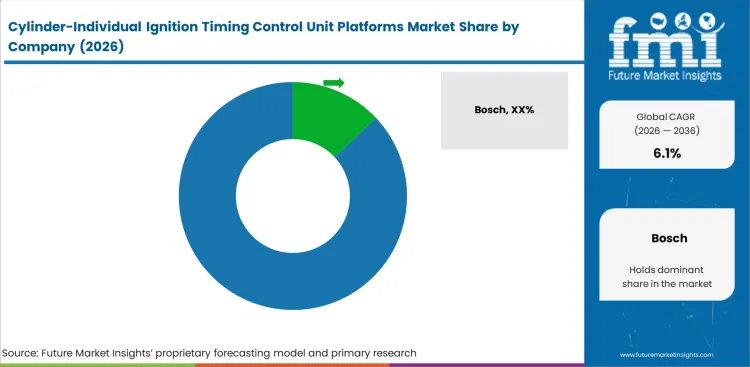
- The market is concentrated around engine control software and validation access instead of basic circuit assembly.
- Bosch and Denso hold firm positions through deep engine ECU portfolios and OEM calibration history.
- Continental and Hitachi Astemo compete through sensor and ignition hardware depth in global platforms.
- Entry barriers include emissions test proof and thermal reliability plus cybersecurity readiness and software change control.
Powertrain control leadership is the prominent competitive filter in this market. Companies such as Bosch describes the engine control unit as the central controller for fuel supply and air management plus injection and ignition. Platform breadth is important ascylinder timing must work with fuel and air control.
Denso and Hitachi Astemo bring ignition hardware and engine electronics depth. Denso lists ignition coils and spark plugs as products that enable ignition and efficient combustion in gasoline engines. Hitachi Astemo highlighted ignition coils covering over 9000 vehicle types in August 2024. The shift toward automotive communication technology means these suppliers must support data exchange between control units and sensors.
Specialist suppliers can maintain edge in aftermarket-adjacent control niches and off-highway platforms. Standard Motor Products and Niterra show active ignition parts expansion, but cylinder timing platforms require deeper software access. BorgWarner and PHINIA show how controller programs in off-highway and clean combustion systems can transfer into adjacent timing control opportunities.
Key Companies in the Cylinder-Individual Ignition Timing Control Unit Platforms Market
Competition is best read by role because engine control depth, ignition hardware and calibration support differ by supplier group.
- Control Platform Leaders: Bosch and Denso hold firm positions through engine ECU depth, ignition hardware knowledge and OEM powertrain access. Continental also fits this group through sensor and control system coverage.
- Ignition and Sensor Specialists: Hitachi Astemo and Niterra support the ignition hardware layer. Their strengths sit in coils, spark plugs and engine sensor coverage that feed timing control needs.
- Adjacent Controller Suppliers: PHINIA and BorgWarner bring control unit and fuel system experience. Marelli adds powertrain electronics and software depth. Their role is concentrated where OEMs need integrated modules and validation support.
Competitive Benchmarking: Cylinder-Individual Ignition Timing Control Unit Platforms Market
| Company | ECM Platform Depth | Ignition Hardware Depth | Calibration Support | Geographic Footprint |
|---|---|---|---|---|
| Bosch | High | Strong | Strong | Global with broad European and Asian OEM depth |
| Denso | High | Strong | Strong | Japan centered with global hybrid and gasoline platform reach |
| Continental | Medium | Strong | Strong | Europe centered with global sensor and control unit reach |
| Hitachi Astemo | Medium | Strong | Medium | Japan centered with broad ignition and engine electronics coverage |
| PHINIA | Medium | Medium | Strong | United States centered with fuel systems and ECU integration depth |
| BorgWarner | Medium | Medium | Strong | Global with off-highway and controller program access |
| Marelli | Medium | Medium | Medium | Europe and Japan rooted with powertrain electronics experience |
| Niterra | Low | Strong | Medium | Japan centered with spark plug and ignition coil strength |
Source: Future Market Insights competitive analysis 2026. Ratings reflect relative positioning based on ECM platform depth and ignition hardware depth plus calibration support.
Key Developments in Cylinder-Individual Ignition Timing Control Unit Platforms Market
- In September 2024, PHINIA launched CR350 technology for Kohler small off-highway diesel engines. The system used electronic control unit functions to improve fuel delivery and efficiency.
- In April 2026, BorgWarner secured a controller supply contract with a world-leading off-highway manufacturer through December 2032. The win covered engine and machine controllers plus power module and battery management system controllers.
- In April 2026, NGK Ignition Parts widened its ignition coil range with 14 new references for four-wheel applications. The expansion supports continued service demand around spark ignition vehicles.
Key Players in the Cylinder-Individual Ignition Timing Control Unit Platforms Market
Major Global Players:
- Bosch
- Denso
- Continental
- Hitachi Astemo
- PHINIA
- BorgWarner
- Marelli
Specialist and Adjacent Players:
- Niterra
- Standard Motor Products
- Mitsubishi Electric
Report Scope and Coverage
| Parameter | Details |
|---|---|
| Quantitative Units | USD 1.0 billion to USD 1.7 billion, at 6.1% CAGR |
| Market Definition | Control unit platforms and software used for cylinder-level ignition timing in spark ignition engines |
| Control Architecture | Integrated ECM platforms, Standalone ignition controllers, Hybrid control units |
| Ignition Strategy | Cylinder spark timing, Multi-spark control, Knock-adaptive timing |
| Vehicle Type | Passenger cars, Light commercial vehicles, Heavy commercial vehicles |
| Fuel Type | Gasoline, Hybrid gasoline, Hydrogen ICE |
| Sales Channel | OEM integration, Tier-1 modules, Service replacement |
| Regions Covered | North America, Latin America, Western Europe, Eastern Europe, East Asia, South Asia and Pacific, Middle East and Africa |
| Countries Covered | United States, China, India, Germany, Japan, South Korea, United Kingdom, and 30+ countries |
| Key Companies Profiled | Bosch, Denso, Continental, Hitachi Astemo, PHINIA, BorgWarner, Marelli |
| Forecast Period | 2026 to 2036 |
| Approach | Hybrid bottom-up and top-down methodology using vehicle production, gasoline platform share, ignition content and supplier validation signals |
Source: Future Market Insights, 2026.
Cylinder-Individual Ignition Timing Control Unit Platforms Market Breakdown By Control Architecture, Ignition Strategy, Vehicle Type, Fuel Type, Sales Channel, and Region
By Control Architecture:
- Integrated ECM platforms
- Standalone ignition controllers
- Hybrid control units
By Ignition Strategy:
- Cylinder spark timing
- Multi-spark control
- Knock-adaptive timing
By Vehicle Type:
- Passenger cars
- Light commercial vehicles
- Heavy commercial vehicles
By Fuel Type:
- Gasoline
- Hybrid gasoline
- Hydrogen ICE
By Sales Channel:
- OEM integration
- Tier-1 modules
- Service replacement
By Region:
- North America: United States and Canada
- Latin America: Brazil and Mexico
- Western Europe: Germany and France plus United Kingdom with Italy and Spain
- Eastern Europe: Poland and Czech Republic
- East Asia: China, Japan and South Korea
- South Asia and Pacific: India, ASEAN and Australia
- Middle East and Africa: GCC and South Africa
Bibliography
- 1. BorgWarner. (2026, April 21). BorgWarner extends controller business with world-leading off-highway manufacturer.
- 2. Continental AG. (2024, September 10). Continental launches major product range expansion initiative for the aftermarket.
- 3. Council of the European Union. (2024, April 12). Euro 7: Council adopts new rules on emission limits for cars and vans plus trucks.
- 4. German Association of the Automotive Industry. (2025, December 7). Forecasts for 2026: New car registrations in Germany rise slightly.
- 5. Hitachi Astemo. (2024, August 13). Hitachi Astemo to showcase automotive solutions at Automechanika Frankfurt 2024.
- 6. Korean Culture and Information Service. (2026, February 19). January 2026 automobile exports reach USD 6.1 billion.
- 7. Niterra. (2026, April 1). NGK Ignition Parts extends ignition coils range with fourteen new references.
- 8. PHINIA. (2024, September 12). PHINIA launches first-to-market technology designed to reduce emissions and enhance fuel efficiency for Kohler small off-highway diesel engines.
- 9. Society of Indian Automobile Manufacturers. (2025, August 28). SIAM annual report 2024-25.
- 10. Society of Motor Manufacturers and Traders. (2026, April 30). Car production stabilises but outlook still challenging.
- 11. Standard Motor Products. (2024, September 11). Standard Motor Products expands ignition program.
- 12. USA Census Bureau. (2026, March). Annual 2025 press highlights.
- 13. USA Environmental Protection Agency. (2026, February 20). The 2025 EPA automotive trends report.
- 14. Xinhua. (2026, January 14). China's auto output, sales reach new highs in 2025. The State Council of the People's Republic of China.
- 15. Japan Automobile Manufacturers Association. (2026, March 17). Annual data release: Japanese-brand automakers surpass $70 billion in cumulative USA investment.
The bibliography is provided for reader reference and uses government sources, trade bodies and company technical sources.
This Report Answers
- What is the current and future size of the cylinder-individual ignition timing control unit platforms market?
- How fast is the cylinder-individual ignition timing control unit platforms market expected to expand between 2026 and 2036?
- Which control architecture is likely to lead demand by 2026?
- Which ignition strategy is projected to account for a leading share in 2026?
- Why are gasoline and hybrid gasoline platforms important for this market?
- How do emissions rules and calibration cost affect adoption?
- Which countries are projected to record faster expansion during the forecast period?
- Who are the main companies active in cylinder-individual ignition timing control unit platforms?
- How does FMI define the cylinder-individual ignition timing control unit platforms market scope?
- How does FMI estimate and validate the forecast?
Frequently Asked Questions
What is the global market demand for Cylinder-Individual Ignition Timing Control Unit Platforms in 2026?
In 2026, the global cylinder-individual ignition timing control unit platforms market is expected to be worth USD 1.0 billion.
How big will the Cylinder-Individual Ignition Timing Control Unit Platforms Market be in 2036?
By 2036, the cylinder-individual ignition timing control unit platforms market is set to reach USD 1.7 billion as calibration content rises.
How much is demand for Cylinder-Individual Ignition Timing Control Unit Platforms expected to expand between 2026 and 2036?
Between 2026 and 2036, demand is expected to expand at 6.1% CAGR as cylinder-level spark control gains value.
Which control architecture is expected to lead the Cylinder-Individual Ignition Timing Control Unit Platforms Market by 2026?
Integrated ECM platforms are projected to lead control architecture demand with 46.0% share in 2026 due to combined engine control needs.
Which ignition strategy is likely to lead Cylinder-Individual Ignition Timing Control Unit Platforms demand in 2026?
Cylinder spark timing is expected to lead ignition strategy demand with 48.0% share in 2026 as per-cylinder control becomes central.
Which country is forecast to grow fastest in the Cylinder-Individual Ignition Timing Control Unit Platforms Market?
China is expected to post 6.8% CAGR through 2036 as vehicle production scale supports local engine control sourcing.
What does the Cylinder-Individual Ignition Timing Control Unit Platforms Market include?
The market includes ECM platforms and standalone controllers. Timing software and driver electronics are included when used for cylinder-level spark timing control.
How does FMI estimate the Cylinder-Individual Ignition Timing Control Unit Platforms Market forecast?
FMI uses vehicle production and gasoline engine share to validate the forecast. Control unit attach rates and supplier developments are checked against emissions rule signals.
How does cylinder-individual ignition timing control work?
The control unit reads sensor data and adjusts spark timing for each cylinder. Per-cylinder timing improves combustion balance under changing load conditions.
Is cylinder-individual ignition timing control useful for hybrid vehicles?
Yes. Hybrid gasoline vehicles need smooth restart and load change control when the engine cycles on and off during mixed driving.
What limits adoption of cylinder-individual ignition timing control platforms?
Adoption is limited by calibration cost, emissions validation work and the need to prove stable timing across fuel quality variations.
Who uses cylinder-individual ignition timing control platforms?
Automakers and Tier-1 powertrain suppliers use these platforms. Engine calibration teams apply them in gasoline and hybrid gasoline programs plus selected hydrogen ICE programs.
How long can these control unit platforms stay relevant?
These platforms can stay relevant through the forecast decade where gasoline and hybrid engines remain in production beside electric vehicles.
Preview the report firsthand - request a free sample
Get SampleGet the brochure for pricing and purchase details.
Get PDFTable of Content
- Executive Summary
- Global Market Outlook
- Demand-side Trends
- Supply-side Trends
- Technology Roadmap Analysis
- Analysis and Recommendations
- Market Overview
- Market Coverage / Taxonomy
- Market Definition / Scope / Limitations
- Research Methodology
- Chapter Orientation
- Analytical Lens and Working Hypotheses
- Market Structure, Signals, and Trend Drivers
- Benchmarking and Cross-market Comparability
- Market Sizing, Forecasting, and Opportunity Mapping
- Research Design and Evidence Framework
- Desk Research Programme (Secondary Evidence)
- Company Annual and Sustainability Reports
- Peer-reviewed Journals and Academic Literature
- Corporate Websites, Product Literature, and Technical Notes
- Earnings Decks and Investor Briefings
- Statutory Filings and Regulatory Disclosures
- Technical White Papers and Standards Notes
- Trade Journals, Industry Magazines, and Analyst Briefs
- Conference Proceedings, Webinars, and Seminar Materials
- Government Statistics Portals and Public Data Releases
- Press Releases and Reputable Media Coverage
- Specialist Newsletters and Curated Briefings
- Sector Databases and Reference Repositories
- FMI Internal Proprietary Databases and Historical Market Datasets
- Subscription Datasets and Paid Sources
- Social Channels, Communities, and Digital Listening Inputs
- Additional Desk Sources
- Expert Input and Fieldwork (Primary Evidence)
- Primary Modes
- Qualitative Interviews and Expert Elicitation
- Quantitative Surveys and Structured Data Capture
- Blended Approach
- Why Primary Evidence is Used
- Field Techniques
- Interviews
- Surveys
- Focus Groups
- Observational and In-context Research
- Social and Community Interactions
- Stakeholder Universe Engaged
- C-suite Leaders
- Board Members
- Presidents and Vice Presidents
- R&D and Innovation Heads
- Technical Specialists
- Domain Subject-matter Experts
- Scientists
- Physicians and Other Healthcare Professionals
- Governance, Ethics, and Data Stewardship
- Research Ethics
- Data Integrity and Handling
- Primary Modes
- Tooling, Models, and Reference Databases
- Desk Research Programme (Secondary Evidence)
- Data Engineering and Model Build
- Data Acquisition and Ingestion
- Cleaning, Normalisation, and Verification
- Synthesis, Triangulation, and Analysis
- Quality Assurance and Audit Trail
- Market Background
- Market Dynamics
- Drivers
- Restraints
- Opportunity
- Trends
- Scenario Forecast
- Demand in Optimistic Scenario
- Demand in Likely Scenario
- Demand in Conservative Scenario
- Opportunity Map Analysis
- Product Life Cycle Analysis
- Supply Chain Analysis
- Investment Feasibility Matrix
- Value Chain Analysis
- PESTLE and Porter’s Analysis
- Regulatory Landscape
- Regional Parent Market Outlook
- Production and Consumption Statistics
- Import and Export Statistics
- Market Dynamics
- Global Market Analysis 2021 to 2025 and Forecast, 2026 to 2036
- Historical Market Size Value (USD Million) Analysis, 2021 to 2025
- Current and Future Market Size Value (USD Million) Projections, 2026 to 2036
- Y-o-Y Growth Trend Analysis
- Absolute $ Opportunity Analysis
- Global Market Pricing Analysis 2021 to 2025 and Forecast 2026 to 2036
- Global Market Analysis 2021 to 2025 and Forecast 2026 to 2036, By Control Architecture
- Introduction / Key Findings
- Historical Market Size Value (USD Million) Analysis By Control Architecture , 2021 to 2025
- Current and Future Market Size Value (USD Million) Analysis and Forecast By Control Architecture , 2026 to 2036
- Integrated ECM platforms
- Standalone ignition controllers
- Hybrid control units
- Integrated ECM platforms
- Y-o-Y Growth Trend Analysis By Control Architecture , 2021 to 2025
- Absolute $ Opportunity Analysis By Control Architecture , 2026 to 2036
- Global Market Analysis 2021 to 2025 and Forecast 2026 to 2036, By Ignition Strategy
- Introduction / Key Findings
- Historical Market Size Value (USD Million) Analysis By Ignition Strategy, 2021 to 2025
- Current and Future Market Size Value (USD Million) Analysis and Forecast By Ignition Strategy, 2026 to 2036
- Cylinder spark timing
- Multi-spark control
- Knock-adaptive timing
- Cylinder spark timing
- Y-o-Y Growth Trend Analysis By Ignition Strategy, 2021 to 2025
- Absolute $ Opportunity Analysis By Ignition Strategy, 2026 to 2036
- Global Market Analysis 2021 to 2025 and Forecast 2026 to 2036, By Vehicle Type
- Introduction / Key Findings
- Historical Market Size Value (USD Million) Analysis By Vehicle Type, 2021 to 2025
- Current and Future Market Size Value (USD Million) Analysis and Forecast By Vehicle Type, 2026 to 2036
- Passenger cars
- Light commercial vehicles
- Heavy commercial vehicles
- Passenger cars
- Y-o-Y Growth Trend Analysis By Vehicle Type, 2021 to 2025
- Absolute $ Opportunity Analysis By Vehicle Type, 2026 to 2036
- Global Market Analysis 2021 to 2025 and Forecast 2026 to 2036, By Fuel Type
- Introduction / Key Findings
- Historical Market Size Value (USD Million) Analysis By Fuel Type, 2021 to 2025
- Current and Future Market Size Value (USD Million) Analysis and Forecast By Fuel Type, 2026 to 2036
- Gasoline
- Hybrid gasoline
- Hydrogen ICE
- Gasoline
- Y-o-Y Growth Trend Analysis By Fuel Type, 2021 to 2025
- Absolute $ Opportunity Analysis By Fuel Type, 2026 to 2036
- Global Market Analysis 2021 to 2025 and Forecast 2026 to 2036, By Sales Channel
- Introduction / Key Findings
- Historical Market Size Value (USD Million) Analysis By Sales Channel, 2021 to 2025
- Current and Future Market Size Value (USD Million) Analysis and Forecast By Sales Channel, 2026 to 2036
- OEM integration
- Tier-1 modules
- Service replacement
- OEM integration
- Y-o-Y Growth Trend Analysis By Sales Channel, 2021 to 2025
- Absolute $ Opportunity Analysis By Sales Channel, 2026 to 2036
- Global Market Analysis 2021 to 2025 and Forecast 2026 to 2036, By Region
- Introduction
- Historical Market Size Value (USD Million) Analysis By Region, 2021 to 2025
- Current Market Size Value (USD Million) Analysis and Forecast By Region, 2026 to 2036
- North America
- Latin America
- Western Europe
- Eastern Europe
- East Asia
- South Asia and Pacific
- Middle East & Africa
- Market Attractiveness Analysis By Region
- North America Market Analysis 2021 to 2025 and Forecast 2026 to 2036, By Country
- Historical Market Size Value (USD Million) Trend Analysis By Market Taxonomy, 2021 to 2025
- Market Size Value (USD Million) Forecast By Market Taxonomy, 2026 to 2036
- By Country
- USA
- Canada
- Mexico
- By Control Architecture
- By Ignition Strategy
- By Vehicle Type
- By Fuel Type
- By Sales Channel
- By Country
- Market Attractiveness Analysis
- By Country
- By Control Architecture
- By Ignition Strategy
- By Vehicle Type
- By Fuel Type
- By Sales Channel
- Key Takeaways
- Latin America Market Analysis 2021 to 2025 and Forecast 2026 to 2036, By Country
- Historical Market Size Value (USD Million) Trend Analysis By Market Taxonomy, 2021 to 2025
- Market Size Value (USD Million) Forecast By Market Taxonomy, 2026 to 2036
- By Country
- Brazil
- Chile
- Rest of Latin America
- By Control Architecture
- By Ignition Strategy
- By Vehicle Type
- By Fuel Type
- By Sales Channel
- By Country
- Market Attractiveness Analysis
- By Country
- By Control Architecture
- By Ignition Strategy
- By Vehicle Type
- By Fuel Type
- By Sales Channel
- Key Takeaways
- Western Europe Market Analysis 2021 to 2025 and Forecast 2026 to 2036, By Country
- Historical Market Size Value (USD Million) Trend Analysis By Market Taxonomy, 2021 to 2025
- Market Size Value (USD Million) Forecast By Market Taxonomy, 2026 to 2036
- By Country
- Germany
- UK
- Italy
- Spain
- France
- Nordic
- BENELUX
- Rest of Western Europe
- By Control Architecture
- By Ignition Strategy
- By Vehicle Type
- By Fuel Type
- By Sales Channel
- By Country
- Market Attractiveness Analysis
- By Country
- By Control Architecture
- By Ignition Strategy
- By Vehicle Type
- By Fuel Type
- By Sales Channel
- Key Takeaways
- Eastern Europe Market Analysis 2021 to 2025 and Forecast 2026 to 2036, By Country
- Historical Market Size Value (USD Million) Trend Analysis By Market Taxonomy, 2021 to 2025
- Market Size Value (USD Million) Forecast By Market Taxonomy, 2026 to 2036
- By Country
- Russia
- Poland
- Hungary
- Balkan & Baltic
- Rest of Eastern Europe
- By Control Architecture
- By Ignition Strategy
- By Vehicle Type
- By Fuel Type
- By Sales Channel
- By Country
- Market Attractiveness Analysis
- By Country
- By Control Architecture
- By Ignition Strategy
- By Vehicle Type
- By Fuel Type
- By Sales Channel
- Key Takeaways
- East Asia Market Analysis 2021 to 2025 and Forecast 2026 to 2036, By Country
- Historical Market Size Value (USD Million) Trend Analysis By Market Taxonomy, 2021 to 2025
- Market Size Value (USD Million) Forecast By Market Taxonomy, 2026 to 2036
- By Country
- China
- Japan
- South Korea
- By Control Architecture
- By Ignition Strategy
- By Vehicle Type
- By Fuel Type
- By Sales Channel
- By Country
- Market Attractiveness Analysis
- By Country
- By Control Architecture
- By Ignition Strategy
- By Vehicle Type
- By Fuel Type
- By Sales Channel
- Key Takeaways
- South Asia and Pacific Market Analysis 2021 to 2025 and Forecast 2026 to 2036, By Country
- Historical Market Size Value (USD Million) Trend Analysis By Market Taxonomy, 2021 to 2025
- Market Size Value (USD Million) Forecast By Market Taxonomy, 2026 to 2036
- By Country
- India
- ASEAN
- Australia & New Zealand
- Rest of South Asia and Pacific
- By Control Architecture
- By Ignition Strategy
- By Vehicle Type
- By Fuel Type
- By Sales Channel
- By Country
- Market Attractiveness Analysis
- By Country
- By Control Architecture
- By Ignition Strategy
- By Vehicle Type
- By Fuel Type
- By Sales Channel
- Key Takeaways
- Middle East & Africa Market Analysis 2021 to 2025 and Forecast 2026 to 2036, By Country
- Historical Market Size Value (USD Million) Trend Analysis By Market Taxonomy, 2021 to 2025
- Market Size Value (USD Million) Forecast By Market Taxonomy, 2026 to 2036
- By Country
- Kingdom of Saudi Arabia
- Other GCC Countries
- Turkiye
- South Africa
- Other African Union
- Rest of Middle East & Africa
- By Control Architecture
- By Ignition Strategy
- By Vehicle Type
- By Fuel Type
- By Sales Channel
- By Country
- Market Attractiveness Analysis
- By Country
- By Control Architecture
- By Ignition Strategy
- By Vehicle Type
- By Fuel Type
- By Sales Channel
- Key Takeaways
- Key Countries Market Analysis
- USA
- Pricing Analysis
- Market Share Analysis, 2025
- By Control Architecture
- By Ignition Strategy
- By Vehicle Type
- By Fuel Type
- By Sales Channel
- Canada
- Pricing Analysis
- Market Share Analysis, 2025
- By Control Architecture
- By Ignition Strategy
- By Vehicle Type
- By Fuel Type
- By Sales Channel
- Mexico
- Pricing Analysis
- Market Share Analysis, 2025
- By Control Architecture
- By Ignition Strategy
- By Vehicle Type
- By Fuel Type
- By Sales Channel
- Brazil
- Pricing Analysis
- Market Share Analysis, 2025
- By Control Architecture
- By Ignition Strategy
- By Vehicle Type
- By Fuel Type
- By Sales Channel
- Chile
- Pricing Analysis
- Market Share Analysis, 2025
- By Control Architecture
- By Ignition Strategy
- By Vehicle Type
- By Fuel Type
- By Sales Channel
- Germany
- Pricing Analysis
- Market Share Analysis, 2025
- By Control Architecture
- By Ignition Strategy
- By Vehicle Type
- By Fuel Type
- By Sales Channel
- UK
- Pricing Analysis
- Market Share Analysis, 2025
- By Control Architecture
- By Ignition Strategy
- By Vehicle Type
- By Fuel Type
- By Sales Channel
- Italy
- Pricing Analysis
- Market Share Analysis, 2025
- By Control Architecture
- By Ignition Strategy
- By Vehicle Type
- By Fuel Type
- By Sales Channel
- Spain
- Pricing Analysis
- Market Share Analysis, 2025
- By Control Architecture
- By Ignition Strategy
- By Vehicle Type
- By Fuel Type
- By Sales Channel
- France
- Pricing Analysis
- Market Share Analysis, 2025
- By Control Architecture
- By Ignition Strategy
- By Vehicle Type
- By Fuel Type
- By Sales Channel
- India
- Pricing Analysis
- Market Share Analysis, 2025
- By Control Architecture
- By Ignition Strategy
- By Vehicle Type
- By Fuel Type
- By Sales Channel
- ASEAN
- Pricing Analysis
- Market Share Analysis, 2025
- By Control Architecture
- By Ignition Strategy
- By Vehicle Type
- By Fuel Type
- By Sales Channel
- Australia & New Zealand
- Pricing Analysis
- Market Share Analysis, 2025
- By Control Architecture
- By Ignition Strategy
- By Vehicle Type
- By Fuel Type
- By Sales Channel
- China
- Pricing Analysis
- Market Share Analysis, 2025
- By Control Architecture
- By Ignition Strategy
- By Vehicle Type
- By Fuel Type
- By Sales Channel
- Japan
- Pricing Analysis
- Market Share Analysis, 2025
- By Control Architecture
- By Ignition Strategy
- By Vehicle Type
- By Fuel Type
- By Sales Channel
- South Korea
- Pricing Analysis
- Market Share Analysis, 2025
- By Control Architecture
- By Ignition Strategy
- By Vehicle Type
- By Fuel Type
- By Sales Channel
- Russia
- Pricing Analysis
- Market Share Analysis, 2025
- By Control Architecture
- By Ignition Strategy
- By Vehicle Type
- By Fuel Type
- By Sales Channel
- Poland
- Pricing Analysis
- Market Share Analysis, 2025
- By Control Architecture
- By Ignition Strategy
- By Vehicle Type
- By Fuel Type
- By Sales Channel
- Hungary
- Pricing Analysis
- Market Share Analysis, 2025
- By Control Architecture
- By Ignition Strategy
- By Vehicle Type
- By Fuel Type
- By Sales Channel
- Kingdom of Saudi Arabia
- Pricing Analysis
- Market Share Analysis, 2025
- By Control Architecture
- By Ignition Strategy
- By Vehicle Type
- By Fuel Type
- By Sales Channel
- Turkiye
- Pricing Analysis
- Market Share Analysis, 2025
- By Control Architecture
- By Ignition Strategy
- By Vehicle Type
- By Fuel Type
- By Sales Channel
- South Africa
- Pricing Analysis
- Market Share Analysis, 2025
- By Control Architecture
- By Ignition Strategy
- By Vehicle Type
- By Fuel Type
- By Sales Channel
- USA
- Market Structure Analysis
- Competition Dashboard
- Competition Benchmarking
- Market Share Analysis of Top Players
- By Regional
- By Control Architecture
- By Ignition Strategy
- By Vehicle Type
- By Fuel Type
- By Sales Channel
- Competition Analysis
- Competition Deep Dive
- Bosch
- Overview
- Product Portfolio
- Profitability by Market Segments (Product/Age /Sales Channel/Region)
- Sales Footprint
- Strategy Overview
- Marketing Strategy
- Product Strategy
- Channel Strategy
- Denso
- Continental
- Hitachi Astemo
- PHINIA
- BorgWarner
- Marelli
- Niterra
- Bosch
- Competition Deep Dive
- Assumptions & Acronyms Used


