

- Market Size (2026)
- USD 354.4 Mn
- Forecast (2036)
- USD 616.1 Mn
- CAGR (2026 to 2036)
- 5.7%
Nose Gear Steering System Repair Services Market Size, Market Forecast and Outlook By FMI
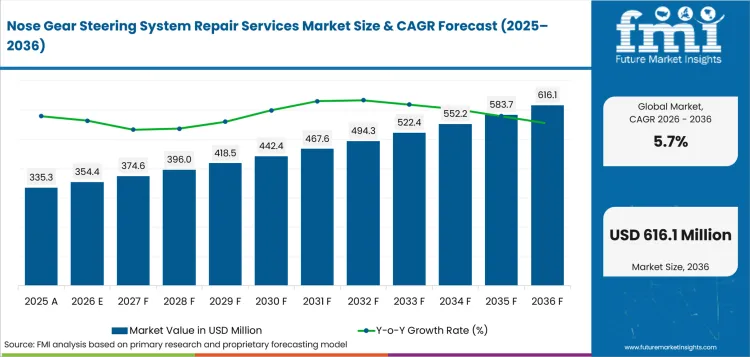
The nose gear steering system repair services market is expected to grow from USD 335.3 million in 2025 to USD 616.1 million by 2036, at a 5.7% CAGR, driven by aircraft taxi safety needs, landing gear overhaul activity, and airline demand for faster repair turnaround, with hydraulic steering systems accounting for 63.0% share and scheduled shop visits contributing 56.0% share as MRO providers prioritize aircraft availability and compliance.
Key Takeaways, Market Size, and Forecast
- 2026 Market Size: USD 354.4 million
- 2036 Market Size: USD 616.1 million
- Forecast CAGR: 5.7% from 2026 to 2036
- Leading System Architecture: Hydraulic steering
- Hydraulic Steering Share in 2026: 63.0%
- Leading Repair Mode: Scheduled shop visits
- Scheduled Shop Visits Share in 2026: 56.0%
- Fastest-growing Country: India
- India CAGR: 7.2% through 2036
Summary of the Nose Gear Steering System Repair Services Market
- Demand and Growth Drivers
- Airlines need dependable nose gear steering because taxi faults can delay aircraft before takeoff. Repair shops receive work when operators need faster actuator checks.
- Landing gear overhaul visits create a natural point for steering repair. Operators can inspect actuators and valves during planned shop work.
- Safety rules are making steering repair more document-driven. Repair providers need clear test records before parts return to service.
- Product and Segment View
- Actuator overhaul is a key service because steering movement depends on clean sealing and smooth motion. Shops with proper test fixtures can support safer aircraft release.
- Hydraulic steering systems stay important across active aircraft fleets. Repair work often focuses on leaks and control valve response.
- Scheduled shop visits are preferred because steering repair can be planned with landing gear service. Operators use this route to reduce avoidable aircraft downtime.
- Geography and Competitive Outlook
- United States demand is backed by a large aircraft repair network. Certified shops can support airline fleets and defense aircraft.
- China and India are building more local MRO capacity. Faster domestic repair access can reduce overseas turnaround delays.
- Competition favors providers with approved repair data and exchange parts. Operators prefer repair partners that can return steering components with clean documents.
- Analyst Opinion
- Nikhil Kaitwade, Principal Consultant at FMI says, “Nose gear steering repair is becoming a reliability decision for aircraft operators. Taxi delays and steering faults affect aircraft use before flight even starts. Repair providers with certified actuator work and fast valve testing will be trusted across airline and MRO programs.”
- Nose Gear Steering System Repair Services Market Value Analysis
- The nose gear steering system repair services market is moving from routine landing gear work into a safety-focused aircraft maintenance service.
- Airlines use these services to restore nose wheel steering response before taxi faults create aircraft delays.
- Market value is built through actuator overhaul and control valve testing because these parts control safe ground movement.
- Repair providers with approved data and exchange units can reduce downtime and return steering parts with clean release documents.
Automatic steering is making nose gear repair more safety-focused instead of routine landing gear service. In January 2025, Transport Canada linked a Challenger landing deviation to uncommanded nose wheel steering. Transport Canada said the transfer valve can fail dormant in non-free-castoring mode inside the nose wheel steering manifold assembly. The directive requires regular transfer-valve functional testing, giving MRO providers a repeat inspection route tied to flight safety records. In May 2024, Transport Canada traced another Challenger steering event to loose potentiometer coupling setscrews after the aircraft veered below 80 knots. The directive requires setscrew replacement within 36 months or 1,400 air-time hours. Repair shops need traceable hardware and clean torque records. Landing gear overhaul demand is creating longer repair programs for regional aircraft. In March 2025, Liebherr signed a landing gear overhaul agreement with SkyWest Airlines for Embraer 175-E1 aircraft. Contracted induction slots run through 2032, and Embraer overhaul intervals are set at 30,000 flight hours or 12 calendar years. This supports steady shop demand for landing gear systems and steering-related component checks.
Nose Gear Steering System Repair Services Market Definition
The nose gear steering system repair services market is a specialized aircraft maintenance service area focused on restoring safe nose wheel steering performance. It supports aircraft movement during pushback and taxi. It also helps pilots keep directional control during runway exit. The market exists because steering faults can delay aircraft and create safety risks on the ground. Airlines, MRO providers and aircraft operators rely on these services to keep steering systems reliable and ready for approved aircraft use.
Nose Gear Steering System Repair Services Market Inclusions
Market scope covers nose gear steering system repair services categorized by service type, including actuator overhaul and control valve repair. It also includes shimmy damper servicing, sensor calibration, and harness repair. Aircraft type covers narrow-body aircraft and wide-body aircraft. Regional aircraft, business aircraft, and military aircraft are included under the same repair scope. Repair mode covers scheduled shop visits, AOG field repair, exchange unit repair, and warranty support. Sales channel covers airline MRO contracts, OEM service channels, independent repair stations, and defense depots. System architecture covers hydraulic steering, electrohydraulic steering, and electric steering systems. The scope also includes repair work performed within landing gear overhaul programs when steering actuators, valves, dampers, or sensors are inspected and returned to service as part of the same maintenance process. Revenue scope covers 2026 to 2036. The key stakeholders include landing gear OEMs, airline MRO providers, independent repair stations, aircraft operators, defense depots, leasing firms, exchange unit suppliers, aviation regulators, and component testing service providers.
Nose Gear Steering System Repair Services Market Exclusions
Scope excludes full landing gear shipsets sold as new production hardware. General aircraft hydraulic maintenance is excluded unless tied to a steering component fault. Wheel, tire and brake repair work is excluded unless the service file is directly connected with nose wheel steering behavior. General avionics repair is outside scope unless steering sensor calibration is part of the work order.
Nose Gear Steering System Repair Services Market Research Methodology
- Primary Research: FMI analysts reviewed steering repair needs across airline MRO planners and component repair specialists.
- Desk Research: Public aviation traffic data and regulator material were reviewed for market validation.
- Market Sizing and Forecasting: Market size was estimated from active aircraft fleets and steering component repair frequency.
- Data Validation: Forecast checks compared aircraft use and landing gear overhaul events across major aviation countries.
Why is the Nose Gear Steering System Repair Services Market Growing?
- Fleet use is raising steering wear as aircraft need reliable nose wheel control during taxi movement.
- Landing gear overhaul visits create planned repair demand for steering actuators and shimmy dampers.
- Approved repair capacity is becoming more important as operators need clear test records before aircraft release.
Repair demand is tied to aircraft movement before takeoff and after landing. Nose gear steering parts face repeated load during pushback and taxi. Higher aircraft use raises the need for repair shops able to test actuators without delaying return to service. Related aircraft maintenance repair and overhaul market supports steering repair as operators plan component checks during scheduled maintenance.
Landing gear overhaul activity gives steering repair a natural service window. HAECO Landing Gear Services completed its 2,000th landing gear overhaul in November 2024 at its Xiamen facility. The company said its landing gear work includes rotable support and exchange options. Steering components benefit from the same repair setup as actuators need approved testing before release. Demand for aircraft landing gear service capacity supports shops with repair records and proper test benches.
Market Segmentation Analysis
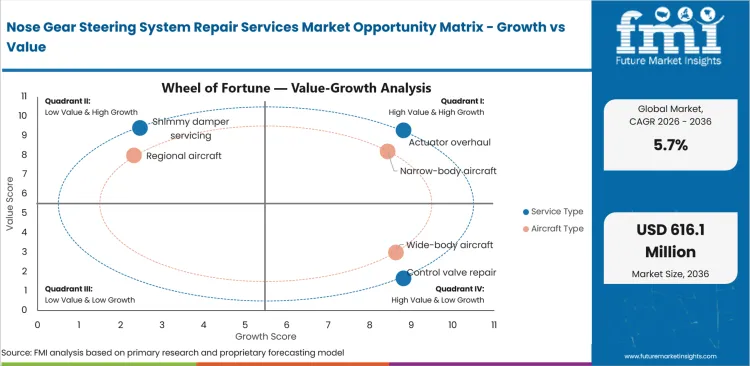
- Actuator overhaul is expected to account for 34.0% of service type demand in 2026.
- Frequent short routes keep narrow-body aircraft at 49.0% share of aircraft type demand in 2026.
- Scheduled shop visits are anticipated to represent 56.0% of repair mode demand in 2026.
- Airline MRO contracts are expected to hold 43.5% of sales channel demand in 2026.
- Hydraulic steering systems are forecast to account for 63.0% of system architecture demand in 2026.
The market is divided into five primary segment groups based on service type and aircraft type. Repair mode, sales channel and system architecture complete the structure. Service type covers actuator overhaul and control valve repair. Shimmy damper servicing, sensor calibration and harness repair complete the service scope. Aircraft type covers narrow-body aircraft and wide-body aircraft. Regional aircraft, business aircraft and military aircraft complete the aircraft scope. Repair mode covers scheduled shop visits and AOG field repair. Exchange unit repair and warranty support complete the repair mode scope. Sales channel covers airline MRO contracts and OEM service channels. Independent repair stations and defense depots complete the channel scope. System architecture covers hydraulic steering and electrohydraulic steering. Electric steering completes the system scope.
Insights into Nose Gear Steering System Repair Services Market by Service Type
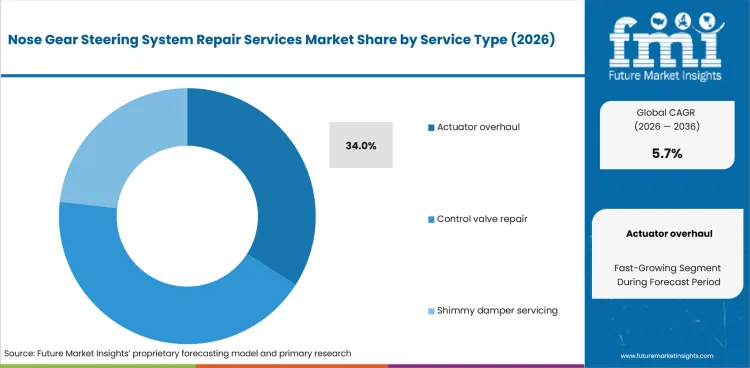
- Actuator overhaul is expected to account for 34.0% share in 2026 due to seal wear and steering fluid leakage. Repair shops need tested actuator fixtures to restore safe nose wheel movement.
- Control valve repair is important for stable steering pressure during taxi movement. Demand for aircraft actuator repair improves when operators need accurate movement response after service.
Insights into Nose Gear Steering System Repair Services Market by Aircraft Type
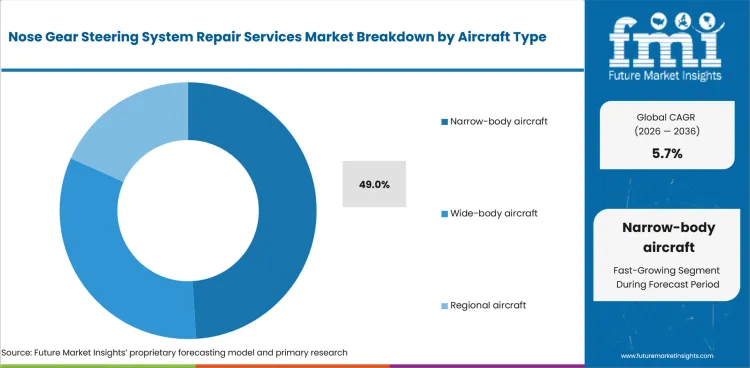
- Narrow-body aircraft are forecast to account for 49.0% share in 2026 with frequent ground movement across short-haul routes. Repeated taxi cycles increase steering actuator wear over time.
- Wide-body aircraft create higher repair value due to heavier nose gear loads. Demand for commercial aircraft MRO services rises when airlines plan deeper landing gear checks.
Insights into Nose Gear Steering System Repair Services Market by Repair Mode
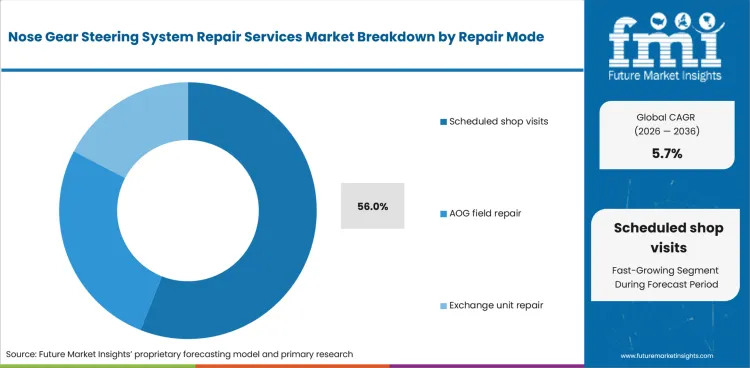
- Scheduled shop visits are expected to represent 56.0% share in 2026 since steering repair fits planned landing gear work. This helps operators reduce unplanned aircraft ground time.
- AOG field repair serves urgent steering faults that can stop aircraft movement before departure. Exchange unit repair gives operators a ready part while deeper shop work continues.
Insights into Nose Gear Steering System Repair Services Market by Sales Channel
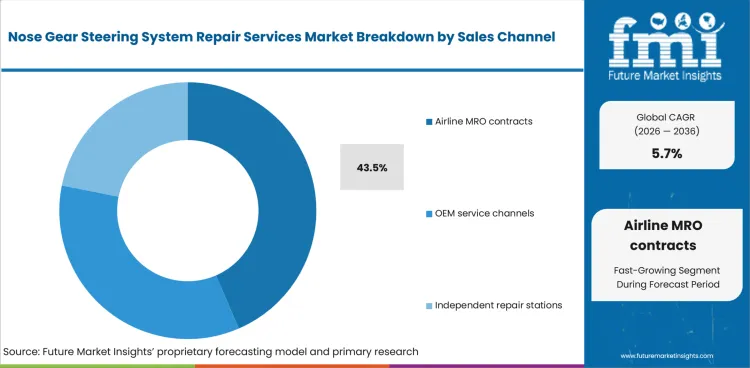
- Airline MRO contracts are expected to hold 43.5% share in 2026 due to repeat repair volume and clear turnaround needs. Airlines prefer service partners with exchange parts and release documents.
- OEM service channels are important for newer aircraft programs with strict repair instructions. Independent repair stations serve mature fleets through cost-focused component work.
Insights into Nose Gear Steering System Repair Services Market by System Architecture
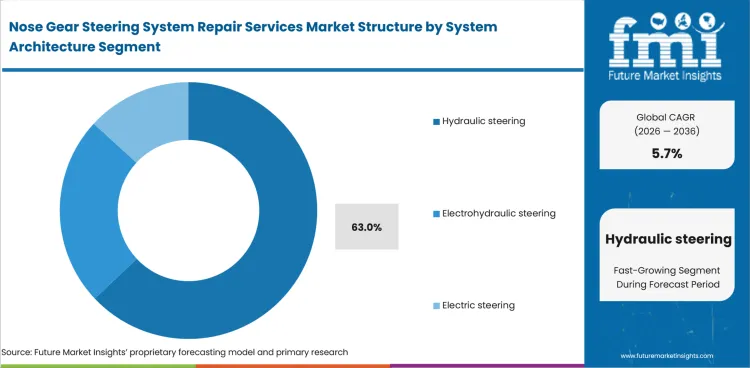
- Hydraulic steering systems are forecast to account for 63.0% share in 2026 with wide use across active aircraft fleets. Repair work often centers on leakage checks and valve response.
- Electrohydraulic steering creates higher testing needs because electrical commands must match hydraulic output after service. Related aircraft hydraulic system outlook helps shops handle pressure-based steering repairs.
Nose Gear Steering System Repair Services Market Drivers, Restraints, and Opportunities
- Taxi cycle wear supports actuator repair as repeated steering movement can create leakage.
- Certification cost can limit smaller repair shops as approved procedures and trained release staff are required.
- Exchange unit programs create service opportunities as operators need faster part access during steering faults.
Taxi Cycle Wear Raises Repair Demand
Steering components work every time an aircraft moves on the ground. Pushback and taxi place repeated stress on actuators. Parking turns can add pressure to control valves. HAECO’s Xiamen landing gear facility completed its 2,000th landing gear overhaul in December 2024. The total included over 500 Boeing 777 gears and 500 Boeing 747 gears. HAECO also reported more than 200 Boeing 747-8 gears and 100 E190 gears. Service depth shows why steering repair needs proven shop equipment. Service depth shows why steering repair needs proven shop equipment. Demand for aircraft brake system checks can move with steering work as nose wheel behavior affects tire wear.
Approval Cost Slows Smaller Repair Shops
Steering repair needs more than basic part replacement. Shops must follow approved repair instructions before a part returns to service. Each test must be documented for aircraft release. Smaller providers can struggle with hydraulic testing and approved repair capacity. In October 2025, Liebherr-Aerospace opened a 33,000 ft² facility expansion in Saline, Michigan. Liebherr said the new building increases MRO shop surface and frees landing gear processing capacity at the main site.
Exchange Units Create Faster Turnaround
Aircraft operators need quick options once a steering fault threatens dispatch. Exchange units give operators a ready part during deeper repair. New aircraft platforms are widening landing gear repair scope in China. In May 2026, HAECO completed its first landing gear overhaul for the COMAC C909 regional jet at Xiamen. The project added a new aircraft platform to HAECO’s specialized landing gear service portfolio in mainland China.
Electric and Hybrid Steering Creates New Repair Needs
Safran’s June 2025 Molsheim investment added machining activity and two surface treatment lines for landing and braking systems. The site includes a 840 m² ExcelFAB building for critical landing system parts, including steering manifolds. This supports repair demand as steering components need precision machining and approved surface treatment after service.
Competitive Landscape and Strategic Positioning
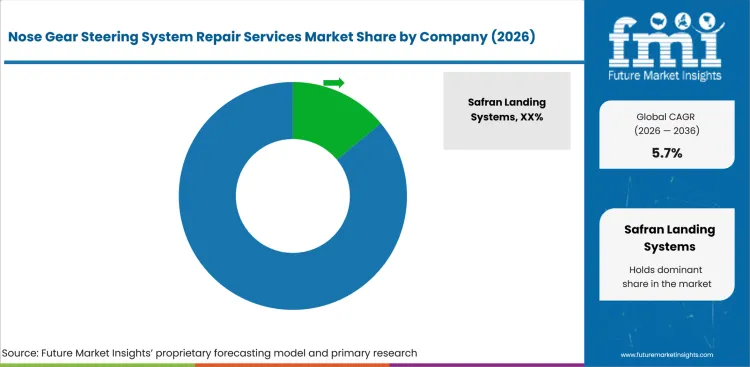
- Competition is centered on approved steering repair depth and landing gear overhaul capability.
- Repair providers stand out with actuator testing and clean release documents.
- Landing gear specialists have an advantage as steering repair can be paired with full gear service.
- Entry barriers include hydraulic testing and plating approvals.
Competitive positioning depends on repair proof and approved shop capability. HAECO Landing Gear Services operates a 10,000 m² open-floor landing gear facility in Xiamen. The company lists approvals from CAAC and EASA. It also lists FAA approval. This gives the company a verified repair platform for landing gear service. Certified repair depth is important as steering actuators must return with clear test documents.
Lufthansa Technik strengthened landing gear service coverage through its November 2025 MRO partnership with Etihad Airways. The company said its UK landing gear workshop will service A380 main landing gear shipsets over five years. The same partnership gives Etihad’s A320-family aircraft access to spare parts pool support. This supports aerospace landing gear service demand as airlines need repair networks with parts access.
TRIUMPH’s 2024 company report states that it is one of two USA companies able to provide complete landing gear system solutions. The company lists actuation and nose wheel steering as part of this capability. TRIUMPH also said its Boeing 787 landing gear actuation system was beginning its 12-year overhaul cycle. This matters for repair services as mature aircraft programs create repeat orders for steering work. Related digital brake control service knowledge can support better steering and braking interface checks.
Key Companies in the Nose Gear Steering System Repair Services Market
- Landing Gear OEM Service Leaders: Safran Landing Systems and Collins Aerospace serve steering system repair through manuals and approved repair support.
- MRO and Repair Specialists: Lufthansa Technik AG and HAECO Landing Gear Services serve landing gear overhaul and component repair needs.
- Exchange and Aftermarket Participants: GA Telesis Landing Gear Services and Triumph Actuation & Landing Gear Systems support actuator and rotables repair.
Competitive Benchmarking: Nose Gear Steering System Repair Services Market
| Company | Steering Repair Depth | Hydraulic Test Depth | Approval Coverage | Geographic Footprint |
|---|---|---|---|---|
| Safran Landing Systems | High | High | High | Global with French strength |
| Lufthansa Technik AG | High | Medium | High | Europe and global airline support |
| GA Telesis Landing Gear Services | Medium | High | Medium | North America and aftermarket centered |
| HAECO Landing Gear Services | Medium | High | High | Asia centered repair network |
| Revima Group | High | Medium | High | France and Thailand repair sites |
| Collins Aerospace | Medium | Medium | High | Global aerospace systems network |
| Triumph Actuation & Landing Gear Systems | Medium | High | Medium | North America and OEM program support |
Source: Future Market Insights competitive analysis, 2026.
Key Developments in Nose Gear Steering System Repair Services Market
- In April 2025, GA Telesis, LLC completed the acquisition of AAR CORP.’s Landing Gear Overhaul business and its Wheels & Brakes business unit. The acquired operations were integrated into GA Telesis MRO Services and renamed GA Telesis Landing Gear Services.
- In June 2025, Safran Landing Systems and Revima Group renewed a long-term spare parts supply and technical support agreement. The contract supports Revima’s landing gear repair and overhaul facilities in France and Thailand with spare parts and engineering support for Airbus aircraft.
Key Players in the Nose Gear Steering System Repair Services Market
Major Global Players
- Safran Landing Systems
- Lufthansa Technik AG
- GA Telesis Landing Gear Services
- HAECO Landing Gear Services
- Revima Group
Specialist and OEM-Linked Players
- Collins Aerospace
- Triumph Actuation & Landing Gear Systems
- AAR Corp.
- ST Engineering Aerospace
- C&L Aero
Analysis of Nose Gear Steering System Repair Services Market by Key Countries
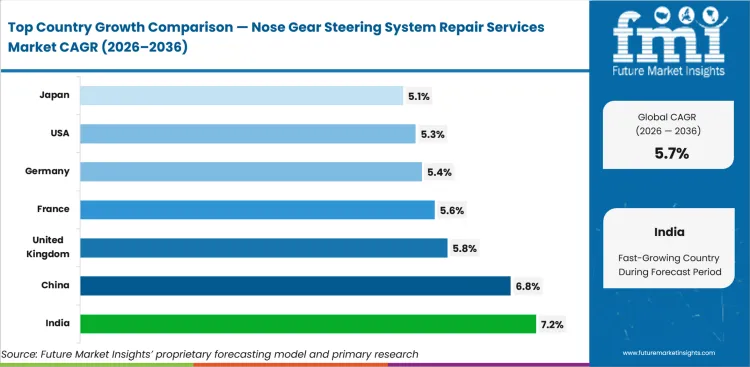
.webp "Top Country Growth Comparison Nose Gear Steering System Repair Services Market Cagr (2026 2036)")
| Country | CAGR |
|---|---|
| United States | 5.3% |
| China | 6.8% |
| India | 7.2% |
| Germany | 5.4% |
| France | 5.6% |
| Japan | 5.1% |
| United Kingdom | 5.8% |
| Global | 5.7% |
Source: Future Market Insights, 2026.
Demand Outlook for Nose Gear Steering System Repair Services Market in the United States
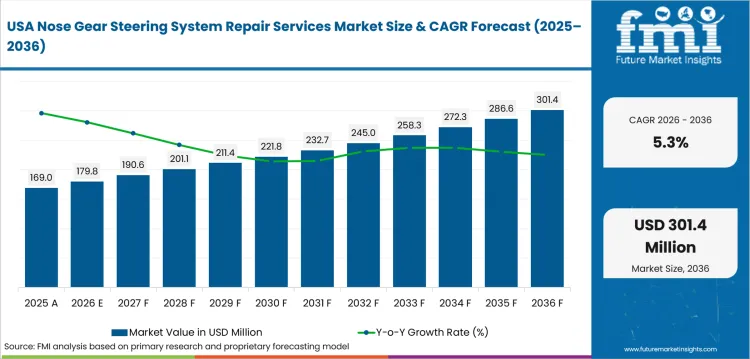
Civil and defense fleet repair depth · 2026 to 2036
Country Market Snapshot Table
| Parameter | Value |
|---|---|
| Market Size in 2025 | USD 89.5 million |
| Market Forecast in 2036 | USD 158.0 million |
| CAGR (2026-2036) | 5.3% |
| Years Considered | 2016-2036 |
| Base Year | 2025 |
| Forecast Period | 2026-2036 |
| Units Considered | Value (USD Mn) |
| Leading Sub-Region | Florida landing gear service corridor |
United States Nose Gear Steering System Repair Services Market Outlook
United States demand comes from airline fleets and business aviation service centers. Nose gear steering repair is important because taxi faults can delay aircraft movement before flight.
Defense aviation adds repair work for rugged steering assemblies. Repair providers need hydraulic test benches and clear release documents to serve these aircraft.
Key Growth Drivers
- Aircraft delivery flow keeps repair planning active, as GAMA reported 3,230 airplane shipments in 2025. This raises future service need for actuator and valve checks.
- Commercial aircraft production supports later MRO work, as Boeing delivered 600 aircraft in 2025. Steering system service demand follows as fleets age.
- Defense aircraft need steering parts that can handle heavy ground movement. This creates steady repair work for certified shops.
- Business aircraft operators need quick exchange support. Fast part access helps reduce ground time after steering faults.
Key Restraints
- Smaller repair shops can face approval delays because steering parts need documented testing before release.
- Mixed fleet types can make inventory planning difficult. GAMA reported turboprop airplane shipments fell 5.1% to 594 units in 2025. This can reduce part commonality for some repair providers.
- Hydraulic test equipment cost can limit smaller shops that handle lower-volume actuator work.
What makes United States unique
The United States has a deep repair network that serves airline fleets and defense aircraft. Business aviation adds another repair stream for actuators and valves.
Key Companies
- Collins Aerospace
- TRIUMPH Group
- GA Telesis Landing Gear Services
- AAR CORP.
- C&L Aviation Services
Sales & Marketing Channels
- Airline MRO contracts
- Defense depot repair programs
- Independent component repair stations
- Exchange unit suppliers
Country Segment Breakdown Table
| Segment | Sub-Segments |
|---|---|
| By Service Type | Actuator Overhaul · Control Valve Repair · Shimmy Damper Servicing · Sensor Calibration |
| By Aircraft Type | Narrow-body Aircraft · Wide-body Aircraft · Business Aircraft · Military Aircraft |
| By Repair Mode | Scheduled Shop Visits · AOG Field Repair · Exchange Unit Repair |
| By Sales Channel | Airline MRO Contracts · OEM Service Channels · Independent Repair Stations |
| By System Architecture | Hydraulic Steering · Electrohydraulic Steering · Electric Steering |
| Market Taxonomy and Sub-Regions Covered | Florida · Texas · Georgia · Ohio · North Carolina · Washington · California |
Frequently Asked Questions
How fast is the United States nose gear steering system repair services market moving?
The forecast pace is listed in the country market snapshot table. Fleet scale keeps repair demand steady across civil and defense aircraft.
Who leads the United States nose gear steering system repair services market?
Collins Aerospace and TRIUMPH Group are important technical names. GA Telesis adds landing gear service depth.
What drives steering repair demand in the United States?
Aircraft operators need reliable nose wheel control during taxi movement. Certified repair shops help reduce release delays after actuator faults.
Sales Analysis of Nose Gear Steering System Repair Services Market in China
Large airline activity · 2026 to 2036
Country Market Snapshot Table
| Parameter | Value |
|---|---|
| Market Size in 2025 | USD 43.8 million |
| Market Forecast in 2036 | USD 90.3 million |
| CAGR (2026-2036) | 6.8% |
| Years Considered | 2016-2036 |
| Base Year | 2025 |
| Forecast Period | 2026-2036 |
| Units Considered | Value (USD Mn) |
| Leading Sub-Region | Xiamen and Guangzhou MRO corridor |
China Nose Gear Steering System Repair Services Market Outlook
China needs more steering repair capacity as airline activity expands across domestic routes. Narrow-body aircraft create frequent steering cycles during airport movement.
Local repair capacity is improving as aviation approvals deepen. Repair providers with exchange stock can help airlines reduce overseas turnaround.
Key Growth Drivers
- Commercial fleet scale raises repair need, as CAAC reported 4,574 commercial aircraft by the end of 2025. Steering actuators need more frequent checks as aircraft use rises.
- Airline network depth supports repair activity, as CAAC reported 5,488 scheduled flight routes in 2025. Wider route coverage increases steering cycles across operating fleets.
- Local landing gear overhaul centers reduce overseas repair time. This helps airlines control component turnaround.
- Airport activity creates steady need for shimmy damper service. Taxi movement puts repeated load on nose gear systems.
Key Restraints
- Certification alignment can slow new repair entrants because aircraft parts need multi-authority approval.
- Domestic aircraft program depth is still developing. CAAC reported 220 domestically manufactured commercial aircraft in service by the end of 2025. This keeps many repair programs tied to overseas OEM documentation.
- Skilled repair staff shortages can slow actuator testing and release paperwork.
What makes China unique
China is building local repair depth for high-use airline fleets. Domestic service capability is becoming more important for steering parts and landing gear components.
Key Companies
- HAECO Landing Gear Services (Xiamen) Co. Ltd.
- Beijing Aircraft Maintenance Engineering Co., Ltd.
- Guangzhou Aircraft Maintenance Engineering Company Limited
- China Eastern Airlines Technic Co., Ltd.
- Shanghai Aircraft Manufacturing Co., Ltd.
Sales & Marketing Channels
- Airline maintenance agreements
- Local landing gear overhaul facilities
- OEM joint venture channels
- Airport-based MRO centers
Country Segment Breakdown Table
| Segment | Sub-Segments |
|---|---|
| By Service Type | Actuator Overhaul · Control Valve Repair · Shimmy Damper Servicing · Sensor Calibration |
| By Aircraft Type | Narrow-body Aircraft · Wide-body Aircraft · Regional Aircraft · Business Aircraft |
| By Repair Mode | Scheduled Shop Visits · AOG Field Repair · Exchange Unit Repair |
| By Sales Channel | Airline MRO Contracts · OEM Service Channels · Repair Joint Ventures |
| By System Architecture | Hydraulic Steering · Electrohydraulic Steering · Electric Steering |
| Market Taxonomy and Sub-Regions Covered | Xiamen · Guangzhou · Beijing · Shanghai · Xi’an · Chengdu · Tianjin |
Frequently Asked Questions
How fast is China nose gear steering system repair services market moving?
The forecast pace is given in the country market snapshot table. Airline fleet use and route depth keep repair demand active.
Who leads China nose gear steering system repair services market?
HAECO Landing Gear Services and Ameco are important service names. GAMECO adds airline repair reach.
What drives repair demand in China?
High aircraft movement raises steering part wear. Local approvals help airlines reduce offshore repair time.
Demand Outlook for Nose Gear Steering System Repair Services Market in India
High domestic aircraft use · 2026 to 2036
Country Market Snapshot Table
| Parameter | Value |
|---|---|
| Market Size in 2025 | USD 17.6 million |
| Market Forecast in 2036 | USD 37.8 million |
| CAGR (2026-2036) | 7.2% |
| Years Considered | 2016-2036 |
| Base Year | 2025 |
| Forecast Period | 2026-2036 |
| Units Considered | Value (USD Mn) |
| Leading Sub-Region | Hyderabad and Delhi MRO corridor |
India Nose Gear Steering System Repair Services Market Outlook
India needs faster steering repair as airlines increase aircraft use across domestic routes. Narrow-body aircraft create repeated taxi movement at busy airports.
Local MRO capacity is improving across key aviation clusters. Airlines benefit when steering actuators and valves can be repaired closer to fleet operations.
Key Growth Drivers
- Airport expansion is creating more domestic service nodes. On September 30, 2025, DGCA granted Navi Mumbai International Airport an aerodrome license for reference code 4F, a 3,700-meter runway, and CAT-I ILS all-weather operations. This supports future repair demand near high-activity airport corridors.
- Local repair access is improving, as India had 149 approved MROs for line and base maintenance in 2024-25. This gives airlines more domestic service options.
- Airline operators need exchange parts for taxi faults. Ready units can reduce delay risk before departure.
- Defense aircraft service creates repair demand for tougher steering assemblies. These parts need careful testing before release.
Key Restraints
- Parts traceability can slow repair release as older aircraft need detailed component records.
- Deeper overhaul capability is still limited. India had 7 MROs able to carry out aircraft overhaul in 2024-25. This can restrict complex steering system repair capacity.
- Smaller shops may struggle with hydraulic test benches and trained release staff.
What makes India unique
India has fast fleet use and a growing local MRO network. The service gap is strongest in deeper component repair.
Key Companies
- AI Engineering Services Limited
- GMR Aero Technic Limited
- Air Works India Engineering Pvt. Ltd.
- Hindustan Aeronautics Limited
- Max Aerospace & Aviation Pvt. Ltd.
Sales & Marketing Channels
- Airline engineering departments
- DGCA-approved repair stations
- Airport MRO facilities
- Defense aircraft service routes
Country Segment Breakdown Table
| Segment | Sub-Segments |
|---|---|
| By Service Type | Actuator Overhaul · Control Valve Repair · Shimmy Damper Servicing · Sensor Calibration |
| By Aircraft Type | Narrow-body Aircraft · Regional Aircraft · Business Aircraft · Military Aircraft |
| By Repair Mode | Scheduled Shop Visits · Exchange Unit Repair · AOG Field Repair |
| By Sales Channel | Airline MRO Contracts · Independent Repair Stations · Defense Depots |
| By System Architecture | Hydraulic Steering · Electrohydraulic Steering · Electric Steering |
| Market Taxonomy and Sub-Regions Covered | Hyderabad · Delhi NCR · Bengaluru · Mumbai · Nagpur · Nashik · Kochi |
Frequently Asked Questions
How fast is India nose gear steering system repair services market moving?
The country snapshot table gives the forecast pace. Local repair capacity is still catching up with fleet use.
Who leads India nose gear steering system repair services market?
AI Engineering Services Limited and GMR Aero Technic Limited are active MRO names. HAL supports defense aircraft service.
What drives repair demand in India?
Frequent domestic aircraft use increases steering cycles. Local repair access helps airlines reduce overseas turnaround.
Opportunity Analysis of Nose Gear Steering System Repair Services Market in Germany
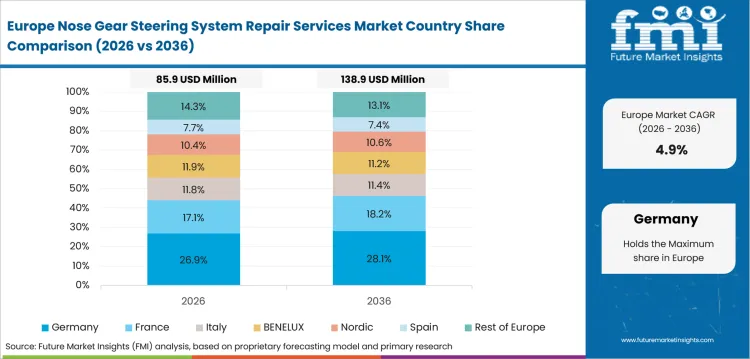
Aerospace supplier depth · 2026 to 2036
Country Market Snapshot Table
| Parameter | Value |
|---|---|
| Market Size in 2025 | USD 23.4 million |
| Market Forecast in 2036 | USD 41.7 million |
| CAGR (2026-2036) | 5.4% |
| Years Considered | 2016-2036 |
| Base Year | 2025 |
| Forecast Period | 2026-2036 |
| Units Considered | Value (USD Mn) |
| Leading Sub-Region | Hamburg and Bavaria aerospace corridor |
Germany Nose Gear Steering System Repair Services Market Outlook
Germany has a strong aircraft systems base that fits steering actuator repair. Aerospace suppliers and MRO providers serve civil aircraft and defense programs.
Repair demand is steady as operators need certified work for hydraulic parts. Electrohydraulic steering creates higher testing needs for repair shops.
Key Growth Drivers
- Aerospace supplier scale supports component repair, as BDLI reported EUR 62.0 billion in German aerospace revenue in 2025. This gives repair providers a strong industry base.
- Civil aviation creates steady repair scope, as BDLI reported EUR 45.0 billion in civil aviation revenue in 2025. Steering work benefits from aircraft systems depth.
- Defense aircraft service adds demand for rugged steering parts. These parts often need stricter test records.
- Certified component shops can serve hydraulic and electrohydraulic steering systems. Test depth is important for actuator release.
Key Restraints
- Skilled labor pressure can slow repair turnaround in specialized aerospace workshops.
- Repair shops need trained staff for release work. BDLI reported 130,000 aerospace employees in Germany in 2025. High employment shows industry depth but also raises competition for skilled workers.
- High workshop cost can make low-volume steering repairs harder to price.
What makes Germany unique
Germany has engineering depth in aircraft systems and component repair. This helps repair providers handle steering actuators and control valves.
Key Companies
- Liebherr-Aerospace Lindenberg GmbH
- Lufthansa Technik AG
- MTU Maintenance Hannover GmbH
- Diehl Aviation Laupheim GmbH
- Aero-Dienst GmbH
Sales & Marketing Channels
- Airline technical service contracts
- Aerospace supplier networks
- Defense aviation service routes
- Certified component repair shops
Country Segment Breakdown Table
| Segment | Sub-Segments |
|---|---|
| By Service Type | Actuator Overhaul · Control Valve Repair · Sensor Calibration · Harness Repair |
| By Aircraft Type | Narrow-body Aircraft · Wide-body Aircraft · Military Aircraft · Business Aircraft |
| By Repair Mode | Scheduled Shop Visits · AOG Field Repair · Exchange Unit Repair |
| By Sales Channel | OEM Service Channels · Airline MRO Contracts · Defense Depots |
| By System Architecture | Hydraulic Steering · Electrohydraulic Steering · Electric Steering |
| Market Taxonomy and Sub-Regions Covered | Hamburg · Bavaria · Baden-Württemberg · Lower Saxony · Bremen · Hesse · North Rhine-Westphalia |
Frequently Asked Questions
How fast is Germany nose gear steering system repair services market moving?
The forecast pace is listed in the snapshot table. Aerospace systems depth keeps repair demand steady.
Who leads Germany nose gear steering system repair services market?
Liebherr-Aerospace Lindenberg GmbH and Lufthansa Technik AG are important names. MTU Maintenance adds repair network strength.
What drives repair demand in Germany?
Aircraft systems expertise helps repair providers manage steering parts with proper test records.
Sales Analysis of Nose Gear Steering System Repair Services Market in France
Landing gear production strength · 2026 to 2036
Country Market Snapshot Table
| Parameter | Value |
|---|---|
| Market Size in 2025 | USD 24.8 million |
| Market Forecast in 2036 | USD 45.2 million |
| CAGR (2026-2036) | 5.6% |
| Years Considered | 2016-2036 |
| Base Year | 2025 |
| Forecast Period | 2026-2036 |
| Units Considered | Value (USD Mn) |
| Leading Sub-Region | Toulouse and Molsheim aerospace corridor |
France Nose Gear Steering System Repair Services Market Outlook
France has deep landing gear and braking system capability. Local suppliers support actuator work and steering system service for civil aircraft.
Repair demand comes from airline MRO and aircraft manufacturing depth. Steering components benefit from access to OEM repair data and trained aerospace workers.
Key Growth Drivers
- Landing gear system depth helps steering repair, as GIFAS reported EUR 85.6 billion in French aerospace revenue in 2025. This gives repair shops a large technical base.
- New aircraft orders sustain future service need, as GIFAS reported EUR 88.6 billion in order intake in 2025. Steering repairs follow as aircraft move into active service.
- OEM repair data helps shops handle actuators and steering manifolds. This reduces uncertainty during release checks.
- Defense aviation supports lower-volume steering repair work. These parts need careful inspection and qualified documents.
Key Restraints
- High repair documentation needs can slow release after steering actuator work.
- Export-heavy workload can stretch supplier capacity. GIFAS reported EUR 59.4 billion in French aerospace exports in 2025. This can add pressure on parts and skilled labor.
- Smaller shops may face cost pressure in plating and surface treatment work.
What makes France unique
France is a central landing gear systems hub. Production depth and repair know-how sit close to each other.
Key Companies
- Safran Landing Systems
- Revima Group
- Sabena technics
- Air France Industries KLM Engineering & Maintenance
- Daher
Sales & Marketing Channels
- OEM repair programs
- Airline MRO contracts
- Landing gear overhaul centers
- Defense aircraft service routes
Country Segment Breakdown Table
| Segment | Sub-Segments |
|---|---|
| By Service Type | Actuator Overhaul · Control Valve Repair · Shimmy Damper Servicing · Sensor Calibration |
| By Aircraft Type | Narrow-body Aircraft · Wide-body Aircraft · Military Aircraft · Business Aircraft |
| By Repair Mode | Scheduled Shop Visits · Exchange Unit Repair · AOG Field Repair |
| By Sales Channel | OEM Service Channels · Airline MRO Contracts · Independent Repair Stations |
| By System Architecture | Hydraulic Steering · Electrohydraulic Steering · Electric Steering |
| Market Taxonomy and Sub-Regions Covered | Toulouse · Molsheim · Paris Region · Bordeaux · Lyon · Dinard · Nîmes |
Frequently Asked Questions
How fast is France nose gear steering system repair services market moving?
The country table gives the forecast pace. Landing gear production depth supports long-term repair demand.
Who leads France nose gear steering system repair services market?
Safran Landing Systems and Revima Group are important names. Sabena technics adds wider MRO service reach.
What drives repair demand in France?
Landing gear expertise helps repair providers handle actuator overhaul and steering control checks.
Future Outlook for Nose Gear Steering System Repair Services Market in Japan
Precision aircraft parts base · 2026 to 2036
Country Market Snapshot Table
| Parameter | Value |
|---|---|
| Market Size in 2025 | USD 16.8 million |
| Market Forecast in 2036 | USD 29.0 million |
| CAGR (2026-2036) | 5.1% |
| Years Considered | 2016-2036 |
| Base Year | 2025 |
| Forecast Period | 2026-2036 |
| Units Considered | Value (USD Mn) |
| Leading Sub-Region | Nagoya aerospace corridor |
Japan Nose Gear Steering System Repair Services Market Outlook
Japan has a precision aircraft parts base and a careful repair culture. Steering repair demand comes from airline fleets and defense aircraft support.
Repair providers need traceable records and tight quality checks. Shops with component repair skill can serve hydraulic and electrohydraulic steering parts.
Key Growth Drivers
- Aircraft parts activity supports component repair, as Japan aircraft and related parts local production was estimated at USD 12.007 billion in 2025. This gives repair shops a stronger supply base for aircraft maintenance work.
- Aircraft parts activity supports component repair, as Japan aircraft and related parts local production was estimated at USD 12.007 billion in 2025. This gives repair shops a stronger supply base for aircraft maintenance work.
- Airline reliability needs create demand for actuator and valve testing. Steering faults can delay aircraft before departure.
- Defense aircraft service supports smaller batch repair. These jobs require careful records and qualified workmanship.
Key Restraints
- Imported aircraft parts can lengthen steering repair timelines.
- Japan relies on imported aircraft and related technologies. The USA International Trade Administration stated in November 2025 that Japan continues to offer a long-term market for imported aircraft and aircraft parts. This can affect lead time for some steering components.
- Some aircraft programs need overseas OEM data before repair release.
What makes Japan unique
Japan combines precision parts manufacturing with careful aircraft maintenance practice. This helps steering repair work that needs tight testing control.
Key Companies
- Mitsubishi Heavy Industries Ltd.
- Kawasaki Heavy Industries Ltd.
- MHI Aero Engine Service Co., Ltd.
- JAL Engineering Co., Ltd.
- ANA Base Maintenance Technics Co., Ltd.
Sales & Marketing Channels
- Airline engineering divisions
- Aerospace manufacturer service routes
- Defense aircraft service channels
- Component repair workshops
Country Segment Breakdown Table
| Segment | Sub-Segments |
|---|---|
| By Service Type | Actuator Overhaul · Control Valve Repair · Sensor Calibration · Harness Repair |
| By Aircraft Type | Narrow-body Aircraft · Wide-body Aircraft · Business Aircraft · Military Aircraft |
| By Repair Mode | Scheduled Shop Visits · Exchange Unit Repair · AOG Field Repair |
| By Sales Channel | Airline MRO Contracts · Aerospace Manufacturer Channels · Defense Depots |
| By System Architecture | Hydraulic Steering · Electrohydraulic Steering · Electric Steering |
| Market Taxonomy and Sub-Regions Covered | Nagoya · Tokyo · Komaki · Kobe · Gifu · Osaka · Hiroshima |
Frequently Asked Questions
How fast is Japan nose gear steering system repair services market moving?
The snapshot table gives the forecast pace. Demand comes from airline maintenance and defense aircraft service.
Who leads Japan nose gear steering system repair services market?
Mitsubishi Heavy Industries Ltd. and Kawasaki Heavy Industries Ltd. are important aerospace names. JAL Engineering adds airline service reach.
What drives repair demand in Japan?
Aircraft reliability standards create demand for accurate actuator testing and clear repair records.
Future Outlook for Nose Gear Steering System Repair Services Market in the United Kingdom
Landing gear service corridor · 2026 to 2036
Country Market Snapshot Table
| Parameter | Value |
|---|---|
| Market Size in 2025 | USD 20.5 million |
| Market Forecast in 2036 | USD 38.1 million |
| CAGR (2026-2036) | 5.8% |
| Years Considered | 2016-2036 |
| Base Year | 2025 |
| Forecast Period | 2026-2036 |
| Units Considered | Value (USD Mn) |
| Leading Sub-Region | London Heathrow landing gear corridor |
United Kingdom Nose Gear Steering System Repair Services Market Outlook
United Kingdom demand comes from airline activity and landing gear service depth near major airports. Steering repair needs quick access to parts and approved testing.
MRO providers near Heathrow have a clear service advantage for airline fleets. Defense aircraft support adds work for steering parts that need strict release files.
Key Growth Drivers
- Airport traffic creates repair need, as UK CAA reported 302.0 million passengers through UK airports in 2025. Steering systems face repeated taxi and gate movement.
- Future aircraft service work is supported by order depth, as ADS reported 569 commercial aircraft orders in Q1 2026. New fleet activity can create later repair demand.
- Landing gear service workshops help airlines handle steering faults during deeper maintenance.
- Defense aircraft service adds demand for qualified component repair and release records.
Key Restraints
- Skilled workshop capacity can limit urgent steering repair during peak fleet use.
- Service pressure rises when airport traffic is high. UK CAA reported passenger numbers rose 2.0% in 2025 from 2024. Higher aircraft activity can strain short-turn repair support.
- Exchange part availability can slow repair release if operators need older steering units.
What makes United Kingdom unique
The United Kingdom has landing gear service depth near Heathrow and a strong defense aircraft support base.
Key Companies
- STS Aviation Services UK Ltd.
- AerFin Limited
- BAE Systems plc
- Parker Meggitt
- GKN Aerospace Services Limited
Sales & Marketing Channels
- Airline MRO contracts
- Airport-based repair networks
- Defense service channels
- Component exchange suppliers
Country Segment Breakdown Table
| Segment | Sub-Segments |
|---|---|
| By Service Type | Actuator Overhaul · Control Valve Repair · Shimmy Damper Servicing · Sensor Calibration |
| By Aircraft Type | Narrow-body Aircraft · Wide-body Aircraft · Military Aircraft · Business Aircraft |
| By Repair Mode | Scheduled Shop Visits · AOG Field Repair · Exchange Unit Repair |
| By Sales Channel | Airline MRO Contracts · Independent Repair Stations · Defense Service Channels |
| By System Architecture | Hydraulic Steering · Electrohydraulic Steering · Electric Steering |
| Market Taxonomy and Sub-Regions Covered | Greater London · Wales · Midlands · Bristol · Manchester · Hampshire · Scotland |
Frequently Asked Questions
How fast is the United Kingdom nose gear steering system repair services market moving?
The forecast pace is listed in the snapshot table. Airline traffic and landing gear repair depth support demand.
Who leads the United Kingdom nose gear steering system repair services market?
STS Aviation Services UK Ltd. and AerFin Limited are active MRO names. BAE Systems plc supports defense aircraft service demand.
What drives repair demand in the United Kingdom?
Airport activity and aircraft reliability needs create steady demand for steering actuator repair and exchange support.
Report Scope and Coverage
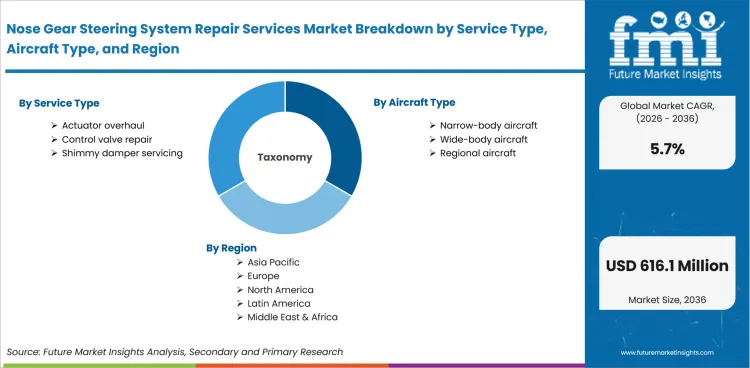
| Parameter | Details |
|---|---|
| Market Size by 2036 | USD 616.1 million |
| Growth Rate | 5.7% CAGR from 2026 to 2036 |
| Forecast Period | 2026 to 2036 |
| Base Year Value | USD 354.4 million in 2026 |
| By Service Type | Actuator Overhaul, Control Valve Repair, Shimmy Damper Servicing, Sensor Calibration, Harness Repair |
| By Aircraft Type | Narrow-body Aircraft, Wide-body Aircraft, Regional Aircraft, Business Aircraft, Military Aircraft |
| By Repair Mode | Scheduled Shop Visits, AOG Field Repair, Exchange Unit Repair, Warranty Support |
| By Sales Channel | Airline MRO Contracts, OEM Service Channels, Independent Repair Stations, Defense Depots |
| By System Architecture | Hydraulic Steering, Electrohydraulic Steering, Electric Steering |
| Regions Covered | North America, Latin America, Western Europe, Eastern Europe, East Asia, South Asia and Pacific, Middle East & Africa |
| Countries Covered | United States, China, India, Germany, France, Japan, United Kingdom, and 30 plus countries |
| Key Companies Profiled | Safran Landing Systems, Lufthansa Technik AG, GA Telesis Landing Gear Services, HAECO Landing Gear Services, Revima Group, Collins Aerospace, TRIUMPH Group, AAR CORP., ST Engineering Aerospace, C&L Aviation Services |
| Approach | Hybrid bottom-up and top-down methodology using fleet use, steering component repair cycles, landing gear overhaul activity, MRO capacity, and supplier service coverage |
Source: Future Market Insights, 2026.
Nose Gear Steering System Repair Services Market Breakdown by Service Type, Aircraft Type, Repair Mode, Sales Channel, System Architecture, and Region
Nose Gear Steering System Repair Services Market Segmented by Service Type
- Actuator overhaul
- Control valve repair
- Shimmy damper servicing
- Sensor calibration
- Harness repair
Nose Gear Steering System Repair Services Market Segmented by Aircraft Type
- Narrow-body aircraft
- Wide-body aircraft
- Regional aircraft
- Business aircraft
- Military aircraft
Nose Gear Steering System Repair Services Market Segmented by Repair Mode
- Scheduled shop visits
- AOG field repair
- Exchange unit repair
- Warranty support
Nose Gear Steering System Repair Services Market Segmented by Sales Channel
- Airline MRO contracts
- OEM service channels
- Independent repair stations
- Defense depots
Nose Gear Steering System Repair Services Market Segmented by System Architecture
- Hydraulic steering
- Electrohydraulic steering
- Electric steering
Nose Gear Steering System Repair Services Market by Region
- North America
- Latin America
- Western Europe
- Eastern Europe
- East Asia
- South Asia and Pacific
- Middle East & Africa
Research Sources and Bibliography
- Transport Canada. (2025, January 31). Airworthiness Directive CF-2025-05: Landing gear. Transport Canada.
- Transport Canada. (2024, May 3). Airworthiness Directive CF-2024-12: Landing gear. Transport Canada.
- HAECO. (2024, December 9). HAECO celebrates completion of 2000th landing gear overhaul. HAECO.
- HAECO. (2026, May 28). HAECO strengthens landing gear capabilities with first C909 overhaul. HAECO.
- Safran. (2025, June 4). Safran inaugurates new industrial facilities for landing and braking systems in Molsheim, France. Safran.
- Safran. (2025, June 18). Safran and Revima strengthen their landing gear collaboration. Safran.
- Liebherr. (2025, March 21). Liebherr signs landing gear overhaul agreement with SkyWest Airlines. Liebherr.
- Liebherr. (2025, October 2). Liebherr-Aerospace opens its new building in the USA. Liebherr.
- General Aviation Manufacturers Association. (2026, February 26). Quarterly shipments and billings. General Aviation Manufacturers Association.
- The Boeing Company. (2026, January 13). Boeing announces fourth quarter deliveries. Boeing.
- Civil Aviation Administration of China. (2026, April 22). CAAC releases statistical bulletin of civil aviation industry development in 2025. Civil Aviation Administration of China.
- Ministry of Civil Aviation, Government of India. (2025, March 31). Annual report civil aviation for the year 2024-25. Ministry of Civil Aviation, Government of India.
- Adani Group. (2024, December 29). Navi Mumbai International Airport flies closer to readiness: Successfully conducts first flight validation test. Adani Group.
- Bundesverband der Deutschen Luft- und Raumfahrtindustrie e.V. (2026, May 27). BDLI industry data 2026: Aerospace industry sets new records for revenue and employment. BDLI.
- Groupement des Industries Françaises Aéronautiques et Spatiales. (2026, May 11). 2025 results: The French aerospace industry remains strongly positioned for the future. GIFAS.
- International Trade Administration. (2025, November 18). Japan: Aircraft and related parts. USA Department of Commerce.
- International Trade Administration. (2025, November 18). Japan: Aircraft and related parts. USA Department of Commerce.
- UK Civil Aviation Authority. (2026, February 24). UK aviation officially breaks records with over 300m passenger journeys in 2025. UK Civil Aviation Authority.
- ADS Group. (2026, April 29). 13-year high for Q1 aircraft orders, ADS reveals. ADS Group.
- Lufthansa Technik. (2025, November 18). New cooperations across a multitude of fields: Etihad Airways and Lufthansa Technik form strategic MRO partnership. Lufthansa Technik.
- TRIUMPH Group, Inc. (2024). 2024 sustainability report. TRIUMPH Group.
- GA Telesis. (2025, April 7). GA Telesis expands MRO capabilities with acquisition of AAR’s landing gear overhaul and wheels & brakes business. GA Telesis.
- AAR CORP. (2025, April 3). AAR completes sale of Landing Gear Overhaul business. AAR CORP.
Report Questions Answered
- How large will nose gear steering system repair services demand be in 2026?
- What revenue value is forecast for the market by 2036?
- Which CAGR is expected for the market during 2026 to 2036?
- Which service type is expected to lead demand and why?
- Which repair mode is expected to account for the strongest share in 2026?
- Which countries are expected to expand faster than the global pace?
- How do certified repair approvals affect supplier selection?
- Which companies are active in steering repair and landing gear overhaul?
- How was the forecast built from fleet use and repair frequency?
Frequently Asked Questions
What is the value of the nose gear steering system repair services market in 2026?
Nose gear steering system repair services demand is expected to reach USD 354.4 million in 2026.
What will the nose gear steering system repair services market reach by 2036?
Market revenue is forecast to reach USD 616.1 million by 2036 at 5.7% CAGR.
Which service type leads the market?
Actuator overhaul is expected to lead service type demand with 34.0% share in 2026 as seal wear and hydraulic leakage create repeat repair work.
Which repair mode holds the strongest share?
Scheduled shop visits are anticipated to hold 56.0% share in 2026 as steering work fits planned landing gear removal cycles.
Why do hydraulic steering systems lead demand?
Hydraulic steering systems are expected to account for 63.0% share in 2026 as mature aircraft fleets use hydraulic actuators and valves.
Which countries expand faster in nose gear steering system repair services?
India at 7.2% CAGR and China at 6.8% CAGR are forecast above the global pace through 2036.
Which companies serve nose gear steering system repair services?
Safran Landing Systems, Lufthansa Technik AG, GA Telesis Landing Gear Services and HAECO Landing Gear Services are active service providers.
What is the key restraint for suppliers?
Certification cost is the key restraint as repair shops need approved procedures, skilled release staff and traceable test records.
Preview the report firsthand - request a free sample
Get SampleGet the brochure for pricing and purchase details.
Get PDFTable of Content
- Executive Summary
- Global Market Outlook
- Demand-side Trends
- Supply-side Trends
- Technology Roadmap Analysis
- Analysis and Recommendations
- Market Overview
- Market Coverage / Taxonomy
- Market Definition / Scope / Limitations
- Research Methodology
- Chapter Orientation
- Analytical Lens and Working Hypotheses
- Market Structure, Signals, and Trend Drivers
- Benchmarking and Cross-market Comparability
- Market Sizing, Forecasting, and Opportunity Mapping
- Research Design and Evidence Framework
- Desk Research Programme (Secondary Evidence)
- Company Annual and Sustainability Reports
- Peer-reviewed Journals and Academic Literature
- Corporate Websites, Product Literature, and Technical Notes
- Earnings Decks and Investor Briefings
- Statutory Filings and Regulatory Disclosures
- Technical White Papers and Standards Notes
- Trade Journals, Industry Magazines, and Analyst Briefs
- Conference Proceedings, Webinars, and Seminar Materials
- Government Statistics Portals and Public Data Releases
- Press Releases and Reputable Media Coverage
- Specialist Newsletters and Curated Briefings
- Sector Databases and Reference Repositories
- FMI Internal Proprietary Databases and Historical Market Datasets
- Subscription Datasets and Paid Sources
- Social Channels, Communities, and Digital Listening Inputs
- Additional Desk Sources
- Expert Input and Fieldwork (Primary Evidence)
- Primary Modes
- Qualitative Interviews and Expert Elicitation
- Quantitative Surveys and Structured Data Capture
- Blended Approach
- Why Primary Evidence is Used
- Field Techniques
- Interviews
- Surveys
- Focus Groups
- Observational and In-context Research
- Social and Community Interactions
- Stakeholder Universe Engaged
- C-suite Leaders
- Board Members
- Presidents and Vice Presidents
- R&D and Innovation Heads
- Technical Specialists
- Domain Subject-matter Experts
- Scientists
- Aircraft MRO Managers and Landing Gear Repair Specialists
- Governance, Ethics, and Data Stewardship
- Research Ethics
- Data Integrity and Handling
- Primary Modes
- Tooling, Models, and Reference Databases
- Desk Research Programme (Secondary Evidence)
- Data Engineering and Model Build
- Data Acquisition and Ingestion
- Cleaning, Normalisation, and Verification
- Synthesis, Triangulation, and Analysis
- Quality Assurance and Audit Trail
- Market Background
- Market Dynamics
- Drivers
- Restraints
- Opportunity
- Trends
- Scenario Forecast
- Demand in Optimistic Scenario
- Demand in Likely Scenario
- Demand in Conservative Scenario
- Opportunity Map Analysis
- Product Life Cycle Analysis
- Supply Chain Analysis
- Investment Feasibility Matrix
- Value Chain Analysis
- PESTLE and Porter’s Analysis
- Regulatory Landscape
- Regional Parent Market Outlook
- Production and Consumption Statistics
- Import and Export Statistics
- Market Dynamics
- Global Market Analysis 2016 to 2025 and Forecast, 2026 to 2036
- Historical Market Size Value (USD Million) Analysis, 2016 to 2025
- Current and Future Market Size Value (USD Million) Projections, 2026 to 2036
- Y-o-Y Growth Trend Analysis
- Absolute $ Opportunity Analysis
- Global Market Pricing Analysis 2016 to 2025 and Forecast 2026 to 2036
- Global Market Analysis 2016 to 2025 and Forecast 2026 to 2036, By Service Type
- Introduction / Key Findings
- Historical Market Size Value (USD Million) Analysis By Service Type, 2016 to 2025
- Current and Future Market Size Value (USD Million) Analysis and Forecast By Service Type, 2026 to 2036
- Actuator overhaul
- Control valve repair
- Shimmy damper servicing
- Actuator overhaul
- Y-o-Y Growth Trend Analysis By Service Type, 2016 to 2025
- Absolute $ Opportunity Analysis By Service Type, 2026 to 2036
- Global Market Analysis 2016 to 2025 and Forecast 2026 to 2036, By Aircraft Type
- Introduction / Key Findings
- Historical Market Size Value (USD Million) Analysis By Aircraft Type, 2016 to 2025
- Current and Future Market Size Value (USD Million) Analysis and Forecast By Aircraft Type, 2026 to 2036
- Narrow-body aircraft
- Wide-body aircraft
- Regional aircraft
- Narrow-body aircraft
- Y-o-Y Growth Trend Analysis By Aircraft Type, 2016 to 2025
- Absolute $ Opportunity Analysis By Aircraft Type, 2026 to 2036
- Global Market Analysis 2016 to 2025 and Forecast 2026 to 2036, By Repair Mode
- Introduction / Key Findings
- Historical Market Size Value (USD Million) Analysis By Repair Mode, 2016 to 2025
- Current and Future Market Size Value (USD Million) Analysis and Forecast By Repair Mode, 2026 to 2036
- Scheduled shop visits
- AOG field repair
- Exchange unit repair
- Scheduled shop visits
- Y-o-Y Growth Trend Analysis By Repair Mode, 2016 to 2025
- Absolute $ Opportunity Analysis By Repair Mode, 2026 to 2036
- Global Market Analysis 2016 to 2025 and Forecast 2026 to 2036, By Sales Channel
- Introduction / Key Findings
- Historical Market Size Value (USD Million) Analysis By Sales Channel, 2016 to 2025
- Current and Future Market Size Value (USD Million) Analysis and Forecast By Sales Channel, 2026 to 2036
- Airline MRO contracts
- OEM service channels
- Independent repair stations
- Airline MRO contracts
- Y-o-Y Growth Trend Analysis By Sales Channel, 2016 to 2025
- Absolute $ Opportunity Analysis By Sales Channel, 2026 to 2036
- Global Market Analysis 2016 to 2025 and Forecast 2026 to 2036, By System Architecture
- Introduction / Key Findings
- Historical Market Size Value (USD Million) Analysis By System Architecture, 2016 to 2025
- Current and Future Market Size Value (USD Million) Analysis and Forecast By System Architecture, 2026 to 2036
- Hydraulic steering
- Electrohydraulic steering
- Electric steering
- Hydraulic steering
- Y-o-Y Growth Trend Analysis By System Architecture, 2016 to 2025
- Absolute $ Opportunity Analysis By System Architecture, 2026 to 2036
- Global Market Analysis 2016 to 2025 and Forecast 2026 to 2036, By Region
- Introduction
- Historical Market Size Value (USD Million) Analysis By Region, 2016 to 2025
- Current Market Size Value (USD Million) Analysis and Forecast By Region, 2026 to 2036
- North America
- Latin America
- Western Europe
- Eastern Europe
- East Asia
- South Asia and Pacific
- Middle East & Africa
- Market Attractiveness Analysis By Region
- North America Market Analysis 2016 to 2025 and Forecast 2026 to 2036, By Country
- Historical Market Size Value (USD Million) Trend Analysis By Market Taxonomy, 2016 to 2025
- Market Size Value (USD Million) Forecast By Market Taxonomy, 2026 to 2036
- By Country
- USA
- Canada
- Mexico
- By Service Type
- By Aircraft Type
- By Repair Mode
- By Sales Channel
- By System Architecture
- By Country
- Market Attractiveness Analysis
- By Country
- By Service Type
- By Aircraft Type
- By Repair Mode
- By Sales Channel
- By System Architecture
- Key Takeaways
- Latin America Market Analysis 2016 to 2025 and Forecast 2026 to 2036, By Country
- Historical Market Size Value (USD Million) Trend Analysis By Market Taxonomy, 2016 to 2025
- Market Size Value (USD Million) Forecast By Market Taxonomy, 2026 to 2036
- By Country
- Brazil
- Chile
- Rest of Latin America
- By Service Type
- By Aircraft Type
- By Repair Mode
- By Sales Channel
- By System Architecture
- By Country
- Market Attractiveness Analysis
- By Country
- By Service Type
- By Aircraft Type
- By Repair Mode
- By Sales Channel
- By System Architecture
- Key Takeaways
- Western Europe Market Analysis 2016 to 2025 and Forecast 2026 to 2036, By Country
- Historical Market Size Value (USD Million) Trend Analysis By Market Taxonomy, 2016 to 2025
- Market Size Value (USD Million) Forecast By Market Taxonomy, 2026 to 2036
- By Country
- Germany
- UK
- Italy
- Spain
- France
- Nordic
- BENELUX
- Rest of Western Europe
- By Service Type
- By Aircraft Type
- By Repair Mode
- By Sales Channel
- By System Architecture
- By Country
- Market Attractiveness Analysis
- By Country
- By Service Type
- By Aircraft Type
- By Repair Mode
- By Sales Channel
- By System Architecture
- Key Takeaways
- Eastern Europe Market Analysis 2016 to 2025 and Forecast 2026 to 2036, By Country
- Historical Market Size Value (USD Million) Trend Analysis By Market Taxonomy, 2016 to 2025
- Market Size Value (USD Million) Forecast By Market Taxonomy, 2026 to 2036
- By Country
- Russia
- Poland
- Hungary
- Balkan & Baltic
- Rest of Eastern Europe
- By Service Type
- By Aircraft Type
- By Repair Mode
- By Sales Channel
- By System Architecture
- By Country
- Market Attractiveness Analysis
- By Country
- By Service Type
- By Aircraft Type
- By Repair Mode
- By Sales Channel
- By System Architecture
- Key Takeaways
- East Asia Market Analysis 2016 to 2025 and Forecast 2026 to 2036, By Country
- Historical Market Size Value (USD Million) Trend Analysis By Market Taxonomy, 2016 to 2025
- Market Size Value (USD Million) Forecast By Market Taxonomy, 2026 to 2036
- By Country
- China
- Japan
- South Korea
- By Service Type
- By Aircraft Type
- By Repair Mode
- By Sales Channel
- By System Architecture
- By Country
- Market Attractiveness Analysis
- By Country
- By Service Type
- By Aircraft Type
- By Repair Mode
- By Sales Channel
- By System Architecture
- Key Takeaways
- South Asia and Pacific Market Analysis 2016 to 2025 and Forecast 2026 to 2036, By Country
- Historical Market Size Value (USD Million) Trend Analysis By Market Taxonomy, 2016 to 2025
- Market Size Value (USD Million) Forecast By Market Taxonomy, 2026 to 2036
- By Country
- India
- ASEAN
- Australia & New Zealand
- Rest of South Asia and Pacific
- By Service Type
- By Aircraft Type
- By Repair Mode
- By Sales Channel
- By System Architecture
- By Country
- Market Attractiveness Analysis
- By Country
- By Service Type
- By Aircraft Type
- By Repair Mode
- By Sales Channel
- By System Architecture
- Key Takeaways
- Middle East & Africa Market Analysis 2016 to 2025 and Forecast 2026 to 2036, By Country
- Historical Market Size Value (USD Million) Trend Analysis By Market Taxonomy, 2016 to 2025
- Market Size Value (USD Million) Forecast By Market Taxonomy, 2026 to 2036
- By Country
- Kingdom of Saudi Arabia
- Other GCC Countries
- Turkiye
- South Africa
- Other African Union
- Rest of Middle East & Africa
- By Service Type
- By Aircraft Type
- By Repair Mode
- By Sales Channel
- By System Architecture
- By Country
- Market Attractiveness Analysis
- By Country
- By Service Type
- By Aircraft Type
- By Repair Mode
- By Sales Channel
- By System Architecture
- Key Takeaways
- Key Countries Market Analysis
- USA
- Pricing Analysis
- Market Share Analysis, 2025
- By Service Type
- By Aircraft Type
- By Repair Mode
- By Sales Channel
- By System Architecture
- Canada
- Pricing Analysis
- Market Share Analysis, 2025
- By Service Type
- By Aircraft Type
- By Repair Mode
- By Sales Channel
- By System Architecture
- Mexico
- Pricing Analysis
- Market Share Analysis, 2025
- By Service Type
- By Aircraft Type
- By Repair Mode
- By Sales Channel
- By System Architecture
- Brazil
- Pricing Analysis
- Market Share Analysis, 2025
- By Service Type
- By Aircraft Type
- By Repair Mode
- By Sales Channel
- By System Architecture
- Chile
- Pricing Analysis
- Market Share Analysis, 2025
- By Service Type
- By Aircraft Type
- By Repair Mode
- By Sales Channel
- By System Architecture
- Germany
- Pricing Analysis
- Market Share Analysis, 2025
- By Service Type
- By Aircraft Type
- By Repair Mode
- By Sales Channel
- By System Architecture
- UK
- Pricing Analysis
- Market Share Analysis, 2025
- By Service Type
- By Aircraft Type
- By Repair Mode
- By Sales Channel
- By System Architecture
- Italy
- Pricing Analysis
- Market Share Analysis, 2025
- By Service Type
- By Aircraft Type
- By Repair Mode
- By Sales Channel
- By System Architecture
- Spain
- Pricing Analysis
- Market Share Analysis, 2025
- By Service Type
- By Aircraft Type
- By Repair Mode
- By Sales Channel
- By System Architecture
- France
- Pricing Analysis
- Market Share Analysis, 2025
- By Service Type
- By Aircraft Type
- By Repair Mode
- By Sales Channel
- By System Architecture
- India
- Pricing Analysis
- Market Share Analysis, 2025
- By Service Type
- By Aircraft Type
- By Repair Mode
- By Sales Channel
- By System Architecture
- ASEAN
- Pricing Analysis
- Market Share Analysis, 2025
- By Service Type
- By Aircraft Type
- By Repair Mode
- By Sales Channel
- By System Architecture
- Australia & New Zealand
- Pricing Analysis
- Market Share Analysis, 2025
- By Service Type
- By Aircraft Type
- By Repair Mode
- By Sales Channel
- By System Architecture
- China
- Pricing Analysis
- Market Share Analysis, 2025
- By Service Type
- By Aircraft Type
- By Repair Mode
- By Sales Channel
- By System Architecture
- Japan
- Pricing Analysis
- Market Share Analysis, 2025
- By Service Type
- By Aircraft Type
- By Repair Mode
- By Sales Channel
- By System Architecture
- South Korea
- Pricing Analysis
- Market Share Analysis, 2025
- By Service Type
- By Aircraft Type
- By Repair Mode
- By Sales Channel
- By System Architecture
- Russia
- Pricing Analysis
- Market Share Analysis, 2025
- By Service Type
- By Aircraft Type
- By Repair Mode
- By Sales Channel
- By System Architecture
- Poland
- Pricing Analysis
- Market Share Analysis, 2025
- By Service Type
- By Aircraft Type
- By Repair Mode
- By Sales Channel
- By System Architecture
- Hungary
- Pricing Analysis
- Market Share Analysis, 2025
- By Service Type
- By Aircraft Type
- By Repair Mode
- By Sales Channel
- By System Architecture
- Kingdom of Saudi Arabia
- Pricing Analysis
- Market Share Analysis, 2025
- By Service Type
- By Aircraft Type
- By Repair Mode
- By Sales Channel
- By System Architecture
- Turkiye
- Pricing Analysis
- Market Share Analysis, 2025
- By Service Type
- By Aircraft Type
- By Repair Mode
- By Sales Channel
- By System Architecture
- South Africa
- Pricing Analysis
- Market Share Analysis, 2025
- By Service Type
- By Aircraft Type
- By Repair Mode
- By Sales Channel
- By System Architecture
- USA
- Market Structure Analysis
- Competition Dashboard
- Competition Benchmarking
- Market Share Analysis of Top Players
- By Region
- By Service Type
- By Aircraft Type
- By Repair Mode
- By Sales Channel
- By System Architecture
- Competition Analysis
- Competition Deep Dive
- Safran Landing Systems
- Overview
- Product Portfolio
- Profitability by Market Segments (Service Type/Aircraft Type/Repair Mode/Sales Channel/System Architecture/Region)
- Sales Footprint
- Strategy Overview
- Marketing Strategy
- Product Strategy
- Channel Strategy
- Lufthansa Technik AG
- GA Telesis Landing Gear Services
- HAECO Landing Gear Services
- Revima Group
- Safran Landing Systems
- Competition Deep Dive
- Assumptions & Acronyms Used


