

- Market Size (2026)
- USD 1.2 Bn
- Forecast (2036)
- USD 2.6 Bn
- CAGR (2026 to 2036)
- 7.5%
How big is the servo motor brakes market size?
USD 1.2 billion in 2026 and USD 2.6 billion by 2036 at a 7.5% CAGR.
Sales in servo motor brakes market are projected to grow at 7.5% CAGR through 2036, driving valuation to USD 2.6 billion by 2036 from USD 1.2 billion in 2026. Automation OEMs are expected to qualify braking systems around compact motor packaging and repeatable commissioning across automated equipment. International Federation of Robotics reported on September 25, 2025 having industrial robot installations of 542,000 units in 2024, supporting braking component demand across robot axes and controlled-motion cells.
India and China buyers are anticipated to place greater emphasis on brake interchangeability and application trials before supplier change. Taiwan and South Korea accounts are projected to review electronics equipment uptime and clean installation records across servo-axis programs. Occupational Safety and Health Administration listed Machine Guarding as the 10th most cited standard for fiscal year 2025, reinforcing buyer scrutiny around braking evidence and machine-safety documentation.
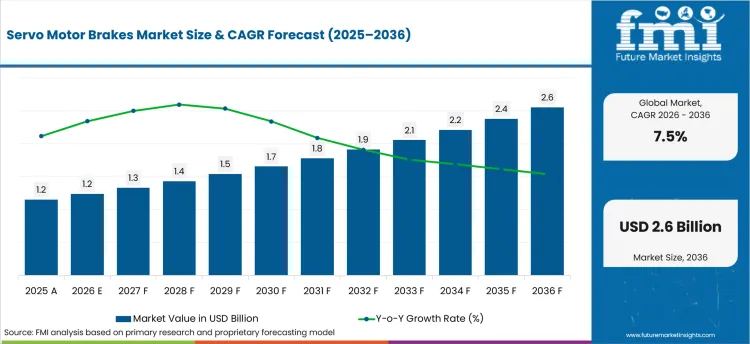
| Metric | Value |
|---|---|
| 2025 Market Size | USD 1.2 billion |
| 2026 Market Size | USD 1.2 billion |
| 2036 Market Size | USD 2.6 billion |
| Forecast CAGR (2026-2036) | 7.5% |
| Demand Type Focus | New servo system fitment |
| New servo system fitment Share (2026) | 72.0% |
| Servo Motor Size Focus | Medium frame servo motors |
| Medium frame servo motors Share (2026) | 44.0% |
| Torque Range Focus | 5-20 Nm |
| 5-20 Nm Share (2026) | 39.0% |
Summary of the Servo Motor Brakes Market
| Market Signal | Commercial Impact |
|---|---|
| Demand and Growth Drivers | Purchasing for servo motor brakes is estimated to rise as machine builders connect axis holding and commissioning assurance. Account decisions are expected to reflect product evidence and short support response across repeat equipment programs.
|
| Product and Segment View | Segment demand is led by new servo system fitment and 5-20 Nm torque applications needing documented brake performance. Specification work is anticipated to focus on brake programs designed for repeat machine platforms and shorter approval cycles.
|
| Geography and Growth Outlook | Country demand is likely to improve across markets investing in automation equipment and local service coverage. Supplier gains are projected to reflect equipment installation depth and proof-led account review.
|
| Competitive Landscape | Competition is likely to focus on brake technology breadth and application support. Account wins are expected to favor suppliers with test records and documentation depth.
|
| Analyst Perspective | Servo motor brakes are developing into a specification-led component group linked to servo accuracy and equipment uptime. Supplier progress is projected to improve led by brake evidence and field support aligned with automation OEM requirements.
|
How is the servo motor brakes market segmented?
The servo motor brakes market is segmented by brake type, torque range, servo motor size, application, demand type, and region.
The servo motor brakes industry is segmented by brake type, torque range, servo motor size, application, demand type, and region. Brake type coverage includes spring-applied brakes, permanent magnet brakes, electromagnetic holding brakes, and dynamic braking units. Torque range coverage includes below 5 Nm, 5-20 Nm, 20-50 Nm, and above 50 Nm. Servo motor size coverage includes compact servo motors, medium frame servo motors, and large frame servo motors. Application coverage includes robotics, CNC machinery, packaging and printing, semiconductor equipment, medical and lab automation, and AGV or mobile robots. Demand type coverage includes new servo system fitment and replacement or retrofit. Regional coverage includes North America, Latin America, Europe, East Asia, South Asia, Oceania, and Middle East and Africa.
How does new servo system fitment support demand type?
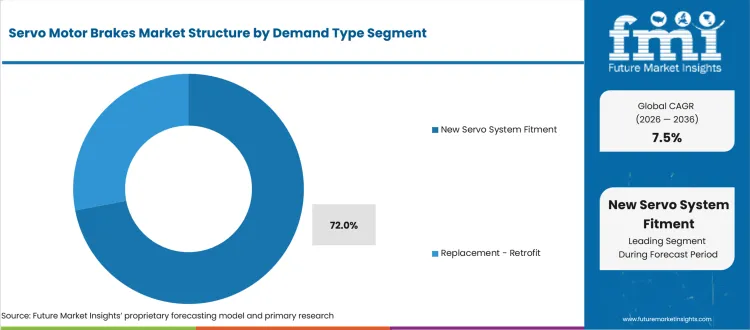
New servo system fitment is anticipated to support demand as OEMs select brake designs during gearbox and drive specification. Design-stage approval helps buyers reduce rework once motor families move into repeated machine builds. Association for Advancing Automation reported on February 6, 2026 stating North America having orders of 36,766 robots in 2025, showing automation investment likely pulls brake selection into early equipment design.
- New servo system fitment is projected to account for 72.0% share in 2026, aided by OEM brake integration and machine-platform planning. Buyers prefer fitment-stage approval once motor face and torque records affect launch timing.
- Replacement and retrofit demand are expected to retain service value. New system fitment gains preference once machine builders need coordinated brake and controller approval before shipment.
How do medium frame servo motors shape servo motor size demand?
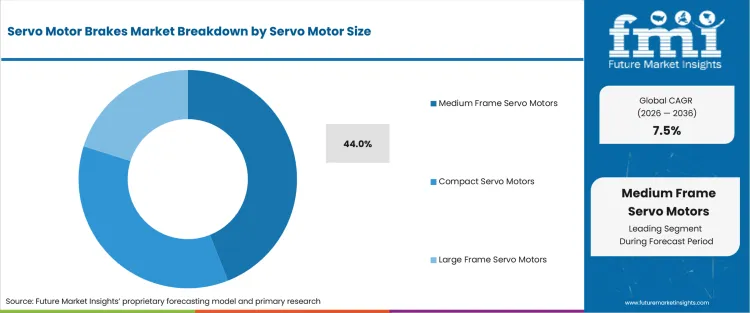
Medium frame servo motors are expected to guide purchasing as many automated machines require holding torque without oversizing brake assemblies. Buyers are likely to compare brake width and interface consistency before platform release. International Federation of Robotics stated on September 25, 2025 having operational industrial robot stock of 4,664,000 units in 2024, keeping medium-frame motor brake programs close to installed automation capacity.
- Medium frame servo motors are anticipated to hold 44.0% share in 2026, led by automated equipment requiring balanced torque and compact assembly. Suppliers gain account approval once brake data supports repeat machine designs.
- Compact servo motors and large frame servo motors serve different equipment profiles. Medium frame designs gain attention as buyers compare torque reserve and enclosure space across repeat production lines.
How is 5-20 Nm positioned within torque range?
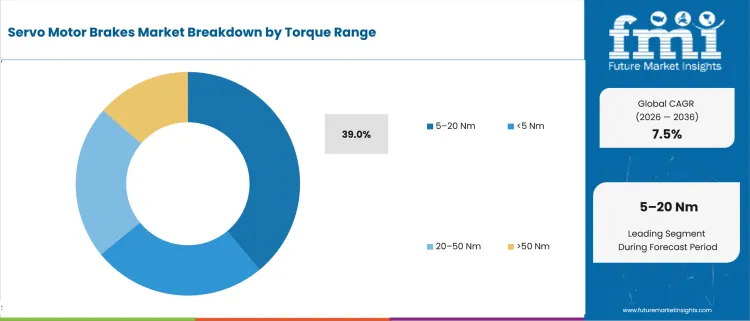
5-20 Nm torque range is estimated to influence brake selection as low-to-medium servo axes need compact holding strength and consistent release response. Equipment builders assess torque margin and coil behavior before locking brake families into product bills. Association for Advancing Automation reported on February 6, 2026 stating collaborative robots being accounted for 28.6% of all robots ordered in fourth quarter 2025, highlighting brake programs built around compact axes and low-to-medium torque applications.
- 5-20 Nm is forecast to hold 39.0% share in 2026, helped by common use across packaging machines and tooling systems. Accounts prefer torque bands supported by clear sizing records and supplier drawings.
- Below 5 Nm and 20-50 Nm ranges serve narrower equipment needs. 5-20 Nm gains selection preference once buyers need a balance of compact design and axis holding confidence.
What supports demand for spring-applied brakes within brake type?
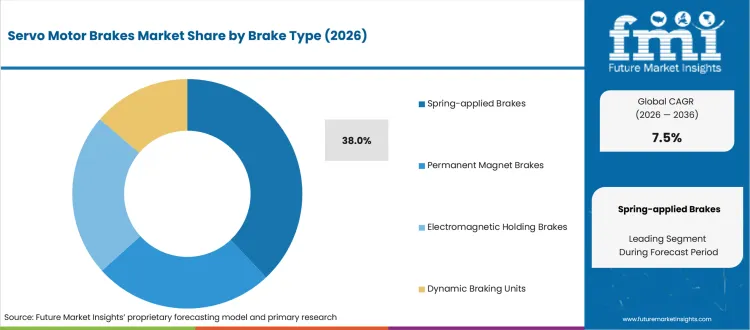
Spring-applied brakes are projected to support demand as fail-safe holding remains essential in vertical axes and power-loss scenarios. Buyers evaluate air-gap tolerance and wear behavior before regular use. Kendrion stated on March 25, 2025 claiming its small-motor brake portfolio uses 3 core technologies, including spring-applied brakes suited for space-saving and energy-efficient robotics or battery-powered mobile systems.
- Spring-applied brakes are estimated to capture 38.0% share in 2026, led by fail-safe holding needs and buyer familiarity. Suppliers gain approval once spring-applied designs pass motor-interface and serviceability review.
- Permanent magnet and electromagnetic holding brakes serve precision and holding applications with different design trade-offs. Spring-applied formats gain account attention once equipment teams compare safe-state behavior and availability.
Why does robotics influence application demand?
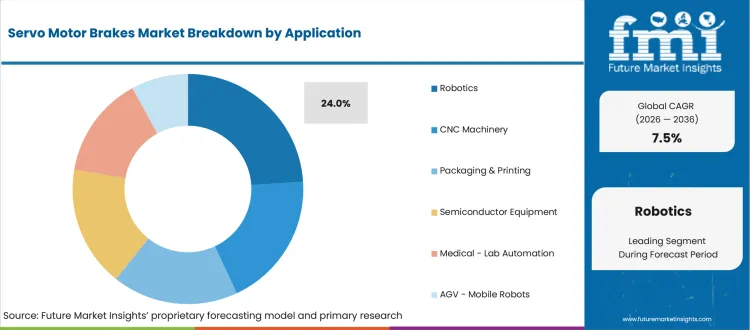
Robotics applications are anticipated to support servo motor brake demand as multi-axis machines rely on controlled stopping and position holding across repeated cycles. Automation teams assess brake response and service access before adding a brake family to approved platforms. International Federation of Robotics reported on September 25, 2025 for Asia being accounted for 74% of new industrial robot deployments in 2024, directing supplier review toward markets with dense automation programs.
- Robotics is predicted to account for 24.0% share in 2026, backed by articulated arms and automated handling systems. Buyers prefer brakes with compact geometry and evidence for repeated cycle behavior.
- CNC machinery and packaging or printing applications retain commercial use. Robotics gains account attention once brake evidence reduces axis drift risk and supports compact machine envelopes.
What are the drivers, restraints, and opportunities in the servo motor brakes market?
Near-term purchases are shaped by product availability and service-led adoption routes outlined below.
- Driver: Machine builders are qualifying servo braking systems for safer axes and repeatable equipment commissioning.
- Restraint: Adoption slows if dimensional evidence or service responsibility remains unclear during trials.
- Opportunity: Compact automation and collaborative systems are opening demand for low-to-medium torque brake designs.
Demand rises as automated equipment programs increase the need for controlled stopping and axis holding. International Federation of Robotics reported on September 25, 2025 announcing annual robot installations to have reached above 500,000 units for the 4th consecutive year in 2024, giving brake suppliers a clear automation base for design approvals.
Restraints center on proof gaps between brake specification and machine-safety acceptance. Occupational Safety and Health Administration reported in its April 15, 2026 update Control of Hazardous Energy ranked 4th among most cited standards for fiscal year 2025, raising the documentation burden for braking systems linked to maintenance and safe stop behavior.
Opportunities are expected to expand as collaborative and compact automation programs require smaller brake packages with verified holding performance. Association for Advancing Automation reported on February 6, 2026 noting collaborative robot orders to have reached 7,212 units in 2025, supporting low-to-medium torque brake demand across space-constrained systems.
What country CAGRs are profiled in the servo motor brakes market?
.webp "Top Country Growth Comparison Servo Motor Brakes Market Cagr (2026 2036)")
| Country | CAGR |
|---|---|
| India | 9.6% |
| China | 8.8% |
| Taiwan | 7.5% |
| South Korea | 7.2% |
| United States | 6.4% |
| Germany | 6.0% |
| Japan | 5.6% |
Source: Future Market Insights analysis, 2026.
How do country-level CAGRs compare in the servo motor brakes market?
Country demand in servo motor brakes is expected to be guided by automation buildout and supplier service access. India and China are likely to connect demand with industrial robot additions and local brake manufacturing access. Taiwan and South Korea are anticipated to connect adoption with electronics equipment and precision automation. United States, Germany, and Japan are projected to connect demand with technical documentation and long qualification cycles.
- India servo motor brake demand is likely to be shaped by local automation growth and application-service needs. Demand in India is projected to grow at 9.6% CAGR through 2036, reflected by robot installation momentum and local equipment expansion. International Federation of Robotics reported on September 25, 2025 claiming India to have reached 9,100 industrial robot installations in 2024. Installation depth keeps brake approval close to field support and machine-platform validation. Local suppliers are expected to gain account attention through shorter sampling cycles and stable service coverage.
- China servo motor brake demand is projected to be influenced by industrial automation scale and domestic servo system depth. International Federation of Robotics reported on September 25, 2025 announcing China having installed 295,000 industrial robots in 2024, supporting a larger base of servo-axis applications needing brake sizing and field response. Sales in China are forecast to expand at 8.8% CAGR from 2026 to 2036, backed by local automation capacity and supplier availability. High equipment volumes make brake evidence valuable since small interface issues may affect many machine builds. Domestic suppliers are expected to receive review strength once technical files and replenishment discipline match OEM launch calendars.
- Taiwan buyers are expected to favor suppliers supporting compact brakes and fast application review for electronics equipment. Adoption in Taiwan is predicted to rise at 7.5% CAGR by 2036, aided by semiconductor equipment concentration and precision manufacturing. SEMI reported on January 7, 2025 stating to have an expected start of 18 new semiconductor fab construction projects in 2025, supporting automation equipment demand linked to motion control and brake qualification. Equipment suppliers are likely to gain acceptance through low-noise operation and documented release response.
- Sector in South Korea is likely to grow at 7.2% CAGR by 2036, reinforced by automation intensity and concentrated manufacturing networks. International Federation of Robotics reported on September 25, 2025 for the Republic of Korea to have installations of 30,600 industrial robots in 2024, keeping brake selection close to robot maintenance and electronics automation support. Account teams are projected to compare suppliers on torque evidence and troubleshooting depth. Local service partners are expected to improve approval confidence once buyers move from single-site trials to repeated orders.
- United States servo motor brake purchasing is anticipated to be shaped by robot orders and machine-safety scrutiny. Market in the United States is expected to scale at 6.4% CAGR during the assessment period, guided by automation upgrades and documentation review. Association for Advancing Automation reported on February 6, 2026 for North American robot orders to have risen by 6.6% in 2025, supporting component demand across new equipment programs and replacements. Buyers are likely to require torque files and service ownership before new brake families enter approved vendor lists. Supplier progress is projected to improve through fast engineering response and distributor coverage.
- Germany is estimated to expand at 6.0% CAGR between 2026 and 2036, reinforced by disciplined machinery compliance and industrial automation depth. German account teams are expected to review brake safety files and machine acceptance records carefully before replacing approved products. International Federation of Robotics reported on September 25, 2025 stating Germany having installed 26,982 industrial robots in 2024. Robot depth supports brake review across machine tools and packaging machinery. Supplier selection is expected to favor tested brake families and consistent documentation.
- Japan keeps servo motor brake demand close to compact machine design and long approval cycles. International Federation of Robotics reported on September 25, 2025 claiming Japan to have installed 44,500 industrial robots in 2024, keeping motion components under review across robotics and precision equipment. Controlled automation expansion is anticipated to keep supplier selection centered on low failure risk and repeat-machine consistency. Japanese equipment teams are likely to avoid quick supplier changes unless sample quality and evidence files remain stable. Sector in Japan is projected to post 5.6% CAGR during the forecast period, shaped by qualification depth and compact machinery standards.
Who are the notable companies in the servo motor brakes market?
Mayr, Kendrion, Ogura Industrial, Miki Pulley, Warner Electric, Nexen Group, KEB Automation, SINFONIA Technology, Mitsubishi Electric, and Yaskawa are expected to shape demand.
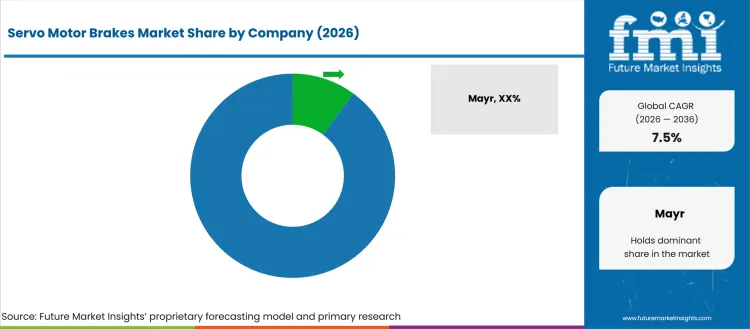
Competition in servo motor brakes is anticipated to center on brake technology coverage and regional service reach. Account teams are likely to compare suppliers based on torque evidence and ability to support repeat-machine programs after initial approval. Mayr, Kendrion, Ogura Industrial, and Miki Pulley are expected to receive review attention due to industrial brake knowledge and servo-axis support. Warner Electric, Nexen Group, and KEB Automation are projected to compete through engineering assistance and channel depth. SINFONIA Technology, Mitsubishi Electric, and Yaskawa are estimated to support account demand led by automation relationships and application guidance.
- Mayr, Kendrion, Ogura Industrial, and Miki Pulley are expected to gain account attention based on brake design depth and servo-axis knowledge. Fail-safe and holding-brake experience is likely to promote programs needing torque testing and repeat production discipline.
- Warner Electric, Nexen Group, and KEB Automation are anticipated to compete led by engineering service and channel support. Their role is projected to improve as machine builders review installation files and local availability before approval.
- SINFONIA Technology, Mitsubishi Electric, and Yaskawa are forecast to support demand depending on automation equipment links. Automation knowledge is expected to help accounts compare brake compatibility and drive-system support.
- Specialist and regional suppliers are estimated to gain review strength depending on customization and service proximity. Supplier access is likely to improve as equipment builders need validated braking support for narrow machine platforms.
Competitive Benchmarking: Servo Motor Brakes Market
| Company | Portfolio Depth | Brake Format Match | Application Support | Service Reach |
|---|---|---|---|---|
| Mayr | High | High | High | Global |
| Kendrion | High | High | High | Global |
| Ogura Industrial | High | High | High | Global |
| Miki Pulley | High | High | High | Global |
| Warner Electric | Medium | High | High | Global |
| Nexen Group | Medium | High | High | Global |
| KEB Automation | Medium | Medium | High | Regional/Global |
| SINFONIA Technology | Medium | Medium | Medium | Regional/Global |
| Mitsubishi Electric | Medium | Medium | Medium | Global |
| Yaskawa | Medium | Medium | Medium | Global |
Source: Future Market Insights competitive analysis, 2026.
Key Developments in the Servo Motor Brakes Market
- In March 2025, Mayr opened its production plant in Halol near Vadodara in India. Mayr stated on March 3, 2025 its plant supports local production of safety brakes and clutches for Indian customers, improving service access for machine builders needing shorter brake supply lines.
- In November 2025, Mayr presented ROBA topstop safety brake and ROBA gateway at SPS 2025 in Nuremberg. Mayr stated in its 2025 event page ROBA topstop supports standard servo motors and sensorless brake monitoring, strengthening safety-brake evidence for vertical-axis equipment.
- In April 2026, Kendrion launched its Slim PM compact permanent magnet brake line for servo motors. Kendrion stated on April 21, 2026 Slim PM and High Torque Line use the same mechanical and electrical interface, helping OEMs cover different torque ranges without motor-platform redesign.
Key Players in the Servo Motor Brakes Market
Motion brake and equipment suppliers
- Mayr
- Kendrion
- Ogura Industrial
- Miki Pulley
Precision engineering and accessory specialists
- Warner Electric
- Nexen Group
- KEB Automation
Automation and application support partners
- SINFONIA Technology
- Mitsubishi Electric
- Yaskawa
Custom and account-specific brake suppliers
- Intorq
- Inertia Dynamics
- KEB America
Servo Motor Brakes Market - Report Scope

| Coverage field | Report scope |
|---|---|
| Market breakdown | Servo Motor Brakes Market breakdown by brake type, torque range, servo motor size, application, demand type, and region |
| Market Definition | Servo motor brakes are spring-applied, permanent magnet, electromagnetic holding, or dynamic braking components used to hold or stop servo-driven axes in automated equipment, robotics, machine tools, packaging machinery, medical automation, and mobile robot platforms. |
| Regions Covered | North America, Latin America, Europe, East Asia, South Asia, Oceania, and Middle East and Africa |
| Countries Covered | United States, China, Germany, Japan, India, South Korea, Taiwan, Canada, Brazil, Mexico, France, Italy, Spain, ASEAN, Australia and New Zealand, GCC countries, South Africa, and Türkiye |
| Key Companies Profiled | Mayr, Kendrion, Ogura Industrial, Miki Pulley, Warner Electric, Nexen Group, KEB Automation, SINFONIA Technology, Mitsubishi Electric, and Yaskawa |
| Forecast Period | 2026 to 2036 |
| Approach | Hybrid bottom-up and top-down methodology using segment share, country CAGR, industrial robot installations, servo-axis demand, brake torque profile, supplier portfolio depth, and channel exposure |
Source: Future Market Insights analysis, 2026.
Servo Motor Brakes Market - Research Methodology
| Method | Approach |
|---|---|
| Primary Research | Primary interviews covered machine builders, automation OEMs, maintenance teams, component distributors, robotics integrators, and precision equipment manufacturers. Discussions focused on torque range, release response, brake life, mounting interface, documentation needs, warranty ownership, and repeat-order readiness. |
| Desk Research | Desk research reviewed official robotics datasets, machinery safety updates, company portfolio pages, brake product releases, automation association references, and standards-body information. |
| Market Sizing and Forecasting | Market sizing used a hybrid model across segment mix, country CAGR, machine-builder adoption, robot installation exposure, replacement cycles, distributor participation, and supplier coverage across servo motor brakes. |
| Data Validation | Data validation compared segment shares, country CAGRs, company alignment, and official source signals to avoid unsupported claims and unrelated automation leakage. |
Servo Motor Brakes Market by Segments
Servo Motor Brakes Market segmented by Brake Type:
- Spring-applied brakes
- Permanent magnet brakes
- Electromagnetic holding brakes
- Dynamic braking units
Servo Motor Brakes Market segmented by Torque Range:
- Below 5 Nm
- 5-20 Nm
- 20-50 Nm
- Above 50 Nm
Servo Motor Brakes Market segmented by Servo Motor Size:
- Compact servo motors
- Medium frame servo motors
- Large frame servo motors
Servo Motor Brakes Market segmented by Application:
- Robotics
- CNC machinery
- Packaging and printing
- Semiconductor equipment
- Medical and lab automation
- AGV and mobile robots
Servo Motor Brakes Market segmented by Demand Type:
- New servo system fitment
- Replacement and retrofit
Servo Motor Brakes Market by Region:
- North America
- United States
- Canada
- Latin America
- Brazil
- Mexico
- Argentina
- Europe
- Germany
- United Kingdom
- France
- Italy
- Spain
- East Asia
- China
- Japan
- South Korea
- Taiwan
- South Asia and Pacific
- India
- Thailand
- Indonesia
- Oceania
- Australia
- New Zealand
- Middle East and Africa
- GCC countries
- South Africa
- Türkiye
Research Sources and Bibliography
- Association for Advancing Automation. (2026, February 6). Robot orders grow 6.6% in 2025 as general industries drive automation adoption.
- International Federation of Robotics. (2025, September 25). World Robotics 2025 report - Industrial robots.
- Kendrion. (2025, March 25). Mini motors, maximum demands: Brake design expertise.
- Kendrion. (2026, April 21). New Slim PM line: Two brakes, one technology - the perfect duo.
- Mayr. (2025, March 3). Mayr power transmission opens plant in India.
- Mayr. (2025). Mayr power transmission at SPS 2025.
- Occupational Safety and Health Administration. (2026, April 15). Top 10 most frequently cited standards for fiscal year 2025.
- SEMI. (2025, January 7). Eighteen new semiconductor fabs to start construction in 2025.
This bibliography is provided for reader reference and is not exhaustive. The full report contains the complete reference list and detailed citations.
This Report Answers
- What segments shape demand across brake type, torque range, servo motor size, application, and demand type?
- How do machine builders evaluate servo motor brakes before replacing approved brake families?
- How do country CAGRs differ across profiled markets?
- What companies compete through brake technology depth and application service?
- How does FMI validate forecasts using a hybrid bottom-up and top-down approach?
- What factors do account teams address before larger account expansion?
- How do torque records and safe-stop evidence affect supplier selection?
- What limits return on investment for account teams adding servo motor brakes to machine programs?
- How do installation files and field response records influence account approval?
- What supplier capabilities improve long-term account confidence?
Frequently Asked Questions
What is supporting demand in the servo motor brakes market?
Demand is likely to be supported by machine builders needing braking systems protecting servo axes during power loss and controlled stopping. Accounts are expected to prefer brake suppliers combining torque evidence and installation support.
Who are the key players in the servo motor brakes market?
Key companies are anticipated to include Mayr, Kendrion, Ogura Industrial, Miki Pulley, Warner Electric, Nexen Group, KEB Automation, SINFONIA Technology, Mitsubishi Electric, and Yaskawa. Competition is likely to be based on brake portfolio depth and regional service coverage.
What is a restraint in the servo motor brakes market?
Proof burden acts as a practical restraint for servo motor brakes since buyers need interface evidence and supplier response before approving equipment use. Accounts slow adoption if brakes lack torque records or supplier response needed for equipment approval.
Why do executives need to track the servo motor brakes market?
Executives are expected to track the market as brake decisions affect machine safety and equipment uptime. Factors such as qualification delay and repeat purchase confidence shape buyer reviews.
What business problem does the servo motor brakes market address?
Market demand addresses equipment programs needing safer restart behavior and documented installation support across automated machinery. Machine builders and automation OEMs need brake formats holding servo axes safely and supporting installation documentation.
What do account teams evaluate before selecting suppliers?
Account teams are likely to evaluate torque rating and repeat-order reliability before supplier approval. Interface continuity and service response are expected to guide final supplier review.
What limits return on investment for purchasing teams?
Return on investment weakens if brake performance or account acceptance is not proven before equipment launch. Qualification delays and replacement work reduce expected margin gains.
How do suppliers build long-term account confidence?
Suppliers build account confidence by providing consistent brake quality and application evidence specific to servo motor brakes. Test records and responsive field support are expected to influence repeat-order trust.
Preview the report firsthand - request a free sample
Get SampleGet the brochure for pricing and purchase details.
Get PDFTable of Content
- Key Takeaways
- Market Size and CAGR
- Top Growth Driver
- Fastest Growing Segment
- Leading Region
- Key Companies
- Emerging Opportunities
- Executive Summary
- Global Market Outlook
- Demand-side Trends
- Supply-side Trends
- Technology Roadmap Analysis
- Analysis and Recommendations
- Analyst Perspective (What is happening? Why now? What should investors know?)
- Key Questions Answered
- How large is the market?
- What is the CAGR?
- What are key trends?
- Which region dominates?
- Who are the leaders?
- Market Overview
- Market Coverage / Taxonomy
- Market Definition / Scope / Limitations
- Research Methodology
- Chapter Orientation
- Analytical Lens and Working Hypotheses
- Market Structure, Signals, and Trend Drivers
- Benchmarking and Cross-market Comparability
- Market Sizing, Forecasting, and Opportunity Mapping
- Research Design and Evidence Framework
- Desk Research Programme (Secondary Evidence)
- Expert Input and Fieldwork (Primary Evidence)
- Tooling, Models, and Reference Databases
- Data Engineering and Model Build
- Quality Assurance and Audit Trail
- Market Background
- Market Dynamics (Drivers, Restraints, Opportunity, Trends)
- Scenario Forecast (Optimistic, Likely, Conservative)
- Impact Analysis
- AI Impact
- Sustainability Impact
- Regulatory Impact
- Technology Impact
- Consumer / Buyer Analysis
- Purchase Drivers
- Adoption Barriers
- Buyer Journey
- Opportunity Map Analysis
- Product Life Cycle Analysis
- Supply Chain Analysis
- Investment Feasibility Matrix
- Value Chain Analysis
- PESTLE and Porter's Analysis
- Regulatory Landscape
- Regional Parent Market Outlook
- Production and Consumption Statistics
- Import and Export Statistics
- Global Market Analysis and Forecast, 2021 to 2036
- Historical Market Size Value (USD Billion) & Volume (Unit) Analysis, 2021 to 2025
- Current and Future Market Size Value (USD Billion) & Volume (Unit) Projections, 2026 to 2036
- Y-o-Y Growth Trend Analysis
- Absolute $ Opportunity Analysis
- Global Market Pricing Analysis, 2021 to 2036
- Global Market Analysis and Forecast, By Brake Type, 2021 to 2036
- Introduction / Key Findings
- Historical Market Size Value (USD Billion) & Volume (Unit) Analysis By Brake Type, 2021 to 2025
- Current and Future Market Size Value (USD Billion) & Volume (Unit) Analysis and Forecast By Brake Type, 2026 to 2036
- Spring-applied Brakes
- Permanent Magnet Brakes
- Electromagnetic Holding Brakes
- Dynamic braking units
- Spring-applied Brakes
- Y-o-Y Growth Trend Analysis By Brake Type, 2021 to 2025
- Absolute $ Opportunity Analysis By Brake Type, 2026 to 2036
- Global Market Analysis and Forecast, By Torque Range, 2021 to 2036
- Introduction / Key Findings
- Historical Market Size Value (USD Billion) & Volume (Unit) Analysis By Torque Range, 2021 to 2025
- Current and Future Market Size Value (USD Billion) & Volume (Unit) Analysis and Forecast By Torque Range, 2026 to 2036
- 5-20 Nm
- <5 Nm
- 20-50 Nm
- >50 Nm
- 5-20 Nm
- Y-o-Y Growth Trend Analysis By Torque Range, 2021 to 2025
- Absolute $ Opportunity Analysis By Torque Range, 2026 to 2036
- Global Market Analysis and Forecast, By Servo Motor Size, 2021 to 2036
- Introduction / Key Findings
- Historical Market Size Value (USD Billion) & Volume (Unit) Analysis By Servo Motor Size, 2021 to 2025
- Current and Future Market Size Value (USD Billion) & Volume (Unit) Analysis and Forecast By Servo Motor Size, 2026 to 2036
- Medium Frame Servo Motors
- Compact Servo Motors
- Large Frame Servo Motors
- Medium Frame Servo Motors
- Y-o-Y Growth Trend Analysis By Servo Motor Size, 2021 to 2025
- Absolute $ Opportunity Analysis By Servo Motor Size, 2026 to 2036
- Global Market Analysis and Forecast, By Application, 2021 to 2036
- Introduction / Key Findings
- Historical Market Size Value (USD Billion) & Volume (Unit) Analysis By Application, 2021 to 2025
- Current and Future Market Size Value (USD Billion) & Volume (Unit) Analysis and Forecast By Application, 2026 to 2036
- Robotics
- CNC Machinery
- Packaging & Printing
- Semiconductor Equipment
- Medical - Lab Automation
- AGV - Mobile Robots
- Robotics
- Y-o-Y Growth Trend Analysis By Application, 2021 to 2025
- Absolute $ Opportunity Analysis By Application, 2026 to 2036
- Global Market Analysis and Forecast, By Demand Type, 2021 to 2036
- Introduction / Key Findings
- Historical Market Size Value (USD Billion) & Volume (Unit) Analysis By Demand Type, 2021 to 2025
- Current and Future Market Size Value (USD Billion) & Volume (Unit) Analysis and Forecast By Demand Type, 2026 to 2036
- New Servo System Fitment
- Replacement - Retrofit
- New Servo System Fitment
- Y-o-Y Growth Trend Analysis By Demand Type, 2021 to 2025
- Absolute $ Opportunity Analysis By Demand Type, 2026 to 2036
- Global Market Analysis and Forecast, By Region, 2021 to 2036
- Introduction
- Historical Market Size Value (USD Billion) & Volume (Unit) Analysis By Region, 2021 to 2025
- Current Market Size Value (USD Billion) & Volume (Unit) Analysis and Forecast By Region, 2026 to 2036
- North America
- Latin America
- Europe
- East Asia
- South Asia and Pacific
- Oceania
- Middle East and Africa
- Market Attractiveness Analysis By Region
- North America Market Analysis and Forecast, By Country, 2021 to 2036
- Historical Market Size Value (USD Billion) & Volume (Unit) Trend Analysis By Market Taxonomy, 2021 to 2025
- Market Size Value (USD Billion) & Volume (Unit) Forecast By Market Taxonomy, 2026 to 2036
- By Country
- United States
- Canada
- By Brake Type
- By Torque Range
- By Servo Motor Size
- By Application
- By Demand Type
- By Country
- Market Attractiveness Analysis
- By Country
- By Brake Type
- By Torque Range
- By Servo Motor Size
- By Application
- By Demand Type
- Key Takeaways
- Latin America Market Analysis and Forecast, By Country
- Historical Market Size Value (USD Billion) & Volume (Unit) Trend Analysis By Market Taxonomy, 2021 to 2025
- Market Size Value (USD Billion) & Volume (Unit) Forecast By Market Taxonomy, 2026 to 2036
- By Country
- Brazil
- Mexico
- Argentina
- By Brake Type
- By Torque Range
- By Servo Motor Size
- By Application
- By Demand Type
- By Country
- Market Attractiveness Analysis
- By Country
- By Brake Type
- By Torque Range
- By Servo Motor Size
- By Application
- By Demand Type
- Key Takeaways
- Europe Market Analysis and Forecast, By Country
- Historical Market Size Value (USD Billion) & Volume (Unit) Trend Analysis By Market Taxonomy, 2021 to 2025
- Market Size Value (USD Billion) & Volume (Unit) Forecast By Market Taxonomy, 2026 to 2036
- By Country
- Germany
- United Kingdom
- France
- Italy
- Spain
- By Brake Type
- By Torque Range
- By Servo Motor Size
- By Application
- By Demand Type
- By Country
- Market Attractiveness Analysis
- By Country
- By Brake Type
- By Torque Range
- By Servo Motor Size
- By Application
- By Demand Type
- Key Takeaways
- East Asia Market Analysis and Forecast, By Country
- Historical Market Size Value (USD Billion) & Volume (Unit) Trend Analysis By Market Taxonomy, 2021 to 2025
- Market Size Value (USD Billion) & Volume (Unit) Forecast By Market Taxonomy, 2026 to 2036
- By Country
- China
- Japan
- South Korea
- Taiwan
- By Brake Type
- By Torque Range
- By Servo Motor Size
- By Application
- By Demand Type
- By Country
- Market Attractiveness Analysis
- By Country
- By Brake Type
- By Torque Range
- By Servo Motor Size
- By Application
- By Demand Type
- Key Takeaways
- South Asia and Pacific Market Analysis and Forecast, By Country
- Historical Market Size Value (USD Billion) & Volume (Unit) Trend Analysis By Market Taxonomy, 2021 to 2025
- Market Size Value (USD Billion) & Volume (Unit) Forecast By Market Taxonomy, 2026 to 2036
- By Country
- India
- Thailand
- Indonesia
- By Brake Type
- By Torque Range
- By Servo Motor Size
- By Application
- By Demand Type
- By Country
- Market Attractiveness Analysis
- By Country
- By Brake Type
- By Torque Range
- By Servo Motor Size
- By Application
- By Demand Type
- Key Takeaways
- Oceania Market Analysis and Forecast, By Country
- Historical Market Size Value (USD Billion) & Volume (Unit) Trend Analysis By Market Taxonomy, 2021 to 2025
- Market Size Value (USD Billion) & Volume (Unit) Forecast By Market Taxonomy, 2026 to 2036
- By Country
- Australia
- New Zealand
- By Brake Type
- By Torque Range
- By Servo Motor Size
- By Application
- By Demand Type
- By Country
- Market Attractiveness Analysis
- By Country
- By Brake Type
- By Torque Range
- By Servo Motor Size
- By Application
- By Demand Type
- Key Takeaways
- Middle East and Africa Market Analysis and Forecast, By Country
- Historical Market Size Value (USD Billion) & Volume (Unit) Trend Analysis By Market Taxonomy, 2021 to 2025
- Market Size Value (USD Billion) & Volume (Unit) Forecast By Market Taxonomy, 2026 to 2036
- By Country
- GCC countries
- South Africa
- Türkiye
- By Brake Type
- By Torque Range
- By Servo Motor Size
- By Application
- By Demand Type
- By Country
- Market Attractiveness Analysis
- By Country
- By Brake Type
- By Torque Range
- By Servo Motor Size
- By Application
- By Demand Type
- Key Takeaways
- Key Countries Market Analysis
- India
- Pricing Analysis
- Market Share Analysis, 2025
- By Brake Type
- By Torque Range
- By Servo Motor Size
- By Application
- By Demand Type
- China
- Pricing Analysis
- Market Share Analysis, 2025
- By Brake Type
- By Torque Range
- By Servo Motor Size
- By Application
- By Demand Type
- Taiwan
- Pricing Analysis
- Market Share Analysis, 2025
- By Brake Type
- By Torque Range
- By Servo Motor Size
- By Application
- By Demand Type
- South Korea
- Pricing Analysis
- Market Share Analysis, 2025
- By Brake Type
- By Torque Range
- By Servo Motor Size
- By Application
- By Demand Type
- United States
- Pricing Analysis
- Market Share Analysis, 2025
- By Brake Type
- By Torque Range
- By Servo Motor Size
- By Application
- By Demand Type
- Germany
- Pricing Analysis
- Market Share Analysis, 2025
- By Brake Type
- By Torque Range
- By Servo Motor Size
- By Application
- By Demand Type
- Japan
- Pricing Analysis
- Market Share Analysis, 2025
- By Brake Type
- By Torque Range
- By Servo Motor Size
- By Application
- By Demand Type
- India
- Market Structure Analysis
- Competition Dashboard
- Competition Benchmarking
- Market Share Analysis of Top Players
- By Regional
- By Brake Type
- By Torque Range
- By Servo Motor Size
- By Application
- By Demand Type
- Emerging Startups
- Innovation Benchmarking
- Competition Analysis
- Competition Deep Dive
- Mayr
- Overview
- Product Portfolio
- Profitability by Market Segments (Product/Region/Sales Channel)
- Sales Footprint
- Strategy Overview
- Marketing Strategy
- Product Strategy
- Channel Strategy
- Kendrion
- Ogura Industrial
- Miki Pulley
- Warner Electric
- Nexen Group
- KEB Automation
- SINFONIA Technology
- Mitsubishi Electric
- Yaskawa
- Mayr
- Case Studies
- Success Stories
- Recent Developments
- Competition Deep Dive
- Assumptions & Acronyms Used


