

- Market Size (2026)
- USD 720.6 Mn
- Forecast (2036)
- USD 2027.7 Mn
- CAGR (2026 to 2036)
- 10.9%
How big is Servo Drive Monitoring Market in 2026?
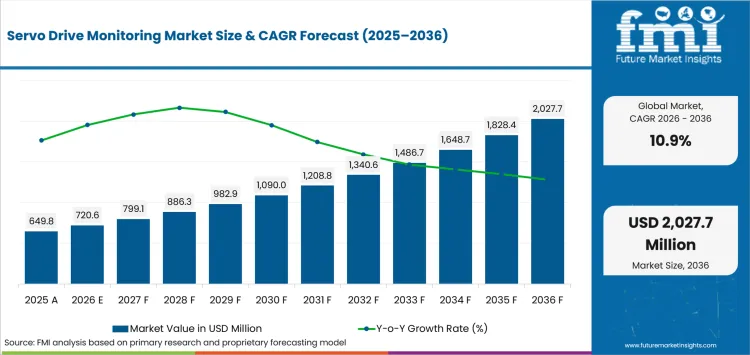
USD 720.6 million in 2026 and USD 2027.7 million by 2036 at a 10.9% CAGR.
Demand for servo drive monitoring is projected to expand at 10.9% CAGR between 2026 and 2036, increasing valuation from USD 720.6 million in 2026 to USD 2027.7 million by 2036. Factories attach monitoring to denser motion systems as maintenance teams need faster fault isolation before a failed servo axis interrupts synchronized production. The International Federation of Robotics reported in September 2025 that 542,000 industrial robots were installed during 2024 as the global motion base expanded.
Regional industrial automation density changes how quickly servo monitoring becomes a maintenance layer and how much retrofit support factories require. The International Federation of Robotics reported 267 robots per 10,000 manufacturing employees in Western Europe during 2024 compared with 204 in North America and 131 in Asia. These installed-base differences shape retrofit workload and service demand although controller compatibility determines how quickly monitoring revenue converts inside each country.
Key Takeaways of Servo Drive Monitoring Market
- Servo-rich production raises monitoring demand as maintenance teams need earlier fault isolation across robotics and other motion-intensive machinery.
- By monitoring type, condition monitoring is estimated to hold 27.0% in 2026 owing to routine health checks that fit established maintenance schedules.
- In 2026, AC servo drives are expected to lead drive type with 43.0% share because closed-loop feedback exposes useful operating variables without extra sensing.
- Based on connectivity, industrial Ethernet is projected to account for 39.0% in 2026 due to synchronized machine networking and diagnostic data exchange.
- Mixed controller estates and operational-technology security reviews raise integration effort during production qualification across brownfield lines.
- The competitive outlook comprises Siemens, Rockwell Automation, ABB, Schneider Electric, Mitsubishi Electric, Omron, Bosch Rexroth and Kollmorgen.
Analyst Perspective
"Servo monitoring earns budget when drive data narrows a fault to one axis and points maintenance toward a credible action. Strong offers combine native diagnostics with secure edge deployment, open industrial networking and service support that avoids unnecessary controls replacement."
- Nikhil Kaitwade, Principal Consultant, Future Market Insights
How is the Servo Drive Monitoring Market segmented?
Axes cover monitoring type, drive type, connectivity, application, sales model and region.
Monitoring type covers condition monitoring, energy monitoring, fault diagnostics, predictive maintenance and performance optimization. Drive type includes AC servo drives, DC servo drives, integrated servo motors and multi-axis servo drives. Connectivity covers industrial Ethernet, fieldbus, wireless or IoT gateway and cloud API, while applications include robotics, CNC machines, packaging machinery, electronics assembly and printing or textile machinery. Sales model includes embedded OEM software, subscription monitoring and retrofit monitoring kits, with region completing coverage.
What makes condition monitoring central to the monitoring type category?
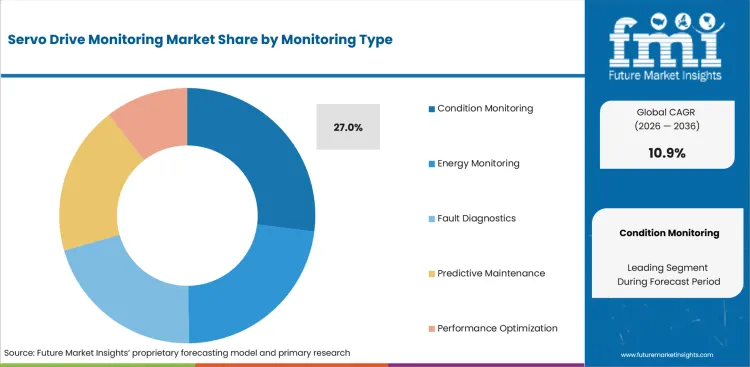
Condition monitoring gives maintenance teams a direct health check before they commit to deeper predictive models across operating equipment. Siemens launched Sinamics S220 in October 2025 with high-frequency data transmission for predictive maintenance via its X128 interface.
- By monitoring type, condition monitoring is estimated to hold 27.0% in 2026 owing to its direct fit with routine health checks and maintenance decisions.
- Maintenance teams can pair condition monitoring systems with existing servo signals so abnormal current or thermal behavior becomes a service decision instead of another raw tag.
How do AC servo drives influence selection within the drive type category?
AC servo drives expose closed-loop position and torque data that help controls engineers interpret axis behavior without adding a separate sensing layer. Their digital architecture also preserves useful commissioning records for later troubleshooting across precision machinery and service cycles.
- In 2026, AC servo drives are expected to lead drive type with 43.0% share because digital feedback loops expose useful operating variables.
- Bosch Rexroth introduced ctrlX DRIVE cabinet-free in February 2025 with IP65 construction and multi-Ethernet interfaces that place diagnostic access near distributed motion hardware.
Why does industrial Ethernet lead the connectivity category?
Industrial Ethernet carries drive status beside controller events so monitoring software can interpret faults inside the machine sequence. Mitsubishi Electric Automation added EtherNet/IP to EtherCAT-compatible MELSERVO-J5 amplifiers by firmware in June 2025 without requiring new hardware.
- Based on connectivity, industrial Ethernet is projected to account for 39.0% in 2026 due to deterministic networking that also carries diagnostic traffic.
- Controls teams favor industrial communication that reaches mixed controller estates without a separate gateway project or forced replacement of serviceable motion hardware during staged brownfield upgrades across older production lines.
What supports robotics within the application category?
Robot cells concentrate several servo axes inside one synchronized machine so small motion deviations can disrupt cycle time and repeatability. Maintenance teams therefore need axis-level diagnostics that separate drive faults from tooling or process problems.
- The application category is forecast to be led by robotics at 25.0% share in 2026 due to multi-axis motion density and costly manual fault isolation.
- Industrial robotics activity strengthens the installed-base case as the International Federation of Robotics reported about 13,000 robots installed by Japanese automotive manufacturers during 2024 in July 2025.
What are the drivers, restraints and opportunities in the Servo Drive Monitoring Market?
Automation density raises demand for servo diagnostics while OT security and legacy integration slow approval and edge analytics reduce retrofit effort for recurring monitoring services.
- Driver: More servo axes increase the cost of manual fault isolation and raise the value of drive-level health signals.
- Restraint: Mixed controller generations and operational-technology security checks extend qualification for connected monitoring across production systems.
- Opportunity: Edge data tools reuse existing drive telemetry and package diagnostics into embedded software or recurring service offers.
Automation Density Raises Diagnostic Value
Robot cells raise diagnostic workload as each production line contains more servo axes that can stop synchronized motion. The Association for Advancing Automation reported 36,766 North American robot orders during 2025 with unit orders rising 6.6% from 2024. Drive-level monitoring tied to factory automation controls helps maintenance teams locate the affected axis sooner and shorten production interruptions as automation spreads.
Cybersecurity Review Extends Qualification
Connected servo monitoring must satisfy plant cybersecurity controls as drive data travels across operational networks shared with production systems. CISA released eleven industrial control systems advisories in September 2025 covering products from Siemens and Schneider Electric. Network segmentation and access controls become part of qualification once predictive maintenance data crosses the original machine boundary.
Edge Analytics Reduce Retrofit Friction
Edge analytics reduce retrofit work by using signals that controllers and motion devices already collect during normal machine operation. OMRON demonstrated Sysmac Studio with NVIDIA Omniverse in March 2025 using automation controllers and motion equipment for digital-twin troubleshooting. Machine builders can package AI-driven predictive maintenance around existing telemetry while keeping sensitive production data inside the plant network.
Which country CAGRs are profiled in the Servo Drive Monitoring Market?
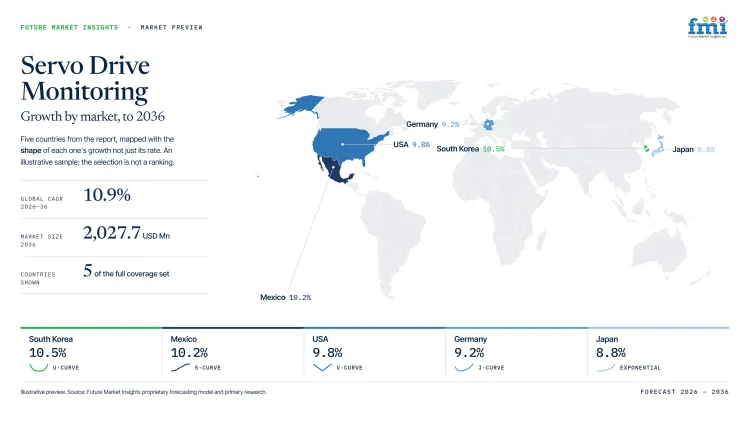
| Country | CAGR |
|---|---|
| South Korea | 10.5% |
| Mexico | 10.2% |
| United States | 9.8% |
| Germany | 9.2% |
| Japan | 8.8% |
How do country-level CAGRs compare in the Servo Drive Monitoring Market?
The coountry forecasts span 1.7 percentage points and form one band instead of distinct tiers. South Korea and Mexico make up the upper cluster while the United States marks a transition toward Germany and Japan. The spacing reflects automation maturity and brownfield integration demands across markets rather than size alone.
- South Korea pairs electronics automation with smart-factory programs that lower monitoring adoption friction.
- Mexico's automotive plants require integrators bridging modern lines with uneven digital practices.
- United States adoption depends on secure remote diagnostics across varied control estates nationwide.
- Germany prioritizes interoperable data exchange and lifecycle compatibility across long-lived machinery estates.
- Japan favors low-disruption diagnostics that fit established servo practices and long replacement cycles.
Similar CAGRs can produce different service costs, qualification work and network integration burdens. The full report provides country-level CAGR analysis across North America, Latin America, Europe, East Asia, South Asia, Oceania and the Middle East and Africa.
Country-wise Analysis
- South Korean electronics and machinery producers use automation networks, and the Ministry of SMEs and Startups stated in January 2025 that more than 1,700 manufacturing SMEs would receive robots or data-driven smart-factory support. South Korea's servo drive monitoring outlook is anticipated to advance at 10.5% CAGR over the assessment period, supported by public programs that widen access to connected production data and local automation services. Smaller factories face commissioning costs and limited maintenance staffing, so automation firms need packaged network connectors plus startup support before recurring software fees or remote diagnostic contracts become acceptable across older equipment fleets nationwide.
- Mexican automotive and electronics plants rely on rapid multi-axis motion across export facilities, yet older production lines often combine mixed controller estates with uneven digital skills and limited specialist support during maintenance programs. Servo drive monitoring demand in Mexico is forecast to rise at 10.2% CAGR over the forecast period, driven by multinational plants modernizing precision production and maintenance systems across major manufacturing corridors and supplier networks. The Secretariat of Economy reported in June 2026 that 4.8% of manufacturing firms with more than ten employees used AI, so integrators must pair network compatibility with training plus field service for connected diagnostics.
- United States manufacturers combine a large automation base with mature system-integration channels, giving maintenance teams several routes to connect servo data with plant reliability workflows and secure edge infrastructure across diverse production sites nationwide. The International Federation of Robotics reported in June 2026 that industrial robot installations reached 38,000 units during 2025 following an 11% increase as manufacturers continued adding servo-rich production assets across several industries. The United States servo drive monitoring sector is projected to record 9.8% CAGR during the assessment period, shaped by a large automation base and qualification demands across mixed drive generations under cybersecurity controls.
- German machine builders evaluate servo monitoring against interoperability and long equipment life as diagnostic software must coexist with durable controller architectures and documented plant data rules across brownfield machinery and modernization programs nationwide. Germany is estimated to post 9.2% CAGR over the forecast period, aided by standards-based data exchange and an installed machinery base that rewards low-disruption monitoring upgrades with lifecycle engineering and local service support. Plattform Industrie 4.0 reported in April 2025 that eight Manufacturing-X projects presented industrial data-sharing applications, yet older control generations require secure interfaces and clear governance across established domestic industrial production sites and long-lived networks.
- Japanese manufacturers operate within a deep robot and servo engineering base, and maintenance teams favor diagnostics that fit established lifecycle practices and preserve dependable support for long-lived precision equipment across domestic production sites. Servo drive monitoring sales in Japan are forecast to expand at 8.8% CAGR by 2036, influenced by precision manufacturing requirements and demand for low-disruption monitoring across established machine fleets and maintenance routines nationwide. The Japan Robot Association reported in June 2026 that domestic robot shipments fell 18.3% to 37,816 units during 2025, a condition that makes compatibility with existing equipment more commercially relevant for monitoring firms.
Who are the notable companies in the Servo Drive Monitoring Market?
Siemens, Rockwell Automation, ABB, Schneider Electric, Mitsubishi Electric, Omron, Bosch Rexroth and Kollmorgen are the notable companies serving this market.
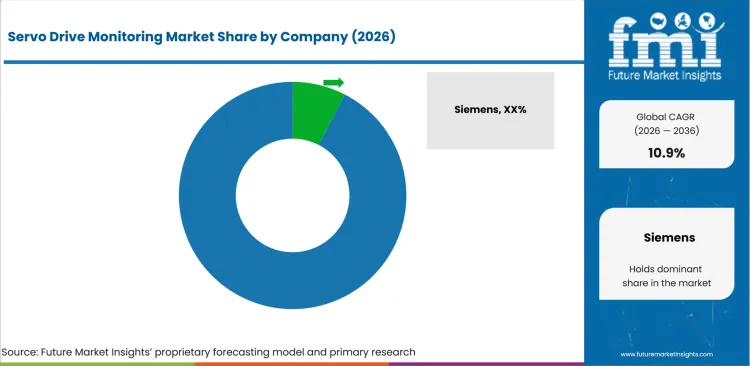
Integrated automation groups and specialist motion companies define a fragmented field because servo monitoring usually sits inside broader control platforms. Independent monitoring software has a narrower entry route unless it can read native drive data and fit existing industrial communication networks under plant cybersecurity rules. Local engineering and lifecycle service determine whether plant teams extend monitoring beyond isolated machines.
- Siemens, Rockwell Automation, ABB and Schneider Electric combine motion platforms with broader controller software and plant analytics.
- Mitsubishi Electric, Omron, Bosch Rexroth and Kollmorgen compete closer to machine design with deeper emphasis on servo engineering, multi-network integration, commissioning and service.
Competitive Benchmarking: Servo Drive Monitoring Market
| Company | Drive-Level Diagnostic Depth | Industrial Network Breadth | Edge and Predictive Analytics | Geographic Reach |
|---|---|---|---|---|
| Siemens | High | Medium | High | Global |
| Rockwell Automation | Medium | Medium | Medium | Global |
| ABB | High | Medium | High | Global |
| Schneider Electric | Medium | Medium | High | Global |
| Mitsubishi Electric | Medium | High | Medium | International |
| Omron | Medium | Medium | High | International |
| Bosch Rexroth | Medium | High | Medium | International |
| Kollmorgen | Medium | Medium | Medium | International |
Key Developments in the Servo Drive Monitoring Market
- In May 2026, Kollmorgen expanded its Essentials portfolio with the PCMM2G controller and high-voltage drive capability up to 4 kW for broader industrial motion requirements.
- In September 2025, OMRON launched its Data Flow Controller for shop-floor data collection and analysis with retrofit connectivity across controllers from multiple manufacturers.
- In June 2025, Schneider Electric opened a Robotics and Motion Center of Excellence in Raleigh to provide design and demonstration support for advanced motion and automation systems.
Key Players in the Servo Drive Monitoring Market
Integrated Automation and Asset Analytics
- Siemens
- Rockwell Automation
- ABB
- Schneider Electric
Networked Servo and Factory Control Platforms
- Mitsubishi Electric
- Omron
- Bosch Rexroth
Motion System Specialist
- Kollmorgen
Servo Drive Monitoring Market - Report Scope
| Coverage field | Report scope |
|---|---|
| Market breakdown | By monitoring type, drive type, connectivity, application, sales model and region. |
| Quantitative Units | Revenue in USD million and CAGR in %. |
| Market Definition | Revenue from software, embedded diagnostic functions, subscriptions, gateways and retrofit kits that monitor servo-drive condition, faults or performance across industrial motion systems. |
| Regions Covered | North America, Latin America, Europe, East Asia, South Asia and Pacific and Middle East and Africa. |
| Countries Covered | South Korea, Mexico, United States, Germany, Japan, and 20+ countries included in the full report. |
| Key Companies Profiled | Siemens, Rockwell Automation, ABB, Schneider Electric, Mitsubishi Electric, Omron, Bosch Rexroth, Kollmorgen. |
| Forecast Period | 2026 to 2036. |
| Approach | Primary and secondary research with market triangulation. |
Servo Drive Monitoring Market - Research Methodology
| Method | Approach |
|---|---|
| Primary Research | FMI analysts gathered input from manufacturers, service providers, technology developers, distributors, end users, procurement teams, and subject-matter experts. Interviews examined purchasing decisions, product or service evaluation, adoption barriers, approval requirements, pricing considerations, and expectations for technical or commercial support. Respondents were also asked what evidence is required before a trial, pilot, or initial order develops into regular purchasing. |
| Desk Research | Desk research covered government statistics, regulatory publications, trade data, industry associations, technical literature, standards, company filings, product information, and official corporate announcements. Sources were reviewed for relevance, publication date, geographic coverage, and consistency with the defined market scope. Claims relating to performance, applications, approvals, capacity, investment, and commercial activity were retained only when supported by credible public evidence. |
| Market Sizing and Forecasting | The market model combined the baseline value with historical performance, segment structure, pricing and volume indicators, adoption levels, company participation, and country-level demand conditions. Forecast assumptions considered economic activity, investment trends, regulatory developments, technology adoption, purchasing cycles, supply availability, and barriers to wider market use. Segment and regional estimates were reconciled before the final market total was calculated. |
| Data Validation | Estimates were checked against multiple independent indicators, including public data, company activity, trade patterns, industry developments, and findings from primary interviews. Validation also tested whether products, services, applications, and company revenues fell within the defined market boundaries. Adjacent categories, unsupported claims, overlapping revenues, and activities without direct market relevance were excluded to reduce double counting and maintain consistency across segments and countries. |
Servo Drive Monitoring Market by Segments
Servo Drive Monitoring Market segmented by Monitoring Type:
- Condition Monitoring
- Energy Monitoring
- Fault Diagnostics
- Predictive Maintenance
- Performance Optimization
Servo Drive Monitoring Market segmented by Drive Type:
- AC Servo Drives
- DC Servo Drives
- Integrated Servo Motors
- Multi-axis Servo Drives
Servo Drive Monitoring Market segmented by Connectivity:
- Industrial Ethernet
- Fieldbus
- Wireless / IoT Gateway
- Cloud API
Servo Drive Monitoring Market segmented by Application:
- Robotics
- CNC Machines
- Packaging Machinery
- Electronics Assembly
- Printing / Textile Machinery
Servo Drive Monitoring Market segmented by Sales Model:
- Embedded OEM Software
- Subscription Monitoring
- Retrofit Monitoring Kits
Servo Drive Monitoring Market by Region:
- North America
- United States
- Canada
- Latin America
- Brazil
- Mexico
- Chile
- Rest of Latin America
- Western Europe
- Germany
- United Kingdom
- Italy
- Spain
- France
- Nordics
- Benelux
- Rest of Western Europe
- Eastern Europe
- Russia
- Poland
- Hungary
- Balkan and Baltic States
- Rest of Eastern Europe
- East Asia
- China
- Japan
- South Korea
- South Asia and Pacific
- India
- ASEAN
- Australia and New Zealand
- Rest of South Asia and Pacific
- Middle East and Africa
- Kingdom of Saudi Arabia
- Other GCC Countries
- Türkiye
- South Africa
- Other African Union Countries
- Rest of Middle East and Africa
Research Sources and Bibliography
- International Federation of Robotics. (2025, September 25). Global Robot Demand in Factories Doubles Over 10 Years.
- International Federation of Robotics. (2026, April 8). Robot Density Surges in Europe, Asia, and Americas.
- Siemens AG. (2025, October 15). Siemens sets new standards in drive technology with Sinamics S220 drive system.
- Bosch Rexroth AG. (2025, February 27). Bosch Rexroth’s ctrlX DRIVE cabinet-free shows: the future of servo drive technology is cabinet-free.
- Mitsubishi Electric Automation, Inc. (2025, June 9). Mitsubishi Electric Automation, Inc. Launches Multi-Network Capability to its Existing MELSERVO-J5 Servo Amplifier.
- International Federation of Robotics. (2025, July 15). Japan’s Car Industry has Highest Robot Installations in Five Years.
- Association for Advancing Automation. (2026, February 6). Robot Orders Grow 6.6% in 2025 as General Industries Drive Broader Automation Adoption.
- Cybersecurity and Infrastructure Security Agency. (2025, September 11). CISA Releases Eleven Industrial Control Systems Advisories.
- OMRON Corporation. (2025, March 18). OMRON Automation Software "Sysmac Studio" and NVIDIA Omniverse Collaborate to Innovate Digital Twin Manufacturing Solutions.
- Ministry of SMEs and Startups. (2025, January 10). Ministry of SMEs and Startups Announces Plan for 2025.
- Secretaría de Economía. (2026, June 5). La adopción de IA en la manufactura mexicana se asocia con retornos medibles: +18.8% en producción y +5.4% en salarios.
- International Federation of Robotics. (2026, June 18). US Robot Industry Returns to Double Digit Growth.
- Plattform Industrie 4.0. (2025, April 11). Hanover 2025 trade fair review Data-driven Industry - Shaping a New Era.
- Japan Robot Association. (2026, June 1)
- Rockwell Automation. (2025, July 2). Kia Slovakia boosts production line resilience, uptime, and digital capabilities through motion solution modernization.
- ABB. (2025, May 4). Building adaptive solutions: Heading for high speed flexible mechatronic production lines.
- Schneider Electric. (2025, May 12). Schneider Electric Unveils Innovations Advancing American Manufacturing at Automate 2025.
- Kollmorgen Corporation. (2026, May 14). Kollmorgen Introduces New Controller and High-Voltage Capability in its Essentials Portfolio.
- OMRON Corporation. (2026, July 21). Simplifying On-Site Data Utilization.
- Schneider Electric. (2025, June 26). Schneider Electric Opens Robotics and Motion Center of Excellence in Raleigh.
- Siemens AG. (2026, March 26). Drivetrain Analyzer Onsite: Siemens introduces new AI‑powered on‑premises analytics for industrial drives.
- ABB. (2026, April 17). ABB Startup Challenge winners drive AI-powered energy innovation.
- Bosch Rexroth AG. (2026, May 13). Gerhard Schubert sets new standards in modularity.
- Bosch Rexroth AG. (2025, March 18). ctrlX OS from Bosch Rexroth: ready for the Cyber Resilience Act.
- Siemens AG. (2026, April 21). Siemens Industrial Edge ecosystem strengthens data and AI integration.
- Rockwell Automation. (2026, April 30). Drive innovation in the Maintain and Improve Stage.
- Schneider Electric. (2026, March 1). Lexium 18MP Servo Drive, User Guide.
- Mitsubishi Electric. (2026, July 9). Update information.
- OMRON. (2026, July 7). A Conceptual Validation of the Evolution and Standardization Technologies of FA Systems in the Data Era.
- Kollmorgen. (2026, June 24). Welcome to the AKD2G WorkBench Online Help.
This bibliography is provided for reader reference and is not exhaustive. The full report contains the complete reference list and detailed citations
This Report Answers
- How large is the servo drive monitoring market in 2026 and 2036?
- Which operating conditions make drive-level monitoring commercially necessary?
- Why do condition monitoring and AC servo drives lead their categories?
- How does industrial Ethernet affect monitoring integration across installed controls?
- How do OT security rules and brownfield estates affect deployment timing?
- Why do profiled countries convert automation into monitoring revenue at different rates?
- Which capabilities distinguish current suppliers beyond servo hardware?
- Which recent motion and factory-data developments affect competitive access?
Frequently Asked Questions
How big is the Servo Drive Monitoring Market in 2026?
The servo drive monitoring market is expected to be valued at USD 720.6 million in 2026. Demand increases as factories attach maintenance diagnostics to servo-rich machinery that exposes current and torque signals alongside thermal and fault data.
What is the CAGR of the Servo Drive Monitoring Market from 2026 to 2036?
The servo drive monitoring market is forecast to expand at a 10.9% CAGR from 2026 to 2036. Growth reflects denser industrial automation and a stronger need to shorten fault isolation before motion failures interrupt high-value production lines.
Which drive type segment is projected to account for 43.0% of the Servo Drive Monitoring Market?
The servo drive monitoring market is projected to derive 43.0% of 2026 revenue from AC servo drives within the drive type category. Their digital control loops expose operating variables that monitoring tools can interpret without replacing the underlying motion architecture.
Which application segment is projected to account for 25.0% of the Servo Drive Monitoring Market in 2026?
The servo drive monitoring market is projected to derive 25.0% of application demand from robotics in 2026. Multi-axis robot cells raise diagnostic value as maintenance teams must separate servo faults from tooling and process problems quickly.
Which companies are active in the Servo Drive Monitoring Market?
The servo drive monitoring market includes Siemens, Rockwell Automation, ABB, Schneider Electric, Mitsubishi Electric, Omron, Bosch Rexroth and Kollmorgen. Their positions differ in drive-data access, industrial-network fit, edge analytics and lifecycle engineering support for machine builders and plant teams.
Preview the report firsthand - request a free sample
Get SampleGet the brochure for pricing and purchase details.
Get PDFTable of Content
- Key Takeaways
- Market Size and CAGR
- Top Growth Driver
- Fastest Growing Segment
- Leading Region
- Key Companies
- Emerging Opportunities
- Executive Summary
- Global Market Outlook
- Demand-side Trends
- Supply-side Trends
- Technology Roadmap Analysis
- Analysis and Recommendations
- Analyst Perspective (What is happening? Why now? What should investors know?)
- Key Questions Answered
- How large is the market?
- What is the CAGR?
- What are key trends?
- Which region dominates?
- Who are the leaders?
- Market Overview
- Market Coverage / Taxonomy
- Market Definition / Scope / Limitations
- Research Methodology
- Chapter Orientation
- Analytical Lens and Working Hypotheses
- Market Structure, Signals, and Trend Drivers
- Benchmarking and Cross-market Comparability
- Market Sizing, Forecasting, and Opportunity Mapping
- Research Design and Evidence Framework
- Desk Research Programme (Secondary Evidence)
- Expert Input and Fieldwork (Primary Evidence)
- Tooling, Models, and Reference Databases
- Data Engineering and Model Build
- Quality Assurance and Audit Trail
- Market Background
- Market Dynamics (Drivers, Restraints, Opportunity, Trends)
- Scenario Forecast (Optimistic, Likely, Conservative)
- Impact Analysis
- AI Impact
- Sustainability Impact
- Regulatory Impact
- Technology Impact
- Consumer / Buyer Analysis
- Purchase Drivers
- Adoption Barriers
- Buyer Journey
- Opportunity Map Analysis
- Product Life Cycle Analysis
- Supply Chain Analysis
- Investment Feasibility Matrix
- Value Chain Analysis
- PESTLE and Porter's Analysis
- Regulatory Landscape
- Regional Parent Market Outlook
- Production and Consumption Statistics
- Import and Export Statistics
- Global Market Analysis and Forecast, 2021 to 2036
- Historical Market Size Value (USD Million) Analysis, 2021 to 2025
- Current and Future Market Size Value (USD Million) Projections, 2026 to 2036
- Y-o-Y Growth Trend Analysis
- Absolute $ Opportunity Analysis
- Global Market Pricing Analysis, 2021 to 2036
- Global Market Analysis and Forecast, By Monitoring Type, 2021 to 2036
- Introduction / Key Findings
- Historical Market Size Value (USD Million) Analysis By Monitoring Type, 2021 to 2025
- Current and Future Market Size Value (USD Million) Analysis and Forecast By Monitoring Type, 2026 to 2036
- Condition Monitoring
- Energy Monitoring
- Fault Diagnostics
- Predictive Maintenance
- Performance Optimization
- Condition Monitoring
- Y-o-Y Growth Trend Analysis By Monitoring Type, 2021 to 2025
- Absolute $ Opportunity Analysis By Monitoring Type, 2026 to 2036
- Global Market Analysis and Forecast, By Drive Type, 2021 to 2036
- Introduction / Key Findings
- Historical Market Size Value (USD Million) Analysis By Drive Type, 2021 to 2025
- Current and Future Market Size Value (USD Million) Analysis and Forecast By Drive Type, 2026 to 2036
- AC Servo Drives
- DC Servo Drives
- Integrated Servo Motors
- Multi-Axis Servo Drives
- AC Servo Drives
- Y-o-Y Growth Trend Analysis By Drive Type, 2021 to 2025
- Absolute $ Opportunity Analysis By Drive Type, 2026 to 2036
- Global Market Analysis and Forecast, By Connectivity, 2021 to 2036
- Introduction / Key Findings
- Historical Market Size Value (USD Million) Analysis By Connectivity, 2021 to 2025
- Current and Future Market Size Value (USD Million) Analysis and Forecast By Connectivity, 2026 to 2036
- Industrial Ethernet
- Fieldbus
- Wireless or IoT Gateway
- Cloud API
- Industrial Ethernet
- Y-o-Y Growth Trend Analysis By Connectivity, 2021 to 2025
- Absolute $ Opportunity Analysis By Connectivity, 2026 to 2036
- Global Market Analysis and Forecast, By Application, 2021 to 2036
- Introduction / Key Findings
- Historical Market Size Value (USD Million) Analysis By Application, 2021 to 2025
- Current and Future Market Size Value (USD Million) Analysis and Forecast By Application, 2026 to 2036
- Robotics
- CNC Machines
- Packaging Machinery
- Electronics Assembly
- Printing or Textile Machinery
- Robotics
- Y-o-Y Growth Trend Analysis By Application, 2021 to 2025
- Absolute $ Opportunity Analysis By Application, 2026 to 2036
- Global Market Analysis and Forecast, By Sales Model, 2021 to 2036
- Introduction / Key Findings
- Historical Market Size Value (USD Million) Analysis By Sales Model, 2021 to 2025
- Current and Future Market Size Value (USD Million) Analysis and Forecast By Sales Model, 2026 to 2036
- Embedded OEM Software
- Subscription Monitoring
- Retrofit Monitoring Kits
- Embedded OEM Software
- Y-o-Y Growth Trend Analysis By Sales Model, 2021 to 2025
- Absolute $ Opportunity Analysis By Sales Model, 2026 to 2036
- Global Market Analysis and Forecast, By Region, 2021 to 2036
- Introduction
- Historical Market Size Value (USD Million) Analysis By Region, 2021 to 2025
- Current Market Size Value (USD Million) Analysis and Forecast By Region, 2026 to 2036
- North America
- Latin America
- Western Europe
- Eastern Europe
- East Asia
- South Asia and Pacific
- Middle East & Africa
- Market Attractiveness Analysis By Region
- North America Market Analysis and Forecast, By Country, 2021 to 2036
- Historical Market Size Value (USD Million) Trend Analysis By Market Taxonomy, 2021 to 2025
- Market Size Value (USD Million) Forecast By Market Taxonomy, 2026 to 2036
- By Country
- USA
- Canada
- By Monitoring Type
- By Drive Type
- By Connectivity
- By Application
- By Sales Model
- By Country
- Market Attractiveness Analysis
- By Country
- By Monitoring Type
- By Drive Type
- By Connectivity
- By Application
- By Sales Model
- Key Takeaways
- Latin America Market Analysis and Forecast, By Country
- Historical Market Size Value (USD Million) Trend Analysis By Market Taxonomy, 2021 to 2025
- Market Size Value (USD Million) Forecast By Market Taxonomy, 2026 to 2036
- By Country
- Brazil
- Mexico
- Chile
- Rest of Latin America
- By Monitoring Type
- By Drive Type
- By Connectivity
- By Application
- By Sales Model
- By Country
- Market Attractiveness Analysis
- By Country
- By Monitoring Type
- By Drive Type
- By Connectivity
- By Application
- By Sales Model
- Key Takeaways
- Western Europe Market Analysis and Forecast, By Country
- Historical Market Size Value (USD Million) Trend Analysis By Market Taxonomy, 2021 to 2025
- Market Size Value (USD Million) Forecast By Market Taxonomy, 2026 to 2036
- By Country
- Germany
- UK
- Italy
- Spain
- France
- Nordic
- BENELUX
- Rest of Western Europe
- By Monitoring Type
- By Drive Type
- By Connectivity
- By Application
- By Sales Model
- By Country
- Market Attractiveness Analysis
- By Country
- By Monitoring Type
- By Drive Type
- By Connectivity
- By Application
- By Sales Model
- Key Takeaways
- Eastern Europe Market Analysis and Forecast, By Country
- Historical Market Size Value (USD Million) Trend Analysis By Market Taxonomy, 2021 to 2025
- Market Size Value (USD Million) Forecast By Market Taxonomy, 2026 to 2036
- By Country
- Russia
- Poland
- Hungary
- Balkan & Baltic
- Rest of Eastern Europe
- By Monitoring Type
- By Drive Type
- By Connectivity
- By Application
- By Sales Model
- By Country
- Market Attractiveness Analysis
- By Country
- By Monitoring Type
- By Drive Type
- By Connectivity
- By Application
- By Sales Model
- Key Takeaways
- East Asia Market Analysis and Forecast, By Country
- Historical Market Size Value (USD Million) Trend Analysis By Market Taxonomy, 2021 to 2025
- Market Size Value (USD Million) Forecast By Market Taxonomy, 2026 to 2036
- By Country
- China
- Japan
- South Korea
- By Monitoring Type
- By Drive Type
- By Connectivity
- By Application
- By Sales Model
- By Country
- Market Attractiveness Analysis
- By Country
- By Monitoring Type
- By Drive Type
- By Connectivity
- By Application
- By Sales Model
- Key Takeaways
- South Asia and Pacific Market Analysis and Forecast, By Country
- Historical Market Size Value (USD Million) Trend Analysis By Market Taxonomy, 2021 to 2025
- Market Size Value (USD Million) Forecast By Market Taxonomy, 2026 to 2036
- By Country
- India
- ASEAN
- Australia & New Zealand
- Rest of South Asia and Pacific
- By Monitoring Type
- By Drive Type
- By Connectivity
- By Application
- By Sales Model
- By Country
- Market Attractiveness Analysis
- By Country
- By Monitoring Type
- By Drive Type
- By Connectivity
- By Application
- By Sales Model
- Key Takeaways
- Middle East & Africa Market Analysis and Forecast, By Country
- Historical Market Size Value (USD Million) Trend Analysis By Market Taxonomy, 2021 to 2025
- Market Size Value (USD Million) Forecast By Market Taxonomy, 2026 to 2036
- By Country
- Kingdom of Saudi Arabia
- Other GCC Countries
- Türkiye
- South Africa
- Other African Union
- Rest of Middle East & Africa
- By Monitoring Type
- By Drive Type
- By Connectivity
- By Application
- By Sales Model
- By Country
- Market Attractiveness Analysis
- By Country
- By Monitoring Type
- By Drive Type
- By Connectivity
- By Application
- By Sales Model
- Key Takeaways
- Key Countries Market Analysis
- USA
- Pricing Analysis
- Market Share Analysis, 2025
- By Monitoring Type
- By Drive Type
- By Connectivity
- By Application
- By Sales Model
- Canada
- Pricing Analysis
- Market Share Analysis, 2025
- By Monitoring Type
- By Drive Type
- By Connectivity
- By Application
- By Sales Model
- Mexico
- Pricing Analysis
- Market Share Analysis, 2025
- By Monitoring Type
- By Drive Type
- By Connectivity
- By Application
- By Sales Model
- Brazil
- Pricing Analysis
- Market Share Analysis, 2025
- By Monitoring Type
- By Drive Type
- By Connectivity
- By Application
- By Sales Model
- Chile
- Pricing Analysis
- Market Share Analysis, 2025
- By Monitoring Type
- By Drive Type
- By Connectivity
- By Application
- By Sales Model
- Germany
- Pricing Analysis
- Market Share Analysis, 2025
- By Monitoring Type
- By Drive Type
- By Connectivity
- By Application
- By Sales Model
- UK
- Pricing Analysis
- Market Share Analysis, 2025
- By Monitoring Type
- By Drive Type
- By Connectivity
- By Application
- By Sales Model
- Italy
- Pricing Analysis
- Market Share Analysis, 2025
- By Monitoring Type
- By Drive Type
- By Connectivity
- By Application
- By Sales Model
- Spain
- Pricing Analysis
- Market Share Analysis, 2025
- By Monitoring Type
- By Drive Type
- By Connectivity
- By Application
- By Sales Model
- France
- Pricing Analysis
- Market Share Analysis, 2025
- By Monitoring Type
- By Drive Type
- By Connectivity
- By Application
- By Sales Model
- India
- Pricing Analysis
- Market Share Analysis, 2025
- By Monitoring Type
- By Drive Type
- By Connectivity
- By Application
- By Sales Model
- ASEAN
- Pricing Analysis
- Market Share Analysis, 2025
- By Monitoring Type
- By Drive Type
- By Connectivity
- By Application
- By Sales Model
- Australia & New Zealand
- Pricing Analysis
- Market Share Analysis, 2025
- By Monitoring Type
- By Drive Type
- By Connectivity
- By Application
- By Sales Model
- China
- Pricing Analysis
- Market Share Analysis, 2025
- By Monitoring Type
- By Drive Type
- By Connectivity
- By Application
- By Sales Model
- Japan
- Pricing Analysis
- Market Share Analysis, 2025
- By Monitoring Type
- By Drive Type
- By Connectivity
- By Application
- By Sales Model
- South Korea
- Pricing Analysis
- Market Share Analysis, 2025
- By Monitoring Type
- By Drive Type
- By Connectivity
- By Application
- By Sales Model
- Russia
- Pricing Analysis
- Market Share Analysis, 2025
- By Monitoring Type
- By Drive Type
- By Connectivity
- By Application
- By Sales Model
- Poland
- Pricing Analysis
- Market Share Analysis, 2025
- By Monitoring Type
- By Drive Type
- By Connectivity
- By Application
- By Sales Model
- Hungary
- Pricing Analysis
- Market Share Analysis, 2025
- By Monitoring Type
- By Drive Type
- By Connectivity
- By Application
- By Sales Model
- Kingdom of Saudi Arabia
- Pricing Analysis
- Market Share Analysis, 2025
- By Monitoring Type
- By Drive Type
- By Connectivity
- By Application
- By Sales Model
- Türkiye
- Pricing Analysis
- Market Share Analysis, 2025
- By Monitoring Type
- By Drive Type
- By Connectivity
- By Application
- By Sales Model
- South Africa
- Pricing Analysis
- Market Share Analysis, 2025
- By Monitoring Type
- By Drive Type
- By Connectivity
- By Application
- By Sales Model
- USA
- Market Structure Analysis
- Competition Dashboard
- Competition Benchmarking
- Market Share Analysis of Top Players
- By Regional
- By Monitoring Type
- By Drive Type
- By Connectivity
- By Application
- By Sales Model
- Emerging Startups
- Innovation Benchmarking
- Competition Analysis
- Competition Deep Dive
- Siemens
- Overview
- Product Portfolio
- Profitability by Market Segments
- Sales Footprint
- Strategy Overview
- Marketing Strategy
- Product Strategy
- Channel Strategy
- Rockwell Automation
- ABB
- Schneider Electric
- Mitsubishi Electric
- Omron
- Bosch Rexroth
- Kollmorgen
- Siemens
- Case Studies
- Success Stories
- Recent Developments
- Competition Deep Dive
- Assumptions & Acronyms Used


