

- Market Size (2026)
- USD 255.0 Mn
- Forecast (2036)
- USD 667.4 Mn
- CAGR (2026 to 2036)
- 10.1%
Servo Drive Condition Monitoring Software Market Size, Market Forecast and Outlook By FMI
USD 255.0 million in 2026 and USD 667.4 million by 2036 at a 10.1% CAGR.
The servo drive condition monitoring software industry value is forecast to rise from USD 231.6 million in 2025 to USD 667.4 million by 2036 at 10.1% CAGR as manufacturers connect drive health, motor current, vibration, thermal behavior, and servo-axis alarms to maintenance workflows. Discrete Automation is expected to secure 52.0% share in 2026 as robots, packaging lines, electronics assembly systems, and machine tools rely on synchronized motion. Engineering Software is forecast to account for 41.5% share in 2026 because service teams need parameter histories, tuning records, and alarm interpretation before they can act on drive data.
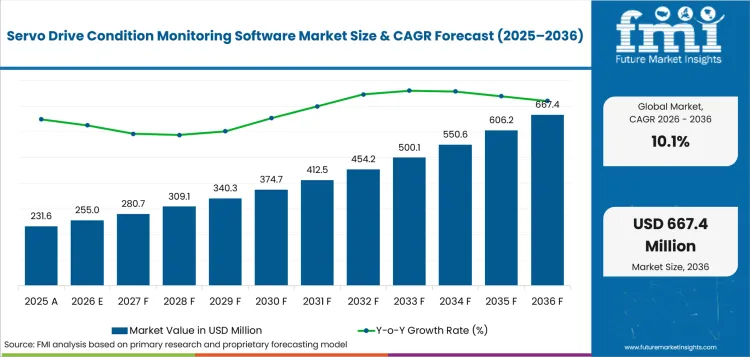
| 2026 Market Size | USD 255.0 million |
|---|---|
| 2036 Market Size | USD 667.4 million |
| Forecast CAGR | 10.1% from 2026 to 2036 |
| Leading Deployment | Discrete Automation |
| Discrete Automation Share in 2026 | 52.0% |
| Leading Offering | Engineering Software |
| Engineering Software Share in 2026 | 41.5% |
| Fastest-growing Country | India |
| India CAGR | 11.8% by 2036 |
Summary of the Servo Drive Condition Monitoring Software Market
- Demand and Growth Drivers
- Maintenance teams are shifting from fixed inspection schedules toward condition-based service decisions for servo motors and drives.
- Machine builders are adding diagnostic tools to commissioning and warranty programs so field teams can trace repeat alarms more clearly.
- Remote service programs are raising the value of software that can connect plant-level drive data with service teams and integrators.
- Product and Segment View
- Discrete Automation is projected to represent 52.0% share in 2026, led by dense servo-axis use in robotics, packaging, electronics, and machine tools.
- Engineering Software is expected to hold 41.5% share in 2026, influenced by its role in interpreting parameter records and alarm histories.
- Embedded Diagnostics is forecast to secure 39.2% share in 2026, supported by machine builders placing drive health functions closer to the controller.
- Geography and Competitive Outlook
- India is projected to record 11.8% CAGR by 2036, backed by new electronics, automotive, and semiconductor-linked manufacturing investment.
- China is expected to expand at 11.3% CAGR by 2036 through robot installation scale and high-tech factory expansion.
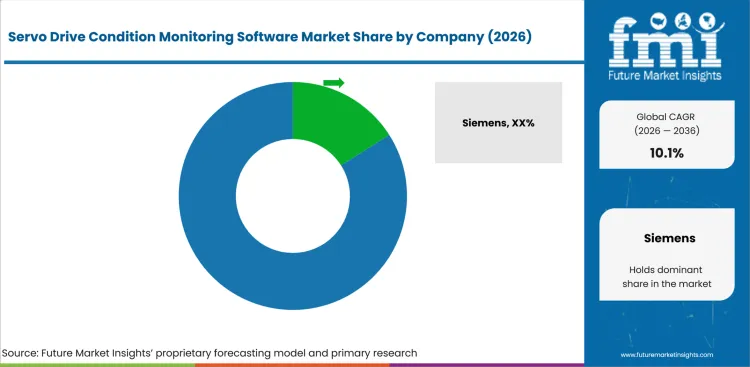
- Siemens and Rockwell Automation compete through motion control portfolios and engineering software depth.
- ABB and Schneider Electric focus on connected services, powertrain visibility, and enterprise automation channels.
- Analyst Opinion
- Nikhil Kaitwade, Principal Consultant for Industrial Automation at FMI, observes, “Servo drive condition monitoring software is becoming a control-layer decision rather than a maintenance add-on. The strongest buyers are factories where one failed axis can stop a high-value line. Suppliers should connect drive data to a real service action, not only a dashboard. Winning platforms will read installed drive families deeply, support cybersecurity review, and help maintenance teams understand whether the next action is inspection, tuning, repair, or replacement.”
Factory automation is widening the practical need for drive-level monitoring as servo axes concentrate inside high-value machines. The International Federation of Robotics reported 542,000 industrial robot installations in 2024, with Asia accounting for 74.0% of new deployments. NIST published Cybersecurity Framework 2.0 in February 2024, giving industrial buyers a common model for managing connected software risk. ABB’s May 2025 Digital Powertrain update also required existing Smart Sensor and drive cloud-interface integrations to migrate by the end of December 2025, showing how condition monitoring platforms are moving toward unified drive and powertrain data environments.
Which factors support expansion in the servo drive condition monitoring software market?
Finished automation software revenue and connected servo diagnostics support market value across manufacturing, machine building, and remote service environments.
- Market value is supported by software attached to servo drives, controllers, and engineering tools before service contracts add recurring revenue.
- Supplier pricing reflects controller compatibility, diagnostic depth, remote access, and the ability to interpret axis-level operating data.
- Revenue improves as machine builders convert service knowledge into software-led support packages after machine installation.
- Buyer trust rises when monitoring platforms present clear drive health records, alarm histories, and maintenance actions.
Why is the servo drive condition monitoring software market growing?
Servo-heavy automation is pushing manufacturers toward earlier fault detection and service planning across robot cells, packaging machines, and precision production lines.
Growth outlook has become more structured as servo monitoring moves from local troubleshooting into connected maintenance systems. The International Federation of Robotics reported that the electrical and electronics industry installed 128,899 industrial robots in 2024, making it the largest robot customer industry. Electronics, semiconductor, battery, and precision assembly lines rely on high-cycle servo motion. As these machine fleets expand, maintenance teams need software that can connect alarms, current changes, thermal trends, and tuning records to real service decisions. Suppliers that make drive health visible at machine level can reduce diagnosis time and strengthen lifecycle service revenue.
How is the servo drive condition monitoring software market segmented?
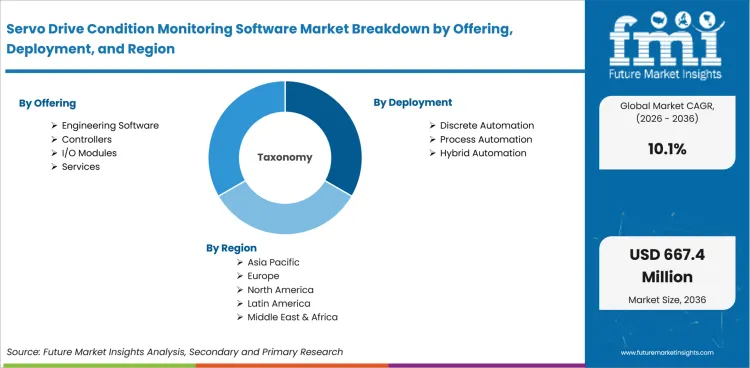
The servo drive condition monitoring software industry is segmented by offering, deployment, application, end-use industry, and monitoring mode.
- Engineering Software is projected to secure 41.5% share in 2026, led by the need to interpret parameter changes, alarm histories, tuning data, and drive behavior.
- Discrete Automation is anticipated to hold 52.0% share in 2026 since robots, packaging equipment, machine tools, and electronics lines use synchronized servo axes.
- Machine Control is expected to capture 36.8% share in 2026 because the most useful fault context is often available near the drive loop and controller.
- Automotive is forecast to represent 27.4% share in 2026, supported by welding, handling, battery equipment, and final assembly automation.
- Embedded Diagnostics is projected to account for 39.2% share in 2026, reflected by machine builders adding drive health functions directly into control systems.
Why does engineering software dominate the servo drive condition monitoring software market?
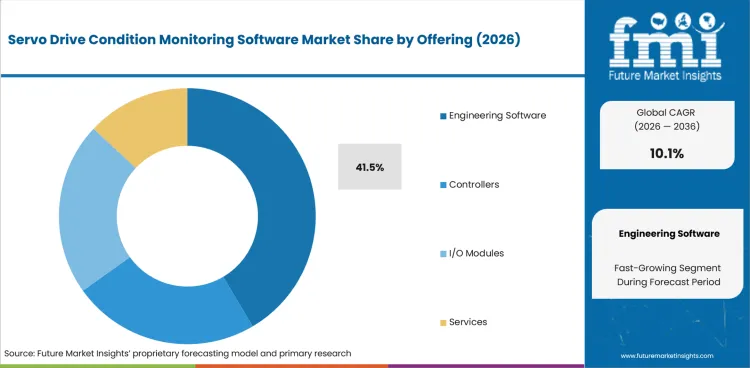
- Engineering Software is projected to account for 41.5% share in 2026, influenced by the need to convert servo parameters, alarms, current signatures, and tuning records into practical maintenance actions.
- Controllers and I/O Modules remain important because they collect machine signals, although buyers increasingly need software interpretation before maintenance teams can act.
Which deployment type leads the servo drive condition monitoring software market?
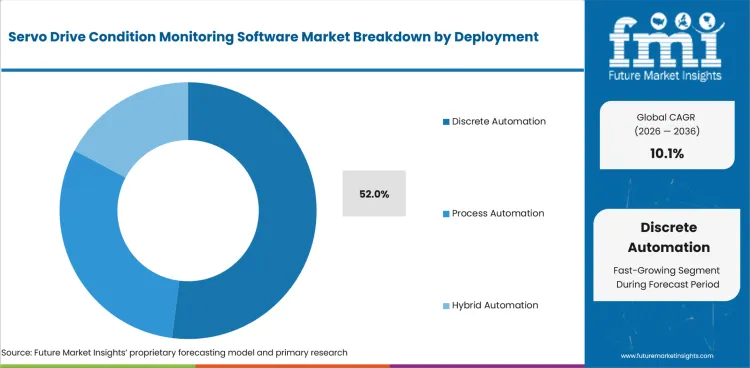
- Discrete Automation is expected to represent 52.0% share in 2026, guided by high servo-axis intensity in robots, packaging lines, machine tools, and electronics assembly.
- Hybrid Automation gains relevance where factories combine machine-level motion control with line integration and process visibility across connected production assets.
Which application leads the servo drive condition monitoring software market?
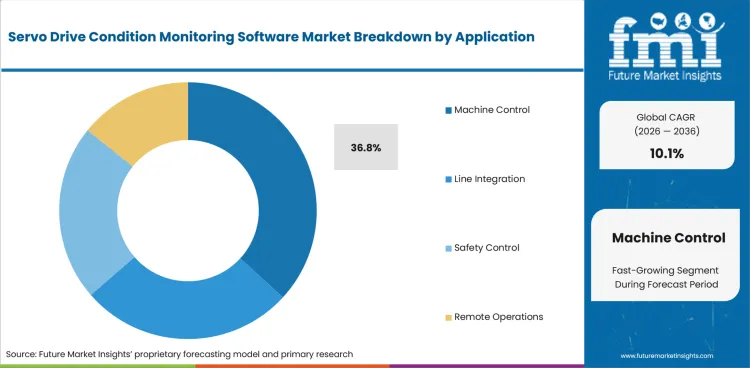
- Machine Control is anticipated to hold 36.8% share in 2026, led by the controller’s role in connecting load behavior, recipe data, cycle timing, and axis alarms.
- Remote Operations is gaining attention as multi-site manufacturers seek common diagnostic views for service teams working across several plants.
Which end-use industry leads the servo drive condition monitoring software market?
- Automotive is projected to account for 27.4% share in 2026, supported by dense servo use in body shops, battery modules, powertrain handling, and final assembly lines.
- Electronics demand is rising as high-cycle assembly and inspection systems require earlier warnings before axis drift affects product quality.
Which monitoring mode leads the servo drive condition monitoring software market?
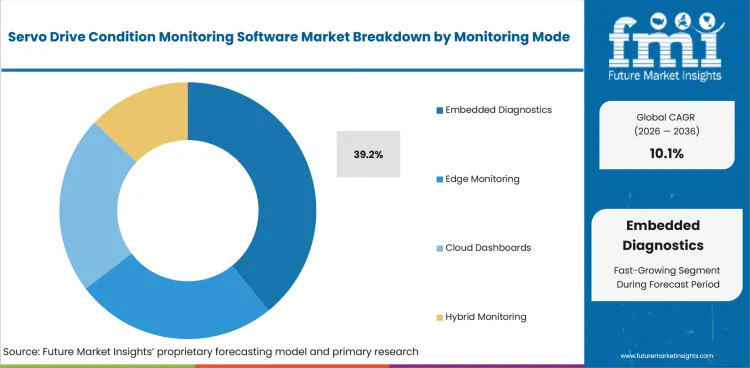
- Embedded Diagnostics is estimated to secure 39.2% share in 2026, shaped by machine builders placing fault detection closer to servo drives and controllers.
- Edge Monitoring gains value where plants need fast local decisions and cannot wait for cloud processing during short maintenance windows.
What are the driver, restraints, and opportunities in the servo drive condition monitoring software market?
Servo-axis density supports adoption while mixed controller estates and cybersecurity reviews can slow wider software rollout.
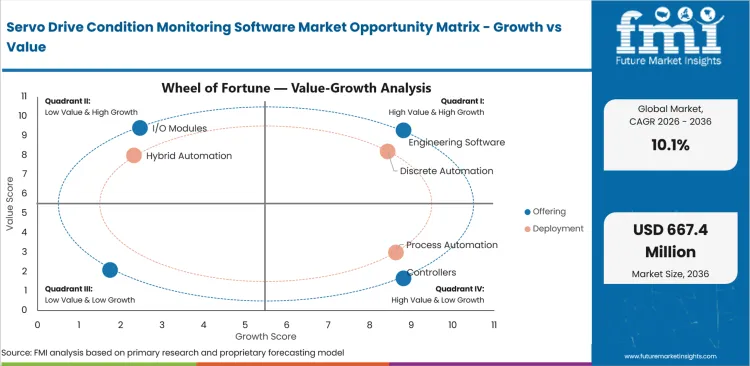
- Driver: Manufacturers are adopting condition-based maintenance because servo-axis faults can stop robot cells, packaging lines, and precision machines.
- Restraint: Legacy controller estates can slow software upgrades when plants use mixed drive families, closed protocols, and older service tools.
- Opportunity: Machine builders can sell monitoring as a service layer after installation and create repeat revenue through diagnostics and remote support.
Servo-axis Density and Diagnostic Value
Servo drive condition monitoring software gains value when machine builders and plant teams need to act before a servo axis stops production. The International Federation of Robotics reported global robot density at 177 robots per 10,000 manufacturing employees in 2024, with Asia at 204, Europe at 148, and the Americas at 131. This density increases the practical need for axis-level monitoring because more robots mean more drives, motors, gear interfaces, and control loops that require service visibility.
Mixed Drive Estates and Cybersecurity Review
A major restraint is the effort needed to connect monitoring software across mixed PLCs, servo families, network protocols, and plant cybersecurity rules. CISA released 10 Industrial Control Systems advisories on August 7, 2025, showing the continuing security review burden around connected operational technology. This affects sales cycles because remote diagnostics must pass access control, update management, and network segmentation checks before plant-wide approval.
Service-led Machine Builder Revenue
The strongest opportunity is in software-led lifecycle service for machine builders. The International Federation of Robotics forecast global robot installations to rise by 6.0% to about 575,000 units in 2025 and exceed 700,000 units by 2028. This creates a broader installed base for machine builders that want to package diagnostics, commissioning records, remote support, and replacement guidance into recurring service offers.
Which countries are growing fastest in the servo drive condition monitoring software market?
India 11.8% CAGR, China 11.3% CAGR, South Korea 10.6% CAGR, Japan 10.0% CAGR, United States 9.7% CAGR, Germany 9.5% CAGR, United Kingdom 8.9% CAGR, and France 8.7% CAGR through 2036.
.webp "Top Country Growth Comparison Servo Drive Condition Monitoring Software Market Cagr (2026 2036)")
| Country | CAGR |
|---|---|
| United States | 9.7% |
| United Kingdom | 8.9% |
| Germany | 9.5% |
| France | 8.7% |
| Japan | 10.0% |
| China | 11.3% |
| South Korea | 10.6% |
| India | 11.8% |
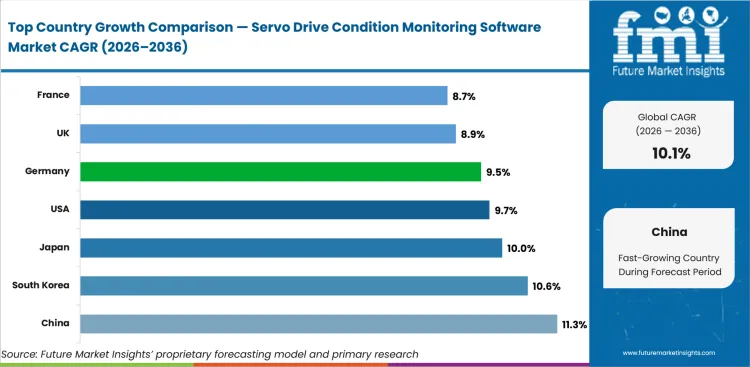
Source: Future Market Insights, 2026.
How do country-level CAGRs compare in the servo drive condition monitoring software market?
India leads country growth while France records the most cautious expansion outlook among profiled markets.
- United States is expected to expand at 9.7% CAGR from 2026 to 2036 due to enterprise automation service contracts and system-integrator channels.
- United Kingdom is estimated to rise at 8.9% CAGR by 2036 with retrofit-led automation upgrades shaping line-level adoption.
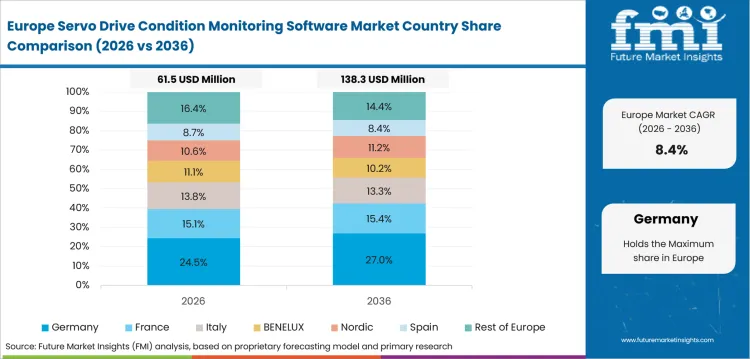
- Germany is forecast to record 9.5% CAGR by 2036 as machine builders embed diagnostics into export equipment.
- France is projected to grow at 8.7% CAGR through 2036 as regulated production sites add targeted monitoring.
- Japan is expected to advance at 10.0% CAGR over the forecast period as embedded servo intelligence supports precision manufacturing.
- China is forecast to grow at 11.3% CAGR through 2036 as robot installation scale expands the monitoring base.
- South Korea is projected to post 10.6% CAGR by 2036 as semiconductor and electronics production supports servo-driven automation.
- India is forecast to record 11.8% CAGR by 2036 as new factory automation projects attach diagnostics earlier.
What is the servo drive condition monitoring software market outlook in the United States?
A 9.7% CAGR through 2036 reflects enterprise automation service contracts and a large installed motion-control base.
Country Market Snapshot Table
| Parameter | Value |
|---|---|
| Market Size in 2025 (Value) | USD 48.4 million |
| Market Size in 2026 (Value) | USD 53.1 million |
| Market Forecast in 2036 (Value) | USD 134.0 million |
| CAGR (2026 to 2036) | 9.7% |
| Years Considered | 2021 to 2036 |
| Base Year | 2025 |
| Forecast Period | 2026 to 2036 |
| Units Considered | Value (USD million) |
| Leading Sub-Region | Midwest and South Atlantic manufacturing corridors |
United States Servo Drive Condition Monitoring Software Market Outlook
United States demand is shaped by large automated plants, enterprise controls standards, and strong system-integrator influence. Buyers often need monitoring software that works with existing PLC standards and can be approved by maintenance and cybersecurity teams.
The market is especially relevant in automotive, packaging, electronics, logistics automation, and battery production. Suppliers with strong installed drive families and service teams can scale from line pilots into plant-wide monitoring programs.
Key Growth Drivers
- Automotive and battery manufacturers use many servo axes that need fault pattern analysis and service records.
- The International Federation of Robotics reported 34,164 industrial robot installations in the United States in 2024, keeping the country the largest robot market in the Americas.
- System integrators can attach diagnostics during line modernization and controller refresh projects.
- The Bureau of Labor Statistics reported manufacturing labor productivity increased 3.7% in the third quarter of 2025, supporting interest in automation tools that protect output per labor hour.
Key Restraints
- Mixed PLC and drive families can raise integration work before monitoring scales across several plants.
- Cybersecurity and remote access approvals can extend buying cycles for diagnostic software.
- CISA released 10 Industrial Control Systems advisories on August 7, 2025, reinforcing careful review of connected control-layer tools.
What makes the United States unique
United States is unique because enterprise service contracts, plant standards, and cybersecurity approvals often shape software adoption together.
Key Companies
- Rockwell Automation
- Siemens
- ABB
- Schneider Electric
- Emerson
- Parker Hannifin
- Kollmorgen
Sales & Marketing Channels
- Direct enterprise automation sales
- Control-system integrator channels
- Machine-builder partnerships
- Distributor-led retrofit programs
- Remote service contracts
- Automotive plant modernization programs
Country Segment Breakdown Table
| Segment | Sub-Segments |
|---|---|
| By Offering | Controllers · I/O Modules · Engineering Software · Services |
| By Deployment | Discrete Automation · Process Automation · Hybrid Automation |
| By Application | Machine Control · Line Integration · Safety Control · Remote Operations |
| By End-use Industry | Automotive · Food & Beverage · Chemicals · Pharmaceuticals · Electronics · Metals |
| By Monitoring Mode | Embedded Diagnostics · Edge Monitoring · Cloud Dashboards · Hybrid Monitoring |
| Key Sub-Regions Covered, Manufacturing Corridors | Midwest · South Atlantic · Texas · California · Northeast · Pacific Northwest |
Frequently Asked Questions
How fast is United States servo drive condition monitoring software market growing?
Demand in the United States is projected to rise at 9.7% CAGR from 2026 to 2036.
Who leads United States servo drive condition monitoring software market?
Rockwell Automation, Siemens, ABB, and Schneider Electric compete through installed controls, motion portfolios, and service contracts.
What is driving adoption in United States servo drive condition monitoring software market?
Automotive automation, battery plants, and system-integrator retrofit programs are moving buyers toward servo diagnostics.
How is the servo drive condition monitoring software market performing in the United Kingdom?
An 8.9% CAGR through 2036 reflects retrofit-led adoption and selective automation upgrades.
Country Market Snapshot Table
| Parameter | Value |
|---|---|
| Market Size in 2025 (Value) | USD 12.2 million |
| Market Size in 2026 (Value) | USD 13.3 million |
| Market Forecast in 2036 (Value) | USD 31.2 million |
| CAGR (2026 to 2036) | 8.9% |
| Years Considered | 2021 to 2036 |
| Base Year | 2025 |
| Forecast Period | 2026 to 2036 |
| Units Considered | Value (USD million) |
| Leading Sub-Region | Midlands and national automation retrofit corridors |
United Kingdom Servo Drive Condition Monitoring Software Market Outlook
United Kingdom demand is more selective than larger automation markets. Many plants begin with one production line or one machine cell before expanding monitoring software across wider operations.
The strongest opportunity is in brownfield factories that need better uptime without replacing every drive family. Suppliers must prove payback through easier diagnosis, fewer repeat alarms, and low-disruption integration.
Key Growth Drivers
- Food, packaging, and logistics lines need monitoring that supports frequent changeovers and limited downtime windows.
- The International Federation of Robotics reported 2,500 industrial robot installations in the United Kingdom in 2024, creating a focused service pool for motion diagnostics.
- Retrofit projects give automation integrators a route to add monitoring during controller upgrades.
- The Office for National Statistics reported production output increased 1.2% in the fourth quarter of 2025, while manufacturing rose 0.9%.
Key Restraints
- Smaller plant scale can make enterprise monitoring harder to justify in one budget cycle.
- Limited in-house motion-control skills can slow interpretation of advanced diagnostic outputs.
- The National Cyber Security Centre dealt with 204 nationally significant cyber attacks in the 12 months to August 2025, raising scrutiny around connected service tools.
What makes the United Kingdom unique
United Kingdom is unique because line-level proof, retrofit practicality, and cybersecurity assurance often matter more than broad platform claims.
Key Companies
- Siemens UK
- Rockwell Automation UK
- ABB UK
- Schneider Electric UK
- Omron Electronics UK
- Beckhoff Automation UK
- Bosch Rexroth UK
Sales & Marketing Channels
- Specialist automation integrators
- Machine-builder upgrade packages
- Distributor service teams
- Food and packaging line retrofits
- Enterprise maintenance pilots
- Remote service subscriptions
Country Segment Breakdown Table
| Segment | Sub-Segments |
|---|---|
| By Offering | Controllers · I/O Modules · Engineering Software · Services |
| By Deployment | Discrete Automation · Process Automation · Hybrid Automation |
| By Application | Machine Control · Line Integration · Safety Control · Remote Operations |
| By End-use Industry | Automotive · Food & Beverage · Chemicals · Pharmaceuticals · Electronics · Metals |
| By Monitoring Mode | Embedded Diagnostics · Edge Monitoring · Cloud Dashboards · Hybrid Monitoring |
| Key Sub-Regions Covered, Retrofit Clusters | Midlands · North West England · London · Wales · Scotland · South East England |
Frequently Asked Questions
How fast is United Kingdom servo drive condition monitoring software market growing?
Industry demand in the United Kingdom is estimated to increase at 8.9% CAGR from 2026 to 2036.
Who leads United Kingdom servo drive condition monitoring software market?
Siemens, Rockwell Automation, ABB, Schneider Electric, Omron, and Beckhoff compete through integrator and OEM channels.
What is driving adoption in United Kingdom servo drive condition monitoring software market?
Brownfield factory upgrades and line-level uptime needs are moving manufacturers toward servo diagnostic tools.
What is the servo drive condition monitoring software market outlook in Germany?
A 9.5% CAGR through 2036 reflects machine-builder specification and premium automation engineering.
Country Market Snapshot Table
| Parameter | Value |
|---|---|
| Market Size in 2025 (Value) | USD 19.7 million |
| Market Size in 2026 (Value) | USD 21.6 million |
| Market Forecast in 2036 (Value) | USD 53.5 million |
| CAGR (2026 to 2036) | 9.5% |
| Years Considered | 2021 to 2036 |
| Base Year | 2025 |
| Forecast Period | 2026 to 2036 |
| Units Considered | Value (USD million) |
| Leading Sub-Region | Bavaria, Baden-Württemberg, and North Rhine-Westphalia machine-building corridors |
Germany Servo Drive Condition Monitoring Software Market Outlook
Germany demand is driven by machine builders that specify controls and diagnostics before final equipment reaches end users. This makes servo monitoring software part of machine design rather than only a plant maintenance purchase.
The market benefits from strong automation engineering depth and export-oriented machinery. Suppliers need documented software, multi-country support, and reliable integration with customer standards.
Key Growth Drivers
- Export machine builders need service tools that reduce post-installation troubleshooting at customer sites.
- The International Federation of Robotics reported 26,982 industrial robot installations in Germany in 2024, representing the largest robot market in Europe.
- Local engineering teams can evaluate diagnostics during machine design and commissioning.
- Destatis reported real manufacturing new orders increased 7.8% month on month in December 2025, supporting near-term machinery planning.
Key Restraints
- Multi-country customer standards make software certification and documentation costly for machine OEMs.
- Brownfield plants may resist closed tools that do not fit existing controller architectures.
- Destatis reported manufacturing new orders fell 11.1% month on month in January 2026, showing budget sensitivity after large-order volatility.
What makes Germany unique
Germany is unique because machine builders often select diagnostic software before the final plant user evaluates the machine.
Key Companies
- Siemens
- Beckhoff Automation
- Bosch Rexroth
- Schneider Electric
- ABB
- Lenze
- B&R Industrial Automation
Sales & Marketing Channels
- Machine-builder design channels
- OEM service contracts
- Automation distributor networks
- Direct factory automation sales
- Engineering software partnerships
- Export machinery support programs
Country Segment Breakdown Table
| Segment | Sub-Segments |
|---|---|
| By Offering | Controllers · I/O Modules · Engineering Software · Services |
| By Deployment | Discrete Automation · Process Automation · Hybrid Automation |
| By Application | Machine Control · Line Integration · Safety Control · Remote Operations |
| By End-use Industry | Automotive · Food & Beverage · Chemicals · Pharmaceuticals · Electronics · Metals |
| By Monitoring Mode | Embedded Diagnostics · Edge Monitoring · Cloud Dashboards · Hybrid Monitoring |
| Key Sub-Regions Covered, Machine-building Areas | Bavaria · Baden-Württemberg · North Rhine-Westphalia · Saxony · Hesse · Lower Saxony |
Frequently Asked Questions
How fast is Germany servo drive condition monitoring software market growing?
Germany demand is forecast to grow at 9.5% CAGR from 2026 to 2036.
Who leads Germany servo drive condition monitoring software market?
Siemens, Beckhoff Automation, Bosch Rexroth, ABB, and Schneider Electric compete through machine-builder relationships.
What is driving adoption in Germany servo drive condition monitoring software market?
Export machinery, premium automation design, and embedded service diagnostics are pushing adoption.
What is the servo drive condition monitoring software market forecast for France?
An 8.7% CAGR through 2036 reflects targeted adoption in regulated and mixed manufacturing settings.
Country Market Snapshot Table
| Parameter | Value |
|---|---|
| Market Size in 2025 (Value) | USD 10.8 million |
| Market Size in 2026 (Value) | USD 11.7 million |
| Market Forecast in 2036 (Value) | USD 26.9 million |
| CAGR (2026 to 2036) | 8.7% |
| Years Considered | 2021 to 2036 |
| Base Year | 2025 |
| Forecast Period | 2026 to 2036 |
| Units Considered | Value (USD million) |
| Leading Sub-Region | Île-de-France and Rhône-Alpes industrial corridors |
France Servo Drive Condition Monitoring Software Market Outlook
France is a selective adoption market where condition monitoring must fit regulated production, mixed automation estates, and lifecycle support requirements. Buyers tend to prioritize maintainability and traceable fault records.
The strongest opportunities are in food, pharmaceutical, cosmetics packaging, and automotive supplier plants. Suppliers should target critical production cells first before wider plant rollout.
Key Growth Drivers
- Pharmaceutical and food plants need traceable fault records that support maintenance and quality teams.
- The International Federation of Robotics reported 4,900 industrial robot installations in France in 2024, maintaining a relevant automation base for targeted diagnostics.
- Packaging machinery upgrades create entry points for servo health dashboards and service contracts.
- INSEE reported manufacturing output rose 0.5% in November 2025, before a later decline showed uneven production conditions.
Key Restraints
- Buyers may delay software spend when payback is not tied to a critical production line.
- Mixed automation estates can limit quick rollout across older and newer machine cells.
- ANSSI processed 4,386 security events in 2024, up 15.0% from the prior year, keeping connected manufacturing tools under stronger cybersecurity review.
What makes France unique
France is unique because quality-sensitive production and lifecycle support often outweigh raw automation scale.
Key Companies
- Schneider Electric
- Siemens France
- ABB France
- Rockwell Automation France
- Omron France
- Bosch Rexroth France
- Fives Group
Sales & Marketing Channels
- OEM machinery channels
- Automation integrator projects
- Pharmaceutical plant upgrades
- Food and packaging service contracts
- Direct industrial software sales
- Critical-line retrofit programs
Country Segment Breakdown Table
| Segment | Sub-Segments |
|---|---|
| By Offering | Controllers · I/O Modules · Engineering Software · Services |
| By Deployment | Discrete Automation · Process Automation · Hybrid Automation |
| By Application | Machine Control · Line Integration · Safety Control · Remote Operations |
| By End-use Industry | Automotive · Food & Beverage · Chemicals · Pharmaceuticals · Electronics · Metals |
| By Monitoring Mode | Embedded Diagnostics · Edge Monitoring · Cloud Dashboards · Hybrid Monitoring |
| Key Sub-Regions Covered, Industrial Corridors | Île-de-France · Auvergne-Rhône-Alpes · Hauts-de-France · Grand Est · Occitanie · Normandy |
Frequently Asked Questions
How fast is France servo drive condition monitoring software market growing?
France demand is expected to rise at 8.7% CAGR from 2026 to 2036.
Who leads France servo drive condition monitoring software market?
Schneider Electric, Siemens, ABB, Rockwell Automation, and Omron compete through automation software and integrator networks.
What is driving adoption in France servo drive condition monitoring software market?
Food, pharmaceutical, packaging, and automotive supplier plants are driving targeted adoption.
What is the servo drive condition monitoring software market outlook in Japan?
A 10.0% CAGR through 2036 reflects precision manufacturing and device-level servo diagnostics.
Country Market Snapshot Table
| Parameter | Value |
|---|---|
| Market Size in 2025 (Value) | USD 22.5 million |
| Market Size in 2026 (Value) | USD 24.8 million |
| Market Forecast in 2036 (Value) | USD 64.3 million |
| CAGR (2026 to 2036) | 10.0% |
| Years Considered | 2021 to 2036 |
| Base Year | 2025 |
| Forecast Period | 2026 to 2036 |
| Units Considered | Value (USD million) |
| Leading Sub-Region | Kanto, Chubu, and Kansai precision manufacturing corridors |
Japan Servo Drive Condition Monitoring Software Market Outlook
Japan demand is shaped by precision manufacturing, high machine reliability expectations, and strong trust in native servo suppliers. Buyers often prefer diagnostics from the same automation family as the drive.
Device-level intelligence is important because machine builders value setup software, predictive maintenance functions, and service tools that reduce manual fault investigation. This supports adoption across electronics, machine tools, automotive, and precision assembly.
Key Growth Drivers
- Precision assembly users need early warnings before axis drift affects product quality.
- The International Federation of Robotics reported 44,453 robot installations in Japan in 2024, with a large operating base across precision production.
- Machine builders can bundle diagnostic functions into servo setup and commissioning tools.
- METI reported industrial production increased 2.5% month on month in February 2025, with production machinery and electronic parts among the main contributors.
Key Restraints
- Older servo platforms can require separate tools that reduce the value of one common dashboard.
- Buyers may prefer proven vendor-native tools over newer third-party analytics platforms.
- METI reported Japan’s inventory index fell 5.0% year on year in April 2026, which can make buyers cautious about adding software unless it protects near-term production efficiency.
What makes Japan unique
Japan is unique because embedded servo intelligence and vendor-native diagnostics often carry more weight than broad enterprise dashboards.
Key Companies
- Mitsubishi Electric
- Omron
- Yaskawa Electric
- Panasonic Industry
- Fuji Electric
- Siemens Japan
- ABB Japan
Sales & Marketing Channels
- Factory automation distributors
- OEM machine-builder bundles
- Direct servo vendor sales
- Precision equipment service networks
- Electronics plant automation teams
- Servo setup software channels
Country Segment Breakdown Table
| Segment | Sub-Segments |
|---|---|
| By Offering | Controllers · I/O Modules · Engineering Software · Services |
| By Deployment | Discrete Automation · Process Automation · Hybrid Automation |
| By Application | Machine Control · Line Integration · Safety Control · Remote Operations |
| By End-use Industry | Automotive · Food & Beverage · Chemicals · Pharmaceuticals · Electronics · Metals |
| By Monitoring Mode | Embedded Diagnostics · Edge Monitoring · Cloud Dashboards · Hybrid Monitoring |
| Key Sub-Regions Covered, Precision Manufacturing Areas | Kanto · Chubu · Kansai · Kyushu · Tohoku · Chugoku |
Frequently Asked Questions
How fast is Japan servo drive condition monitoring software market growing?
Japan demand is forecast to increase at 10.0% CAGR from 2026 to 2036.
Who leads Japan servo drive condition monitoring software market?
Mitsubishi Electric, Omron, Yaskawa Electric, Panasonic Industry, and Fuji Electric lead through servo systems and factory automation channels.
What is driving adoption in Japan servo drive condition monitoring software market?
Precision manufacturing, machine-builder bundling, and embedded diagnostics are driving adoption.
What is the servo drive condition monitoring software market forecast for China?
An 11.3% CAGR through 2036 reflects automation scale and high-tech manufacturing expansion.
Country Market Snapshot Table
| Parameter | Value |
|---|---|
| Market Size in 2025 (Value) | USD 50.6 million |
| Market Size in 2026 (Value) | USD 56.3 million |
| Market Forecast in 2036 (Value) | USD 164.2 million |
| CAGR (2026 to 2036) | 11.3% |
| Years Considered | 2021 to 2036 |
| Base Year | 2025 |
| Forecast Period | 2026 to 2036 |
| Units Considered | Value (USD million) |
| Leading Sub-Region | Yangtze River Delta and Pearl River Delta automation corridors |
China Servo Drive Condition Monitoring Software Market Outlook
China demand is shaped by the world’s largest robot installation base and rapid expansion in electronics, battery, machinery, and high-tech manufacturing. Buyers are increasingly interested in local service support and software that can scale across many production cells.
The market favors suppliers that combine drive compatibility, machine analytics, and fast service response. Domestic automation suppliers and global motion control companies are both competing for machine-builder specifications.
Key Growth Drivers
- Electronics, battery, and machinery producers need servo monitoring across high-cycle automation lines.
- The International Federation of Robotics reported 295,045 industrial robot installations in China in 2024, representing more than half of global installations.
- Local service teams can support large installed bases by attaching diagnostics to machine upgrades.
- China’s National Bureau of Statistics reported equipment manufacturing value added rose 9.2% in 2025, while high-tech manufacturing increased 9.4%.
Key Restraints
- Plants with several imported and domestic servo brands can face integration complexity across diagnostic tools.
- Data governance and plant network rules can slow adoption of remote dashboards in sensitive factories.
- The National Bureau of Statistics reported China’s manufacturing PMI at 50.1% in December 2025, showing modest expansion and buyer sensitivity around project timing.
What makes China unique
China is unique because robot scale and high-tech production density can turn servo monitoring from a pilot tool into a factory-wide service layer.
Key Companies
- Siemens
- ABB
- Schneider Electric
- Mitsubishi Electric
- Omron
- Inovance Technology
- Estun Automation
Sales & Marketing Channels
- Direct automation sales
- OEM machine-builder channels
- Local automation distributors
- Electronics plant service teams
- Battery equipment suppliers
- Industrial software integrators
Country Segment Breakdown Table
| Segment | Sub-Segments |
|---|---|
| By Offering | Controllers · I/O Modules · Engineering Software · Services |
| By Deployment | Discrete Automation · Process Automation · Hybrid Automation |
| By Application | Machine Control · Line Integration · Safety Control · Remote Operations |
| By End-use Industry | Automotive · Food & Beverage · Chemicals · Pharmaceuticals · Electronics · Metals |
| By Monitoring Mode | Embedded Diagnostics · Edge Monitoring · Cloud Dashboards · Hybrid Monitoring |
| Key Sub-Regions Covered, Automation Corridors | Yangtze River Delta · Pearl River Delta · Beijing-Tianjin-Hebei · Chengdu-Chongqing · Shandong · Fujian |
Frequently Asked Questions
How fast is China servo drive condition monitoring software market growing?
China demand is forecast to rise at 11.3% CAGR from 2026 to 2036.
Who leads China servo drive condition monitoring software market?
Siemens, ABB, Schneider Electric, Mitsubishi Electric, Omron, Inovance, and Estun compete across global and domestic channels.
What is driving adoption in China servo drive condition monitoring software market?
Robot scale, electronics manufacturing, and high-tech factory expansion are driving adoption.
What is the servo drive condition monitoring software market outlook in South Korea?
A 10.6% CAGR through 2036 reflects semiconductor, electronics, and precision automation demand.
Country Market Snapshot Table
| Parameter | Value |
|---|---|
| Market Size in 2025 (Value) | USD 13.8 million |
| Market Size in 2026 (Value) | USD 15.3 million |
| Market Forecast in 2036 (Value) | USD 41.9 million |
| CAGR (2026 to 2036) | 10.6% |
| Years Considered | 2021 to 2036 |
| Base Year | 2025 |
| Forecast Period | 2026 to 2036 |
| Units Considered | Value (USD million) |
| Leading Sub-Region | Seoul Capital Area and Gyeonggi semiconductor corridor |
South Korea Servo Drive Condition Monitoring Software Market Outlook
South Korea demand is tied to semiconductor, electronics, automotive, display, and battery production. These industries rely on high-cycle automation and need strong uptime discipline.
Adoption is strongest where servo diagnostics reduce repeat machine stoppage and protect precision output. Suppliers must support local service expectations and integration with advanced factory automation systems.
Key Growth Drivers
- Semiconductor and electronics factories need diagnostics that detect servo drift before quality losses appear.
- The International Federation of Robotics reported 30,596 industrial robot installations in South Korea in 2024, keeping the country among the largest robot markets.
- Automation buyers value tools that connect drive health to production and equipment service records.
- South Korea’s Ministry of Economy and Finance reported mining and manufacturing production rose 5.3% year on year in December 2024, supported by semiconductor exports.
Key Restraints
- Advanced factories may require strict validation before connecting diagnostic software to production networks.
- Service teams can face complexity when imported and domestic automation platforms operate together.
- MSIT’s July 2025 SK Telecom investigation found 9.82 GB of USIM data was compressed and exfiltrated, keeping connected industrial software under stricter remote-access review.
What makes South Korea unique
South Korea is unique because semiconductor and electronics production creates high-value use cases for precise, high-cycle servo monitoring.
Key Companies
- Siemens Korea
- ABB Korea
- Schneider Electric Korea
- Mitsubishi Electric Automation Korea
- Omron Korea
- LS Electric
- Hyundai Robotics
Sales & Marketing Channels
- Semiconductor equipment vendors
- Electronics plant automation teams
- Direct automation sales
- Local systems integrators
- Machine-builder bundles
- Remote service contracts
Country Segment Breakdown Table
| Segment | Sub-Segments |
|---|---|
| By Offering | Controllers · I/O Modules · Engineering Software · Services |
| By Deployment | Discrete Automation · Process Automation · Hybrid Automation |
| By Application | Machine Control · Line Integration · Safety Control · Remote Operations |
| By End-use Industry | Automotive · Food & Beverage · Chemicals · Pharmaceuticals · Electronics · Metals |
| By Monitoring Mode | Embedded Diagnostics · Edge Monitoring · Cloud Dashboards · Hybrid Monitoring |
| Key Sub-Regions Covered, Electronics Manufacturing Areas | Seoul Capital Area · Gyeonggi · Chungcheong · Ulsan · Busan · Daegu |
Frequently Asked Questions
How fast is South Korea servo drive condition monitoring software market growing?
South Korea demand is expected to rise at 10.6% CAGR from 2026 to 2036.
Who leads South Korea servo drive condition monitoring software market?
Siemens, ABB, Schneider Electric, Mitsubishi Electric, Omron, LS Electric, and Hyundai Robotics compete through electronics and industrial automation channels.
What is driving adoption in South Korea servo drive condition monitoring software market?
Semiconductor automation, electronics assembly, and precision equipment uptime needs are driving adoption.
What is the servo drive condition monitoring software market forecast for India?
An 11.8% CAGR through 2036 reflects new automation investment across electronics, automotive, and semiconductor-linked manufacturing.
Country Market Snapshot Table
| Parameter | Value |
|---|---|
| Market Size in 2025 (Value) | USD 8.1 million |
| Market Size in 2026 (Value) | USD 9.0 million |
| Market Forecast in 2036 (Value) | USD 27.5 million |
| CAGR (2026 to 2036) | 11.8% |
| Years Considered | 2021 to 2036 |
| Base Year | 2025 |
| Forecast Period | 2026 to 2036 |
| Units Considered | Value (USD million) |
| Leading Sub-Region | Western and southern manufacturing corridors |
India Servo Drive Condition Monitoring Software Market Outlook
India demand is expanding from a smaller automation base, which makes new projects important for software attachment. Buyers are most active in electronics, automotive, packaging, pharmaceuticals, and emerging semiconductor-linked production.
The market favors suppliers that can pair motion control hardware with practical service support. Integrators and machine builders will play a central role because many plants need help translating drive data into maintenance action.
Key Growth Drivers
- New electronics and automotive factories can attach diagnostics early instead of retrofitting them later.
- The International Federation of Robotics reported 9,100 industrial robot installations in India in 2024, with automotive accounting for 45.0% of installations.
- Systems integrators can add servo monitoring during commissioning and line modernization projects.
- The Press Information Bureau reported electronics production reached ₹11.3 lakh crore in 2024–25, supporting demand for servo-driven assembly and inspection equipment.
Key Restraints
- Smaller factories may lack trained motion-control staff to interpret advanced diagnostic outputs.
- Budget approval can slow when buyers cannot clearly compare subscription cost with downtime losses.
- CERT-In handled over 29.44 lakh cyber incidents in 2025, showing why connected industrial software may face stricter security review.
What makes India unique
India is unique because many automation projects are still new enough to attach monitoring software at the design and commissioning stage.
Key Companies
- Siemens India
- ABB India
- Schneider Electric India
- Rockwell Automation India
- Mitsubishi Electric India
- Omron Automation India
- Delta Electronics India
Sales & Marketing Channels
- Factory automation distributors
- System integrators
- Machine-builder bundles
- Automotive plant projects
- Electronics manufacturing programs
- Remote support contracts
Country Segment Breakdown Table
| Segment | Sub-Segments |
|---|---|
| By Offering | Controllers · I/O Modules · Engineering Software · Services |
| By Deployment | Discrete Automation · Process Automation · Hybrid Automation |
| By Application | Machine Control · Line Integration · Safety Control · Remote Operations |
| By End-use Industry | Automotive · Food & Beverage · Chemicals · Pharmaceuticals · Electronics · Metals |
| By Monitoring Mode | Embedded Diagnostics · Edge Monitoring · Cloud Dashboards · Hybrid Monitoring |
| Key Sub-Regions Covered, Manufacturing Corridors | Maharashtra · Gujarat · Tamil Nadu · Karnataka · Telangana · Haryana |
Frequently Asked Questions
How fast is India servo drive condition monitoring software market growing?
India demand is projected to increase at 11.8% CAGR from 2026 to 2036.
Who leads India servo drive condition monitoring software market?
Siemens India, ABB India, Schneider Electric India, Rockwell Automation India, Mitsubishi Electric India, and Omron Automation India compete through integrators and distributors.
Who are the leading companies in the servo drive condition monitoring software market?
Siemens, Rockwell Automation, ABB, Schneider Electric and Mitsubishi Electric.
- Established automation companies hold an advantage through installed servo families and controller ecosystems.
- Motion-control specialists gain design preference by supporting machine builders with setup software and drive diagnostics.
- Service-led suppliers gain acceptance where remote troubleshooting and lifecycle support are part of plant standards.
- Engineering software vendors win when diagnostic outputs can be used by maintenance teams without repeated controls engineering support.
Automation groups in the market compete by combining servo hardware, engineering tools, service documentation, and remote monitoring. Siemens and Rockwell Automation hold strong positions because many plants already use their controllers, drives, and engineering software. ABB and Schneider Electric compete through connected service environments, powertrain visibility, and enterprise automation accounts. Mitsubishi Electric and Omron remain important in Japan-centered motion automation because their servo tools are tied closely to setup, device monitoring, and factory automation support.
Machine-builder fit has become a competitive separator as OEMs want diagnostic software that travels with exported equipment. Beckhoff Automation competes through PC-based control and analytics software for machine builders that need flexible architectures. Bosch Rexroth, Parker Hannifin, Kollmorgen, and Lenze compete where specialized motion depth and application engineering matter. Suppliers that document drive health, firmware behavior, alarm context, and service steps are better placed than suppliers offering generic machine dashboards.
Regional channels also shape competitive outcomes. In the United States, integrator and enterprise automation contracts influence adoption. Germany is more machine-builder-led, while Japan and South Korea favor supplier trust and embedded diagnostics. China and India require local service depth because factories need fast support across expanding installed bases. Companies that combine drive compatibility, cybersecurity documentation, and technician-friendly workflows should gain more durable project acceptance.
How do top servo drive condition monitoring software companies compare?
Siemens and Rockwell Automation score strongest on installed control ecosystems while ABB and Schneider Electric lead in connected service positioning.
| Company | Relevance to Market Title | Servo Diagnostic Depth | Motion Software Integration | Remote Service Readiness | Channel Reach | Geographic Footprint |
|---|---|---|---|---|---|---|
| Siemens | Very High | Very Strong | Very Strong | Strong | Very Strong | Global |
| Rockwell Automation | Very High | Very Strong | Very Strong | Very Strong | Very Strong | North America and Global |
| ABB | Very High | Strong | Strong | Very Strong | Very Strong | Global |
| Schneider Electric | High | Strong | Very Strong | Very Strong | Very Strong | Global |
| Mitsubishi Electric | Very High | Very Strong | Very Strong | Moderate | Strong | Japan and Global |
| Omron | High | Strong | Very Strong | Moderate | Strong | Japan and Global |
| Beckhoff Automation | High | Moderate | Very Strong | Strong | Strong | Europe and Global |
| Bosch Rexroth | High | Strong | Strong | Moderate | Strong | Global |
| Parker Hannifin | Moderate to High | Strong | Moderate | Moderate | Strong | Global |
| Kollmorgen | High | Strong | Strong | Moderate | Moderate | Global |
Source: Future Market Insights competitive analysis, 2026.
Who are the key players in the servo drive condition monitoring software market?
Siemens, Rockwell Automation and ABB are listed with Schneider Electric and Mitsubishi Electric among other suppliers.
Key global companies leading the servo drive condition monitoring software market include:
- Siemens
- Rockwell Automation
- ABB
- Schneider Electric
- Mitsubishi Electric
- Omron
- Beckhoff Automation
- Bosch Rexroth
- Parker Hannifin
- Kollmorgen
Key Developments in Servo Drive Condition Monitoring Software Market
- In May 2025, ABB migrated existing Smart Sensor Cloud Interface and Cloud Interface for drives integrations toward the ABB Ability Digital Powertrain Cloud Interface.
- In June 2024, Beckhoff expanded the AX8000 multi-axis servo system with a silicon-carbide axis module supporting 28 A nominal current in the same housing size as the prior 18 A IGBT device.
- In December 2024, Mitsubishi Electric updated MR Configurator2 improvement records with MR-J5 series diagnostic and parameter refinements for servo support software.
Key Players in the Servo Drive Condition Monitoring Software Market
Global Automation Groups
- Siemens
- Rockwell Automation
- ABB
- Schneider Electric
- Mitsubishi Electric
Motion and Machine Specialists
- Omron
- Bosch Rexroth
- Parker Hannifin
- Kollmorgen
- Lenze
PC-Based and Embedded Automation Specialists
- Beckhoff Automation
- B&R Industrial Automation
- Delta Electronics
- Yaskawa Electric
- Fuji Electric
Servo Drive Condition Monitoring Software Market - Report Scope
| Parameter | Details |
|---|---|
| Forecast period | 2026 to 2036 |
| Historical period | 2021 to 2025 |
| Quantitative unit | Revenue in USD million |
| By offering | Controllers, I/O Modules, Engineering Software, Services |
| By deployment | Discrete Automation, Process Automation, Hybrid Automation |
| By application | Machine Control, Line Integration, Safety Control, Remote Operations |
| By end-use industry | Automotive, Food & Beverage, Chemicals, Pharmaceuticals, Electronics, Metals |
| By monitoring mode | Embedded Diagnostics, Edge Monitoring, Cloud Dashboards, Hybrid Monitoring |
| Regions covered | North America, Latin America, Europe, East Asia, South Asia and Pacific, Middle East and Africa |
| Countries covered | United States, United Kingdom, Germany, France, Japan, China, South Korea, India |
| Key companies profiled | Siemens, Rockwell Automation, ABB, Schneider Electric, Mitsubishi Electric, Omron, Beckhoff Automation |
| Approach | Bottom-up software-boundary approach using servo-axis density, installed drive families, software attach rates, service penetration, and country-level automation indicators |
Source: Future Market Insights, 2026.
Servo Drive Condition Monitoring Software Market - Scope & Definition
| Attribute | Detail |
|---|---|
| Market Definition | Software and linked control components used to monitor servo-drive health, servo-motor behavior, axis alarms, vibration, thermal signals, current signatures, tuning records, and maintenance actions. |
| Functions Covered | Servo diagnostics, fault detection, alarm interpretation, parameter monitoring, predictive service support, drive health reporting, and remote maintenance visibility. |
| Applications Covered | Machine control, line integration, safety control, and remote operations across servo-driven machines and automated production lines. |
| End-Use Industries | Automotive, food and beverage, chemicals, pharmaceuticals, electronics, metals, and other servo-intensive manufacturing environments. |
| Grades Covered | Embedded diagnostics, edge monitoring, cloud dashboards, and hybrid monitoring configurations. |
| Inclusions | Software, connected controls, engineering tools, dashboards, service modules, and linked monitoring components that collect or interpret servo-drive condition data. |
| Exclusions | Generic enterprise asset management software, standalone vibration meters, building automation drives, manual inspection services, and non-servo drive monitoring platforms. |
Servo Drive Condition Monitoring Software Market - Research Methodology
| Method | Description |
|---|---|
| Primary Research | FMI analyst interviews with machine builders, plant maintenance teams, automation distributors, control-system integrators, and industrial software buyers across key markets. |
| Desk Research | Review of robotics statistics, automation portfolios, servo-drive documentation, cybersecurity guidance, company product records, and official manufacturing indicators. |
| Market Sizing & Forecasting | Bottom-up software-boundary approach using servo-axis density, installed motion platforms, software attach rates, services penetration, and regional automation readiness. |
| Data Validation | Cross-verification using robot installation trends, official country manufacturing data, company product developments, cybersecurity requirements, and supplier portfolio evidence. |
Servo Drive Condition Monitoring Software Market Breakdown by Offering, Deployment, Application, End-use Industry, Monitoring Mode, and Region
Servo Drive Condition Monitoring Software Market Segmented by Offering
- Controllers
- I/O Modules
- Engineering Software
- Services
Servo Drive Condition Monitoring Software Market Segmented by Deployment
- Discrete Automation
- Process Automation
- Hybrid Automation
Servo Drive Condition Monitoring Software Market Segmented by Application
- Machine Control
- Line Integration
- Safety Control
- Remote Operations
Servo Drive Condition Monitoring Software Market Segmented by End-use Industry
- Automotive
- Food & Beverage
- Chemicals
- Pharmaceuticals
- Electronics
- Metals
Servo Drive Condition Monitoring Software Market Segmented by Monitoring Mode
- Embedded Diagnostics
- Edge Monitoring
- Cloud Dashboards
- Hybrid Monitoring
Servo Drive Condition Monitoring Software Market by Region
- North America
- Latin America
- Europe
- East Asia
- South Asia and Pacific
- Middle East and Africa
Research Sources and Bibliography
- ABB. (2025, May). ABB Ability Digital Powertrain: What’s new PT29.
- Agence nationale de la sécurité des systèmes d’information. (2025). Cyber Threat Overview 2024.
- Beckhoff Automation. (2024, June 12). Highly functional and incredibly energy-efficient thanks to silicon carbide.
- Bureau of Labor Statistics. (2026, January 29). Productivity and costs: Third quarter 2025 results.
- Cybersecurity and Infrastructure Security Agency. (2025, August 7). CISA releases ten Industrial Control Systems advisories.
- Destatis. (2026, February 5). New orders in manufacturing in December 2025.
- Destatis. (2026, March 9). New orders in manufacturing in January 2026.
- International Federation of Robotics. (2025). World Robotics 2025 - Industrial robots: Executive summary.
- International Federation of Robotics. (2025, September 25). World Robotics 2025 report - Industrial robots.
- Mitsubishi Electric. (2024, December). Improvement history list MR Configurator2.
- Ministry of Science and ICT. (2025, July 2). MSIT releases final investigation results on SK Telecom cyber incident.
- National Bureau of Statistics of China. (2026, January 1). Purchasing Managers’ Index for December 2025.
- National Bureau of Statistics of China. (2026, January 19). National economy pushed forward with innovation-led and high-quality development and expected targets achieved successfully in 2025.
- National Cyber Security Centre. (2025, October 14). UK experiencing four nationally significant cyber attacks weekly.
- National Institute of Standards and Technology. (2024, February 26). The NIST Cybersecurity Framework 2.0.
- Office for National Statistics. (2026, February 12). Index of Production, UK: December 2025.
- Omron Industrial Automation. (2024, November). K7DD Advanced Motor Condition Monitoring Device datasheet.
- Press Information Bureau. (2025, October 11). India’s electronics leap.
- Press Information Bureau. (2026, January 23). CERT-In: India’s frontline defender against cyber threats.
- Ministry of Economy and Finance. (2025, February 3). Current status of industrial activities: December 2024.
- Ministry of Economy, Trade and Industry. (2025, March). Indices of Industrial Production: Preliminary report for February 2025.
- Ministry of Economy, Trade and Industry. (2026, June 12). Indices of Industrial Production: Revised report for April 2026.
- Institut national de la statistique et des études économiques. (2026, February 5). In December 2025, manufacturing output fell back sharply.
- Siemens. (2026). SINAMICS S200 servo drive system.
This bibliography is provided for reader reference and is not exhaustive. The full report contains the complete reference list and detailed citations.
This Report Answers
- Market size estimates for 2026 and forecasts through 2036 for the servo drive condition monitoring software market.
- Insights across regional and country-level markets using automation intensity and factory software adoption patterns.
- Analysis of demand drivers, servo-axis monitoring needs, remote service adoption, and maintenance workflow changes.
- Evaluation of leading segments across offering, deployment, application, end-use industry, and monitoring mode.
- Assessment of cybersecurity, legacy controller estates, and integration challenges affecting software rollout.
- Identification of opportunities across engineering software, embedded diagnostics, edge monitoring, and service-led machine-builder channels.
- Evaluation of supply dynamics, product innovation trends, and automation channel structures.
- Country-level growth analysis covering the United States, United Kingdom, Germany, France, Japan, China, South Korea, and India.
- Assessment of the competitive landscape, including leading motion control suppliers and automation software participants.
- Analysis of buyer preferences, market penetration trends, and emerging service revenue opportunities.
- Regional outlooks across North America, Europe, East Asia, South Asia and Pacific, Latin America, and Middle East and Africa.
- Delivery of market data, forecasts, and supporting analysis in PDF and Excel formats
Frequently Asked Questions
What is the growth prospect for servo drive condition monitoring software?
Demand for servo drive condition monitoring software is expected to rise at a considerable pace as factories shift toward condition-based maintenance and connected servo diagnostics.
Which companies are expected to shape the servo drive condition monitoring software market?
Siemens, Rockwell Automation, ABB, Schneider Electric, Mitsubishi Electric, Omron, and Beckhoff Automation are expected to shape market competition through motion software and diagnostic portfolios.
Why are leading automation companies investing in servo drive condition monitoring software?
Leading automation companies are investing in servo drive condition monitoring software to connect drive health, service records, and remote maintenance into one workflow.
Why are machine-builder channels important in the servo drive condition monitoring software market?
Machine-builder channels are important because diagnostic software is often selected during machine design and commissioning before the end user standardizes the system.
Which software formats are gaining attention in servo drive condition monitoring software?
Engineering software, embedded diagnostics, and edge monitoring are gaining attention as buyers seek faster fault context near the machine.
How do cybersecurity rules influence servo drive condition monitoring software launches?
Cybersecurity rules influence launches through access control, remote connectivity review, update management, and OT network segmentation requirements.
Why is engineering software important for servo drive diagnostics?
Engineering software is important because servo signals need parameter context, alarm interpretation, and service records before maintenance teams can decide the next action.
What role does remote operations play in servo drive condition monitoring software adoption?
Remote operations support adoption by helping multi-site manufacturers compare drive health, alarm history, and service status across plants.
How do integrator channels support servo drive condition monitoring software?
Integrator channels support adoption by linking diagnostics with PLC upgrades, cabinet redesign, machine commissioning, and plant-level service programs.
Preview the report firsthand - request a free sample
Get SampleGet the brochure for pricing and purchase details.
Get PDFTable of Content
- Key Takeaways
- Market Size and CAGR
- Top Growth Driver
- Fastest Growing Segment
- Leading Region
- Key Companies
- Emerging Opportunities
- Executive Summary
- Global Market Outlook
- Demand-side Trends
- Supply-side Trends
- Technology Roadmap Analysis
- Analysis and Recommendations
- Analyst Perspective (What is happening? Why now? What should investors know?)
- Key Questions Answered
- How large is the market?
- What is the CAGR?
- What are key trends?
- Which region dominates?
- Who are the leaders?
- Market Overview
- Market Coverage / Taxonomy
- Market Definition / Scope / Limitations
- Research Methodology
- Chapter Orientation
- Analytical Lens and Working Hypotheses
- Market Structure, Signals, and Trend Drivers
- Benchmarking and Cross-market Comparability
- Market Sizing, Forecasting, and Opportunity Mapping
- Research Design and Evidence Framework
- Desk Research Programme (Secondary Evidence)
- Expert Input and Fieldwork (Primary Evidence)
- Tooling, Models, and Reference Databases
- Data Engineering and Model Build
- Quality Assurance and Audit Trail
- Market Background
- Market Dynamics (Drivers, Restraints, Opportunity, Trends)
- Scenario Forecast (Optimistic, Likely, Conservative)
- Impact Analysis
- AI Impact
- Sustainability Impact
- Regulatory Impact
- Technology Impact
- Consumer / Buyer Analysis
- Purchase Drivers
- Adoption Barriers
- Buyer Journey
- Opportunity Map Analysis
- Product Life Cycle Analysis
- Supply Chain Analysis
- Investment Feasibility Matrix
- Value Chain Analysis
- PESTLE and Porter's Analysis
- Regulatory Landscape
- Regional Parent Market Outlook
- Production and Consumption Statistics
- Import and Export Statistics
- Global Market Analysis and Forecast, 2021 to 2036
- Historical Market Size Value (USD Million) & Volume (Unit) Analysis, 2021 to 2025
- Current and Future Market Size Value (USD Million) & Volume (Unit) Projections, 2026 to 2036
- Y-o-Y Growth Trend Analysis
- Absolute $ Opportunity Analysis
- Global Market Pricing Analysis, 2021 to 2036
- Global Market Analysis and Forecast, By Offering, 2021 to 2036
- Introduction / Key Findings
- Historical Market Size Value (USD Million) & Volume (Unit) Analysis By Offering, 2021 to 2025
- Current and Future Market Size Value (USD Million) & Volume (Unit) Analysis and Forecast By Offering, 2026 to 2036
- Engineering Software
- Controllers
- I/O Modules
- Services
- Engineering Software
- Y-o-Y Growth Trend Analysis By Offering, 2021 to 2025
- Absolute $ Opportunity Analysis By Offering, 2026 to 2036
- Global Market Analysis and Forecast, By Deployment, 2021 to 2036
- Introduction / Key Findings
- Historical Market Size Value (USD Million) & Volume (Unit) Analysis By Deployment, 2021 to 2025
- Current and Future Market Size Value (USD Million) & Volume (Unit) Analysis and Forecast By Deployment, 2026 to 2036
- Discrete Automation
- Process Automation
- Hybrid Automation
- Discrete Automation
- Y-o-Y Growth Trend Analysis By Deployment, 2021 to 2025
- Absolute $ Opportunity Analysis By Deployment, 2026 to 2036
- Global Market Analysis and Forecast, By Application, 2021 to 2036
- Introduction / Key Findings
- Historical Market Size Value (USD Million) & Volume (Unit) Analysis By Application, 2021 to 2025
- Current and Future Market Size Value (USD Million) & Volume (Unit) Analysis and Forecast By Application, 2026 to 2036
- Machine Control
- Line Integration
- Safety Control
- Remote Operations
- Machine Control
- Y-o-Y Growth Trend Analysis By Application, 2021 to 2025
- Absolute $ Opportunity Analysis By Application, 2026 to 2036
- Global Market Analysis and Forecast, By End-use Industry, 2021 to 2036
- Introduction / Key Findings
- Historical Market Size Value (USD Million) & Volume (Unit) Analysis By End-use Industry, 2021 to 2025
- Current and Future Market Size Value (USD Million) & Volume (Unit) Analysis and Forecast By End-use Industry, 2026 to 2036
- Automotive
- Food & Beverage
- Chemicals
- Pharmaceuticals
- Electronics
- Metals
- Automotive
- Y-o-Y Growth Trend Analysis By End-use Industry, 2021 to 2025
- Absolute $ Opportunity Analysis By End-use Industry, 2026 to 2036
- Global Market Analysis and Forecast, By Monitoring Mode, 2021 to 2036
- Introduction / Key Findings
- Historical Market Size Value (USD Million) & Volume (Unit) Analysis By Monitoring Mode, 2021 to 2025
- Current and Future Market Size Value (USD Million) & Volume (Unit) Analysis and Forecast By Monitoring Mode, 2026 to 2036
- Embedded Diagnostics
- Edge Monitoring
- Cloud Dashboards
- Hybrid Monitoring
- Embedded Diagnostics
- Y-o-Y Growth Trend Analysis By Monitoring Mode, 2021 to 2025
- Absolute $ Opportunity Analysis By Monitoring Mode, 2026 to 2036
- Global Market Analysis and Forecast, By Region, 2021 to 2036
- Introduction
- Historical Market Size Value (USD Million) & Volume (Unit) Analysis By Region, 2021 to 2025
- Current Market Size Value (USD Million) & Volume (Unit) Analysis and Forecast By Region, 2026 to 2036
- North America
- Latin America
- Western Europe
- Eastern Europe
- East Asia
- South Asia and Pacific
- Middle East & Africa
- Market Attractiveness Analysis By Region
- North America Market Analysis and Forecast, By Country, 2021 to 2036
- Historical Market Size Value (USD Million) & Volume (Unit) Trend Analysis By Market Taxonomy, 2021 to 2025
- Market Size Value (USD Million) & Volume (Unit) Forecast By Market Taxonomy, 2026 to 2036
- By Country
- USA
- Canada
- Mexico
- By Offering
- By Deployment
- By Application
- By End-use Industry
- By Monitoring Mode
- By Country
- Market Attractiveness Analysis
- By Country
- By Offering
- By Deployment
- By Application
- By End-use Industry
- By Monitoring Mode
- Key Takeaways
- Latin America Market Analysis and Forecast, By Country
- Historical Market Size Value (USD Million) & Volume (Unit) Trend Analysis By Market Taxonomy, 2021 to 2025
- Market Size Value (USD Million) & Volume (Unit) Forecast By Market Taxonomy, 2026 to 2036
- By Country
- Brazil
- Chile
- Rest of Latin America
- By Offering
- By Deployment
- By Application
- By End-use Industry
- By Monitoring Mode
- By Country
- Market Attractiveness Analysis
- By Country
- By Offering
- By Deployment
- By Application
- By End-use Industry
- By Monitoring Mode
- Key Takeaways
- Western Europe Market Analysis and Forecast, By Country
- Historical Market Size Value (USD Million) & Volume (Unit) Trend Analysis By Market Taxonomy, 2021 to 2025
- Market Size Value (USD Million) & Volume (Unit) Forecast By Market Taxonomy, 2026 to 2036
- By Country
- Germany
- UK
- Italy
- Spain
- France
- Nordic
- BENELUX
- Rest of Western Europe
- By Offering
- By Deployment
- By Application
- By End-use Industry
- By Monitoring Mode
- By Country
- Market Attractiveness Analysis
- By Country
- By Offering
- By Deployment
- By Application
- By End-use Industry
- By Monitoring Mode
- Key Takeaways
- Eastern Europe Market Analysis and Forecast, By Country
- Historical Market Size Value (USD Million) & Volume (Unit) Trend Analysis By Market Taxonomy, 2021 to 2025
- Market Size Value (USD Million) & Volume (Unit) Forecast By Market Taxonomy, 2026 to 2036
- By Country
- Russia
- Poland
- Hungary
- Balkan & Baltic
- Rest of Eastern Europe
- By Offering
- By Deployment
- By Application
- By End-use Industry
- By Monitoring Mode
- By Country
- Market Attractiveness Analysis
- By Country
- By Offering
- By Deployment
- By Application
- By End-use Industry
- By Monitoring Mode
- Key Takeaways
- East Asia Market Analysis and Forecast, By Country
- Historical Market Size Value (USD Million) & Volume (Unit) Trend Analysis By Market Taxonomy, 2021 to 2025
- Market Size Value (USD Million) & Volume (Unit) Forecast By Market Taxonomy, 2026 to 2036
- By Country
- China
- Japan
- South Korea
- By Offering
- By Deployment
- By Application
- By End-use Industry
- By Monitoring Mode
- By Country
- Market Attractiveness Analysis
- By Country
- By Offering
- By Deployment
- By Application
- By End-use Industry
- By Monitoring Mode
- Key Takeaways
- South Asia and Pacific Market Analysis and Forecast, By Country
- Historical Market Size Value (USD Million) & Volume (Unit) Trend Analysis By Market Taxonomy, 2021 to 2025
- Market Size Value (USD Million) & Volume (Unit) Forecast By Market Taxonomy, 2026 to 2036
- By Country
- India
- ASEAN
- Australia & New Zealand
- Rest of South Asia and Pacific
- By Offering
- By Deployment
- By Application
- By End-use Industry
- By Monitoring Mode
- By Country
- Market Attractiveness Analysis
- By Country
- By Offering
- By Deployment
- By Application
- By End-use Industry
- By Monitoring Mode
- Key Takeaways
- Middle East & Africa Market Analysis and Forecast, By Country
- Historical Market Size Value (USD Million) & Volume (Unit) Trend Analysis By Market Taxonomy, 2021 to 2025
- Market Size Value (USD Million) & Volume (Unit) Forecast By Market Taxonomy, 2026 to 2036
- By Country
- Kingdom of Saudi Arabia
- Other GCC Countries
- Türkiye
- South Africa
- Other African Union
- Rest of Middle East & Africa
- By Offering
- By Deployment
- By Application
- By End-use Industry
- By Monitoring Mode
- By Country
- Market Attractiveness Analysis
- By Country
- By Offering
- By Deployment
- By Application
- By End-use Industry
- By Monitoring Mode
- Key Takeaways
- Key Countries Market Analysis
- USA
- Pricing Analysis
- Market Share Analysis, 2025
- By Offering
- By Deployment
- By Application
- By End-use Industry
- By Monitoring Mode
- Canada
- Pricing Analysis
- Market Share Analysis, 2025
- By Offering
- By Deployment
- By Application
- By End-use Industry
- By Monitoring Mode
- Mexico
- Pricing Analysis
- Market Share Analysis, 2025
- By Offering
- By Deployment
- By Application
- By End-use Industry
- By Monitoring Mode
- Brazil
- Pricing Analysis
- Market Share Analysis, 2025
- By Offering
- By Deployment
- By Application
- By End-use Industry
- By Monitoring Mode
- Chile
- Pricing Analysis
- Market Share Analysis, 2025
- By Offering
- By Deployment
- By Application
- By End-use Industry
- By Monitoring Mode
- Germany
- Pricing Analysis
- Market Share Analysis, 2025
- By Offering
- By Deployment
- By Application
- By End-use Industry
- By Monitoring Mode
- UK
- Pricing Analysis
- Market Share Analysis, 2025
- By Offering
- By Deployment
- By Application
- By End-use Industry
- By Monitoring Mode
- Italy
- Pricing Analysis
- Market Share Analysis, 2025
- By Offering
- By Deployment
- By Application
- By End-use Industry
- By Monitoring Mode
- Spain
- Pricing Analysis
- Market Share Analysis, 2025
- By Offering
- By Deployment
- By Application
- By End-use Industry
- By Monitoring Mode
- France
- Pricing Analysis
- Market Share Analysis, 2025
- By Offering
- By Deployment
- By Application
- By End-use Industry
- By Monitoring Mode
- India
- Pricing Analysis
- Market Share Analysis, 2025
- By Offering
- By Deployment
- By Application
- By End-use Industry
- By Monitoring Mode
- ASEAN
- Pricing Analysis
- Market Share Analysis, 2025
- By Offering
- By Deployment
- By Application
- By End-use Industry
- By Monitoring Mode
- Australia & New Zealand
- Pricing Analysis
- Market Share Analysis, 2025
- By Offering
- By Deployment
- By Application
- By End-use Industry
- By Monitoring Mode
- China
- Pricing Analysis
- Market Share Analysis, 2025
- By Offering
- By Deployment
- By Application
- By End-use Industry
- By Monitoring Mode
- Japan
- Pricing Analysis
- Market Share Analysis, 2025
- By Offering
- By Deployment
- By Application
- By End-use Industry
- By Monitoring Mode
- South Korea
- Pricing Analysis
- Market Share Analysis, 2025
- By Offering
- By Deployment
- By Application
- By End-use Industry
- By Monitoring Mode
- Russia
- Pricing Analysis
- Market Share Analysis, 2025
- By Offering
- By Deployment
- By Application
- By End-use Industry
- By Monitoring Mode
- Poland
- Pricing Analysis
- Market Share Analysis, 2025
- By Offering
- By Deployment
- By Application
- By End-use Industry
- By Monitoring Mode
- Hungary
- Pricing Analysis
- Market Share Analysis, 2025
- By Offering
- By Deployment
- By Application
- By End-use Industry
- By Monitoring Mode
- Kingdom of Saudi Arabia
- Pricing Analysis
- Market Share Analysis, 2025
- By Offering
- By Deployment
- By Application
- By End-use Industry
- By Monitoring Mode
- Türkiye
- Pricing Analysis
- Market Share Analysis, 2025
- By Offering
- By Deployment
- By Application
- By End-use Industry
- By Monitoring Mode
- South Africa
- Pricing Analysis
- Market Share Analysis, 2025
- By Offering
- By Deployment
- By Application
- By End-use Industry
- By Monitoring Mode
- USA
- Market Structure Analysis
- Competition Dashboard
- Competition Benchmarking
- Market Share Analysis of Top Players
- By Regional
- By Offering
- By Deployment
- By Application
- By End-use Industry
- By Monitoring Mode
- Emerging Startups
- Innovation Benchmarking
- Competition Analysis
- Competition Deep Dive
- Siemens
- Overview
- Product Portfolio
- Profitability by Market Segments (Product/Region/Sales Channel)
- Sales Footprint
- Strategy Overview
- Marketing Strategy
- Product Strategy
- Channel Strategy
- Beckhoff Automation
- Bosch Rexroth
- Schneider Electric
- ABB
- Lenze
- B&R Industrial Automation
- Siemens
- Case Studies
- Success Stories
- Recent Developments
- Competition Deep Dive
- Assumptions & Acronyms Used


