

- Market Size (2026)
- USD 420.5 Mn
- Forecast (2036)
- USD 678.5 Mn
- CAGR (2026 to 2036)
- 4.9%
How big is Shave Butters & Creams Market in 2026?
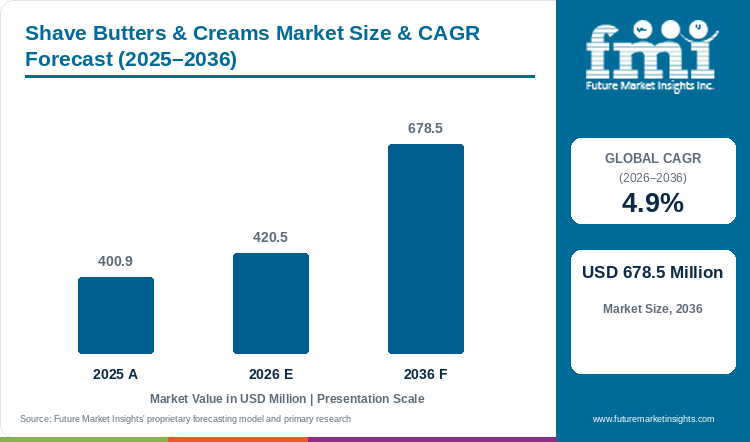
USD 420.5 Million in 2026 and USD 678.5 Million by 2036 at a 4.9% CAGR.
Sales of shave butters and creams is estimated at USD 400.9 Million in 2025 and USD 420.5 Million in 2026, as per FMI. Revenue is projected to reach USD 678.5 Million by 2036 at a 4.9% CAGR, opening USD 258.0 Million of new sales for shave-care producers. Edgewell’s August 2025 Progista account links preparation, shaving and aftercare in one men’s grooming system, showing how the formula can earn its place through the task it performs [1]. Analysts at FMI see familiar grooming brands and focused formulation as the nearest routes to volume. Beiersdorf’s October 2025 NIVEA MEN x Real Madrid limited edition brought a recognizable men’s-care proposition to more than 40 countries [2]. Such activity can bring buyers into the routine, but shave-cream repeat sales will depend on the product itself. Producers that pair clear skin-fit guidance with dependable performance can retain demand after the promotion ends.
Key Takeaways
- Core / classic lines hold 34.0% of Product Type in 2026 because familiar lubrication and routine-use benefits suit broad wet-shaving occasions.
- Conventional formulations hold 47.0% of Nature in 2026 because established formulas remain widely available across mass retail and replenishment channels.
- Cream & balm holds 30.0% of Format in 2026 because controlled application gives users visible coverage and a cushioning layer at the blade-skin interface.
- The main purchasing friction is skin compatibility. Razor bumps or irritation can change shaving frequency and can push some users toward electric shaving or other alternatives.
- Profiled companies are Edgewell Personal Care, Shiseido, Beiersdorf, L'Oreal, Unilever, Kenvue, Procter & Gamble, Wahl, Henkel, and Church & Dwight.
Analyst Perspective
“Demand becomes repeat revenue when a formula delivers credible glide and skin comfort at a price consumers will replenish, while the supplier can document ingredients and maintain channel availability across the target geography.”
- Rahul Pandita, Principal Consultant, FMI
How is the shave butters & creams market segmented?
The market is segmented by Product Type, Nature, Format, Price Positioning, and Sales Channel.
Product Type includes Core / classic lines, Targeted treatment lines, Sensitive & gentle lines, Premium & clinical lines, and Kits & sets. Nature covers Conventional, Vegan & cruelty-free, Natural & organic, Dermocosmetic / clinical, and Fragrance-free & sensitive. Format includes Cream & balm, Liquid & serum, Stick & solid, Spray & mist, Sheet & patch, and Powder. Price Positioning spans Mass, Masstige, Premium, and Professional. Sales Channel includes E-commerce & DTC, Specialty beauty retail, Pharmacies & drugstores, Supermarkets & hypermarkets, and Salons & spas.
What keeps Core / classic lines central to Product Type?
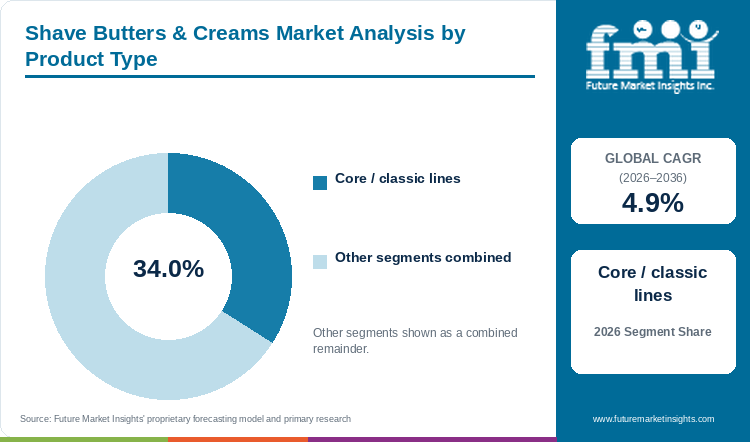
Core / classic lines hold 34.0% of Product Type in 2026.
Core / classic lines address the baseline job of a shave-prep product: soften hair and reduce drag between blade and skin. That makes the format easy to understand and easy to repeat. Premium or targeted lines can command attention when irritation or skin concerns are acute, but classic lines remain the reference purchase for users who prioritize predictable performance and routine replenishment.
- Core / classic lines hold 34.0% of Product Type in 2026. Familiar use patterns and broad compatibility support the segment across everyday wet shaving.
- Edgewell’s November 2025 results release includes Cremo within its grooming portfolio alongside established shave-preparation brands [3]. The current Cremo range provides a direct performance-shaving proposition [4].
Why does Conventional remain the leading Nature category?
Conventional holds 47.0% of Nature in 2026.
Conventional formulas retain a practical advantage because buyers can find them across broad price points and retail settings. Their commercial task is not to avoid formulation complexity but to manage it within familiar texture and performance expectations. Regulation increasingly makes ingredient visibility part of that task. Suppliers that use fragranced or multi-ingredient formulas must balance sensory appeal with disclosure duties and consumer sensitivity concerns.
- Conventional holds 47.0% of Nature in 2026. Its lead reflects established manufacturing economics and the wide availability of familiar shave creams and gels.
- The May 2026 consolidated EU Cosmetics Regulation includes composition and ingredient-labeling provisions [5]. For scented shave preparation, accurate product information belongs in formulation and packaging decisions from the start.
What makes Cream & balm the leading Format?
Cream & balm holds 30.0% of Format in 2026.
Cream and balm formats let users place product exactly where the blade will pass. The visible coating also makes coverage easy to judge during a wet shave. Suppliers can use the format for classic lubrication or for skin-comfort positioning. That flexibility supports both routine and more targeted propositions without changing the basic shaving workflow.
- Cream & balm holds 30.0% of Format in 2026. Controlled application and cushioning at the blade-skin interface support repeat use.
- In October 2025, Beiersdorf announced a NIVEA MEN x Real Madrid limited edition for more than 40 countries [2]. The activity shows the merchandising reach available to an established men’s-care platform.
Why does Mass lead Price Positioning?
Mass holds 30.0% of Price Positioning in 2026.
Mass positioning fits a product that is often replenished alongside other grooming basics. Buyers can trade up for premium skin claims, but recurring use keeps absolute price visible in the purchase decision. Mass products also benefit from wider shelf access and lower trial risk. The segment therefore competes on dependable glide and tolerability rather than prestige cues alone.
- Mass holds 30.0% of Price Positioning in 2026. Frequent replenishment rewards accessible pricing and wide retail availability.
- Aveeno’s current Therapeutic Shave Gel listing emphasizes a fragrance-free formula with oat and vitamin E [6]. Its focused proposition shows how an accessible shave-preparation product can address a specific preference.
How does E-commerce & DTC lead Sales Channel?
E-commerce & DTC holds 33.0% of Sales Channel in 2026.
Digital channels help buyers search by skin concern and compare variant claims before purchase. They also support replenishment without requiring a specialist retail visit. This matters in a fragmented category where sensitive-skin or targeted formulas may not receive equal shelf space in every store. Suppliers can use direct pages and marketplaces to explain use cases while keeping slower-moving variants commercially available.
- E-commerce & DTC holds 33.0% of Sales Channel in 2026. Searchability and repeat ordering favor a category with multiple scents, skin claims, and use occasions.
- In August 2026, the U.S. Census Bureau reported that second-quarter e-commerce sales rose 12.2% year over year and represented 17.1% of retail sales. The broader channel supports digital discovery and replenishment for shave-prep products. [7]
What are the drivers, restraints and opportunities in the shave butters & creams market?
Digital replenishment and skin-comfort needs support demand, while irritation and compliance requirements can slow repeat purchase, and sensitive or fragrance-conscious formulations create an opening for targeted differentiation.
- Driver: Online discovery and repeat replenishment make targeted shave-prep variants easier to find and repurchase.
- Restraint: Razor bumps, irritation, and substitution toward dry or electric shaving can reduce use frequency.
- Opportunity: Fragrance-conscious and sensitive-skin formulas can turn a common shaving friction into a clearer product-selection reason.
Online retail makes it practical to carry a wider range than a single physical shelf. U.S. e-commerce sales grew faster than total retail in the second quarter of 2026 according to the Census Bureau. Great Britain also recorded 11.0% year-over-year growth in online spending for the three months to July 2026. [7] [8] For shave-prep suppliers, digital availability supports education and replenishment when the product benefit is specific enough to search for by name or skin concern.
Discomfort can reduce a buyer’s willingness to keep the same wet-shaving routine. Dove Men+Care’s June 2025 guidance connects shaving preparation and aftercare to that experience [9]. Suppliers need to show how their formula fits the intended routine without promising to resolve every cause of irritation. Clear skin-fit information and a dependable texture can support repeat purchase when the buyer compares several preparation formats.
The opportunity is to make skin compatibility a primary selection criterion. EU fragrance-allergen rules require individual labeling for specified substances above defined thresholds. [5] That increases the value of clear ingredient communication. Kenvue's Aveeno Therapeutic Shave Gel is positioned as fragrance free and allergy tested, while Beiersdorf markets a sensitive shaving gel around irritation protection. [10] [6] Suppliers that pair transparent formulas with problem-specific claims can address consumers who might otherwise reduce wet-shaving frequency or switch formats.
Which country CAGRs are profiled in the shave butters & creams market?
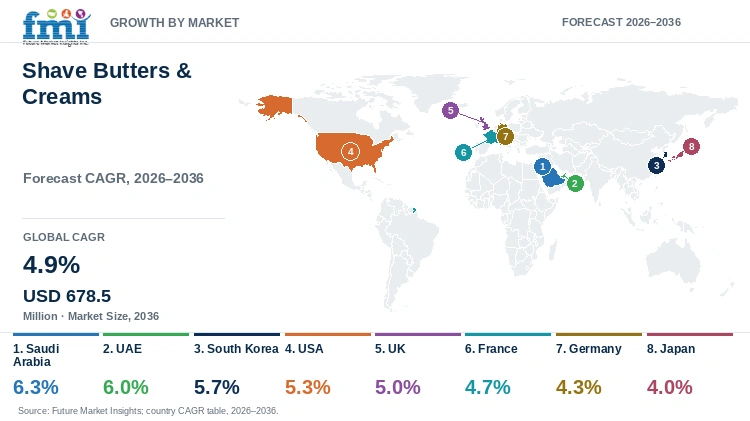
The profiled country CAGRs cover the period from 2026 to 2036.
| Country | CAGR |
|---|---|
| Saudi Arabia | 6.3% |
| UAE | 6.0% |
| South Korea | 5.7% |
| USA | 5.3% |
| UK | 5.0% |
| France | 4.7% |
| Germany | 4.3% |
| Japan | 4.0% |
How do country-level CAGRs compare in the shave butters & creams market?
The profiled growth rates form three practical bands. Saudi Arabia and the UAE are above 6%. South Korea and the USA sit in the mid-to-high 5% range, while the UK is at 5.0%. France, Germany, and Japan are lower-growth profiles. The spread between Saudi Arabia at 6.3% and Japan at 4.0% is 2.3 percentage points. These are growth rates rather than measures of absolute market size.
- Saudi Arabia: Rapid digital-payment adoption improves the transaction environment, while cosmetic notification requirements make compliant product onboarding essential.
- UAE: A formal e-commerce framework supports online selling, but licensing and mainland operating requirements influence route-to-market choices.
- South Korea: High mobile-shopping activity supports discovery of skin-care-like shave formulations and digitally replenished targeted products.
- USA: Deep e-commerce adoption expands assortment access, while MoCRA raises the importance of facility registration and product-listing discipline.
- UK: Online retail is deeply embedded, which increases reach for DTC brands but also sharpens price comparison and claim scrutiny.
- France: High online purchasing supports multichannel access, while EU cosmetic labeling rules strengthen the case for transparent fragrance and ingredient communication.
- Germany: Online buying is mature, so growth depends less on channel creation and more on differentiated formulas and strong repeat purchase.
- Japan: A large B2C e-commerce base supports digital selling, but the profiled CAGR remains the lowest among the eight countries.
Country CAGRs should be read alongside channel maturity and product-regulation conditions. The profiled set spans North America, Western Europe, East Asia, and the Middle East. It does not imply that the fastest CAGR corresponds to the largest revenue pool.
Country-wise Analysis
- Saudi Arabia offers the quickest profiled expansion, at a 6.3% CAGR through 2036, with digital payment reducing friction around replenishment. SAMA reported that electronic payments represented 85% of retail payments in 2025 [11]. Shave-care brands can make familiar formulas easy to reorder through local online channels. Clear skin-fit information and reliable availability will matter more to repeat demand than a promotion that generates only one trial.
- The UAE’s payment infrastructure supports direct sales of specialist shave preparation, with a 6.0% CAGR forecast through 2036. Aani reached 12.5 million registered users in April 2026 [12]. Brands can offer sensitive-skin and premium variants through digital retail, while local fulfillment keeps replenishment practical. Product pages should explain texture, scent and the amount needed so the buyer can judge routine value before purchase.
- South Korea’s mobile channel gives new shave-care formulas a quick route to buyers, supporting a 5.7% CAGR through 2036. Official statistics put mobile at 77.4% of online-shopping value in December 2025 [13]. Short demonstrations can explain glide and application, but repeat sales will depend on the formula’s feel in use. Suppliers should make the successful product easy to identify and reorder rather than constantly changing the assortment.
- US shoppers can reach niche shaving formulas through large online assortments, and sales are forecast at a 5.3% CAGR through 2036. Census reported a 17.1% online share of retail sales in its August 2026 release [7]. That access helps trial while increasing price comparison. Brands need to connect a specific shaving concern to a credible formula and show why the pack offers value over repeated uses.
- The UK’s established internet retail supports a 5.0% CAGR through 2036, with replenishment already familiar to many shoppers. ONS recorded online sales at 27.4% of Great Britain’s retail total in 2025 [14]. Suppliers can present texture and skin suitability in more detail than a shelf label allows. Keeping the formula and pack size consistent can help a first successful shave become an easy repeat order.
- France’s broad online audience gives specialist shave care room to find repeat buyers, supporting a 4.7% CAGR through 2036. Insee recorded recent online purchasing by 63.6% of people aged 15 or older in 2025 [15]. Differentiation needs to remain practical: skin feel, fragrance and rinsing matter during every use. Brands that describe those attributes clearly can compete without making the routine seem more complicated.
- Germany’s mature digital buying makes comparison easy, and shave butters and creams are forecast at a 4.3% CAGR through 2036. Destatis found that 70% of people aged 16 to 74 had recently bought online in 2025 [16]. Suppliers should make ingredients and intended skin fit straightforward to assess. A formula that performs reliably at an accessible price can retain users as they compare both mass and specialist options.
- Japan’s men’s grooming offers increasingly connect shaving to skin care, with a 4.0% CAGR forecast through 2036. Edgewell’s August 2025 Progista account presents preparation and aftercare alongside the razor [1]. Shave-cream suppliers can compete by showing the role their formula plays in that routine. A precise comfort or application benefit will provide a stronger reason to switch than novelty alone in an established grooming market.
Who are the notable companies in the shave butters & creams market?
Edgewell Personal Care, Shiseido, Beiersdorf, L'Oreal, Unilever, Kenvue, Procter & Gamble, Wahl, Henkel, and Church & Dwight are the notable companies profiled in this market.
Competition separates into dedicated wet-shave portfolios, skincare formulations and broader grooming platforms. Edgewell’s 2025 portfolio includes Cremo and established shave-preparation brands [3]. Beiersdorf and P&G bring large grooming franchises, while Shiseido and Kenvue connect shaving to facial and sensitive-skin care. These wider capabilities influence competition, but only the defined shave-butter and cream revenue is included in the market.
- Dedicated wet-shave portfolios: Edgewell Personal Care, Beiersdorf, and Procter & Gamble compete with documented shave-prep products and established shaving routines.
- Skin-care-led shave formulations: Shiseido, L'Oreal, and Kenvue link shave preparation to cleansing, sensitive-skin care, or targeted irritation concerns.
- Broader grooming and personal-care participants: Wahl, Henkel, Church & Dwight, and Unilever have differing levels of direct formula evidence. Current market-specific capability is scored only where first-party support is available.
Competitive Benchmarking: Shave Butters & Creams Market
| Company | Shave-Prep Formula Breadth | Sensitive-Skin / Treatment Positioning | Digital Replenishment & Channel Evidence | Geographic Reach |
|---|---|---|---|---|
| Edgewell Personal Care | High | High | High | Edgewell grooming portfolio and current Cremo direct retail offer [3] [4] |
| Shiseido | Medium | Medium | High | Japan-led men’s skincare and current US cleanser/shaving-cream offer [17] [18] |
| Beiersdorf | High | High | High | International NIVEA MEN platform with current UK shave-preparation products [2] [10] |
| L'Oreal | Medium | Medium | Medium | Men Expert shaving gel documented on the Middle East consumer site; wider shave-prep reach is not fully verified. [19] |
| Unilever | Unscored | Unscored | Unscored | International personal-care platform; adjacent to the defined shave-preparation category |
| Kenvue | Medium | High | Medium | Current US Aveeno shave-gel offer [6] |
| Procter & Gamble | High | High | High | Gillette Venus and Satin Care shave-prep products documented in the U.S. within a global grooming platform. [20] [21] |
| Wahl | Medium | Medium | Medium | Professional grooming and electric-shaving platform [22] |
| Henkel | Medium | Medium | Unscored | La Toja shaving products are documented within Henkel Consumer Brands; product-level reach is strongest in the brand's core European markets. [23] |
| Church & Dwight | Unscored | Unscored | Unscored | Broader household and personal-care portfolio; this profile does not assign direct shave-preparation capability from the corporate range. |
Scoring basis: Shave-Prep Formula Breadth measures documented variety across creams, gels, foams, hybrid cleansers, or related shave-prep formats. Sensitive-Skin / Treatment Positioning measures explicit evidence of irritation, dry-skin, razor-bump, or sensitive-skin propositions. Digital Replenishment & Channel Evidence measures documented direct digital selling or strong product-level online access. High indicates broad documented capability; Medium indicates credible but narrower capability. Low would indicate a documented limitation. Unavailable public information is left Unscored.
Key Developments in the Shave Butters & Creams Market
- Edgewell’s November 2025 results release identifies Cremo alongside its other grooming and shave-preparation brands [3]. That portfolio lets the company connect differentiated formulas with established retail relationships. Continued performance depends on each formula earning repeat use alongside the consumer’s preferred razor.
- In October 2025, Beiersdorf announced a NIVEA MEN x Real Madrid limited edition for more than 40 countries [2]. The activity can introduce buyers to a broader men’s-care routine. Shave-preparation suppliers still need a clear role within that routine to retain sales after a promotion.
- In April 2026, Shiseido announced Skin Matte Serum for men’s sebum and shine concerns [17]. Although outside shave-cream revenue, the launch shows the competition for a place in daily male skincare. Shave formulas need to complement that routine through texture and ease of use.
Key Players in the Shave Butters & Creams Market
Dedicated Wet-Shave and Shave-Prep Portfolios
- Edgewell Personal Care
- Beiersdorf
- Procter & Gamble
Skin-Care-Led Shave Formulations
- Shiseido
- L'Oreal
- Kenvue
Broader Grooming and Personal-Care Platforms
- Unilever
- Wahl
- Henkel
- Church & Dwight
Shave Butters & Creams Market - Report Scope
| Coverage field | Report scope |
|---|---|
| Market breakdown | Product Type; Nature; Format; Price Positioning; Sales Channel |
| Quantitative Units | USD Million |
| Market Definition | Revenue includes shave-preparation products marketed to provide blade glide, reduce shaving friction, condition skin during shaving, or address shaving-related skin comfort within the stated segmentation. Razors, electric shavers, depilatories, unrelated moisturizers or cleansers, salon service revenue, and other adjacent grooming products are excluded. In kits, only the attributable shave-prep component is included when separable. |
| Regions Covered | North America; Latin America; Western Europe; Eastern Europe; East Asia; South Asia and Pacific; Middle East and Africa |
| Countries Covered | USA; Germany; France; UK; Saudi Arabia; UAE; Japan; South Korea |
| Key Companies Profiled | Edgewell Personal Care; Shiseido; Beiersdorf; L'Oreal; Unilever; Kenvue; Procter & Gamble; Wahl; Henkel; Church & Dwight |
| Forecast Period | 2026 to 2036 |
| Approach | Primary and secondary research with market triangulation. |
Shave Butters & Creams Market - Research Methodology
| Method | Approach |
|---|---|
| Primary Research | FMI analysts gathered input from manufacturers, service providers, technology developers, distributors, end users, procurement teams and subject-matter experts. Interviews examined purchasing decisions, product or service evaluation, adoption barriers, approval requirements, pricing considerations and expectations for technical or commercial support. Respondents were also asked what evidence is required before a trial, pilot, or initial order develops into regular purchasing. |
| Desk Research | Desk research covered government statistics, regulatory publications, trade data, industry associations, technical literature, standards, company filings, product information and official corporate announcements. Sources were reviewed for relevance, publication date, geographic coverage and consistency with the defined market scope. Claims relating to performance, applications, approvals, capacity, investment and commercial activity were retained only when supported by credible public evidence. |
| Market Sizing and Forecasting | The market model combined the baseline value with historical performance, segment structure, pricing and volume indicators, adoption levels, company participation and country-level demand conditions. Forecast assumptions considered economic activity, investment trends, regulatory developments, technology adoption, purchasing cycles, supply availability and barriers to wider market use. Segment and regional estimates were reconciled before the final market total was calculated. |
| Data Validation | Estimates were checked against multiple independent indicators, including public data, company activity, trade patterns, industry developments and findings from primary interviews. Validation also tested whether products, services, applications and company revenues fell within the defined market boundaries. Adjacent categories, unsupported claims, overlapping revenues and activities without direct market relevance were excluded to reduce double counting and maintain consistency across segments and countries. |
Shave Butters & Creams Market by Segments
Shave Butters & Creams Market segmented by Product Type:
- Core / classic lines
- Targeted treatment lines
- Sensitive & gentle lines
- Premium & clinical lines
- Kits & sets
Shave Butters & Creams Market segmented by Nature:
- Conventional
- Vegan & cruelty-free
- Natural & organic
- Dermocosmetic / clinical
- Fragrance-free & sensitive
Shave Butters & Creams Market segmented by Format:
- Cream & balm
- Liquid & serum
- Stick & solid
- Spray & mist
- Sheet & patch
- Powder
Shave Butters & Creams Market segmented by Price Positioning:
- Mass
- Masstige
- Premium
- Professional
Shave Butters & Creams Market segmented by Sales Channel:
- E-commerce & DTC
- Specialty beauty retail
- Pharmacies & drugstores
- Supermarkets & hypermarkets
- Salons & spas
Shave Butters & Creams Market by Region:
- North America
- United States
- Canada
- Latin America
- Brazil
- Mexico
- Argentina
- Chile
- Western Europe
- Germany
- France
- United Kingdom
- Italy
- Spain
- Benelux
- Nordics
- Eastern Europe
- Poland
- Czech Republic
- Romania
- Hungary
- East Asia
- China
- Japan
- South Korea
- South Asia and Pacific
- India
- ASEAN
- Australia and New Zealand
- Middle East and Africa
- GCC Countries
- South Africa
- Türkiye
- Israel
Research Sources and Bibliography
- [1] Edgewell Personal Care (2025, August 28). Progista: How Schick Japan Launched the First Total Grooming Care Brand for Men.
- [2] Beiersdorf (2025, October 2). NIVEA MEN and Real Madrid extend global partnership through 2030.
- [3] Edgewell Personal Care (2025, November 13). Fourth Quarter and Fiscal 2025 Results; 2026 Outlook.
- [4] Cremo (n.d.). Original Shaving Cream. Current page, accessed 6 October 2026.
- [5] European Union (2026, May 18 consolidated version). Cosmetics Regulation: current composition and labeling provisions.
- [6] Aveeno (n.d.). Therapeutic Shave Gel with Oat for Dry Skin. Current page, accessed 6 October 2026.
- [7] U.S. Census Bureau (2026, August 18). Quarterly Retail E-Commerce Sales.
- [8] Office for National Statistics (2026, August 21). Retail sales, Great Britain: July 2026.
- [9] Dove Men+Care (2025, June 16). How to stop shaving rash for men.
- [10] NIVEA (n.d.). NIVEA MEN Sensitive Shaving Gel 200ml. Current page, accessed 6 October 2026.
- [11] Saudi Central Bank (2026, April 12). SAMA: E-Payments Account for 85% of Total Retail Payments in 2025.
- [12] Al Etihad Payments (2026, April 10). Aani reaches 12.5 million registered users.
- [13] Ministry of Data and Statistics, Republic of Korea (2026, February 2). Online Shopping in December 2025.
- [14] Office for National Statistics (2026, August 21). Internet sales as a percentage of total retail sales, series J4MC: 2025 annual figure.
- [15] Insee (2025, December 2). Achat sur Internet selon l’âge.
- [16] German Federal Statistical Office (2025, November 27). Internet users and online shoppers.
- [17] Shiseido (2026, April 21). SHISEIDO MEN Skin Matte Serum for sebum and shine concerns.
- [18] Shiseido (n.d.). Shiseido Men Face Cleanser. Current page, accessed 6 October 2026.
- [19] L'Oreal Paris (n.d.). Shaving Cream. Current page, accessed 6 October 2026.
- [20] Gillette Venus (n.d.). Venus Pubic Hair & Skin Smoothing Cleanser & Shave Gel. Current page, accessed 6 October 2026.
- [21] Gillette Venus (n.d.). Satin Care Sensitive Shave Gel. Current page, accessed 6 October 2026.
- [22] Wahl USA (n.d.). What Kind of Shaving Products Do I Need?. Current page, accessed 6 October 2026.
- [23] Henkel (n.d.). La Toja. Current page, accessed 6 October 2026.
- [24] Wahl (2026, May 8). Wahl Launches TrimNinja: The Always-Sharp Trimmer Built to Last.
- [25] Saudi Food and Drug Authority (2026, April 28). List of Notification of Marketing for Cosmetic Products (Listed Products).
- [26] United Arab Emirates Government (2026, April 30). eCommerce.
- [27] U.S. Food and Drug Administration (2026, May 4). Modernization of Cosmetics Regulation Act of 2022 (MoCRA).
- [28] U.S. Food and Drug Administration (2026, September 9). Registration & Listing of Cosmetic Product Facilities and Products.
"This bibliography is provided for reader reference and is not exhaustive. The full report contains the complete reference list and detailed citations."
This Report Answers
- How large is the Shave Butters & Creams Market in 2026 and what value is forecast for 2036?
- Which industry pressures support demand for shave butters and creams?
- Why do Core / classic lines hold the leading Product Type position?
- Why does Conventional hold the leading Nature position?
- How do the profiled country growth rates differ from 2026 to 2036?
- Which companies supply relevant shave-prep and skin-comfort product categories?
- What limits adoption, repeat purchase, or supplier switching in shave preparation?
- What should buyers evaluate before selecting a shave butter or cream?
Frequently Asked Questions
How big is the Shave Butters & Creams Market in 2026, and what is forecast for 2036?
The market is valued at USD 420.5 Million in 2026 and is forecast to reach USD 678.5 Million by 2036. Growth depends on repeat purchase across accessible mass formats and targeted skin-comfort variants.
What is the CAGR of the Shave Butters & Creams Market from 2026 to 2036?
The market is forecast to grow at 4.9% from 2026 to 2036. The rate reflects steady category expansion rather than a short-cycle adoption spike.
Which Product Type segment leads the Shave Butters & Creams Market?
Core / classic lines lead Product Type with a 34.0% share in 2026. Their position reflects familiar wet-shaving routines and broad applicability across everyday use.
Which Nature segment leads the Shave Butters & Creams Market?
Conventional leads Nature with a 47.0% share in 2026. Established formulas remain widely available across price points and retail channels.
Which profiled countries have the highest growth rates in the Shave Butters & Creams Market?
Saudi Arabia has the highest profiled CAGR at 6.3%, followed by the UAE at 6.0% from 2026 to 2036. South Korea follows at 5.7%, which keeps the fastest profiled growth concentrated in digitally active consumer markets.
Which companies are active in the Shave Butters & Creams Market?
Profiled companies are Edgewell Personal Care, Shiseido, Beiersdorf, L'Oreal, Unilever, Kenvue, Procter & Gamble, Wahl, Henkel, and Church & Dwight. Their documented roles range from dedicated shave-prep portfolios to skin-care-led formulas and broader grooming platforms.
Preview the report firsthand - request a free sample
Get SampleGet the brochure for pricing and purchase details.
Get PDFTable of Content
- Key Takeaways
- Market Size and CAGR
- Top Growth Driver
- Fastest Growing Segment
- Leading Region
- Key Companies
- Emerging Opportunities
- Executive Summary
- Global Market Outlook
- Demand-side Trends
- Supply-side Trends
- Technology Roadmap Analysis
- Analysis and Recommendations
- Analyst Perspective (What is happening? Why now? What should investors know?)
- Key Questions Answered
- How large is the market?
- What is the CAGR?
- What are key trends?
- Which region dominates?
- Who are the leaders?
- Market Overview
- Market Coverage / Taxonomy
- Market Definition / Scope / Limitations
- Research Methodology
- Chapter Orientation
- Analytical Lens and Working Hypotheses
- Market Structure, Signals, and Trend Drivers
- Benchmarking and Cross-market Comparability
- Market Sizing, Forecasting, and Opportunity Mapping
- Research Design and Evidence Framework
- Desk Research Programme (Secondary Evidence)
- Expert Input and Fieldwork (Primary Evidence)
- Tooling, Models, and Reference Databases
- Data Engineering and Model Build
- Quality Assurance and Audit Trail
- Market Background
- Market Dynamics (Drivers, Restraints, Opportunity, Trends)
- Scenario Forecast (Optimistic, Likely, Conservative)
- Impact Analysis
- AI Impact
- Sustainability Impact
- Regulatory Impact
- Technology Impact
- Consumer / Buyer Analysis
- Purchase Drivers
- Adoption Barriers
- Buyer Journey
- Opportunity Map Analysis
- Product Life Cycle Analysis
- Supply Chain Analysis
- Investment Feasibility Matrix
- Value Chain Analysis
- PESTLE and Porter's Analysis
- Regulatory Landscape
- Regional Parent Market Outlook
- Production and Consumption Statistics
- Import and Export Statistics
- Global Market Analysis and Forecast, 2021 to 2036
- Historical Market Size Value (USD Million) Analysis, 2021 to 2025
- Current and Future Market Size Value (USD Million) Projections, 2026 to 2036
- Y-o-Y Growth Trend Analysis
- Absolute $ Opportunity Analysis
- Global Market Pricing Analysis, 2021 to 2036
- Global Market Analysis and Forecast, By Product Type, 2021 to 2036
- Introduction / Key Findings
- Historical Market Size Value (USD Million) Analysis By Product Type, 2021 to 2025
- Current and Future Market Size Value (USD Million) Analysis and Forecast By Product Type, 2026 to 2036
- Core / classic lines
- Targeted treatment lines
- Sensitive & gentle lines
- Premium & clinical lines
- Kits & sets
- Y-o-Y Growth Trend Analysis By Product Type, 2021 to 2025
- Absolute $ Opportunity Analysis By Product Type, 2026 to 2036
- Global Market Analysis and Forecast, By Nature, 2021 to 2036
- Introduction / Key Findings
- Historical Market Size Value (USD Million) Analysis By Nature, 2021 to 2025
- Current and Future Market Size Value (USD Million) Analysis and Forecast By Nature, 2026 to 2036
- Conventional
- Vegan & cruelty-free
- Natural & organic
- Dermocosmetic / clinical
- Fragrance-free & sensitive
- Y-o-Y Growth Trend Analysis By Nature, 2021 to 2025
- Absolute $ Opportunity Analysis By Nature, 2026 to 2036
- Global Market Analysis and Forecast, By Format, 2021 to 2036
- Introduction / Key Findings
- Historical Market Size Value (USD Million) Analysis By Format, 2021 to 2025
- Current and Future Market Size Value (USD Million) Analysis and Forecast By Format, 2026 to 2036
- Cream & balm
- Liquid & serum
- Stick & solid
- Spray & mist
- Sheet & patch
- Powder
- Y-o-Y Growth Trend Analysis By Format, 2021 to 2025
- Absolute $ Opportunity Analysis By Format, 2026 to 2036
- Global Market Analysis and Forecast, By Price Positioning, 2021 to 2036
- Introduction / Key Findings
- Historical Market Size Value (USD Million) Analysis By Price Positioning, 2021 to 2025
- Current and Future Market Size Value (USD Million) Analysis and Forecast By Price Positioning, 2026 to 2036
- Mass
- Masstige
- Premium
- Professional
- Y-o-Y Growth Trend Analysis By Price Positioning, 2021 to 2025
- Absolute $ Opportunity Analysis By Price Positioning, 2026 to 2036
- Global Market Analysis and Forecast, By Sales Channel, 2021 to 2036
- Introduction / Key Findings
- Historical Market Size Value (USD Million) Analysis By Sales Channel, 2021 to 2025
- Current and Future Market Size Value (USD Million) Analysis and Forecast By Sales Channel, 2026 to 2036
- E-commerce & DTC
- Specialty beauty retail
- Pharmacies & drugstores
- Supermarkets & hypermarkets
- Salons & spas
- Y-o-Y Growth Trend Analysis By Sales Channel, 2021 to 2025
- Absolute $ Opportunity Analysis By Sales Channel, 2026 to 2036
- Global Market Analysis and Forecast, By Region, 2021 to 2036
- Introduction
- Historical Market Size Value (USD Million) Analysis By Region, 2021 to 2025
- Current Market Size Value (USD Million) Analysis and Forecast By Region, 2026 to 2036
- North America
- Latin America
- Western Europe
- Eastern Europe
- East Asia
- South Asia and Pacific
- Middle East and Africa
- Market Attractiveness Analysis By Region
- North America Market Analysis and Forecast, By Country, 2021 to 2036
- Historical Market Size Value (USD Million) Trend Analysis By Market Taxonomy, 2021 to 2025
- Market Size Value (USD Million) Forecast By Market Taxonomy, 2026 to 2036
- By Country
- United States
- Canada
- By Product Type
- By Nature
- By Format
- By Price Positioning
- By Sales Channel
- By Country
- Market Attractiveness Analysis
- By Country
- By Product Type
- By Nature
- By Format
- By Price Positioning
- By Sales Channel
- Key Takeaways
- Latin America Market Analysis and Forecast, By Country
- Historical Market Size Value (USD Million) Trend Analysis By Market Taxonomy, 2021 to 2025
- Market Size Value (USD Million) Forecast By Market Taxonomy, 2026 to 2036
- By Country
- Brazil
- Mexico
- Argentina
- Chile
- By Product Type
- By Nature
- By Format
- By Price Positioning
- By Sales Channel
- By Country
- Market Attractiveness Analysis
- By Country
- By Product Type
- By Nature
- By Format
- By Price Positioning
- By Sales Channel
- Key Takeaways
- Western Europe Market Analysis and Forecast, By Country
- Historical Market Size Value (USD Million) Trend Analysis By Market Taxonomy, 2021 to 2025
- Market Size Value (USD Million) Forecast By Market Taxonomy, 2026 to 2036
- By Country
- Germany
- France
- United Kingdom
- Italy
- Spain
- Benelux
- Nordics
- By Product Type
- By Nature
- By Format
- By Price Positioning
- By Sales Channel
- By Country
- Market Attractiveness Analysis
- By Country
- By Product Type
- By Nature
- By Format
- By Price Positioning
- By Sales Channel
- Key Takeaways
- Eastern Europe Market Analysis and Forecast, By Country
- Historical Market Size Value (USD Million) Trend Analysis By Market Taxonomy, 2021 to 2025
- Market Size Value (USD Million) Forecast By Market Taxonomy, 2026 to 2036
- By Country
- Poland
- Czech Republic
- Romania
- Hungary
- By Product Type
- By Nature
- By Format
- By Price Positioning
- By Sales Channel
- By Country
- Market Attractiveness Analysis
- By Country
- By Product Type
- By Nature
- By Format
- By Price Positioning
- By Sales Channel
- Key Takeaways
- East Asia Market Analysis and Forecast, By Country
- Historical Market Size Value (USD Million) Trend Analysis By Market Taxonomy, 2021 to 2025
- Market Size Value (USD Million) Forecast By Market Taxonomy, 2026 to 2036
- By Country
- China
- Japan
- South Korea
- By Product Type
- By Nature
- By Format
- By Price Positioning
- By Sales Channel
- By Country
- Market Attractiveness Analysis
- By Country
- By Product Type
- By Nature
- By Format
- By Price Positioning
- By Sales Channel
- Key Takeaways
- South Asia and Pacific Market Analysis and Forecast, By Country
- Historical Market Size Value (USD Million) Trend Analysis By Market Taxonomy, 2021 to 2025
- Market Size Value (USD Million) Forecast By Market Taxonomy, 2026 to 2036
- By Country
- India
- ASEAN
- Australia and New Zealand
- By Product Type
- By Nature
- By Format
- By Price Positioning
- By Sales Channel
- By Country
- Market Attractiveness Analysis
- By Country
- By Product Type
- By Nature
- By Format
- By Price Positioning
- By Sales Channel
- Key Takeaways
- Middle East and Africa Market Analysis and Forecast, By Country
- Historical Market Size Value (USD Million) Trend Analysis By Market Taxonomy, 2021 to 2025
- Market Size Value (USD Million) Forecast By Market Taxonomy, 2026 to 2036
- By Country
- GCC Countries
- South Africa
- Türkiye
- Israel
- By Product Type
- By Nature
- By Format
- By Price Positioning
- By Sales Channel
- By Country
- Market Attractiveness Analysis
- By Country
- By Product Type
- By Nature
- By Format
- By Price Positioning
- By Sales Channel
- Key Takeaways
- Key Countries Market Analysis
- United States
- Pricing Analysis
- Market Share Analysis, 2025
- By Product Type
- By Nature
- By Format
- By Price Positioning
- By Sales Channel
- Canada
- Pricing Analysis
- Market Share Analysis, 2025
- By Product Type
- By Nature
- By Format
- By Price Positioning
- By Sales Channel
- Mexico
- Pricing Analysis
- Market Share Analysis, 2025
- By Product Type
- By Nature
- By Format
- By Price Positioning
- By Sales Channel
- Brazil
- Pricing Analysis
- Market Share Analysis, 2025
- By Product Type
- By Nature
- By Format
- By Price Positioning
- By Sales Channel
- Chile
- Pricing Analysis
- Market Share Analysis, 2025
- By Product Type
- By Nature
- By Format
- By Price Positioning
- By Sales Channel
- Germany
- Pricing Analysis
- Market Share Analysis, 2025
- By Product Type
- By Nature
- By Format
- By Price Positioning
- By Sales Channel
- United Kingdom
- Pricing Analysis
- Market Share Analysis, 2025
- By Product Type
- By Nature
- By Format
- By Price Positioning
- By Sales Channel
- Italy
- Pricing Analysis
- Market Share Analysis, 2025
- By Product Type
- By Nature
- By Format
- By Price Positioning
- By Sales Channel
- Spain
- Pricing Analysis
- Market Share Analysis, 2025
- By Product Type
- By Nature
- By Format
- By Price Positioning
- By Sales Channel
- France
- Pricing Analysis
- Market Share Analysis, 2025
- By Product Type
- By Nature
- By Format
- By Price Positioning
- By Sales Channel
- India
- Pricing Analysis
- Market Share Analysis, 2025
- By Product Type
- By Nature
- By Format
- By Price Positioning
- By Sales Channel
- ASEAN
- Pricing Analysis
- Market Share Analysis, 2025
- By Product Type
- By Nature
- By Format
- By Price Positioning
- By Sales Channel
- Australia and New Zealand
- Pricing Analysis
- Market Share Analysis, 2025
- By Product Type
- By Nature
- By Format
- By Price Positioning
- By Sales Channel
- China
- Pricing Analysis
- Market Share Analysis, 2025
- By Product Type
- By Nature
- By Format
- By Price Positioning
- By Sales Channel
- Japan
- Pricing Analysis
- Market Share Analysis, 2025
- By Product Type
- By Nature
- By Format
- By Price Positioning
- By Sales Channel
- South Korea
- Pricing Analysis
- Market Share Analysis, 2025
- By Product Type
- By Nature
- By Format
- By Price Positioning
- By Sales Channel
- Poland
- Pricing Analysis
- Market Share Analysis, 2025
- By Product Type
- By Nature
- By Format
- By Price Positioning
- By Sales Channel
- Hungary
- Pricing Analysis
- Market Share Analysis, 2025
- By Product Type
- By Nature
- By Format
- By Price Positioning
- By Sales Channel
- Türkiye
- Pricing Analysis
- Market Share Analysis, 2025
- By Product Type
- By Nature
- By Format
- By Price Positioning
- By Sales Channel
- South Africa
- Pricing Analysis
- Market Share Analysis, 2025
- By Product Type
- By Nature
- By Format
- By Price Positioning
- By Sales Channel
- Saudi Arabia
- Pricing Analysis
- Market Share Analysis, 2025
- By Product Type
- By Nature
- By Format
- By Price Positioning
- By Sales Channel
- UAE
- Pricing Analysis
- Market Share Analysis, 2025
- By Product Type
- By Nature
- By Format
- By Price Positioning
- By Sales Channel
- United States
- Market Structure Analysis
- Competition Dashboard
- Competition Benchmarking
- Market Share Analysis of Top Players
- By Regional
- By Product Type
- By Nature
- By Format
- By Price Positioning
- By Sales Channel
- Emerging Startups
- Innovation Benchmarking
- Competition Analysis
- Competition Deep Dive
- Edgewell Personal Care
- Overview
- Product Portfolio
- Profitability by Market Segments
- Sales Footprint
- Strategy Overview
- Marketing Strategy
- Product Strategy
- Channel Strategy
- Shiseido
- Beiersdorf
- L'Oreal
- Unilever
- Kenvue
- Procter & Gamble
- Wahl
- Henkel
- Church & Dwight
- Edgewell Personal Care
- Case Studies
- Success Stories
- Recent Developments
- Competition Deep Dive
- Assumptions & Acronyms Used


