

- Market Size (2026)
- USD 3.4 Bn
- Forecast (2036)
- USD 8.0 Bn
- CAGR (2026 to 2036)
- 9.0%
How big is Single-Use Consumables Market in 2026?
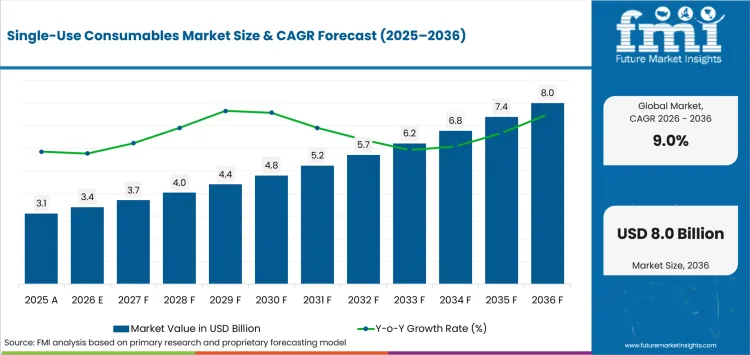
USD 3.4 billion in 2026 and USD 8.0 billion by 2036 at a 9.0% CAGR.
Demand for single-use consumables is projected to expand at a 9.0% CAGR between 2026 and 2036, increasing the market from USD 3.4 billion to USD 8.0 billion. Biopharmaceutical manufacturers use tubing and connectors to move process fluids, while capsule filters and valves control separation or flow inside the same production path.
Integrity evidence is central to the purchase decision. The Bio-Process Systems Alliance states that integrity testing or monitoring is expected for closed single-use systems used in sterile manufacturing, and the supplier should validate that the test method does not damage the assembly. This makes documentation, traceability and replacement lead times part of routine procurement.
Key Takeaways of Single-Use Consumables Market
- The market is projected to increase from USD 3.4 billion in 2026 to USD 8.0 billion by 2036 at a 9.0% CAGR.
- Tubing is forecast to lead Product Type with a 24.0% share in 2026 because fluid transfer is required across upstream and downstream operations.
- Filtration is estimated to account for 31.0% of Application demand in 2026 as depth and membrane filters support clarification and sterile processing.
- Biopharmaceutical & Pharmaceutical Companies lead End User at 49.0%; Polyethylene leads Material at 34.0%; Standard Single-Use Components lead Product Configuration at 43.0%.
- Extractables, leachables and system-integrity evidence can lengthen qualification, especially when several components are combined into one fluid path.
- Key companies include Thermo Fisher Scientific Inc., Sartorius AG, Danaher Corporation, Merck KGaA, Avantor, Inc., Repligen Corporation, Corning Incorporated, Meissner Filtration Products Inc., Lonza Group AG and Parker Hannifin Corporation.
Analyst Perspective
"Single-use procurement works best when the complete fluid path is assessed as one system. Teams should qualify materials, connections and integrity tests together so a change in one component does not create avoidable validation work elsewhere in the process."
- Anurag Sharma, Principal Consultant at Future Market Insights
How is the Single-Use Consumables Market segmented?
The single-use consumables market is segmented by product type, application, end user, material and product configuration.
Product Type covers Tubing, Connectors, Disposable Capsule Filters and Valves. Application includes Filtration, Cell Culture & Mixing, Storage and Sampling. End User separates biopharmaceutical and pharmaceutical companies from contract organizations, equipment manufacturers and research institutes. Material covers PE, PVC, Silicone and PP, while Product Configuration distinguishes individual components from pre-assembled and integrated systems.
Why does Tubing lead the Product Type category?
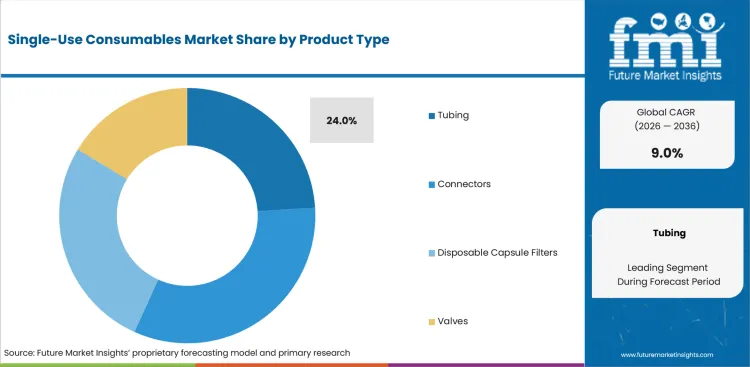
Tubing forms the physical transfer route between vessels, filters and storage containers. BioPhorum's extractables framework treats tubing as a product-contact component that requires material and test information before it is incorporated into a manufacturing process.
- Tubing is projected to account for 24.0% of Product Type demand in 2026 because fluid transfer appears across media preparation, harvest, filtration and fill-finish workflows.
- Silicone Tubing and PVC Tubing form the two subsegments. Connectors, Disposable Capsule Filters and Valves cover the other component groups used around the fluid path.
Why does Filtration lead the Application category?
Filtration sits at repeated control points in bioprocessing. Depth filters remove larger process impurities, while membrane filters support finer separation and sterile handling. Filter selection also affects pressure limits, hold-up volume and integrity testing.
- Filtration is forecast to lead Application with a 31.0% share in 2026 because clarification and sterile filtration recur across development and commercial production.
- Cell Culture & Mixing covers bioreactors and mixing systems, while Storage covers bags and containers. Sampling includes aseptic and closed-system formats.
Why do Biopharmaceutical & Pharmaceutical Companies lead the End User category?
These manufacturers own the process-validation record and carry the risk of a sterility breach or material interaction. Their purchasing teams therefore assess sterilization status, change notifications and component traceability before a consumable becomes part of the manufacturing record.
- Biopharmaceutical & Pharmaceutical Companies are estimated to hold 49.0% of End User demand in 2026 because single-use fluid paths are consumed directly in development and production.
- CROs and CMOs require flexible assemblies for client programs. Equipment OEMs, system integrators and research institutes form the remaining end-user groups.
Why does Polyethylene lead the Material category?
Polyethylene is widely used in films and containers because it can provide a flexible product-contact layer across storage and transfer applications. Qualification still depends on the exact film structure, manufacturing process and extractables data rather than the polymer name alone.
- Polyethylene (PE) is projected to hold 34.0% of Material demand in 2026, supported by its use in single-use bags and film-based containers.
- Low-Density and High-Density Polyethylene sit within PE. PVC, Silicone and Polypropylene provide alternative material routes for tubing, fittings and rigid components.
Why do Standard Single-Use Components lead the Product Configuration category?
Standard components give process owners a straightforward route to replace or qualify one part inside an existing setup. Pre-assembled systems reduce onsite connections, but they shift more design responsibility toward the supplier and require evidence for the complete assembly.
- Standard Single-Use Components are estimated to account for 43.0% of Product Configuration demand in 2026 because individual tubing and connectors remain the basic units of process design.
- Pre-Assembled Single-Use Assemblies include custom and ready-to-use fluid paths. Integrated Single-Use Systems combine several unit operations within a closed configuration.
What are the drivers, restraints and opportunities in the Single-Use Consumables Market?
Closed processing raises demand for documented assemblies, while extractables and integrity risks slow qualification and create room for pre-assembled systems.
- Driver: Closed fluid paths reduce open handling and increase demand for tubing, filters and connectors that arrive sterilized with usable documentation.
- Restraint: Extractables, leachables and leak risk require evidence for each component and for the complete assembly under its intended operating conditions.
- Opportunity: Standardized user requirements and engineered assemblies can reduce design iterations when manufacturers scale a process across sites.
Closed processing supports contamination control by limiting direct contact between the product and the surrounding environment. Cytiva notes that closed systems are commonly created with sterile single-use consumables, which can reduce cleaning and setup work. Demand therefore rises when suppliers can provide a complete fluid path with clear operating limits.
Qualification remains the main restraint. BioPhorum's extractables templates cover films, tubing, connectors and filters, while FDA's draft Q3E guidance sets out a risk-based framework for extractables and leachables. A buyer must confirm that standardized data match the actual contact time, temperature and process fluid.
The opportunity lies in assemblies that are easier to specify and transfer between sites. The 2026 BioPhorum and BPSA user-requirements toolkit gives manufacturers and suppliers a common structure for assembly design. Suppliers can build on that structure through configurable tubing sets, sampling systems and filtration assemblies.
Which country CAGRs are analyzed in the Single-Use Consumables Market?
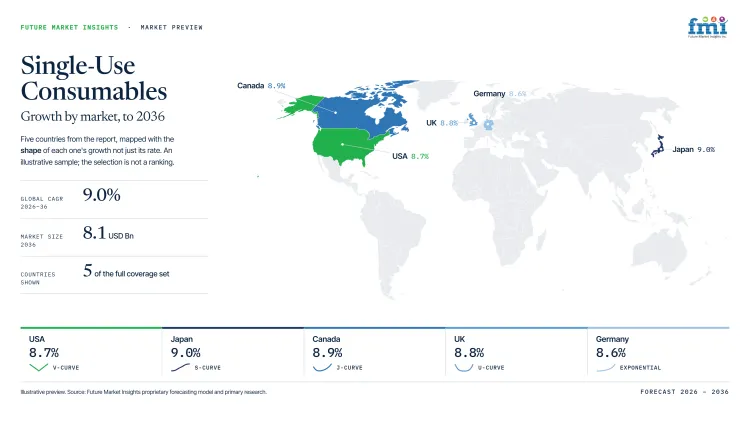
| Country | CAGR |
|---|---|
| South Korea | 10.2% |
| Australia | 9.1% |
| Japan | 9.0% |
| Canada | 8.9% |
| UK | 8.8% |
| USA | 8.7% |
| Germany | 8.6% |
How do country-level CAGRs compare in the Single-Use Consumables Market?
The seven country CAGRs span 1.6 percentage points, from 10.2% in South Korea to 8.6% in Germany. The narrow range shows that market access will depend on qualification support and supply continuity alongside the underlying growth rate.
- South Korea is expected to record significant growth, supported by expanding biopharmaceutical manufacturing capacity and stronger adoption of single-use processing systems.
- Australia is projected to maintain steady demand as manufacturers align sterile production practices with updated GMP requirements.
- Japan is forecast to experience sustained growth, driven by strict aseptic-processing standards and demand for well-documented consumable systems.
- Canada is expected to expand gradually as pharmaceutical manufacturers strengthen sterile production, quality control and packaging operations.
- The UK is likely to see stable adoption as bioprocessing companies focus on compliant fluid transfer, sampling and filtration workflows.
- The USA is projected to remain an important market due to its large biopharmaceutical manufacturing base and continued investment in flexible production infrastructure.
- Germany is expected to record measured growth, supported by its established bioprocessing ecosystem and emphasis on product traceability and process validation.
Small CAGR differences can still produce different entry conditions because sterile-manufacturing rules, inspection practices and local technical support vary by country. Suppliers need a consistent global quality file with country-specific implementation support.
Country-wise Analysis
- South Korea is projected to record CAGR at 10.2% through 2036. The Ministry of Food and Drug Safety publishes a formal GMP regulation for medicinal products. Suppliers entering the market need clear evidence on sterilization, integrity and change control, supported by local technical teams that can work with Korean manufacturers.
- Australia is expected to expand at a 9.1% CAGR. The Therapeutic Goods Administration adopted PIC/S GMP Guide PE009-17 from September 1, 2025, with major changes centered on Annex 1 for sterile medicines. Single-use suppliers can support adoption by mapping assembly evidence to contamination-control and filter-integrity procedures.
- Japan is forecast to advance at a 9.0% CAGR. PMDA maintains GMP inspection requirements and publishes guidance for sterile pharmaceutical products produced by aseptic processing. Documentation for tubing, connectors and filters therefore needs to fit the intended process step and the Japanese inspection record.
- Canada is anticipated to grow at an 8.9% CAGR. Health Canada's GUI-0119 provides guidance for sterile drug manufacture and covers qualification, validation and contamination-control principles. Buyers will expect the supplier file to connect component materials with the complete assembly and its sterilization method.
- UK demand is estimated to rise at an 8.8% CAGR. The MHRA inspects manufacturing and distribution sites for GMP or GDP compliance using a risk-based approach. Regional availability and dependable change notifications can influence supplier selection because a replacement component may require formal assessment.
- The USA is projected to post an 8.7% CAGR. FDA states that cGMP requires proper design, monitoring and control of manufacturing processes and facilities. Single-use suppliers therefore compete on traceable specifications and process-relevant validation evidence in addition to price.
- Germany is forecast to expand at an 8.6% CAGR. EU GMP Annex 1 is fully applicable for sterile medicinal products and places strong emphasis on contamination control and closed-system integrity. German buyers are likely to favor suppliers that can maintain consistent material records across European production sites.
Who are the notable companies in the Single-Use Consumables Market?
Thermo Fisher Scientific Inc., Sartorius AG, Danaher Corporation, Merck KGaA, Avantor, Inc., Repligen Corporation, Corning Incorporated, Meissner Filtration Products Inc., Lonza Group AG and Parker Hannifin Corporation are notable companies active in the single-use consumables market.
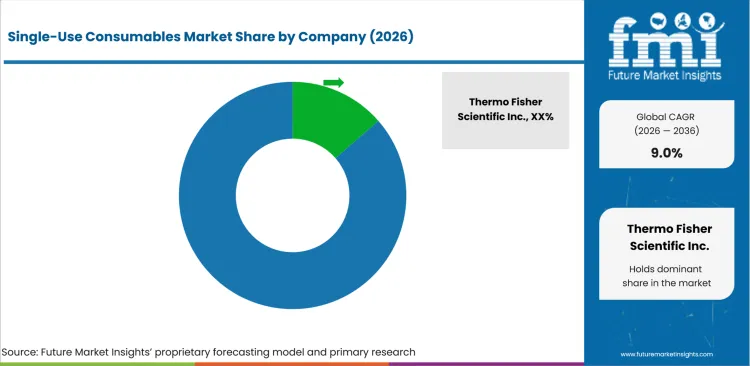
Competition spans full bioprocess platforms, fluid-management specialists and filtration suppliers. Large biopharmaceutical operators also shape demand because their qualification standards influence component design, documentation and supply agreements.
- Integrated bioprocess platforms: Thermo Fisher Scientific Inc.; Sartorius AG; Danaher Corporation; Merck KGaA; Avantor, Inc.
- Fluid-management and single-use specialists: Repligen Corporation; Corning Incorporated; Meissner Filtration Products Inc.; Parker Hannifin Corporation.
- Biopharmaceutical manufacturing services: Lonza Group AG, which is a major user of single-use technologies rather than a broad consumables supplier.
Competitive Benchmarking: Single-Use Consumables Market
| Company | Single-use portfolio | Filtration & fluid paths | Biopharma coverage | Geographic reach |
|---|---|---|---|---|
| Thermo Fisher Scientific Inc. | High | High | High | Global |
| Sartorius AG | High | High | High | Global |
| Danaher Corporation | High | High | High | Global |
| Merck KGaA | High | High | High | Global |
| Avantor, Inc. | High | High | High | 180 countries |
| Repligen Corporation | High | High | High | Global |
| Corning Incorporated | Medium | Medium | High | Global |
| Meissner Filtration Products Inc. | High | High | High | USA and Ireland manufacturing |
| Lonza Group AG | Low | Low | High | Global manufacturing network |
| Parker Hannifin Corporation | High | High | High | Global |
Scoring basis: Single-use portfolio is High when official material confirms several product groups such as bags, tubing, connectors or valves. Filtration and fluid management is High when both filtration and assembled fluid-path capability are documented. Biopharma application coverage is High when the company explicitly serves pharmaceutical or biopharmaceutical production. Lonza is rated on its role as a manufacturing user, not as a diversified consumables supplier. Geographic Reach reflects public operating information and does not represent market share.
Key Developments in the Single-Use Consumables Market
- In April 2026, Avantor unified the Masterflex portfolio around standard, configurable and engineered-to-order pumps, single-use assemblies and systems for research through high-volume bioprocess manufacturing.
- In January 2026, Sartorius expanded its bio-circular offering to filters and additional single-use fluid-management technologies, supported by certified production sites in Germany, Tunisia, France and the UK.
- In September 2025, Thermo Fisher Scientific completed the acquisition of Solventum's Purification and Filtration business to expand its bioprocessing and filtration portfolio.
Key Players in the Single-Use Consumables Market
Integrated Bioprocess and Filtration Platforms
- Thermo Fisher Scientific Inc.
- Sartorius AG
- Danaher Corporation
- Merck KGaA
- Avantor, Inc.
Fluid Management and Single-Use Specialists
- Repligen Corporation
- Corning Incorporated
- Meissner Filtration Products Inc.
- Parker Hannifin Corporation
Biopharmaceutical Manufacturing Services
- Lonza Group AG
Single-Use Consumables Market - Report Scope
| Coverage field | Report scope |
|---|---|
| Market breakdown | By Product Type, Application, End User, Material and Product Configuration. |
| Quantitative Units | USD billion. |
| Market Definition | Disposable tubing, connectors, capsule filters, valves, bags and related assemblies used for fluid transfer, filtration, storage, sampling and integrated bioprocessing. |
| Regions Covered | North America, Latin America, Europe, East Asia, South Asia and Pacific, and Middle East and Africa. |
| Countries Covered | South Korea, Australia, Japan, Canada, UK, USA, Germany, and other countries included in the full report. |
| Key Companies | Thermo Fisher Scientific Inc.; Sartorius AG; Danaher Corporation; Merck KGaA; Avantor, Inc.; Repligen Corporation; Corning Incorporated; Meissner Filtration Products Inc.; Lonza Group AG; Parker Hannifin Corporation. |
| Forecast Period | 2026 to 2036. |
| Approach | Primary and secondary research with market triangulation. |
Single-Use Consumables Market - Research Methodology
| Method | Approach |
|---|---|
| Primary Research | FMI analysts gathered input from manufacturers, distributors, biopharmaceutical users, contract manufacturers, equipment suppliers and subject-matter experts. Interviews examined buying criteria, validation requirements, supply continuity, technical support and the evidence needed before a component or assembly becomes part of routine manufacturing. |
| Desk Research | Desk research covered regulatory guidance, industry-association publications, standards, company filings, product literature and official corporate announcements. Sources were checked for relevance to the market definition, publication date and geographic scope. Product or company claims were retained only when supported by public evidence. |
| Market Sizing and Forecasting | The market model combined the baseline value with historical performance, segment structure, adoption levels, pricing and volume indicators, company participation and country demand conditions. Forecast assumptions considered biologics manufacturing activity, outsourcing, sterile-processing requirements, qualification cycles and supply availability. |
| Data Validation | Estimates were checked against multiple indicators, including regulatory developments, company actions, industry guidance and findings from primary interviews. Validation also tested whether products and revenues fell inside the market boundary. Adjacent equipment categories and unsupported claims were excluded to reduce overlap. |
Single-Use Consumables Market by Segments
Single-Use Consumables Market segmented by Product Type:
- Tubing
- Silicone Tubing
- PVC Tubing
- Connectors
- Luer Connectors
- Quick Connectors
- Disposable Capsule Filters
- Depth Filters
- Membrane Filters
- Valves
- Check Valves
- Control Valves
Single-Use Consumables Market segmented by Application:
- Filtration
- Depth Filtration
- Membrane Filtration
- Cell Culture & Mixing
- Single-Use Bioreactors
- Single-Use Mixing Systems
- Storage
- Bioprocessing Bags
- Single-Use Storage Containers
- Sampling
- Aseptic Sampling
- Closed-System Sampling
Single-Use Consumables Market segmented by End User:
- Biopharmaceutical & Pharmaceutical Companies
- Biopharmaceutical Manufacturers
- Pharmaceutical Manufacturers
- Contract Research & Contract Manufacturing Organizations
- CROs
- CMOs & CDMOs
- Original Equipment Manufacturers (OEMs)
- Bioprocess Equipment OEMs
- Single-Use System Integrators
- Academic & Research Institutes
- Universities
- Research Laboratories
Single-Use Consumables Market segmented by Material:
- Polyethylene (PE)
- Low-Density Polyethylene
- High-Density Polyethylene
- Polyvinyl Chloride (PVC)
- Flexible PVC
- Medical-Grade PVC
- Silicone
- Platinum-Cured Silicone
- Standard Silicone
- Polypropylene (PP)
- Standard Polypropylene
- Medical-Grade Polypropylene
Single-Use Consumables Market segmented by Product Configuration:
- Standard Single-Use Components
- Individual Tubing
- Individual Connectors
- Pre-Assembled Single-Use Assemblies
- Custom Fluid Management Assemblies
- Ready-to-Use Assemblies
- Integrated Single-Use Systems
- Integrated Bioprocess Systems
- Customized Closed Systems
Single-Use Consumables Market by Region:
- North America
- United States
- Canada
- Latin America
- Brazil
- Chile
- Mexico
- Rest of Latin America
- Western Europe
- Germany
- United Kingdom
- Italy
- Spain
- France
- Nordics
- Benelux
- Rest of Western Europe
- Eastern Europe
- Russia
- Poland
- Hungary
- Balkan and Baltic States
- Rest of Eastern Europe
- East Asia
- China
- Japan
- South Korea
- South Asia and Pacific
- India
- ASEAN
- Australia and New Zealand
- Rest of South Asia and Pacific
- Middle East and Africa
- Kingdom of Saudi Arabia
- Other GCC Countries
- Türkiye
- South Africa
- Other African Union Countries
- Rest of Middle East and Africa
Research Sources and Bibliography
- USA Food and Drug Administration. (2025, November 21). Facts About the Current Good Manufacturing Practice (CGMP).
- USA Food and Drug Administration. (2004, October). Sterile Drug Products Produced by Aseptic Processing - Current Good Manufacturing Practice.
- USA Food and Drug Administration. (2025, December 1). Q3E Guideline for Extractables and Leachables.
- European Commission. (2022, August 25). EudraLex Volume 4, Annex 1: Manufacture of Sterile Medicinal Products.
- Pharmaceutical Inspection Co-operation Scheme. (2023, August 25). Entry into force of revised GMP Annex 1.
- Bio-Process Systems Alliance. (2024-2025). Integrity Assurance FAQs.
- Bio-Process Systems Alliance. (2026, March 19). BioPhorum and BPSA Single-Use Assembly/Systems User Requirements Toolkit.
- BioPhorum. (2020, April 22). Extractables testing of polymeric single-use components used in biopharmaceutical manufacturing.
- BioPhorum. (2019, May 15). Guide to the completion of the BioPhorum extractables data template.
- Pharmaceuticals and Medical Devices Agency. (n.d.). GMP compliance inspection.
- Medicines and Healthcare products Regulatory Agency. (n.d.). Good manufacturing practice and good distribution practice.
- Health Canada. (2024, May 21). Manufacture of sterile drugs, GUI-0119, version 2.
- Therapeutic Goods Administration. (2025, August 27). Good manufacturing practice requirements for medicinal products: PIC/S Guide to GMP PE009-17.
- Ministry of Food and Drug Safety. (2023, March 27). Regulation on Good Manufacturing Practices for Medicinal Products.
- Thermo Fisher Scientific. (n.d.). Single-Use Tubing and Assemblies.
- Thermo Fisher Scientific. (2025, September 2). Thermo Fisher Scientific completes acquisition of Solventum's Purification and Filtration business.
- Sartorius. (2026, January 14). Sartorius expands bio-circular product offering for more sustainable bioprocesses.
- Cytiva. (2024, September 13). Process considerations for closed connected processing.
- Merck. (n.d.). Single-Use Assemblies.
- Avantor. (2026, April 21). Avantor unifies Masterflex portfolio to streamline fluid management from R&D to bioprocess manufacturing.
- Repligen. (n.d.). Fluid Management.
- Corning. (n.d.). Single-use Bioprocessing Technology.
- Meissner. (n.d.). Single-Use Systems.
- Parker Hannifin. (n.d.). PureTain PUPSIT Assemblies.
- Lonza. (2025, April 1). Biologics.
This bibliography is provided for reader reference and is not exhaustive. The full report contains the complete reference list and detailed citations.
This Report Answers
- How large is the Single-Use Consumables Market in 2026 and 2036?
- Which operating conditions support adoption of closed single-use fluid paths?
- Which product type and application lead demand in 2026?
- Which end user, material and product configuration hold the largest shares?
- How do country growth rates affect supplier entry conditions?
- Which companies combine filtration with single-use fluid management?
- What slows qualification and where do engineered assemblies create opportunity?
- How are market estimates validated across segments and regions?
Frequently Asked Questions
How big is the Single-Use Consumables Market in 2026?
USD 3.4 billion represents the market value in 2026. Demand is projected to reach USD 8.0 billion by 2036 as closed fluid paths expand across biopharmaceutical and pharmaceutical production.
What is the CAGR of the Single-Use Consumables Market from 2026 to 2036?
A 9.0% CAGR is projected between 2026 and 2036. Growth depends on broader use of tubing, capsule filters and ready-to-use assemblies, while integrity and material qualification remain central purchasing requirements.
Which segments lead the Single-Use Consumables Market in 2026?
Tubing leads Product Type at 24.0% and Filtration leads Application at 31.0%. Biopharmaceutical & Pharmaceutical Companies account for 49.0% of End User demand, while PE leads Material at 34.0% and Standard Single-Use Components lead Product Configuration at 43.0%.
How much will the Single-Use Consumables Market add between 2026 and 2036?
The market is expected to add USD 4.7 billion between 2026 and 2036. The increase reflects wider use of sterile fluid transfer and filtration, supported by pre-assembled configurations that reduce onsite connection work.
Which companies are active in the Single-Use Consumables Market?
Ten notable companies include Thermo Fisher Scientific Inc., Sartorius AG, Danaher Corporation, Merck KGaA, Avantor, Inc., Repligen Corporation, Corning Incorporated, Meissner Filtration Products Inc., Lonza Group AG and Parker Hannifin Corporation.
Preview the report firsthand - request a free sample
Get SampleGet the brochure for pricing and purchase details.
Get PDFTable of Content
- Key Takeaways
- Market Size and CAGR
- Top Growth Driver
- Fastest Growing Segment
- Leading Region
- Key Companies
- Emerging Opportunities
- Executive Summary
- Global Market Outlook
- Demand-side Trends
- Supply-side Trends
- Technology Roadmap Analysis
- Analysis and Recommendations
- Analyst Perspective (What is happening? Why now? What should investors know?)
- Key Questions Answered
- How large is the market?
- What is the CAGR?
- What are key trends?
- Which region dominates?
- Who are the leaders?
- Market Overview
- Market Coverage / Taxonomy
- Market Definition / Scope / Limitations
- Research Methodology
- Chapter Orientation
- Analytical Lens and Working Hypotheses
- Market Structure, Signals, and Trend Drivers
- Benchmarking and Cross-market Comparability
- Market Sizing, Forecasting, and Opportunity Mapping
- Research Design and Evidence Framework
- Desk Research Programme (Secondary Evidence)
- Expert Input and Fieldwork (Primary Evidence)
- Tooling, Models, and Reference Databases
- Data Engineering and Model Build
- Quality Assurance and Audit Trail
- Market Background
- Market Dynamics (Drivers, Restraints, Opportunity, Trends)
- Scenario Forecast (Optimistic, Likely, Conservative)
- Impact Analysis
- AI Impact
- Sustainability Impact
- Regulatory Impact
- Technology Impact
- Consumer / Buyer Analysis
- Purchase Drivers
- Adoption Barriers
- Buyer Journey
- Opportunity Map Analysis
- Product Life Cycle Analysis
- Supply Chain Analysis
- Investment Feasibility Matrix
- Value Chain Analysis
- PESTLE and Porter's Analysis
- Regulatory Landscape
- Regional Parent Market Outlook
- Production and Consumption Statistics
- Import and Export Statistics
- Global Market Analysis and Forecast, 2021 to 2036
- Historical Market Size Value (USD Billion) Analysis, 2021 to 2025
- Current and Future Market Size Value (USD Billion) Projections, 2026 to 2036
- Y-o-Y Growth Trend Analysis
- Absolute $ Opportunity Analysis
- Global Market Pricing Analysis, 2021 to 2036
- Global Market Analysis and Forecast, By Product Type, 2021 to 2036
- Introduction / Key Findings
- Historical Market Size Value (USD Billion) Analysis By Product Type, 2021 to 2025
- Current and Future Market Size Value (USD Billion) Analysis and Forecast By Product Type, 2026 to 2036
- Tubing
- Silicone Tubing
- PVC Tubing
- Connectors
- Luer Connectors
- Quick Connectors
- Disposable Capsule Filters
- Depth Filters
- Membrane Filters
- Valves
- Check Valves
- Control Valves
- Tubing
- Y-o-Y Growth Trend Analysis By Product Type, 2021 to 2025
- Absolute $ Opportunity Analysis By Product Type, 2026 to 2036
- Global Market Analysis and Forecast, By Application, 2021 to 2036
- Introduction / Key Findings
- Historical Market Size Value (USD Billion) Analysis By Application, 2021 to 2025
- Current and Future Market Size Value (USD Billion) Analysis and Forecast By Application, 2026 to 2036
- Filtration
- Depth Filtration
- Membrane Filtration
- Cell Culture & Mixing
- Single-Use Bioreactors
- Single-Use Mixing Systems
- Storage
- Bioprocessing Bags
- Single-Use Storage Containers
- Sampling
- Aseptic Sampling
- Closed-System Sampling
- Filtration
- Y-o-Y Growth Trend Analysis By Application, 2021 to 2025
- Absolute $ Opportunity Analysis By Application, 2026 to 2036
- Global Market Analysis and Forecast, By End User, 2021 to 2036
- Introduction / Key Findings
- Historical Market Size Value (USD Billion) Analysis By End User, 2021 to 2025
- Current and Future Market Size Value (USD Billion) Analysis and Forecast By End User, 2026 to 2036
- Biopharmaceutical & Pharmaceutical Companies
- Biopharmaceutical Manufacturers
- Pharmaceutical Manufacturers
- Contract Research & Contract Manufacturing Organizations
- CROs
- CMOs & CDMOs
- Original Equipment Manufacturers (OEMs)
- Bioprocess Equipment OEMs
- Single-Use System Integrators
- Academic & Research Institutes
- Universities
- Research Laboratories
- Biopharmaceutical & Pharmaceutical Companies
- Y-o-Y Growth Trend Analysis By End User, 2021 to 2025
- Absolute $ Opportunity Analysis By End User, 2026 to 2036
- Global Market Analysis and Forecast, By Material, 2021 to 2036
- Introduction / Key Findings
- Historical Market Size Value (USD Billion) Analysis By Material, 2021 to 2025
- Current and Future Market Size Value (USD Billion) Analysis and Forecast By Material, 2026 to 2036
- Polyethylene (PE)
- Low-Density Polyethylene
- High-Density Polyethylene
- Polyvinyl Chloride (PVC)
- Flexible PVC
- Medical-Grade PVC
- Silicone
- Platinum-Cured Silicone
- Standard Silicone
- Polypropylene (PP)
- Standard Polypropylene
- Medical-Grade Polypropylene
- Polyethylene (PE)
- Y-o-Y Growth Trend Analysis By Material, 2021 to 2025
- Absolute $ Opportunity Analysis By Material, 2026 to 2036
- Global Market Analysis and Forecast, By Product Configuration, 2021 to 2036
- Introduction / Key Findings
- Historical Market Size Value (USD Billion) Analysis By Product Configuration, 2021 to 2025
- Current and Future Market Size Value (USD Billion) Analysis and Forecast By Product Configuration, 2026 to 2036
- Standard Single-Use Components
- Individual Tubing
- Individual Connectors
- Pre-Assembled Single-Use Assemblies
- Custom Fluid Management Assemblies
- Ready-to-Use Assemblies
- Integrated Single-Use Systems
- Integrated Bioprocess Systems
- Customized Closed Systems
- Standard Single-Use Components
- Y-o-Y Growth Trend Analysis By Product Configuration, 2021 to 2025
- Absolute $ Opportunity Analysis By Product Configuration, 2026 to 2036
- Global Market Analysis and Forecast, By Region, 2021 to 2036
- Introduction
- Historical Market Size Value (USD Billion) Analysis By Region, 2021 to 2025
- Current Market Size Value (USD Billion) Analysis and Forecast By Region, 2026 to 2036
- North America
- Latin America
- Western Europe
- Eastern Europe
- East Asia
- South Asia and Pacific
- Middle East & Africa
- Market Attractiveness Analysis By Region
- North America Market Analysis and Forecast, By Country, 2021 to 2036
- Historical Market Size Value (USD Billion) Trend Analysis By Market Taxonomy, 2021 to 2025
- Market Size Value (USD Billion) Forecast By Market Taxonomy, 2026 to 2036
- By Country
- USA
- Canada
- By Product Type
- By Application
- By End User
- By Material
- By Product Configuration
- By Country
- Market Attractiveness Analysis
- By Country
- By Product Type
- By Application
- By End User
- By Material
- By Product Configuration
- Key Takeaways
- Latin America Market Analysis and Forecast, By Country
- Historical Market Size Value (USD Billion) Trend Analysis By Market Taxonomy, 2021 to 2025
- Market Size Value (USD Billion) Forecast By Market Taxonomy, 2026 to 2036
- By Country
- Brazil
- Mexico
- Chile
- Rest of Latin America
- By Product Type
- By Application
- By End User
- By Material
- By Product Configuration
- By Country
- Market Attractiveness Analysis
- By Country
- By Product Type
- By Application
- By End User
- By Material
- By Product Configuration
- Key Takeaways
- Western Europe Market Analysis and Forecast, By Country
- Historical Market Size Value (USD Billion) Trend Analysis By Market Taxonomy, 2021 to 2025
- Market Size Value (USD Billion) Forecast By Market Taxonomy, 2026 to 2036
- By Country
- Germany
- UK
- Italy
- Spain
- France
- Nordic
- BENELUX
- Rest of Western Europe
- By Product Type
- By Application
- By End User
- By Material
- By Product Configuration
- By Country
- Market Attractiveness Analysis
- By Country
- By Product Type
- By Application
- By End User
- By Material
- By Product Configuration
- Key Takeaways
- Eastern Europe Market Analysis and Forecast, By Country
- Historical Market Size Value (USD Billion) Trend Analysis By Market Taxonomy, 2021 to 2025
- Market Size Value (USD Billion) Forecast By Market Taxonomy, 2026 to 2036
- By Country
- Russia
- Poland
- Hungary
- Balkan & Baltic
- Rest of Eastern Europe
- By Product Type
- By Application
- By End User
- By Material
- By Product Configuration
- By Country
- Market Attractiveness Analysis
- By Country
- By Product Type
- By Application
- By End User
- By Material
- By Product Configuration
- Key Takeaways
- East Asia Market Analysis and Forecast, By Country
- Historical Market Size Value (USD Billion) Trend Analysis By Market Taxonomy, 2021 to 2025
- Market Size Value (USD Billion) Forecast By Market Taxonomy, 2026 to 2036
- By Country
- China
- Japan
- South Korea
- By Product Type
- By Application
- By End User
- By Material
- By Product Configuration
- By Country
- Market Attractiveness Analysis
- By Country
- By Product Type
- By Application
- By End User
- By Material
- By Product Configuration
- Key Takeaways
- South Asia and Pacific Market Analysis and Forecast, By Country
- Historical Market Size Value (USD Billion) Trend Analysis By Market Taxonomy, 2021 to 2025
- Market Size Value (USD Billion) Forecast By Market Taxonomy, 2026 to 2036
- By Country
- India
- ASEAN
- Australia & New Zealand
- Rest of South Asia and Pacific
- By Product Type
- By Application
- By End User
- By Material
- By Product Configuration
- By Country
- Market Attractiveness Analysis
- By Country
- By Product Type
- By Application
- By End User
- By Material
- By Product Configuration
- Key Takeaways
- Middle East & Africa Market Analysis and Forecast, By Country
- Historical Market Size Value (USD Billion) Trend Analysis By Market Taxonomy, 2021 to 2025
- Market Size Value (USD Billion) Forecast By Market Taxonomy, 2026 to 2036
- By Country
- Kingdom of Saudi Arabia
- Other GCC Countries
- Türkiye
- South Africa
- Other African Union
- Rest of Middle East & Africa
- By Product Type
- By Application
- By End User
- By Material
- By Product Configuration
- By Country
- Market Attractiveness Analysis
- By Country
- By Product Type
- By Application
- By End User
- By Material
- By Product Configuration
- Key Takeaways
- Key Countries Market Analysis
- USA
- Pricing Analysis
- Market Share Analysis, 2025
- By Product Type
- By Application
- By End User
- By Material
- By Product Configuration
- Canada
- Pricing Analysis
- Market Share Analysis, 2025
- By Product Type
- By Application
- By End User
- By Material
- By Product Configuration
- Mexico
- Pricing Analysis
- Market Share Analysis, 2025
- By Product Type
- By Application
- By End User
- By Material
- By Product Configuration
- Brazil
- Pricing Analysis
- Market Share Analysis, 2025
- By Product Type
- By Application
- By End User
- By Material
- By Product Configuration
- Chile
- Pricing Analysis
- Market Share Analysis, 2025
- By Product Type
- By Application
- By End User
- By Material
- By Product Configuration
- Germany
- Pricing Analysis
- Market Share Analysis, 2025
- By Product Type
- By Application
- By End User
- By Material
- By Product Configuration
- UK
- Pricing Analysis
- Market Share Analysis, 2025
- By Product Type
- By Application
- By End User
- By Material
- By Product Configuration
- Italy
- Pricing Analysis
- Market Share Analysis, 2025
- By Product Type
- By Application
- By End User
- By Material
- By Product Configuration
- Spain
- Pricing Analysis
- Market Share Analysis, 2025
- By Product Type
- By Application
- By End User
- By Material
- By Product Configuration
- France
- Pricing Analysis
- Market Share Analysis, 2025
- By Product Type
- By Application
- By End User
- By Material
- By Product Configuration
- India
- Pricing Analysis
- Market Share Analysis, 2025
- By Product Type
- By Application
- By End User
- By Material
- By Product Configuration
- ASEAN
- Pricing Analysis
- Market Share Analysis, 2025
- By Product Type
- By Application
- By End User
- By Material
- By Product Configuration
- Australia & New Zealand
- Pricing Analysis
- Market Share Analysis, 2025
- By Product Type
- By Application
- By End User
- By Material
- By Product Configuration
- China
- Pricing Analysis
- Market Share Analysis, 2025
- By Product Type
- By Application
- By End User
- By Material
- By Product Configuration
- Japan
- Pricing Analysis
- Market Share Analysis, 2025
- By Product Type
- By Application
- By End User
- By Material
- By Product Configuration
- South Korea
- Pricing Analysis
- Market Share Analysis, 2025
- By Product Type
- By Application
- By End User
- By Material
- By Product Configuration
- Russia
- Pricing Analysis
- Market Share Analysis, 2025
- By Product Type
- By Application
- By End User
- By Material
- By Product Configuration
- Poland
- Pricing Analysis
- Market Share Analysis, 2025
- By Product Type
- By Application
- By End User
- By Material
- By Product Configuration
- Hungary
- Pricing Analysis
- Market Share Analysis, 2025
- By Product Type
- By Application
- By End User
- By Material
- By Product Configuration
- Kingdom of Saudi Arabia
- Pricing Analysis
- Market Share Analysis, 2025
- By Product Type
- By Application
- By End User
- By Material
- By Product Configuration
- Türkiye
- Pricing Analysis
- Market Share Analysis, 2025
- By Product Type
- By Application
- By End User
- By Material
- By Product Configuration
- South Africa
- Pricing Analysis
- Market Share Analysis, 2025
- By Product Type
- By Application
- By End User
- By Material
- By Product Configuration
- USA
- Market Structure Analysis
- Competition Dashboard
- Competition Benchmarking
- Market Share Analysis of Top Players
- By Regional
- By Product Type
- By Application
- By End User
- By Material
- By Product Configuration
- Emerging Startups
- Innovation Benchmarking
- Competition Analysis
- Competition Deep Dive
- Thermo Fisher Scientific Inc.
- Overview
- Product Portfolio
- Profitability by Market Segments
- Sales Footprint
- Strategy Overview
- Marketing Strategy
- Product Strategy
- Channel Strategy
- Sartorius AG
- Danaher Corporation
- Merck KGaA
- Avantor, Inc.
- Repligen Corporation
- Corning Incorporated
- Meissner Filtration Products Inc.
- Lonza Group AG
- Parker Hannifin Corporation
- Others
- Thermo Fisher Scientific Inc.
- Case Studies
- Success Stories
- Recent Developments
- Competition Deep Dive
- Assumptions & Acronyms Used


