

- Market Size (2026)
- USD 376.7 Mn
- Forecast (2036)
- USD 1050.5 Mn
- CAGR (2026 to 2036)
- 10.8%
How big is Sleep Hydration Drinks Market in 2026?
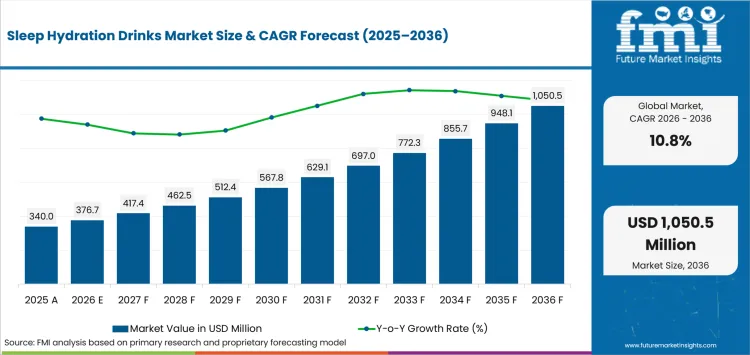
USD 376.7 million in 2026 and USD 1050.5 million by 2036 at a 10.8% CAGR.
The market was valued at USD 340.0 million in 2025. Demand for sleep hydration drinks is projected to expand at 10.8% CAGR between 2026 and 2036, increasing valuation from USD 376.7 million in 2026 to USD 1050.5 million by 2036. Commercial adoption depends on turning an evening wellness need into a repeat beverage routine without overstating what an ingredient can do.
CDC reported that 15.4% of US adults had trouble falling asleep most days or every day in 2024, while 12.9% used a sleep aid most days or every day. Those surveys do not measure sleep drinks, but they show a recurring self-care context.
Key Takeaways of Sleep Hydration Drinks Market
- Bedtime beverage demand develops where convenient formats fit an established evening routine without implying treatment.
- RTD Sleep Drinks account for 34.0% of Product Type demand in 2026 because a finished single serving removes preparation at bedtime.
- Magnesium accounts for 36.7% of Active Ingredient demand in 2026 because it can be used across canned and mixable formulations.
- Melatonin-Free accounts for 36.1% of Claim demand in 2026 as brands seek nighttime positioning that can travel across more regulatory settings.
- Cans account for 46.6% of Packaging demand, while Supermarkets & Hypermarkets represent 52.6% of Sales Channel demand in 2026.
- Som Sleep, Dream Water, NeuroSleep, PepsiCo (Driftwell), Recess, Moment, Tranquini and Just Chill are active across direct sleep or adjacent relaxation beverage routes.
Analyst Perspective
"Sleep hydration drinks have to behave like beverages at shelf and like responsibly framed wellness products at bedtime. The practical test is whether a formula can keep its claim language across markets while preserving taste and repeat use. Product teams should start with the evening occasion, then work backward to ingredient choice and channel fit."
- Nandini Roy Choudhury, Principal Consultant, Future Market Insights
How is the Sleep Hydration Drinks Market segmented?
The sleep hydration drinks market is segmented by Product Type, Active Ingredient, Claim, Packaging, Sales Channel and Region.
Sleep hydration drinks are segmented by Product Type, Active Ingredient, Claim, Packaging, Sales Channel and Region across commercial beverage routes. Product Type separates ready-to-consume drinks from products that require mixing or dilution. Active Ingredient captures the functional basis of the formula. Claim describes the promise shown to consumers. Packaging affects portion control and merchandising. Sales Channel identifies where discovery and repeat purchase take place.
Why does Magnesium lead the Active Ingredient category?
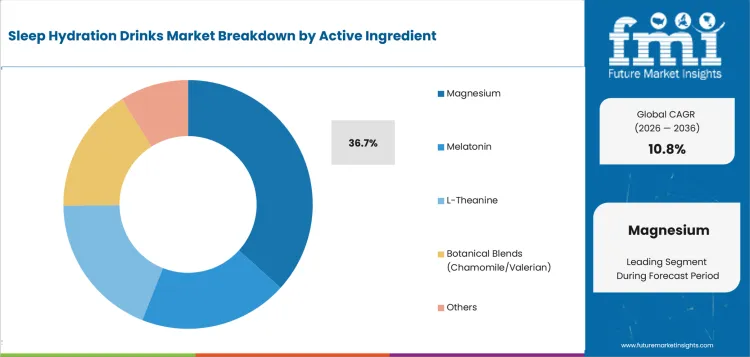
Magnesium works across canned and mixable products and can support formulations that avoid melatonin. Melatonin gives a direct nighttime cue but faces different regulatory conditions by country. L-Theanine is used in calming beverage systems, while Botanical Blends (Chamomile/Valerian) extend the plant-led route. Others capture remaining actives. NCCIH says research on magnesium for insomnia is limited, so brands should separate ingredient presence from a treatment claim. That distinction also matters in adjacent sleep supplements.
- Magnesium is estimated to account for 36.7% of Active Ingredient demand in 2026 because it can move between RTD and mixable formats without defining the product as a melatonin proposition.
- Recess described its Mood line in October 2025 as magnesium L-threonate and adaptogen canned sparkling waters and powders, illustrating one mineral platform across finished drinks and mixes.
Why do RTD Sleep Drinks lead the Product Type category?
RTD Sleep Drinks remove preparation at the point when consumers are winding down. Powder Sticks serve travel or pantry use, while Effervescent Tablets offer a compact dissolve-at-home format. Concentrates allow flexible serving size, and Others cover beverage formats outside those named groups. The RTD route also overlaps with the wider functional beverages category because the product has to meet beverage expectations on flavor and shelf presentation as well as nighttime positioning.
- RTD Sleep Drinks are projected to account for 34.0% of Product Type demand in 2026 because a sealed single serving reduces bedtime preparation.
- Ennismore announced in March 2022 that Som Sleep would be placed in guestrooms at four Miami SLS and Hyde properties, showing how a sleep-focused beverage can enter hospitality as an evening-use format.
Why does Melatonin-Free lead the Claim category?
Melatonin-Free gives manufacturers room to build nighttime propositions around minerals, amino acids or botanicals when melatonin creates regulatory or channel friction. Sugar-Free addresses routine consumption, while Natural / Clean Label raises scrutiny of ingredient choice and processing. Others cover claims outside the named set. The UK is a clear constraint because the MHRA identifies melatonin as a prescription-only medicine.
- Melatonin-Free is forecast to account for 36.1% of Claim demand in 2026 because it supports nighttime positioning without making the formula dependent on one sleep-active ingredient.
- Moment currently describes its nighttime powder blends as melatonin-free products containing magnesium alongside L-theanine and calming botanicals.
Why do Cans lead the Packaging category?
Cans provide a sealed single serving that can carry ingredient disclosure and nighttime cues on the same pack. Bottles offer familiar resealable handling, while Stick Packs fit dry mixes used at home or during travel. Others cover packaging outside the named formats. In the wider RTD beverages market, finished packs compete on immediate use, which makes portion clarity relevant to a sleep-oriented occasion.
- Cans are expected to account for 46.6% of Packaging demand in 2026 because the format combines portion control with familiar beverage merchandising.
- Crown Holdings said in March 2025 that Moment would transition six SKUs to 12-ounce directly printed cans across selected US regions, linking can format with shelf presentation and distribution.
Why do Supermarkets & Hypermarkets lead the Sales Channel category?
Supermarkets & Hypermarkets place sleep hydration drinks inside routine grocery trips instead of restricting discovery to supplement-led destinations. Online / DTC supports education and subscription-style replenishment. Convenience Stores fit impulse or travel occasions, while Specialty & Health Stores give shoppers a wellness-oriented context. Others capture remaining routes to market.
- Supermarkets & Hypermarkets are projected to account for 52.6% of Sales Channel demand in 2026 because high-frequency shopping supports discovery and repeat purchase.
- Recess reported in October 2025 that it was sold in more than 15,000 US stores, showing that relaxation-led functional drinks can reach grocery and mass-market retail alongside online channels.
What are the drivers, restraints and opportunities in the Sleep Hydration Drinks Market?
Recurring sleep difficulty supports evening beverage routines, while evidence and country-specific claim rules constrain positioning as melatonin-free formulations open wider commercial routes.
- Driver: Recurring sleep difficulty creates a self-managed evening occasion that beverage formats can serve.
- Restraint: Ingredient evidence and country-specific claim rules limit how directly a drink can promise sleep support.
- Opportunity: Melatonin-free formulations can use magnesium or L-Theanine with botanical systems to fit more retail settings.
The restraint appears when product language moves ahead of the evidence. NCCIH states that there is very little research on magnesium for insomnia and that the available studies are not adequate for well-informed decisions. Brands therefore need claims that match the evidence and local rules instead of treating ingredient popularity as proof of a sleep outcome.
The opportunity lies in products that keep a clear nighttime occasion without depending on melatonin. Magnesium and L-Theanine can be paired with botanical systems, while flavor and beverage texture still have to work for repeat use. The same formulation logic is visible across adaptogenic beverages, where wellness positioning depends on ingredient choice and regulatory compliance.
How do country CAGRs compare in the Sleep Hydration Drinks Market?
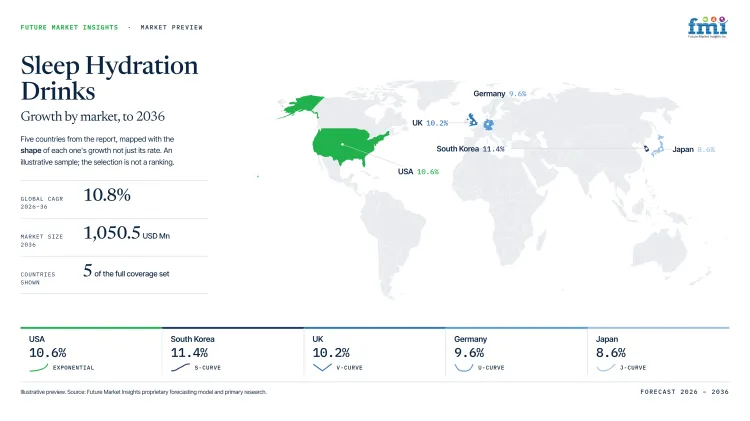
| Country | CAGR |
|---|---|
| USA | 10.6% |
| UK | 10.2% |
| Germany | 9.6% |
| Japan | 8.6% |
| South Korea | 11.4% |
- USA sleep hydration market is set to grow at 10.6% as companies are combining broad beverage distribution with a visible population already using self-managed sleep aids.
- Demand for sleep hydration drinks in the UK is set to grow at 10.2% CAGR during the forecast period.
- Germany at 9.6% is supported by growing attention to sleep quality. Robert Koch Institute data show that 39.6% of German adults sleep fewer than seven hours on weekdays, creating room for nighttime hydration products positioned around evening routines and general wellness. Claims, however, need to remain clearly separated from insomnia treatment or other medical benefits.
- Japan at 8.6% benefits from a policy environment that increasingly treats adequate sleep as part of everyday health management. Japan’s Ministry of Health, Labour and Welfare provides specific sleep recommendations through its Sleep Guide for Health Promotion 2023, supporting products positioned around bedtime routines, hydration and general wellbeing rather than therapeutic sleep claims.
- South Korea at 11.4% has a defined regulatory pathway for health-functional ingredients, giving brands a clearer framework for products that combine hydration with recognized functional benefits. MFDS requires functionality claims to correspond with approved or individually recognized functions, making formulation evidence and compliant positioning important for sleep-oriented hydration products.
Comparable growth rates can lead to different launch paths. The commercial decision is therefore less about ranking countries and more about matching formulation, claims and channels to the operating conditions in each market. The full report extends country analysis across the stated global regions.
Country-wise Analysis
- USA: Sleep hydration drinks can reach consumers through grocery, wellness retail and direct-to-consumer routes. Demand is forecast to expand at 10.6% CAGR through 2036. CDC data show recurring sleep difficulty and regular sleep-aid use, which creates an established self-care context without directly measuring beverage demand.
- UK: Melatonin rules materially affect formulation strategy for mainstream beverage channels. Demand is forecast to rise at 10.2% CAGR through 2036. The MHRA states that melatonin is a prescription-only medicine, giving melatonin-free products a clearer route for food and beverage positioning.
- Germany: Public-health evidence shows a substantial sleep burden that can support interest in nonprescription evening routines. Demand is forecast to expand at 9.6% CAGR through 2036. Robert Koch Institute reported that 16.3% of adults had sleep-onset problems and 31.7% had problems maintaining sleep in 2024.
- Japan: National guidance places sleep within broader health behavior, which shapes how a nighttime drink is framed. Demand is forecast to rise at 8.6% CAGR through 2036. The Ministry of Health, Labour and Welfare maintains the Sleep Guide for Health Promotion 2023 as a public-health reference.
- South Korea: Ingredient recognition rules add a compliance step to functional positioning. Demand is forecast to expand at 11.4% CAGR through 2036. The Ministry of Food and Drug Safety issued Regulation No. 2026-33 on April 13, 2026 for recognition of functional ingredients and related standards.
Who are the notable companies in the Sleep Hydration Drinks Market?
Som Sleep, Dream Water, NeuroSleep, PepsiCo (Driftwell), Recess, Moment, Tranquini and Just Chill are notable companies serving direct sleep and adjacent relaxation beverage occasions.
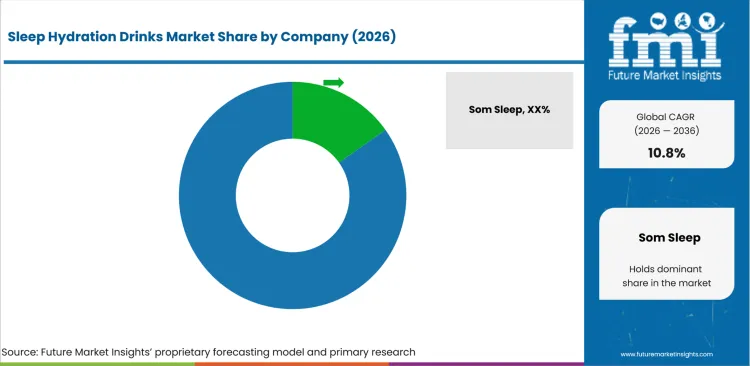
Competition includes direct sleep-beverage specialists alongside broader relaxation platforms. Som Sleep, Dream Water and NeuroSleep use explicit bedtime positioning. PepsiCo (Driftwell), Recess and Moment extend the category through relaxation beverages or nighttime mixes. Tranquini and Just Chill participate closer to the evening wind-down occasion, with public product materials showing a less direct sleep-specific proposition.
- Direct sleep positioning: Som Sleep, Dream Water and NeuroSleep use dedicated bedtime beverage or mix formats.
- Broader relaxation platforms: PepsiCo (Driftwell), Recess and Moment connect calming or nighttime use with established beverage formats.
- Evening relaxation adjacency: Tranquini and Just Chill compete for wind-down occasions without the same direct sleep-specific framing.
Competitive Benchmarking: Sleep Hydration Drinks Market
| Company | Direct Sleep Positioning | Format Breadth | Mainstream Retail Access | Geographic Reach |
|---|---|---|---|---|
| Som Sleep | High | Low | Medium | USA; DTC and documented hospitality placement |
| Dream Water | High | High | Medium | USA and Canada; company portfolio and Canada launch documented |
| NeuroSleep | High | High | Medium | USA; DTC and historical national retail distribution documented |
| PepsiCo (Driftwell) | Medium | Low | Medium | North America; documented launch in 2020-2021 |
| Recess | Medium | High | High | USA; more than 15,000 stores plus online distribution documented in 2025 |
| Moment | High | High | Medium | USA; DTC sleep blends and canned beverage distribution documented |
| Tranquini | Low | Low | Medium | USA-facing DTC and local-store request routes documented |
| Just Chill | Low | Low | Medium | Pacific Northwest and USA-focused DTC presence documented |
Scoring basis: Direct Sleep Positioning is High when a documented product explicitly serves sleep or bedtime use, Medium when the proposition is broader relaxation with a sleep-adjacent role, and Low when current materials center on general wind-down use. Format Breadth reflects evidence across finished drinks and mixable formats. Mainstream Retail Access reflects documented retail reach rather than assumed availability. Geographic Reach records markets supported by company pages or company-issued releases; historical launches are identified where current distribution is not confirmed.
Key Developments in the Sleep Hydration Drinks Market
- In October 2025, Recess closed a USD 30 million Series B round led by CAVU Consumer Partners and appointed Kyle Thomas as President and Co-CEO. The company said the funding would support organizational scale, retail expansion and marketing.
- In April 2024, Dream Water announced an Immunity Support Sleep Shot for Canada after Health Canada approval obtained on February 23, 2024. The product combined the brand's SleepStat blend with added immune-support ingredients.
Key Players in the Sleep Hydration Drinks Market
Sleep-Specific Beverage Specialists
- Som Sleep
- Dream Water
- NeuroSleep
Functional Relaxation Platforms
- PepsiCo (Driftwell)
- Recess
- Moment
Evening Relaxation Brands
- Tranquini
- Just Chill
Sleep Hydration Drinks Market - Report Scope
| Coverage field | Report scope |
|---|---|
| Market breakdown | By Product Type, Active Ingredient, Claim, Packaging, Sales Channel and Region. |
| Quantitative Units | USD Million. |
| Market Definition | Revenue includes sleep hydration drinks sold as RTD beverages, powder sticks, effervescent tablets, concentrates and other beverage formats within the defined ingredient and claim universe. Standalone pills, capsules or gummies are excluded. Conventional hydration drinks without a sleep or relaxation proposition are excluded, as are prescription sleep medicines and adjacent substitute beverage revenue. |
| Regions Covered | North America, Latin America, Western Europe, Eastern Europe, East Asia, South Asia and Pacific, and Middle East and Africa. |
| Countries Covered | USA, UK, Germany, Japan, South Korea, and more than 25 additional countries included in the full report. |
| Notable Companies | Som Sleep, Dream Water, NeuroSleep, PepsiCo (Driftwell), Recess, Moment, Tranquini, Just Chill. |
| Forecast Period | 2026 to 2036. |
| Approach | Primary and secondary research with market triangulation. |
Sleep Hydration Drinks Market - Research Methodology
| Method | Approach |
|---|---|
| Primary Research | FMI analysts gathered input from brand operators, manufacturers, distributors, retailers, end users and subject-matter specialists. Interviews examined purchase triggers, product evaluation, channel behavior, formulation constraints and the evidence required before a trial or initial listing develops into repeat purchasing. |
| Desk Research | Desk research covered public-health agencies, regulators, official guidance, company filings, company newsrooms, product documentation and industry publications. Sources were reviewed for relevance, publication date, geographic coverage and consistency with the market definition. |
| Market Sizing and Forecasting | The market model combined the baseline value with format structure, ingredient and claim adoption, channel access, country conditions and company participation. Forecast assumptions considered regulatory developments, repeat-purchase behavior, route-to-market expansion and barriers to wider use. |
| Data Validation | Estimates were checked against independent public indicators and company activity. Validation tested whether products and revenue streams fell within the defined market boundary. Adjacent substitutes, unsupported claims and overlapping revenue were excluded to reduce double counting. |
Sleep Hydration Drinks Market by Segments
Sleep Hydration Drinks Market segmented by Product Type:
- RTD Sleep Drinks
- Powder Sticks
- Effervescent Tablets
- Concentrates
- Others
Sleep Hydration Drinks Market segmented by Active Ingredient:
- Magnesium
- Melatonin
- L-Theanine
- Botanical Blends (Chamomile/Valerian)
- Others
Sleep Hydration Drinks Market segmented by Claim:
- Melatonin-Free
- Sugar-Free
- Natural / Clean Label
- Others
Sleep Hydration Drinks Market segmented by Packaging:
- Cans
- Bottles
- Stick Packs
- Others
Sleep Hydration Drinks Market segmented by Sales Channel:
- Supermarkets & Hypermarkets
- Online / DTC
- Convenience Stores
- Specialty & Health Stores
- Others
Sleep Hydration Drinks Market by Region:
- North America
- United States
- Canada
- Latin America
- Brazil
- Mexico
- Argentina
- Chile
- Western Europe
- Germany
- France
- United Kingdom
- Italy
- Spain
- Benelux
- Nordics
- Eastern Europe
- Poland
- Czech Republic
- Romania
- Hungary
- East Asia
- China
- Japan
- South Korea
- South Asia and Pacific
- India
- ASEAN
- Australia and New Zealand
- Middle East and Africa
- GCC Countries
- South Africa
- Türkiye
- Israel
Research Sources and Bibliography
- Mykyta, L., Elgaddal, N., & Warren, A. (2026, April). Use of Sleep Aids Among Adults Age 18 and Older: United States, 2024.
- National Center for Complementary and Integrative Health. (2024, January). In the News: Magnesium Supplements for Sleep Disorders.
- Medicines and Healthcare products Regulatory Agency. (2025, August 18). Parents and caregivers advised to stop all use of specific brand of kids' magnesium gummies due to the presence of an undeclared prescription-only medicine.
- Beyer, A.-K., Yessimova, D., Schlack, R., Neuhauser, H., & Nübel, J. (2026, June 3). Sleep onset problems and problems maintaining sleep among adults in Germany. Results from the Panel 'Health in Germany' 2024.
- Ministry of Health, Labour and Welfare, Japan. (2024, September 18). Sleep Measures: Sleep Guide for Health Promotion 2023.
- Ministry of Food and Drug Safety, Republic of Korea. (2026, April 13). Regulation on Recognition of Functional Ingredient and of Standard-Specification for Health Functional Foods (No. 2026-33).
- Ennismore. (2022, March 28). SLS and Hyde expand their wellness initiatives through a new collaboration with Som Sleep.
- Delivra Health Brands Inc. (2024, April 9). Dream Water Brand to Launch Its Immunity Support Sleep Shot in the Canadian Market.
- Neuro Brands, LLC. (2020, July 8). Neuro Brands Expands Beverage Portfolio with the Launch of neuroIMMUNE and neuroSLEEP Powder Drink Mix Packets.
- PepsiCo. (2021, March 25). The story of Driftwell, a beverage launch like no other.
- Recess. (2025, October 29). Recess Secured USD 30M in Series B Funding Led by CAVU and Announces the Appointment of Kyle Thomas as President & Co-CEO.
- Moment. (accessed 2026, August 19). Frequently Asked Questions.
- Crown Holdings, Inc. (2025, March 31). Botanical Beverage Brand Moment and Crown Holdings Elevate 'Modern Soda' to a New Level of Sustainability.
- Tranquini. (accessed 2026, August 19). Adaptogen Drinks by Tranquini: Tranquility in Every Sip.
- Just Chill. (accessed 2026, August 19). Hemp THC Drinks: Craft Tonics from the Pacific Northwest.
This bibliography is provided for reader reference and is not exhaustive. The full report contains the complete reference list and detailed citations.
This Report Answers
- How is the Sleep Hydration Drinks Market expected to develop through 2036?
- Which sleep-health conditions support demand for an evening beverage routine?
- Why do RTD Sleep Drinks hold the main Product Type position?
- How does magnesium affect formulation and channel strategy?
- Why does melatonin-free positioning matter across countries?
- How do local regulations affect country entry conditions?
- Which companies compete through sleep products or adjacent relaxation beverages?
- What can limit repeat purchase and return on a sleep hydration drink launch?
Frequently Asked Questions
How big is the sleep hydration drinks market in 2026?
USD 376.7 million represents the sleep hydration drinks market value in 2026. The market is forecast to reach USD 1,050.5 million by 2036 as beverage-format sleep and relaxation propositions expand across retail and direct channels.
What is the CAGR of the sleep hydration drinks market from 2026 to 2036?
A 10.8% CAGR is projected for the sleep hydration drinks market between 2026 and 2036. Growth depends on repeat evening use, compliant claims and formats that fit established beverage purchasing habits.
Which Product Type segment is projected to account for 34.0% of the sleep hydration drinks market?
RTD Sleep Drinks are projected to account for 34.0% of Product Type demand in 2026. Finished single servings reduce preparation at bedtime and can be merchandised through familiar beverage channels.
How much will the sleep hydration drinks market add between 2026 and 2036?
USD 673.8 million is expected to be added to the sleep hydration drinks market between 2026 and 2036. The increase depends on wider retail access and repeat purchase while formulation and claim rules remain market-specific.
Which companies are active in the sleep hydration drinks market?
Eight companies active in the sleep hydration drinks market include Som Sleep, Dream Water, NeuroSleep, PepsiCo (Driftwell), Recess, Moment, Tranquini and Just Chill. Their positions range from direct bedtime formulations to adjacent relaxation beverages.
Preview the report firsthand - request a free sample
Get SampleGet the brochure for pricing and purchase details.
Get PDFTable of Content
- Key Takeaways
- Market Size and CAGR
- Top Growth Driver
- Fastest Growing Segment
- Leading Region
- Key Companies
- Emerging Opportunities
- Executive Summary
- Global Market Outlook
- Demand-side Trends
- Supply-side Trends
- Technology Roadmap Analysis
- Analysis and Recommendations
- Analyst Perspective (What is happening? Why now? What should investors know?)
- Key Questions Answered
- How large is the market?
- What is the CAGR?
- What are key trends?
- Which region dominates?
- Who are the leaders?
- Market Overview
- Market Coverage / Taxonomy
- Market Definition / Scope / Limitations
- Research Methodology
- Chapter Orientation
- Analytical Lens and Working Hypotheses
- Market Structure, Signals, and Trend Drivers
- Benchmarking and Cross-market Comparability
- Market Sizing, Forecasting, and Opportunity Mapping
- Research Design and Evidence Framework
- Desk Research Programme (Secondary Evidence)
- Expert Input and Fieldwork (Primary Evidence)
- Tooling, Models, and Reference Databases
- Data Engineering and Model Build
- Quality Assurance and Audit Trail
- Market Background
- Market Dynamics (Drivers, Restraints, Opportunity, Trends)
- Scenario Forecast (Optimistic, Likely, Conservative)
- Impact Analysis
- AI Impact
- Sustainability Impact
- Regulatory Impact
- Technology Impact
- Consumer / Buyer Analysis
- Purchase Drivers
- Adoption Barriers
- Buyer Journey
- Opportunity Map Analysis
- Product Life Cycle Analysis
- Supply Chain Analysis
- Investment Feasibility Matrix
- Value Chain Analysis
- PESTLE and Porter's Analysis
- Regulatory Landscape
- Regional Parent Market Outlook
- Production and Consumption Statistics
- Import and Export Statistics
- Global Market Analysis and Forecast, 2021 to 2036
- Historical Market Size Value (USD Million) Analysis, 2021 to 2025
- Current and Future Market Size Value (USD Million) Projections, 2026 to 2036
- Y-o-Y Growth Trend Analysis
- Absolute $ Opportunity Analysis
- Global Market Pricing Analysis, 2021 to 2036
- Global Market Analysis and Forecast, By Product Type, 2021 to 2036
- Introduction / Key Findings
- Historical Market Size Value (USD Million) Analysis By Product Type, 2021 to 2025
- Current and Future Market Size Value (USD Million) Analysis and Forecast By Product Type, 2026 to 2036
- RTD Sleep Drinks
- Powder Sticks
- Effervescent Tablets
- Concentrates
- Others
- RTD Sleep Drinks
- Y-o-Y Growth Trend Analysis By Product Type, 2021 to 2025
- Absolute $ Opportunity Analysis By Product Type, 2026 to 2036
- Global Market Analysis and Forecast, By Active Ingredient, 2021 to 2036
- Introduction / Key Findings
- Historical Market Size Value (USD Million) Analysis By Active Ingredient, 2021 to 2025
- Current and Future Market Size Value (USD Million) Analysis and Forecast By Active Ingredient, 2026 to 2036
- Magnesium
- Melatonin
- L-Theanine
- Botanical Blends (Chamomile/Valerian)
- Others
- Magnesium
- Y-o-Y Growth Trend Analysis By Active Ingredient, 2021 to 2025
- Absolute $ Opportunity Analysis By Active Ingredient, 2026 to 2036
- Global Market Analysis and Forecast, By Claim, 2021 to 2036
- Introduction / Key Findings
- Historical Market Size Value (USD Million) Analysis By Claim, 2021 to 2025
- Current and Future Market Size Value (USD Million) Analysis and Forecast By Claim, 2026 to 2036
- Melatonin-Free
- Sugar-Free
- Natural / Clean Label
- Others
- Melatonin-Free
- Y-o-Y Growth Trend Analysis By Claim, 2021 to 2025
- Absolute $ Opportunity Analysis By Claim, 2026 to 2036
- Global Market Analysis and Forecast, By Packaging, 2021 to 2036
- Introduction / Key Findings
- Historical Market Size Value (USD Million) Analysis By Packaging, 2021 to 2025
- Current and Future Market Size Value (USD Million) Analysis and Forecast By Packaging, 2026 to 2036
- Cans
- Bottles
- Stick Packs
- Others
- Cans
- Y-o-Y Growth Trend Analysis By Packaging, 2021 to 2025
- Absolute $ Opportunity Analysis By Packaging, 2026 to 2036
- Global Market Analysis and Forecast, By Sales Channel, 2021 to 2036
- Introduction / Key Findings
- Historical Market Size Value (USD Million) Analysis By Sales Channel, 2021 to 2025
- Current and Future Market Size Value (USD Million) Analysis and Forecast By Sales Channel, 2026 to 2036
- Supermarkets & Hypermarkets
- Online / DTC
- Convenience Stores
- Specialty & Health Stores
- Others
- Supermarkets & Hypermarkets
- Y-o-Y Growth Trend Analysis By Sales Channel, 2021 to 2025
- Absolute $ Opportunity Analysis By Sales Channel, 2026 to 2036
- Global Market Analysis and Forecast, By Region, 2021 to 2036
- Introduction
- Historical Market Size Value (USD Million) Analysis By Region, 2021 to 2025
- Current Market Size Value (USD Million) Analysis and Forecast By Region, 2026 to 2036
- North America
- Latin America
- Western Europe
- Eastern Europe
- East Asia
- South Asia and Pacific
- Middle East & Africa
- Market Attractiveness Analysis By Region
- North America Market Analysis and Forecast, By Country, 2021 to 2036
- Historical Market Size Value (USD Million) Trend Analysis By Market Taxonomy, 2021 to 2025
- Market Size Value (USD Million) Forecast By Market Taxonomy, 2026 to 2036
- By Country
- USA
- Canada
- By Product Type
- By Active Ingredient
- By Claim
- By Packaging
- By Sales Channel
- By Country
- Market Attractiveness Analysis
- By Country
- By Product Type
- By Active Ingredient
- By Claim
- By Packaging
- By Sales Channel
- Key Takeaways
- Latin America Market Analysis and Forecast, By Country
- Historical Market Size Value (USD Million) Trend Analysis By Market Taxonomy, 2021 to 2025
- Market Size Value (USD Million) Forecast By Market Taxonomy, 2026 to 2036
- By Country
- Brazil
- Mexico
- Chile
- Rest of Latin America
- By Product Type
- By Active Ingredient
- By Claim
- By Packaging
- By Sales Channel
- By Country
- Market Attractiveness Analysis
- By Country
- By Product Type
- By Active Ingredient
- By Claim
- By Packaging
- By Sales Channel
- Key Takeaways
- Western Europe Market Analysis and Forecast, By Country
- Historical Market Size Value (USD Million) Trend Analysis By Market Taxonomy, 2021 to 2025
- Market Size Value (USD Million) Forecast By Market Taxonomy, 2026 to 2036
- By Country
- Germany
- UK
- Italy
- Spain
- France
- Nordic
- BENELUX
- Rest of Western Europe
- By Product Type
- By Active Ingredient
- By Claim
- By Packaging
- By Sales Channel
- By Country
- Market Attractiveness Analysis
- By Country
- By Product Type
- By Active Ingredient
- By Claim
- By Packaging
- By Sales Channel
- Key Takeaways
- Eastern Europe Market Analysis and Forecast, By Country
- Historical Market Size Value (USD Million) Trend Analysis By Market Taxonomy, 2021 to 2025
- Market Size Value (USD Million) Forecast By Market Taxonomy, 2026 to 2036
- By Country
- Russia
- Poland
- Hungary
- Balkan & Baltic
- Rest of Eastern Europe
- By Product Type
- By Active Ingredient
- By Claim
- By Packaging
- By Sales Channel
- By Country
- Market Attractiveness Analysis
- By Country
- By Product Type
- By Active Ingredient
- By Claim
- By Packaging
- By Sales Channel
- Key Takeaways
- East Asia Market Analysis and Forecast, By Country
- Historical Market Size Value (USD Million) Trend Analysis By Market Taxonomy, 2021 to 2025
- Market Size Value (USD Million) Forecast By Market Taxonomy, 2026 to 2036
- By Country
- China
- Japan
- South Korea
- By Product Type
- By Active Ingredient
- By Claim
- By Packaging
- By Sales Channel
- By Country
- Market Attractiveness Analysis
- By Country
- By Product Type
- By Active Ingredient
- By Claim
- By Packaging
- By Sales Channel
- Key Takeaways
- South Asia and Pacific Market Analysis and Forecast, By Country
- Historical Market Size Value (USD Million) Trend Analysis By Market Taxonomy, 2021 to 2025
- Market Size Value (USD Million) Forecast By Market Taxonomy, 2026 to 2036
- By Country
- India
- ASEAN
- Australia & New Zealand
- Rest of South Asia and Pacific
- By Product Type
- By Active Ingredient
- By Claim
- By Packaging
- By Sales Channel
- By Country
- Market Attractiveness Analysis
- By Country
- By Product Type
- By Active Ingredient
- By Claim
- By Packaging
- By Sales Channel
- Key Takeaways
- Middle East & Africa Market Analysis and Forecast, By Country
- Historical Market Size Value (USD Million) Trend Analysis By Market Taxonomy, 2021 to 2025
- Market Size Value (USD Million) Forecast By Market Taxonomy, 2026 to 2036
- By Country
- Kingdom of Saudi Arabia
- Other GCC Countries
- Türkiye
- South Africa
- Other African Union
- Rest of Middle East & Africa
- By Product Type
- By Active Ingredient
- By Claim
- By Packaging
- By Sales Channel
- By Country
- Market Attractiveness Analysis
- By Country
- By Product Type
- By Active Ingredient
- By Claim
- By Packaging
- By Sales Channel
- Key Takeaways
- Key Countries Market Analysis
- USA
- Pricing Analysis
- Market Share Analysis, 2025
- By Product Type
- By Active Ingredient
- By Claim
- By Packaging
- By Sales Channel
- Canada
- Pricing Analysis
- Market Share Analysis, 2025
- By Product Type
- By Active Ingredient
- By Claim
- By Packaging
- By Sales Channel
- Mexico
- Pricing Analysis
- Market Share Analysis, 2025
- By Product Type
- By Active Ingredient
- By Claim
- By Packaging
- By Sales Channel
- Brazil
- Pricing Analysis
- Market Share Analysis, 2025
- By Product Type
- By Active Ingredient
- By Claim
- By Packaging
- By Sales Channel
- Chile
- Pricing Analysis
- Market Share Analysis, 2025
- By Product Type
- By Active Ingredient
- By Claim
- By Packaging
- By Sales Channel
- Germany
- Pricing Analysis
- Market Share Analysis, 2025
- By Product Type
- By Active Ingredient
- By Claim
- By Packaging
- By Sales Channel
- UK
- Pricing Analysis
- Market Share Analysis, 2025
- By Product Type
- By Active Ingredient
- By Claim
- By Packaging
- By Sales Channel
- Italy
- Pricing Analysis
- Market Share Analysis, 2025
- By Product Type
- By Active Ingredient
- By Claim
- By Packaging
- By Sales Channel
- Spain
- Pricing Analysis
- Market Share Analysis, 2025
- By Product Type
- By Active Ingredient
- By Claim
- By Packaging
- By Sales Channel
- France
- Pricing Analysis
- Market Share Analysis, 2025
- By Product Type
- By Active Ingredient
- By Claim
- By Packaging
- By Sales Channel
- India
- Pricing Analysis
- Market Share Analysis, 2025
- By Product Type
- By Active Ingredient
- By Claim
- By Packaging
- By Sales Channel
- ASEAN
- Pricing Analysis
- Market Share Analysis, 2025
- By Product Type
- By Active Ingredient
- By Claim
- By Packaging
- By Sales Channel
- Australia & New Zealand
- Pricing Analysis
- Market Share Analysis, 2025
- By Product Type
- By Active Ingredient
- By Claim
- By Packaging
- By Sales Channel
- China
- Pricing Analysis
- Market Share Analysis, 2025
- By Product Type
- By Active Ingredient
- By Claim
- By Packaging
- By Sales Channel
- Japan
- Pricing Analysis
- Market Share Analysis, 2025
- By Product Type
- By Active Ingredient
- By Claim
- By Packaging
- By Sales Channel
- South Korea
- Pricing Analysis
- Market Share Analysis, 2025
- By Product Type
- By Active Ingredient
- By Claim
- By Packaging
- By Sales Channel
- Russia
- Pricing Analysis
- Market Share Analysis, 2025
- By Product Type
- By Active Ingredient
- By Claim
- By Packaging
- By Sales Channel
- Poland
- Pricing Analysis
- Market Share Analysis, 2025
- By Product Type
- By Active Ingredient
- By Claim
- By Packaging
- By Sales Channel
- Hungary
- Pricing Analysis
- Market Share Analysis, 2025
- By Product Type
- By Active Ingredient
- By Claim
- By Packaging
- By Sales Channel
- Kingdom of Saudi Arabia
- Pricing Analysis
- Market Share Analysis, 2025
- By Product Type
- By Active Ingredient
- By Claim
- By Packaging
- By Sales Channel
- Türkiye
- Pricing Analysis
- Market Share Analysis, 2025
- By Product Type
- By Active Ingredient
- By Claim
- By Packaging
- By Sales Channel
- South Africa
- Pricing Analysis
- Market Share Analysis, 2025
- By Product Type
- By Active Ingredient
- By Claim
- By Packaging
- By Sales Channel
- USA
- Market Structure Analysis
- Competition Dashboard
- Competition Benchmarking
- Market Share Analysis of Top Players
- By Regional
- By Product Type
- By Active Ingredient
- By Claim
- By Packaging
- By Sales Channel
- Emerging Startups
- Innovation Benchmarking
- Competition Analysis
- Competition Deep Dive
- Som Sleep
- Overview
- Product Portfolio
- Profitability by Market Segments
- Sales Footprint
- Strategy Overview
- Marketing Strategy
- Product Strategy
- Channel Strategy
- Dream Water
- NeuroSleep
- PepsiCo (Driftwell)
- Recess
- Moment
- Tranquini
- Just Chill
- Som Sleep
- Case Studies
- Success Stories
- Recent Developments
- Competition Deep Dive
- Assumptions & Acronyms Used


