

- Industry Size (2026)
- USD 45 Bn
- Forecast (2036)
- USD 130 Bn
- CAGR (2026 to 2036)
- 12%
Smart Camera Market Forecast and Outlook 2026 to 2036
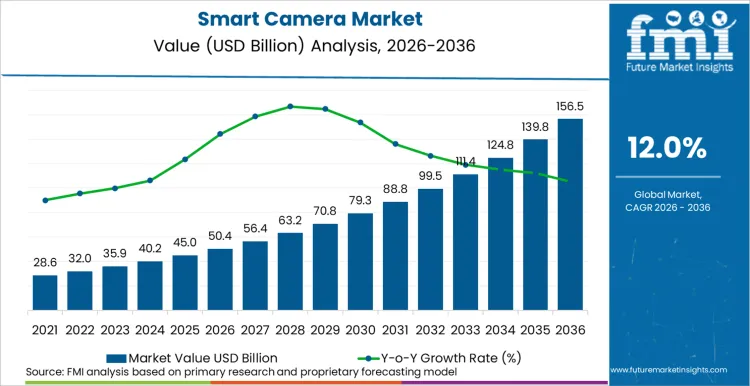
The global smart camera sector is on track to achieve a valuation of USD 156.5 billion by 2036, accelerating from USD 50.4 billion in 2026 at a CAGR of 12.0%. As per Future Market Insights, expansion is structurally underpinned by the global scaling of AI-powered surveillance infrastructure, smart city deployments, and the consumer smart home camera segment. The Connectivity Standards Alliance (CSA) released Matter 1.5 in November 2025, officially introducing native camera support with WebRTC streaming, validating the industry's transition toward interoperable, standards-based camera ecosystems.
This interoperability standard compels camera manufacturers to integrate Matter 1.5 compatibility while investing in on-chip edge AI to differentiate through processing capability rather than proprietary lock-in. Simultaneously the industrial and automotive segments are expanding as digital lidar and AI-powered stereo cameras converge into unified sensing platforms.
In November 2024, Apple confirmed its first entry into the smart home IP camera market with mass production scheduled for 2026, integrating with its existing hardware ecosystem via private wireless connectivity and targeting annual shipments in the tens of millions. FMI is of the opinion that Apple's IP camera entry will accelerate Matter 1.5 adoption across the industry, as competing manufacturers adopt the standard to maintain interoperability with Apple HomeKit, effectively making Matter the default camera connectivity protocol by 2028.
The competitive landscape in 2025 and 2026 is defined by edge AI acquisitions and on-chip processing. Ouster closed the acquisition of StereoLabs in February 2026 to create a unified digital lidar and AI stereo camera sensing platform. Qualcomm acquired Augentix in December 2025 to expand its Insight Platform for edge AI camera deployments in India's digital public infrastructure. Hanwha Vision unveiled a 4-channel AI multi-sensor camera powered by the NVIDIA Jetson platform in November 2024 with 100 TOPS processing.
Dahua Technology debuted the WITHS Series wireless camera line at IFA 2025. Sony and Raspberry Pi began commercial release of their AI Camera module built on the IMX500 sensor with on-chip AI. Xiaomi launched the Smart Camera C700 with 4K and local AI processing. As per FMI, this convergence of Matter 1.5 interoperability, Apple market entry, and edge AI processing migration confirms that the smart camera market is transitioning from cloud-dependent proprietary systems into a standards-based, on-device AI intelligence platform.
Summary of Smart Camera Market
What Is Growth Outlook for Smart Camera Market as per Future Market Insights Projection?
Future Market Insights projects the smart camera industry to expand at a CAGR of 12.0% from 2026 to 2036, increasing from USD 50.4 Billion in 2026 to USD 156.5 Billion by 2036.
FMI Research Approach: FMI proprietary forecasting model based on CSA Matter adoption data, smart city camera deployment pipeline, and edge AI chipset shipment tracking.
How Do FMI Analysts Perceive Smart Camera Market to Evolve?
FMI analysts perceive the market evolving toward standards-based, edge AI-native camera platforms where Matter 1.5 interoperability replaces proprietary ecosystems and 65% of AI inference occurs on-device rather than in the cloud.
FMI Research Approach: CSA Matter 1.5 release analysis and edge AI inference migration projections.
Which Country Holds Largest Share in Global Smart Camera Market?
China holds a significant share of the global smart camera market by volume which is supported by the scale of its surveillance infrastructure, the dominance of Hikvision and Dahua in global camera shipments, and the concentration of smart city deployments.
FMI Research Approach: FMI country-level revenue modeling by camera shipment data and smart city project pipeline tracking.
How Large Will Smart Camera Market Be by 2036?
The global smart camera market is projected to reach USD 156.5 Billion by 2036.
FMI Research Approach: FMI long-term revenue forecast derived from smart city and surveillance camera deployment projections and consumer smart home adoption rates.
What Is Definition of Smart Camera Market?
The smart camera market includes AI-powered surveillance cameras, consumer smart home cameras, industrial machine vision cameras, automotive sensing cameras, and edge AI camera modules with on-chip processing for threat detection, facial recognition, object tracking, and environmental monitoring.
FMI Research Approach: FMI market taxonomy aligned with CSA Matter device classification and ONVIF camera interoperability standards.
What Are Globally Unique Trends Shaping Smart Camera Market?
Globally unique trends include Matter 1.5 native camera support with WebRTC (CSA), Apple's first IP camera with tens of millions of projected annual shipments, and unified lidar-stereo camera sensing platforms (Ouster/StereoLabs).
FMI Research Approach: CSA Matter 1.5 release and Apple smart home camera confirmation tracking.
Smart Camera Market Key Takeaways
| Metric | Details |
|---|---|
| Industry Size (2026) | USD 50.4 Billion |
| Industry Value (2036) | USD 156.5 Billion |
| CAGR (2026 to 2036) | 12.0% |
Source: Future Market Insights (FMI) analysis, based on proprietary forecasting model and primary research
Segment-wise Analysis
By Components
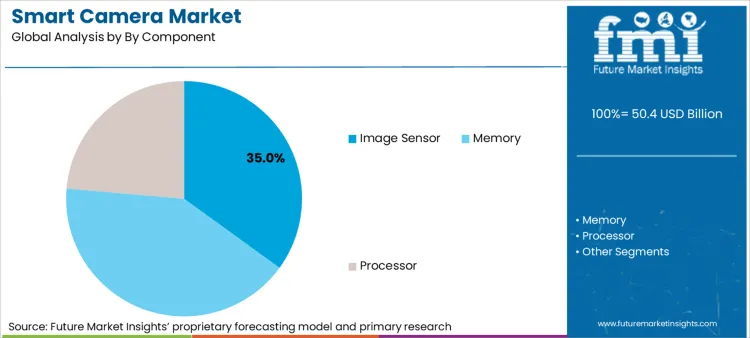
During the forecast period, the Image sensor segment is expected to dominate the industry, with 35% of the total industry share in 2025. Image sensors are an essential part of cameras in smartphones, automotive, industrial inspection, medical imaging, and security surveillance. CMOS-based image sensors are experiencing increasing demand for higher-resolution, AI-enabled, and low-light imaging applications.
Companies like Sony, Samsung, and Omni Vision are developing cutting-edge image sensor technologies such as stacked sensors, AI-based image processing, and quantum dot sensors. The penetration of autonomous vehicles, AR/VR applications, and high-end smartphone cameras is anticipated to drive growth momentum for this segment.
In 2025, the Memory segment is expected to account for 43% of the industry share, on account of the increasing demand for high-bandwidth data storage as well as processing in the IoT devices, AI-based applications, and automotive sensors. The rapid growth in sensor data complexity and the need for high-performance DRAM, NAND, and NOR flash memory has become a requirement in edge computing, as well as in ADAS (Advanced Driver Assistance Systems) and industrial automation.
Micron, SK Hynix, and Samsung are the big players in this segment, launching low-power and high-capacity memory types that have been optimized for AI and machine learning, 5G, and the IoT. Emerging non-volatile memory (NVM) technologies (e.g., MRAM, ReRAM) are also gaining popularity for real-time sensor data processing.
Given AI’s dominance, automation, and real-time data analytics, image sensors and memory will remain crucial as we push forward toward smarter devices, autonomous systems, and connected industries.
By Application
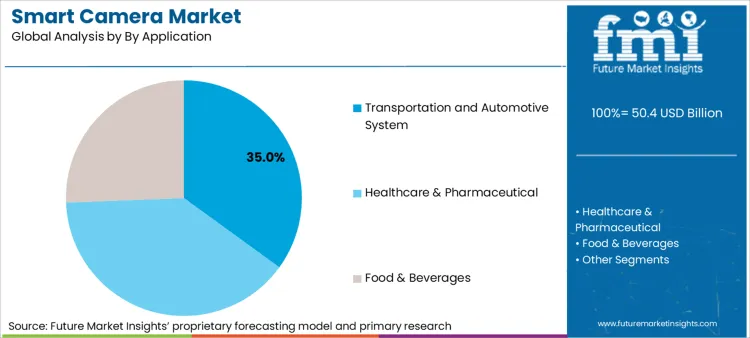
In 2025, the transportation and automotive systems segment will also remain the largest performer, representing a 35% industry share. LiDAR, radar, accelerometers, and image sensors are flying off the hypothetical shelves with the rise of autonomous vehicles, advanced driver-assistance systems (ADAS), and smart transport solutions.
Sensor technologies equipped with AI capabilities are slowly getting integrated into vehicles companies like Tesla, BMW, and Toyota are already using them to ensure safety, navigation, and real-time assessment of traffic. The increasing adoption of electric vehicles (EVs) is also driving demand for battery monitoring sensors and thermal management systems.
The healthcare & Pharmaceutical segment is projected to hold a 42% industry share in 2025, as the development of wearable health devices, remote patient monitoring, and smart medical imaging systems will fuel robust growth in this area. It is the increase in chronic diseases, boom in ageing population, and the increasing trends in personalized medicine that are driving the demand for biosensors, pressure sensors, and infrared imaging sensors.
Companies such as Medtronic, Philips, and Abbott are using MEMS-based and CMOS sensors to create non-invasive diagnostic tools, smart insulin pumps, and AI-assisted imaging solutions. The growth explosion of telehealth and AI-enabled clinical diagnostics is only driving the demand for sensor-driven healthcare applications even higher.
With the explosion of smart mobility solutions and innovative digital healthcare solutions, these two industries, the automotive and healthcare sectors, will drive sensor industry growth on both ends, as making transportation safer and patient care more efficient are driving indicative goals.
Trend Analysis and Purchasing Criteria Across Different End-Use Segments
The industry worldwide is growing at a fast pace, fueled by increasing demand for AI vision systems, automation, and security. In the automotive industry, they are crucial for ADAS, driver monitoring, and autonomous driving applications, emphasizing high-resolution imaging and AI features.
Healthcare applications are centered around AI-driven diagnostics, distant monitoring, and medical imaging, with high power efficiency and accuracy being critical. Industrial smart cameras have widespread use in quality control, machine vision, and automation, where integration and cost form the prime purchase drivers.
Consumer electronics experience mass adoption in smartphones, home automation, and gaming, with customers prioritizing connectivity and image processing capability. The security & surveillance industry requires AI-driven facial recognition, motion detection, and night vision for greater monitoring and threat detection.
Smart cameras in retail and smart cities are crucial in traffic management, crowd analytics, and targeted advertising, underlining the need for real-time processing and cloud connectivity.
Contracts and Deals Analysis
| Company | Contract Value (USD million) |
|---|---|
| Meta Platforms and EssilorLuxottica | Approximately USD 500 - USD 700 |
| Apple Inc. | Approximately USD 300 - USD 400 |
| Hikvision | Approximately USD 100 - USD 150 |
The smart camera industry witnessed incredible expansion in 2024 and early 2025 with advancements in technology and government interventions. With the consolidation of Meta Platforms and EssilorLuxottica, they succeeded in introducing the Ray-Ban smart glasses, with traditional design and smart specs, and boosting enormous sales.
So-called smart door lock camera with Face ID is a beacon for Apple moving into the smart doorbell camera segment of the home security industry as an effort to augment its ecosystem. Similarly, Hikvision stepping back from Xinjiang contracts is a sign of how international regulations and ethical considerations are impacting the industry. These events are indicative of a dynamic industry that is compelled by the need for consumers to acquire new goods as well as a need to comply with global standards.
Shifts in the Market from 2021 to 2025 and Future Trends 2026 to 2036
Between 2020 and 2024, the industry expanded significantly as industries integrated artificial intelligence (AI), edge computing, and advanced image processing into surveillance, automation, and real-time analytics. AI-enabled smart cameras enhanced the performance in security, automotive, healthcare, and industrial applications through facial recognition, object detection, and deep learning-driven decision-making. The industry overcame the challenge of expensive production, data privacy, and interoperability despite the upgrade. The industry responded by simplifying AI models, lowering the cost of hardware, and enhancing cloud storage ability to facilitate seamless running and management of data.
2025 to 2035 will witness the industry mature with advancements in technology, along with quantum-enabled imaging, neuromorphic vision processing, and self-learning artificial intelligence-based systems. Artificial intelligence-driven smart cameras will foretell security attacks, facilitate industrial automation, and enhance medical diagnosis with computer vision.
Smart cities will propel safety and efficiency through AI-powered traffic management, people analytics, and smart retail. Edge processing will decrease latency in AI-based computing to enhance the real-time decision-making of autonomous vehicles and industrial automation. Intelligent cameras will lead the applications for mixed reality and augmented reality use in delivering interactive gaming, training, and virtual collaboration.
Manufacturing will focus on sustainability through power-saving processors, recyclable packaging, and sun-powered smart cameras. Ubiquitous 6G-capable smart cameras will give rise to ultra-high-speed data transfer, remote monitoring, and AI-based predictive maintenance and thus find applications in robotics, telemedicine, and autonomous security systems.
Comparative Market Shift Analysis 2021 to 2025 vs. 2026 to 2036
| 2021 to 2025 | (2026 to 2036 |
|---|---|
| Governments imposed privacy regulations and cybersecurity requirements on AI-enabled smart cameras. | AI-driven compliance monitoring, blockchain-secured video storage, and decentralized surveillance frameworks will define governance. |
| AI-powered facial recognition, deep learning-based object detection, and 5 G-enabled smart cameras improved efficiency. | Quantum-enhanced imaging, neuromorphic vision processing, and AI-powered real-time analytics will redefine their capabilities. |
| They optimized security, traffic management, automated quality control, and consumer electronics. | AI-based real-time security monitoring, augmented reality integration, and autonomous vehicle vision systems will widen the applications. |
| Companies used AI-driven surveillance, automated threat detection, and edge computing-based smart cameras. | 6G-powered real-time vision processing, blockchain-protected video analytics, and AI-driven autonomous monitoring systems will fuel adoption. |
| Companies maximized energy-efficient smart cameras, cloud storage, and AI-driven video compression. | AI-driven energy optimization, solar-powered smart cameras, and biodegradable camera parts will maximize sustainability and cost savings. |
| AI-based real-time analytics of data, predictive maintenance, and anomaly detection boosted operations. | Predictive vision processing with quantum assistance, behavior analytics through AI, and decentralized real-time monitoring will transform predictive modeling. |
| Adoption of smart cameras was affected by supply chain disruptions, high component prices, and cyberattacks. | Quantum-protected data transmission, AI-optimized supply chain logistics, and next-generation semiconducting materials will make markets more robust. |
| AI adoption, 5G, and growing demand for high-resolution surveillance propelled the industry growth. | The future industry growth will be propelled by AI-driven decentralized surveillance, neuromorphic vision processing, and future-edge computing. |
Risk Assessment of the Smart Camera Market
The industry surge is due to the rising need for these devices in urban surveillance, automotive, retail stores, and other industrial settings. However, the implementation of high production costs and the fast pace of technological advancements turn out to be the financial wear and tear. The companies must stress erecting cost-effective production, forming a partnership, and unending research and development to uphold profitability and competitiveness.
The disturbances in the supply chain, as well as the semiconductor shortages, and dependence on specialized parts, have effects on production and pricing. Tensions in global politics, restrictive trade measures, and increased raw material prices all contribute to industry instability. The companies need to diversify their suppliers, put money into local manufacturing, and explore alternative materials to reduce possible risks and maintain their supply chain.
Hyper-accelerated developments in artificial intelligence, edge computing, and high-definition imaging create the danger of products becoming obsolete. Companies should give first priority to modular architecture, software-based improvements, and the use of Artificial Intelligence in their products in order to comply with the emerging requirements of the industry and the consumers but in the long run make sure of the product's relevance.
The security issues that have arisen threaten the implementation of smart cameras with Internet of Things and cloud Tethering. The risk includes the unauthorized access of outsiders to, data breaches, and hacking attempts ruin the security and the user privacy. The main pillar to achieving data protection and customer trust is the rigorous implementation of encryption, AI-driven detection of threats, and updating regular firmware.
Market Definition
The smart camera market represents revenue generated from the manufacture and sale of cameras with integrated AI processing, connectivity, and analytics capability. The market measures the value of AI-powered surveillance cameras, consumer smart home cameras, industrial machine vision systems, automotive sensing cameras, and edge AI camera modules.
Inclusions cover AI-powered IP surveillance cameras, consumer smart home security cameras, industrial machine vision cameras, automotive ADAS and autonomous driving cameras, edge AI camera modules (Sony IMX500, NVIDIA Jetson-based), digital lidar-camera fusion sensors, and Matter 1.5-compatible camera systems with WebRTC streaming.
Exclusions include standalone CCTV cameras without AI processing or network connectivity, consumer action cameras and camcorders without smart analytics, medical imaging cameras (endoscopes, surgical cameras), and general-purpose webcams without edge AI or smart home integration.
Country-wise Analysis
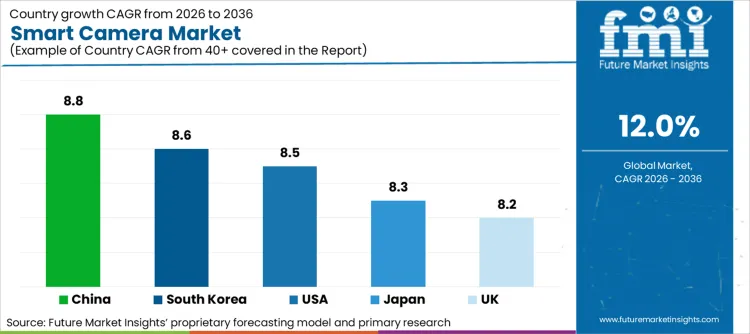
| Countries | CAGR (2026 to 2036) |
|---|---|
| USA | 8.5% |
| UK | 8.2% |
| France | 8.1% |
| Germany | 8.3% |
| Italy | 8% |
| South Korea | 8.6% |
| Japan | 8.3% |
| China | 8.8% |
| Australia | 7.9% |
| New Zealand | 7.8% |
USA
The USA CAGR is calculated as 8.5% in 2025 to 2035. The USA industry grows robustly with the growing adoption of computer vision, AI, and IoT across sectors. Google, Apple, and Amazon heavily invest in smart camera solutions in security, retail analytics, and consumer electronics. Growing demand for face recognition, edge computing, and AI-powered surveillance technology is driving innovation, and therefore, industries benefit from added security and automation. The defense industry is also driving adoption through the help of smart cameras, which utilize and apply smart cameras to provide enhanced reconnaissance and threat identification.
The retail industry facilitates business through the utilization of artificial intelligence-based smart cameras to track customers, prevent loss, and offer personalized shopping experiences. The automotive sector applies sophisticated ADAS and autonomous navigation with high-resolution smart cameras. Governments also promote businesses to adopt energy-efficient and high-resolution camera solutions, therefore driving the industry.
UK
8.2% CAGR is projected between 2025 to 2035. The UK industry grows as companies adopt digital transformation and AI-based surveillance solutions. Companies such as Dyson and BAE Systems create advanced imaging technology for industrial automation, defense, and consumer use. The demand for smart home security, AI-based analytics, and industrial monitoring systems drives the industry. Companies leverage cloud-connected smart cameras to streamline surveillance and boost monitoring capabilities across sectors.
The UK government also invests in smart city solutions, which necessitate smart camera technology for astute surveillance in public safety and transportation. The ones that are artificially intelligent simplify traffic control and planning, and are utilized by retailers to interact with clients. Furthermore, businesses also spend on compliance with regulations and data protection, thus necessitating GDPR-compliant smart camera technology.
France
CAGR for 2025 to 2035 is estimated to be 8.1% through 2035. The French industry evolves as industries embrace AI-driven surveillance solutions in the automotive, aerospace, and retail sectors. Thales and Schneider Electric dominate industrial vision, defense-imaging-grade offerings, and security offerings. Public safety and autonomous surveillance for the same perpetually enhance the need for AI-driven smart cameras and real-time processing.
Automotive is witnessing growing usage of smart cameras in autonomous driving and retail use cases. Artificial intelligence-based imaging technology is driving facial recognition for security applications, with retail utilizing it to monitor customers and monitor inventory. Government-initiated digital transformation initiatives drive further industry growth.
Germany
CAGR is estimated to be 8.3% during the forecast period. The German industry grows as enterprises invest in AI-based vision systems for automotive, industrial automation, and security. Bosch, Siemens, and Zeiss develop high-precision imaging solutions that boost the demand for machine vision and surveillance technology. Industry 4.0 drives the deployment of them for manufacturing and robotics automation.
Automotive manufacturers embed sophisticated cameras in cars to identify lanes, watch over drivers, and allow for autonomous driving. Governments provide stringent data privacy laws that compel firms to manufacture AI-enabled cameras with high-quality encryption and privacy safeguards. Furthermore, investment in urban intelligent infrastructure propels smart traffic monitoring and security service uptake.
Italy
The CAGR for the smart camera market is likely to be around 8% during the forecast period. Italy's industry grows consistently as industries embrace AI, automation, and IoT-based security systems. Leonardo and STMicroelectronics are driving smart imaging growth in aerospace, defense, and industrial automation. The adoption of an AI-based security system enhances surveillance in public spaces, transportation, and shopping complexes.
The automotive industry has driver assistance and safety. Retailers deploy AI-based surveillance systems to watch for customers' activities and inventory management. Smart city projects and government digitalization policies also drive more investments into AI-based camera solutions.
South Korea
The CAGR for South Korea market is likely to be around 8.6% through 2035. South Korea's industry flourishes as the world leader in AI imaging, real-time monitoring, and intelligent home security solutions. Samsung, LG, and Hanwha finance industry automation, security, and consumer electronics camera technologies. Government-sponsored smart city infrastructure stimulates demand for high-definition surveillance systems.
Companies incorporate 5G-connected AI-intelligent smart cameras to drive security, transportation, and healthcare applications. Smart vision technologies find applications in the automotive sector in self-driving cars, and smart home applications are gaining traction with increased demand for networked security systems. Semiconductor technology fuels innovation in small-sized, high-performance ones as well.
Japan
The industry in Japan is set to record 8.3% CAGR during the forecast period. Japan's industry is growing as top players innovate quality imaging technology in robotics, healthcare, and security products. AI-based technologies drive the industry with Sony, Panasonic, and Canon, leading to the provision of thorough real-time analysis and process automation. Japan's robot and factory automation drive stimulates machine vision technology adoption.
They are employed in the automotive sector for automated parking, collision avoidance, and traffic monitoring. Artificial intelligence-enabled healthcare imaging streamlines diagnosis and patient care. Furthermore, the requirement for smart infrastructure and urban security fuels the wide use of AI-based surveillance solutions in cities.
China
China’s industry is projected to grow at a CAGR of 8.8% during the forecast period. The Chinese industry is expanding at a rapid rate, with organizations investing in vision systems that incorporate AI to secure, retail, and manufacture applications. Industry giants Hikvision, Dahua, and Huawei dominate the competition with face recognition, real-time inspection, and IoT-driven cameras. Mass surveillance and city planning are also encouraged by the government, which contributes to mass-scale penetration.
The AI-based ones are designed for application in the e-commerce industry to provide automatic warehouses and fraud detection. The transport industry improves safety through the use of intelligent traffic monitoring software. Furthermore, the reality that China is a leading producer of semiconductors guarantees that there will be continuous research the technology.
Australia
It is estimated to be 7.9% CAGR from 2025 to 2035. The industry in Australia expands with industries embracing AI-based surveillance, industrial automation, and weather monitoring. Cochlear and Atlassian lead image-based solutions for security, healthcare, and infrastructure sectors. Maximum usage of smart home security drives the demand for household use of AI-based cameras.
Government investment in smart city infrastructure begins with the creation of real-time traffic management and public security programs. The agriculture sector is facilitated by AI imagery technology for efficient utilization of resources and farm inspection. Companies also enhance sustainability through the creation of power-efficient technology.
New Zealand
The CAGR between 2025 and 2035 is 7.8%. The industry in New Zealand grows more and more as businesses invest in AI-based security, environmental monitoring, and automation. Businesses such as Fisher & Paykel Healthcare incorporate smart imaging for patient diagnosis and remote monitoring of patients. The government has plans around smart cities, hence creating demand for AI-based surveillance systems.
They help agriculture through livestock monitoring and intelligent irrigation. Smart home solutions also increase, and thus the need for AI-driven security solutions increases. AI and edge computing investment also fuels smart camera solutions in industry segments.
Competitive Outlook
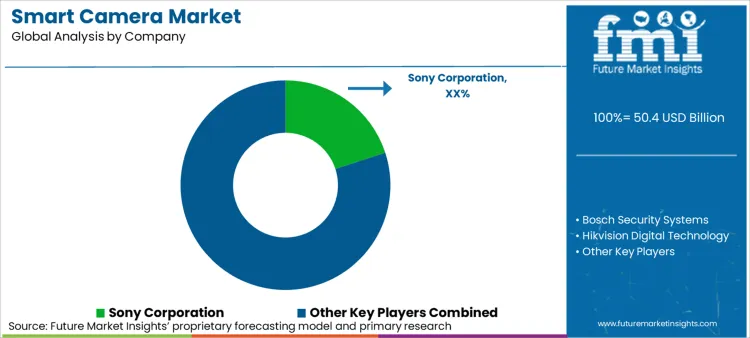
The industry is characterized by intense competition, fueled by the rising deployment of AI-based surveillance, facial recognition, and IoT-integrated surveillance systems. An increase in security concerns, urbanization, the development of smart city infrastructure, and industrial automation drives demand. Innovative advances in real-time video analytics, edge computing, and cloud-based storage have been significant drivers of growth in the industry, along with prominent trends, including thermal imaging & low-light performance, as well as AI content recognition.
Through the establishment of tech companies, security firms, niche camera makers, solid R&D capabilities, extensive distribution expeditors, and innovative approaches, Mistral Co. dominates the industry. All Rights Reserved. Some of the key players in the Video Surveillance Industry include Sony Corporation, Bosch Security Systems, Hikvision Digital Technology, Axis Communications, and FLIR Systems. Niche players and the new kids in town, likewise, are creating tools and solutions pertaining to AI-driven analytics, green smart camera tech, and integrated smart home ecosystems as a way to set themselves apart from the competition.
The evolution of this industry, although, is shaped by multiple other major forces, including algorithms-enabled image processing, profuse edge computing, regulatory requirements for data privacy and cyber security, etc. To sustain growth, companies are emphasizing product line expansion, diversification into industrial and smart city applications, and penetration into home security and enterprise surveillance.
Some of the strategic dimensions being contemplated in terms of defining competitive dynamics include price competition, supply chain efficiencies, and changing consumer preferences and demand in terms of AI-powered, cloud-connected and energy efficient smart cameras. With ongoing emphasis on security, automation, and AI-based analytics, brands should differentiate based on superior image quality, regulatory compliance, and integration into existing IoT ecosystems.
Market Share Analysis by Company
| Company Name | Estimated Market Share (%) |
|---|---|
| Sony Corporation | 20-25% |
| Bosch Security Systems | 15-20% |
| Hikvision Digital Technology | 12-17% |
| Axis Communications | 8-12% |
| FLIR Systems | 5-9% |
| Other Companies (combined) | 30-40% |
Key Company Offerings and Activities
| Company Name | Key Offerings/Activities |
|---|---|
| Sony Corporation | Drives AI image sensors, high-res surveillance, and smart home camera solutions. |
| Bosch Security Systems | AI-powered security cameras, IoT(Internet of Things) connected surveillance and intelligent analytic video. |
| Hikvision Digital Technology | Specializes in facial recognition, thermal imaging, and smart city surveillance solutions |
| Axis Communications | Specializes in network cameras, real-time analytics , and AI-powered security systems. |
| FLIR Systems | Authorized dealer of thermal imaging cameras, intelligent monitoring systems, and detection of moving objects based on AI. |
Key Company Insights
Sony Corporation (20-25%)
They pioneered the industry segment by integrating AI-based image sensors, high-resolution video processing, and cybersecurity solutions.
Bosch devices (15-20%)
Bosch security and surveillance with AI-enabled smart cameras, IoT monitoring, and real-time video analytics.
Hikvision Digital Technology (12-17%)
Hikvision's focus includes AI-driven facial recognition, smart city surveillance, and integrated security monitoring systems.
Axis Communications (8-12%)
Axis Communications leads the development of network cameras, end-to-end real-time security analytics, and AI/human-centric systems for smart monitoring.
FLIR Systems (5-9%)
FLIR Systems is known for thermal imaging solutions, military-grade security cameras, and AI-enhanced monitoring.
Other Key Players (30 - 40% Combined)
Dahua Technology, Samsung Techwin (Hanwha), Avigilon (Motorola Solutions), Honeywell Security, Panasonic i-PRO Sensing Solutions
Recent Developments
- In November 2025, the CSA released Matter 1.5 officially introducing native smart camera support with WebRTC streaming for cross-vendor interoperability.
- In February 2026, Ouster closed the acquisition of StereoLabs to create a unified digital lidar and AI stereo camera sensing platform.
- In December 2025, Qualcomm acquired Augentix to expand its Insight Platform for edge AI camera deployments in India's digital public infrastructure.
Key Market Players
- Sony Corporation
- Bosch Security Systems
- Hikvision Digital Technology
- Axis Communications
- FLIR Systems
- Dahua Technology
- Samsung Techwin (Hanwha)
- Avigilon (Motorola Solutions)
- Honeywell Security.
- Panasonic i-PRO Sensing Solutions
Scope of Report
| Items | Values |
|---|---|
| Quantitative Units (2026) | USD 50.4 Billion |
| Product Type | AI Surveillance Cameras, Consumer Smart Home Cameras, Industrial Machine Vision, Automotive Sensing Cameras, Edge AI Modules |
| End User | Government/Smart City, Enterprise Security, Consumer Smart Home, Industrial/Manufacturing, Automotive |
| Regions Covered | North America, Europe, Asia Pacific, Latin America, Middle East and Africa |
| Countries Covered | China, USA, Germany, India, Japan, South Korea, and 40+ countries |
| Key Companies Profiled | Hikvision, Dahua, Hanwha Vision, Ouster, Qualcomm, Sony, Apple, Xiaomi |
Smart Camera Market Segmentation
By Component:
By components, the industry covers image sensor, memory, processor, communication interface, lens, display, and others.
By Applications:
By applications, the industry includes transportation and automotive systems, healthcare & pharmaceuticals, food & beverages, military & defense, commercial areas, consumer segments, and others.
By Region:
By region, the industry covers North America, Latin America, Europe, Asia Pacific, and the Middle East & Africa (MEA).
Bibliography
- Connectivity Standards Alliance. (2025, November). Matter 1.5 release: native camera support with WebRTC streaming. CSA.
- Ouster Inc. (2026, February). Ouster acquires StereoLabs for unified lidar-camera sensing platform. Ouster Investor Relations.
- Qualcomm Inc. (2025, December). Qualcomm acquires Augentix for edge AI camera platform expansion. Qualcomm Newsroom.
- Hanwha Vision. (2024, November). 4-channel AI multi-sensor camera powered by NVIDIA Jetson with 100 TOPS. Hanwha Vision.
Frequently Asked Questions
What is the current global market size for Smart Cameras?
The global market is valued at USD 50.4 Billion in 2026, driven by Matter 1.5 interoperability, edge AI processing migration, and Apple's IP camera market entry.
What is the projected CAGR for the market over the next 10 years?
The market is projected to grow at a CAGR of 12.0% from 2026 to 2036.
Which regions are experiencing the fastest expansion?
Asia Pacific leads by volume driven by Chinese surveillance and smart city scale, while North America is the fastest-growing consumer smart home camera market through Apple ecosystem integration.
What are the primary market drivers?
Matter 1.5 camera interoperability, edge AI inference migration, Apple IP camera entry, and smart city surveillance scaling are the primary growth catalysts.
Who are the leading suppliers in the industry?
Hikvision, Dahua, Hanwha Vision, and Ouster are key players, while Apple, Sony, and Qualcomm are driving edge AI and consumer ecosystem integration.
Preview the report firsthand - request a free sample
Get SampleGet the brochure for pricing and purchase details.
Get PDFTable of Content
- Executive Summary
- Global Market Outlook
- Demand-side Trends
- Supply-side Trends
- Technology Roadmap Analysis
- Analysis and Recommendations
- Market Overview
- Market Coverage / Taxonomy
- Market Definition / Scope / Limitations
- Research Methodology
- Chapter Orientation
- Analytical Lens and Working Hypotheses
- Market Structure, Signals, and Trend Drivers
- Benchmarking and Cross-market Comparability
- Market Sizing, Forecasting, and Opportunity Mapping
- Research Design and Evidence Framework
- Desk Research Programme (Secondary Evidence)
- Company Annual and Sustainability Reports
- Peer-reviewed Journals and Academic Literature
- Corporate Websites, Product Literature, and Technical Notes
- Earnings Decks and Investor Briefings
- Statutory Filings and Regulatory Disclosures
- Technical White Papers and Standards Notes
- Trade Journals, Industry Magazines, and Analyst Briefs
- Conference Proceedings, Webinars, and Seminar Materials
- Government Statistics Portals and Public Data Releases
- Press Releases and Reputable Media Coverage
- Specialist Newsletters and Curated Briefings
- Sector Databases and Reference Repositories
- FMI Internal Proprietary Databases and Historical Market Datasets
- Subscription Datasets and Paid Sources
- Social Channels, Communities, and Digital Listening Inputs
- Additional Desk Sources
- Expert Input and Fieldwork (Primary Evidence)
- Primary Modes
- Qualitative Interviews and Expert Elicitation
- Quantitative Surveys and Structured Data Capture
- Blended Approach
- Why Primary Evidence is Used
- Field Techniques
- Interviews
- Surveys
- Focus Groups
- Observational and In-context Research
- Social and Community Interactions
- Stakeholder Universe Engaged
- C-suite Leaders
- Board Members
- Presidents and Vice Presidents
- R&D and Innovation Heads
- Technical Specialists
- Domain Subject-matter Experts
- Scientists
- Physicians and Other Healthcare Professionals
- Governance, Ethics, and Data Stewardship
- Research Ethics
- Data Integrity and Handling
- Primary Modes
- Tooling, Models, and Reference Databases
- Desk Research Programme (Secondary Evidence)
- Data Engineering and Model Build
- Data Acquisition and Ingestion
- Cleaning, Normalisation, and Verification
- Synthesis, Triangulation, and Analysis
- Quality Assurance and Audit Trail
- Market Background
- Market Dynamics
- Drivers
- Restraints
- Opportunity
- Trends
- Scenario Forecast
- Demand in Optimistic Scenario
- Demand in Likely Scenario
- Demand in Conservative Scenario
- Opportunity Map Analysis
- Product Life Cycle Analysis
- Supply Chain Analysis
- Investment Feasibility Matrix
- Value Chain Analysis
- PESTLE and Porter’s Analysis
- Regulatory Landscape
- Regional Parent Market Outlook
- Production and Consumption Statistics
- Import and Export Statistics
- Market Dynamics
- Global Market Analysis 2021 to 2025 and Forecast, 2026 to 2036
- Historical Market Size Value (USD Million) Analysis, 2021 to 2025
- Current and Future Market Size Value (USD Million) Projections, 2026 to 2036
- Y-o-Y Growth Trend Analysis
- Absolute $ Opportunity Analysis
- Global Market Pricing Analysis 2021 to 2025 and Forecast 2026 to 2036
- Global Market Analysis 2021 to 2025 and Forecast 2026 to 2036, By By Component
- Introduction / Key Findings
- Historical Market Size Value (USD Million) Analysis By By Component , 2021 to 2025
- Current and Future Market Size Value (USD Million) Analysis and Forecast By By Component , 2026 to 2036
- Image Sensor
- Memory
- Processor
- Image Sensor
- Y-o-Y Growth Trend Analysis By By Component , 2021 to 2025
- Absolute $ Opportunity Analysis By By Component , 2026 to 2036
- Global Market Analysis 2021 to 2025 and Forecast 2026 to 2036, By By Application
- Introduction / Key Findings
- Historical Market Size Value (USD Million) Analysis By By Application, 2021 to 2025
- Current and Future Market Size Value (USD Million) Analysis and Forecast By By Application, 2026 to 2036
- Transportation and Automotive System
- Healthcare & Pharmaceutical
- Food & Beverages
- Transportation and Automotive System
- Y-o-Y Growth Trend Analysis By By Application, 2021 to 2025
- Absolute $ Opportunity Analysis By By Application, 2026 to 2036
- Global Market Analysis 2021 to 2025 and Forecast 2026 to 2036, By Region
- Introduction
- Historical Market Size Value (USD Million) Analysis By Region, 2021 to 2025
- Current Market Size Value (USD Million) Analysis and Forecast By Region, 2026 to 2036
- North America
- Latin America
- Western Europe
- Eastern Europe
- East Asia
- South Asia and Pacific
- Middle East & Africa
- Market Attractiveness Analysis By Region
- North America Market Analysis 2021 to 2025 and Forecast 2026 to 2036, By Country
- Historical Market Size Value (USD Million) Trend Analysis By Market Taxonomy, 2021 to 2025
- Market Size Value (USD Million) Forecast By Market Taxonomy, 2026 to 2036
- By Country
- USA
- Canada
- Mexico
- By By Component
- By By Application
- By Country
- Market Attractiveness Analysis
- By Country
- By By Component
- By By Application
- Key Takeaways
- Latin America Market Analysis 2021 to 2025 and Forecast 2026 to 2036, By Country
- Historical Market Size Value (USD Million) Trend Analysis By Market Taxonomy, 2021 to 2025
- Market Size Value (USD Million) Forecast By Market Taxonomy, 2026 to 2036
- By Country
- Brazil
- Chile
- Rest of Latin America
- By By Component
- By By Application
- By Country
- Market Attractiveness Analysis
- By Country
- By By Component
- By By Application
- Key Takeaways
- Western Europe Market Analysis 2021 to 2025 and Forecast 2026 to 2036, By Country
- Historical Market Size Value (USD Million) Trend Analysis By Market Taxonomy, 2021 to 2025
- Market Size Value (USD Million) Forecast By Market Taxonomy, 2026 to 2036
- By Country
- Germany
- UK
- Italy
- Spain
- France
- Nordic
- BENELUX
- Rest of Western Europe
- By By Component
- By By Application
- By Country
- Market Attractiveness Analysis
- By Country
- By By Component
- By By Application
- Key Takeaways
- Eastern Europe Market Analysis 2021 to 2025 and Forecast 2026 to 2036, By Country
- Historical Market Size Value (USD Million) Trend Analysis By Market Taxonomy, 2021 to 2025
- Market Size Value (USD Million) Forecast By Market Taxonomy, 2026 to 2036
- By Country
- Russia
- Poland
- Hungary
- Balkan & Baltic
- Rest of Eastern Europe
- By By Component
- By By Application
- By Country
- Market Attractiveness Analysis
- By Country
- By By Component
- By By Application
- Key Takeaways
- East Asia Market Analysis 2021 to 2025 and Forecast 2026 to 2036, By Country
- Historical Market Size Value (USD Million) Trend Analysis By Market Taxonomy, 2021 to 2025
- Market Size Value (USD Million) Forecast By Market Taxonomy, 2026 to 2036
- By Country
- China
- Japan
- South Korea
- By By Component
- By By Application
- By Country
- Market Attractiveness Analysis
- By Country
- By By Component
- By By Application
- Key Takeaways
- South Asia and Pacific Market Analysis 2021 to 2025 and Forecast 2026 to 2036, By Country
- Historical Market Size Value (USD Million) Trend Analysis By Market Taxonomy, 2021 to 2025
- Market Size Value (USD Million) Forecast By Market Taxonomy, 2026 to 2036
- By Country
- India
- ASEAN
- Australia & New Zealand
- Rest of South Asia and Pacific
- By By Component
- By By Application
- By Country
- Market Attractiveness Analysis
- By Country
- By By Component
- By By Application
- Key Takeaways
- Middle East & Africa Market Analysis 2021 to 2025 and Forecast 2026 to 2036, By Country
- Historical Market Size Value (USD Million) Trend Analysis By Market Taxonomy, 2021 to 2025
- Market Size Value (USD Million) Forecast By Market Taxonomy, 2026 to 2036
- By Country
- Kingdom of Saudi Arabia
- Other GCC Countries
- Turkiye
- South Africa
- Other African Union
- Rest of Middle East & Africa
- By By Component
- By By Application
- By Country
- Market Attractiveness Analysis
- By Country
- By By Component
- By By Application
- Key Takeaways
- Key Countries Market Analysis
- USA
- Pricing Analysis
- Market Share Analysis, 2025
- By By Component
- By By Application
- Canada
- Pricing Analysis
- Market Share Analysis, 2025
- By By Component
- By By Application
- Mexico
- Pricing Analysis
- Market Share Analysis, 2025
- By By Component
- By By Application
- Brazil
- Pricing Analysis
- Market Share Analysis, 2025
- By By Component
- By By Application
- Chile
- Pricing Analysis
- Market Share Analysis, 2025
- By By Component
- By By Application
- Germany
- Pricing Analysis
- Market Share Analysis, 2025
- By By Component
- By By Application
- UK
- Pricing Analysis
- Market Share Analysis, 2025
- By By Component
- By By Application
- Italy
- Pricing Analysis
- Market Share Analysis, 2025
- By By Component
- By By Application
- Spain
- Pricing Analysis
- Market Share Analysis, 2025
- By By Component
- By By Application
- France
- Pricing Analysis
- Market Share Analysis, 2025
- By By Component
- By By Application
- India
- Pricing Analysis
- Market Share Analysis, 2025
- By By Component
- By By Application
- ASEAN
- Pricing Analysis
- Market Share Analysis, 2025
- By By Component
- By By Application
- Australia & New Zealand
- Pricing Analysis
- Market Share Analysis, 2025
- By By Component
- By By Application
- China
- Pricing Analysis
- Market Share Analysis, 2025
- By By Component
- By By Application
- Japan
- Pricing Analysis
- Market Share Analysis, 2025
- By By Component
- By By Application
- South Korea
- Pricing Analysis
- Market Share Analysis, 2025
- By By Component
- By By Application
- Russia
- Pricing Analysis
- Market Share Analysis, 2025
- By By Component
- By By Application
- Poland
- Pricing Analysis
- Market Share Analysis, 2025
- By By Component
- By By Application
- Hungary
- Pricing Analysis
- Market Share Analysis, 2025
- By By Component
- By By Application
- Kingdom of Saudi Arabia
- Pricing Analysis
- Market Share Analysis, 2025
- By By Component
- By By Application
- Turkiye
- Pricing Analysis
- Market Share Analysis, 2025
- By By Component
- By By Application
- South Africa
- Pricing Analysis
- Market Share Analysis, 2025
- By By Component
- By By Application
- USA
- Market Structure Analysis
- Competition Dashboard
- Competition Benchmarking
- Market Share Analysis of Top Players
- By Regional
- By By Component
- By By Application
- Competition Analysis
- Competition Deep Dive
- Sony Corporation
- Overview
- Product Portfolio
- Profitability by Market Segments (Product/Age /Sales Channel/Region)
- Sales Footprint
- Strategy Overview
- Marketing Strategy
- Product Strategy
- Channel Strategy
- Bosch Security Systems
- Hikvision Digital Technology
- Axis Communications
- FLIR Systems
- Dahua Technology
- Samsung Techwin (Hanwha)
- Avigilon (Motorola Solutions)
- Sony Corporation
- Competition Deep Dive
- Assumptions & Acronyms Used


