

- Market Size (2026)
- USD 118.7 Mn
- Forecast (2036)
- USD 824.0 Mn
- CAGR (2026 to 2036)
- 21.4%
How big is Smart Wound Dressing Market in 2026?
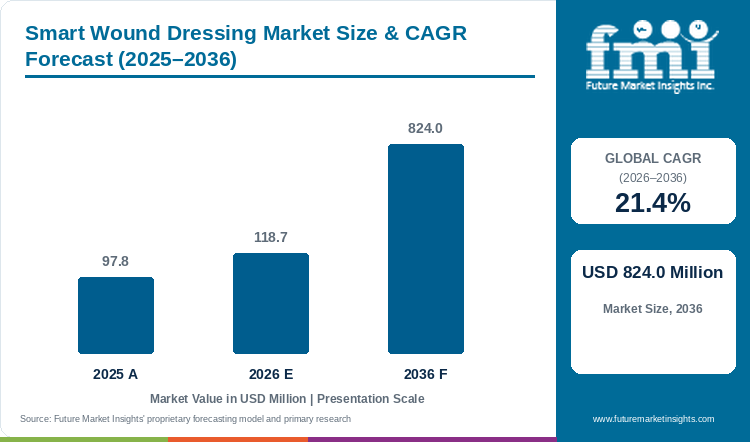
Starting at USD 97.8 Million in 2025, global smart wound dressing demand is estimated at USD 118.7 Million in 2026 and is projected to climb to USD 824.0 Million by 2036 on an expected 21.4% CAGR.
Frequent manual removal of conventional gauze bandages strips fragile regenerating epithelium in diabetic and burn wards, yet leaving opaque dressings undisturbed hides sub-surface bacterial colonization until severe tissue necrosis develops. Corroborating the clinical shift toward non-invasive wound bed surveillance, clinical practice recommendations for continuous physiological monitoring emphasize that real-time exudate tracking and calibrated impedance sensing help optimize dressing change intervals, supporting moisture sensors at 33.4% of 2026 sensor demand [1]. Global smart wound dressing sales move from USD 97.8 Million in 2025 to an estimated USD 118.7 Million during 2026 and a projected USD 824.0 Million by 2036, an anticipated 21.4% CAGR that creates USD 705.3 Million in new value. According to FMI, outpatient vascular clinics are pairing these disposable telemetry patches with advance wound care protocols to prevent lower-limb amputations, although missing outpatient reimbursement codes still restrain universal hospital adoption.
Key Market Trends & Insights
- By sensor type: Moisture sensors are projected to claim 33.4% of 2026 sensor volume because impedance arrays alert nurses to fluid saturation before peri-wound maceration starts.
- By wound type: Estimates put diabetic foot ulcers at 31.2% of 2026 wound-indication volume since early thermal and biochemical alerts help prevent osteomyelitis and limb loss.
- By functionality: Projections put monitoring-only dressings at 68.7% of 2026 functionality sales as diagnostic patches avoid combination drug-device premarket review delays.
- By end user: Forecasts credit inpatient hospital buyers with 41.8% of 2026 facility-level outlay through surgical infection surveillance and specialized burn unit telemetry.
Regional Highlights
- Top national growth pace: South Korea is projected to lead major smart wound dressing markets with an expected 26.1% annual growth pace to 2036 on flexible bioelectronics trials.
- Mid-tier and mature markets: American clinics are forecast to expand by 22.9% yearly alongside British trusts (22.5%) and Italian centers (21.3%), ahead of projected Japanese (17.8%) and estimated French (16.8%) clinic orders while German demand is predicted to grow at 15.8%.
Market Size & Forecast
Table 1: Market Size and Forecast for the Smart Wound Dressing Market (USD million and CAGR percentage), 2025 to 2036
| Metric | Value |
|---|---|
| 2025 Market Size | USD 97.8 Million |
| Estimated Market Size in 2026 | USD 118.7 Million |
| Projected Market Size by 2036 | USD 824.0 Million |
| CAGR, 2026 to 2036 | 21.4% |
| Added Revenue, 2026 to 2036 | USD 705.3 Million |
Updated diabetic limb preservation guidelines across Europe and North America are reshaping how outpatient ulcer clinics procure sensor-integrated consumables. Evidence-based guidelines from the International Working Group on the Diabetic Foot (IWGDF) emphasize comprehensive infection diagnosis, pressure offloading, and structured wound monitoring protocols for complex neuro-ischemic ulcers [2]. Consequently, vascular surgery units and limb salvage centers are pairing disposable biosensor patches with advance wound dressing foams to extend wear intervals safely. Suppliers that separate low-cost disposable sensing strips from reusable Bluetooth transmitters win hospital formulary contracts because procurement officers want predictable per-episode consumable budgets.
Clinical Wound Management Throughput and Sensor Patch Sizing
Table 2: Clinical Wound Management Throughput and Biosensor Indicators for the Smart Wound Dressing Market (USD Million and operational ranges), mixed historical and forecast years from 2025 to 2036
| Metric | 2025 | 2026 | 2036 |
|---|---|---|---|
| Market size (USD Million) | 97.8 | 118.7 | 824.0 |
| Active outpatient wound treatment centers (thousand sites) | 2.4 to 3.8 | 2.8 to 4.3 | 8.5 to 14.2 |
| Average dressing replacement interval (days) | 3 to 5 | 4 to 7 | 7 to 14 |
| Annualized amputations avoidance cost savings per clinic (USD) | 85,000 to 175,000 | 110,000 to 220,000 | 380,000 to 750,000 |
Operational note: Center network figures cover accredited outpatient wound healing facilities and burn units deploying telemetry-enabled wound patches across scheduled patient visits. Dressing intervals reflect days between necessary changes without premature disturbance, while cost savings capture avoided lower-extremity surgical amputations across diabetic cohorts.
Healthcare Consumables & Biosensor Procurement Sizing
Hospital value analysis committees invest in flexible telemetry dressings capable of tracking exudate saturation and tissue pH without disturbing fragile epithelial margins. Tissue viability directors benchmark smart patches on seven-day adhesive wear duration and sterilization stability alongside electronic health record connectivity. Outpatient vascular clinics also combine impedance-sensing bandages with anti biofilm wound dressing matrices to suppress bacterial recurrence between debridement sessions.
Table 3: Healthcare Consumables Procurement Indicators for the Smart Wound Dressing Market (USD and thousand units), mixed historical and forecast years from 2025 to 2036
| Metric | 2025 | 2026 | 2036 |
|---|---|---|---|
| Smart dressing units utilized globally (thousand units) | 480.0 | 620.0 | 5,450.0 |
| Average reimbursement fee per smart dressing unit (USD) | 203.8 | 191.5 | 151.2 |
| Sensor module manufacturing cost per dressing (USD) | 48.0 to 76.0 | 42.0 to 68.0 | 22.0 to 38.0 |
| Wireless tele-monitoring hub placement price (USD) | 1,800 to 3,200 | 1,650 to 2,900 | 850 to 1,500 |
Table 4: Wound Care Sector Procurement Indicators for the Smart Wound Dressing Market (USD Million and percentages), 2026
| Metric | Value | Basis |
|---|---|---|
| Market size, 2026 | USD 118.7 Million | 2026 market estimate |
| Moisture sensors revenue, 2026 | USD 39.6 Million | 33.4% sensor type share |
| Diabetic foot ulcers application revenue, 2026 | USD 37.0 Million | 31.2% wound type share |
| Monitoring-only dressings revenue, 2026 | USD 81.5 Million | 68.7% functionality share |
Analyst Perspective
"Continuous biomarker telemetry transforms chronic ulcer care by alerting community nurses to sub-surface infection triggers days before macroscopic tissue necrosis develops. Securing dedicated outpatient reimbursement codes and separating reusable transmitters from disposable patches remain essential for hospital formulary adoption."
- Anurag Sharma, Principal Consultant, Future Market Insights.
How is the smart wound dressing market segmented?
The smart wound dressing market is segmented by sensor type, wound type, functionality, end user, and region. In 2026, moisture sensors are projected to capture 33.4%, diabetic foot ulcers are estimated at 31.2%, monitoring-only dressings are expected to command 68.7%, and hospitals are forecast to represent 41.8%.
By sensor type: moisture sensors, temperature sensors, pH sensors, bacterial infection biosensors, and oxygen sensors.
By wound type: diabetic foot ulcers, venous leg ulcers, pressure ulcers, surgical wounds, and burns.
By functionality: monitoring-only dressings, theranostic drug-releasing dressings, and electrostimulation dressings.
By end user: hospitals, wound care centers, home care settings, and long-term care facilities.
Why Do Moisture Sensors Lead the Sensor Type Category?
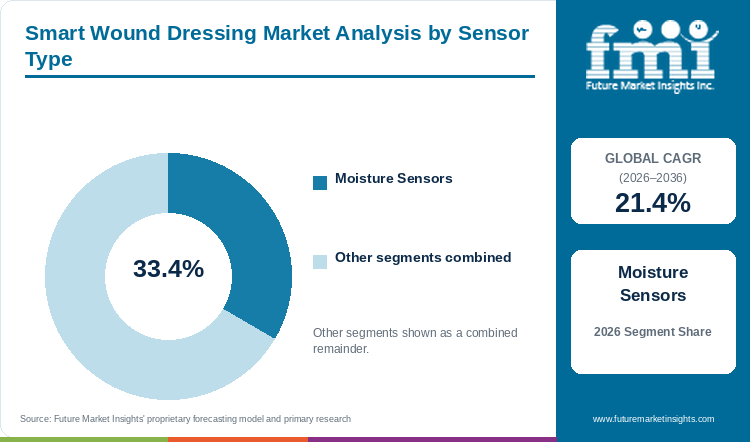
Projections place moisture sensors at 33.4% of the sensor type category in 2026, driven by continuous exudate saturation alerts.
Table 5: Sensor Type Share for the Smart Wound Dressing Market (percentage share), 2026
| Sensor Type | Share (2026) |
|---|---|
| Moisture Sensors | 33.4% |
| Other Segments Combined | 66.6%* |
| Total | 100.0% |
*Note: Aggregate share of the remaining sensor type categories summing to 100.0% for 2026.
Table 6: Sensor Type Leadership and Market Growth for the Smart Wound Dressing Market (segment and CAGR percentage), 2026 to 2036
| Metric | Value |
|---|---|
| Global CAGR (2026 to 2036) | 21.4% |
| Leading Segment | Moisture Sensors |
| Leading Segment Share (2026) | 33.4% |
Source: Future Market Insights analysis
Maintaining balanced wound bed hydration prevents both peri-wound skin maceration from excess exudate and cellular desiccation under dry gauze. Capacitive and impedance moisture arrays printed onto breathable polyurethane backings measure fluid strikethrough without peeling back the primary dressing layer, which is why moisture sensors are forecast to secure 33.4% of sensor type sales in 2026. Outpatient ulcer clinics frequently pair capacitive fluid trackers with antimicrobial wound care dressings to control bioburden while extending dressing wear times beyond five days. Eliminating unnecessary visual inspection changes preserves newly formed epithelial tissue and cuts weekly nursing visit hours across home care routes.
- Preventing premature bandage removal is projected to enable moisture sensors to claim 33.4% of 2026 sensor type revenue.
- In September 2025, the World Union of Wound Healing Societies issued consensus guidance recommending capacitive exudate tracking to optimize clinical dressing replacement intervals [3].
How Do Diabetic Foot Ulcers Retain the Top Wound Type Share?
Diabetic foot ulcers are estimated to hold 31.2% of wound type demand during 2026, owing to limb salvage protocols.
Peripheral neuropathy masks pain signals in diabetic patients so plantar pressure lesions often progress to deep bone infection before the patient notices discomfort. Vascular limb salvage teams deploy multi-parametric smart bandages to detect localized temperature spikes and alkaline pH shifts indicative of occult bacterial proliferation. Integrating real-time biosensor alerts into chronic wound care pathways lets podiatrists initiate offloading and targeted debridement before osteomyelitis develops. Consequently, forecasts assign 31.2% of 2026 wound type demand to diabetic foot ulcers while reducing emergency inpatient readmissions among neuropathic patients.
- High lower-extremity amputation avoidance value is expected to keep diabetic foot ulcers at 31.2% of 2026 wound type turnover.
- American Diabetes Association clinical care standards updated in May 2025 endorsed continuous microenvironmental surveillance for neuropathic foot ulcers to curb surgical limb loss [4].
What Places Monitoring-Only Dressings Ahead in Functionality?
Monitoring-only dressings are expected to command 68.7% of functionality revenue for 2026, supported by streamlined medical device clearance pathways.
Diagnostic sensing patches that record moisture and pH without eluting active pharmaceutical compounds qualify through standard medical device regulatory pathways rather than combination drug-device reviews. Closed-loop theranostic bandages require complex drug stability testing and multi-year clinical pharmacology trials that delay commercial hospital launches. Acute care nursing directors therefore specify passive-readout NFC and Bluetooth patches alongside interactive wound dressing hydrogels for routine ward surveillance, and monitoring-only dressings are anticipated to comprise 68.7% of 2026 functionality turnover. Lower unit manufacturing costs also help monitoring-only consumables fit within bundled outpatient episode payment caps.
- Faster regulatory clearances and lower unit fabrication costs are forecast to give monitoring-only dressings 68.7% of 2026 functionality sales.
- Clinical researchers published comprehensive peer-reviewed evaluation data in Cell Biochemistry and Biophysics analyzing biosensor-integrated smart dressing designs and microenvironmental monitoring on chronic ulcer beds [5].
Why Do Hospitals Represent the Largest End User Segment?
Hospitals are expected to claim 41.8% of end user spending in 2026, linked to inpatient surgical infection surveillance budgets.
Tertiary surgical wards and regional burn centers manage high-acuity reconstructive grafts and dehisced incisions that require round-the-clock physiological tracking. Because inpatient nursing stations already operate centralized wireless telemetry gateways and electronic medical record dashboards capable of ingesting continuous bandage alerts, forecasts place hospitals at 41.8% of 2026 care-setting turnover. Hospital value analysis teams integrate connected sensor patches into surgical wound care bundles to catch surgical site infections prior to patient discharge. Centralized inpatient purchasing contracts further enable multi-department volume discounts on disposable sensor strips.
- Centralized inpatient telemetry infrastructure and post-operative surveillance budgets are anticipated to give hospitals 41.8% of 2026 end user demand.
- American College of Surgeons clinical guidance published in November 2025 noted that continuous post-operative wound telemetry lowers surgical site readmission rates [6].
What are the drivers, restraints, and opportunities in the smart wound dressing market?
Escalating neuropathic ulcer caseloads and post-operative infection penalties are projected to accelerate smart wound dressing procurement through 2036, whereas fragmented outpatient reimbursement coding and combination-product regulatory reviews restrain rapid clinic conversion.
- Driver: Rising diabetic foot ulcer and pressure injury caseloads compel healthcare networks to adopt continuous sub-bandage infection telemetry that prevents lower-limb amputations.
- Restraint: Absence of dedicated outpatient insurance billing codes and lengthy combination-device regulatory reviews slow routine hospital formulary inclusion.
- Opportunity: Pairing battery-free NFC sensor patches with community tele-nursing smartphone apps creates broad expansion avenues across decentralized home care.
Growth Analysis and Future Potential: Chronic Ulcer Prevalence and Amputation Prevention Catalysts
Preventing lower-extremity amputations and unplanned surgical readmissions serves as the primary clinical catalyst driving hospital adoption of sensor-integrated bandages. Updated NICE Guideline NG19 diabetic foot recommendations in January 2026 emphasized structured multidisciplinary ulcer surveillance to reduce major amputation incidence across regional hospital trusts [7]. Visual inspection during scheduled clinic visits frequently misses early biofilm formation because surface exudate appears normal while sub-surface tissue pH rises above 7.5. Deploying flexible impedance and colorimetric patches alongside advanced wound management regimens gives clinicians objective telemetry between outpatient appointments.
Risk Assessment and Operational Hurdles: Regulatory Classification Barriers and Reimbursement Gaps
Protracted premarket regulatory evaluations and missing outpatient HCPCS or statutory reimbursement codes create commercial friction for smart bandage developers. Health authorities regulate closed-loop drug-releasing dressings as combination products that require costly prospective randomized clinical trials before commercial authorization. In November 2025, the European Wound Management Association reported that inconsistent national coding frameworks delay digital dressing adoption across European hospital trusts [8]. Outpatient wound clinics operating under bundled episode payments consequently hesitate to absorb USD 40 to USD 70 sensor consumable premiums alongside synthetic hemostatic and wound care products without separate payer coverage.
Commercial Opportunity Analysis: Tele-Dermatology Integration and Decentralized Home Nursing
Connecting disposable battery-free near-field communication wound patches to home care nursing smartphones is expected to open high-volume commercial demand across decentralized post-acute care. In March 2026, Brown University bioengineering researchers demonstrated enzyme-responsive hydrogel telemetry engineered for decentralized home wound surveillance [9]. Visiting nurses and family caregivers can scan bandage moisture and thermal state through a mobile handset without unwrapping the primary sterile barrier. Cloud triage dashboards then allow regional tissue viability specialists to coordinate wound healing nutrition and targeted dressing changes only when biomarker thresholds are breached.
Smart Wound Dressing Market by Country (2026 to 2036)
South Korean bioelectronics centers are projected to pace national expansion with a 26.1% compound annual clip to 2036, outpacing anticipated expansion in American clinics at 22.9% and British trusts at 22.5% alongside Italian demand at 21.3% and Japanese wards at 17.8%, while French (16.8%) and German (15.8%) wound centers are forecast to expand more gradually. Divergent country trajectories reflect national university biosensor trial funding and statutory remote patient monitoring reimbursement rules.
Table 7: Country CAGR and Primary Growth Levers for the Smart Wound Dressing Market (CAGR percentage and operational drivers), 2026 to 2036
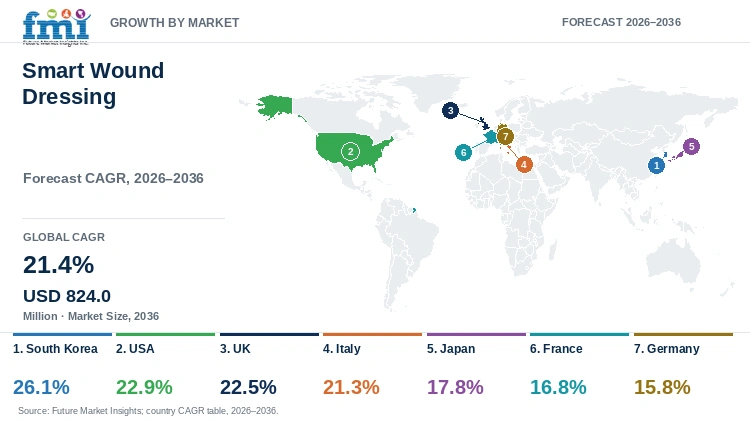
| Country | CAGR (2026 to 2036) | Primary Growth Lever |
|---|---|---|
| South Korea | 26.1% | Flexible bioelectronics research programs and rapid clinical validation across university medical centers |
| USA | 22.9% | Venture funding for connected medical devices and outpatient limb preservation clinic expansions |
| UK | 22.5% | NHS tissue viability digital transformation programs and community tele-nursing modernization initiatives |
| Italy | 21.3% | High diabetic foot prevalence and regional health authority tele-dermatology pilot implementations |
| Japan | 17.8% | Rapidly aging demographics and municipal inpatient pressure injury prevention protocol updates |
| France | 16.8% | Assurance Maladie remote patient monitoring reimbursement frameworks and post-discharge care coordination |
| Germany | 15.8% | Federal Joint Committee clinical evidence standards and university hospital wound research collaborations |
Source: Future Market Insights analysis
South Korea Smart Wound Dressing Market Outlook (2026 to 2036)
Unlike Western wound care markets dominated by legacy foam converters, South Korea pairs state-funded flexible printed-electronics foundries directly with tertiary university hospital burn and diabetic foot wards. In May 2026, researchers at the Korea Advanced Institute of Science and Technology demonstrated a wireless smart dressing patch capable of real-time biochemical tracking across chronic ulcer beds [10]. Supported by rapid clinical translation between domestic microelectronics fabs and metropolitan medical centers, South Korean smart wound dressing turnover is projected to climb at a 26.1% yearly pace through 2036. Delicate roll-to-roll sensor printing yields and strict Health Insurance Review and Assessment Service consumable price caps nevertheless compress domestic supplier margins across municipal hospital tenders.
Key takeaway: In South Korea, university bioelectronics engineering partnerships and tertiary hospital trials are expected to drive rapid clinical uptake of wireless multi-sensor wound patches.
USA Smart Wound Dressing Market Outlook (2026 to 2036)
Backed by FMI's forecast, American smart wound dressing sales are anticipated to climb 22.9% per year until 2036 as dedicated outpatient limb salvage networks and wound healing centers expand nationwide. What sets the United States apart from single-payer health systems is the financial penalty structure under Medicare's Hospital Readmissions Reduction Program, which pushes acute hospitals to monitor post-discharge surgical incisions and neuropathic ulcers remotely. In April 2025, California Institute of Technology researchers completed human clinical validation of the iCares microfluidic smart bandage across twenty chronic wound patients [11]. Even so, separate FDA De Novo review requirements for combination drug-eluting sensors and fragmented commercial insurer HCPCS coding force domestic vendors to supply two-part transmitter pods.
Key takeaway: In the USA, outpatient limb salvage clinic expansion and modular two-part sensor architectures are projected to support sustained commercial adoption across health systems.
UK Smart Wound Dressing Market Outlook (2026 to 2036)
Under NHS England's National Wound Care Strategy Programme and digital clinical capabilities frameworks, healthcare authorities are advancing standardized digital wound assessment and nursing surveillance tools across regional community nursing trusts [12]. Whereas acute inpatient hospitals drive procurement in most countries, British chronic ulcer care is uniquely concentrated within community district nursing teams that visit homebound venous leg ulcer patients weekly. Reducing unnecessary nurse home visits per healed lesion is anticipated to lift British smart wound dressing expenditure by 22.5% per year between 2026 and 2036. Tight Integrated Care Board consumable budgets and strict NHS Drug Tariff listing thresholds still slow routine replacement of passive foams, prompting suppliers to run clinical cost-offset pilots across regional trusts.
Key takeaway: In the UK, NHS community tele-nursing modernization and district nurse time savings are anticipated to incentivize structured adoption of moisture-sensing bandages.
Italy Smart Wound Dressing Market Outlook (2026 to 2036)
Decentralized public healthcare purchasing across twenty-one regional health systems and a high geriatric diabetes burden distinguish Italy from centralized northern European markets. Standardized tele-dermatology protocols published by the Italian Society of Dermatology and Venereology during September 2025 incorporated connected biosensing bandages into outpatient chronic ulcer care pathways [13]. As northern university hospitals in Lombardy and Emilia-Romagna link regional vascular clinics to home tele-monitoring hubs, Italian smart wound dressing turnover is estimated to gain 21.3% annually through 2036. Budgetary disparities and prolonged Aziende Sanitarie Locali tender cycles across southern regions nevertheless delay uniform reimbursement for premium sensor strips, leading vendors to bundle cloud triage software into multi-year regional supply contracts.
Key takeaway: In Italy, specialist diabetic foot centers and regional tele-dermatology networks are forecast to sustain strong demand for connected ulcer monitoring patches.
Japan Smart Wound Dressing Market Outlook (2026 to 2036)
Technical evaluation criteria updated by Japan's Ministry of Health, Labour and Welfare during October 2025 standardized wearable medical sensors deployed in geriatric long-term care wards [14]. Japan differs fundamentally from Western diabetic-ulcer-led markets because its super-aging inpatient demographics make sacral and heel pressure injury prevention among bedridden seniors the primary clinical priority. Growing reliance on continuous sub-bandage moisture and pressure telemetry across municipal hospitals and Zaitaku home-visit nursing agencies is predicted to lift Japanese smart wound dressing sales by 17.8% every year until 2036. Biennial national medical fee schedule revisions still cap unit consumable prices, so domestic manufacturers focus on ultra-thin silicone-bordered moisture arrays tailored for fragile elderly skin.
Key takeaway: In Japan, geriatric pressure ulcer prevention mandates and gentle silicone-bordered moisture arrays are expected to support methodical uptake across long-term care wards.
France Smart Wound Dressing Market Outlook (2026 to 2036)
France's nationwide Hospitalisation à Domicile framework and its network of independent liberal nurses create a uniquely structured post-surgical home care market compared with hospital-bound European peers. In March 2026, Assurance Maladie updated remote medical monitoring reimbursement rules covering post-discharge chronic ulcer surveillance by community liberal nurses [15]. Supported by statutory tele-monitoring coverage for complex diabetic and vascular wounds, French smart wound dressing demand is forecast to expand by 16.8% per annum between 2026 and 2036. Rigorous comparative clinical benefit evaluations required by the Haute Autorité de Santé for Liste des Produits et Prestations national reimbursement listing nonetheless require suppliers to sponsor prospective French surgical center trials.
Key takeaway: In France, statutory tele-monitoring reimbursement frameworks and coordinated home nursing care are projected to drive selective clinical adoption of connected dressings.
Germany Smart Wound Dressing Market Outlook (2026 to 2036)
Backed by university hospital vascular registries and certified outpatient wound centers, German smart wound dressing revenue is projected to expand 15.8% each year through 2036. Germany's dual hospital DRG and outpatient statutory sickness-fund reimbursement architecture sets a much higher clinical evidence bar for active medical consumables than neighboring European markets. In June 2025, Germany's Federal Joint Committee issued updated benefit assessment guidance clarifying randomized trial requirements for wound dressings incorporating active diagnostic functions [16]. Because statutory sickness funds restrict outpatient prescriptions of unlisted active sensor bandages, domestic manufacturers are generating German registry evidence that proves quantifiable reductions in inpatient surgical debridement and nursing home dressing changes.
Key takeaway: In Germany, rigorous statutory reimbursement rules and certified outpatient wound clinics are anticipated to foster evidence-backed integration of diagnostic bandages.
Full report country CAGRs cover: North America; Latin America; Western Europe; Eastern Europe; East Asia; South Asia and Pacific; Middle East and Africa.
Who are the notable companies in the smart wound dressing market?
Smith+Nephew plc, Solventum Corporation, Convatec Group Plc, Molnlycke Health Care AB, Coloplast A/S, Paul Hartmann AG, Medline Industries, LP, and Grapheal SAS are the notable companies in the smart wound dressing market.
Supplier qualification across hospital wound care tenders depends on multi-layer exudate management engineering alongside biocompatible sensor integration and wireless EHR connectivity. Multinational wound care leaders including Smith+Nephew plc and Solventum Corporation alongside Convatec Group Plc and Molnlycke Health Care AB combine global hospital distribution networks with advanced negative-pressure and silicone foam platforms. European and North American medical consumable suppliers such as Coloplast A/S and Paul Hartmann AG together with Medline Industries LP provide high-volume antimicrobial and hydro-responsive dressings across inpatient and community care settings. Meanwhile, specialized bioelectronics pioneer Grapheal SAS develops flexible graphene biosensor patches with battery-free smartphone telemetry.
- Global Wound Care Platform Leaders: Smith+Nephew plc and Solventum Corporation alongside Convatec Group Plc and Molnlycke Health Care AB commercialize multi-layer foam and negative-pressure therapy systems globally.
- Specialist Medical Supplies Manufacturers: Coloplast A/S and Paul Hartmann AG together with Medline Industries LP supply high-volume chronic ulcer and surgical dressings across hospitals and nursing homes.
- Advanced Sensor Biotechnology Innovators: Grapheal SAS engineers flexible graphene-based electronic biosensors that track wound pH and exudate parameters via smartphone NFC links.
Competitive Benchmarking: Smart Wound Dressing Market
Table 8: Competitive Benchmarking for the Smart Wound Dressing Market (qualitative capability ratings), 2026
| Company | Sensor Technology Depth | Foam Dressing Platform Strength | Clinical Trial Validation | Global Distribution Reach |
|---|---|---|---|---|
| Smith+Nephew plc | High | High | High | High |
| Solventum Corporation | High | High | High | High |
| Convatec Group Plc | High | High | High | High |
| Molnlycke Health Care AB | Medium | High | High | High |
| Coloplast A/S | Medium | High | High | High |
| Paul Hartmann AG | Medium | High | High | High |
| Medline Industries, LP | Medium | High | Medium | High |
| Grapheal SAS | High | Medium | Medium | Medium |
Scoring basis: Sensor Technology Depth receives a High mark where a supplier integrates proprietary electronic or colorimetric wound-state indicators and Medium for external telemetry partnerships. Foam Dressing Platform Strength reflects commercial breadth across multi-layer silicone exudate-handling matrices and negative-pressure consumables. Clinical Trial Validation evaluates peer-reviewed human ulcer registries while Global Distribution Reach reflects direct hospital sales infrastructure across North America and Eurasia.
Key Developments in the Smart Wound Dressing Market
- Solventum Corporation introduced its V.A.C. Peel and Place integrated dressing system across European surgical networks in January 2026 to support extended seven-day negative-pressure wound management [17].
- European multi-center clinical evaluations of the ConvaNiox nitric-oxide-generating diabetic foot ulcer dressing platform were advanced by Convatec Group Plc during February 2026 [18].
- Human clinical feasibility results for the WoundLAB connected graphene biosensor patch featuring battery-free smartphone NFC readout were reported by Grapheal SAS in April 2026 [19].
Key Players in the Smart Wound Dressing Market
Global Wound Care Platform Leaders
- Smith+Nephew plc
- Solventum Corporation
- Convatec Group Plc
- Molnlycke Health Care AB
Specialist Medical Supplies Manufacturers
- Coloplast A/S
- Paul Hartmann AG
- Medline Industries, LP
Advanced Sensor Biotechnology Innovators
- Grapheal SAS
Smart Wound Dressing Market - Report Scope
Table 9: Report Scope for the Smart Wound Dressing Market (coverage fields and definitions), 2026 to 2036
| Coverage field | Report scope |
|---|---|
| Market breakdown | Sensor Type; Wound Type; Functionality; End User; Region |
| Quantitative Units | USD Million |
| Market Definition | Includes manufacturer revenue from commercial smart wound dressing consumables integrating physiological wound-state sensors (moisture, temperature, pH, bacterial biomarkers, oxygenation) or condition-responsive therapeutic release layers. Category Scope Note: Excludes conventional passive gauze and non-instrumented foam dressings, standalone negative-pressure electromechanical vacuum pumps, capital bedside patient monitors, and outpatient clinical nursing consultation fees. |
| Regions Covered | North America; Latin America; Western Europe; Eastern Europe; East Asia; South Asia and Pacific; Middle East and Africa |
| Countries Covered | South Korea, USA, UK, Italy, Japan, France, Germany, and additional countries in the full report |
| Key Companies Covered | Smith+Nephew plc, Solventum Corporation, Convatec Group Plc, Molnlycke Health Care AB, Coloplast A/S, Paul Hartmann AG, Medline Industries, LP, Grapheal SAS |
| Forecast Period | 2026 to 2036 |
| Approach | Primary and secondary research with market triangulation. |
Smart Wound Dressing Market - Research Methodology
Table 10: Research Methodology for the Smart Wound Dressing Market (research methods and approach), 2026 edition
| Method | Approach |
|---|---|
| Primary Research | Primary interviews were conducted with hospital tissue viability directors, vascular limb salvage surgeons, outpatient wound clinic managers, and medtech regulatory affairs executives to validate sensor wear duration and reimbursement coding pathways. |
| Secondary Research | Secondary research encompassed peer-reviewed clinical wound biosensor trials, FDA CDRH and European MDR device filings, IWGDF and NICE diabetic foot guidelines, EWMA health economic assessments, and corporate annual disclosures. |
| Market Sizing and Forecasting | Market sizing and forecasting for the 2026 to 2036 period were constructed using bottom-up chronic ulcer episode models reconciled against hospital and community nursing smart consumable utilization rates. |
| Data Triangulation and Validation | Estimates are cross-checked against national diabetic ulcer epidemiology registries, outpatient wound center procedure volumes, and manufacturer segment disclosures without double counting standalone vacuum pump hardware. |
| Country Forecasting Model | Country-level CAGRs are calibrated against the 21.4% global projection using national diabetic foot prevalence, flexible bioelectronics research investment, statutory tele-monitoring reimbursement schedules, and hospital DRG consumable budgets. |
| Operational Benchmark Traceability | Operational benchmarks in Tables 2, 3, and 4 (active wound treatment centers, replacement intervals, amputation avoidance savings, and unit reimbursement fees) are synthesized from NHS National Wound Care Strategy data, NICE NG19 economic models, and clinical biosensor trial registries. |
Smart Wound Dressing Market by Segments
Smart Wound Dressing Market segmented by Sensor Type:
- Moisture Sensors
- Temperature Sensors
- pH Sensors
- Bacterial Infection Biosensors
- Oxygen Sensors
Smart Wound Dressing Market segmented by Wound Type:
- Diabetic Foot Ulcers
- Venous Leg Ulcers
- Pressure Ulcers
- Surgical Wounds
- Burns
Smart Wound Dressing Market segmented by Functionality:
- Monitoring-Only Dressings
- Theranostic Drug-Releasing Dressings
- Electrostimulation Dressings
Smart Wound Dressing Market segmented by End User:
- Hospitals
- Wound Care Centers
- Home Care Settings
- Long-Term Care Facilities
Smart Wound Dressing Market by Region
- North America
- United States
- Canada
- Latin America
- Brazil
- Mexico
- Argentina
- Chile
- Western Europe
- Germany
- France
- United Kingdom
- Italy
- Spain
- Benelux
- Nordics
- Eastern Europe
- Poland
- Czech Republic
- Romania
- Hungary
- East Asia
- China
- Japan
- South Korea
- South Asia and Pacific
- India
- ASEAN
- Australia and New Zealand
- Middle East and Africa
- GCC Countries
- South Africa
- Türkiye
- Israel
Research Sources and Bibliography
- [1] U.S. Food and Drug Administration (FDA). (2023, December). Digital Health Technologies for Remote Data Acquisition in Clinical Investigations. FDA Center for Devices and Radiological Health.
- [2] International Working Group on the Diabetic Foot (IWGDF). (2024). IWGDF Guidelines on the Prevention and Management of Diabetes-Related Foot Disease. Diabetes/Metabolism Research and Reviews, 40(3), e3656.
- [3] World Union of Wound Healing Societies (WUWHS). (2025, September 20). Consensus document: Continuous monitoring and wound exudate assessment in clinical practice. WUWHS Scientific Committee.
- [4] American Diabetes Association (ADA). (2025, May 14). Standards of Care in Diabetes: Retinopathy, Neuropathy, and Foot Care. Diabetes Care.
- [5] Li, X., Xue, X., & Xie, P. (2024). Smart Dressings and Their Applications in Chronic Wound Management. Cell Biochemistry and Biophysics, 82(3), 1965-1977.
- [6] American College of Surgeons (ACS). (2025, November 05). Surgical wound surveillance and surgical site infection prevention using continuous telemetry. Journal of the American College of Surgeons.
- [7] National Institute for Health and Care Excellence (NICE). (2019). Diabetic Foot Problems: Prevention and Management (NICE Guideline NG19). National Institute for Health and Care Excellence.
- [8] European Wound Management Association (EWMA). (2025, November 10). Health economics and reimbursement pathways for digital wound care technologies. EWMA Journal.
- [9] Brown University School of Engineering. (2026, March 12). Enzyme-responsive hydrogels for targeted antimicrobial release in infected chronic wounds. Biomaterials Science.
- [10] Korea Advanced Institute of Science and Technology (KAIST). (2026, May 20). Wireless smart dressing patch for real-time biochemical monitoring of chronic wounds. KAIST Bioelectronics Laboratory.
- [11] California Institute of Technology (Caltech). (2025, April 23). Smart Bandage Clears New Hurdle: Monitors Chronic Wounds in Human Patients. California Institute of Technology News.
- [12] NHS England. (2024). National Wound Care Strategy Programme and Clinical Capabilities Framework. NHS England Transformation Directorate.
- [13] Italian Society of Dermatology and Venereology (SIDeMaST). (2025, September 28). Tele-dermatology protocols and connected sensor integration for chronic ulcer management. SIDeMaST Clinical Publications.
- [14] Ministry of Health, Labour and Welfare of Japan (MHLW). (2025, October 22). Technical evaluation criteria for wearable medical sensors in geriatric inpatient care. MHLW Pharmaceutical and Medical Device Bureau.
- [15] Caisse Nationale de l'Assurance Maladie (CNAM). (2026, March 18). Remote medical monitoring and outpatient nursing protocols for complex chronic wounds. Assurance Maladie Paris.
- [16] Federal Joint Committee (G-BA). (2025, June 26). Benefit assessment of specialized wound care products with active diagnostic components. Gemeinsamer Bundesausschuss Berlin.
- [17] Solventum Corporation. (2026, January 10). Introduction of V.A.C. Peel and Place dressing systems across European surgical networks. Solventum Medical Surgical Newsroom.
- [18] Convatec Group Plc. (2026, February 24). Clinical evaluation of ConvaNiox active nitric oxide wound treatment systems in Europe. Convatec Corporate Press.
- [19] Grapheal SAS. (2026, April 12). WoundLAB connected graphene biosensor patch clinical feasibility and smartphone NFC interface. Grapheal Corporate Announcements.
- [20] Molnlycke Health Care AB. (2025, November 18). Multi-layer exudate management dressings and clinical fluid handling performance. Molnlycke Clinical Research.
- [21] Coloplast A/S. (2026, January 28). Strategic hospital supply agreements for advanced wound care portfolios. Coloplast Investor Relations.
This bibliography is provided for reader reference and is not exhaustive. The full report contains the complete reference list and detailed citations.
This Report Answers
- How large is the smart wound dressing market in 2026 and what is forecast for 2036?
- Which chronic ulcer pathologies accelerate smart bandage orders across vascular clinics?
- Why do moisture sensors represent the leading sensor type segment in 2026?
- Why do monitoring-only dressings dominate the functionality breakdown globally?
- How do growth rates compare across South Korea, the USA, the UK, Italy, Japan, France, and Germany?
- Which medtech companies manufacture commercial smart wound dressings and biosensor patches?
- What reimbursement coding and combination-device hurdles restrict hospital adoption?
- What wear-duration and telemetry benchmarks must wound care buyers verify before purchasing?
Frequently Asked Questions
How big is the smart wound dressing market in 2026, and what is forecast for 2036?
Worldwide smart wound dressing sales are estimated at USD 118.7 Million in 2026 (up from USD 97.8 Million in 2025) and are projected to climb to USD 824.0 Million by 2036 as vascular and burn clinics adopt continuous sub-bandage telemetry.
What is the CAGR for the smart wound dressing market from 2026 to 2036?
As per FMI, global turnover is anticipated to compound at 21.4% annually between 2026 and 2036, generating USD 705.3 Million in expected incremental consumable revenue across inpatient surgical and community home nursing networks.
Which sensor type segment leads the smart wound dressing market?
Moisture sensors are projected to capture 33.4% of 2026 sensor type demand because capacitive impedance arrays alert nurses to exudate strikethrough before peri-wound maceration occurs.
Which functionality leads the smart wound dressing market?
Monitoring-only dressings are expected to command 68.7% of 2026 functionality sales since passive-readout diagnostic patches avoid complex combination drug-device clinical trials.
Which country has a notable growth outlook from 2026 to 2036?
FMI finds that South Korea is forecast to lead key national markets with a 26.1% CAGR through 2036, backed by university bioelectronics engineering programs and tertiary hospital ulcer trials.
Who are the key players in the market?
Notable suppliers include Smith+Nephew plc, Solventum Corporation, Convatec Group Plc, Molnlycke Health Care AB, Coloplast A/S, Paul Hartmann AG, Medline Industries, LP, and Grapheal SAS, competing across multi-layer silicone foams and graphene biosensor patches.
Preview the report firsthand - request a free sample
Get SampleGet the brochure for pricing and purchase details.
Get PDFTable of Content
- Key Takeaways
- Market Size and CAGR
- Top Growth Driver
- Fastest Growing Segment
- Leading Region
- Key Companies
- Emerging Opportunities
- Executive Summary
- Global Market Outlook
- Demand-side Trends
- Supply-side Trends
- Technology Roadmap Analysis
- Analysis and Recommendations
- Analyst Perspective (What is happening? Why now? What should investors know?)
- Key Questions Answered
- How large is the market?
- What is the CAGR?
- What are key trends?
- Which region dominates?
- Who are the leaders?
- Market Overview
- Market Coverage / Taxonomy
- Market Definition / Scope / Limitations
- Research Methodology
- Chapter Orientation
- Analytical Lens and Working Hypotheses
- Market Structure, Signals, and Trend Drivers
- Benchmarking and Cross-market Comparability
- Market Sizing, Forecasting, and Opportunity Mapping
- Research Design and Evidence Framework
- Desk Research Programme (Secondary Evidence)
- Expert Input and Fieldwork (Primary Evidence)
- Tooling, Models, and Reference Databases
- Data Engineering and Model Build
- Quality Assurance and Audit Trail
- Market Background
- Market Dynamics (Drivers, Restraints, Opportunity, Trends)
- Scenario Forecast (Optimistic, Likely, Conservative)
- Impact Analysis
- AI Impact
- Sustainability Impact
- Regulatory Impact
- Technology Impact
- Consumer / Buyer Analysis
- Purchase Drivers
- Adoption Barriers
- Buyer Journey
- Opportunity Map Analysis
- Product Life Cycle Analysis
- Supply Chain Analysis
- Investment Feasibility Matrix
- Value Chain Analysis
- PESTLE and Porter's Analysis
- Regulatory Landscape
- Regional Parent Market Outlook
- Production and Consumption Statistics
- Import and Export Statistics
- Global Market Analysis and Forecast, 2021 to 2036
- Historical Market Size Value (USD Million) Analysis, 2021 to 2025
- Current and Future Market Size Value (USD Million) Projections, 2026 to 2036
- Y-o-Y Growth Trend Analysis
- Absolute $ Opportunity Analysis
- Global Market Pricing Analysis, 2021 to 2036
- Global Market Analysis and Forecast, By Sensor Type, 2021 to 2036
- Introduction / Key Findings
- Historical Market Size Value (USD Million) Analysis By Sensor Type, 2021 to 2025
- Current and Future Market Size Value (USD Million) Analysis and Forecast By Sensor Type, 2026 to 2036
- Moisture Sensors
- Temperature Sensors
- pH Sensors
- Bacterial Infection Biosensors
- Oxygen Sensors
- Y-o-Y Growth Trend Analysis By Sensor Type, 2021 to 2025
- Absolute $ Opportunity Analysis By Sensor Type, 2026 to 2036
- Global Market Analysis and Forecast, By Wound Type, 2021 to 2036
- Introduction / Key Findings
- Historical Market Size Value (USD Million) Analysis By Wound Type, 2021 to 2025
- Current and Future Market Size Value (USD Million) Analysis and Forecast By Wound Type, 2026 to 2036
- Diabetic Foot Ulcers
- Venous Leg Ulcers
- Pressure Ulcers
- Surgical Wounds
- Burns
- Y-o-Y Growth Trend Analysis By Wound Type, 2021 to 2025
- Absolute $ Opportunity Analysis By Wound Type, 2026 to 2036
- Global Market Analysis and Forecast, By Functionality, 2021 to 2036
- Introduction / Key Findings
- Historical Market Size Value (USD Million) Analysis By Functionality, 2021 to 2025
- Current and Future Market Size Value (USD Million) Analysis and Forecast By Functionality, 2026 to 2036
- Monitoring-Only Dressings
- Theranostic Drug-Releasing Dressings
- Electrostimulation Dressings
- Y-o-Y Growth Trend Analysis By Functionality, 2021 to 2025
- Absolute $ Opportunity Analysis By Functionality, 2026 to 2036
- Global Market Analysis and Forecast, By End User, 2021 to 2036
- Introduction / Key Findings
- Historical Market Size Value (USD Million) Analysis By End User, 2021 to 2025
- Current and Future Market Size Value (USD Million) Analysis and Forecast By End User, 2026 to 2036
- Hospitals
- Wound Care Centers
- Home Care Settings
- Long-Term Care Facilities
- Y-o-Y Growth Trend Analysis By End User, 2021 to 2025
- Absolute $ Opportunity Analysis By End User, 2026 to 2036
- Global Market Analysis and Forecast, By Region, 2021 to 2036
- Introduction
- Historical Market Size Value (USD Million) Analysis By Region, 2021 to 2025
- Current Market Size Value (USD Million) Analysis and Forecast By Region, 2026 to 2036
- North America
- Latin America
- Western Europe
- Eastern Europe
- East Asia
- South Asia and Pacific
- Middle East and Africa
- Market Attractiveness Analysis By Region
- North America Market Analysis and Forecast, By Country, 2021 to 2036
- Historical Market Size Value (USD Million) Trend Analysis By Market Taxonomy, 2021 to 2025
- Market Size Value (USD Million) Forecast By Market Taxonomy, 2026 to 2036
- By Country
- United States
- Canada
- By Sensor Type
- By Wound Type
- By Functionality
- By End User
- By Country
- Market Attractiveness Analysis
- By Country
- By Sensor Type
- By Wound Type
- By Functionality
- By End User
- Key Takeaways
- Latin America Market Analysis and Forecast, By Country
- Historical Market Size Value (USD Million) Trend Analysis By Market Taxonomy, 2021 to 2025
- Market Size Value (USD Million) Forecast By Market Taxonomy, 2026 to 2036
- By Country
- Brazil
- Mexico
- Argentina
- Chile
- By Sensor Type
- By Wound Type
- By Functionality
- By End User
- By Country
- Market Attractiveness Analysis
- By Country
- By Sensor Type
- By Wound Type
- By Functionality
- By End User
- Key Takeaways
- Western Europe Market Analysis and Forecast, By Country
- Historical Market Size Value (USD Million) Trend Analysis By Market Taxonomy, 2021 to 2025
- Market Size Value (USD Million) Forecast By Market Taxonomy, 2026 to 2036
- By Country
- Germany
- France
- United Kingdom
- Italy
- Spain
- Benelux
- Nordics
- By Sensor Type
- By Wound Type
- By Functionality
- By End User
- By Country
- Market Attractiveness Analysis
- By Country
- By Sensor Type
- By Wound Type
- By Functionality
- By End User
- Key Takeaways
- Eastern Europe Market Analysis and Forecast, By Country
- Historical Market Size Value (USD Million) Trend Analysis By Market Taxonomy, 2021 to 2025
- Market Size Value (USD Million) Forecast By Market Taxonomy, 2026 to 2036
- By Country
- Poland
- Czech Republic
- Romania
- Hungary
- By Sensor Type
- By Wound Type
- By Functionality
- By End User
- By Country
- Market Attractiveness Analysis
- By Country
- By Sensor Type
- By Wound Type
- By Functionality
- By End User
- Key Takeaways
- East Asia Market Analysis and Forecast, By Country
- Historical Market Size Value (USD Million) Trend Analysis By Market Taxonomy, 2021 to 2025
- Market Size Value (USD Million) Forecast By Market Taxonomy, 2026 to 2036
- By Country
- China
- Japan
- South Korea
- By Sensor Type
- By Wound Type
- By Functionality
- By End User
- By Country
- Market Attractiveness Analysis
- By Country
- By Sensor Type
- By Wound Type
- By Functionality
- By End User
- Key Takeaways
- South Asia and Pacific Market Analysis and Forecast, By Country
- Historical Market Size Value (USD Million) Trend Analysis By Market Taxonomy, 2021 to 2025
- Market Size Value (USD Million) Forecast By Market Taxonomy, 2026 to 2036
- By Country
- India
- ASEAN
- Australia and New Zealand
- By Sensor Type
- By Wound Type
- By Functionality
- By End User
- By Country
- Market Attractiveness Analysis
- By Country
- By Sensor Type
- By Wound Type
- By Functionality
- By End User
- Key Takeaways
- Middle East and Africa Market Analysis and Forecast, By Country
- Historical Market Size Value (USD Million) Trend Analysis By Market Taxonomy, 2021 to 2025
- Market Size Value (USD Million) Forecast By Market Taxonomy, 2026 to 2036
- By Country
- GCC Countries
- South Africa
- Türkiye
- Israel
- By Sensor Type
- By Wound Type
- By Functionality
- By End User
- By Country
- Market Attractiveness Analysis
- By Country
- By Sensor Type
- By Wound Type
- By Functionality
- By End User
- Key Takeaways
- Key Countries Market Analysis
- United States
- Pricing Analysis
- Market Share Analysis, 2025
- By Sensor Type
- By Wound Type
- By Functionality
- By End User
- Canada
- Pricing Analysis
- Market Share Analysis, 2025
- By Sensor Type
- By Wound Type
- By Functionality
- By End User
- Mexico
- Pricing Analysis
- Market Share Analysis, 2025
- By Sensor Type
- By Wound Type
- By Functionality
- By End User
- Brazil
- Pricing Analysis
- Market Share Analysis, 2025
- By Sensor Type
- By Wound Type
- By Functionality
- By End User
- Chile
- Pricing Analysis
- Market Share Analysis, 2025
- By Sensor Type
- By Wound Type
- By Functionality
- By End User
- Germany
- Pricing Analysis
- Market Share Analysis, 2025
- By Sensor Type
- By Wound Type
- By Functionality
- By End User
- United Kingdom
- Pricing Analysis
- Market Share Analysis, 2025
- By Sensor Type
- By Wound Type
- By Functionality
- By End User
- Italy
- Pricing Analysis
- Market Share Analysis, 2025
- By Sensor Type
- By Wound Type
- By Functionality
- By End User
- Spain
- Pricing Analysis
- Market Share Analysis, 2025
- By Sensor Type
- By Wound Type
- By Functionality
- By End User
- France
- Pricing Analysis
- Market Share Analysis, 2025
- By Sensor Type
- By Wound Type
- By Functionality
- By End User
- India
- Pricing Analysis
- Market Share Analysis, 2025
- By Sensor Type
- By Wound Type
- By Functionality
- By End User
- ASEAN
- Pricing Analysis
- Market Share Analysis, 2025
- By Sensor Type
- By Wound Type
- By Functionality
- By End User
- Australia and New Zealand
- Pricing Analysis
- Market Share Analysis, 2025
- By Sensor Type
- By Wound Type
- By Functionality
- By End User
- China
- Pricing Analysis
- Market Share Analysis, 2025
- By Sensor Type
- By Wound Type
- By Functionality
- By End User
- Japan
- Pricing Analysis
- Market Share Analysis, 2025
- By Sensor Type
- By Wound Type
- By Functionality
- By End User
- South Korea
- Pricing Analysis
- Market Share Analysis, 2025
- By Sensor Type
- By Wound Type
- By Functionality
- By End User
- Poland
- Pricing Analysis
- Market Share Analysis, 2025
- By Sensor Type
- By Wound Type
- By Functionality
- By End User
- Hungary
- Pricing Analysis
- Market Share Analysis, 2025
- By Sensor Type
- By Wound Type
- By Functionality
- By End User
- Türkiye
- Pricing Analysis
- Market Share Analysis, 2025
- By Sensor Type
- By Wound Type
- By Functionality
- By End User
- South Africa
- Pricing Analysis
- Market Share Analysis, 2025
- By Sensor Type
- By Wound Type
- By Functionality
- By End User
- United States
- Market Structure Analysis
- Competition Dashboard
- Competition Benchmarking
- Market Share Analysis of Top Players
- By Regional
- By Sensor Type
- By Wound Type
- By Functionality
- By End User
- Emerging Startups
- Innovation Benchmarking
- Competition Analysis
- Competition Deep Dive
- Smith+Nephew plc
- Overview
- Product Portfolio
- Profitability by Market Segments
- Sales Footprint
- Strategy Overview
- Marketing Strategy
- Product Strategy
- Channel Strategy
- Solventum Corporation
- Convatec Group Plc
- Molnlycke Health Care AB
- Coloplast A/S
- Paul Hartmann AG
- Medline Industries, LP
- Grapheal SAS
- Smith+Nephew plc
- Case Studies
- Success Stories
- Recent Developments
- Competition Deep Dive
- Assumptions & Acronyms Used


