

- Market Size (2026)
- USD 295.3 Mn
- Forecast (2036)
- USD 449.9 Mn
- CAGR (2026 to 2036)
- 4.3%
How big is Sous-Vide Cooking Bags Market in 2026?
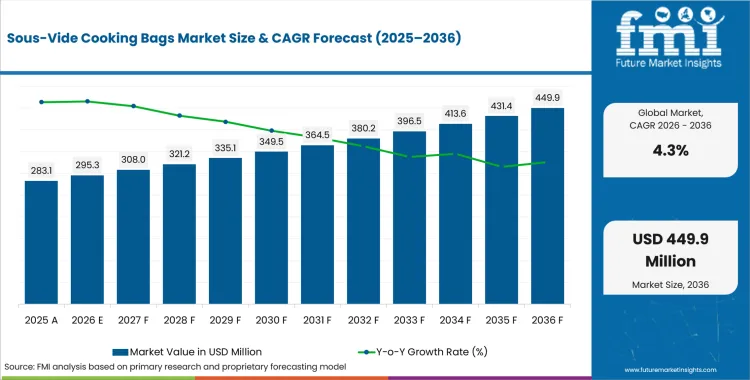
USD 295.3 Million in 2026 and USD 449.9 Million by 2036 at a 4.3% CAGR.
Demand for sous-vide cooking bags is projected to expand at 4.3% CAGR between 2026 and 2036, lifting valuation from USD 295.3 million in 2026 to USD 449.9 million by 2036. Commercial demand is tied to repeat foodservice preparation rather than to a one-time equipment cycle. USDA Economic Research Service reported in June 2026 that USA food-away-from-home spending reached $1.41 trillion in 2025 and represented 56.3% of total food expenditure. That scale supports kitchens that standardize portioning and make-ahead production across multiple locations. Sous-vide bags fit that operating model because each prepared item consumes a bag and must meet a defined seal, temperature, and handling specification. The forecast therefore reflects a consumables stream that rises as operators increase standardized production. Purchasing shifts from ad hoc pouch selection toward approved specifications that can be replenished through normal foodservice channels.
Conversion conditions differ across the profiled countries. UK operators face detailed vacuum-pack safety guidance that keeps shelf-life controls central to adoption. France places strong emphasis on food-contact suitability for the intended use, including heating conditions. Germany combines foodservice sustainability pressure with a packaging law framework that treats bags and film wrappers differently from some takeaway containers. Japan added another materials-compliance checkpoint when its post-transition positive-list regime for food utensils and packaging took effect on June 1, 2025. In each country, interest becomes a repeat purchase only when the pouch specification clears both process-safety and material-compliance review.
Key Takeaways
- Commercial sous-vide creates repeat bag consumption because kitchens standardize portioning, vacuum sealing and thermal preparation around an approved pouch specification.
- Chamber vacuum bags account for 39.0% of Product Type demand in 2026 because the format aligns with commercial chamber-machine throughput and smooth-pouch economics.
- Molded fiber & bagasse account for 25.0% of Material demand in 2026 within the defined bag and bag-integrated cooking-pack boundary.
- Standard meal accounts for 38.0% of Format Size demand in 2026 because a repeat portion can be linked to menu costing and controlled thermal preparation.
- QSR chains account for 33.0% of End Use demand in 2026 because centralized specification can translate menu repetition into recurring bag purchases.
- Broadline foodservice distributors account for 38.0% of Sales Channel demand in 2026 because repeat bags fit routine foodservice replenishment and consolidated ordering.
- Food-contact, heat-use and reduced-oxygen validation slow supplier changes, but materials that can reduce impact without sacrificing seal integrity open a clear development path.
- Direct cook-in and sous-vide packaging suppliers include Sealed Air (CRYOVAC), Sirane (Coppice Alupack), VacMaster, Supreme Industries Performance Films, GreenPak, and Vacuum Pack India.
Analyst Perspective
“A sous-vide bag earns repeat business only after it survives the buyer’s real sealing, storage and cooking process. Material claims matter, but food-contact documentation, seal reliability and replenishment at the right size and gauge determine whether a trial becomes a contract.”
- Nandini Roy Choudhury, Principal Consultant, Future Market Insights
How is the Sous-Vide Cooking Bags Market segmented?
The market is segmented by Product Type, Material, Format Size, End Use, and Sales Channel.
Product Type distinguishes the pouch architecture and the sealing workflow used by the operator. Material separates the primary or bag-integrated material family that defines barrier, heat, and disposal considerations. Format Size captures portion economics and kitchen throughput. End Use identifies the operating environment that sets menu repeatability and procurement scale. Sales Channel shows whether the purchase is routed through a broadline distributor, a direct chain agreement, a specialist packaging distributor, or an online source.
Why do QSR chains lead the End Use category?
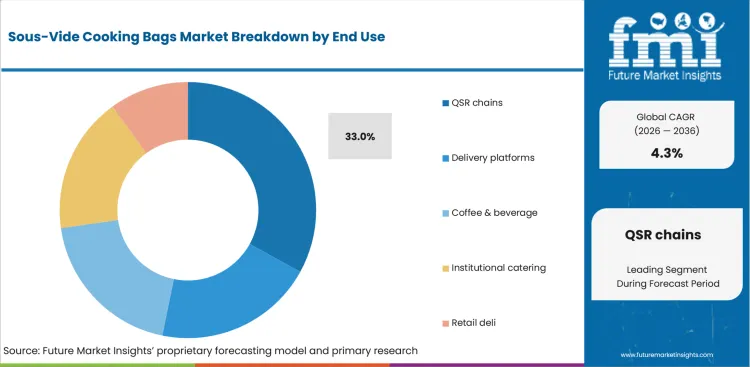
QSR chains create value from consistency across many service points. Central culinary teams can approve a cooking method and specify a pouch that supports the same portion and preparation sequence across locations. That creates a repeatable consumables requirement once the bag is qualified. Delivery platforms influence meal packaging but do not always control back-of-house cooking specifications. Coffee and beverage operators use narrower menu applications. Institutional catering can be large but may have longer procurement cycles. Retail deli programs add prepared-food demand with different shelf-life and merchandising needs. Material choices link the pouch to the broader packaging film discussion around barrier performance and food contact.
- QSR chains account for 33.0% of End Use demand in 2026 because centralized specification can translate menu repetition into recurring bag purchases.
- Detmold Group reported in July 2026 that Detpak opened a USA manufacturing facility to support major QSR customers with locally produced foodservice packaging, illustrating the value placed on local supply for chain accounts.
Why do Chamber vacuum bags lead the Product Type category?
Commercial chamber systems evacuate the entire chamber rather than pulling air through a textured path in the pouch. That operating principle allows smooth chamber bags to be used efficiently in batch-oriented kitchens and commissaries. It also supports liquid-rich preparations because the pressure change occurs around the bag rather than only at the open edge. Channel bags remain important for external suction machines. Roll stock is useful where sizing flexibility matters, while high-temp retort-safe formats address more specialized thermal conditions. Duni Group reinforced the commercial vacuum workflow in November 2025 when Duniform added vacuum solutions with compatible packaging and reseller support. Sous-vide pouches occupy a specialized corner of the wider food bags category because they must tolerate both vacuum and thermal use.
- Chamber vacuum bags account for 39.0% of Product Type demand in 2026 because the format aligns with commercial chamber-machine throughput and smooth-pouch economics.
- Duni Group announced in November 2025 that its Duniform range included vacuum machine systems, aftermarket service, and compatible packaging supplied through a reseller network.
Why does Molded fiber & bagasse lead the Material category?
The material decision increasingly sits beside functional validation rather than after it. Within this market taxonomy, molded fiber and bagasse capture eligible bag-format or bag-integrated cooking configurations that use fiber-based components to reduce reliance on conventional plastic structures. The commercial attraction is most pronounced when the design preserves moisture resistance and heat-use performance. Paperboard offers a similar fiber pathway in other constructions. rPET & PP remain familiar where heat and barrier performance are prioritized. Compostable polymers and aluminium address distinct disposal or barrier cases. The leadership case therefore reflects material-transition pressure tempered by process qualification. The product is distinct from ordinary storage bags once cooking temperature and reduced-oxygen processing enter the specification.
- Molded fiber & bagasse account for 25.0% of Material demand in 2026 within the defined bag and bag-integrated cooking-pack boundary.
- Huhtamaki reported in November 2024 that it opened a smooth molded fiber production line in Lurgan, Northern Ireland, expanding fiber foodservice capacity alongside sites in Europe and the USA.
Why does Standard meal lead the Format Size category?
Standard-meal sizing converts a culinary portion into a repeat packaging specification. Chain kitchens can link one bag size to recipe weight and cook time. The same specification can carry label data, inventory units, and station setup. That reduces the number of judgment calls made during high-volume prep. Single-serve sizes fit smaller portions or individualized programs, while family and catering formats support bulk servings that require different handling. Standard meal therefore wins on operating repeatability rather than on the leading physical pack. The format also makes replenishment easier because buyers can forecast bag demand from planned meal counts. Chamber-bag demand also follows investment in vacuum packaging workflows used by processors and professional kitchens.
- Standard meal accounts for 38.0% of Format Size demand in 2026 because a repeat portion can be linked to menu costing and controlled thermal preparation.
- Genpak noted in June 2025 that foodservice packaging size should match business needs and common meal formats, reinforcing the operational value of standardized size selection.
Why do Broadline foodservice distributors lead the Sales Channel category?
Sous-vide bags are repeat consumables that kitchens need alongside a much wider basket of foodservice supplies. Broadline distributors can combine frequent replenishment with established ordering systems and route density. That lowers the transaction burden for operators that do not want a separate purchasing process for every pouch size. Direct chain contracts remain important where custom specifications or national pricing justify dedicated agreements. Packaging distributors are valuable for technical formats and lower-volume specialty needs. Online channels serve smaller buyers and trial demand. The leading route therefore reflects replenishment convenience after specification approval. Longer hold times and oxygen control make barrier packaging performance commercially relevant to sous-vide qualification.
- Broadline foodservice distributors account for 38.0% of Sales Channel demand in 2026 because repeat bags fit routine foodservice replenishment and consolidated ordering.
- Duni Group stated in November 2025 that Duniform vacuum solutions are available through its reseller network, showing how channel partners support access to equipment-compatible packaging.
What are the drivers, restraints and opportunities in the Sous-Vide Cooking Bags Market?
Scaled foodservice standardization supports recurring bag demand, while reduced-oxygen and heat-use qualification slows conversion, and validated lower-impact materials create a product-development opening.
- Driver: Centralized and repeat foodservice prep converts approved sous-vide packaging into a recurring operating consumable.
- Restraint: Reduced-oxygen process controls and intended-use material validation increase qualification effort before repeat purchasing.
- Opportunity: Recyclable or lower-plastic structures can gain share when they preserve seal integrity, heat performance, and documented food-contact suitability.
Driver. Foodservice scale makes standardization commercially valuable. USDA Economic Research Service reported in June 2026 that USA food-away-from-home spending reached $1.41 trillion in 2025. Large chains and institutional kitchens can translate that demand into repeatable preparation systems where portions are sealed in advance and cooked to controlled specifications. Once a pouch passes the operator’s tests, each production cycle creates another consumables order. The relevant demand mechanism is therefore not simply restaurant traffic. It is the conversion of meal volume into a standardized prep workflow with predictable packaging consumption.
Restraint. Qualification becomes more demanding when food is sealed under reduced oxygen and then held under controlled temperature conditions. The FDA’s 2022 Food Code requires establishments using reduced-oxygen packaging for time and temperature control for safety foods to control Clostridium botulinum and Listeria monocytogenes. Its 2022 changes also address cooling paths for cook-chill and sous-vide food in sealed bags. That means the buyer must validate both the food process and the packaging used within it. This friction delays approval and narrows the value of bags that lack clear intended-use documentation.
Opportunity. Material redesign can create value if it reduces environmental burden without weakening the cooking pack. Berry Global reported in January 2025 that Entour mono-material PE laminates achieved positive converting trials and strong sealing performance on a B&B line. The films were positioned for bags and pouches in food and other applications. For sous-vide use, the converter route still requires heat-use and food-contact qualification, while demonstrating how recyclable flexible structures can retain strong sealing performance. Suppliers that pair such material engineering with heat-use testing and food-contact documentation can address sustainability targets without asking operators to compromise process reliability.
Which country CAGRs are profiled in the Sous-Vide Cooking Bags Market?
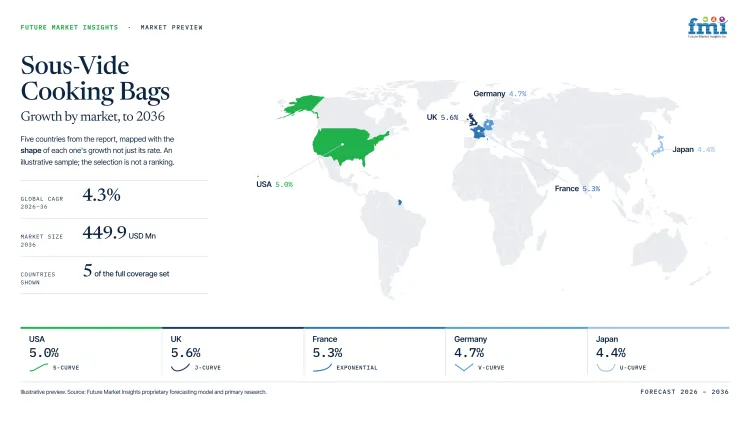
| Country | CAGR (2026-2036) |
|---|---|
| USA | 5.0% |
| France | 5.3% |
| UK | 5.6% |
| Germany | 4.7% |
| Japan | 4.4% |
How do country-level CAGRs compare in the Sous-Vide Cooking Bags Market?
The five profiled CAGRs form a narrow 1.2 percentage-point range. UK at 5.6% and France at 5.3% form the upper band. USA sits at the midpoint with 5.0%. Germany at 4.7% and Japan at 4.4% make up the lower band. Each adjacent rate differs by 0.3 percentage points, which is too small to support a market-size conclusion on its own. Commercial planning should therefore focus first on qualification burden and foodservice structure. Distributor access and materials regulation matter more than reading the CAGR table as a ranking of absolute opportunity.
- Chain kitchens and institutional foodservice buyers often standardize recipes through centralized operating procedures but must execute food safety controls at the establishment level. That gives USA a distinct Sous-Vide Cooking Bags path within its 5.0% CAGR forecast.
- France carries a 5.3% CAGR through 2036, with conversion tied to this market reality: Professional buyers place strong weight on documented food-contact suitability for the actual heating and storage condition.
- At 5.6% CAGR, UK remains commercially distinct. Operators using vacuum or modified-atmosphere chilled processes must build shelf-life and temperature control into routine food safety management.
- Germany is forecast at 4.7% CAGR. QSR and takeaway operators make packaging choices inside a broader policy environment that rewards visible waste reduction but applies different rules to different pack forms.
- Packaging buyers need material information that can move through supplier and food-manufacturer quality systems without ambiguity. In Japan, that operating setting accompanies a 4.4% CAGR through 2036.
CAGR describes the pace of forecast expansion, not the absolute revenue base or the ease of winning business. A supplier still needs to compare chain density and kitchen workflows. Material rules, approved distributor coverage, and the cost of supporting qualification also shape the addressable opportunity. The broader report scope therefore uses country growth rates as one commercial input rather than as a substitute for market structure.
Country-wise Analysis
- USA: Chain kitchens and institutional foodservice buyers often standardize recipes through centralized operating procedures but must execute food safety controls at the establishment level. Growth in Sous-Vide Cooking Bags across USA is projected at 5.0% CAGR from 2026 to 2036. FDA’s December 2022 Food Code update addressed cook-chill and sous-vide cooling under reduced-oxygen packaging and reinforced controls for C. botulinum and L. monocytogenes. What slows conversion is documentation plus local implementation of the model code. Qualified suppliers need validated temperature-use guidance and broad distributor stock for approved pouch sizes.
- France: Professional buyers place strong weight on documented food-contact suitability for the actual heating and storage condition. The ten-year forecast for Sous-Vide Cooking Bags in France reaches 5.3% CAGR. DGCCRF reported in October 2024 that 27% of 350 tested food-contact material samples were non-compliant in its 2022 survey and warned against using articles outside tested conditions. That scrutiny raises the cost of weak documentation. Suppliers should provide intended-use restrictions and traceable conformity information in a form procurement teams can audit.
- UK: Operators using vacuum or modified-atmosphere chilled processes must build shelf-life and temperature control into routine food safety management. Between 2026 and 2036, sales of Sous-Vide Cooking Bags in UK are expected to rise at 5.6% CAGR. Food Standards Agency guidance published in May 2018 explains how businesses and manufacturers should vacuum pack chilled food safely with attention to non-proteolytic Clostridium botulinum. A local execution risk is process validation rather than bag availability alone. Suppliers can differentiate through clear pouch-use limits and technical support for controlled chilled workflows.
- Germany: QSR and takeaway operators make packaging choices inside a broader policy environment that rewards visible waste reduction but applies different rules to different pack forms. The Sous-Vide Cooking Bags outlook for Germany points to a 4.7% CAGR from 2026 to 2036. The federal environment ministry stated in February 2023 that certain takeaway food and drink sellers must offer reusable alternatives, while separate guidance excludes bags and film wrappers from that specific container definition. The main commercial hurdle is proving environmental claims without compromising cooking performance. Suppliers should separate front-of-house reuse obligations from back-of-house bag functionality and document recyclable-material claims precisely.
- Japan: Packaging buyers need material information that can move through supplier and food-manufacturer quality systems without ambiguity. For Japan, the Sous-Vide Cooking Bags market is projected to advance at 4.4% CAGR through 2036. Japan’s Ministry of Health, Labour and Welfare published the post-transition positive-list framework in November 2023 for implementation from June 1, 2025. A practical constraint is confirming that synthetic-resin food-contact constituents and information transfer meet the applicable requirements. Providers need compliant resin selections and disciplined technical documentation backed by reliable local distribution.
Who are the notable companies in the Sous-Vide Cooking Bags Market?
Sealed Air (CRYOVAC), Sirane (Coppice Alupack), VacMaster, Supreme Industries Performance Films, GreenPak, and Vacuum Pack India.
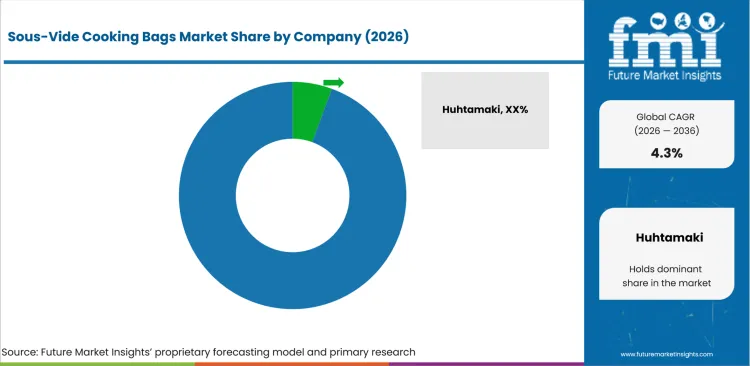
The direct competitor set is centered on suppliers that publish cook-in or sous-vide-compatible bag capability. Sealed Air markets CRYOVAC cook-in systems for commercial thermal processing, Sirane supplies dedicated Sira-Cook sous-vide bags, and VacMaster supports chamber and external-vacuum users. Supreme Industries Performance Films, GreenPak and Vacuum Pack India add manufacturing or regional supply options for cook-in and sous-vide pouches. General foodservice packaging without a qualified cooking pouch sits outside the direct supplier comparison.
- Commercial cook-in systems: Sealed Air (CRYOVAC) and Sirane (Coppice Alupack) address thermal-process bags with explicit cook-in capability.
- Professional vacuum formats: VacMaster serves professional and smaller-scale users with chamber and external-vacuum bags that are suitable for sous-vide.
- Specialist pouch manufacturers: Supreme Industries Performance Films, GreenPak and Vacuum Pack India broaden B2B and regional pouch supply.
Competitive Benchmarking: Sous-Vide Cooking Bags Market
| Company | Direct Product Position | Format | Temperature / Use Case | Commercial Route |
|---|---|---|---|---|
| Sealed Air (CRYOVAC) | Cook-in bag supplier | Barrier shrink and cook-in bags | Commercial cooking and processed food | Processors, foodservice and retail |
| Sirane (Coppice Alupack) | Dedicated sous-vide cooking bags | Vacuum cook-in bags | Sous-vide and roast-after-sous-vide | Processors and foodservice |
| VacMaster | Sous-vide-compatible bag and roll supplier | Chamber and external-vacuum pouches | Boil and sous-vide | Restaurant, professional and home |
| Supreme Industries Performance Films | Cook-in vacuum-pouch manufacturer | PA/PE and high-barrier pouches | Cook-in and sous-vide | B2B food processors |
| GreenPak | Boilable sous-vide pouch manufacturer | Multilayer vacuum pouches | Sous-vide and thermal prep | B2B and custom |
| Vacuum Pack India | Vacuum-pouch manufacturer | Chamber pouches | Sous-vide compatible | Indian food industry |
Benchmarking is based on explicit cooking-bag capability, pouch format, thermal use case and the route through which food processors or kitchens can qualify and replenish the product.
Key Developments in the Sous-Vide Cooking Bags Market
- In November 2025, Duni Group launched expanded Duniform vacuum and composting solutions for foodservice operators. The vacuum offer combined machine systems with compatible packaging, aftermarket service, and reseller access. For the defined market, the development matters because it links vacuum equipment selection with a supported packaging ecosystem and gives operators a clearer route from process setup to repeat consumable purchasing.
- In April 2025, Novolex completed its combination with Pactiv Evergreen after the previously announced merger agreement. Pactiv Evergreen survived the transaction as a wholly owned subsidiary of Novolex. The combination brings two large foodservice packaging platforms under common ownership, strengthening account coverage and procurement leverage across foodservice packaging.
- In January 2025, Berry Global completed converting trials of Entour mono-material PE lamination films on a B&B Verpackungstechnik line. The company reported positive sealing results and positioned the film for bags and pouches in food and other markets. The development provides a relevant material pathway for recyclable flexible packaging, subject to separate food-contact and heat-use validation for any sous-vide application.
Key Players in the Sous-Vide Cooking Bags Market
Commercial Cook-In Platforms
- Sealed Air (CRYOVAC)
- Sirane (Coppice Alupack)
Professional Vacuum Formats
- VacMaster
Specialist Pouch Manufacturers
- Supreme Industries Performance Films
- GreenPak
- Vacuum Pack India
Sous-Vide Cooking Bags Market - Report Scope
| Coverage field | Report scope |
|---|---|
| Market breakdown | Product Type, Material, Format Size, End Use, and Sales Channel |
| Quantitative Units | USD Million |
| Market Definition | Revenue from food-contact bags and pouches sold specifically for sous-vide, cook-chill, or reduced-oxygen thermal preparation within the defined segmentation universe. Standalone equipment, downstream prepared-food revenue, ordinary storage bags, and adjacent serviceware are excluded; fiber or paper formats are included only when sold within an eligible bag or bag-integrated cooking solution. |
| Regions Covered | North America; Latin America; Western Europe; Eastern Europe; East Asia; South Asia and Pacific; Middle East and Africa |
| Countries Covered | USA, France, UK, Germany, Japan, and more than twenty-five additional countries in the full report |
| Key Companies Profiled | Sealed Air (CRYOVAC); Sirane (Coppice Alupack); VacMaster; Supreme Industries Performance Films; GreenPak; Vacuum Pack India |
| Forecast Period | 2026 to 2036 |
| Approach | Hybrid bottom-up and top-down sizing using product, end-use, channel, price, and operating indicators with reconciliation against the defined revenue boundary. |
Sous-Vide Cooking Bags Market - Research Methodology
| Method | Approach |
|---|---|
| Primary Research | Structured discussions with packaging and converting suppliers, foodservice distributors, chain procurement teams, institutional foodservice operators, and subject specialists. The work focuses on product qualification, performance thresholds, purchasing frictions, route-to-market behavior, and repeat replenishment. |
| Desk Research | Review of government food safety requirements, food-contact material rules, official foodservice statistics, public filings, product documentation, trade information, and first-party company releases. Sources are screened for relevance to the defined cooking-bag revenue boundary. |
| Market Sizing and Forecasting | Hybrid bottom-up and top-down analysis using product and channel logic, end-use demand, price and volume behavior, foodservice activity, material transition, and regulatory conditions. Forecast assumptions are reconciled with the stated market definition and period. |
| Data Validation | Cross-checking across independent public indicators and commercial evidence. Downstream food revenue, equipment, ordinary storage bags, adjacent serviceware, double counting, and unsupported claims are excluded from the final market boundary. |
Sous-Vide Cooking Bags Market by Segments
Sous-Vide Cooking Bags Market segmented by Product Type:
- Chamber vacuum bags
- Channel bags
- Roll stock
- High-temp retort-safe
Sous-Vide Cooking Bags Market segmented by Material:
- Molded fiber & bagasse
- Paperboard
- rPET & PP
- Compostable polymers
- Aluminium
Sous-Vide Cooking Bags Market segmented by Format Size:
- Standard meal
- Single-serve
- Family & catering
Sous-Vide Cooking Bags Market segmented by End Use:
- QSR chains
- Delivery platforms
- Coffee & beverage
- Institutional catering
- Retail deli
Sous-Vide Cooking Bags Market segmented by Sales Channel:
- Broadline foodservice distributors
- Direct chain contracts
- Packaging distributors
- Online
Sous-Vide Cooking Bags Market by Region:
- North America
- United States
- Canada
- Latin America
- Brazil
- Mexico
- Argentina
- Chile
- Western Europe
- Germany
- France
- United Kingdom
- Italy
- Spain
- Benelux
- Nordics
- Eastern Europe
- Poland
- Czech Republic
- Romania
- Hungary
- East Asia
- China
- Japan
- South Korea
- South Asia and Pacific
- India
- ASEAN
- Australia and New Zealand
- Middle East and Africa
- GCC Countries
- South Africa
- Türkiye
- Israel
Research Sources and Bibliography
- USA Department of Agriculture, Economic Research Service (2026, June 11). Total USA food spending reached $2.51 trillion in 2025.
- USA Food and Drug Administration (2022, December 28). Food Code 2022.
- Food Standards Agency (2018, May 22). Vacuum packaging.
- Direction générale de la concurrence, de la consommation et de la répression des fraudes (2024, October 16). Soyez vigilants en cas d'utilisation de matériaux au contact des aliments.
- Federal Ministry for the Environment, Climate Action, Nature Conservation and Nuclear Safety (2023, February 10). Was bedeutet die neue Mehrwegangebotspflicht im To-Go-Bereich?
- Ministry of Health, Labour and Welfare, Japan (2023, November 30). Positive List System for Food Utensils, Containers and Packaging after June 1, 2025.
- Duni Group (2025, November 25). Duni Group and Duniform Take the Next Step in Reducing Food Waste.
- USA Securities and Exchange Commission / Pactiv Evergreen Inc. (2025, April 1). Form 8-K.
- Berry Global (2025, January 29). Tailored Solutions for Berry’s Entour Film from B&B Conversion Line.
- Huhtamaki (2024, November 22). Huhtamaki Fiber Foodservice expands global reach with launch of innovative fiber lid production in UK and Ireland.
- Sabert (2024, April 23). Sabert Redefines Food Packaging Performance with Pulp Ultra Containers.
- Genpak (2025, June 4). Commercial Food Service Container Buying Guide.
- Dart Container (2025, May 12). Dart products earn sustainability recognition.
- Detmold Group (2026, July 20). Detpak Is Now Manufacturing in the United States.
- Graphic Packaging Holding Company (2026, March 2). 2025 Annual Report on Form 10-K.
- Sealed Air. (2026). CRYOVAC Brand Cook-In Bags.
- Sirane, Coppice Alupack Ltd. (2026). Sira-Cook Sous-Vide Cooking Bags.
- VacMaster. (2026). Sous Vide Bags and Rolls.
- Supreme Industries Performance Films. (2026). Vacuum Pouches: Standard and Cook-In.
- GreenPak. (2026). Sous-Vide Cooking Vacuum Pouches.
- Vacuum Pack India. (2026). Vacuum Pouches for Sous Vide.
This Report Answers
- How is demand for the Sous-Vide Cooking Bags Market expected to evolve through 2036?
- Which foodservice operating pressures support recurring demand for sous-vide cooking bags?
- Why do Chamber vacuum bags hold the leading position in Product Type?
- How does Molded fiber & bagasse influence the Material mix and downstream specification choices?
- Why does Standard meal hold the leading position in Format Size?
- How do growth rates differ across USA, France, UK, Germany, and Japan from 2026 to 2036?
- Which companies provide flexible-pack capability, material-transition platforms, or broad foodservice access?
- What reduced-oxygen and food-contact qualification requirements can slow adoption?
- What should chain procurement and foodservice operations teams evaluate before approving a cooking-bag specification?
Frequently Asked Questions
What is driving growth in the Sous-Vide Cooking Bags Market?
Growth is driven by foodservice operators that standardize portions and preparation across multiple kitchens, turning approved bags into repeat consumables. The most pronounced demand appears where controlled cooking, make-ahead production, and dependable replenishment are integrated into routine operations.
Who are the key players in the Sous-Vide Cooking Bags Market?
Key players include Sealed Air (CRYOVAC), Sirane (Coppice Alupack), VacMaster, Supreme Industries Performance Films, GreenPak and Vacuum Pack India. Their differences are visible in cook-in validation, pouch architecture, customer scale and replenishment routes.
What is a notable restraint in the Sous-Vide Cooking Bags Market?
The main restraint is qualification under reduced-oxygen food safety controls and the intended heating conditions of the package. A bag that seals well still needs credible food-contact documentation and process compatibility before procurement teams will approve repeat use.
Why should executives track the Sous-Vide Cooking Bags Market?
Executives should track the market because cooking bags connect foodservice standardization with labor efficiency and safety control. Specification changes can alter material strategy and operating consistency while also changing qualification effort and recurring packaging cost across many locations.
What business problem does the Sous-Vide Cooking Bags Market address?
Sous-vide cooking bags help commercial kitchens portion food, remove air, and hold items in a controlled thermal workflow before service. The business value comes from repeatability and make-ahead production when the pouch is matched to the process and menu.
What should chain procurement teams evaluate in the Sous-Vide Cooking Bags Market?
Procurement teams should verify seal integrity, puncture resistance, and intended temperature range before approval. They should then confirm food-contact compliance and machine compatibility while checking portion sizing, distributor availability, and whether sustainability claims hold under the actual cooking process.
What limits return on investment in the Sous-Vide Cooking Bags Market?
Return on investment weakens when buyers focus only on unit bag price and ignore qualification effort, failures, or extra handling. Poorly matched sizes and weak seals can erase savings, as can limited distributor stock or uncertain material documentation.
What supports long-term commercial confidence in the Sous-Vide Cooking Bags Market?
Long-term confidence is supported by recurring foodservice consumption and by suppliers that continue investing in vacuum workflows, flexible materials, and foodservice packaging capacity. The durable opportunity depends on proving safety and performance while meeting evolving material and channel requirements.
Preview the report firsthand - request a free sample
Get SampleGet the brochure for pricing and purchase details.
Get PDFTable of Content
- Key Takeaways
- Market Size and CAGR
- Top Growth Driver
- Fastest Growing Segment
- Leading Region
- Key Companies
- Emerging Opportunities
- Executive Summary
- Global Market Outlook
- Demand-side Trends
- Supply-side Trends
- Technology Roadmap Analysis
- Analysis and Recommendations
- Analyst Perspective (What is happening? Why now? What should investors know?)
- Key Questions Answered
- How large is the market?
- What is the CAGR?
- What are key trends?
- Which region dominates?
- Who are the leaders?
- Market Overview
- Market Coverage / Taxonomy
- Market Definition / Scope / Limitations
- Research Methodology
- Chapter Orientation
- Analytical Lens and Working Hypotheses
- Market Structure, Signals, and Trend Drivers
- Benchmarking and Cross-market Comparability
- Market Sizing, Forecasting, and Opportunity Mapping
- Research Design and Evidence Framework
- Desk Research Programme (Secondary Evidence)
- Expert Input and Fieldwork (Primary Evidence)
- Tooling, Models, and Reference Databases
- Data Engineering and Model Build
- Quality Assurance and Audit Trail
- Market Background
- Market Dynamics (Drivers, Restraints, Opportunity, Trends)
- Scenario Forecast (Optimistic, Likely, Conservative)
- Impact Analysis
- AI Impact
- Sustainability Impact
- Regulatory Impact
- Technology Impact
- Consumer / Buyer Analysis
- Purchase Drivers
- Adoption Barriers
- Buyer Journey
- Opportunity Map Analysis
- Product Life Cycle Analysis
- Supply Chain Analysis
- Investment Feasibility Matrix
- Value Chain Analysis
- PESTLE and Porter's Analysis
- Regulatory Landscape
- Regional Parent Market Outlook
- Production and Consumption Statistics
- Import and Export Statistics
- Global Market Analysis and Forecast, 2021 to 2036
- Historical Market Size Value (USD Million) Analysis, 2021 to 2025
- Current and Future Market Size Value (USD Million) Projections, 2026 to 2036
- Y-o-Y Growth Trend Analysis
- Absolute $ Opportunity Analysis
- Global Market Pricing Analysis, 2021 to 2036
- Global Market Analysis and Forecast, By Product Type, 2021 to 2036
- Introduction / Key Findings
- Historical Market Size Value (USD Million) Analysis By Product Type, 2021 to 2025
- Current and Future Market Size Value (USD Million) Analysis and Forecast By Product Type, 2026 to 2036
- Chamber vacuum bags
- Channel bags
- Roll stock
- High-temp retort-safe
- Chamber vacuum bags
- Y-o-Y Growth Trend Analysis By Product Type, 2021 to 2025
- Absolute $ Opportunity Analysis By Product Type, 2026 to 2036
- Global Market Analysis and Forecast, By Material, 2021 to 2036
- Introduction / Key Findings
- Historical Market Size Value (USD Million) Analysis By Material, 2021 to 2025
- Current and Future Market Size Value (USD Million) Analysis and Forecast By Material, 2026 to 2036
- Molded fiber & bagasse
- Paperboard
- rPET & PP
- Compostable polymers
- Aluminium
- Molded fiber & bagasse
- Y-o-Y Growth Trend Analysis By Material, 2021 to 2025
- Absolute $ Opportunity Analysis By Material, 2026 to 2036
- Global Market Analysis and Forecast, By Format Size, 2021 to 2036
- Introduction / Key Findings
- Historical Market Size Value (USD Million) Analysis By Format Size, 2021 to 2025
- Current and Future Market Size Value (USD Million) Analysis and Forecast By Format Size, 2026 to 2036
- Standard meal
- Single-serve
- Family & catering
- Standard meal
- Y-o-Y Growth Trend Analysis By Format Size, 2021 to 2025
- Absolute $ Opportunity Analysis By Format Size, 2026 to 2036
- Global Market Analysis and Forecast, By End Use, 2021 to 2036
- Introduction / Key Findings
- Historical Market Size Value (USD Million) Analysis By End Use, 2021 to 2025
- Current and Future Market Size Value (USD Million) Analysis and Forecast By End Use, 2026 to 2036
- QSR chains
- Delivery platforms
- Coffee & beverage
- Institutional catering
- Retail deli
- QSR chains
- Y-o-Y Growth Trend Analysis By End Use, 2021 to 2025
- Absolute $ Opportunity Analysis By End Use, 2026 to 2036
- Global Market Analysis and Forecast, By Sales Channel, 2021 to 2036
- Introduction / Key Findings
- Historical Market Size Value (USD Million) Analysis By Sales Channel, 2021 to 2025
- Current and Future Market Size Value (USD Million) Analysis and Forecast By Sales Channel, 2026 to 2036
- Broadline foodservice distributors
- Direct chain contracts
- Packaging distributors
- Online
- Broadline foodservice distributors
- Y-o-Y Growth Trend Analysis By Sales Channel, 2021 to 2025
- Absolute $ Opportunity Analysis By Sales Channel, 2026 to 2036
- Global Market Analysis and Forecast, By Region, 2021 to 2036
- Introduction
- Historical Market Size Value (USD Million) Analysis By Region, 2021 to 2025
- Current Market Size Value (USD Million) Analysis and Forecast By Region, 2026 to 2036
- North America
- Latin America
- Western Europe
- Eastern Europe
- East Asia
- South Asia and Pacific
- Middle East & Africa
- Market Attractiveness Analysis By Region
- North America Market Analysis and Forecast, By Country, 2021 to 2036
- Historical Market Size Value (USD Million) Trend Analysis By Market Taxonomy, 2021 to 2025
- Market Size Value (USD Million) Forecast By Market Taxonomy, 2026 to 2036
- By Country
- USA
- Canada
- By Product Type
- By Material
- By Format Size
- By End Use
- By Sales Channel
- By Country
- Market Attractiveness Analysis
- By Country
- By Product Type
- By Material
- By Format Size
- By End Use
- By Sales Channel
- Key Takeaways
- Latin America Market Analysis and Forecast, By Country
- Historical Market Size Value (USD Million) Trend Analysis By Market Taxonomy, 2021 to 2025
- Market Size Value (USD Million) Forecast By Market Taxonomy, 2026 to 2036
- By Country
- Brazil
- Mexico
- Chile
- Rest of Latin America
- By Product Type
- By Material
- By Format Size
- By End Use
- By Sales Channel
- By Country
- Market Attractiveness Analysis
- By Country
- By Product Type
- By Material
- By Format Size
- By End Use
- By Sales Channel
- Key Takeaways
- Western Europe Market Analysis and Forecast, By Country
- Historical Market Size Value (USD Million) Trend Analysis By Market Taxonomy, 2021 to 2025
- Market Size Value (USD Million) Forecast By Market Taxonomy, 2026 to 2036
- By Country
- Germany
- UK
- Italy
- Spain
- France
- Nordic
- BENELUX
- Rest of Western Europe
- By Product Type
- By Material
- By Format Size
- By End Use
- By Sales Channel
- By Country
- Market Attractiveness Analysis
- By Country
- By Product Type
- By Material
- By Format Size
- By End Use
- By Sales Channel
- Key Takeaways
- Eastern Europe Market Analysis and Forecast, By Country
- Historical Market Size Value (USD Million) Trend Analysis By Market Taxonomy, 2021 to 2025
- Market Size Value (USD Million) Forecast By Market Taxonomy, 2026 to 2036
- By Country
- Russia
- Poland
- Hungary
- Balkan & Baltic
- Rest of Eastern Europe
- By Product Type
- By Material
- By Format Size
- By End Use
- By Sales Channel
- By Country
- Market Attractiveness Analysis
- By Country
- By Product Type
- By Material
- By Format Size
- By End Use
- By Sales Channel
- Key Takeaways
- East Asia Market Analysis and Forecast, By Country
- Historical Market Size Value (USD Million) Trend Analysis By Market Taxonomy, 2021 to 2025
- Market Size Value (USD Million) Forecast By Market Taxonomy, 2026 to 2036
- By Country
- China
- Japan
- South Korea
- By Product Type
- By Material
- By Format Size
- By End Use
- By Sales Channel
- By Country
- Market Attractiveness Analysis
- By Country
- By Product Type
- By Material
- By Format Size
- By End Use
- By Sales Channel
- Key Takeaways
- South Asia and Pacific Market Analysis and Forecast, By Country
- Historical Market Size Value (USD Million) Trend Analysis By Market Taxonomy, 2021 to 2025
- Market Size Value (USD Million) Forecast By Market Taxonomy, 2026 to 2036
- By Country
- India
- ASEAN
- Australia & New Zealand
- Rest of South Asia and Pacific
- By Product Type
- By Material
- By Format Size
- By End Use
- By Sales Channel
- By Country
- Market Attractiveness Analysis
- By Country
- By Product Type
- By Material
- By Format Size
- By End Use
- By Sales Channel
- Key Takeaways
- Middle East & Africa Market Analysis and Forecast, By Country
- Historical Market Size Value (USD Million) Trend Analysis By Market Taxonomy, 2021 to 2025
- Market Size Value (USD Million) Forecast By Market Taxonomy, 2026 to 2036
- By Country
- Kingdom of Saudi Arabia
- Other GCC Countries
- Türkiye
- South Africa
- Other African Union
- Rest of Middle East & Africa
- By Product Type
- By Material
- By Format Size
- By End Use
- By Sales Channel
- By Country
- Market Attractiveness Analysis
- By Country
- By Product Type
- By Material
- By Format Size
- By End Use
- By Sales Channel
- Key Takeaways
- Key Countries Market Analysis
- USA
- Pricing Analysis
- Market Share Analysis, 2025
- By Product Type
- By Material
- By Format Size
- By End Use
- By Sales Channel
- Canada
- Pricing Analysis
- Market Share Analysis, 2025
- By Product Type
- By Material
- By Format Size
- By End Use
- By Sales Channel
- Mexico
- Pricing Analysis
- Market Share Analysis, 2025
- By Product Type
- By Material
- By Format Size
- By End Use
- By Sales Channel
- Brazil
- Pricing Analysis
- Market Share Analysis, 2025
- By Product Type
- By Material
- By Format Size
- By End Use
- By Sales Channel
- Chile
- Pricing Analysis
- Market Share Analysis, 2025
- By Product Type
- By Material
- By Format Size
- By End Use
- By Sales Channel
- Germany
- Pricing Analysis
- Market Share Analysis, 2025
- By Product Type
- By Material
- By Format Size
- By End Use
- By Sales Channel
- UK
- Pricing Analysis
- Market Share Analysis, 2025
- By Product Type
- By Material
- By Format Size
- By End Use
- By Sales Channel
- Italy
- Pricing Analysis
- Market Share Analysis, 2025
- By Product Type
- By Material
- By Format Size
- By End Use
- By Sales Channel
- Spain
- Pricing Analysis
- Market Share Analysis, 2025
- By Product Type
- By Material
- By Format Size
- By End Use
- By Sales Channel
- France
- Pricing Analysis
- Market Share Analysis, 2025
- By Product Type
- By Material
- By Format Size
- By End Use
- By Sales Channel
- India
- Pricing Analysis
- Market Share Analysis, 2025
- By Product Type
- By Material
- By Format Size
- By End Use
- By Sales Channel
- ASEAN
- Pricing Analysis
- Market Share Analysis, 2025
- By Product Type
- By Material
- By Format Size
- By End Use
- By Sales Channel
- Australia & New Zealand
- Pricing Analysis
- Market Share Analysis, 2025
- By Product Type
- By Material
- By Format Size
- By End Use
- By Sales Channel
- China
- Pricing Analysis
- Market Share Analysis, 2025
- By Product Type
- By Material
- By Format Size
- By End Use
- By Sales Channel
- Japan
- Pricing Analysis
- Market Share Analysis, 2025
- By Product Type
- By Material
- By Format Size
- By End Use
- By Sales Channel
- South Korea
- Pricing Analysis
- Market Share Analysis, 2025
- By Product Type
- By Material
- By Format Size
- By End Use
- By Sales Channel
- Russia
- Pricing Analysis
- Market Share Analysis, 2025
- By Product Type
- By Material
- By Format Size
- By End Use
- By Sales Channel
- Poland
- Pricing Analysis
- Market Share Analysis, 2025
- By Product Type
- By Material
- By Format Size
- By End Use
- By Sales Channel
- Hungary
- Pricing Analysis
- Market Share Analysis, 2025
- By Product Type
- By Material
- By Format Size
- By End Use
- By Sales Channel
- Kingdom of Saudi Arabia
- Pricing Analysis
- Market Share Analysis, 2025
- By Product Type
- By Material
- By Format Size
- By End Use
- By Sales Channel
- Türkiye
- Pricing Analysis
- Market Share Analysis, 2025
- By Product Type
- By Material
- By Format Size
- By End Use
- By Sales Channel
- South Africa
- Pricing Analysis
- Market Share Analysis, 2025
- By Product Type
- By Material
- By Format Size
- By End Use
- By Sales Channel
- USA
- Market Structure Analysis
- Competition Dashboard
- Competition Benchmarking
- Market Share Analysis of Top Players
- By Regional
- By Product Type
- By Material
- By Format Size
- By End Use
- By Sales Channel
- Emerging Startups
- Innovation Benchmarking
- Competition Analysis
- Competition Deep Dive
- Huhtamaki
- Overview
- Product Portfolio
- Profitability by Market Segments
- Sales Footprint
- Strategy Overview
- Marketing Strategy
- Product Strategy
- Channel Strategy
- Novolex
- Graphic Packaging
- Dart Container
- Sabert
- Duni
- Berry Global
- Genpak
- Detmold Group
- Pactiv Evergreen
- Huhtamaki
- Case Studies
- Success Stories
- Recent Developments
- Competition Deep Dive
- Assumptions & Acronyms Used


