

- Market Size (2026)
- USD 689.5 Mn
- Forecast (2036)
- USD 1246.5 Mn
- CAGR (2026 to 2036)
- 6.1%
How big is SPF Lip Balms Market in 2026?
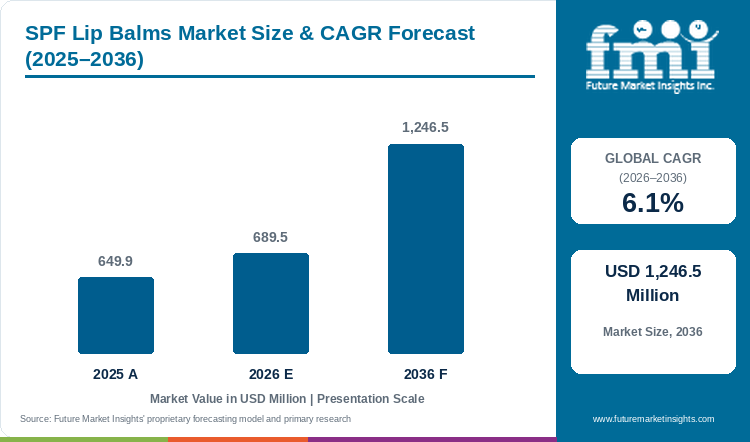
Demand for SPF lip balms is projected to expand at 6.1% CAGR between 2026 and 2036. Industry value grows from USD 649.9 million in 2025 to USD 689.5 million in 2026 and is projected to reach USD 1,246.5 million by 2036.
Demand for SPF lip balms is projected to expand at 6.1% CAGR between 2026 and 2036. The market value is likely to increase from USD 649.9 million in 2025 to USD 689.5 million in 2026 and further reach USD 1,246.5 million by 2036. The U.S. Food and Drug Administration identifies lips as a frequently forgotten area and specifically instructs consumers to use SPF lip balm, calling for broad-spectrum SPF 15 or higher and reapplication at least every two hours [1]. Because a lip product wears off through eating, drinking and normal contact faster than most face products, demand is increasingly built around replenishment. However, sunscreen testing requirements and jurisdiction-specific claim rules are required to be maintained for regular retail supply.
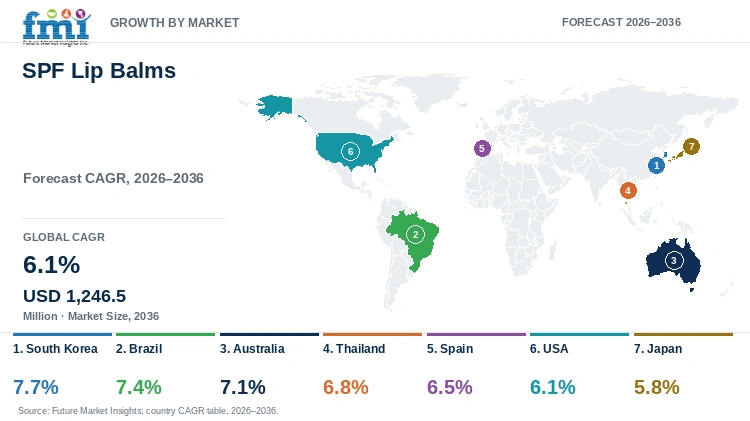
Regional adoption patterns for SPF lip balms diverge across geographies, shaped by beauty-adoption speed, sunscreen regulation and channel trust. South Korea is projected to grow at 7.7% CAGR through 2036, whereas Brazil is anticipated to grow at 7.4%. South Korea's pace reflects rapid beauty-category turnover alongside functional-cosmetics review: in August 2026, the Ministry of Food and Drug Safety proposed allowing in-vitro evidence for sunscreen efficacy review while strengthening reliability controls [6]. Brazil's growth instead runs through a cosmetics system that treats sunscreen as a higher-control category, where Anvisa guidance keeps sunscreens subject to marketing authorization under RDC 907/2024 [3]. Decorated or tinted SPF lip products still require consistent formula and documented testing in both markets, so compliant claims, locally acceptable textures and reliable reapplication cues are what ultimately convert regulatory clearance into repeat purchase.
Key Takeaways
- Routine lip photoprotection is becoming a repeat-use skin-care behavior, which is expected to support the SPF lip balms market growth.
- Based on product type, core / classic lines is projected to account for 33.0% in 2026 owing to a simple hydration-plus-SPF proposition and low switching friction.
- By nature, conventional is estimated to hold 54.0% in 2026 due to established UV-filter systems and broader formulation latitude.
- In 2026, cream & balm is expected to lead format with 36.0% share owing to controlled dosing and repeatable film formation on a frequently worn-off surface.
- Jurisdiction-specific sunscreen testing rules and taste or texture trade-offs may hamper repeat use and slow product localization.
- Profiled companies include Procter & Gamble, Estee Lauder Companies, Kao Corporation, e.l.f. Beauty, Coty, Beiersdorf, Shiseido, L'Oreal, Unilever, and Amorepacific.
Analyst Perspective
“High SPF alone will not sustain repeat purchase if taste or drag discourages reapplication. In my experience, suppliers that pair compliant UV claims with lip-care sensorials and channel-specific packaging will convert sun-safety awareness into durable unit demand.”
- Rahul Pandita, Principal Consultant, Future Market Insights.
How is the SPF lip balms market segmented?
SPF lip balms market is segmented by product type, nature, format, price positioning, and sales channel.
- By product type: Core / Classic Lines, Targeted Treatment Lines, Sensitive & Gentle Lines, Premium & Clinical Lines, and Kits & Sets.
- By nature: Conventional, Vegan & Cruelty-Free, Natural & Organic, Dermocosmetic / Clinical, and Fragrance-Free & Sensitive.
- By format: Cream & Balm, Liquid & Serum, Stick & Solid, Spray & Mist, Sheet & Patch, and Powder.
- By price positioning: Mass, Masstige, Premium, and Professional.
- By sales channel: E-commerce & DTC, Specialty Beauty Retail, Pharmacies & Drugstores, Supermarkets & Hypermarkets, and Salons & Spas.
- By region: North America, Latin America, Western Europe, Eastern Europe, East Asia, South Asia and Pacific, and Middle East and Africa.
Why does Core / Classic Lines hold notable product type demand?
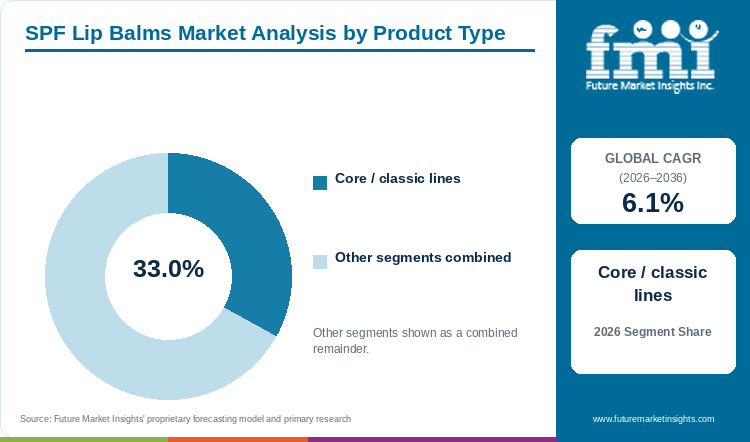
Based on product type, core / classic lines is projected to account for 33.0% in 2026, driven by low-friction everyday use.
Core / classic lip balms combine moisture and SPF in one familiar format, which reduces the number of decisions a buyer makes before a routine purchase. The format favors portability and an unobtrusive feel over a specialized treatment regimen, which supports frequent, low-consideration replacement. FDA consumer guidance continued to identify lips as a frequently forgotten area and specifically advised the use of SPF lip balm [1], reinforcing the routine role of simple protective lip products.
- Core / classic lines hold 33.0% of product type demand in 2026 because the segment combines everyday hydration with a simple SPF proposition and low switching friction.
- A familiar product can be applied often without turning sun protection into a complex regimen, which keeps the format central to routine replacement.
Why does Conventional lead the Nature category?
By nature, conventional is estimated to hold 54.0% in 2026, owing to established UV-filter systems and accessible formulation cost.
Conventional formulas benefit from established UV-filter systems and extensive know-how around emollients, waxes and flavor masking. In June 2026, the FDA added bemotrizinol to the list of permitted sunscreen active ingredients, the first new UV filter added to the U.S. monograph since the late 1990s [16]. Access to validated filter options can widen formulation choices for conventional lip-balm makers while keeping efficacy evidence central. The same need for stable protection also affects the SPF boosters market. Natural, organic, vegan and dermocosmetic positioning can narrow the ingredient toolkit or raise cost when high protection and elegant texture are both required. Conventional products therefore retain an advantage in price flexibility and broad retail availability.
- Conventional holds 54.0% of nature demand in 2026 because established UV filters and conventional excipient systems give formulators wide latitude on protection, texture and price.
- Alternative natures expand around specific consumer values, but they compete for a smaller share of a category still anchored in routine, affordable reapplication.
How does Cream & Balm anchor the Format category?
In 2026, cream & balm is expected to lead format with 36.0% share, supported by controlled dosing and repeatable film formation.
Cream and balm textures fit the dual job of lip care and sun protection, depositing emollients that reduce dryness while forming a coherent film for UV filters. The format lets users control the amount applied and reapply directly after eating or drinking. Liquids and serums offer lighter sensorials but need packaging that prevents leakage and supports controlled dosing. Cream and balm formats therefore remain a practical middle ground between occlusive care and formulation flexibility.
- Cream & balm holds 36.0% of format demand in 2026 because the format supports both moisturization and repeatable film formation on a surface exposed to frequent wear-off.
- Its familiarity also lowers the education burden for a buyer deciding between balm, stick, serum or spray at shelf.
What supports Mass in the Price Positioning category?
By price positioning, mass is forecast to represent 32.0% in 2026, enabled by replacement economics and multi-location ownership.
Mass pricing aligns with the replacement economics of an item that is small and regularly reapplied. Consumers often keep more than one lip product and a lower entry price reduces spending due to seasonal replenishment. Premium and professional products can earn higher margins through clinical cues and prestige branding, and elegant tints or specialized actives can add further value, but those propositions are less universal.
- Mass holds 32.0% of price positioning demand in 2026 because frequent reapplication and multi-location use reward accessible unit prices and broad availability.
- Mass leadership is therefore less about low quality than about minimizing the cost of routine compliance while preserving acceptable protection and feel.
What drives E-commerce & DTC in the Sales Channel category?
E-commerce & DTC is forecast to lead sales channel with 30.0% share in 2026, supported by low comparison friction and direct replenishment.
Digital channels make SPF lip products unusually easy to compare, letting a shopper weigh protection factor. That transparency helps newer brands explain hybrid concepts that may be hard to communicate on a crowded shelf. Pharmacies retain an advantage when consumers want health-oriented reassurance, and specialty beauty stores are useful for testing texture and tint, but e-commerce and DTC lead because they compress discovery and repeat purchase into one journey.
- E-commerce & DTC holds 30.0% of sales channel demand in 2026 because digital discovery lowers comparison friction and enables direct replenishment for a frequently replaced lip product.
- Direct channels also support bundles and limited shades, so creator-led launches can connect discovery with rapid replenishment.
What are the drivers, restraints and opportunities in the SPF lip balms market?
Routine lip photoprotection supports demand, while regulatory and sensory complexity slow conversion, and hybrid high-protection formats create the clearest opening for differentiated growth.
- Driver: Sun-safety guidance is extending daily SPF behavior to the lips and increasing the need for convenient repeat application.
- Restraint: UV-filter rules and testing expectations raise localization cost, while taste or texture trade-offs can reduce adherence.
- Opportunity: High-SPF lip care that feels cosmetic rather than medicinal can bridge sun care and treatment with tint-led digital beauty discovery.
Daily Sun-Safety Guidance Extends to the Lips
The strongest demand mechanism is the extension of sun-protection routines to a body area that users often forget. FDA guidance explicitly calls out the lips and recommends SPF lip balm. It also emphasizes regular reapplication [1]. That instruction matters because lip products wear away through normal daily activity. SPF lip balms also sit inside the wider lip care market where comfort and everyday use already shape repeat purchase. Brands that make SPF lip care easy to carry and pleasant to reapply are better placed to turn sun-safety awareness into recurring unit demand.
Jurisdiction-Specific Sunscreen Rules Raise Localization Cost
The main restraint starts when a lip-care formula carries a regulated sunscreen claim. Requirements differ across markets. The United States treats sunscreen as an OTC drug while Australia uses its own sunscreen standard and therapeutic framework. Brazil requires marketing authorization for sunscreens and several Asian markets use separate functional-cosmetic or testing rules. The same localization burden affects the suncare products market. Testing, documentation and labeling work can slow a global rollout. Taste and wax drag also matter because they are noticed immediately on the lips. A formula can meet protection requirements and still lose repeat purchase if daily use is unpleasant.
Beauty-Led Hybrids Open a Premium Lane
The clearest opportunity is to make high protection feel like modern lip beauty. Unilever's March 2026 investor presentation displayed a Vaseline Gluta-Hya Lip Serum Gloss SPF15 [13]. Shiseido also showed in January 2026 that its VOYAGER platform could combine SPF function with fragrance and color in a new suncare concept [10]. The same move toward color and daily care is visible in the pH based lip balm market. Lighter textures and beauty benefits can make reapplication easier. Suppliers still need to keep protection claims and lip comfort consistent.
Which country CAGRs are profiled in the SPF lip balms market?
| Country | CAGR |
|---|---|
| South Korea | 7.7% |
| Brazil | 7.4% |
| Australia | 7.1% |
| Thailand | 6.8% |
| Spain | 6.5% |
| USA | 6.1% |
| Japan | 5.8% |
Country-wise Analysis
- USA: U.S. consumers purchase SPF lip balms inside an OTC sunscreen framework, so the shelf proposition combines beauty convenience with drug-label discipline. Demand for SPF lip balms in the USA is forecast to expand at 6.1% CAGR from 2026 to 2036. By June 2026, FDA consumer guidance still identified lips as a frequently forgotten area and specifically instructed consumers to use SPF lip balm [1]. The same framework requires compliant active ingredients, effectiveness claims and labeling, and in June 2026 the FDA added bemotrizinol as a new permitted sunscreen active ingredient, widening the UV-filter toolkit available to formulators [16].
- Japan: Japanese buyers operate in a market where SPF and PA language is already familiar. Demand for SPF lip balms in Japan is forecast to expand at 5.8% CAGR from 2026 to 2036. Shiseido sells a Moisturizing Lip Creator SPF18 PA++ in Japan [9]. This shows that a dedicated SPF lip format can sit beside wider facial suncare products.
- South Korea: Demand for SPF lip balms in South Korea is forecast to expand at 7.7% CAGR from 2026 to 2036. In August 2026, the Ministry of Food and Drug Safety proposed changes to sunscreen functional-cosmetics review evidence that would allow in-vitro data while strengthening reliability controls [6]. Kao had already entered the Korean market with Bioré UV in March 2026 under a unified global campaign [8].
- Australia: Australian consumers face a sun-care environment where protection claims receive unusually close regulatory and testing attention. Demand for SPF lip balms in Australia is forecast to expand at 7.1% CAGR from 2026 to 2036. In December 2025, the Therapeutic Goods Administration clarified that secondary sunscreens for lips with SPF 4 or higher can be excluded from therapeutic-goods legislation, yet they still need to comply with the Australian sunscreen standard [2]. NIVEA's locally listed SPF50 lip balm illustrates how high SPF can be paired with everyday care positioning [11].
- Brazil: Brazilian buyers encounter SPF lip products within a cosmetics system that treats sunscreen claims as a higher-control category. Anvisa's cosmetics guidance was updated in April 2026 and states that sunscreens are subject to marketing authorization procedures under RDC 907/2024 [3]. Anvisa also continued enforcement against products made with formulas different from those authorized, so formula consistency matters after approval as much as registration timing.
- Spain: As per FMI, demand for SPF lip balms in Spain is forecast to expand at 6.5% CAGR from 2026 to 2036. AEMPS guidance specifically advises protecting lips with photoprotective pencils or sticks and selecting products that protect against both UVB and UVA radiation [4].
- Thailand: Thai shoppers operate in a beauty market where sunscreen efficacy claims must be supported under a notification system with company responsibility for product evidence. Demand for SPF lip balms in Thailand is forecast to expand at 6.8% CAGR from 2026 to 2036. On June 17, 2026, the Thai FDA said sunscreen oversight is based on science and international standards, pointing to recognized methods for SPF and UVAPF testing as well as water-resistance testing [5].
Who are the notable companies in the SPF lip balms market?
Procter & Gamble, Estee Lauder Companies, Kao Corporation, e.l.f. Beauty, Coty, Beiersdorf, Shiseido, L'Oreal, Unilever, and Amorepacific are the notable companies profiled in this market.
Beiersdorf, Shiseido, L'Oreal, Unilever and e.l.f. Beauty have direct SPF lip products in selected markets. This gives them practical experience with protection claims and lip texture. Kao Corporation brings sunscreen formulation experience and Asian market reach through Bioré. Procter & Gamble, Estee Lauder Companies and Coty contribute wider skin-care or prestige beauty portfolios. Amorepacific adds lip-care innovation and digital beauty distribution.
- Direct SPF lip and dermosuncare platforms: Beiersdorf, Shiseido, L'Oreal and Unilever have protection-led lip or sensitive-area products alongside established skin-care businesses.
- Suncare technology and prestige beauty platforms: Kao Corporation, Procter & Gamble, Estee Lauder Companies and Coty bring wider UV, skin-care or beauty capabilities.
- Lip care and digital beauty expansion platforms: e.l.f. Beauty and Amorepacific bring lip-category momentum and strong digital beauty reach. e.l.f. Beauty also sells an SPF lip gloss in the United States.
Competitive Benchmarking: SPF Lip Balms Market
| Company | Direct SPF Lip Offering | Suncare Formulation Evidence | Lip Care / Digital Reach | Geographic Reach |
|---|---|---|---|---|
| Procter & Gamble | Low | Low | Low | Global consumer group with broad skin-care and grooming reach |
| Estee Lauder Companies | Low | Low | Low | Global prestige beauty presence across skin care and cosmetics |
| Kao Corporation | Low | High | Low | Asia, Americas and Europe; Bioré present across 66 countries and regions |
| e.l.f. Beauty | High | Medium | High | United States and selected international e-commerce markets; SPF lip gloss listed in U.S. OTC records |
| Coty | Low | Low | Low | Global beauty group with fragrance and color-cosmetics reach |
| Beiersdorf | High | High | High | Global NIVEA platform with an SPF lip product sold in Australia |
| Shiseido | High | High | High | Global prestige platform with an SPF lip product sold in Japan |
| L'Oreal | High | High | High | Global dermocosmetics platform with an SPF lip product sold in Argentina |
| Unilever | High | Medium | High | Global Vaseline platform with an SPF lip hybrid shown in 2026 company materials |
| Amorepacific | Low | Low | High | Korea-rooted global beauty platform with strong Laneige lip-care commercialization |
Scoring basis: Direct SPF Lip Offering looks at named lip products with an explicit SPF or UV-protection claim. Suncare Formulation Evidence looks at sunscreen formulation or UV-protection capability. Lip Care / Digital Reach looks at lip-care commercialization and digital beauty access. High indicates broad capability while Medium indicates a narrower role. Low indicates limited direct participation in the assessed area.
Key Developments in the SPF Lip Balms Market
- In January 2026, Shiseido announced the first suncare product developed with its AI-powered VOYAGER formulation platform [10]. The fragrance- and color-infused mist combines SPF function with sensory attributes and was scheduled for a summer 2026 launch. The development sits outside lip balm revenue, but it shows how Shiseido is using formulation intelligence to reduce trade-offs between protection and beauty experience.
- In March 2026, Kao Corporation announced Bioré's entry into South Korea and a unified global campaign across more than 15 countries and regions [8]. The Korean rollout used Kao's lightweight sunscreen technology as the central proposition, expanding a platform that could support adjacent SPF lip participation through shared UV science and market access.
- In March 2026, Unilever presented a Vaseline Gluta-Hya Lip Serum Gloss SPF15 in its investor materials on a sharper beauty and personal care operating model [13]. The pack combined lip serum and gloss language with hyaluronic acid, tripeptide and SPF 15, signaling movement toward beauty-led SPF lip hybrids that raise the competitive bar for balm-only portfolios.
Key Players in the SPF Lip Balms Market
Direct SPF Lip and Dermosuncare Platforms
- Beiersdorf
- Shiseido
- L'Oreal
- Unilever
Suncare Technology and Prestige Beauty Platforms
- Kao Corporation
- Procter & Gamble
- Estee Lauder Companies
- Coty
Lip Care and Digital Beauty Expansion Platforms
- e.l.f. Beauty
- Amorepacific
SPF Lip Balms Market - Report Scope
| Coverage field | Report scope |
|---|---|
| Market breakdown | Product Type, Nature, Format, Price Positioning, and Sales Channel |
| Quantitative Units | USD Million |
| Market Definition | Includes revenue from finished lip-care products sold with an explicit SPF or UV-protection claim across the specified product type, nature, format, price, and channel categories. Excludes non-SPF lip care, face or body sunscreens not intended for lips, and adjacent beauty or sun-care products whose revenue is not attributable to an SPF lip product. |
| Regions Covered | North America; Latin America; Western Europe; Eastern Europe; East Asia; South Asia and Pacific; Middle East and Africa |
| Countries Covered | USA, Japan, South Korea, Australia, Brazil, Spain, Thailand, and more than twenty-three additional countries in the full report |
| Key Companies Profiled | Procter & Gamble; Estee Lauder Companies; Kao Corporation; e.l.f. Beauty; Coty; Beiersdorf; Shiseido; L'Oreal; Unilever; Amorepacific |
| Forecast Period | 2026 to 2036 |
| Approach | Hybrid bottom-up and top-down sizing that reconciles category sales, price bands, channel checks, public filings, regulatory records, and industry evidence without double counting adjacent products. |
SPF Lip Balms Market - Research Methodology
| Method | Approach |
|---|---|
| Primary Research | FMI gathers input from manufacturers, distributors, retailers, e-commerce operators, category managers, subject-matter experts and end users. Discussion covers pricing, channel mix, purchase triggers, repeat use, claims and formulation issues. |
| Desk Research | Desk research uses regulatory guidance, national authority publications, company filings, company newsrooms, product documentation, standards material and relevant trade or channel data. |
| Market Sizing and Forecasting | Base-year category value is triangulated with product availability, format and price architecture, channel structure, country growth assumptions, and observed regulatory conditions. Forecasting considers repeat-purchase behavior, product innovation, channel development, and barriers that can delay or narrow adoption. |
| Data Validation | Market figures are checked against product scope, country conditions, company roles and source consistency. Non-SPF lip care and unrelated face or body sunscreen revenue are excluded. |
SPF Lip Balms Market by Segments
SPF Lip Balms Market segmented by Product Type:
- Core / classic lines
- Targeted treatment lines
- Sensitive & gentle lines
- Premium & clinical lines
- Kits & sets
SPF Lip Balms Market segmented by Nature:
- Conventional
- Vegan & cruelty-free
- Natural & organic
- Dermocosmetic / clinical
- Fragrance-free & sensitive
SPF Lip Balms Market segmented by Format:
- Cream & balm
- Liquid & serum
- Stick & solid
- Spray & mist
- Sheet & patch
- Powder
SPF Lip Balms Market segmented by Price Positioning:
- Mass
- Masstige
- Premium
- Professional
SPF Lip Balms Market segmented by Sales Channel:
- E-commerce & DTC
- Specialty beauty retail
- Pharmacies & drugstores
- Supermarkets & hypermarkets
- Salons & spas
SPF Lip Balms Market by Region:
- North America
- United States
- Canada
- Latin America
- Brazil
- Mexico
- Argentina
- Chile
- Western Europe
- Germany
- France
- United Kingdom
- Italy
- Spain
- Benelux
- Nordics
- Eastern Europe
- Poland
- Czech Republic
- Romania
- Hungary
- East Asia
- China
- Japan
- South Korea
- South Asia and Pacific
- India
- ASEAN
- Australia and New Zealand
- Middle East and Africa
- GCC Countries
- South Africa
- Türkiye
- Israel
Research Sources and Bibliography
- [1] U.S. Food and Drug Administration. (n.d.; accessed September 2, 2026). Sunscreen: How to Help Protect Your Skin from the Sun. FDA sunscreen guidance
- [2] Therapeutic Goods Administration. (2025, December 19). Sunscreen regulation in Australia. TGA sunscreen regulation
- [3] Agência Nacional de Vigilância Sanitária. (2020, October 29; modified April 6, 2026). Personal Hygiene Products, Cosmetics and Fragrances. Anvisa cosmetics guidance
- [4] Agencia Española de Medicamentos y Productos Sanitarios. (2019, June 28). Decálogo de la AEMPS para tomar el sol de forma segura. AEMPS sun-safety guidance
- [5] Thai Food and Drug Administration. (2026, June 17). Thai FDA confirms sunscreen oversight follows scientific and international standards. https://www.fda.moph.go.th/news/news1862569
- [6] Ministry of Food and Drug Safety, Republic of Korea. (2026, August 19). Proposed amendment concerning functional-cosmetics sunscreen efficacy review evidence.
- [7] Kao Corporation. (2024, December 11). Bioré UV Aqua Rich Watery Hold Cream launch announcement and sunscreen-use survey. https://www.kao.com/global/en/newsroom/news/release/2024/20241211-001/
- [8] Kao Corporation. (2026, March 19). Kao's Bioré Accelerates Global Growth with Entry into the South Korean Market and the Launch of a Unified Global Campaign. https://www.kao.com/global/en/newsroom/news/release/2026/20260319-001/
- [9] Shiseido. (2021, March 21; product page accessed September 2, 2026). SHISEIDO MEN Moisturizing Lip Creator SPF18 PA++. https://brand.shiseido.co.jp/shiseido-men-moisturizing-lip-creator-4514254993736.html
- [10] Shiseido Company, Limited. (2026, January 20). Shiseido Develops Its First Unique Suncare Product Using the AI-Powered Formulation Development Platform VOYAGER. https://corp.shiseido.com/en/news/detail.html?n=00000000004127
- [11] NIVEA / Beiersdorf. (n.d.; accessed September 2, 2026). Ultra Care & Protection SPF50 Lip Balm. https://www.nivea.com.au/products/ultra-care-and-protection-spf50-lip-balm-400600007857120031.html
- [12] La Roche-Posay / L'Oreal. (n.d.; accessed September 2, 2026). Anthelios Lips Stick / Sensitive Areas Stick SPF50+. https://www.laroche-posay.com.ar/anthelios/anthelios-xl-stick-spf-50-plus
- [13] Unilever. (2026, March 31). A sharper, focused HPC pureplay - investor presentation. https://www.unilever.com/files/a-sharper-focused-hpc-pureplay-presentation.pdf
- [14] DailyMed / e.l.f. Cosmetics, Inc. (2025, November 7). e.l.f Sun Boss Gloss SPF 25 Sunscreen Peachy Kween [marketing start February 15, 2024]. https://dailymed.nlm.nih.gov/dailymed/fda/fdaDrugXsl.cfm?setid=4d9784b6-c54d-483d-a5ba-c557a05300ec
- [15] Amorepacific. (2025, April 21). Laneige launches Glaze Craze Tinted Lip Serum.
- [16] U.S. Food and Drug Administration. (2026, June 9). FDA adds bemotrizinol to the list of permitted sunscreen active ingredients.
This bibliography is provided for reader reference. The full report contains the complete reference list and detailed citations.
This Report Answers
- What is the SPF Lip Balms Market size in 2026 and what value is forecast for 2036?
- Which sun-protection behaviors and regulatory conditions support demand for SPF lip products?
- Why do Core / classic lines hold the leading position in Product Type?
- How does Conventional formulation positioning influence SPF lip product economics and availability?
- Why does Cream & balm hold the leading position in Format?
- How do growth rates differ across the USA, Japan, South Korea, Australia, Brazil, Spain, and Thailand?
- Which roles do Procter & Gamble, Estee Lauder Companies, Kao Corporation, e.l.f. Beauty, Coty, Beiersdorf, Shiseido, L'Oreal, Unilever, and Amorepacific play in the competitive landscape?
- How do sunscreen testing, claim rules, and sensory trade-offs limit adoption?
- What should beauty category managers, brand owners, and formulators evaluate before launching or buying SPF lip products?
Frequently Asked Questions
What is driving growth in the SPF Lip Balms Market?
Growth is supported by the extension of everyday sun-protection habits to the lips and by the need for frequent reapplication. Products that combine credible UV claims with familiar lip-care textures can turn awareness into habitual replenishment.
Who are the key players in the SPF Lip Balms Market?
The profiled companies are Procter & Gamble, Estee Lauder Companies, Kao Corporation, e.l.f. Beauty, Coty, Beiersdorf, Shiseido, L'Oreal, Unilever, and Amorepacific. Their roles range from direct SPF lip portfolios to broader sun-care, beauty, and lip-care platforms.
What notable restraint affects the SPF Lip Balms Market?
The main restraint is the combination of jurisdiction-specific sunscreen requirements and lip-specific sensory constraints, which can delay testing and labeling. Active-ingredient rules plus taste or texture problems can reduce repeat use even when consumer interest is present.
Why should executives track the SPF Lip Balms Market?
The market sits at the intersection of sun care and lip care, which creates opportunities across established beauty and pharmacy channels. Executives should track whether SPF becomes a routine lip benefit rather than a seasonal specialty claim.
What business problem does the SPF Lip Balms Market address?
SPF lip balms give consumers a portable way to protect a frequently forgotten area while also managing dryness and everyday comfort. The product solves a repeat-application problem that ordinary face sunscreen is not designed to handle neatly on the lips.
What should beauty category managers evaluate in the SPF Lip Balms Market?
Category managers should compare protection claims with local regulatory status and texture while weighing taste, reapplication instructions and price against channel fit. They should separate SPF lip products from ordinary lip care and facial sun care.
What limits return on investment in the SPF Lip Balms Market?
Return can be weakened by repeated localization work and small-batch complexity, especially when poor sensorials suppress repeat use. A high protection factor cannot compensate for poor taste or drag, while residue and channel education costs can hinder reapplication and repurchase.
What supports long-term commercial confidence in the SPF Lip Balms Market?
Long-term confidence comes from durable sun-safety behavior and the ability to integrate protection into everyday beauty routines. The forecast reaches USD 1,246.5 million by 2036 at 6.1% CAGR from 2026 to 2036, while innovation broadens format and channel options.
Preview the report firsthand - request a free sample
Get SampleGet the brochure for pricing and purchase details.
Get PDFTable of Content
- Key Takeaways
- Market Size and CAGR
- Top Growth Driver
- Fastest Growing Segment
- Leading Region
- Key Companies
- Emerging Opportunities
- Executive Summary
- Global Market Outlook
- Demand-side Trends
- Supply-side Trends
- Technology Roadmap Analysis
- Analysis and Recommendations
- Analyst Perspective (What is happening? Why now? What should investors know?)
- Key Questions Answered
- How large is the market?
- What is the CAGR?
- What are key trends?
- Which region dominates?
- Who are the leaders?
- Market Overview
- Market Coverage / Taxonomy
- Market Definition / Scope / Limitations
- Research Methodology
- Chapter Orientation
- Analytical Lens and Working Hypotheses
- Market Structure, Signals, and Trend Drivers
- Benchmarking and Cross-market Comparability
- Market Sizing, Forecasting, and Opportunity Mapping
- Research Design and Evidence Framework
- Desk Research Programme (Secondary Evidence)
- Expert Input and Fieldwork (Primary Evidence)
- Tooling, Models, and Reference Databases
- Data Engineering and Model Build
- Quality Assurance and Audit Trail
- Market Background
- Market Dynamics (Drivers, Restraints, Opportunity, Trends)
- Scenario Forecast (Optimistic, Likely, Conservative)
- Impact Analysis
- AI Impact
- Sustainability Impact
- Regulatory Impact
- Technology Impact
- Consumer / Buyer Analysis
- Purchase Drivers
- Adoption Barriers
- Buyer Journey
- Opportunity Map Analysis
- Product Life Cycle Analysis
- Supply Chain Analysis
- Investment Feasibility Matrix
- Value Chain Analysis
- PESTLE and Porter's Analysis
- Regulatory Landscape
- Regional Parent Market Outlook
- Production and Consumption Statistics
- Import and Export Statistics
- Global Market Analysis and Forecast, 2021 to 2036
- Historical Market Size Value (USD Million) Analysis, 2021 to 2025
- Current and Future Market Size Value (USD Million) Projections, 2026 to 2036
- Y-o-Y Growth Trend Analysis
- Absolute $ Opportunity Analysis
- Global Market Pricing Analysis, 2021 to 2036
- Global Market Analysis and Forecast, By Product Type, 2021 to 2036
- Introduction / Key Findings
- Historical Market Size Value (USD Million) Analysis By Product Type, 2021 to 2025
- Current and Future Market Size Value (USD Million) Analysis and Forecast By Product Type, 2026 to 2036
- Core / classic lines
- Targeted treatment lines
- Sensitive & gentle lines
- Premium & clinical lines
- Kits & sets
- Y-o-Y Growth Trend Analysis By Product Type, 2021 to 2025
- Absolute $ Opportunity Analysis By Product Type, 2026 to 2036
- Global Market Analysis and Forecast, By Nature, 2021 to 2036
- Introduction / Key Findings
- Historical Market Size Value (USD Million) Analysis By Nature, 2021 to 2025
- Current and Future Market Size Value (USD Million) Analysis and Forecast By Nature, 2026 to 2036
- Conventional
- Vegan & cruelty-free
- Natural & organic
- Dermocosmetic / clinical
- Fragrance-free & sensitive
- Y-o-Y Growth Trend Analysis By Nature, 2021 to 2025
- Absolute $ Opportunity Analysis By Nature, 2026 to 2036
- Global Market Analysis and Forecast, By Format, 2021 to 2036
- Introduction / Key Findings
- Historical Market Size Value (USD Million) Analysis By Format, 2021 to 2025
- Current and Future Market Size Value (USD Million) Analysis and Forecast By Format, 2026 to 2036
- Cream & balm
- Liquid & serum
- Stick & solid
- Spray & mist
- Sheet & patch
- Powder
- Y-o-Y Growth Trend Analysis By Format, 2021 to 2025
- Absolute $ Opportunity Analysis By Format, 2026 to 2036
- Global Market Analysis and Forecast, By Price Positioning, 2021 to 2036
- Introduction / Key Findings
- Historical Market Size Value (USD Million) Analysis By Price Positioning, 2021 to 2025
- Current and Future Market Size Value (USD Million) Analysis and Forecast By Price Positioning, 2026 to 2036
- Mass
- Masstige
- Premium
- Professional
- Y-o-Y Growth Trend Analysis By Price Positioning, 2021 to 2025
- Absolute $ Opportunity Analysis By Price Positioning, 2026 to 2036
- Global Market Analysis and Forecast, By Sales Channel, 2021 to 2036
- Introduction / Key Findings
- Historical Market Size Value (USD Million) Analysis By Sales Channel, 2021 to 2025
- Current and Future Market Size Value (USD Million) Analysis and Forecast By Sales Channel, 2026 to 2036
- E-commerce & DTC
- Specialty beauty retail
- Pharmacies & drugstores
- Supermarkets & hypermarkets
- Salons & spas
- Y-o-Y Growth Trend Analysis By Sales Channel, 2021 to 2025
- Absolute $ Opportunity Analysis By Sales Channel, 2026 to 2036
- Global Market Analysis and Forecast, By Region, 2021 to 2036
- Introduction
- Historical Market Size Value (USD Million) Analysis By Region, 2021 to 2025
- Current Market Size Value (USD Million) Analysis and Forecast By Region, 2026 to 2036
- North America
- Latin America
- Western Europe
- Eastern Europe
- East Asia
- South Asia and Pacific
- Middle East and Africa
- Market Attractiveness Analysis By Region
- North America Market Analysis and Forecast, By Country, 2021 to 2036
- Historical Market Size Value (USD Million) Trend Analysis By Market Taxonomy, 2021 to 2025
- Market Size Value (USD Million) Forecast By Market Taxonomy, 2026 to 2036
- By Country
- United States
- Canada
- By Product Type
- By Nature
- By Format
- By Price Positioning
- By Sales Channel
- By Country
- Market Attractiveness Analysis
- By Country
- By Product Type
- By Nature
- By Format
- By Price Positioning
- By Sales Channel
- Key Takeaways
- Latin America Market Analysis and Forecast, By Country
- Historical Market Size Value (USD Million) Trend Analysis By Market Taxonomy, 2021 to 2025
- Market Size Value (USD Million) Forecast By Market Taxonomy, 2026 to 2036
- By Country
- Brazil
- Mexico
- Argentina
- Chile
- By Product Type
- By Nature
- By Format
- By Price Positioning
- By Sales Channel
- By Country
- Market Attractiveness Analysis
- By Country
- By Product Type
- By Nature
- By Format
- By Price Positioning
- By Sales Channel
- Key Takeaways
- Western Europe Market Analysis and Forecast, By Country
- Historical Market Size Value (USD Million) Trend Analysis By Market Taxonomy, 2021 to 2025
- Market Size Value (USD Million) Forecast By Market Taxonomy, 2026 to 2036
- By Country
- Germany
- France
- United Kingdom
- Italy
- Spain
- Benelux
- Nordics
- By Product Type
- By Nature
- By Format
- By Price Positioning
- By Sales Channel
- By Country
- Market Attractiveness Analysis
- By Country
- By Product Type
- By Nature
- By Format
- By Price Positioning
- By Sales Channel
- Key Takeaways
- Eastern Europe Market Analysis and Forecast, By Country
- Historical Market Size Value (USD Million) Trend Analysis By Market Taxonomy, 2021 to 2025
- Market Size Value (USD Million) Forecast By Market Taxonomy, 2026 to 2036
- By Country
- Poland
- Czech Republic
- Romania
- Hungary
- By Product Type
- By Nature
- By Format
- By Price Positioning
- By Sales Channel
- By Country
- Market Attractiveness Analysis
- By Country
- By Product Type
- By Nature
- By Format
- By Price Positioning
- By Sales Channel
- Key Takeaways
- East Asia Market Analysis and Forecast, By Country
- Historical Market Size Value (USD Million) Trend Analysis By Market Taxonomy, 2021 to 2025
- Market Size Value (USD Million) Forecast By Market Taxonomy, 2026 to 2036
- By Country
- China
- Japan
- South Korea
- By Product Type
- By Nature
- By Format
- By Price Positioning
- By Sales Channel
- By Country
- Market Attractiveness Analysis
- By Country
- By Product Type
- By Nature
- By Format
- By Price Positioning
- By Sales Channel
- Key Takeaways
- South Asia and Pacific Market Analysis and Forecast, By Country
- Historical Market Size Value (USD Million) Trend Analysis By Market Taxonomy, 2021 to 2025
- Market Size Value (USD Million) Forecast By Market Taxonomy, 2026 to 2036
- By Country
- India
- ASEAN
- Australia and New Zealand
- By Product Type
- By Nature
- By Format
- By Price Positioning
- By Sales Channel
- By Country
- Market Attractiveness Analysis
- By Country
- By Product Type
- By Nature
- By Format
- By Price Positioning
- By Sales Channel
- Key Takeaways
- Middle East and Africa Market Analysis and Forecast, By Country
- Historical Market Size Value (USD Million) Trend Analysis By Market Taxonomy, 2021 to 2025
- Market Size Value (USD Million) Forecast By Market Taxonomy, 2026 to 2036
- By Country
- GCC Countries
- South Africa
- Türkiye
- Israel
- By Product Type
- By Nature
- By Format
- By Price Positioning
- By Sales Channel
- By Country
- Market Attractiveness Analysis
- By Country
- By Product Type
- By Nature
- By Format
- By Price Positioning
- By Sales Channel
- Key Takeaways
- Key Countries Market Analysis
- United States
- Pricing Analysis
- Market Share Analysis, 2025
- By Product Type
- By Nature
- By Format
- By Price Positioning
- By Sales Channel
- Canada
- Pricing Analysis
- Market Share Analysis, 2025
- By Product Type
- By Nature
- By Format
- By Price Positioning
- By Sales Channel
- Mexico
- Pricing Analysis
- Market Share Analysis, 2025
- By Product Type
- By Nature
- By Format
- By Price Positioning
- By Sales Channel
- Brazil
- Pricing Analysis
- Market Share Analysis, 2025
- By Product Type
- By Nature
- By Format
- By Price Positioning
- By Sales Channel
- Chile
- Pricing Analysis
- Market Share Analysis, 2025
- By Product Type
- By Nature
- By Format
- By Price Positioning
- By Sales Channel
- Germany
- Pricing Analysis
- Market Share Analysis, 2025
- By Product Type
- By Nature
- By Format
- By Price Positioning
- By Sales Channel
- United Kingdom
- Pricing Analysis
- Market Share Analysis, 2025
- By Product Type
- By Nature
- By Format
- By Price Positioning
- By Sales Channel
- Italy
- Pricing Analysis
- Market Share Analysis, 2025
- By Product Type
- By Nature
- By Format
- By Price Positioning
- By Sales Channel
- Spain
- Pricing Analysis
- Market Share Analysis, 2025
- By Product Type
- By Nature
- By Format
- By Price Positioning
- By Sales Channel
- France
- Pricing Analysis
- Market Share Analysis, 2025
- By Product Type
- By Nature
- By Format
- By Price Positioning
- By Sales Channel
- India
- Pricing Analysis
- Market Share Analysis, 2025
- By Product Type
- By Nature
- By Format
- By Price Positioning
- By Sales Channel
- ASEAN
- Pricing Analysis
- Market Share Analysis, 2025
- By Product Type
- By Nature
- By Format
- By Price Positioning
- By Sales Channel
- Australia and New Zealand
- Pricing Analysis
- Market Share Analysis, 2025
- By Product Type
- By Nature
- By Format
- By Price Positioning
- By Sales Channel
- China
- Pricing Analysis
- Market Share Analysis, 2025
- By Product Type
- By Nature
- By Format
- By Price Positioning
- By Sales Channel
- Japan
- Pricing Analysis
- Market Share Analysis, 2025
- By Product Type
- By Nature
- By Format
- By Price Positioning
- By Sales Channel
- South Korea
- Pricing Analysis
- Market Share Analysis, 2025
- By Product Type
- By Nature
- By Format
- By Price Positioning
- By Sales Channel
- Poland
- Pricing Analysis
- Market Share Analysis, 2025
- By Product Type
- By Nature
- By Format
- By Price Positioning
- By Sales Channel
- Hungary
- Pricing Analysis
- Market Share Analysis, 2025
- By Product Type
- By Nature
- By Format
- By Price Positioning
- By Sales Channel
- Türkiye
- Pricing Analysis
- Market Share Analysis, 2025
- By Product Type
- By Nature
- By Format
- By Price Positioning
- By Sales Channel
- South Africa
- Pricing Analysis
- Market Share Analysis, 2025
- By Product Type
- By Nature
- By Format
- By Price Positioning
- By Sales Channel
- Australia
- Pricing Analysis
- Market Share Analysis, 2025
- By Product Type
- By Nature
- By Format
- By Price Positioning
- By Sales Channel
- Thailand
- Pricing Analysis
- Market Share Analysis, 2025
- By Product Type
- By Nature
- By Format
- By Price Positioning
- By Sales Channel
- United States
- Market Structure Analysis
- Competition Dashboard
- Competition Benchmarking
- Market Share Analysis of Top Players
- By Regional
- By Product Type
- By Nature
- By Format
- By Price Positioning
- By Sales Channel
- Emerging Startups
- Innovation Benchmarking
- Competition Analysis
- Competition Deep Dive
- Procter & Gamble
- Overview
- Product Portfolio
- Profitability by Market Segments
- Sales Footprint
- Strategy Overview
- Marketing Strategy
- Product Strategy
- Channel Strategy
- Estee Lauder Companies
- Kao Corporation
- e.l.f. Beauty
- Coty
- Beiersdorf
- Shiseido
- L'Oreal
- Unilever
- Amorepacific
- Procter & Gamble
- Case Studies
- Success Stories
- Recent Developments
- Competition Deep Dive
- Assumptions & Acronyms Used


