

- Market Size (2026)
- USD 719.9 Mn
- Forecast (2036)
- USD 1364.1 Mn
- CAGR (2026 to 2036)
- 6.6%
How big is Lip Liners Market in 2026?
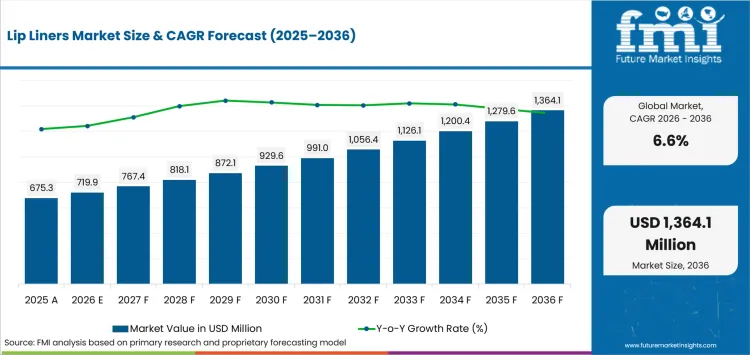
USD 719.9 million in 2026 and USD 1,364.1 million by 2036 at a 6.6% CAGR.
Demand for lip liners is projected to expand at 6.6% CAGR between 2026 and 2036, increasing valuation from USD 719.9 million in 2026 to USD 1,364.1 million by 2036. Lipstick and gloss launches keep liner visible within the wider colour cosmetics market, but repeat purchase depends on the liner’s own precision and wear. The Estée Lauder Companies reported in October 2025 that M·A·C introduced Lipglazer Glossy Liner in July 2025 as a shiny, volumizing liner. That launch widens the finish choices available to consumers without changing the core need for controlled outlining and repeatable application.
Digital discovery shortens the distance between shade comparison and checkout, which makes online presentation important for a low-ticket color product. The USA Census Bureau reported in August 2026 that e-commerce represented 17.1% of USA retail sales in the second quarter. That channel depth gives the beauty and personal care market more room for swatches, pairing guidance, and long-tail shades than a constrained physical shelf. Country performance still depends on local retail access, safety files, and shade relevance.
Key Takeaways
- Demand for lip liners is supported by defined lip-combo routines that use liner for contouring, edge correction, and a base under lipstick or gloss.
- Based on product type, core - classic lines are projected to account for 34.0% in 2026 due to familiar application and easy pairing with other lip color.
- In 2026, conventional is expected to lead nature with 52.0% share because formulators retain broad options for pigment, glide, and wear performance.
- By format, cream & balm is forecast to represent 30.0% in 2026 driven by controlled placement that still permits soft blending and full-lip fill.
- Shade proliferation and jurisdiction-specific cosmetic rules raise launch costs because each additional SKU needs inventory discipline and market-ready documentation.
- Some of the key players in this market include The Estée Lauder Companies, Puig, e.l.f. Beauty, Coty, Morphe, Cheekbone Beauty, Mirabella Beauty, and Milk Makeup.
Analyst Perspective
"Lip liners earn repeat purchase when a shade family stays easy to navigate and the formula gives clean control without dragging at the lip edge. The stronger portfolios treat liner as its own product job, then use lipstick and gloss pairing to raise basket value without overloading the shade count."
- Rahul Pandita, Principal Consultant, Future Market Insights
How is the lip liners market segmented?
The market is segmented by product type, nature, format, price positioning, sales channel and region.
Product type separates classic, treatment, sensitive, premium, and kit-based offers. Nature distinguishes conventional, vegan, natural, clinical, and sensitivity-led positioning. Format captures the application system, while price positioning separates mass, masstige, premium, and professional offers. Sales channel tracks digital, specialty, pharmacy, mass-retail, and salon routes.
Why do core - classic lines lead demand within the product type category?
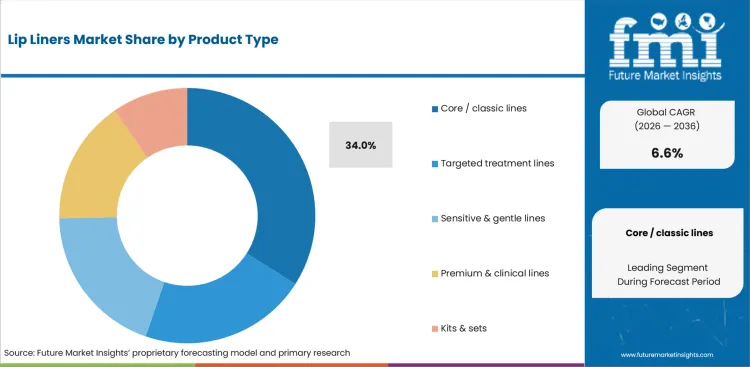
Core - classic lines let users outline the lip, correct shape, or build a base for another color product. The adjacent cosmetic pencil and pen market uses the same precision format. Cheekbone Beauty added Earthy to its Horizon Lip Pencil range in March 2025, refreshing the shade offer without changing application.
- Core - classic lines are set to lead the product type category with 34.0% share in 2026 due to familiar use in defined and layered lip looks.
- Retailers can replenish proven shades selectively, while brands add trend colors without rebuilding the application story.
Why does conventional lead demand within the nature category?
Conventional formulas give developers broad choices for pigment, wax, oil, and film former while balancing glide with edge control. The cosmetic chemicals market supplies that formulation base. FDA counted 1,298,361 unique active cosmetic product listings as of June 30, 2026, showing the documentation scale that every marketed SKU enters.
- By nature, conventional is estimated to hold 52.0% in 2026 owing to broad formulation choice for pigment strength, slip, film formation, and wear.
- Brands can use differentiated personal care ingredients while retaining conventional positioning, provided every SKU preserves its safety records and product identity.
Why does cream & balm lead demand within the format category?
Cream & balm textures lower drag while preserving the point control needed at the lip perimeter. Morphe’s August 2025 editorial paired its new Soulmatte Velvet Lip Mousse with Soulmatte Filling Gel Lip Liner as the contouring step. The pairing moves from defined outline to a softer finish without changing the liner’s precision job.
- The cream & balm segment is likely to capture 30.0% share in 2026 attributable to smooth placement for outlining, soft contouring, and fuller coverage.
- Cosmetic pigments can tune opacity, while lip care formulation cues improve comfort if the liner still holds a stable edge.
Why does e-commerce & DTC lead demand within the sales channel category?
Digital shelves can display more undertones and pair each liner with lipstick or gloss without matching that inventory in every store. The Office for National Statistics found that 28.3% of Great Britain retail spending occurred online in December 2025. That share makes swatch quality and clear shade naming material to conversion.
- E-commerce & DTC is projected to hold 24.0% share in 2026 owing to broad shade presentation, bundle merchandising, and direct access to niche colors.
- Online stores can separate vegan cosmetics and organic cosmetics by claim, giving smaller liner ranges visibility without securing physical shelf space.
What are the drivers, restraints and opportunities in the Lip Liners Market?
Defined lip-combo routines support demand, while formula and labeling obligations raise launch work, leaving room for differentiated liners that pair precision with comfort or retail access.
- Driver: Lip-combo routines give liner a visible role in contouring, edge correction, and preparation for another color product.
- Restraint: Formula changes and labeling obligations can force separate documentation or packaging work before one global shade range reaches every market.
- Opportunity: Retail expansion gives differentiated liner formats more chances to convert digital discovery into repeat purchase through physical trial and replenishment.
Liner-led Lip Routines Increase Attachment Sales
A liner gains commercial value when it changes the finished lip look instead of functioning as an optional accessory. Cheekbone Beauty launched its Powwow Kit in June 2025 with Horizon Lip Pencil in True Red alongside lip oil and other color products. The kit makes liner part of a coordinated purchase, which gives brands a practical route to raise attachment sales while preserving a clear contouring job.
Formula and Labeling Changes Raise SKU Work
A broad shade range becomes expensive when one formulation or label cannot move unchanged into every target market. The European Commission’s July 2025 guidance states that make-up and lip cosmetics covered by the microplastics restriction have a transition until October 2035, with a required microplastics label from October 2031. The long transition reduces immediate disruption, but portfolio teams still need reformulation and packaging plans before the relevant deadlines.
Physical Retail Expansion Improves Trial for Texture-led Offers
Texture and undertone are harder to judge from a screen than a simple shade name, so physical trial can improve conversion for unfamiliar liner formats. Waldencast announced in January 2025 that Milk Makeup would enter more than 600 Ulta Beauty stores during spring 2025. Broader retail access gives lip products more testing occasions, although each new door still has to justify its inventory depth and shade productivity.
Which country CAGRs are profiled in the Lip Liners Market?
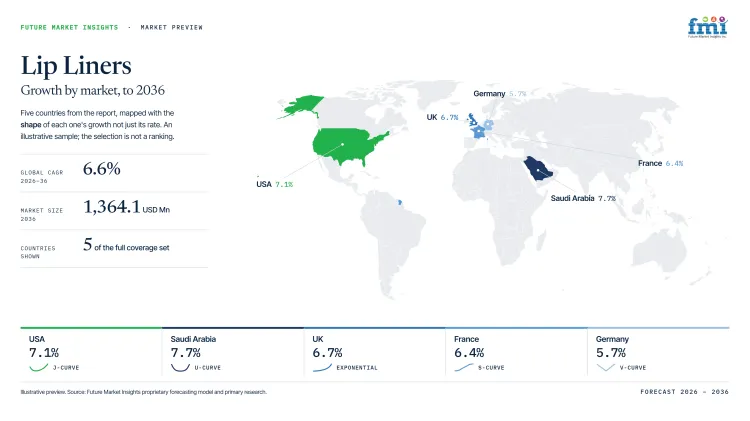
| Country | CAGR |
|---|---|
| United Arab Emirates | 8.0% |
| Saudi Arabia | 7.7% |
| South Korea | 7.4% |
| United States | 7.1% |
| United Kingdom | 6.7% |
| France | 6.4% |
| Japan | 6.1% |
| Germany | 5.7% |
How do country-level CAGRs compare in the Lip Liners Market?
The upper growth group clusters in the Gulf and South Korea, while the United States and Western European markets occupy the middle and lower range. A 2.3 percentage-point spread separates the United Arab Emirates from Germany, pointing to faster channel build-out in expansion markets and steadier replacement purchasing in mature retail systems.
- UAE prestige malls widen brand discovery.
- Saudi Arabia's digital retail shortens the purchase path.
- South Korea's rapid launches shorten product cycles.
- USA channel breadth supports replenishment.
- UK online retail deepens shade presentation.
- France's selective retail raises differentiation pressure.
- Japan's mixed channels preserve texture testing.
- Germany's drugstores reward productive mass assortments.
Similar CAGRs can hide different retail economics. The full report provides country-level CAGR analysis across North America, Latin America, Europe, East Asia, South Asia, Oceania and the Middle East and Africa.
Country-wise Analysis
- Dubai gives beauty brands dense prestige retail, tourism traffic, and rapid access to imported cosmetics, but shelf entry still depends on product registration and local distribution discipline. Lip-liner demand in the United Arab Emirates is forecast to rise at 8.0% CAGR over the forecast period, propelled by frequent beauty launches and high mall-based product discovery; Dubai Municipality stated in October 2025 that it monitors more than 500,000 imported consumer products. The scale supports fast assortment refreshes, yet import oversight and intense prestige competition mean new ranges need clear shade roles and reliable stock rather than a long list of overlapping colors.
- Saudi beauty discovery increasingly begins on digital platforms, while large malls and specialist chains convert that interest into physical trial for color cosmetics. GASTAT’s Q3 2025 bulletin recorded a 33.9% year-over-year increase in the retail e-commerce sales index, giving brands a stronger digital path for swatches and lip-combo education; Saudi Arabia is set to post 7.7% CAGR through 2036, aided by that channel expansion. Local growth does not remove assortment risk because shade depth ties up inventory, so operators with disciplined online-to-store replenishment and national delivery coverage should capture more repeat purchases than ranges built mainly for launch visibility in major cities.
- Korean color cosmetics compete on fast shade turnover, detailed finish comparisons, and a retail culture that moves new colors quickly between domestic platforms and physical beauty stores. South Korea is positioned to record 7.4% CAGR during the assessment period, tied to sustained product experimentation and export-led brand activity. The Ministry of Food and Drug Safety documented in May 2026 that 2025 cosmetics exports increased 11.8% from the prior year; that production and launch tempo supports liner innovation, but domestic brands still face short trend cycles that can leave slow shades behind during fast promotional cycles locally.
- The USA market gives lip liners broad access to mass retailers, prestige chains, marketplaces, and brand-owned sites, which lowers dependence on one route to market and widens replenishment options. The FDA counted 16,398 unique active cosmetic facility registrations as of June 30, 2026, showing the scale of the manufacturing and processing base that supports frequent assortment activity. By 2036, the United States is projected to grow at 7.1% CAGR, helped by channel depth and active lip launches; the main constraint is shelf productivity, so brands need shade families that earn replenishment instead of merely expanding choice across core shades.
- British beauty retail pairs strong online purchasing with national chains that give consumers several ways to compare shade, texture, and price before committing to a liner. The Office for Product Safety and Standards said in July 2026 that 861,686 cosmetic product notifications had been submitted to the SCPN by May 28, making notification work a visible operating requirement for brands entering Great Britain. The United Kingdom lip liners sector may progress at 6.7% CAGR through 2036, reflecting mature channel access despite compliance work; operators that keep notification records aligned with live SKUs can avoid launch delays while maintaining faster shade rotation.
- French color cosmetics sell through selective beauty chains, pharmacies, department stores, and digital platforms, while imported brands compete against a strong domestic beauty industry and tightly edited premium assortments. France is likely to register 6.4% CAGR over the assessment period, attributable to continued premium discovery and broad channel choice. FEBEA reported in February 2026 that French cosmetics imports increased 6% during 2025; higher import activity expands the competitive set available to retailers, while another nude liner must still earn shelf space through a distinct undertone, finish, or price position especially for retailers serving both local and tourist traffic in Paris.
- Japanese consumers compare color cosmetics online, but department stores and specialist beauty retail still give texture and undertone testing an important role in purchase decisions and premium brand discovery. METI’s August 2025 e-commerce survey placed the 2024 e-commerce ratio for cosmetics and pharmaceuticals at 8.82%, indicating that digital buying is established without replacing store-based evaluation. Adoption of lip liners in Japan is expected to maintain 6.1% CAGR through 2036, given that mixed channel structure; brands can use detailed digital shade guidance, yet poorly translated undertones or oversized assortments will struggle to earn steady replenishment in core urban and specialty stores.
- German beauty purchasing is concentrated in drugstores, giving mass-priced liners frequent visibility but putting strong pressure on each shade to justify its place in a disciplined shelf set. In 2025, IKW found that drugstores accounted for 53% of beauty-care purchases, a channel structure that favors accessible price points and repeat replenishment for familiar color products. Germany could advance at 5.7% CAGR over the forecast period, supported by that retail density; growth is slower than the Gulf markets because distribution is already mature, so incremental gains depend more on productive shades and clear format differences than new-channel build-out in major chains.
Who are the notable companies in the Lip Liners Market?
The Estée Lauder Companies, Puig, e.l.f. Beauty, Coty, Morphe, Cheekbone Beauty, Mirabella Beauty, and Milk Makeup are the notable companies profiled in this market.
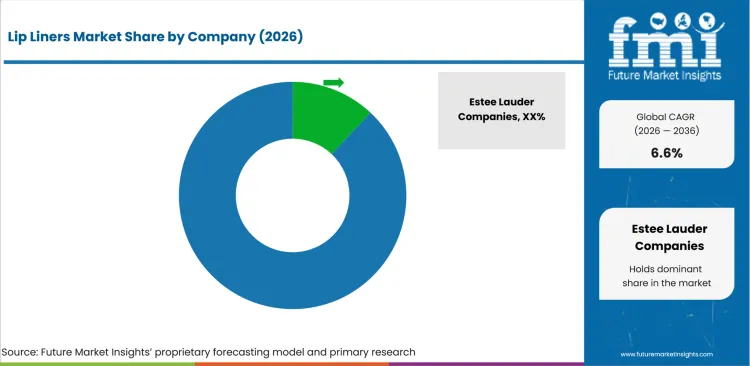
Competition spans global beauty groups, prestige makeup platforms, digital-first brands, and smaller specialists with direct lip-pencil ranges. The main entry barrier is not corporate scale by itself; a credible range needs a usable shade ladder, repeatable wear, current safety records, and retail access that keeps core shades in stock.
- The Estée Lauder Companies, Puig, and Coty use prestige portfolios and multi-country distribution to place liners beside established makeup franchises.
- e.l.f. Beauty, Morphe, and Milk Makeup use high-visibility retail and digital discovery with distinct price and texture positions.
- Cheekbone Beauty and Mirabella Beauty use narrower ranges where shade identity, formula feel, and focused retail partnerships carry more weight.
Competitive Benchmarking: Lip Liners Market
| Company | Direct Liner Breadth | Format & Wear Differentiation | Documented Channel Access | Geographic Reach |
|---|---|---|---|---|
| The Estée Lauder Companies | High | High | High | Global |
| Puig | High | High | High | Global |
| e.l.f. Beauty | High | Medium | High | North America, Europe and GCC |
| Coty | Medium | Medium | High | Global |
| Morphe | Medium | High | Medium | North America, Europe and selected international markets |
| Cheekbone Beauty | Medium | Medium | Medium | Canada and United States |
| Mirabella Beauty | Low | Medium | Low | North America |
| Milk Makeup | Low | Medium | High | North America, Europe and selected international markets |
Scoring basis: High direct-liner breadth requires at least two documented liner propositions; Medium identifies one established line, and Low identifies one narrow offer. High format and wear differentiation requires several documented application or finish systems; Medium requires one differentiated system, and Low covers basic definition. High channel access requires major retail plus direct or multi-country distribution; Medium covers national or regional retail, and Low reflects narrower verified access.
Key Developments in the Lip Liners Market
- In January 2025, Milk Makeup announced an expansion into more than 600 Ulta Beauty stores, giving its color portfolio a wider USA testing and replenishment network.
- In May 2025, e.l.f. Beauty expanded e.l.f. Cosmetics into Kruidvat and Trekpleister, covering 959 stores in the Netherlands and 271 Kruidvat stores in Belgium.
- In May 2026, Coty launched Marc Jacobs Beauty with lip products and a staged Sephora rollout in the United States, Canada, United Kingdom, and Australia.
Key Players in the Lip Liners Market
Global Beauty and Prestige Platforms
- The Estée Lauder Companies
- Puig
- Coty
Digital and Specialty Makeup Platforms
- e.l.f. Beauty
- Morphe
- Milk Makeup
Focused Color Cosmetics Specialists
- Cheekbone Beauty
- Mirabella Beauty
Lip Liners Market - Report Scope
| Coverage field | Report scope |
|---|---|
| Market breakdown | By product type, nature, format, price positioning, sales channel and region. |
| Quantitative Units | USD million. |
| Market Definition | Products whose primary sold function is to outline, define, contour, prime, or fill lips. Liner-led kits and sets are included; adjacent lip color or lip-care products are excluded when their primary function is not lining or contouring. |
| Regions Covered | North America, Latin America, Western Europe, Eastern Europe, East Asia, South Asia and Pacific, and Middle East and Africa. |
| Countries Covered | United Arab Emirates, Saudi Arabia, South Korea, United States, United Kingdom, France, Japan, Germany, and 20+ countries included in the full report. |
| Key Companies Profiled | The Estée Lauder Companies, Puig, e.l.f. Beauty, Coty, Morphe, Cheekbone Beauty, Mirabella Beauty, and Milk Makeup. |
| Forecast Period | 2026 to 2036. |
| Approach | Primary and secondary research with market triangulation. |
Lip Liners Market - Research Methodology
| Method | Approach |
|---|---|
| Primary Research | FMI analysts gathered input from manufacturers, service providers, technology developers, distributors, end users, procurement teams, and subject-matter experts. Interviews examined purchasing decisions, product or service evaluation, adoption barriers, approval requirements, pricing considerations, and expectations for technical or commercial support. Respondents were also asked what evidence is required before a trial, pilot, or initial order develops into regular purchasing. |
| Desk Research | Desk research covered government statistics, regulatory publications, trade data, industry associations, technical literature, standards, company filings, product information, and official corporate announcements. Sources were reviewed for relevance, publication date, geographic coverage, and consistency with the defined market scope. Claims relating to performance, applications, approvals, capacity, investment, and commercial activity were retained only when supported by credible public evidence. |
| Market Sizing and Forecasting | The market model combined the baseline value with historical performance, segment structure, pricing and volume indicators, adoption levels, company participation, and country-level demand conditions. Forecast assumptions considered economic activity, investment trends, regulatory developments, technology adoption, purchasing cycles, supply availability, and barriers to wider market use. Segment and regional estimates were reconciled before the final market total was calculated. |
| Data Validation | Estimates were checked against multiple independent indicators, including public data, company activity, trade patterns, industry developments, and findings from primary interviews. Validation also tested whether products, services, applications, and company revenues fell within the defined market boundaries. Adjacent categories, unsupported claims, overlapping revenues, and activities without direct market relevance were excluded to reduce double counting and maintain consistency across segments and countries. |
Lip Liners Market by Segments
Lip Liners Market segmented by Product Type:
- Core - classic lines
- Targeted treatment lines
- Sensitive & gentle lines
- Premium & clinical lines
- Kits & sets
Lip Liners Market segmented by Nature:
- Conventional
- Vegan & cruelty-free
- Natural & organic
- Dermocosmetic / clinical
- Fragrance-free & sensitive
Lip Liners Market segmented by Format:
- Cream & balm
- Liquid & serum
- Stick & solid
- Spray & mist
- Sheet & patch
- Powder
Lip Liners Market segmented by Price Positioning:
- Mass
- Masstige
- Premium
- Professional
Lip Liners Market segmented by Sales Channel:
- E-commerce & DTC
- Specialty beauty retail
- Pharmacies & drugstores
- Supermarkets & hypermarkets
- Salons & spas
Lip Liners Market by Region:
- North America
- United States
- Canada
- Latin America
- Brazil
- Mexico
- Argentina
- Chile
- Western Europe
- Germany
- France
- United Kingdom
- Italy
- Spain
- Benelux
- Nordics
- Eastern Europe
- Poland
- Czech Republic
- Romania
- Hungary
- East Asia
- China
- Japan
- South Korea
- South Asia and Pacific
- India
- ASEAN
- Australia and New Zealand
- Middle East and Africa
- GCC Countries
- South Africa
- Türkiye
- Israel
Research Sources and Bibliography
- USA Food and Drug Administration. (2026, February 11). Registration & Listing of Cosmetic Product Facilities and Products.
- USA Census Bureau. (2026, August 18). Quarterly Retail E-Commerce Sales.
- Office for National Statistics. (2026, January 23). Retail sales, Great Britain: December 2025.
- European Commission. (2025, July 18). Commission Regulation (EU) 2023/2055 - Restriction of microplastics intentionally added to products.
- Office for Product Safety and Standards. (2026, July 17). New data on UK cosmetic product safety notifications.
- General Authority for Statistics. (2025). Wholesale and Retail Trade Statistics, Q3 2025.
- Dubai Municipality. (2025, October 27). Product safety at Beautyworld Middle East 2025.
- Industrieverband Körperpflege- und Waschmittel e. V.. (2025, December 3). Market Data.
- Fédération des Entreprises de la Beauté. (2026, February 6). Coup de frein sur les exportations de cosmétiques français en 2025 : le secteur demeure deuxième contributeur à la balance commerciale malgré un repli sur le marché américain.
- Ministry of Food and Drug Safety. (2026, May 28).
- Ministry of Economy, Trade and Industry. (2025, August 26). Results of FY2024 E-Commerce Market Survey Compiled.
- The Estée Lauder Companies. (2025, October 30). The Estée Lauder Companies Reports Fiscal 2026 First Quarter Results.
- Cheekbone Beauty. (2025, March 7). Cheekbone Beauty Unveils New Horizon Lip Pencil Shade: "Earthy" - A Rich, Warm Espresso Brown.
- Morphe. (2025, August 5). HOW TO PERFECT THE #VELVETLIPS TIKTOK TREND.
- Cheekbone Beauty. (2025, June 21). Cheekbone Beauty Launches Limited-Edition Powwow Kit for Indigenous Peoples Day.
- Waldencast plc. (2025, January 28). Milk Makeup to Launch at Ulta Beauty This Spring.
- e.l.f. Beauty. (2025, May 15). e.l.f. Beauty Expands Presence in The Netherlands and Belgium with Entry into KRUIDVAT and TREKPLEISTER Drugstores.
- Coty Inc.. (2026, May 20). Coty Launches Marc Jacobs Beauty: One Of The Most-requested Luxury Comebacks.
- e.l.f. Beauty. (2025, May 28). e.l.f. Beauty Announces Definitive Agreement to Acquire rhode in $1 Billion Deal.
- e.l.f. Beauty. (2025, September 4). rhode Launches in Sephora.
- The Estée Lauder Companies. (2025, October 29). M·A·C Cosmetics to Launch in Sephora USA.
- e.l.f. Beauty. (2026, April 30). rhode Continues Its Global Retail Expansion Into Sephora Europe.
- Cheekbone Beauty. (2026, July 28). An Honest Update for Our USA Customers.
- The Estée Lauder Companies. (2026, May 1). The Estée Lauder Companies Reports Fiscal 2026 Third Quarter Results.
- Charlotte Tilbury. (2025, April 29). Discover The Super Nudes Collection: Easy Sculpting Secrets for the Face + Lips!.
- e.l.f. Beauty. (2025, November 20). e.l.f. Beauty Launches in the Gulf Cooperation Council (GCC) Exclusively with Sephora.
- Coty Inc.. (2026, August 19). Coty Announces Fourth Quarter Fiscal Year 2026 Results.
- Morphe. (2025, March 6). Pucker Up With Meredith Duxbury.
- Cheekbone Beauty. (2026, July 17). Inspired by Cloudberry Lips, Created for Future Generations.
- Mirabella Beauty. (2025, January 17). Mirabella Unveils the Revolutionary Velvet Lip Crayons.
- Waldencast plc. (2025, November 24). Waldencast Announces Q2 2025 Results and Provides Q3 2025 Trading Update.
- e.l.f. Cosmetics. (2026). Complete Guide to e.l.f. Lip Makeup: Balms, Liners, Oils & More.
- Milk Makeup. (2025). St. Vincent: Live Your Look Fall 2025.
- Puig. (2026, February 18). Puig achieves strong growth and record sales over €5bn, significantly improving profitability, and continues to outperform the premium beauty market.
This Report Answers
- How large is the lip liners market in 2026 and 2036?
- Which product type accounts for the largest authorised share in 2026?
- Which sales channel holds the largest authorised channel share?
- What operating conditions support liner attachment to lipstick and gloss purchases?
- Which compliance and assortment issues can slow multi-country rollout?
- How do the eight profiled country CAGRs compare through 2036?
- Which companies have documented lip-liner activity and current distribution actions?
- How do format, wear, channel access, and geographic reach differ among profiled companies?
Frequently Asked Questions
How big is the lip liners market in 2026?
The lip liners market is valued at USD 719.9 million in 2026 and is projected to reach USD 1,364.1 million by 2036. Growth comes from defined lip-combo routines, new finish choices, and broader digital discovery.
What is the CAGR of the lip liners market from 2026 to 2036?
The lip liners market is projected to grow at a CAGR of 6.6% between 2026 and 2036. Expansion is tied to repeat use for contouring, shade pairing, and retailer access that keeps core colors available.
Which product type leads the lip liners market?
The core - classic lines segment is expected to hold 34.0% of the lip liners market in 2026, driven by familiar application for outlining and layered color. Its direct product job also makes shade extensions easier to merchandise.
Which nature segment leads the lip liners market?
The conventional segment is expected to hold 52.0% of the lip liners market in 2026, supported by broad formulation choice for pigment, glide, and wear. Brands can still differentiate claims without narrowing every formula to a specialty nature position.
Which countries are projected to record the highest growth in the lip liners market?
The United Arab Emirates is projected to grow at 8.0% CAGR, followed by Saudi Arabia at 7.7% and South Korea at 7.4% through 2036. Faster channel expansion and frequent beauty launches distinguish these markets from mature retail systems.
Which companies are active in the lip liners market?
Key companies operating in the market include The Estée Lauder Companies, Puig, e.l.f. Beauty, Coty, Morphe, Cheekbone Beauty, Mirabella Beauty, and Milk Makeup. They compete through documented liner propositions, wear differences, and retail networks ranging from focused regional coverage to global prestige distribution.
Preview the report firsthand - request a free sample
Get SampleGet the brochure for pricing and purchase details.
Get PDFTable of Content
- Key Takeaways
- Market Size and CAGR
- Top Growth Driver
- Fastest Growing Segment
- Leading Region
- Key Companies
- Emerging Opportunities
- Executive Summary
- Global Market Outlook
- Demand-side Trends
- Supply-side Trends
- Technology Roadmap Analysis
- Analysis and Recommendations
- Analyst Perspective (What is happening? Why now? What should investors know?)
- Key Questions Answered
- How large is the market?
- What is the CAGR?
- What are key trends?
- Which region dominates?
- Who are the leaders?
- Market Overview
- Market Coverage / Taxonomy
- Market Definition / Scope / Limitations
- Research Methodology
- Chapter Orientation
- Analytical Lens and Working Hypotheses
- Market Structure, Signals, and Trend Drivers
- Benchmarking and Cross-market Comparability
- Market Sizing, Forecasting, and Opportunity Mapping
- Research Design and Evidence Framework
- Desk Research Programme (Secondary Evidence)
- Expert Input and Fieldwork (Primary Evidence)
- Tooling, Models, and Reference Databases
- Data Engineering and Model Build
- Quality Assurance and Audit Trail
- Market Background
- Market Dynamics (Drivers, Restraints, Opportunity, Trends)
- Scenario Forecast (Optimistic, Likely, Conservative)
- Impact Analysis
- AI Impact
- Sustainability Impact
- Regulatory Impact
- Technology Impact
- Consumer / Buyer Analysis
- Purchase Drivers
- Adoption Barriers
- Buyer Journey
- Opportunity Map Analysis
- Product Life Cycle Analysis
- Supply Chain Analysis
- Investment Feasibility Matrix
- Value Chain Analysis
- PESTLE and Porter's Analysis
- Regulatory Landscape
- Regional Parent Market Outlook
- Production and Consumption Statistics
- Import and Export Statistics
- Global Market Analysis and Forecast, 2021 to 2036
- Historical Market Size Value (USD Million) Analysis, 2021 to 2025
- Current and Future Market Size Value (USD Million) Projections, 2026 to 2036
- Y-o-Y Growth Trend Analysis
- Absolute $ Opportunity Analysis
- Global Market Pricing Analysis, 2021 to 2036
- Global Market Analysis and Forecast, By Product Type, 2021 to 2036
- Introduction / Key Findings
- Historical Market Size Value (USD Million) Analysis By Product Type, 2021 to 2025
- Current and Future Market Size Value (USD Million) Analysis and Forecast By Product Type, 2026 to 2036
- Core / classic lines
- Targeted treatment lines
- Sensitive & gentle lines
- Premium & clinical lines
- Kits & sets
- Core / classic lines
- Y-o-Y Growth Trend Analysis By Product Type, 2021 to 2025
- Absolute $ Opportunity Analysis By Product Type, 2026 to 2036
- Global Market Analysis and Forecast, By Nature, 2021 to 2036
- Introduction / Key Findings
- Historical Market Size Value (USD Million) Analysis By Nature, 2021 to 2025
- Current and Future Market Size Value (USD Million) Analysis and Forecast By Nature, 2026 to 2036
- Conventional
- Vegan & cruelty-free
- Natural & organic
- Dermocosmetic / clinical
- Fragrance-free & sensitive
- Conventional
- Y-o-Y Growth Trend Analysis By Nature, 2021 to 2025
- Absolute $ Opportunity Analysis By Nature, 2026 to 2036
- Global Market Analysis and Forecast, By Format, 2021 to 2036
- Introduction / Key Findings
- Historical Market Size Value (USD Million) Analysis By Format, 2021 to 2025
- Current and Future Market Size Value (USD Million) Analysis and Forecast By Format, 2026 to 2036
- Cream & balm
- Liquid & serum
- Stick & solid
- Spray & mist
- Sheet & patch
- Powder
- Cream & balm
- Y-o-Y Growth Trend Analysis By Format, 2021 to 2025
- Absolute $ Opportunity Analysis By Format, 2026 to 2036
- Global Market Analysis and Forecast, By Price Positioning, 2021 to 2036
- Introduction / Key Findings
- Historical Market Size Value (USD Million) Analysis By Price Positioning, 2021 to 2025
- Current and Future Market Size Value (USD Million) Analysis and Forecast By Price Positioning, 2026 to 2036
- Mass
- Masstige
- Premium
- Professional
- Mass
- Y-o-Y Growth Trend Analysis By Price Positioning, 2021 to 2025
- Absolute $ Opportunity Analysis By Price Positioning, 2026 to 2036
- Global Market Analysis and Forecast, By Sales Channel, 2021 to 2036
- Introduction / Key Findings
- Historical Market Size Value (USD Million) Analysis By Sales Channel, 2021 to 2025
- Current and Future Market Size Value (USD Million) Analysis and Forecast By Sales Channel, 2026 to 2036
- E-commerce & DTC
- Specialty beauty retail
- Pharmacies & drugstores
- Supermarkets & hypermarkets
- Salons & spas
- E-commerce & DTC
- Y-o-Y Growth Trend Analysis By Sales Channel, 2021 to 2025
- Absolute $ Opportunity Analysis By Sales Channel, 2026 to 2036
- Global Market Analysis and Forecast, By Region, 2021 to 2036
- Introduction
- Historical Market Size Value (USD Million) Analysis By Region, 2021 to 2025
- Current Market Size Value (USD Million) Analysis and Forecast By Region, 2026 to 2036
- North America
- Latin America
- Western Europe
- Eastern Europe
- East Asia
- South Asia and Pacific
- Middle East & Africa
- Market Attractiveness Analysis By Region
- North America Market Analysis and Forecast, By Country, 2021 to 2036
- Historical Market Size Value (USD Million) Trend Analysis By Market Taxonomy, 2021 to 2025
- Market Size Value (USD Million) Forecast By Market Taxonomy, 2026 to 2036
- By Country
- USA
- Canada
- By Product Type
- By Nature
- By Format
- By Price Positioning
- By Sales Channel
- By Country
- Market Attractiveness Analysis
- By Country
- By Product Type
- By Nature
- By Format
- By Price Positioning
- By Sales Channel
- Key Takeaways
- Latin America Market Analysis and Forecast, By Country
- Historical Market Size Value (USD Million) Trend Analysis By Market Taxonomy, 2021 to 2025
- Market Size Value (USD Million) Forecast By Market Taxonomy, 2026 to 2036
- By Country
- Brazil
- Mexico
- Chile
- Rest of Latin America
- By Product Type
- By Nature
- By Format
- By Price Positioning
- By Sales Channel
- By Country
- Market Attractiveness Analysis
- By Country
- By Product Type
- By Nature
- By Format
- By Price Positioning
- By Sales Channel
- Key Takeaways
- Western Europe Market Analysis and Forecast, By Country
- Historical Market Size Value (USD Million) Trend Analysis By Market Taxonomy, 2021 to 2025
- Market Size Value (USD Million) Forecast By Market Taxonomy, 2026 to 2036
- By Country
- Germany
- UK
- Italy
- Spain
- France
- Nordic
- BENELUX
- Rest of Western Europe
- By Product Type
- By Nature
- By Format
- By Price Positioning
- By Sales Channel
- By Country
- Market Attractiveness Analysis
- By Country
- By Product Type
- By Nature
- By Format
- By Price Positioning
- By Sales Channel
- Key Takeaways
- Eastern Europe Market Analysis and Forecast, By Country
- Historical Market Size Value (USD Million) Trend Analysis By Market Taxonomy, 2021 to 2025
- Market Size Value (USD Million) Forecast By Market Taxonomy, 2026 to 2036
- By Country
- Russia
- Poland
- Hungary
- Balkan & Baltic
- Rest of Eastern Europe
- By Product Type
- By Nature
- By Format
- By Price Positioning
- By Sales Channel
- By Country
- Market Attractiveness Analysis
- By Country
- By Product Type
- By Nature
- By Format
- By Price Positioning
- By Sales Channel
- Key Takeaways
- East Asia Market Analysis and Forecast, By Country
- Historical Market Size Value (USD Million) Trend Analysis By Market Taxonomy, 2021 to 2025
- Market Size Value (USD Million) Forecast By Market Taxonomy, 2026 to 2036
- By Country
- China
- Japan
- South Korea
- By Product Type
- By Nature
- By Format
- By Price Positioning
- By Sales Channel
- By Country
- Market Attractiveness Analysis
- By Country
- By Product Type
- By Nature
- By Format
- By Price Positioning
- By Sales Channel
- Key Takeaways
- South Asia and Pacific Market Analysis and Forecast, By Country
- Historical Market Size Value (USD Million) Trend Analysis By Market Taxonomy, 2021 to 2025
- Market Size Value (USD Million) Forecast By Market Taxonomy, 2026 to 2036
- By Country
- India
- ASEAN
- Australia & New Zealand
- Rest of South Asia and Pacific
- By Product Type
- By Nature
- By Format
- By Price Positioning
- By Sales Channel
- By Country
- Market Attractiveness Analysis
- By Country
- By Product Type
- By Nature
- By Format
- By Price Positioning
- By Sales Channel
- Key Takeaways
- Middle East & Africa Market Analysis and Forecast, By Country
- Historical Market Size Value (USD Million) Trend Analysis By Market Taxonomy, 2021 to 2025
- Market Size Value (USD Million) Forecast By Market Taxonomy, 2026 to 2036
- By Country
- Kingdom of Saudi Arabia
- Other GCC Countries
- Türkiye
- South Africa
- Other African Union
- Rest of Middle East & Africa
- By Product Type
- By Nature
- By Format
- By Price Positioning
- By Sales Channel
- By Country
- Market Attractiveness Analysis
- By Country
- By Product Type
- By Nature
- By Format
- By Price Positioning
- By Sales Channel
- Key Takeaways
- Key Countries Market Analysis
- USA
- Pricing Analysis
- Market Share Analysis, 2025
- By Product Type
- By Nature
- By Format
- By Price Positioning
- By Sales Channel
- Canada
- Pricing Analysis
- Market Share Analysis, 2025
- By Product Type
- By Nature
- By Format
- By Price Positioning
- By Sales Channel
- Mexico
- Pricing Analysis
- Market Share Analysis, 2025
- By Product Type
- By Nature
- By Format
- By Price Positioning
- By Sales Channel
- Brazil
- Pricing Analysis
- Market Share Analysis, 2025
- By Product Type
- By Nature
- By Format
- By Price Positioning
- By Sales Channel
- Chile
- Pricing Analysis
- Market Share Analysis, 2025
- By Product Type
- By Nature
- By Format
- By Price Positioning
- By Sales Channel
- Germany
- Pricing Analysis
- Market Share Analysis, 2025
- By Product Type
- By Nature
- By Format
- By Price Positioning
- By Sales Channel
- UK
- Pricing Analysis
- Market Share Analysis, 2025
- By Product Type
- By Nature
- By Format
- By Price Positioning
- By Sales Channel
- Italy
- Pricing Analysis
- Market Share Analysis, 2025
- By Product Type
- By Nature
- By Format
- By Price Positioning
- By Sales Channel
- Spain
- Pricing Analysis
- Market Share Analysis, 2025
- By Product Type
- By Nature
- By Format
- By Price Positioning
- By Sales Channel
- France
- Pricing Analysis
- Market Share Analysis, 2025
- By Product Type
- By Nature
- By Format
- By Price Positioning
- By Sales Channel
- India
- Pricing Analysis
- Market Share Analysis, 2025
- By Product Type
- By Nature
- By Format
- By Price Positioning
- By Sales Channel
- ASEAN
- Pricing Analysis
- Market Share Analysis, 2025
- By Product Type
- By Nature
- By Format
- By Price Positioning
- By Sales Channel
- Australia & New Zealand
- Pricing Analysis
- Market Share Analysis, 2025
- By Product Type
- By Nature
- By Format
- By Price Positioning
- By Sales Channel
- China
- Pricing Analysis
- Market Share Analysis, 2025
- By Product Type
- By Nature
- By Format
- By Price Positioning
- By Sales Channel
- Japan
- Pricing Analysis
- Market Share Analysis, 2025
- By Product Type
- By Nature
- By Format
- By Price Positioning
- By Sales Channel
- South Korea
- Pricing Analysis
- Market Share Analysis, 2025
- By Product Type
- By Nature
- By Format
- By Price Positioning
- By Sales Channel
- Russia
- Pricing Analysis
- Market Share Analysis, 2025
- By Product Type
- By Nature
- By Format
- By Price Positioning
- By Sales Channel
- Poland
- Pricing Analysis
- Market Share Analysis, 2025
- By Product Type
- By Nature
- By Format
- By Price Positioning
- By Sales Channel
- Hungary
- Pricing Analysis
- Market Share Analysis, 2025
- By Product Type
- By Nature
- By Format
- By Price Positioning
- By Sales Channel
- Kingdom of Saudi Arabia
- Pricing Analysis
- Market Share Analysis, 2025
- By Product Type
- By Nature
- By Format
- By Price Positioning
- By Sales Channel
- Türkiye
- Pricing Analysis
- Market Share Analysis, 2025
- By Product Type
- By Nature
- By Format
- By Price Positioning
- By Sales Channel
- South Africa
- Pricing Analysis
- Market Share Analysis, 2025
- By Product Type
- By Nature
- By Format
- By Price Positioning
- By Sales Channel
- USA
- Market Structure Analysis
- Competition Dashboard
- Competition Benchmarking
- Market Share Analysis of Top Players
- By Regional
- By Product Type
- By Nature
- By Format
- By Price Positioning
- By Sales Channel
- Emerging Startups
- Innovation Benchmarking
- Competition Analysis
- Competition Deep Dive
- Estee Lauder Companies
- Overview
- Product Portfolio
- Profitability by Market Segments
- Sales Footprint
- Strategy Overview
- Marketing Strategy
- Product Strategy
- Channel Strategy
- Procter & Gamble
- Kao Corporation
- Amorepacific
- Beiersdorf
- Unilever
- Coty
- Shiseido
- e.l.f. Beauty
- L'Oreal
- Estee Lauder Companies
- Case Studies
- Success Stories
- Recent Developments
- Competition Deep Dive
- Assumptions & Acronyms Used


