

- Market Size (2026)
- USD 3.9 Bn
- Forecast (2036)
- USD 6.8 Bn
- CAGR (2026 to 2036)
- 5.7%
How big is Mill Liners Market in 2026?
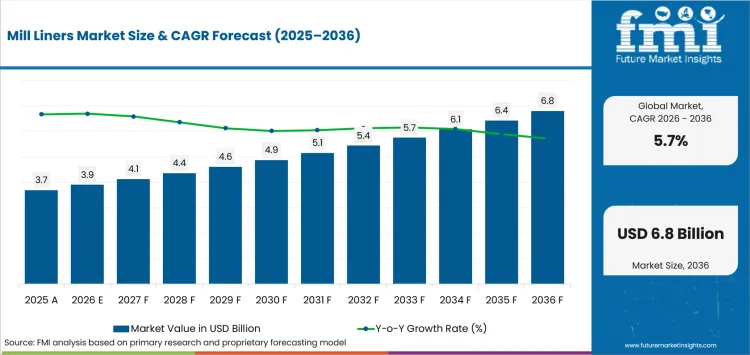
USD 3.9 billion in 2026 and USD 6.8 billion by 2036 at a 5.7% CAGR.
Demand for mill liners is projected to expand at 5.7% CAGR between 2026 and 2036, increasing valuation from USD 3.9 billion in 2026 to USD 6.8 billion by 2036. Recurring abrasion makes liner replacement a scheduled production requirement across high-throughput mineral-processing equipment instead of discretionary maintenance. FLS secured a multi-year gold-mine liner contract in July 2026 after wear and installation records supported the award. Long-term awards tie recurring orders to measured wear performance and service quality across operating campaigns.
Country conversion differs between Japan's mature cement network and Australia's mining base as their replacement triggers differ. Japan's transport ministry forecast 33.0 million tonnes of cement demand for fiscal 2025, keeping grinding assets tied to brownfield maintenance instead of rapid fleet expansion. Japan's cement grinding operations therefore value proven fit and predictable reline timing, while remote Australian mines put more weight on local stock and service distance.
Key Takeaways of Mill Liners Market
- Recurring abrasion converts mill operating hours into planned liner replacement orders across active mining and cement grinding assets.
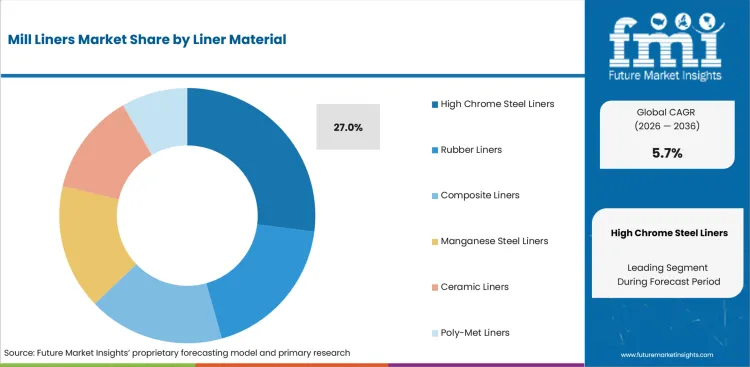
- By liner material, high chrome steel liners are estimated to hold 27.0% in 2026 owing to established abrasive-service qualification.
- In 2026, ball mills are expected to lead mill type with 34.0% share because installed fleets span mining and cement.
- The component category is forecast to be led by shell liners at 31.0% in 2026 due to broad wear exposure.
- Qualification risk slows switching as liner geometry and weight can disturb throughput or handling during fixed shutdown windows.
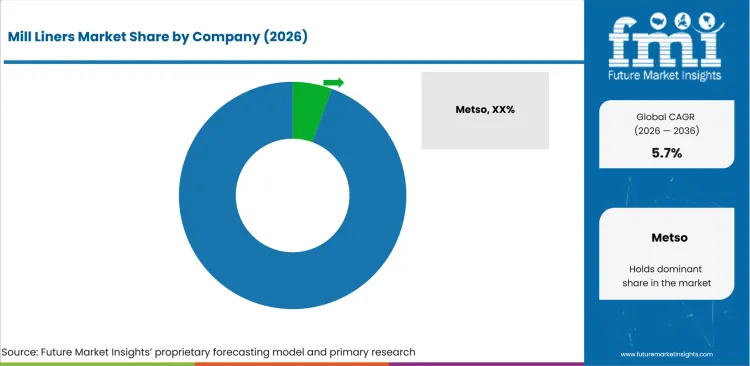
- Metso, FLSmidth, Magotteaux, ME Elecmetal, Bradken, Trelleborg, Multotec and Tega Industries Limited serve the mill liners market.
Analyst Perspective
"Mill operators should judge liner proposals against the next reline by comparing wear life and installation effort with throughput stability. Lower part prices lose value when uncertain fit extends an outage or forces another intervention before the intended campaign ends."
- Nikhil Kaitwade, Principal Consultant, Future Market Insights
How is the Mill Liners Market segmented?
Liner material, mill type, component, end use, demand type, sales model and region define the market.
Liner material includes high chrome steel, rubber, composite, manganese steel, ceramic and Poly-Met liners. Mill type covers ball, SAG, AG, vertical roller and tube mills. Component covers shell, head, grate, lifter and discharge liners. End use includes mining, cement, power and utilities and industrial minerals. Demand type covers replacement / wear parts, new mill fitment and performance upgrades. Within the demand type category, replacement / wear parts are estimated to account for 68.0% in 2026 because installed grinding mills require recurring liner renewal.
What makes high chrome steel liners central to the liner material category?
High chrome steel remains familiar in abrasive service as maintenance teams know the handling and wear behavior of qualified cast sets. ME Elecmetal reported in March 2026 that a Peruvian mine had implemented a rubber-steel hybrid liner with external bolting on a 24-by-36-foot ball mill. The redesign cut cylinder rings from six to five, showing the engineering work needed to replace an established metallic liner.
- By liner material, high chrome steel liners are estimated to hold 27.0% in 2026 owing to established qualification in abrasive grinding duties.
- Consistent foundry metallurgy and dimensional control reduce fit risk across heavy liners and related industrial lining materials.
What supports ball mills within the mill type category?
Ball mills expose shell and end components to repeated media impact across mineral and cement grinding circuits. Their installed base keeps replacement tied to predictable wear campaigns after the original equipment enters steady production.
- In 2026, ball mills are expected to lead mill type with 34.0% share because their installed base spans mineral and cement processing.
- New grinding mill systems lock liner geometry into commissioning specifications before replacement habits form across an operating fleet. Metso and G Mining Ventures signed a May 2025 equipment agreement that puts proprietary wear linings on Oko West’s Premier ball mill.
How do shell liners influence selection within the component category?
Shell liners cover the mill's largest cylindrical wear surface and influence charge lift during every rotation. Metso said in January 2026 that its new Quzhou plant would start manufacturing larger rubber and Poly-Met mill-lining components toward midyear. Regional production shortens the route from an approved design to replacement delivery when large shell components must fit a fixed reline schedule.
- Shell liners are projected to hold 31.0% share in 2026 owing to extensive wear exposure and their direct influence on charge movement.
- Wear mapping connects shell condition with predictive maintenance programs that schedule profile changes before the next planned reline reaches the site.
Why does mining lead demand within the end use category?
Mining mills process abrasive ore through sustained operating campaigns, making liner condition central to throughput and shutdown planning. Operators replace liner sets when wear changes charge movement or creates unacceptable maintenance risk.
- By end use, mining is estimated to hold 49.0% in 2026 due to high grinding volumes and recurring liner replacement across mineral-processing circuits.
- Mining operators evaluate liner designs against mill geometry, ore properties and planned reline intervals. Proven fit and local installation support reduce execution risk during tightly scheduled maintenance campaigns.
What are the drivers, restraints and opportunities in the Mill Liners Market?
Recurring grinding wear sustains replacement demand while qualification risk limits design switching and lifecycle services extend revenue beyond the liner purchase.
- Driver: Continuous mineral and cement grinding wears liner surfaces and converts active mill hours into scheduled replacement orders.
- Restraint: A change in liner material or profile can disturb fit and throughput during shutdowns with fixed maintenance scopes.
- Opportunity: Wear monitoring and liner recycling can turn repeated relines into longer service relationships tied to predictable maintenance planning.
Grinding Duty Sustains Planned Replacement Cycles
Active grinding fleets generate liner wear even when mine operators delay major equipment purchases across a maintenance cycle. Australia’s Department of Industry reported in July 2026 that iron ore export volumes rose 6% year over year in the March quarter. That operating intensity does not convert one-for-one into liner orders, but it keeps surface mining equipment and grinding circuits working against recurrent wear limits.
Qualification Risk Protects Proven Liner Designs
Changing a qualified liner profile carries throughput risk because altered charge movement and installation tolerances can weaken restart performance during fixed outages that leave little recovery time for onsite corrections. Metso reported in June 2026 that two Asia Pacific mill-lining agreements link performance to throughput and service life, giving production teams measured targets before approving different liner designs at site.
Lifecycle Services Extend Revenue Beyond Replacement Parts
End-of-life handling can extend a liner relationship beyond the replacement set by solving a recurring site problem alongside wear management. Mines using aggregate and mineral-processing equipment already coordinate inspection and reline windows as part of broader shutdown planning. FLS launched a South American recycling service in April 2025 for composite and rubber grinding-mill liners, giving that maintenance cycle a defined material-recovery route.
Which country CAGRs are profiled in the Mill Liners Market?
| Country | CAGR |
|---|---|
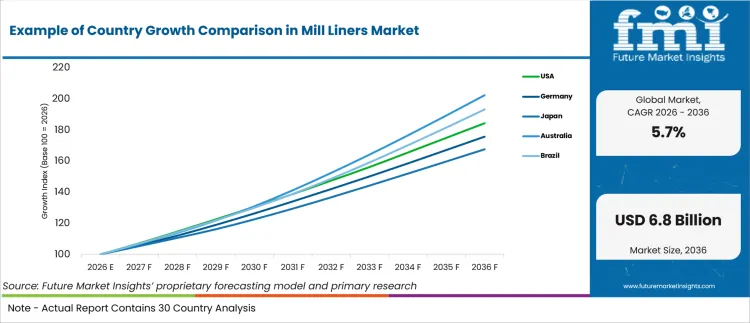
| Australia | 5.6% |
| Brazil | 5.3% |
| USA | 4.8% |
| Germany | 4.4% |
| Japan | 4.1% |
How do country-level CAGRs compare in the Mill Liners Market?
The 1.5 percentage-point spread forms a compact upper pair and a lower three-country band instead of a sharply separated growth curve. Australia and Brazil depend more on mining project activity and heavy-site logistics. The USA occupies the middle transition point, while Germany and Japan rely more heavily on brownfield replacement inside mature grinding networks.
- Western Australian mine distances make regional stock and reline crews unusually important.
- Brazilian inland freight corridors reward nearby foundry capacity for heavy replacement sets.
- Long federal mine-permitting timelines preserve brownfield replacement alongside slower US greenfield conversion.
- Lower-clinker cement changes German grinding duty without producing a comparable greenfield mill wave.
- Japan's concentrated cement network favors dependable local service around established grinding assets.
Similar CAGRs can produce different service requirements and entry costs. The full report provides country-level CAGR analysis across North America, Latin America, Europe, East Asia, South Asia, Oceania and the Middle East and Africa.
Country-wise Analysis
- Remote Western Australian mines need replacement sets and reline crews positioned near operating districts, and the Department of Industry reported three iron ore projects became committed while two finished construction during 2025. Mill liner demand in Australia is forecast to rise at 5.6% CAGR over the forecast period, supported by large mines that plan liner replacement against fixed outage calendars and restricted specialist labor availability. Regional manufacturing shortens the supply route for heavy liner sets, but long service distances favor companies that hold critical inventory and field support near Western Australian mining districts ahead of planned relines during peak maintenance periods.
- Brazilian mines transport heavy liner sets across long inland freight corridors, making regional foundry capacity material to shutdown planning at remote iron ore and copper processing complexes far from coastal manufacturing hubs. Vale reported in April 2026 that first-quarter iron ore production reached 69.7 Mt, with record output at S11D and Brucutu plus continued Capanema ramp-up sustaining grinding duty across major processing assets. Mill liner sales in Brazil are forecast to expand at 5.3% CAGR by 2036, while mine operators compare domestic manufacturing and delivery control with wear performance as late heavy-component shipments can extend planned outages across inland sites.
- USA mining companies rely heavily on qualified brownfield grinding assets, ordering replacement liners around fixed shutdown windows as lengthy federal reviews postpone some new-mill commissioning and first-fit demand across project timelines. The USA is estimated to post 4.8% CAGR over the forecast period, supported by recurring wear across operating mines and cement plants that schedule replacement purchases around fixed maintenance windows and qualified liner designs. The USA Department of the Interior reported in April 2025 that mine permitting can take seven to ten years, so stock availability and field engineering remain important until faster approvals bring new grinding capacity into construction.
- German cement plants are changing grinding duty as clinker content falls, forcing maintenance teams to judge liner materials against shifting feed behavior and maintenance intervals instead of relying solely on familiar historical wear patterns. The German mill liners sector is projected to record 4.4% CAGR during the assessment period, with VDZ reporting in March 2026 that the national clinker factor was about 67% as lower-clinker formulations gained ground. Local testing capacity helps plants assess profile changes under new cement recipes, but conservative qualification keeps site-specific wear evidence and dependable local technical support necessary before production-critical liner designs are changed.
- Japan’s concentrated cement network gives local service teams short support routes around mature grinding assets, and the Japan Cement Association counted 26 operating plants owned by 15 companies in July 2025. Plant maintenance groups value long campaign life and predictable fit over rapid material switching, since liner trials can disturb established grinding conditions and require extra review across production assets with conservative qualification routines. Adoption of mill liners in Japan is estimated to expand at 4.1% CAGR through 2036, reinforced by repeat replacement inside mature mills and documented campaign performance as the main route to broader use of alternative profiles.
Who are the notable companies in the Mill Liners Market?
Metso, FLSmidth, Magotteaux, ME Elecmetal, Bradken, Trelleborg, Multotec and Tega Industries Limited serve the mill liners market.
Mill liner competition remains fragmented across integrated mill OEMs, cast-wear specialists and polymer lining groups competing at production-critical grinding sites. Polymer-focused offers use industrial rubber systems to reduce component weight and absorb impact in selected duties. Natural rubber compounds suit grinding conditions that favor elastomeric designs, while cast-metal groups depend more on alloy control and foundry execution. Entry requires measured wear performance plus exact fit and delivery within fixed reline windows at operating sites.
- Metso, FLSmidth, ME Elecmetal and Bradken combine engineered liners with manufacturing, wear measurement and service across major mining regions.
- Magotteaux, Trelleborg and Multotec specialize in metallurgy or rubber lining systems for distinct grinding duties and reline conditions.
- Tega Industries Limited combines mill liners with mineral-processing wear products across mining and industrial grinding applications.
Competitive Benchmarking: Mill Liners Market
| Company | Documented Liner Material Breadth | Regional Manufacturing & Supply | Wear Engineering & Service | Geographic Reach |
|---|---|---|---|---|
| Metso | High | High | High | Global mining regions |
| FLSmidth | High | High | High | Global mining regions |
| Magotteaux | Medium | Medium | Medium | Global mining and cement regions |
| ME Elecmetal | Medium | Medium | Medium | Americas, Australia and Africa |
| Bradken | Medium | High | High | Australia, Americas and Asia |
| Trelleborg | Low | Medium | Medium | Global mining regions |
| Multotec | Low | Medium | High | Africa, Australia, Americas and Asia |
| Tega Industries Limited | Low | Medium | Medium | India, Africa, Australia and Latin America |
Key Developments in the Mill Liners Market
- In July 2026, Bradken opened its Chilca mill-liner foundry in Peru to add manufacturing support for Latin American mining operations.
- In July 2025, Metso signed an agreement to acquire TL Solution's mill-liner recycling operations and induction-heating technology for its recycling service platform.
- In April 2025, FLSmidth opened a mill-liner manufacturing facility at Casablanca in Chile with annual production capacity of about 6.5 thousand tons.
Key Players in the Mill Liners Market
Integrated Mill-Lining and Lifecycle Platforms
- Metso
- FLSmidth
- ME Elecmetal
- Bradken
Specialized Wear and Polymer Lining Providers
- Magotteaux
- Trelleborg
- Multotec
Mineral-Processing Liner Specialist
- Tega Industries Limited
Mill Liners Market - Report Scope
| Coverage field | Report scope |
|---|---|
| Market breakdown | By liner material, mill type, component, end use, demand type, sales model and region. |
| Quantitative Units | Revenue in USD million and CAGR in %. |
| Market Definition | Commercial mill liner systems and replacement components that protect grinding mills and influence charge movement across mining, cement and industrial processing applications. |
| Regions Covered | North America, Latin America, Europe, East Asia, South Asia and Pacific, and Middle East and Africa. |
| Countries Covered | Australia, Brazil, USA, Germany, Japan, and 20+ countries included in the full report. |
| Key Companies Profiled | Metso, FLSmidth, Magotteaux, ME Elecmetal, Bradken, Trelleborg, Multotec, Tega Industries Limited. |
| Forecast Period | 2026 to 2036. |
| Approach | Primary and secondary research with market triangulation. |
Mill Liners Market - Research Methodology
| Method | Approach |
|---|---|
| Primary Research | FMI analysts gathered input from manufacturers, service providers, technology developers, distributors, end users, procurement teams, and subject-matter experts. Interviews examined purchasing decisions, product or service evaluation, adoption barriers, approval requirements, pricing considerations, and expectations for technical or commercial support. Respondents were also asked what evidence is required before a trial, pilot, or initial order develops into regular purchasing. |
| Desk Research | Desk research covered government statistics, regulatory publications, trade data, industry associations, technical literature, standards, company filings, product information, and official corporate announcements. Sources were reviewed for relevance, publication date, geographic coverage, and consistency with the defined market scope. Claims relating to performance, applications, approvals, capacity, investment, and commercial activity were retained only when supported by credible public evidence. |
| Market Sizing and Forecasting | The market model combined the baseline value with historical performance, segment structure, pricing and volume indicators, adoption levels, company participation, and country-level demand conditions. Forecast assumptions considered economic activity, investment trends, regulatory developments, technology adoption, purchasing cycles, supply availability, and barriers to wider market use. Segment and regional estimates were reconciled before the final market total was calculated. |
| Data Validation | Estimates were checked against multiple independent indicators, including public data, company activity, trade patterns, industry developments, and findings from primary interviews. Validation also tested whether products, services, applications, and company revenues fell within the defined market boundaries. Adjacent categories, unsupported claims, overlapping revenues, and activities without direct market relevance were excluded to reduce double counting and maintain consistency across segments and countries. |
Mill Liners Market by Segments
Mill Liners Market segmented by Liner Material:
- High Chrome Steel Liners
- Rubber Liners
- Composite Liners
- Manganese Steel Liners
- Ceramic Liners
- Poly-Met Liners
Mill Liners Market segmented by Mill Type:
- Ball Mills
- SAG Mills
- AG Mills
- Vertical Roller Mills
- Tube Mills
Mill Liners Market segmented by Component:
- Shell Liners
- Head Liners
- Grate Liners
- Lifter Bars
- Discharge Liners
Mill Liners Market segmented by End Use:
- Cement
- Mining
- Power & Utilities
- Industrial Minerals
Mill Liners Market segmented by Demand Type:
- New Mill Fitment
- Replacement / Wear Parts
- Performance Upgrade
Mill Liners Market segmented by Sales Model:
- Direct OEM
- Aftermarket Supplier
- Maintenance Service Contract
Mill Liners Market by Region:
- North America
- United States
- Canada
- Latin America
- Brazil
- Mexico
- Chile
- Rest of Latin America
- Western Europe
- Germany
- United Kingdom
- Italy
- Spain
- France
- Nordics
- Benelux
- Rest of Western Europe
- Eastern Europe
- Russia
- Poland
- Hungary
- Balkan and Baltic States
- Rest of Eastern Europe
- East Asia
- China
- Japan
- South Korea
- South Asia and Pacific
- India
- ASEAN
- Australia and New Zealand
- Rest of South Asia and Pacific
- Middle East and Africa
- Kingdom of Saudi Arabia
- Other GCC Countries
- Türkiye
- South Africa
- Other African Union Countries
- Rest of Middle East and Africa
Research Sources and Bibliography
- FLSmidth & Co. A/S. (2026, July 2). FLS wins multi-year contract to supply mill lining solutions to a gold mine in the ASEA region.
- Ministry of Land, Infrastructure, Transport and Tourism. (2025, October 31).
- ME Elecmetal. (2026, March 6). ME PolyFIT® Innovative Hybrid Solutions: Optimizing Secondary Grinding Performance Through External Bolting.
- Metso Corporation. (2025, May 23). Metso and G Mining Ventures sign key process equipment agreement for Oko West Gold Project in Guyana.
- Metso Corporation. (2026, January 8). Metso enhances its customer service in China with a new rubber products factory.
- Magotteaux. (2026, May 15). Magotteaux launches Exact: a new VRM wear parts solution.
- Australian Government Department of Industry, Science and Resources. (2026, July 3). Resources and energy quarterly: June 2026.
- Metso Corporation. (2026, June 29). Metso advances mill lining performance and reliability in Asia Pacific with new Life Cycle Services agreements.
- FLSmidth & Co. A/S. (2025, April 10). FLS advances sustainability through innovation with its new mill liner recycling service offering.
- Australian Government Department of Industry, Science and Resources. (2025, December 19). Resources and energy major projects: 2025.
- Vale S.A. (2026, April 17). Vale's production and sales in 1Q26.
- USA Department of the Interior. (2025, April 18). Trump Administration Adds Key Mining Projects to FAST-41.
- Müller, C. (2026, March). Germany’s Clinker Cut Revolution.
- Japan Cement Association. (2025, July). Statistics.
- Trelleborg Fluid Handling Solutions. (2025, February 11). Supporting Mining OEMs.
- Multotec. (n.d.). Multotec supplies scientifically designed mill liners with 3D scanning technology to mining operations. Retrieved August 11, 2026.
- Tega Industries Limited. (2025, August 20). Redefining Mill Lining Performance for Large size SAG Mills: How DynaPrime® Dominates the Challenge.
- Bradken. (2026, July 10). Bradken officially opens world-class Chilca Foundry, strengthening mining support across Latin America.
- Metso Corporation. (2025, July 4). Metso acquires recycling operations to boost sustainable mill lining services.
- FLSmidth & Co. A/S. (2025, April 14). FLS opens new mill liner manufacturing facility in Chile that operates with 100% renewable energy and water reuse.
This bibliography is provided for reader reference and is not exhaustive. The full report contains the complete reference list and detailed citations
This Report Answers
- What values define the mill liners market forecast from 2026 to 2036?
- How does grinding wear convert operating hours into recurring liner replacements?
- Why do high chrome steel liners hold 27.0% of 2026 liner material demand?
- How does the ball mill installed base sustain recurring liner replacements?
- Why do shell liners receive close attention during planned relines?
- How do service and qualification conditions differ across the five profiled countries?
- Which companies combine liner engineering with material specialization or lifecycle support?
- How do qualification risk and shutdown constraints limit liner-design switching?
Frequently Asked Questions
How big is the Mill Liners Market in 2026?
The mill liners market is valued at USD 3.9 billion in 2026 and is projected to reach USD 6.8 billion by 2036. Active grinding fleets require recurring liner replacement during planned maintenance cycles.
What is the CAGR of the Mill Liners Market from 2026 to 2036?
The mill liners market is projected to grow at a CAGR of 5.7% between 2026 and 2036. Replacement demand and new mill fitment across mining and cement operations support expansion.
Which liner material leads the Mill Liners Market?
High chrome steel liners are projected to account for 27.0% of the mill liners market in 2026. Their established qualification for abrasive grinding duties supports their current position.
How much value will the Mill Liners Market add between 2026 and 2036?
The mill liners market is expected to add USD 2.9 billion in value between 2026 and 2036. Replacement wear parts, new mill fitment and performance upgrades support this increase.
Which companies are active in the Mill Liners Market?
Key companies include Metso, FLSmidth, Magotteaux, ME Elecmetal, Bradken, Trelleborg, Multotec and Tega Industries Limited. They compete through metallic, polymer and composite liner systems with lifecycle support.
Preview the report firsthand - request a free sample
Get SampleGet the brochure for pricing and purchase details.
Get PDFTable of Content
- Key Takeaways
- Market Size and CAGR
- Top Growth Driver
- Fastest Growing Segment
- Leading Region
- Key Companies
- Emerging Opportunities
- Executive Summary
- Global Market Outlook
- Demand-side Trends
- Supply-side Trends
- Technology Roadmap Analysis
- Analysis and Recommendations
- Analyst Perspective (What is happening? Why now? What should investors know?)
- Key Questions Answered
- How large is the market?
- What is the CAGR?
- What are key trends?
- Which region dominates?
- Who are the leaders?
- Market Overview
- Market Coverage / Taxonomy
- Market Definition / Scope / Limitations
- Research Methodology
- Chapter Orientation
- Analytical Lens and Working Hypotheses
- Market Structure, Signals, and Trend Drivers
- Benchmarking and Cross-market Comparability
- Market Sizing, Forecasting, and Opportunity Mapping
- Research Design and Evidence Framework
- Desk Research Programme (Secondary Evidence)
- Expert Input and Fieldwork (Primary Evidence)
- Tooling, Models, and Reference Databases
- Data Engineering and Model Build
- Quality Assurance and Audit Trail
- Market Background
- Market Dynamics (Drivers, Restraints, Opportunity, Trends)
- Scenario Forecast (Optimistic, Likely, Conservative)
- Impact Analysis
- AI Impact
- Sustainability Impact
- Regulatory Impact
- Technology Impact
- Consumer / Buyer Analysis
- Purchase Drivers
- Adoption Barriers
- Buyer Journey
- Opportunity Map Analysis
- Product Life Cycle Analysis
- Supply Chain Analysis
- Investment Feasibility Matrix
- Value Chain Analysis
- PESTLE and Porter's Analysis
- Regulatory Landscape
- Regional Parent Market Outlook
- Production and Consumption Statistics
- Import and Export Statistics
- Global Market Analysis and Forecast, 2021 to 2036
- Historical Market Size Value (USD Billion) Analysis, 2021 to 2025
- Current and Future Market Size Value (USD Billion) Projections, 2026 to 2036
- Y-o-Y Growth Trend Analysis
- Absolute $ Opportunity Analysis
- Global Market Pricing Analysis, 2021 to 2036
- Global Market Analysis and Forecast, By Liner Material, 2021 to 2036
- Introduction / Key Findings
- Historical Market Size Value (USD Billion) Analysis By Liner Material, 2021 to 2025
- Current and Future Market Size Value (USD Billion) Analysis and Forecast By Liner Material, 2026 to 2036
- High Chrome Steel Liners
- Rubber Liners
- Composite Liners
- Manganese Steel Liners
- Ceramic Liners
- Poly-Met Liners
- High Chrome Steel Liners
- Y-o-Y Growth Trend Analysis By Liner Material, 2021 to 2025
- Absolute $ Opportunity Analysis By Liner Material, 2026 to 2036
- Global Market Analysis and Forecast, By Mill Type, 2021 to 2036
- Introduction / Key Findings
- Historical Market Size Value (USD Billion) Analysis By Mill Type, 2021 to 2025
- Current and Future Market Size Value (USD Billion) Analysis and Forecast By Mill Type, 2026 to 2036
- Ball Mills
- SAG Mills
- AG Mills
- Vertical Roller Mills
- Tube Mills
- Ball Mills
- Y-o-Y Growth Trend Analysis By Mill Type, 2021 to 2025
- Absolute $ Opportunity Analysis By Mill Type, 2026 to 2036
- Global Market Analysis and Forecast, By Component, 2021 to 2036
- Introduction / Key Findings
- Historical Market Size Value (USD Billion) Analysis By Component, 2021 to 2025
- Current and Future Market Size Value (USD Billion) Analysis and Forecast By Component, 2026 to 2036
- Shell Liners
- Head Liners
- Grate Liners
- Lifter Bars
- Discharge Liners
- Shell Liners
- Y-o-Y Growth Trend Analysis By Component, 2021 to 2025
- Absolute $ Opportunity Analysis By Component, 2026 to 2036
- Global Market Analysis and Forecast, By End Use, 2021 to 2036
- Introduction / Key Findings
- Historical Market Size Value (USD Billion) Analysis By End Use, 2021 to 2025
- Current and Future Market Size Value (USD Billion) Analysis and Forecast By End Use, 2026 to 2036
- Mining
- Cement
- Power & Utilities
- Industrial Minerals
- Mining
- Y-o-Y Growth Trend Analysis By End Use, 2021 to 2025
- Absolute $ Opportunity Analysis By End Use, 2026 to 2036
- Global Market Analysis and Forecast, By Demand Type, 2021 to 2036
- Introduction / Key Findings
- Historical Market Size Value (USD Billion) Analysis By Demand Type, 2021 to 2025
- Current and Future Market Size Value (USD Billion) Analysis and Forecast By Demand Type, 2026 to 2036
- Replacement / Wear Parts
- New Mill Fitment
- Performance Upgrade
- Replacement / Wear Parts
- Y-o-Y Growth Trend Analysis By Demand Type, 2021 to 2025
- Absolute $ Opportunity Analysis By Demand Type, 2026 to 2036
- Global Market Analysis and Forecast, By Region, 2021 to 2036
- Introduction
- Historical Market Size Value (USD Billion) Analysis By Region, 2021 to 2025
- Current Market Size Value (USD Billion) Analysis and Forecast By Region, 2026 to 2036
- North America
- Latin America
- Western Europe
- Eastern Europe
- East Asia
- South Asia and Pacific
- Middle East & Africa
- Market Attractiveness Analysis By Region
- North America Market Analysis and Forecast, By Country, 2021 to 2036
- Historical Market Size Value (USD Billion) Trend Analysis By Market Taxonomy, 2021 to 2025
- Market Size Value (USD Billion) Forecast By Market Taxonomy, 2026 to 2036
- By Country
- USA
- Canada
- By Liner Material
- By Mill Type
- By Component
- By End Use
- By Demand Type
- By Country
- Market Attractiveness Analysis
- By Country
- By Liner Material
- By Mill Type
- By Component
- By End Use
- By Demand Type
- Key Takeaways
- Latin America Market Analysis and Forecast, By Country
- Historical Market Size Value (USD Billion) Trend Analysis By Market Taxonomy, 2021 to 2025
- Market Size Value (USD Billion) Forecast By Market Taxonomy, 2026 to 2036
- By Country
- Brazil
- Mexico
- Chile
- Rest of Latin America
- By Liner Material
- By Mill Type
- By Component
- By End Use
- By Demand Type
- By Country
- Market Attractiveness Analysis
- By Country
- By Liner Material
- By Mill Type
- By Component
- By End Use
- By Demand Type
- Key Takeaways
- Western Europe Market Analysis and Forecast, By Country
- Historical Market Size Value (USD Billion) Trend Analysis By Market Taxonomy, 2021 to 2025
- Market Size Value (USD Billion) Forecast By Market Taxonomy, 2026 to 2036
- By Country
- Germany
- UK
- Italy
- Spain
- France
- Nordic
- BENELUX
- Rest of Western Europe
- By Liner Material
- By Mill Type
- By Component
- By End Use
- By Demand Type
- By Country
- Market Attractiveness Analysis
- By Country
- By Liner Material
- By Mill Type
- By Component
- By End Use
- By Demand Type
- Key Takeaways
- Eastern Europe Market Analysis and Forecast, By Country
- Historical Market Size Value (USD Billion) Trend Analysis By Market Taxonomy, 2021 to 2025
- Market Size Value (USD Billion) Forecast By Market Taxonomy, 2026 to 2036
- By Country
- Russia
- Poland
- Hungary
- Balkan & Baltic
- Rest of Eastern Europe
- By Liner Material
- By Mill Type
- By Component
- By End Use
- By Demand Type
- By Country
- Market Attractiveness Analysis
- By Country
- By Liner Material
- By Mill Type
- By Component
- By End Use
- By Demand Type
- Key Takeaways
- East Asia Market Analysis and Forecast, By Country
- Historical Market Size Value (USD Billion) Trend Analysis By Market Taxonomy, 2021 to 2025
- Market Size Value (USD Billion) Forecast By Market Taxonomy, 2026 to 2036
- By Country
- China
- Japan
- South Korea
- By Liner Material
- By Mill Type
- By Component
- By End Use
- By Demand Type
- By Country
- Market Attractiveness Analysis
- By Country
- By Liner Material
- By Mill Type
- By Component
- By End Use
- By Demand Type
- Key Takeaways
- South Asia and Pacific Market Analysis and Forecast, By Country
- Historical Market Size Value (USD Billion) Trend Analysis By Market Taxonomy, 2021 to 2025
- Market Size Value (USD Billion) Forecast By Market Taxonomy, 2026 to 2036
- By Country
- India
- ASEAN
- Australia & New Zealand
- Rest of South Asia and Pacific
- By Liner Material
- By Mill Type
- By Component
- By End Use
- By Demand Type
- By Country
- Market Attractiveness Analysis
- By Country
- By Liner Material
- By Mill Type
- By Component
- By End Use
- By Demand Type
- Key Takeaways
- Middle East & Africa Market Analysis and Forecast, By Country
- Historical Market Size Value (USD Billion) Trend Analysis By Market Taxonomy, 2021 to 2025
- Market Size Value (USD Billion) Forecast By Market Taxonomy, 2026 to 2036
- By Country
- Kingdom of Saudi Arabia
- Other GCC Countries
- Türkiye
- South Africa
- Other African Union
- Rest of Middle East & Africa
- By Liner Material
- By Mill Type
- By Component
- By End Use
- By Demand Type
- By Country
- Market Attractiveness Analysis
- By Country
- By Liner Material
- By Mill Type
- By Component
- By End Use
- By Demand Type
- Key Takeaways
- Key Countries Market Analysis
- USA
- Pricing Analysis
- Market Share Analysis, 2025
- By Liner Material
- By Mill Type
- By Component
- By End Use
- By Demand Type
- Canada
- Pricing Analysis
- Market Share Analysis, 2025
- By Liner Material
- By Mill Type
- By Component
- By End Use
- By Demand Type
- Mexico
- Pricing Analysis
- Market Share Analysis, 2025
- By Liner Material
- By Mill Type
- By Component
- By End Use
- By Demand Type
- Brazil
- Pricing Analysis
- Market Share Analysis, 2025
- By Liner Material
- By Mill Type
- By Component
- By End Use
- By Demand Type
- Chile
- Pricing Analysis
- Market Share Analysis, 2025
- By Liner Material
- By Mill Type
- By Component
- By End Use
- By Demand Type
- Germany
- Pricing Analysis
- Market Share Analysis, 2025
- By Liner Material
- By Mill Type
- By Component
- By End Use
- By Demand Type
- UK
- Pricing Analysis
- Market Share Analysis, 2025
- By Liner Material
- By Mill Type
- By Component
- By End Use
- By Demand Type
- Italy
- Pricing Analysis
- Market Share Analysis, 2025
- By Liner Material
- By Mill Type
- By Component
- By End Use
- By Demand Type
- Spain
- Pricing Analysis
- Market Share Analysis, 2025
- By Liner Material
- By Mill Type
- By Component
- By End Use
- By Demand Type
- France
- Pricing Analysis
- Market Share Analysis, 2025
- By Liner Material
- By Mill Type
- By Component
- By End Use
- By Demand Type
- India
- Pricing Analysis
- Market Share Analysis, 2025
- By Liner Material
- By Mill Type
- By Component
- By End Use
- By Demand Type
- ASEAN
- Pricing Analysis
- Market Share Analysis, 2025
- By Liner Material
- By Mill Type
- By Component
- By End Use
- By Demand Type
- Australia & New Zealand
- Pricing Analysis
- Market Share Analysis, 2025
- By Liner Material
- By Mill Type
- By Component
- By End Use
- By Demand Type
- China
- Pricing Analysis
- Market Share Analysis, 2025
- By Liner Material
- By Mill Type
- By Component
- By End Use
- By Demand Type
- Japan
- Pricing Analysis
- Market Share Analysis, 2025
- By Liner Material
- By Mill Type
- By Component
- By End Use
- By Demand Type
- South Korea
- Pricing Analysis
- Market Share Analysis, 2025
- By Liner Material
- By Mill Type
- By Component
- By End Use
- By Demand Type
- Russia
- Pricing Analysis
- Market Share Analysis, 2025
- By Liner Material
- By Mill Type
- By Component
- By End Use
- By Demand Type
- Poland
- Pricing Analysis
- Market Share Analysis, 2025
- By Liner Material
- By Mill Type
- By Component
- By End Use
- By Demand Type
- Hungary
- Pricing Analysis
- Market Share Analysis, 2025
- By Liner Material
- By Mill Type
- By Component
- By End Use
- By Demand Type
- Kingdom of Saudi Arabia
- Pricing Analysis
- Market Share Analysis, 2025
- By Liner Material
- By Mill Type
- By Component
- By End Use
- By Demand Type
- Türkiye
- Pricing Analysis
- Market Share Analysis, 2025
- By Liner Material
- By Mill Type
- By Component
- By End Use
- By Demand Type
- South Africa
- Pricing Analysis
- Market Share Analysis, 2025
- By Liner Material
- By Mill Type
- By Component
- By End Use
- By Demand Type
- USA
- Market Structure Analysis
- Competition Dashboard
- Competition Benchmarking
- Market Share Analysis of Top Players
- By Regional
- By Liner Material
- By Mill Type
- By Component
- By End Use
- By Demand Type
- Emerging Startups
- Innovation Benchmarking
- Competition Analysis
- Competition Deep Dive
- Metso
- Overview
- Product Portfolio
- Profitability by Market Segments
- Sales Footprint
- Strategy Overview
- Marketing Strategy
- Product Strategy
- Channel Strategy
- FLSmidth
- Magotteaux
- ME Elecmetal
- Bradken
- Trelleborg
- Multotec
- Weir Group
- AIA Engineering
- Polycorp
- Metso
- Case Studies
- Success Stories
- Recent Developments
- Competition Deep Dive
- Assumptions & Acronyms Used


