

- Market Size (2026)
- USD 946.0 Mn
- Forecast (2036)
- USD 2198.8 Mn
- CAGR (2026 to 2036)
- 8.8%
How big is Lipoprotein(a) Lowering Therapies Market size?
USD 946.0 million in 2026 and USD 2,198.8 million by 2036 at an 8.8% CAGR.
Sales of lipoprotein(a) lowering therapies are estimated to rise at 8.8% CAGR through 2036, increasing valuation from USD 946.0 million in 2026 to USD 2,198.8 million by 2036. Medical specialists focus heavily on advanced heart disease treatments to improve patient outcomes. Specialist interest specifically centers on hepatic apolipoprotein(a) suppression through durable RNA medicines. Ongoing clinical research tracks the progress of these new therapies. United States National Library of Medicine updated pelacarsen CAVS study enrollment to 502 participants in June 2026. Revised enrollment supports continued evaluation across calcific valve disease.
Different global healthcare networks evaluate new cardiovascular therapies based on distinct regional priorities. United States and United Kingdom health systems prioritize outcome evidence and specialist lipid pathways during therapy review. Japan and South Korea care networks emphasize referral discipline and consistent cardiovascular diagnostics. New trial data continually reinforces these regional evaluations. Nissen and colleagues reported randomization of 320 participants in March 2025. Such specific trial strengthens evidence for prolonged lepodisiran activity.
-lowering-therapies-market-value-analysis.webp "Lipoprotein(a) Lowering Therapies Market Value Analysis")
Key Takeaways of Lipoprotein(a) Lowering Therapies Market
- Demand for lipoprotein(a) lowering therapies is driven by specialists connecting inherited cardiovascular risk with measurable treatment response, with program decisions reflecting outcome evidence and repeatable patient identification.
- By modality, antisense oligonucleotides hold the leading share at 41.1% in 2026, owing to established LPA messenger RNA suppression programs.
- Atherosclerotic cardiovascular disease is the dominant indication segment, accounting for 34.2% share in 2026, led by measurable cardiovascular event endpoints.
- Hospitals secure 33.2% share in 2026, backed by specialist cardiology services and trial-ready infrastructure.
- Outcome trials remain central to coverage decisions, while infrequent dosing profiles support adherence across long-duration treatment pathways.
- The United States, United Kingdom, and Japan record CAGRs of 10.6%, 10.1%, and 9.4% respectively through 2036, shaped by outcome-trial participation, organized cardiology pathways, and tertiary-care concentration.
- Competition centers on Novartis, Eli Lilly, Amgen, Ionis Pharmaceuticals, and Silence Therapeutics, with vendors differentiating through injectable RNA medicines, oral treatment formats, and partnered RNA medicine development programs.
Analyst Perspective
"Clinical adoption will increasingly depend on demonstrating that lipoprotein(a)-lowering therapies provide meaningful cardiovascular risk reduction beyond existing lipid management strategies. Physicians are evaluating long-term outcome data, patient selection criteria, and integration with established preventive care pathways before expanding routine use. Companies that strengthen clinical evidence, improve diagnostic access, and support coordinated cardiovascular care will be better positioned to drive sustained market adoption."
- Anurag Sharma, Principal Consultant for Healthcare at Future Market Insights
Source: Future Market Insights analysis, 2026.
How is Lipoprotein(a) Lowering Therapies Market segmented?
The lipoprotein(a) lowering therapies industry is segmented by therapy type, target, indication, end user, and region.
The lipoprotein(a) lowering therapies market is segmented by therapy type, target, indication, end user, and region. Therapy type coverage includes antisense oligonucleotides and small interfering RNA medicines supported by oligonucleotide API. PCSK9 inhibitors and lipoprotein apheresis represent established alternatives. Target coverage addresses LPA gene and apolipoprotein(a) supported by PCSK9 and LDL receptor pathways. Indication coverage includes atherosclerotic cardiovascular disease and familial hypercholesterolemia followed by elevated lipoprotein(a) and secondary cardiovascular prevention. End-user coverage spans hospitals and specialty cardiology clinics supported by ambulatory care centers and academic research institutes. Regional coverage includes North America and Latin America followed by Europe and East Asia. South Asia with Oceania and Middle East and Africa completes geographic assessment.
Why do antisense oligonucleotides shape therapy-type demand?
-lowering-therapies-market-analysis-by-therapy-type.webp "Lipoprotein(a) Lowering Therapies Market Analysis By Therapy Type")
Antisense oligonucleotides suppress apolipoprotein(a) production led by sequence-specific messenger RNA binding. United States National Library of Medicine records updated in May 2026 listed 8,323 participants within the pelacarsen cardiovascular outcomes study. Such advanced program strengthens clinical familiarity with targeted Lp(a) reduction across specialist cardiovascular services.
- Antisense oligonucleotides are projected to represent 41.1% share in 2026, driven by advanced clinical development and established dosing evidence. Cardiovascular teams assess durability and safety monitoring before incorporating these therapies into specialist treatment pathways.
- Small interfering RNA therapies support prolonged target suppression through infrequent subcutaneous administration. PCSK9 inhibitors and lipoprotein apheresis serve patients requiring broader lipid control or immediate Lp(a) removal.
Why does the LPA gene lead target selection?
-lowering-therapies-market-analysis-by-target.webp "Lipoprotein(a) Lowering Therapies Market Analysis By Target")
The LPA gene controls hepatic apolipoprotein(a) production and inherited Lp(a) concentrations. A July 2025 American Heart Association publication estimated elevated Lp(a) levels among 1 in 5 Americans. The inherited prevalence supports therapies designed to interrupt production near its principal biological source.
- In 2026, the LPA gene is anticipated to account for 32.3% share in 2026 due to its direct connection with apolipoprotein(a) production. Developers prioritize selective gene-expression control to deliver substantial Lp(a) reductions beyond conventional LDL-lowering mechanisms.
- Apolipoprotein(a) targeting supports precise protein reduction across RNA-based therapeutic programs. PCSK9 and LDL receptor pathway approaches provide complementary lipid control across patients carrying several cardiovascular risks.
Why does atherosclerotic cardiovascular disease lead indication demand?
-lowering-therapies-market-analysis-by-indication.webp "Lipoprotein(a) Lowering Therapies Market Analysis By Indication")
Atherosclerotic cardiovascular disease provides measurable endpoints for assessing cardiovascular benefits from Lp(a) reduction. A January 2026 United States Centers for Disease Control and Prevention report recorded 683,491 heart disease deaths during 2024. It reinforces outcome studies involving myocardial infarction and stroke across high-risk populations.
- Based on indication, atherosclerotic cardiovascular disease is forecast to capture 34.2% share in 2026 since it is led by defined cardiovascular endpoints and identifiable high-risk patients. Trial sponsors evaluate major adverse cardiovascular events instead of relying exclusively on biomarker reductions.
- Familial hypercholesterolemia and elevated Lp(a) identify inherited-risk populations requiring earlier specialist intervention. Secondary cardiovascular prevention supports treatment across patients facing persistent risk under standard lipid management.
Why do hospitals lead end-user demand?
-lowering-therapies-market-analysis-by-end-user.webp "Lipoprotein(a) Lowering Therapies Market Analysis By End User")
Hospitals combine lipid testing and cardiovascular imaging with specialist consultation and trial monitoring. Eli Lilly and Company reported in June 2026 an ACCLAIM-CTA enrollment target of 252 participants. Such trial requirements favor institutions equipped for longitudinal assessment and cardiovascular safety monitoring.
- By end-user, hospitals are estimated to secure 33.2% share in 2026 owing to cardiologist access and diagnostic infrastructure. These institutions identify eligible patients and supervise emerging therapies across complex secondary-prevention populations.
- Specialty cardiology clinics support routine Lp(a) testing and continuing treatment across stable high-risk patients. Ambulatory care centers and academic research institutes contribute injection services and clinical evidence development.
What are drivers, restraints, and opportunities in Lipoprotein(a) Lowering Therapies Market?
Inherited cardiovascular risk and emerging clinical evidence promote targeted therapy review. Outcome uncertainty and inconsistent testing may delay routine use across general cardiology pathways.
- Driver: Dedicated medicines provide deeper lipoprotein(a) suppression than conventional lipid treatments across genetically elevated patient groups. Measurable biomarker response supports specialist interest across residual-risk pathways.
- Restraint: Payers and clinicians require cardiovascular outcome proof prior to routine prescribing across broad patient populations. Variable testing thresholds are likely to delay consistent treatment eligibility decisions.
- Opportunity: Testing programs create identifiable treatment populations through cardiology referrals and in vitro diagnostics. Structured follow-up connects laboratory results with specialist treatment review.
Broader treatment flexibility influences adoption among patients preferring convenient long-term therapy formats. Nicholls and colleagues reported placebo-adjusted muvalaplin reductions reaching 85.8% in November 2024. Oral administration expands treatment choice through small molecule inhibitors designed for sustained daily dosing across selected patients.
Nissen and colleagues reported enrollment of 178 patients across a Phase 2 zerlasiran study in November 2024. Moderate enrollment supported biomarker assessment without establishing fewer major cardiovascular events across routine care. Limited outcome evidence may delay prescribing confidence among clinicians and reimbursement authorities.
American Heart Association reported in March 2026 stating lipoprotein(a) concentrations of 250 nmol/L are associated with at least a two-fold increased long-term risk of heart attack or stroke. Clear risk thresholds strengthen specialist testing pathways and support treatment evaluation among patients carrying substantial inherited cardiovascular risk.
How are country CAGRs aligned in Lipoprotein(a) Lowering Therapies Market?
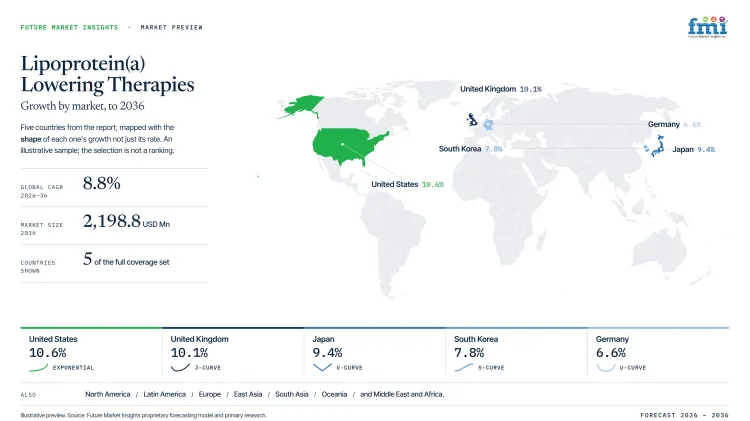
| Country or Market | CAGR |
|---|---|
| United States | 10.6% |
| United Kingdom | 10.1% |
| Japan | 9.4% |
| South Korea | 7.8% |
| Germany | 6.6% |
Source: Future Market Insights analysis, 2026.
How do country-level CAGRs compare in the Lipoprotein(a) Lowering Therapies Market?
Country comparison shows a gradual step-down across the profiled forecasts. United States records the highest CAGR followed by United Kingdom and Japan. South Korea occupies the next position with Germany at the lower end. The four-point spread reflects differences in testing access and clinical trial participation. National positions also indicate varied specialist capacity across cardiovascular care systems.
- United States leads profiled expansion supported by extensive cardiovascular outcome research and specialist participation.
- United Kingdom follows closely aided by organized lipid services and structured secondary prevention programs.
- Japan occupies the middle tier supported by tertiary hospitals and standardized laboratory practices.
- South Korea records a lower forecast pace amid improving specialist guidance and clinical familiarity.
- Germany closes the comparison backed by established apheresis services and gradual therapeutic transition.
Comparable CAGRs may produce different entry conditions across laboratory networks and specialist referral systems. The full report covers North America, Latin America, Europe, East Asia, South Asia, Oceania, and the Middle East and Africa.
Country-wise Analysis
- Sales in the United States are forecast to scale at 10.6% CAGR from 2026 to 2036, driven by deep outcome-trial participation and specialist lipid infrastructure. Academic medical centers provide recruitment capacity for clinical trials across diverse cardiovascular populations. American Heart Association reported fewer than 1% of patients with atherosclerotic cardiovascular disease received lipoprotein(a) testing in July 2025, revealing a large identification gap across secondary prevention services.
- Sector in the United Kingdom is projected to rise at 10.1% CAGR during the study period, influenced by specialist lipid pathways. National cardiology services connect laboratory measurement with organized secondary prevention reviews across high-risk populations. Office for National Statistics recorded 54,097 ischemic heart disease deaths during 2024 in its October 2025 release, sustaining attention toward inherited residual risk.
- Japan’s market is estimated to expand at 9.4% CAGR during the forecast period, aided by tertiary hospital concentration and established laboratory testing pathways. These institutions provide structured settings for inherited-risk assessment and specialist treatment introduction. The Statistics Bureau of Japan reported 36.243 million residents aged 65 years or older during 2024 in its April 2025 release, supporting preventive cardiovascular service demand.
- Industry in South Korean is anticipated to expand at 7.8% CAGR between 2026 and 2036, led by tertiary referral expansion. Lipid society guidance supports risk assessment and treatment readiness across specialized cardiology centers. A Korean Circulation Journal position paper published in January 2026 documented reductions above 80% across 5 Phase 2 agents, strengthening clinician familiarity with targeted medicines.
- The market in Germany is likely to progress at 6.6% CAGR during the assessment period, guided by established apheresis services during gradual pharmacological transition. Specialist lipid clinics provide practical experience with inherited disorders and procedure-intensive treatment pathways. German Federal Statistical Office reported a 23.2% population share for residents aged 60 to under 80 during 2024 in its June 2025 table, sustaining cardiovascular service demand.
Who are notable companies in Lipoprotein(a) Lowering Therapies Market?
Novartis develops pelacarsen across cardiovascular outcome and calcific valve disease programs. Eli Lilly advances lepodisiran and muvalaplin through injectable and oral treatment formats. Amgen progresses olpasiran across prevention studies. Ionis Pharmaceuticals contributes antisense discovery experience. Silence Therapeutics adds small interfering RNA development expertise.
-lowering-therapies-market-analysis-by-company.webp "Lipoprotein(a) Lowering Therapies Market Analysis By Company")
Competition in lipoprotein(a) lowering therapies is anticipated to center on outcome evidence and dosing durability. Clinical teams are likely to compare biomarker suppression and safety monitoring prior to treatment adoption. Companies with global trial execution and specialist medical education are expected to receive stronger review attention.
- Novartis and Eli Lilly are expected to gain review attention based on advanced clinical programs covering distinct treatment formats. Specialist teams are likely to assess dosing intervals and cardiovascular outcome design across complete care pathways.
- Amgen is anticipated to compete through olpasiran development across primary and secondary prevention populations. Cardiology programs are projected to compare outcome evidence and treatment durability across high-risk groups.
- Ionis Pharmaceuticals is forecast to support antisense program development depending on established hepatic targeting experience. Partnership execution is expected to influence continuing participation across late-stage cardiovascular development.
- Silence Therapeutics is likely to receive specialist interest due to an advanced small interfering RNA program. Partner selection and trial execution are anticipated to influence future clinical review across cardiovascular services.
Competitive Benchmarking: Lipoprotein(a) Lowering Therapies Market
| Company | Portfolio Depth | Clinical Match | Service Support | Service Reach |
|---|---|---|---|---|
| Novartis AG | High | High | High | Global |
| Eli Lilly and Company | High | High | High | Global |
| Amgen Inc. | High | High | High | Global |
| Ionis Pharmaceuticals, Inc. | Medium | High | Medium | Global |
| Silence Therapeutics plc | Medium | High | Medium | Global |
Source: Future Market Insights competitive analysis, 2026.
Key Developments in Lipoprotein(a) Lowering Therapies Market
- In March 2025, Eli Lilly announced positive ALPACA results for lepodisiran across adults with elevated lipoprotein(a). Company information supported continued development of long-duration dosing across inherited cardiovascular risk pathways.
- In August 2025, Novartis announced Lp(a)FRONTIERS APHERESIS study presentation across European Society of Cardiology Congress. Development assesses pelacarsen as a treatment intended to reduce dependence on lipoprotein apheresis.
- In April 2026, Amgen reported 3 active Phase 3 olpasiran studies across secondary prevention and primary prevention with coronary plaque assessment. Program breadth expands clinical evaluation across distinct elevated lipoprotein(a) populations.
Key Players in Lipoprotein(a) Lowering Therapies Market
Diversified pharmaceutical developers
- Novartis AG
- Eli Lilly and Company
- Amgen Inc.
RNA medicine specialists
- Ionis Pharmaceuticals, Inc.
- Silence Therapeutics plc
Lipoprotein(a) Lowering Therapies Market Report Scope
-lowering-therapies-market-breakdown-by-therapy-type,-target,-and-region.webp "Lipoprotein(a) Lowering Therapies Market Breakdown By Therapy Type, Target, And Region")
| Coverage field | Report scope |
|---|---|
| Market breakdown | Lipoprotein(a) Lowering Therapies Market breakdown by therapy type, target, indication, end user, and region |
| Quantitative Units | Revenue in USD Million, CAGR in %. |
| Market Definition | Lipoprotein(a) lowering therapies include medicines and procedures intended to reduce circulating lipoprotein(a) across cardiovascular risk pathways. |
| Regions Covered | North America, Latin America, Europe, East Asia, South Asia, Oceania, and Middle East and Africa. |
| Countries Covered | United States, United Kingdom, Japan, South Korea, Germany, China, and India with 30+ countries included in full analysis. |
| Key Companies Profiled | Novartis AG, Eli Lilly and Company, Amgen Inc., Ionis Pharmaceuticals, Inc., and Silence Therapeutics plc |
| Forecast Period | 2026 to 2036 |
| Approach | Hybrid bottom-up and top-down methodology using segment share and country CAGR with clinical evidence and company participation. |
Source: Future Market Insights analysis, 2026.
Lipoprotein(a) Lowering Therapies Market - Research Methodology
| Method | Approach |
|---|---|
| Primary Research | FMI analysts gathered input from manufacturers, service providers, technology developers, distributors, end users, sourcing teams, and subject-matter experts. Interviews examined purchasing decisions, product or service evaluation, adoption barriers, approval requirements, pricing considerations, and expectations for technical or commercial support. Respondents were also asked what evidence is required before a trial, pilot, or initial order develops into regular purchasing. |
| Desk Research | Desk research covered government statistics, regulatory publications, trade data, industry associations, technical literature, standards, company filings, product information, and official corporate announcements. Sources were reviewed for relevance, publication date, geographic coverage, and consistency with the defined market scope. Claims relating to performance, applications, approvals, capacity, investment, and commercial activity were retained only when supported by credible public evidence. |
| Market Sizing and Forecasting | The market model combined the baseline value with historical performance, segment structure, pricing and volume indicators, adoption levels, company participation, and country-level demand conditions. Forecast assumptions considered economic activity, investment trends, regulatory developments, technology adoption, purchasing cycles, supply availability, and barriers to wider market use. Segment and regional estimates were reconciled before the final market total was calculated. |
| Data Validation | Estimates were checked against multiple independent indicators, including public data, company activity, trade patterns, industry developments, and findings from primary interviews. Validation also tested whether products, services, applications, and company revenues fell within the defined market boundaries. Adjacent categories, unsupported claims, overlapping revenues, and activities without direct market relevance were excluded to reduce double counting and maintain consistency across segments and countries. |
Source: Future Market Insights analysis, 2026.
Lipoprotein(a) Lowering Therapies Market by Segments
Lipoprotein(a) Lowering Therapies Market segmented by Therapy Type:
- Antisense Oligonucleotides
- Small Interfering RNA
- PCSK9 Inhibitors
- Lipoprotein Apheresis
- Other Emerging Therapies
Lipoprotein(a) Lowering Therapies Market segmented by Target:
- LPA Gene
- Apolipoprotein(a)
- PCSK9
- LDL Receptor Pathway
Lipoprotein(a) Lowering Therapies Market segmented by Indication:
- Atherosclerotic Cardiovascular Disease
- Familial Hypercholesterolemia
- Elevated Lipoprotein(a)
- Secondary Cardiovascular Prevention
Lipoprotein(a) Lowering Therapies Market segmented by End User:
- Hospitals
- Specialty Cardiology Clinics
- Ambulatory Care Centers
- Academic & Research Institutes
Lipoprotein(a) Lowering Therapies Market segmented by Region:
- North America
- Latin America
- Europe
- East Asia
- South Asia
- Oceania
- Middle East and Africa
Research Sources and Bibliography
- ClinicalTrials.gov. (2026, June 23). A multicenter trial assessing the impact of lipoprotein(a) lowering with pelacarsen on the progression of calcific aortic valve stenosis.
- Nissen, S. E., Ni, W., Shen, X., Wang, Q., Navar, A. M., Nicholls, S. J., Wolski, K., Michael, L., Haupt, A., & Krege, J. H. (2025, March 30). Lepodisiran - A long-duration small interfering RNA targeting lipoprotein(a). New England Journal of Medicine, 392, 1673-1683.
- Nissen, S. E., Wolski, K., Watts, G. F., Koren, M. J., Fok, H., Nicholls, S. J., Rider, D. A., Cho, L., Romano, S. J., Melgaard, C., & Rambaran, C. (2024, April 8). Single ascending and multiple-dose trial of zerlasiran, a short interfering RNA targeting lipoprotein(a). JAMA, 331(18), 1534-1543.
- Novartis AG. (2026, June 17). Lipoprotein(a) lowering study of pelacarsen with background inclisiran in participants with established atherosclerotic cardiovascular disease.
- Xu, J., Murphy, S. L., Kochanek, K. D., & Arias, E. (2026, January 29). Mortality in the United States, 2024. NCHS Data Brief, 548, 1-7.
- ClinicalTrials.gov. (2026, May 6). Assessing the impact of lipoprotein(a) lowering with pelacarsen on major cardiovascular events in patients with cardiovascular disease.
- Nicholls, S. J., Ni, W., Rhodes, G. M., Nissen, S. E., Navar, A. M., Michael, L. F., Haupt, A., & Krege, J. H. (2024, November 18). Oral muvalaplin for lowering of lipoprotein(a): A randomized clinical trial. JAMA, 333(3), 222-231.
- Nissen, S. E., Wang, Q., Nicholls, S. J., Navar, A. M., Ray, K. K., Szarek, M., Troquay, R. P. T., Dorresteijn, J. A. N., Fok, H., Rider, D. A., Romano, S. J., Wolski, K., & Rambaran, C. (2024, November 18). Zerlasiran - A small-interfering RNA targeting lipoprotein(a): A Phase 2 randomized clinical trial. JAMA, 332(23), 1992-2002.
- American Heart Association. (2026, March 13). ACC/AHA issue updated guideline for managing lipids, cholesterol.
- American Heart Association. (2025, July 23). Screening for cardiovascular disease marker in community health centers may reduce risk.
- Office for National Statistics. (2025, October 9). Deaths registered in England and Wales: 2024.
- Statistics Bureau of Japan. (2025, April 14). Current population estimates as of October 1, 2024.
- Jang, Y., Lee, J. H., Lee, S. G., Choe, H. J., Park, S. M., Jeong, I. K., & Kim, B. J. (2026, January). A position paper on lipoprotein(a) from the Lipoprotein(a) Task Force of the Korean Society of Lipid and Atherosclerosis. Korean Circulation Journal, 56(1), 9-32.
- German Federal Statistical Office. (2025, June 20). Population by age groups.
- Eli Lilly and Company. (2025, March 30). Lilly lepodisiran reduced levels of genetically inherited heart disease risk factor lipoprotein(a) in adults with elevated levels.
- Novartis AG. (2025, August 18). New Novartis ESC data highlights strength of cardiovascular portfolio.
- Amgen Inc. (2026, April 30). Amgen reports first quarter 2026 financial results.
This bibliography is provided for reader reference and is not exhaustive. Full report contains complete reference records and detailed source review.
This Report Answers
- What therapy types influence demand across specialist cardiovascular pathways?
- How do clinicians evaluate lipoprotein(a) lowering therapies prior to routine use?
- How do country forecasts differ across specialist testing and treatment systems?
- What companies compete through modality depth and clinical evidence?
- How are forecasts validated through independent indicators and primary research?
- What evidence do hospital committees examine prior to treatment adoption?
- How do biomarker durability and outcome evidence influence therapy selection?
- What limits return on investment across specialist cardiovascular programs?
- How do testing pathways influence treatment eligibility across patient populations?
- What company capabilities improve long-term clinical confidence and treatment use?
Frequently Asked Questions
How big is the Lipoprotein(a) Lowering Therapies Market in 2026?
The lipoprotein(a) lowering therapies market is valued at USD 946.0 million in 2026 and is forecast to reach USD 2198.8 million by 2036. Growth reflects specialists connecting inherited cardiovascular risk with measurable treatment response through hepatic apolipoprotein(a) suppression and emerging RNA-based medicines.
What is the CAGR of the Lipoprotein(a) Lowering Therapies Market from 2026 to 2036?
The lipoprotein(a) lowering therapies market grows at a CAGR of 8.8% between 2026 and 2036, supported by dedicated medicines that provide deeper lipoprotein(a) suppression than conventional lipid treatments across genetically elevated cardiovascular risk patient groups.
Which modality leads the Lipoprotein(a) Lowering Therapies Market?
Antisense oligonucleotides account for 41.1% of the lipoprotein(a) lowering therapies market by modality in 2026, driven by advanced clinical development and established dosing evidence supporting specialist cardiovascular treatment pathways worldwide.
How much will the Lipoprotein(a) Lowering Therapies Market add between 2026 and 2036?
The lipoprotein(a) lowering therapies market is set to add USD 1252.8 million between 2026 and 2036, growing from USD 946.0 million to USD 2198.8 million as outcome-trial evidence extends specialist treatment access across cardiovascular risk populations.
Who are the leading companies in the Lipoprotein(a) Lowering Therapies Market?
Five companies lead the lipoprotein(a) lowering therapies market, including Novartis, Eli Lilly, Amgen, Ionis Pharmaceuticals, and Silence Therapeutics, competing through injectable RNA medicines, oral treatment formats, and partnered RNA medicine development programs.
Preview the report firsthand - request a free sample
Get SampleGet the brochure for pricing and purchase details.
Get PDFTable of Content
- Key Takeaways
- Market Size and CAGR
- Top Growth Driver
- Fastest Growing Segment
- Leading Region
- Key Companies
- Emerging Opportunities
- Executive Summary
- Global Market Outlook
- Demand-side Trends
- Supply-side Trends
- Technology Roadmap Analysis
- Analysis and Recommendations
- Analyst Perspective (What is happening? Why now? What should investors know?)
- Key Questions Answered
- How large is the market?
- What is the CAGR?
- What are key trends?
- Which region dominates?
- Who are the leaders?
- Market Overview
- Market Coverage / Taxonomy
- Market Definition / Scope / Limitations
- Research Methodology
- Chapter Orientation
- Analytical Lens and Working Hypotheses
- Market Structure, Signals, and Trend Drivers
- Benchmarking and Cross-market Comparability
- Market Sizing, Forecasting, and Opportunity Mapping
- Research Design and Evidence Framework
- Desk Research Programme (Secondary Evidence)
- Expert Input and Fieldwork (Primary Evidence)
- Tooling, Models, and Reference Databases
- Data Engineering and Model Build
- Quality Assurance and Audit Trail
- Market Background
- Market Dynamics (Drivers, Restraints, Opportunity, Trends)
- Scenario Forecast (Optimistic, Likely, Conservative)
- Impact Analysis
- AI Impact
- Sustainability Impact
- Regulatory Impact
- Technology Impact
- Consumer / Buyer Analysis
- Purchase Drivers
- Adoption Barriers
- Buyer Journey
- Opportunity Map Analysis
- Product Life Cycle Analysis
- Supply Chain Analysis
- Investment Feasibility Matrix
- Value Chain Analysis
- PESTLE and Porter's Analysis
- Regulatory Landscape
- Regional Parent Market Outlook
- Production and Consumption Statistics
- Import and Export Statistics
- Global Market Analysis and Forecast, 2021 to 2036
- Historical Market Size Value (USD Million) Analysis, 2021 to 2025
- Current and Future Market Size Value (USD Million) Projections, 2026 to 2036
- Y-o-Y Growth Trend Analysis
- Absolute $ Opportunity Analysis
- Global Market Pricing Analysis, 2021 to 2036
- Global Market Analysis and Forecast, By Therapy Type, 2021 to 2036
- Introduction / Key Findings
- Historical Market Size Value (USD Million) Analysis By Therapy Type, 2021 to 2025
- Current and Future Market Size Value (USD Million) Analysis and Forecast By Therapy Type, 2026 to 2036
- Antisense Oligonucleotides (ASOs)
- Small Interfering RNA (siRNA)
- PCSK9 Inhibitors
- Lipoprotein Apheresis
- Other Emerging Therapies
- Antisense Oligonucleotides (ASOs)
- Y-o-Y Growth Trend Analysis By Therapy Type, 2021 to 2025
- Absolute $ Opportunity Analysis By Therapy Type, 2026 to 2036
- Global Market Analysis and Forecast, By Target, 2021 to 2036
- Introduction / Key Findings
- Historical Market Size Value (USD Million) Analysis By Target, 2021 to 2025
- Current and Future Market Size Value (USD Million) Analysis and Forecast By Target, 2026 to 2036
- LPA Gene
- Apolipoprotein(a)
- PCSK9
- LDL Receptor Pathway
- LPA Gene
- Y-o-Y Growth Trend Analysis By Target, 2021 to 2025
- Absolute $ Opportunity Analysis By Target, 2026 to 2036
- Global Market Analysis and Forecast, By Indication, 2021 to 2036
- Introduction / Key Findings
- Historical Market Size Value (USD Million) Analysis By Indication, 2021 to 2025
- Current and Future Market Size Value (USD Million) Analysis and Forecast By Indication, 2026 to 2036
- Atherosclerotic Cardiovascular Disease (ASCVD)
- Familial Hypercholesterolemia
- Elevated Lipoprotein(a)
- Secondary Cardiovascular Prevention
- Atherosclerotic Cardiovascular Disease (ASCVD)
- Y-o-Y Growth Trend Analysis By Indication, 2021 to 2025
- Absolute $ Opportunity Analysis By Indication, 2026 to 2036
- Global Market Analysis and Forecast, By End User, 2021 to 2036
- Introduction / Key Findings
- Historical Market Size Value (USD Million) Analysis By End User, 2021 to 2025
- Current and Future Market Size Value (USD Million) Analysis and Forecast By End User, 2026 to 2036
- Hospitals
- Specialty Cardiology Clinics
- Ambulatory Care Centers
- Academic & Research Institutes
- Hospitals
- Y-o-Y Growth Trend Analysis By End User, 2021 to 2025
- Absolute $ Opportunity Analysis By End User, 2026 to 2036
- Global Market Analysis and Forecast, By Region, 2021 to 2036
- Introduction
- Historical Market Size Value (USD Million) Analysis By Region, 2021 to 2025
- Current Market Size Value (USD Million) Analysis and Forecast By Region, 2026 to 2036
- North America
- Latin America
- Western Europe
- Eastern Europe
- East Asia
- South Asia and Pacific
- Middle East & Africa
- Market Attractiveness Analysis By Region
- North America Market Analysis and Forecast, By Country, 2021 to 2036
- Historical Market Size Value (USD Million) Trend Analysis By Market Taxonomy, 2021 to 2025
- Market Size Value (USD Million) Forecast By Market Taxonomy, 2026 to 2036
- By Country
- USA
- Canada
- By Therapy Type
- By Target
- By Indication
- By End User
- By Country
- Market Attractiveness Analysis
- By Country
- By Therapy Type
- By Target
- By Indication
- By End User
- Key Takeaways
- Latin America Market Analysis and Forecast, By Country
- Historical Market Size Value (USD Million) Trend Analysis By Market Taxonomy, 2021 to 2025
- Market Size Value (USD Million) Forecast By Market Taxonomy, 2026 to 2036
- By Country
- Brazil
- Mexico
- Chile
- Rest of Latin America
- By Therapy Type
- By Target
- By Indication
- By End User
- By Country
- Market Attractiveness Analysis
- By Country
- By Therapy Type
- By Target
- By Indication
- By End User
- Key Takeaways
- Western Europe Market Analysis and Forecast, By Country
- Historical Market Size Value (USD Million) Trend Analysis By Market Taxonomy, 2021 to 2025
- Market Size Value (USD Million) Forecast By Market Taxonomy, 2026 to 2036
- By Country
- Germany
- UK
- Italy
- Spain
- France
- Nordic
- BENELUX
- Rest of Western Europe
- By Therapy Type
- By Target
- By Indication
- By End User
- By Country
- Market Attractiveness Analysis
- By Country
- By Therapy Type
- By Target
- By Indication
- By End User
- Key Takeaways
- Eastern Europe Market Analysis and Forecast, By Country
- Historical Market Size Value (USD Million) Trend Analysis By Market Taxonomy, 2021 to 2025
- Market Size Value (USD Million) Forecast By Market Taxonomy, 2026 to 2036
- By Country
- Russia
- Poland
- Hungary
- Balkan & Baltic
- Rest of Eastern Europe
- By Therapy Type
- By Target
- By Indication
- By End User
- By Country
- Market Attractiveness Analysis
- By Country
- By Therapy Type
- By Target
- By Indication
- By End User
- Key Takeaways
- East Asia Market Analysis and Forecast, By Country
- Historical Market Size Value (USD Million) Trend Analysis By Market Taxonomy, 2021 to 2025
- Market Size Value (USD Million) Forecast By Market Taxonomy, 2026 to 2036
- By Country
- China
- Japan
- South Korea
- By Therapy Type
- By Target
- By Indication
- By End User
- By Country
- Market Attractiveness Analysis
- By Country
- By Therapy Type
- By Target
- By Indication
- By End User
- Key Takeaways
- South Asia and Pacific Market Analysis and Forecast, By Country
- Historical Market Size Value (USD Million) Trend Analysis By Market Taxonomy, 2021 to 2025
- Market Size Value (USD Million) Forecast By Market Taxonomy, 2026 to 2036
- By Country
- India
- ASEAN
- Australia & New Zealand
- Rest of South Asia and Pacific
- By Therapy Type
- By Target
- By Indication
- By End User
- By Country
- Market Attractiveness Analysis
- By Country
- By Therapy Type
- By Target
- By Indication
- By End User
- Key Takeaways
- Middle East & Africa Market Analysis and Forecast, By Country
- Historical Market Size Value (USD Million) Trend Analysis By Market Taxonomy, 2021 to 2025
- Market Size Value (USD Million) Forecast By Market Taxonomy, 2026 to 2036
- By Country
- Kingdom of Saudi Arabia
- Other GCC Countries
- Türkiye
- South Africa
- Other African Union
- Rest of Middle East & Africa
- By Therapy Type
- By Target
- By Indication
- By End User
- By Country
- Market Attractiveness Analysis
- By Country
- By Therapy Type
- By Target
- By Indication
- By End User
- Key Takeaways
- Key Countries Market Analysis
- USA
- Pricing Analysis
- Market Share Analysis, 2025
- By Therapy Type
- By Target
- By Indication
- By End User
- Canada
- Pricing Analysis
- Market Share Analysis, 2025
- By Therapy Type
- By Target
- By Indication
- By End User
- Mexico
- Pricing Analysis
- Market Share Analysis, 2025
- By Therapy Type
- By Target
- By Indication
- By End User
- Brazil
- Pricing Analysis
- Market Share Analysis, 2025
- By Therapy Type
- By Target
- By Indication
- By End User
- Chile
- Pricing Analysis
- Market Share Analysis, 2025
- By Therapy Type
- By Target
- By Indication
- By End User
- Germany
- Pricing Analysis
- Market Share Analysis, 2025
- By Therapy Type
- By Target
- By Indication
- By End User
- UK
- Pricing Analysis
- Market Share Analysis, 2025
- By Therapy Type
- By Target
- By Indication
- By End User
- Italy
- Pricing Analysis
- Market Share Analysis, 2025
- By Therapy Type
- By Target
- By Indication
- By End User
- Spain
- Pricing Analysis
- Market Share Analysis, 2025
- By Therapy Type
- By Target
- By Indication
- By End User
- France
- Pricing Analysis
- Market Share Analysis, 2025
- By Therapy Type
- By Target
- By Indication
- By End User
- India
- Pricing Analysis
- Market Share Analysis, 2025
- By Therapy Type
- By Target
- By Indication
- By End User
- ASEAN
- Pricing Analysis
- Market Share Analysis, 2025
- By Therapy Type
- By Target
- By Indication
- By End User
- Australia & New Zealand
- Pricing Analysis
- Market Share Analysis, 2025
- By Therapy Type
- By Target
- By Indication
- By End User
- China
- Pricing Analysis
- Market Share Analysis, 2025
- By Therapy Type
- By Target
- By Indication
- By End User
- Japan
- Pricing Analysis
- Market Share Analysis, 2025
- By Therapy Type
- By Target
- By Indication
- By End User
- South Korea
- Pricing Analysis
- Market Share Analysis, 2025
- By Therapy Type
- By Target
- By Indication
- By End User
- Russia
- Pricing Analysis
- Market Share Analysis, 2025
- By Therapy Type
- By Target
- By Indication
- By End User
- Poland
- Pricing Analysis
- Market Share Analysis, 2025
- By Therapy Type
- By Target
- By Indication
- By End User
- Hungary
- Pricing Analysis
- Market Share Analysis, 2025
- By Therapy Type
- By Target
- By Indication
- By End User
- Kingdom of Saudi Arabia
- Pricing Analysis
- Market Share Analysis, 2025
- By Therapy Type
- By Target
- By Indication
- By End User
- Türkiye
- Pricing Analysis
- Market Share Analysis, 2025
- By Therapy Type
- By Target
- By Indication
- By End User
- South Africa
- Pricing Analysis
- Market Share Analysis, 2025
- By Therapy Type
- By Target
- By Indication
- By End User
- USA
- Market Structure Analysis
- Competition Dashboard
- Competition Benchmarking
- Market Share Analysis of Top Players
- By Regional
- By Therapy Type
- By Target
- By Indication
- By End User
- Emerging Startups
- Innovation Benchmarking
- Competition Analysis
- Competition Deep Dive
- Novartis AG
- Overview
- Product Portfolio
- Profitability by Market Segments
- Sales Footprint
- Strategy Overview
- Marketing Strategy
- Product Strategy
- Channel Strategy
- Eli Lilly and Company
- Ionis Pharmaceuticals, Inc.
- Arrowhead Pharmaceuticals, Inc.
- Silence Therapeutics plc
- Amgen Inc.
- Regeneron Pharmaceuticals, Inc.
- Verve Therapeutics, Inc.
- CRISPR Therapeutics AG
- Intellia Therapeutics, Inc.
- Novartis AG
- Case Studies
- Success Stories
- Recent Developments
- Competition Deep Dive
- Assumptions & Acronyms Used


