

- Market Size (2026)
- USD 1297.8 Mn
- Forecast (2036)
- USD 4177.1 Mn
- CAGR (2026 to 2036)
- 12.4%
How big is the spiral dough mixers market in 2026?
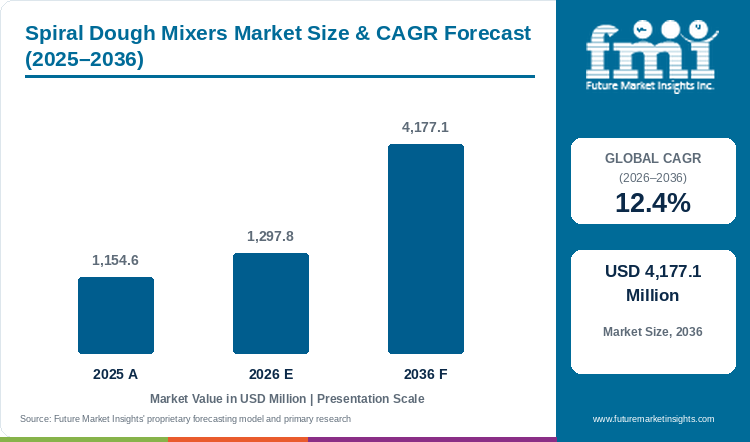
The market was valued at USD 1,154.6 million in 2025 and is expected to reach USD 1,297.8 million in 2026. It is projected to reach USD 4,177.1 million by 2036 at a CAGR of 12.4% from 2026 to 2036.
The spiral dough mixers market was valued at USD 1,154.6 million in 2025 and is estimated at USD 1,297.8 million in 2026. Forecast revenue reaches USD 4,177.1 million by 2036 at a CAGR of 12.4%, and spiral mixers account for 31.0% of equipment type demand in 2026. Middleby reported 25.0% organic sales growth in its Food Processing segment in the first quarter of 2026, indicating active investment across a broader equipment portfolio.[5] For dough mixing, the decision turns on batch consistency, temperature control and how quickly a bowl can be discharged and returned to service. Where those constraints already affect a bakery's schedule, automated ingredient addition and bowl handling can extend the value of an existing batch process before a plant adds capacity. Such projects still depend on the bread or pastry process being served; a faster mixer offers little benefit if proofing or make-up immediately becomes the next constraint.
Key Market Trends & Insights
- By equipment type: Spiral Mixers represented 31.0% of 2026 equipment type demand. Separate batches let a bakery change doughs through the day without a continuous line. The test is whether the lightest charge still moves around the tool as the full load does.
- By capacity: 500-2,000 kg/hr accounted for 40.0% of 2026 capacity demand. Hourly supply comes from whole cycles of charging, kneading and discharge, so one rating hides the slowest step. It's tested by whether bowl emptying keeps pace with the divider.
- By automation level: Fully Automatic / Robotic held 43.0% of 2026 automation level demand. Automation pays where dosing and bowl movement remove variation outside the kneading itself. The test is whether a single dosing delay stops the whole sequence or leaves the next bowl ready.
Regional Highlights
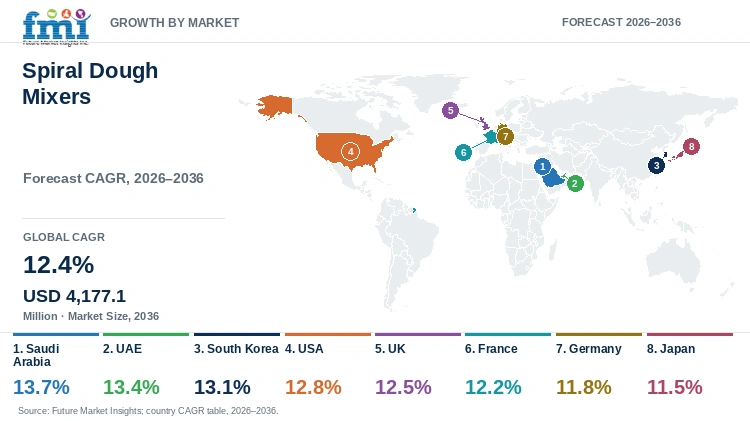
- Saudi Arabia has the highest projected spiral dough mixer growth at 13.7% CAGR from 2026 to 2036, placing a premium on batch consistency and the flow of dough into the next production stage.
- The UAE follows at 13.4%, South Korea at 13.1% and the USA at 12.8%, while Japan's 11.5% forecast remains positive despite being the lowest of the eight profiles.
Market Size & Forecast
Table 1: Spiral Dough Mixers Market Size and Forecast (USD million), 2025 to 2036
| Market size and forecast | Value |
|---|---|
| 2025 Value (actual) | USD 1,154.6 million |
| Estimated market size in 2026 | USD 1,297.8 million |
| Projected market size by 2036 | USD 4,177.1 million |
| CAGR (2026-2036) | 12.4% |
The practical opportunity depends on whether the mixing area keeps the next stage fed with dough in the required condition. VMI introduced a double-jacketed cooled-bowl option for its SPI range in April 2025.[2] WP Kemper presented KAIROS in May 2025 with process data and interfaces for further automated assistance.[3] Coperion’s SERBOTEL 2025 programme covered VMI mixers for batches up to 40 kg and the Genius range for up to 160 kg.[4] These options address temperature, repeatability and batch range, although a specification cannot show how a particular flour and recipe will behave. OSHA’s interpretation for vertical food mixers adds guarding obligations around rotating parts.[1] Consequently, actual demand will depend on whether a mixer improves dough condition and batch timing without adding handling or cleaning steps that cancel the gain.
Spiral Dough Mixers Market is segmented by Equipment Type, Capacity, Automation Level, End User, Sales Channel and Region. The forecast period runs from 2026 to 2036.
Kneading introduces a thermal constraint alongside mechanical dough development. VMI’s double-jacketed cooled bowl extends temperature control into its removable-bowl SPI range, including pastry applications.[2] The surrounding dough chilling and water metering systems establish incoming conditions, while mixing duration and the wait before discharge affect the final result. A bakery facing warm dough may have an opportunity to improve consistency without buying a larger bowl. Where the recipe changes frequently, the cooling arrangement must also remain compatible with normal loading, bowl movement and cleaning. This makes temperature control a process choice with implications beyond the mixer itself.
The market spans substantially different batch sizes. Coperion’s SERBOTEL 2025 presentation included VMI’s SPI 53 and 63 for batches up to 40 kg and the Genius range for up to 160 kg per batch.[4] Smaller batches can support a varied retail assortment, while larger ones reduce the number of preparations needed for established lines. Neither is automatically preferable when demand changes during the day. Underfilled large batches, repeated small loads and long waits for the next stage create different costs. Equipment selection therefore starts with the bakery’s routine and peak batch requirements, including the smallest recipe it expects staff to make reliably.
Process records create a common reference across operators and shifts. WP Kemper described KAIROS in May 2025 as prepared for AI assistance, with data collection and interfaces for further functions.[3] The present equipment proposition includes process information; additional autonomous functions remain a development direction. Records can help relate a change in dough to ingredients, mixing conditions or an intervention made during the batch. The benefit depends on staff being able to act on that information while production continues. Safe access remains a physical requirement alongside digital control: OSHA’s vertical-mixer interpretation addresses guarding around rotating parts.[1] Loading, inspection and discharge therefore shape the design of an automated mixing area just as much as the recipe programme.
Table 2: Supporting Industry Indicators for the Spiral Dough Mixers Market, 2025 to 2026 and current product specifications
| Indicator | Data point | Why it matters | Source |
|---|---|---|---|
| Broader processing-equipment sales | Middleby Food Processing organic sales increased 25.0% in Q1 2026. | Recent supplier trading indicates renewed capital-equipment activity. | [5] |
| Small-batch spiral mixing | Coperion presented SPI 53/63 mixers for batches up to 40 kg at SERBOTEL 2025. | A small batch range can suit frequent recipe changes and retail output. | [4] |
| Larger batch offer | Coperion presented Genius mixers for batches up to 160 kg. | Batch size changes the loading rhythm and receiving requirement. | [4] |
| Temperature-control development | VMI introduced a cooled-bowl SPI option in April 2025. | Thermal control supports recipes sensitive to final dough temperature. | [2] |
| Process-data platform | WP Kemper presented KAIROS with data and future-assistance interfaces in May 2025. | Recorded conditions can help reproduce accepted recipes across operators. | [3] |
| Installed guarding requirement | OSHA provides an interpretation covering vertical food mixers. | Safe access must fit routine loading and unloading tasks. | [1] |
Demand Intensity Analysis
The spiral dough mixers market is forecast to generate an additional USD 2,879.3 million in annual revenue between 2026 and 2036, growing at a 12.4% value CAGR. Capacity investment, renewal and control of temperature or batch handling create different reasons for buying a mixer. Middleby’s Food Processing segment reported 25.0% organic sales growth in the first quarter of 2026, which gives recent context from a broader processing-equipment business.[5] Within spiral mixing, a temperature-sensitive dough can create demand for cooling, while more production shifts can strengthen the case for reproducible records and transfers. Their economic purpose is to deliver dough of the required condition with fewer delays and corrections, allowing better use of the bakery’s forming and baking capacity.
The 500-2,000 kg/hr category contributes USD 519.1 million in 2026. Successive complete batches establish that hourly supply, with charging and emptying occupying part of each cycle. A removable-bowl arrangement can separate some of those tasks from the mixer but needs space for bowl movement and waiting loads. A fixed-bowl machine creates a different loading and discharge pattern. Coperion’s published offer ranges from SPI models serving batches up to 40 kg to Genius equipment for up to 160 kg.[4] These examples show why the required batch range can be more informative for purchasing than a single hourly rating. Capacity decisions therefore start from the smallest and largest batch the plant expects to run.
Fully automatic / robotic equipment represents USD 558.1 million in 2026. Automation can coordinate additions and reduce repeated manual handling around heavy bowls. It also increases dependence on the connected sequence: a dosing delay or unavailable discharge point can leave the mixing mechanism idle. Repetitive production provides more scope to spread that investment over many batches, while a varied small-batch operation may benefit more from accessible controls and a broad working range. Demand consequently supports several degrees of mechanisation. The spending follows the tasks that interrupt dough supply, rather than a universal preference for the highest automation level. Interfaces to dosing and discharge equipment therefore belong in the purchase scope from the start.
Industrial bakeries account for USD 635.9 million in 2026. Mixing commits dough to the stages that follow: once a batch is developed, resting and transfer have to fit the pace of dividing or sheeting. An additional mixer has limited value if bowls cannot be emptied or returned quickly enough. Industrial demand therefore includes lifting, discharge and ingredient connections around the mixing mechanism. Replacement can be justified by those handling requirements even where the motor and bowl still provide sufficient kneading capacity. This makes the mixing area, rather than the mixer alone, the relevant unit of capital investment. Long-term sales are ultimately determined by whether the mixing area keeps forming fed without delay.
Table 3: Demand Intensity Metrics for the Spiral Dough Mixers Market, 2026 to 2036 with relevant industry comparisons
| Demand intensity metric | Value | Basis |
|---|---|---|
| Spiral dough mixers value CAGR | 12.4% | Global market value growth, 2026 to 2036. |
| Broader processing-equipment sales growth | 25.0% | Middleby Food Processing organic growth, Q1 2026.[5] |
| Illustrative small-batch maximum | 40 kg per batch | VMI SPI 53/63 offer presented by Coperion at SERBOTEL 2025.[4] |
| Illustrative larger-batch maximum | 160 kg per batch | VMI Genius range presented by Coperion at SERBOTEL 2025.[4] |
| Industrial-bakery revenue, 2026 | USD 635.9 million | End User category. |
| 500-2,000 kg/hr revenue, 2026 | USD 519.1 million | Capacity category. |
| Fully automatic / robotic revenue, 2026 | USD 558.1 million | Automation Level category. |
Analyst Perspective
A spiral mixer earns a lasting place when it delivers dough in the required condition without disrupting the flow to forming. Suppliers that tie cooling, records and bowl handling to the batch cycle keep the order, while one that adds handling steps loses it.
- Nandini Roy Choudhury, Principal Analyst at Future Market Insights
How is the spiral dough mixers market segmented?
The spiral dough mixers market is segmented by Equipment Type (Spiral mixers, Planetary mixers, Horizontal mixers, Continuous mixing systems), Capacity (500-2,000 kg/hr, Below 500 kg/hr, Above 2,000 kg/hr), Automation Level (Fully automatic / robotic, Semi-automatic, Manual), End User (Industrial bakeries, In-store & retail bakeries, Artisan bakeries, Foodservice / QSR central kitchens), and Sales Channel (Direct OEM sales, Dealers & distributors, Aftermarket & refurbished). Regionally, the market is segmented into North America, Latin America, Western Europe, Eastern Europe, East Asia, South Asia and Pacific, and Middle East and Africa.
Why do Spiral mixers anchor the Equipment Type category?
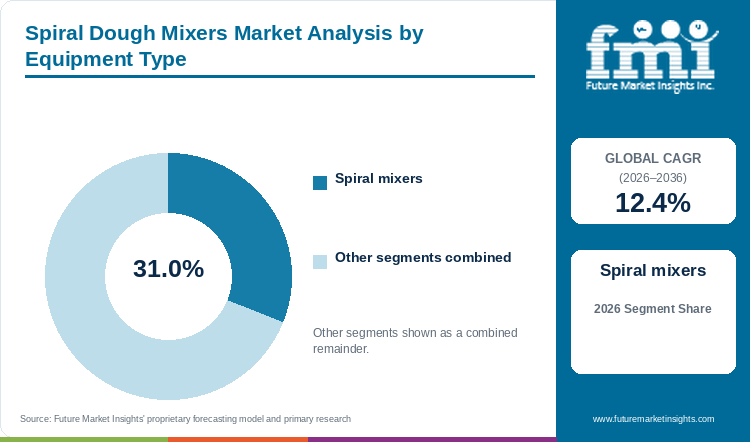
Spiral mixers lead with 31.0% of Equipment Type revenue in 2026.
A spiral tool and rotating bowl develop yeast dough in separate batches, which suits bread and pizza production with changing quantities and formulations. The working range depends on how dough moves at both small and full loads, so a larger nominal bowl can be unhelpful when a bakery often mixes less. Other architectures, including planetary mixers, answer different preparation needs.
- Spiral mixers hold 31.0% of Equipment Type revenue in 2026, with batch operation accommodating varied dough quantities and formulations.
- The mixer needs to move dough effectively at the smallest batch the bakery expects to make.
How does 500-2,000 kg/hr balance capacity and flexibility?
500-2,000 kg/hr leads with 40.0% of Capacity revenue in 2026.
The middle band lets a bakery raise batch supply without the largest ingredient-handling installations. Hourly output depends on charging, kneading and discharge together. A slow bowl-emptying step leaves a capable mixer and the receiving divider waiting, and shortening kneading does not remove that delay. A larger batch can also overwhelm a forming stage built for smaller deliveries.
- The 500-2,000 kg/hr category leads Capacity with 40.0%; complete batch cycles determine the hourly dough supply.
- Bowl emptying needs to keep pace with the divider, since kneading time alone does not set output.
What makes Fully automatic / robotic systems attractive to bakery operators?
Fully automatic / robotic leads with 43.0% of Automation Level revenue in 2026.
Automatic ingredient additions and bowl movement reduce variation in the tasks around kneading. The mechanism repeats its programme, but manual weighing or a late transfer still changes the batch. Coordination links the mixer to dosing and discharge equipment, so an interruption in either can hold up the sequence. Demand is strongest where repeat batches and dependable interfaces justify the link.
- Fully automatic / robotic leads Automation Level with 43.0% of 2026 revenue, extending control to ingredient addition and material movement.
- A delay at the dosing point needs to show early enough for operators to protect the batch sequence.
Why are Industrial bakeries the principal End User?
Industrial bakeries lead with 49.0% of End User revenue in 2026.
An industrial mixing room feeds several later operations whose timing cannot drift apart for long. A stoppage leaves forming equipment idle, while an early batch waits longer than intended before dividing. Multiple shifts raise the value of dependable discharge and maintenance support, which explains spending on bowl handling and ingredient connections alongside the mixer. Retail bakeries and central kitchens set different batch priorities.
- Industrial bakeries generate 49.0% of End User revenue in 2026; their connected lines depend on a regular supply of developed dough.
- Discharge from the mixer needs to match the divider feed across successive batches.
Why does Direct OEM sales dominate equipment purchasing?
Direct OEM sales hold 61.0% of Sales Channel revenue in 2026.
Industrial mixing projects include recipe programming, dosing connections and equipment for lifting or emptying bowls. Buying from the manufacturer places one technical owner over those interfaces, and the contract can state who provides each transfer component and how the sequence will be accepted. Dealers remain a route for standard machines and local support. Refurbished units raise questions about guarding, hygiene history and control compatibility.
- Direct OEM sales hold 61.0% of Sales Channel revenue in 2026, bringing mixer configuration and commissioning into one engineering discussion.
- Lifting hardware, dosing links and discharge controls need an identified technical owner.
What are the drivers, restraints and opportunities in the spiral dough mixers market?
Repeatable dough development supports batch automation
Spiral mixing keeps the flexibility of separate batches while allowing repetitive tasks to be mechanised. Ingredient addition, bowl movement and discharge can become more consistent without forcing every recipe into a continuous process. Coperion’s SERBOTEL 2025 programme placed spiral mixing alongside fermentation technologies, which links kneading to later preparation.[4] A supplier gains where removing a repeated manual transfer or coordinating the next bowl gives the divider a steadier supply.
Heat and ingredient variation complicate scale-up
Scale-up exposes a thermal limit as well as a volume limit. Ingredient temperature, kneading and the interval before forming all shape final dough condition, and a larger bowl does not preserve it across a heavier run. VMI’s 2025 cooled-bowl option addresses temperature-sensitive work within a removable-bowl spiral arrangement.[2] A supplier gains where cooling is sold as a process-control purchase rather than as added nominal capacity.
Process records can make specialist mixing knowledge easier to repeat
Specialist mixing knowledge sits in the adjustments an experienced baker makes during a batch. Process records make those decisions visible to other shifts and explain why a familiar recipe behaved differently. WP Kemper’s May 2025 KAIROS presentation emphasised data collection and interfaces for further automated assistance.[3] A supplier gains where the records are used to preserve dough characteristics through staff changes or ingredient variation, not merely accumulated.
Which country CAGRs are profiled in the spiral dough mixers market?
Table 4: Country growth outlook for the spiral dough mixers market
| Country | CAGR, 2026 to 2036 |
|---|---|
| Saudi Arabia | 13.7% |
| UAE | 13.4% |
| South Korea | 13.1% |
| USA | 12.8% |
| UK | 12.5% |
| France | 12.2% |
| Germany | 11.8% |
| Japan | 11.5% |
Saudi Arabia
Saudi Arabia has the highest profiled CAGR at 13.7% for 2026 to 2036, above the global rate of 12.4%. The USDA Foreign Agricultural Service reported in April 2026 that distributors serve about 11,700 food establishments, including 6,500 licensed bakeries. The count shows how widely bread is made across the Kingdom, not how many of those bakeries will buy a new mixer. New mixing areas need dosing, lifting and discharge equipment around the spiral mechanism, and temperature-sensitive recipes can add water control or bowl cooling to the project scope. However, a transfer point left unresolved can leave sufficient mixing capacity unused. Demand will depend on how many projects specify the surrounding equipment together with the mixer.
UAE
The UAE is forecast at 13.4% CAGR from 2026 to 2036, above the global rate of 12.4%. The USDA Foreign Agricultural Service’s April 2026 report notes that bread is often eaten two to three times a day. It also lists wheat and bread among nine basic items under a six-month price freeze. The report describes demand, not mixer purchases, and a freeze limits how far bakeries can pass cost into shelf prices. A central bakery serving several order sizes may need a broad batch range more than a larger bowl. However, removable bowls occupy space while waiting, emptying or being cleaned. Demand will depend on how many bakeries can balance batch size against handling space.
South Korea
South Korea’s outlook is 13.1% CAGR over 2026 to 2036, above the global rate of 12.4%. The USDA Foreign Agricultural Service’s April 2026 Grain and Feed Annual estimates that bread takes about 20.0% of Korean flour demand, behind noodles at about 40.0%. The share shows that bread matters to millers, not how many bakeries will replace mixers. A new flour blend or hydration level can change the development required even when the finished format stays familiar, so recipe records help carry a change across several shifts. However, SPC Group plans a Texas bakery plant for 2027 that will replace some frozen dough made in Korea. Demand will depend on how many Korean producers keep dough output at home.
USA
The USA is forecast at 12.8% CAGR through 2036, above the global rate of 12.4%. The Bureau of Labor Statistics’ producer price index for commercial bakeries stood 2.5% above its level a year earlier in September 2026. Moderate price growth leaves bakeries limited room to absorb dough waste, although the index does not measure mixer spending. OSHA’s interpretation for vertical food mixers places guarding around rotating parts within US operating requirements,[1] which matters when loading, inspection or discharge changes during a replacement. However, industrial projects may also need to carry one dough specification across sites with different ingredient feeds and floor layouts. Demand will depend on whether manufacturer engineering can adapt that specification to each installation.
UK
The UK market is projected at 12.5% CAGR from 2026 to 2036, slightly above the global rate of 12.4%. The Federation of Bakers reported in 2025 that 83.7% of bread and morning goods bought in the UK are pre-packed. The share points to plant-scale production where batch handling is already coordinated, although it does not show mixer replacement. A larger bowl can create an unloading problem before it creates more useful output. That constrains replacements in existing workrooms where guard movement, lifting equipment and cleaning access compete for space. However, fixed and removable bowl designs address that constraint differently. Demand will depend on how many replacements fit existing floor space without rebuilding the mixing area.
France
France is forecast at 12.2% CAGR over 2026 to 2036, below the global rate of 12.4%. The Observatoire de la formation des prix et des marges put wheat at 6.2% of the baguette’s retail price excluding VAT in 2025. The share suggests that dough consistency and downstream yield weigh more on a baker’s result than the grain, though not equipment spending. Coperion’s SERBOTEL 2025 programme presented spiral mixers alongside related preparation equipment in France,[4] and a batch has value only when it reaches fermentation and forming on time. However, a smaller bakery may keep separate batches and manual finishing, while an industrial site coordinates discharge with dough processing system equipment. Demand will depend on how many French bakeries need discharge coordinated with later stages.
Germany
Germany is projected at 11.8% CAGR from 2026 to 2036, below the global rate of 12.4%. The Zentralverband des Deutschen Bäckerhandwerks reported that craft bakeries fell 2.8% to 8,659 in 2025 while revenue rose 1.3% to EUR 18.14 billion. Fewer businesses selling more points to consolidated production, though the figures do not identify equipment spending. A replacement that reduces repeated corrections can be valuable without changing batch weight. Final dough temperature and the order of additions help show whether the limit lies in mixing, ingredient variation or waiting before discharge. However, a larger bowl rarely fixes any of these causes. Demand will depend on whether sites buy process improvements around the mixer or only more volume.
Japan
Japan is projected at 11.5% CAGR for 2026 to 2036, the lowest profiled rate and below the global 12.4%. Japan’s agriculture ministry raised the price of imported wheat sold to millers by 12.0% to 70,020 yen per tonne from October 2026. Dearer flour raises the cost of every dough that has to be remade, though it does not show mixer demand. Minimum batch size matters when a Japanese bakery makes several doughs in short runs, and a small charge must still reach the next operation at the right temperature. VMI’s cooled-bowl development illustrates one such option.[2] However, a sensitive dough must also reach the surrounding bakery processing equipment in forming condition. Demand will depend on how many short-run bakeries value thermal control over bowl size.
Who are the notable companies in the spiral dough mixers market?
DIOSNA; VMI; Escher Mixers; Sancassiano; WP Kemper
DIOSNA, VMI, Escher Mixers, Sancassiano and WP Kemper offer different combinations of spiral tools, bowl arrangements and surrounding automation. Fixed and removable bowls create different handling requirements, while cooling and process-data functions address variation in the dough. The range of architectures gives suppliers several ways to improve a mixing area without assuming that every bakery needs a larger batch.
Application knowledge helps preserve dough development as the batch range or ingredient supply changes. Engineering support addresses a separate need: coordinating dosing, bowl movement and discharge. Suppliers able to provide both can participate in the equipment around the mixer and in later upgrades, extending the commercial relationship beyond the initial kneading unit.
Competitive Benchmarking: Spiral Dough Mixers Market
Table 5: Company capabilities in the spiral dough mixers market
| Company | Relevant offer | Commercial capability |
|---|---|---|
| DIOSNA | SP and SPV spiral mixers | Fixed and removable-bowl kneading configurations |
| VMI | SPI and Genius spiral mixers | Batch kneading with temperature-control options |
| Escher Mixers | Fixed and removable-bowl spiral mixers | Mixing combined with lifting and discharge arrangements |
| Sancassiano | Single- and double-spiral mixers | Programmable mixing and automated bowl systems |
| WP Kemper | Spiral mixers and KAIROS platform | Recipe control and process-information functions |
Key Developments in the Spiral Dough Mixers Market
- VMI announced a double-jacketed cooled-bowl option for its SPI spiral range in April 2025 ahead of iba. It addresses temperature-sensitive batch applications while retaining removable-bowl handling.[2]
- WP Kemper introduced KAIROS in May 2025, combining process-data collection with interfaces for further automation and operator assistance.[3]
Key Players in the Spiral Dough Mixers Market
- DIOSNA
- VMI
- Escher Mixers
- Sancassiano
- WP Kemper
Spiral Dough Mixers Market - Report Scope
Table 6: Report scope for the spiral dough mixers market
| Coverage field | Report scope |
|---|---|
| Market breakdown | Equipment Type, Capacity, Automation Level, End User, Sales Channel |
| Quantitative Units | USD Million |
| Market Definition | Revenue from new and refurbished commercial dough-mixing equipment within the equipment-type categories. Include the identifiable mixer value of bundled production lines; exclude finished baked-goods sales, stand-alone adjacent forming or baking equipment, unrelated service contracts and parts-only transactions. |
| Regions Covered | North America, Latin America, Western Europe, Eastern Europe, East Asia, South Asia and Pacific, Middle East and Africa |
| Countries Covered | Saudi Arabia; UAE; South Korea; USA; UK; France; Germany; Japan |
| Key Companies Profiled | DIOSNA; VMI; Escher Mixers; Sancassiano; WP Kemper |
| Forecast Period | 2026 to 2036 |
| Approach | Market assessment supported by official technical and regulatory publications, company product information and country operating conditions. |
Spiral Dough Mixers Market - Research Methodology
Table 7: Research approach for the spiral dough mixers market
| Method | Approach |
|---|---|
| Market coverage | The assessment follows the equipment sold, its bakery application and the revenue boundaries stated in the market definition. |
| Secondary evidence | Government and technical publications are considered alongside first-party product information and dated corporate announcements. |
| Commercial analysis | Purchasing requirements, operating constraints, service needs and country-specific routes to market inform the interpretation of demand. |
| Forecast presentation | Global values, leading segment shares and country growth rates are stated for the 2026 to 2036 forecast period. |
Spiral Dough Mixers Market by Segments
Equipment Type
- Spiral mixers
- Planetary mixers
- Horizontal mixers
- Continuous mixing systems
Capacity
- 500-2,000 kg/hr
- Below 500 kg/hr
- Above 2,000 kg/hr
Automation Level
- Fully automatic / robotic
- Semi-automatic
- Manual
End User
- Industrial bakeries
- In-store & retail bakeries
- Artisan bakeries
- Foodservice / QSR central kitchens
Sales Channel
- Direct OEM sales
- Dealers & distributors
- Aftermarket & refurbished
Spiral Dough Mixers Market by Region
- North America
- United States
- Canada
- Latin America
- Brazil
- Mexico
- Argentina
- Chile
- Western Europe
- Germany
- France
- United Kingdom
- Italy
- Spain
- Benelux
- Nordics
- Eastern Europe
- Poland
- Czech Republic
- Romania
- Hungary
- East Asia
- China
- Japan
- South Korea
- South Asia and Pacific
- India
- ASEAN
- Australia and New Zealand
- Middle East and Africa
- GCC Countries
- South Africa
- Türkiye
- Israel
Research Sources and Bibliography
- [1] Occupational Safety and Health Administration. (1999, February 26). OSHA enforcement policy on vertical food mixers.
- [2] VMI SA. (2025, April 24). VMI introduces new cooling option for its renowned SPI spiral mixer.
- [3] WP Kemper GmbH. (2025, May 16). KAIROS: The mixer already thinking in AI.
- [4] Coperion. (2025, October). Coperion at SERBOTEL 2025.
- [5] The Middleby Corporation. (2026, May 7). The Middleby Corporation reports first quarter results.
This Report Answers
- How large is the spiral dough mixers market in 2026, and what value is forecast for 2036?
- Which industrial operating pressures are influencing demand for controlled dough mixing?
- Why do Spiral mixers account for the leading Equipment Type share?
- Why is the 500-2,000 kg/hr band the largest Capacity segment?
- How do profiled country growth rates differ between Saudi Arabia and Japan?
- Which profiled companies document mixing machinery, and which focus on related bakery lines?
Frequently Asked Questions
How big is the spiral dough mixers market in 2026, and what is forecast for 2036?
It is valued at USD 1,297.8 Million in 2026 and is forecast at USD 4,177.1 Million in 2036.
What is the CAGR for the spiral dough mixers market from 2026 to 2036?
The forecast CAGR is 12.4% from 2026 to 2036.
Which Equipment Type segment leads the spiral dough mixers market?
Spiral mixers lead with a 31.0% share of 2026 Equipment Type revenue. Their established handling of elastic bread and pizza dough supports use across varied commercial bakery sizes.
Which Capacity segment contributes the largest share?
500-2,000 kg/hr leads Capacity at 40.0% in 2026. The range can support mechanised production without requiring the scale of the largest continuous installations.
Which profiled countries have the fastest growth rates?
Saudi Arabia leads at 13.7%, followed by UAE at 13.4% and South Korea at 13.1% from 2026 to 2036.
Which companies participate in the spiral dough mixers market?
Relevant participants include DIOSNA, VMI, Escher Mixers, Sancassiano and WP Kemper.
Preview the report firsthand - request a free sample
Get SampleGet the brochure for pricing and purchase details.
Get PDFTable of Content
- Key Takeaways
- Market Size and CAGR
- Top Growth Driver
- Fastest Growing Segment
- Leading Region
- Key Companies
- Emerging Opportunities
- Executive Summary
- Global Market Outlook
- Demand-side Trends
- Supply-side Trends
- Technology Roadmap Analysis
- Analysis and Recommendations
- Analyst Perspective (What is happening? Why now? What should investors know?)
- Key Questions Answered
- How large is the market?
- What is the CAGR?
- What are key trends?
- Which region dominates?
- Who are the leaders?
- Market Overview
- Market Coverage / Taxonomy
- Market Definition / Scope / Limitations
- Research Methodology
- Chapter Orientation
- Analytical Lens and Working Hypotheses
- Market Structure, Signals, and Trend Drivers
- Benchmarking and Cross-market Comparability
- Market Sizing, Forecasting, and Opportunity Mapping
- Research Design and Evidence Framework
- Desk Research Programme (Secondary Evidence)
- Expert Input and Fieldwork (Primary Evidence)
- Tooling, Models, and Reference Databases
- Data Engineering and Model Build
- Quality Assurance and Audit Trail
- Market Background
- Market Dynamics (Drivers, Restraints, Opportunity, Trends)
- Scenario Forecast (Optimistic, Likely, Conservative)
- Impact Analysis
- AI Impact
- Sustainability Impact
- Regulatory Impact
- Technology Impact
- Consumer / Buyer Analysis
- Purchase Drivers
- Adoption Barriers
- Buyer Journey
- Opportunity Map Analysis
- Product Life Cycle Analysis
- Supply Chain Analysis
- Investment Feasibility Matrix
- Value Chain Analysis
- PESTLE and Porter's Analysis
- Regulatory Landscape
- Regional Parent Market Outlook
- Production and Consumption Statistics
- Import and Export Statistics
- Global Market Analysis and Forecast, 2021 to 2036
- Historical Market Size Value (USD Million) Analysis, 2021 to 2025
- Current and Future Market Size Value (USD Million) Projections, 2026 to 2036
- Y-o-Y Growth Trend Analysis
- Absolute $ Opportunity Analysis
- Global Market Pricing Analysis, 2021 to 2036
- Global Market Analysis and Forecast, By Equipment Type, 2021 to 2036
- Introduction / Key Findings
- Historical Market Size Value (USD Million) Analysis By Equipment Type, 2021 to 2025
- Current and Future Market Size Value (USD Million) Analysis and Forecast By Equipment Type, 2026 to 2036
- Spiral mixers
- Planetary mixers
- Horizontal mixers
- Continuous mixing systems
- Y-o-Y Growth Trend Analysis By Equipment Type, 2021 to 2025
- Absolute $ Opportunity Analysis By Equipment Type, 2026 to 2036
- Global Market Analysis and Forecast, By Capacity, 2021 to 2036
- Introduction / Key Findings
- Historical Market Size Value (USD Million) Analysis By Capacity, 2021 to 2025
- Current and Future Market Size Value (USD Million) Analysis and Forecast By Capacity, 2026 to 2036
- 500-2,000 kg/hr
- Below 500 kg/hr
- Above 2,000 kg/hr
- Y-o-Y Growth Trend Analysis By Capacity, 2021 to 2025
- Absolute $ Opportunity Analysis By Capacity, 2026 to 2036
- Global Market Analysis and Forecast, By Automation Level, 2021 to 2036
- Introduction / Key Findings
- Historical Market Size Value (USD Million) Analysis By Automation Level, 2021 to 2025
- Current and Future Market Size Value (USD Million) Analysis and Forecast By Automation Level, 2026 to 2036
- Fully automatic / robotic
- Semi-automatic
- Manual
- Y-o-Y Growth Trend Analysis By Automation Level, 2021 to 2025
- Absolute $ Opportunity Analysis By Automation Level, 2026 to 2036
- Global Market Analysis and Forecast, By End User, 2021 to 2036
- Introduction / Key Findings
- Historical Market Size Value (USD Million) Analysis By End User, 2021 to 2025
- Current and Future Market Size Value (USD Million) Analysis and Forecast By End User, 2026 to 2036
- Industrial bakeries
- In-store & retail bakeries
- Artisan bakeries
- Foodservice / QSR central kitchens
- Y-o-Y Growth Trend Analysis By End User, 2021 to 2025
- Absolute $ Opportunity Analysis By End User, 2026 to 2036
- Global Market Analysis and Forecast, By Sales Channel, 2021 to 2036
- Introduction / Key Findings
- Historical Market Size Value (USD Million) Analysis By Sales Channel, 2021 to 2025
- Current and Future Market Size Value (USD Million) Analysis and Forecast By Sales Channel, 2026 to 2036
- Direct OEM sales
- Dealers & distributors
- Aftermarket & refurbished
- Y-o-Y Growth Trend Analysis By Sales Channel, 2021 to 2025
- Absolute $ Opportunity Analysis By Sales Channel, 2026 to 2036
- Global Market Analysis and Forecast, By Region, 2021 to 2036
- Introduction
- Historical Market Size Value (USD Million) Analysis By Region, 2021 to 2025
- Current Market Size Value (USD Million) Analysis and Forecast By Region, 2026 to 2036
- North America
- Latin America
- Western Europe
- Eastern Europe
- East Asia
- South Asia and Pacific
- Middle East and Africa
- Market Attractiveness Analysis By Region
- North America Market Analysis and Forecast, By Country, 2021 to 2036
- Historical Market Size Value (USD Million) Trend Analysis By Market Taxonomy, 2021 to 2025
- Market Size Value (USD Million) Forecast By Market Taxonomy, 2026 to 2036
- By Country
- United States
- Canada
- By Equipment Type
- By Capacity
- By Automation Level
- By End User
- By Sales Channel
- By Country
- Market Attractiveness Analysis
- By Country
- By Equipment Type
- By Capacity
- By Automation Level
- By End User
- By Sales Channel
- Key Takeaways
- Latin America Market Analysis and Forecast, By Country
- Historical Market Size Value (USD Million) Trend Analysis By Market Taxonomy, 2021 to 2025
- Market Size Value (USD Million) Forecast By Market Taxonomy, 2026 to 2036
- By Country
- Brazil
- Mexico
- Argentina
- Chile
- By Equipment Type
- By Capacity
- By Automation Level
- By End User
- By Sales Channel
- By Country
- Market Attractiveness Analysis
- By Country
- By Equipment Type
- By Capacity
- By Automation Level
- By End User
- By Sales Channel
- Key Takeaways
- Western Europe Market Analysis and Forecast, By Country
- Historical Market Size Value (USD Million) Trend Analysis By Market Taxonomy, 2021 to 2025
- Market Size Value (USD Million) Forecast By Market Taxonomy, 2026 to 2036
- By Country
- Germany
- France
- United Kingdom
- Italy
- Spain
- Benelux
- Nordics
- By Equipment Type
- By Capacity
- By Automation Level
- By End User
- By Sales Channel
- By Country
- Market Attractiveness Analysis
- By Country
- By Equipment Type
- By Capacity
- By Automation Level
- By End User
- By Sales Channel
- Key Takeaways
- Eastern Europe Market Analysis and Forecast, By Country
- Historical Market Size Value (USD Million) Trend Analysis By Market Taxonomy, 2021 to 2025
- Market Size Value (USD Million) Forecast By Market Taxonomy, 2026 to 2036
- By Country
- Poland
- Czech Republic
- Romania
- Hungary
- By Equipment Type
- By Capacity
- By Automation Level
- By End User
- By Sales Channel
- By Country
- Market Attractiveness Analysis
- By Country
- By Equipment Type
- By Capacity
- By Automation Level
- By End User
- By Sales Channel
- Key Takeaways
- East Asia Market Analysis and Forecast, By Country
- Historical Market Size Value (USD Million) Trend Analysis By Market Taxonomy, 2021 to 2025
- Market Size Value (USD Million) Forecast By Market Taxonomy, 2026 to 2036
- By Country
- China
- Japan
- South Korea
- By Equipment Type
- By Capacity
- By Automation Level
- By End User
- By Sales Channel
- By Country
- Market Attractiveness Analysis
- By Country
- By Equipment Type
- By Capacity
- By Automation Level
- By End User
- By Sales Channel
- Key Takeaways
- South Asia and Pacific Market Analysis and Forecast, By Country
- Historical Market Size Value (USD Million) Trend Analysis By Market Taxonomy, 2021 to 2025
- Market Size Value (USD Million) Forecast By Market Taxonomy, 2026 to 2036
- By Country
- India
- ASEAN
- Australia and New Zealand
- By Equipment Type
- By Capacity
- By Automation Level
- By End User
- By Sales Channel
- By Country
- Market Attractiveness Analysis
- By Country
- By Equipment Type
- By Capacity
- By Automation Level
- By End User
- By Sales Channel
- Key Takeaways
- Middle East and Africa Market Analysis and Forecast, By Country
- Historical Market Size Value (USD Million) Trend Analysis By Market Taxonomy, 2021 to 2025
- Market Size Value (USD Million) Forecast By Market Taxonomy, 2026 to 2036
- By Country
- GCC Countries
- South Africa
- Türkiye
- Israel
- By Equipment Type
- By Capacity
- By Automation Level
- By End User
- By Sales Channel
- By Country
- Market Attractiveness Analysis
- By Country
- By Equipment Type
- By Capacity
- By Automation Level
- By End User
- By Sales Channel
- Key Takeaways
- Key Countries Market Analysis
- United States
- Pricing Analysis
- Market Share Analysis, 2025
- By Equipment Type
- By Capacity
- By Automation Level
- By End User
- By Sales Channel
- Canada
- Pricing Analysis
- Market Share Analysis, 2025
- By Equipment Type
- By Capacity
- By Automation Level
- By End User
- By Sales Channel
- Mexico
- Pricing Analysis
- Market Share Analysis, 2025
- By Equipment Type
- By Capacity
- By Automation Level
- By End User
- By Sales Channel
- Brazil
- Pricing Analysis
- Market Share Analysis, 2025
- By Equipment Type
- By Capacity
- By Automation Level
- By End User
- By Sales Channel
- Chile
- Pricing Analysis
- Market Share Analysis, 2025
- By Equipment Type
- By Capacity
- By Automation Level
- By End User
- By Sales Channel
- Germany
- Pricing Analysis
- Market Share Analysis, 2025
- By Equipment Type
- By Capacity
- By Automation Level
- By End User
- By Sales Channel
- United Kingdom
- Pricing Analysis
- Market Share Analysis, 2025
- By Equipment Type
- By Capacity
- By Automation Level
- By End User
- By Sales Channel
- Italy
- Pricing Analysis
- Market Share Analysis, 2025
- By Equipment Type
- By Capacity
- By Automation Level
- By End User
- By Sales Channel
- Spain
- Pricing Analysis
- Market Share Analysis, 2025
- By Equipment Type
- By Capacity
- By Automation Level
- By End User
- By Sales Channel
- France
- Pricing Analysis
- Market Share Analysis, 2025
- By Equipment Type
- By Capacity
- By Automation Level
- By End User
- By Sales Channel
- India
- Pricing Analysis
- Market Share Analysis, 2025
- By Equipment Type
- By Capacity
- By Automation Level
- By End User
- By Sales Channel
- ASEAN
- Pricing Analysis
- Market Share Analysis, 2025
- By Equipment Type
- By Capacity
- By Automation Level
- By End User
- By Sales Channel
- Australia and New Zealand
- Pricing Analysis
- Market Share Analysis, 2025
- By Equipment Type
- By Capacity
- By Automation Level
- By End User
- By Sales Channel
- China
- Pricing Analysis
- Market Share Analysis, 2025
- By Equipment Type
- By Capacity
- By Automation Level
- By End User
- By Sales Channel
- Japan
- Pricing Analysis
- Market Share Analysis, 2025
- By Equipment Type
- By Capacity
- By Automation Level
- By End User
- By Sales Channel
- South Korea
- Pricing Analysis
- Market Share Analysis, 2025
- By Equipment Type
- By Capacity
- By Automation Level
- By End User
- By Sales Channel
- Poland
- Pricing Analysis
- Market Share Analysis, 2025
- By Equipment Type
- By Capacity
- By Automation Level
- By End User
- By Sales Channel
- Hungary
- Pricing Analysis
- Market Share Analysis, 2025
- By Equipment Type
- By Capacity
- By Automation Level
- By End User
- By Sales Channel
- Türkiye
- Pricing Analysis
- Market Share Analysis, 2025
- By Equipment Type
- By Capacity
- By Automation Level
- By End User
- By Sales Channel
- South Africa
- Pricing Analysis
- Market Share Analysis, 2025
- By Equipment Type
- By Capacity
- By Automation Level
- By End User
- By Sales Channel
- Saudi Arabia
- Pricing Analysis
- Market Share Analysis, 2025
- By Equipment Type
- By Capacity
- By Automation Level
- By End User
- By Sales Channel
- UAE
- Pricing Analysis
- Market Share Analysis, 2025
- By Equipment Type
- By Capacity
- By Automation Level
- By End User
- By Sales Channel
- United States
- Market Structure Analysis
- Competition Dashboard
- Competition Benchmarking
- Market Share Analysis of Top Players
- By Regional
- By Equipment Type
- By Capacity
- By Automation Level
- By End User
- By Sales Channel
- Emerging Startups
- Innovation Benchmarking
- Competition Analysis
- Competition Deep Dive
- DIOSNA
- Overview
- Product Portfolio
- Profitability by Market Segments
- Sales Footprint
- Strategy Overview
- Marketing Strategy
- Product Strategy
- Channel Strategy
- VMI
- Escher Mixers
- Sancassiano
- WP Kemper
- DIOSNA
- Case Studies
- Success Stories
- Recent Developments
- Competition Deep Dive
- Assumptions & Acronyms Used


