

- Market Size (2026)
- USD 2.1 Bn
- Forecast (2036)
- USD 3.6 Bn
- CAGR (2026 to 2036)
- 5.4%
How big is the Steering Intermediate Shaft Market in 2026?
USD 2.1 billion in 2026 and USD 3.6 billion by 2036 at a 5.4% CAGR.
Vehicle platform redesign is reshaping steering intermediate shaft demand during the forecast period. OEMs are moving toward electric power steering layouts and tighter crash validation. The International Energy Agency projected in May 2026 that global electric car sales would reach 23 million in 2026. That shift is significant for shaft suppliers due to compact steering packages that need low-friction joints and controlled collapse behavior.
Passenger vehicle OEMs, dealer service networks and aftermarket distributors are some end users driving demand. Their adoption is attributable to safety sign-off and the need to hold steering feel across platform variants. Steering shafts create value by reducing late design changes and preventing service mismatch. Buyers gain value from assemblies that reduce late design changes and keep service teams aligned to approved part specifications. That means suppliers need engineering evidence before price discussions, especially in programs carrying comfort and safety targets.
North America and Western Europe focus on recall control and stable supplier qualification. China and India place more emphasis on new platform launches and EV or SUV program scale. The product becomes more valuable as it links crash performance and steering architecture decisions which makes supplier selection strategic in cases where steering architecture and service coverage must be considered together.
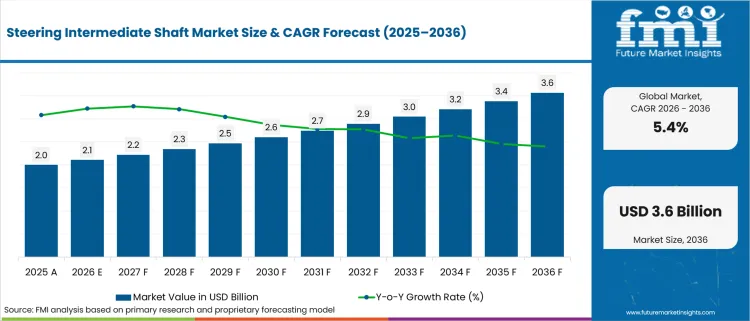
| Metric | Value |
|---|---|
| 2025 Market Size | USD 2.0 billion |
| 2026 Market Size | USD 2.1 billion |
| 2036 Market Size | USD 3.6 billion |
| Forecast CAGR (2026-2036) | 5.4% |
| Shaft Type Focus | Collapsible Shafts |
| Collapsible Shafts Share (2026) | 42.0% |
| Vehicle Type Focus | Passenger Cars |
| Passenger Cars Share (2026) | 57.5% |
| Steering System Focus | EPS |
| EPS Share (2026) | 68.0% |
| Fastest-growing Country | China |
| China CAGR by 2036 | 6.6% |
Summary of the Steering Intermediate Shaft Market
| Market Signal | Commercial Impact |
|---|---|
| Demand and Growth Drivers | Demand for steering intermediate shafts is increasing as electric steering systems, vehicle safety requirements, and expanding EV platforms drive OEM sourcing and replacement opportunities.
|
| Product and Segment View | Collapsible shafts, electronic power steering systems, and steel materials continue to dominate market demand across OEM vehicle programs.
|
| Geography and Growth Outlook | Asia remains the fastest-growing regional market while Germany continues to support demand through advanced automotive engineering and EV production.
|
| Competitive Landscape | Competition is increasingly focused on crash validation, low-friction steering performance, OEM engineering support, and long-term platform qualification.
|
| Analyst Perspective | Steering intermediate shafts are evolving from conventional mechanical linkages into safety-critical steering components where validation, packaging efficiency, and long-term durability increasingly determine supplier selection.
- Nikhil Kaitwade, Principal Consultant at Future Market Insights |
How is the steering intermediate shaft market segmented?
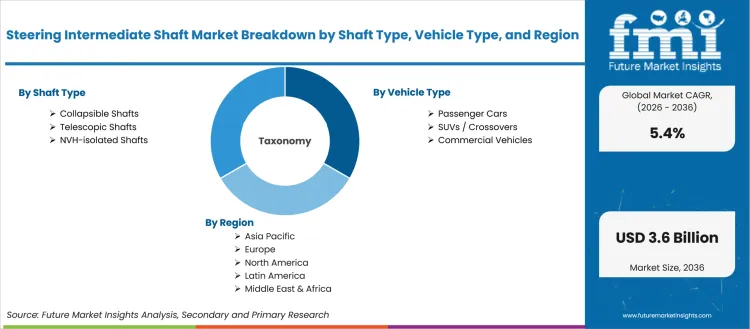
The Steering Intermediate Shaft industry is segmented by shaft type, vehicle type, steering system, sales channel, material, and region.
The steering intermediate shaft market is segmented by shaft type, vehicle type, steering system, sales channel, material, and region. Shaft type covers Collapsible Shafts, Telescopic Shafts, Universal Joint Shafts, and NVH-isolated Shafts. Vehicle type includes Passenger Cars, SUVs / Crossovers, Light Commercial Vehicles, and Commercial Vehicles. Steering system spans EPS, Hydraulic Power Steering, Steer-by-wire Support, and Manual / Other. Sales channel covers OEM and Aftermarket. Material includes Steel, Aluminum, and Hybrid / Lightweight structures. Regional coverage extends across North America, Latin America, Europe, East Asia, South Asia and Pacific, and Middle East and Africa.
Why are Collapsible Shafts important within shaft type?
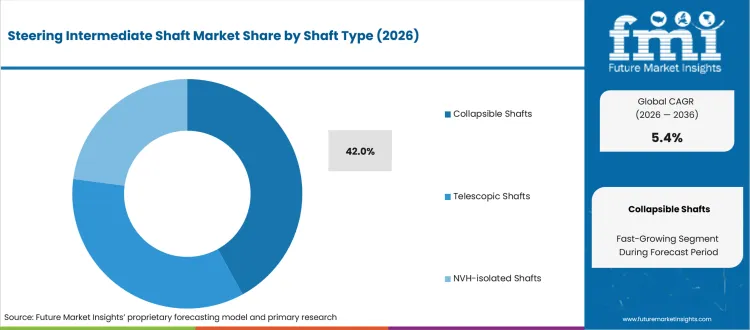
Crash-energy management is a design issue that appears before a steering program reaches production. OEM engineers need a shaft that can transmit driver input during normal use and manage collapse behavior during impact validation. That makes the part more than a connecting tube. It becomes a safety and packaging component inside the steering column module. This makes the segment relevant for sourcing teams that need safety validation before pricing negotiations begin.
- In 2026, Collapsible Shafts are anticipated to hold 42.0% of shaft type demand due to OEM focus on crash load paths and dashboard packaging. Buyers specify collapse stroke early in design programs. Late changes can affect pedal clearance, driver injury targets, and steering column geometry.
- The buyer value is reduced late-stage engineering risk before a vehicle program reaches production. Nexteer describes columns and intermediate shafts driver-input transfer parts for the steering mechanism. That functional link explains why collapse behavior, joint stiffness, and torque transfer need validation together.
What keeps Passenger Cars prominent within vehicle type?
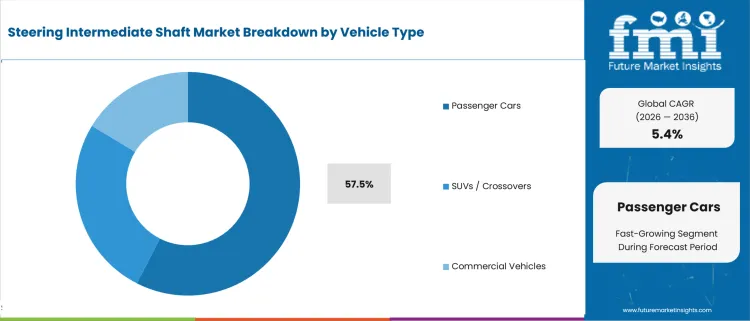
Passenger car platforms create repeatable shaft demand across compact cars, sedans, and entry SUVs. The operating issue is packaging consistency across many trims and regional variants. Buyers need a validated shaft that can repeat joint angle, spline fit, and collapse behavior. This repeatability lets suppliers spread validation learning across model families and keep regional part programs manageable. That makes part commonality a commercial issue for sourcing teams.
- Passenger Cars represent estimated 57.5% share in 2026, attributable to repeat demand from compact cars and sedan programs. Entry SUVs add another volume layer. These platforms reuse similar steering layouts across many variants, making shaft geometry and spline fit important for OEM cost control.
- Passenger vehicle buyers are expected to prioritize shaft assemblies that keep steering feel consistent across electric and hybrid platforms. IEA reported in May 2026 that electric cars were projected to represent 28% of total car sales in 2026. This shift raises the value of compact shaft routing.
How does EPS shape steering system demand?
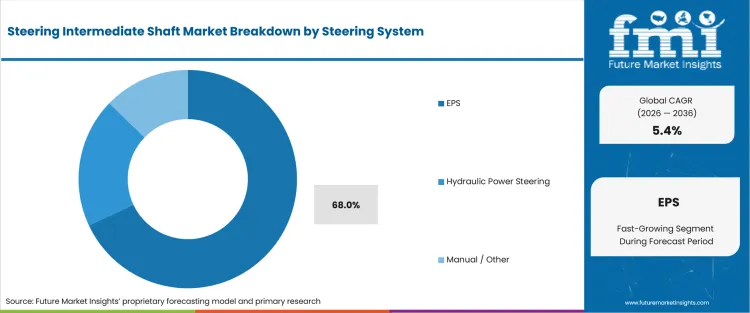
Electric assist changes the way drivers feel shaft friction and joint roughness. EPS packages often place the motor, column, and steering gear in tighter layouts. That raises the importance of mechanical precision even inside more software-defined steering systems. The adaptive steering market illustrates how steering feel is becoming more system-specific. The segment therefore carries mechanical value during the shift toward more electronic steering assistance.
- EPS is predicted to account for 68.0% share in 2026, driven by electric assist packaging and steering feel calibration. Bosch describes electric power steering belt-drive servo units for mid-size vehicles, sports cars, SUVs, and light commercial vehicles. That scope supports shaft demand across varied vehicle layouts.
- The operating value is clearer in compact front-end layouts and EV platforms. ZF states that real steer-by-wire removes the mechanical connection between the steering wheel and steering gear. The automotive steer-by-wire actuator market shows why substitution risk must be planned during mixed-platform sourcing.
Why does OEM remain central within sales channel?
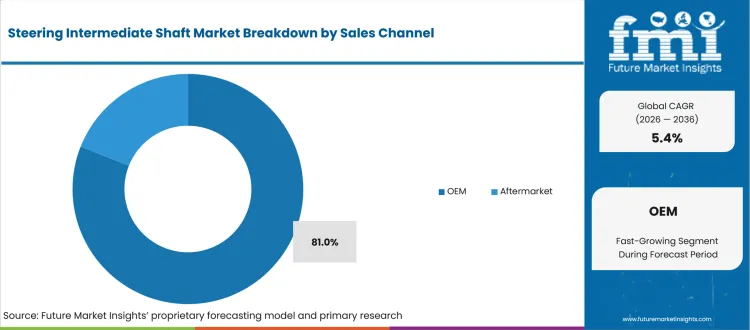
OEM sourcing sits close to vehicle architecture due to shaft lock-in before production release. Buyers cannot treat the part like a simple catalog item once collapse stroke and column interface are validated. The purchasing decision therefore stays close to engineering release and warranty accountability. This raises the commercial value of engineering access and program timing discipline for approved suppliers.
- OEM is expected to hold 81.0% share in 2026, owing to the need for platform-level validation before start of production. Shaft dimensions and collapse behavior are locked into the steering architecture. Joint angles are also fixed before production release, making the part difficult to source generically.
- The channel value comes from accountability during design release and warranty response. The steering column control modules market shows how steering subsystems are evaluated like integrated vehicle electronics and mechanical packages. OEM sourcing therefore favors suppliers that can support validation and change control.
What supports Steel within the material category?
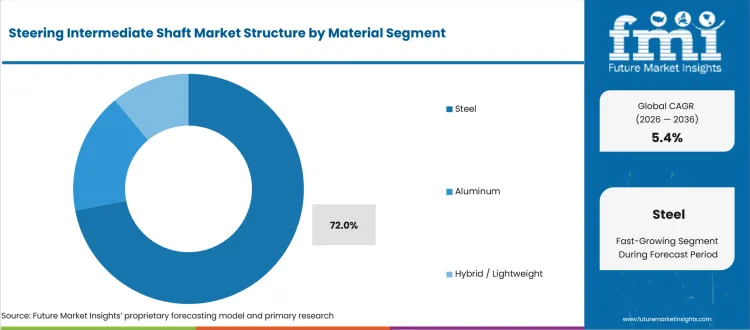
Material choice remains tied to torsional strength, fatigue life, forming cost, and crash behavior. Buyers still need predictable shaft behavior across high-volume programs. Lightweight alternatives gain attention in selected EVs and premium vehicles, yet cost approval remains harder once the steering package must pass durability and safety validation. This keeps material decisions close to purchasing teams that must balance safety targets and piece-price control.
- In 2026, Steel is anticipated to hold 72.0% of material demand due to torsional strength and familiar forming economics. Fatigue life keeps it practical for volume programs. Buyers still need predictable behavior under crash and vibration loads, making steel practical for cost-disciplined passenger platforms.
- Aluminum and hybrid shafts are expected to gain use in selected EV and premium platforms due to weight targets that justify more costly validation. Bosch lists its lightweight commercial steering shaft at up to 1.2 kg lower than conventional shafts. That shows how material choice can shift once packaging value is clear.
What are the drivers, restraints, and opportunities in the steering intermediate shaft market?
Near-term purchases are being shaped by the validation requirement and aftermarket replacement route outlined below.
- Driver: EPS platform redesign is driven by compact steering layouts that raise demand for low-friction joints, controlled collapse stroke, and repeatable steering feel.
- Restraint: Steer-by-wire adoption is a restraint owing to selected platforms removing the mechanical link between steering wheel and steering gear.
- Opportunity: Aftermarket replacement gains traction from older vehicle fleets that need fit-specific shaft, joint, and spline matching during repair.
OEM engineering teams are raising scrutiny on intermediate shafts once EPS packaging changes joint angles and driver feel. Buyers now review friction behavior and collapse stroke before production release. They also test noise behavior and process control before awarding repeat programs. The State Council reported in January 2026 that China produced 16.626 million new energy vehicles in 2025. That figure is important for suppliers due to EV and hybrid platforms creating fresh steering layouts that need validated shaft geometry before series sourcing.
By-wire systems reduce future mechanical shaft content in selected premium and software-defined vehicles. ZF said in July 2025 that steer-by-wire can reduce the steering wheel angle to 180 to 210 degrees. This function shows why some vehicle programs may shift packaging value away from mechanical shafts. The restraint is not immediate for mass-market platforms. It pushes shaft suppliers to serve conventional programs and build by-wire awareness for customers planning mixed steering architectures. Suppliers that understand both paths can keep relevance during platform transition.
Repair and service channels create a practical route for suppliers that can support fit-specific part matching. ACEA reported in January 2026 that 256 million passenger cars were on EU roads in 2024. This installed base supports replacement demand for mechanical steering links across aging passenger car fleets. The opportunity is not limited to universal parts. It favors suppliers that can prove fit accuracy, catalog coverage, spline matching, and warranty discipline. Suppliers that combine OEM validation records and aftermarket catalog accuracy can reach buyers beyond new vehicle programs.
Which country CAGRs are profiled in the steering intermediate shaft market?
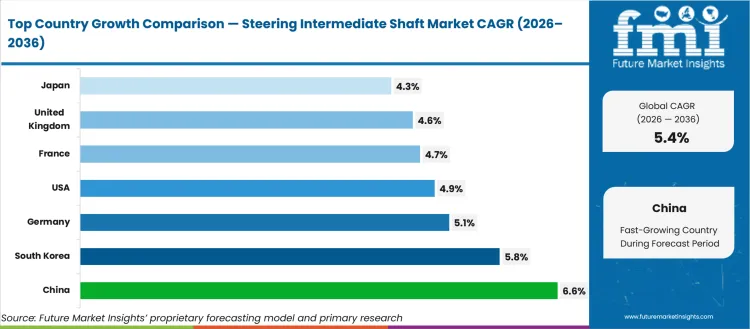
| Country | CAGR |
|---|---|
| United States | 4.9% |
| United Kingdom | 4.6% |
| Germany | 5.1% |
| France | 4.7% |
| Japan | 4.3% |
| China | 6.6% |
| South Korea | 5.8% |
| India | 6.4% |
How do country-level CAGRs compare in the steering intermediate shaft market?
Country profiles should be read by the operating pressure behind steering shaft demand rather than by the CAGR table alone. In established markets, the case is tied to recall control, repair accuracy, and replacement discipline across large vehicle fleets. Germany, Japan, and South Korea add engineering depth that supports precision steering programs. China and India have a different profile, driven by fresh vehicle platforms, local sourcing, and EV or SUV programs that reset supplier lists. For purchasing teams, country variation shows the markets tied to replacement discipline and the markets tied to new platform award cycles.
- By 2036, the United States is projected to record 4.9% CAGR, supported by replacement demand and safety-led OEM validation. NHTSA’s September 2025 Ford recall covered 115,539 vehicles carrying upper shaft separation risk. This evidence matters due to the country’s large recall and dealer service system. USA demand differs from China and India. Its growth is tied less to new platform volume and more to warranty exposure, approved replacement parts, and safety documentation. Fleet age and service-center coverage make defect response a steady demand base.
- The United Kingdom is expected to grow at 4.6% CAGR during the forecast period, shaped by a large repair base and gradual zero-emission vehicle inflow. The Department for Transport reported 42.3 million licensed vehicles at the end of 2025. This installed base supports service-channel demand for replacement shafts and joint assemblies. The UK profile sits below China and India. New platform growth is steadier, yet aftermarket fit accuracy and repair availability keep the country relevant for suppliers. Service distributors gain relevance once parts must match older platforms.
- Over the assessment period, Germany is forecast to advance at 5.1% CAGR, reinforced by premium vehicle engineering and domestic electric vehicle output. VDA reported that Germany produced 1.22 million battery-electric passenger cars in 2025. That output supports demand for compact steering layouts and precise shaft behavior. Germany differs from France and the UK. Local engineering depth keeps shaft validation close to OEM platform development and export program requirements, which supports suppliers able to work at design-release level. Export programs add another validation layer for suppliers.
- France is anticipated to post 4.7% CAGR by 2036, attributable to a repair base that balances lower new-car registrations and used-vehicle activity. SDES reported 5.534 million used passenger car sales in 2025. Older vehicles keep mechanical steering links in service longer and support parts replacement. France stays below Germany due to lower production-led pull, yet it remains meaningful for aftermarket distributors and suppliers serving repair networks. The country profile is therefore closer to service demand than new platform awards.
- Japan is likely to expand at 4.3% CAGR by 2036, driven by precision steering requirements and long vehicle service lives. JAMA reported 62.321 million passenger cars in use in Japan in 2024. This fleet supports periodic replacement of worn steering links and joints. Domestic vehicle demand is steadier than in India or China. Supplier relevance depends on quality consistency, fit accuracy, and platform-specific validation. Japan therefore records a measured profile tied to engineering discipline and service reliability. This keeps supplier approval tied to reliability data.
- China is estimated to rise at 6.6% CAGR between 2026 and 2036, propelled by NEV output and local SUV platform expansion. The State Council reported that China’s vehicle output reached 34.531 million units in 2025. That production base gives shaft suppliers broad program access. New vehicle architecture creates more first-fit sourcing opportunities than in slower-growth markets. Local engineering support also matters due to many programs moving quickly from launch planning to series production. This benefits suppliers that can localize validation support.
- South Korea is projected to record 5.8% CAGR by 2036, supported by export-oriented vehicle programs and domestic production scale. MOTIR reported that first-quarter vehicle production reached 1.026 million units in 2026. Export programs require consistent steering feel and validated parts across model variants. South Korea compares closer to Germany than to India. Its growth case is tied to engineering quality, platform exports, and regional supplier access rather than domestic vehicle volume alone. Supplier proximity matters for launch timing and export quality.
- India is expected to grow at 6.4% CAGR during the forecast period, owing to passenger vehicle growth and local supplier development. PIB reported that India produced 53.8 lakh passenger vehicles during January to December 2025. That scale supports OEM-fit intermediate shafts across compact cars and SUVs. Demand is tied to expanding production capacity and localization. This gives regional suppliers more room to win new platform work, especially for buyers that need shorter sourcing chains and service reach.
Who are the notable companies in the steering intermediate shaft market?
Nexteer Automotive, Bosch Mobility, HL Mando, NSK, JTEKT, thyssenkrupp Presta and Hitachi Astemo are the notable companies shaping this market.
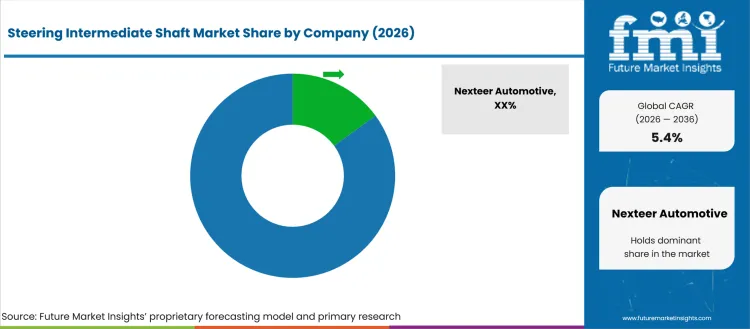
Supplier selection in steering intermediate shafts depends on the layer of the steering system the buyer wants to control. Nexteer and Bosch Mobility are more relevant for buyers that need column and shaft engineering inside complete steering modules. JTEKT, NSK, HL Mando, and Hitachi Astemo gain relevance for steering system breadth and regional OEM access. thyssenkrupp Presta and regional suppliers are better suited to platform programs that need column integration and close engineering support. The supplier decision therefore centers on validation depth, steering architecture fit, and service reach.
- Nexteer Automotive and Bosch Mobility are relevant for buyers that need shaft, column and steering-module knowledge inside one sourcing path. Their role is practical due to OEM validation needs that connect collapse behavior, packaging and warranty exposure before production release.
- JTEKT and NSK focus on steering systems and related components for global OEM programs. Their relevance is supported by established steering unit portfolios that include columns, shafts, and system components. Buyers use this supplier type once shaft decisions need broader steering architecture support.
- HL Mando and Hitachi Astemo gain preference in Asian OEM programs due to regional program access and steering-system integration depth. Their value is tied to local engineering support, customer proximity, and the need to align shaft validation to platform timing across export and domestic vehicles.
- thyssenkrupp Presta and regional steering suppliers are suited to programs that require column integration and engineering coordination. The automotive OEM market explains why suppliers need program access before a shaft reaches series production. Platform proximity remains a practical basis of competition.
Competitive Benchmarking: Steering Intermediate Shaft Market
| Company | Collapse Load Validation | Low-Friction Joint Design | OEM Platform Engineering | Footprint |
|---|---|---|---|---|
| Nexteer Automotive | High | High | High | Global |
| Bosch Mobility | High | High | Strong | Global |
| HL Mando | High | Strong | Strong | Global |
| NSK | Strong | Strong | Strong | Global |
| JTEKT | Strong | Strong | High | Global |
| thyssenkrupp Presta | Strong | Medium | Strong | Global |
| Hitachi Astemo | Medium | Strong | Strong | Global |
Source: Future Market Insights competitive analysis, 2026. Ratings reflect relative portfolio relevance, workflow or project fit, service capability, and geographic reach.
Key Developments in the Steering Intermediate Shaft Market
- In April 2025, Nexteer Automotive expanded its high-output column-assist electric power steering portfolio to support up to 110 Nm of steering assist. The development is significant to intermediate shaft suppliers due to higher steering loads in SUVs and EVs. It points to stricter torque transfer and joint-angle validation needs.
- In February 2025, ZF announced series production of steer-by-wire steering for the NIO ET9. The development is important to intermediate shafts due to selected vehicle programs removing the mechanical link between steering wheel and front wheels. It signals a long-term substitution path for selected premium platforms.
- In April 2026, Nexteer Automotive started series production of its first steer-by-wire program for a Chinese NEV manufacturer. The development shows by-wire steering moving from validation to production. It also signals that conventional shaft suppliers must prepare for mixed mechanical and electronic steering architectures.
- In May 2026, JTEKT named its steer-by-wire system Syncusteer and proposed it to customers. The development is relevant due to established steering suppliers extending portfolios beyond mechanical steering links. It points to a buyer environment that still needs shafts on many platforms and plans by-wire alternatives.
Key Players in the Steering Intermediate Shaft Market
Global Steering System Suppliers
- Nexteer Automotive
- Bosch Mobility
- JTEKT
- NSK
Regional and OEM-Linked Steering Suppliers
- HL Mando
- thyssenkrupp Presta
- Hitachi Astemo
Column and Shaft Specialists
- NSK Steering & Control
- JTEKT India
- HL Mando ANAND India
Steering Intermediate Shaft Market - Report Scope
| Coverage field | Report scope |
|---|---|
| Market breakdown | By shaft type, vehicle type, steering system, sales channel, material, and region |
| Market Definition | Steering intermediate shafts are mechanical links that connect a vehicle steering column to the steering gear or rack. |
| Regions Covered | North America, Latin America, Europe, East Asia, South Asia and Pacific, and Middle East and Africa |
| Countries Covered | United States, United Kingdom, Germany, France, Japan, China, South Korea, India, and broader regional coverage |
| Key Companies Profiled | Nexteer Automotive, Bosch Mobility, HL Mando, NSK, JTEKT, thyssenkrupp Presta, and Hitachi Astemo |
| Forecast Period | 2026 to 2036 |
| Approach | FMI estimates are based on vehicle production, steering-system fitment, shaft content per platform, material mix, service demand, and supplier portfolio validation. |
Steering Intermediate Shaft Market - Research Methodology
| Method | Approach |
|---|---|
| Primary Research | FMI analysts reviewed inputs from steering component suppliers, OEM sourcing teams, aftermarket distributors, and service-channel participants. The review focused on shaft geometry, collapse behavior, joint durability, NVH control, and warranty-linked sourcing pressure. |
| Desk Research | Desk research covered transport safety filings, vehicle production releases, official registration statistics, supplier product pages, and steering technology announcements. Source categories included transport regulators, national statistics offices, industry associations, and official company materials. |
| Market Sizing and Forecasting | The model combined vehicle production, EPS fitment, shaft content per vehicle, material mix, OEM program timing, and aftermarket replacement rates. Regional forecasts were adjusted for platform expansion, vehicle age, repair-channel depth, and by-wire substitution risk. |
| Data Validation | Forecasts were checked against recall activity, EV platform growth, country production data, and supplier portfolio evidence. Duplicate external statistics were avoided by assigning each public figure to one section before final writing. |
Steering Intermediate Shaft Market by Segments
Steering Intermediate Shaft Market segmented by Shaft Type:
- Collapsible Shafts
- Telescopic Shafts
- Universal Joint Shafts
- NVH-isolated Shafts
Steering Intermediate Shaft Market segmented by Vehicle Type:
- Passenger Cars
- SUVs / Crossovers
- Light Commercial Vehicles
- Commercial Vehicles
Steering Intermediate Shaft Market segmented by Steering System:
- EPS
- Hydraulic Power Steering
- Steer-by-wire Support
- Manual / Other
Steering Intermediate Shaft Market segmented by Sales Channel:
- OEM
- Aftermarket
Steering Intermediate Shaft Market segmented by Material:
- Steel
- Aluminum
- Hybrid / Lightweight
Steering Intermediate Shaft Market by Region:
- North America
- United States
- Canada
- Europe
- Germany
- United Kingdom
- France
- Italy
- Spain
- Asia Pacific
- China
- Japan
- South Korea
- Taiwan
- Singapore
- Latin America
- Brazil
- Mexico
- Argentina
- Middle East & Africa
- GCC Countries
- South Africa
- Israel
Research Sources and Bibliography
- International Energy Agency. (May 2026). Executive summary - Global EV Outlook 2026 - Analysis.
- National Highway Traffic Safety Administration. (September 2025). Part 573 Safety Recall Report 25V626.
- GOV.UK Department for Transport. (May 2026). Vehicle licensing statistics, United Kingdom: 2025.
- Verband der Automobilindustrie. (February 2026). Production and market in January 2026.
- Press Information Bureau, Ministry of Heavy Industries. (February 2026). STATUS OF HEAVY INDUSTRIES SECTOR.
- The State Council of the People’s Republic of China. (January 2026). China’s auto output, sales reach new highs in 2025.
- Service des données et études statistiques. (June 2026). Immatriculation des véhicules routiers.
- Japan Automobile Manufacturers Association. (September 2025). The Motor Industry of Japan 2025.
- Ministry of Trade, Industry and Resources. (April 2026). March 2026 Automobile Exports Reach $6.4 Billion.
- Bosch Mobility. (2026). Steering shaft for steering systems for commercial vehicles.
- Bosch Mobility. (2026). Electric Power Steering System with Belt Drive Servo Unit.
- 14. Nexteer Automotive. (April 2025). Nexteer Expands Portfolio With High Output Column-Assist Electric Power Steering.
- Nexteer Automotive. (April 2026). Nexteer Puts Steer-by-Wire into Series Production.
- ZF. (February 2025). Start of series production for Steer-by-Wire steering at Chinese manufacturer NIO.
- JTEKT Corporation. (May 2026). Named steer-by-wire system "Syncusteer" and propose it to customers.
- ZF. (July 2025). ZF Steer-by-Wire: Driving Innovation in a New Direction.
- European Automobile Manufacturers' Association. (January 2026). Report - Vehicles on European roads 2026.
This bibliography is provided for reader reference and uses primary government, standards-body, official trade body, and company sources.
This Report Answers
- What is the expected global value of the Steering Intermediate Shaft Market in 2026 and 2036?
- What CAGR is forecast for steering intermediate shafts during the 2026 to 2036 period?
- Which shaft type, vehicle type, and steering system segments show notable 2026 shares?
- Why do OEMs and aftermarket channels buy validated steering intermediate shaft assemblies?
- How do EPS adoption and steer-by-wire substitution risk affect buyer decisions?
- Which countries are compared in the steering intermediate shaft forecast?
- Which companies compete across steering columns, shafts, and steering modules?
- What product capabilities are included within the steering intermediate shaft definition?
- How does FMI size and forecast steering intermediate shaft demand across segments and countries?
- What validation and supplier-selection factors should executives assess?
Frequently Asked Questions
What is driving growth in the Steering Intermediate Shaft Market?
Growth is driven by EPS packaging, crash validation and local platform expansion across EV and SUV programs.
Why should executives track the Steering Intermediate Shaft Market?
Executives should track this market because steering intermediate shafts sit directly at the intersection of vehicle safety, steering feel, platform redesign, and warranty risk, especially as EPS and EV architectures become more compact.
What business problem does the Steering Intermediate Shaft Market address?
It ensures reliable transfer of driver steering input while managing crash energy, joint friction, and packaging constraints, preventing late design changes, safety non compliance, and service mismatches across vehicle platforms.
What should procurement leaders evaluate before selecting suppliers?
Procurement leaders should evaluate collapse stroke validation, joint friction behavior, spline and interface compatibility, EPS packaging fit, noise performance, material fatigue life, and the supplier’s ability to support OEM validation and change control.
What can limit return on investment for buyers?
Return on investment can be limited by late engineering changes, poor alignment with EPS packaging, or inadequate aftermarket part coverage. Buyers reduce this risk by locking shaft specifications early and aligning sourcing with steering architecture decisions.
How can suppliers build executive confidence?
Suppliers build confidence by proving crash load performance, delivering consistent steering feel across variants, supporting OEM validation programs, and providing fit accurate service parts with clear engineering documentation.
Preview the report firsthand - request a free sample
Get SampleGet the brochure for pricing and purchase details.
Get PDFTable of Content
- Key Takeaways
- Market Size and CAGR
- Top Growth Driver
- Fastest Growing Segment
- Leading Region
- Key Companies
- Emerging Opportunities
- Executive Summary
- Global Market Outlook
- Demand-side Trends
- Supply-side Trends
- Technology Roadmap Analysis
- Analysis and Recommendations
- Analyst Perspective (What is happening? Why now? What should investors know?)
- Key Questions Answered
- How large is the market?
- What is the CAGR?
- What are key trends?
- Which region dominates?
- Who are the leaders?
- Market Overview
- Market Coverage / Taxonomy
- Market Definition / Scope / Limitations
- Research Methodology
- Chapter Orientation
- Analytical Lens and Working Hypotheses
- Market Structure, Signals, and Trend Drivers
- Benchmarking and Cross-market Comparability
- Market Sizing, Forecasting, and Opportunity Mapping
- Research Design and Evidence Framework
- Desk Research Programme (Secondary Evidence)
- Expert Input and Fieldwork (Primary Evidence)
- Tooling, Models, and Reference Databases
- Data Engineering and Model Build
- Quality Assurance and Audit Trail
- Market Background
- Market Dynamics (Drivers, Restraints, Opportunity, Trends)
- Scenario Forecast (Optimistic, Likely, Conservative)
- Impact Analysis
- AI Impact
- Sustainability Impact
- Regulatory Impact
- Technology Impact
- Consumer / Buyer Analysis
- Purchase Drivers
- Adoption Barriers
- Buyer Journey
- Opportunity Map Analysis
- Product Life Cycle Analysis
- Supply Chain Analysis
- Investment Feasibility Matrix
- Value Chain Analysis
- PESTLE and Porter's Analysis
- Regulatory Landscape
- Regional Parent Market Outlook
- Production and Consumption Statistics
- Import and Export Statistics
- Global Market Analysis and Forecast, 2021 to 2036
- Historical Market Size Value (USD Billion) & Volume (Unit) Analysis, 2021 to 2025
- Current and Future Market Size Value (USD Billion) & Volume (Unit) Projections, 2026 to 2036
- Y-o-Y Growth Trend Analysis
- Absolute $ Opportunity Analysis
- Global Market Pricing Analysis, 2021 to 2036
- Global Market Analysis and Forecast, By Shaft Type, 2021 to 2036
- Introduction / Key Findings
- Historical Market Size Value (USD Billion) & Volume (Unit) Analysis By Shaft Type, 2021 to 2025
- Current and Future Market Size Value (USD Billion) & Volume (Unit) Analysis and Forecast By Shaft Type, 2026 to 2036
- Collapsible Shafts
- Telescopic Shafts
- Universal Joint Shafts
- NVH-isolated Shafts
- Y-o-Y Growth Trend Analysis By Shaft Type, 2021 to 2025
- Absolute $ Opportunity Analysis By Shaft Type, 2026 to 2036
- Global Market Analysis and Forecast, By Vehicle Type, 2021 to 2036
- Introduction / Key Findings
- Historical Market Size Value (USD Billion) & Volume (Unit) Analysis By Vehicle Type, 2021 to 2025
- Current and Future Market Size Value (USD Billion) & Volume (Unit) Analysis and Forecast By Vehicle Type, 2026 to 2036
- Passenger Cars
- SUVs / Crossovers
- Light Commercial Vehicles
- Commercial Vehicles
- Y-o-Y Growth Trend Analysis By Vehicle Type, 2021 to 2025
- Absolute $ Opportunity Analysis By Vehicle Type, 2026 to 2036
- Global Market Analysis and Forecast, By Steering System, 2021 to 2036
- Introduction / Key Findings
- Historical Market Size Value (USD Billion) & Volume (Unit) Analysis By Steering System, 2021 to 2025
- Current and Future Market Size Value (USD Billion) & Volume (Unit) Analysis and Forecast By Steering System, 2026 to 2036
- EPS
- Hydraulic Power Steering
- Steer-by-wire Support
- Manual / Other
- Y-o-Y Growth Trend Analysis By Steering System, 2021 to 2025
- Absolute $ Opportunity Analysis By Steering System, 2026 to 2036
- Global Market Analysis and Forecast, By Sales Channel, 2021 to 2036
- Introduction / Key Findings
- Historical Market Size Value (USD Billion) & Volume (Unit) Analysis By Sales Channel, 2021 to 2025
- Current and Future Market Size Value (USD Billion) & Volume (Unit) Analysis and Forecast By Sales Channel, 2026 to 2036
- OEM
- Aftermarket
- OEM
- Y-o-Y Growth Trend Analysis By Sales Channel, 2021 to 2025
- Absolute $ Opportunity Analysis By Sales Channel, 2026 to 2036
- Global Market Analysis and Forecast, By Material, 2021 to 2036
- Introduction / Key Findings
- Historical Market Size Value (USD Billion) & Volume (Unit) Analysis By Material, 2021 to 2025
- Current and Future Market Size Value (USD Billion) & Volume (Unit) Analysis and Forecast By Material, 2026 to 2036
- Steel
- Aluminum
- Hybrid / Lightweight
- Steel
- Y-o-Y Growth Trend Analysis By Material, 2021 to 2025
- Absolute $ Opportunity Analysis By Material, 2026 to 2036
- Global Market Analysis and Forecast, By Region, 2021 to 2036
- Introduction
- Historical Market Size Value (USD Billion) & Volume (Unit) Analysis By Region, 2021 to 2025
- Current Market Size Value (USD Billion) & Volume (Unit) Analysis and Forecast By Region, 2026 to 2036
- North America
- Latin America
- Western Europe
- Eastern Europe
- East Asia
- South Asia and Pacific
- Middle East & Africa
- Market Attractiveness Analysis By Region
- North America Market Analysis and Forecast, By Country, 2021 to 2036
- Historical Market Size Value (USD Billion) & Volume (Unit) Trend Analysis By Market Taxonomy, 2021 to 2025
- Market Size Value (USD Billion) & Volume (Unit) Forecast By Market Taxonomy, 2026 to 2036
- By Country
- USA
- Canada
- Mexico
- By Shaft Type
- By Vehicle Type
- By Steering System
- By Sales Channel
- By Material
- By Country
- Market Attractiveness Analysis
- By Country
- By Shaft Type
- By Vehicle Type
- By Steering System
- By Sales Channel
- By Material
- Key Takeaways
- Latin America Market Analysis and Forecast, By Country
- Historical Market Size Value (USD Billion) & Volume (Unit) Trend Analysis By Market Taxonomy, 2021 to 2025
- Market Size Value (USD Billion) & Volume (Unit) Forecast By Market Taxonomy, 2026 to 2036
- By Country
- Brazil
- Chile
- Rest of Latin America
- By Shaft Type
- By Vehicle Type
- By Steering System
- By Sales Channel
- By Material
- By Country
- Market Attractiveness Analysis
- By Country
- By Shaft Type
- By Vehicle Type
- By Steering System
- By Sales Channel
- By Material
- Key Takeaways
- Western Europe Market Analysis and Forecast, By Country
- Historical Market Size Value (USD Billion) & Volume (Unit) Trend Analysis By Market Taxonomy, 2021 to 2025
- Market Size Value (USD Billion) & Volume (Unit) Forecast By Market Taxonomy, 2026 to 2036
- By Country
- Germany
- UK
- Italy
- Spain
- France
- Nordic
- BENELUX
- Rest of Western Europe
- By Shaft Type
- By Vehicle Type
- By Steering System
- By Sales Channel
- By Material
- By Country
- Market Attractiveness Analysis
- By Country
- By Shaft Type
- By Vehicle Type
- By Steering System
- By Sales Channel
- By Material
- Key Takeaways
- Eastern Europe Market Analysis and Forecast, By Country
- Historical Market Size Value (USD Billion) & Volume (Unit) Trend Analysis By Market Taxonomy, 2021 to 2025
- Market Size Value (USD Billion) & Volume (Unit) Forecast By Market Taxonomy, 2026 to 2036
- By Country
- Russia
- Poland
- Hungary
- Balkan & Baltic
- Rest of Eastern Europe
- By Shaft Type
- By Vehicle Type
- By Steering System
- By Sales Channel
- By Material
- By Country
- Market Attractiveness Analysis
- By Country
- By Shaft Type
- By Vehicle Type
- By Steering System
- By Sales Channel
- By Material
- Key Takeaways
- East Asia Market Analysis and Forecast, By Country
- Historical Market Size Value (USD Billion) & Volume (Unit) Trend Analysis By Market Taxonomy, 2021 to 2025
- Market Size Value (USD Billion) & Volume (Unit) Forecast By Market Taxonomy, 2026 to 2036
- By Country
- China
- Japan
- South Korea
- By Shaft Type
- By Vehicle Type
- By Steering System
- By Sales Channel
- By Material
- By Country
- Market Attractiveness Analysis
- By Country
- By Shaft Type
- By Vehicle Type
- By Steering System
- By Sales Channel
- By Material
- Key Takeaways
- South Asia and Pacific Market Analysis and Forecast, By Country
- Historical Market Size Value (USD Billion) & Volume (Unit) Trend Analysis By Market Taxonomy, 2021 to 2025
- Market Size Value (USD Billion) & Volume (Unit) Forecast By Market Taxonomy, 2026 to 2036
- By Country
- India
- ASEAN
- Australia & New Zealand
- Rest of South Asia and Pacific
- By Shaft Type
- By Vehicle Type
- By Steering System
- By Sales Channel
- By Material
- By Country
- Market Attractiveness Analysis
- By Country
- By Shaft Type
- By Vehicle Type
- By Steering System
- By Sales Channel
- By Material
- Key Takeaways
- Middle East & Africa Market Analysis and Forecast, By Country
- Historical Market Size Value (USD Billion) & Volume (Unit) Trend Analysis By Market Taxonomy, 2021 to 2025
- Market Size Value (USD Billion) & Volume (Unit) Forecast By Market Taxonomy, 2026 to 2036
- By Country
- Kingdom of Saudi Arabia
- Other GCC Countries
- Türkiye
- South Africa
- Other African Union
- Rest of Middle East & Africa
- By Shaft Type
- By Vehicle Type
- By Steering System
- By Sales Channel
- By Material
- By Country
- Market Attractiveness Analysis
- By Country
- By Shaft Type
- By Vehicle Type
- By Steering System
- By Sales Channel
- By Material
- Key Takeaways
- Key Countries Market Analysis
- USA
- Pricing Analysis
- Market Share Analysis, 2025
- By Shaft Type
- By Vehicle Type
- By Steering System
- By Sales Channel
- By Material
- Canada
- Pricing Analysis
- Market Share Analysis, 2025
- By Shaft Type
- By Vehicle Type
- By Steering System
- By Sales Channel
- By Material
- Mexico
- Pricing Analysis
- Market Share Analysis, 2025
- By Shaft Type
- By Vehicle Type
- By Steering System
- By Sales Channel
- By Material
- Brazil
- Pricing Analysis
- Market Share Analysis, 2025
- By Shaft Type
- By Vehicle Type
- By Steering System
- By Sales Channel
- By Material
- Chile
- Pricing Analysis
- Market Share Analysis, 2025
- By Shaft Type
- By Vehicle Type
- By Steering System
- By Sales Channel
- By Material
- Germany
- Pricing Analysis
- Market Share Analysis, 2025
- By Shaft Type
- By Vehicle Type
- By Steering System
- By Sales Channel
- By Material
- UK
- Pricing Analysis
- Market Share Analysis, 2025
- By Shaft Type
- By Vehicle Type
- By Steering System
- By Sales Channel
- By Material
- Italy
- Pricing Analysis
- Market Share Analysis, 2025
- By Shaft Type
- By Vehicle Type
- By Steering System
- By Sales Channel
- By Material
- Spain
- Pricing Analysis
- Market Share Analysis, 2025
- By Shaft Type
- By Vehicle Type
- By Steering System
- By Sales Channel
- By Material
- France
- Pricing Analysis
- Market Share Analysis, 2025
- By Shaft Type
- By Vehicle Type
- By Steering System
- By Sales Channel
- By Material
- India
- Pricing Analysis
- Market Share Analysis, 2025
- By Shaft Type
- By Vehicle Type
- By Steering System
- By Sales Channel
- By Material
- ASEAN
- Pricing Analysis
- Market Share Analysis, 2025
- By Shaft Type
- By Vehicle Type
- By Steering System
- By Sales Channel
- By Material
- Australia & New Zealand
- Pricing Analysis
- Market Share Analysis, 2025
- By Shaft Type
- By Vehicle Type
- By Steering System
- By Sales Channel
- By Material
- China
- Pricing Analysis
- Market Share Analysis, 2025
- By Shaft Type
- By Vehicle Type
- By Steering System
- By Sales Channel
- By Material
- Japan
- Pricing Analysis
- Market Share Analysis, 2025
- By Shaft Type
- By Vehicle Type
- By Steering System
- By Sales Channel
- By Material
- South Korea
- Pricing Analysis
- Market Share Analysis, 2025
- By Shaft Type
- By Vehicle Type
- By Steering System
- By Sales Channel
- By Material
- Russia
- Pricing Analysis
- Market Share Analysis, 2025
- By Shaft Type
- By Vehicle Type
- By Steering System
- By Sales Channel
- By Material
- Poland
- Pricing Analysis
- Market Share Analysis, 2025
- By Shaft Type
- By Vehicle Type
- By Steering System
- By Sales Channel
- By Material
- Hungary
- Pricing Analysis
- Market Share Analysis, 2025
- By Shaft Type
- By Vehicle Type
- By Steering System
- By Sales Channel
- By Material
- Kingdom of Saudi Arabia
- Pricing Analysis
- Market Share Analysis, 2025
- By Shaft Type
- By Vehicle Type
- By Steering System
- By Sales Channel
- By Material
- Türkiye
- Pricing Analysis
- Market Share Analysis, 2025
- By Shaft Type
- By Vehicle Type
- By Steering System
- By Sales Channel
- By Material
- South Africa
- Pricing Analysis
- Market Share Analysis, 2025
- By Shaft Type
- By Vehicle Type
- By Steering System
- By Sales Channel
- By Material
- USA
- Market Structure Analysis
- Competition Dashboard
- Competition Benchmarking
- Market Share Analysis of Top Players
- By Regional
- By Shaft Type
- By Vehicle Type
- By Steering System
- By Sales Channel
- By Material
- Emerging Startups
- Innovation Benchmarking
- Competition Analysis
- Competition Deep Dive
- Nexteer Automotive
- Overview
- Product Portfolio
- Profitability by Market Segments (Product/Region/Sales Channel)
- Sales Footprint
- Strategy Overview
- Marketing Strategy
- Product Strategy
- Channel Strategy
- Bosch Mobility
- JTEKT
- NSK
- HL Mando
- Hitachi Astemo
- Nexteer Automotive
- Case Studies
- Success Stories
- Recent Developments
- Competition Deep Dive
- Assumptions & Acronyms Used


