

- Market Size (2026)
- USD 680.7 Mn
- Forecast (2036)
- USD 2436.3 Mn
- CAGR (2026 to 2036)
- 13.6%
How big is the Steering Redundancy Modules Market in 2026?
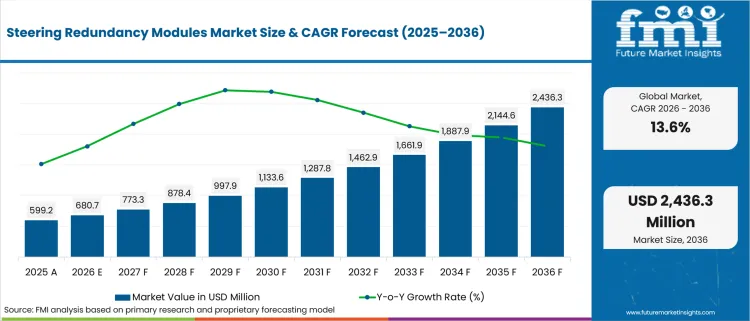
USD 680.7 million in 2026 and USD 2,436.3 million by 2036 at a 13.6% CAGR.
Vehicle architecture is shifting toward x-by-wire systems, and that change moves steering fallback into electronic control paths. OEMs need steering continuity during a fault and clear proof that a backup path can take over without a steering jump. Steering redundancy modules gain relevance due to platforms that replace mechanical fallback using software and backup power. The commercial case is reinforced by vehicle programs that need actuator arbitration and diagnostic evidence before production approval. This makes redundancy content part of platform design instead of a late steering-unit upgrade.
OEMs and Tier-1 suppliers form the core buyer base for these modules. EV makers and automated shuttle developers add demand from programs that need electronic control continuity. Commercial vehicle programs create another route due to higher safety exposure on fleet platforms. Buyers need redundant ECUs and backup power paths. They also need sensor cross-checks and actuator software that can preserve steering control under a defined fault case. The market creates value by reducing integration risk before launch and by giving vehicle engineers a clearer safety case for steering continuity.
Regional adoption reflects differences in vehicle-platform strategy and safety validation depth. Germany and Japan connect demand to premium engineering and careful platform approval. China and India connect the same market to electric vehicle scale and local software validation capacity. The product becomes more valuable once steering hardware and diagnostics are planned together. Backup power and automotive steering systems then become part of the same safety package. Buyers should view steering redundancy modules as a risk-control layer that links vehicle motion to supplier capability. The same layer links regulatory review to long-term platform value.
| Metric | Value |
|---|---|
| 2025 Market Size | USD 599.2 million |
| 2026 Market Size | USD 680.7 million |
| 2036 Market Size | USD 2,436.3 million |
| Forecast CAGR (2026-2036) | 13.6% |
| Module Type Focus | Redundant ECU Modules |
| Redundant ECU Modules Share (2026) | 39.5% |
| Steering System Focus | Steer-by-wire |
| Steer-by-wire Share (2026) | 41.0% |
| Vehicle Type Focus | Passenger EVs |
| Passenger EVs Share (2026) | 46.0% |
| Fastest-growing Country | China |
| China CAGR by 2036 | 17.1% |
Summary of the Steering Redundancy Modules Market
| Market Signal | Commercial Impact |
|---|---|
| Demand and Growth Drivers | Demand for steering redundancy modules is increasing as OEMs accelerate steer-by-wire development, EV platform expansion, and functional safety validation across next-generation vehicle architectures.
|
| Product and Segment View | Redundant ECU modules, steer-by-wire architectures, and passenger EV platforms represent the leading commercial opportunities within the steering redundancy modules market.
|
| Geography and Growth Outlook | Asia continues to lead market growth while Germany remains an important center for premium by-wire vehicle engineering and steering technology development.
|
| Competitive Landscape | Competition is increasingly centered on integrated steering electronics, software validation, actuator redundancy, and functional safety expertise rather than standalone hardware supply.
|
| Analyst Perspective | Steering redundancy modules are evolving into critical safety systems where hardware reliability, software validation, and fault-management capabilities increasingly determine OEM sourcing decisions.
- Nikhil Kaitwade, Principal Consultant at Future Market Insights |
How is the steering redundancy modules market segmented?
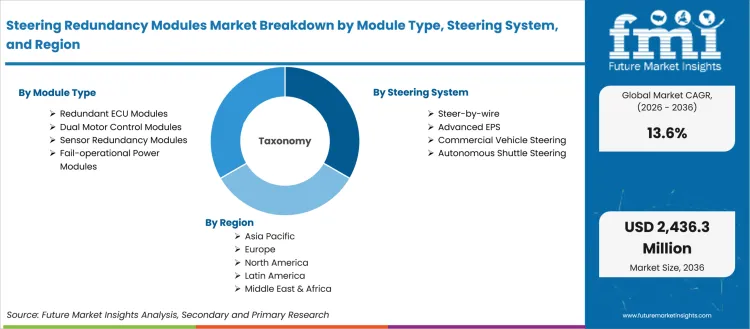
The Steering Redundancy Modules industry is segmented by module type, steering system, vehicle type, safety level, sales channel, and region.
The steering redundancy modules market is segmented by module type, steering system, vehicle type, safety level, sales channel, and region. Module type covers redundant ECU modules, dual motor control modules, fail-operational power modules, and sensor redundancy modules. Steering system includes steer-by-wire, Advanced EPS, autonomous shuttle steering, and commercial vehicle steering. Vehicle type spans passenger EVs, ADAS-equipped ICE / hybrid, autonomous vehicles, and commercial vehicles. Safety level includes ASIL B, ASIL C, and ASIL D. Sales channel covers OEM and Tier-1 integrated supply. Regional coverage extends across North America, Latin America, Western Europe, Eastern Europe, East Asia, South Asia and Pacific, and the Middle East and Africa.
Why are Redundant ECU Modules important within the module-type category?
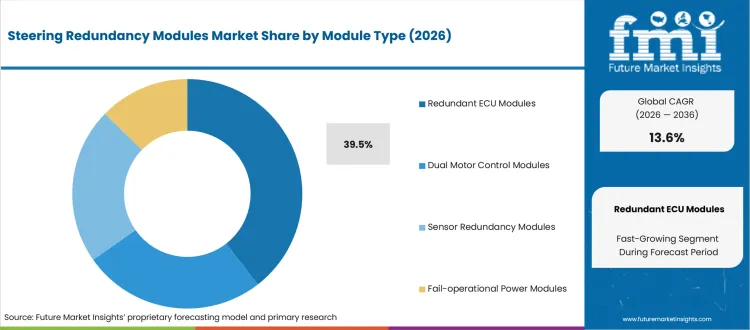
Steering control failures create a direct vehicle-control problem that cannot wait for a secondary repair process. Redundant ECU modules address this issue by giving the steering system two control paths that can compare commands and hand over control during a fault. The segment is relevant to OEMs that need clear diagnostics before production release.
- In 2026, Redundant ECU Modules are anticipated to hold 39.5% of module-type demand due to the need for two control paths before actuator movement. Nexteer said its first series-production steer-by-wire program achieved ASIL D functional safety approval. That supports buyer focus on fault diagnosis and redundancy monitoring.
- The OEM value is lower steering-control uncertainty during a fault event. Buyers using redundant ECUs gain a clearer way to compare commands and trigger backup control. This makes the segment central to sourcing decisions for fail-operational steering and electronic power steering upgrades.
What supports Steer-by-wire platforms within the steering-system category?
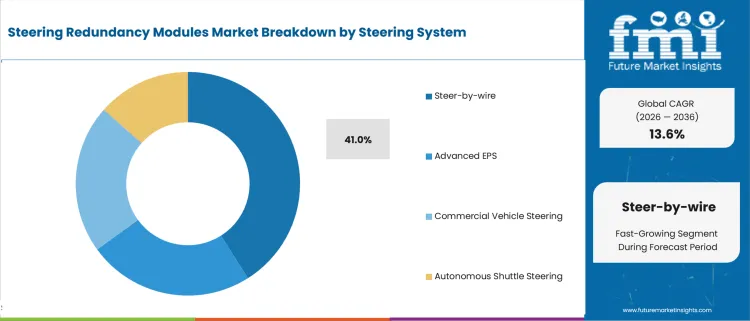
The steering-system issue is not just actuator movement. It is the removal of the mechanical path that traditionally carried driver input to the front wheels. Steer-by-wire platforms therefore need actuator feel and road-wheel command to work together. Software logic and backup paths must also align before a vehicle can be released. This makes the segment a direct test of by-wire readiness.
- Steer-by-wire is estimated to hold 41.0% of steering-system demand in 2026, driven by OEM programs that remove the physical steering connection. Bosch describes steer-by-wire using a steering wheel actuator plus a rack actuator. That design explains why redundancy modules become billable safety content.
- Buyers evaluate steer-by-wire suppliers by fault handling and steering feel instead of hardware presence alone. The sourcing case overlaps with steer-by-wire road wheel actuator modules due to rack actuation and redundant command paths that decide whether the vehicle can continue safely during a fault.
How do Passenger EVs shape vehicle-type demand?
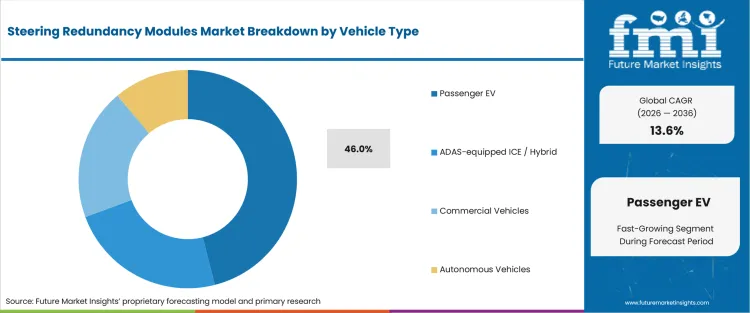
Passenger EV platforms give steering suppliers more freedom to place actuators and route wiring than many legacy ICE layouts. The business problem for OEMs is adding cabin flexibility and chassis software without weakening steering availability. Passenger EVs therefore become early vehicles for redundancy content that must be planned before platform freeze.
- Passenger EVs is predicted to account for 46.0% share in 2026, owing to platform layouts that make actuator routing and backup power easier to plan. IEA reported that electric car sales in China exceeded 11 million in 2025. That scale supports earlier redundancy-module integration.
- Passenger EV makers use redundancy modules to support cabin freedom and software-led chassis features without losing safety continuity. The operating case gains weight once one platform carries several body styles. This gives suppliers more repeatable content across vehicle programs and reduces integration learning costs.
Why does ASIL D matter within the safety-level category?
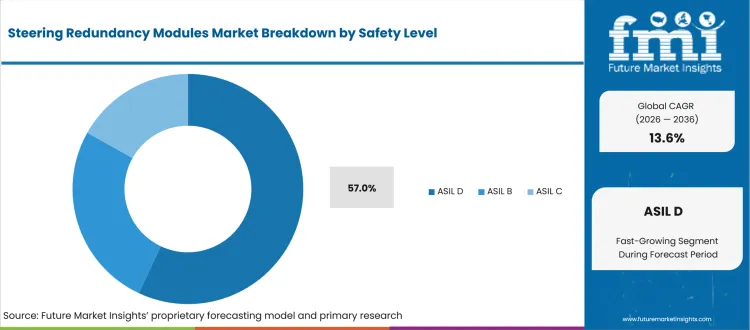
Safety-level selection is a sourcing decision before it becomes a compliance task. Steering loss is treated like a severe vehicle-control hazard in by-wire and fault-tolerant EPS designs. ASIL D is significant due to diagnostic monitoring and power fallback needs that suppliers must prove early. It turns sensor plausibility into a purchasing criterion for by-wire and fault-tolerant EPS programs.
- ASIL D is projected to represent 57.0% of safety-level demand in 2026, shaped by the high severity of steering loss in by-wire systems. Nexteer said its series-production steer-by-wire system includes fault diagnosis and redundancy monitoring. This supports higher validation depth in buyer reviews.
- Safety-level demand is gaining tighter engineering review due to documented diagnostics and fail-operational response needs. Buyers prefer module suppliers that can show how automotive sensors and redundant control paths cross-check angle and torque signals before actuator commands are executed.
How is OEM positioned within the sales-channel category?
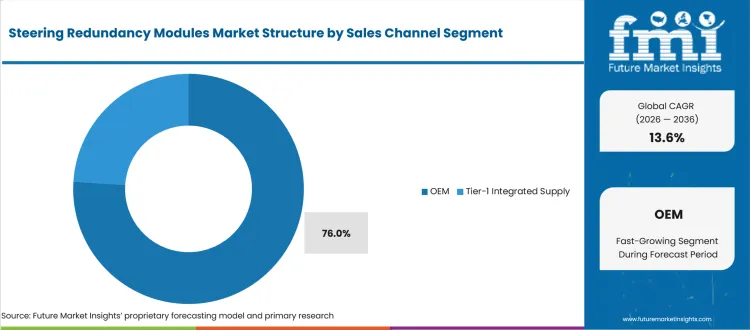
Steering redundancy is decided before the vehicle reaches production. The sales-channel issue is therefore integration ownership and not spare-part availability. OEM buyers want a supplier that can support platform validation and safety documentation across the launch cycle. They also need software release control and actuator packaging support before production approval. This places OEM sourcing ahead of aftermarket channels.
- OEM is expected to hold 76.0% share in 2026, attributable to platform-level validation before production approval. Steering redundancy modules cannot be treated like repair parts. Actuator response and ECU logic must be approved together before the steering system enters series production. Backup power and diagnostic records need the same approval path before OEM launch teams sign off.
- Tier-1 Integrated Supply remains relevant in programs that need actuator hardware and safety software validated in one package. ZF said in July 2025 that Mercedes-Benz series production for its steer-by-wire system would begin in 2026. That timing supports OEM preference for validated package suppliers.
What are the drivers, restraints, and opportunities in the steering redundancy modules market?
Near-term purchases are being shaped by fail-operational platform design, validation cost, and motion-control integration opportunities.
- Driver: Fail-operational steering demand is driven by OEM movement from assisted steering to by-wire control paths that need backup ECUs and sensor checks.
- Restraint: Validation cost is shaped by ASIL D documentation and fault-injection testing across long platform approval cycles that delay smaller supplier participation.
- Opportunity: Integrated motion control gains traction from OEM interest in steering and braking software that can share diagnostics with chassis fallback logic.
OEM steering programs are moving electronic fallback into the design brief due to by-wire architecture and automated driving requirements. UNECE’s June 2025 update to UN Regulation No. 157 set approval provisions for Automated Lane Keeping Systems. That regulatory context makes steering continuity more visible during platform planning. It also raises interest in automotive active safety systems that need reliable steering response. Suppliers that combine redundant ECUs and actuator fallback gain a clearer route into early sourcing discussions. Diagnostic logs and backup energy make the package easier to defend during safety review.
Validation cost slows adoption owing to repeatable fault evidence across each vehicle platform. UNECE’s April 2024 update to UN Regulation No. 79 covers steering equipment and electrical control lines. That source reinforces the need to prove electronic-control behavior before production approval. Smaller suppliers can lose time during fault-injection work and software documentation. Better-positioned suppliers can convert this restraint into an advantage by offering safety-case support and simulation evidence alongside module supply. This helps OEM teams reduce review risk without separating hardware from validation work.
Growth opportunities are opening around integrated vehicle motion instead of steering hardware alone. ZF reported in September 2025 that its China joint venture would expand localized intelligent chassis technologies and production capacity for Active Kinematics Control and Steer-by-Wire. That development points to supplier demand for packages that connect redundancy logic to broader chassis control. Startups and engineering partners can enter by supporting validation software and fault-diagnosis tools. The practical route is to serve Tier-1 programs that need faster software testing across regional EV platforms.
Which country CAGRs are profiled in the steering redundancy modules market?
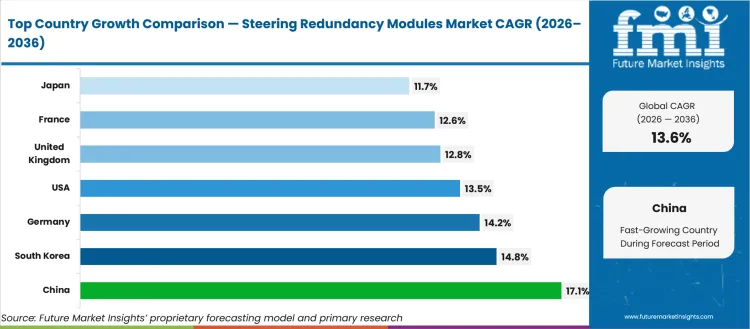
| Country | CAGR |
|---|---|
| United States | 13.5% |
| United Kingdom | 12.8% |
| Germany | 14.2% |
| France | 12.6% |
| Japan | 11.7% |
| China | 17.1% |
| South Korea | 14.8% |
| India | 15.5% |
How do country-level CAGRs compare in the steering redundancy modules market?
Country profiles in steering redundancy modules should be read by platform readiness and EV depth. Safety validation capacity and supplier access also shape the forecast. In established automotive markets, the case is tied to premium vehicle programs and stricter approval discipline. In high-growth markets, the same modules are closer to NEV scale and local software-validation capability. Japan and Germany emphasize engineering proof and supplier depth. China and India emphasize platform volume and localization. For buyers and investors, the comparison shows whether spending is being pulled by premium architecture or domestic EV scale. It also shows how quickly validation resources can be mobilized.
- By 2036, the United States is projected to record 13.5% CAGR supported by automated-vehicle safety work and local EV supply investment. The USA Department of Energy reported in January 2025 that announced investments in the domestic EV and battery supply chain exceeded USD 188 billion. This supports local validation demand.
- The United Kingdom is expected to grow at 12.8% CAGR during the forecast period, reinforced by zero-emission car uptake and strict approval culture. GOV.UK reported in April 2026 that 473,000 zero-emission cars were registered in the United Kingdom during 2025. This supports demand for safety-rich vehicle electronics.
- Over the assessment period, Germany is forecast to advance at 14.2% CAGR shaped by domestic electric-vehicle production depth and steering supplier capability. VDA reported in August 2025 that Germany produced 635,000 BEVs in the first half of 2025. This supports module demand across premium EV platforms.
- Demand outlook for France points to 12.6% CAGR by 2036, supported by compact EV launches and EU safety compliance work. ACEA reported in January 2026 that France recorded 302,673 battery-electric car registrations in 2025. This creates a steady addressable base for electronic steering safety content.
- Japan is likely to expand at 11.7% CAGR by 2036, influenced by careful EV adoption and deep steering engineering capability. The USA International Trade Administration reported in November 2025 that EVs represented 3.5% of Japan’s 2024 vehicle sales. This lower base keeps adoption more selective.
- China is estimated to rise at 17.1% CAGR between 2026 and 2036, propelled by NEV scale and faster premium EV commercialization. IEA reported in 2026 that China’s public charging infrastructure exceeded 4.7 million points in 2025. This supports high EV utilization and faster by-wire platform movement.
- South Korea is projected to post 14.8% CAGR by 2036, supported by export-focused vehicle electronics and by-wire supplier activity. Korea.net reported in January 2026 that eco-friendly vehicle exports accounted for 42.5% of automobile export value. This supports steering electronics aligned to higher-value export vehicles.
- Demand in India is projected to grow at 15.5% CAGR by 2036, attributable to localized vehicle production and software validation work. India’s Press Information Bureau reported in December 2024 that 16.15 lakh EVs had been incentivized under FAME-II. This strengthens the local base for EV steering content.
Who are the notable companies in the steering redundancy modules market?
Bosch Mobility, ZF Friedrichshafen AG, Nexteer Automotive, JTEKT Corporation, HL Mando, Schaeffler AG, Astemo, thyssenkrupp Steering, and L&T Technology Services are the notable companies shaping this market.
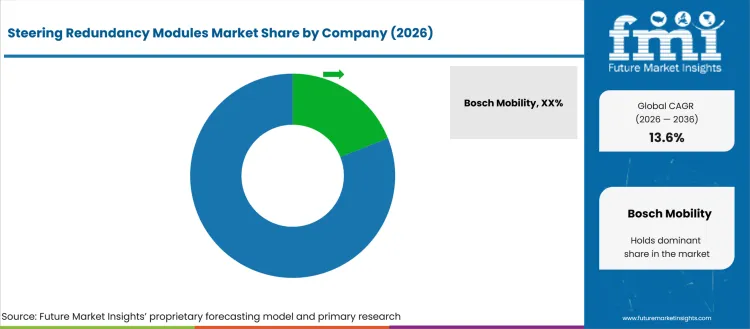
Automotive software capability becomes more important as OEMs expect diagnostics and calibration to move alongside steering hardware. Supplier competition in steering redundancy modules is structured around the vehicle layer that the buyer wants to control. Bosch Mobility and ZF are more relevant for integrated steering actuation. Nexteer and JTEKT add production evidence across by-wire programs. HL Mando and Schaeffler add actuator hardware. Astemo adds steering system fit due to broader chassis electronics coverage. thyssenkrupp Steering and L&T Technology Services gain relevance from software engineering and validation support. Software release control also needs to move with the steering package.
- Bosch Mobility and ZF are relevant in programs that need steering actuation and vehicle motion software. Their role is practical due to integrated steering wheel actuator and rack actuator scope across by-wire platforms. Software scope also supports OEM fault-handling reviews.
- Nexteer Automotive and JTEKT Corporation focus on production steer-by-wire and backup-power evidence. Buyers choosing these suppliers are typically looking for fault diagnosis and steering feel across passenger EV programs. Controlled fallback remains part of the same sourcing decision.
- HL Mando and Schaeffler gain preference in chassis programs shaped by by-wire actuation depth. Astemo adds additional chassis electronics scope. Their relevance is suited to OEM teams that need steering actuators and platform integration support.
- thyssenkrupp Steering and L&T Technology Services matter in engineering environments that need software validation capacity. Their role is supported by the 2025 software hub agreement that expands development support for steering systems from Pune.
Competitive Benchmarking: Steering Redundancy Modules Market
| Company | Redundancy Control Scope | Actuator System Fit | Software and Validation Depth | Footprint or Program Reach |
|---|---|---|---|---|
| Bosch Mobility | High | Strong | High | Global |
| ZF Friedrichshafen AG | High | Strong | High | Global |
| Nexteer Automotive | High | Medium | High | Global |
| JTEKT Corporation | Medium | Strong | Medium | Asia and global |
| HL Mando | Medium | Strong | Medium | Asia and global |
| Schaeffler AG | Medium | Strong | Medium | Global |
| Astemo | Medium | Medium | Medium | Global |
| thyssenkrupp Steering | Medium | Strong | High | Global |
| L&T Technology Services | Medium | Medium | Strong | Global |
Source: Future Market Insights competitive analysis, 2026. Ratings reflect relative portfolio relevance, workflow or project fit, service capability, and geographic reach.
Key Developments in the Steering Redundancy Modules Market
- In February 2025, ZF started series production of steer-by-wire steering for the NIO ET9. The company supplied the steering wheel actuator and redundant steering gear actuator. Software was also part of the steering package. This matters due to production by-wire programs that turn redundancy modules into direct platform content.
- In April 2026, Nexteer Automotive started series production of its first steer-by-wire program for a Chinese NEV maker. The system achieved ASIL D functional safety approval in late 2025. This points to buyer demand for verified diagnostics and redundancy monitoring before series launch.
- In October 2025, JTEKT said its steer-by-wire system and Libuddy backup power supply were installed in the Lexus RZ. The development matters due to backup energy needs in linkless steering systems. It reinforces supplier focus on power continuity and safe vehicle movement.
- In June 2025, L&T Technology Services and thyssenkrupp Steering agreed to establish a global software hub in Pune. The agreement matters for steering redundancy modules due to the rising need for validation software and engineering capacity. It supports supplier access to scalable software development.
Key Players in the Steering Redundancy Modules Market
Steering and Actuator System Suppliers
- Bosch Mobility
- ZF Friedrichshafen AG
- Nexteer Automotive
- JTEKT Corporation
By-wire Chassis Specialists
- HL Mando
- Schaeffler AG
- Astemo
- thyssenkrupp Steering
Software and Validation Partners
- L&T Technology Services
Steering Redundancy Modules Market - Report Scope
| Coverage field | Report scope |
|---|---|
| Market breakdown | Steering Redundancy Modules Market Breakdown By Module Type, Steering System, Vehicle Type, Safety Level, Sales Channel, and Region |
| Market Definition | Electronic and electromechanical modules that keep steering control available after a primary steering path fails. |
| Regions Covered | North America, Latin America, Western Europe, Eastern Europe, East Asia, South Asia and Pacific, Middle East and Africa |
| Countries Covered | United States, United Kingdom, Germany, France, Japan, China, South Korea, India and 30+ countries |
| Key Companies Profiled | Bosch Mobility, ZF Friedrichshafen AG, Nexteer Automotive, JTEKT Corporation, HL Mando, Schaeffler AG, Astemo, thyssenkrupp Steering, L&T Technology Services |
| Forecast Period | 2026 to 2036 |
| Approach | Hybrid bottom-up and top-down methodology using platform volumes, module content, safety levels, supplier evidence, and country-level vehicle demand signals |
Steering Redundancy Modules Market - Research Methodology
| Method | Approach |
|---|---|
| Primary Research | FMI analysts reviewed inputs from steering system suppliers, chassis electronics teams, EV platform engineers, safety validation specialists, and Tier-1 sales teams. Discussions focused on redundancy content per platform, by-wire timing, and fail-operational design choices. |
| Desk Research | Desk research covered vehicle safety rules, EV production indicators, charging infrastructure data, official vehicle statistics, company steering releases, and supplier product pages. Product relevance was checked against redundant ECU, actuator, backup power, and sensor redundancy scope. |
| Market Sizing and Forecasting | The model combined steering platform volumes, estimated module content per vehicle, country-level EV readiness, and platform safety levels. Forecast assumptions were adjusted for steer-by-wire launches, ASIL D requirements, advanced EPS use, and Tier-1 integration routes. |
| Data Validation | Forecasts were checked against supplier portfolios, EV production shifts, public steering technology evidence, and country-level vehicle data. Duplicate statistics were avoided by assigning each external figure to one section before final drafting. |
Steering Redundancy Modules Market by Segments
Steering Redundancy Modules Market segmented by Module Type:
- Redundant ECU Modules
- Dual Motor Control Modules
- Fail-operational Power Modules
- Sensor Redundancy Modules
Steering Redundancy Modules Market segmented by Steering System:
- Steer-by-wire
- Advanced EPS
- Autonomous Shuttle Steering
- Commercial Vehicle Steering
Steering Redundancy Modules Market segmented by Vehicle Type:
- Passenger EVs
- ADAS-equipped ICE / Hybrid
- Autonomous Vehicles
- Commercial Vehicles
Steering Redundancy Modules Market segmented by Safety Level:
- ASIL B
- ASIL C
- ASIL D
Steering Redundancy Modules Market segmented by Sales Channel:
- OEM
- Tier-1 Integrated Supply
Steering Redundancy Modules Market by Region:
- North America
- United States
- Canada
- Europe
- Germany
- United Kingdom
- France
- Italy
- Spain
- Asia Pacific
- China
- Japan
- South Korea
- Taiwan
- Singapore
- Latin America
- Brazil
- Mexico
- Argentina
- Middle East & Africa
- GCC Countries
- South Africa
- Israel
Research Sources and Bibliography
- International Energy Agency. (2026, March). Technology: Electric vehicles. Global Energy Review 2026.
- International Energy Agency. (2026, May 20). Close to 30% of cars sold this year are set to be electric as countries and consumers respond to energy crisis. IEA.
- International Energy Agency. (2026, June). Trends in electric cars. Global EV Outlook 2026.
- National Highway Traffic Safety Administration. (2024, April 29). NHTSA finalizes key safety rule to reduce crashes and save lives. USA Department of Transportation.
- National Highway Traffic Safety Administration. (2025, April 24). Third Amendment to Standing General Order 2021-01. USA Department of Transportation.
- National Bureau of Statistics of China. (2026, February 28). Statistical communiqué of the People’s Republic of China on the 2025 national economic and social development.
- Department for Transport and Driver and Vehicle Licensing Agency. (2026, April 29). Vehicle licensing statistics, United Kingdom: 2025. GOV.UK.
- Verband der Automobilindustrie. (2025, August 4). Electric car production at record levels in first half of the year. VDA.
- Verband der Automobilindustrie. (2026, February 3). 40% electric share of passenger car production in 2025. VDA.
- European Automobile Manufacturers’ Association. (2026, January 27). New car registrations: +1.8% in 2025; battery-electric 17.4% market share. ACEA.
- Press Information Bureau. (2026, February 10). Status of heavy industries sector. Government of India.
- Press Information Bureau. (2024, December 19). Year End Review 2024: Ministry of Heavy Industries. Government of India.
- USA Department of Energy. (2025, January). A report on actions for medium- and heavy-duty vehicle energy and emissions.
- USA International Trade Administration. (2025, November 20). Japan - Automotive. USA Department of Commerce.
- Ministry of Trade, Industry and Energy. (2026, January). January 2026 automobile exports reach $6.1 billion. Korea.net.
- ZF Friedrichshafen AG. (2025, February 17). Start of series production for Steer-by-Wire steering at Chinese car manufacturer NIO. ZF.
- ZF Friedrichshafen AG. (2025, July 10). ZF Steer-by-Wire: Driving innovation in a new direction. ZF.
- Nexteer Automotive. (2026, April 28). Nexteer puts Steer-by-Wire into series production. Nexteer Automotive.
- Nexteer Automotive. (2026, April 21). Nexteer introduces market-ready EMB at Auto China 2026, advancing comprehensive motion control solutions. Nexteer Automotive.
- JTEKT Corporation. (2025, October 1). Steer-by-Wire System and Backup Power Supply (Libuddy®) are installed in LEXUS RZ. JTEKT.
- L&T Technology Services. (2025, June 30). LTTS & thyssenkrupp Steering business unit enter into a strategic partnership to establish a global software hub in Pune, India. L&T Technology Services.
- Schaeffler. (2025, September 3). Shaping the future of mobility with electric axle drives and software-defined powertrain solutions. Schaeffler.
- United Nations Economic Commission for Europe. (2025, June). Agreement Addendum 156 - UN Regulation No. 157. UNECE.
- United Nations Economic Commission for Europe. (2024, April). Agreement Addendum 78: UN Regulation No. 79. UNECE.
- ZF Friedrichshafen AG. (2025, September 23). ZF Continues to Expand Steering System Capacity in China. ZF.
This bibliography is provided for reader reference and uses primary government, standards-body, official trade body, and company sources.
This Report Answers
- What is the expected global value of the Steering Redundancy Modules Market in 2026 and 2036?
- What CAGR is forecast for steering redundancy modules during the 2026 to 2036 period?
- Which module type is expected to hold a notable share in 2026?
- Why do OEMs buy redundancy modules for steer-by-wire and safety-rich EPS platforms?
- How do steering system choices influence redundant ECU and power-module demand?
- Which countries are compared in the steering redundancy modules forecast?
- Which companies are relevant in fail-operational steering and redundancy module supply?
- How do ASIL D requirements influence module design and supplier selection?
- What segment categories are included in the steering redundancy modules market scope?
- How does FMI size and forecast module demand across vehicle platforms and countries?
Frequently Asked Questions
What is driving growth in the Steering Redundancy Modules Market?
Growth is driven by fail-operational steering needs and by-wire vehicle architecture. EV platform scale and OEM safety validation pressure add support.
Why should executives track steering redundancy modules?
Executives tracking this market gain visibility into how by-wire steering affects safety cases and warranty risk. Supplier selection and vehicle platform value are also influenced.
What should buyers evaluate before selecting a steering redundancy module supplier?
Buyers should compare actuator scope and ECU redundancy depth before selecting suppliers. ASIL evidence and local validation capacity should also guide sourcing decisions.
What business problem does the Steering Redundancy Modules Market address?
It ensures steering control remains available during electronic or actuator faults by enabling seamless takeover through validated backup control paths.
What can limit return on investment for buyers?
Return on investment can be limited by high validation cost long software approval cycles or late integration of redundancy into vehicle platforms.
How can suppliers build executive confidence?
Suppliers build confidence by demonstrating proven fail operational behavior validated diagnostics reliable backup power and strong OEM launch support.
Preview the report firsthand - request a free sample
Get SampleGet the brochure for pricing and purchase details.
Get PDFTable of Content
- Key Takeaways
- Market Size and CAGR
- Top Growth Driver
- Fastest Growing Segment
- Leading Region
- Key Companies
- Emerging Opportunities
- Executive Summary
- Global Market Outlook
- Demand-side Trends
- Supply-side Trends
- Technology Roadmap Analysis
- Analysis and Recommendations
- Analyst Perspective (What is happening? Why now? What should investors know?)
- Key Questions Answered
- How large is the market?
- What is the CAGR?
- What are key trends?
- Which region dominates?
- Who are the leaders?
- Market Overview
- Market Coverage / Taxonomy
- Market Definition / Scope / Limitations
- Research Methodology
- Chapter Orientation
- Analytical Lens and Working Hypotheses
- Market Structure, Signals, and Trend Drivers
- Benchmarking and Cross-market Comparability
- Market Sizing, Forecasting, and Opportunity Mapping
- Research Design and Evidence Framework
- Desk Research Programme (Secondary Evidence)
- Expert Input and Fieldwork (Primary Evidence)
- Tooling, Models, and Reference Databases
- Data Engineering and Model Build
- Quality Assurance and Audit Trail
- Market Background
- Market Dynamics (Drivers, Restraints, Opportunity, Trends)
- Scenario Forecast (Optimistic, Likely, Conservative)
- Impact Analysis
- AI Impact
- Sustainability Impact
- Regulatory Impact
- Technology Impact
- Consumer / Buyer Analysis
- Purchase Drivers
- Adoption Barriers
- Buyer Journey
- Opportunity Map Analysis
- Product Life Cycle Analysis
- Supply Chain Analysis
- Investment Feasibility Matrix
- Value Chain Analysis
- PESTLE and Porter's Analysis
- Regulatory Landscape
- Regional Parent Market Outlook
- Production and Consumption Statistics
- Import and Export Statistics
- Global Market Analysis and Forecast, 2021 to 2036
- Historical Market Size Value (USD Million) & Volume (Unit) Analysis, 2021 to 2025
- Current and Future Market Size Value (USD Million) & Volume (Unit) Projections, 2026 to 2036
- Y-o-Y Growth Trend Analysis
- Absolute $ Opportunity Analysis
- Global Market Pricing Analysis, 2021 to 2036
- Global Market Analysis and Forecast, By Module Type, 2021 to 2036
- Introduction / Key Findings
- Historical Market Size Value (USD Million) & Volume (Unit) Analysis By Module Type, 2021 to 2025
- Current and Future Market Size Value (USD Million) & Volume (Unit) Analysis and Forecast By Module Type, 2026 to 2036
- Redundant ECU Modules
- Dual Motor Control Modules
- Sensor Redundancy Modules
- Fail-operational Power Modules
- Redundant ECU Modules
- Y-o-Y Growth Trend Analysis By Module Type, 2021 to 2025
- Absolute $ Opportunity Analysis By Module Type, 2026 to 2036
- Global Market Analysis and Forecast, By Steering System, 2021 to 2036
- Introduction / Key Findings
- Historical Market Size Value (USD Million) & Volume (Unit) Analysis By Steering System, 2021 to 2025
- Current and Future Market Size Value (USD Million) & Volume (Unit) Analysis and Forecast By Steering System, 2026 to 2036
- Steer-by-wire
- Advanced EPS
- Commercial Vehicle Steering
- Autonomous Shuttle Steering
- Steer-by-wire
- Y-o-Y Growth Trend Analysis By Steering System, 2021 to 2025
- Absolute $ Opportunity Analysis By Steering System, 2026 to 2036
- Global Market Analysis and Forecast, By Vehicle Type, 2021 to 2036
- Introduction / Key Findings
- Historical Market Size Value (USD Million) & Volume (Unit) Analysis By Vehicle Type, 2021 to 2025
- Current and Future Market Size Value (USD Million) & Volume (Unit) Analysis and Forecast By Vehicle Type, 2026 to 2036
- Passenger EV
- ADAS-equipped ICE / Hybrid
- Commercial Vehicles
- Autonomous Vehicles
- Passenger EV
- Y-o-Y Growth Trend Analysis By Vehicle Type, 2021 to 2025
- Absolute $ Opportunity Analysis By Vehicle Type, 2026 to 2036
- Global Market Analysis and Forecast, By Safety Level, 2021 to 2036
- Introduction / Key Findings
- Historical Market Size Value (USD Million) & Volume (Unit) Analysis By Safety Level, 2021 to 2025
- Current and Future Market Size Value (USD Million) & Volume (Unit) Analysis and Forecast By Safety Level, 2026 to 2036
- ASIL D
- ASIL B
- ASIL C
- ASIL D
- Y-o-Y Growth Trend Analysis By Safety Level, 2021 to 2025
- Absolute $ Opportunity Analysis By Safety Level, 2026 to 2036
- Global Market Analysis and Forecast, By Sales Channel, 2021 to 2036
- Introduction / Key Findings
- Historical Market Size Value (USD Million) & Volume (Unit) Analysis By Sales Channel, 2021 to 2025
- Current and Future Market Size Value (USD Million) & Volume (Unit) Analysis and Forecast By Sales Channel, 2026 to 2036
- OEM
- Tier-1 Integrated Supply
- OEM
- Y-o-Y Growth Trend Analysis By Sales Channel, 2021 to 2025
- Absolute $ Opportunity Analysis By Sales Channel, 2026 to 2036
- Global Market Analysis and Forecast, By Region, 2021 to 2036
- Introduction
- Historical Market Size Value (USD Million) & Volume (Unit) Analysis By Region, 2021 to 2025
- Current Market Size Value (USD Million) & Volume (Unit) Analysis and Forecast By Region, 2026 to 2036
- North America
- Latin America
- Western Europe
- Eastern Europe
- East Asia
- South Asia and Pacific
- Middle East & Africa
- Market Attractiveness Analysis By Region
- North America Market Analysis and Forecast, By Country, 2021 to 2036
- Historical Market Size Value (USD Million) & Volume (Unit) Trend Analysis By Market Taxonomy, 2021 to 2025
- Market Size Value (USD Million) & Volume (Unit) Forecast By Market Taxonomy, 2026 to 2036
- By Country
- USA
- Canada
- Mexico
- By Module Type
- By Steering System
- By Vehicle Type
- By Safety Level
- By Sales Channel
- By Country
- Market Attractiveness Analysis
- By Country
- By Module Type
- By Steering System
- By Vehicle Type
- By Safety Level
- By Sales Channel
- Key Takeaways
- Latin America Market Analysis and Forecast, By Country
- Historical Market Size Value (USD Million) & Volume (Unit) Trend Analysis By Market Taxonomy, 2021 to 2025
- Market Size Value (USD Million) & Volume (Unit) Forecast By Market Taxonomy, 2026 to 2036
- By Country
- Brazil
- Chile
- Rest of Latin America
- By Module Type
- By Steering System
- By Vehicle Type
- By Safety Level
- By Sales Channel
- By Country
- Market Attractiveness Analysis
- By Country
- By Module Type
- By Steering System
- By Vehicle Type
- By Safety Level
- By Sales Channel
- Key Takeaways
- Western Europe Market Analysis and Forecast, By Country
- Historical Market Size Value (USD Million) & Volume (Unit) Trend Analysis By Market Taxonomy, 2021 to 2025
- Market Size Value (USD Million) & Volume (Unit) Forecast By Market Taxonomy, 2026 to 2036
- By Country
- Germany
- UK
- Italy
- Spain
- France
- Nordic
- BENELUX
- Rest of Western Europe
- By Module Type
- By Steering System
- By Vehicle Type
- By Safety Level
- By Sales Channel
- By Country
- Market Attractiveness Analysis
- By Country
- By Module Type
- By Steering System
- By Vehicle Type
- By Safety Level
- By Sales Channel
- Key Takeaways
- Eastern Europe Market Analysis and Forecast, By Country
- Historical Market Size Value (USD Million) & Volume (Unit) Trend Analysis By Market Taxonomy, 2021 to 2025
- Market Size Value (USD Million) & Volume (Unit) Forecast By Market Taxonomy, 2026 to 2036
- By Country
- Russia
- Poland
- Hungary
- Balkan & Baltic
- Rest of Eastern Europe
- By Module Type
- By Steering System
- By Vehicle Type
- By Safety Level
- By Sales Channel
- By Country
- Market Attractiveness Analysis
- By Country
- By Module Type
- By Steering System
- By Vehicle Type
- By Safety Level
- By Sales Channel
- Key Takeaways
- East Asia Market Analysis and Forecast, By Country
- Historical Market Size Value (USD Million) & Volume (Unit) Trend Analysis By Market Taxonomy, 2021 to 2025
- Market Size Value (USD Million) & Volume (Unit) Forecast By Market Taxonomy, 2026 to 2036
- By Country
- China
- Japan
- South Korea
- By Module Type
- By Steering System
- By Vehicle Type
- By Safety Level
- By Sales Channel
- By Country
- Market Attractiveness Analysis
- By Country
- By Module Type
- By Steering System
- By Vehicle Type
- By Safety Level
- By Sales Channel
- Key Takeaways
- South Asia and Pacific Market Analysis and Forecast, By Country
- Historical Market Size Value (USD Million) & Volume (Unit) Trend Analysis By Market Taxonomy, 2021 to 2025
- Market Size Value (USD Million) & Volume (Unit) Forecast By Market Taxonomy, 2026 to 2036
- By Country
- India
- ASEAN
- Australia & New Zealand
- Rest of South Asia and Pacific
- By Module Type
- By Steering System
- By Vehicle Type
- By Safety Level
- By Sales Channel
- By Country
- Market Attractiveness Analysis
- By Country
- By Module Type
- By Steering System
- By Vehicle Type
- By Safety Level
- By Sales Channel
- Key Takeaways
- Middle East & Africa Market Analysis and Forecast, By Country
- Historical Market Size Value (USD Million) & Volume (Unit) Trend Analysis By Market Taxonomy, 2021 to 2025
- Market Size Value (USD Million) & Volume (Unit) Forecast By Market Taxonomy, 2026 to 2036
- By Country
- Kingdom of Saudi Arabia
- Other GCC Countries
- Türkiye
- South Africa
- Other African Union
- Rest of Middle East & Africa
- By Module Type
- By Steering System
- By Vehicle Type
- By Safety Level
- By Sales Channel
- By Country
- Market Attractiveness Analysis
- By Country
- By Module Type
- By Steering System
- By Vehicle Type
- By Safety Level
- By Sales Channel
- Key Takeaways
- Key Countries Market Analysis
- USA
- Pricing Analysis
- Market Share Analysis, 2025
- By Module Type
- By Steering System
- By Vehicle Type
- By Safety Level
- By Sales Channel
- Canada
- Pricing Analysis
- Market Share Analysis, 2025
- By Module Type
- By Steering System
- By Vehicle Type
- By Safety Level
- By Sales Channel
- Mexico
- Pricing Analysis
- Market Share Analysis, 2025
- By Module Type
- By Steering System
- By Vehicle Type
- By Safety Level
- By Sales Channel
- Brazil
- Pricing Analysis
- Market Share Analysis, 2025
- By Module Type
- By Steering System
- By Vehicle Type
- By Safety Level
- By Sales Channel
- Chile
- Pricing Analysis
- Market Share Analysis, 2025
- By Module Type
- By Steering System
- By Vehicle Type
- By Safety Level
- By Sales Channel
- Germany
- Pricing Analysis
- Market Share Analysis, 2025
- By Module Type
- By Steering System
- By Vehicle Type
- By Safety Level
- By Sales Channel
- UK
- Pricing Analysis
- Market Share Analysis, 2025
- By Module Type
- By Steering System
- By Vehicle Type
- By Safety Level
- By Sales Channel
- Italy
- Pricing Analysis
- Market Share Analysis, 2025
- By Module Type
- By Steering System
- By Vehicle Type
- By Safety Level
- By Sales Channel
- Spain
- Pricing Analysis
- Market Share Analysis, 2025
- By Module Type
- By Steering System
- By Vehicle Type
- By Safety Level
- By Sales Channel
- France
- Pricing Analysis
- Market Share Analysis, 2025
- By Module Type
- By Steering System
- By Vehicle Type
- By Safety Level
- By Sales Channel
- India
- Pricing Analysis
- Market Share Analysis, 2025
- By Module Type
- By Steering System
- By Vehicle Type
- By Safety Level
- By Sales Channel
- ASEAN
- Pricing Analysis
- Market Share Analysis, 2025
- By Module Type
- By Steering System
- By Vehicle Type
- By Safety Level
- By Sales Channel
- Australia & New Zealand
- Pricing Analysis
- Market Share Analysis, 2025
- By Module Type
- By Steering System
- By Vehicle Type
- By Safety Level
- By Sales Channel
- China
- Pricing Analysis
- Market Share Analysis, 2025
- By Module Type
- By Steering System
- By Vehicle Type
- By Safety Level
- By Sales Channel
- Japan
- Pricing Analysis
- Market Share Analysis, 2025
- By Module Type
- By Steering System
- By Vehicle Type
- By Safety Level
- By Sales Channel
- South Korea
- Pricing Analysis
- Market Share Analysis, 2025
- By Module Type
- By Steering System
- By Vehicle Type
- By Safety Level
- By Sales Channel
- Russia
- Pricing Analysis
- Market Share Analysis, 2025
- By Module Type
- By Steering System
- By Vehicle Type
- By Safety Level
- By Sales Channel
- Poland
- Pricing Analysis
- Market Share Analysis, 2025
- By Module Type
- By Steering System
- By Vehicle Type
- By Safety Level
- By Sales Channel
- Hungary
- Pricing Analysis
- Market Share Analysis, 2025
- By Module Type
- By Steering System
- By Vehicle Type
- By Safety Level
- By Sales Channel
- Kingdom of Saudi Arabia
- Pricing Analysis
- Market Share Analysis, 2025
- By Module Type
- By Steering System
- By Vehicle Type
- By Safety Level
- By Sales Channel
- Türkiye
- Pricing Analysis
- Market Share Analysis, 2025
- By Module Type
- By Steering System
- By Vehicle Type
- By Safety Level
- By Sales Channel
- South Africa
- Pricing Analysis
- Market Share Analysis, 2025
- By Module Type
- By Steering System
- By Vehicle Type
- By Safety Level
- By Sales Channel
- USA
- Market Structure Analysis
- Competition Dashboard
- Competition Benchmarking
- Market Share Analysis of Top Players
- By Region
- By Module Type
- By Steering System
- By Vehicle Type
- By Safety Level
- By Sales Channel
- Emerging Startups
- Innovation Benchmarking
- Competition Analysis
- Competition Deep Dive
- Bosch Mobility
- Overview
- Product Portfolio
- Profitability by Market Segments (Product/Region/Sales Channel)
- Sales Footprint
- Strategy Overview
- Marketing Strategy
- Product Strategy
- Channel Strategy
- ZF Friedrichshafen AG
- Nexteer Automotive
- JTEKT Corporation
- HL Mando
- Astemo
- Bosch Mobility
- Case Studies
- Success Stories
- Recent Developments
- Competition Deep Dive
- Assumptions & Acronyms Used


