

- Market Size (2026)
- USD 2.2 Bn
- Forecast (2036)
- USD 3.6 Bn
- CAGR (2026 to 2036)
- 5.0%
How big is Automotive Shift Fork Modules Market in 2026?
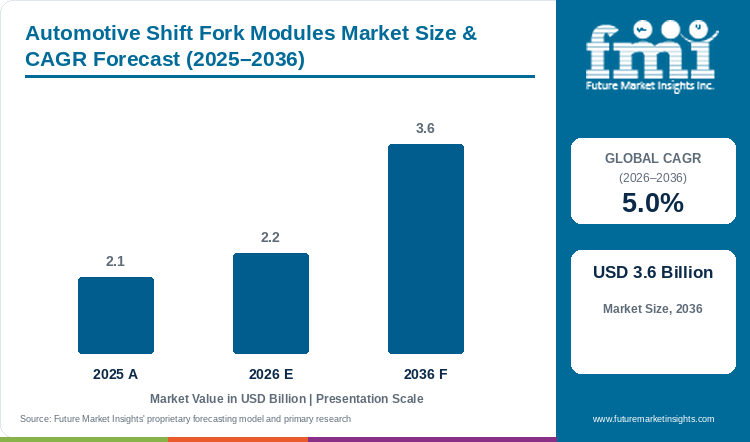
Demand for automotive shift fork modules is projected to expand at 5.0% CAGR between 2026 and 2036. Industry value grows from USD 2.1 billion in 2025 to USD 2.2 billion in 2026 and is projected to reach USD 3.6 billion by 2036.
FMI projects automotive shift fork modules to rise from USD 2.2 billion in 2026 to USD 3.6 billion by 2036 at a 5.0% CAGR, with comparison showing 8.8% growth for automotive gear shift systems, 8.7% for dual-clutch transmissions, 7.0% for automotive gear shifters, and 4.3% for automotive transmissions. The demand is supported by the reason that shift forks remain necessary in manual, dual-clutch, automated manual and hybrid gearboxes. Single-speed electric vehicles use fewer shift points, so demand follows the mix of transmission designs in production.
Romania produced 545,510 vehicles in 2025, down 2.6% from 2024, according to ACAROM. INEGI recorded 3,953,494 light vehicles in Mexico, with light trucks making up 77.2% of output. Romania's smaller production base makes individual gearbox programs more consequential for local machining suppliers. Mexico's export-scale assembly supports steadier component volumes, and FMI projects 5.6% growth there and 5.9% in Romania.
Key Takeaways
- Manual and DCT programs keep selector hardware in production because both architectures still use controlled fork travel inside multi-speed gearboxes.
- Manual transmission shift forks are projected to account for 27.0% of module type demand in 2026, supported by installed multi-speed programs.
- Cast aluminum is estimated to hold 28.0% of material demand in 2026 because near-net-shape casting reduces mass and secondary machining.
- Manual transmissions are expected to hold 34.0% of transmission type demand in 2026 as established multi-speed programs remain in production.
- FMI analysis places Romania at 5.9% CAGR over the forecast period, while Mexico reaches 5.6% as export production supports steadier module volumes.
- Notable Automotive Shift Fork Modules Market companies include Methode Electronics, Magna International, Schaeffler, AISIN, Hyundai Transys, ZF Friedrichshafen, BorgWarner, Linamar, Musashi Seimitsu, and Kongsberg Automotive.
Analyst Perspective
"Hybrid and DCT programs keep mechanical selector demand active as electrification spreads through vehicle portfolios. Single-speed EVs reduce fork count, so remaining value moves toward compact actuation with position feedback and tighter validation."
- Nikhil Kaitwade, Principal Consultant, Future Market Insights
How is the Automotive Shift Fork Modules Market segmented?
Automotive Shift Fork Modules Market is segmented by five primary commercial axes and region: module type, material, transmission type, sales channel, vehicle type, and region. The 2026 estimates place manual transmission shift forks at 27.0%, cast aluminum at 28.0%, manual transmissions at 34.0%, transmission OEMs at 53.0%, and passenger cars at 45.0% within their respective parent categories.
The module type axis includes manual transmission shift forks, DCT shift fork modules, AMT shift fork modules, EV reducer selector forks, and sensorized shift fork modules.
The material axis includes cast aluminum, forged steel, powder metal, engineering polymer pads, and hybrid metal-polymer.
The transmission type axis includes manual transmissions, dual-clutch transmissions, automated manual transmissions, and EV reduction units.
The sales channel axis includes transmission OEMs, Tier-1 powertrain suppliers, aftermarket replacement, and precision casting/machining suppliers.
The vehicle type axis includes passenger cars, light commercial vehicles, performance vehicles, and commercial vehicles.
The region split covers North America, Latin America, Western Europe, Eastern Europe, East Asia, South Asia and Pacific, and Middle East and Africa.
Why do manual transmission shift forks remain relevant in module type demand?
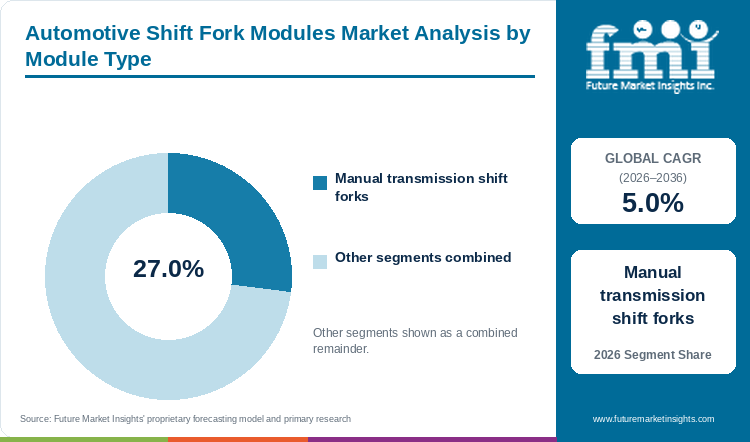
Based on module type, manual transmission shift forks are projected to account for 27.0% in 2026, supported by installed programs.
FMI's segment analysis indicates that manual shift forks remain relevant because installed gearboxes still select gears through rail-and-sleeve movement. Dual-clutch transmissions automate the command, but they still need controlled fork travel to complete each shift. Kongsberg Automotive's ATrAct system adds actuation and position sensing around the fork without removing its mechanical engagement task.
- Manual transmission shift forks are projected at 27.0% of module type demand in 2026, as serviceable rail-and-sleeve designs remain in active use.
- Kongsberg Automotive's current ATrAct unit places shift forks on individual gears and links them to a transmission actuator.
What supports cast aluminum use in the material category today?
By material, cast aluminum is estimated to hold 28.0% in 2026, owing to low mass and near-net-shape casting.
Cast aluminum suits shift forks that need low moving mass and complex rib or pad geometry. Casting forms these features near their final shape, which reduces the amount of metal removed during machining. Linamar combines automotive casting with precision machining for transmission components, giving suppliers closer control over fork geometry at production volume.
- Cast aluminum is estimated at 28.0% of material demand in 2026, as integrated ribs and pad supports limit secondary machining.
- Current Linamar capability links light-metal casting with transmission-part machining, which supports integrated production for qualified drivetrain components.
Which conditions keep manual transmissions relevant in transmission type demand?
In 2026, manual transmissions are expected to lead transmission type with 34.0% share, reinforced by established multi-speed vehicle programs.
Manual transmissions still support module demand in cost-sensitive passenger cars and commercial vehicles because their selector systems remain proven and serviceable. Electrification changes that demand unevenly because single-speed EVs remove many mechanical shift functions. In June 2025, ZF reported an order for several thousand manual and AMT nine-speed transmissions from a commercial-vehicle OEM.
- Manual transmissions are expected at 34.0% of transmission type demand in 2026, supported by a serviceable installed base in multi-speed programs.
- In June 2025, ZF reported an order for several thousand manual and AMT nine-speed transmissions from a commercial-vehicle OEM.
Why do transmission OEMs retain control over sales channel demand?
Transmission OEMs are expected to command 53.0% of sales channel revenue in 2026, driven by design-release and validation control.
Transmission OEMs retain channel control because fork geometry is fixed against rail travel and actuator force before serial release, and gearbox packaging is locked at the same stage. Aftermarket clutch components can replace worn parts, but they do not define the original fork interface. AISIN's hybrid gearsets use shift-by-wire control, yet the released selector design still sits with the transmission integrator.
- Transmission OEMs are projected at 53.0% of sales channel revenue in 2026 because integrators own rail geometry and actuator-force limits before serial release.
- Direct design control reduces revalidation work caused by changes to rail travel or actuator force inside an approved transmission program.
How do passenger cars sustain demand within the vehicle type category?
Passenger cars are projected to hold 45.0% of vehicle type demand in 2026, linked to manual and hybrid programs.
Passenger-car demand follows the transmission mix inside each model line because manual and dual-clutch gearboxes keep mechanical forks. Hybrid systems can retain dog-clutch engagement inside electrified drivetrains, as AISIN's hybrid systems show. Similar selector hardware is used in light commercial vehicle programs under longer duty cycles, so module demand depends on transmission architecture instead of passenger-car output alone.
- Passenger cars are projected at 45.0% of vehicle type demand in 2026 because manual and hybrid multi-speed architectures remain in active programs.
- Battery-electric platforms reduce conventional fork count, while hybrid passenger cars retain compact mechanical engagement points inside electrified transmissions.
What are the drivers, restraints, and opportunities in the Automotive Shift Fork Modules Market?
In the Automotive Shift Fork Modules Market, multi-speed production is the key driver, EV simplification the key restraint, and sensor-ready integration the key opportunity.
- Driver: Multi-speed production keeps selector hardware active because manual and DCT gearboxes remain in use alongside automated and hybrid programs.
- Restraint: Single-speed EV layouts reduce conventional fork count and narrow the number of mechanical shift functions in each drivetrain.
- Opportunity: Sensor-ready modules can add position feedback and actuator integration where electrified transmissions retain mechanical selector functions.
Multi-Speed Programs Retain Selector Demand
Multi-speed transmissions keep shift-fork demand active because every gear change still moves a rail, fork, and synchronizer through a fixed path. In May 2026, BorgWarner said a new SUV program would use its latest wet dual clutch. The program keeps mechanical selector travel inside a current vehicle launch. These systems use automotive actuators to return each fork to its released position on every shift. That requirement keeps fork geometry and wear limits central to supplier validation as manual, DCT, and AMT production continues.
Single-Speed EVs Reduce Fork Content
Battery EVs often use one reduction stage, so they need fewer selector functions than multi-speed gearboxes. The IEA reported in May 2026 that electric cars represented one-quarter of global new-car sales in 2025. As electric share rises, vehicle growth does not translate directly into shift-fork demand. Electric vehicle e-axles usually carry less conventional fork content than manual or dual-clutch gearboxes. Module demand therefore depends more on hybrids and selected reduction units that still use a mechanical engagement point.
Sensor-Ready Modules Add Control Value
According to FMI analysis, sensor-ready modules gain value in electrified transmissions that keep a mechanical engagement point and need position feedback. Hyundai Transys reported in February 2025 that its powertrain development process received ISO 26262 functional-safety certification. In that control loop, automotive sensors can confirm selector position while the fork still meets its travel and durability limits. The added electronics move module value beyond the fork body toward a combined mechanical and sensing package. A combined package gives suppliers more value per retained shift point even as total fork count falls.
Which country CAGRs are profiled in the Automotive Shift Fork Modules Market?
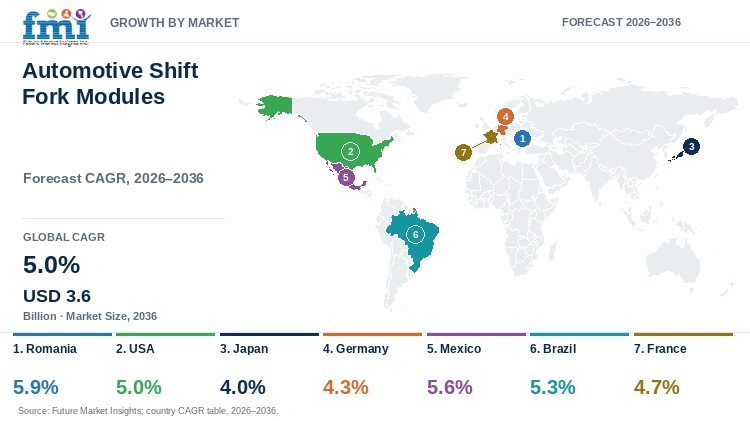
| Country | CAGR |
|---|---|
| Romania | 5.9% |
| USA | 5.0% |
| Japan | 4.0% |
| Germany | 4.3% |
| Mexico | 5.6% |
| Brazil | 5.3% |
| France | 4.7% |
How do country-level CAGRs compare in the Automotive Shift Fork Modules Market?
Country demand depends on vehicle output and the transmission mix used in that output. Hybrid and multi-speed programs keep more selector content than single-speed EVs. Production scale then determines whether local machining and launch support can be justified.
- Romanian module demand is tied to a concentrated production base, so one transmission program can materially change local machining workloads.
- US hybrid production is expanding and keeps multi-speed selector hardware relevant, while each platform still requires its own transmission validation.
- Japanese vehicle ownership remains high and replacement cycles are long, which supports service demand for established multi-speed drivetrains.
- German programs combine ongoing hybrid transmission work with weaker vehicle output and continued investment in electric drivetrains.
- Mexico's 2025 production was dominated by light trucks, giving transmission suppliers large export programs with tight launch schedules.
- Brazilian motor-vehicle production rose year over year in May 2026, keeping local drivetrain machining and assembly activity active.
- French registrations are shifting toward hybrids and EVs, which changes the mix of gearbox designs used in new passenger cars.
Full report country CAGRs cover: North America; Latin America; Western Europe; Eastern Europe; East Asia; South Asia and Pacific; Middle East and Africa.
Country-wise Analysis
- Romania's shift-fork outlook is shaped by a concentrated vehicle-production base. A change in one gearbox program can therefore move local machining demand quickly. FMI's country analysis projects 5.9% CAGR over the assessment period. ACAROM reported in January 2026 that Romania produced 545,510 vehicles in 2025, down 2.6% from 2024. Lower output leaves fewer programs over which suppliers can spread tooling and engineering costs. Flexible local machining is therefore useful for small revisions and launch support. Suppliers that can adjust fork geometry or wear surfaces without disrupting an approved interface are better suited to this production structure. Romania's growth case rests on program responsiveness because national scale remains limited.
- US demand is moving with hybrid production while manual gearbox demand remains limited. The market is projected to expand at 5.0% CAGR during the forecast period. In February 2026, the EPA projected hybrids at 19% of model-year 2025 light-duty production. Hybrids can retain several mechanical engagement points that single-speed EVs remove. Shift-fork demand therefore stays tied to electrified transmissions with internal shifting. Each program still needs released fork geometry and durability data before serial production. Sensorized designs also need position control that matches actuator movement. Over the assessment period, hybrid volume and engineering response will decide how much selector content remains in US production.
- Japan combines broad vehicle ownership with long replacement cycles, giving established drivetrains a longer commercial life. Automotive shift-fork module demand is forecast to rise at 4.0% CAGR over the projection period. JAMA reported in April 2026 that passenger-car ownership reached 71.9% in its 2025 national survey and vehicle holding periods remained long. Longer ownership supports replacement demand for approved transmission parts already in service. New demand comes from hybrid transmissions that retain mechanical selector travel, while single-speed EVs use fewer engagement points. By 2036, fork demand will depend on how long existing transmission families remain active and how quickly single-speed EVs replace them.
- Germany combines weaker vehicle output with continued hybrid transmission work. Shift-fork demand is projected to grow at 4.3% CAGR by 2036. Destatis reported in February 2026 that automotive-industry production fell 1.7% during 2025. Lower output weakens the case for tooling dedicated to one gearbox family. Battery-electric platforms remove many conventional shift functions, while hybrid transmissions offset part of that loss by retaining mechanical engagement points. Flexible machining becomes more useful as program volumes move between hybrid and conventional drivetrains. During the forecast period, suppliers that can transfer approved fork geometry between programs can serve changing German production without carrying excess dedicated capacity.
- Mexico's shift-fork opportunity is concentrated in high-volume export vehicle programs. Demand is forecast to expand at 5.6% CAGR during the forecast period. INEGI reported in January 2026 that Mexico produced 3,953,494 light vehicles in 2025. Light trucks represented 77.2% of national output, which concentrates transmission demand in large production runs. High volume supports local machining but raises the cost of late design changes. A revised fork or rail interface must be corrected without slowing export assembly. Local engineering support can shorten that response during launch or warranty work. Over the assessment period, Mexico's growth depends on serving large programs while keeping each part inside platform-specific validation.
- Brazilian shift-fork demand depends on vehicle output and the powertrain mix inside that production. The market is projected to grow at 5.3% CAGR during the assessment period. IBGE reported in July 2026 that output of motor vehicles, trailers and bodies rose 7.3% year over year in May. Higher production keeps local component activity active, but each powertrain carries a different amount of fork content. Hybrids can retain mechanical selector functions that single-speed EVs often remove. Imported material costs also influence casting and machining economics for local suppliers. Local production becomes more useful for smaller batches and rapid design changes. By 2036, demand will follow the share of platforms that retain mechanical engagement.
- France's registration mix is changing the transmission hardware needed in new passenger cars. Shift-fork module demand is anticipated to grow at 4.7% CAGR between 2026 and 2036. SDES reported in February 2026 that France registered 1.665 million new passenger cars in 2025. Non-plug-in gasoline hybrids represented 42.5% of registrations, compared with 19.9% for electric cars. The gap matters because hybrids can retain mechanical engagement points that many battery-electric platforms remove. Suppliers therefore need production plans that can support hybrid selector parts as conventional fork volumes decline. Over the forecast period, the registration mix will decide which fork designs keep scale and which move into smaller production runs.
Who are the notable companies in the Automotive Shift Fork Modules Market?
Notable Automotive Shift Fork Modules Market companies include Magna International, AISIN, Hyundai Transys, ZF Friedrichshafen, BorgWarner, Kongsberg Automotive, Methode Electronics, Schaeffler, Linamar, Musashi Seimitsu.
FMI identifies a fragmented supplier field because companies sell into different parts of the transmission interface. AISIN, Hyundai Transys, and ZF integrate selectors inside complete transmissions, while Kongsberg Automotive and Methode Electronics supply actuation or sensing. Linamar and Musashi Seimitsu compete closer to precision manufacturing, and buyers focus on repeatable geometry and process control. Vehicle makers use different approval routes for system suppliers and component specialists. Electrification widens the split because hybrid gearboxes can retain mechanical engagement, while many single-speed EVs remove conventional selector functions.
- Integrated transmission and electrified drive-system suppliers: Magna International, AISIN, Hyundai Transys, and ZF Friedrichshafen.
- Shift control and mechatronics specialists: Methode Electronics, BorgWarner, and Kongsberg Automotive.
- Precision mechanical component specialists: Schaeffler, Linamar, and Musashi Seimitsu.
Competitive Benchmarking: Automotive Shift Fork Modules Market
| Company | Transmission Architecture Access | Shift Control Integration | Precision Manufacturing Depth | Geographic Reach |
|---|---|---|---|---|
| Methode Electronics | Low | Medium | Medium | High |
| Magna International | High | High | High | High |
| Schaeffler | High | High | High | High |
| AISIN | High | High | High | High |
| Hyundai Transys | High | High | High | High |
| ZF Friedrichshafen | High | High | High | High |
| BorgWarner | High | High | High | High |
| Linamar | Medium | Low | High | High |
| Musashi Seimitsu | Medium | Medium | High | High |
| Kongsberg Automotive | Medium | High | Medium | High |
The benchmark compares companies on capability breadth, technical depth, current activity, and geographic reach. High indicates broad documented participation in a category or region. Medium indicates narrower participation, while Low indicates limited public evidence for that dimension. The ratings compare documented market roles and do not measure product quality or company market share.
Key Developments in the Automotive Shift Fork Modules Market
- In March 2026, Linamar agreed to acquire Winning BLW facilities in Remscheid and Penzberg for additional forging and gear manufacturing. The deal expands its European production base for gears and related transmission components.
- In April 2025, ZF introduced TraXon 2 Hybrid to the North American commercial-vehicle market. The automated manual transmission keeps multi-speed selector functions inside an electrified heavy-duty drivetrain.
- In February 2025, Hyundai Transys received ISO 26262 functional-safety certification for its powertrain product-development process. The certification adds a formal safety framework for electrified transmission development and control validation.
- In February 2025, Stellantis announced additional eDCT production at Termoli from 2026 with planned annual capacity of 300,000 units. The investment expands European production capacity for hybrid dual-clutch transmissions.
Key Players in the Automotive Shift Fork Modules Market
Integrated Transmission and Electrified Drive-System Suppliers
- Magna International
- AISIN
- Hyundai Transys
- ZF Friedrichshafen
Shift Control and Mechatronics Specialists
- Methode Electronics
- BorgWarner
- Kongsberg Automotive
Precision Mechanical Component Specialists
- Schaeffler
- Linamar
- Musashi Seimitsu
Automotive Shift Fork Modules Market - Report scope
| Coverage field | Report scope |
|---|---|
| Market breakdown | By Module Type, Material, Transmission Type, Sales Channel, Vehicle Type, and Region. |
| Quantitative Units | USD billion. |
| Market Definition | Revenue includes automotive shift fork bodies and fork-based selector modules sold for manual, DCT, AMT, hybrid, and EV reduction-unit applications. Complete transmission revenue and downstream vehicle revenue are excluded. Adjacent components sold separately are also excluded. |
| Regions Covered | North America, Latin America, Western Europe, Eastern Europe, East Asia, South Asia and Pacific, and Middle East and Africa. |
| Countries Covered | Romania, USA, Japan, Germany, Mexico, Brazil, France, and more than twenty-five additional countries in the full report. |
| Key Companies Profiled | Methode Electronics, Magna International, Schaeffler, AISIN, Hyundai Transys, ZF Friedrichshafen, BorgWarner, Linamar, Musashi Seimitsu, Kongsberg Automotive. |
| Forecast Period | 2026 to 2036. |
| Approach | Primary and secondary research with market triangulation across module content, transmission output, vehicle production, pricing, replacement demand, and country conditions. |
Automotive Shift Fork Modules Market - Research Methodology
| Method | Approach |
|---|---|
| Primary Research | FMI analysts gathered input from manufacturers, service providers, technology developers, distributors, end users, procurement teams, and subject-matter experts. Interviews examined purchasing decisions, product or service evaluation, adoption barriers, approval requirements, pricing considerations, and expectations for technical or commercial support. Respondents were also asked what evidence is required before a trial, pilot, or initial order develops into regular purchasing. |
| Desk Research | Desk research covered government statistics, regulatory publications, trade data, industry associations, technical literature, standards, company filings, product information, and official corporate announcements. Sources were reviewed for relevance, publication date, geographic coverage, and consistency with the defined market scope. Claims relating to performance, applications, approvals, capacity, investment, and commercial activity were retained only when supported by credible public evidence. |
| Market Sizing and Forecasting | The market model combined the baseline value with historical performance, segment structure, pricing and volume indicators, adoption levels, company participation, and country-level demand conditions. Forecast assumptions considered economic activity, investment trends, regulatory developments, technology adoption, purchasing cycles, supply availability, and barriers to wider market use. Segment and regional estimates were reconciled before the final market total was calculated. |
| Data Validation | Estimates were checked against multiple independent indicators, including public data, company activity, trade patterns, industry developments, and findings from primary interviews. Validation also tested whether products, services, applications, and company revenues fell within the defined market boundaries. Adjacent categories, unsupported claims, overlapping revenues, and activities without direct market relevance were excluded to reduce double counting and maintain consistency across segments and countries. |
Automotive Shift Fork Modules Market by Segments
Automotive Shift Fork Modules Market segmented by Module Type:
- Manual transmission shift forks
- DCT shift fork modules
- AMT shift fork modules
- EV reducer selector forks
- Sensorized shift fork modules
Automotive Shift Fork Modules Market segmented by Material:
- Cast aluminum
- Forged steel
- Powder metal
- Engineering polymer pads
- Hybrid metal-polymer
Automotive Shift Fork Modules Market segmented by Transmission Type:
- Manual transmissions
- Dual-clutch transmissions
- Automated manual transmissions
- EV reduction units
Automotive Shift Fork Modules Market segmented by Sales Channel:
- Transmission OEMs
- Tier-1 powertrain suppliers
- Aftermarket replacement
- Precision casting/machining suppliers
Automotive Shift Fork Modules Market segmented by Vehicle Type:
- Passenger cars
- Light commercial vehicles
- Performance vehicles
- Commercial vehicles
Automotive Shift Fork Modules Market by Region:
- North America
- United States
- Canada
- Latin America
- Brazil
- Mexico
- Argentina
- Chile
- Western Europe
- Germany
- France
- United Kingdom
- Italy
- Spain
- Benelux
- Nordics
- Eastern Europe
- Poland
- Czech Republic
- Romania
- Hungary
- East Asia
- China
- Japan
- South Korea
- South Asia and Pacific
- India
- ASEAN
- Australia and New Zealand
- Middle East and Africa
- GCC Countries
- South Africa
- Türkiye
- Israel
Research Sources and Bibliography
- International Organization of Motor Vehicle Manufacturers. (2026, April 23). Auto industry growth shifted east in 2025 amid global repositioning. https://oica.net/auto-industry-growth-shifted-east-in-2025-amid-global-repositioning/
- U.S. Environmental Protection Agency. (2026, February). The 2025 EPA Automotive Trends Report: Fuel Economy and Technology since 1975. https://www.epa.gov/system/files/documents/2026-02/420r26001.pdf
- Instituto Nacional de Estadística y Geografía. (2026, January 9). Registro administrativo de la industria automotriz de vehículos ligeros: Diciembre de 2025 [Administrative register of the light-vehicle automotive industry: December 2025]. https://cloud.inegi.org.mx/app/saladeprensa/noticia/10534
- ACAROM. (2026, January 9). Producția de automobile în România - scădere de 2.6 procente în 2025 [Automobile production in Romania - decrease of 2.6 percent in 2025].
- Japan Automobile Manufacturers Association. (2026, April 14). 2025 [About the 2025 passenger-car market trend survey].
- Federal Statistical Office of Germany. (2026, February 6). Production in December 2025: -1.9% on the previous month.
- Service des données et études statistiques. (2026, February 11). Immatriculations de voitures en 2025: le marché du neuf baisse, celui de l’occasion résiste [Car registrations in 2025: New-car market falls while the used-car market holds up].
- Brazilian Institute of Geography and Statistics. (2026, July 3). Industrial production changes -0.2% in May.
- International Energy Agency. (2026, May). Global EV Outlook 2026: Trends in electric cars.
- BorgWarner Inc. (2026, May 6). BorgWarner wins two conquest awards in Asia for combustion and hybrid powertrain programs.
- Hyundai Transys. (2025, February 24). HYUNDAI TRANSYS obtains international standard certification for automotive functional safety.
- ZF Friedrichshafen AG. (2025, June 18). ZF Group in India enters a Strategic Business Partnership with a Leading CV OEM for its Transmission Solutions.
- AISIN Corporation. (2026, August 27). Newly Developed "Two-Motor Hybrid Drive Module" Adopted for STELLANTIS New "Jeep Cherokee".
- Schaeffler AG. (2026, April 27). Not just a bridging technology: Schaeffler offers extensive range from components to systems for all hybrid powertrains.
- Linamar Corporation. (n.d.). Mobility technologies and solutions. Retrieved September 27, 2026.
- Methode Electronics. (n.d.). Powertrain & Chassis. Retrieved September 28, 2026.
- Magna International Inc. (2026, March 24). Magna unveils DHD REX hybrid drive for enhanced EV range.
- BorgWarner Inc. (2026, August 4). BorgWarner wins major program with next generation integrated drive module technology.
- Kongsberg Automotive. (n.d.). GEAR CONTROL UNIT ATrAct. Retrieved September 28, 2026.
- Musashi Seimitsu Industry Co., Ltd. (n.d.). Power Train. Retrieved September 28, 2026.
- Methode Electronics, Inc. (2026, June 24). Methode Electronics, Inc. reports fiscal 2026 fourth quarter and full year financial results.
- AISIN Corporation. (n.d.). Hybrid transmission. Retrieved September 28, 2026.
- Hyundai Transys. (n.d.). Hybrid Drive System. Retrieved September 28, 2026.
- ZF Friedrichshafen AG. (n.d.). TraXon 2 Hybrid. Retrieved September 28, 2026.
- BorgWarner Inc. (n.d.). Electric Drive Modules. Retrieved September 28, 2026.
- Linamar Corporation. (2026, March 27). Linamar Corporation to Acquire Winning BLW’s Remscheid and Penzberg Facilities, Expanding Its Forging and Gear Manufacturing.
- ZF Friedrichshafen AG. (2025, April 28). ZF Unveils TraXon 2 Hybrid Transmission to North American commercial vehicle market, globally premieres e-comp Scroll hybrid electric air compressor at ACT Expo 2025.
- Stellantis. (2025, February 17). Stellantis investit dans les transmissions électrifiées eDCT en France et en Italie [Stellantis invests in electrified eDCT transmissions in France and Italy].
This bibliography is provided for reader reference. The full report contains the complete reference list and detailed citations.
This Report Answers
- What is the Automotive Shift Fork Modules Market value in 2026?
- What value is projected for Automotive Shift Fork Modules Market by 2036?
- Which dominant segments shape Automotive Shift Fork Modules Market in 2026?
- Which country outlooks matter for Automotive Shift Fork Modules Market by 2036?
- Which companies compete in the Automotive Shift Fork Modules Market today?
- What does the Automotive Shift Fork Modules Market scope include?
Frequently Asked Questions
How big is the Automotive Shift Fork Modules Market in 2026?
Automotive Shift Fork Modules Market is valued at USD 2.2 billion in 2026. The market is projected to reach USD 3.6 billion by 2036.
What CAGR is projected for Automotive Shift Fork Modules Market by 2036?
Automotive Shift Fork Modules Market is projected to grow at 5.0% CAGR from 2026 to 2036. The forecast begins with a USD 2.2 billion estimate for 2026.
Which module type holds a notable 2026 Automotive Shift Fork Modules share?
Manual transmission shift forks are projected to hold 27.0% of module type demand in 2026. Installed manual programs keep rail-and-sleeve selector demand active in current vehicle production.
Which material holds a notable 2026 Automotive Shift Fork Modules share?
Cast aluminum is estimated to hold 28.0% of material demand in 2026. Lower moving mass and near-net-shape casting support its use in fork bodies.
Which country has a notable Automotive Shift Fork Modules Market outlook?
Romania is projected to grow at 5.9% CAGR over the forecast period. Its concentrated production base makes nearby machining more useful because a change in one transmission program can affect local workloads quickly.
Who are notable companies in the Automotive Shift Fork Modules Market?
Notable companies include Methode Electronics, Magna International, Schaeffler, AISIN, Hyundai Transys, ZF Friedrichshafen, BorgWarner, Linamar, Musashi Seimitsu, and Kongsberg Automotive.
Preview the report firsthand - request a free sample
Get SampleGet the brochure for pricing and purchase details.
Get PDFTable of Content
- Key Takeaways
- Market Size and CAGR
- Top Growth Driver
- Fastest Growing Segment
- Leading Region
- Key Companies
- Emerging Opportunities
- Executive Summary
- Global Market Outlook
- Demand-side Trends
- Supply-side Trends
- Technology Roadmap Analysis
- Analysis and Recommendations
- Analyst Perspective (What is happening? Why now? What should investors know?)
- Key Questions Answered
- How large is the market?
- What is the CAGR?
- What are key trends?
- Which region dominates?
- Who are the leaders?
- Market Overview
- Market Coverage / Taxonomy
- Market Definition / Scope / Limitations
- Research Methodology
- Chapter Orientation
- Analytical Lens and Working Hypotheses
- Market Structure, Signals, and Trend Drivers
- Benchmarking and Cross-market Comparability
- Market Sizing, Forecasting, and Opportunity Mapping
- Research Design and Evidence Framework
- Desk Research Programme (Secondary Evidence)
- Expert Input and Fieldwork (Primary Evidence)
- Tooling, Models, and Reference Databases
- Data Engineering and Model Build
- Quality Assurance and Audit Trail
- Market Background
- Market Dynamics (Drivers, Restraints, Opportunity, Trends)
- Scenario Forecast (Optimistic, Likely, Conservative)
- Impact Analysis
- AI Impact
- Sustainability Impact
- Regulatory Impact
- Technology Impact
- Consumer / Buyer Analysis
- Purchase Drivers
- Adoption Barriers
- Buyer Journey
- Opportunity Map Analysis
- Product Life Cycle Analysis
- Supply Chain Analysis
- Investment Feasibility Matrix
- Value Chain Analysis
- PESTLE and Porter's Analysis
- Regulatory Landscape
- Regional Parent Market Outlook
- Production and Consumption Statistics
- Import and Export Statistics
- Global Market Analysis and Forecast, 2021 to 2036
- Historical Market Size Value (USD Billion) Analysis, 2021 to 2025
- Current and Future Market Size Value (USD Billion) Projections, 2026 to 2036
- Y-o-Y Growth Trend Analysis
- Absolute $ Opportunity Analysis
- Global Market Pricing Analysis, 2021 to 2036
- Global Market Analysis and Forecast, By Module Type, 2021 to 2036
- Introduction / Key Findings
- Historical Market Size Value (USD Billion) Analysis By Module Type, 2021 to 2025
- Current and Future Market Size Value (USD Billion) Analysis and Forecast By Module Type, 2026 to 2036
- Manual transmission shift forks
- DCT shift fork modules
- AMT shift fork modules
- EV reducer selector forks
- Sensorized shift fork modules
- Y-o-Y Growth Trend Analysis By Module Type, 2021 to 2025
- Absolute $ Opportunity Analysis By Module Type, 2026 to 2036
- Global Market Analysis and Forecast, By Material, 2021 to 2036
- Introduction / Key Findings
- Historical Market Size Value (USD Billion) Analysis By Material, 2021 to 2025
- Current and Future Market Size Value (USD Billion) Analysis and Forecast By Material, 2026 to 2036
- Cast aluminum
- Forged steel
- Powder metal
- Engineering polymer pads
- Hybrid metal-polymer
- Y-o-Y Growth Trend Analysis By Material, 2021 to 2025
- Absolute $ Opportunity Analysis By Material, 2026 to 2036
- Global Market Analysis and Forecast, By Transmission Type, 2021 to 2036
- Introduction / Key Findings
- Historical Market Size Value (USD Billion) Analysis By Transmission Type, 2021 to 2025
- Current and Future Market Size Value (USD Billion) Analysis and Forecast By Transmission Type, 2026 to 2036
- Manual transmissions
- Dual-clutch transmissions
- Automated manual transmissions
- EV reduction units
- Y-o-Y Growth Trend Analysis By Transmission Type, 2021 to 2025
- Absolute $ Opportunity Analysis By Transmission Type, 2026 to 2036
- Global Market Analysis and Forecast, By Sales Channel, 2021 to 2036
- Introduction / Key Findings
- Historical Market Size Value (USD Billion) Analysis By Sales Channel, 2021 to 2025
- Current and Future Market Size Value (USD Billion) Analysis and Forecast By Sales Channel, 2026 to 2036
- Transmission OEMs
- Tier-1 powertrain suppliers
- Aftermarket replacement
- Precision casting/machining suppliers
- Y-o-Y Growth Trend Analysis By Sales Channel, 2021 to 2025
- Absolute $ Opportunity Analysis By Sales Channel, 2026 to 2036
- Global Market Analysis and Forecast, By Vehicle Type, 2021 to 2036
- Introduction / Key Findings
- Historical Market Size Value (USD Billion) Analysis By Vehicle Type, 2021 to 2025
- Current and Future Market Size Value (USD Billion) Analysis and Forecast By Vehicle Type, 2026 to 2036
- Passenger cars
- Light commercial vehicles
- Performance vehicles
- Commercial vehicles
- Y-o-Y Growth Trend Analysis By Vehicle Type, 2021 to 2025
- Absolute $ Opportunity Analysis By Vehicle Type, 2026 to 2036
- Global Market Analysis and Forecast, By Region, 2021 to 2036
- Introduction
- Historical Market Size Value (USD Billion) Analysis By Region, 2021 to 2025
- Current Market Size Value (USD Billion) Analysis and Forecast By Region, 2026 to 2036
- North America
- Latin America
- Western Europe
- Eastern Europe
- East Asia
- South Asia and Pacific
- Middle East and Africa
- Market Attractiveness Analysis By Region
- North America Market Analysis and Forecast, By Country, 2021 to 2036
- Historical Market Size Value (USD Billion) Trend Analysis By Market Taxonomy, 2021 to 2025
- Market Size Value (USD Billion) Forecast By Market Taxonomy, 2026 to 2036
- By Country
- United States
- Canada
- By Module Type
- By Material
- By Transmission Type
- By Sales Channel
- By Vehicle Type
- By Country
- Market Attractiveness Analysis
- By Country
- By Module Type
- By Material
- By Transmission Type
- By Sales Channel
- By Vehicle Type
- Key Takeaways
- Latin America Market Analysis and Forecast, By Country
- Historical Market Size Value (USD Billion) Trend Analysis By Market Taxonomy, 2021 to 2025
- Market Size Value (USD Billion) Forecast By Market Taxonomy, 2026 to 2036
- By Country
- Brazil
- Mexico
- Argentina
- Chile
- By Module Type
- By Material
- By Transmission Type
- By Sales Channel
- By Vehicle Type
- By Country
- Market Attractiveness Analysis
- By Country
- By Module Type
- By Material
- By Transmission Type
- By Sales Channel
- By Vehicle Type
- Key Takeaways
- Western Europe Market Analysis and Forecast, By Country
- Historical Market Size Value (USD Billion) Trend Analysis By Market Taxonomy, 2021 to 2025
- Market Size Value (USD Billion) Forecast By Market Taxonomy, 2026 to 2036
- By Country
- Germany
- France
- United Kingdom
- Italy
- Spain
- Benelux
- Nordics
- By Module Type
- By Material
- By Transmission Type
- By Sales Channel
- By Vehicle Type
- By Country
- Market Attractiveness Analysis
- By Country
- By Module Type
- By Material
- By Transmission Type
- By Sales Channel
- By Vehicle Type
- Key Takeaways
- Eastern Europe Market Analysis and Forecast, By Country
- Historical Market Size Value (USD Billion) Trend Analysis By Market Taxonomy, 2021 to 2025
- Market Size Value (USD Billion) Forecast By Market Taxonomy, 2026 to 2036
- By Country
- Poland
- Czech Republic
- Romania
- Hungary
- By Module Type
- By Material
- By Transmission Type
- By Sales Channel
- By Vehicle Type
- By Country
- Market Attractiveness Analysis
- By Country
- By Module Type
- By Material
- By Transmission Type
- By Sales Channel
- By Vehicle Type
- Key Takeaways
- East Asia Market Analysis and Forecast, By Country
- Historical Market Size Value (USD Billion) Trend Analysis By Market Taxonomy, 2021 to 2025
- Market Size Value (USD Billion) Forecast By Market Taxonomy, 2026 to 2036
- By Country
- China
- Japan
- South Korea
- By Module Type
- By Material
- By Transmission Type
- By Sales Channel
- By Vehicle Type
- By Country
- Market Attractiveness Analysis
- By Country
- By Module Type
- By Material
- By Transmission Type
- By Sales Channel
- By Vehicle Type
- Key Takeaways
- South Asia and Pacific Market Analysis and Forecast, By Country
- Historical Market Size Value (USD Billion) Trend Analysis By Market Taxonomy, 2021 to 2025
- Market Size Value (USD Billion) Forecast By Market Taxonomy, 2026 to 2036
- By Country
- India
- ASEAN
- Australia and New Zealand
- By Module Type
- By Material
- By Transmission Type
- By Sales Channel
- By Vehicle Type
- By Country
- Market Attractiveness Analysis
- By Country
- By Module Type
- By Material
- By Transmission Type
- By Sales Channel
- By Vehicle Type
- Key Takeaways
- Middle East and Africa Market Analysis and Forecast, By Country
- Historical Market Size Value (USD Billion) Trend Analysis By Market Taxonomy, 2021 to 2025
- Market Size Value (USD Billion) Forecast By Market Taxonomy, 2026 to 2036
- By Country
- GCC Countries
- South Africa
- Türkiye
- Israel
- By Module Type
- By Material
- By Transmission Type
- By Sales Channel
- By Vehicle Type
- By Country
- Market Attractiveness Analysis
- By Country
- By Module Type
- By Material
- By Transmission Type
- By Sales Channel
- By Vehicle Type
- Key Takeaways
- Key Countries Market Analysis
- United States
- Pricing Analysis
- Market Share Analysis, 2025
- By Module Type
- By Material
- By Transmission Type
- By Sales Channel
- By Vehicle Type
- Canada
- Pricing Analysis
- Market Share Analysis, 2025
- By Module Type
- By Material
- By Transmission Type
- By Sales Channel
- By Vehicle Type
- Mexico
- Pricing Analysis
- Market Share Analysis, 2025
- By Module Type
- By Material
- By Transmission Type
- By Sales Channel
- By Vehicle Type
- Brazil
- Pricing Analysis
- Market Share Analysis, 2025
- By Module Type
- By Material
- By Transmission Type
- By Sales Channel
- By Vehicle Type
- Chile
- Pricing Analysis
- Market Share Analysis, 2025
- By Module Type
- By Material
- By Transmission Type
- By Sales Channel
- By Vehicle Type
- Germany
- Pricing Analysis
- Market Share Analysis, 2025
- By Module Type
- By Material
- By Transmission Type
- By Sales Channel
- By Vehicle Type
- United Kingdom
- Pricing Analysis
- Market Share Analysis, 2025
- By Module Type
- By Material
- By Transmission Type
- By Sales Channel
- By Vehicle Type
- Italy
- Pricing Analysis
- Market Share Analysis, 2025
- By Module Type
- By Material
- By Transmission Type
- By Sales Channel
- By Vehicle Type
- Spain
- Pricing Analysis
- Market Share Analysis, 2025
- By Module Type
- By Material
- By Transmission Type
- By Sales Channel
- By Vehicle Type
- France
- Pricing Analysis
- Market Share Analysis, 2025
- By Module Type
- By Material
- By Transmission Type
- By Sales Channel
- By Vehicle Type
- India
- Pricing Analysis
- Market Share Analysis, 2025
- By Module Type
- By Material
- By Transmission Type
- By Sales Channel
- By Vehicle Type
- ASEAN
- Pricing Analysis
- Market Share Analysis, 2025
- By Module Type
- By Material
- By Transmission Type
- By Sales Channel
- By Vehicle Type
- Australia and New Zealand
- Pricing Analysis
- Market Share Analysis, 2025
- By Module Type
- By Material
- By Transmission Type
- By Sales Channel
- By Vehicle Type
- China
- Pricing Analysis
- Market Share Analysis, 2025
- By Module Type
- By Material
- By Transmission Type
- By Sales Channel
- By Vehicle Type
- Japan
- Pricing Analysis
- Market Share Analysis, 2025
- By Module Type
- By Material
- By Transmission Type
- By Sales Channel
- By Vehicle Type
- South Korea
- Pricing Analysis
- Market Share Analysis, 2025
- By Module Type
- By Material
- By Transmission Type
- By Sales Channel
- By Vehicle Type
- Poland
- Pricing Analysis
- Market Share Analysis, 2025
- By Module Type
- By Material
- By Transmission Type
- By Sales Channel
- By Vehicle Type
- Hungary
- Pricing Analysis
- Market Share Analysis, 2025
- By Module Type
- By Material
- By Transmission Type
- By Sales Channel
- By Vehicle Type
- Türkiye
- Pricing Analysis
- Market Share Analysis, 2025
- By Module Type
- By Material
- By Transmission Type
- By Sales Channel
- By Vehicle Type
- South Africa
- Pricing Analysis
- Market Share Analysis, 2025
- By Module Type
- By Material
- By Transmission Type
- By Sales Channel
- By Vehicle Type
- Romania
- Pricing Analysis
- Market Share Analysis, 2025
- By Module Type
- By Material
- By Transmission Type
- By Sales Channel
- By Vehicle Type
- United States
- Market Structure Analysis
- Competition Dashboard
- Competition Benchmarking
- Market Share Analysis of Top Players
- By Regional
- By Module Type
- By Material
- By Transmission Type
- By Sales Channel
- By Vehicle Type
- Emerging Startups
- Innovation Benchmarking
- Competition Analysis
- Competition Deep Dive
- Methode Electronics
- Overview
- Product Portfolio
- Profitability by Market Segments
- Sales Footprint
- Strategy Overview
- Marketing Strategy
- Product Strategy
- Channel Strategy
- Magna International
- Schaeffler
- AISIN
- Hyundai Transys
- ZF Friedrichshafen
- BorgWarner
- Linamar
- Musashi Seimitsu
- Kongsberg Automotive
- Methode Electronics
- Case Studies
- Success Stories
- Recent Developments
- Competition Deep Dive
- Assumptions & Acronyms Used


