

- Market Size (2026)
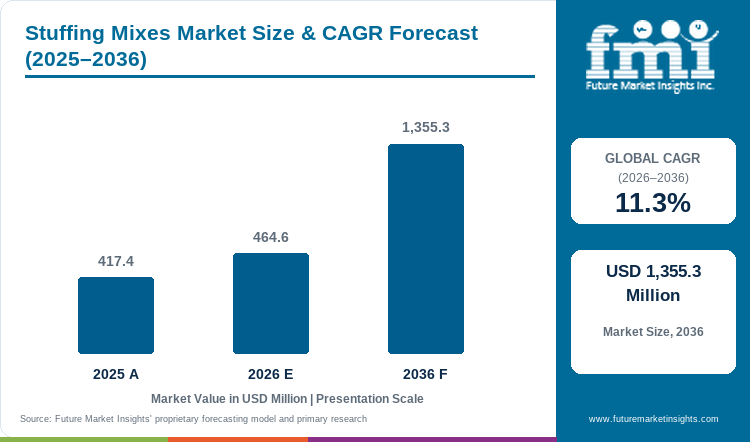
- USD 464.6 Mn
- Forecast (2036)
- USD 1355.3 Mn
- CAGR (2026 to 2036)
- 11.3%
How big is Stuffing Mixes Market in 2026?
USD 464.6 Million in 2026 and USD 1355.3 Million by 2036 at an 11.3% CAGR.
The Stuffing Mixes Market was valued at USD 417.4 Million in 2025. Demand is extending beyond a single holiday purchase because stuffing mixes reduce the work required to prepare a familiar bread-based side. Kraft Heinz markets Stove Top across several seasoning variants and positions the brand for use throughout the year. Retailers benefit from shelf-stable packs that fit planned meal baskets. Specialty suppliers can compete through fresh formats or differentiated dietary propositions.
The purchase case is strongest when preparation becomes faster without making the finished dish feel generic. That balance can support traditional holiday use while creating smaller meal occasions during the rest of the year.
South Korea has a highly developed online shopping environment. Statistics Korea reported that mobile transactions accounted for approximately 77% of online shopping transaction value in 2025, with the share having risen consistently year on year. Online food and beverage transaction value has grown steadily, supported by high smartphone penetration and platform-driven grocery discovery. These conditions make mobile grocery discovery relevant to route-to-market planning for imported and specialty products.
Key Takeaways of Stuffing Mixes Market
- Stuffing mixes reduce holiday side-dish preparation work because the bread base and seasoning arrive pre-combined.
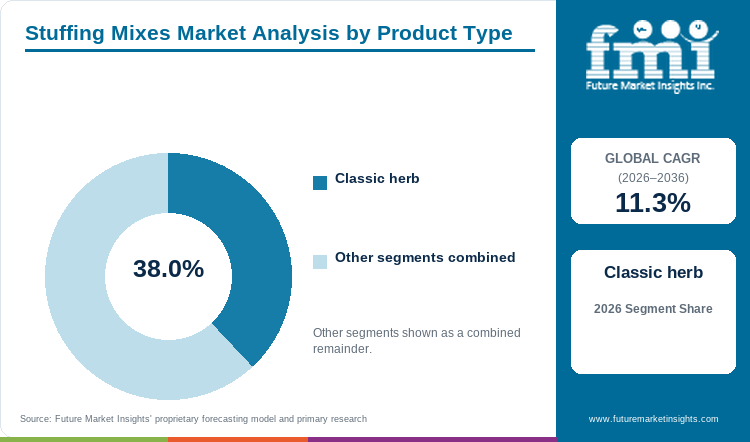
- In 2026, classic herb is estimated to account for 38.0% of product type demand because its traditional flavor profile gives households a familiar starting point for customization.
- Conventional is projected to hold 58.0% of claim/nature demand in 2026 because mainstream formulations remain compatible with broad retail pricing and established ingredient systems.
- Fresh is anticipated to account for 37.0% of format demand in 2026 because immediate aroma and texture cues support prepared-food placement.
- Seasonal concentration can strain inventory when a supplier has not matched shelf life and pack size to the intended household or foodservice buying occasion.
- Directly evidenced participants include The Kraft Heinz Company (Stove Top), The Campbell's Company (Pepperidge Farm), Premier Foods (Paxo), Sugar Foods Corporation (Mrs. Cubbison's), Bell's Foods, Aleia's Gluten Free Foods and Newly Weds Foods. Market analysis also uses current regulator and food-labeling records.
Analyst Perspective
"Stuffing mixes have a clear convenience proposition, but established markets still carry pronounced seasonal demand. Faster preparation can widen usage when the finished dish retains familiar taste and texture. Dietary requirements create a second route to differentiation, especially where formulation and labeling can support a clear claim. Suppliers also need to match shelf life and pack size to the buying occasion because household grocery and foodservice demand operate differently."
- Nandini Roy Choudhury, Principal Consultant, Future Market Insights
How is the Stuffing Mixes Market segmented?
The market is segmented by Product Type, Claim / Nature, Format, Packaging Format, Sales Channel, and Region.
Product Type covers classic herb, cornbread style, premium & artisan, and gluten-free stuffing. Claim / Nature covers conventional, clean label, organic, gluten-free, and high-protein / fortified products.
Format separates Fresh, Frozen prepared stuffing, Dry / ambient mix, Refrigerated prepared stuffing, and Foodservice prepared / heat-and-serve. Packaging Format covers multipacks, single-serve packs, family-size pouches or boxes, and bulk foodservice packs.
Sales Channel covers supermarkets & hypermarkets, artisan & specialty bakeries, convenience & forecourt, online & DTC, and foodservice distributors.
Why does classic herb lead demand within the product type category?
Classic herb sits close to the category reference point because sage and onion are strongly associated with traditional stuffing. Celery and related savory notes reinforce that familiarity. This lowers trial risk during important meal occasions.
The base is also easy to customize with broth or vegetables. Households can add meat, fruit, or nuts according to preference. Foodservice operators gain a familiar platform that can be adapted into a house recipe.
Premium & artisan products can target more specialized occasions. Cornbread styles create another recognizable proposition, while gluten-free products address specific dietary requirements. Classic herb retains the broadest connection between packaged convenience and the sensory profile expected from stuffing.
- Classic herb holds 38.0% share in 2026 because its traditional flavor profile gives households and operators a familiar starting point for customization.
- Kraft Heinz currently markets Traditional Sage and Savory Herbs variants within the Stove Top stuffing range, supporting the continued commercial relevance of familiar herb-led flavor profiles.
Why does conventional lead demand within the claim / nature category?
Conventional products lead because mainstream buyers often prioritize taste and easy preparation before seeking a specialized claim. Established formulations also support broad retail availability and familiar price points.
Clean label and organic propositions become more relevant when buyers have a defined ingredient preference. Gluten-free products serve a clear dietary requirement, while fortified products address a different nutritional proposition. Each can add sourcing or formulation complexity.
The commercial task for conventional suppliers is therefore to protect the familiar eating experience while responding to changing nutrition expectations. Label clarity becomes more important where regulation or retailer policy raises the threshold for product claims.
- Conventional holds 58.0% share in 2026 because mainstream formulations remain compatible with broad retail pricing and established ingredient systems.
- The USA FDA updated the definition of the "healthy" nutrient-content claim in December 2024. The change increased the importance of sodium and added-sugar limits for products seeking that positioning.
Why does fresh lead demand within the format category?
Fresh leads where buyers want less work than scratch preparation while retaining characteristics associated with freshly prepared stuffing. Retail deli and prepared-food programs can merchandise it as a ready meal component. Households gain faster preparation with a more immediate meal occasion.
Frozen and refrigerated alternatives provide different holding windows. Dry formats offer a longer shelf life. Fresh formats gain their advantage where aroma and immediate consumption have greater value.
- Fresh holds 37.0% share in 2026 because immediate aroma and texture cues support prepared-food placement while reducing preparation work for the buyer.
- Fresh formats can support deli and prepared-food merchandising when the product is sold close to the intended meal occasion. Their commercial value comes from shortening preparation while retaining the sensory cues associated with a freshly assembled side dish.
Why does multipack lead demand within the packaging format category?
Multipack leads because stuffing demand is often planned around households and gatherings rather than a single impulse serving. Multiple units allow retailers to promote a seasonal meal basket without forcing the buyer into one oversized package.
Households can also spread use across more than one meal. Single-serve packs suit smaller occasions. Family-size formats serve larger gatherings, while bulk packs reduce handling for foodservice operators.
Multipacks balance pantry storage with planned meal volume. They can also give brands space to offer more than one flavor within a familiar retail format.
- Multipack holds 36.0% share in 2026 because it balances planned meal volume with pantry storage and repeat preparation.
- Kraft Heinz currently lists Stove Top variants including Everyday Stuffing Mix for Chicken, Savory Herbs, Traditional Sage, Chicken, Pork, Turkey, and a lower-sodium chicken option.
Why do supermarkets & hypermarkets lead demand within the sales channel category?
Supermarkets & hypermarkets lead because stuffing is commonly purchased as part of a wider meal basket. The shopper may already be buying poultry or gravy. Seasonal vegetables and other side dishes can be purchased during the same trip.
Physical grocery stores also allow direct comparison between conventional and specialized products. Online & DTC channels can broaden assortment and make dietary variants easier to locate. Artisan & specialty bakeries compete differently through freshness. Foodservice distributors address larger buying units and operational specifications.
Mass grocery remains central because stuffing can be merchandised close to other products associated with the same meal occasion.
- Supermarkets & hypermarkets hold 39.0% share in 2026 because the channel captures planned meal-basket purchasing and gives stuffing useful adjacency to related side-dish products.
- The Campbell's Company maintains Pepperidge Farm stuffing as a dedicated retail category with sage & onion, corn bread, and country-style options.
What are the drivers, restraints, and opportunities in the Stuffing Mixes Market?
Convenience and consistent meal preparation support demand. Seasonal concentration can constrain execution, while year-round formats and differentiated claims can create additional meal occasions.
- Driver: Buyers value a reliable side dish that reduces preparation time while retaining familiar flavor and room for customization.
- Restraint: Demand remains concentrated around major seasonal occasions in several established markets.
- Opportunity: Suppliers can widen the addressable market through dietary propositions and formats suited to more frequent meal occasions.
Convenience supports demand when it changes actual preparation behavior. Germany's BMEL reported in September 2024 that 56% of respondents considered easy and quick preparation important. Stuffing mixes fit that requirement because the bread base and seasoning arrive pre-combined. The buyer can add liquid or other ingredients instead of preparing the entire base from scratch.
Foodservice operators gain a related benefit when a predictable base reduces training requirements and batch variation. Time savings become more commercially useful when the finished dish still delivers the savory profile expected from stuffing.
Seasonality remains a material planning constraint. Premier Foods said in September 2025 that nearly 50% of stuffing consumers buy the category only once a year. This helps explain the commercial interest in faster formats and products designed for use outside the festive period.
Concentrated demand raises inventory risk and increases competition for seasonal shelf space. Fresh and chilled products carry added waste exposure if sell-through falls below plan. Packaged products also need to meet nutrition and allergen requirements. More frequent usage can reduce dependence on a narrow holiday window.
The strongest opportunity is to extend stuffing into additional meal occasions while serving consumers with defined dietary needs. The USA FDA's January 2025 allergen guidance reinforces the importance of declaring major allergens where applicable.
Aleia's current range shows how gluten-free and other free-from positioning can be built directly into stuffing products. Specialty claims can broaden the buyer base, but repeat purchase still depends on eating quality and reliable preparation.
Which country CAGRs are covered in the Stuffing Mixes Market?
| Country | CAGR |
|---|---|
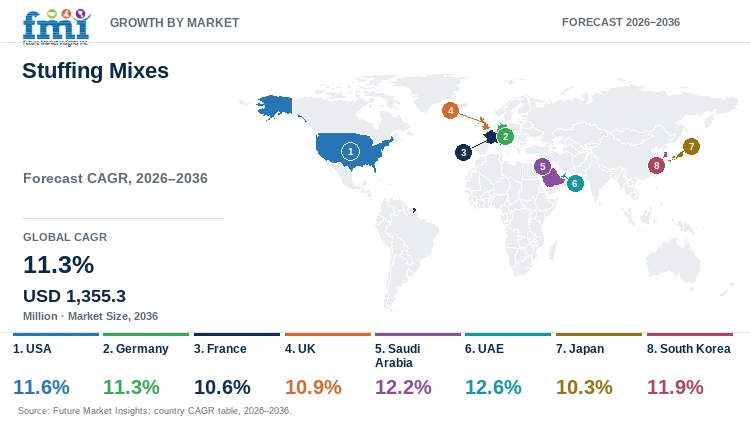
| USA | 11.6% |
| Germany | 11.3% |
| France | 10.6% |
| UK | 10.9% |
| Saudi Arabia | 12.2% |
| UAE | 12.6% |
| Japan | 10.3% |
| South Korea | 11.9% |
How do country-level CAGRs compare in the Stuffing Mixes Market?
The country rates span 2.3 percentage points from the UAE at 12.6% to Japan at 10.3%. Saudi Arabia follows the UAE at 12.2%. South Korea and USA remain above the overall 11.3% forecast pace.
Germany matches the overall market rate. UK and France grow at a slower pace, while Japan records the lowest rate among the countries covered.
These differences influence channel development and investment timing. They should not be treated as a ranking of market size because absolute revenue also depends on the starting category base.
- UAE at 12.6% and Saudi Arabia at 12.2% are separated by 0.4 percentage points. Both require suppliers to address local labeling requirements before imported or locally distributed assortments can scale.
- South Korea at 11.9% and USA at 11.6% combine strong growth with different retail conditions. Mobile grocery has greater strategic relevance in South Korea, while the USA category remains closely connected with seasonal grocery execution.
- Germany at 11.3% and UK at 10.9% differ by 0.4 percentage points. Product communication matters in both markets, though the relevant nutrition and promotion frameworks differ.
- France at 10.6% and Japan at 10.3% are closely grouped. France has an updated voluntary Nutri-Score framework, while Japan requires detailed processed-food labeling.
CAGR alone does not determine commercial priority. Suppliers must also consider the scale of the addressable category and the economics of the intended format. Retail structure can affect route-to-market requirements. Product familiarity can determine how much consumer education is required.
Country-wise Analysis
USA
Demand for Stuffing Mixes in USA is forecast to expand at 11.6% CAGR from 2026 to 2036.
USA purchasing remains closely connected with mass grocery and seasonal meal planning. Quick-preparation branded products already have established consumer recognition.
- In December 2024, the FDA updated the definition of the "healthy" nutrient-content claim. The revised framework includes limits for nutrients such as sodium and added sugars when a product uses the claim.
- For stuffing suppliers, the immediate issue is whether a product's intended nutrition positioning matches its formulation. Holiday availability remains commercially important, while easier preparation can support use beyond the main seasonal period.
Germany
Demand for Stuffing Mixes in Germany is forecast to expand at 11.3% CAGR from 2026 to 2036.
- German food purchasing combines convenience with close attention to product information. BMEL reported in September 2024 that 56% of respondents considered easy and quick preparation important.
- That creates a relevant opening for mixes that reduce preparation work. The product still needs to communicate ingredients and preparation clearly. Pack sizes also need to fit planned household meals rather than depend entirely on a holiday occasion.
France
Demand for Stuffing Mixes in France is forecast to expand at 10.6% CAGR from 2026 to 2036.
- Nutrition communication is visible in French packaged-food purchasing. A March 2025 decree adopted the updated Nutri-Score presentation recommended by the French state for manufacturers and distributors choosing to use the mark.
- For stuffing products that use Nutri-Score, formulation decisions can therefore affect front-of-pack presentation. The challenge is to improve the nutrition proposition without moving too far from the savory profile buyers expect from the category.
UK
Demand for Stuffing Mixes in UK is forecast to expand at 10.9% CAGR from 2026 to 2036.
- The UK is an established stuffing market with branded products designed around roast meals and seasonal consumption. Nutrition rules can influence promotion for products that fall within the relevant definitions.
- Advertising restrictions for less healthy food and drink came into force on January 5, 2026. England also applies restrictions covering certain locations and volume promotions for products that fall in scope.
- Stuffing suppliers need to determine how individual SKUs are classified before planning seasonal media and promotional activity. This is especially relevant when a large share of annual demand is concentrated in a short selling window.
Saudi Arabia
Demand for Stuffing Mixes in Saudi Arabia is forecast to expand at 12.2% CAGR from 2026 to 2036.
- Shelf-stable imported products can access the market when local labeling and importer requirements are addressed correctly. SFDA requires prepackaged food labeling in Arabic. Other languages can appear alongside the required Arabic information.
- For international stuffing brands, packaging therefore becomes an early market-entry consideration. Ambient stability can support distribution, while the product proposition needs to fit local meal occasions rather than rely solely on Western holiday associations.
UAE
Demand for Stuffing Mixes in UAE is forecast to expand at 12.6% CAGR from 2026 to 2036.
- The UAE gives consumers broad access to imported packaged foods. Nutrition communication is also becoming more visible in Abu Dhabi.
- In March 2025, the Abu Dhabi Quality and Conformity Council approved the Nutri-Mark guideline. The system uses an A-to-E grade based on nutritional composition.
- Companies selling applicable products need to consider how formulation interacts with the scoring system. Imported brands may also need to explain the meal occasion more clearly in a market where stuffing does not have the same cultural position as in the UK or USA.
Japan
Demand for Stuffing Mixes in Japan is forecast to expand at 10.3% CAGR from 2026 to 2036.
- Japanese packaged-food buyers operate within detailed labeling requirements. Japan's Consumer Affairs Agency requires processed foods to provide prescribed information covering ingredients and allergens. Date marking and storage information are also required.
- For imported stuffing products, clear Japanese preparation guidance becomes important because category familiarity may be lower than in established Western markets. Smaller pack formats can also help match local household requirements.
South Korea
Demand for Stuffing Mixes in South Korea is forecast to expand at 11.9% CAGR from 2026 to 2036.
- Statistics Korea reported that mobile transactions accounted for approximately 77% of online shopping transaction value in 2025, shaped by South Korea's near-universal smartphone penetration and platform-driven purchasing. Online food and beverage transaction value has continued to grow year on year, reflecting the shift toward app-based grocery and meal procurement.
- These figures describe the wider digital grocery environment rather than stuffing-mix demand itself. They indicate that imported and specialty food suppliers need to treat mobile product discovery as a meaningful route-to-market consideration.
- Localized product information can help explain preparation and usage. Digital merchandising also becomes more important where consumers encounter the category online before seeing it on a physical shelf.
Who are the notable companies in the Stuffing Mixes Market?
The Kraft Heinz Company (Stove Top), The Campbell's Company (Pepperidge Farm), Premier Foods (Paxo), Sugar Foods Corporation (Mrs. Cubbison's), Bell's Foods, Aleia's Gluten Free Foods, and Newly Weds Foods are notable participants in this market.
The direct competitive set is anchored in companies with established stuffing products or stuffing-specific ingredient offerings. The Kraft Heinz Company through Stove Top and The Campbell's Company through Pepperidge Farm compete in mainstream packaged stuffing in North America. Premier Foods participates through Paxo in the UK. Sugar Foods Corporation operates Mrs. Cubbison's, while Bell's Foods maintains a regional stuffing presence. Aleia's Gluten Free Foods targets buyers seeking gluten-free stuffing. Newly Weds Foods participates through stuffing crumb and customized formulations for retail or foodservice applications. Competition varies by route to market. Consumer brands compete through familiarity and preparation convenience. Specialty suppliers differentiate through dietary positioning. Ingredient suppliers compete through formulation flexibility and operating consistency.
- The Kraft Heinz Company (Stove Top), The Campbell's Company (Pepperidge Farm), Premier Foods (Paxo), Sugar Foods Corporation (Mrs. Cubbison's), and Bell's Foods compete through consumer-facing stuffing ranges.
- Aleia's Gluten Free Foods competes through gluten-free and free-from stuffing formats.
- Newly Weds Foods serves retail and foodservice customers with shredded and cubed stuffing crumb alongside customized formulation capability.
Competitive Benchmarking: Stuffing Mixes Market
| Company | Consumer Stuffing Range | Dietary and Free-From Coverage | Foodservice and Ingredient Supply | Geographic Reach |
|---|---|---|---|---|
| The Kraft Heinz Company (Stove Top) | High | Medium | Medium | North America with broad mainstream retail presence |
| The Campbell's Company (Pepperidge Farm) | High | Medium | High | North America across retail and foodservice channels |
| Premier Foods (Paxo) | High | Medium | Medium | United Kingdom with selected international reach |
| Sugar Foods Corporation (Mrs. Cubbison's) | High | Low | Medium | United States with regional and national retail coverage |
| Bell's Foods | Medium | Low | Low | New England and select United States regional markets |
| Aleia's Gluten Free Foods | Medium | High | Low | United States through natural and specialty retail channels |
| Newly Weds Foods | Low | Medium | High | North America and international foodservice and private-label customers |
Key Developments in the Stuffing Mixes Market
- In September 2025, Premier Foods announced Paxo Orange & Cranberry Stuffing Wreath Kits and a year-round Paxo Quick Cook Stuffing Sage & Onion product. Premier Foods positioned the Quick Cook product around faster preparation and the opportunity to support stuffing sales outside the festive period. The launch directly addresses two commercial constraints in the category: preparation time and concentrated seasonal demand.
Key Players in the Stuffing Mixes Market
Branded Retail Stuffing
- The Kraft Heinz Company (Stove Top)
- The Campbell's Company (Pepperidge Farm)
Regional and Specialty Stuffing Brands
- Premier Foods (Paxo)
- Sugar Foods Corporation (Mrs. Cubbison's)
- Bell's Foods
- Aleia's Gluten Free Foods
Ingredient and Foodservice Stuffing Systems
- Newly Weds Foods
Stuffing Mixes Market - Report Scope
| Coverage field | Report scope |
|---|---|
| Market breakdown | Product Type; Claim / Nature; Format; Packaging Format; Sales Channel; Region |
| Quantitative Units | Revenue in USD Million and CAGR in %. |
| Market Definition | Revenue includes products sold specifically for preparation or service as stuffing within the stated segmentation. General-purpose breadcrumbs and standalone seasonings are excluded. Downstream finished stuffed meals and substitute side dishes are also excluded. |
| Regions Covered | North America; Latin America; Western Europe; Eastern Europe; East Asia; South Asia and Pacific; Middle East and Africa |
| Countries Covered | USA; Germany; France; UK; Saudi Arabia; UAE; Japan; South Korea; and additional countries covered in the full report |
| Key Companies | The Kraft Heinz Company (Stove Top); The Campbell's Company (Pepperidge Farm); Premier Foods (Paxo); Sugar Foods Corporation (Mrs. Cubbison's); Bell's Foods; Aleia's Gluten Free Foods; Newly Weds Foods |
| Forecast Period | 2026 to 2036 |
| Approach | FMI applies a hybrid bottom-up and top-down sizing approach that considers product-level revenue patterns and channel evidence. Company positioning and relevant operating indicators are also incorporated. |
Stuffing Mixes Market - Research Methodology
| Method | Approach |
|---|---|
| Primary Research | FMI uses structured discussions with manufacturers, ingredient suppliers, distributors, retail category participants, foodservice operators, and subject-matter experts. The work examines product scope, purchase triggers, seasonality, channel mix, pricing behavior, claim requirements, and adoption frictions. |
| Desk Research | FMI reviews government statistics and food-labeling rules alongside company filings. Product documentation and credible industry publications are also reviewed where relevant to the defined market boundary or an operating mechanism. |
| Market Sizing and Forecasting | Sizing considers the defined stuffing-mix revenue boundary and relevant product structures. Country conditions and supplier roles are incorporated into the assessment. Forecast assumptions consider convenience demand and seasonal concentration alongside dietary claims. Channel reach and regulatory change are also evaluated. |
| Data Validation | Evidence is cross-checked across company and regulatory sources. Channel and country evidence provide additional validation. Boundary checks exclude general-purpose breadcrumbs and downstream finished meals. Adjacent side dishes are not counted as stuffing-mix revenue. |
Stuffing Mixes Market by Segments
Stuffing Mixes Market segmented by Product Type:
- Classic herb
- Cornbread style
- Premium & artisan
- Gluten-free
Stuffing Mixes Market segmented by Claim / Nature:
- Conventional
- Clean label
- Organic
- Gluten-free
- High-protein / fortified
Stuffing Mixes Market segmented by Format:
- Fresh
- Frozen prepared stuffing
- Dry / ambient mix
- Refrigerated prepared stuffing
- Foodservice prepared / heat-and-serve
Stuffing Mixes Market segmented by Packaging Format:
- Multipack
- Single-serve
- Family-size pouch / box
- Bulk foodservice
Stuffing Mixes Market segmented by Sales Channel:
- Supermarkets & hypermarkets
- Artisan & specialty bakeries
- Convenience & forecourt
- Online & DTC
- Foodservice distributors
Stuffing Mixes Market by Region:
- North America
- United States
- Canada
- Latin America
- Brazil
- Mexico
- Argentina
- Chile
- Western Europe
- Germany
- France
- United Kingdom
- Italy
- Spain
- Benelux
- Nordics
- Eastern Europe
- Poland
- Czech Republic
- Romania
- Hungary
- East Asia
- China
- Japan
- South Korea
- South Asia and Pacific
- India
- ASEAN
- Australia and New Zealand
- Middle East and Africa
- GCC Countries
- South Africa
- Türkiye
- Israel
Research Sources and Bibliography
- USA Food and Drug Administration (2024, December 19). FDA Updates "Healthy" Claim, Providing a Refreshed Tool for Consumers.
- USA Food and Drug Administration (2025, January 6). Food Allergens/Gluten-Free Guidance Documents & Regulatory Information.
- Federal Ministry of Food and Agriculture, Germany (2024, September 24). Deutschland, wie es isst - der BMEL-Ernährungsreport 2024.
- Légifrance (2025, March 15). Arrêté du 14 mars 2025 fixant la forme de présentation complémentaire à la déclaration nutritionnelle recommandée par l'Etat.
- UK Department of Health and Social Care (2025, June 4). Restricting advertising of less healthy food or drink on TV and online: products in scope.
- Saudi Food and Drug Authority (2024, July 18). Is it allowed to write the food product label in English only?
- Saudi Food and Drug Authority (2025, June 18). SFDA to Implement New Food Rules for Transparency and Consumer Health.
- Abu Dhabi Quality and Conformity Council (2025, March 1). The Abu Dhabi Quality and Conformity Council Approves the Nutri-Mark Label Guideline.
- Consumer Affairs Agency, Japan (2026, April). Food Labelling and food-allergy information for processed foods.
- Statistics Korea (2025, June 2). Online Shopping in April 2025.
- Bell's Seasoning & Foods. Traditional Stuffing product use.
- Mrs. Cubbison's. Stuffing products.
- Aleia's Gluten Free Foods. Gluten-Free Savory Stuffing.
- Newly Weds Foods. Stuffing Crumb.
- Premier Foods (2025, September 30). Bisto and Paxo serve up new range of festive meal must haves.
- Pepperidge Farm (2026). Stuffing product category.
- The Kraft Heinz Company (2026). Stove Top - Bread Stuffing.
This bibliography is provided for reader reference and is not exhaustive because the full report contains the complete source list and detailed citations.
This Report Answers
- What is the Stuffing Mixes Market size in 2026 and what value is forecast for 2036?
- Which convenience and preparation pressures support demand for stuffing mixes?
- Why does Classic herb hold the leading position within Product Type?
- How does Conventional positioning influence formulation and channel demand?
- Why does Fresh hold the leading position within Format?
- How do growth rates differ across USA, Germany, France, UK, Saudi Arabia, UAE, Japan, and South Korea?
- Which companies compete through finished stuffing or specialty formulations?
- How do seasonality and shelf-life economics affect commercial execution?
- How do nutrition rules and allergen requirements affect product positioning?
Frequently Asked Questions
How big is the Stuffing Mixes Market in 2026?
The stuffing mixes market is valued at USD 464.6 million in 2026 and is forecast to reach USD 1355.3 million by 2036. Demand is supported by shelf-stable packs that fit planned meal baskets, with Kraft Heinz positioning Stove Top for use across seasonal and year-round occasions.
What is the CAGR of the Stuffing Mixes Market from 2026 to 2036?
The stuffing mixes market grows at a CAGR of 11.3% between 2026 and 2036, supported by faster preparation formats that reduce scratch cooking time while retaining the savory bread-base profile buyers expect from traditional and specialty stuffing occasions.
Which product type leads the Stuffing Mixes Market?
Classic herb accounts for 38.0% of the stuffing mixes market by product type in 2026, driven by strong association with traditional sage and onion flavoring that lowers trial risk and supports easy customization for households and foodservice operators alike.
How much will the Stuffing Mixes Market add between 2026 and 2036?
The stuffing mixes market is set to add USD 890.7 million between 2026 and 2036, growing from USD 464.6 million to USD 1355.3 million as convenience formats and dietary claim variants extend usage beyond a single seasonal purchase occasion.
Who are the leading companies in the Stuffing Mixes Market?
Seven companies lead the stuffing mixes market, including The Kraft Heinz Company, The Campbell's Company, Premier Foods, Sugar Foods Corporation, Bell's Foods, Aleia's Gluten Free Foods, and Newly Weds Foods, competing through branded retail ranges, dietary positioning, and foodservice stuffing crumb formulations.
Preview the report firsthand - request a free sample
Get SampleGet the brochure for pricing and purchase details.
Get PDFTable of Content
- Key Takeaways
- Market Size and CAGR
- Top Growth Driver
- Fastest Growing Segment
- Leading Region
- Key Companies
- Emerging Opportunities
- Executive Summary
- Global Market Outlook
- Demand-side Trends
- Supply-side Trends
- Technology Roadmap Analysis
- Analysis and Recommendations
- Analyst Perspective (What is happening? Why now? What should investors know?)
- Key Questions Answered
- How large is the market?
- What is the CAGR?
- What are key trends?
- Which region dominates?
- Who are the leaders?
- Market Overview
- Market Coverage / Taxonomy
- Market Definition / Scope / Limitations
- Research Methodology
- Chapter Orientation
- Analytical Lens and Working Hypotheses
- Market Structure, Signals, and Trend Drivers
- Benchmarking and Cross-market Comparability
- Market Sizing, Forecasting, and Opportunity Mapping
- Research Design and Evidence Framework
- Desk Research Programme (Secondary Evidence)
- Expert Input and Fieldwork (Primary Evidence)
- Tooling, Models, and Reference Databases
- Data Engineering and Model Build
- Quality Assurance and Audit Trail
- Market Background
- Market Dynamics (Drivers, Restraints, Opportunity, Trends)
- Scenario Forecast (Optimistic, Likely, Conservative)
- Impact Analysis
- AI Impact
- Sustainability Impact
- Regulatory Impact
- Technology Impact
- Consumer / Buyer Analysis
- Purchase Drivers
- Adoption Barriers
- Buyer Journey
- Opportunity Map Analysis
- Product Life Cycle Analysis
- Supply Chain Analysis
- Investment Feasibility Matrix
- Value Chain Analysis
- PESTLE and Porter's Analysis
- Regulatory Landscape
- Regional Parent Market Outlook
- Production and Consumption Statistics
- Import and Export Statistics
- Global Market Analysis and Forecast, 2021 to 2036
- Historical Market Size Value (USD Million) Analysis, 2021 to 2025
- Current and Future Market Size Value (USD Million) Projections, 2026 to 2036
- Y-o-Y Growth Trend Analysis
- Absolute $ Opportunity Analysis
- Global Market Pricing Analysis, 2021 to 2036
- Global Market Analysis and Forecast, By Product Type, 2021 to 2036
- Introduction / Key Findings
- Historical Market Size Value (USD Million) Analysis By Product Type, 2021 to 2025
- Current and Future Market Size Value (USD Million) Analysis and Forecast By Product Type, 2026 to 2036
- Classic herb
- Cornbread style
- Premium & artisan
- Gluten-free
- Y-o-Y Growth Trend Analysis By Product Type, 2021 to 2025
- Absolute $ Opportunity Analysis By Product Type, 2026 to 2036
- Global Market Analysis and Forecast, By Claim / Nature, 2021 to 2036
- Introduction / Key Findings
- Historical Market Size Value (USD Million) Analysis By Claim / Nature, 2021 to 2025
- Current and Future Market Size Value (USD Million) Analysis and Forecast By Claim / Nature, 2026 to 2036
- Conventional
- Clean label
- Organic
- Gluten-free
- High-protein / fortified
- Y-o-Y Growth Trend Analysis By Claim / Nature, 2021 to 2025
- Absolute $ Opportunity Analysis By Claim / Nature, 2026 to 2036
- Global Market Analysis and Forecast, By Format, 2021 to 2036
- Introduction / Key Findings
- Historical Market Size Value (USD Million) Analysis By Format, 2021 to 2025
- Current and Future Market Size Value (USD Million) Analysis and Forecast By Format, 2026 to 2036
- Fresh
- Frozen prepared stuffing
- Dry / ambient mix
- Refrigerated prepared stuffing
- Foodservice prepared / heat-and-serve
- Y-o-Y Growth Trend Analysis By Format, 2021 to 2025
- Absolute $ Opportunity Analysis By Format, 2026 to 2036
- Global Market Analysis and Forecast, By Packaging Format, 2021 to 2036
- Introduction / Key Findings
- Historical Market Size Value (USD Million) Analysis By Packaging Format, 2021 to 2025
- Current and Future Market Size Value (USD Million) Analysis and Forecast By Packaging Format, 2026 to 2036
- Multipack
- Single-serve
- Family-size pouch / box
- Bulk foodservice
- Y-o-Y Growth Trend Analysis By Packaging Format, 2021 to 2025
- Absolute $ Opportunity Analysis By Packaging Format, 2026 to 2036
- Global Market Analysis and Forecast, By Sales Channel, 2021 to 2036
- Introduction / Key Findings
- Historical Market Size Value (USD Million) Analysis By Sales Channel, 2021 to 2025
- Current and Future Market Size Value (USD Million) Analysis and Forecast By Sales Channel, 2026 to 2036
- Supermarkets & hypermarkets
- Artisan & specialty bakeries
- Convenience & forecourt
- Online & DTC
- Foodservice distributors
- Y-o-Y Growth Trend Analysis By Sales Channel, 2021 to 2025
- Absolute $ Opportunity Analysis By Sales Channel, 2026 to 2036
- Global Market Analysis and Forecast, By Region, 2021 to 2036
- Introduction
- Historical Market Size Value (USD Million) Analysis By Region, 2021 to 2025
- Current Market Size Value (USD Million) Analysis and Forecast By Region, 2026 to 2036
- North America
- Latin America
- Western Europe
- Eastern Europe
- East Asia
- South Asia and Pacific
- Middle East and Africa
- Market Attractiveness Analysis By Region
- North America Market Analysis and Forecast, By Country, 2021 to 2036
- Historical Market Size Value (USD Million) Trend Analysis By Market Taxonomy, 2021 to 2025
- Market Size Value (USD Million) Forecast By Market Taxonomy, 2026 to 2036
- By Country
- United States
- Canada
- By Product Type
- By Claim / Nature
- By Format
- By Packaging Format
- By Sales Channel
- By Country
- Market Attractiveness Analysis
- By Country
- By Product Type
- By Claim / Nature
- By Format
- By Packaging Format
- By Sales Channel
- Key Takeaways
- Latin America Market Analysis and Forecast, By Country
- Historical Market Size Value (USD Million) Trend Analysis By Market Taxonomy, 2021 to 2025
- Market Size Value (USD Million) Forecast By Market Taxonomy, 2026 to 2036
- By Country
- Brazil
- Mexico
- Argentina
- Chile
- By Product Type
- By Claim / Nature
- By Format
- By Packaging Format
- By Sales Channel
- By Country
- Market Attractiveness Analysis
- By Country
- By Product Type
- By Claim / Nature
- By Format
- By Packaging Format
- By Sales Channel
- Key Takeaways
- Western Europe Market Analysis and Forecast, By Country
- Historical Market Size Value (USD Million) Trend Analysis By Market Taxonomy, 2021 to 2025
- Market Size Value (USD Million) Forecast By Market Taxonomy, 2026 to 2036
- By Country
- Germany
- France
- United Kingdom
- Italy
- Spain
- Benelux
- Nordics
- By Product Type
- By Claim / Nature
- By Format
- By Packaging Format
- By Sales Channel
- By Country
- Market Attractiveness Analysis
- By Country
- By Product Type
- By Claim / Nature
- By Format
- By Packaging Format
- By Sales Channel
- Key Takeaways
- Eastern Europe Market Analysis and Forecast, By Country
- Historical Market Size Value (USD Million) Trend Analysis By Market Taxonomy, 2021 to 2025
- Market Size Value (USD Million) Forecast By Market Taxonomy, 2026 to 2036
- By Country
- Poland
- Czech Republic
- Romania
- Hungary
- By Product Type
- By Claim / Nature
- By Format
- By Packaging Format
- By Sales Channel
- By Country
- Market Attractiveness Analysis
- By Country
- By Product Type
- By Claim / Nature
- By Format
- By Packaging Format
- By Sales Channel
- Key Takeaways
- East Asia Market Analysis and Forecast, By Country
- Historical Market Size Value (USD Million) Trend Analysis By Market Taxonomy, 2021 to 2025
- Market Size Value (USD Million) Forecast By Market Taxonomy, 2026 to 2036
- By Country
- China
- Japan
- South Korea
- By Product Type
- By Claim / Nature
- By Format
- By Packaging Format
- By Sales Channel
- By Country
- Market Attractiveness Analysis
- By Country
- By Product Type
- By Claim / Nature
- By Format
- By Packaging Format
- By Sales Channel
- Key Takeaways
- South Asia and Pacific Market Analysis and Forecast, By Country
- Historical Market Size Value (USD Million) Trend Analysis By Market Taxonomy, 2021 to 2025
- Market Size Value (USD Million) Forecast By Market Taxonomy, 2026 to 2036
- By Country
- India
- ASEAN
- Australia and New Zealand
- By Product Type
- By Claim / Nature
- By Format
- By Packaging Format
- By Sales Channel
- By Country
- Market Attractiveness Analysis
- By Country
- By Product Type
- By Claim / Nature
- By Format
- By Packaging Format
- By Sales Channel
- Key Takeaways
- Middle East and Africa Market Analysis and Forecast, By Country
- Historical Market Size Value (USD Million) Trend Analysis By Market Taxonomy, 2021 to 2025
- Market Size Value (USD Million) Forecast By Market Taxonomy, 2026 to 2036
- By Country
- GCC Countries
- South Africa
- Türkiye
- Israel
- By Product Type
- By Claim / Nature
- By Format
- By Packaging Format
- By Sales Channel
- By Country
- Market Attractiveness Analysis
- By Country
- By Product Type
- By Claim / Nature
- By Format
- By Packaging Format
- By Sales Channel
- Key Takeaways
- Key Countries Market Analysis
- United States
- Pricing Analysis
- Market Share Analysis, 2025
- By Product Type
- By Claim / Nature
- By Format
- By Packaging Format
- By Sales Channel
- Canada
- Pricing Analysis
- Market Share Analysis, 2025
- By Product Type
- By Claim / Nature
- By Format
- By Packaging Format
- By Sales Channel
- Mexico
- Pricing Analysis
- Market Share Analysis, 2025
- By Product Type
- By Claim / Nature
- By Format
- By Packaging Format
- By Sales Channel
- Brazil
- Pricing Analysis
- Market Share Analysis, 2025
- By Product Type
- By Claim / Nature
- By Format
- By Packaging Format
- By Sales Channel
- Chile
- Pricing Analysis
- Market Share Analysis, 2025
- By Product Type
- By Claim / Nature
- By Format
- By Packaging Format
- By Sales Channel
- Germany
- Pricing Analysis
- Market Share Analysis, 2025
- By Product Type
- By Claim / Nature
- By Format
- By Packaging Format
- By Sales Channel
- United Kingdom
- Pricing Analysis
- Market Share Analysis, 2025
- By Product Type
- By Claim / Nature
- By Format
- By Packaging Format
- By Sales Channel
- Italy
- Pricing Analysis
- Market Share Analysis, 2025
- By Product Type
- By Claim / Nature
- By Format
- By Packaging Format
- By Sales Channel
- Spain
- Pricing Analysis
- Market Share Analysis, 2025
- By Product Type
- By Claim / Nature
- By Format
- By Packaging Format
- By Sales Channel
- France
- Pricing Analysis
- Market Share Analysis, 2025
- By Product Type
- By Claim / Nature
- By Format
- By Packaging Format
- By Sales Channel
- India
- Pricing Analysis
- Market Share Analysis, 2025
- By Product Type
- By Claim / Nature
- By Format
- By Packaging Format
- By Sales Channel
- ASEAN
- Pricing Analysis
- Market Share Analysis, 2025
- By Product Type
- By Claim / Nature
- By Format
- By Packaging Format
- By Sales Channel
- Australia and New Zealand
- Pricing Analysis
- Market Share Analysis, 2025
- By Product Type
- By Claim / Nature
- By Format
- By Packaging Format
- By Sales Channel
- China
- Pricing Analysis
- Market Share Analysis, 2025
- By Product Type
- By Claim / Nature
- By Format
- By Packaging Format
- By Sales Channel
- Japan
- Pricing Analysis
- Market Share Analysis, 2025
- By Product Type
- By Claim / Nature
- By Format
- By Packaging Format
- By Sales Channel
- South Korea
- Pricing Analysis
- Market Share Analysis, 2025
- By Product Type
- By Claim / Nature
- By Format
- By Packaging Format
- By Sales Channel
- Poland
- Pricing Analysis
- Market Share Analysis, 2025
- By Product Type
- By Claim / Nature
- By Format
- By Packaging Format
- By Sales Channel
- Hungary
- Pricing Analysis
- Market Share Analysis, 2025
- By Product Type
- By Claim / Nature
- By Format
- By Packaging Format
- By Sales Channel
- Türkiye
- Pricing Analysis
- Market Share Analysis, 2025
- By Product Type
- By Claim / Nature
- By Format
- By Packaging Format
- By Sales Channel
- South Africa
- Pricing Analysis
- Market Share Analysis, 2025
- By Product Type
- By Claim / Nature
- By Format
- By Packaging Format
- By Sales Channel
- Saudi Arabia
- Pricing Analysis
- Market Share Analysis, 2025
- By Product Type
- By Claim / Nature
- By Format
- By Packaging Format
- By Sales Channel
- UAE
- Pricing Analysis
- Market Share Analysis, 2025
- By Product Type
- By Claim / Nature
- By Format
- By Packaging Format
- By Sales Channel
- United States
- Market Structure Analysis
- Competition Dashboard
- Competition Benchmarking
- Market Share Analysis of Top Players
- By Regional
- By Product Type
- By Claim / Nature
- By Format
- By Packaging Format
- By Sales Channel
- Emerging Startups
- Innovation Benchmarking
- Competition Analysis
- Competition Deep Dive
- The Kraft Heinz Company (Stove Top)
- Overview
- Product Portfolio
- Profitability by Market Segments
- Sales Footprint
- Strategy Overview
- Marketing Strategy
- Product Strategy
- Channel Strategy
- The Campbell's Company (Pepperidge Farm)
- Premier Foods (Paxo)
- Sugar Foods Corporation (Mrs. Cubbison's)
- Bell's Foods
- Aleia's Gluten Free Foods
- Newly Weds Foods
- The Kraft Heinz Company (Stove Top)
- Case Studies
- Success Stories
- Recent Developments
- Competition Deep Dive
- Assumptions & Acronyms Used


