

- Industry Size (2026)
- USD 687.72 Mn
- Forecast (2036)
- USD 1109.61 Mn
- CAGR (2026 to 2036)
- 4.9%
Suture Needles Market size, market forecast and outlook by FMI
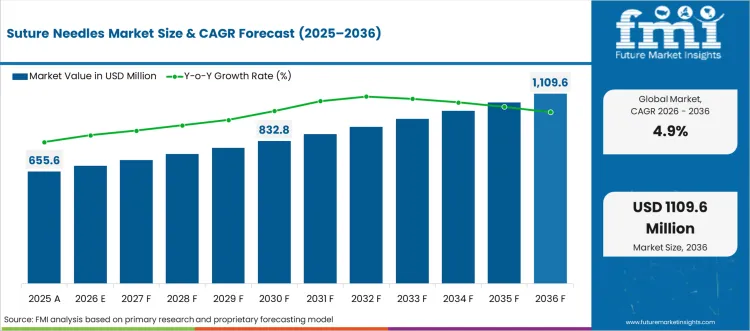
The suture needles market was valued at USD 655.60 million in 2025, projected to reach USD 687.72 million in 2026, and is forecast to expand to USD 1109.61 million by 2036 at a 4.9% CAGR. Growing global surgical procedure volumes across general surgery, cardiovascular, and orthopedic disciplines are sustaining baseline suture needle consumption. Hospital procurement committees are consolidating needle supply contracts around manufacturers that offer complete suturing system portfolios, pairing needle geometry options with compatible suture materials to reduce operating room setup complexity.
Summary of Suture Needles Market
- Market Snapshot
- The suture needles market is valued at USD 655.60 million in 2025 and is projected to reach USD 1109.61 million by 2036.
- The industry is expected to grow at a 4.9% CAGR from 2026 to 2036, creating an incremental opportunity of USD 421.88 million.
- The market remains a procedure-linked surgical consumable category where needle geometry precision, tissue penetration consistency, and suturing system portfolio breadth define competitive dynamics.
- Demand and Growth Drivers
- Demand is driven by growing global surgical procedure volumes across general surgery, cardiovascular, orthopedic, and gynecological disciplines that generate per-case suture needle consumption.
- Hospital procurement consolidation around complete suturing system portfolios is favoring manufacturers that offer paired needle-suture configurations covering multiple surgical specialty requirements.
- Growth is supported by expanding surgical infrastructure in emerging markets where new hospital operating room construction generates first-time instrument procurement demand.
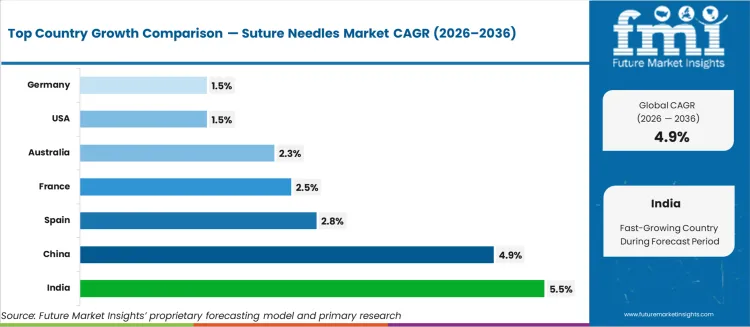
- Among key countries, India leads at 5.5% CAGR, China at 4.9%, South Korea at 3.9%, Spain at 2.8%, France at 2.5%, Australia at 2.3%.
- Product and Segment View
- The market includes straight, compound curve, half curved, and J shaped suture needles in blunt point, tapercut, reverse cutting, round bodied, conventional cutting, and spatula configurations for general surgery, cardiovascular, orthopedic, and gynecological procedures.
- Straight shaped needles leads by Shape with 40.7% share in 2026.
- General surgery leads by Application with 37.9% share in 2026.
- Scope includes Shape, Application, Type segmentation with regional coverage across seven global regions.
- Geography and Competitive Outlook
- India and China are the fastest-growing markets, while North America and Europe remain mature demand bases.
- Competition is shaped by product quality, distribution reach, and regulatory compliance, with key players including Medtronic, Futura Surgicare Pvt. Ltd., Johnson & Johnson Medical N.V., Aurolab, Natsume Seisakusho Co. Ltd., Alfresa Pharma Corporation, Bear Medic Corporation, SUTUREX & RENODEX, Teleflex Incorporated, Smith & Nephew, Hu-Friedy Mfg. Co. LLC, FSSB Chirurgische Nadlen GmbH, Burtons Medical Equipment Ltd., and Advin Health Care.
Based on FMI's report, the suture needles sector operates as a surgical consumable market where demand tracks procedure volumes across general surgery, cardiovascular, orthopedic, and gynecological disciplines. Straight shaped needles account for the largest share due to their versatility across superficial closure and general suturing applications. Compound curve and half-curved formats serve specialized access requirements in cardiovascular and deep-tissue procedures. The market is distributed across blunt point, tapercut, reverse cutting, round bodied, conventional cutting, and spatula needle types, each addressing specific tissue penetration and holding strength requirements dictated by surgical discipline and closure site characteristics.
Country-level growth trajectories reflect surgical procedure volume expansion and hospital instrument procurement modernization. India leads at 5.5% CAGR, driven by expanding surgical infrastructure in public and private hospital networks. China follows at 4.9%, where hospital construction programs are scaling surgical supply chain capacity. South Korea at 3.9% benefits from advanced surgical specialty density and high per-procedure needle consumption. Spain at 2.8% and France at 2.5% maintain steady procurement volumes tied to established surgical caseloads across public health systems.
Suture Needles Market key takeaways
| Metric | Details |
|---|---|
| Industry Size (2026) | USD 687.72 million |
| Industry Value (2036) | USD 1109.61 million |
| CAGR (2026 to 2036) | 4.9% |
Source: Future Market Insights, 2026
Suture Needles Market definition
Suture Needles encompasses precision-manufactured surgical needles designed to carry suture material through tissue during wound closure and surgical repair procedures. The market covers straight, compound curve, half curved, and J shaped needle geometries in blunt point, tapercut, reverse cutting, round bodied, conventional cutting, and spatula point configurations. Primary applications span general surgery, cardiovascular procedures, orthopedic surgery, gynecological procedures, and veterinary surgery across hospital and ambulatory surgical settings.
Suture Needles Market inclusions
Market scope includes global and regional market sizes, a 2026 to 2036 forecast period, segment breakdowns by Shape, Application, Type, and regional analysis across North America, Latin America, Europe, East Asia, South Asia, Oceania, and Middle East and Africa. Pricing trend analysis and competitive positioning assessments are incorporated.
Suture Needles Market exclusions
The scope excludes suture materials (absorbable and non-absorbable threads), surgical stapler devices, and tissue adhesive products. Hypodermic injection needles and biopsy needles that do not carry suture material are also excluded from the valuation.
Suture Needles Market research methodology
- Primary Research: Analysts engaged with surgical instrument procurement managers, operating room materials coordinators, and suture needle manufacturing quality leads to map product selection criteria and hospital contracting patterns.
- Desk Research: Data collection aggregated surgical procedure volume databases, medical device regulatory approval registries, hospital procurement contract disclosures, and clinical practice guideline publications.
- Market-Sizing and Forecasting: Baseline values derive from a bottom-up aggregation of product-level revenues, applying region-specific adoption curves to project future demand velocity.
- Data Validation and Update Cycle: Projections are tested against publicly reported expenditure guidance from leading industry participants and cross-referenced with regulatory filings.
Key Industry Highlights
As Surgeries Become More Common Due to Demographic Shifts, Demand for Reliable and Specialized Suture Needles Has Significantly Increased.
The United Nations Population Division estimates that the number of persons aged 65 years and over would double in the next three decades to reach 1.6 billion by 2050.
With increase in age, human health is susceptible to many chronic disorders. Cardiac heart valves, especially the aortic valves, are prone to degenerative changes that eventually culminate in diseases such as aortic stenosis. Aortic stenosis is a condition that arises due to narrowing of the valve opening, with the outcome being reduction in the flow of blood from the heart to the rest of the body.
In severe conditions, surgical repair or even replacement of valves is necessary. Whether it is the correct placement of a prosthetic valve or the mending of an existing one, proper function without leakage and with the assurance of not failing again within a short period has to be ensured, and all this needs to be done with exact suture.
Such scrupulous suturing is very important for the overall long-term success of surgery and recovery; therefore, only the best quality suture needles will be effective.
This would be similarly the case with prostate cancer in older men, where a prostatectomy might be needed to partially or completely remove the organ. It is usually done in those cases where the cancer has not yet spread beyond the prostate or, as in benign prostatic hyperplasia, when it obstructs the normal process of urination to a great degree.
Effective suturing after prostatectomy is quite essential to properly close the incision and correctly align and support the surrounding tissues, like the bladder and the urethra.
The need for new and reliable suture needles in healthcare is therefore increasing in the light of this increase in the adult populating afflicted by these conditions.
The Suture Needles Market Is Undergoing a Transformative Shift, Largely Driven by Advancements in Biomaterials.
The innovations introduced into the use of biomaterials has changed the aspects of surgical procedures and open up new opportunities for suture needles market growth. A deep understanding of how advanced biomaterials are impacting this market provides insight into larger issues of healthcare and industry. For instance, PGA and PLLA are polymers used in making sutures that are slowly digested in the body.
This obviates the process of removal of sutures and at the same time minimizes the risk of infections or foreign body reactions. In internal operations where retention of sutures for long is not necessary, this becomes very useful.
Advanced biomaterials are manufactured materials that would interact with biological systems for medical applications. Such materials are designed to be biocompatible and promote the body's natural healing while minimizing adverse reactions. Relating this to suture needles, biomaterials play a very critical role in enhancing performance and safety, hence the outcomes in patients.
While traditional stainless steel needles are reliable, the score is low in terms of flexibility and sharpness. Biomaterials, like high-strength polymers and metal alloys, has enable the creation of sharper and more resilient needles.
Advanced biomaterials exhibit enhanced biocompatibility than the conventional ones. For instance, bioresorbable materials are naturally absorbed in the body and hence don't require the removal of the suture material. These reduce the incidence of complications that may arise later in life. There is almost no risk of chronic inflammation or non-specific adverse reactions, especially for internal sutures.
Increased Surgical Precision and Pain Management is Fueling the Growth for Suture Needles Market
Advanced technological adoption and innovation have driven the suture needles market to gain higher surgical precision and better pain management. Consistently, surgeons and health service providers want to perfect the precision of any given surgical procedure, alongside trying to minimize discomfort for patients and ensure faster recovery.
All the above factors further shape demand for the suture needles market in terms of development of products and manufacturers' strategy.
The precision of surgery is not only related to the abilities of a surgeon but also, in direct proportion, to how effective his tools and the materials used are. The growing sophistication of surgical techniques increases the demands for precision-engineered suture needles.
In bioresorbable sutures, the needles need to smoothly pass through the material without structurally weakening it. In antimicrobial-coated sutures, needles shall not rupture the coating because the preservation of this very coat is important for the prevention of infections.
This brings out the fact that there has to be constant innovation of needles in terms of technology to ensure compatibility and perfect harmony as the technologies of the materials continue to develop.
For example, ultra-sharp-tipped needles having smooth coatings allow easier passage through the tissues, which reduces the actual physical trauma of suturing and hence the resultant pain in the patients.
The two most significant factors in improving the outcome for the patient are effectively managed pain and accelerated recovery. The precision of wound closure has an influence on the degree of postoperative pain and on time-to-recovery.
If the sutures are well placed, tight, and the needle is cut properly, this will decrease the incidence of certain complications like wound disruption or infection, thus making postoperative pain less and resulting in a quicker recovery process.
The Severity of Needlestick Injuries is the Major Challenge for Suture Needles Market
Needle stick injuries possess as one of the major restraints for the suture needles market due to the nature of the accidents involving punctures from these needles. Needle stick injuries are quite common within healthcare settings and may be of serious concern to health workers and patients.
The impact of needle-stick injuries goes beyond health issues and questions of safety and also influences dynamics in the market, product development, and practices by regulators of the suture needles sector.
Needle-stick injuries is health hazard for the patients as well as healthcare workers. This provide entry for bloodborne pathogens such as HIV, Hepatitis B, and Hepatitis C leading to exposure of lethal diseases. The risk of acquiring such illnesses requires strict safety measures and safer engineering of needles.
Such high risks associated with the occurrence of such infections bring out the need for innovations in suture needle design and handling.
For instance, the FDA and European Medicines Agency set guidelines that helped to spur the design, development, and diffusion of safety-engineered needles.
These regulations encourage the implementation of safer needle technologies to reduce the incidence of a stick from a needle. Compliance with these standards is very labor-intensive and expensive for manufacturers. The need to comply with these regulations could delay product launches, thus adding to R&D expenses.
Furthermore, constant upgrading of product designs and safety features for regulatory compliance drags on market dynamics.
Treating such injuries has therefore increased the focus on developing safer needle technologies, impacting production costs and market dynamics.
2021 to 2025 Global Suture Needles Sales Outlook Compared to Demand Forecast from 2026 to 2036
Developed healthcare infrastructure, especially in the case of emerging economies, has increased access to surgical procedures and hence raised demand for suture needles. More hospitals, surgical centers, and better-equipped systems of healthcare have placed surgical interventions at the reach of many more people.
The other major factors that continue to feed this demand are technological innovations in the form of advanced absorbable sutures and new designs of the needle.
With enhanced healthcare standards globally, there will be a continuous demand for the highest quality surgical instruments, including suture needles. The increasing demand is suture needles upon the requirement of precision, safety, and efficiency in surgical procedures.
Suture needle manufacturers view this as a challenge and substantially invest in research and development activities to come out with new products meeting the emerging requirements of health institutions. It is key to serving diverse needs in modern surgical practice, such as innovations in needle design and materials.
In addition, the averseness to wound closure via surgical means has fueled the availability of substitutes in form of adhesive strips and staplers, hence reducing the demand for traditional suture needles.
Market Concentration
Tier 1 companies comprise market leaders with a market revenue of above USD 100 million capturing significant market share of 56.6% in global market. Tier 1 companies focus on expanding their market presence in emerging economies by establishing local manufacturing facilities, distribution networks, and partnerships.
This strategy helps them tap into growing healthcare markets and address local demands more effectively. These companies implement rigorous quality control processes and ensure their products comply with international standards to build trust and credibility in the market.
Prominent companies in tier 1 include Medtronic, Futura Surgicare Pvt. Ltd., Johnson & Johnson Medical N.V., Aurolab, Alfresa Pharma Corporation and Bear Medic Corporation.
Tier 2 companies include mid-size players with revenue of USd 50 to 100 million having presence in specific regions and highly influencing the local market and holds around 29.6% market share. Tier 2 companies often specialize in specific segments of the market, such as developing suture needles for particular types of surgeries or materials.
This targeted approach allows them to become experts in niche areas and cater to specific needs that larger players might overlook. Prominent companies in tier 2 include SUTUREX & RENODEX, Teleflex Incorporated, Smith & Nephew and Hu-Friedy Mfg. Co. LLC.
Finally, Tier 3 companies, such as FSSB Chirurgische Nadlen GmbH, Burtons Medical Equipment Ltd. and Advin Health Care. These market players specialize in specific products and cater to niche markets, adding diversity to the industry.
Overall, while Tier 1 companies are the primary drivers of the market, Tier 2 and 3 companies also make significant contributions, ensuring the Suture Needles sales remains dynamic and competitive.
Country-wise Insights
The section below covers the industry analysis for the suture needles market for different countries. Market demand analysis on key countries in several regions of the globe, including North America, Asia Pacific, Europe, and others, is provided. The United States is anticipated to remain at the forefront in North America, with higher market share through 2035. In Asia Pacific, India is projected to witness a CAGR of 5.5% by 2035.
.webp "Top Country Growth Comparison Suture Needles Market Cagr (2026 2036)")
| Countries | Value CAGR (2025 to 2035) |
|---|---|
| USA | 1.5% |
| Germany | 1.5% |
| China | 4.9% |
| France | 2.5% |
| India | 5.5% |
| Spain | 2.8% |
| Australia | 2.3% |
| South Korea | 3.9% |
A Strong Focus On Cost Effective Manufacturing and Quality Healthcare Delivery in The China
China suture needles market is poised to exhibit a CAGR of 4.9% between 2025 and 2035. Currently, it holds the highest share in the East Asia market, and the trend is expected to continue during the forecast period.
The low costs of production methods in China, combined with lower labor costs, contribute to the affordable cost of suture needles. This cost advantage will enable Chinese manufacturers to quote competitive prices in both the domestic and international markets, thereby attracting healthcare providers and distributors.
China has been able to corner a strong share in the global suture needles export market by leveraging the advantage brought in by its manufactural prowess to supply healthcare providers across the globe. This reach has given impetus to China's position in the international suture needles market.
Backed by fast infrastructure development in the Chinese healthcare industry, such as building new hospitals and surgical centers, suture needles have kept up their rapid growth. This growing market opens ample opportunities for local manufacturers to supply their products.
The presence of prominent suture needles manufacturers and suppliers in United States
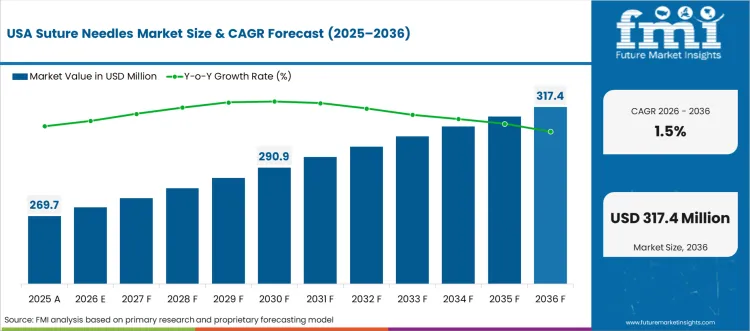
USA suture needles market is poised to exhibit a CAGR of 1.5% between 2025 and 2035. Currently, it holds the highest share in the North America market, and the trend is expected to continue during the forecast period.
Advanced infrastructure in health care, especially in the emerging economies, has altered access to surgical procedures and raised demand for suture needles. More hospitals, surgical centers, and better-equipped systems of healthcare have placed surgical interventions within the reach of many more people.
Other major factors that go on feeding this demand are technological innovations in the form of advanced absorbable sutures and new designs for the needle.
United States with enhanced healthcare standards globally, there will be a continuous demand for the highest quality surgical instruments, including suture needles. The increasing demand is due to the requirement of precision, safety, and efficiency in surgical procedures.
In USA suture needle manufacturers view this as a challenge and substantially invest in research and development activities to come out with new products meeting the emerging requirements of health institutions. It is key to serving diverse needs in modern surgical practice, such as innovations in needle design and materials.
Rigorous regulatory approvals in USA for medical devices are expected to serve as a barrier in the adoption of new technologies associated with suture needles, hence delaying their launch.
India’s Growing Number of Surgical Procedures Is Propelling the Suture Needles Market Forward.
India’s suture needles market is poised to exhibit a CAGR of 5.5% between 2025 and 2035. Currently, it holds the highest share in the Asia Pacific market, and the trend is expected to continue during the forecast period.
Increasing number of metabolic and cardiovascular diseases has resulted in a higher volume of surgical procedures in India, which is on an increasing prevalence, driven by some important factors such as the spreading of chronic diseases, aging population, and improvements in medical technology.
Together, these factors are causing a higher demand for surgical interventions, hence substantial opportunity for companies specializing in suture needles.
It is expected that the growing volume of surgeries in India will offer a huge growth opportunity for suture needle manufacturers. Companies offering high quality and reliable suture needles can meet the rising demand ushered in by such trends.
With the rising incidences of surgical interventions, the requirement for advanced technologies in suture needles that can provide the best performance and help ensure patient safety will become critical. The growing market presents the brightest avenue for expansion and innovation in suture needles.
Category-wise Insights
The section contains information about the leading segments in the industry. By shape, the straight shaped needles segment holds the highest market share of 40.7% in 2026.
The Dominance of Straight Shaped Needles in the Suture Needles Market Is Attributed to Their Versatility
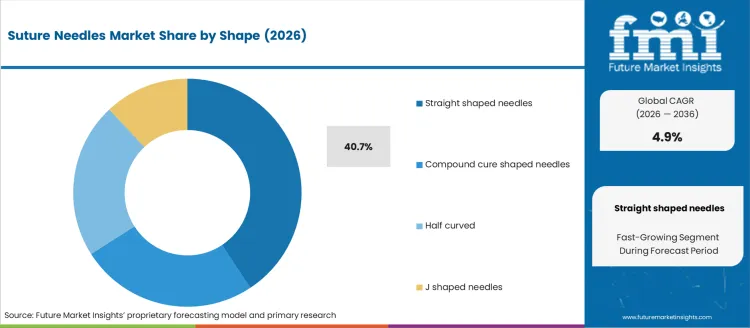
| By Shape | Straight Shaped Needles |
|---|---|
| Value Share (2026) | 40.7% |
Straight shaped needles are very versatile and, therefore, suitable for most surgical applications. Their design allows for straightforward insertion and the simplicity they provide advantageous in simple suturing tasks and those that are complicated. This greatly explains their high usage among healthcare providers.
Simplicity of straight needles makes them easier to handle and control during surgeries. One of the reasons many surgeons usually go for straight needles is for predictable performance and user-friendly alignment, reducing the risk of complications, hence improving overall efficiency during procedures.
These needles find application in almost all surgical contexts, from the routine to specialized interventions. Their broad applicability across several types of sutures and tissues further hold their lead in the market. In general, straight-shaped needles are less complex to make compared to other more specialized designs for needles.
It is this ease in production cost that reflects in their prices, thus making them very attractive to most healthcare facilities, especially those under budget pressures.
Joint Health Support as a Leading Application
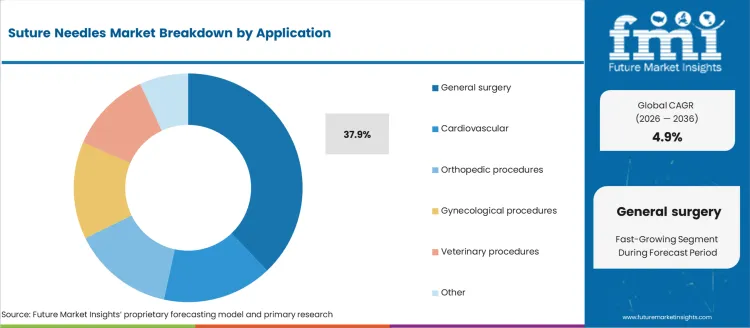
| By Application | General Surgery |
|---|---|
| Value Share (2036) | 37.9% |
General surgery includes abdominal surgeries, hernia repairs, and soft tissue surgeries. Each of these requires an interesting set of suture needles for all kinds of surgical applications. As general surgery comprises several operations, the number and types of operations are so many that it consumes a large share of suture needles, hence contributing the most to the market share in this particular segment.
Most of the time, general surgical procedures are based on standardized protocols, one of which includes the use of special suture needles. It becomes very easy for healthcare providers to embrace and use the suture needles that will suit their needs under such standardization, as procurement and usage become very easy.
The following factors exert an influence that allows the segment of general surgery to dominate the market it represents a wide field of procedures, high frequency of surgeries, versatility in the use of needles, standardized practices, and generalized availability.
Competitive Landscape
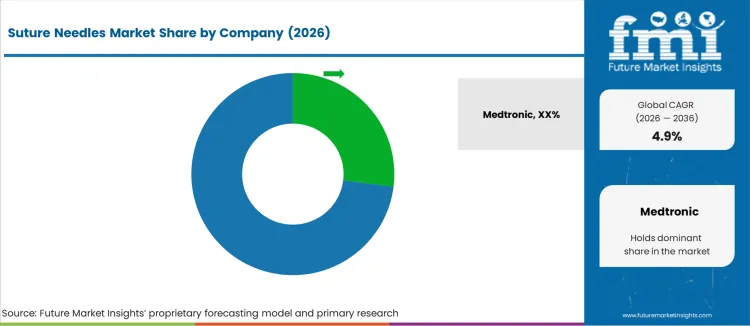
The market players are using strategies to stay competitive, such as product differentiation through innovative formulations, strategic partnerships with healthcare providers for distribution. Another key strategic focus of these companies is to actively look for strategic partners to bolster their product portfolios and expand their global market presence.
Recent Industry Developments in Suture Needles Market
- On June 25, 2025, Jashvik Capital, a private equity firm based in India, announced its investment in Futura Surgicare. This partnership aims to enhance product innovation and expand the company's offerings in the medical industry. Jashvik's investment will support Futura in driving organic and inorganic growth while ensuring affordable access to high-quality medical products both in India and internationally
- In July 2025, Teleflex Incorporated a leading global provider of medical technologies, announced that it has entered into a definitive agreement to acquire privately-held Palette Life Sciences AB for an upfront cash payment of USD 600 million at closing
Scope of the report
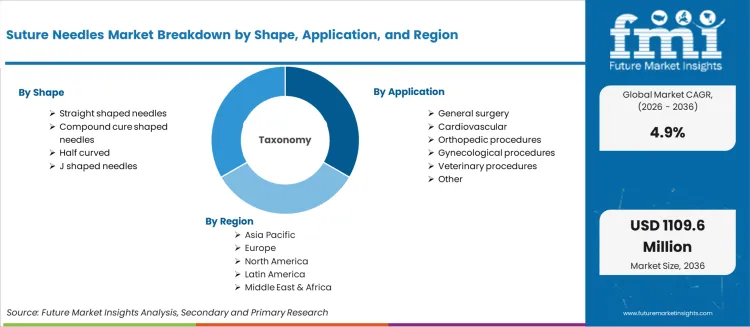
| Metric | Value |
|---|---|
| Quantitative Units | USD 687.72 million to USD 1109.61 million, at a CAGR of 4.9% |
| Market Definition | Suture Needles encompasses precision-manufactured surgical needles designed to carry suture material through tissue during wound closure and surgical repair procedures. The market covers straight, com... |
| Shape Segmentation | Straight shaped needles, Compound cure shaped needles, Half curved, J shaped needles |
| Application Segmentation | General surgery, Cardiovascular, Orthopedic procedures, Gynecological procedures, Veterinary procedures, Other |
| Type Segmentation | Blunt point needle, Tapercut needle, Reverse cutting needle, Round bodied needle, Conventional cutting needle, Spatula needle |
| Regions Covered | North America, Latin America, Europe, East Asia, South Asia, Oceania, Middle East and Africa |
| Countries Covered | India, China, South Korea, Spain, France, Australia, USA, and 40 plus countries |
| Key Companies Profiled | Medtronic, Futura Surgicare Pvt. Ltd., Johnson & Johnson Medical N.V., Aurolab, Natsume Seisakusho Co. Ltd., Alfresa Pharma Corporation, Bear Medic Corporation, SUTUREX & RENODEX, Teleflex Incorporated, Smith & Nephew, Hu-Friedy Mfg. Co. LLC, FSSB Chirurgische Nadlen GmbH, Burtons Medical Equipment Ltd., and Advin Health Care |
| Forecast Period | 2026 to 2036 |
| Approach | Forecasting models apply a bottom-up methodology starting with global installed base metrics and projecting the conversion rate to advanced product adoption. |
Key Segments of Suture Needles Market
By Shape:
In terms of shape, the industry is divided into half curved, compound cure shaped needles, straight shaped needles and j shaped needles.
By Type:
In terms of type, the industry is segregated into blunt point needle, tapercut needle, reverse cutting needle, round bodied needle, conventional cutting needle and spatula needle
By Application:
In terms of application, the industry is segregated into cardiovascular, general surgery, orhopedic procedures, gynecological procedures, veterinary procedures and other applications.
By Region:
Key countries of North America, Latin America, Western Europe, Eastern, South Asia, East Asia and Middle East and Africa (MEA) have been covered in the report.
Bibliography
- 1. World Health Organization. (2024). Global Health Expenditure Database. WHO.
- 2. USA Food and Drug Administration. (2024). Medical Device Databases. FDA.
- 3. European Commission. (2024). Regulation (EU) 2017/745 on Medical Devices. EUR-Lex.
- 4. Organisation for Economic Co-operation and Development. (2024). Health at a Glance 2024. OECD Publishing.
- 5. The World Bank. (2024). World Development Indicators: Health Systems. World Bank Group.
This bibliography is provided for reader reference. The full Future Market Insights report contains the complete reference list with primary research documentation.
Frequently Asked Questions
How large is the demand for Suture Needles in the global market in 2026?
Demand for suture needles in the global market is estimated to be valued at USD 687.72 million in 2026.
What will be the market size of Suture Needles in the global market by 2036?
Market size for suture needles is projected to reach USD 1109.61 million by 2036.
What is the expected demand growth for Suture Needles between 2026 and 2036?
Demand for suture needles is expected to grow at a CAGR of 4.9% between 2026 and 2036.
Which Shape is poised to lead global sales by 2026?
Straight shaped needles accounts for 40.7% share in 2026 as it addresses the primary demand requirements across global markets.
How significant is the role of General surgery in driving suture needles adoption in 2026?
General surgery represents 37.9% of segment share as end-user demand consolidates around established application pathways.
What is driving demand in India?
India is projected to grow at a CAGR of 5.5% during 2026 to 2036, driven by expanding infrastructure investment and regulatory modernization.
What does market forecast mean on this page?
The market forecast represents a model-based projection built on defined industry and supply chain assumptions for strategic planning purposes.
How does FMI build and validate the suture needles forecast?
Forecasting models apply a bottom-up methodology starting with global installed base metrics and cross-validate projections against quarterly industry revenue volumes.
Preview the report firsthand - request a free sample
Get SampleGet the brochure for pricing and purchase details.
Get PDFTable of Content
- Executive Summary
- Global Market Outlook
- Demand-side Trends
- Supply-side Trends
- Technology Roadmap Analysis
- Analysis and Recommendations
- Market Overview
- Market Coverage / Taxonomy
- Market Definition / Scope / Limitations
- Research Methodology
- Chapter Orientation
- Analytical Lens and Working Hypotheses
- Market Structure, Signals, and Trend Drivers
- Benchmarking and Cross-market Comparability
- Market Sizing, Forecasting, and Opportunity Mapping
- Research Design and Evidence Framework
- Desk Research Programme (Secondary Evidence)
- Company Annual and Sustainability Reports
- Peer-reviewed Journals and Academic Literature
- Corporate Websites, Product Literature, and Technical Notes
- Earnings Decks and Investor Briefings
- Statutory Filings and Regulatory Disclosures
- Technical White Papers and Standards Notes
- Trade Journals, Industry Magazines, and Analyst Briefs
- Conference Proceedings, Webinars, and Seminar Materials
- Government Statistics Portals and Public Data Releases
- Press Releases and Reputable Media Coverage
- Specialist Newsletters and Curated Briefings
- Primary Modes
- Qualitative Interviews and Expert Elicitation
- Quantitative Surveys and Structured Data Capture
- Blended Approach
- Why Primary Evidence is Used
- Field Techniques
- Interviews
- Surveys
- Focus Groups
- Observational and In-context Research
- Social and Community Interactions
- Stakeholder Universe Engaged
- C-suite Leaders
- Board Members
- Presidents and Vice Presidents
- R&D and Innovation Heads
- Technical Specialists
- Domain Subject-matter Experts
- Scientists
- Physicians and Other Healthcare Professionals
- Governance, Ethics, and Data Stewardship
- Research Ethics
- Data Integrity and Handling
- Tooling, Models, and Reference Databases
- Desk Research Programme (Secondary Evidence)
- Data Engineering and Model Build
- Data Acquisition and Ingestion
- Cleaning, Normalisation, and Verification
- Synthesis, Triangulation, and Analysis
- Quality Assurance and Audit Trail
- Market Background
- Market Dynamics
- Drivers
- Restraints
- Opportunity
- Trends
- Scenario Forecast
- Demand in Optimistic Scenario
- Demand in Likely Scenario
- Demand in Conservative Scenario
- Opportunity Map Analysis
- Product Life Cycle Analysis
- Supply Chain Analysis
- Investment Feasibility Matrix
- Value Chain Analysis
- PESTLE and Porter’s Analysis
- Regulatory Landscape
- Regional Parent Market Outlook
- Production and Consumption Statistics
- Import and Export Statistics
- Market Dynamics
- Global Market Analysis 2021 to 2025 and Forecast, 2026 to 2036
- Historical Market Size Value (USD Million) Analysis, 2021 to 2025
- Current and Future Market Size Value (USD Million) Projections, 2026 to 2036
- Y-o-Y Growth Trend Analysis
- Absolute $ Opportunity Analysis
- Global Market Pricing Analysis 2021 to 2025 and Forecast 2026 to 2036
- Global Market Analysis 2021 to 2025 and Forecast 2026 to 2036, By Shape
- Introduction / Key Findings
- Historical Market Size Value (USD Million) Analysis By Shape , 2021 to 2025
- Current and Future Market Size Value (USD Million) Analysis and Forecast By Shape , 2026 to 2036
- Straight shaped needles
- Compound cure shaped needles
- Half curved
- J shaped needles
- Straight shaped needles
- Y-o-Y Growth Trend Analysis By Shape , 2021 to 2025
- Absolute $ Opportunity Analysis By Shape , 2026 to 2036
- Global Market Analysis 2021 to 2025 and Forecast 2026 to 2036, By Application
- Introduction / Key Findings
- Historical Market Size Value (USD Million) Analysis By Application, 2021 to 2025
- Current and Future Market Size Value (USD Million) Analysis and Forecast By Application, 2026 to 2036
- General surgery
- Cardiovascular
- Orthopedic procedures
- Gynecological procedures
- Veterinary procedures
- Other
- General surgery
- Y-o-Y Growth Trend Analysis By Application, 2021 to 2025
- Absolute $ Opportunity Analysis By Application, 2026 to 2036
- Global Market Analysis 2021 to 2025 and Forecast 2026 to 2036, By Type
- Introduction / Key Findings
- Historical Market Size Value (USD Million) Analysis By Type, 2021 to 2025
- Current and Future Market Size Value (USD Million) Analysis and Forecast By Type, 2026 to 2036
- Blunt point needle
- Tapercut needle
- Reverse cutting needle
- Round bodied needle
- Conventional cutting needle
- Spatula needle
- Blunt point needle
- Y-o-Y Growth Trend Analysis By Type, 2021 to 2025
- Absolute $ Opportunity Analysis By Type, 2026 to 2036
- Global Market Analysis 2021 to 2025 and Forecast 2026 to 2036, By Region
- Introduction
- Historical Market Size Value (USD Million) Analysis By Region, 2021 to 2025
- Current Market Size Value (USD Million) Analysis and Forecast By Region, 2026 to 2036
- North America
- Latin America
- Western Europe
- Eastern Europe
- East Asia
- South Asia and Pacific
- Middle East & Africa
- Market Attractiveness Analysis By Region
- North America Market Analysis 2021 to 2025 and Forecast 2026 to 2036, By Country
- Historical Market Size Value (USD Million) Trend Analysis By Market Taxonomy, 2021 to 2025
- Market Size Value (USD Million) Forecast By Market Taxonomy, 2026 to 2036
- By Country
- USA
- Canada
- Mexico
- By Shape
- By Application
- By Type
- By Country
- Market Attractiveness Analysis
- By Country
- By Shape
- By Application
- By Type
- Key Takeaways
- Latin America Market Analysis 2021 to 2025 and Forecast 2026 to 2036, By Country
- Historical Market Size Value (USD Million) Trend Analysis By Market Taxonomy, 2021 to 2025
- Market Size Value (USD Million) Forecast By Market Taxonomy, 2026 to 2036
- By Country
- Brazil
- Chile
- Rest of Latin America
- By Shape
- By Application
- By Type
- By Country
- Market Attractiveness Analysis
- By Country
- By Shape
- By Application
- By Type
- Key Takeaways
- Western Europe Market Analysis 2021 to 2025 and Forecast 2026 to 2036, By Country
- Historical Market Size Value (USD Million) Trend Analysis By Market Taxonomy, 2021 to 2025
- Market Size Value (USD Million) Forecast By Market Taxonomy, 2026 to 2036
- By Country
- Germany
- UK
- Italy
- Spain
- France
- Nordic
- BENELUX
- Rest of Western Europe
- By Shape
- By Application
- By Type
- By Country
- Market Attractiveness Analysis
- By Country
- By Shape
- By Application
- By Type
- Key Takeaways
- Eastern Europe Market Analysis 2021 to 2025 and Forecast 2026 to 2036, By Country
- Historical Market Size Value (USD Million) Trend Analysis By Market Taxonomy, 2021 to 2025
- Market Size Value (USD Million) Forecast By Market Taxonomy, 2026 to 2036
- By Country
- Russia
- Poland
- Hungary
- Balkan & Baltic
- Rest of Eastern Europe
- By Shape
- By Application
- By Type
- By Country
- Market Attractiveness Analysis
- By Country
- By Shape
- By Application
- By Type
- Key Takeaways
- East Asia Market Analysis 2021 to 2025 and Forecast 2026 to 2036, By Country
- Historical Market Size Value (USD Million) Trend Analysis By Market Taxonomy, 2021 to 2025
- Market Size Value (USD Million) Forecast By Market Taxonomy, 2026 to 2036
- By Country
- China
- Japan
- South Korea
- By Shape
- By Application
- By Type
- By Country
- Market Attractiveness Analysis
- By Country
- By Shape
- By Application
- By Type
- Key Takeaways
- South Asia and Pacific Market Analysis 2021 to 2025 and Forecast 2026 to 2036, By Country
- Historical Market Size Value (USD Million) Trend Analysis By Market Taxonomy, 2021 to 2025
- Market Size Value (USD Million) Forecast By Market Taxonomy, 2026 to 2036
- By Country
- India
- ASEAN
- Australia & New Zealand
- Rest of South Asia and Pacific
- By Shape
- By Application
- By Type
- By Country
- Market Attractiveness Analysis
- By Country
- By Shape
- By Application
- By Type
- Key Takeaways
- Middle East & Africa Market Analysis 2021 to 2025 and Forecast 2026 to 2036, By Country
- Historical Market Size Value (USD Million) Trend Analysis By Market Taxonomy, 2021 to 2025
- Market Size Value (USD Million) Forecast By Market Taxonomy, 2026 to 2036
- By Country
- Kingdom of Saudi Arabia
- Other GCC Countries
- Turkiye
- South Africa
- Other African Union
- Rest of Middle East & Africa
- By Shape
- By Application
- By Type
- By Country
- Market Attractiveness Analysis
- By Country
- By Shape
- By Application
- By Type
- Key Takeaways
- Key Countries Market Analysis
- USA
- Pricing Analysis
- Market Share Analysis, 2025
- By Shape
- By Application
- By Type
- Canada
- Pricing Analysis
- Market Share Analysis, 2025
- By Shape
- By Application
- By Type
- Mexico
- Pricing Analysis
- Market Share Analysis, 2025
- By Shape
- By Application
- By Type
- Brazil
- Pricing Analysis
- Market Share Analysis, 2025
- By Shape
- By Application
- By Type
- Chile
- Pricing Analysis
- Market Share Analysis, 2025
- By Shape
- By Application
- By Type
- Germany
- Pricing Analysis
- Market Share Analysis, 2025
- By Shape
- By Application
- By Type
- UK
- Pricing Analysis
- Market Share Analysis, 2025
- By Shape
- By Application
- By Type
- Italy
- Pricing Analysis
- Market Share Analysis, 2025
- By Shape
- By Application
- By Type
- Spain
- Pricing Analysis
- Market Share Analysis, 2025
- By Shape
- By Application
- By Type
- France
- Pricing Analysis
- Market Share Analysis, 2025
- By Shape
- By Application
- By Type
- India
- Pricing Analysis
- Market Share Analysis, 2025
- By Shape
- By Application
- By Type
- ASEAN
- Pricing Analysis
- Market Share Analysis, 2025
- By Shape
- By Application
- By Type
- Australia & New Zealand
- Pricing Analysis
- Market Share Analysis, 2025
- By Shape
- By Application
- By Type
- China
- Pricing Analysis
- Market Share Analysis, 2025
- By Shape
- By Application
- By Type
- Japan
- Pricing Analysis
- Market Share Analysis, 2025
- By Shape
- By Application
- By Type
- South Korea
- Pricing Analysis
- Market Share Analysis, 2025
- By Shape
- By Application
- By Type
- Russia
- Pricing Analysis
- Market Share Analysis, 2025
- By Shape
- By Application
- By Type
- Poland
- Pricing Analysis
- Market Share Analysis, 2025
- By Shape
- By Application
- By Type
- Hungary
- Pricing Analysis
- Market Share Analysis, 2025
- By Shape
- By Application
- By Type
- Kingdom of Saudi Arabia
- Pricing Analysis
- Market Share Analysis, 2025
- By Shape
- By Application
- By Type
- Turkiye
- Pricing Analysis
- Market Share Analysis, 2025
- By Shape
- By Application
- By Type
- South Africa
- Pricing Analysis
- Market Share Analysis, 2025
- By Shape
- By Application
- By Type
- USA
- Market Structure Analysis
- Competition Dashboard
- Competition Benchmarking
- Market Share Analysis of Top Players
- By Regional
- By Shape
- By Application
- By Type
- Competition Analysis
- Competition Deep Dive
- Medtronic
- Overview
- Product Portfolio
- Profitability by Market Segments (Product/Age /Sales Channel/Region)
- Sales Footprint
- Strategy Overview
- Marketing Strategy
- Product Strategy
- Channel Strategy
- Futura Surgicare Pvt. Ltd.
- Johnson & Johnson Medical N.V.
- Aurolab
- Natsume Seisakusho Co. Ltd.
- Alfresa Pharma Corporation
- Bear Medic Corporation
- SUTUREX & RENODEX
- Teleflex Incorporated
- Smith & Nephew
- Hu-Friedy Mfg. Co. LLC
- FSSB Chirurgische Nadlen GmbH
- Burtons Medical Equipment Ltd.
- Advin Health Care
- Medtronic
- Competition Deep Dive
- Assumptions & Acronyms Used


