

- Market Size (2026)
- USD 1.9 Bn
- Forecast (2036)
- USD 6.2 Bn
- CAGR (2026 to 2036)
- 12.6%
How big is Synthetic Biology Cell Programming Market in 2026?
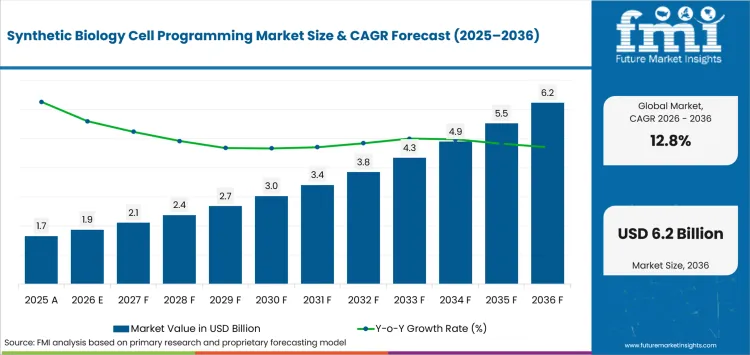
USD 1.9 billion in 2026 and USD 6.2 billion by 2036 at a 12.6% CAGR.
Demand for synthetic biology cell programming is forecast to expand at 12.6% CAGR between 2026 and 2036, increasing valuation from USD 1.9 billion in 2026 to USD 6.2 billion by 2036. Commercial spending concentrates on platforms that design genetic changes and deliver reproducible cells with documented identity and function. The broader synthetic biology market provides upstream design context for these programs and their programmable development tools. NIH’s Somatic Cell Genome Editing program states that its second phase prioritizes targeted delivery and clinical translation across multiple diseases. Public investment strengthens demand for validated editors and assay systems without removing development risk from commercial programs. The related CRISPR systems market shapes tool selection across discovery and therapeutic development programs worldwide. Platform value rises once sequence design and cell modification connect with analytical evidence that supports repeatable decisions.
United States developers combine specialized research centers with private manufacturing partners across early and clinical programs. United Kingdom access depends more directly on national reimbursement and treatment-center capacity for advanced therapies. The MHRA opened a May 2026 consultation to clarify how synthetic nucleic acids and sequence-specific genome editing fit United Kingdom gene-therapy rules. German programs operate through centralized European authorization and national oversight from the Paul-Ehrlich-Institut for advanced therapies. Japanese developers use a regenerative-product framework that permits conditional pathways alongside extensive post-approval obligations for commercial sponsors. South Korea is building public biofoundry infrastructure and a statutory framework that supports national synthetic biology development. National differences shape gene editing workflows across approval routes and service models that require distinct commercial support. ;
Key Takeaways of Synthetic Biology Cell Programming Market
- Demand for synthetic biology cell programming is driven by biopharmaceutical pipelines requiring edited cells with traceable design and analytical records, as research teams fund programming to convert genetic designs into reproducible cellular functions.
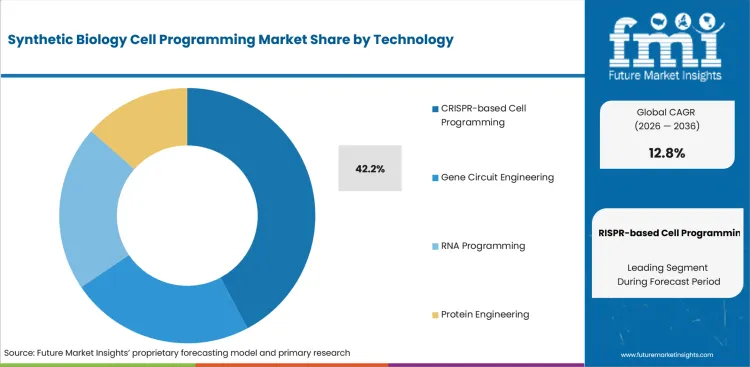
- By technology, CRISPR-based cell programming is expected to lead with 42.2% share in 2026, due to flexible targeting across research and therapeutic programs.
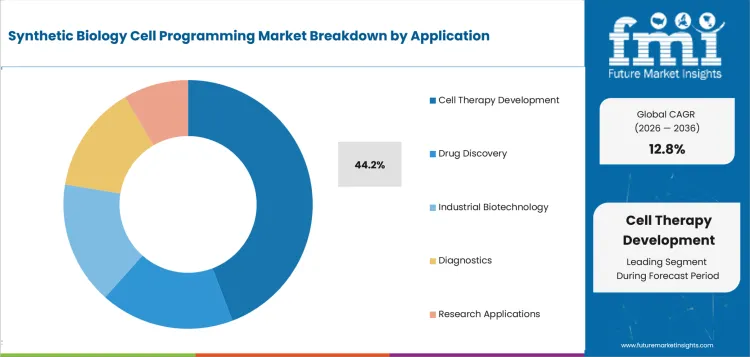
- Cell therapy development is the dominant application segment, projected to hold 44.2% share in 2026, as engineered cells require extensive functional and manufacturing validation.
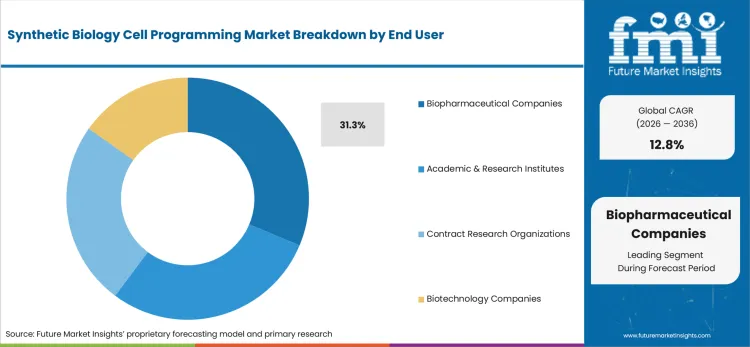
- Biopharmaceutical companies are estimated to lead the end-user category with 31.3% share in 2026, through internal pipelines and outsourced specialist development work.
- Mammalian cells are anticipated to capture 33.7% share in 2026, despite demanding culture conditions and complex quality controls.
- South Korea, Germany, and the United Kingdom are expected to lead growth at 15.1%, 12.8%, and 11.2% CAGR respectively through 2036, supported by biofoundry investment, regulated advanced-therapy pathways, and improved reimbursement access.
- Competition centers on Ginkgo Bioworks, Synthego, Twist Bioscience, Integrated DNA Technologies, GenScript Biotech, Thermo Fisher Scientific, Lonza, and ElevateBio, with vendors differentiating through cell-programming design services, synthetic DNA/guide-RNA inputs, and advanced-therapy manufacturing capability.
Analyst Perspective
"The synthetic biology cell programming market is progressing from research-focused innovation toward scalable biomanufacturing applications. Commercial success will depend on translating laboratory performance into reproducible manufacturing processes while preserving cell quality, potency, and regulatory compliance. Developers are placing greater emphasis on technology transfer, process standardization, and staged validation to reduce development risk. Companies that simplify scale-up and support reliable manufacturing execution are expected to strengthen their competitive position."
- Anurag Sharma,, Principal Analyst at Future Market Insights
Source: FMI's proprietary forecasting model and primary research
How is the Synthetic Biology Cell Programming Market segmented?
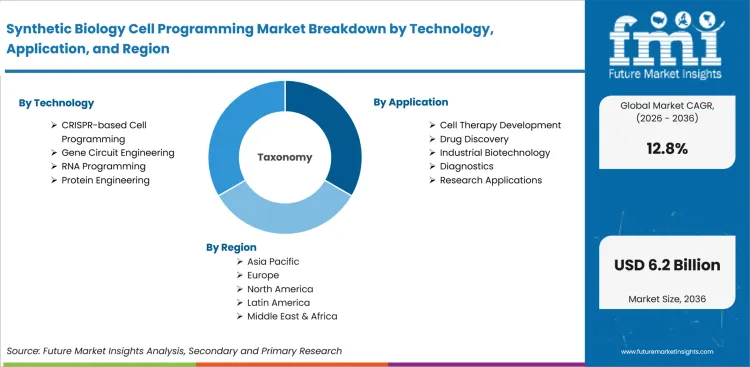
The synthetic biology cell programming market is segmented by technology, application, end user, cell type, and region.
The segmentation framework separates programming methods from the development work and cellular systems used across commercial projects. Technology analysis covers CRISPR-based programming together with gene circuits and RNA or protein engineering approaches. Application analysis distinguishes cell therapy development from drug discovery and from industrial or diagnostic programming across commercial projects. End-user categories separate biopharmaceutical companies from research institutes and from outsourced development organizations with different purchasing needs. Cell-type analysis compares mammalian and microbial cells with stem cells and immune cells under different handling requirements. Regional analysis reflects approval pathways and service access across countries with distinct research and manufacturing networks.
Why does CRISPR-based cell programming remain central to the Technology category?
CRISPR-based programming gives research teams a programmable route for changing targeted sequences across diverse mammalian and microbial cells. Platform selection depends on delivery efficiency and off-target control as much as editor activity during controlled experiments. FDA’s genome-editing guidance addresses product design and manufacturing considerations for human gene therapies that incorporate genome editing. Commercial value improves once providers connect editor design with cell recovery and verified functional testing.
- CRISPR-based cell programming is expected to hold 42.2% share in 2026, owing to flexible targeting across several research and therapeutic applications. The segment supports knockout and insertion workflows together with multiplex changes that other programming methods cannot match consistently. Its share reflects broad technical utility across research settings rather than guaranteed success within every targeted cell type.
- Biopharmaceutical laboratories adopt CRISPR workflows when editing reagents integrate with delivery and clone-validation systems across one documented process. Strong providers offer design support and off-target analysis together with materials suitable for later development stages. Adoption slows whenever editing efficiency requires extensive cell-specific optimization or repeated recovery work across sensitive laboratory workflows.
How does cell therapy development shape the Application category?
Cell therapy programs require engineered cells that retain identity and function throughout expansion and controlled manufacturing. Development teams therefore evaluate editing performance together with potency assays and process reproducibility across representative batches. ASGCT reported in April 2025 that non-genetically modified cell therapy trials initiated for non-oncology indications increased to 74% from 58%. The CRISPR delivery devices offers a related view of how editing materials enter difficult cellular targets. Commercial demand rises as programming platforms support therapeutic design and later manufacturing evidence across one controlled development pathway.
- By application, cell therapy development is forecast to represent 44.2% share in 2026, attributable to the extensive design and validation support required for engineered cells. Each program must connect the intended genetic change with potency and product identity across controlled manufacturing stages. The large share reflects service intensity and long development timelines beside the number of active programs.
- Therapeutic developers favor platforms that support research-grade experiments and provide a credible transition toward regulated production materials. Technology transfer becomes easier once analytical methods and cell-handling instructions remain consistent across external partners. Adoption remains constrained by delivery limits and variable cell recovery across sensitive starting materials used in therapeutic programs.
Why do biopharmaceutical companies anchor the End User category?
Biopharmaceutical companies coordinate target selection and cell engineering with preclinical evidence and manufacturing decisions across pipelines. Internal teams combine platform partners with contract development organizations to control development risk across programs. ASGCT reported in January 2025 that seed and Series A financing for gene and cell therapy companies reached USD 609.2 million during the fourth quarter of 2024. Funding supports platform access but cannot replace direct product evidence during formal commercial development decisions.
- Based on end user, biopharmaceutical companies are projected to hold 31.3% share in 2026, supported by internal pipelines and outsourced specialist development programs. Biopharmaceutical companies purchase editing reagents and engineered cells together with analytical services that support formal development decisions. Their position reflects coordinated spending across several workflow stages rather than reliance on one product category.
- Large developers adopt cell programming platforms through milestone-based work that separates discovery experiments from regulated translation activities. Smaller biotechnology companies often outsource a larger portion of design and validation work due to limited internal infrastructure. Providers gain durable accounts by supporting data transfer and process continuity across both operating models.
What supports mammalian cells within the Cell Type category?
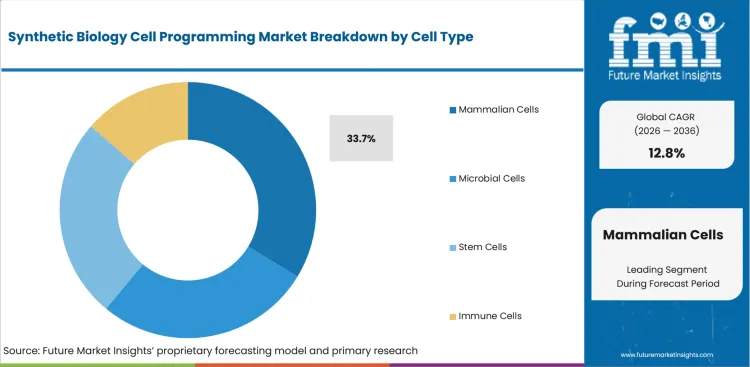
Mammalian cells offer disease-relevant biology for therapeutic development but require controlled culture and careful recovery after genetic modification. Researchers must verify phenotype and genomic integrity together with the intended editing result across representative passages. NIH reported in May 2025 that its genome-editing program supported a breakthrough study involving a personalized therapeutic approach. The gene synthesis capacity market provides an upstream comparison for the constructs used to program complex cellular models. Commercial demand depends on reproducibility across fragile cell systems rather than editor activity measured during controlled experiments alone.
- Mammalian cells are expected to account for 33.7% share in 2026, driven by their relevance across drug discovery and cell therapy development. Their biology supports disease models and therapeutic products that require human cellular functions during formal development programs. The share also reflects higher service value created by demanding culture conditions and extensive analytical requirements.
- Research institutes and biopharmaceutical companies use mammalian cell programming to evaluate targets within biologically relevant systems before clinical development. Providers must control clone selection and passage history together with contamination testing and identity confirmation across extended cultures. Adoption becomes costly whenever edited populations require prolonged screening or fail to preserve the intended phenotype.
What are the drivers, restraints, and opportunities in the Synthetic Biology Cell Programming Market?
Demand rises as researchers connect programmable editors with validated cells and specialized translation services across development programs. Adoption slows when delivery performance and potency evidence remain uncertain across sensitive therapeutic cell programs. Integrated design and manufacturing support creates an opportunity to reduce transfer risk across complex development handoffs.
- Driver: Expanding therapeutic pipelines increase demand for reproducible cell engineering across discovery and development programs.
- Restraint: Cell-specific delivery and off-target uncertainty raise validation costs before engineered cells enter clinical manufacturing.
- Opportunity: Integrated design and manufacturing services can reduce handoff risk across complex cell programming programs.
Therapeutic pipeline activity supports market growth as developers test programmed cells across oncology and rare disease applications. ASGCT reported in August 2025 that oncology represented 64% of the eighty gene therapy trials initiated during the second quarter. The trial concentration creates demand for editing materials and cell models that support repeated target evaluation. Platform providers gain stronger commercial positions once experimental services connect with evidence needed for formal development decisions.
Delivery uncertainty restrains adoption because strong editor activity does not guarantee safe modification across the intended cell population. FDA’s April 2026 draft guidance recommends next-generation sequencing methods for assessing off-target editing and loss of genome integrity. Developers therefore need validated analytical workflows beside the editing system throughout nonclinical and clinical development programs. Project costs rise whenever cell-specific delivery requires repeated optimization or creates unclear safety signals during formal nonclinical development.
Integrated infrastructure creates an opportunity to connect design and screening with controlled manufacturing across one accountable development route. South Korea’s Ministry of Science and ICT included a public biofoundry and AI-driven biotechnology development within its January 2025 work plan. The enzymatic DNA synthesis market offers an upstream comparison for faster production of complex genetic inputs. Service providers can reduce transfer risk by preserving data formats and quality requirements across each workflow stage.
Which country CAGRs are profiled in the Synthetic Biology Cell Programming Market?
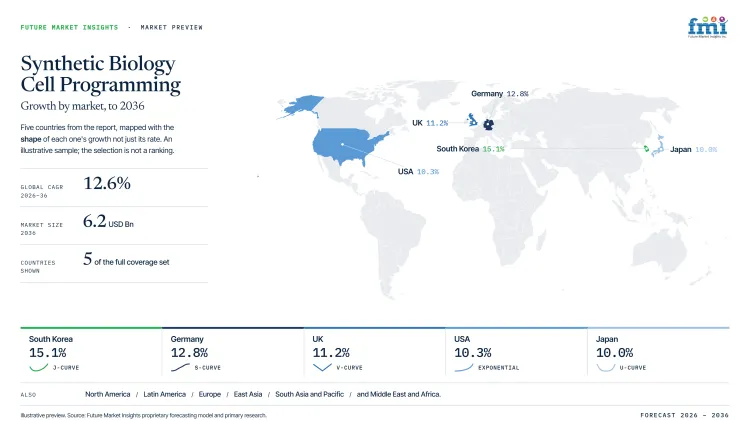
| Country | CAGR |
|---|---|
| USA | 10.3% |
| UK | 11.2% |
| Germany | 12.8% |
| Japan | 10.0% |
| South Korea | 15.1% |
How do country-level CAGRs compare in the synthetic biology cell programming market?
The country forecasts form a measured range instead of one uniform adoption pattern across the assessed national markets. South Korea stands apart at 15.1% because national biofoundry policy creates a stronger infrastructure signal. Germany follows at 12.8% through regulated advanced-therapy pathways and an established specialist biomanufacturing capacity base. The UK records 11.2% as reimbursement access improves for selected gene-edited therapies within specialized national treatment centers. The USA and Japan form a lower growth band at 10.3% and 10.0% despite substantial research and approval infrastructure. Similar forecast rates can hide different service gaps and purchasing models across each assessed national market.
South Korea and Germany form the upper growth cluster across the five profiled countries through distinct infrastructure and regulatory routes.
- The UK occupies the middle position as national access expands through selected reimbursement decisions and specialized treatment centers.
- The USA and Japan show similar forecast rates despite different approval pathways and domestic service structures.
- The 5.1 percentage-point spread reflects national infrastructure and evidence requirements rather than differences in scientific capability alone.
- The progression forms two broad growth clusters rather than a smooth step-down across every profiled national forecast.
Markets with similar CAGRs can present different entry conditions through local manufacturing access and specialized clinical support. Country entry plans should assess those operating conditions beside each published national growth rate and commercial route. The full report provides country-level CAGR analysis across North America, Latin America, Europe, East Asia, South Asia, Oceania and the Middle East and Africa.
Country-wise Analysis
- The United States combines NIH-funded genome-editing research with a broad network of specialized cell and gene therapy developers. The national market is forecast to expand at 10.3% CAGR from 2026 to 2036 through research spending and private development activity. FDA’s Purple Book confirms a formal commercial pathway for licensed biological products that includes cellular and gene therapies. Contract manufacturers and specialist laboratories provide development routes across major biotechnology clusters and established therapeutic research centers. Long service distances and complex technology transfer can increase timelines for smaller developers outside those clusters. Commercial entry depends on reliable analytical support and a manufacturing route that remains available through clinical development.
- The United Kingdom uses a nationally coordinated health system that can translate selected advanced therapies through centralized reimbursement decisions. The national market is projected to record 11.2% CAGR over the 2026-2036 forecast period as treatment access expands selectively. NHS England reported in January 2025 that eligible sickle cell patients could receive the gene-edited therapy exagamglogene autotemcel through a confidential commercial agreement. National purchasing creates a direct enabler for approved programs that present clear clinical evidence and manageable service requirements. Limited transplant-center capacity and demanding conditioning requirements constrain patient throughput and specialized training availability across national treatment networks. Developers need early engagement with specialist centers and evidence packages that address service burden beside clinical performance.
- Germany combines specialist university centers with formal national oversight for advanced therapy medicinal products and European authorization routes. The national market is forecast to rise at 12.8% CAGR from 2026 to 2036 through regulated development and manufacturing activity. The Paul-Ehrlich-Institut stated in April 2025 that advanced therapy manufacturing requires Good Manufacturing Practice and that certain hospital-exemption products need national authorization. Established research centers and contract manufacturers provide a direct enabler for controlled translation work across regulated advanced-therapy programs. Strict documentation and manufacturing obligations create material cost and timeline friction for early programs with limited operational resources. Commercial plans should secure qualified production capacity before clinical schedules depend on a single external facility.
- Japan operates a dedicated regulatory framework for regenerative medical products alongside established pharmaceutical development and manufacturing capabilities. The national market is estimated to grow at 10.0% CAGR from 2026 to 2036 through carefully governed adoption. PMDA review records list 2025 approvals for regenerative products including Elevidys and Vyjuvek under the national review system. Conditional pathways and domestic review expertise create a direct route for innovative programs that satisfy national evidence requirements. Post-approval evidence duties and process-comparability requirements can extend development work across manufacturing changes and later commercial expansion. Market access favors providers that combine local regulatory support with validated analytical and technology-transfer capabilities.
- South Korea is creating a national synthetic biology framework supported by public research infrastructure and concentrated biotechnology clusters. The national market is projected to advance at 15.1% CAGR through 2036, supported by coordinated policy and platform investment. The Ministry of Science and ICT reported in April 2025 that the Synthetic Biology Promotion Act establishes national plans and support for biofoundries and research hubs. Public infrastructure provides a direct enabler for automated design and testing across national research programs and shared facilities. Clinical translation and internationally accepted manufacturing evidence remain material frictions for commercial therapeutic programs seeking global development routes.
Who are the notable companies in the Synthetic Biology Cell Programming Market?
Ginkgo Bioworks, Twist Bioscience, Synthego, GenScript Biotech, Integrated DNA Technologies, Thermo Fisher Scientific, Lonza, and ElevateBio are notable companies shaping this market.
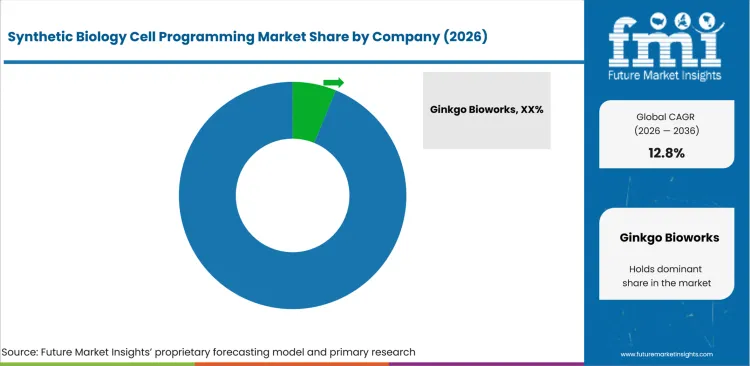
The competitive field combines programming platforms with DNA synthesis and CRISPR tool providers alongside advanced-therapy development organizations. Cell engineering specialists compete through design depth and reproducibility across difficult cellular systems used in commercial development programs. Synthetic DNA companies compete through sequence capacity and quality documentation across research and translation workflows. Manufacturing organizations compete through process development and regulated production support rather than direct ownership of genome-editing tools.
- Ginkgo Bioworks provides a horizontal cell-programming platform that combines biological design with automation and development services. Synthego supplies CRISPR reagents and therapeutic development support across genome-editing workflows used in research and therapeutic development. Funds managed by Perceptive Advisors completed a July 2025 asset acquisition and continued operations through Synthego Holdings LLC under the established brand. Their strongest fit appears in programs that require design assistance and repeatable engineering rather than standalone commodity inputs.
- Twist Bioscience supplies high-throughput synthetic DNA through a silicon-based manufacturing platform for complex research and therapeutic programs. Integrated DNA Technologies provides CRISPR guide RNAs and off-target analysis together with current Good Manufacturing Practice materials. Synthetic DNA providers serve programs that need controlled genetic inputs and documentation across several development stages.
- GenScript Biotech and Thermo Fisher Scientific combine editing tools with cell engineering or workflow services. Lonza and ElevateBio emphasize process development and regulated manufacturing for advanced therapies across research and commercial programs. Their relevance increases as cell programming programs progress from experimental design toward controlled clinical production.
Competitive Benchmarking: Synthetic Biology Cell Programming Market
| Company | Cell Programming Platform | CRISPR and DNA Tools | Therapeutic Translation Support | Geographic Reach |
|---|---|---|---|---|
| Ginkgo Bioworks | High | Medium | Medium | Global |
| Twist Bioscience | Low | High | Medium | Global |
| Synthego | High | High | Medium | North America and Europe |
| GenScript Biotech | High | High | High | Global |
| Integrated DNA Technologies | Low | High | Medium | Global |
| Thermo Fisher Scientific | High | High | High | Global |
| Lonza | Medium | Low | High | Global |
| ElevateBio | High | High | High | North America |
Key Developments in the Synthetic Biology Cell Programming Market
- In January 2025, Ginkgo Bioworks partnered with Universal Cells and Astellas to advance induced pluripotent stem cell-derived therapies for solid tumors by combining cell programming services with development capabilities. The agreement created a commercial route for engineered cell platforms within therapeutic discovery and later development programs that require reproducible materials and formal quality evidence. Program value depends on successful translation from cell design into development materials that satisfy formal program requirements.
- In May 2025, Twist Bioscience and Ginkgo Bioworks revised their collaboration through a three-year agreement valued at USD 15 million and transferred licenses covering certain long-DNA technologies. Ginkgo retained practice rights and continued purchasing Twist DNA products without minimum-volume requirements under the revised commercial arrangement. The arrangement strengthened upstream DNA access for cell programming while giving both organizations greater operating flexibility across commercial development programs.
- In January 2025, Synthego entered a global licensing agreement with AstraZeneca covering manufacturing and distribution of the eSpOT-ON CRISPR enzyme in protein and messenger RNA formats. The agreement also granted therapeutic commercialization rights and paired the nuclease with Synthego guide-RNA capabilities across development workflows. The license broadened editor choice for therapeutic programs requiring high-fidelity performance and clearer commercial access across development stages.
- In June 2025, ProBio and GenScript Biotech opened a Good Manufacturing Practice facility spanning 128 thousand square feet in New Jersey for plasmid DNA and viral vector manufacturing. The site supports adeno-associated virus and lentiviral programs across cell and gene therapy development and manufacturing. North American developers gain another route for clinical and commercial manufacturing inputs when technology transfer and quality documentation remain aligne
Key Players in the Synthetic Biology Cell Programming Market
Cell Programming and Genome Engineering Platforms
- Ginkgo Bioworks
- Synthego
- GenScript Biotech
Synthetic DNA and CRISPR Tool Providers
- Twist Bioscience
- Integrated DNA Technologies
- Thermo Fisher Scientific
Cell and Gene Therapy Translation Platforms
- Lonza
- ElevateBio
Synthetic Biology Cell Programming Market - Report Scope
| Coverage field | Report scope |
|---|---|
| Market breakdown | Technology, application, end user, cell type, and region. |
| Market Definition | Products and services used to design and edit living cells through programmable genetic or molecular systems. The scope also includes engineering and validation services that translate cellular designs into documented commercial workflows. |
| Regions Covered | North America, Latin America, Europe, East Asia, South Asia and Pacific, and Middle East and Africa. |
| Countries Covered | USA, UK, Germany, Japan, and South Korea, with wider coverage across more than thirty countries. |
| Key Companies Profiled | Ginkgo Bioworks, Twist Bioscience, Synthego, GenScript Biotech, Integrated DNA Technologies, Thermo Fisher Scientific, Lonza, and ElevateBio |
| Forecast Period | 2026 to 2036. |
| Approach | Hybrid bottom-up and top-down market sizing supported by documented primary research and authoritative official desk research. |
Synthetic Biology Cell Programming Market - Research Methodology
| Method | Approach |
|---|---|
| Primary Research | FMI analysts gathered input from manufacturers, service providers, technology developers, distributors, end users, sourcing teams, and subject-matter experts. Interviews examined purchasing decisions, product or service evaluation, adoption barriers, approval requirements, pricing considerations, and expectations for technical or commercial support. Respondents were also asked what evidence is required before a trial, pilot, or initial order develops into regular purchasing. |
| Desk Research | Desk research covered government statistics, regulatory publications, trade data, industry associations, technical literature, standards, company filings, product information, and official corporate announcements. Sources were reviewed for relevance, publication date, geographic coverage, and consistency with the defined market scope. Claims relating to performance, applications, approvals, capacity, investment, and commercial activity were retained only when supported by credible public evidence. |
| Market Sizing and Forecasting | The market model combined the baseline value with historical performance, segment structure, pricing and volume indicators, adoption levels, company participation, and country-level demand conditions. Forecast assumptions considered economic activity, investment trends, regulatory developments, technology adoption, purchasing cycles, supply availability, and barriers to wider market use. Segment and regional estimates were reconciled before the final market total was calculated. |
| Data Validation | Estimates were checked against multiple independent indicators, including public data, company activity, trade patterns, industry developments, and findings from primary interviews. Validation also tested whether products, services, applications, and company revenues fell within the defined market boundaries. Adjacent categories, unsupported claims, overlapping revenues, and activities without direct market relevance were excluded to reduce double counting and maintain consistency across segments and countries. |
Synthetic Biology Cell Programming Market by Segments
Synthetic Biology Cell Programming Market segmented by Technology:
- CRISPR-based Cell Programming
- Gene Circuit Engineering
- RNA Programming
- Protein Engineering
Synthetic Biology Cell Programming Market segmented by Application:
- Cell Therapy Development
- Drug Discovery
- Industrial Biotechnology
- Diagnostics
- Research Applications
Synthetic Biology Cell Programming Market segmented by End User:
- Biopharmaceutical Companies
- Academic & Research Institutes
- Contract Research Organizations
- Biotechnology Companies
Synthetic Biology Cell Programming Market segmented by Cell Type:
- Mammalian Cells
- Microbial Cells
- Stem Cells
- Immune Cells
Synthetic Biology Cell Programming Market by Region:
- North America
- United States
- Canada
- Latin America
- Brazil
- Mexico
- Argentina
- Chile
- Western Europe
- Germany
- France
- United Kingdom
- Italy
- Spain
- Benelux
- Nordics
- Eastern Europe
- Poland
- Czech Republic
- Romania
- Hungary
- East Asia
- China
- Japan
- South Korea
- South Asia and Pacific
- India
- ASEAN
- Australia and New Zealand
- Middle East and Africa
- GCC Countries
- South Africa
- Türkiye
- Israel
Research Sources and Bibliography
- National Institutes of Health. (2026, May 27).
- National Institutes of Health Common Fund. (2025, May 15).
- American Society of Gene & Cell Therapy. (2025, April 17).
- American Society of Gene & Cell Therapy. (2025, August 1).
- American Society of Gene & Cell Therapy. (2025, January 27).
- USA Food and Drug Administration. (2024, January).
- USA Food and Drug Administration. (2026, April).
- USA Food and Drug Administration. (n.d.).
- NHS England. (2025, January 31).
- Medicines and Healthcare products Regulatory Agency. (2026, May 11).
- Paul-Ehrlich-Institut. (2025, April 3).
- Pharmaceuticals and Medical Devices Agency. (2025).
- Ministry of Science and ICT. (2025, April 11).
- Ministry of Science and ICT. (2025, January 16).
- Ginkgo Bioworks. (n.d.).
- Ginkgo Bioworks. (2025, January 13).
- Twist Bioscience. (n.d.).
- Twist Bioscience. (2025, May 8).
- Synthego. (n.d.).
- Synthego. (2025, January 13).
- Synthego. (2025, July 21).
- GenScript Biotech. (n.d.).
- GenScript Biotech. (2025, June 23).
- Integrated DNA Technologies. (n.d.).
- Thermo Fisher Scientific. (n.d.).
- Lonza. (n.d.).
- ElevateBio. (n.d.).
This bibliography is provided for reader reference and is not exhaustive. The full report contains the complete reference list and detailed citations
This Report Answers
- How large is the synthetic biology cell programming market in 2026 and 2036?
- Which technical and commercial factors support the 12.6% forecast CAGR through 2036?
- Why does CRISPR-based cell programming hold the largest Technology share in 2026?
- How does cell therapy development influence demand for programming platforms and validation services?
- Why do biopharmaceutical companies account for the largest End User share in 2026?
- How do growth rates differ across the USA, UK, Germany, Japan, and South Korea?
- Which companies provide cell programming platforms and synthetic DNA or translation services?
- What limits reproducible editing across sensitive cell types and regulated therapeutic programs?
- How can integrated services reduce development risk across design and manufacturing handoffs?
Frequently Asked Questions
What is driving growth in the synthetic biology cell programming market?
Therapeutic pipelines drive demand for programmable editing platforms that produce reproducible engineered cells across discovery and controlled development activities. Research teams also need analytical evidence and manufacturing support that connect experimental designs with repeatable decisions across later development stages.
Who are the key players in the synthetic biology cell programming market?
Ginkgo Bioworks and Synthego represent platform specialists within the assessed competitive field alongside GenScript Biotech and Twist Bioscience. Lonza and ElevateBio contribute translation and manufacturing support that becomes more important as engineered cell programs enter regulated development.
What is a notable restraint in the synthetic biology cell programming market?
Cell-specific delivery and off-target uncertainty create a material restraint by increasing validation work across sensitive therapeutic cell populations. Developers face additional cost and schedule risk whenever edited cells require repeated optimization or fail identity and potency requirements.
Why should executives track the synthetic biology cell programming market?
Executives should track this market because platform choices influence technical performance and later manufacturing responsibility across several external development handoffs. Early visibility into validation needs helps leaders compare service models and avoid commitments that separate laboratory success from commercial readiness.
What business problem does the synthetic biology cell programming market address?
The market addresses the difficulty of converting genetic designs into reproducible cellular functions that remain stable through validation and controlled manufacturing. Integrated platforms reduce fragmented handoffs by connecting editor selection with cell recovery and analytical evidence across one documented development process.
What should biopharmaceutical developers evaluate in the synthetic biology cell programming market?
Biopharmaceutical developers should evaluate editing efficiency and cell recovery together with off-target analysis and technology-transfer requirements across representative workflows. Contract reviews should also define material quality and service response standards before external partners assume responsibility for regulated development tasks.
What limits return on investment in the synthetic biology cell programming market?
Return on investment weakens as difficult cell types require repeated optimization and extended screening before a reliable programmed population emerges. Unclear service ownership also increases transfer delays and duplicate validation work across research and manufacturing partners during later development.
What supports long-term commercial confidence in the synthetic biology cell programming market?
Long-term commercial confidence depends on reproducible cell performance and documented manufacturing controls across the full development pathway. Providers strengthen confidence by maintaining consistent materials and analytical methods as programs transfer between research teams and regulated production partners.
Preview the report firsthand - request a free sample
Get SampleGet the brochure for pricing and purchase details.
Get PDFTable of Content
- Key Takeaways
- Market Size and CAGR
- Top Growth Driver
- Fastest Growing Segment
- Leading Region
- Key Companies
- Emerging Opportunities
- Executive Summary
- Global Market Outlook
- Demand-side Trends
- Supply-side Trends
- Technology Roadmap Analysis
- Analysis and Recommendations
- Analyst Perspective (What is happening? Why now? What should investors know?)
- Key Questions Answered
- How large is the market?
- What is the CAGR?
- What are key trends?
- Which region dominates?
- Who are the leaders?
- Market Overview
- Market Coverage / Taxonomy
- Market Definition / Scope / Limitations
- Research Methodology
- Chapter Orientation
- Analytical Lens and Working Hypotheses
- Market Structure, Signals, and Trend Drivers
- Benchmarking and Cross-market Comparability
- Market Sizing, Forecasting, and Opportunity Mapping
- Research Design and Evidence Framework
- Desk Research Programme (Secondary Evidence)
- Expert Input and Fieldwork (Primary Evidence)
- Tooling, Models, and Reference Databases
- Data Engineering and Model Build
- Quality Assurance and Audit Trail
- Market Background
- Market Dynamics (Drivers, Restraints, Opportunity, Trends)
- Scenario Forecast (Optimistic, Likely, Conservative)
- Impact Analysis
- AI Impact
- Sustainability Impact
- Regulatory Impact
- Technology Impact
- Consumer / Buyer Analysis
- Purchase Drivers
- Adoption Barriers
- Buyer Journey
- Opportunity Map Analysis
- Product Life Cycle Analysis
- Supply Chain Analysis
- Investment Feasibility Matrix
- Value Chain Analysis
- PESTLE and Porter's Analysis
- Regulatory Landscape
- Regional Parent Market Outlook
- Production and Consumption Statistics
- Import and Export Statistics
- Global Market Analysis and Forecast, 2021 to 2036
- Historical Market Size Value (USD Billion) Analysis, 2021 to 2025
- Current and Future Market Size Value (USD Billion) Projections, 2026 to 2036
- Y-o-Y Growth Trend Analysis
- Absolute $ Opportunity Analysis
- Global Market Pricing Analysis, 2021 to 2036
- Global Market Analysis and Forecast, By Technology, 2021 to 2036
- Introduction / Key Findings
- Historical Market Size Value (USD Billion) Analysis By Technology, 2021 to 2025
- Current and Future Market Size Value (USD Billion) Analysis and Forecast By Technology, 2026 to 2036
- CRISPR-based Cell Programming
- Gene Circuit Engineering
- RNA Programming
- Protein Engineering
- CRISPR-based Cell Programming
- Y-o-Y Growth Trend Analysis By Technology, 2021 to 2025
- Absolute $ Opportunity Analysis By Technology, 2026 to 2036
- Global Market Analysis and Forecast, By Application, 2021 to 2036
- Introduction / Key Findings
- Historical Market Size Value (USD Billion) Analysis By Application, 2021 to 2025
- Current and Future Market Size Value (USD Billion) Analysis and Forecast By Application, 2026 to 2036
- Cell Therapy Development
- Drug Discovery
- Industrial Biotechnology
- Diagnostics
- Research Applications
- Cell Therapy Development
- Y-o-Y Growth Trend Analysis By Application, 2021 to 2025
- Absolute $ Opportunity Analysis By Application, 2026 to 2036
- Global Market Analysis and Forecast, By End User, 2021 to 2036
- Introduction / Key Findings
- Historical Market Size Value (USD Billion) Analysis By End User, 2021 to 2025
- Current and Future Market Size Value (USD Billion) Analysis and Forecast By End User, 2026 to 2036
- Biopharmaceutical Companies
- Academic & Research Institutes
- Contract Research Organizations
- Biotechnology Companies
- Biopharmaceutical Companies
- Y-o-Y Growth Trend Analysis By End User, 2021 to 2025
- Absolute $ Opportunity Analysis By End User, 2026 to 2036
- Global Market Analysis and Forecast, By Cell Type, 2021 to 2036
- Introduction / Key Findings
- Historical Market Size Value (USD Billion) Analysis By Cell Type, 2021 to 2025
- Current and Future Market Size Value (USD Billion) Analysis and Forecast By Cell Type, 2026 to 2036
- Mammalian Cells
- Microbial Cells
- Stem Cells
- Immune Cells
- Mammalian Cells
- Y-o-Y Growth Trend Analysis By Cell Type, 2021 to 2025
- Absolute $ Opportunity Analysis By Cell Type, 2026 to 2036
- Global Market Analysis and Forecast, By Region, 2021 to 2036
- Introduction
- Historical Market Size Value (USD Billion) Analysis By Region, 2021 to 2025
- Current Market Size Value (USD Billion) Analysis and Forecast By Region, 2026 to 2036
- North America
- Latin America
- Western Europe
- Eastern Europe
- East Asia
- South Asia and Pacific
- Middle East & Africa
- Market Attractiveness Analysis By Region
- North America Market Analysis and Forecast, By Country, 2021 to 2036
- Historical Market Size Value (USD Billion) Trend Analysis By Market Taxonomy, 2021 to 2025
- Market Size Value (USD Billion) Forecast By Market Taxonomy, 2026 to 2036
- By Country
- USA
- Canada
- By Technology
- By Application
- By End User
- By Cell Type
- By Country
- Market Attractiveness Analysis
- By Country
- By Technology
- By Application
- By End User
- By Cell Type
- Key Takeaways
- Latin America Market Analysis and Forecast, By Country
- Historical Market Size Value (USD Billion) Trend Analysis By Market Taxonomy, 2021 to 2025
- Market Size Value (USD Billion) Forecast By Market Taxonomy, 2026 to 2036
- By Country
- Brazil
- Mexico
- Chile
- Rest of Latin America
- By Technology
- By Application
- By End User
- By Cell Type
- By Country
- Market Attractiveness Analysis
- By Country
- By Technology
- By Application
- By End User
- By Cell Type
- Key Takeaways
- Western Europe Market Analysis and Forecast, By Country
- Historical Market Size Value (USD Billion) Trend Analysis By Market Taxonomy, 2021 to 2025
- Market Size Value (USD Billion) Forecast By Market Taxonomy, 2026 to 2036
- By Country
- Germany
- UK
- Italy
- Spain
- France
- Nordic
- BENELUX
- Rest of Western Europe
- By Technology
- By Application
- By End User
- By Cell Type
- By Country
- Market Attractiveness Analysis
- By Country
- By Technology
- By Application
- By End User
- By Cell Type
- Key Takeaways
- Eastern Europe Market Analysis and Forecast, By Country
- Historical Market Size Value (USD Billion) Trend Analysis By Market Taxonomy, 2021 to 2025
- Market Size Value (USD Billion) Forecast By Market Taxonomy, 2026 to 2036
- By Country
- Russia
- Poland
- Hungary
- Balkan & Baltic
- Rest of Eastern Europe
- By Technology
- By Application
- By End User
- By Cell Type
- By Country
- Market Attractiveness Analysis
- By Country
- By Technology
- By Application
- By End User
- By Cell Type
- Key Takeaways
- East Asia Market Analysis and Forecast, By Country
- Historical Market Size Value (USD Billion) Trend Analysis By Market Taxonomy, 2021 to 2025
- Market Size Value (USD Billion) Forecast By Market Taxonomy, 2026 to 2036
- By Country
- China
- Japan
- South Korea
- By Technology
- By Application
- By End User
- By Cell Type
- By Country
- Market Attractiveness Analysis
- By Country
- By Technology
- By Application
- By End User
- By Cell Type
- Key Takeaways
- South Asia and Pacific Market Analysis and Forecast, By Country
- Historical Market Size Value (USD Billion) Trend Analysis By Market Taxonomy, 2021 to 2025
- Market Size Value (USD Billion) Forecast By Market Taxonomy, 2026 to 2036
- By Country
- India
- ASEAN
- Australia & New Zealand
- Rest of South Asia and Pacific
- By Technology
- By Application
- By End User
- By Cell Type
- By Country
- Market Attractiveness Analysis
- By Country
- By Technology
- By Application
- By End User
- By Cell Type
- Key Takeaways
- Middle East & Africa Market Analysis and Forecast, By Country
- Historical Market Size Value (USD Billion) Trend Analysis By Market Taxonomy, 2021 to 2025
- Market Size Value (USD Billion) Forecast By Market Taxonomy, 2026 to 2036
- By Country
- Kingdom of Saudi Arabia
- Other GCC Countries
- Türkiye
- South Africa
- Other African Union
- Rest of Middle East & Africa
- By Technology
- By Application
- By End User
- By Cell Type
- By Country
- Market Attractiveness Analysis
- By Country
- By Technology
- By Application
- By End User
- By Cell Type
- Key Takeaways
- Key Countries Market Analysis
- USA
- Pricing Analysis
- Market Share Analysis, 2025
- By Technology
- By Application
- By End User
- By Cell Type
- Canada
- Pricing Analysis
- Market Share Analysis, 2025
- By Technology
- By Application
- By End User
- By Cell Type
- Mexico
- Pricing Analysis
- Market Share Analysis, 2025
- By Technology
- By Application
- By End User
- By Cell Type
- Brazil
- Pricing Analysis
- Market Share Analysis, 2025
- By Technology
- By Application
- By End User
- By Cell Type
- Chile
- Pricing Analysis
- Market Share Analysis, 2025
- By Technology
- By Application
- By End User
- By Cell Type
- Germany
- Pricing Analysis
- Market Share Analysis, 2025
- By Technology
- By Application
- By End User
- By Cell Type
- UK
- Pricing Analysis
- Market Share Analysis, 2025
- By Technology
- By Application
- By End User
- By Cell Type
- Italy
- Pricing Analysis
- Market Share Analysis, 2025
- By Technology
- By Application
- By End User
- By Cell Type
- Spain
- Pricing Analysis
- Market Share Analysis, 2025
- By Technology
- By Application
- By End User
- By Cell Type
- France
- Pricing Analysis
- Market Share Analysis, 2025
- By Technology
- By Application
- By End User
- By Cell Type
- India
- Pricing Analysis
- Market Share Analysis, 2025
- By Technology
- By Application
- By End User
- By Cell Type
- ASEAN
- Pricing Analysis
- Market Share Analysis, 2025
- By Technology
- By Application
- By End User
- By Cell Type
- Australia & New Zealand
- Pricing Analysis
- Market Share Analysis, 2025
- By Technology
- By Application
- By End User
- By Cell Type
- China
- Pricing Analysis
- Market Share Analysis, 2025
- By Technology
- By Application
- By End User
- By Cell Type
- Japan
- Pricing Analysis
- Market Share Analysis, 2025
- By Technology
- By Application
- By End User
- By Cell Type
- South Korea
- Pricing Analysis
- Market Share Analysis, 2025
- By Technology
- By Application
- By End User
- By Cell Type
- Russia
- Pricing Analysis
- Market Share Analysis, 2025
- By Technology
- By Application
- By End User
- By Cell Type
- Poland
- Pricing Analysis
- Market Share Analysis, 2025
- By Technology
- By Application
- By End User
- By Cell Type
- Hungary
- Pricing Analysis
- Market Share Analysis, 2025
- By Technology
- By Application
- By End User
- By Cell Type
- Kingdom of Saudi Arabia
- Pricing Analysis
- Market Share Analysis, 2025
- By Technology
- By Application
- By End User
- By Cell Type
- Türkiye
- Pricing Analysis
- Market Share Analysis, 2025
- By Technology
- By Application
- By End User
- By Cell Type
- South Africa
- Pricing Analysis
- Market Share Analysis, 2025
- By Technology
- By Application
- By End User
- By Cell Type
- USA
- Market Structure Analysis
- Competition Dashboard
- Competition Benchmarking
- Market Share Analysis of Top Players
- By Regional
- By Technology
- By Application
- By End User
- By Cell Type
- Emerging Startups
- Innovation Benchmarking
- Competition Analysis
- Competition Deep Dive
- Ginkgo Bioworks
- Overview
- Product Portfolio
- Profitability by Market Segments
- Sales Footprint
- Strategy Overview
- Marketing Strategy
- Product Strategy
- Channel Strategy
- Twist Bioscience
- Synthego
- GenScript Biotech
- Codexis
- Amyris
- Inscripta
- Integrated DNA Technologies
- ElevateBio
- Precigen
- Ginkgo Bioworks
- Case Studies
- Success Stories
- Recent Developments
- Competition Deep Dive
- Assumptions & Acronyms Used


