

- Industry Size (2026)
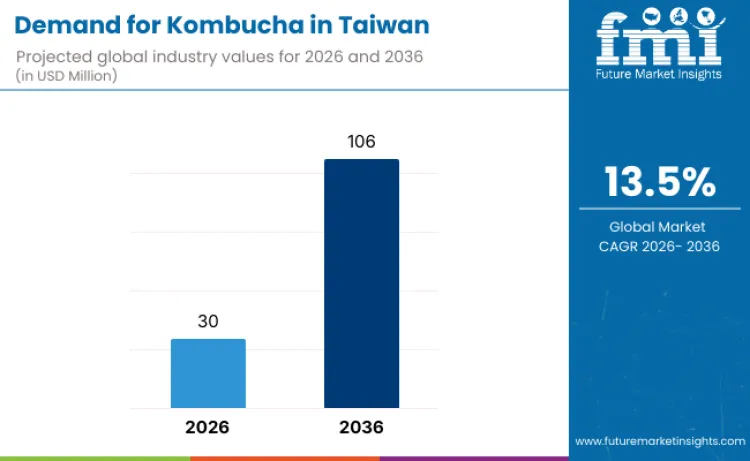
- USD 30.0 Mn
- Forecast (2036)
- USD 106.0 Mn
- CAGR (2026 to 2036)
- 13.5%
Kombucha Outlook in Taiwan 2026 to 2036
Demand for Kombucha in Taiwan is projected at USD 30.0 million in 2026 and is expected to reach USD 106.0 million by 2036, progressing at a 13.5% CAGR. Growth is being shaped by how urban beverage operators and emerging functional drink brands are using fermentation-led positioning to build repeat purchase cycles, drive higher margin per serving, and refresh premium beverage menus without adding complex operational steps.
On-trade outlets are treating kombucha as a menu amplifier that lifts ticket values through premium pours, seasonal flavors, and limited-run collaborations. Off-trade distribution is expanding through curated retail where consumers actively browse for differentiated chilled beverages. Third, brand owners are optimizing formats and supply planning so café chains can maintain consistent carbonation, acidity targets, and packaging presentation across multi-location rollouts.
FMI thinks the sales curve is supported by a higher cadence of product rotation and fast-cycle innovation compared to traditional RTD categories. This supports stronger velocity for brands that can execute small batch launches while maintaining dependable availability for flagship SKUs. FMI is of the opinion that procurement wins in the on-trade channel often translate into wider downstream placement, since consumer trial at cafés tends to unlock later off-trade pull.
Quick Stats for Kombucha Demand in Taiwan
- Kombucha Valuation in Taiwan (2026): USD 30.0 million
- Kombucha Forecast Valuation in Taiwan (2036): USD 106.0 million
- Kombucha Forecast CAGR (2026 to 2036): 13.5%
- Leading Regional Growth: East & Islands (14.3%)
- Leading Product: Conventional (85.0% share)
- Leading Sales Channel: On-trade (75.0% share)
- Key Companies Profiled: Kai Kombucha; KULTCHA Kombucha; EBEN Raw Kombucha; Zestea Kombucha; Yu Fermentory
Macro-level food and beverage trends influencing kombucha demand in Taiwan
| Trend | What it entails for Kombucha demand in Taiwan |
|---|---|
| Premium beverage menu renovation in cafés | Pushes higher throughput for on-trade Kombucha as outlets seek differentiated pours with strong margin per serving |
| Functional positioning in RTD beverages | Supports repeat purchase where consumers track fermentation-led cues and prefer “better-for-you” beverages in daily routines |
| Growth of chilled and fresh beverage retail | Strengthens off-trade visibility through premium grocery and convenience channels investing in cold chain assortment depth |
| Seasonal flavor drops and limited-run cycles | Increases frequency of launches, supporting brands that can execute fast innovation with reliable quality consistency |
| Demand for low-ABV and alternative social drinks | Expands attention toward hard kombucha variants where the format fits casual social occasions |
| Packaging and sustainability expectations | Encourages brands to optimize pack formats, reduce packaging waste, and improve shelf presentation for premium placement |
Source: Future Market Insights (FMI) analysis, based on proprietary forecasting model and primary research
Kombucha Industry in Taiwan Key Takeaways
| Metric | Value |
|---|---|
| Industry Value (2026) | USD 30.0 million |
| Industry Forecast Value (2036) | USD 106.0 million |
| Forecast CAGR (2026 to 2036) | 13.5% |
Source: FMI’s proprietary forecasting model and primary research
The Kombucha landscape in Taiwan is also strengthened by wider beverage premiumization patterns that are often evaluated alongside functional beverages signals in portfolio planning cycles.
Why is Taiwan Building Strong Demand for Kombucha?
Taiwan’s beverage culture is structurally aligned with rapid adoption cycles. Consumers are comfortable experimenting across tea, coffee, fermented drinks, and seasonal specialties, which supports fast trial-to-repeat conversion when a product delivers a consistent experience. As per FMI, Kombucha is benefiting from on-trade visibility where cafés and boutique beverage bars can introduce it as a core menu item rather than a niche option.
Retail expansion is also becoming more strategic. Several brands are approaching off-trade not as a volume dump channel, but as an extension of brand theater where packaging, chilled placement, and flavor stories carry pricing power.
This supports healthier unit economics compared to categories that compete primarily on discounting. Some brand owners align these strategies with adjacent fermentation-led beverage roadmaps, including probiotic drink preferences, particularly when planning cross-category consumer acquisition.
How is the Kombucha Industry Segmented in Taiwan?
Taiwan’s Kombucha landscape reflects how brands prioritize mainstream appeal, distribution efficiency, and repeatable consumer experience across café and retail environments.
Why does Conventional Kombucha remain the Dominant Product Type?
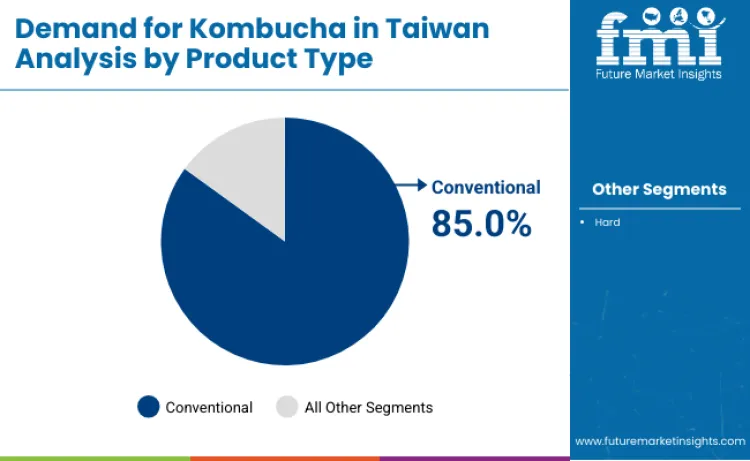
Conventional accounts for an 85.0% share, keeping it in the lead due to broad suitability across café menus, wellness-led retail assortments, and daily consumption routines. FMI thinks conventional variants are winning because they support easier positioning across multiple consumer cohorts without introducing additional regulatory, compliance, or operational complexity.
Where does Hard Kombucha fit in the portfolio mix?
Hard kombucha expands around social occasions and alternative alcohol formats, especially where consumers look for a differentiated beverage identity versus mainstream alcoholic RTDs.
FMI is of the opinion that hard variants scale fastest when brands treat them as targeted portfolio extensions rather than the primary volume engine. These decisions are often benchmarked against broader alcohol-adjacent innovation cycles such as ready-to-drink beverages positioning.
Why does On-trade lead Sales Channel Performance in Taiwan?
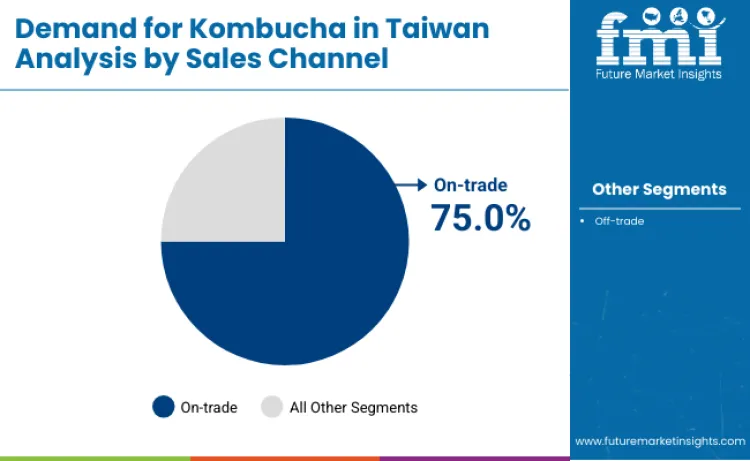
On-trade accounts for 75.0% of total sales, reflecting how trial and repeat are being built through cafés, beverage kiosks, and hospitality-led formats. As per FMI, the channel supports stronger brand visibility, higher consumer education through menu placement, and easier conversion via single-serve experiences. It also allows brands to test new flavors in controlled volumes before committing to wider retail placement.
What is shaping off-trade growth despite a smaller share today?
Off-trade growth is tied to premium retail penetration, cold-chain shelf positioning, and frequency-building through at-home consumption. FMI thinks off-trade placement improves when brands build stable distribution discipline and minimize quality variability that could weaken repeat purchase confidence.
What are the Dynamics, Restraints, Opportunities, and Threats Shaping this Space?
What Dynamics are Accelerating Sales Momentum?
Taiwan’s café ecosystem is acting as a high-efficiency launchpad, enabling brands to scale consumer trial quickly and translate visibility into steady reorder patterns. FMI expects that the strongest momentum is showing up in metro clusters where beverage novelty cycles move quickly and premium pricing is more defensible.
What Restraints could Slow Expansion?
Cold-chain dependency and shelf-life risk remain practical constraints. Product inconsistency can increase returns, reduce reorder confidence, and create listing friction. As per FMI, scaling also requires disciplined production control to maintain consistent taste profile and carbonation behavior across batches.
Where do the Strongest Opportunities sit for Kombucha Brands and Distributors?
On-trade network expansion remains the clearest opportunity because new café listings often open repeat demand across multiple outlets under the same brand group. Another opportunity comes from disciplined brand storytelling and pack optimization that supports premium chilled placement, which is also assessed alongside health drinks positioning when retailers build wellness-oriented assortments.
What threats could disrupt demand expectations?
Competitive intensity within premium chilled beverages can dilute shelf attention, especially if similar claims appear across adjacent categories. FMI thinks pricing pressure may emerge if brands rely too heavily on promotions to drive off-trade movement instead of sustaining velocity through product identity and consistent quality.
How is Kombucha Demand Evolving across Key Regions in Taiwan?
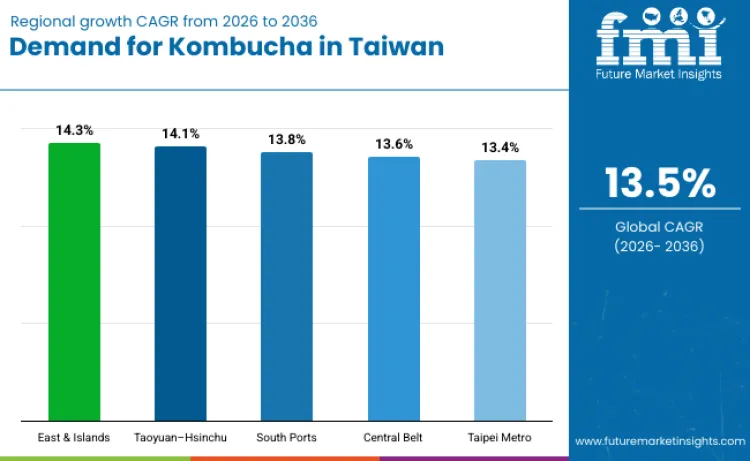
| Region | CAGR (2026-2036) |
|---|---|
| Taipei Metro | 13.4% |
| Taoyuan-Hsinchu | 14.1% |
| Central Belt | 13.6% |
| South Ports | 13.8% |
| East & Islands | 14.3% |
Source: Future Market Insights analysis, supported by a proprietary forecasting model and primary research
Why does East & Islands lead growth despite lower base scale?
The Kombucha landscape in the East & Island regions of Taiwan is slated to advance at a CAGR of 14.3%, reflecting strong tourism-linked consumption, premium café density in selected hotspots, and higher openness to differentiated beverage formats. Growth here is supported by experiential consumption patterns where trial rates remain elevated during peak travel periods.
What keeps Taoyuan-Hsinchu on a Strong Upward Path?
Taoyuan-Hsinchu grows at 14.1%, backed by commuter traffic, higher spending power in selected nodes, and a strong café culture that supports premium beverages. FMI thinks the region performs well where operators actively rotate menus and use limited-time offerings to drive repeat visits.
How is the Central Belt progressing through steady retail and café penetration?
The Central Belt expands at 13.6%, driven by gradual channel build-out and more structured retail assortment upgrades. Growth becomes more stable as cold-chain placement improves and brands widen local distribution.
Why do South Ports Maintain Growth Continuity?
South Ports advance at 13.8%, shaped by lifestyle-driven consumption and beverage-led hospitality adoption. Several operators in this region treat kombucha as a premium menu option aligned with café-led footfall patterns.
How does Taipei Metro sustain the largest scale even at a slightly lower CAGR?
Taipei Metro grows at 13.4% and remains the primary scale anchor due to concentration of premium outlets and higher frequency consumption routines. Taipei continues to serve as the key launch platform for brand discovery and new SKU testing, including strategies aligned with fermented drinks positioning.
What defines the Competitive Landscape for Kombucha in Taiwan?
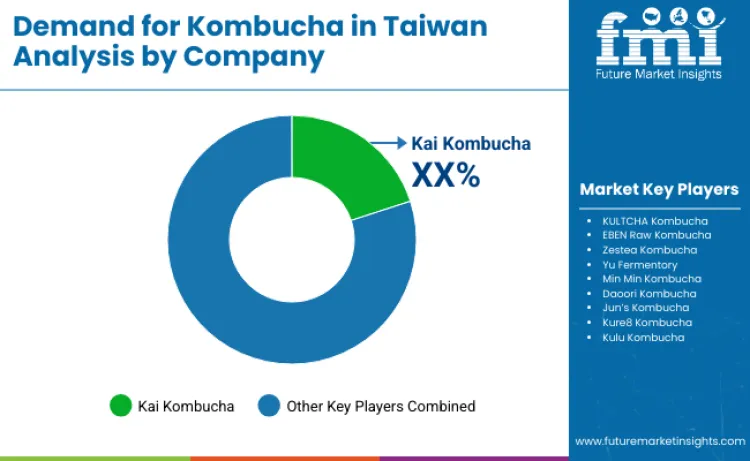
Competition is shaped by brand identity strength, quality consistency at scale, and the ability to secure repeat visibility across café menus and chilled retail placements. FMI thinks the strongest operators are those that maintain stable product performance across batches while running an innovation cadence that keeps consumers engaged without overwhelming the supply chain.
Kai Kombucha and KULTCHA Kombucha compete through brand recognition and on-trade presence that supports steady reorder patterns. EBEN Raw Kombucha and Zestea Kombucha contribute through premium positioning and differentiated flavor development that fits café rotation strategies.
Yu Fermentory, Min Min Kombucha, Daoori Kombucha, Jun’s Kombucha, Kure8 Kombucha, and Kulu Kombucha add competitive depth through local production identity and targeted distribution footprints. The next phase of competitive advantage is likely to depend on distribution discipline, consistency control, and the ability to manage portfolio breadth without diluting availability for core SKUs.
Key Industry Participants
- Kai Kombucha
- KULTCHA Kombucha
- EBEN Raw Kombucha
- Zestea Kombucha
- Yu Fermentory
- Min Min Kombucha
- Daoori Kombucha
- Jun’s Kombucha
- Kure8 Kombucha
- Kulu Kombucha
Scope of Report
| Items | Values |
|---|---|
| Quantitative Units | USD Million |
| Product | Conventional; Hard |
| Sales Channel | On-trade; Off-trade |
| Regions Covered | Taipei Metro; Taoyuan-Hsinchu; Central Belt; South Ports; East & Islands |
| Key Companies Profiled | Kai Kombucha; KULTCHA Kombucha; EBEN Raw Kombucha; Zestea Kombucha; Yu Fermentory |
Source: Future Market Insights-analysis driven by proprietary forecasting models and primary research
Kombucha Demand in Taiwan by Segments
By Product
- Conventional
- Hard
By Sales Channel
- On-trade
- Off-trade
By Region
- Taipei Metro
- Taoyuan-Hsinchu
- Central Belt
- South Ports
- East & Islands
Bibliography
- Codex Alimentarius Commission. (2018). General standard for the labelling of prepackaged foods (CXS 1-1985, latest revision). FAO/WHO Codex Alimentarius.
- Codex Alimentarius Commission. (2023). General principles of food hygiene (CXC 1-1969, latest revision). FAO/WHO Codex Alimentarius.
- International Organization for Standardization. (2018). ISO 22000:2018 - Food safety management systems - Requirements for any organization in the food chain. ISO.
- World Health Organization. (2023). Healthy diet: Fact sheet and guidance on beverage sugar reduction. World Health Organization.
- Taiwan Food and Drug Administration. (2024). Regulations and guidance on food labelling and nutrition claims for packaged beverages. Ministry of Health and Welfare, Taiwan.
- Ministry of Finance, Taiwan. (2023). Tobacco and Alcohol Administration Act and related enforcement rules. Ministry of Finance, Taiwan.
Frequently Asked Questions
What is the outlook for Kombucha demand in Taiwan for 2026?
In 2026, kombucha demand in Taiwan is likely to total USD 30.0 million.
What is the expected valuation for Kombucha demand in Taiwan for 2036?
Kombucha demand in Taiwan is forecasted to reach USD 106.0 million by 2036.
At what rate will kombucha demand expand in Taiwan from 2026 to 2036?
Kombucha demand in Taiwan is expected to progress at a 13.5% CAGR from 2026 to 2036.
Which product segment leads kombucha consumption in Taiwan?
Conventional kombucha is most widely consumed in Taiwan, capturing 85.0% of total demand.
Which Sales Channel leads Kombucha Sales in Taiwan?
On-trade constitutes the leading channel in Taiwan, accounting for 75.0% of total sales.
Preview the report firsthand - request a free sample
Get SampleGet the brochure for pricing and purchase details.
Get PDFTable of Content
- Executive Summary
- Industry Introduction, including Taxonomy and Market Definition
- Trends and Success Factors, including Macro-economic Factors, Market Dynamics, and Recent Industry Developments
- Taiwan Demand Analysis 2021 to 2025 and Forecast 2026 to 2036, including Historical Analysis and Future Projections
- Pricing Analysis
- Taiwan Analysis 2021 to 2025 and Forecast 2026 to 2036
- Product Type
- Sales Channel
- By Product Type
- Conventional
- Hard
- By Sales Channel
- On-trade
- Off-trade
- By Region
- Taipei Metro
- Taoyuan-Hsinchu
- Central Belt
- South Ports
- East & Islands
- Taipei Metro Sales Analysis 2021 to 2025 and Forecast 2026 to 2036, by Key Segments
- Taoyuan-Hsinchu Sales Analysis 2021 to 2025 and Forecast 2026 to 2036, by Key Segments
- Central Belt Sales Analysis 2021 to 2025 and Forecast 2026 to 2036, by Key Segments
- South Ports Sales Analysis 2021 to 2025 and Forecast 2026 to 2036, by Key Segments
- East & Islands Sales Analysis 2021 to 2025 and Forecast 2026 to 2036, by Key Segments
- Sales Forecast to 2036 by Product Type, Sales Channel, and Region
- Competitive Assessment, Company Share Analysis by Key Players, and Competition Dashboard
- Company Profile
- Kai Kombucha
- KULTCHA Kombucha
- EBEN Raw Kombucha
- Zestea Kombucha
- Yu Fermentory
- Min Min Kombucha
- Daoori Kombucha
- Jun’s Kombucha
- Kure8 Kombucha
- Kulu Kombucha
- Other Players


