

- Market Size (2026)
- USD 522.1 Mn
- Forecast (2036)
- USD 1592.7 Mn
- CAGR (2026 to 2036)
- 11.8%
How big is Thermal-Aware GPU Scheduling Software Market in 2026?
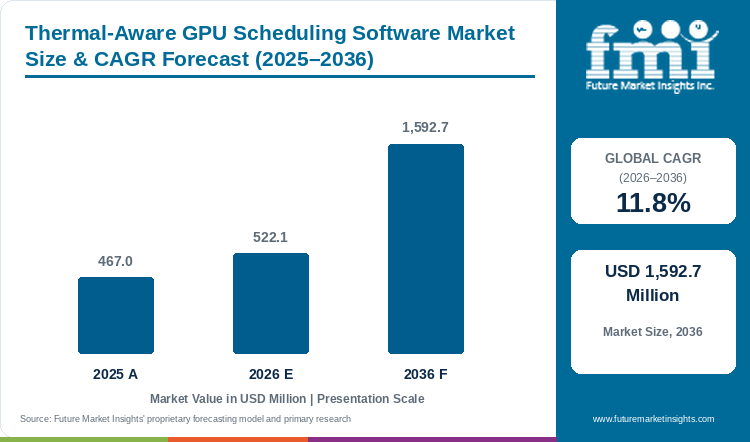
The market was valued at USD 467.0 Million in 2025 and is expected to reach USD 522.1 Million in 2026, with growth at an 11.8% CAGR from 2026 to 2036 taking its value to USD 1,592.7 Million by 2036.
Thermal-aware placement considers whether a rack can sustain more work as well as whether its GPUs are available, bringing local cooling headroom into the scheduling decision. Current readings need to be associated with the correct resources because delayed or poorly mapped data can move a job unnecessarily or send it to another constrained rack. The decision also needs to account for data movement, restart time and availability commitments, since a cooler destination may still delay useful completion. The product’s role is to use installed cooling capability more effectively, with hardware protection retaining its own responsibilities. Planned capacity in France and the UAE becomes a software opportunity when an operating owner has suitable sensor access and authority over scheduling. The forecast includes qualifying thermal and power-informed control software, excluding cooling hardware, accelerators and monitoring without a connection to workload placement. [5]
Key Market Trends & Insights
- Monitoring & telemetry holds 27.0% of platform function in 2026, connecting temperature and device-health readings to the resources a placement policy can use.
- SaaS / public cloud holds 38.0% of deployment model in 2026, allowing centralized administration while tenants retain agreed quotas and priorities.
- 251–500 kW holds 32.0% of AI rack density in 2026, requiring attention to local peaks that an average utilization measure may conceal.
- Hyperscale AI data centers account for 46.0% of data center type in 2026, where thermal decisions need to preserve job priority and recovery as well as cooling limits.
Regional Highlights
- UAE has the highest profiled CAGR at 13.2% during 2026–2036.
- The next two profiled growth rates are South Korea at 12.9% and France at 12.6% over the same period.
Market Size & Forecast
| Metric | Value |
|---|---|
| 2025 market value | USD 467.0 Million |
| 2026 market estimate | USD 522.1 Million |
| 2036 market forecast | USD 1,592.7 Million |
| Forecast CAGR, 2026–2036 | 11.8% |
The market covers software that uses GPU power and thermal information to guide workload scheduling, admission or control. Servers, accelerators, cooling hardware and monitoring products without a qualifying scheduling connection are outside the scope.
Thermal-aware placement remains connected to data-center power because workload movement can alter electrical demand as well as local heat production.
Infrastructure readiness and acceptance
| Documented operating context | Source |
|---|---|
| Red Hat released OpenShift 4.21 in February 2026 with capabilities for combined AI and enterprise workload operations. | [1] |
| Red Hat describes workload-level power monitoring in OpenShift as an input to energy visibility. | [2] |
| NVIDIA’s DCGM documentation describes GPU diagnostic tests and their operational requirements. | [3] |
| NVIDIA described Mission Control’s AI-factory provisioning, telemetry and recovery functions in March 2025. | [4] |
Analyst Perspective
Thermal information becomes useful to a scheduler when current readings identify the affected resources and can inform an authorized placement decision. A trial should compare completion and temperature behavior together, accounting for movement and restart costs while retaining local safeguards and an understandable fallback for missing data.
- Sudip Saha, Principal Analyst at Future Market Insights
How is the thermal-aware GPU scheduling software market segmented?
Platform Function covers Monitoring & telemetry, Planning & simulation, Optimization & control, Fault / reliability analytics and Reporting & governance. Deployment Model covers SaaS / public cloud, Private cloud, On-premise and Hybrid deployment. AI Rack Density covers 251–500 kW, 100–250 kW, Below 100 kW and Above 500 kW. Data Center Type covers Hyperscale AI data centers, Colocation AI facilities, Enterprise private AI and HPC & research centers. Commercial Model covers Direct enterprise contract, System integrator / EPC-led, Subscription / license and Managed-service contract.
Data from data-center infrastructure management can help the scheduler distinguish a temporary sensor reading from a persistent cooling constraint affecting a resource group.
Why does Monitoring & telemetry lead platform function demand?
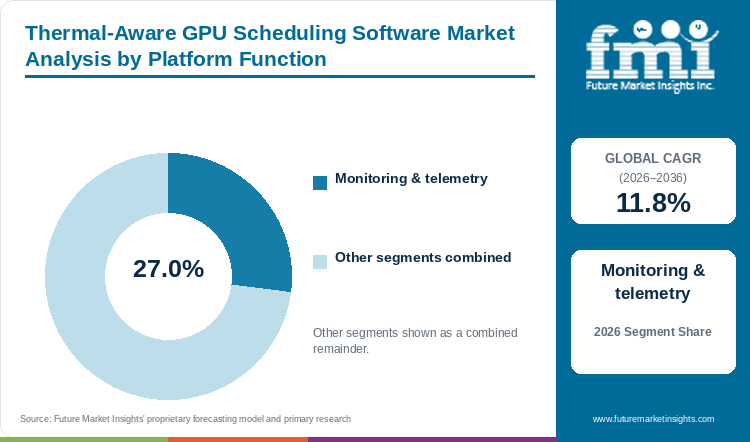
Monitoring & telemetry: 27.0% of platform function in 2026.
A thermal policy needs measurements tied to the resources a job could use, connecting GPU temperature and device-health information with the relevant rack and cooling zone. NVIDIA Data Center GPU Manager documents temperature and thermal-violation measurements that can contribute to this view. Timing and stable identifiers determine whether that information remains useful when a decision is executed, while a link to the workload behind an excursion helps the operator assess the effect of the resulting policy.
- The Monitoring & telemetry segment accounts for 27.0% of platform function in 2026.
- Stable resource identifiers are essential when a sensor change or rack reconfiguration would otherwise attach a temperature reading to the wrong scheduling target.
Why does SaaS / public cloud lead deployment model demand?
SaaS / public cloud: 38.0% of deployment model in 2026.
Hosted administration can coordinate policies across dispersed or leased GPU pools while tenants retain their quotas and priorities, making permission boundaries part of the design. Network delay also limits how quickly a central instruction reaches the site, so remote placement must remain distinct from immediate hardware protection. Buyers can gain common administration while retaining local overrides and safeguards, provided telemetry access, authority and recovery procedures are agreed for each operating environment.
- The SaaS / public cloud segment accounts for 38.0% of deployment model in 2026.
- Central policy management should retain local overrides and make clear which actions remain the responsibility of hardware protection systems.
What are the drivers, restraints, and opportunities in the thermal-aware GPU scheduling software market?
Thermal headroom influences where work can run
Uneven accelerator loading can leave free GPUs in a rack without enough cooling headroom for another sustained job, creating a placement constraint that utilization alone does not reveal. Thermal information can guide the choice among available resources, beginning with observation before automated limits are authorized. Comparing completion within the existing cooling capability then shows whether a changed policy provides a useful result.
Sensor quality and response timing constrain control
Thermal policy needs consistent timing and a maintained sensor-to-resource map because missing or mismatched readings can cause unnecessary movement. Cooling changes may invalidate an earlier rule, requiring a known fallback and a record explaining each intervention, while hosted products add data-access and security requirements. These connections help the owner judge whether automation can act reliably within the operating environment.
Cooling-aware placement can reduce avoidable throttling
Vendors can begin with a cluster whose cooling arrangement and workloads are well understood. Validated adapters can connect accelerator readings with the existing scheduler rather than establish a separate control system. A limited pilot then allows the operator to compare completion times and thermal behavior under consistent conditions. This makes it easier to see whether placement changes help or simply move the problem elsewhere. Expansion should follow repeatable results and a clear method for maintaining sensor mappings. One successful policy should not be assumed to suit every hall or workload mix.
During AI infrastructure commissioning, thermal operating envelopes can be checked before automated placement policies are applied to live work.
Which country and market CAGRs are profiled for thermal-aware GPU scheduling software?
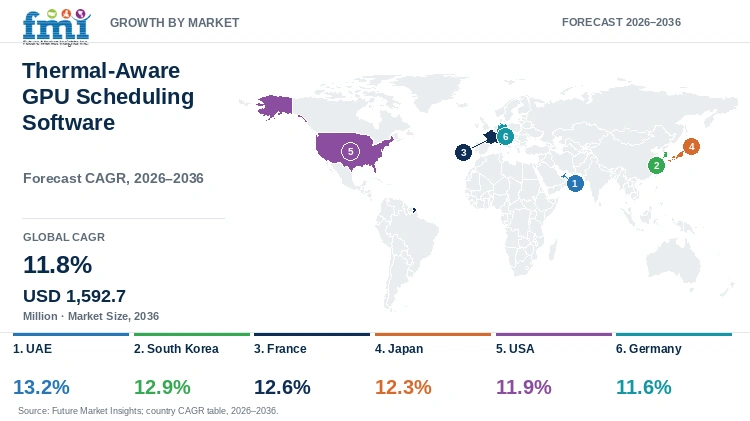
| Country | CAGR |
|---|---|
| UAE | 13.2% |
| South Korea | 12.9% |
| France | 12.6% |
| Japan | 12.3% |
| USA | 11.9% |
| Germany | 11.6% |
Country-wise Analysis
UAE
- Staged UAE AI development requires scheduling to follow the power and cooling blocks actually commissioned, with resource identity and timely local readings establishing where a constraint applies. Several institutional users may share the facility, making control-plane ownership and recovery policy relevant before placement changes are authorized. The UAE has the fastest profiled forecast, at a 13.2% CAGR from 2026 to 2036.
South Korea
- Shared GPU initiatives in South Korea bring several workload priorities into one facility, where thermal policies must respect allocations and agreed access to operational data. Moving work may require a restart, so suppliers need to demonstrate the net effect on completion rather than temperature alone. These operating and audit requirements accompany South Korea’s 12.9% CAGR forecast for 2026 to 2036.
France
- French electrical and cooling commissioning needs to establish reliable measurement boundaries before automated thermal placement connects tenant work with resource-group limits. Comparisons under the same operating conditions can show whether a policy improves completion or transfers heat concentration to another constrained rack. France’s 12.6% CAGR forecast for 2026 to 2036 therefore depends on facilities with sufficiently defined operating responsibilities.
Japan
- Local airflow or liquid-loop capacity can restrict Japanese placement choices even when several GPUs appear free, while application latency may prevent work from moving elsewhere. A useful policy explains the constraint behind each intervention and provides a known response to missing readings. Japan is forecast to grow at a 12.3% CAGR from 2026 to 2036 as operators apply thermal information within those site and application limits.
USA
- American operators using Slurm or Kubernetes need thermal policies to fit those environments and the facility tools that describe actual cooling conditions. Multi-site decisions also have to account for data movement and availability commitments, leaving some workload mixes with limited scope for relocation. Demonstrated gains in completion within these requirements support comparison as the USA grows at a forecast 11.9% CAGR from 2026 to 2036.
Germany
- German sites may update cooling controls and compute-management tools on different schedules, requiring resource identity and measurement mappings to remain usable across maintenance cycles. An audit trail lets operations teams see why a placement changed and assess its effect without disrupting critical jobs merely to test the policy. Germany’s forecast is an 11.6% CAGR from 2026 to 2036 within this operating context.
Who are the notable companies in the thermal-aware GPU scheduling software market?
NVIDIA, including SchedMD; Red Hat; Hewlett Packard Enterprise; IBM; Siemens Digital Industries Software
Temperature access is only the starting point for a thermal scheduler. The provider must associate readings with the right workload and act while the information is still relevant. Customers should compare the quality of that connection and the handling of missing data before choosing between competing platforms.
Competitive Benchmarking: Thermal-Aware GPU Scheduling Software Market
| Participant | Commercial focus | Buyer qualification priority |
|---|---|---|
| NVIDIA, including SchedMD | AI workload and cluster management | Scheduler integration and recovery controls |
| Red Hat | Kubernetes and OpenShift AI platforms | Admission policy and operational consistency |
| Hewlett Packard Enterprise | Hybrid infrastructure operations | Workload-to-infrastructure visibility |
| IBM | Enterprise workload orchestration | Priority rules and queue governance |
| Siemens Digital Industries Software | HPC workload-management software | Policy integration and deployment support |
Key Developments in the Thermal-Aware GPU Scheduling Software Market
- Red Hat described dynamic resource allocation in OpenShift 4.21 in March 2026, addressing GPU scheduling for AI workloads. [1]
- NVIDIA described Mission Control’s AI-factory provisioning, telemetry and recovery functions in March 2025. [4]
Key Players in the Thermal-Aware GPU Scheduling Software Market
- NVIDIA, including SchedMD
- Red Hat
- Hewlett Packard Enterprise
- IBM
- Siemens Digital Industries Software
Thermal-Aware GPU Scheduling Software Market - Report Scope
| Coverage field | Report scope |
|---|---|
| Market breakdown | Platform Function; Deployment Model; AI Rack Density; Data Center Type; Commercial Model; Region |
| Quantitative unit | USD Million |
| Market definition | The market covers software that uses GPU power and thermal information to guide workload scheduling, admission or control. Servers, accelerators, cooling hardware and monitoring products without a qualifying scheduling connection are outside the scope. |
| Regions covered | North America; Latin America; Western Europe; Eastern Europe; East Asia; South Asia and Pacific; Middle East and Africa |
| Countries / markets profiled | UAE; South Korea; France; Japan; USA; Germany |
| Key companies profiled | NVIDIA, including SchedMD; Red Hat; Hewlett Packard Enterprise; IBM; Siemens Digital Industries Software |
| Base year / forecast period | 2026 / 2026–2036 |
| Estimate coverage | 2025 and 2026 market estimates; 2036 forecast; segment shares and country / market CAGRs. |
Thermal-Aware GPU Scheduling Software Market - Research Methodology
| Method | Application |
|---|---|
| Market definition | The analysis follows the stated product or service boundary and distinguishes direct category revenue from adjacent activities. |
| Secondary research | Official technical, regulatory, research and company publications provide the documented operating context and recent developments cited in this report. |
| Forecast and segmentation | Market estimates, segment shares and geographic forecasts are presented as analytical estimates within the stated commercial scope. |
| Competitive assessment | Participants are compared by their relevant products or services, commercial role and buyer qualification requirements. |
| Interpretation | The assessment considers purchasing conditions and the scope of the documented product, service or performance claim. |
Thermal-Aware GPU Scheduling Software Market by Segments
Platform Function
- Monitoring & telemetry
- Planning & simulation
- Optimization & control
- Fault / reliability analytics
- Reporting & governance
Deployment Model
- SaaS / public cloud
- Private cloud
- On-premise
- Hybrid deployment
AI Rack Density
- 251–500 kW
- 100–250 kW
- Below 100 kW
- Above 500 kW
Data Center Type
- Hyperscale AI data centers
- Colocation AI facilities
- Enterprise private AI
- HPC & research centers
Commercial Model
- Direct enterprise contract
- System integrator / EPC-led
- Subscription / license
- Managed-service contract
Thermal-Aware GPU Scheduling Software Market by Region
- North America
- United States
- Canada
- Latin America
- Brazil
- Mexico
- Argentina
- Chile
- Western Europe
- Germany
- France
- United Kingdom
- Italy
- Spain
- Benelux
- Nordics
- Eastern Europe
- Poland
- Czech Republic
- Romania
- Hungary
- East Asia
- China
- Japan
- South Korea
- South Asia and Pacific
- India
- ASEAN
- Australia and New Zealand
- Middle East and Africa
- GCC Countries
- South Africa
- Türkiye
- Israel
Research Sources and Bibliography
- [1] Red Hat. (2026, March 25). Dynamic resource allocation goes GA in Red Hat OpenShift 4.21: Smarter GPU scheduling for AI workloads.
- [2] Red Hat. (2024, January 31). Power monitoring for Red Hat OpenShift: Technology Preview.
- [3] NVIDIA. (n.d.). Data Center GPU Manager User Guide: DCGM Diagnostics.
- [4] NVIDIA. (2025, March 25). Automating AI Factories with NVIDIA Mission Control.
- [5] Future Market Insights. (2026). Thermal-Aware GPU Scheduling Software Market: Global industry analysis and opportunity assessment, 2026–2036.
This Report Answers
- How large is the thermal-aware GPU scheduling software market in 2026?
- What value and CAGR are forecast through 2036?
- Which platform function segment leads in 2026?
- Which deployment model segment has the largest share?
- Which profiled country or market has the fastest forecast growth?
- Which participants are covered in the competitive assessment?
Frequently Asked Questions
How large is the thermal-aware GPU scheduling software market in 2026?
The market was valued at USD 467.0 Million in 2025 and is expected to reach USD 522.1 Million in 2026.
What value and CAGR are forecast through 2036?
The market is projected to reach USD 1,592.7 Million by 2036, with an 11.8% CAGR during 2026–2036.
Which platform function segment leads in 2026?
The Monitoring & telemetry segment accounts for 27.0% of platform function in 2026.
Which deployment model segment has the largest share?
The SaaS / public cloud segment accounts for 38.0% of deployment model in 2026.
Which profiled country or market has the fastest forecast growth?
UAE has the highest profiled CAGR at 13.2% during 2026–2036.
Which participants are covered in the competitive assessment?
The assessment covers NVIDIA, including SchedMD, Red Hat, Hewlett Packard Enterprise, IBM and Siemens Digital Industries Software.
Preview the report firsthand - request a free sample
Get SampleGet the brochure for pricing and purchase details.
Get PDFTable of Content
- Key Takeaways
- Market Size and CAGR
- Top Growth Driver
- Fastest Growing Segment
- Leading Region
- Key Companies
- Emerging Opportunities
- Executive Summary
- Global Market Outlook
- Demand-side Trends
- Supply-side Trends
- Technology Roadmap Analysis
- Analysis and Recommendations
- Analyst Perspective (What is happening? Why now? What should investors know?)
- Key Questions Answered
- How large is the market?
- What is the CAGR?
- What are key trends?
- Which region dominates?
- Who are the leaders?
- Market Overview
- Market Coverage / Taxonomy
- Market Definition / Scope / Limitations
- Research Methodology
- Chapter Orientation
- Analytical Lens and Working Hypotheses
- Market Structure, Signals, and Trend Drivers
- Benchmarking and Cross-market Comparability
- Market Sizing, Forecasting, and Opportunity Mapping
- Research Design and Evidence Framework
- Desk Research Programme (Secondary Evidence)
- Expert Input and Fieldwork (Primary Evidence)
- Tooling, Models, and Reference Databases
- Data Engineering and Model Build
- Quality Assurance and Audit Trail
- Market Background
- Market Dynamics (Drivers, Restraints, Opportunity, Trends)
- Scenario Forecast (Optimistic, Likely, Conservative)
- Impact Analysis
- AI Impact
- Sustainability Impact
- Regulatory Impact
- Technology Impact
- Consumer / Buyer Analysis
- Purchase Drivers
- Adoption Barriers
- Buyer Journey
- Opportunity Map Analysis
- Product Life Cycle Analysis
- Supply Chain Analysis
- Investment Feasibility Matrix
- Value Chain Analysis
- PESTLE and Porter's Analysis
- Regulatory Landscape
- Regional Parent Market Outlook
- Production and Consumption Statistics
- Import and Export Statistics
- Global Market Analysis and Forecast, 2021 to 2036
- Historical Market Size Value (USD Million) Analysis, 2021 to 2025
- Current and Future Market Size Value (USD Million) Projections, 2026 to 2036
- Y-o-Y Growth Trend Analysis
- Absolute $ Opportunity Analysis
- Global Market Pricing Analysis, 2021 to 2036
- Global Market Analysis and Forecast, By Platform Function, 2021 to 2036
- Introduction / Key Findings
- Historical Market Size Value (USD Million) Analysis By Platform Function, 2021 to 2025
- Current and Future Market Size Value (USD Million) Analysis and Forecast By Platform Function, 2026 to 2036
- Monitoring & telemetry
- Planning & simulation
- Optimization & control
- Fault / reliability analytics
- Reporting & governance
- Y-o-Y Growth Trend Analysis By Platform Function, 2021 to 2025
- Absolute $ Opportunity Analysis By Platform Function, 2026 to 2036
- Global Market Analysis and Forecast, By Deployment Model, 2021 to 2036
- Introduction / Key Findings
- Historical Market Size Value (USD Million) Analysis By Deployment Model, 2021 to 2025
- Current and Future Market Size Value (USD Million) Analysis and Forecast By Deployment Model, 2026 to 2036
- SaaS / public cloud
- Private cloud
- On-premise
- Hybrid deployment
- Y-o-Y Growth Trend Analysis By Deployment Model, 2021 to 2025
- Absolute $ Opportunity Analysis By Deployment Model, 2026 to 2036
- Global Market Analysis and Forecast, By AI Rack Density, 2021 to 2036
- Introduction / Key Findings
- Historical Market Size Value (USD Million) Analysis By AI Rack Density, 2021 to 2025
- Current and Future Market Size Value (USD Million) Analysis and Forecast By AI Rack Density, 2026 to 2036
- 251–500 kW
- 100–250 kW
- Below 100 kW
- Above 500 kW
- Y-o-Y Growth Trend Analysis By AI Rack Density, 2021 to 2025
- Absolute $ Opportunity Analysis By AI Rack Density, 2026 to 2036
- Global Market Analysis and Forecast, By Data Center Type, 2021 to 2036
- Introduction / Key Findings
- Historical Market Size Value (USD Million) Analysis By Data Center Type, 2021 to 2025
- Current and Future Market Size Value (USD Million) Analysis and Forecast By Data Center Type, 2026 to 2036
- Hyperscale AI data centers
- Colocation AI facilities
- Enterprise private AI
- HPC & research centers
- Y-o-Y Growth Trend Analysis By Data Center Type, 2021 to 2025
- Absolute $ Opportunity Analysis By Data Center Type, 2026 to 2036
- Global Market Analysis and Forecast, By Commercial Model, 2021 to 2036
- Introduction / Key Findings
- Historical Market Size Value (USD Million) Analysis By Commercial Model, 2021 to 2025
- Current and Future Market Size Value (USD Million) Analysis and Forecast By Commercial Model, 2026 to 2036
- Direct enterprise contract
- System integrator / EPC-led
- Subscription / license
- Managed-service contract
- Y-o-Y Growth Trend Analysis By Commercial Model, 2021 to 2025
- Absolute $ Opportunity Analysis By Commercial Model, 2026 to 2036
- Global Market Analysis and Forecast, By Region, 2021 to 2036
- Introduction
- Historical Market Size Value (USD Million) Analysis By Region, 2021 to 2025
- Current Market Size Value (USD Million) Analysis and Forecast By Region, 2026 to 2036
- North America
- Latin America
- Western Europe
- Eastern Europe
- East Asia
- South Asia and Pacific
- Middle East and Africa
- Market Attractiveness Analysis By Region
- North America Market Analysis and Forecast, By Country, 2021 to 2036
- Historical Market Size Value (USD Million) Trend Analysis By Market Taxonomy, 2021 to 2025
- Market Size Value (USD Million) Forecast By Market Taxonomy, 2026 to 2036
- By Country
- United States
- Canada
- By Platform Function
- By Deployment Model
- By AI Rack Density
- By Data Center Type
- By Commercial Model
- By Country
- Market Attractiveness Analysis
- By Country
- By Platform Function
- By Deployment Model
- By AI Rack Density
- By Data Center Type
- By Commercial Model
- Key Takeaways
- Latin America Market Analysis and Forecast, By Country
- Historical Market Size Value (USD Million) Trend Analysis By Market Taxonomy, 2021 to 2025
- Market Size Value (USD Million) Forecast By Market Taxonomy, 2026 to 2036
- By Country
- Brazil
- Mexico
- Argentina
- Chile
- By Platform Function
- By Deployment Model
- By AI Rack Density
- By Data Center Type
- By Commercial Model
- By Country
- Market Attractiveness Analysis
- By Country
- By Platform Function
- By Deployment Model
- By AI Rack Density
- By Data Center Type
- By Commercial Model
- Key Takeaways
- Western Europe Market Analysis and Forecast, By Country
- Historical Market Size Value (USD Million) Trend Analysis By Market Taxonomy, 2021 to 2025
- Market Size Value (USD Million) Forecast By Market Taxonomy, 2026 to 2036
- By Country
- Germany
- France
- United Kingdom
- Italy
- Spain
- Benelux
- Nordics
- By Platform Function
- By Deployment Model
- By AI Rack Density
- By Data Center Type
- By Commercial Model
- By Country
- Market Attractiveness Analysis
- By Country
- By Platform Function
- By Deployment Model
- By AI Rack Density
- By Data Center Type
- By Commercial Model
- Key Takeaways
- Eastern Europe Market Analysis and Forecast, By Country
- Historical Market Size Value (USD Million) Trend Analysis By Market Taxonomy, 2021 to 2025
- Market Size Value (USD Million) Forecast By Market Taxonomy, 2026 to 2036
- By Country
- Poland
- Czech Republic
- Romania
- Hungary
- By Platform Function
- By Deployment Model
- By AI Rack Density
- By Data Center Type
- By Commercial Model
- By Country
- Market Attractiveness Analysis
- By Country
- By Platform Function
- By Deployment Model
- By AI Rack Density
- By Data Center Type
- By Commercial Model
- Key Takeaways
- East Asia Market Analysis and Forecast, By Country
- Historical Market Size Value (USD Million) Trend Analysis By Market Taxonomy, 2021 to 2025
- Market Size Value (USD Million) Forecast By Market Taxonomy, 2026 to 2036
- By Country
- China
- Japan
- South Korea
- By Platform Function
- By Deployment Model
- By AI Rack Density
- By Data Center Type
- By Commercial Model
- By Country
- Market Attractiveness Analysis
- By Country
- By Platform Function
- By Deployment Model
- By AI Rack Density
- By Data Center Type
- By Commercial Model
- Key Takeaways
- South Asia and Pacific Market Analysis and Forecast, By Country
- Historical Market Size Value (USD Million) Trend Analysis By Market Taxonomy, 2021 to 2025
- Market Size Value (USD Million) Forecast By Market Taxonomy, 2026 to 2036
- By Country
- India
- ASEAN
- Australia and New Zealand
- By Platform Function
- By Deployment Model
- By AI Rack Density
- By Data Center Type
- By Commercial Model
- By Country
- Market Attractiveness Analysis
- By Country
- By Platform Function
- By Deployment Model
- By AI Rack Density
- By Data Center Type
- By Commercial Model
- Key Takeaways
- Middle East and Africa Market Analysis and Forecast, By Country
- Historical Market Size Value (USD Million) Trend Analysis By Market Taxonomy, 2021 to 2025
- Market Size Value (USD Million) Forecast By Market Taxonomy, 2026 to 2036
- By Country
- GCC Countries
- South Africa
- Türkiye
- Israel
- By Platform Function
- By Deployment Model
- By AI Rack Density
- By Data Center Type
- By Commercial Model
- By Country
- Market Attractiveness Analysis
- By Country
- By Platform Function
- By Deployment Model
- By AI Rack Density
- By Data Center Type
- By Commercial Model
- Key Takeaways
- Key Countries Market Analysis
- United States
- Pricing Analysis
- Market Share Analysis, 2025
- By Platform Function
- By Deployment Model
- By AI Rack Density
- By Data Center Type
- By Commercial Model
- Canada
- Pricing Analysis
- Market Share Analysis, 2025
- By Platform Function
- By Deployment Model
- By AI Rack Density
- By Data Center Type
- By Commercial Model
- Mexico
- Pricing Analysis
- Market Share Analysis, 2025
- By Platform Function
- By Deployment Model
- By AI Rack Density
- By Data Center Type
- By Commercial Model
- Brazil
- Pricing Analysis
- Market Share Analysis, 2025
- By Platform Function
- By Deployment Model
- By AI Rack Density
- By Data Center Type
- By Commercial Model
- Chile
- Pricing Analysis
- Market Share Analysis, 2025
- By Platform Function
- By Deployment Model
- By AI Rack Density
- By Data Center Type
- By Commercial Model
- Germany
- Pricing Analysis
- Market Share Analysis, 2025
- By Platform Function
- By Deployment Model
- By AI Rack Density
- By Data Center Type
- By Commercial Model
- United Kingdom
- Pricing Analysis
- Market Share Analysis, 2025
- By Platform Function
- By Deployment Model
- By AI Rack Density
- By Data Center Type
- By Commercial Model
- Italy
- Pricing Analysis
- Market Share Analysis, 2025
- By Platform Function
- By Deployment Model
- By AI Rack Density
- By Data Center Type
- By Commercial Model
- Spain
- Pricing Analysis
- Market Share Analysis, 2025
- By Platform Function
- By Deployment Model
- By AI Rack Density
- By Data Center Type
- By Commercial Model
- France
- Pricing Analysis
- Market Share Analysis, 2025
- By Platform Function
- By Deployment Model
- By AI Rack Density
- By Data Center Type
- By Commercial Model
- India
- Pricing Analysis
- Market Share Analysis, 2025
- By Platform Function
- By Deployment Model
- By AI Rack Density
- By Data Center Type
- By Commercial Model
- ASEAN
- Pricing Analysis
- Market Share Analysis, 2025
- By Platform Function
- By Deployment Model
- By AI Rack Density
- By Data Center Type
- By Commercial Model
- Australia and New Zealand
- Pricing Analysis
- Market Share Analysis, 2025
- By Platform Function
- By Deployment Model
- By AI Rack Density
- By Data Center Type
- By Commercial Model
- China
- Pricing Analysis
- Market Share Analysis, 2025
- By Platform Function
- By Deployment Model
- By AI Rack Density
- By Data Center Type
- By Commercial Model
- Japan
- Pricing Analysis
- Market Share Analysis, 2025
- By Platform Function
- By Deployment Model
- By AI Rack Density
- By Data Center Type
- By Commercial Model
- South Korea
- Pricing Analysis
- Market Share Analysis, 2025
- By Platform Function
- By Deployment Model
- By AI Rack Density
- By Data Center Type
- By Commercial Model
- Poland
- Pricing Analysis
- Market Share Analysis, 2025
- By Platform Function
- By Deployment Model
- By AI Rack Density
- By Data Center Type
- By Commercial Model
- Hungary
- Pricing Analysis
- Market Share Analysis, 2025
- By Platform Function
- By Deployment Model
- By AI Rack Density
- By Data Center Type
- By Commercial Model
- Türkiye
- Pricing Analysis
- Market Share Analysis, 2025
- By Platform Function
- By Deployment Model
- By AI Rack Density
- By Data Center Type
- By Commercial Model
- South Africa
- Pricing Analysis
- Market Share Analysis, 2025
- By Platform Function
- By Deployment Model
- By AI Rack Density
- By Data Center Type
- By Commercial Model
- UAE
- Pricing Analysis
- Market Share Analysis, 2025
- By Platform Function
- By Deployment Model
- By AI Rack Density
- By Data Center Type
- By Commercial Model
- United States
- Market Structure Analysis
- Competition Dashboard
- Competition Benchmarking
- Market Share Analysis of Top Players
- By Regional
- By Platform Function
- By Deployment Model
- By AI Rack Density
- By Data Center Type
- By Commercial Model
- Emerging Startups
- Innovation Benchmarking
- Competition Analysis
- Competition Deep Dive
- NVIDIA, including SchedMD
- Overview
- Product Portfolio
- Profitability by Market Segments
- Sales Footprint
- Strategy Overview
- Marketing Strategy
- Product Strategy
- Channel Strategy
- Red Hat
- Hewlett Packard Enterprise
- IBM
- Siemens Digital Industries Software
- NVIDIA, including SchedMD
- Case Studies
- Success Stories
- Recent Developments
- Competition Deep Dive
- Assumptions & Acronyms Used


