


Traditional Wound Management Market : Global Industry Analysis 2016 - 2025 and Opportunity Assessment 2026 - 2036
Traditional Wound Management Market is segmented by Product Type (Bandages, Gauzes, Medical Tape, Surgical Sponges, Undercast Paddings, Others), Application (Skin and Diabetic Ulcers, Burns, Surgeries, Trauma, Others), End User (Hospitals, Clinics, Rehabilitation Centers, Homecare Settings, Ambulatory Surgical Centers), and Region. Forecast for 2026 to 2036.
Historical Data Covered: 2016 - 2025 | Base Year: 2025 | Estimated Year: 2026 | Forecast Period: 2026 - 2036
Traditional Wound Management Market Size, Market Forecast and Outlook By FMI
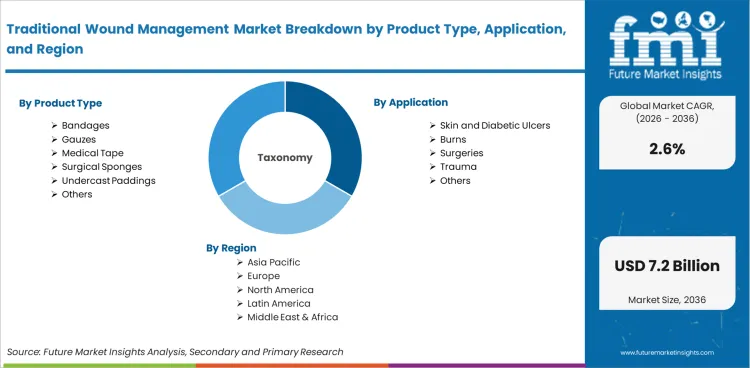
The traditional wound management market was valued at USD 5.4 billion in 2025. The market is set to reach USD 5.6 billion by 2026-end and grow at a CAGR of 2.6% between 2026-2036 to reach USD 7.2 billion by 2036. Bandages will dominate with a 38.0% share, while Skin and Diabetic Ulcers will lead with a 37.0% share.
Summary of the Traditional Wound Management Market
- Demand and Growth Drivers
- Rising prevalence of chronic conditions and aging populations across developed economies are expanding clinical demand for traditional wound management solutions.
- Regulatory emphasis on patient outcomes and procedural standardization is accelerating institutional procurement of advanced product configurations.
- Reimbursement pathway expansion in key markets is supporting adoption by lowering cost-of-access barriers for hospitals and surgical centers.
- Product and Segment View
- Bandages is likely to remain a leading product type segment, supported by 38% share of demand from primary end-use applications.
- Skin and Diabetic Ulcers accounts for 37% of application demand, supported by volume-driven procurement from core application segments.
- Product differentiation across technology tiers and application segments is expected to support margin stability for established participants.
- Geography and Competitive Outlook
- India is likely to remain a key market owing to infrastructure expansion, rising institutional demand, and government procurement programs.
- Japan is likely to sustain demand on account of advanced manufacturing capabilities, quality-driven procurement standards, and technology leadership.
- Companies that can combine product type capabilities and large-scale producer access are likely to gain traction during the forecast period.
- Analyst Opinion
- Sabyasachi Ghosh, Principal Consultant at FMI says, 'Companies that can improve cost competitiveness while delivering consistent performance in bandages and skin and diabetic ulcers applications are likely to strengthen their position over the forecast period.'
- The traditional wound management market is evolving from a volume-driven category into a more defined market where product performance and compliance determine competitive positioning.
- Adoption is being shaped by structural shifts in end-use procurement rather than cyclical recovery, indicating sustained demand expansion.
- The market is also benefiting from regulatory-driven upgrade cycles that create replacement demand beyond organic growth.
- Demand is further supported by the need for solutions that balance performance, compliance, and long-term cost efficiency.
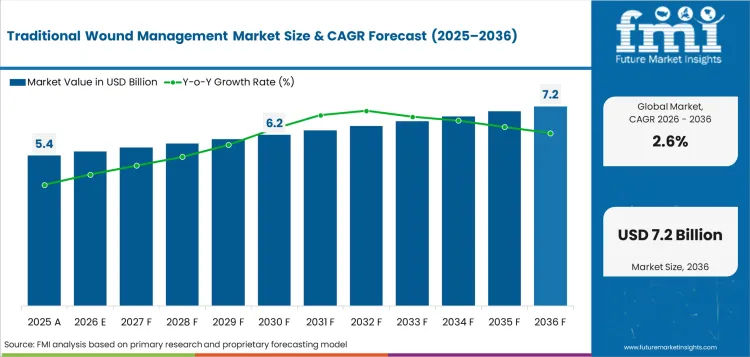
Traditional Wound Management Market Definition
The traditional wound management market includes all commercially traded products and services classified within this category, covering solutions segmented by product type, application, end user, distribution channel, technology. The market encompasses both established product configurations and emerging technology variants used across industrial, commercial, and institutional applications.
Traditional Wound Management Market Inclusions
Market scope encompasses all commercially traded products categorized by product type (Bandages, Gauzes, Medical Tape, Surgical Sponges, Undercast Paddings), application (Skin and Diabetic Ulcers, Burns, Surgeries, Trauma, Others), end user (Hospitals, Clinics, Rehabilitation Centers, Homecare Settings, Ambulatory Surgical Centers), distribution channel (Hospital Pharmacies, Retail Pharmacies, Online Sales), technology (Basic Wound Care Technology, Antiseptic Technology). The range of revenue sizes is from 2026 to 2036.
Traditional Wound Management Market Exclusions
The scope does not include raw or unprocessed materials that are not commercially classified within the defined product taxonomy, components sold as part of unrelated systems where traditional wound management functionality is incidental, or products manufactured exclusively for internal consumption without commercial distribution.
Traditional Wound Management Market Research Methodology
- Primary Research: FMI analysts conducted interviews with manufacturers, distributors, procurement managers, and technical specialists across key markets to gather primary demand intelligence and validate market dynamics.
- Desk Research: Combined data from industry associations, regulatory filings, corporate annual reports, and trade publications to build comprehensive market intelligence.
- Market Sizing and Forecasting: Bottom-up aggregation from segment-level transaction data across product categories, applications, and regions, validated against top-down industry benchmarks.
- Data Validation: Cross-checked quarterly against global production statistics, trade data, and manufacturer disclosures to ensure forecast accuracy.
Why is the Traditional Wound Management Market Growing?
- Structural demand expansion across primary end-use segments is supporting a 2.6% CAGR through the forecast period with growth concentrated in product type applications.
- India is the fastest growing country with 3.2% growth, driven by infrastructure expansion and increasing institutional procurement supporting adoption.
- Upgrade cycles, driven by regulatory compliance requirements and performance standardization, are keeping replacement demand above organic market growth.
The traditional wound management market is projected to expand at a CAGR of 2.6% between 2026 and 2036, fueled by structural changes in end-use procurement, regulatory compliance cycles, and technology-driven performance requirements. Bandages account for the largest share of demand, buoyed by targeted purchasing by primary end-use segments where performance and reliability requirements drive specification-based purchasing.
As the procedural evidence builds in other indication categories and patient populations, clinical adoption grows. As clinical protocols become standardized around the product category, hospitals and ambulatory surgical centers are increasing procurement volumes, which reduces per-procedure costs and improves outcome predictability. Reimbursement coverage expansion in key markets is reducing access barriers, with favorable payment pathways supporting institutional adoption in both public and private healthcare settings.
Regulatory approval timelines and compliance requirements remain structural barriers to entry for new market participants which maintain the competitive positioning of established manufacturers with broad product portfolios and multi-market regulatory clearances. Companies with active product development pipelines and that also maintain post-market surveillance and quality compliance are likely to maintain their market shares during the forecast period.
Market Segmentation Analysis
- Bandages holds 38% of the product type segment, with product type used across multiple end-use categories.
- Skin and Diabetic Ulcers accounts for the largest share of demand at 37%, with procurement concentrated in high-volume application categories.
- Cardinal Health leads distribution, reflecting established procurement relationships and contract manufacturing strength.
The traditional wound management market is divided into groups based on product type, application, end user, distribution channel, technology. By product type: Bandages, Gauzes, Medical Tape, Surgical Sponges. By application: Skin and Diabetic Ulcers, Burns, Surgeries, Trauma. By end user: Hospitals, Clinics, Rehabilitation Centers, Homecare Settings. By distribution channel: Hospital Pharmacies, Retail Pharmacies, Online Sales. By technology: Basic Wound Care Technology, Antiseptic Technology.
Insights into the Bandages Product Type Segment
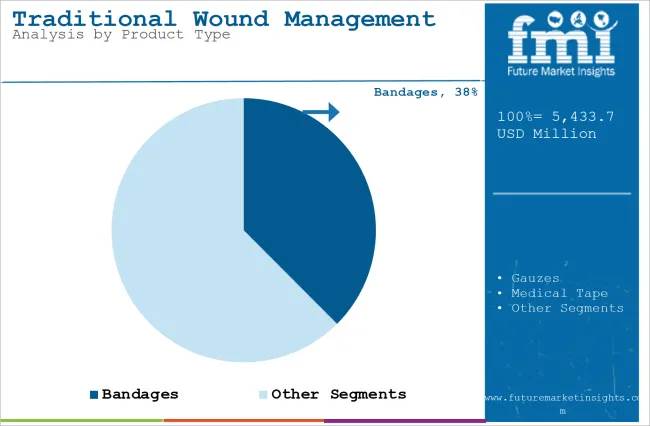
In 2026, Bandages is expected to make up 38% of the market. Demand is concentrated in applications where product type performance directly affects operational outcomes and compliance positioning. Procurement decisions in this segment are shaped by specification requirements, cost-performance ratios, and supplier reliability across multi-year contracting cycles.
Insights into the Skin and Diabetic Ulcers Application Segment
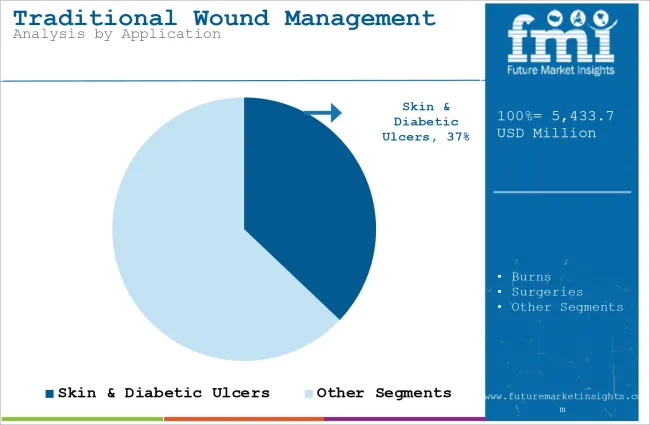
Skin and Diabetic Ulcers accounts for 37% of the application segment. Growth in this category reflects expanding application scope and procurement volume increases from institutional and industrial buyers. Product differentiation is shaped by performance certification, regulatory compliance, and cost competitiveness across geographic markets.
Traditional Wound Management Market Drivers, Restraints, and Opportunities
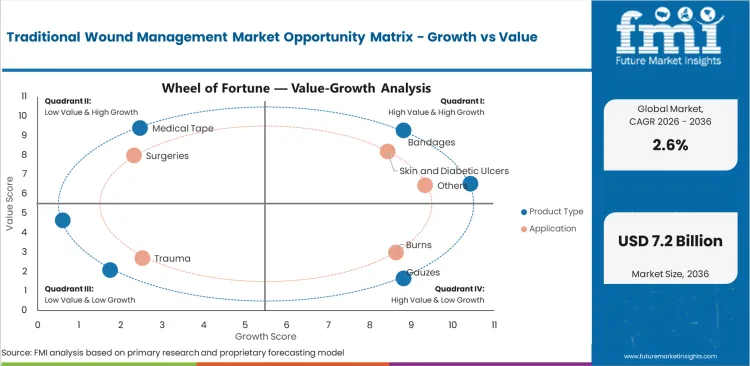
- Structured demand for traditional wound management products is being created across primary end-use segments due to regulatory compliance requirements and certification mandates.
- Price premiums for advanced configurations restrict adoption in price-sensitive segments, driving growth in premium & certified categories
- Technology advancement and increasing application scope is providing incremental demand from previously underserved end-use categories.
The traditional wound management market is growing continuously due to regulatory compliance needs, technological advancements and expanding application scope. Cost premiums and scaling challenges exist, but opportunities in compliance-driven procurement, performance upgrades and geographic expansion in high-growth markets do as well.
Regulatory and Compliance Driven Demand
Demand is determined by regulatory requirements for standardized product specifications and performance certifications. Regulatory compliance requirements in North America, Europe and East Asia are creating more regularized procurement cycles as institutional buyers are timing their buying decisions to regulatory and certification renewal timelines.
Cost Premium and Scalability Constraints
Growth is driven by technology advancement that expands the addressable application scope. Demand is expanding in applications that previously used alternative solutions because of performance gains in core product categories, and this demand is incremental and outside of traditional end-use segments.
Technology Driven Application Expansion
Growth reflects technology advancement that expands the addressable application scope. Performance improvements in core product categories are enabling adoption in applications previously served by alternative solutions, creating incremental demand beyond traditional end-use segments.
Supply Chain and Sourcing Dynamics
sourcing reliability considerations. Buyers with multi-year procurement needs are broadening supplier bases and favoring manufacturers that have proven production capacity, quality consistency and delivery reliability across geographic markets.
Analysis of Traditional Wound Management Market By Key Countries
.webp "Top Country Growth Comparison Traditional Wound Management Market Cagr (2026 2036)")
| Country | CAGR |
|---|---|
| India | 3.2% |
| Japan | 2.1% |
| Brazil | 1.9% |
| Germany | 1.8% |
| USA | 1.4% |
Source: FMI analysis based on primary research and proprietary forecasting model
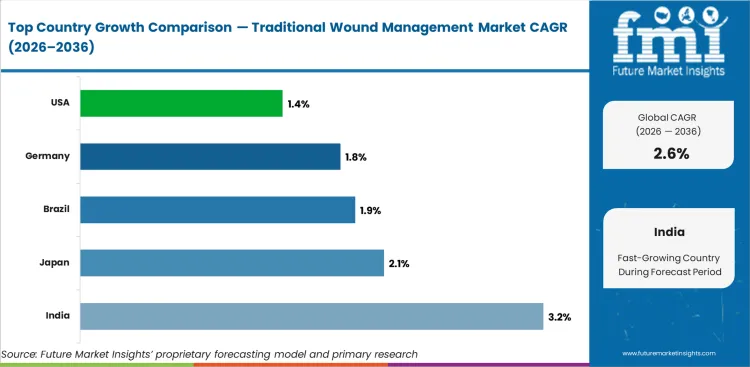
- India at 3.2% reflects infrastructure expansion and growing institutional procurement supporting adoption.
- Japan at 2.1% reflects advanced manufacturing and quality-driven procurement sustaining technology leadership.
- Brazil at 1.9% reflects favorable market conditions and expanding end-use demand.
- Germany at 1.8% reflects engineering-led manufacturing and export demand sustaining market growth.
The global traditional wound management market is expected to grow at a rate of 2.6% per year from 2026 to 2036. The study covers more than 30 countries, and the main markets are listed below.
Demand Outlook for Traditional Wound Management Market in India
India is expected to grow at 3.2% through 2036. Market expansion is shaped by infrastructure development programs, institutional procurement growth, and increasing adoption of standardized product specifications across organized industry segments. Government procurement initiatives are creating structured demand channels.
- Infrastructure development programs support institutional procurement.
- Organized industry adoption is expanding the addressable market.
- Government initiatives create procurement channels for standardized products.
Future Outlook for Traditional Wound Management Market in Japan
Japan is expected to grow at 2.1% through 2036. Advanced manufacturing capabilities and quality-driven procurement standards sustain technology leadership. Demand reflects institutional procurement patterns that prioritize product reliability, performance consistency, and long-term supplier relationships.
- Quality-driven procurement standards sustain premium product demand.
- Advanced manufacturing supports technology leadership and export competitiveness.
- Institutional procurement patterns prioritize long-term supplier relationships.
Opportunity Analysis of Traditional Wound Management Market in Brazil
Brazil is expected to grow at 1.9% through 2036. Favorable demand conditions and expanding end-use applications are supporting market growth through the forecast period.
- Expanding end-use demand supports volume growth.
- Institutional procurement patterns create structured demand.
- Regulatory alignment drives compliance-based purchasing.
In-depth Analysis of Traditional Wound Management Market in Germany
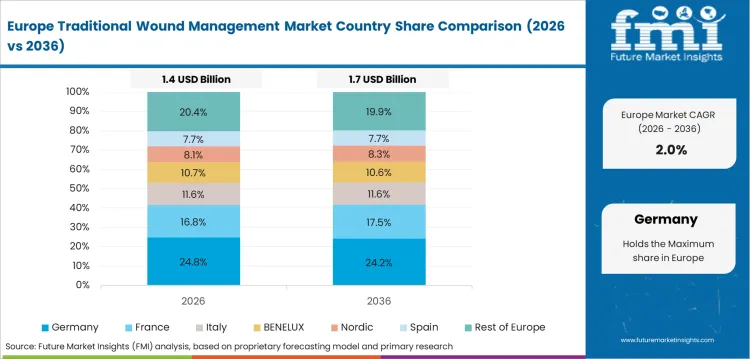
Germany is expected to grow at 1.8% through 2036. Engineering-intensive manufacturing and export demand sustain market growth. Advanced industrial infrastructure and regulatory compliance leadership position Germany as a high-value procurement market.
- Expanding end-use demand supports volume growth.
- Institutional procurement patterns create structured demand.
- Regulatory alignment drives compliance-based purchasing.
Sales Analysis of Traditional Wound Management Market in USA
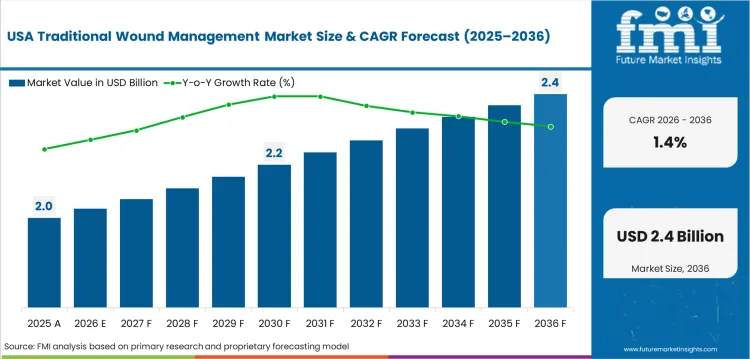
USA is expected to grow at 1.4% through 2036. Demand is supported by regulatory compliance cycles, aftermarket replacement volumes, and institutional procurement from large-scale end-users. Cardinal Health maintains established distribution channels and procurement relationships across the US market.
- Regulatory compliance requirements sustain upgrade and replacement cycles.
- Aftermarket procurement from aging installed base generates recurring demand.
- Institutional buyers prioritize performance certification and supply reliability.
Competitive Landscape and Strategic Positioning
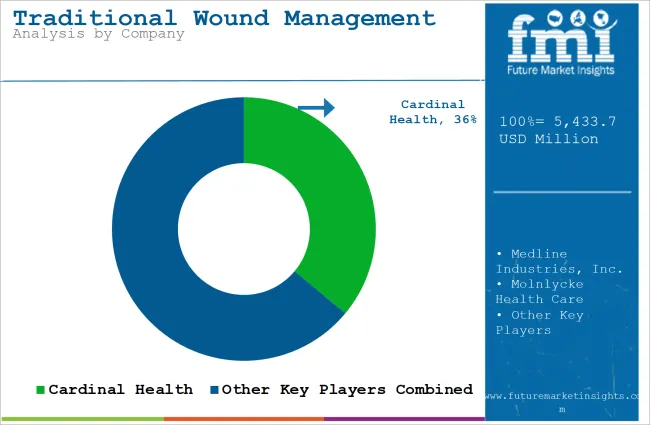
- Cardinal Health holds approximately 18.7% market share and leads through integrated production capabilities and established procurement relationships across primary end-use segments.
- Medline Industries, Inc., Molnlycke Health Care, and 3M all offer complementary product ranges across the value chain.
- New players are focusing on specialized applications and technology differentiation to establish competitive positions in high-growth segments.
Cardinal Health leads through broad product portfolio coverage, multi-regional manufacturing capabilities, and established procurement relationships with institutional buyers. Medline Industries, Inc. competes through complementary product offerings and regional distribution strength.
Molnlycke Health Care and other established manufacturers maintain market positions through technology specialization, regional market access, and application-specific product development.
Barriers include price sensitivity across the value chain, regulatory approval requirements for new product entries, production scaling challenges, and established supply chain relationships. Strategic priorities include cost reduction, geographic expansion, and partnerships for compliance-driven procurement programs.
Key Companies in the Traditional Wound Management Market
Key global companies leading the traditional wound management market include:
- Cardinal Health, Medline Industries, Inc., Molnlycke Health Care, 3M, Paul Hartman AG, Smith & Nephew, DUKAL Corporation maintain established market positions through broad product portfolios, multi-regional manufacturing capabilities, and institutional procurement relationships.
Competitive Benchmarking: Traditional Wound Management Market
| Company | Product Breadth | Technology Capability | Distribution Reach | Geographic Footprint |
|---|---|---|---|---|
| Cardinal Health | High | High | Strong | Global |
| Medline Industries, Inc. | High | High | Strong | Global |
| Molnlycke Health Care | High | Medium | Strong | Global |
| 3M | Medium | Medium | Moderate | Multi-regional |
| Paul Hartman AG | Medium | Medium | Moderate | Multi-regional |
| Smith & Nephew | Medium | Medium | Moderate | Multi-regional |
| DUKAL Corporation | Low | Medium | Low | Regional |
| BSN Medical | Low | Medium | Low | Regional |
Source: Future Market Insights competitive analysis, 2026.
Key Developments in Traditional Wound Management Market
- Rising demand is driven by the growing burden of acute and chronic wounds, especially among aging populations and diabetic patients.
- The market is expanding in cost-sensitive regions because traditional dressings remain affordable, widely available, and preferred for routine wound care.
Key Players in the Traditional Wound Management Market
Major Global Players
- Cardinal Health
- Medline Industries, Inc.
- Molnlycke Health Care
- 3M
- Paul Hartman AG
- Smith & Nephew
- DUKAL Corporation
Emerging Players/Startups
- BSN Medical
Report Scope and Coverage
| Parameter | Details |
|---|---|
| Quantitative Units | USD 5.57 billion to USD 7.20 billion, at a CAGR of 2.6% |
| Market Definition | The traditional wound management market encompasses product type, application, end user, distribution channel, technology segmentation across commercial and institutional applications. |
| Regions Covered | North America, Latin America, Europe, East Asia, South Asia and Pacific, Middle East and Africa |
| Countries Covered | India, Japan, Brazil, Germany, USA, 30 plus countries |
| Key Companies Profiled | Cardinal Health, Medline Industries, Inc., Molnlycke Health Care, 3M, Paul Hartman AG, Smith & Nephew, DUKAL Corporation, BSN Medical |
| Forecast Period | 2026 to 2036 |
| Approach | Hybrid bottom-up and top-down methodology starting with verified transaction data, projecting adoption velocity across segments and regions. |
Market Segmentation Analysis
Traditional Wound Management Market Segmented by Product Type:
- Bandages
- Gauzes
- Medical Tape
- Surgical Sponges
- Undercast Paddings
- Others
Traditional Wound Management Market Segmented by Application:
- Skin and Diabetic Ulcers
- Burns
- Surgeries
- Trauma
- Others
Traditional Wound Management Market Segmented by End User:
- Hospitals
- Clinics
- Rehabilitation Centers
- Homecare Settings
- Ambulatory Surgical Centers
Traditional Wound Management Market Segmented by Distribution Channel:
- Hospital Pharmacies
- Retail Pharmacies
- Online Sales
Traditional Wound Management Market Segmented by Technology:
- Basic Wound Care Technology
- Absorption Based Healing
- Protection Based Healing
- Antiseptic Technology
- Alcohol Based Solutions
- Iodine Based Solutions
Traditional Wound Management Market by Region:
- North America
- USA
- Canada
- Mexico
- Latin America
- Brazil
- Chile
- Rest of Latin America
- Western Europe
- Germany
- UK
- Italy
- Spain
- France
- Nordic
- BENELUX
- Rest of Western Europe
- Eastern Europe
- Russia
- Poland
- Hungary
- Balkan & Baltic
- Rest of Eastern Europe
- East Asia
- China
- Japan
- South Korea
- South Asia and Pacific
- India
- ASEAN
- Australia & New Zealand
- Rest of South Asia and Pacific
- Middle East & Africa
- Kingdom of Saudi Arabia
- Other GCC Countries
- Turkiye
- South Africa
- Other African Union
- Rest of Middle East & Africa
Research Sources and Bibliography
- 1. World Health Organization. (2025). WHO Global Health Expenditure Database. WHO.
- 2. USA Food and Drug Administration. (2025). FDA Medical Device Approvals and Clearances Database. FDA.
- 3. European Medicines Agency. (2024). EMA Regulatory Guidance and Medical Device Standards. EMA.
- 4. Centers for Disease Control and Prevention. (2025). CDC Health Statistics and Surveillance Reports. CDC.
- 5. Organisation for Economic Co-operation and Development. (2025). OECD Health Statistics Database. OECD.
This bibliography is provided for reader reference.
This Report Answers
- Estimating the size of the market and revenue projections from 2026 to 2036.
- Segmentation by product type, application, end user, distribution channel, technology.
- Insights about more than 30 markets in the region.
- Analysis of technology that includes core product categories and emerging configurations.
- Assessment of the competitive landscape.
- Finding investment opportunities in high-growth segments and regions.
- Keeping track of the supply chain.
- Delivery of data in PDF and Excel formats.
Frequently Asked Questions
What is the global market demand for Traditional Wound Management Market in 2026?
In 2026, the global traditional wound management market is expected to be worth USD 5.57 billion.
How big will the market for Traditional Wound Management Market be in 2036?
By 2036, the market for traditional wound management market is expected to be worth USD 7.20 billion.
How much do you think demand for Traditional Wound Management Market will grow between 2026 and 2036?
Between 2026 and 2036, the demand for traditional wound management market is expected to grow at a CAGR of 2.6%.
Which Product Type is likely to be the best seller in the Traditional Wound Management Market by 2026?
Bandages will make up 38% of the market in 2026. This shows that bandages is the primary demand category due to increasing clinical adoption and expanding procedural volume across hospital systems.
What is causing demand to rise in India in the Traditional Wound Management Market?
India is expected to grow at a rate of 3.2% per year through 2036, thanks to infrastructure expansion and growing institutional procurement supporting adoption.
What is causing demand to rise in Japan in the Traditional Wound Management Market?
Japan is expected to grow at a rate of 2.1% per year through 2036, thanks to advanced manufacturing and quality-driven procurement sustaining technology leadership.
What does this report mean by 'Traditional Wound Management Market definition'?
The traditional wound management market includes products and services classified by product type, application, end user, distribution channel, technology, spanning the 2026 to 2036 forecast period.
How does FMI make the Traditional Wound Management Market forecast and check it?
Forecasting models use a hybrid bottom-up and top-down approach, starting with verified transaction data and checking it against global production statistics and manufacturer disclosures.
Table of Content
- Executive Summary
- Global Market Outlook
- Demand-side Trends
- Supply-side Trends
- Technology Roadmap Analysis
- Analysis and Recommendations
- Market Overview
- Market Coverage / Taxonomy
- Market Definition / Scope / Limitations
- Research Methodology
- Chapter Orientation
- Analytical Lens and Working Hypotheses
- Market Structure, Signals, and Trend Drivers
- Benchmarking and Cross-market Comparability
- Market Sizing, Forecasting, and Opportunity Mapping
- Research Design and Evidence Framework
- Desk Research Programme (Secondary Evidence)
- Company Annual and Sustainability Reports
- Peer-reviewed Journals and Academic Literature
- Corporate Websites, Product Literature, and Technical Notes
- Earnings Decks and Investor Briefings
- Statutory Filings and Regulatory Disclosures
- Technical White Papers and Standards Notes
- Trade Journals, Industry Magazines, and Analyst Briefs
- Conference Proceedings, Webinars, and Seminar Materials
- Government Statistics Portals and Public Data Releases
- Press Releases and Reputable Media Coverage
- Specialist Newsletters and Curated Briefings
- Sector Databases and Reference Repositories
- FMI Internal Proprietary Databases and Historical Market Datasets
- Subscription Datasets and Paid Sources
- Social Channels, Communities, and Digital Listening Inputs
- Additional Desk Sources
- Expert Input and Fieldwork (Primary Evidence)
- Primary Modes
- Qualitative Interviews and Expert Elicitation
- Quantitative Surveys and Structured Data Capture
- Blended Approach
- Why Primary Evidence is Used
- Field Techniques
- Interviews
- Surveys
- Focus Groups
- Observational and In-context Research
- Social and Community Interactions
- Stakeholder Universe Engaged
- C-suite Leaders
- Board Members
- Presidents and Vice Presidents
- R&D and Innovation Heads
- Technical Specialists
- Domain Subject-matter Experts
- Scientists
- Physicians and Other Healthcare Professionals
- Governance, Ethics, and Data Stewardship
- Research Ethics
- Data Integrity and Handling
- Primary Modes
- Tooling, Models, and Reference Databases
- Desk Research Programme (Secondary Evidence)
- Data Engineering and Model Build
- Data Acquisition and Ingestion
- Cleaning, Normalisation, and Verification
- Synthesis, Triangulation, and Analysis
- Quality Assurance and Audit Trail
- Market Background
- Market Dynamics
- Drivers
- Restraints
- Opportunity
- Trends
- Scenario Forecast
- Demand in Optimistic Scenario
- Demand in Likely Scenario
- Demand in Conservative Scenario
- Opportunity Map Analysis
- Product Life Cycle Analysis
- Supply Chain Analysis
- Investment Feasibility Matrix
- Value Chain Analysis
- PESTLE and Porter’s Analysis
- Regulatory Landscape
- Regional Parent Market Outlook
- Production and Consumption Statistics
- Import and Export Statistics
- Market Dynamics
- Global Market Analysis 2021 to 2025 and Forecast, 2026 to 2036
- Historical Market Size Value (USD Million) Analysis, 2021 to 2025
- Current and Future Market Size Value (USD Million) Projections, 2026 to 2036
- Y-o-Y Growth Trend Analysis
- Absolute $ Opportunity Analysis
- Global Market Pricing Analysis 2021 to 2025 and Forecast 2026 to 2036
- Global Market Analysis 2021 to 2025 and Forecast 2026 to 2036, By Product Type
- Introduction / Key Findings
- Historical Market Size Value (USD Million) Analysis By Product Type , 2021 to 2025
- Current and Future Market Size Value (USD Million) Analysis and Forecast By Product Type , 2026 to 2036
- Bandages
- Gauzes
- Medical Tape
- Surgical Sponges
- Undercast Paddings
- Others
- Bandages
- Y-o-Y Growth Trend Analysis By Product Type , 2021 to 2025
- Absolute $ Opportunity Analysis By Product Type , 2026 to 2036
- Global Market Analysis 2021 to 2025 and Forecast 2026 to 2036, By Application
- Introduction / Key Findings
- Historical Market Size Value (USD Million) Analysis By Application, 2021 to 2025
- Current and Future Market Size Value (USD Million) Analysis and Forecast By Application, 2026 to 2036
- Skin and Diabetic Ulcers
- Burns
- Surgeries
- Trauma
- Others
- Skin and Diabetic Ulcers
- Y-o-Y Growth Trend Analysis By Application, 2021 to 2025
- Absolute $ Opportunity Analysis By Application, 2026 to 2036
- Global Market Analysis 2021 to 2025 and Forecast 2026 to 2036, By End User
- Introduction / Key Findings
- Historical Market Size Value (USD Million) Analysis By End User, 2021 to 2025
- Current and Future Market Size Value (USD Million) Analysis and Forecast By End User, 2026 to 2036
- Hospitals
- Clinics
- Rehabilitation Centers
- Homecare Settings
- Ambulatory Surgical Centers
- Hospitals
- Y-o-Y Growth Trend Analysis By End User, 2021 to 2025
- Absolute $ Opportunity Analysis By End User, 2026 to 2036
- Global Market Analysis 2021 to 2025 and Forecast 2026 to 2036, By Distribution Channel
- Introduction / Key Findings
- Historical Market Size Value (USD Million) Analysis By Distribution Channel, 2021 to 2025
- Current and Future Market Size Value (USD Million) Analysis and Forecast By Distribution Channel, 2026 to 2036
- Hospital Pharmacies
- Retail Pharmacies
- Online Sales
- Hospital Pharmacies
- Y-o-Y Growth Trend Analysis By Distribution Channel, 2021 to 2025
- Absolute $ Opportunity Analysis By Distribution Channel, 2026 to 2036
- Global Market Analysis 2021 to 2025 and Forecast 2026 to 2036, By Technology
- Introduction / Key Findings
- Historical Market Size Value (USD Million) Analysis By Technology, 2021 to 2025
- Current and Future Market Size Value (USD Million) Analysis and Forecast By Technology, 2026 to 2036
- Basic Wound Care Technology
- Absorption Based Healing
- Protection Based Healing
- Antiseptic Technology
- Alcohol Based Solutions
- Iodine Based Solutions
- Basic Wound Care Technology
- Y-o-Y Growth Trend Analysis By Technology, 2021 to 2025
- Absolute $ Opportunity Analysis By Technology, 2026 to 2036
- Global Market Analysis 2021 to 2025 and Forecast 2026 to 2036, By Region
- Introduction
- Historical Market Size Value (USD Million) Analysis By Region, 2021 to 2025
- Current Market Size Value (USD Million) Analysis and Forecast By Region, 2026 to 2036
- North America
- Latin America
- Western Europe
- Eastern Europe
- East Asia
- South Asia and Pacific
- Middle East & Africa
- Market Attractiveness Analysis By Region
- North America Market Analysis 2021 to 2025 and Forecast 2026 to 2036, By Country
- Historical Market Size Value (USD Million) Trend Analysis By Market Taxonomy, 2021 to 2025
- Market Size Value (USD Million) Forecast By Market Taxonomy, 2026 to 2036
- By Country
- USA
- Canada
- Mexico
- By Product Type
- By Application
- By End User
- By Distribution Channel
- By Technology
- By Country
- Market Attractiveness Analysis
- By Country
- By Product Type
- By Application
- By End User
- By Distribution Channel
- By Technology
- Key Takeaways
- Latin America Market Analysis 2021 to 2025 and Forecast 2026 to 2036, By Country
- Historical Market Size Value (USD Million) Trend Analysis By Market Taxonomy, 2021 to 2025
- Market Size Value (USD Million) Forecast By Market Taxonomy, 2026 to 2036
- By Country
- Brazil
- Chile
- Rest of Latin America
- By Product Type
- By Application
- By End User
- By Distribution Channel
- By Technology
- By Country
- Market Attractiveness Analysis
- By Country
- By Product Type
- By Application
- By End User
- By Distribution Channel
- By Technology
- Key Takeaways
- Western Europe Market Analysis 2021 to 2025 and Forecast 2026 to 2036, By Country
- Historical Market Size Value (USD Million) Trend Analysis By Market Taxonomy, 2021 to 2025
- Market Size Value (USD Million) Forecast By Market Taxonomy, 2026 to 2036
- By Country
- Germany
- UK
- Italy
- Spain
- France
- Nordic
- BENELUX
- Rest of Western Europe
- By Product Type
- By Application
- By End User
- By Distribution Channel
- By Technology
- By Country
- Market Attractiveness Analysis
- By Country
- By Product Type
- By Application
- By End User
- By Distribution Channel
- By Technology
- Key Takeaways
- Eastern Europe Market Analysis 2021 to 2025 and Forecast 2026 to 2036, By Country
- Historical Market Size Value (USD Million) Trend Analysis By Market Taxonomy, 2021 to 2025
- Market Size Value (USD Million) Forecast By Market Taxonomy, 2026 to 2036
- By Country
- Russia
- Poland
- Hungary
- Balkan & Baltic
- Rest of Eastern Europe
- By Product Type
- By Application
- By End User
- By Distribution Channel
- By Technology
- By Country
- Market Attractiveness Analysis
- By Country
- By Product Type
- By Application
- By End User
- By Distribution Channel
- By Technology
- Key Takeaways
- East Asia Market Analysis 2021 to 2025 and Forecast 2026 to 2036, By Country
- Historical Market Size Value (USD Million) Trend Analysis By Market Taxonomy, 2021 to 2025
- Market Size Value (USD Million) Forecast By Market Taxonomy, 2026 to 2036
- By Country
- China
- Japan
- South Korea
- By Product Type
- By Application
- By End User
- By Distribution Channel
- By Technology
- By Country
- Market Attractiveness Analysis
- By Country
- By Product Type
- By Application
- By End User
- By Distribution Channel
- By Technology
- Key Takeaways
- South Asia and Pacific Market Analysis 2021 to 2025 and Forecast 2026 to 2036, By Country
- Historical Market Size Value (USD Million) Trend Analysis By Market Taxonomy, 2021 to 2025
- Market Size Value (USD Million) Forecast By Market Taxonomy, 2026 to 2036
- By Country
- India
- ASEAN
- Australia & New Zealand
- Rest of South Asia and Pacific
- By Product Type
- By Application
- By End User
- By Distribution Channel
- By Technology
- By Country
- Market Attractiveness Analysis
- By Country
- By Product Type
- By Application
- By End User
- By Distribution Channel
- By Technology
- Key Takeaways
- Middle East & Africa Market Analysis 2021 to 2025 and Forecast 2026 to 2036, By Country
- Historical Market Size Value (USD Million) Trend Analysis By Market Taxonomy, 2021 to 2025
- Market Size Value (USD Million) Forecast By Market Taxonomy, 2026 to 2036
- By Country
- Kingdom of Saudi Arabia
- Other GCC Countries
- Turkiye
- South Africa
- Other African Union
- Rest of Middle East & Africa
- By Product Type
- By Application
- By End User
- By Distribution Channel
- By Technology
- By Country
- Market Attractiveness Analysis
- By Country
- By Product Type
- By Application
- By End User
- By Distribution Channel
- By Technology
- Key Takeaways
- Key Countries Market Analysis
- USA
- Pricing Analysis
- Market Share Analysis, 2025
- By Product Type
- By Application
- By End User
- By Distribution Channel
- By Technology
- Canada
- Pricing Analysis
- Market Share Analysis, 2025
- By Product Type
- By Application
- By End User
- By Distribution Channel
- By Technology
- Mexico
- Pricing Analysis
- Market Share Analysis, 2025
- By Product Type
- By Application
- By End User
- By Distribution Channel
- By Technology
- Brazil
- Pricing Analysis
- Market Share Analysis, 2025
- By Product Type
- By Application
- By End User
- By Distribution Channel
- By Technology
- Chile
- Pricing Analysis
- Market Share Analysis, 2025
- By Product Type
- By Application
- By End User
- By Distribution Channel
- By Technology
- Germany
- Pricing Analysis
- Market Share Analysis, 2025
- By Product Type
- By Application
- By End User
- By Distribution Channel
- By Technology
- UK
- Pricing Analysis
- Market Share Analysis, 2025
- By Product Type
- By Application
- By End User
- By Distribution Channel
- By Technology
- Italy
- Pricing Analysis
- Market Share Analysis, 2025
- By Product Type
- By Application
- By End User
- By Distribution Channel
- By Technology
- Spain
- Pricing Analysis
- Market Share Analysis, 2025
- By Product Type
- By Application
- By End User
- By Distribution Channel
- By Technology
- France
- Pricing Analysis
- Market Share Analysis, 2025
- By Product Type
- By Application
- By End User
- By Distribution Channel
- By Technology
- India
- Pricing Analysis
- Market Share Analysis, 2025
- By Product Type
- By Application
- By End User
- By Distribution Channel
- By Technology
- ASEAN
- Pricing Analysis
- Market Share Analysis, 2025
- By Product Type
- By Application
- By End User
- By Distribution Channel
- By Technology
- Australia & New Zealand
- Pricing Analysis
- Market Share Analysis, 2025
- By Product Type
- By Application
- By End User
- By Distribution Channel
- By Technology
- China
- Pricing Analysis
- Market Share Analysis, 2025
- By Product Type
- By Application
- By End User
- By Distribution Channel
- By Technology
- Japan
- Pricing Analysis
- Market Share Analysis, 2025
- By Product Type
- By Application
- By End User
- By Distribution Channel
- By Technology
- South Korea
- Pricing Analysis
- Market Share Analysis, 2025
- By Product Type
- By Application
- By End User
- By Distribution Channel
- By Technology
- Russia
- Pricing Analysis
- Market Share Analysis, 2025
- By Product Type
- By Application
- By End User
- By Distribution Channel
- By Technology
- Poland
- Pricing Analysis
- Market Share Analysis, 2025
- By Product Type
- By Application
- By End User
- By Distribution Channel
- By Technology
- Hungary
- Pricing Analysis
- Market Share Analysis, 2025
- By Product Type
- By Application
- By End User
- By Distribution Channel
- By Technology
- Kingdom of Saudi Arabia
- Pricing Analysis
- Market Share Analysis, 2025
- By Product Type
- By Application
- By End User
- By Distribution Channel
- By Technology
- Turkiye
- Pricing Analysis
- Market Share Analysis, 2025
- By Product Type
- By Application
- By End User
- By Distribution Channel
- By Technology
- South Africa
- Pricing Analysis
- Market Share Analysis, 2025
- By Product Type
- By Application
- By End User
- By Distribution Channel
- By Technology
- USA
- Market Structure Analysis
- Competition Dashboard
- Competition Benchmarking
- Market Share Analysis of Top Players
- By Regional
- By Product Type
- By Application
- By End User
- By Distribution Channel
- By Technology
- Competition Analysis
- Competition Deep Dive
- Cardinal Health
- Overview
- Product Portfolio
- Profitability by Market Segments (Product/Age /Sales Channel/Region)
- Sales Footprint
- Strategy Overview
- Marketing Strategy
- Product Strategy
- Channel Strategy
- Medline Industries, Inc.
- Molnlycke Health Care
- 3M
- Paul Hartman AG
- Smith & Nephew
- DUKAL Corporation
- BSN Medical
- Cardinal Health
- Competition Deep Dive
- Assumptions & Acronyms Used
List of Tables
- Table 1: Global Market Value (USD Million) Forecast by Region, 2021 to 2036
- Table 2: Global Market Value (USD Million) Forecast by Product Type , 2021 to 2036
- Table 3: Global Market Value (USD Million) Forecast by Application, 2021 to 2036
- Table 4: Global Market Value (USD Million) Forecast by End User, 2021 to 2036
- Table 5: Global Market Value (USD Million) Forecast by Distribution Channel, 2021 to 2036
- Table 6: Global Market Value (USD Million) Forecast by Technology, 2021 to 2036
- Table 7: North America Market Value (USD Million) Forecast by Country, 2021 to 2036
- Table 8: North America Market Value (USD Million) Forecast by Product Type , 2021 to 2036
- Table 9: North America Market Value (USD Million) Forecast by Application, 2021 to 2036
- Table 10: North America Market Value (USD Million) Forecast by End User, 2021 to 2036
- Table 11: North America Market Value (USD Million) Forecast by Distribution Channel, 2021 to 2036
- Table 12: North America Market Value (USD Million) Forecast by Technology, 2021 to 2036
- Table 13: Latin America Market Value (USD Million) Forecast by Country, 2021 to 2036
- Table 14: Latin America Market Value (USD Million) Forecast by Product Type , 2021 to 2036
- Table 15: Latin America Market Value (USD Million) Forecast by Application, 2021 to 2036
- Table 16: Latin America Market Value (USD Million) Forecast by End User, 2021 to 2036
- Table 17: Latin America Market Value (USD Million) Forecast by Distribution Channel, 2021 to 2036
- Table 18: Latin America Market Value (USD Million) Forecast by Technology, 2021 to 2036
- Table 19: Western Europe Market Value (USD Million) Forecast by Country, 2021 to 2036
- Table 20: Western Europe Market Value (USD Million) Forecast by Product Type , 2021 to 2036
- Table 21: Western Europe Market Value (USD Million) Forecast by Application, 2021 to 2036
- Table 22: Western Europe Market Value (USD Million) Forecast by End User, 2021 to 2036
- Table 23: Western Europe Market Value (USD Million) Forecast by Distribution Channel, 2021 to 2036
- Table 24: Western Europe Market Value (USD Million) Forecast by Technology, 2021 to 2036
- Table 25: Eastern Europe Market Value (USD Million) Forecast by Country, 2021 to 2036
- Table 26: Eastern Europe Market Value (USD Million) Forecast by Product Type , 2021 to 2036
- Table 27: Eastern Europe Market Value (USD Million) Forecast by Application, 2021 to 2036
- Table 28: Eastern Europe Market Value (USD Million) Forecast by End User, 2021 to 2036
- Table 29: Eastern Europe Market Value (USD Million) Forecast by Distribution Channel, 2021 to 2036
- Table 30: Eastern Europe Market Value (USD Million) Forecast by Technology, 2021 to 2036
- Table 31: East Asia Market Value (USD Million) Forecast by Country, 2021 to 2036
- Table 32: East Asia Market Value (USD Million) Forecast by Product Type , 2021 to 2036
- Table 33: East Asia Market Value (USD Million) Forecast by Application, 2021 to 2036
- Table 34: East Asia Market Value (USD Million) Forecast by End User, 2021 to 2036
- Table 35: East Asia Market Value (USD Million) Forecast by Distribution Channel, 2021 to 2036
- Table 36: East Asia Market Value (USD Million) Forecast by Technology, 2021 to 2036
- Table 37: South Asia and Pacific Market Value (USD Million) Forecast by Country, 2021 to 2036
- Table 38: South Asia and Pacific Market Value (USD Million) Forecast by Product Type , 2021 to 2036
- Table 39: South Asia and Pacific Market Value (USD Million) Forecast by Application, 2021 to 2036
- Table 40: South Asia and Pacific Market Value (USD Million) Forecast by End User, 2021 to 2036
- Table 41: South Asia and Pacific Market Value (USD Million) Forecast by Distribution Channel, 2021 to 2036
- Table 42: South Asia and Pacific Market Value (USD Million) Forecast by Technology, 2021 to 2036
- Table 43: Middle East & Africa Market Value (USD Million) Forecast by Country, 2021 to 2036
- Table 44: Middle East & Africa Market Value (USD Million) Forecast by Product Type , 2021 to 2036
- Table 45: Middle East & Africa Market Value (USD Million) Forecast by Application, 2021 to 2036
- Table 46: Middle East & Africa Market Value (USD Million) Forecast by End User, 2021 to 2036
- Table 47: Middle East & Africa Market Value (USD Million) Forecast by Distribution Channel, 2021 to 2036
- Table 48: Middle East & Africa Market Value (USD Million) Forecast by Technology, 2021 to 2036
List of Figures
- Figure 1: Global Market Pricing Analysis
- Figure 2: Global Market Value (USD Million) Forecast 2021-2036
- Figure 3: Global Market Value Share and BPS Analysis by Product Type , 2026 and 2036
- Figure 4: Global Market Y-o-Y Growth Comparison by Product Type , 2026-2036
- Figure 5: Global Market Attractiveness Analysis by Product Type
- Figure 6: Global Market Value Share and BPS Analysis by Application, 2026 and 2036
- Figure 7: Global Market Y-o-Y Growth Comparison by Application, 2026-2036
- Figure 8: Global Market Attractiveness Analysis by Application
- Figure 9: Global Market Value Share and BPS Analysis by End User, 2026 and 2036
- Figure 10: Global Market Y-o-Y Growth Comparison by End User, 2026-2036
- Figure 11: Global Market Attractiveness Analysis by End User
- Figure 12: Global Market Value Share and BPS Analysis by Distribution Channel, 2026 and 2036
- Figure 13: Global Market Y-o-Y Growth Comparison by Distribution Channel, 2026-2036
- Figure 14: Global Market Attractiveness Analysis by Distribution Channel
- Figure 15: Global Market Value Share and BPS Analysis by Technology, 2026 and 2036
- Figure 16: Global Market Y-o-Y Growth Comparison by Technology, 2026-2036
- Figure 17: Global Market Attractiveness Analysis by Technology
- Figure 18: Global Market Value (USD Million) Share and BPS Analysis by Region, 2026 and 2036
- Figure 19: Global Market Y-o-Y Growth Comparison by Region, 2026-2036
- Figure 20: Global Market Attractiveness Analysis by Region
- Figure 21: North America Market Incremental Dollar Opportunity, 2026-2036
- Figure 22: Latin America Market Incremental Dollar Opportunity, 2026-2036
- Figure 23: Western Europe Market Incremental Dollar Opportunity, 2026-2036
- Figure 24: Eastern Europe Market Incremental Dollar Opportunity, 2026-2036
- Figure 25: East Asia Market Incremental Dollar Opportunity, 2026-2036
- Figure 26: South Asia and Pacific Market Incremental Dollar Opportunity, 2026-2036
- Figure 27: Middle East & Africa Market Incremental Dollar Opportunity, 2026-2036
- Figure 28: North America Market Value Share and BPS Analysis by Country, 2026 and 2036
- Figure 29: North America Market Value Share and BPS Analysis by Product Type , 2026 and 2036
- Figure 30: North America Market Y-o-Y Growth Comparison by Product Type , 2026-2036
- Figure 31: North America Market Attractiveness Analysis by Product Type
- Figure 32: North America Market Value Share and BPS Analysis by Application, 2026 and 2036
- Figure 33: North America Market Y-o-Y Growth Comparison by Application, 2026-2036
- Figure 34: North America Market Attractiveness Analysis by Application
- Figure 35: North America Market Value Share and BPS Analysis by End User, 2026 and 2036
- Figure 36: North America Market Y-o-Y Growth Comparison by End User, 2026-2036
- Figure 37: North America Market Attractiveness Analysis by End User
- Figure 38: North America Market Value Share and BPS Analysis by Distribution Channel, 2026 and 2036
- Figure 39: North America Market Y-o-Y Growth Comparison by Distribution Channel, 2026-2036
- Figure 40: North America Market Attractiveness Analysis by Distribution Channel
- Figure 41: North America Market Value Share and BPS Analysis by Technology, 2026 and 2036
- Figure 42: North America Market Y-o-Y Growth Comparison by Technology, 2026-2036
- Figure 43: North America Market Attractiveness Analysis by Technology
- Figure 44: Latin America Market Value Share and BPS Analysis by Country, 2026 and 2036
- Figure 45: Latin America Market Value Share and BPS Analysis by Product Type , 2026 and 2036
- Figure 46: Latin America Market Y-o-Y Growth Comparison by Product Type , 2026-2036
- Figure 47: Latin America Market Attractiveness Analysis by Product Type
- Figure 48: Latin America Market Value Share and BPS Analysis by Application, 2026 and 2036
- Figure 49: Latin America Market Y-o-Y Growth Comparison by Application, 2026-2036
- Figure 50: Latin America Market Attractiveness Analysis by Application
- Figure 51: Latin America Market Value Share and BPS Analysis by End User, 2026 and 2036
- Figure 52: Latin America Market Y-o-Y Growth Comparison by End User, 2026-2036
- Figure 53: Latin America Market Attractiveness Analysis by End User
- Figure 54: Latin America Market Value Share and BPS Analysis by Distribution Channel, 2026 and 2036
- Figure 55: Latin America Market Y-o-Y Growth Comparison by Distribution Channel, 2026-2036
- Figure 56: Latin America Market Attractiveness Analysis by Distribution Channel
- Figure 57: Latin America Market Value Share and BPS Analysis by Technology, 2026 and 2036
- Figure 58: Latin America Market Y-o-Y Growth Comparison by Technology, 2026-2036
- Figure 59: Latin America Market Attractiveness Analysis by Technology
- Figure 60: Western Europe Market Value Share and BPS Analysis by Country, 2026 and 2036
- Figure 61: Western Europe Market Value Share and BPS Analysis by Product Type , 2026 and 2036
- Figure 62: Western Europe Market Y-o-Y Growth Comparison by Product Type , 2026-2036
- Figure 63: Western Europe Market Attractiveness Analysis by Product Type
- Figure 64: Western Europe Market Value Share and BPS Analysis by Application, 2026 and 2036
- Figure 65: Western Europe Market Y-o-Y Growth Comparison by Application, 2026-2036
- Figure 66: Western Europe Market Attractiveness Analysis by Application
- Figure 67: Western Europe Market Value Share and BPS Analysis by End User, 2026 and 2036
- Figure 68: Western Europe Market Y-o-Y Growth Comparison by End User, 2026-2036
- Figure 69: Western Europe Market Attractiveness Analysis by End User
- Figure 70: Western Europe Market Value Share and BPS Analysis by Distribution Channel, 2026 and 2036
- Figure 71: Western Europe Market Y-o-Y Growth Comparison by Distribution Channel, 2026-2036
- Figure 72: Western Europe Market Attractiveness Analysis by Distribution Channel
- Figure 73: Western Europe Market Value Share and BPS Analysis by Technology, 2026 and 2036
- Figure 74: Western Europe Market Y-o-Y Growth Comparison by Technology, 2026-2036
- Figure 75: Western Europe Market Attractiveness Analysis by Technology
- Figure 76: Eastern Europe Market Value Share and BPS Analysis by Country, 2026 and 2036
- Figure 77: Eastern Europe Market Value Share and BPS Analysis by Product Type , 2026 and 2036
- Figure 78: Eastern Europe Market Y-o-Y Growth Comparison by Product Type , 2026-2036
- Figure 79: Eastern Europe Market Attractiveness Analysis by Product Type
- Figure 80: Eastern Europe Market Value Share and BPS Analysis by Application, 2026 and 2036
- Figure 81: Eastern Europe Market Y-o-Y Growth Comparison by Application, 2026-2036
- Figure 82: Eastern Europe Market Attractiveness Analysis by Application
- Figure 83: Eastern Europe Market Value Share and BPS Analysis by End User, 2026 and 2036
- Figure 84: Eastern Europe Market Y-o-Y Growth Comparison by End User, 2026-2036
- Figure 85: Eastern Europe Market Attractiveness Analysis by End User
- Figure 86: Eastern Europe Market Value Share and BPS Analysis by Distribution Channel, 2026 and 2036
- Figure 87: Eastern Europe Market Y-o-Y Growth Comparison by Distribution Channel, 2026-2036
- Figure 88: Eastern Europe Market Attractiveness Analysis by Distribution Channel
- Figure 89: Eastern Europe Market Value Share and BPS Analysis by Technology, 2026 and 2036
- Figure 90: Eastern Europe Market Y-o-Y Growth Comparison by Technology, 2026-2036
- Figure 91: Eastern Europe Market Attractiveness Analysis by Technology
- Figure 92: East Asia Market Value Share and BPS Analysis by Country, 2026 and 2036
- Figure 93: East Asia Market Value Share and BPS Analysis by Product Type , 2026 and 2036
- Figure 94: East Asia Market Y-o-Y Growth Comparison by Product Type , 2026-2036
- Figure 95: East Asia Market Attractiveness Analysis by Product Type
- Figure 96: East Asia Market Value Share and BPS Analysis by Application, 2026 and 2036
- Figure 97: East Asia Market Y-o-Y Growth Comparison by Application, 2026-2036
- Figure 98: East Asia Market Attractiveness Analysis by Application
- Figure 99: East Asia Market Value Share and BPS Analysis by End User, 2026 and 2036
- Figure 100: East Asia Market Y-o-Y Growth Comparison by End User, 2026-2036
- Figure 101: East Asia Market Attractiveness Analysis by End User
- Figure 102: East Asia Market Value Share and BPS Analysis by Distribution Channel, 2026 and 2036
- Figure 103: East Asia Market Y-o-Y Growth Comparison by Distribution Channel, 2026-2036
- Figure 104: East Asia Market Attractiveness Analysis by Distribution Channel
- Figure 105: East Asia Market Value Share and BPS Analysis by Technology, 2026 and 2036
- Figure 106: East Asia Market Y-o-Y Growth Comparison by Technology, 2026-2036
- Figure 107: East Asia Market Attractiveness Analysis by Technology
- Figure 108: South Asia and Pacific Market Value Share and BPS Analysis by Country, 2026 and 2036
- Figure 109: South Asia and Pacific Market Value Share and BPS Analysis by Product Type , 2026 and 2036
- Figure 110: South Asia and Pacific Market Y-o-Y Growth Comparison by Product Type , 2026-2036
- Figure 111: South Asia and Pacific Market Attractiveness Analysis by Product Type
- Figure 112: South Asia and Pacific Market Value Share and BPS Analysis by Application, 2026 and 2036
- Figure 113: South Asia and Pacific Market Y-o-Y Growth Comparison by Application, 2026-2036
- Figure 114: South Asia and Pacific Market Attractiveness Analysis by Application
- Figure 115: South Asia and Pacific Market Value Share and BPS Analysis by End User, 2026 and 2036
- Figure 116: South Asia and Pacific Market Y-o-Y Growth Comparison by End User, 2026-2036
- Figure 117: South Asia and Pacific Market Attractiveness Analysis by End User
- Figure 118: South Asia and Pacific Market Value Share and BPS Analysis by Distribution Channel, 2026 and 2036
- Figure 119: South Asia and Pacific Market Y-o-Y Growth Comparison by Distribution Channel, 2026-2036
- Figure 120: South Asia and Pacific Market Attractiveness Analysis by Distribution Channel
- Figure 121: South Asia and Pacific Market Value Share and BPS Analysis by Technology, 2026 and 2036
- Figure 122: South Asia and Pacific Market Y-o-Y Growth Comparison by Technology, 2026-2036
- Figure 123: South Asia and Pacific Market Attractiveness Analysis by Technology
- Figure 124: Middle East & Africa Market Value Share and BPS Analysis by Country, 2026 and 2036
- Figure 125: Middle East & Africa Market Value Share and BPS Analysis by Product Type , 2026 and 2036
- Figure 126: Middle East & Africa Market Y-o-Y Growth Comparison by Product Type , 2026-2036
- Figure 127: Middle East & Africa Market Attractiveness Analysis by Product Type
- Figure 128: Middle East & Africa Market Value Share and BPS Analysis by Application, 2026 and 2036
- Figure 129: Middle East & Africa Market Y-o-Y Growth Comparison by Application, 2026-2036
- Figure 130: Middle East & Africa Market Attractiveness Analysis by Application
- Figure 131: Middle East & Africa Market Value Share and BPS Analysis by End User, 2026 and 2036
- Figure 132: Middle East & Africa Market Y-o-Y Growth Comparison by End User, 2026-2036
- Figure 133: Middle East & Africa Market Attractiveness Analysis by End User
- Figure 134: Middle East & Africa Market Value Share and BPS Analysis by Distribution Channel, 2026 and 2036
- Figure 135: Middle East & Africa Market Y-o-Y Growth Comparison by Distribution Channel, 2026-2036
- Figure 136: Middle East & Africa Market Attractiveness Analysis by Distribution Channel
- Figure 137: Middle East & Africa Market Value Share and BPS Analysis by Technology, 2026 and 2036
- Figure 138: Middle East & Africa Market Y-o-Y Growth Comparison by Technology, 2026-2036
- Figure 139: Middle East & Africa Market Attractiveness Analysis by Technology
- Figure 140: Global Market - Tier Structure Analysis
- Figure 141: Global Market - Company Share Analysis


