

- Market Size (2026)
- USD 420.0 Mn
- Forecast (2036)
- USD 766.5 Mn
- CAGR (2026 to 2036)
- 6.2%
How big is Twin Fluid Nozzles Market in 2026?
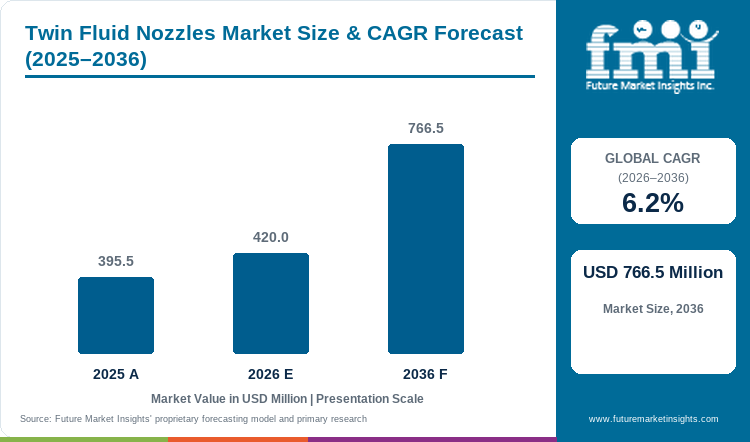
The twin fluid nozzles market is valued at USD 420.0 million in 2026 and is projected to reach USD 766.5 million by 2036, growing at a 6.2% CAGR.
The twin fluid nozzles market stood at USD 395.5 Million in 2025, is estimated at USD 420.0 Million in 2026, and is forecast to reach USD 766.5 Million by 2036 at a 6.2% CAGR from 2026 to 2036.
Twin fluid nozzles earn their place when a process needs droplet control that liquid pressure alone cannot deliver reliably.
A second fluid supplies atomization energy, most often compressed air or another gas, so operators can work with lower liquid pressure and tune droplet behavior through the gas-to-liquid relationship. This matters in flue gas conditioning and reagent injection.
It also matters in spray drying and combustion duties where evaporation distance or mixing quality can determine process performance.
The U.S. Environmental Protection Agency stated in July 2026 that its Mercury and Air Toxics Standards still apply to existing and new coal- and oil-fired electric generating units above 25 MW, even after repeal of certain 2024 amendments. That continuing compliance burden keeps engineered spray injection relevant.
Buyers therefore compare droplet spectrum and turndown. They also assess gas consumption and free passage. The effort required to service a lance in place can decide the final choice.
Purchasing conditions differ by country even when the same atomization physics applies. Brazil combines the fastest profiled CAGR with a power mix in which thermal generation rose 12.3% in 2025, creating demand for equipment that can accommodate variable duty.
Germany brings a mature industrial and waste-to-energy base, so replacement fit and serviceability can matter as much as first cost. Japan has a dense incineration fleet and favors solutions that limit maintenance exposure in established plants.
KSA has an inspection environment that is becoming more formalized, while the USA faces a more policy-sensitive retrofit cycle.
Across these markets, interest converts into an order only when the supplier proves the required droplet distribution at the plant duty point and shows acceptable compressed-gas use over the expected operating range.
Key Takeaways of Twin Fluid Nozzles Market
- Internal mixing leads the market in 2026. Air-liquid leads the market in 2026.
- Fine atomization leads the market in 2026. Flue gas conditioning leads the market in 2026. Power plants lead the market in 2026.
- Driver: Emissions-control and process-stability requirements increase demand for controllable fine atomization.
- Restraint: Compressor energy, gas-supply capacity, and cleaning burden can erase the operating advantage of a twin-fluid design.
- Opportunity: Low-air, clog-resistant and automatically controlled nozzles can unlock retrofit and variable-load applications. Brazil has the highest profiled country CAGR at 7.1%, compared with Japan at 5.0%.
Analyst Perspective
Revenue capture will favor suppliers that prove the spray result and the operating-cost result at the same duty point. Buyers need droplet size and penetration to remain stable through the required turndown range.
- Nikhil Kaitwade, Principal Consultant, Future Market Insights
How is the Twin Fluid Nozzles Market segmented?
The twin fluid nozzles market is segmented by Nozzle Type, Fluid Pair, Droplet Size, Application, and End Use.
The twin fluid nozzles market uses five segment axes with region as the geographic split.
Nozzle type covers internal mixing, external mixing, Y-jet twin fluid, effervescent atomizers, and air-assist atomizers.
Fluid pair covers air-liquid, steam-liquid, gas-liquid, and liquid-liquid assisted.
Droplet size covers fine atomization, medium atomization, and coarse atomization.
Application covers flue gas conditioning, spray drying, combustion/burners, gas cooling, and chemical reactors.
End use covers power plants, chemicals, food processing, cement, and waste incineration.
What makes Internal mixing central to the Nozzle Type category?
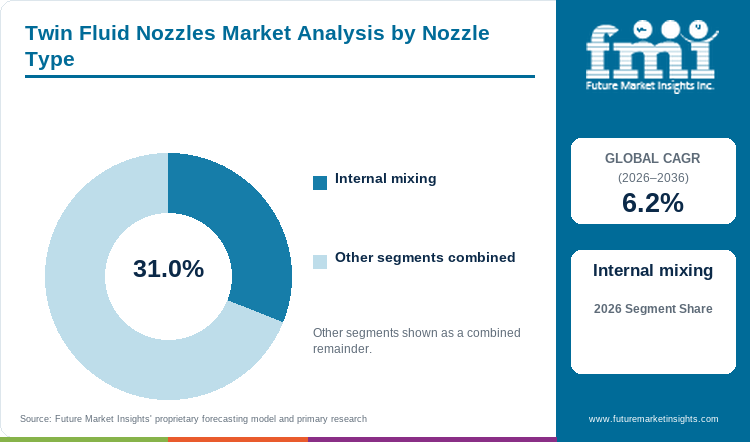
Internal mixing brings the liquid and atomizing medium together inside the nozzle before the two-phase stream exits. The approach is well suited to duties where fine breakup and a compact spray source are more important than maximum separation between the two flow paths.
It also lets designers shape the internal flow field to control droplet formation over a meaningful operating range. The trade-off is that the mixing passages must tolerate the actual liquid chemistry and solids content.
When deposits or crystallization are likely, buyers may shift toward external mixing or designs with larger free passages. Internal mixing therefore leads where atomization quality and controllability outweigh cleaning risk.
- Internal mixing accounts for 31.0% of the market in 2026 because it combines strong atomization with controllable two-phase mixing in compact nozzle assemblies.
- In March 2025, IKEUCHI’s pneumatic nozzle catalog described internal and external air-liquid mixing systems. It also covered impinging systems and identified internal mixing as a configuration with strong atomizing performance.
Why does Air-liquid lead the Fluid Pair category?
Air-liquid systems fit the utility architecture of many industrial sites because compressed air is already available for instruments and process equipment.
Air pressure can be changed independently of liquid flow in many designs, giving operators a practical way to adjust droplet size or spray character without raising liquid pressure to extreme levels. That flexibility is valuable in coating and cooling. It also supports gas treatment and combustion duties.
The economic test is the compressor load. Plants with expensive or capacity-constrained compressed air scrutinize air-to-liquid ratios closely and may prefer low-air designs or steam where process conditions justify it. Even with that constraint, familiarity and controllability support air-liquid leadership.
- Air-liquid accounts for 58.0% of the market in 2026 because compressed air provides a familiar and controllable atomization medium across diverse industrial plants.
- In November 2025, Spraying Systems Co.’s VX-Series automatic air atomizing nozzles were introduced to industrial buyers with automatic control and a design intended to limit overspray.
How does Fine atomization lead the Droplet Size category?
Fine droplets shorten evaporation time and increase interfacial area. Those characteristics matter when liquid must evaporate before reaching a duct wall, contact hot gas quickly, or distribute a reagent through a limited reaction zone. Fine atomization can also improve coating uniformity at low application rates.
The operating penalty appears when ever-smaller droplets require more atomizing gas or create drift beyond the target zone. Buyers therefore specify a droplet spectrum rather than simply asking for the smallest possible drop.
The leading position of fine atomization reflects the number of process duties where rapid heat or mass transfer is the decisive requirement.
- Fine atomization accounts for 44.0% of the market in 2026 because rapid evaporation and high interfacial area are critical in gas treatment, spray drying, and precision dosing.
- In July 2024, Lechler reported that its redesigned Laval 1AW twin-fluid nozzle retained a very fine droplet spectrum while providing a control ratio of up to 70:1.
What supports Flue gas conditioning in the Application category?
Flue gas conditioning puts atomization inside a narrow process window. Water or reagent must disperse into a hot gas stream without excessive wall wetting, incomplete evaporation, or poor cross-sectional coverage.
Twin-fluid designs help by adding atomization energy independently of liquid pressure and by offering broad turndown in engineered lance systems. This makes them useful when load changes alter gas temperature or residence time.
Maintenance remains important because lime slurry, salts, or contaminated water can foul small passages. Suppliers that combine a stable droplet spectrum with clog resistance and accessible lance hardware are better positioned for long-run gas-treatment service.
- Flue gas conditioning accounts for 24.0% of the market in 2026 because gas-treatment trains require controlled evaporation and reagent distribution across changing operating loads.
- In April 2026, BETE Spray Technology submitted an expanded edition of its technical white paper, "Co-Current vs. Counter-Current Spray Evaporation in a Gas Cooling Duct," to ILASS-Americas 2026, using CFD analysis to compare spray orientation performance for gas cooling applications.
What drives Power plants in the End Use category?
Power plants combine high gas volumes with tightly engineered environmental-control trains. Twin-fluid nozzles can serve reagent injection and gas cooling. They also serve semi-dry scrubbing and other duties where liquid distribution must be managed within an existing duct or vessel.
The installed base also creates replacement demand because nozzles and lances operate in corrosive or solids-laden environments. New equipment is only part of the opportunity. Maintenance teams often buy when wear, plugging, or a change in fuel and load profile makes the existing spray result unstable.
Retrofit compatibility and proof of lifecycle cost therefore matter alongside atomization performance in this end-use segment.
- Power plants account for 24.0% of the market in 2026 because emissions-control and gas-conditioning systems create recurring demand for engineered spray injection and replacement parts.
- In July 2024, Lechler stated that the redesigned Laval 1AW nozzle was developed for ammonia-water injection in SCR applications and made easier to integrate through a standardized lance adapter.
What are the drivers, restraints, and opportunities in the Twin Fluid Nozzles Market?
In the twin fluid nozzles market, the key driver is emissions-control and process-stability requirements increasing demand for controllable fine atomization, since standards like the US Mercury and Air Toxics Standards keep engineered spray injection relevant for coal- and oil-fired generating units even after related rule changes. The key restraint is compressor energy, gas-supply capacity, and cleaning burden, which can erase the operating advantage of a twin-fluid design, as lime-milk service in semi-dry flue-gas cleaning can cause deposits and nozzle blockage that historically required regular disassembly. The key opportunity is low-air, clog-resistant, and automatically controlled nozzles that can unlock retrofit and variable-load applications, letting suppliers that package these features into retrofit-ready lance assemblies convert installed process problems into replacement revenue faster than those selling nozzle geometry alone.
- Driver: Emissions-control and process-stability requirements increase demand for controllable fine atomization.
- Restraint: Compressor energy, gas-supply capacity, and cleaning burden can erase the operating advantage of a twin-fluid design.
- Opportunity: Low-air, clog-resistant, and automatically controlled nozzles can unlock retrofit and variable-load applications.
Industrial operators buy twin-fluid nozzles when the spray must do more than simply move liquid into a vessel. Fine droplet formation can shorten evaporation distance and improve reagent contact in hot-gas service. It can also stabilize spray quality when liquid viscosity or flow changes.
The U.S. Environmental Protection Agency stated in July 2026 that MATS technology-based standards continue to apply to existing and new coal- and oil-fired electric generating units above 25 MW.
Comparable operating pressure exists in cement, waste-to-energy and chemical applications even when the governing rule differs. The commercial driver is therefore the need to hold a required process or emissions result across changing load, not atomization for its own sake.
The main restraint appears in the utility and maintenance bill. Delavan’s combustion guidance explains that air-atomizing equipment carries higher equipment and power requirements than comparable pressure atomization because a compressor is required.
That cost is compounded when a plant must oversize compressed-air capacity or operate at high gas-to-liquid ratios. Fouling can add another penalty. Lechler describes how lime-milk service in semi-dry flue-gas cleaning can cause deposits and nozzle blockage that historically required regular disassembly.
A twin-fluid design can still be justified. Buyers need a complete lifecycle case covering air use and cleaning intervals. Spare parts and downtime also matter.
The strongest opportunity is to reduce those penalties without giving up the controllability that makes twin-fluid atomization useful. Automatic air-atomizing platforms can coordinate liquid and atomizing air while quick-release or standardized interfaces reduce maintenance time.
Low-air architectures address compressor constraints directly. Clog-resistant external mixing creates another route for viscous or solids-bearing liquids.
Spraying Systems Co.’s VX-Series appeared in November 2025 with automatic control and low-overspray positioning, while Lechler’s 2024 1AW redesign emphasized standardized integration and broad turndown.
Suppliers that package these features into retrofit-ready lance assemblies can convert installed process problems into replacement revenue faster than suppliers selling nozzle geometry alone.
Which country CAGRs are profiled in the Twin Fluid Nozzles Market?
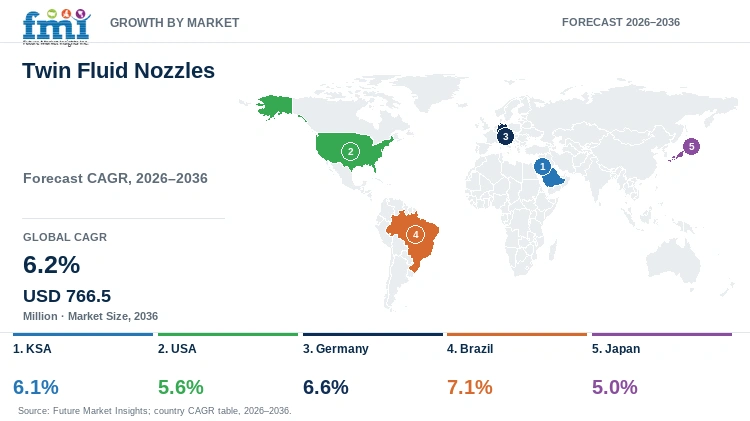
| Country | CAGR |
|---|---|
| KSA | 6.1% |
| USA | 5.6% |
| Germany | 6.6% |
| Brazil | 7.1% |
| Japan | 5.0% |
How do country-level CAGRs compare in the Twin Fluid Nozzles Market?
The five profiled CAGRs form a stepped range rather than sharply separated growth tiers. Brazil is highest at 7.1%, followed by Germany at 6.6% and KSA at 6.1%. USA follows at 5.6%, while Japan is the lower boundary at 5.0%. The spread between Brazil and Japan is 2.1 percentage points.
The top two markets can be treated as an upper growth pair, Saudi Arabia and the USA as a middle pair and Japan as a mature lower-growth case. These rates indicate pacing, not absolute market size. Supplier decisions still depend on installed assets and project pipelines.
Service access and the cost of qualifying a nozzle for a specific duty also matter.
- Brazil exceeds Germany by 0.5 percentage points. The difference supports earlier channel and application-development investment where thermal and industrial projects are active, but it does not prove a larger installed market.
- Germany exceeds KSA by 0.5 percentage points. Germany’s opportunity is more service and retrofit intensive, while KSA can be more project-led and dependent on EPC specifications.
- KSA exceeds USA by 0.5 percentage points. KSA’s pace rewards local project support, while U.S. demand is spread across a broad installed base and is more exposed to regulatory timing.
- USA exceeds Japan by 0.6 percentage points. Both are mature engineering markets, but Japan’s dense incineration fleet places more emphasis on replacement qualification and maintenance continuity.
CAGR should be read alongside the purchasing environment. A slower market can still support substantial replacement revenue if the installed base is large and nozzle service is recurring. A faster market can remain difficult if projects are intermittent or compressed-air economics are unfavorable.
The wider report therefore evaluates country growth against local end-use activity and environmental enforcement. It also considers utility constraints and supplier access instead of using CAGR as a proxy for market size or competitive ease.
Country-wise Analysis
- KSA purchases are influenced by large industrial projects in which engineering contractors and plant teams can specify spray hardware as part of a broader environmental or process package. Demand for twin fluid nozzles in Saudi Arabia is forecast to expand at 6.1% CAGR from 2026 to 2036. During February 2025 the Saudi Accreditation Authority granted ISO/IEC 17020 inspection accreditation to the National Center for Environmental Compliance, strengthening the quality infrastructure around environmental inspection. The friction is proving reliability under hot and dusty operating conditions while supporting projects locally. Suppliers need strong EPC engagement, corrosion-resistant materials and service capability that can follow a project from specification through commissioning.
- U.S. buyers often evaluate twin-fluid hardware as a retrofit choice against hydraulic nozzles, existing lance systems and compressor capacity. Sales of Twin Fluid Nozzles in the USA are forecast to rise at 5.6% CAGR from 2026 to 2036. During July 2026 the U.S. Environmental Protection Agency confirmed that MATS technology-based standards remain applicable to existing and new coal- and oil-fired units above 25 MW while certain 2024 amendments had been repealed in February. Regulatory change can delay marginal upgrades and makes plant-level economics more important. Suppliers need retrofit-compatible assemblies and quantified evidence on air consumption, maintenance savings and spray performance at variable load.
- German users operate within a mature industrial base where nozzle selection is closely tied to engineered emissions-control systems and maintenance planning. Demand for twin fluid nozzles in Germany is forecast to expand at 6.6% CAGR from 2026 to 2036. In June 2026, Germany’s Umweltbundesamt reported that national NOx emissions had fallen 72% from 1990 to 2024, while further measures were still needed to maintain reduction obligations. The friction is replacing or upgrading hardware without compromising proven process performance or plant availability. Suppliers need application engineering and precise documentation. Low-maintenance designs and service support must also fit established plant standards.
- Brazilian demand is shaped by a power system in which renewable generation dominates but thermal output can move materially with system conditions. Adoption of Twin Fluid Nozzles in Brazil is forecast to expand at 7.1% CAGR from 2026 to 2036. In June 2026, Empresa de Pesquisa Energética reported that thermal electricity generation rose 12.3% in 2025 to 169.9 TWh and that natural-gas use for power generation increased 22.7%. Variable thermal dispatch can make fixed-duty spray settings less attractive. Suppliers need broad turndown, robust materials and local application support that can prove performance across changing gas flow and temperature conditions.
- Japanese demand is anchored by a mature waste-treatment infrastructure where reliability and service continuity can outweigh aggressive equipment replacement. Sales of Twin Fluid Nozzles in Japan are forecast to rise at 5.0% CAGR from 2026 to 2036. In March 2026, Japan’s Ministry of the Environment reported 991 municipal waste incineration plants as of March 2025, including 415 plants with power-generation facilities. The friction is qualification inside established systems where downtime and spray instability carry high operating consequences. Suppliers need compact retrofit geometry and clog-resistant designs. They also need stable droplet control and dependable technical support for long equipment lifecycles.
Who are the notable companies in the Twin Fluid Nozzles Market?
Lechler and Spraying Systems Co. are profiled. BETE Fog Nozzle and IKEUCHI are also covered. Delavan and Düsen-Schlick are also covered. PNR Italia and Hennlich are also covered. Bete Ltd. and CYCO & Changyuan complete the notable-company set.
The competitive field is best read through the process problems each supplier is equipped to solve. Gas-treatment specialists compete on engineered lance integration, droplet control, and resistance to deposits or harsh flue-gas conditions.
Broad industrial atomization suppliers compete on the number of mix configurations and spray patterns. Automatic controls and application-support routes also matter to plant engineers. A third group competes through combustion know-how, regional distribution, or accessible dual-fluid product ranges.
These positions overlap, but they create different buying advantages. A power-plant retrofit may favor a supplier with proven lance integration and service access. A food or chemical coating line may favor automatic control and cleanability.
A combustion buyer may prioritize fuel handling, burner compatibility, and turndown.
- Gas-treatment and engineered injection: Lechler and BETE Fog Nozzle compete alongside Düsen-Schlick and Hennlich. Their work covers flue-gas conditioning and reagent injection as well as gas cooling and serviceable lance architectures.
- Broad industrial atomization and control: Spraying Systems Co., IKEUCHI, and PNR Italia offer wide pneumatic nozzle portfolios with internal or external mixing choices and configurable control features.
- Combustion and regional channel positions: Delavan, Bete Ltd. and CYCO & Changyuan address combustion duties, regional access or value-oriented dual-fluid applications with varying levels of system integration.
Competitive Benchmarking: Twin Fluid Nozzles Market
| Company | Twin-Fluid Architecture Breadth | Gas-Treatment Process Fit | Flow-Control & Serviceability | Geographic Reach |
|---|---|---|---|---|
| Lechler | High | High | High | Global project and service presence |
| Spraying Systems Co. | High | Medium | High | Global manufacturing and sales network |
| BETE Fog Nozzle | High | High | High | Global distributor and project network |
| IKEUCHI | High | Medium | High | Japan-led global sales and service footprint |
| Delavan | Medium | Medium | Medium | North America, Europe, and export markets |
| Düsen-Schlick | High | High | High | Europe-based global industrial project reach |
| PNR Italia | High | High | Medium | Europe-based international distribution |
| Hennlich | Medium | High | Medium | Central Europe with selected international reach |
| Bete Ltd. | Medium | Medium | Medium | United Kingdom and selected European channels |
| CYCO & Changyuan | Medium | Medium | Medium | China-based export reach |
Scoring basis: Twin-Fluid Architecture Breadth measures documented access to internal and external mixing designs, multiple atomizing media, or a broad pneumatic atomizer range. Gas-Treatment Process Fit measures direct evidence of gas cooling and flue-gas conditioning.
SCR/SNCR, scrubbing and related engineered injection also count. Flow-Control & Serviceability measures documented turndown and automatic control. Independent air-liquid adjustment, cleanout features or modular maintenance can also support a rating. High indicates broad or deep documented capability.
Medium indicates credible but narrower capability. Low would indicate a documented limitation, while unavailable public information is left low rather than treated as Low.
Key Developments in the Twin Fluid Nozzles Market
- In July 2024, Lechler redesigned the Laval 1AW twin-fluid nozzle used for ammonia-water injection in SCR service. The revision added compatibility with a standardized lance adapter and simplified assembly while retaining a very fine droplet spectrum. Lechler also reported a control ratio of up to 70:1. The development lowers integration and changeout friction in trial, retrofit and variable-flow projects where fast nozzle exchange matters.
- In June 2024, BETE Fog Nozzle and EXAIR announced a strategic merger under which EXAIR acquired BETE. BETE Spray Technology now operates as part of EXAIR. References to BETE throughout this report reflect its nozzle engineering capabilities within the EXAIR group. The companies linked BETE’s spray-nozzle engineering with EXAIR’s compressed-air expertise and a broader customer-support network. The combination is directly relevant to twin-fluid atomization because compressed air is both the enabling utility and a major operating-cost variable. It increases the scope for coordinated nozzle and compressed-air engineering around industrial spray systems.
- In November 2025, Spraying Systems Co.'s VX-Series automatic air atomizing nozzles were featured in trade-press product coverage, highlighting their automatic control and minimal overspray for viscous liquids, coatings, and lubricants. Current product information also emphasizes independent control of spray media and rapid operation. The launch strengthens the case for twin-fluid technology in applications where repeatability and material-use control must justify the extra compressed-air utility.
Key Players in the Twin Fluid Nozzles Market
Gas-Treatment and Engineered Injection Specialists
- Lechler
- BETE Fog Nozzle
- Düsen-Schlick
- Hennlich
Broad Industrial Atomization and Control Platforms
- Spraying Systems Co.
- IKEUCHI
- PNR Italia
Combustion and Regional Dual-Fluid Specialists
- Delavan
- Bete Ltd.
- CYCO & Changyuan
Twin Fluid Nozzles Market - Report Scope
| Coverage field | Report scope |
|---|---|
| Market breakdown | Nozzle Type, Fluid Pair, Droplet Size, Application, End Use |
| Quantitative Units | Revenue in USD Million and CAGR in %. |
| Market Definition | Revenue includes twin fluid nozzle products sold within the stated segmentation universe, including nozzle heads and purpose-built twin-fluid nozzle assemblies where the nozzle is the commercial product. Downstream finished-product revenue, independently sold plant equipment, single-fluid nozzles, and adjacent or substitute spray products are excluded. |
| Regions Covered | North America, Latin America, Western Europe, Eastern Europe, East Asia, South Asia and Pacific, Middle East and Africa |
| Countries Covered | KSA, USA, Germany, Brazil, Japan, and more than twenty-five additional countries in the full report |
| Key Companies Profiled | Lechler, Spraying Systems Co., BETE Fog Nozzle, IKEUCHI, Delavan, Düsen-Schlick, PNR Italia, Hennlich, Bete Ltd., CYCO & Changyuan |
| Forecast Period | 2026 to 2036 |
| Approach | A hybrid bottom-up and top-down approach reconciles supplier product activity, application-level demand, installed equipment needs, replacement cycles, and country industry indicators. |
Twin Fluid Nozzles Market - Research Methodology
| Method | Approach |
|---|---|
| Primary Research | FMI consults nozzle makers and system integrators. End users and procurement teams explain operating ranges and maintenance needs. The research tests purchase criteria and adoption barriers. |
| Desk Research | FMI reviews environmental rules and official energy statistics. First-party technical literature supports twin-fluid applications. Sources are retained when they support the defined market boundary. |
| Market Sizing and Forecasting | FMI reconciles supplier demand with installed equipment and retrofit activity. Forecasts reflect emissions investment and compressed-gas economics. Country conditions and channel structure are checked against the revenue boundary. |
| Data Validation | Findings are checked against independent evidence. The estimate excludes substitute nozzle categories and downstream products. Duplicate revenue and unsupported company shares are removed. |
Twin Fluid Nozzles Market by Segments
Twin Fluid Nozzles Market segmented by Nozzle Type:
- Internal mixing
- External mixing
- Y-jet twin fluid
- Effervescent atomizers
- Air-assist atomizers
Twin Fluid Nozzles Market segmented by Fluid Pair:
- Air-liquid
- Steam-liquid
- Gas-liquid
- Liquid-liquid assisted
Twin Fluid Nozzles Market segmented by Droplet Size:
- Fine atomization
- Medium atomization
- Coarse atomization
Twin Fluid Nozzles Market segmented by Application:
- Flue gas conditioning
- Spray drying
- Combustion / burners
- Gas cooling
- Chemical reactors
Twin Fluid Nozzles Market segmented by End Use:
- Power plants
- Chemicals
- Food processing
- Cement
- Waste incineration
Twin Fluid Nozzles Market by Region:
- North America
- United States
- Canada
- Latin America
- Brazil
- Mexico
- Argentina
- Chile
- Western Europe
- Germany
- France
- United Kingdom
- Italy
- Spain
- Benelux
- Nordics
- Eastern Europe
- Poland
- Czech Republic
- Romania
- Hungary
- East Asia
- China
- Japan
- South Korea
- South Asia and Pacific
- India
- ASEAN
- Australia and New Zealand
- Middle East and Africa
- GCC Countries
- South Africa
- Türkiye
- Israel
Research Sources and Bibliography
- Lechler (2024, July 10). New design of Laval 1AW nozzle.
- BETE Fog Nozzle / EXAIR (2024, June 26). EXAIR and BETE Announce Strategic Merger.
- Food Manufacturing / Spraying Systems Co. (2025, November 21). VX-Series Nozzles: Smarter Spray Control.
- PNR Italia (2026, March 19). ISO 14067:2018 certification for product carbon footprint.
- BETE Fog Nozzle (2025, November 7). Boost Efficiency & Reduce Waste With Air Atomizing Nozzles.
- Delavan (2022, May). Delavan Combustion Catalog: AIRO Air Atomizing Nozzles.
- IKEUCHI (2025, March). Pneumatic Spray Nozzles Catalog.
- Düsen-Schlick (n.d.). Two-Substance Nozzles.
- HENNLICH (n.d.). Pneumatic Atomizing Nozzles.
- CYCO & Changyuan (n.d.). Dual-Fluid and Air Atomizing Nozzle Product Range.
- U.S. Environmental Protection Agency (2026, July 29). Mercury and Air Toxics Standards.
- Saudi Accreditation Authority (2025, February 16). The Saudi Accreditation Authority grants accreditation to the National Center for Environmental Compliance.
- Umweltbundesamt (2026, June 25). Stickstoffoxid-Emissionen.
- Empresa de Pesquisa Energética (2026, June 3). EPE publica o Relatório Síntese do Balanço Energético Nacional 2026.
- Ministry of the Environment, Government of Japan (2026, March 27). Municipal solid waste generation and disposal in FY2024.
This bibliography is provided for reader reference and is not exhaustive. The full report contains the complete reference list and detailed citations.
This Report Answers
- What is the Twin Fluid Nozzles Market size in 2026 and how large is it forecast to be by 2036?
- Which emissions-control and industrial process pressures support demand for twin fluid nozzles?
- Why does Internal mixing hold the leading position in the Nozzle Type category?
- How does Air-liquid atomization influence utility needs and downstream nozzle demand?
- Why does Fine atomization hold the leading position in the Droplet Size category?
- How do the profiled country growth rates compare for the Twin Fluid Nozzles market?
- Which approved companies compete through gas-treatment engineering, broad atomization portfolios, combustion expertise or regional channels?
- How do compressed-gas cost, clogging, and maintenance limit adoption?
Frequently Asked Questions
What is driving growth in the Twin Fluid Nozzles Market?
Growth is driven by applications that need controlled fine atomization in gas treatment and spray drying, with combustion and process dosing adding demand. Buyers invest when twin-fluid designs can hold the required droplet spectrum across changing load without unacceptable air or maintenance cost.
Who are the key players in the Twin Fluid Nozzles Market?
Lechler, Spraying Systems Co. and BETE Fog Nozzle are among the profiled companies. Other suppliers listed under Key Players differ in gas-treatment integration and industrial atomization breadth.
What notable restraint affects the Twin Fluid Nozzles Market?
The main restraint is the total cost of compressed air or other atomizing media combined with cleaning and maintenance exposure. A design that creates excellent droplets can still lose the purchase if compressor load, plugging risk, or downtime weakens lifecycle economics.
Why should executives track the Twin Fluid Nozzles Market?
The market sits inside capital and maintenance decisions for emissions control and thermal processing, as well as coating and reaction engineering. Executives should track whether suppliers can turn atomization performance into lower reagent loss, predictable maintenance and retrofit compatibility at the plant level.
What business problem does the Twin Fluid Nozzles Market address?
Twin fluid nozzles address the need to break liquid into controlled droplets when liquid pressure alone cannot deliver the required spray result. They help plants manage evaporation distance and reagent contact, as well as viscous-fluid atomization and coating precision under variable load.
What should plant engineers evaluate in the Twin Fluid Nozzles Market?
Plant engineers should evaluate droplet spectrum and turndown, then test spray angle and penetration against liquid properties and atomizing-gas demand. The best choice meets the duty point across the full operating range and provides suitable materials, free passage and maintenance access.
What limits return on investment in the Twin Fluid Nozzles Market?
Return on investment weakens when air consumption is high or when deposits force frequent cleaning and production interruptions. It also deteriorates when a nozzle is poorly matched to the liquid, leading to overspray or wall wetting and increasing the risk of incomplete evaporation or repeated replacement.
What supports long-term commercial confidence in the Twin Fluid Nozzles Market?
Confidence comes from durable industrial uses where droplet control is tied to process quality or environmental performance. The strongest suppliers also demonstrate controllable atomization and serviceable hardware, backed by multiple mixing architectures and application support that helps users manage utility and maintenance costs.
Preview the report firsthand - request a free sample
Get SampleGet the brochure for pricing and purchase details.
Get PDFTable of Content
- Key Takeaways
- Market Size and CAGR
- Top Growth Driver
- Fastest Growing Segment
- Leading Region
- Key Companies
- Emerging Opportunities
- Executive Summary
- Global Market Outlook
- Demand-side Trends
- Supply-side Trends
- Technology Roadmap Analysis
- Analysis and Recommendations
- Analyst Perspective (What is happening? Why now? What should investors know?)
- Key Questions Answered
- How large is the market?
- What is the CAGR?
- What are key trends?
- Which region dominates?
- Who are the leaders?
- Market Overview
- Market Coverage / Taxonomy
- Market Definition / Scope / Limitations
- Research Methodology
- Chapter Orientation
- Analytical Lens and Working Hypotheses
- Market Structure, Signals, and Trend Drivers
- Benchmarking and Cross-market Comparability
- Market Sizing, Forecasting, and Opportunity Mapping
- Research Design and Evidence Framework
- Desk Research Programme (Secondary Evidence)
- Expert Input and Fieldwork (Primary Evidence)
- Tooling, Models, and Reference Databases
- Data Engineering and Model Build
- Quality Assurance and Audit Trail
- Market Background
- Market Dynamics (Drivers, Restraints, Opportunity, Trends)
- Scenario Forecast (Optimistic, Likely, Conservative)
- Impact Analysis
- AI Impact
- Sustainability Impact
- Regulatory Impact
- Technology Impact
- Consumer / Buyer Analysis
- Purchase Drivers
- Adoption Barriers
- Buyer Journey
- Opportunity Map Analysis
- Product Life Cycle Analysis
- Supply Chain Analysis
- Investment Feasibility Matrix
- Value Chain Analysis
- PESTLE and Porter's Analysis
- Regulatory Landscape
- Regional Parent Market Outlook
- Production and Consumption Statistics
- Import and Export Statistics
- Global Market Analysis and Forecast, 2021 to 2036
- Historical Market Size Value (USD Million) Analysis, 2021 to 2025
- Current and Future Market Size Value (USD Million) Projections, 2026 to 2036
- Y-o-Y Growth Trend Analysis
- Absolute $ Opportunity Analysis
- Global Market Pricing Analysis, 2021 to 2036
- Global Market Analysis and Forecast, By Nozzle Type, 2021 to 2036
- Introduction / Key Findings
- Historical Market Size Value (USD Million) Analysis By Nozzle Type, 2021 to 2025
- Current and Future Market Size Value (USD Million) Analysis and Forecast By Nozzle Type, 2026 to 2036
- Internal mixing
- External mixing
- Y-jet twin fluid
- Effervescent atomizers
- Air-assist atomizers
- By Product Type
- Y-o-Y Growth Trend Analysis By Nozzle Type, 2021 to 2025
- Absolute $ Opportunity Analysis By Nozzle Type, 2026 to 2036
- Global Market Analysis and Forecast, By Fluid Pair, 2021 to 2036
- Introduction / Key Findings
- Historical Market Size Value (USD Million) Analysis By Fluid Pair, 2021 to 2025
- Current and Future Market Size Value (USD Million) Analysis and Forecast By Fluid Pair, 2026 to 2036
- Air-liquid
- Steam-liquid
- Gas-liquid
- Liquid-liquid assisted
- By Drive
- Y-o-Y Growth Trend Analysis By Fluid Pair, 2021 to 2025
- Absolute $ Opportunity Analysis By Fluid Pair, 2026 to 2036
- Global Market Analysis and Forecast, By Droplet Size, 2021 to 2036
- Introduction / Key Findings
- Historical Market Size Value (USD Million) Analysis By Droplet Size, 2021 to 2025
- Current and Future Market Size Value (USD Million) Analysis and Forecast By Droplet Size, 2026 to 2036
- Fine atomization
- Medium atomization
- Coarse atomization
- By Application
- Y-o-Y Growth Trend Analysis By Droplet Size, 2021 to 2025
- Absolute $ Opportunity Analysis By Droplet Size, 2026 to 2036
- Global Market Analysis and Forecast, By Application, 2021 to 2036
- Introduction / Key Findings
- Historical Market Size Value (USD Million) Analysis By Application, 2021 to 2025
- Current and Future Market Size Value (USD Million) Analysis and Forecast By Application, 2026 to 2036
- Flue gas conditioning
- Spray drying
- Combustion / burners
- Gas cooling
- Chemical reactors
- By Automation Level
- Y-o-Y Growth Trend Analysis By Application, 2021 to 2025
- Absolute $ Opportunity Analysis By Application, 2026 to 2036
- Global Market Analysis and Forecast, By End Use, 2021 to 2036
- Introduction / Key Findings
- Historical Market Size Value (USD Million) Analysis By End Use, 2021 to 2025
- Current and Future Market Size Value (USD Million) Analysis and Forecast By End Use, 2026 to 2036
- Power plants
- Chemicals
- Food processing
- Cement
- Waste incineration
- By Sales Channel
- Y-o-Y Growth Trend Analysis By End Use, 2021 to 2025
- Absolute $ Opportunity Analysis By End Use, 2026 to 2036
- Global Market Analysis and Forecast, By Region, 2021 to 2036
- Introduction
- Historical Market Size Value (USD Million) Analysis By Region, 2021 to 2025
- Current Market Size Value (USD Million) Analysis and Forecast By Region, 2026 to 2036
- North America
- Latin America
- Western Europe
- Eastern Europe
- East Asia
- South Asia and Pacific
- Middle East and Africa
- Market Attractiveness Analysis By Region
- North America Market Analysis and Forecast, By Country, 2021 to 2036
- Historical Market Size Value (USD Million) Trend Analysis By Market Taxonomy, 2021 to 2025
- Market Size Value (USD Million) Forecast By Market Taxonomy, 2026 to 2036
- By Country
- United States
- Canada
- By Nozzle Type
- By Fluid Pair
- By Droplet Size
- By Application
- By End Use
- By Country
- Market Attractiveness Analysis
- By Country
- By Nozzle Type
- By Fluid Pair
- By Droplet Size
- By Application
- By End Use
- Key Takeaways
- Latin America Market Analysis and Forecast, By Country
- Historical Market Size Value (USD Million) Trend Analysis By Market Taxonomy, 2021 to 2025
- Market Size Value (USD Million) Forecast By Market Taxonomy, 2026 to 2036
- By Country
- Brazil
- Mexico
- Argentina
- Chile
- By Nozzle Type
- By Fluid Pair
- By Droplet Size
- By Application
- By End Use
- By Country
- Market Attractiveness Analysis
- By Country
- By Nozzle Type
- By Fluid Pair
- By Droplet Size
- By Application
- By End Use
- Key Takeaways
- Western Europe Market Analysis and Forecast, By Country
- Historical Market Size Value (USD Million) Trend Analysis By Market Taxonomy, 2021 to 2025
- Market Size Value (USD Million) Forecast By Market Taxonomy, 2026 to 2036
- By Country
- Germany
- France
- United Kingdom
- Italy
- Spain
- Benelux
- Nordics
- By Nozzle Type
- By Fluid Pair
- By Droplet Size
- By Application
- By End Use
- By Country
- Market Attractiveness Analysis
- By Country
- By Nozzle Type
- By Fluid Pair
- By Droplet Size
- By Application
- By End Use
- Key Takeaways
- Eastern Europe Market Analysis and Forecast, By Country
- Historical Market Size Value (USD Million) Trend Analysis By Market Taxonomy, 2021 to 2025
- Market Size Value (USD Million) Forecast By Market Taxonomy, 2026 to 2036
- By Country
- Poland
- Czech Republic
- Romania
- Hungary
- By Nozzle Type
- By Fluid Pair
- By Droplet Size
- By Application
- By End Use
- By Country
- Market Attractiveness Analysis
- By Country
- By Nozzle Type
- By Fluid Pair
- By Droplet Size
- By Application
- By End Use
- Key Takeaways
- East Asia Market Analysis and Forecast, By Country
- Historical Market Size Value (USD Million) Trend Analysis By Market Taxonomy, 2021 to 2025
- Market Size Value (USD Million) Forecast By Market Taxonomy, 2026 to 2036
- By Country
- China
- Japan
- South Korea
- By Nozzle Type
- By Fluid Pair
- By Droplet Size
- By Application
- By End Use
- By Country
- Market Attractiveness Analysis
- By Country
- By Nozzle Type
- By Fluid Pair
- By Droplet Size
- By Application
- By End Use
- Key Takeaways
- South Asia and Pacific Market Analysis and Forecast, By Country
- Historical Market Size Value (USD Million) Trend Analysis By Market Taxonomy, 2021 to 2025
- Market Size Value (USD Million) Forecast By Market Taxonomy, 2026 to 2036
- By Country
- India
- ASEAN
- Australia and New Zealand
- By Nozzle Type
- By Fluid Pair
- By Droplet Size
- By Application
- By End Use
- By Country
- Market Attractiveness Analysis
- By Country
- By Nozzle Type
- By Fluid Pair
- By Droplet Size
- By Application
- By End Use
- Key Takeaways
- Middle East and Africa Market Analysis and Forecast, By Country
- Historical Market Size Value (USD Million) Trend Analysis By Market Taxonomy, 2021 to 2025
- Market Size Value (USD Million) Forecast By Market Taxonomy, 2026 to 2036
- By Country
- GCC Countries
- South Africa
- Türkiye
- Israel
- By Nozzle Type
- By Fluid Pair
- By Droplet Size
- By Application
- By End Use
- By Country
- Market Attractiveness Analysis
- By Country
- By Nozzle Type
- By Fluid Pair
- By Droplet Size
- By Application
- By End Use
- Key Takeaways
- Key Countries Market Analysis
- United States
- Pricing Analysis
- Market Share Analysis, 2025
- By Nozzle Type
- By Fluid Pair
- By Droplet Size
- By Application
- By End Use
- Canada
- Pricing Analysis
- Market Share Analysis, 2025
- By Nozzle Type
- By Fluid Pair
- By Droplet Size
- By Application
- By End Use
- Mexico
- Pricing Analysis
- Market Share Analysis, 2025
- By Nozzle Type
- By Fluid Pair
- By Droplet Size
- By Application
- By End Use
- Brazil
- Pricing Analysis
- Market Share Analysis, 2025
- By Nozzle Type
- By Fluid Pair
- By Droplet Size
- By Application
- By End Use
- Chile
- Pricing Analysis
- Market Share Analysis, 2025
- By Nozzle Type
- By Fluid Pair
- By Droplet Size
- By Application
- By End Use
- Germany
- Pricing Analysis
- Market Share Analysis, 2025
- By Nozzle Type
- By Fluid Pair
- By Droplet Size
- By Application
- By End Use
- United Kingdom
- Pricing Analysis
- Market Share Analysis, 2025
- By Nozzle Type
- By Fluid Pair
- By Droplet Size
- By Application
- By End Use
- Italy
- Pricing Analysis
- Market Share Analysis, 2025
- By Nozzle Type
- By Fluid Pair
- By Droplet Size
- By Application
- By End Use
- Spain
- Pricing Analysis
- Market Share Analysis, 2025
- By Nozzle Type
- By Fluid Pair
- By Droplet Size
- By Application
- By End Use
- France
- Pricing Analysis
- Market Share Analysis, 2025
- By Nozzle Type
- By Fluid Pair
- By Droplet Size
- By Application
- By End Use
- India
- Pricing Analysis
- Market Share Analysis, 2025
- By Nozzle Type
- By Fluid Pair
- By Droplet Size
- By Application
- By End Use
- ASEAN
- Pricing Analysis
- Market Share Analysis, 2025
- By Nozzle Type
- By Fluid Pair
- By Droplet Size
- By Application
- By End Use
- Australia and New Zealand
- Pricing Analysis
- Market Share Analysis, 2025
- By Nozzle Type
- By Fluid Pair
- By Droplet Size
- By Application
- By End Use
- China
- Pricing Analysis
- Market Share Analysis, 2025
- By Nozzle Type
- By Fluid Pair
- By Droplet Size
- By Application
- By End Use
- Japan
- Pricing Analysis
- Market Share Analysis, 2025
- By Nozzle Type
- By Fluid Pair
- By Droplet Size
- By Application
- By End Use
- South Korea
- Pricing Analysis
- Market Share Analysis, 2025
- By Nozzle Type
- By Fluid Pair
- By Droplet Size
- By Application
- By End Use
- Poland
- Pricing Analysis
- Market Share Analysis, 2025
- By Nozzle Type
- By Fluid Pair
- By Droplet Size
- By Application
- By End Use
- Hungary
- Pricing Analysis
- Market Share Analysis, 2025
- By Nozzle Type
- By Fluid Pair
- By Droplet Size
- By Application
- By End Use
- Türkiye
- Pricing Analysis
- Market Share Analysis, 2025
- By Nozzle Type
- By Fluid Pair
- By Droplet Size
- By Application
- By End Use
- South Africa
- Pricing Analysis
- Market Share Analysis, 2025
- By Nozzle Type
- By Fluid Pair
- By Droplet Size
- By Application
- By End Use
- KSA
- Pricing Analysis
- Market Share Analysis, 2025
- By Nozzle Type
- By Fluid Pair
- By Droplet Size
- By Application
- By End Use
- United States
- Market Structure Analysis
- Competition Dashboard
- Competition Benchmarking
- Market Share Analysis of Top Players
- By Regional
- By Nozzle Type
- By Fluid Pair
- By Droplet Size
- By Application
- By End Use
- Emerging Startups
- Innovation Benchmarking
- Competition Analysis
- Competition Deep Dive
- Lechler
- Overview
- Product Portfolio
- Profitability by Market Segments
- Sales Footprint
- Strategy Overview
- Marketing Strategy
- Product Strategy
- Channel Strategy
- Spraying Systems Co.
- BETE Fog Nozzle
- IKEUCHI
- Delavan
- Düsen-Schlick
- PNR Italia
- Hennlich
- Bete Ltd.
- CYCO & Changyuan
- Lechler
- Case Studies
- Success Stories
- Recent Developments
- Competition Deep Dive
- Assumptions & Acronyms Used


