

- Market Size (2026)
- USD 490.9 Mn
- Forecast (2036)
- USD 1151.5 Mn
- CAGR (2026 to 2036)
- 8.9%
How big is the ultrasonic cake cutting machines market in 2026?
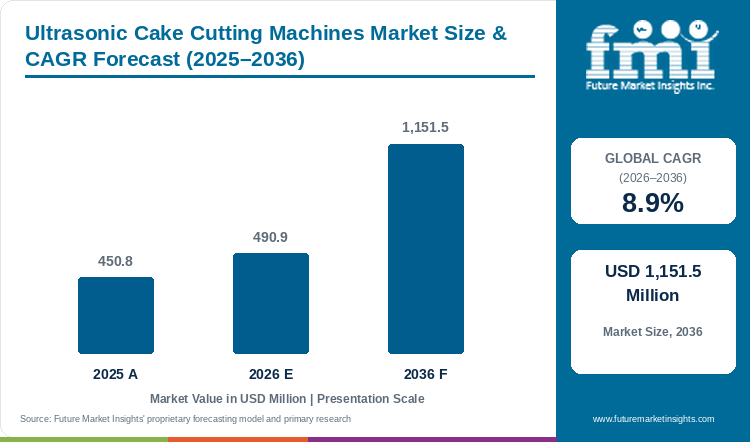
The market was valued at USD 450.8 million in 2025 and is expected to reach USD 490.9 million in 2026. It is projected to reach USD 1,151.5 million by 2036 at a CAGR of 8.9% from 2026 to 2036.
The ultrasonic cake cutting machines market was valued at USD 450.8 million in 2025 and is anticipated to reach USD 490.9 million in 2026, before growing to USD 1,151.5 million by 2036 at an 8.9% CAGR over 2026 to 2036. Mid-capacity lines account for 43.0% of Equipment Type in 2026, while 500-2,000 kg/hr accounts for 42.0% of Capacity and Fully automatic / robotic systems account for 45.0% of Automation Level. Buyers balance cleaner cuts and consistent portions against integration cost, product qualification, and sanitation requirements. Ultrasonically vibrating blades address a specific production defect: compressed sponge layers, displaced fillings, and dragged icing during portioning. Gorreri’s published dual-head cutter details servo-controlled cake portioning and blade-cleaning options.[2] Its acquisition by Middleby in November 2024 also places this application inside a wider commercial bakery-equipment portfolio.[1] Industrial bakeries will fund equipment when controlled trials demonstrate fewer rejected portions and dependable downstream pack alignment.
Key Market Trends & Insights
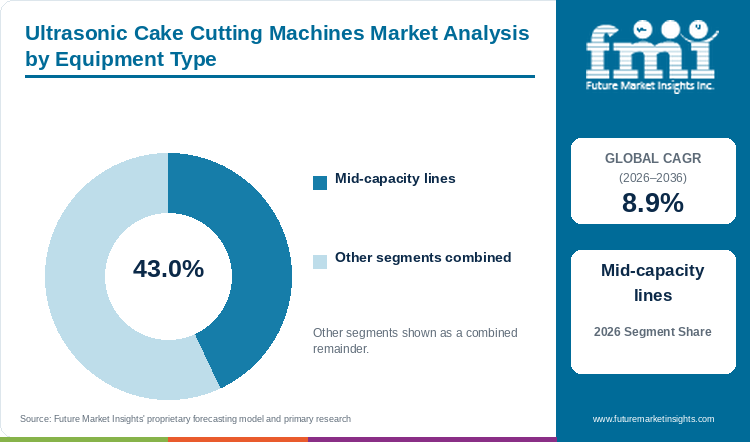
- By Equipment Type: Mid-capacity lines hold 43.0% of Equipment Type in 2026 because they fit multi-product bakeries needing output without a complete high-capacity line redesign.
- By Capacity: 500-2,000 kg/hr leads Capacity at 42.0% in 2026, reflecting the operating band where cut consistency and conveyor synchronization must improve together.
- By Automation Level: Fully automatic / robotic leads Automation Level with 45.0% in 2026 as repeatable cutting patterns support standardized portions and handoff to packaging.
Regional Highlights
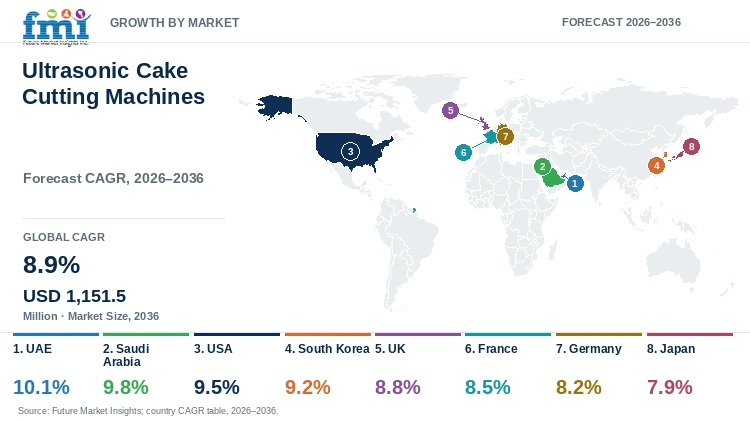
- The UAE's 10.1% projected CAGR leads the country forecasts for ultrasonic cake cutting machines, where cleaner portions and alignment with packaging can support equipment investment.
- Saudi Arabia follows at 9.8% and the USA at 9.5%; Japan's 7.9% rate is the lowest of the eight profiles over the 2026 to 2036 period.
Market Size & Forecast
Table 1: Ultrasonic Cake Cutting Machines Market Size and Forecast (USD million), 2025 to 2036
| Market size and forecast | Value |
|---|---|
| 2025 Value (actual) | USD 450.8 million |
| Estimated market size in 2026 | USD 490.9 million |
| Projected market size by 2036 | USD 1,151.5 million |
| CAGR (2026-2036) | 8.9% |
Country purchasing conditions diverge. The UAE and Saudi Arabia have food-manufacturing policy and licensing signals that support equipment-evaluation pipelines, but neither provides a direct count of ultrasonic cake cutters. Japan’s agriculture ministry has published hygienic guidance for food-factory robots, raising the importance of cleanability and operational documentation.[27] European sites operate under food-hygiene obligations that place similar scrutiny on contact surfaces.[19] Across markets, capital approval still depends on documented cake-type trials and verifiable line throughput. Maintenance access and local technical support also determine the acceptance decision.
The market is segmented by Equipment Type, Capacity, Automation Level, End User, Sales Channel, and Region, with a global forecast from 2026 to 2036.
Profiled companies are AMF Bakery Systems, Buhler Group, Baker Perkins, Rademaker, FRITSCH Group, Rheon Automatic Machinery, Mecatherm, Middleby, Reading Bakery Systems, Kaak Group. Their documented involvement spans cake-capable cutting platforms, broader bakery-line integration, and adjacent baked-goods systems.
Table 2: Supporting Industry Indicators for the Ultrasonic Cake Cutting Machines Market
| Indicator | Data point | Why it matters | Source |
|---|---|---|---|
| Cake-equipment acquisition | In November 2024, Middleby acquired Italy-based Gorreri.[1] | The acquisition specifically included cake-processing equipment and ultrasonic portioning technology. Ownership connects a directly documented cake-cutting capability to a wider bakery processing portfolio, although integration outcomes and sales volumes were not disclosed. | [1] |
| Pastry-line design | In May 2025, FRITSCH Group introduced its PROGRESSA pastry line for retail bakers, emphasizing hygienic design and efficient product changes.[8] | The system concerns pastry processing rather than a disclosed ultrasonic cake cutter. It nevertheless illustrates the line-cleaning and format-flexibility criteria against which portioning equipment is compared. | [8] |
| Digital line support | In May 2025, Mecatherm introduced its MyMecatherm digital platform for monitoring and supporting industrial bakery operations.[9] | This was a production-line service development, not an ultrasonic cutting launch. Connected equipment insight can lower operational uncertainty when manufacturers evaluate integrating a new cake-portioning station. | [9] |
Demand Intensity Analysis
Portion uniformity is the purchase trigger: ultrasonic blades must protect layered cakes and reduce handling losses without compromising hygienic operating routines.
Buyers face qualification costs from variable cake temperatures and fillings. Changeover hygiene, sonotrode maintenance, and service readiness further complicate approval.
The increase from USD 490.9 million in 2026 to USD 1,151.5 million in 2036 represents USD 660.6 million in additional market revenue over the forecast period.
Table 3: Demand Intensity Metrics for the Ultrasonic Cake Cutting Machines Market, 2026 to 2036
| Demand intensity metric | Value | Basis |
|---|---|---|
| Ultrasonic Cake Cutting Machines Market value CAGR | 8.9% | Global market value growth, 2026 to 2036 |
| Mid-capacity lines share in 2026 | 43.0% | Equipment Type classification |
| 500-2,000 kg/hr share in 2026 | 42.0% | Capacity classification |
| Fully automatic / robotic share in 2026 | 45.0% | Automation Level classification |
| Added revenue through 2036 | USD 660.6 million | Increase in market revenue from 2026 to 2036 |
Analyst Perspective
Revenue conversion depends less on blade-frequency claims than on live trials that measure portion appearance and material giveaway. Cleaning time and uptime at the intended line speed also determine payback. A system must pass that combined acceptance test before a bakery can defend the capital expenditure.
- Nandini Roy Choudhury, Principal Consultant, FMI
How is the ultrasonic cake cutting machines market segmented?
Equipment Type, Capacity, Automation Level, End User, and Sales Channel are the five analytical segmentation axes.
Equipment Type includes Mid-capacity lines, Compact / entry systems, and High-capacity industrial lines. Capacity covers 500-2,000 kg/hr, Below 500 kg/hr, and Above 2,000 kg/hr. Automation Level consists of Fully automatic / robotic, Semi-automatic, and Manual. End User includes Industrial bakeries, In-store & retail bakeries, Artisan bakeries, and Foodservice / QSR central kitchens. Sales Channel is divided into Direct OEM sales, Dealers & distributors, and Aftermarket & refurbished.
Why do Mid-capacity lines anchor equipment purchases?
Mid-capacity equipment offers a compromise between stand-alone portioning cells and engineered high-volume lines. Production managers can allocate a cutter to several cake formats while keeping common upstream cooling and downstream packing assets. This is particularly relevant when orders shift among round cakes, slabs, and filled products. Installation space and accessible washdown zones often matter as much as peak cutting speed.
- Mid-capacity lines represent 43.0% of Equipment Type in 2026; flexible batch changeovers underpin their position.
- In November 2024, Middleby acquired Gorreri, whose cake-cutting range includes configurable dual-head ultrasonic equipment.[1] The offering gives bakeries a specified option to test against their required portion size, filling and line speed.
What makes 500-2,000 kg/hr the principal capacity band?
Capacity selection begins with chilled product weight and the speed at which a cake can be presented squarely to the cutter. Continuous feed helps sustain throughput only if indexing and portion removal remain reliable. A kg/hr designation cannot be inferred directly from a supplier’s pieces-per-hour claim because cake mass and cut geometry differ. Midrange installations therefore require trials using the buyer’s own recipes and packaging specifications.
- 500-2,000 kg/hr accounts for 42.0% of Capacity in 2026; the band aligns throughput improvement with manageable integration risk.
- In November 2024, Cheersonic documented a cake-specific ultrasonic cutting configuration with programmable cutting patterns. Supplier examples illustrate flexibility but cannot establish a universal kg/hr rate.
Why does Fully automatic / robotic lead automation planning?
Automatic loading and servo-controlled cutting paths reduce the frequency with which operators reposition soft cakes by hand. They also permit documented recipes for changing portion counts. The benefit depends on reliable sensors and consistent cake orientation rather than robotics alone. Factories must validate blade guards and interlocks. Cleaning access and repeatability across chilled and freshly produced formats matter equally.
- Fully automatic / robotic represents 45.0% of Automation Level in 2026, supported by recipe repeatability and pack-line handoff.
- FoodTools describes robotic ultrasonic cutting with programmable cake presentation and motion. This establishes an available technical architecture, not a verified market-wide automation rate.
How do Industrial bakeries shape end-user demand?
Industrial bakeries are most exposed to cumulative giveaway and packaging errors across repeated shifts. A small deviation in portion width can produce rework or costly overweight servings at scale. Engineering and food-safety teams jointly specify blade access, tooling change, and wet-cleaning procedures. Retail and artisan sites still value neat cuts but generally buy around smaller footprints and less continuous throughput.
- Industrial bakeries hold 43.0% of End User in 2026 because long runs make portion accuracy and equipment uptime economically material.
- In June 2025, AMF Bakery Systems and Puratos opened a pilot bakery for process trials in New Jersey. Such environments illustrate the importance of industrial qualification, not a cake-cutter sales share.
Why does Direct OEM sales secure the main purchasing channel?
An ultrasonic cutter needs more than a sales quotation. The buyer must establish product handling geometry and sonotrode selection. Conveyor controls and safety interfaces also require acceptance criteria with clear installation responsibilities. Direct OEM engagement concentrates those obligations with the specialist equipment team. Dealers retain a role in smaller projects and local commissioning, while refurbished systems require particular scrutiny of blade history and control-system compatibility.
- Direct OEM sales account for 58.0% of Sales Channel in 2026 because application tests and line interfaces favor direct specification and commissioning.
- Bühler documents factory installation and retrofit of ultrasonic knives for its transversal cutter.[3] That specification illustrates why OEM engineering support matters during initial supply and later upgrades.
What are the drivers, restraints and opportunities in the ultrasonic cake cutting machines market?
Demand for neat, repeatable cake portions drives machinery investment, while qualification and washdown burdens restrict orders, and modular automation creates a retrofit opportunity.
- Driver: Industrial bakers seek lower giveaway and cleaner slices across chilled layered cakes and multi-shift packing lines.
- Restraint: Plant acceptance tests must address food-contact hygiene and product variability. Downtime risk, safety, and ultrasonic maintenance also matter.
- Opportunity: Retrofit-ready cutting heads and well-supported robotic cells can serve lines where full replacement is uneconomic.
The driver is a measurable production loss rather than automation for its own sake. Cream-filled and laminated cakes can deform under conventional blades, leaving inconsistent edges and uneven portion weights. Gorreri publishes ultrasonic cake-cutting machinery designed for configurable cutting arrangements; Bühler identifies cake applications and optional ultrasonic knives on a transversal cutter.[3] These product disclosures demonstrate that suppliers are engineering around sticky textures and recipe variability. A bakery will move from demonstration to purchase when test-batch yield, cutting cycle time, and packaging acceptance meet its financial threshold. The reported market forecast reflects expenditure on the equipment rather than increased cake sales.
The restraint arises during technical and sanitation sign-off. In the United States, FDA current good manufacturing practice rules govern food processing equipment and hygienic operations.[18] Regulation (EC) No 852/2004 imposes hygiene obligations in European facilities. An ultrasonic blade can improve contact behavior yet still need verified cleaning of holders and guides. Guarding and drive housings require their own hygiene assessment. Different temperatures and inclusions may require recipe-specific tuning. Procurement teams consequently ask for food-contact documentation and confirmed service intervals. Spare sonotrodes and demonstrable clean-down time support acceptance. These requirements lengthen engineering review and can postpone installation even where operators like the cut appearance.
The opportunity is targeted integration into established cooling-to-packaging flows. Bühler explicitly states that ultrasonic knives can be specified on new transversal cutters or added later.[3] This makes the retrofit decision different from a complete bakery replacement. Suppliers capable of defined interfaces and supported commissioning can propose modular cells for selected cake formats. The route to revenue requires more than a retrofit brochure. End users must demonstrate blade compatibility and safe access. Stable product indexing and replacement-part availability also matter. The broad-based shift toward smart food-factory operations in South Korea and digital line support described by Mecatherm indicates complementary infrastructure, not guaranteed uptake of cake cutters.
Which country CAGRs are profiled in the ultrasonic cake cutting machines market?
The following country CAGRs apply to the 2026 to 2036 forecast period.
Table 4: Country growth outlook for the Ultrasonic Cake Cutting Machines Market
| Country | CAGR |
|---|---|
| UAE | 10.1% |
| Saudi Arabia | 9.8% |
| USA | 9.5% |
| South Korea | 9.2% |
| UK | 8.8% |
| France | 8.5% |
| Germany | 8.2% |
| Japan | 7.9% |
How do country-level CAGRs compare in the ultrasonic cake cutting machines market?
Projected growth rates span 7.9% to 10.1%, a 2.2 percentage-point spread between Japan and the UAE. The UAE and Saudi Arabia form the highest-growth pair; the USA and South Korea are also above the global 8.9% rate. The UK, France, Germany, and Japan are below that global rate. These rankings describe percentage growth, not the absolute size of country markets or the number of installed machines.
- UAE: Food-manufacturing investment policy may support automated cake-processing specifications, subject to buyer-level budget approvals.
- Saudi Arabia: A growing licensed food-factory base raises the importance of commissioning and dependable local service.
- USA: Industrial food-safety practices and mixed cake formats sharpen the case for validated robotic portioning.
- South Korea: Smart-food-factory initiatives encourage automation trials but do not establish cake-machine installations.
- UK: HACCP procedures and central production kitchens place documented cleaning and traceability at the center of evaluations.
- France: Distinct artisan and industrial bakery structures create demand for differently sized portioning cells.
- Germany: Bakery consolidation can strengthen utilization economics while raising investment scrutiny.
- Japan: Food-factory robot hygiene guidance shapes technical qualification for compact automated installations.
All eight country profiles are directional operating analyses. Public industry or policy indicators clarify adoption conditions but are not counts of ultrasonic cake-cutting machines.
Country-wise Analysis
UAE
The UAE records a 10.1% CAGR from 2026 to 2036, the highest among the profiled countries. The government’s National Food Security Strategy 2051 identifies food-production capabilities as a policy priority. The Ministry of Industry and Advanced Technology also highlighted new industrial projects at its May 2025 manufacturing initiative, including food-related sectors. These are broad industrial signals rather than direct cutter orders. Central bakeries supplying foodservice and retail channels can evaluate automated portioning where chilled distribution requires consistent presentation. OEMs still need to show hygienic integration, spare-part access, and a service response model suited to local production schedules.
Saudi Arabia
Saudi Arabia’s ultrasonic cake cutting machines market has a 9.8% CAGR for 2026 to 2036. In January 2026, the Saudi Food and Drug Authority reported growth in licensed food factories and warehouses during 2025. This expands the observable food-processing base without establishing cake-specific machine demand. Buyers supplying high-throughput retail and hospitality accounts can favor consistent portion weights and repeatable sanitation protocols. Imported equipment must also be supported with installation engineering and replacement ultrasonic components. A procurement case becomes credible when local service partners can sustain performance after the acceptance trial.
USA
A 9.5% CAGR from 2026 to 2036 places the USA above the global forecast rate. The U.S. Census Bureau separately classifies commercial bakery production and frozen cakes and pastries, illustrating the range of industrial processes that a supplier must address. FDA manufacturing rules also make food-contact cleaning and protective design part of machine qualification.[18] U.S. facilities evaluating robotic ultrasonic cells will focus on cake mass variation and offcut disposal. Guarding and downstream packaging speed must also be validated. Available FoodTools robotic systems show an addressable technical approach. Yet product-specific trials remain essential because headline cake-per-hour rates cannot prove the buyer’s target capacity in kg/hr.
South Korea
South Korea is assigned a 9.2% CAGR for 2026 to 2036. Its Ministry of Agriculture, Food and Rural Affairs outlined smart-food-factory support in its February 2025 policy planning and a food-technology development roadmap in July 2026. Those measures concern food manufacturing more widely, not a published ultrasonic cake-cutter installed base. In centrally supplied confectionery and dessert operations, shorter product runs could favor programmable portion recipes and automated transfer. Suppliers must still prove integration with local packing systems, operator training, and repeatable sanitation cycles before an automation pilot becomes a purchase.
UK
The UK market carries an 8.8% CAGR from 2026 to 2036. Food-safety guidance on managing hazards makes documented process controls relevant to any new food-contact machine. For bakeries producing chilled cakes for retailers or foodservice, the selling point is repeatable slicing without compromising ingredient segregation and changeover procedures. Buyers are likely to test several icings and inclusions rather than rely on a demonstration using a single plain sponge. Good outcomes depend on access for washing and blade inspection as well as portion accuracy. Distributor support can ease smaller deployments, but responsibility for acceptance testing remains a key contracting issue.
France
France is projected at an 8.5% CAGR between 2026 and 2036. INSEE separates industrial production of bread and fresh pastry from more artisanal activities in its published business classifications. That distinction matters because an industrial producer buys around continuous conveyor integration, whereas a neighborhood pâtisserie may prefer a compact or manually attended unit. Suppliers should adapt cutting fixtures to decorated layer cakes and variable portion geometry. Equipment that changes recipes quickly may be attractive even without maximum hourly speed. A purchaser nevertheless needs evidence of hygienic blade cleaning and acceptable appearance across its own assortment.
Germany
Germany’s 8.2% CAGR from 2026 to 2036 reflects a more measured rate than the Middle Eastern profiles. In April 2025, the German Bakers Confederation reported that bakery enterprise numbers fell during 2024 while the craft sector continued to operate at substantial scale. Fewer establishments do not by themselves determine machine spending, but they focus attention on utilization and capital productivity. EU food-hygiene requirements add a technical test for blade sanitation and reachable cleaning points. For bakeries running both pastry and cake formats, retrofit compatibility and predictable changeover time are more persuasive than a new stand-alone cutting claim.
Japan
Japan registers a 7.9% CAGR over 2026 to 2036. In April 2024, the Ministry of Agriculture, Forestry and Fisheries publicized hygiene guidance for robots used in food factories. That guidance highlights why automation proposals must show accessible food-contact zones and practical cleaning procedures alongside throughput. Japan’s bakery processors may value a smaller enclosed footprint where staffing patterns and plant layout constrain full-line changes. An ultrasonic cutter must still be accepted on local recipes, icing structures, and temperature specifications. The lower projected growth rate is not evidence of a smaller installed base or weaker technical standards.
Who are the notable companies in the ultrasonic cake cutting machines market?
AMF Bakery Systems, Buhler Group, Baker Perkins, Rademaker, FRITSCH Group, Rheon Automatic Machinery, Mecatherm, Middleby, Reading Bakery Systems, Kaak Group are the notable companies profiled in this market.
The profiled company landscape includes a narrow set of documented cake-capable ultrasonic offerings and a broader group of bakery-system integrators. Buhler Group explicitly presents a transversal cutter that can use ultrasonic knives for biscuits and cakes.[3] Middleby added Gorreri’s ultrasonic cake portioning through an acquisition, while Rheon Automatic Machinery documents ultrasonics for soft dough rather than a verified finished-cake cutter. Reading Bakery Systems also publishes an ultrasonic guillotine for soft or filled baked goods, without a named finished-cake application. AMF Bakery Systems, Rademaker, FRITSCH Group, Mecatherm, and Kaak Group contribute wider bakery-line integration knowledge. Baker Perkins is evidenced primarily in biscuit processing. These are capability-based distinctions, not statements of equivalent direct ultrasonic cake-cutter supply.
- Ultrasonic and precision-cutting platforms: Buhler Group, Middleby, Rheon Automatic Machinery, and Reading Bakery Systems; the latter two have documented ultrasonic cutters but lack explicit finished-cake application evidence.
- Integrated bakery and pastry-line platforms: AMF Bakery Systems, Rademaker, FRITSCH Group, Mecatherm, and Kaak Group; line roles do not by themselves establish ultrasonic cake-machine catalogs.
- Adjacent baked-goods systems: Baker Perkins; its documented biscuit and cookie machinery is not evidence of an ultrasonic cake-cutter offering.
Competitive Benchmarking: Ultrasonic Cake Cutting Machines Market
Table 5: Company capabilities for the Ultrasonic Cake Cutting Machines Market
| Company | Ultrasonic Cake-Cutting Evidence | Bakery-Line Integration | Hygiene & Service Documentation | Geographic Reach |
|---|---|---|---|---|
| AMF Bakery Systems | Unscored | High | High | Americas and international bakery markets |
| Buhler Group | High | High | High | International; documented cake and bar applications |
| Baker Perkins | Unscored | Medium | Medium | UK and USA; further cutter reach unverified |
| Rademaker | Unscored | High | Medium | Europe, North America, and Asia |
| FRITSCH Group | Unscored | High | High | Germany, North America, and international users |
| Rheon Automatic Machinery | Medium | Medium | Medium | Japan and Europe; finished-cake reach unverified |
| Mecatherm | Unscored | High | High | France-based; international bakery projects |
| Middleby | High | High | High | USA and Italy; international commercial activity |
| Reading Bakery Systems | Medium | Medium | High | USA; service in Europe, Asia, Latin America |
| Kaak Group | Unscored | High | Unscored | Netherlands; international bakery projects |
Scoring basis: Ultrasonic Cake-Cutting Evidence assesses documented product applicability, with High reserved for cake-capable ultrasonic specifications and Medium for adjacent ultrasonic cutting only. Bakery-Line Integration measures documented upstream, downstream, or complete bakery-line capabilities. Hygiene & Service Documentation measures published sanitary design and maintenance provisions. Controls and customer-support practices are also assessed. High denotes broad or directly detailed evidence; Medium denotes narrower evidence. Low indicates a documented limitation rather than missing information; unavailable public information is marked Unscored. Ratings do not measure sales or market share.
Key Developments in the Ultrasonic Cake Cutting Machines Market
- In November 2024, Middleby acquired Italy-based Gorreri.[1] The acquisition specifically included cake-processing equipment and ultrasonic portioning technology. Ownership connects a directly documented cake-cutting capability to a wider bakery processing portfolio, although integration outcomes and sales volumes were not disclosed.
- In May 2025, FRITSCH Group introduced its PROGRESSA pastry line for retail bakers, emphasizing hygienic design and efficient product changes.[8] The system concerns pastry processing rather than a disclosed ultrasonic cake cutter. It nevertheless illustrates the line-cleaning and format-flexibility criteria against which portioning equipment is compared.
- In May 2025, Mecatherm introduced its MyMecatherm digital platform for monitoring and supporting industrial bakery operations.[9] This was a production-line service development, not an ultrasonic cutting launch. Connected equipment insight can lower operational uncertainty when manufacturers evaluate integrating a new cake-portioning station.
Key Players in the Ultrasonic Cake Cutting Machines Market
Ultrasonic and Precision-Cutting Platforms
- Buhler Group
- Middleby
- Rheon Automatic Machinery
- Reading Bakery Systems
Integrated Bakery and Pastry-Line Platforms
- AMF Bakery Systems
- Rademaker
- FRITSCH Group
- Mecatherm
- Kaak Group
Adjacent Baked-Goods Systems
- Baker Perkins
Ultrasonic Cake Cutting Machines Market - Report Scope
Table 6: Report scope for the Ultrasonic Cake Cutting Machines Market
| Coverage field | Report scope |
|---|---|
| Market breakdown | Equipment Type; Capacity; Automation Level; End User; Sales Channel |
| Quantitative Units | USD million |
| Market Definition | Revenue from complete ultrasonic cake-cutting machines, compatible integrated cake-portioning systems, and attributable cake-cutting modules sold within the listed segments. Qualifying refurbished machines are included under Sales Channel; downstream cake sales, unrelated bakery lines, conventional non-ultrasonic cutters, and stand-alone routine service or spare-part revenues are excluded. |
| Regions Covered | North America; Latin America; Western Europe; Eastern Europe; East Asia; South Asia and Pacific; Middle East and Africa |
| Countries Covered | UAE, Saudi Arabia, USA, South Korea, UK, France, Germany, Japan |
| Key Companies Profiled | AMF Bakery Systems, Buhler Group, Baker Perkins, Rademaker, FRITSCH Group, Rheon Automatic Machinery, Mecatherm, Middleby, Reading Bakery Systems, Kaak Group |
| Forecast Period | 2026 to 2036 |
| Approach | Primary and secondary research with market triangulation. |
Ultrasonic Cake Cutting Machines Market - Research Methodology
Table 7: Research approach for the Ultrasonic Cake Cutting Machines Market
| Method | Approach |
|---|---|
| Primary Research | FMI analysts gathered input from manufacturers, service providers, technology developers, distributors, end users, procurement teams and subject-matter experts. Interviews examined purchasing decisions, product or service evaluation, adoption barriers, approval requirements, pricing considerations and expectations for technical or commercial support. Respondents were also asked what evidence is required before a trial, pilot, or initial order develops into regular purchasing. |
| Desk Research | Desk research covered government statistics, regulatory publications, trade data, industry associations, technical literature, standards, company filings, product information and official corporate announcements. Sources were reviewed for relevance, publication date, geographic coverage and consistency with the defined market scope. Claims relating to performance, applications, approvals, capacity, investment and commercial activity were retained only when supported by credible public evidence. |
| Market Sizing and Forecasting | The market model combined the baseline value with historical performance, segment structure, pricing and volume indicators, adoption levels, company participation and country-level demand conditions. Forecast assumptions considered economic activity, investment trends, regulatory developments, technology adoption, purchasing cycles, supply availability and barriers to wider market use. Segment and regional estimates were reconciled before the final market total was calculated. |
| Data Validation | Estimates were checked against multiple independent indicators, including public data, company activity, trade patterns, industry developments and findings from primary interviews. Validation also tested whether products, services, applications and company revenues fell within the defined market boundaries. Adjacent categories, unsupported claims, overlapping revenues and activities without direct market relevance were excluded to reduce double counting and maintain consistency across segments and countries. |
Ultrasonic Cake Cutting Machines Market by Segments
Equipment Type
- Mid-capacity lines
- Compact / entry systems
- High-capacity industrial lines
Capacity
- 500-2,000 kg/hr
- Below 500 kg/hr
- Above 2,000 kg/hr
Automation Level
- Fully automatic / robotic
- Semi-automatic
- Manual
End User
- Industrial bakeries
- In-store & retail bakeries
- Artisan bakeries
- Foodservice / QSR central kitchens
Sales Channel
- Direct OEM sales
- Dealers & distributors
- Aftermarket & refurbished
Ultrasonic Cake Cutting Machines Market by Region
- North America
- United States
- Canada
- Latin America
- Brazil
- Mexico
- Argentina
- Chile
- Western Europe
- Germany
- France
- United Kingdom
- Italy
- Spain
- Benelux
- Nordics
- Eastern Europe
- Poland
- Czech Republic
- Romania
- Hungary
- East Asia
- China
- Japan
- South Korea
- South Asia and Pacific
- India
- ASEAN
- Australia and New Zealand
- Middle East and Africa
- GCC Countries
- South Africa
- Türkiye
- Israel
Research Sources and Bibliography
- [1] Middleby (2024, November 26). Middleby Acquires Gorreri Food Processing Technology.
- [2] Gorreri (n.d.). CUTTERSONIC GCS-SA Double-Head Ultrasonic Cutting Machine.
- [3] Bühler Group (n.d.). Transversal Cutting Machine.
- [4] Rheon Europe (n.d.). Ultra Sonic Guillotine Cutter.
- [5] Reading Bakery Systems (n.d.). Ultrasonic Guillotine Cutter: Clean Cutting of Sticky or Fragile Products.
- [6] FoodTools (n.d.). RPS-100C Robotic Ultrasonic Cutting System.
- [7] Cheersonic (2024, November 8). Cutting Round and Sheet Cake.
- [8] FRITSCH Group (2025, May 13). PROGRESSA pastry: New Pastry Line for Retail Bakers.
- [9] Mecatherm (2025, May 18). MECATHERM Facilitates Production Line Operations with MyMecatherm Digital Platform.
- [10] AMF Bakery Systems (2025, June 9). AMF and Puratos Launch Joint Pilot Bakery Facility.
- [11] Middleby (2025, August 13). Middleby Acquires Oka-Spezialmaschinenfabrik GmbH & Co. KG.
- [12] Reading Bakery Systems (2025, August 1). RBS Expands Customer Care Team to Strengthen Global Support.
- [13] Reading Bakery Systems (2025, May 14). Visit RBS at iba 2025 to Discover the Future of Baking.
- [14] Bühler Group (2025, May 7). Bühler Introduces OptiBake, Raising the Bar in Wafer Production.
- [15] Rebecca Spayne / International Bakery (2025, July 14). Who’s Who: Rademaker.
- [16] Baker Perkins (n.d.). TruClean Series3 Rotary Moulder.
- [17] Rademaker (n.d.). Radini Bakery Solutions.
- [18] U.S. Food and Drug Administration (n.d.). Current Good Manufacturing Practices for Food and Dietary Supplements.
- [19] European Parliament and Council (2004, April 29). Regulation (EC) No 852/2004 on the Hygiene of Foodstuffs.
- [20] U.S. Census Bureau (n.d.). North American Industry Classification System (NAICS), 2022.
- [21] German Bakers Confederation (2025, April 14). Bäckerhandwerk beweist Resilienz: Betriebsrückgang und stabile Neugründungen.
- [22] INSEE (2024, March 11). Fiche secteur 1071A: Fabrication industrielle de pain et de pâtisserie fraîche.
- [23] UK Food Standards Agency (n.d.). Managing Food Safety.
- [24] Saudi Food and Drug Authority (2026, January 26). SFDA Reports 18% Growth in Licensed Factories and Warehouses During 2025.
- [25] UAE Government (n.d.). National Food Security Strategy 2051.
- [26] UAE Ministry of Industry and Advanced Technology (2025, May 22). Make it in the Emirates Concludes with New Industrial Projects.
- [27] Japan Ministry of Agriculture, Forestry and Fisheries (2024, April 17). Food Factory Robot Hygienic Guidelines Announcement.
- [28] Republic of Korea Ministry of Agriculture, Food and Rural Affairs (2025, February 14). 2025 Major Policy Plans: Food Industry and Smart Manufacturing.
- [29] Republic of Korea Ministry of Agriculture, Food and Rural Affairs (2026, July 20). Food-Tech Master Plan and Smart Food Factory Expansion.
This Report Answers
- What is the global ultrasonic cake cutting machines market value in 2026 and its outlook for 2036?
- Which operational pressures encourage cake manufacturers to buy ultrasonic portioning equipment?
- Why do Mid-capacity lines lead Equipment Type?
- Why does the 500-2,000 kg/hr capacity band hold the largest position?
- How do projected growth rates differ across the eight profiled countries?
- Which profiled companies document ultrasonic cake-cutting capability and which mainly supply adjacent bakery systems?
- What technical, sanitation, and service requirements can delay procurement or supplier switching?
- What qualification evidence should buyers require before specifying an ultrasonic cutter?
Frequently Asked Questions
How big is the ultrasonic cake cutting machines market in 2026, and what is forecast for 2036?
The market is valued at USD 490.9 million in 2026 and projected at USD 1,151.5 million by 2036. Spending covers qualifying ultrasonic cake-cutting equipment rather than cake products sold by users.
What is the ultrasonic cake cutting machines market CAGR from 2026 to 2036?
The projected CAGR is 8.9% from 2026 to 2036. Growth depends on buyers demonstrating improved portion consistency with acceptable uptime and sanitation costs.
Which Equipment Type segment leads the ultrasonic cake cutting machines market?
Mid-capacity lines lead Equipment Type with a 43.0% share in 2026. Their versatility can be valuable to cake producers serving several product formats.
Which Capacity segment has the leading position?
500-2,000 kg/hr leads Capacity with a 42.0% share in 2026. Buyers need product-specific weight and throughput tests because pieces per hour is not a universal substitute for kg/hr.
Which profiled countries have the highest forecast growth rates?
UAE is highest at a 10.1% CAGR, followed by Saudi Arabia at 9.8%, over 2026 to 2036. These percentage growth rates do not establish which country has the largest equipment market.
Which companies are profiled in the ultrasonic cake cutting machines market?
The companies are AMF Bakery Systems, Buhler Group, Baker Perkins, Rademaker, FRITSCH Group, Rheon Automatic Machinery, Mecatherm, Middleby, Reading Bakery Systems, Kaak Group. Public documentation differs across direct ultrasonic cake-cutting products and related bakery-line systems; the two should not be conflated.
Preview the report firsthand - request a free sample
Get SampleGet the brochure for pricing and purchase details.
Get PDFTable of Content
- Key Takeaways
- Market Size and CAGR
- Top Growth Driver
- Fastest Growing Segment
- Leading Region
- Key Companies
- Emerging Opportunities
- Executive Summary
- Global Market Outlook
- Demand-side Trends
- Supply-side Trends
- Technology Roadmap Analysis
- Analysis and Recommendations
- Analyst Perspective (What is happening? Why now? What should investors know?)
- Key Questions Answered
- How large is the market?
- What is the CAGR?
- What are key trends?
- Which region dominates?
- Who are the leaders?
- Market Overview
- Market Coverage / Taxonomy
- Market Definition / Scope / Limitations
- Research Methodology
- Chapter Orientation
- Analytical Lens and Working Hypotheses
- Market Structure, Signals, and Trend Drivers
- Benchmarking and Cross-market Comparability
- Market Sizing, Forecasting, and Opportunity Mapping
- Research Design and Evidence Framework
- Desk Research Programme (Secondary Evidence)
- Expert Input and Fieldwork (Primary Evidence)
- Tooling, Models, and Reference Databases
- Data Engineering and Model Build
- Quality Assurance and Audit Trail
- Market Background
- Market Dynamics (Drivers, Restraints, Opportunity, Trends)
- Scenario Forecast (Optimistic, Likely, Conservative)
- Impact Analysis
- AI Impact
- Sustainability Impact
- Regulatory Impact
- Technology Impact
- Consumer / Buyer Analysis
- Purchase Drivers
- Adoption Barriers
- Buyer Journey
- Opportunity Map Analysis
- Product Life Cycle Analysis
- Supply Chain Analysis
- Investment Feasibility Matrix
- Value Chain Analysis
- PESTLE and Porter's Analysis
- Regulatory Landscape
- Regional Parent Market Outlook
- Production and Consumption Statistics
- Import and Export Statistics
- Global Market Analysis and Forecast, 2021 to 2036
- Historical Market Size Value (USD Million) Analysis, 2021 to 2025
- Current and Future Market Size Value (USD Million) Projections, 2026 to 2036
- Y-o-Y Growth Trend Analysis
- Absolute $ Opportunity Analysis
- Global Market Pricing Analysis, 2021 to 2036
- Global Market Analysis and Forecast, By Equipment Type, 2021 to 2036
- Introduction / Key Findings
- Historical Market Size Value (USD Million) Analysis By Equipment Type, 2021 to 2025
- Current and Future Market Size Value (USD Million) Analysis and Forecast By Equipment Type, 2026 to 2036
- Mid-capacity lines
- Compact / entry systems
- High-capacity industrial lines
- Y-o-Y Growth Trend Analysis By Equipment Type, 2021 to 2025
- Absolute $ Opportunity Analysis By Equipment Type, 2026 to 2036
- Global Market Analysis and Forecast, By Capacity, 2021 to 2036
- Introduction / Key Findings
- Historical Market Size Value (USD Million) Analysis By Capacity, 2021 to 2025
- Current and Future Market Size Value (USD Million) Analysis and Forecast By Capacity, 2026 to 2036
- 500-2,000 kg/hr
- Below 500 kg/hr
- Above 2,000 kg/hr
- Y-o-Y Growth Trend Analysis By Capacity, 2021 to 2025
- Absolute $ Opportunity Analysis By Capacity, 2026 to 2036
- Global Market Analysis and Forecast, By Automation Level, 2021 to 2036
- Introduction / Key Findings
- Historical Market Size Value (USD Million) Analysis By Automation Level, 2021 to 2025
- Current and Future Market Size Value (USD Million) Analysis and Forecast By Automation Level, 2026 to 2036
- Fully automatic / robotic
- Semi-automatic
- Manual
- Y-o-Y Growth Trend Analysis By Automation Level, 2021 to 2025
- Absolute $ Opportunity Analysis By Automation Level, 2026 to 2036
- Global Market Analysis and Forecast, By End User, 2021 to 2036
- Introduction / Key Findings
- Historical Market Size Value (USD Million) Analysis By End User, 2021 to 2025
- Current and Future Market Size Value (USD Million) Analysis and Forecast By End User, 2026 to 2036
- Industrial bakeries
- In-store & retail bakeries
- Artisan bakeries
- Foodservice / QSR central kitchens
- Y-o-Y Growth Trend Analysis By End User, 2021 to 2025
- Absolute $ Opportunity Analysis By End User, 2026 to 2036
- Global Market Analysis and Forecast, By Sales Channel, 2021 to 2036
- Introduction / Key Findings
- Historical Market Size Value (USD Million) Analysis By Sales Channel, 2021 to 2025
- Current and Future Market Size Value (USD Million) Analysis and Forecast By Sales Channel, 2026 to 2036
- Direct OEM sales
- Dealers & distributors
- Aftermarket & refurbished
- Y-o-Y Growth Trend Analysis By Sales Channel, 2021 to 2025
- Absolute $ Opportunity Analysis By Sales Channel, 2026 to 2036
- Global Market Analysis and Forecast, By Region, 2021 to 2036
- Introduction
- Historical Market Size Value (USD Million) Analysis By Region, 2021 to 2025
- Current Market Size Value (USD Million) Analysis and Forecast By Region, 2026 to 2036
- North America
- Latin America
- Western Europe
- Eastern Europe
- East Asia
- South Asia and Pacific
- Middle East and Africa
- Market Attractiveness Analysis By Region
- North America Market Analysis and Forecast, By Country, 2021 to 2036
- Historical Market Size Value (USD Million) Trend Analysis By Market Taxonomy, 2021 to 2025
- Market Size Value (USD Million) Forecast By Market Taxonomy, 2026 to 2036
- By Country
- United States
- Canada
- By Equipment Type
- By Capacity
- By Automation Level
- By End User
- By Sales Channel
- By Country
- Market Attractiveness Analysis
- By Country
- By Equipment Type
- By Capacity
- By Automation Level
- By End User
- By Sales Channel
- Key Takeaways
- Latin America Market Analysis and Forecast, By Country
- Historical Market Size Value (USD Million) Trend Analysis By Market Taxonomy, 2021 to 2025
- Market Size Value (USD Million) Forecast By Market Taxonomy, 2026 to 2036
- By Country
- Brazil
- Mexico
- Argentina
- Chile
- By Equipment Type
- By Capacity
- By Automation Level
- By End User
- By Sales Channel
- By Country
- Market Attractiveness Analysis
- By Country
- By Equipment Type
- By Capacity
- By Automation Level
- By End User
- By Sales Channel
- Key Takeaways
- Western Europe Market Analysis and Forecast, By Country
- Historical Market Size Value (USD Million) Trend Analysis By Market Taxonomy, 2021 to 2025
- Market Size Value (USD Million) Forecast By Market Taxonomy, 2026 to 2036
- By Country
- Germany
- France
- United Kingdom
- Italy
- Spain
- Benelux
- Nordics
- By Equipment Type
- By Capacity
- By Automation Level
- By End User
- By Sales Channel
- By Country
- Market Attractiveness Analysis
- By Country
- By Equipment Type
- By Capacity
- By Automation Level
- By End User
- By Sales Channel
- Key Takeaways
- Eastern Europe Market Analysis and Forecast, By Country
- Historical Market Size Value (USD Million) Trend Analysis By Market Taxonomy, 2021 to 2025
- Market Size Value (USD Million) Forecast By Market Taxonomy, 2026 to 2036
- By Country
- Poland
- Czech Republic
- Romania
- Hungary
- By Equipment Type
- By Capacity
- By Automation Level
- By End User
- By Sales Channel
- By Country
- Market Attractiveness Analysis
- By Country
- By Equipment Type
- By Capacity
- By Automation Level
- By End User
- By Sales Channel
- Key Takeaways
- East Asia Market Analysis and Forecast, By Country
- Historical Market Size Value (USD Million) Trend Analysis By Market Taxonomy, 2021 to 2025
- Market Size Value (USD Million) Forecast By Market Taxonomy, 2026 to 2036
- By Country
- China
- Japan
- South Korea
- By Equipment Type
- By Capacity
- By Automation Level
- By End User
- By Sales Channel
- By Country
- Market Attractiveness Analysis
- By Country
- By Equipment Type
- By Capacity
- By Automation Level
- By End User
- By Sales Channel
- Key Takeaways
- South Asia and Pacific Market Analysis and Forecast, By Country
- Historical Market Size Value (USD Million) Trend Analysis By Market Taxonomy, 2021 to 2025
- Market Size Value (USD Million) Forecast By Market Taxonomy, 2026 to 2036
- By Country
- India
- ASEAN
- Australia and New Zealand
- By Equipment Type
- By Capacity
- By Automation Level
- By End User
- By Sales Channel
- By Country
- Market Attractiveness Analysis
- By Country
- By Equipment Type
- By Capacity
- By Automation Level
- By End User
- By Sales Channel
- Key Takeaways
- Middle East and Africa Market Analysis and Forecast, By Country
- Historical Market Size Value (USD Million) Trend Analysis By Market Taxonomy, 2021 to 2025
- Market Size Value (USD Million) Forecast By Market Taxonomy, 2026 to 2036
- By Country
- GCC Countries
- South Africa
- Türkiye
- Israel
- By Equipment Type
- By Capacity
- By Automation Level
- By End User
- By Sales Channel
- By Country
- Market Attractiveness Analysis
- By Country
- By Equipment Type
- By Capacity
- By Automation Level
- By End User
- By Sales Channel
- Key Takeaways
- Key Countries Market Analysis
- United States
- Pricing Analysis
- Market Share Analysis, 2025
- By Equipment Type
- By Capacity
- By Automation Level
- By End User
- By Sales Channel
- Canada
- Pricing Analysis
- Market Share Analysis, 2025
- By Equipment Type
- By Capacity
- By Automation Level
- By End User
- By Sales Channel
- Mexico
- Pricing Analysis
- Market Share Analysis, 2025
- By Equipment Type
- By Capacity
- By Automation Level
- By End User
- By Sales Channel
- Brazil
- Pricing Analysis
- Market Share Analysis, 2025
- By Equipment Type
- By Capacity
- By Automation Level
- By End User
- By Sales Channel
- Chile
- Pricing Analysis
- Market Share Analysis, 2025
- By Equipment Type
- By Capacity
- By Automation Level
- By End User
- By Sales Channel
- Germany
- Pricing Analysis
- Market Share Analysis, 2025
- By Equipment Type
- By Capacity
- By Automation Level
- By End User
- By Sales Channel
- United Kingdom
- Pricing Analysis
- Market Share Analysis, 2025
- By Equipment Type
- By Capacity
- By Automation Level
- By End User
- By Sales Channel
- Italy
- Pricing Analysis
- Market Share Analysis, 2025
- By Equipment Type
- By Capacity
- By Automation Level
- By End User
- By Sales Channel
- Spain
- Pricing Analysis
- Market Share Analysis, 2025
- By Equipment Type
- By Capacity
- By Automation Level
- By End User
- By Sales Channel
- France
- Pricing Analysis
- Market Share Analysis, 2025
- By Equipment Type
- By Capacity
- By Automation Level
- By End User
- By Sales Channel
- India
- Pricing Analysis
- Market Share Analysis, 2025
- By Equipment Type
- By Capacity
- By Automation Level
- By End User
- By Sales Channel
- ASEAN
- Pricing Analysis
- Market Share Analysis, 2025
- By Equipment Type
- By Capacity
- By Automation Level
- By End User
- By Sales Channel
- Australia and New Zealand
- Pricing Analysis
- Market Share Analysis, 2025
- By Equipment Type
- By Capacity
- By Automation Level
- By End User
- By Sales Channel
- China
- Pricing Analysis
- Market Share Analysis, 2025
- By Equipment Type
- By Capacity
- By Automation Level
- By End User
- By Sales Channel
- Japan
- Pricing Analysis
- Market Share Analysis, 2025
- By Equipment Type
- By Capacity
- By Automation Level
- By End User
- By Sales Channel
- South Korea
- Pricing Analysis
- Market Share Analysis, 2025
- By Equipment Type
- By Capacity
- By Automation Level
- By End User
- By Sales Channel
- Poland
- Pricing Analysis
- Market Share Analysis, 2025
- By Equipment Type
- By Capacity
- By Automation Level
- By End User
- By Sales Channel
- Hungary
- Pricing Analysis
- Market Share Analysis, 2025
- By Equipment Type
- By Capacity
- By Automation Level
- By End User
- By Sales Channel
- Türkiye
- Pricing Analysis
- Market Share Analysis, 2025
- By Equipment Type
- By Capacity
- By Automation Level
- By End User
- By Sales Channel
- South Africa
- Pricing Analysis
- Market Share Analysis, 2025
- By Equipment Type
- By Capacity
- By Automation Level
- By End User
- By Sales Channel
- UAE
- Pricing Analysis
- Market Share Analysis, 2025
- By Equipment Type
- By Capacity
- By Automation Level
- By End User
- By Sales Channel
- Saudi Arabia
- Pricing Analysis
- Market Share Analysis, 2025
- By Equipment Type
- By Capacity
- By Automation Level
- By End User
- By Sales Channel
- United States
- Market Structure Analysis
- Competition Dashboard
- Competition Benchmarking
- Market Share Analysis of Top Players
- By Regional
- By Equipment Type
- By Capacity
- By Automation Level
- By End User
- By Sales Channel
- Emerging Startups
- Innovation Benchmarking
- Competition Analysis
- Competition Deep Dive
- AMF Bakery Systems
- Overview
- Product Portfolio
- Profitability by Market Segments
- Sales Footprint
- Strategy Overview
- Marketing Strategy
- Product Strategy
- Channel Strategy
- Buhler Group
- Baker Perkins
- Rademaker
- FRITSCH Group
- Rheon Automatic Machinery
- Mecatherm
- Middleby
- Reading Bakery Systems
- Kaak Group
- AMF Bakery Systems
- Case Studies
- Success Stories
- Recent Developments
- Competition Deep Dive
- Assumptions & Acronyms Used


